

Effect of Linear Sprints and Change-of-Direction Training Versus Small-Sided Soccer Games on Physical Performance in Highly Trained Young Female Soccer Players: A Randomized Cross-Over Study
 ,
,  ,
,  and
and 
Abstract
- Both LSCD and SSSG training modalities improved physical performance in elite young female soccer players, though the magnitude of improvement varied depending on the specific physical capability assessed.
- LSCD produced higher gains in sprint speed, agility and explosive power, while SSSG was more effective in enhancing aerobic endurance and ball-control agility.
- From a practical standpoint, integrating both training approaches may offer a more comprehensive strategy for developing the diverse physical and technical demands of modern women’s soccer.
1. Introduction
2. Materials and Methods
2.1. Participants
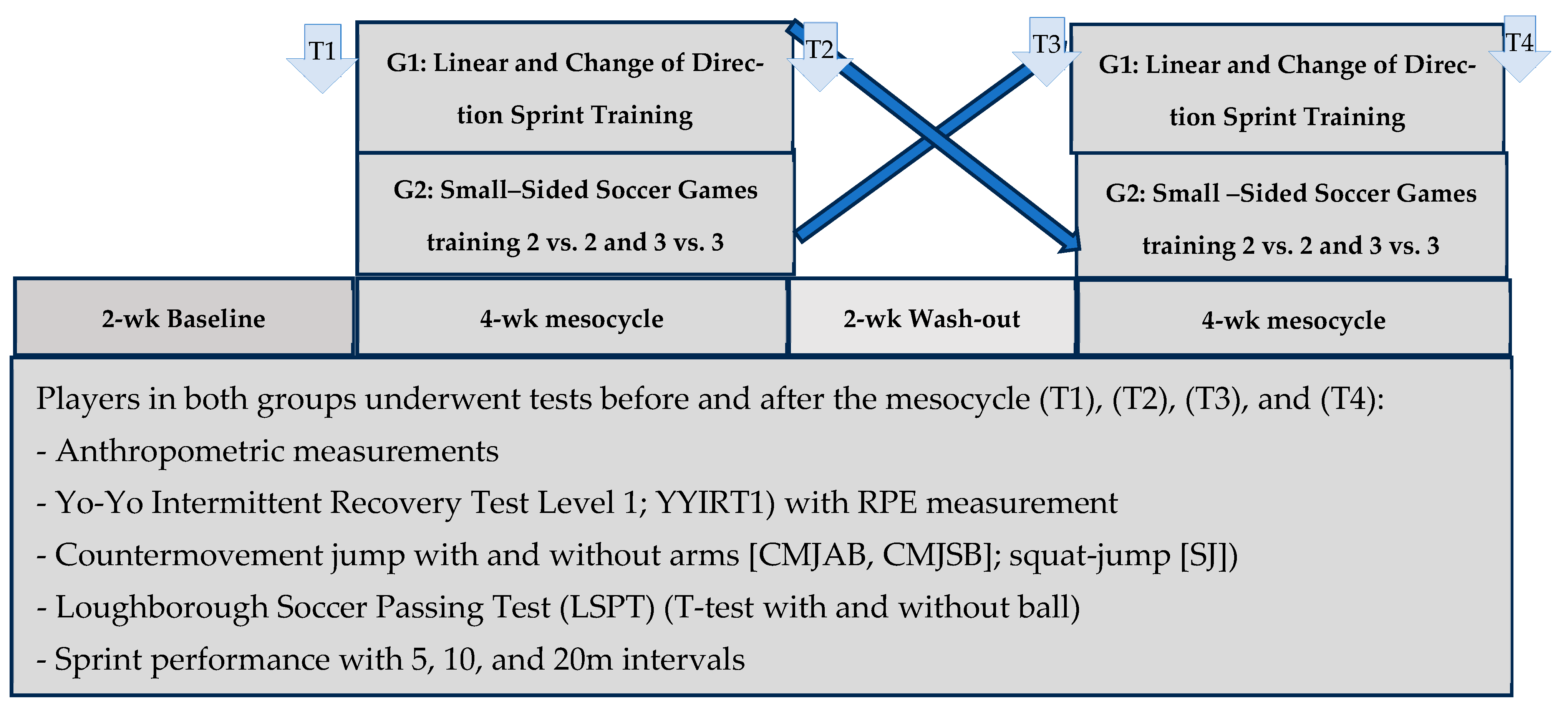
2.2. Experimental Design
2.3. Anthropometric Measurements
2.4. Fitness Variables
2.4.1. Change of Direction Speed (COD) Test
2.4.2. Yo-Yo Intermittent Recovery Test Level 1 (YYIRTL1)
2.4.3. Jumping Performance
2.4.4. Linear Speed Test
2.4.5. Loughborough Soccer Passing Test
2.4.6. Repeated Shuttle Sprint Ability Test (RSSA)
2.4.7. Quantifying Training Load
2.4.8. Estimation of Menstrual Cycle Phases
2.4.9. Training Program
2.4.10. Active Recovery Wash-Out Period
2.5. Statistical Analysis
3. Results
3.1. Descriptive and Baseline Comparisons
3.2. Anthropometric Characteristics
3.3. Fitness Variables
3.4. Phases of the Menstrual Cycle
3.5. Session RPE
4. Discussion
4.1. Anthropometric Characteristics
4.2. Physical Fitness Variables
5. Limitations
6. Conclusions
7. Practical Applications
Author Contributions
Funding
Institutional Review Board Statement
Informed Consent Statement
Data Availability Statement
Acknowledgments
Conflicts of Interest
Abbreviations
| LSCD | Linear sprints and changes of direction |
| SSSG | Small-sided soccer games |
| BMI | Body mass index |
| LSPT | Loughborough soccer passing test |
| RSSA | Repeat shuttle sprint ability test |
| Session-RPE | Session-perceived exertion rate |
| SJ | Squat jump |
| CMJ with A | Countermovement jump, with arms |
| CMJ without A | Countermovement jump, without arms |
| HRJ15 | Height of repeated jumps |
| PRJ15 | Power of repeated jumps |
| t-Test | t-Test without ball and without ball |
| YIRT 1 | Yo-Yo Intermittent Recovery Test Level 1 |
References
- Manson, S.A.; Brughelli, M.; Harris, N.K. Physiological characteristics of international female soccer players. J. Strength Cond. Res. 2014, 28, 308–318. [Google Scholar] [CrossRef] [PubMed]
- FIFA. Women’s Football Strategy: 2023–2027; Fédération Internationale de Football Association: Zurich, Switzerland, 2023. [Google Scholar]
- Williams, J. A Beautiful Game? International Perspectives on Women’s Football; Routledge: Abingdon, UK, 2021. [Google Scholar]
- Valenti, M.; Scelles, N.; Morrow, S. The professionalisation of women’s football: Developments and challenges. Eur. Sport Manag. Q. 2022, 22, 315–333. [Google Scholar]
- Mujika, I.; Santisteban, J.; Impellizzeri, F.M.; Castagna, C. Fitness determinants of success in women’s soccer. J. Sports Sci. 2019, 37, 1455–1462. [Google Scholar]
- Datson, N.; Hulton, A.; Andersson, H.; Lewis, T.; Weston, M.; Drust, B. Analysis of physical performance in elite women’s football: The FA Women’s Super League. J. Sports Sci. 2019, 37, 785–792. [Google Scholar]
- Andersson, H.A.; Randers, M.B.; Heiner, M.A.; Krustrup, P.; Mohr, M. Elite female soccer players perform more high-intensity running when playing in international games compared with domestic league games. J. Strength Cond. Res. 2010, 24, 912–919. [Google Scholar] [CrossRef]
- Vescovi, J.D.; McGuigan, M.R. Relationships between sprinting, agility, and jump ability in female athletes. J. Sports Sci. 2008, 26, 97–107. [Google Scholar] [CrossRef]
- Randell, R.K.; Clifford, T.; Drust, B.; Moss, S.L.; Unnithan, V.B.; De Ste Croix, M.B.A.; Datson, N.; Martin, D.; Mayho, H.; Carter, J.M.; et al. Physiological Characteristics of Female Soccer Players and Health and Performance Considerations: A Narrative Review. Sports Med. 2021, 51, 1377–1399. [Google Scholar] [CrossRef]
- Martínez Lagunas, V.; Niessen, M.; Hartmann, U. Women’s football: Player characteristics and demands of the game. J. Sport Health Sci. 2014, 3, 258–272. [Google Scholar] [CrossRef]
- Drust, B.; Reilly, T.; Williams, M.A. Applied physiology and game analysis of soccer. J. Sports Sci. 2000, 18, 637–650. [Google Scholar]
- Zouhal, H.; Coppalle, S.; Rave, G.; Dupont, G.; Jan, J.; Tourny, C.; Ahmadi, S. High-level soccer: Physical and physiological analysis: Physical and physiological analysis-Injuries and prevention. Sci. Sports 2012, 36, 332–357. [Google Scholar] [CrossRef]
- Faude, O.; Koch, T.; Meyer, T. Straight sprinting is the most frequent action leading to goals in elite soccer. J. Sports Sci. 2012, 30, 625–631. [Google Scholar] [CrossRef]
- Buchheit, M.; Mendez, V.A.; Delhomel, G.; Brughelli, M.; Ahmaidi, S. Improving repeated sprint ability in young elite soccer players: Repeated shuttle sprints vs. explosive strength training. J. Strength Cond. Res. 2010, 24, 2715–2722. [Google Scholar] [CrossRef]
- Stølen, T.; Chamari, K.; Castagna, C.; Wisløff, U. Physiology of soccer. Sports Med. 2005, 35, 501–536. [Google Scholar] [CrossRef]
- Horníková, H.; Zemková, E. Relationship between Physical Factors and Change of Direction Speed in Team Sports. Appl. Sci. 2021, 11, 655. [Google Scholar] [CrossRef]
- Jovanovic, M.; Sporis, G.; Omrcen, D.; Fiorentini, F. Effects of Speed, Agility, Quickness Training Method on Power Performance in Elite Soccer Players. J. Strength Cond. Res. 2011, 25, 1285–1292. [Google Scholar] [CrossRef]
- Hill-Haas, S.V.; Dawson, B.T.; Impellizzeri, F.M.; Coutts, A.J. Physiology of small-sided games training in football: A systematic review. Sports Med. 2011, 41, 199–220. [Google Scholar] [CrossRef]
- Clemente, F.M.; Ramirez, C.R.; Afonso, J.; Sarmento, H.; Rosemann, T.; Knechtle, B.A. Meta-analytical comparison of the effects of small-sided games vs running-based high-intensity interval training on soccer players’ repeated-sprint ability. Int. J. Environ. Res. Public Health 2021, 18, 2781. [Google Scholar] [CrossRef] [PubMed]
- Praca, G.M.; Andrade, A.G.P.; Abreu, C.O.; Moreira, P.; Clemente, F.M.; Aquino, R. Manipulating the pitch size constrains the players’ positioning during unbalanced soccer small-sided games played by different age groups. Kinesiology 2022, 53, 206–214. [Google Scholar] [CrossRef]
- Hill-Haas, S.V.; Coutts, A.J.; Dawson, B.T.; Rowsell, G.J. Time and movement characteristics and physiological responses of small-sided games in elite youth players: The influence of player numbers and rule changes. J. Strength Cond. Res. 2010, 24, 2149–2156. [Google Scholar] [CrossRef]
- Hill-Haas, S.V.; Coutts, A.J.; Rowsell, G.J.; Dawson, B.T. Generic versus small-sided game training in soccer: Effects on aerobic fitness and power. Int. J. Sports Med. 2009, 30, 636–642. [Google Scholar] [CrossRef] [PubMed]
- Katis, A.; Kellis, E. Effects of small-sided games on physical conditioning and performance in young soccer players. J. Sports Sci. Med. 2009, 8, 374–380. [Google Scholar]
- Praça, G.M.; Chagas, M.H.; Bredt, S.D.G.T.; Andrade, A.G.P. Small-sided soccer games with larger relative areas result in higher physical and physiological responses: A systematic and meta-analytical review. J. Hum. Kinet. 2022, 81, 163–176. [Google Scholar] [CrossRef]
- Halouani, J.C.; Chtourou, H.; Gabbett, T.J.; Chaouachi, A.; Chamari, K. Small-sided games in team sports training: A brief review. J. Strength Cond. Res. 2014, 28, 3594–3618. [Google Scholar] [CrossRef] [PubMed]
- Dong, K.; Jeong, G.; Chun, B. The Effects of Different Training Interventions on Soccer Players’ Sprints and Changes of Direction: A Network Meta-Analysis of Randomized Controlled Trials. Appl. Sci. 2023, 13, 446. [Google Scholar] [CrossRef]
- Born, D.P.; Zinner, C.; Düking, P.; Sperlich, B. Multidirectional sprint training improves change-of-direction speed and reactive agility in young highly trained soccer players. J. Sports Sci. Med. 2016, 15, 314–319. [Google Scholar]
- Zouhal, H.; Abderrahman, A.B.; Dupont, G.; Truptin, P.; Le Bris, R.; Le Postec, E.; Sghaeir, Z.; Brughelli, M.; Granacher, U.; Bideau, B. Effects of Neuromuscular Training on Agility Performance in Elite Soccer Players. Front. Physiol. 2019, 10, 947. [Google Scholar] [CrossRef]
- Christian, R.; Meike, K.; Arthur, P.; Janina, S.T.; Christian, S. Metabolic, cognitive and neuromuscular responses to different multidirectional agility-like sprint protocols in elite female soccer players—A randomised crossover study. BMC Sports Sci. Med. Rehabil. 2024, 16, 64. [Google Scholar] [CrossRef]
- Roso-Moliner, A.; Gonzalo-Skok, O.; Villavicencio Álvarez, V.E.; Calero-Morales, S.; Mainer-Pardos, E. Analysing the Influence of Speed and Jumping Performance Metrics on the Percentage Change of Direction Deficit in Adolescent Female Soccer Players. Life 2024, 14, 466. [Google Scholar] [CrossRef] [PubMed]
- Lockie, R.G.; Dawes, J.J.; Jones, M.T. Relationships between linear speed and lower-body power with change-of-direction speed in National Collegiate Athletic Association Divisions I and II women soccer athletes. Sports 2018, 6, 30. [Google Scholar] [CrossRef] [PubMed]
- Stanković, M.; Trajković, N.; Mačak, D.; Đorđević, D.; Lazić, A.; Milanović, Z. Effects of linear and change of direction high-intensity interval training on physical performance of elite female soccer players. Biol. Sport 2024, 41, 31–39. [Google Scholar] [CrossRef]
- Nayıroğlu, S.; Yılmaz, A.K.; Silva, A.F.; Silva, R.; Nobari, H.; Clemente, F.M. Effects of small-sided games and running-based high-intensity interval training on body composition and physical fitness in under-19 female soccer players. BMC Sports Sci. Med. Rehabil. 2022, 14, 119. [Google Scholar] [CrossRef]
- Sánchez, M.; Sanchez-Sanchez, J.; Nakamura, F.Y.; Clemente, F.M.; Romero-Moraleda, B.; Ramirez-Campillo, R. Effects of Plyometric Jump Training in Female Soccer Player’s Physical Fitness: A Systematic Review with Meta-Analysis. Int. J. Environ. Res. Public Health 2020, 17, 8911. [Google Scholar] [CrossRef] [PubMed]
- Dello Iacono, A.; Ardigò, L.P.; Mecke, Y.P.J. Effect of Small-Sided Games and Repeated Shuffle Sprint Training on Physical Performance in Elite Handball Players. J. Strength Cond. Res. 2016, 30, 830–840. [Google Scholar] [CrossRef]
- Vescovi, J.D. Motion characteristics of youth women soccer matches: Female athletes in motion (FAiM) study. Int. J. Sports Med. 2014, 35, 110–117. [Google Scholar] [CrossRef]
- Smith, B.; Weir, P. Female youth soccer participation and continued engagement: Associations with community size, community density, and relative age. J. Sport Behav. 2020, 2, 552597. Available online: https://pubmed.ncbi.nlm.nih.gov/33345116 (accessed on 26 November 2025). [CrossRef]
- Hammami, M.A.; Ayed, K.B.; Ali, A.; Zouita, S.; Marzougui, H.; Moran, J.; Zouhal, H. Les effets d’une saison de football sur les caractéristiques anthropométriques, la condition physique et les compétences footballistiques chez les jeunes joueuses de football d’élite nord-africaines. Sci Sports 2023, 38, 401–410. [Google Scholar] [CrossRef]
- Christou, M.; Smilios, I.; Sotiropoulos, K.; Volaklis, K.; Pilianidis, T.; Tokmakidis, S.P. Effects of resistance training on the physical abilities of adolescent soccer players. Resist. J. Cond. Res. 2006, 20, 783–791. [Google Scholar]
- Wong, P.L.; Chamari, K.; Wisloff, U. Effects of combined strength and power training on the field for 12 weeks on the physical performance of young soccer players under 14 years of age. Resist. J. Cond. Res. 2010, 24, 644–652. [Google Scholar] [CrossRef] [PubMed]
- Krustrup, P.; Mohr, M.; Ellingsgaard, H.; Bangsbo, J. Physical demands during an elite women’s soccer match: Importance of training status. Exerc. Sport. Med. Sci. 2005, 37, 1242–1248. [Google Scholar] [CrossRef] [PubMed]
- Svensson, M.; Drust, B. Tests on soccer players. J. Sports Sci. 2005, 23, 601–618. [Google Scholar] [CrossRef]
- Padulo, J.; Attene, G.; Ardigò, L.P.; Bragazzi, N.L.; Maffulli, N.; Zagatto, A.M.; Dello Iacono, A. Can a Repeated Sprint Ability Test Help Clear a Previously Injured Soccer Player for Fully Functional Return to Activity? A Pilot Study. Clin. J. Sport Med. 2017, 27, 361–368. [Google Scholar] [CrossRef]
- Joseph, S.; Michael ALittle, K.J.C. Weiner and the foundation of post-WW II human biology in the United Kingdom. Am. J. Phys. Anthropol. 2012, 149, 114–131. [Google Scholar] [CrossRef]
- Semenick, D. Le test T. Natl. Strength Cond. Assoc. J. 1990, 12, 36–37. [Google Scholar] [CrossRef]
- Rebelo, A.N.; Brito, J.; Maia, J.; Coelho-e-Silva, M.J.; Figueiredo, A.J.; Bangsbo, J.; Malina, R.M. Anthropometric characteristics, physical fitness and technical performance of under-19 soccer players by competitive level and field position. Int. J. Sports Med. 2013, 34, 312–317. [Google Scholar] [CrossRef] [PubMed]
- Bangsbo, J. The physiology of soccer with special reference to intense intermittent exercise. Acta Physiol. Scand. Suppl. 1994, 619, 1–155. [Google Scholar] [PubMed]
- Krustrup, P.; Mohr, M.; Amstrup, T.; Rysgaard, T.; Johansen, J.; Steensberg, A.; Pedersen, P.K.; Bangsbo, J. The yo-yo intermittent recovery test: Physiological response, reliability and validity. Med. Sci. Sports Exerc. 2003, 35, 697–705. [Google Scholar] [CrossRef]
- Kocak, U.Z.; Kayıhan, G. Test–retest reliability and validity of the Yo-Yo Intermittent Recovery Test Level 1 in young soccer players. J. Strength Cond. Res. 2014, 28, 3480–3487. [Google Scholar] [CrossRef]
- Chamari, K.; Chaouachi, A.; Hambli, M.; Kaouech, F.; Wisløff, U.; Castagna, C. The five-jump distance test as a field test to assess lower-limb explosive power in soccer players. J. Strength Cond. Res. 2008, 22, 944–950. [Google Scholar] [CrossRef]
- Fahey, J.; McMahon, J.; Ripley, N.J. Test Re-test reliability of countermovement jump, single leg countermovement jump, and countermovement rebound jump force plate metrics in female football players: Vertical jump test-rest reliability in female youth football players. Int. J. Strength Cond. 2024, 4. [Google Scholar] [CrossRef]
- Drozd, M.; Krzysztofik, M.; Nawrocka, M.; Krawczyk, M.; Kotuła, K.; Langer, A.; Maszczyk, A. Analysis of the results of the 30 m running speed test in soccer players of third division soccer leagues. Turk. J. Kinesiol. 2017, 3, 1–5. [Google Scholar]
- Haugen, T.; Tønnessen, E.; Seiler, S. Speed and countermovement-jump characteristics of elite female soccer players, 1995–2010. Int. J. Sports Physiol. Perform. 2012, 7, 340–349. [Google Scholar] [CrossRef]
- Ali, A.; Foskett, A.; Gant, N. Validation of a soccer skills test for women. Int. J. Sports Med. 2008, 29, 917–921. [Google Scholar] [CrossRef]
- Impellizzeri, F.M.; Rampinini, E.; Castagna, C.; Bishop, D.; Bravo, D.F.; Tibaudi, A.; Wisloff, U. Validity of a repeated sprint test for soccer. Int. J. Sports Med. 2008, 29, 899–905. [Google Scholar] [CrossRef]
- Impellizzeri, F.M.; Rampinini, E.; Castagna, C.; Bishop, D.; Ferrari Bravo, D.; Tibaudi, A.; Wisløff. The Development of a Test of Repeated Sprint Ability in Soccer Players. J. Strength Cond. Res. 2010, 24, 1371–1378. [Google Scholar] [CrossRef]
- Foster, C.; Florhaug, J.A.; Franklin, J.; Gottschall, L.; Hrovatin, L.A.; Parker, S.; Dodge, C.A. A new approach to monitoring physical training. J. Strength Cond. Res. 2001, 15, 109–115. [Google Scholar]
- Elliott-Sale, K.J.; Minahan, C.L.; de Jonge, X.A.J.; Ackerman, K.E.; Sipilä, S.; Constantini, N.W.; Hackney, A.C. Methodological considerations for sport and exercise science studies with women as participants: A working guide to standards of practice for research on women. Sports Med. 2021, 51, 843–861. [Google Scholar] [CrossRef]
- Igonin, P.H.; Rogowski, I.; Boisseau, N.; Martin, C. Impact of menstrual cycle phases on movement patterns of sub-elite female soccer players during competitive matches. Int. J. Environ. Res. Public Health 2022, 19, 4465. [Google Scholar] [CrossRef] [PubMed]
- Impellizzeri, F.M.; Rampinini, E.; Coutts, A.J.; Sassi, A.; Marcora, S.M. Use of RPE-based training load in soccer. Sports Exerc. Med. Sci. 2004, 36, 1042–1047. [Google Scholar] [CrossRef] [PubMed]
- Chaouachi, A.; Chtara, M.; Hammami, R.; Chtara, H.; Turki, O.; et Castagna, C. Effets de l’entraînement aux sprints multidirectionnels et aux jeux à effectifs réduits sur l’agilité et les capacités de changement de direction chez les jeunes footballeurs. J. Strength Cond. Res. 2014, 28, 3121–3127. [Google Scholar] [CrossRef]
- Impellizzeri, F.M.; Marcora, S.M.; Castagna, C.; Reilly, T.; Sassi, A.; Iaia, F.M.; Rampinini, E. Physiological and performance effects of generic versus specific aerobic training in soccer players. Int. J. Sports Med. 2006, 27, 483–492. [Google Scholar] [CrossRef] [PubMed]
- Sanchez-Sanchez, J.; Ramirez-Campillo, R.; Carretero, M.; Martín, V.; Hernández, D.; Nakamura, F.Y. Soccer Small-Sided Games Activities Vary According to the Interval Regime and their Order of Presentation within the Session. J. Hum. Kinet. 2018, 62, 167–175. [Google Scholar] [CrossRef]
- Cohen, J. Statistical Power Analysis for the Behavioral Sciences, 2nd ed.; Routledge: London, UK, 1988. [Google Scholar]
- Peltola, E. Competitive performance of elite track-and-field athletes: Variability and smallest worthwhile enhancements. Sport Sci. 2005, 9, 17–21. [Google Scholar]
- Thomas, P.; Claire, T.; Abderraouf, B.A.; Iyed, S.; Sghaeir, Z.; Mehdi, R.A.; Zouhal, H. Performances de sprint et de saut chez de jeunes footballeurs hautement entraînés d’âges chronologiques différents: Effets de la comparaison de sprint linéaire vs Entraînement de changement de direction. J. Exerc. Sci. Fit. 2021, 19, 81–90. [Google Scholar] [CrossRef]
- Campo, S.S.; Vaeyens, R.; Philippaerts, R.M.; Redondo, J.C.; de Benito, A.M.; Cuadrado, G. Effects of lower extremity plyometric training on body composition, explosive strength and kicking speed in female soccer players. J. Strength Cond. Res. 2009, 23, 1714–1722. [Google Scholar] [CrossRef] [PubMed]
- Kotzamanidis, C. L’effet de l’entraînement au sprint sur les performances de course et de saut vertical chez les garçons préadolescents. J. Hum. Mov. Stud. 2013, 44, 225–240. [Google Scholar]
- Rumpf, M.C.; Lockie, R.G.; Cronin, J.B.; Jalilvand, F. Effet de différentes méthodes d’entraînement au sprint sur les performances de sprint sur différentes distances: Un bref aperçu. J. Résistance Cond. Rés. 2016, 30, 1767–1785. [Google Scholar]
- Rumpf, M.C.; Cronin, J.B.; Mohamad, I.N.; Mohamad, S.; Oliver, J.L.; Hughes, M.G. L’effet de l’entraînement au sprint avec résistance sur la cinétique et la cinématique maximales du sprint chez les jeunes. Eur. J. Sport Sci. 2015, 15, 374–381. [Google Scholar] [CrossRef]
- Buchheit, M.; Millet, G.P.; Parisy, A.; Pourchez, S.; Laursen, P.B.; Ahmaidi, S. Entraînement supramaximal et réactivation parasympathique post-exercice chez les adolescents. Exerc. Sport. Sci. Médicales 2008, 40, 362–371. [Google Scholar] [CrossRef]
- Chaalali, A.; Rouissi, M.; Chtara, M.; Owen, A.; Bragazzi, N.L.; Moalla, W.; Chaouachi, A.; Amri, M.; Chamari, K. Entraînement d’agilité chez les jeunes footballeurs d’élite: Résultats prometteurs comparés aux exercices de changement de direction. Biol. Sport 2016, 33, 345–351. [Google Scholar] [CrossRef]
- Rand, M.K.; Ohtsuki, T. Analyse EMG des muscles des membres inférieurs chez l’homme lors d’un changement rapide de direction de course. Posture De La Marche 2000, 12, 169–183. [Google Scholar] [CrossRef]
- Pettersen, S.A.; Mathisen, G.E. Effets des activités de courte durée sur le sprint et l’agilité performances chez les garçons de 11 à 12 ans. J Résistance Cond. Rés. 2012, 26, 1033–1038. [Google Scholar]
- Krzysztof, M.; Mero, A. Une analyse cinématique des trois meilleures performances de 100 m de tous les temps. J. Hum. Kinet. 2013, 36, 149–160. [Google Scholar] [CrossRef] [PubMed]
- West, D.J.; Cunningham, D.J.; Bracken, R.M.; Bevan, H.R.; Crewther, B.T.; Cook, C.J.; Kilduff, L.P. Effets de l’entraînement au sprint avec résistance sur l’accélération chez les joueurs professionnels de rugby à XV. J. Résistance Condition Rés. 2013, 27, 1014–1018. [Google Scholar]
- Panagoulis, C.; Chatzinikolaou, A.; Avloniti, A.; Leontsini, D.; Deli, C.K.; Draganidis, D.; Fatouros, I.G. L’entraînement de force neuromusculaire intégratif en cours de saison améliore les performances des athlètes de football adolescents. J. Strength Cond. Rés. 2020, 34, 516–526. [Google Scholar] [CrossRef]
- Dal Pupo, J.; Detanicoa, D.; Lorival, J.; Carminattia, B.; Santosa, S. Réponses physiologiques et neuromusculaires dans la course navette et le sprint répété en ligne droite. Points Med. Esport 2013, 48, 43–48. [Google Scholar]
- Aagaard, P.; Simonsen, E.B.; Andersen, J.L.; Magnusson, P.; Dyhre-Poulsen, P. Increased rate of force development and neural drive of human skeletal muscle following resistance training. J. Appl. Physiol. 2002, 93, 1318–1326. [Google Scholar] [CrossRef]
- Cormie, P.; McGuigan, M.R.; Newton, R.U. Developing maximal neuromuscular power: Part 1—Biological basis of maximal power production. Sports Med. 2011, 41, 17–38. [Google Scholar] [CrossRef] [PubMed]
- Ross, A.; Leveritt, M. Long-term metabolic and skeletal muscle adaptations to short-sprint training: A review. Sports Med. 2002, 32, 409–425. [Google Scholar] [CrossRef]
- Kraemer, W.J.; Ratamess, N.A. Fundamentals of resistance training: Progression and exercise prescription. Med. Sci. Sports Exerc. 2004, 36, 674–688. [Google Scholar] [CrossRef]
- Djaoui, L.; Chamari, K.; Owen, A.L.; Dellal, A. Vitesse maximale de sprint des joueurs de football d’élite pendant l’entraînement et les matchs. J. Strength Cond. Rés. 2017, 31, 1509–1517. [Google Scholar] [CrossRef]
- Gabbett, T.J.; Mulvey, M.J. Time-motion analysis of small-sided training games and competition in elite women soccer players. J. Strength Cond. Res. 2008, 22, 543–552. [Google Scholar] [CrossRef]
- Moran, J.; Blagrove, R.C.; Drury, B.; Fernandes, J.F.T.; Paxton, K.; Chaabene, H.; Ramirez-Campillo, R. Effects of small-sided games on physical performance in youth soccer players: A systematic review and meta-analysis. Sports Med. 2018, 48, 1237–1254. [Google Scholar]
- Haugen, T.A.; Seiler, S. Physical and physiological testing of soccer players: Why, what and how should we measure? Sports 2015, 3, 13–26. [Google Scholar]
- Moreira, A.; Pereira, L.A.; Silva, P.; Costa, M.; Sousa, R. Sprint performance adaptations from different soccer training modalities: Comparative effects of small-sided games (SSGs) and resisted sprints. J. Strength Cond. Res. 2020, 34, 1918–1925. [Google Scholar]
- Hill-Haas, S.V.; Dawson, B.T.; Coutts, A.J.; Rowsell, G.J. Physiological responses and time-motion characteristics of various small-sided soccer games in youth players. J. Sports Sci. 2011, 29, 967–974. [Google Scholar] [CrossRef]
- Owen, A.L.; Wong, D.P.; Paul, D.; Dellal, A. Physiological and technical demands of small-sided games in soccer: Effects of pitch size. J. Sports Sci. 2012, 30, 1559–1566. [Google Scholar]
- Dellal, A.; Lago-Penas, C.; Rey, E.; Chamari, K. Physical and technical activity of soccer players in small-sided games: Influence of the number of players and repetition of bouts. Int. J. Sports Physiol. Perform. 2011, 6, 366–374. [Google Scholar]
- Rumpf, M.C.; Cronin, J.B.; Oliver, J.L.; Hughes, M.G.; Mohamad, I.N. Training effects of sprinting and small-sided games on sprint performance in youth soccer players. Eur. J. Sport Sci. 2016, 16, 558–566. [Google Scholar]
- Karahan, M. Effect of skill-based training vs. small-sided games on physical performance improvement in young soccer players. Biol. Sport 2020, 37, 305–312. [Google Scholar] [CrossRef] [PubMed]
- Haugen, T.A.; Tonnessen, E.; Hisdal, J.; Seiler, S. The role and development of sprinting speed in soccer. Int. J. Sports Physiol. Perform. 2019, 14, 934–940. [Google Scholar] [CrossRef]
- Bartolomei, S.; Smith, J.; Ricci, F. Effects of resisted sprint training on acceleration and maximal sprint velocity in female soccer players: A randomized controlled trial. J. Sports Sci. 2022. Advance online publication. [Google Scholar]
- Fanchini, M.; Schena, F.; Maffiuletti, N.A. Effects of high-intensity interval training in men soccer players’ physical fitness: A systematic review with meta-analysis of randomized-controlled and non-controlled trials. J. Sports Sci. 2021, 39, 1202–1222. [Google Scholar] [CrossRef]
- Constantini, N.W.; Dubnov, G.; Lebrun, C.M. The menstrual cycle and sport performance. Clin. Sports Med. 2005, 24, e51–e82. [Google Scholar] [CrossRef]
- Dudek, M.; Koziak, W.; Kornacka, A.; Bętkowska, A.; Makieła, M.; Tomaka, R.; Byra, A. The impact of hormonal fluctuations during the menstrual cycle on the performance of female athletes—Systematic review. Qual. Sport 2025, 39, 58431. [Google Scholar] [CrossRef]
- Oester, C.; Norris, D.; Scott, D.; Pedlar, C.; Bruinvels, G.; Lovell, R. Inconsistencies in the perceived impact of the menstrual cycle on sport performance and in the prevalence of menstrual cycle symptoms: A scoping review the literature. J. Sci. Med. Sport 2024, 27, 373–384. [Google Scholar] [CrossRef]
- Hamed-Hamed, D.; González-Muñoz, A.; Cuevas-Cervera, M.; Pérez-Montilla, J.J.; Aguilar-Núñez, D.; Aguilar-García, M.; Pruimboom, L.; Navarro-Ledesma, S. Effects of the menstrual cycle on the performance of female football players: A systematic review. Front. Physiol. 2024, 15, 1359953. [Google Scholar] [CrossRef]
- García-Pinillos, F.; Bujalance-Moreno, P.; Jérez-Mayorga, D.; Velarde-Sotres, Á.; Anaya-Moix, V.; PueyoVilla, S.; Lago-Fuentes, C. Training Habits of Eumenorrheic Active Women during the Different Phases of Their Menstrual Cycle: A Descriptive Study. Int. J. Environ. Res. Public Health 2021, 18, 3662. [Google Scholar] [CrossRef] [PubMed]
- Janse, D.E.; Jonge, X.; Thompson, B.; Han, A. Methodological Recommendations for Menstrual Cycle Research in Sports and Exercise. Med. Sci. Sports Exerc. 2019, 51, 2610–2617. [Google Scholar] [CrossRef]
- Impellizzeri, F.M.; Rampinini, E.; Marcora, S.M. Physiological assessment of aerobic training in soccer. J. Sports Sci. 2004, 23, 583–592. [Google Scholar] [CrossRef] [PubMed]
- Bourdon, P.C.; Cardinale, M.; Murray, A.; Gastin, P.; Kellmann, M.; Varley, M.C.; Gabbett, T.J.; Coutts, A.J.; Burgess, D.J.; Gregson, W.; et al. Monitoring athlete training loads: Consensus statement. Int. J. Sports Physiol. Perform. 2017, 12 (Suppl. S2), S2161–S2170. [Google Scholar] [CrossRef] [PubMed]
- Coutts, A.J.; Wallace, L.K.; Slattery, K.M. Monitoring changes in performance, physiology, biochemistry, and psychology during overreaching and recovery in triathletes. Int. J. Sports Med. 2009, 28, 125–134. [Google Scholar] [CrossRef]
- Kyprianou, E.; Di Salvo, V.; Lolli, L.; Al Haddad, H.; Villanueva, A.M.; Gregson, W.; Weston, M. Pour mesurer la vitesse de pointe au football, laissez les joueurs sprinter. J. Strength Cond. Rés. 2019, 36, 273–276. [Google Scholar] [CrossRef] [PubMed]



| Saturday | Sunday | Monday | |
|---|---|---|---|
| Morning 9:00–12:00 a.m. | Anthropometric measurements t-Test with and without the ball 11:00 a.m. | CMJ without arm swing CMJ with arm swing SJ 15 s repeated jumps | LSPT |
| Afternoon 18:00–19:00 p.m. | YYIRT1 | 5 m, 10 m, and 20 m sprint test | RSSA |
| Group | Variable | T1 | T2 | T3 | T4 |
|---|---|---|---|---|---|
| G1 | Height (cm) | 159.4 ± 8.5 | 159.4 ± 8.5 | 159.8 ± 8.4 | 159.8 ± 8.4 |
| Body mass (kg) | 49.2 ± 9.7 | 50.0 ± 9.8 | 50.5 ± 9.7 | 50.6 ± 9.6 | |
| BMI (kg/m2) | 22.2 ± 9.7 | 22.5 ± 9.8 | 22.6 ± 9.7 | 22.8 ± 9.6 | |
| S6SF | 80.9 ± 26.4 | 81.9 ± 26.6 | 82.0 ± 26.9 | 81.9 ± 27.0 | |
| G2 | Height (cm) | 159.1 ± 4.7 | 159.2 ± 4.7 | 159.3 ± 4.7 | 159.4 ± 4.6 |
| Body mass (kg) | 50.9 ± 6.5 | 51.4 ± 6.3 | 51.3 ± 6.2 | 50.9 ± 5.7 | |
| BMI (kg/m2) | 22.2 ± 5.6 | 22.5 ± 6.1 | 23.4 ± 6.1 | 23.8 ± 6.0 | |
| S6SF | 82.2 ± 23.7 | 82.9 ± 23.7 | 83.4 ± 23.6 | 84.1 ± 23.7 |
| WEEK 1 | WEEK 2 | WEEK 3 | WEEK 4 | |
|---|---|---|---|---|
| P1: Linear Sprints and Changes of Direction Training Program Description (LSCD) | ||||
| Session 1 | Speed-oriented warm-up 15′ 2 × 30 m, Linear Sprint 2 × 30 m, with 180° COD 2 × 30 m, with 90° COD r: TW × 15 R: 3′ 12′ cooling-down | Speed-oriented warm-up 15′ 2 × 30 m, Linear Sprint 2 × 30 m, with 45° COD 2 × 30 m, with 90° COD r: TW × 15 R: 3′ 12′ cooling-down | Speed-oriented warm-up 15′ 2 × 30 m, Linear Sprint 30 m, with 180° COD 30 m, with 90° COD 30 m, with 45 °COD r: TW × 15 R: 3′ 12′ cooling-down | Speed-oriented warm-up 15′ 2 × 30 m, Linear Sprint 30 m, COD 180° 30 m, with 90° COD 30 m, with 45° COD r: TW × 15 R: 3′ 12′ cooling-down |
| Session 2 | Speed-oriented warm-up 15′ | Speed-oriented warm-up 15′ | Speed-oriented warm-up 15′ | Speed-oriented warm-up 15′ |
| 2 × 20 m, Linear Sprint | 2 × 20 m, Linear Sprint | 2 × 20 m, Linear Sprint | 2 × 20 m, Linear Sprint | |
| 2 × 20 m, with 180° CD | 2 × 20 m, with 180° CD | 2 × 20 m, with 180° CD | 2 × 20 m, with 180° CD | |
| 2 × 20 m, with 90° CD | 2 × 20 m, with 90° CD | 2 × 20 m, with 90° CD | 2 × 20 m, with 90° CD | |
| 2 × 20 m, with 45° CD | 2 × 20 m, with 45° CD | 2 × 20 m, with 45° CD | 2 × 20 m, with 45° CD | |
| r: TW × 15 | r: TW × 15 | r: TW × 15 | r: TW × 15 | |
| R: 3′ | R: 3′ | R: 3′ | R: 3′ | |
| 12′ cooling-down | 12′ cooling-down | 12′ cooling-down | 12′ cooling-down | |
| Session 3 | Speed-oriented warm-up 15′ | Speed-oriented warm-up 15′ | Speed-oriented warm-up 15′ | Speed-oriented warm-up 15′ |
| 3 × 10 m, Linear Sprint | 3 × 10 m, Linear Sprint | 3 × 10 m, Linear Sprint | 3 × 10 m, Linear Sprint | |
| 3 × 10 m, with 180° CD | 3 × 10 m, with 180° CD | 3 × 10 m, with 180° CD | 3 × 10 m, with 180° CD | |
| 3 × 10 m, with 90° CD | 3 × 10 m, with 90° CD | 3 × 10 m, with 90° CD | 3 × 10 m, with 90° CD | |
| 3 × 10 m, with 45° CD | 3 × 10 m, with 45° CD | 3 × 10 m, with 45° CD | 3 × 10 m, with 45° CD | |
| r: TW × 15 | r: TW × 15 | r: TW × 15 | r: TW × 15 | |
| R: 3′ | R: 3′ | R: 3′ | R: 3′ | |
| 12′ cooling-down | 12′ cooling-down | 12′ cooling-down | 12′ cooling-down | |
| WEEK 1 | WEEK 2 | WEEK 3 | WEEK 4 | |
|---|---|---|---|---|
| Session 1 | Coordination warm-up with ball 6′ | Coordination warm-up with ball 6′ | Coordination warm-up with ball 6′ | Coordination warm-up with ball 6′ |
| 3 sets 3 × 3′ (3C3) | 3 sets 3 × 3′ (3C3) | 3 sets 3 × 3′ (3C3) | sets 3 × 3′ (3C3) | |
| (85–90% HR max) | (85–90% HR max) | (85–90% HR max) | (85–90% HR max) | |
| r: 2′–3′ | r: 2′–3′ | r: 2′–3′ | r: 2′–3′ | |
| R: 5′–6′ | R: 5′–6′ | R: 5′–6′ | R: 5′–6′ | |
| 8′ cooling-down | 8′ cooling-down | 8′ cooling-down | 8′ cooling-down | |
| Field size: 30 m × 20 m | Field size: 30 m × 20 m | Field size: 30 m × 20 m | Field size: 30 m × 20 m | |
| Session 2 | Coordination warm-up with ball 6′ | Coordination warm-up without ball 6′ | Coordination warm-up with ball 6′ | Coordination warm-up without ball 6′ |
| 3 sets 4 × 1′30″ (2C2) | 3 sets 3 × 3′ (3C3) | 3 sets 4 × 1′30″ (2C2) | 3 sets 3 × 3′ (3C3) | |
| (85–90% HR max) | (85–90% HR max) | (85–90% HR max) | (85–90% HR max) | |
| r: 2′–3′ | r: 2′–3′ | r: 2′–3′ | r: 2′–3′ | |
| R: 5′–6′ | R: 5′–6′ | R: 5′–6′ | R: 5′–6′ | |
| 8′ cooling-down | 8′ cooling-down | 8′ cooling-down | 8′ cooling-down | |
| Field size: 15 m × 20 m | Field size: 30 m × 20 m | Field size: 15 m × 20 m | Field size: 30 m × 20 m | |
| Session 3 | Coordination warm-up with ball | Coordination warm-up without ball | Coordination warm-up with ball | Coordination warm-up without ball |
| 3 sets 4 × 1′30″ (2C2) | 2 sets 4 × 4′ (2C2) | 3 sets 4 × 1′30″ (2C2) | 2 sets 4 × 4′ (2C2) | |
| (85–90% HR max) | (85–90% HR max) | (85–90% HR max) | (85–90% HR max) | |
| r: 2′–3′ | r: 2′–3′ | r: 2′–3′ | r: 2′–3′ | |
| R: 5′–6′ | R: 5′–6′ | R: 5′–6′ | R: 5′–6′ | |
| 6′ cooling-down | 6′ cooling-down | 6′ cooling-down | 6′ cooling-down | |
| Field size: 15 m × 20 m | Field size: 15 m × 20 m | Field size: 15 m × 20 m | Field size: 15 m × 20 m |
| WEEK 1 | WEEK 2 | |
|---|---|---|
| Session 1 | 8′ coordination warm-up with ball | 8′ Coordination warm-up without ball |
| Aerobic training 3 × 10′ | Aerobic training 3 × 10′ | |
| (85–90% HR max) | (85–90% HR max) | |
| R: 4′ | R: 4′ | |
| 10′ cooling-down | 10′ cooling-down | |
| Session 2 | 8′ coordination warm-up with ball | 8′ coordination warm-up without ball |
| Aerobic training 3 × 7′ | Aerobic training 3 × 7′ | |
| (85–90% HR max) | (85–90% HR max) | |
| R: 3′ | R: 3′ | |
| 10′ cooling-down | 10′ cooling-down | |
| Session 3 | 8′ coordination warm-up with ball | 8′ Coordination warm-up without ball |
| Aerobic training 3 × 10′ | Aerobic training 3 × 10′ | |
| (85–90% HR max) | (85–90% HR max) | |
| R: 4′ | R: 4′ | |
| 10′ cooling-down | 10′ cooling-down |
| Variable | Group | Intervention | Pre | Post | Δ% | Within-Group Comparison (p, d) | Intervention Comparison (p, d) |
|---|---|---|---|---|---|---|---|
| Height (cm) | G1 | LSCD | 159.38 ± 8.46 | 159.38 ± 8.46 | 0.39 ± 5.31 | p = 0.91. d = 0.01 | p = 0.94. d = −0.02 |
| SSSG | 159.77 ± 8.38 | 159.77 ± 8.38 | 0.38 ± 5.24 | p = 0.91. d = 0.01 | |||
| G2 | LSCD | 159.27 ± 4.66 | 159.44 ± 4.55 | 0.10 ± 2.89 | p = 0.91. d = 0.01 | p = 0.92. d = 0.06 | |
| SSSG | 159.14 ± 4.73 | 159.16 ± 4.73 | 0.01 ± 2.97 | p = 0.95. d = 0.02 | |||
| Body mass (kg) | G1 | LSCD | 49.17 ± 9.73 | 50.02 ± 9.76 | 1.72 ± 19.82 | p = 0.91. d = 0.04 | p = 0.94. d = −0.10 |
| SSSG | 50.48 ± 9.67 | 50.65 ± 9.59 | 0.32 ± 19.07 | p = 0.91. d = 0.04 | |||
| G2 | LSCD | 51.33 ± 6.18 | 50.86 ± 5.70 | −0.92 ± 11.60 | p = 0.91. d = 0.04 | p = 0.96. d = −0.01 | |
| SSSG | 50.94 ± 6.49 | 51.41 ± 6.26 | 0.93 ± 12.52 | p = 0.98. d = 0.01 | |||
| BMI (kg/m2) | G1 | LSCD | 22.17 ± 9.73 | 22.46 ± 9.76 | 1.30 ± 43.96 | p = 0.91. d = 0.03 | p = 0.94. d = −0.10 |
| SSSG | 22.65 ± 9.67 | 22.75 ± 9.59 | 0.44 ± 42.52 | p = 0.91. d = 0.03 | |||
| G2 | LSCD | 23.39 ± 6.05 | 23.77 ± 6.03 | 1.59 ± 25.82 | p = 0.91. d = 0.03 | p = 0.96. d = −0.01 | |
| SSSG | 22.21 ± 5.60 | 22.54 ± 6.10 | 1.51 ± 26.40 | p = 0.98. d = 0.01 | |||
| S6SF (cm) | G1 | LSCD | 80.86 ± 26.41 | 81.95 ± 26.60 | 1.35 ± 32.78 | p = 0.80. d = −0.01 | p = 0.84. d = −0.02 |
| SSSG | 82.01 ± 26.89 | 81.96 ± 27.03 | −0.06 ± 32.88 | p = 0.80. d = −0.01 | |||
| G2 | LSCD | 83.37 ± 23.64 | 84.13 ± 23.66 | 0.91 ± 28.37 | p = 0.80. d = −0.01 | p = 0.94. d = 0.06 | |
| SSSG | 82.24 ± 23.74 | 82.68 ± 23.73 | 0.53 ± 28.85 | p = 0.92. d = 0.02 |
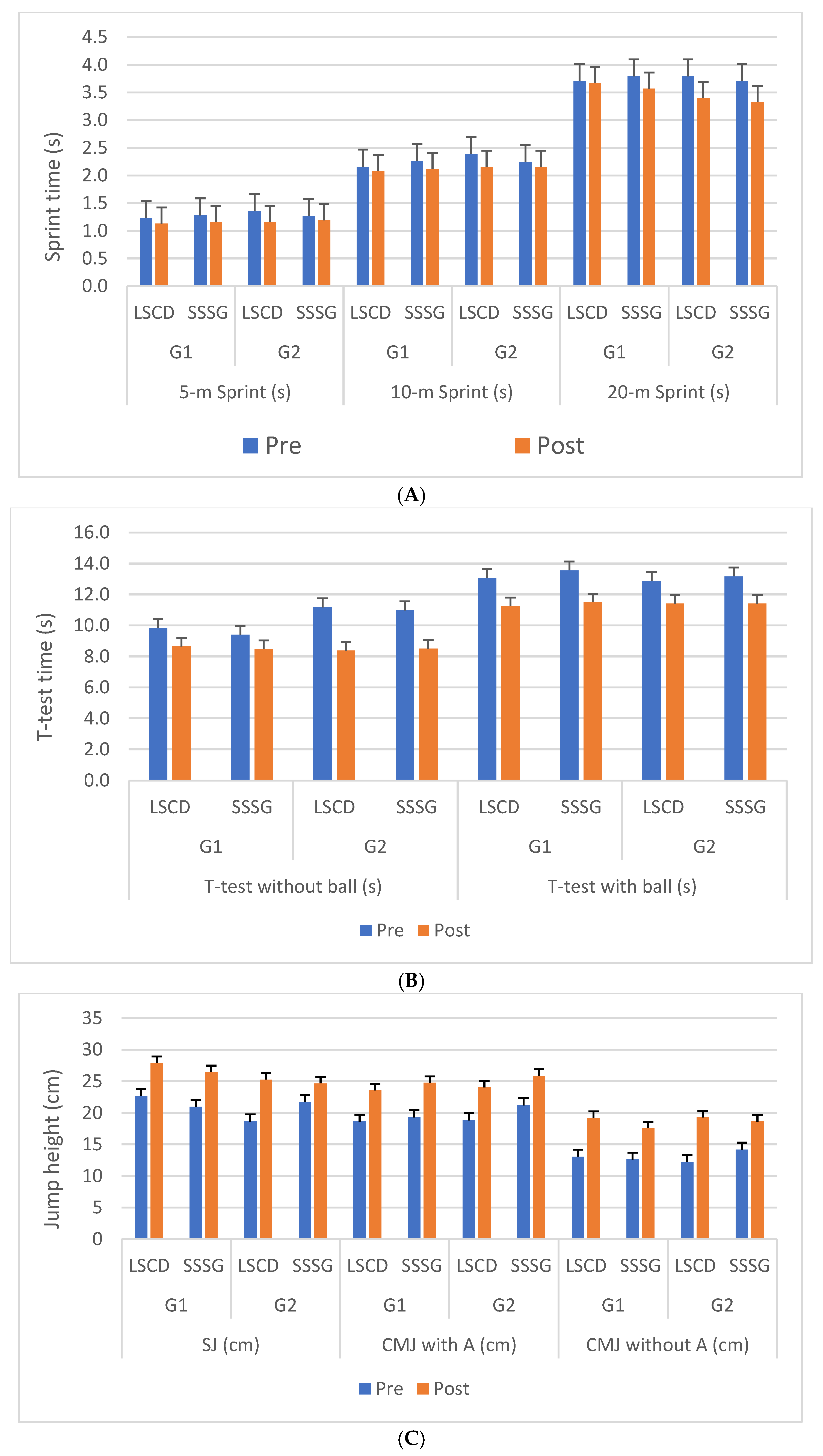
| Variable | Group | Intervention | Pre Mean ± SD | Post Mean ± SD | Δ% Mean ± SD | Within-Group Comparison (p, d) | Intervention Comparison (p, d) |
|---|---|---|---|---|---|---|---|
| 5 m Sprint (s) | G1 | LSCD | 1.23 ± 0.05 | 1.13 ± 0.07 | −8.43 ± 4.85 | <0.001 (−2) | 0.25 (−0.46) |
| SSSG | 1.28 ± 0.05 | 1.16 ± 0.06 | −9.75 ± 4.33 | <0.001 (−2.4) | |||
| G2 | LSCD | 1.36 ± 0.09 | 1.16 ± 0.09 | −14.75 ± 6.63 | <0.001 (−2.22) | 0.38 (−0.35) | |
| SSSG | 1.27 ± 0.08 | 1.19 ± 0.08 | −6.75 ± 6.45 | 0.003 (−1) | |||
| 10 m Sprint (s) | G1 | LSCD | 2.16 ± 0.06 | 2.08 ± 0.06 | −3.39 ± 2.78 | <0.001 (−1.33) | 0.002 (−1.33) |
| SSSG | 2.26 ± 0.06 | 2.12 ± 0.06 | −6.46 ± 2.55 | <0.001 (−2.33) | |||
| G2 | LSCD | 2.39 ± 0.10 | 2.16 ± 0.11 | −9.64 ± 4.32 | <0.001 (−2.3) | 0.52 (−0.54) | |
| SSSG | 2.24 ± 0.11 | 2.16 ± 0.11 | −3.57 ± 5.01 | 0.04 (−0.73) | |||
| 20 m Sprint (s) | G1 | LSCD | 3.71 ± 0.11 | 3.67 ± 0.10 | −1.13 ± 2.94 | 0.07 (−0.36) | 0.11 (−0.48) |
| SSSG | 3.79 ± 0.29 | 3.57 ± 0.20 | −5.86 ± 6.72 | 0.02 (−0.76) | |||
| G2 | LSCD | 3.79 ± 0.25 | 3.40 ± 0.29 | −10.32 ± 7.12 | <0.001 (−1.36) | 0.56 (−0.23) | |
| SSSG | 3.71 ± 0.30 | 3.33 ± 0.21 | −10.31 ± 7.21 | <0.001 (−1.35) | |||
| t-test without ball (s) | G1 | LSCD | 9.85 ± 0.73 | 8.65 ± 0.32 | −12.18 ± 6.42 | <0.001 (−2.55) | 0.29 (−0.42) |
| SSSG | 9.40 ± 0.61 | 8.49 ± 0.33 | −9.69 ± 5.62 | <0.001 (−2.13) | |||
| G2 | LSCD | 11.17 ± 0.65 | 8.38 ± 0.43 | −24.97 ± 5.10 | <0.001 (−4.2) | 0.74 (−0.19) | |
| SSSG | 10.98 ± 0.95 | 8.51 ± 0.28 | −22.47 ± 7.71 | <0.001 (−3.5) | |||
| t-test with ball (s) | G1 | LSCD | 13.07 ± 0.49 | 11.25 ± 0.74 | −13.93 ± 4.98 | <0.001 (−2.42) | 0.12 (−0.65) |
| SSSG | 13.56 ± 1.33 | 11.50 ± 0.96 | −15.19 ± 8.77 | <0.001 (−1.36) | |||
| G2 | LSCD | 12.88 ± 1.16 | 11.41 ± 1.34 | −11.41 ± 9.76 | 0.001 (−1.08) | 0.83 (−0.09) | |
| SSSG | 13.17 ± 1.53 | 11.42 ± 1.01 | −13.29 ± 10.21 | 0.001 (−1.19) | |||
| SJ (cm) | G1 | LSCD | 22.66 ± 3.99 | 27.90 ± 4.06 | 23.12 ± 17.76 | 0.002 (1.32) | 0.32 (0.45) |
| SSSG | 20.95 ± 2.74 | 26.46 ± 2.76 | 26.30 ± 13.12 | <0.001 (1.97) | |||
| G2 | LSCD | 18.64 ± 2.52 | 25.26 ± 3.13 | 35.52 ± 15.41 | <0.001 (2.54) | 0.11 (−0.68) | |
| SSSG | 21.71 ± 3.39 | 24.66 ± 3.89 | 13.59 ± 16.87 | 0.006 (0.86) | |||
| CMJ with A (cm) | G1 | LSCD | 18.61 ± 3.29 | 23.56 ± 3.36 | 26.60 ± 17.87 | <0.001 (1.51) | 0.2 (−0.44) |
| SSSG | 19.28 ± 2.93 | 24.75 ± 3.82 | 28.37 ± 17.97 | <0.001 (1.9) | |||
| G2 | LSCD | 18.81 ± 2.22 | 24.03 ± 2.51 | 27.75 ± 12.62 | <0.001 (2.11) | 0.04 (−0.97) | |
| SSSG | 21.19 ± 2.97 | 25.87 ± 2.86 | 22.09 ± 13.75 | <0.001 (1.61) | |||
| CMJ without A (cm) | G1 | LSCD | 13.07 ± 0.49 | 19.21 ± 0.77 | 46.98 ± 5.14 | <0.001 (8.25) | 0.001 (1.73) |
| SSSG | 12.60 ± 0.84 | 17.58 ± 0.91 | 39.52 ± 6.96 | <0.001 (6.55) | |||
| G2 | LSCD | 12.25 ± 1.43 | 19.27 ± 1.38 | 57.31 ± 11.47 | <0.001 (5.01) | 0.04 (−0.91) | |
| SSSG | 14.17 ± 1.53 | 18.63 ± 1.05 | 31.47 ± 9.54 | <0.001 (3.02) |
| Groupe | Tests | EF | LF | ML | Total |
|---|---|---|---|---|---|
| LSCD and SSSG | T1 | 12 (44%) | 5 (19%) | 10 (37%) | 27 (100%) |
| T2 | 11 (41%) | 6 (22%) | 10 (37%) | 27 (100%) | |
| T3 | 13 (48%) | 4 (15%) | 10 (37%) | 27 (100%) | |
| T4 | 12 (44%) | 5 (19%) | 10 (37%) | 27 (100%) |
| 95% Confidence Interval | ||||||
|---|---|---|---|---|---|---|
| Mesocycle 1 | Group | Average (Standard Deviation) | p-Value | Lower | Higher | d |
| Week 1 | G1 | 1744.8 ± 130.5 AU | p = 0.95 | −0.754 | 0.756 | d = 0.001 |
| G2 | 1744.6 ± 127.7 AU | |||||
| Week 2 | G1 | 1782.8 ± 160.4 AU | p = 0.93 | −0.781 | 0.728 | d = −0.02 |
| G2 | 1787.1 ± 162.9 AU | |||||
| Week 3 | G1 | 1817.8 ± 53.4 AU | p = 0.56 | −0.652 | 0.859 | d = −0.05 |
| G2 | 1812.6 ± 44.2 AU | |||||
| Week 4 | G1 | 1786.1 ± 130.5 AU | p = 0.94 | −0.793 | 0.717 | d = −0.03 |
| G2 | 1791.1 ± 131.7 AU | |||||
| 95% Confidence Interval | ||||||
|---|---|---|---|---|---|---|
| Mesocycle 2 | Group | Average (Standard Deviation) | p-Value | Lower | Higher | d |
| Week 1 | G1 | 1814 ± 58 AU | p = 0.16 | −0.796 | 0.714 | d = −0.04 |
| G2 | 1816.93 ± 79.5 AU | |||||
| Week 2 | G1 | 1830.5 ± 106.7 AU | p = 0.70 | −0.652 | 0.858 | d = 0.10 |
| G2 | 1820.1 ± 93.2 AU | |||||
| Week 3 | G1 | 1740.9 ± 32.7 AU | p = 0.53 | −0.536 | 0.979 | d = 0.22 |
| G2 | 1734 ± 27.7 AU | |||||
| Week 4 | G1 | 1801.5 ± 78.7 AU | p = 0.57 | −0.661 | 0.849 | d = −0.09 |
| G2 | 1791.1 ± 131.7 AU | |||||
Disclaimer/Publisher’s Note: The statements, opinions and data contained in all publications are solely those of the individual author(s) and contributor(s) and not of MDPI and/or the editor(s). MDPI and/or the editor(s) disclaim responsibility for any injury to people or property resulting from any ideas, methods, instructions or products referred to in the content. |
© 2025 by the authors. Licensee MDPI, Basel, Switzerland. This article is an open access article distributed under the terms and conditions of the Creative Commons Attribution (CC BY) license (https://creativecommons.org/licenses/by/4.0/).
Share and Cite
Aboulfaraj, A.; Laziri, F.; Haddou, S.E.; Lahlou, S.; Aghrouch, M.; Belamjahad, A.; Del Coso, J.; Ardigò, L.P.; Zouhal, H. Effect of Linear Sprints and Change-of-Direction Training Versus Small-Sided Soccer Games on Physical Performance in Highly Trained Young Female Soccer Players: A Randomized Cross-Over Study. Sports 2025, 13, 445. https://doi.org/10.3390/sports13120445
Aboulfaraj A, Laziri F, Haddou SE, Lahlou S, Aghrouch M, Belamjahad A, Del Coso J, Ardigò LP, Zouhal H. Effect of Linear Sprints and Change-of-Direction Training Versus Small-Sided Soccer Games on Physical Performance in Highly Trained Young Female Soccer Players: A Randomized Cross-Over Study. Sports. 2025; 13(12):445. https://doi.org/10.3390/sports13120445
Chicago/Turabian StyleAboulfaraj, Abdelwahid, Fatiha Laziri, Salah Eddine Haddou, Salah Lahlou, Mohamed Aghrouch, Ali Belamjahad, Juan Del Coso, Luca Paolo Ardigò, and Hassane Zouhal. 2025. "Effect of Linear Sprints and Change-of-Direction Training Versus Small-Sided Soccer Games on Physical Performance in Highly Trained Young Female Soccer Players: A Randomized Cross-Over Study" Sports 13, no. 12: 445. https://doi.org/10.3390/sports13120445
APA StyleAboulfaraj, A., Laziri, F., Haddou, S. E., Lahlou, S., Aghrouch, M., Belamjahad, A., Del Coso, J., Ardigò, L. P., & Zouhal, H. (2025). Effect of Linear Sprints and Change-of-Direction Training Versus Small-Sided Soccer Games on Physical Performance in Highly Trained Young Female Soccer Players: A Randomized Cross-Over Study. Sports, 13(12), 445. https://doi.org/10.3390/sports13120445