


Abstract
Sedentary behavior and inadequate energy expenditure are serious global public health concerns among youngsters. The exponential growth in technology emerges as a valuable opportunity to foster physical activity, particularly through active video games. We performed a systematic review following the Preferred Reporting Items for Systematic Reviews and Meta-Analyses guidelines in PubMed, Web of Science, Cochrane, and Scopus to provide a comprehensive view of the literature on energy expenditure levels among adolescents while playing active video games. Among the 574 manuscripts identified at the first screening stage, 23 were retained for analysis. Ten studies were characterized by longitudinal and thirteen by cross-sectional designs. The results showed that short-term active video games elicited energy expenditure values comparable to moderate-intensity physical activity (3–6 METs). However, in intervention programs (with at least six weeks) the results indicate no significant effects of active video games on youngsters’ energy expenditure levels and physical activity profiles between baseline and follow-up assessments. Overall, active video games based on sports and dance were the most used, and boys tended to achieve higher energy expenditure than girls. The diversity of methods implemented limits comparing results and drawing generalized conclusions. However, considering its attractiveness to youth, active video games might emerge as a complementary tool to traditional physical activities promoted in schools and local communities. Details regarding gender differences and contradictory results of longitudinal approaches should be considered in future research based on standardized methods.
1. Introduction
Worldwide, it is estimated that nearly 81% of adolescents aged between 11 and 17 years do not meet the recommended physical activity (PA) levels [1]. This is highly concerning since increased time spent in sedentary behavior (SB) and low PA have been associated with overweight and obesity, which represents severe public health problems. According to the literature, obesity is the result of the imbalance between energy intake (EI) and energy expenditure (EE) [2], influenced by physiological, psychological, and environmental factors [3]. Therefore, estimating EE is critical in the global context of non-communicable diseases [4].
In the literature, the doubly labeled water technique is described as the “gold standard” approach to assessing EE [4], which involves elevated costs and does not provide information on PA patterns [5]. PA is any bodily movement elevating the EE above resting levels [6]. Thus, levels of PA are directly related to EE [7]. Therefore, motion sensors, such as accelerometers, are available and accessible tools frequently used to measure PA and estimate EE [3].
To address the fight against SB and promote PA levels among children and adolescents, active video games (AVGs) that integrate exercise and gaming entertainments have emerged as an innovative approach [8]. Several investigations based on AVGs have targeted children and adolescents, particularly overweight and/or obese [9,10], and older adults [11,12]. The literature results indicate that AVGs can generate health benefits in physical fitness and weight loss [8,13]. Indeed, previous research has given much attention to the effects of AVGs on weight-related outcomes, with a significant reduction in body weight and body mass index being reported after a PA intervention program based on AVGs [14,15]. Therefore, not surprisingly, AVGs have been seen as an innovative and engaging tool to enhance PA among overweight participants. Particularly for that reason, EE assessment while playing AVGs is crucial to understanding the type of activity intensity that might be achieved. In a systematic review conducted on this topic, the authors reported that EE levels observed ranged between 2.0 and 5.0 metabolic equivalents of tasks (METs) [16]. In another review article, games examined elicited an EE at or above 3 METs, which corresponded to moderate intensity PA [17]. In the previous studies mentioned, the literature search included young participants aged up to 18 [17] or 21 [16] years old, and EE assessments based on indirect calorimetry [17]. Moreover, most of the investigations evaluated were based on cross-sectional analysis deployed in a laboratory context.
However, another important matter to be considered is the differences between genders. Research has shown that girls tend to be less active than boys. Possible justifications for this conclusion are related to girls’ lower participation in organized sports [18], less social support to engage in PA [19], and probably their less perceived enjoyment during Physical Education classes [20]. Thus, intervention programs based on PA tailored according to gender are recommended.
Since AVGs capitalize on youth interest in computerized video games and the need to increase PA [8], AVGs may represent a tool for the promotion of more active lifestyles. Therefore, the present systematic review aims to (1) provide a comprehensive view of the literature on EE levels examined through objective measures among children and adolescents while playing AVGs and (2) summarize the characteristics (i.e., games used, sessions’ duration, instruments used to play) of the studies analyzed. Based on previous literature, the current study aims to clarify the following questions: (1) Which type of PA intensity can be achieved through AVGs?; (2) What are the most common games and instruments used to play?; and (3) Are there differences in EE between boys and girls while playing AVGs? The information gathered through these questions is of great interest for the designing of innovative PA programs that can engage and motivate young populations.
2. Materials and Methods
This systematic review followed the Preferred Reporting Items for Systematic Reviews and Meta-Analyses (PRISMA) 2020 guidelines [21]. The PRISMA checklist is available in the supplementary file (Figure S1).
2.1. Search Strategy
Four comprehensive electronic databases (PubMed, Web of Science, Cochrane, and Scopus) were screened by three independent authors (C.F., S.A., and F.S.). Primary sources articles published until June of 2023 were considered eligible. The following terms were defined and used to search at the title/abstract level: “serious gam*”, “exergam*”, “active video game”, “child*”, “adolescen*”, “you*”, “energy expenditure”, “metabolic equivalent”, “accelerometer*”, “pedometer*”, “heart rate”, and “activity monitor*” combined with the Boolean operators “OR” and “AND”.
2.2. Inclusion Criteria
Inclusion criteria considered were as follows: (a) participants aged between 9 and 17 years from both sexes; (b) studies that assessed EE during AVGs played for at least 30 min; (c) reports of at least one outcome related to EE (light PA-LPA, moderate PA-MPA, vigorous PA-VPA, moderate-to-vigorous PA, metabolic equivalent—MET, heart rate—HR) evaluated through objective measures; and (d) full text written in English, Spanish, and Portuguese, published in the past 20 years (1 January 2023 until 1 July 2023).
2.3. Exclusion Criteria
Exclusion criteria considered were as follows: (a) participants with injury, illness, or disabilities; (b) no reports on at least one variable concerning EE; (c) descriptive studies, systematic reviews, protocols, book chapters, conference abstracts, or letter to editors; and (d) studies written in other languages or published before 2003. Regarding the study design, the authors have chosen to focus on experimental studies with a full description of the methods implemented and the results achieved.
2.4. Screening Strategy and Study Selection
All returning documents were compiled into a reference manager (EndNote X20, Thomson Reuters, Philadelphia, PA, USA) for additional analysis after the search completion. After deleting duplicate entries (automatically and manually), potentially eligible studies were independently assessed by three authors (C.F., S.A., and F.S.) to guarantee that articles met the inclusion criteria. Then, the same authors performed a full-text reading for eligible studies. In case of disagreements, a final decision was made by a fourth and more experienced author (E.R.G.) based on the revision of the inclusion/exclusion criteria and the review objectives.
2.5. Data Extraction and Harmonization
All authors discussed the criteria for data extraction and harmonization. The following categories were systematically extracted for eligible studies: (1) author name and study year, (2) study’s purpose, (3) sample characteristics (number of participants, age, and sex), (4) instruments and measures, (5) active video games used, number of sessions and program duration, and (6) main findings.
2.6. Study Risk of Bias
The quality assessment was performed using the Effective Public Health Practice Project (EPHPP) [22], and the modified version of the Newcastle-Ottawa Scale (NOS) [23], according to the study design (longitudinal or cross-sectional).
The EPHPP was used to evaluate longitudinal studies and comprises six categories that examine selection bias, confounding variables, data collection methods/instruments, blinding, and dropouts. Based on predetermined criteria, each category was scored as “poor”, “fair”, or “good”, determining an overall score defined as “weak”, “moderate”, or “strong”. Two authors (C.F. and S.A.) independently assigned a score to each study, and disagreements were solved by a third and more experienced author (E.R.G.) based on this review’s objectives.
The NOS instrument was used to assess cross-sectional studies and aims to determine the risk of bias, depending on three main categories: (1) sample selection, (2) comparability or control of confounders, and (3) outcomes. Points are given in each category (represented by *). Studies present a high risk of bias when classified between zero and three points, a moderate risk of bias between four and six points, and if a score greater than seven points was obtained, a low risk of bias was classified. Each article can receive a total of ten points in this assessment. Two authors carried out this assessment independently (F.S., C.F.), and disagreements were solved by a third and more experienced author (E.R.G.).
3. Results
3.1. Study Selection
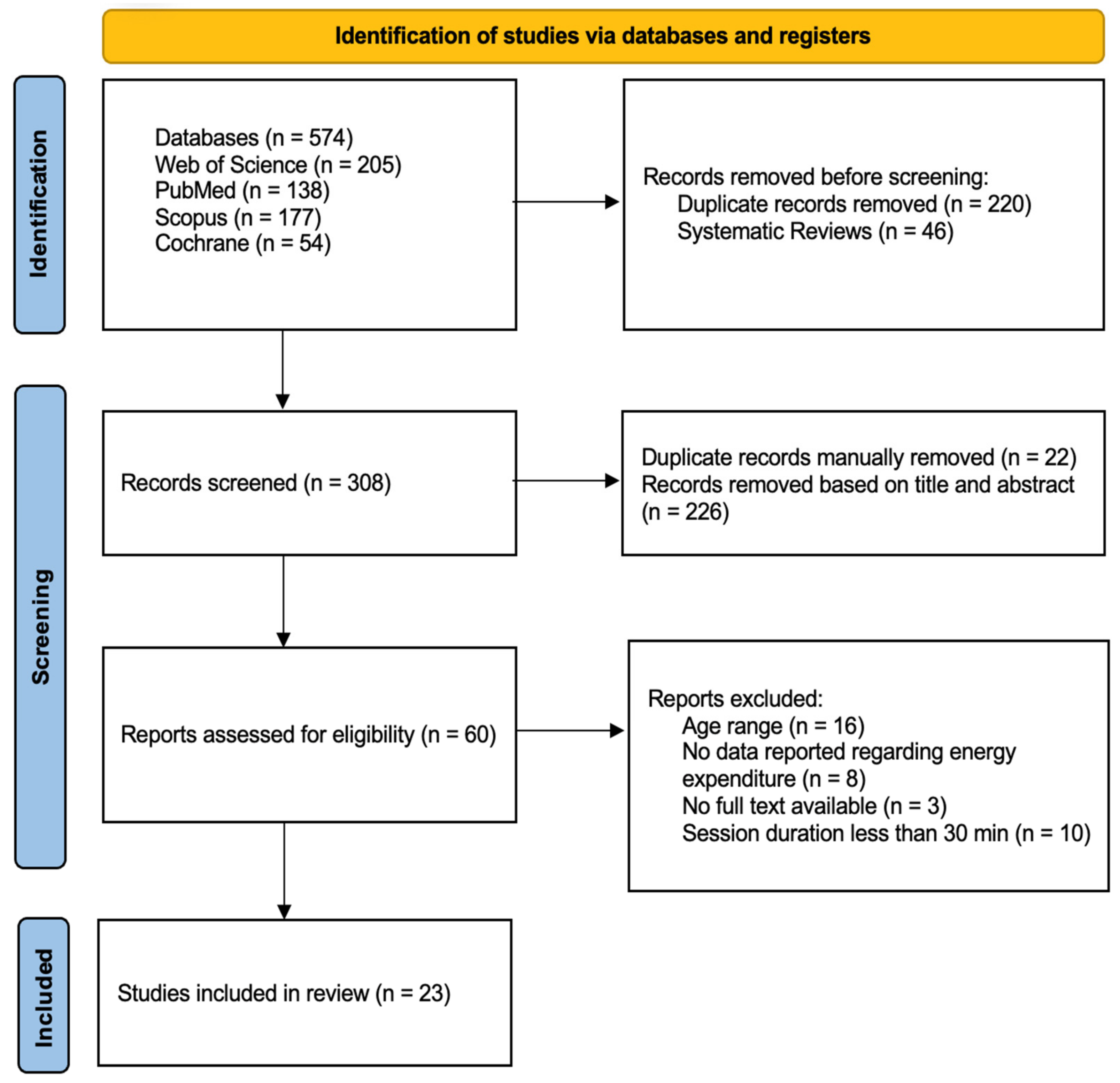
Figure 1 resumes the flowchart of the study selection procedure. The initial search in four databases (Web of Science, PubMed, Scopus, and Cochrane) identified 574 manuscripts. Duplicates were automatically removed (n = 220), and systematic review articles were excluded (n = 46). From the 308 manuscripts remaining, 22 were manually removed as duplicate records, and 226 were eliminated based on title and abstract. The full-text analysis comprised 60 manuscripts, and 36 did not meet the inclusion criteria for the following reasons: age range (n = 16), no data reported regarding energy expenditure (n = 8), no full text available (n = 3), and the total AVGs’ session duration was less than 30 min (n = 10). Subsequently, 23 records were included in the analysis.
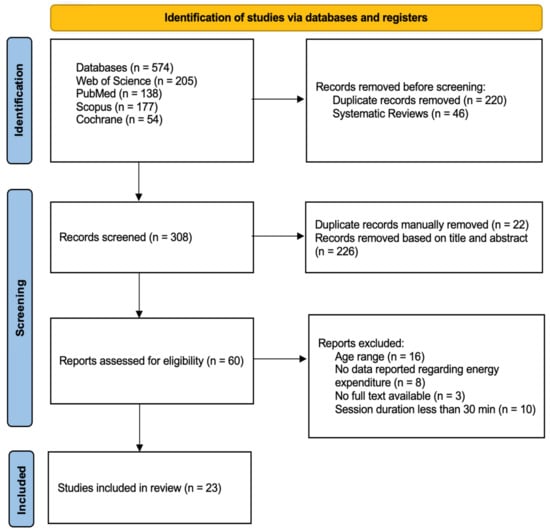
Figure 1.
PRISMA flowchart of the studies’ selection.
3.2. Risk of Bias Assessment
The detailed analysis of the study quality and risk of bias is summarized in the Supplementary File S1 (Tables S1 and S2). Ten studies were assessed using the EPHPP tool. Among those, two were classified as strong [24,25], six as moderate [10,26,27,28,29,30], and two as weak quality [31,32]. According to the EPHPP items, it was verified that most of the studies revealed no baseline differences between groups or accounted for at least 80% of the significant confounders (n = 8). All studies presented valid and reliable data collection instruments.
Thirteen studies were evaluated using the NOS. All of the studies scored greater than seven points and were, therefore, classified as having a low risk of bias. In the participants selection, only six studies obtained a score on the first question [33,34,35,36,37,38], as the sample was considered truly or somewhat representative of the target population. Regarding sample size, only two studies [37,39] obtained a score, since a justification for the sample size was presented. Most studies (n = 9) showed the inclusion or exclusion criteria, thus obtaining one point. Finally, all studies obtained two points, as the instruments used were considered valid. Regarding the comparability section, most studies (n = 11) received a maximum score of two points. In this parameter, even if the study did not have a control group, the top score was given when there was an adjustment or control of confounding factors, such as age, sex, or body weight. Finally, in the outcome section, all of the studies obtained the maximum score (three points), which clearly described the assessment and statistical analysis conducted.
3.3. Intervention Characteristics
Details regarding the study’s description, variables included, and main findings are presented in Table 1 and Table 2. Table 1 displays the cross-sectional studies (n = 13), while Table 2 resumes longitudinal interventions (n = 10).

Table 1.
Summary of the longitudinal studies’ description, variables included, and main findings.
Table 2.
Summary of the cross-sectional studies description, variables included, and main findings.
Among all of the studies, 1439 children and adolescents were assessed. One study did not report the participants’ percentage regarding sex [35], two studies considered exclusively boys [37,39], and most of the overall participants were girls (n = 744). Three investigations have included only overweight participants [10,24,25], and three evaluated both overweight and normal-weight participants [35,39,43]. Participants’ ages ranged between 9 and 17 years; however, fewer studies considered adolescents aged at least 13 years (n = 9) [24,35,36,37,38,39,40,41,42].
In longitudinal studies, the shortest intervention duration was six weeks [28], while the longer one was deployed for 12 months [27]. The most common duration of the intervention was 12 weeks (n = 3) [24,26,31]. Regarding the methods implemented, in six studies, participants attended weekly sessions based on AVGs, ranging between 40 and 60 min [10,25,28,29,30,32], while in the other four studies, participants had access to AVGs and were incentivized to play them daily [24,26,27,31]. Most of the studies included a control group (CG) that did not engage in any AVGs (n = 9) [10,24,25,26,27,29,30,31,32], and one study only considered exclusively an intervention group (IG) [28]. Regarding cross-sectional studies, most included only one testing session (n = 9) [33,35,37,39,40,41,42,44,45], ranging between 30 and 60 min.
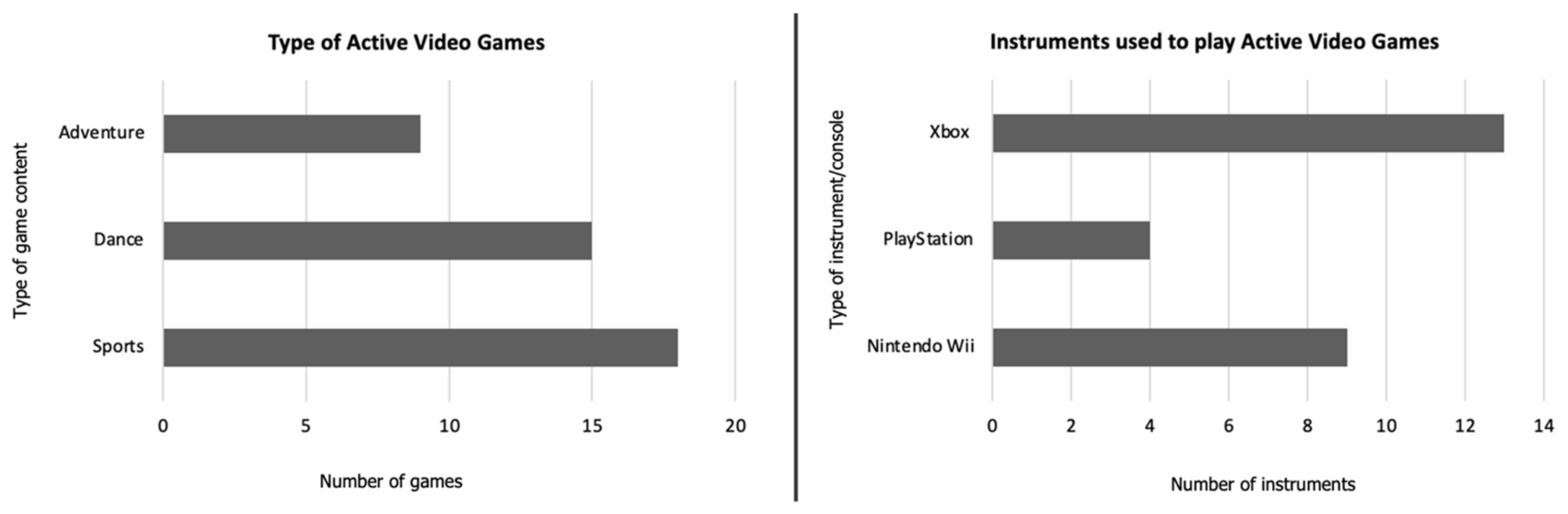
Figure 2 displays the types of AVGs selected, and the instruments used to play in the studies under analysis. Games based on sports (n = 18) and dance (n = 15) were the most common, and Xbox was the game console most used during the interventions/testing sessions (n = 13). It is of note that 15 studies have combined different types of AVGs [10,25,26,29,30,31,32,33,34,36,38,42,43,45], and four studies have implemented more than one game console [10,29,32,43].
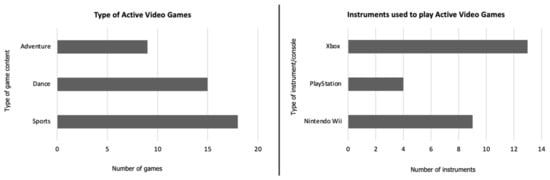
Figure 2.
Types of AVGs and instruments used in the studies under analysis.
3.4. Energy Expenditure during AVGs
Details concerning EE results are presented in the Supplementary File S2 (Tables S3 and S4).
Longitudinal studies
In longitudinal studies, the authors have relied mostly on accelerometers to measure PA levels. The results obtained were contradictory. In five interventions, no significant changes were seen in MVPA between the IG and CG [10,26,27,30,31]. In contrast, opposite results were described in four studies [24,25,28,29]. Additionally, one study reported increases in METs/day seen among the IG (baseline = 1.71 ± 0.20; follow-up = 1.81 ± 0.20), whereas the CG showed a decreased METs/day over time (baseline = 1.74 ± 0.16; follow-up = 1.45 ± 0.52) [32]. Interestingly, regarding MVPA and VPA, among the three studies that included overweight participants [10,24,25], only the intervention that combined AVGs with a program focused on nutritional knowledge has described significant improvements in participants’ MVPA and VPA (p ≤ 0.05) at follow-up (week 16) [25].
Cross-sectional studies
In cross-sectional studies, indirect calorimetry was frequently used to assess EE (n = 11) [33,34,35,37,39,40,41,42,43,44,45]. Indeed, most of these studies have included a single testing session with a single group deployed in a laboratory context (n = 10) [33,34,36,37,38,40,41,42,44,45].
Among the investigations conducted, three have focused on comparing EE between overweight and normal-weight participants [35,39,43]. In two studies, no significant differences were seen between groups while playing AVGs in EE, and METs’ mean values [39,43]. Interestingly, in both of these studies, the authors reported that AVGs can reach moderate-intensity PA (3–6 METs), which may be relevant to developing and maintaining cardiorespiratory fitness [39,43].
The single-group analysis showed a significantly greater EE and HR during AVGs compared to rest conditions (p ≤ 0.05). In the investigations that included sex comparisons, boys tended to attain higher EE than girls [34,36,42,44]. Among the games selected, boxing consistently showed enhanced EE compared to other sports and dance games [38,40,42]. In three investigations, the data on EE and HR during AVGs were comparable to moderate-intensity PA [34,40,44].
Two studies aimed to compare EE between AVGs and nonactive games [33,37], and another two have evaluated the differences between playing modes (single vs. two-player mode) [38,45]. Consistently, AVGs elicited substantial increases in EE compared to nonactive gaming, with almost double the mean values of EE being reported during AVGs. Regarding playing mode, there was a tendency to achieve higher EE during the two-player mode compared to the single-player mode.
4. Discussion
This systematic review aimed to provide an overall view of the current evidence on EE among adolescents while playing AVGs. According to the results, short-term AVG sessions (with at least 30 min of duration) elicited EE values comparable to moderate-intensity PA (3–6 METs). However, the analysis of intervention programs based on AVGs (with at least six weeks of duration) did not conclude significant changes in EE and PA profiles from the baseline to follow-up. AVGs based on sports and dance through the Xbox and Nintendo Wii were the most used during the interventions. Overall boys tended to achieve higher EE than girls.
Current guidelines for youth recommend at least 60 min per day of MVPA to achieve healthier lifestyles [1]. Among the 23 studies under analysis, five have described EE levels comparable to moderate-intensity PA (3–6 METs), which is consistent with the previous research conducted among youth and adult populations [7,46]. However, caution is needed in the interpretation of these results. Only one study has provided an AVG session of 60 min, while the other four focused on 30 min sessions, not meeting the recommended guidelines for PA. Besides, no distinguishment was made between PA intensity levels while playing the different AVGs, which would allow a better understanding of the impact derived from each game. This data is of great interest in designing AVG sessions, particularly in defining intensity thresholds based on the targeted physical fitness components. For instance, previous research has reported superior benefits for body composition and cardiorespiratory fitness outcomes of time spent in vigorous PA over moderate PA, which is likely due to the increased overall EE resulting from vigorous PA compared to a similar volume of moderate PA [47,48].
Meantime, both longitudinal and cross-sectional investigations were analyzed in the present study. To assess the efficacy of intervention programs based on AVGs, the authors have relied on accelerometry to quantify PA, and indirectly EE, at the baseline and follow-up. In fewer laboratory sessions, indirect calorimetry was frequently used to assess EE. Even though a diversity of protocols was implemented, the metrics used to interpret the results limits the comparison between studies. For instance, in cross-sectional approaches, while some authors used the MET [35,38,44] to report EE, others relied on results expressions based on kilocalories (kcal) [33,42,43,45] and joules (J) [34,36,37,39,40,41] to report their data. On the other hand, the number of sessions and their duration (ranging between 30 and 60 min) were also quite diverse between the investigations. Therefore, it is strongly recommended for future research to use standardized methods to allow a clearer comparison between studies. Based on the results of the present review, it seems that AVGs might be promoted between two and three times per week for at least 45 to 60 min.
In intervention programs, AVGs showed the potential to enhance PA, even if not with statistical effect. Interestingly, among the intervention programs that included overweight participants (n = 3), significant improvements between baseline and follow-up were only reported in the program that combined AVGs and a specific unit dedicated to nutritional knowledge [25]. Indeed, multidisciplinary approaches combining nutrition and PA at individual, family, and institutional levels, have been pointed out as crucial in the fight against youth obesity [49]. Therefore, although AVGs emerged as a potential source to reach moderate-intensity PA, which is relevant to promoting health-related physical components, effective intervention strategies should focus on behavioral changes [50], and combine the efforts of several actors (i.e., family, friends, school teachers) involved in the youngsters’ life. In this matter, Physical Education emerges as a crucial environment since it underlines the importance of PA. Indeed, future AVG interventions might be introduced in Physical Education classes allowing students to experience different ways to participate in PA.
Most of the AVG sessions analyzed included sports (n = 18) and dance (n = 15) games. Among the studies that compared EE between AVGs, boxing games showed the highest EE levels (n = 3). On the other hand, in the investigations that included sex comparisons (n = 4), the authors reported that boys tended to attain superior EE than girls. In a previous meta-analysis, game type and player age were identified as significant moderators of the AVGs’ effects. Games including lower body and whole body movements produced more EE than upper body systems, and youth displayed higher EE than adults [46]. Regarding sex differences, a previous literature review also concluded that EE was higher for boys than girls [16], which might be related to the type of games used. As an example, dance activities are often more associated with girls’ preferences [9], while sports and boxing games could be more attractive to boys. Therefore, interventions designed for youth populations should consider gender, providing tailored programs that elicit the interest of the participants. Instant enjoyment and moderate challenge have been mentioned as key motivating elements for PA adherence [51] and, therefore, these aspects should be considered by AVGs designers and by sports and health professionals when defining intervention programs.
The current study presents some limitations that should be highlighted. The diversity in the methods employed and the use of several EE outcomes limits the comparison between studies. Future research based on standardized methods would contribute to a more rigorous results comparison and support deeper conclusions. Moreover, several investigations included in this analysis were centered on one testing session (n = 9), which is influenced by the type and duration of the AVGs played in each study. Therefore, caution is recommended in the results’ interpretation. In longitudinal approaches, repetitive programs exclusively based on AVGs may lead to boredom among participants [27]. In addition, AVGs was only able to promote light to moderate PA levels, and opportunities to perform vigorous PA during youth have been strongly recommended in the literature [47].
Even though, there is evidence for the potential of AVGs to promote EE in youth, probably due to its attractiveness among youngsters, based on the current study, AVG programs might emerge as a different and complementary tool to traditional PA activities developed in schools and local communities. However, the lack of details concerning the comparison of EE between different AVG types and exploring the differences between boys’ and girls’ preferences justifies future research on the topic. Due to the contradictory findings identified, the current review also underlines the need to develop future investigations to examine the effects of a long-term intervention including AVGs on youngsters’ PA profiles.
5. Conclusions
The results of the present review suggest AVGs as a potential source of EE among youngsters, particularly to induce light to moderate PA levels. However, the diversity of methods used in the studies analyzed limits the comparison of results and drawing generalized conclusions. Overall, there is still a lack of longitudinal data on the impact of AVGs on health-related components. Indeed, among the twenty-three studies included, nine were based on one testing session. Future research designed to examine the effect of a long-term intervention including AVGs on PA levels is still needed. Considering its attractiveness to the younger population, AVGs might emerge as a complementary strategy to traditional PA activities to avoid game repetition boredom considering its lack of ability to promote vigorous PA levels.
Supplementary Materials
The following supporting information can be downloaded at: https://www.mdpi.com/article/10.3390/sports12020039/s1; Figure S1: PRISMA checklist; Table S1: Longitudinal studies methodological quality assessment using the Effective Public Health Practice Project; Table S2: Cross-sectional studies methodological assessment using the Newcastle-Ottawa Scale; Table S3: Descriptive statistics for energy expenditure among the longitudinal studies included in the analysis; Table S4: Descriptive statistics for energy expenditure among the cross-sectional studies included in the analysis.
Author Contributions
Conceptualization, C.F. and É.R.G.; methodology, C.F., S.A., F.S., M.D. and É.R.G.; software, C.F., S.A. and F.S.; validation, A.I., A.M. and M.d.M.N.; formal analysis, C.F., S.A. and F.S.; investigation, C.F., S.A., F.S., M.D. and É.R.G.; resources, A.I., A.M. and É.R.G.; data curation, C.F., S.A. and F.S.; writing—original draft preparation, C.F., S.A. and F.S.; writing—review and editing, M.D., A.I., A.M., M.d.M.N. and É.R.G.; visualization, A.I., A.M.; supervision, É.R.G.; project administration, É.R.G.; funding acquisition, É.R.G. All authors have read and agreed to the published version of the manuscript.
Funding
This research was funded by the Portuguese Recovery and Resilience Program (PRR), IAPMEI/ANI/FCT under the Agenda C645022399-00000057 (eGamesLab).
Acknowledgments
C.F. and E.R.G. acknowledge the support from LARSyS—Portuguese national funding agency for science, research, and technology (FCT) pluriannual funding 2020–2023 (reference: ITI-LX UIDP/50009/2020).
Conflicts of Interest
The authors declare no conflicts of interest.
References
- World Health Organization. Global Status Report on Physical Activity 2022: Country Profiles; World Health Organization: Geneva, Switzerland, 2022. [Google Scholar]
- Carneiro, I.P.; Elliott, S.A.; Siervo, M.; Padwal, R.; Bertoli, S.; Battezzati, A.; Prado, C.M. Is obesity associated with altered energy expenditure? Adv. Nutr. 2016, 7, 476–487. [Google Scholar] [CrossRef] [PubMed]
- O’Driscoll, R.; Turicchi, J.; Beaulieu, K.; Scott, S.; Matu, J.; Deighton, K.; Finlayson, G.; Stubbs, J. How well do activity monitors estimate energy expenditure? A systematic review and meta-analysis of the validity of current technologies. Br. J. Sports Med. 2020, 54, 332–340. [Google Scholar] [PubMed]
- Hills, A.P.; Mokhtar, N.; Byrne, N.M. Assessment of physical activity and energy expenditure: An overview of objective measures. Front. Nutr. 2014, 1, 5. [Google Scholar] [CrossRef] [PubMed]
- Plasqui, G.; Westerterp, K.R. Physical activity assessment with accelerometers: An evaluation against doubly labeled water. Obesity 2007, 15, 2371–2379. [Google Scholar] [CrossRef] [PubMed]
- Caspersen, C.J.; Powell, K.E.; Christenson, G.M. Physical activity, exercise, and physical fitness: Definitions and distinctions for health-related research. Public Health Rep. 1985, 100, 126. [Google Scholar] [PubMed]
- Sween, J.; Wallington, S.F.; Sheppard, V.; Taylor, T.; Llanos, A.A.; Adams-Campbell, L.L. The role of exergaming in improving physical activity: A review. J. Phys. Act. Health 2014, 11, 864–870. [Google Scholar] [CrossRef]
- Gao, Z.; Chen, S. Are field-based exergames useful in preventing childhood obesity? A systematic review. Obes. Rev. 2014, 15, 676–691. [Google Scholar] [CrossRef] [PubMed]
- Staiano, A.E.; Marker, A.M.; Beyl, R.A.; Hsia, D.S.; Katzmarzyk, P.T.; Newton, R. A randomized controlled trial of dance exergaming for exercise training in overweight and obese adolescent girls. Pediatr. Obes. 2017, 12, 120–128. [Google Scholar] [CrossRef]
- Comeras-Chueca, C.; Villalba-Heredia, L.; Perez-Lasierra, J.L.; Marín-Puyalto, J.; Lozano-Berges, G.; Matute-Llorente, Á.; Vicente-Rodríguez, G.; Gonzalez-Aguero, A.; Casajús, J.A. Active video games improve muscular fitness and motor skills in children with overweight or obesity. Int. J. Environ. Res. Public Health 2022, 19, 2642. [Google Scholar] [CrossRef]
- Gonçalves, A.; Muñoz, J.; Cameirão, M.S.; Gouveia, É.R.; Sousa, H.; Bermudez i Badia, S. The benefits of custom exergames for fitness, balance, and health-related quality of life: A randomized controlled trial with community-dwelling older adults. Games Health J. 2021, 10, 245–253. [Google Scholar]
- Agmon, M.; Perry, C.K.; Phelan, E.; Demiris, G.; Nguyen, H.Q. A pilot study of Wii Fit exergames to improve balance in older adults. J. Geriatr. Phys. Ther. 2011, 34, 161–167. [Google Scholar] [CrossRef]
- Benzing, V.; Schmidt, M. Exergaming for children and adolescents: Strengths, weaknesses, opportunities and threats. J. Clin. Med. 2018, 7, 422. [Google Scholar] [CrossRef] [PubMed]
- Staiano, A.E.; Beyl, R.A.; Guan, W.; Hendrick, C.A.; Hsia, D.S.; Newton, R.L., Jr. Home-based exergaming among children with overweight and obesity: A randomized clinical trial. Pediatr. Obes. 2018, 13, 724–733. [Google Scholar] [CrossRef] [PubMed]
- Foley, L.; Jiang, Y.; Ni Mhurchu, C.; Jull, A.; Prapavessis, H.; Rodgers, A.; Maddison, R. The effect of active video games by ethnicity, sex and fitness: Subgroup analysis from a randomised controlled trial. Int. J. Behav. Nutr. Phys. Act. 2014, 11, 46. [Google Scholar] [CrossRef] [PubMed]
- Biddiss, E.; Irwin, J. Active video games to promote physical activity in children and youth: A systematic review. Arch. Pediatr. Adolesc. Med. 2010, 164, 664–672. [Google Scholar] [CrossRef] [PubMed]
- Barnett, A.; Cerin, E.; Baranowski, T. Active video games for youth: A systematic review. J. Phys. Act. Health 2011, 8, 724–737. [Google Scholar] [CrossRef]
- Vella, S.A.; Cliff, D.P.; Okely, A.D. Socio-ecological predictors of participation and dropout in organised sports during childhood. Int. J. Behav. Nutr. Phys. Act. 2014, 11, 62. [Google Scholar] [CrossRef] [PubMed]
- Edwardson, C.L.; Gorely, T.; Pearson, N.; Atkin, A. Sources of activity-related social support and adolescents’ objectively measured after-school and weekend physical activity: Gender and age differences. J. Phys. Act. Health 2013, 10, 1153–1158. [Google Scholar] [CrossRef]
- Cairney, J.; Kwan, M.Y.; Velduizen, S.; Hay, J.; Bray, S.R.; Faught, B.E. Gender, perceived competence and the enjoyment of physical education in children: A longitudinal examination. Int. J. Behav. Nutr. Phys. Act. 2012, 9, 26. [Google Scholar] [CrossRef]
- Page, M.J.; McKenzie, J.E.; Bossuyt, P.M.; Boutron, I.; Hoffmann, T.C.; Mulrow, C.D.; Shamseer, L.; Tetzlaff, J.M.; Akl, E.A.; Brennan, S.E. The PRISMA 2020 statement: An updated guideline for reporting systematic reviews. Int. J. Surg. 2021, 88, 105906. [Google Scholar] [CrossRef]
- Thomas, B.; Ciliska, D.; Dobbins, M.; Micucci, S. Quality Assessment Tool for Quantitative Studies Dictionary: The Effective Public Health Practice Project (EPHPP); McMaster University: Hamilton, ON, Canada, 2008. [Google Scholar]
- Herzog, R.; Álvarez-Pasquin, M.J.; Díaz, C.; Del Barrio, J.L.; Estrada, J.M.; Gil, Á. Are healthcare workers’ intentions to vaccinate related to their knowledge, beliefs and attitudes? A systematic review. BMC Public Health 2013, 13, 154. [Google Scholar] [CrossRef] [PubMed]
- Maloney, A.E.; Threlkeld, K.A.; Cook, W.L. Comparative Effectiveness of a 12-Week Physical Activity Intervention for Overweight and Obese Youth: Exergaming with “Dance Dance Revolution”. Games Health J. 2012, 1, 96–103. [Google Scholar] [CrossRef] [PubMed]
- Trost, S.G.; Sundal, D.; Foster, G.D.; Lent, M.R.; Vojta, D. Effects of a pediatric weight management program with and without active video games: A randomized trial. JAMA Pediatr. 2014, 168, 407–413. [Google Scholar] [CrossRef]
- Baranowski, T.; Abdelsamad, D.; Baranowski, J.; O’Connor, T.M.; Thompson, D.; Barnett, A.; Cerin, E.; Chen, T.A. Impact of an Active Video Game on Healthy Children’s Physical Activity. Pediatrics 2012, 129, E636–E642. [Google Scholar] [CrossRef]
- Azevedo, L.B.; Watson, D.B.; Haighton, C.; Adams, J. The effect of dance mat exergaming systems on physical activity and health—Related outcomes in secondary schools: Results from a natural experiment. BMC Public Health 2014, 14, 951. [Google Scholar] [CrossRef] [PubMed]
- Chen, H.; Sun, H. The Effects of Active Videogame Feedback and Practicing Experience on Children’s Physical Activity Intensity and Enjoyment. Games Health J. 2017, 6, 200–204. [Google Scholar] [CrossRef] [PubMed]
- Ye, S.; Pope, Z.C.; Lee, J.E.; Gao, Z. Effects of school-based exergaming on urban children’s physical activity and cardiorespiratory fitness: A quasi-experimental study. Int. J. Environ. Res. Public Health 2019, 16, 4080. [Google Scholar] [CrossRef]
- Liang, Y.; Lau, P.W.C.; Jiang, Y.; Maddison, R. Getting Active with Active Video Games: A Quasi-Experimental Study. Int. J. Environ. Res Public Health 2020, 17, 7984. [Google Scholar] [CrossRef]
- Mhurchu, C.N.; Maddison, R.; Jiang, Y.; Jull, A.; Prapavessis, H.; Rodgers, A. Couch potatoes to jumping beans: A pilot study of the effect of active video games on physical activity in children. Int. J. Behav. Nutr. Phys. Act. 2008, 5, 8. [Google Scholar] [CrossRef]
- Gao, Z.; Pope, Z.C.; Lee, J.E.; Quan, M.H. Effects of Active Video Games on Children’s Psychosocial Beliefs and School Day Energy Expenditure. J. Clin. Med. 2019, 8, 1268. [Google Scholar] [CrossRef]
- Maddison, R.; Mhurchu, C.N.; Jull, A.; Jiang, Y.; Prapavessis, H.; Rodgers, A. Energy expended playing video console games: An opportunity to increase children’s physical activity? Pediatr. Exerc. Sci. 2007, 19, 334–343. [Google Scholar] [CrossRef] [PubMed]
- Graf, D.L.; Pratt, L.V.; Hester, C.N.; Short, K.R. Playing Active Video Games Increases Energy Expenditure in Children. Pediatrics 2009, 124, 534–540. [Google Scholar] [CrossRef] [PubMed]
- O’Donovan, C.; Roche, E.F.; Hussey, J. The energy cost of playing active video games in children with obesity and children of a healthy weight. Pediatr. Obes. 2014, 9, 310–317. [Google Scholar] [CrossRef] [PubMed]
- Rosenberg, M.; Lay, B.; Lee, M.; Derbyshire, A.; Kur, J.; Ferguson, R.; Maitland, C.; Mills, A.; Davies, C.; Pratt, I.S.; et al. New-Generation Active Videogaming Maintains Energy Expenditure in Children Across Repeated Bouts. Games Health J. 2013, 2, 274–279. [Google Scholar] [CrossRef] [PubMed]
- Gribbon, A.; McNeil, J.; Jay, O.; Tremblay, M.S.; Chaput, J.P. Active video games and energy balance in male adolescents: A randomized crossover trial. Am. J. Clin. Nutr. 2015, 101, 1126–1134. [Google Scholar] [CrossRef] [PubMed]
- Verhoeven, K.; Abeele, V.V.; Gers, B.; Seghers, J. Energy Expenditure During Xbox Kinect Play in Early Adolescents: The Relationship with Player Mode and Game Enjoyment. Games Health J. 2015, 4, 444–451. [Google Scholar] [CrossRef] [PubMed]
- Chaput, J.P.; Genin, P.M.; Le Moel, B.; Pereira, B.; Boirie, Y.; Duclos, M.; Thivel, D. Lean adolescents achieve higher intensities but not higher energy expenditure while playing active video games compared with obese ones. Pediatr. Obes. 2016, 11, 102–106. [Google Scholar] [CrossRef]
- Graves, L.E.F.; Ridgers, N.D.; Stratton, G. The contribution of upper limb and total body movement to adolescents’ energy expenditure whilst playing Nintendo Wii. Eur. J. Appl. Physiol. 2008, 104, 617–623. [Google Scholar] [CrossRef]
- Graves, L.E.; Ridgers, N.D.; Williams, K.; Stratton, G.; Atkinson, G.; Cable, N.T. The physiological cost and enjoyment of Wii Fit in adolescents, young adults, and older adults. J. Phys. Act. Health 2010, 7, 393–401. [Google Scholar] [CrossRef]
- Smallwood, S.R.; Morris, M.M.; Fallows, S.J.; Buckley, J.P. Physiologic Responses and Energy Expenditure of Kinect Active Video Game Play in Schoolchildren. Arch. Pediatr. Adolesc. Med. 2012, 166, 1005–1009. [Google Scholar] [CrossRef]
- Lau, P.W.C.; Liang, Y.; Lau, E.Y.; Choi, C.R.; Kim, C.G.; Shin, M.S. Evaluating physical and perceptual responses to exergames in chinese children. Int. J. Environ. Res. Public Health 2015, 12, 4018–4030. [Google Scholar] [CrossRef] [PubMed]
- McNarry, M.A.; Mackintosh, K.A. Investigating the Relative Exercise Intensity of Exergames in Prepubertal Children. Games Health J. 2016, 5, 135–140. [Google Scholar] [CrossRef] [PubMed]
- Barkman, J.; Pfeiffer, K.; Diltz, A.; Peng, W. Examining Energy Expenditure in Youth Using XBOX Kinect: Differences by Player Mode. J. Phys. Act. Health 2016, 13, S41–S43. [Google Scholar] [CrossRef] [PubMed]
- Peng, W.; Lin, J.-H.; Crouse, J. Is playing exergames really exercising? A meta-analysis of energy expenditure in active video games. Cyberpsychol. Behav. Soc. Netw. 2011, 14, 681–688. [Google Scholar] [CrossRef]
- Sardinha, L.B.; Magalhães, J.P.; Santos, D.A.; Hetherington-Rauth, M. Intensity matters: Impact of physical activity energy expenditure at moderate and vigorous intensity on total and abdominal obesity in children. Eur. J. Clin. Nutr. 2023, 77, 546–550. [Google Scholar] [CrossRef]
- Gralla, M.H.; McDonald, S.M.; Breneman, C.; Beets, M.W.; Moore, J.B. Associations of objectively measured vigorous physical activity with body composition, cardiorespiratory fitness, and cardiometabolic health in youth: A review. Am. J. Lifestyle Med. 2019, 13, 61–97. [Google Scholar] [CrossRef]
- Fornari, E.; Brusati, M.; Maffeis, C. Nutritional strategies for childhood obesity prevention. Life 2021, 11, 532. [Google Scholar] [CrossRef]
- Koletzko, B.; Fishbein, M.; Lee, W.S.; Moreno, L.; Mouane, N.; Mouzaki, M.; Verduci, E. Prevention of childhood obesity: A position paper of the Global Federation of International Societies of Paediatric Gastroenterology, Hepatology and Nutrition (FISPGHAN). J. Pediatr. Gastroenterol. Nutr. 2020, 70, 702–710. [Google Scholar] [CrossRef]
- Sun, H. Impact of exergames on physical activity and motivation in elementary school students: A follow-up study. J. Sport Health Sci. 2013, 2, 138–145. [Google Scholar] [CrossRef]
Disclaimer/Publisher’s Note: The statements, opinions and data contained in all publications are solely those of the individual author(s) and contributor(s) and not of MDPI and/or the editor(s). MDPI and/or the editor(s) disclaim responsibility for any injury to people or property resulting from any ideas, methods, instructions or products referred to in the content. |
© 2024 by the authors. Licensee MDPI, Basel, Switzerland. This article is an open access article distributed under the terms and conditions of the Creative Commons Attribution (CC BY) license (https://creativecommons.org/licenses/by/4.0/).