Effects of Sublethal Exposure to Piper aduncum L. Essential Oil on Population Growth of Stored-Product Insect Pests




Simple Summary
Abstract
1. Introduction
2. Materials and Methods
2.1. Insect Rearing
2.2. Obtaining and Extracting Piper Aduncum Essential Oil
2.3. Piper Aduncum Essential Oil Composition
2.4. Population Growth Bioassays
2.5. Total Number of Emerged Insects and Grain Mass Loss
2.6. Statistical Analyses
3. Results
3.1. Piper Aduncum Essential Oil Composition
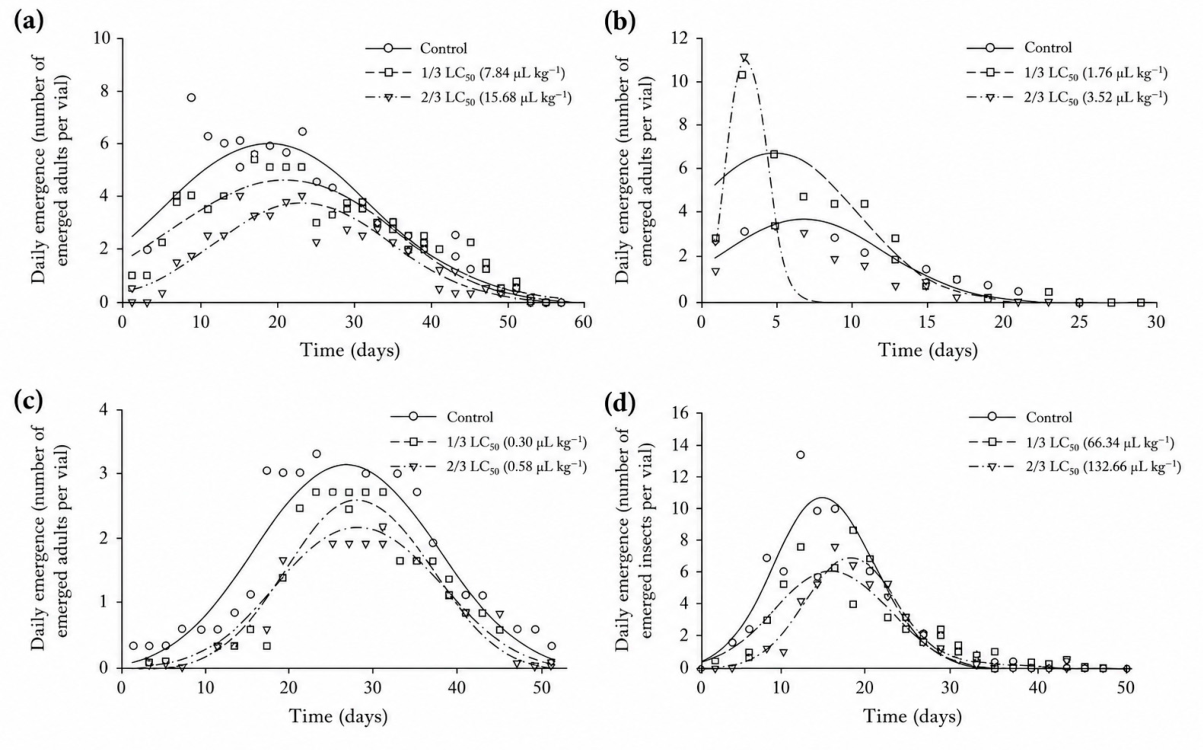
3.2. Population Growth Rate
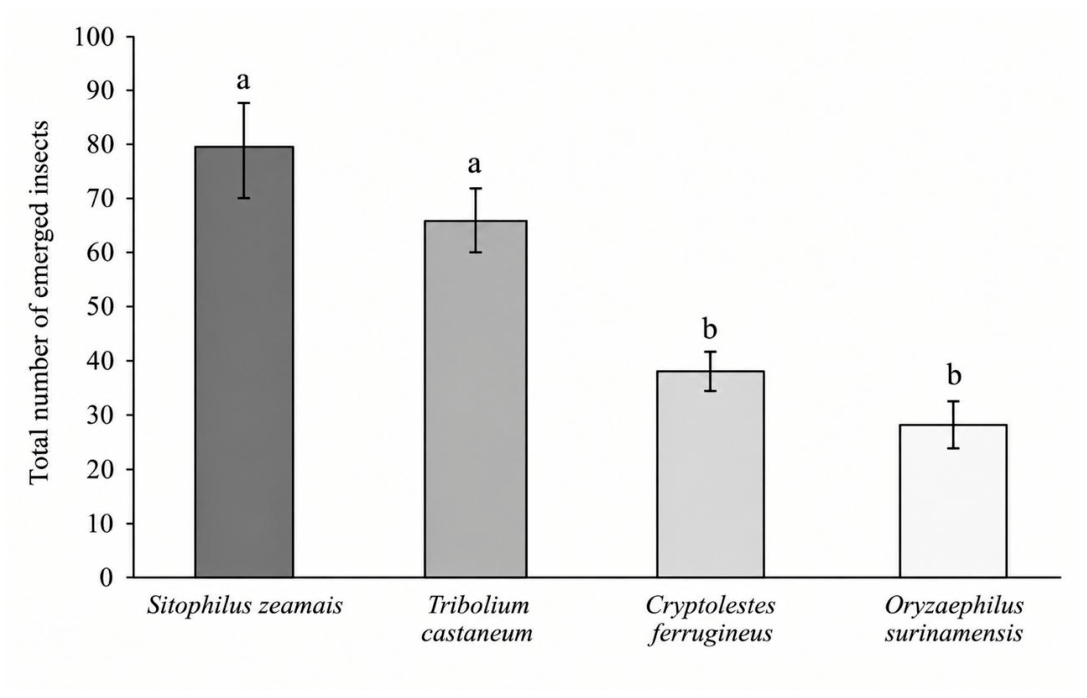
3.3. Total Number of Emerged Insects and Grain Mass Loss
4. Discussion
5. Conclusions
Author Contributions
Funding
Data Availability Statement
Acknowledgments
Conflicts of Interest
Abbreviations
| PAEO | Piper aduncum L. essential oil |
| LC50 | Lethal concentration capable of killing 50% of the insects |
| LC95 | Lethal concentration capable of killing 95% of the insects |
References
- Taddese, M.; Dibaba, K.; Bayissa, W.; Hunde, D.; Mendesil, E.; Kassie, M.; Mutungi, C.; Tefera, T. Assessment of quantitative and qualitative losses of stored grains due to insect infestation in Ethiopia. J. Stored Prod. Res. 2020, 89, 101689. [Google Scholar] [CrossRef] [Scilit]
- Lorini, I.; Krzyzanowski, F.C.; França-Neto, J.B.; Henning, A.A.; Henning, F.A. Manejo Integrado de Pragas de Grãos e Sementes Armazenadas; Embrapa: Brasília, Brazil, 2015; 84p. [Google Scholar]
- Sousa, A.H.; Faroni, L.D.A.; Guedes, R.N.C.; Tótola, M.R.; Urruchi, W.I. Ozone as a management alternative against phosphine-resistant insect pests of stored products. J. Stored Prod. Res. 2008, 44, 379–385. [Google Scholar] [CrossRef] [Scilit]
- Pimentel, M.A.G.; Ferreira, E.G. Toxicity of products formulated with entomopathogenic fungi on the maize weevil. Rev. Bras. Milho Sorgo 2012, 11, 209–215. [Google Scholar]
- Lopes, L.M.; Sousa, A.H.; Faroni, L.R.A.; Silva, M.V.A.; Ferraz, M.S.S.; Santos, V.B. Toxicity and Sublethal Effects of Piper hispidinervum Essential Oil on Behavioral and Physiological Responses of Sitophilus zeamais Populations. Molecules 2024, 29, 4116. [Google Scholar] [CrossRef] [Scilit] [PubMed]
- Santos, W.P.; Lopes, L.M.; Silva, G.N.; Carvalho, M.S.; Sousa, A.H. Piper aduncum Essential Oil: Toxicity to Sitophilus zeamais and Effects on the Quality of Corn Grains. Processes 2025, 13, 1363. [Google Scholar] [CrossRef] [Scilit]
- Haddi, K.; Valbon, W.R.; Viteri Jumbo, L.O.; Oliveira, L.O.; Guedes, R.N.; Oliveira, E.E. Diversity and convergence of mechanisms involved in pyrethroid resistance in the stored grain weevils, Sitophilus spp. Sci. Rep. 2018, 8, 16361. [Google Scholar] [CrossRef] [Scilit] [PubMed]
- Jumbo, L.O.V.; Corrêa, M.J.M.; Gomes, J.M.; Armijos, M.J.G.; Valarezo, E.; Mantilla-Afanador, J.G.; Machado, F.P.; Rocha, L.; Aguiar, R.W.S.; Oliveira, E.E. Potential of Bursera graveolens Essential Oil for Controlling Bean Weevil Infestations: Toxicity, Repellence, and Action Targets. Ind. Crops Prod. 2022, 178, 114611. [Google Scholar] [CrossRef] [Scilit]
- Spletozer, A.G.; Santos, C.R.; Sanches, L.A.; Garlet, J. Plantas com potencial inseticida: Enfoque em espécies amazônicas. Cienc. Florest. 2021, 31, 974–997. [Google Scholar] [CrossRef] [Scilit]
- Fernandes, E.T.; Favero, S. Óleo essencial de Schinus molle L. para o controle de Sitophilus zeamais Most. 1855 (Coleoptera: Curculionidae) em milho. Rev. Bras. Agroecol. 2014, 9, 225–231. [Google Scholar]
- Guedes, R.N.C.; Smagghe, G.; Stark, J.D.; Desneux, N. Pesticide-induced stress in arthropod pest for optimized integrated pest management programs. Annu. Rev. Entomol. 2016, 61, 43–62. [Google Scholar] [CrossRef] [Scilit] [PubMed]
- Sousa, A.H.; Faroni, L.R.A.; Guedes, R.N.C. Locomotor behavior of Sitophilus zeamais populations under sublethal ozone exposure. J. Pest Sci. 2017, 90, 239–247. [Google Scholar] [CrossRef] [Scilit]
- Souza, L.P.; Faroni, L.R.A.; Lopes, L.M.; Sousa, A.H.; Prates, L.H.F. Toxicity and sublethal effects of allyl isothiocyanate to Sitophilus zeamais on population development and walking behavior. J. Pest Sci. 2018, 91, 761–770. [Google Scholar] [CrossRef] [Scilit]
- Durofil, A.; Radice, M.; Blanco-Salas, J.; Téllez, T.R. Piper aduncum Essential Oil: A Promising Insecticide, Acaricide and Antiparasitic. A Review. Parasite 2021, 28, 42. [Google Scholar] [CrossRef] [Scilit] [PubMed]
- Araújo, A.M.N.; Faroni, L.R.D.; Oliveira, J.V.; Navarro, D.M.A.F.; Barbosa, D.R.S.; Breda, M.O.; França, S.M. Lethal and sublethal responses of Sitophilus zeamais populations to essential oils. J. Pest Sci. 2017, 90, 589–600. [Google Scholar] [CrossRef] [Scilit]
- Nascimento, J.M.; Sousa, A.H.; Lopes, L.M.; Mendonça, J.F.; Santos, A.C.V. Bioactivity of Piper aduncum L. essential oil for insect pests of stored products. Pesqui. Agropecu. Trop. 2023, 53, e77482. [Google Scholar] [CrossRef] [Scilit]
- Lopes, L.M.; Faroni, L.R.D.; Silva, G.N.; Barbosa, D.R.S.; Carvalho, M.S.; Martins, H.P.F.; Santos, T.R.D.; Dias, I.S.; Sousa, A.H. Development and Population Growth Rates of Sitophilus zeamais (Coleoptera: Curculionidae) Exposed to a Sublethal Concentration of Essential Oil of Piper hispidinervum. Insects 2025, 16, 697. [Google Scholar] [CrossRef] [Scilit] [PubMed]
- Desneux, N.; Decourtye, A.; Delpuech, J.-M. The sublethal effects of pesticides on beneficial arthropods. Annu. Rev. Entomol. 2007, 52, 81–106. [Google Scholar] [CrossRef] [Scilit] [PubMed]
- Guedes, N.M.P.; Tolledo, J.; Corrêa, A.S.; Guedes, R.N.C. Insecticide-induced hormesis in an insecticide-resistant strain of the maize weevil. J. Appl. Entomol. 2010, 134, 142–148. [Google Scholar] [CrossRef] [Scilit]
- Guedes, R.N.C.; Cutler, G.C. Insecticide-induced hormesis and arthropod pest management. Pest Manag. Sci. 2014, 70, 690–697. [Google Scholar] [CrossRef] [Scilit] [PubMed]
- Martins, J.C.; Silva, E.M.; Silva, R.S.; Ferreira, S.R.; Picanço, M.C. Copaiba oil and Neem extract can be a potential alternative for the behavioral control of Sitophilus zeamais. Braz. J. Biol. 2022, 84, e254628. [Google Scholar] [PubMed]
- Vilca Mallqui, K.S.; Vieira, J.L.; Guedes, R.N.C.; Gontijo, L.M. Azadirachtin-induced hormesis mediating shift in fecundity-longevity trade-off in the Mexican bean weevil (Chrysomelidae: Bruchinae). J. Econ. Entomol. 2014, 107, 860–866. [Google Scholar] [CrossRef] [Scilit] [PubMed]
- Guedes, N.M.P.; Guedes, R.N.C.; Ferreira, G.H.; Silva, L.B. Flight take-off and walking behavior of insecticide-susceptible and resistant strains of Sitophilus zeamais exposed to deltamethrin. Bull. Entomol. Res. 2009, 99, 393–400. [Google Scholar] [CrossRef] [Scilit] [PubMed]
- Cutler, G.C.; Guedes, R.N.C. Occurrence and significance of insecticide-induced hormesis in insects. In Pesticide Dose: Effects on the Environment and Target and Non-Target Organisms; Duke, S.O., Kudesk, P., Solomon, K., Eds.; American Chemical Society: Washington, DC, USA, 2017; pp. 101–119. [Google Scholar]
- Adams, R.P. Identification of Essential Oil Components by Gas Chromatography/Mass Spectrometry, 4th ed.; Allured Publishing Corporation: Carol Stream, IL, USA, 2007; 804p. [Google Scholar]
- Ferraz, M.S.S. Potencial Inseticida do Óleo Essencial de Piper hispidinervum sobre Callosobruchus maculatus e Qualidade de Feijão-Caupi. Master’s Thesis, Universidade Federal de Viçosa, Viçosa, Brazil, 2018. [Google Scholar]
- Trematerra, P.; Fontana, F.; Mancini, M. Analysis of development rates of Sitophilus oryzae (L.) in five cereals of the genus Triticum. J. Stored Prod. Res. 1996, 32, 315–322. [Google Scholar] [CrossRef] [Scilit]
- Sousa, A.H.; Faroni, L.R.A.; Pimentel, M.A.G.; Guedes, R.N.C. Developmental and population growth rates of phosphine-resistant and susceptible populations of stored-product insect pests. J. Stored Prod. Res. 2009, 45, 241–246. [Google Scholar] [CrossRef] [Scilit]
- Freitas, R.C.P.; Faroni, L.R.D.; Haddi, K.; Jumbo, L.O.V.; Oliveira, E.E. Allyl isothiocyanate actions on populations of Sitophilus zeamais resistant to phosphine: Toxicity, emergence inhibition and repellency. J. Stored Prod. Res. 2016, 69, 257–264. [Google Scholar] [CrossRef] [Scilit]
- Jumbo, L.O.V.; Haddi, K.; Faroni, L.R.D.; Heleno, F.F.; Pinto, F.G.; Oliveira, E.E. Toxicity to, oviposition and population growth impairments of Callosobruchus maculatus exposed to clove and cinnamon essential oils. PLoS ONE 2018, 13, e0207618. [Google Scholar] [CrossRef] [Scilit] [PubMed]
- Magalhães, C.R.I.; Oliveira, C.R.F.; Matos, C.H.C.; Brito, S.S.S.; Magalhães, T.A.; Ferraz, M.S.S. Potencial inseticida de óleos essenciais sobre Tribolium castaneum em milho armazenado. Rev. Bras. Plantas Med. 2015, 17, 1150–1158. [Google Scholar] [CrossRef] [Scilit][Green Version]
- França, S.M.; Breda, M.A.; Barbosa, D.R.S.; Araújo, A.M.N.; Guedes, C.A. The sublethal effects of insecticides in insects. In Biological Control of Pest and Vector Insects; Shields, V.D.C., Ed.; InTech: Rijeka, Croatia, 2017; pp. 23–39. [Google Scholar]
- Guedes, R.N.C.; Guedes, N.M.P.; Rosi-Denadai, C.A. Sub-lethal effects of insecticides on stored-product insects: Current knowledge and future needs. Stewart Postharvest Rev. 2011, 7, 1–5. [Google Scholar] [CrossRef] [Scilit]
- Vélez, M.; Botina, L.L.; Turchen, L.M.; Barbosa, W.F.; Guedes, R.N.C. Spinosad and deltamethrin-induced impact on mating and reproductive output of the maize weevil Sitophilus zeamais. J. Econ. Entomol. 2018, 111, 950–958. [Google Scholar] [CrossRef] [Scilit] [PubMed]
- Silva, S.M.; Haddi, K.; Viteri Jumbo, L.O.; Oliveira, E.E. Progeny of the maize weevil, Sitophilus zeamais, is affected by parental exposure to clove and cinnamon essential oils. Entomol. Exp. Appl. 2017, 163, 220–228. [Google Scholar] [CrossRef] [Scilit]
- Yu, Y.; Shen, G.Q.; Zhu, H.; Lu, Y. Imidacloprid-induced hormesis on the fecundity and juvenile hormone levels of the green peach aphid Myzus persicae (Sulzer). Pestic. Biochem. Physiol. 2010, 98, 238–242. [Google Scholar] [CrossRef] [Scilit]
- Calabrese, E.J. Evidence that hormesis represents an “overcompensation” response to a disruption in homeostasis. Ecotoxicol. Environ. Saf. 1999, 42, 135–137. [Google Scholar] [CrossRef] [Scilit] [PubMed]
- Cutler, G.C.; Ramanaidu, K.; Astatkie, T.; Isman, M.B. Green peach aphid, Myzus persicae (Hemiptera: Aphididae), reproduction during exposure to sublethal concentrations of imidacloprid and azadirachtin. Pest Manag. Sci. 2009, 65, 205–209. [Google Scholar] [CrossRef] [Scilit] [PubMed]
- Cordeiro, E.M.G.; Moura, I.L.T.; Fadini, M.A.M.; Guedes, R.N.C. Beyond selectivity: Are behavioral avoidance and hormesis likely causes of pyrethroid-induced outbreaks of the southern red mite Oligonychus ilicis? Chemosphere 2013, 93, 1111–1116. [Google Scholar] [CrossRef] [Scilit] [PubMed]


| Insect Species | Sublethal Concentrations of PAEO (μL kg−1) | |
|---|---|---|
| 1/3 LC50 | 2/3 LC50 | |
| Sitophilus zeamais | 7.84 | 15.68 |
| Oryzaephilus surinamensis | 1.76 | 3.52 |
| Tribolium castaneum | 66.34 | 132.66 |
| Cryptolestes ferrugineus | 0.30 | 0.58 |
| Components | Class | LRI 1 | KI 1 | LRI 2 | KI 2 | Relative Concentration (% Area) |
|---|---|---|---|---|---|---|
| α-copaene | Sesquiterpene | 1383 | 1386 | 1374 | 1376 | 0.96 |
| (E)-caryophyllene | Sesquiterpene | 1429 | 1433 | 1417 | 1419 | 3.82 |
| α-humulene | Sesquiterpene | 1464 | 1470 | 1452 | 1454 | 1.04 |
| Germacrene-D | Sesquiterpene | 1492 | 1499 | 1484 | 1485 | 1.42 |
| Pentadecane | Sesquiterpene | 1504 | 1511 | 1500 | 1500 | 1.20 |
| Myristicin | Phenylpropanoid | 1534 | 1539 | 1517 | 1518 | 9.57 |
| (+) spathulenol 3 | Sesquiterpene | 1591 | 1592 | - | - | 2.36 |
| Caryophyllene oxide | Sesquiterpene | 1595 | 1596 | 1582 | 1583 | 2.38 |
| Viridiflorol | Sesquiterpene | 1605 | 1606 | 1592 | 1592 | 4.68 |
| Dillapiole | Phenylpropanoid | 1650 | 1653 | 1620 | 1620 | 70.34 |
| Apiol | Phenylpropanoid | 1698 | 1703 | 1677 | 1678 | 1.15 |
| Total | 98.92 (identified) |
| Variable | Model | Species | Treatment | Estimated Parameters (±SEM) | dferror | F | R2 | ||
|---|---|---|---|---|---|---|---|---|---|
| a | b | c | |||||||
| Daily emergence | y (x) = a exp (−0.5 ((x − b)/c)2) | S. zeamais | Control | 6.16 ± 0.33 | 18.59 ± 0.92 | 13.79 ± 1.03 | 26 | 74.69 | 0.92 |
| 1/3 LC50 | 4.83 ± 0.25 | 20.62 ± 0.95 | 14.87 ± 1.07 | 26 | 68.28 | 0.92 | |||
| 2/3 LC50 | 3.99 ± 0.21 | 23.30 ± 0.70 | 11.68 ± 0.73 | 26 | 30.08 | 0.94 | |||
| O. surinamensis | Control | 3.89 ± 0.30 | 6.93 ± 0.52 | 5.32 ± 0.59 | 12 | 56.97 | 0.95 | ||
| 1/3 LC50 | 6.86 ± 0.80 | 4.87 ± 1.13 | 5.52 ± 1.19 | 12 | 27.43 | 0.91 | |||
| 2/3 LC50 | 10.67 ± 1.24 | 3.12 ± 0.22 | 1.31 ± 0.16 | 12 | 30.08 | 0.91 | |||
| C. ferrugineus | Control | 3.16 ± 0.14 | 26.68 ± 0.58 | 11.17 ± 59 | 23 | 96.32 | 0.95 | ||
| 1/3 LC50 | 2.66 ± 0.14 | 28.11 ± 0.55 | 8.95 ± 0.55 | 23 | 100.53 | 0.95 | |||
| 2/3 LC50 | 2.26 ± 0.15 | 28.16 ± 0.76 | 10.27 ± 0.78 | 23 | 55.76 | 0.91 | |||
| T. castaneum | Control | 10.82 ± 0.61 | 15.65 ± 0.40 | 6.05 ± 0.40 | 21 | 118.62 | 0.96 | ||
| 1/3 LC50 | 6.44 ± 0.43 | 16.48 ± 0.52 | 6.80 ± 0.53 | 21 | 75.74 | 0.94 | |||
| 2/3 LC50 | 7.29 ± 0.28 | 18.82 ± 0.24 | 5.33 ± 0.24 | 21 | 281.93 | 0.98 | |||
| Species | Sublethal Concentration of PAEO (μL kg−1) | Total Number of Emerged Insects |
|---|---|---|
| S. zeamais | Control | 98.00 ± 7.87 a |
| 1/3 LC50 (7.84 μL kg−1) | 82.00 ± 7.87 ab | |
| 2/3 LC50 (15.68 μL kg−1) | 56.25 ± 7.87 b | |
| T. castaneum | Control | 86.25 ± 5.47 a |
| 1/3 LC50 (66.34 μL kg−1) | 57.50 ± 5.47 b | |
| 2/3 LC50 (132.66 μL kg−1) | 51.50 ± 5.47 b | |
| C. ferrugineus | Control | 42.00 ± 3.67 a |
| 1/3 LC50 (0.30 μL kg−1) | 30.50 ± 3.67 a | |
| 2/3 LC50 (0.58 μL kg−1) | 42.00 ± 3.67 a | |
| O. surinamensis | Control | 23.00 ± 4.27 a |
| 1/3 LC50 (1.76 μL kg−1) | 37.50 ± 4.27 a | |
| 2/3 LC50 (3.52 μL kg−1) | 26.00 ± 4.27 a |
Disclaimer/Publisher’s Note: The statements, opinions and data contained in all publications are solely those of the individual author(s) and contributor(s) and not of MDPI and/or the editor(s). MDPI and/or the editor(s) disclaim responsibility for any injury to people or property resulting from any ideas, methods, instructions or products referred to in the content. |
© 2026 by the authors. Licensee MDPI, Basel, Switzerland. This article is an open access article distributed under the terms and conditions of the Creative Commons Attribution (CC BY) license.
Share and Cite
da Silva Tamwing, G.; Machado, M.L.C.; de Sousa, A.H. Effects of Sublethal Exposure to Piper aduncum L. Essential Oil on Population Growth of Stored-Product Insect Pests. Insects 2026, 17, 951. https://doi.org/10.3390/insects17090951
da Silva Tamwing G, Machado MLC, de Sousa AH. Effects of Sublethal Exposure to Piper aduncum L. Essential Oil on Population Growth of Stored-Product Insect Pests. Insects. 2026; 17(9):951. https://doi.org/10.3390/insects17090951
Chicago/Turabian Styleda Silva Tamwing, Gabriela, Marcelo Luan Costa Machado, and Adalberto Hipólito de Sousa. 2026. "Effects of Sublethal Exposure to Piper aduncum L. Essential Oil on Population Growth of Stored-Product Insect Pests" Insects 17, no. 9: 951. https://doi.org/10.3390/insects17090951
APA Styleda Silva Tamwing, G., Machado, M. L. C., & de Sousa, A. H. (2026). Effects of Sublethal Exposure to Piper aduncum L. Essential Oil on Population Growth of Stored-Product Insect Pests. Insects, 17(9), 951. https://doi.org/10.3390/insects17090951