Identification of Legal Barriers to the Rearing and Processing of Insects in the EU—Implications Based on a Case Study

 ,
,  ,
,  , and
, and 
Simple Summary
Abstract
1. Introduction
2. Materials and Methods
3. Results and Discussion
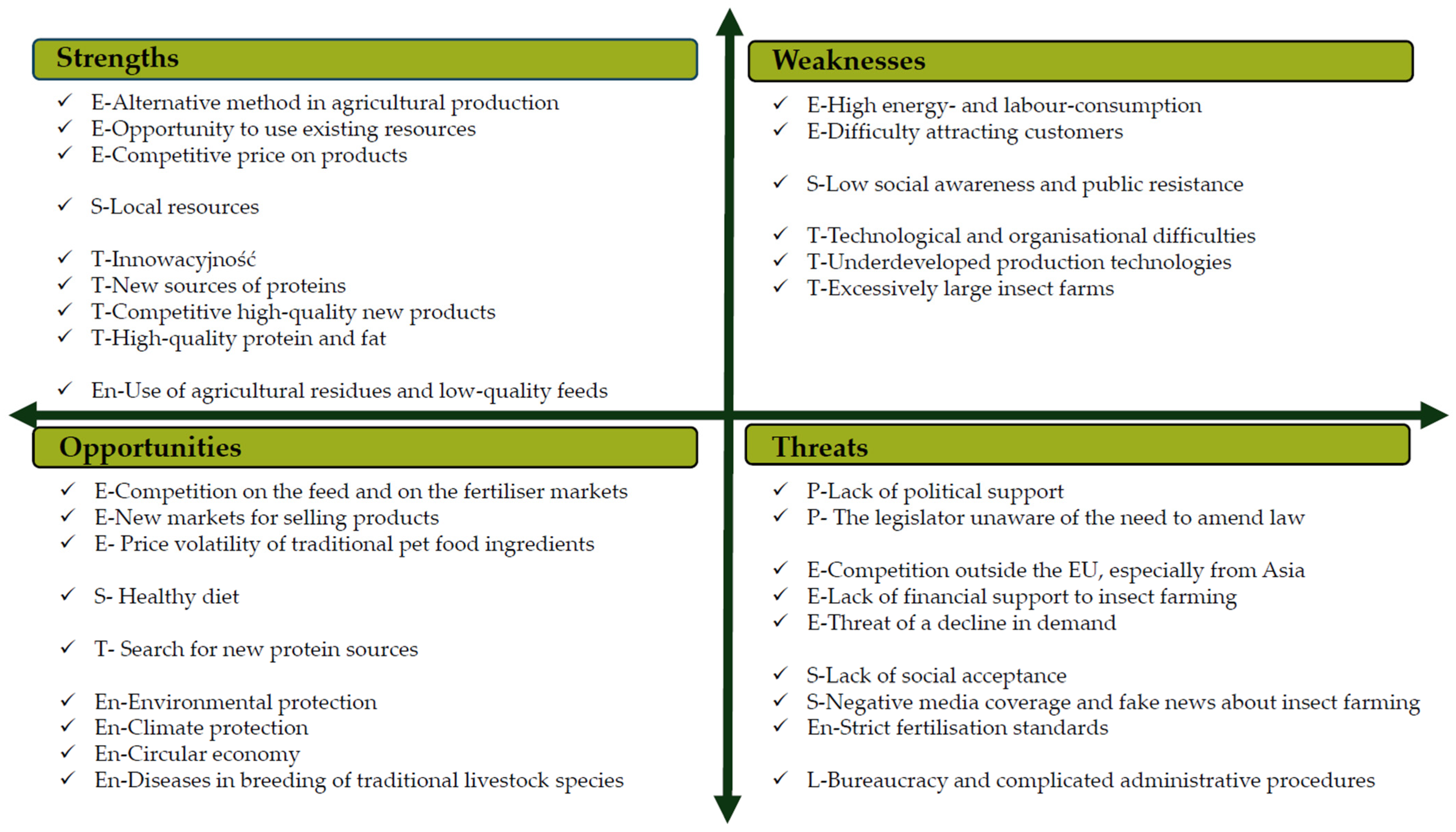
3.1. An SWOT Analysis of the Insect Farming Sector
3.2. The Legal Status of Insect Processing
3.3. Legal Conditions Concerning Insect Rearing
3.4. Products (Feeds) Allowed for Feeding Farmed Insects
3.5. Insect Production for Feed
3.5.1. Types of Insect-Based Products for Feeding Other Animals
3.5.2. Regulation of Feed Production
3.5.3. Law Regulating Feed Production
3.6. Welfare of Insects
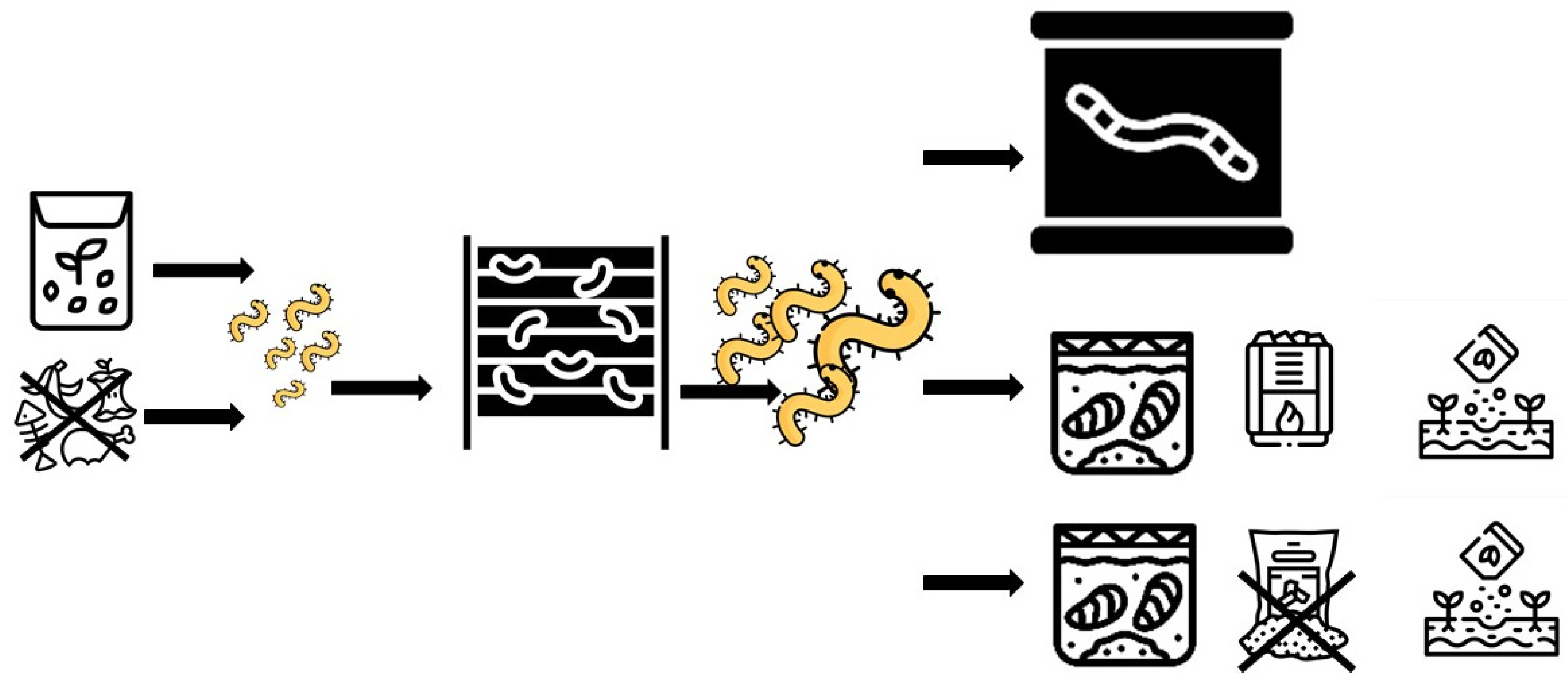
3.7. Frass as Fertilizer
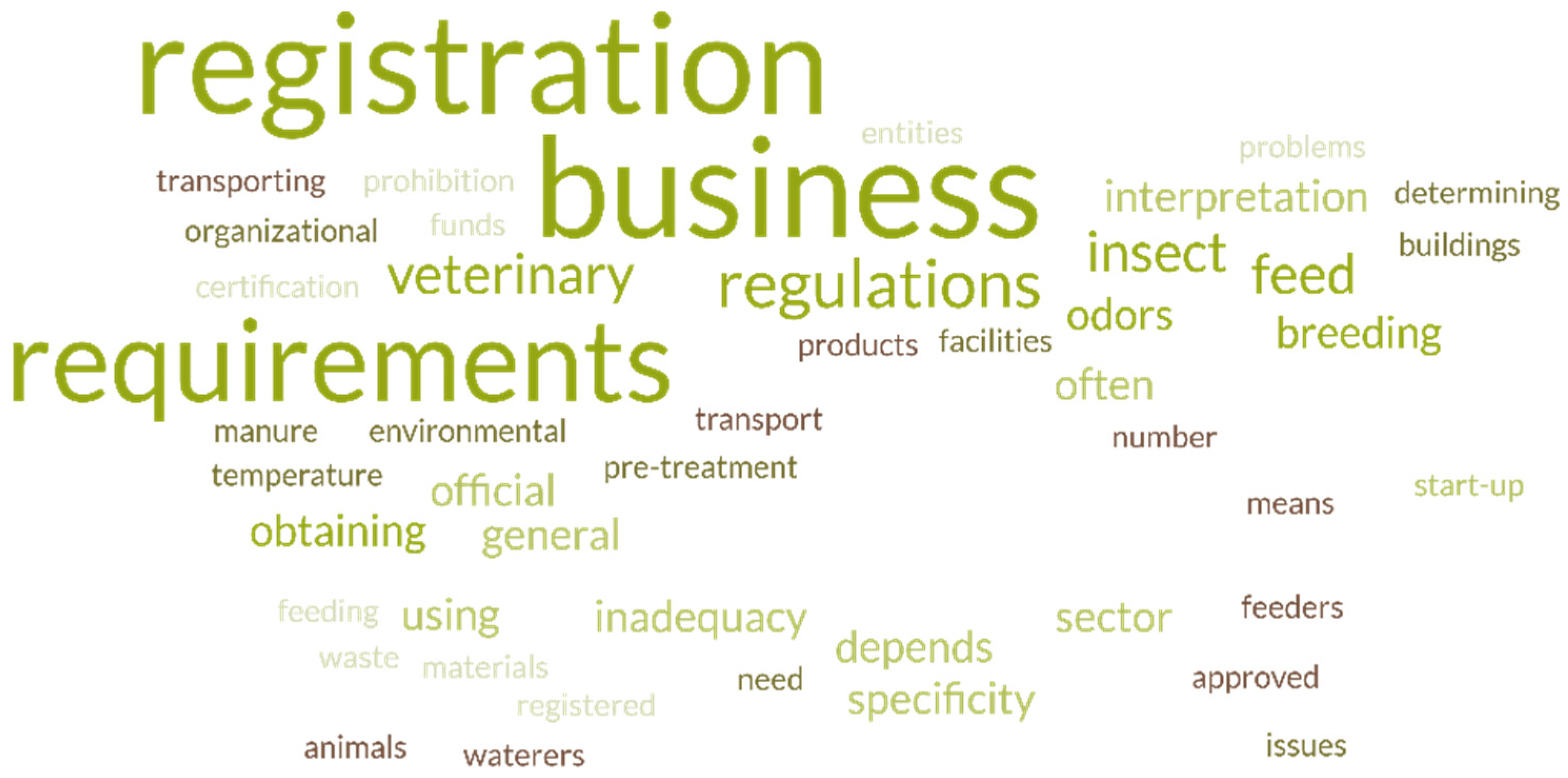
3.8. Problems Indicated by Stakeholders Regarding Insect Farming and Frass Production
3.9. Identified Legal Problems Affecting Insect Framing and Production of Fertilizer from Frass
3.10. Suggested Legal Solutions
3.10.1. Introduction of New Raw Materials (Including Catering Waste) for Feeding Insects
3.10.2. Relaxing Constraints in Frass-Based Fertilizer Production
4. Conclusions
Author Contributions
Funding
Data Availability Statement
Acknowledgments
Conflicts of Interest
References
- Aguilar-Toalá, J.E.; Cruz-Monterrosa, R.G.; Liceaga, A.M. Beyond Human Nutrition of Edible Insects: Health Benefits and Safety Aspects. Insects 2022, 13, 1007. [Google Scholar] [CrossRef] [Scilit] [PubMed]
- Alejandro Ruiz, F.E.; Ortega Jácome, J.F.; Tejera, E.; Alvarez-Suarez, J.M. Edible insects as functional foods: Bioactive compounds, health benefits, safety concerns, allergenicity, and regulatory considerations. Front. Nutr. 2025, 12, 1571084. [Google Scholar] [CrossRef] [Scilit] [PubMed]
- Aguilar-Toalá, J.E.; Vidal-Limón, A.M.; Liceaga, A.M. Advancing Food Security with Farmed Edible Insects: Economic, Social, and Environmental Aspects. Insects 2025, 16, 67. [Google Scholar] [CrossRef] [Scilit]
- Beller, S.; Grundmann, S.M.; Pies, K.; Most, E.; Schuchardt, S.; Seel, W.; Simon, M.-C.; Eder, K.; Ringseis, R. Effect of replacing soybean meal with Hermetia illucens meal on cecal microbiota, liver transcriptome, and plasma metabolome of broilers. Poult. Sci. 2024, 103, 103635. [Google Scholar] [CrossRef] [Scilit]
- Bachev, H.; Ivanov, B.; Toteva, D.; Sokolova, E. Agrarian sustainability in Bulgaria—Economic, social and ecological aspects. Bulg. J. Agric. Sci. 2017, 23, 519–525. [Google Scholar]
- Lange, K.W.; Nakamura, Y. Potential contribution of edible insects to sustainable consumption and production. Front. Sustain. 2023, 4, 1112950. [Google Scholar] [CrossRef] [Scilit]
- Gori, A.; Armani, A.; Pedonese, F.; Benini, O.; Mancini, S.; Nuvoloni, R. Heavy metals (Pb, Cd, Ni) in insect-based products for human consumption sold by e-commerce in the EU market: Occurrence and potential health risk associated with dietary exposure. Food Control 2025, 167, 110781. [Google Scholar] [CrossRef] [Scilit]
- Liceaga, A.M. Processing insects for use in the food and feed industry. Curr. Opin. Insect Sci. 2021, 48, 32–36. [Google Scholar] [CrossRef] [Scilit]
- Álvarez-Suárez, J.M.; Liceaga, A.M. Toward a regional regulatory framework for edible insects in Latin America: Opportunities and challenges. Front. Sustain. Food Syst. 2025, 9, 1731296. [Google Scholar] [CrossRef] [Scilit]
- Food Safety and Security Act 2025 (No. 7 of 2025) Republic of Singapore Government Gazette. Available online: https://sso.agc.gov.sg/Act/FSSA2025 (accessed on 27 February 2026).
- Krongdang, S.; Venkatachalam, K.; Chitov, T.; Wangtueai, S.; Wongsa, J.; Parametthanuwat, T.; Charoenphun, N. Edible Insect Production in Thailand: Sustainable Supply Chain Management. Insects 2025, 16, 827. [Google Scholar] [CrossRef] [Scilit]
- Xie, B.; Zhu, Y.; Chu, X.; Pokharel, S.S.; Qian, L.; Chen, F. Research Progress and Production Status of Edible Insects as Food in China. Foods 2024, 13, 1986. [Google Scholar] [CrossRef] [Scilit]
- Van Huis, A. Prospects of insects as food and feed. Org. Agric. 2021, 11, 301–308. [Google Scholar] [CrossRef] [Scilit]
- Svanberg, I.; Berggren, A. Insects as past and future food in entomophobic Europe. Food Cult. Soc. 2021, 24, 624–638. [Google Scholar] [CrossRef] [Scilit]
- Meijer, N.; Safitri, R.A.; Tao, W.; Hoek-Van den Hil, E.F. Review: European Union legislation and regulatory framework for edible insect production—Safety issues. Animal 2025, 19, 101468. [Google Scholar] [CrossRef] [Scilit]
- Van Huis, A.; Oonincx, D.G.A.B. The environmental sustainability of insects as food and feed. A review. Agron. Sustain. Dev. 2017, 37, 43. [Google Scholar] [CrossRef] [Scilit]
- Dicke, M. Insects as feed and the Sustainable Development Goals. J. Insects Food Feed 2018, 4, 147–156. [Google Scholar] [CrossRef] [Scilit]
- Raheem, D.; Carrascosa, C.; Oluwole, O.B.; Nieuwland, M.; Saraiva, A.; Millán, R.; Raposo, A. Traditional consumption of and rearing edible insects in Africa, Asia and Europe. Crit. Rev. Food Sci. Nutr. 2019, 59, 2169–2188. [Google Scholar] [CrossRef] [Scilit]
- Lähteenmäki-Uutela, A.; Marimuthu, S.B.; Meijer, N. Regulations on insects as food and feed: A global comparison. J. Insects Food Feed 2021, 7, 849–856. [Google Scholar] [CrossRef] [Scilit]
- Żuk-Gołaszewska, K.; Gałęcki, R.; Obremski, K.; Smetana, S.; Figiel, S.; Gołaszewski, J. Edible insect farming in the context of the EU regulations and marketing—An overview. Insects 2022, 13, 446. [Google Scholar] [CrossRef] [Scilit]
- Montanari, F.; Pinto de Moura, A.; Miguel Cunha, L. The EU regulatory framework for insects as food and feed and its current constraints. In Production and Commercialization of Insects as Food and Feed: Identification of the Main Constraints in the European Union; Montanari, F., Pinto de Moura, A., Miguel Cunha, L., Eds.; Springer International Publishing: Cham, Switzerland, 2021; pp. 41–78. [Google Scholar] [CrossRef] [Scilit]
- Marien, A.; Dubois, B.; Fumière, O.; Anselmo, A.; Maljean, J.; Debailleul, C.; Morin, J.-F.; Debode, F. Authentication of Insect-Based Products in Food and Feed: A Benchmark Survey. Insects 2025, 16, 729. [Google Scholar] [CrossRef] [Scilit]
- Leigh, D. SWOT Analysis. In Handbook of Improving Performance in the Workplace; John Wiley & Sons: Hoboken, NJ, USA, 2009; Volumes 1–3, pp. 115–140. [Google Scholar] [CrossRef] [Scilit]
- Magondu, E.; Njogu, L.; Ouko, K.; Mboya, J.B.; Muthoka, M.; Yossa, R.; Munguti, J.; Opiyo, M.A.; Meenakshisundaram, M.; Tanga, C.M.; et al. A PESTEL/SWOT Matrix Analysis of Sustainable Aquafeed Sector: A Case of Kenya’s Fish Feed Sector. Rev. Aquac. 2025, 17, e70081. [Google Scholar] [CrossRef] [Scilit]
- How to Conduct a PESTLE Analysis. 2021. Available online: https://www.runi.ac.il/media/fdclcptd/use-ibisworld-research-for-pestle-analysis.pdf (accessed on 29 December 2025).
- Gasco, L.; Acuti, G.; Bani, P.; Zotte, A.D.; Danieli, P.P.; De Angelis, A.; Fortina, R.; Marino, R.; Parisi, G.; Piccolo, G.; et al. Insect and fish by-products as sustainable alternatives to conventional animal proteins in animal nutrition. Ital. J. Anim. Sci. 2020, 19, 360–372. [Google Scholar] [CrossRef] [Scilit]
- Girotto, F.; Piazza, L. Food waste bioconversion into new food: A mini-review on nutrients circularity in the production of mushrooms, microalgae and insects. Waste Manag. Res. 2022, 40, 47–53. [Google Scholar] [CrossRef] [Scilit]
- Blessie, R.F.; Pragalyaashree, M.M.; Leya, B.; Nivetha, T.U. Meat consumption trends: Health impacts, alternatives, and sustainability perspectives. Theory Pract. Meat Process. 2025, 10, 247–264. [Google Scholar] [CrossRef] [Scilit]
- Glencross, B.; Ling, X.; Gatlin, D.; Kaushik, S.; Øverland, M.; Newton, R.; Valente, L.M.P. A SWOT Analysis of the Use of Marine, Grain, Terrestrial-Animal and Novel Protein Ingredients in Aquaculture Feeds. Rev. Fish. Sci. Aquac. 2024, 32, 396–434. [Google Scholar] [CrossRef] [Scilit]
- Regulation (EC) No 178/2002 of the European Parliament and of the Council of 28 January 2002 Laying Down the General Principles and Requirements of Food Law, Establishing the European Food Safety Authority and Laying Down Procedures in Matters of Food Safety, OJ L 31, 1.2.2002. Available online: https://eur-lex.europa.eu/eli/reg/2002/178/oj (accessed on 29 December 2025).
- Regulation (EC) No 852/2004 of the European Parliament and of the Council of 29 April 2004 on the Hygiene of Foodstuffs, OJ L 139, 30.4.2004. pp. 1–54. Available online: https://eur-lex.europa.eu/eli/reg/2004/852/oj/eng (accessed on 29 December 2025).
- Regulation (EC) No 853/2004 of the European Parliament and of the Council of 29 April 2004 Laying Down Specific Hygiene Rules for Food of Animal Origin, OJ L 139, 30.4.2004. Available online: https://eur-lex.europa.eu/legal-content/en/ALL/?uri=CELEX%3A32004R0853 (accessed on 29 December 2025).
- Regulation (EU) 2017/625 of the European Parliament and of the Council of 15 March 2017 on Official Controls and Other Official Activities Performed to Ensure the Application of Food and Feed Law, Rules on Animal Health and Welfare, Plant Health and Plant Protection Products, Amending Regulations (EC) No 999/2001, (EC) No 396/2005, (EC) No 1069/2009, (EC) No 1107/2009, (EU) No 1151/2012, (EU) No 652/2014, (EU) 2016/429 and (EU) 2016/2031 of the European Parliament and of the Council, Council Regulations (EC) No 1/2005 and (EC) No 1099/2009 and Council Directives 98/58/EC, 1999/74/EC, 2007/43/EC, 2008/119/EC and 2008/120/EC, and Repealing Regulations (EC) No 854/2004 and (EC) No 882/2004 of the European Parliament and of the Council, Council Directives 89/608/EEC, 89/662/EEC, 90/425/EEC, 91/496/EEC, 96/23/EC, 96/93/EC and 97/78/EC and Council Decision 92/438/EEC (Official Controls Regulation) (Text with EEA Relevance), OJ L 95, 7.4.2017. Available online: https://eur-lex.europa.eu/eli/reg/2017/625/oj/eng (accessed on 29 December 2025).
- Regulation (EU) No 1169/2011 of the European Parliament and of the Council of 25 October 2011 on the Provision of Food Information to Consumers, Amending Regulations (EC) No 1924/2006 and (EC) No 1925/2006 of the European Parliament and of the Council, and Repealing Commission Directive 87/250/EEC, Council Directive 90/496/EEC, Commission Directive 1999/10/EC, Directive 2000/13/EC of the European Parliament and of the Council, Commission Directives 2002/67/EC and 2008/5/EC and Commission Regulation (EC) No 608/2004 Text with EEA Relevance, OJ L 304, 22.11.2011. Available online: https://eur-lex.europa.eu/eli/reg/2011/1169/oj/eng (accessed on 29 December 2025).
- Regulation (EC) No 767/2009 of the European Parliament and of the Council of 13 July 2009 on the Placing on the Market and Use of Feed, Amending European Parliament and Council Regulation (EC) No 1831/2003 and Repealing Council Directive 79/373/EEC, Commission Directive 80/511/EEC, Council Directives 82/471/EEC, 83/228/EEC, 93/74/EEC, 93/113/EC and 96/25/EC and Commission Decision 2004/217/EC (Text with EEA relevance), OJ L 229, 1.9.2009. Available online: https://eur-lex.europa.eu/legal-content/EN/TXT/?uri=CELEX%3A32009R0767 (accessed on 29 December 2025).
- Regulation (EC) No 1069/2009 of the European Parliament and of the Council of 21 October 2009 Laying Down Health Rules as Regards Animal By-Products and Derived Products Not Intended for Human Consumption and Repealing Regulation (EC) No 1774/2002 (Animal by-products Regulation), OJ L 300, 14.11.2009. Available online: https://eur-lex.europa.eu/eli/reg/2009/1069/oj (accessed on 29 December 2025).
- Commission Regulation (EU) No 142/2011 of 25 February 2011 Implementing Regulation (EC) No 1069/2009 of the European Parliament and of the Council Laying Down Health Rules as Regards Animal By-Products and Derived Products Not Intended for Human Consumption and Implementing Council Directive 97/78/EC as Regards Certain Samples and Items Exempt from Veterinary Checks at the Border Under That Directive Text with EEA Relevance, OJ L 54, 26.2.2011. Available online: https://eur-lex.europa.eu/eli/reg/2011/142/oj/eng (accessed on 29 December 2025).
- Regulation (EC) No 999/2001 of the European Parliament and of the Council of 22 May 2001 Laying Down Rules for the Prevention, Control and Eradication of Certain Transmissible Spongiform Encephalopathies, OJ L 147, 31.5.2001. Available online: https://eur-lex.europa.eu/eli/reg/2001/999/oj (accessed on 29 December 2025).
- Commission Regulation (EU) No 68/2013 of 16 January 2013 on the Catalogue of Feed Materials Text with EEA Relevance, OJ L 29, 30.1.2013. Available online: https://eur-lex.europa.eu/eli/reg/2013/68/oj (accessed on 29 December 2025).
- Regulation (EC) No 1831/2003 of the European Parliament and of the Council of 22 September 2003 on Additives for Use in Animal Nutrition (Text with EEA Relevance), OJ L 268, 18.10.2003. Available online: https://eur-lex.europa.eu/eli/reg/2003/1831/oj/ (accessed on 29 December 2025).
- Directive 2002/32/EC of the European Parliament and of the Council of 7 May 2002 on Undesirable Substances in Animal Feed—Council Statement, OJ L 140, 30.5.2002. Available online: http://data.europa.eu/eli/dir/2002/32/oj (accessed on 29 December 2025).
- Directive 2008/98/EC of the European Parliament and of the Council of 19 November 2008 on Waste and Repealing Certain Directives (Text with EEA Relevance), OJ L 312, 22.11.2008. Available online: https://eur-lex.europa.eu/legal-content/EN/TXT/HTML/?uri=CELEX:32008L0098 (accessed on 29 December 2025).
- Commission Regulation (EU) 2017/893 of 24 May 2017 amending Annexes I and IV to Regulation (EC) No 999/2001 of the European Parliament and of the Council and Annexes X, XIV and XV to Commission Regulation (EU) No 142/2011 as Regards the Provisions on Processed Animal Protein (Text with EEA Relevance.), C/2017/3399, OJ L 138, 25.5.2017. Available online: https://op.europa.eu/en/publication-detail/-/publication/d07e2398-410c-11e7-a9b0-01aa75ed71a1 (accessed on 29 December 2025).
- Commission Regulation (EU) 2021/1925 of 5 November 2021 Amending Certain Annexes to Regulation (EU) No 142/2011 as Regards the Requirements for Placing on the Market of Certain Insect Products and the Adaptation of a Containment Method (Text with EEA Relevance), C/2021/7824, OJ L 393, 8.11.2021. Available online: https://eur-lex.europa.eu/eli/reg/2005/183/oj/eng (accessed on 29 December 2025).
- Regulation (EC) No 183/2005 of the European Parliament and of the Council of 12 January 2005 Laying Down Requirements for Feed Hygiene (Text with EEA Relevance), OJ L 35, 8.2.2005. Available online: https://eur-lex.europa.eu/legal-content/DE/TXT/HTML/?uri=OJ:L:2005:035:FULL&from=IT (accessed on 29 December 2025).
- Council Directive 98/58/EC of 20 July 1998 Concerning the Protection of Animals Kept for Farming Purposes, OJ L 221, 8.8.1998. Available online: https://eur-lex.europa.eu/legal-content/EN/TXT/?uri=oj:JOL_1998_221_R_TOC (accessed on 29 December 2025).
- Regulation (EU) 2019/1009 of the European Parliament and of the Council of 5 June 2019 Laying Down Rules on the Making Available on the Market of EU Fertilising Products and Amending Regulations (EC) No 1069/2009 and (EC) No 1107/2009 and Repealing Regulation (EC) No 2003/2003 (Text with EEA Relevance), PE/76/2018/REV/1, OJ L 170, 25.6.2019. Available online: https://eur-lex.europa.eu/legal-content/ES/ALL/?uri=CELEX:32021R1925 (accessed on 29 December 2025).
- Ustawa z Dnia 14 Grudnia 2012 r. o Odpadach (t.j. Dz.U. z 2023 r., poz.1587), EN: Act of 14 December 2012 on Waste. Available online: https://isap.sejm.gov.pl/isap.nsf/download.xsp/WDU20230001587/U/D20231587Lj.pdf (accessed on 29 December 2025).
- Ustawa z Dnia 6 Marca 2018 r. Prawo Przedsiębiorców, (t.j. Dz. U. z 2025 r. poz. 1480), (eng: Act of 6 March 2018, Entrepreneurs’ Law). Available online: https://isap.sejm.gov.pl/isap.nsf/download.xsp/WDU20250001480/U/D20251480Lj.pdf (accessed on 29 December 2025).
- Ustawa z Dnia 16 Grudnia 2005 r. o Produktach Pochodzenia Zwierzęcego (t.j. Dz. U. z 2025 r. poz. 1424), (eng: Act of 16 December 2005 on Products of Animal Origin). Available online: https://isap.sejm.gov.pl/isap.nsf/download.xsp/WDU20060170127/U/D20060127Lj.pdf (accessed on 29 December 2025).
- Ustawa z Dnia 10 Lipca 2007 r. o Nawozach i Nawożeniu (t.j. Dz.U. z 2024 r., poz. 105 ze zm.), (Eng: Act of 10 July 2007 on Fertilizers and Fertilization). Available online: https://isap.sejm.gov.pl/isap.nsf/download.xsp/WDU20071471033/U/D20071033Lj.pdf (accessed on 29 December 2025).
- Rozporządzenie Ministra Rolnictwa i Rozwoju Wsi z dnia 9 Sierpnia 2024 r w Sprawie Wykonania Niektórych Przepisów Ustawy o Nawozach i Nawożeniu, (.D.z.U. z 2024 r., poz. 1261), (Eng: Regulation of the Minister of Agriculture and Rural Development of 9 August 2024 on the Implementation of Certain Provisions of the Act on Fertilizers and Fertilization). Available online: https://isap.sejm.gov.pl/isap.nsf/download.xsp/WDU20240001261/O/D20241261.pdf (accessed on 29 December 2025).
- Skotnicka, M.; Karwowska, K.; Kłobukowski, F.; Borkowska, A.; Pieszko, M. Possibilities of the Development of Edible Insect-Based Foods in Europe. Foods 2021, 10, 766. [Google Scholar] [CrossRef] [Scilit] [PubMed]
- Document Ares(2019)382900. Available online: https://eur-lex.europa.eu/legal-content/EN/TXT/?uri=PI_COM:Ares(2019)382900 (accessed on 29 December 2025).
- IPIFF (International Platform of Insects for Food and Feed). Factsheet: Animal Welfare in Insect Production. 2019. Available online: https://ipiff.org/wp-content/uploads/2022/11/Insect-welfare-factsheet-final.pdf (accessed on 4 January 2026).
- SCoPAFF (Standing Committee on Plants, Animals, Food and Feed Section Animal Nutrition). Sante.g.,3(2024)2112308: Summary Report 15–16 February 2024. Available online: https://food.ec.europa.eu/document/download/48254f32-f70b-4758-b385-db7edf45627b_en?filename=reg-com_aninutrit_20240215_sum.pdf (accessed on 4 January 2026).
- Niyonsaba, H.H.; Höhler, J.; Van der Fels Klerx, H.J.; Slijper, T.; Alleweldt, F.; Kara, S.; Zanoli, R.; Costa, A.I.A.; Peters, M.; Meuwissen, M.P.M. Barriers, risks and risk management strategies in European insect supply chains. J. Insects Food Feed 2023, 9, 691–705. [Google Scholar] [CrossRef] [Scilit]
- Veldkamp, T.; Meijer, N.; Alleweldt, F.; Deruytter, D.; Van Campenhout, L.; Gasco, L.; Roos, N.; Smetana, S.; Fernandes, A.; Van der Fels-Klerx, H.J. Overcoming technical and market barriers to enable sustainable large-scale production and consumption of insect proteins in Europe: A SUSINCHAIN perspective. Insects 2022, 13, 281. [Google Scholar] [CrossRef] [Scilit]
- Meijer, N.; Van Raamsdonk, L.W.; Gerrits, E.W.; Appel, M.J. The use of animal by-products in a circular bioeconomy: Time for a TSE road map 3? Heliyon 2023, 9, e14021. [Google Scholar] [CrossRef] [Scilit]
- Van Raamsdonk, L.W.D.; Meijer, N.; Gerrits, E.W.J.; Appel, M.J. New approaches for safe use of food by-products and biowaste in the feed production chain. J. Clean. Prod. 2023, 388, 135954. [Google Scholar] [CrossRef] [Scilit]
- Van Raamsdonk, L.W.; Prins, T.W.; Meijer, N.; Scholtens, I.M.; Bremer, M.G.; De Jong, J. Bridging legal requirements and analytical methods: A review of monitoring opportunities of animal proteins in feed. Food Addit. Contam. Part A 2019, 36, 46–73. [Google Scholar] [CrossRef] [Scilit]
- Battiston, R.; Di Pietro, W.; Anderson, K. The pet mantis market. J. Orthoptera Res. 2022, 31, 63–68. [Google Scholar] [CrossRef] [Scilit]
- Greyvenstein, B.; Du Plessis, H.; Van den Berg, J. The charismatic praying mantid: A gateway for insect conservation. Afr. Zool. 2020, 55, 109–118. [Google Scholar] [CrossRef] [Scilit]
- Valdés, F.; Villanueva, V.; Durán, E.; Campos, F.; Avendaño, C.; Sánchez, M.; Domingoz-Araujo, C.; Valenzuela, C. Insects as feed for companion and exotic pets: A current trend. Animals 2022, 12, 1450. [Google Scholar] [CrossRef] [Scilit] [PubMed]
- Van Huis, A. Welfare of farmed insects. J. Insects Food Feed 2021, 7, 573–584. [Google Scholar] [CrossRef] [Scilit]
- Klobučar, T.; Fisher, D.N. When do we start caring about insect welfare? Neotrop. Entomol. 2023, 52, 5–10. [Google Scholar] [CrossRef] [Scilit]
- Delvendahl, N.; Rumpold, B.A.; Langen, N. Edible insects as food–insect welfare and ethical aspects from a consumer perspective. Insects 2022, 13, 121. [Google Scholar] [CrossRef] [Scilit] [PubMed]
- Barrett, M.; Fischer, B. Challenges in farmed insect welfare: Beyond the question of sentience. Anim. Welf. 2023, 32, e4. [Google Scholar] [CrossRef] [Scilit] [PubMed]
- Barrett, M.; Adcock, S.J.J. Animal welfare science: An integral piece of sustainable insect agriculture. J. Insects Food Feed 2023, 10, 517–531. [Google Scholar] [CrossRef] [Scilit]
- Chirere, T.E.S.; Khalil, S.; Lalander, C. Fertiliser effect on Swiss chard of black soldier fly larvae-frass compost made from food waste and faeces. J. Insects Food Feed 2021, 7, 457–469. [Google Scholar] [CrossRef] [Scilit]
- Klammsteiner, T.; Turan, V.; Fernández-Delgado Juárez, M.; Oberegger, S.; Insam, H. Suitability of black soldier fly frass as soil amendment and implication for organic waste hygienization. Agronomy 2020, 10, 1578. [Google Scholar] [CrossRef] [Scilit]
- Setti, L.; Francia, E.; Pulvirenti, A.; Gigliano, S.; Zaccardelli, M.; Pane, C.; Caradonia, F.; Bortolini, S.; Maistrello, L.; Ronga, D. Use of black soldier fly (Hermetia illucens (L.), Diptera: Stratiomyidae) larvae processing residue in peat-based growing media. Waste Manag. 2019, 95, 278–288. [Google Scholar] [CrossRef] [Scilit]
- Quilliam, R.S.; Nuku-Adeku, C.; Maquart, P.; Little, D.; Newton, R.; Murray, F. Integrating insect frass biofertilisers into sustainable peri-urban agro-food systems. J. Insects Food Feed. 2020, 6, 315–322. [Google Scholar] [CrossRef] [Scilit]
- Beesigamukama, D.; Mochoge, B.; Korir, N.K.; Fiaboe, K.K.M.; Nakimbugwe, D.; Khamis, F.M.; Subramanian, S.; Dubois, T.; Musyoka, M.W.; Ekesi, S.; et al. Exploring black soldier fly frass as novel fertilizer for improved growth, yield, and nitrogen use efficiency of maize under field conditions. Front. Plant Sci. 2020, 11, 574592. [Google Scholar] [CrossRef] [Scilit] [PubMed]
- Gudinskaitė, G.; Paleckienė, R. The Possibilities of Using Non-Traditional Raw Materials for Fertilizing Products. Sustainability 2025, 17, 5710. [Google Scholar] [CrossRef] [Scilit]
- Ashworth, A.J.; Amorim, H.C.S.; Drescher, G.L.; Moore, P.A.; Rojas, M.G.; Morales-Ramos, J.; Donoghue, A.M. Insect frass fertilizer as soil amendment for improved forage and soil health in circular systems. Sci. Rep. 2025, 15, 3024. [Google Scholar] [CrossRef] [Scilit]
- Larouche, J.; Campbell, B.; Hénault-Éthier, L.; Banks, I.J.; Tomberlin, J.K.; Preyer, C.; Deschamps, M.H.; Vandenberg, G.W. The edible insect sector in Canada and the United States. Anim. Front. 2023, 13, 16–25. [Google Scholar] [CrossRef] [Scilit] [PubMed]



| Areas of Regulation | Legal Acts | General Solutions |
|---|---|---|
| Insect rearing | Regulation (EC) No 178/2002 [30], 852/2004 [31], 853/2004 [32] and 2017/625 [33] Regulation (EC) No 1169/2011 [34] Regulation (EC) No 767/2009 Annex III [35] | Food and feed safety. HACCP system. Food labeling. Prohibits the use household waste or manure for animal nutrition. |
| Feeding of farmed insects | Regulation No 1069/2009 [36] Regulation (EC) No 142/2011 Annex IV [37] Regulation (EC) No 999/2002 Annex XIV Chapter 1 Section 2, 5b [38], Regulation (EC) No 1069/2009 [37], Regulation (EC) No 142/2011 [37] Regulation (EC) No 999/2001 Article 7 and Annex IV [38] Regulation (EC) No 68/2013 [39] Regulation (EC) No 767/2009 Annex III [35] Regulation (EC) No 1831/2003 [40] Regulation (EC) No 142/2011 Section 10 Annex X [37] Directive No 2002/32/EC [41] Directive No 2008/98/EC Article 5 [42] Regulation (EC) No 1069/2009 [36] | Classification of insects as farmed animals. Materials approved for insect nutrition. A ban on the use of manure, catering waste and untreated animal by-products. A feed ban. A catalogue of feed materials materials prohibited in animal nutrition. Authorized feed additives food removed from human consumption. Undesirable substances in animal feed. Insects intended as fishing bait. Recognition of a substance as a by-product. By-products for processing animal protein. |
| Insect species for feed production | Regulation (EC) No 999/2001 Article 7(1) [38]. Regulation (EC) No 767/2009 Article 4 [35]. Regulation (EC) No 1069/2009 Articles 10 and 31 [36], Regulation (EC) No 142/2011 Annex X [37]. Regulation (EC) No 142/2011 Annex X [37]. Regulation (EC) No 142/2011 Annex I [37]. Regulation (EC) No 1069/2009 [36]. Regulation (EC) No 142/2011 Chapter III Annex IV [37]. Regulation (EC) No 2017/893 [43]. Regulation (EC) No 2021/1925) [44]. | A feed ban. Safety and marketing requirements. Fats intended to feed. The processing of fats and hydrolyzed proteins requirements. Products of animal origin that do not require processing such as PAPs. Three categories of animal by-products. Processing of insect biomass to PAPs. The lists of insect species approved for farming. Added species to the above list silkworm (Bombyx mori). |
| Regulation of feed production | Regulation No 183/2005 Article 2 [45]. Regulation No 183/2005 Annex II [45]. Regulation (EC) No 142/2011 Annex IV [37]. Regulation (EC) No 767/2009 [35]. Regulation (EC) No 178/2002 Article 15 [31]. | Business entities operating on the feed market. Rules of food hygiene and an HACCP system. Methods using by insect-based feed manufacturers. Requirements applied to feeds sold on the market. Marking and labeling of feed. |
| Welfare of insects | Directive 98/58/EC Article 1 [46]. | Welfare in animal rearing. |
| Frass as fertilizer | Regulation (EU) No 142/2011 Annex I [37]. Regulation (EU) 2021/1925 [44]. Regulation (EU) No 2019/1009 [47]. | The possibility of using frass for fertilization. Safety requirements for frass to meet. Insect farming regulations. |
| Areas of Regulation | Legal Acts | General Solutions |
|---|---|---|
| Feeding of farmed insects | Act of 14 December 2012, on waste Article 10 [48]. | Recognition of a substance as a by-product. |
| Insect production for feed | Act of 6 March 2018, Entrepreneurs’ Law Article 6 item 1 point 1 [49]. Act of 16 December 2005, on products of animal origin [50]. | Requirements applied to business activity in the rearing and production of useable insects on a farm the procedure for the registration of business entities. |
| Frass as fertilizer | Act of 10 July 2007 on fertilisers and fertilisation [51] Regulation of the Minister of Agriculture and Rural Development of 9 August 2024 on implementation of certain provisions of the Act of Fertilisers and Fertilisation [52]. | Insect farming regulations. |
Disclaimer/Publisher’s Note: The statements, opinions and data contained in all publications are solely those of the individual author(s) and contributor(s) and not of MDPI and/or the editor(s). MDPI and/or the editor(s) disclaim responsibility for any injury to people or property resulting from any ideas, methods, instructions or products referred to in the content. |
© 2026 by the authors. Licensee MDPI, Basel, Switzerland. This article is an open access article distributed under the terms and conditions of the Creative Commons Attribution (CC BY) license.
Share and Cite
Zięty, J.J.; Zębek, E.M.; Olba-Zięty, E.; Krzyżaniak, M.; Stolarski, M.J. Identification of Legal Barriers to the Rearing and Processing of Insects in the EU—Implications Based on a Case Study. Insects 2026, 17, 319. https://doi.org/10.3390/insects17030319
Zięty JJ, Zębek EM, Olba-Zięty E, Krzyżaniak M, Stolarski MJ. Identification of Legal Barriers to the Rearing and Processing of Insects in the EU—Implications Based on a Case Study. Insects. 2026; 17(3):319. https://doi.org/10.3390/insects17030319
Chicago/Turabian StyleZięty, Jakub Jan, Elżbieta Małgorzata Zębek, Ewelina Olba-Zięty, Michał Krzyżaniak, and Mariusz Jerzy Stolarski. 2026. "Identification of Legal Barriers to the Rearing and Processing of Insects in the EU—Implications Based on a Case Study" Insects 17, no. 3: 319. https://doi.org/10.3390/insects17030319
APA StyleZięty, J. J., Zębek, E. M., Olba-Zięty, E., Krzyżaniak, M., & Stolarski, M. J. (2026). Identification of Legal Barriers to the Rearing and Processing of Insects in the EU—Implications Based on a Case Study. Insects, 17(3), 319. https://doi.org/10.3390/insects17030319