Nematodes in the Pine Forests of Northern and Central Greece


1
Forest Research Institute, Hellenic Agricultural Organization Demeter, Vassilika, 57006 Thessaloniki, Greece
2
Zoology Department, School of Biology, Faculty of Sciences, Aristotle University of Thessaloniki, 54124 Thessaloniki, Greece
3
Scientific Directorate of Entomology and Agricultural Zoology, Benaki Phytopathological Institute, Kifissia, 14561 Athens, Greece
*
Author to whom correspondence should be addressed.
Insects 2022, 13(2), 194; https://doi.org/10.3390/insects13020194
Submission received: 13 December 2021
/
Revised: 10 February 2022
/
Accepted: 11 February 2022
/
Published: 13 February 2022
(This article belongs to the Special Issue Selected Papers from the 1st International Electronic Conference on Entomology)
Simple Summary
Pine wood nematode Bursaphelenchus xylophilus is the agent of pine wilt disease and one of the most important forest tree pathogens worldwide, transmitted through beetles of the Monochamus genus. As an invasive species, it has spread beyond its natural range by human activity mainly wood trade. The devastating impact it has on pine forests has led to severe environmental and economic damages in its introduced countries. The wide distribution of Monochamus spp. beetles in many parts of the world along with favourable climatic conditions, which are both important factors for the establishment of pine wilt disease, have raised awareness over its continuous expansion. Therefore, in an attempt to control and even inhibit its further spread and consequently its severely adverse impacts, appropriate measures have already been taken and implemented from countries across the globe.
Abstract
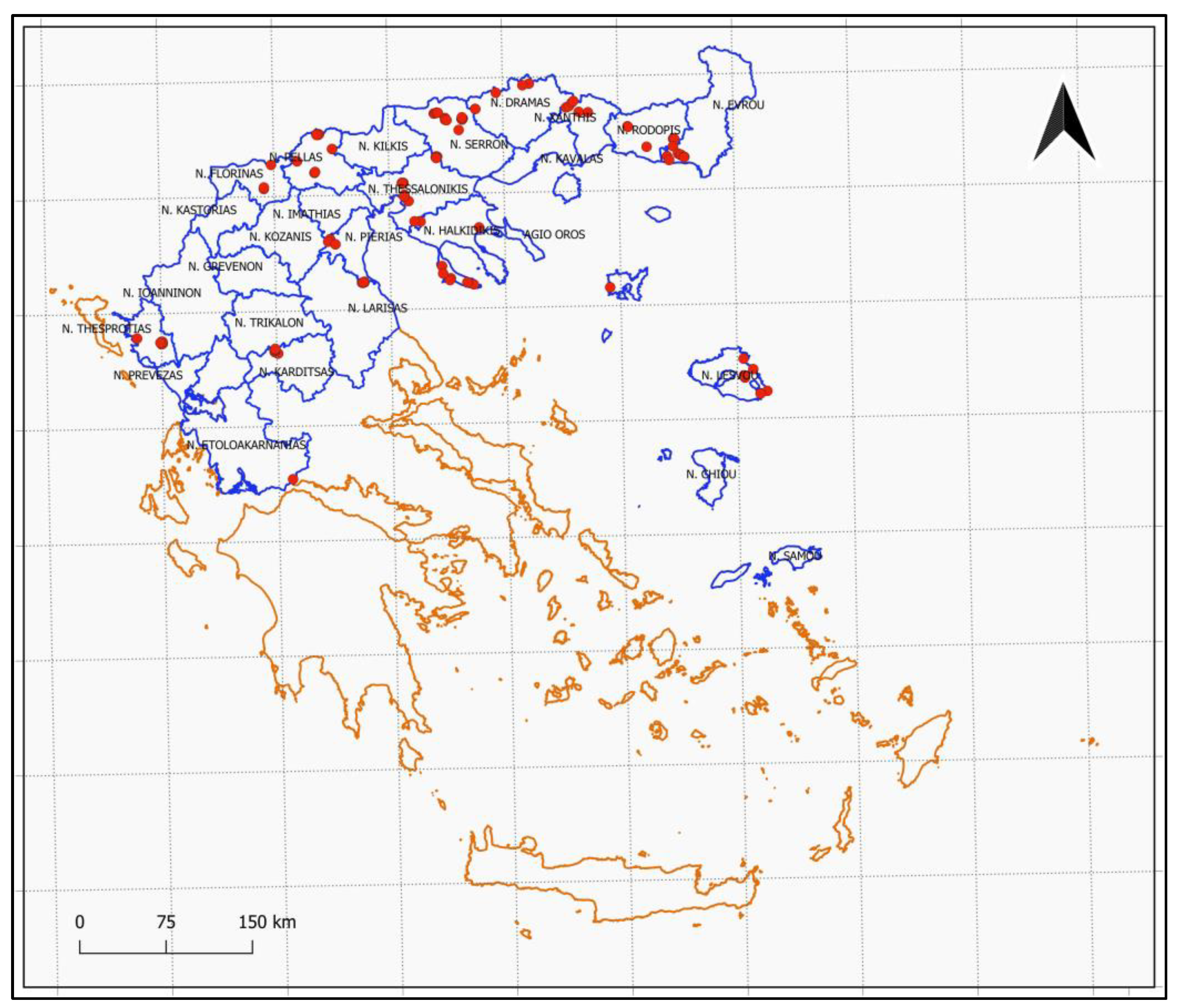
In the context of plants or plant products protection by harmful organisms, measures have been taken by EU countries in order to prevent their introduction and establishment into the EU, and also limit their expansion in case they do enter. Such a case is Bursaphelenchus xylophilus (Parasitaphelenchidae, Nematoda), already recorded in Portugal and Spain. So, Member States should take all the appropriate steps in order to monitor and confine if necessary susceptible plants and/or plant products. Such measures include annual surveys even in countries where pine wilt disease does not occur yet. Therefore, national survey programs are widely established, sampling and examining samples from pine trees showing suspicious symptoms that could potentially be attributed to B. xylophilus. In this direction, such a network has also been established in Greece collecting and examining wood samples nationwide. In total, 123 wood samples were collected from conifer trees of Northern and Central Greece. Though B. xylophilus was absent from all samples examined, four other Bursaphelenchus species were identified. In addition, other nematode taxa were also recorded, including several phytophagous, microbivorous as well as predatory nematode species. This highlights the fact that besides preventing the introduction of B. xylophilus in Greece, national survey programs can significantly contribute to and enhance our knowledge of the indigenous nematode species.
Keywords:
Bursaphelenchus spp.; national survey program; nematodes; conifers; Greece