


Abstract
This study investigates the key performance-related fuel properties of emulsifier–diesel solutions and ethanol-in-diesel microemulsions. This work begins with the in situ polymerization of long alkyl chain-substituted glycidyl methacrylate (R-GMA) in diesel and the optional presence of a second methacrylate monomer. The resulting diesel-soluble oligomer functions as a nonionic emulsifier. Controlled amounts of ethanol are subsequently incorporated into the emulsifier–diesel solution to form a stable microemulsion, referred to as E-Diesel. This study examines how the structure of the emulsifier influences key fuel properties, including (i) ethanol–diesel miscibility, (ii) gross calorific value, (iii) Ramsbottom carbon residue (% of fuel), (iv) entrapped polycyclic aromatic hydrocarbons (PAHs), and (v) fuel lubricity. Both the hydrophilic–hydrophobic balance and the structure of the emulsifier side chains are found to significantly affect these properties. Compared with neat diesel, oligomeric emulsifiers enable the substantial dispersion of ethanol in diesel (up to 18 wt.%). The resulting fuel exhibits a gross calorific value exceeding the theoretical sum of diesel and ethanol at the same composition (a synergistic effect) and achieves an enhancement in lubricity up to 49.5% relative to neat diesel at a 5% emulsifier loading. Although the presence of emulsifiers leads to an increase in the carbon residue by up to 54.7% compared to neat diesel during controlled pyrolysis, it simultaneously reduces the PAH content in the exhaust. Overall, this study establishes fundamental correlations among microemulsion stability, combustion synergy, carbon residue formulation, and fuel lubricity, which are governed by the structure of the emulsifier.
1. Introduction
The inclusion of ethanol in diesel represents a contemporary endeavor to enhance the use of renewable energy because ethanol is primarily produced from the fermentation of lignocellulosic biomass [1], and therefore the amount of CO2 generated from ethanol in compression ignition engines joins part of the carbon cycle [2]. Besides this, alcohol is easy to transport even though it has a lower flash point than diesel. The addition of ethanol into diesel fuels could also cause a reduction in diesel particulate matter and other regulated diesel emissions from most compression ignition (CI) engines; such emissions include CO, hydrocarbons, and NOx [3,4,5]. However, the miscibility gap [6,7] between diesel and ethanol remains a challenging issue.
There are in general two tactics we can use to incorporate ethanol into diesel before it is injected into CI engines: (i) mixing fumigated ethanol and diesel in an engine through dual-fuel injection, which requires a separate fuel tank, separate injectors, fuel lines, and controllers, etc. [8]; and (ii) preparing stable ethanol–diesel mixtures, which can take the form of solutions and microemulsions, respectively. A co-solvent, typically Tri-n-butyl phosphate [9], THF [10] or 1-Butanol [11], is often added to enhance the miscibility between ethanol and diesel because the co-solvent molecules disrupt the aggregation of ethanol molecules due to interactions between them and the adequate solubility of the co-solvents in diesel [12], ensuring the formation of a homogeneous ethanol–diesel solution under the optimum condition.
The application of an emulsifier results in a reverse microemulsion in which the dispersed phase is present in the form of microdroplets, generally in the range of 10 to 100 nm, surrounded by emulsifier molecules [13,14,15]. Hence, an E-Diesel microemulsion is a transparent liquid. Most often, effective emulsifiers for E-Diesel microemulsion have hydrophilic–lipophilic balance (HLB) values that range between 4 and 5, such as sorbitan oleate (Span-80, HLB = 4.3) and ethoxylated octylphenol (Triton X-15, HLB = 4.9), because they are strongly lipophilic, but their hydrophilic heads still possess adequate H-bonding with ethanol or water [16]. Using Span-80 alone with a content between 1 and 5 wt.%, the resulting E-Diesel typically results in a maximum ethanol content below 10 wt.%.
The integration of a nonionic surfactant and an aliphatic alcohol, e.g., methyl oleate (HLB 5.0 to 7.0) and 1-octanol (HLB 7.6–8.2), could stabilize a microemulsion containing 25 vol.% ethanol with an abundant droplet size of about 22 nm in a mixture of palm oil/diesel (1:1) [17]. Alternatively, a recent study developed a specific cationic emulsifier with a configuration of bilateral hydrophobic branched chains from the hydrophilic center (onium + glycol) to stabilize an E-Diesel containing significantly small ethanol droplets (4 to 11 nm) as a dispersed phase. This emulsifier, however, requires a large dosage, e.g., 20 wt.%, to stabilize about 5 wt.% ethanol in a mixture of waste cooking oil/diesel (1:4) [18]. A stable E-Diesel microemulsion could offer better atomization during injection, and, subsequently, fuel–air mixing could result in a micro-explosion in the CI engine [19]. A typical ternary fuel was formulated by assembling diesel, biodiesel (methyl ester of fatty acids), and ethanol, where biodiesel acts as an emulsifier as well as a co-solvent to enhance the miscibility between non-polar naphtha and ethanol [20]. This study exemplifies the miscibility-enhancing role of biodiesel, which primarily relies on the dispersion forces between non-polar molecules and polar molecules.
The primary technical challenges limiting the commercial application of E-Diesel include the thermodynamic instability of co-solvent systems and microemulsions, the inherently low cetane number of ethanol, and a reduced fuel lubricity, viz., a larger wear scar, resulting from the direct blending of ethanol into diesel. The latter arises because ethanol has low viscosity and displaces diesel molecules from metal surfaces. As discussed above, the incorporation of appropriate co-solvents and emulsifiers can effectively address stability issues and, in turn, help mitigate the remaining challenges [21,22,23,24]. Furthermore, the impacts of the emulsifier on the main performance properties of E-Diesel fuels are detailed in Table 1. In contrast to the low-molecular-weight emulsifiers that are widely used in current emulsion fuels, oligomeric emulsifiers have been rarely investigated, largely due to the challenges associated with their synthesis and limited solubility in target fuels. Compared with conventional surfactants, oligomeric emulsifiers not only possess higher molecular weights but also exhibit more versatile chain conformations. Consequently, a rationally designed oligomeric emulsifier is expected to significantly enhance the colloidal stability of E-Diesel microemulsions with a higher ethanol content, potentially eliminating the need for co-solvents by forming a thicker and more elastic interfacial film. This stabilization effect is strongly dependent on the molecular chain architecture, which governs conformational stability [25].
Table 1.
The primary effects of emulsifier on the properties of ethanol–diesel emulsion fuels.
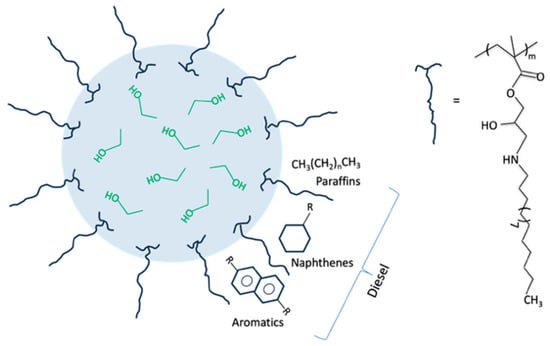
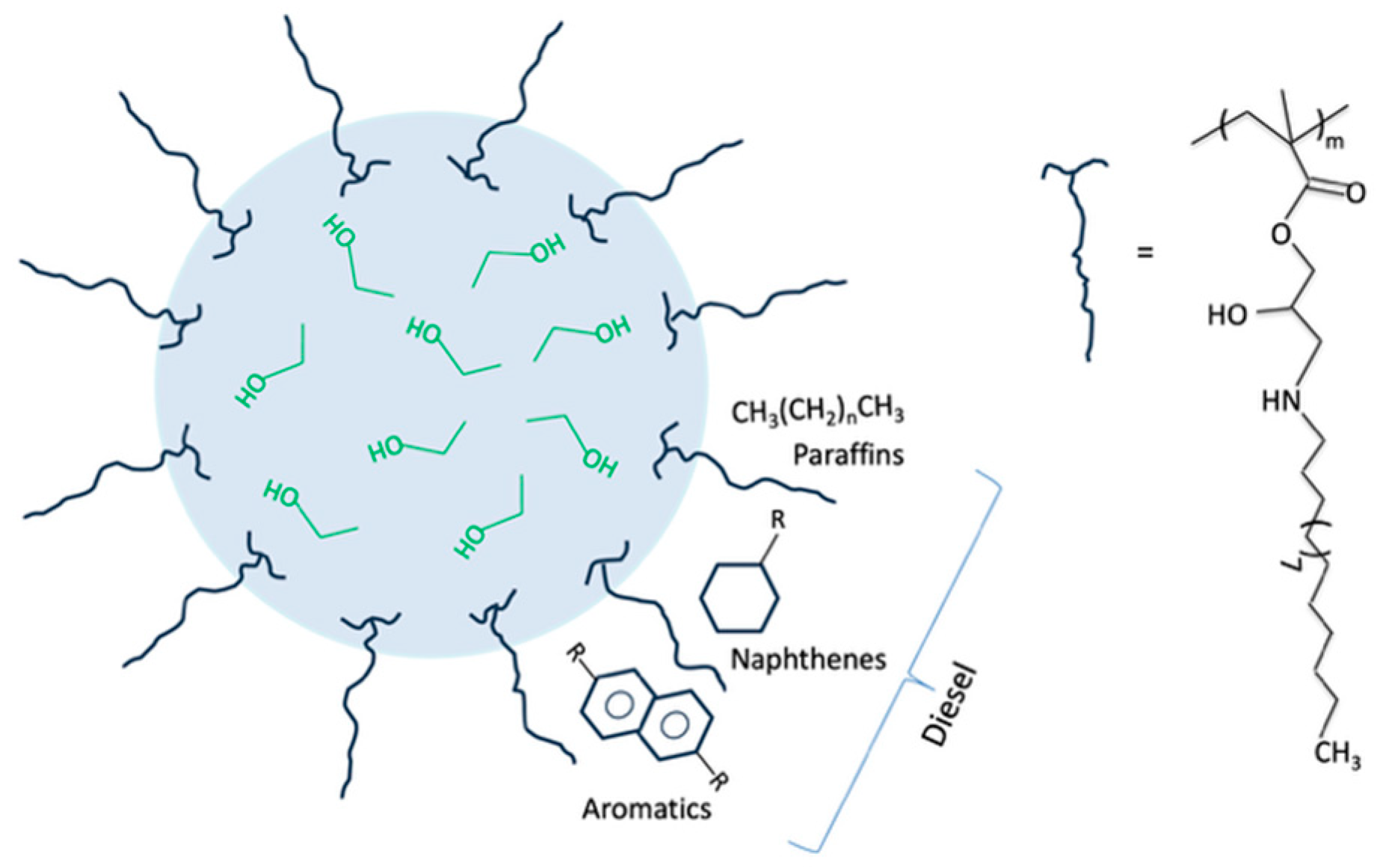
We have previously shown that an oligomeric emulsifier derived from R-GMA exhibits an improved emulsifying performance compared with Span-80 in stabilizing E-Diesel microemulsions [26]. This enhanced performance is attributed to its comb-like molecular architecture, consisting of a hydrophilic main chain and lipophilic side chains. Compared with discrete, low-molecular-weight emulsifiers at the same dosage, an oligomeric emulsifier has a lower configurational entropy in E-Diesel, as each oligomer molecule presents multiple lipophilic side chains that collectively associate with diesel, along with a series of hydrophilic pendant groups distributed along the backbone (Figure 1). As a result, a kinetically favorable physical film forms around dispersed ethanol droplets, inhibiting their coalescence and thereby preventing phase separation.
Figure 1.
An illustration of the E-Diesel microemulsion structure formed by individually dispersed ethanol droplets in diesel, where each droplet is surrounded by an oriented layer of oligomer molecules. The hexadecyl side chains extend parallel into diesel bulk.
This work examines the influence of the oligomeric emulsifier structure on (i) the colloidal stability of E-Diesel; (ii) the synergistic combustion behavior of the two fuel components; (iii) carbon residue formation; (iv) the formation of combustion-derived, solvent-soluble PAHs attached to or embedded in the carbon residue; and (v) fuel lubricity. The latest advances in the studies of these five specific properties of emulsion fuels are remarked in the following literature [27,28,29,30,31]. The latter four properties were not investigated in our previous study [26], which employed only one oligomeric emulsifier. These properties are intrinsically influenced by the chain architecture of the oligomeric emulsifier and its aggregation state in diesel. The comb-like amphiphilic chain architecture provides kinetic stabilization for dispersed ethanol droplets through a spatial entanglement of the main chains and lipophilic side chains extending into the diesel phase, as illustrated in Figure 1.
2. Materials and Methods
2.1. Chemicals
Hexadecylamine (HDA, technical grade, 90%), 1-dodecylamine (DDA, technical grade, 90%), 2,2′-azobis(isobutyronitrile) (AIBN, 0.2 M in toluene), glycidyl methacrylate, (GMA, 97%,), 2-Hydroxyethyl methacrylate (HEMA, ≥99.0%), Lauryl methacrylate (LMA, 96%), tert-butyl methacrylate (tBMA, 98%), inhibitor remover, Diethanolamine (DEA, reagent grade, ≥98.0%), and ethanolamine (EA, ≥98.0%) were all purchased from Sigma-Aldrich (St. Louis, MO, USA). The above acrylic monomers were passed respectively through a short column of neutral alumina to remove the inhibitor before use. Commercial diesel #2 (ExxonMobil Synergy Diesel, Paulsboro, NJ, USA) [32] was obtained from an Exxon gas station.
2.2. Synthesis of Amphiphilic Comb-like Polymer
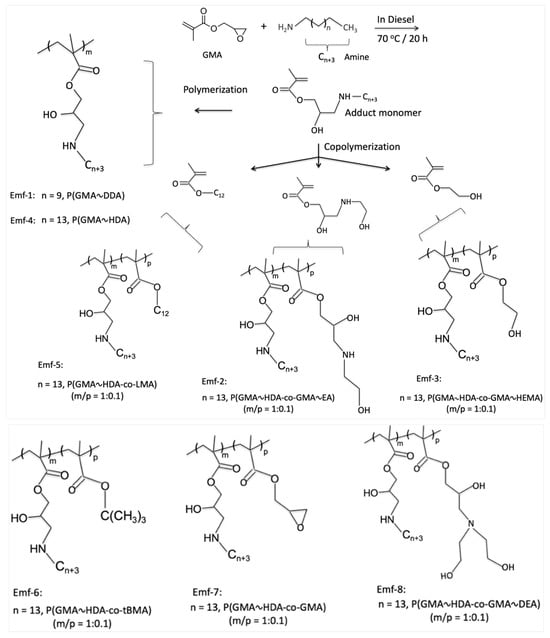
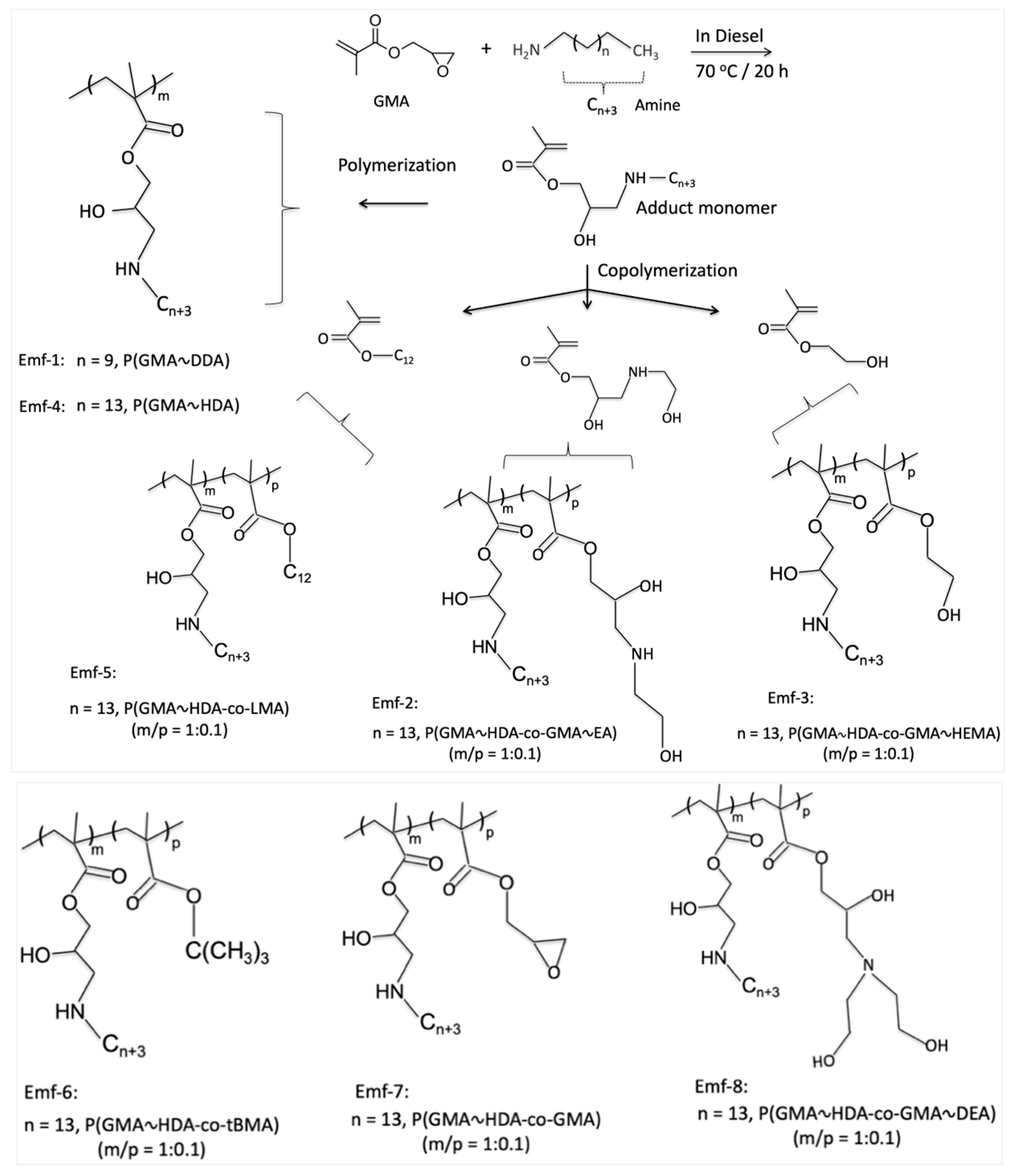
This study synthesized eight structures for the GMA-derived oligomers presented in Table 2 and Figure 2. There are three types of chain structures: homopolymers from an adduct monomer, copolymers of the adduct monomer with another adduct monomer, and copolymers of the adduct monomer with a methacrylate. Their synthesis protocols are presented as follows using the three oligomers as an example.
Table 2.
The structural identity of the synthesized emulsifiers.
Figure 2.
The molecular structures of the eight oligomeric emulsifiers synthesized in diesel.
2.2.1. P(GMA~HDA) Synthesized Using a Typical Two-Step Protocol as Detailed Below
HDA (1.97 g, 14.7 mmol) and diesel (7.5 mL) were added to a one-neck round-bottom flask (30 mL) equipped with a reflux column. The mixture was then magnetically stirred in an oil bath (70 °C) for about 20 min to form a clear solution. GMA (2.09 g, 14.7 mmol) was then introduced through a syringe into the solution. The mixture was then stirred for 24 h at 70 °C to complete the alkylation to obtain the adduct monomer, GMA~HDA. Subsequently, the reaction mixture was diluted with 12.5 mL diesel and purged with argon for 20 min, which was followed by introducing a toluene solution of AIBN (0.1 M) into diesel solution with a dose of 1 mol % of GMA-HDA. The solution was then stirred at 70 °C for another 24 h under argon atmosphere to complete the free-radical polymerization, leading to an emulsifier–diesel solution of P(GMA~HAD) with a concentration of 19.6 wt.%.
2.2.2. Synthesis of P(GMA~HDA-co-GMA~MEA0.1)
The synthesis of this random oligomeric copolymer was carried out in two steps. First, the oligomer P(GMA~HDA-co-GMA0.1) was synthesized in diesel, following the same procedure as for P(GMA~HDA), except that an excess amount of GMA (2.30 g, 16.17 mmol) was used. This step yielded P(GMA~HDA-co-GMA0.1) oligomeric chains dispersed in diesel. Second, a solution of ethanolamine (EA, 0.090 g, 1.47 mmol) in ethanol (1 mL) was introduced into the resulting diesel solution via a syringe. The alkylation of EA with GMA was performed under stirring at 70 °C for 3 h under an argon atmosphere. The final diesel solution contained approximately 16.6 wt.% of the targeted oligomer.
2.2.3. Synthesis of P(GMA~HAD-co-HEMA0.1)
This random oligomeric copolymer was synthesized in the two steps. First, the adduct monomer GMA~HDA (14.7 mmol) was synthesized in diesel following the same protocol described in Section 2.2.1. Second, a small amount of diesel (1 mL) was added into a pre-weighed HEMA (0.191 g, 1.47 mmol) in a 5 mL beaker to prepare a solution; it was then transferred to the resulting adduct monomer–diesel solution. The free-radical polymerization was subsequently conducted in the resulting solution by following the same step as described in Section 2.2.1. This diesel solution that was finally obtained contained approximately 19.5 wt.% of the target oligomer.
2.3. Formulation of E-Diesel and the Turbidity Measurement
Eight solutions, each containing an emulsifier (Emf-i) and diesel obtained from the preceding synthesis systems, were used as the stock solutions. An ethanol-in-diesel microemulsion was prepared in two steps: a given amount of the stock solution (3 mL) was diluted using diesel to a concentration of 5 wt.%; subsequently, ethanol was injected by portion (40 μL for each addition) into the diluted Emf-i and diesel solution (6.5 g) with magnetic stirring at 200 rpm for 10 min to homogenize the blend at 25 °C. The homogeneity of the resulting solution was monitored using a bench-top turbidity meter (LaMotte LTC3000, Chestertown, MD, USA) with five measurement ranges (0–11, 11–110, 110–300, 300–600, 600–4000 NTU). The device is equipped with an infrared light source operating at a wavelength of 850 nm and two detectors that function simultaneously, as the samples exhibit turbidity levels above 10 NTU. The transmission detector measures light passing directly through the sample to determine the reduction in intensity caused by absorption and scattering. The backscattering detector measures light that is scattered and reflected backward at angles between 90° and 180°. The intensity of this signal is used to calculate the turbidity of the sample. Turbidity calibration was performed using five EPA-compliant turbidity standards corresponding to the five measurement ranges described above. Before analyzing each sample, the calibration was verified once to ensure that measurements were consistent and reproducible across different samples.
In this examination, the initial turbidity is that of the diesel solution (5 wt.% Emf-i); then, the turbidity underwent continuous and minor increases with the addition of alcohol portion by portion until an obvious leap in turbidity (≥70 NTU). This point is taken as the incipient phase instability, though the emulsion still retains adequate clarity at this ethanol content. Hence, the limit of ethanol for this microemulsion is defined as the alcohol content (in wt.%) right before the point showing initial instability.
2.4. Determination of Ramsbottom Carbon Residue of a Micro-Emulsified E-Diesel Following ASTM D524-10 [33]
An accurate amount (W = 4 g ± 0.1 g) of a sample, e.g., E-Diesel, was transferred using a syringe into a special glass bulb (Kimble) with a capillary opening as shown in Figure S1. The bulb was then placed in a carbon residue apparatus (Koehler, Holtsville, NY, USA), a special furnace maintained at approximately 550 °C ± 5 °C. The sample was thus quickly heated to this temperature point at which all volatile matter was evaporated out of the bulb with or without decomposition, while the heavier portion underwent cracking and coking reactions (Figure S2). In the consecutive pyrolyzing period, the coke or carbon residue generated inside the bulb further underwent slow carbonization, accompanied by burning due to negative pressure-caused air flow into the bulb. After a designed heating period according to the standard, the bulb was removed from the furnace and allowed to cool in a desiccator to ambient temperature. The bulb was weighed again on an analytical balance to determine the amount of carbon residue left in the bulb (CR), namely the weight gained in the glass bulb after the test. The carbon residue is, therefore, expressed as a percentage of the amount of fuel sample initially added: (CR/W) × 100. Moreover, the oxidation condition of this test was modified by including a trace of t-butyl peroxide in the E-Diesel to examine its leverage on the formation of carbon residue. To assess the measurement uncertainty from using this equipment and the test conditions, neat diesel was measured three times, yielding a relative standard deviation below 5%. This level of precision allows the differences among the remaining samples to be clearly distinguished.
2.5. Field-Emission Scanning Electron Microscope (FE-SEM) Used to Characterize the Morphology of Carbon Residue
After chloroform extraction, described in detail in the following section, a sample of residue carbon was scratched from the inner surface of a Ramsbottom bulb and collected using a lab spoon. A trace of the sample was dry-dispersed and adhered to graphite tape on the sample holder of SEM equipment (JEOL JSM 6700F, Tokyo, Japan). The holder was coated with a thin platinum layer via sputtering for 60 s before being transferred to the vacuum chamber of the equipment. Imaging was conducted at an accelerating voltage of 5 kV under varying magnifications.
2.6. UV-Vis Spectroscopy Characterization of the PAHs Species Extracted from the Ramsbottom Carbon Residue
This examination aimed to determine nonvolatile but solvent-soluble compounds generated in the course of the Ramsbottom carbon residue test. The extraction was executed in two steps: Firstly, chloroform (12.5 mL) was injected using a syringe into a Ramsbottom vial, and the chloroform was left in the vial to soak in the carbon residue for 24 h. The vial was then subjected to sonication for 1 h in an ultrasonic cleaner (Cole-Parmer UC-200, Chicago, IL, USA) at 40 kHz before the extract was drawn out. This extraction was repeated one more time in the same vial, and the two extracts were combined. Secondly, the chloroform extract (5 mL) was drawn and filtered through a 0.45 µm syringe filter to filter away tiny carbon particles from the purified chloroform extract. Alternatively, the chloroform extract (5 mL) was mixed with cyclohexane (10 mL), and the resulting mixture was then passed through a new syringe filter. The collected filtrate (~15 mL) in a beaker was allowed to be dried in a fumed hood under ambient conditions. Finally, cyclohexane (5 mL) was introduced into the beaker to redissolve those compounds (typically, naphthene-aromatic hydrocarbons) soluble in pure cyclohexane to prepare the cyclohexane-based extract. The UV-Vis spectroscopy analysis of the extracts was performed on a spectrophotometer (Shimadzu UV-1900i, Kyoto, Japan).
2.7. Determination of the Gross Calorific Value (GCV) of the Selected E-Diesels (Fuels) by Following ASTM D240-09 [34]
A preset amount of fuel sample (0.65 g) was added in the crucible, which was then secured in the vessel of an oxygen bomb calorimeter (Parr Model 6200 Automatic Isoperibol Calorimeter, Hillsboro, OR, USA). The bomb was sealed and filled with oxygen to 30 bars after connecting an ignition wire across the electrodes, which was followed by placing the bomb into the water bath equipped with a thermometer and a stirrer to uniform heat distribution. Then, the fuel was ignited, and the temperature of the water bath was recorded until reaching the highest temperature, which reflects the heat released. The heat absorbed by water and the calorimeter was divided by the mass of the fuel to obtain the GCV. To assess the measurement uncertainty of the calorimeter and test conditions, the neat diesel was measured three times. The relative standard deviations were below 0.1%, consistent with the precision provided by the calorimeter (0.05% to 0.1%); therefore, the remaining samples were each measured once under identical conditions.
2.8. Measurement of the Lubricity of the Various Emulsifier–Diesel Solution by Following ASTM D6079 [35]
The test was carried out on a high-frequency reciprocating rig (HFRR, PCS Instruments, London, UK), which is a ball-on-plate tester for the boundary lubrication of fuels. A given amount (2 mL) of an emulsifier–diesel solution containing 5% Emf-i was placed in the test reservoir of HFRR, and the temperature of the air bath enclosed in the reservoir was adjusted to 60 °C. After the fuel temperature stabilized, a vibrator arm holding a non-rotating steel ball was loaded with 200 g and lowered until it contacted the preset test metal disk, which was completely submerged in the fuel. The ball was then reciprocated against the disk with a 1 mm stroke at a frequency of 50 Hz for 75 min. After that, the ball was removed from the vibrator arm, and the major and minor diameters, x and y, of the wear scar were measured using an optical microscope (AO 10 SKU: AO-10-POL, Buffalo, NY, USA). Therefore, the wear scar diameter, calculated as (y + x)/2, indicates an inverse relationship with the measured fuel lubricity. To assess measurement uncertainty under the device and test conditions, the neat diesel was measured three times, and the observed scar diameters varied within 10%, corresponding to a standard deviation of less than 35 µm. Since the variations in scar diameters among the other samples were clearly greater than 10%, the remaining samples were each measured once under identical conditions.
3. Results and Discussion
3.1. The Dominant Kinetical Stabilization Role of the Oligomer Emulsifiers in Maintaining E-Diesels
The strategy used to synthesize the oligomeric emulsifiers involves the free-radical polymerization of the GMA–adduct monomer, with or without a second GMA–adduct monomer, in diesel, as described in Section 2.2. This is an in situ approach, since oligomers obtained via ex situ synthesis cannot be re-dissolved in diesel because of their unique comb-like chain structure, in which hydrophilic functional groups are located adjacent to the main chain, and aliphatic side chains (C12–C16) extend outward, as shown in Figure 2. This chain architecture also makes it difficult to determine the molecular weights through size-exclusion chromatography because the oligomer chains tend to self-assemble into particles in common GPC eluents [25]. Moreover, the pendant hydroxyl and amine groups in the adduct monomer (Figure 2) act as reactive chain-transfer sites that interfere with chain growth, while the aliphatic side chains further impose steric hindrance. Consequently, the emulsifiers formed in situ in the diesel medium are expected to be low-molecular-weight oligomers.
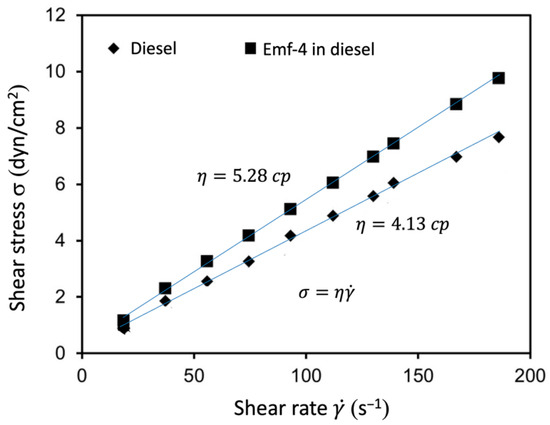
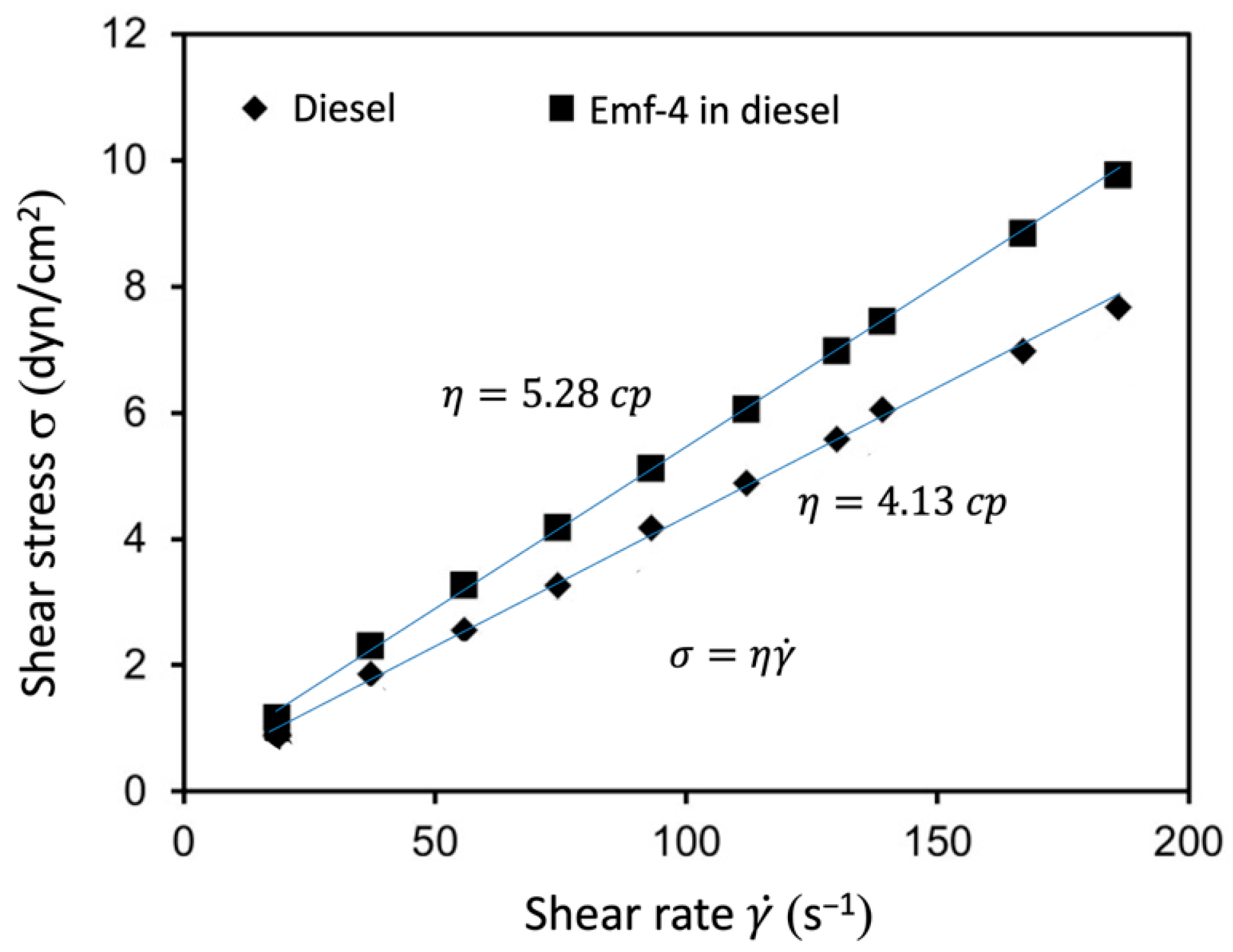
The emulsifier–diesel solution of Emf-4 shows a negligible shear thinning effect, i.e., the solution maintains a linear relationship of vs. , which is like that of the prestine diesel with close viscosity (η) readings (Figure 3). This Newtonian fluid behavior implies that Emf-4 molecules assemble to form small micelles that are spherical in shape, as illustrated in Figure 1. On the contrary, the wormlike micelles cause non-Newtonian behavior in their dispersions, characterized by shear-thinning and transient network forming [36]. Moreover, the oligomeric and comb-like chain structure ensures that Emf-4 molecules form small and well-compacted reverse micelles in diesel, so that they are unlikely to deform or dismantle with the increase in the shear rate.
Figure 3.
The rheological behavior of Emf-4 (5%)–diesel solution, selected to represent the design of oligomer emulsifiers in this study and that of diesel as a control.
With respect to the hydrophilic lipophilic balance (HLB) values of the emulsifiers, they are estimated using the group contribution method proposed by Davies [37], , where Hh,i and Hl,i are the contributions of hydrophilic and hydrophobic groups, respectively. The calculation was based on the comonomer units in an oligomer emulsifier (Emf-i, i = 1 to 8). The contributions of comonomer units to the HLB value were estimated using their mole fractions, m and p, as shown in Figure 2. The resulting HLB values are listed in Table 3, integrating the contributions of individual comonomer units within each oligomer. These values exceed the HLB of Span-80 (4.3), as described above, indicating that Emf-i is significantly more hydrophilic. Thermodynamically, this suggests that they are unable to maintain the colloidal stability of E-Diesel without the use of a co-solvent, as discussed in the fourth paragraph of the Introduction. However, contrary to this expectation, Emf-i demonstrates a greater capacity than Span-80 to disperse higher ethanol contents in diesel (Table 4). As proposed in the Introduction, this behavior is attributed to the steric hindrance associated with the comb-like chain architecture, resulting in a lower configurational entropy of the emulsifier layer around ethanol droplets compared with that formed by Span-80 molecules.
Table 3.
The HLB values estimated by using the Davies method *.
Table 4.
The effect of emulsifier identity on the colloidal stability of E-Diesel microemulsion.
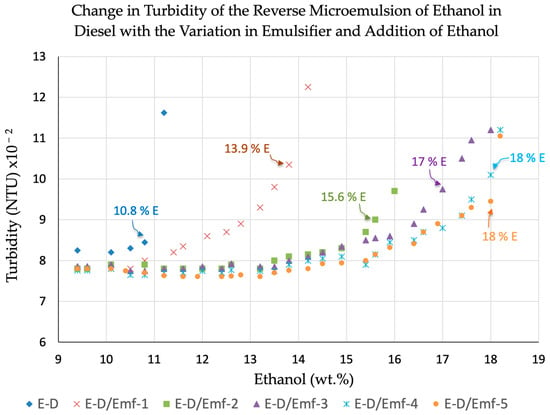
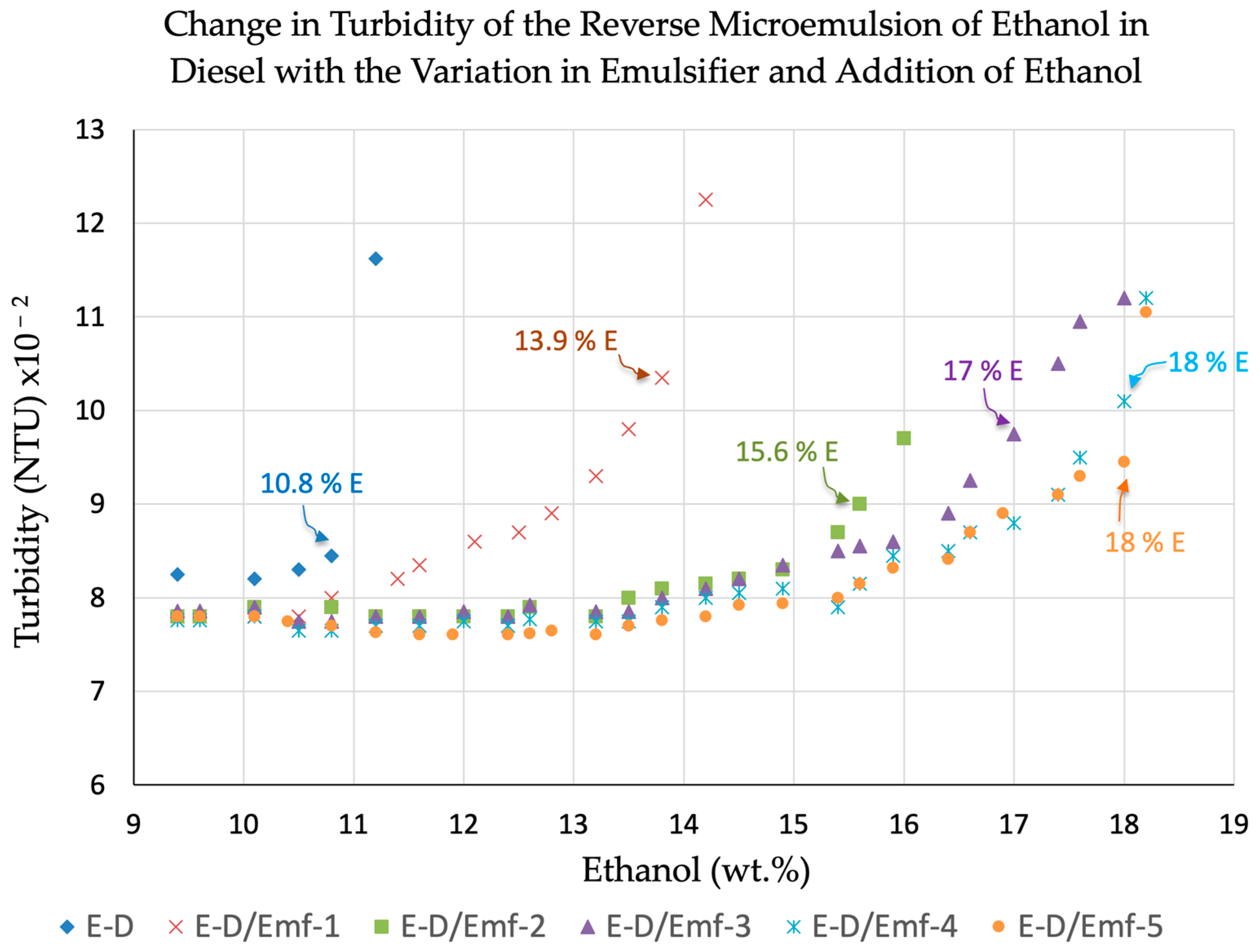
Figure 4 presents the competences of the synthesized Emf-i for stabilizing E-Diesels when accompanying the introduction of ethanol into diesel. The ethanol limit of each microemulsion is labeled on the chart. In this measurement, the turbidity values of the six systems vary from 950 NTU at 0 wt.% ethanol to 800 ± 25 NTU at 9.0 wt.% ethanol, which indicates that the ethanol added from the start dissolves in diesel, resulting in only minor or insignificant changes in turbidity across all specimens. The turbidity levels of these E-Diesels start diverging after reaching a 10 wt.% ethanol content. The corresponding turbidity values at the ethanol content limits are listed in Table 4. As explained in Section 2.3, the ethanol limit of an E-Diesel is the point right before the percentage giving rise to an apparent upsurge in turbidity. This high turbidity rise (≥70 NTU) demonstrates that the E-Diesel enters into its binodal region [38], since this rise in optical turbidity is caused by increased light scattering from coalescing droplets. In Figure 4, the lowest ethanol limit comes from the ethanol–diesel solution without an emulsifier, in which the solubility of ethanol in diesel relies primarily on the dispersion, π-effect, and dipole interactions of the alcohol molecules with the aromatic compounds [39]. With these intermolecular forces, a maximum of 10.8% ethanol solubility is achieved. On the basis of this control, the presence of an Emf-i in diesel enhances the colloidal stability of the resulting microemulsion by allowing a higher ethanol content. Moreover, the ethanol limit increases as the HLB value of Emf-i decreases (i.e., with increasing lipophilicity). This behavior arises from the stabilization effect due to interactions between the aliphatic side chains of Emf-i and diesel molecules, as illustrated in Figure 1. For example, compared with Emf-1, Emf-4 possesses longer aliphatic side chains and therefore enables a higher ethanol limit in the resulting E-Diesel. Furthermore, although Emf-5 has a lower HLB value than Emf-4, both emulsifiers give rise to similar ethanol limits. This coincidence can be attributed to the copolymeric chain structure of Emf-5, which features a less uniform side chain arrangement. Such structural irregularity increases the configurational entropy of the oligomer and consequently weakens the dynamic stability of the oligomer molecules surrounding the micro-ethanol droplets. Accordingly, subsequent investigations focus on the properties of E-Diesel formulated using Emf-4 as emulsifier. Lastly, this measurement protocol is limited in that it does not account for the impact of fuel storage time on the colloidal stability of an E-Diesel microemulsion.
Figure 4.
Variation in the turbidity readings with the introduction of ethanol to an emulsifier–diesel solution containing Emf-i, where E-D is the short form of ethanol-in-diesel microemulsion, i.e., E-Diesel.
3.2. Influences of Emulsifiers and Oxygenates on Ramsbottom Carbon Residue
This test aims to unveil how the presence of an emulsifier carrying a group of oxygenates in diesel impacts the formation of Ramsbottom carbon residue composed of soot and char. In principle, the inclusion of an emulsifier in diesel would raise the carbon residue because of its polymeric chain structure that is involatile and undergoes incomplete pyrolysis. In addition, the emulsifier would hold more diesel molecules in the testing glass bulb during the swift heating up at the beginning, which finally contributes to the accumulation of carbon residue. This effect is clear, as shown in No. 2 and 3, which are emulsifier–diesel solutions, with respect to No. 1 (Table 5). Also, the higher content of the emulsifier in the solution, the higher the produced carbon residue. Moreover, the rise in the bulkiness and non-uniformity of side chains in contrast to Emf-4 (No. 7), e.g., Emf-6, results in the highest level of carbon residue. This is due to the enhanced capability of the emulsifier to hold diesel molecules, as explained above.
Table 5.
A list of the carbon residue values of different fuel compositions, determined by following ASTM D524 standard.
Compared with neat diesel, the ethanol–diesel blend (No. 4) produced a slightly higher carbon residue. This behavior is attributed to the faster vaporization rate and higher latent heat of vaporization of ethanol, which jointly delay the escape of diesel molecules from the sample bulb during the flash-heating step of the test (Section 2.4). In addition, the incorporation of ethanol into the Emf-4-diesel solutions (Nos. 2 and 3) leads to an increase in the carbon residue, despite the lower diesel content in the resulting E-Diesel fuels (Nos. 5 and 6). Notably, the carbon residue shows a marked increase when transitioning from D97.5/Emf-4 to E12-D85.5/Emf-4. In this case, the Emf-4 content remains unchanged, while the ethanol content increases. Beyond the aforementioned effects, ethanol is also known to promote dehydrogenation and cyclization reactions, resulting in the formation of polycyclic aromatic hydrocarbons (PAHs) through free-radical pathways [40]. PAHs, in turn, exhibit a strong tendency to aggregate and form soot and char. However, a further increase in the ethanol content to form E15-D80/Emf-4 does not result in an additional rise in the carbon residue compared with its parent solution, D95/Emf-4. This is attributed to the oxidizing effect of ethanol, which contributes to the removal of carbonaceous deposits [41].
Furthermore, a variety of small amounts of t-butyl peroxide was included in E15-D80/Emf-4 (No. 6) while maintaining the same content of Emf-4, with the aim of examining the impact of oxidation on the generation of carbon residue (No. 8 to 10). The resulting three samples all display reduced carbon residues compared to the starting formulation because of the oxidizing effect of the peroxide, which helps to gasify soot and char. Nevertheless, when there is an optimal peroxide dose, an increase from Ox1 to Ox2 (No. 9 to 10) raises the carbon residue. This occurs because the peroxide, while supplying oxygen to facilitate carbon gasification, also acts as a free-radical initiator, thereby aggravating the free-radical reactions that intensify the aromatization of diesel molecules and promote coke formation.
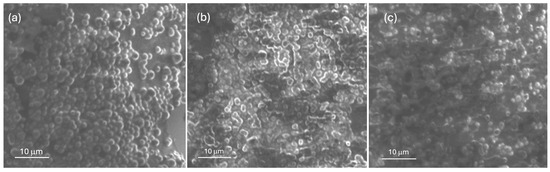
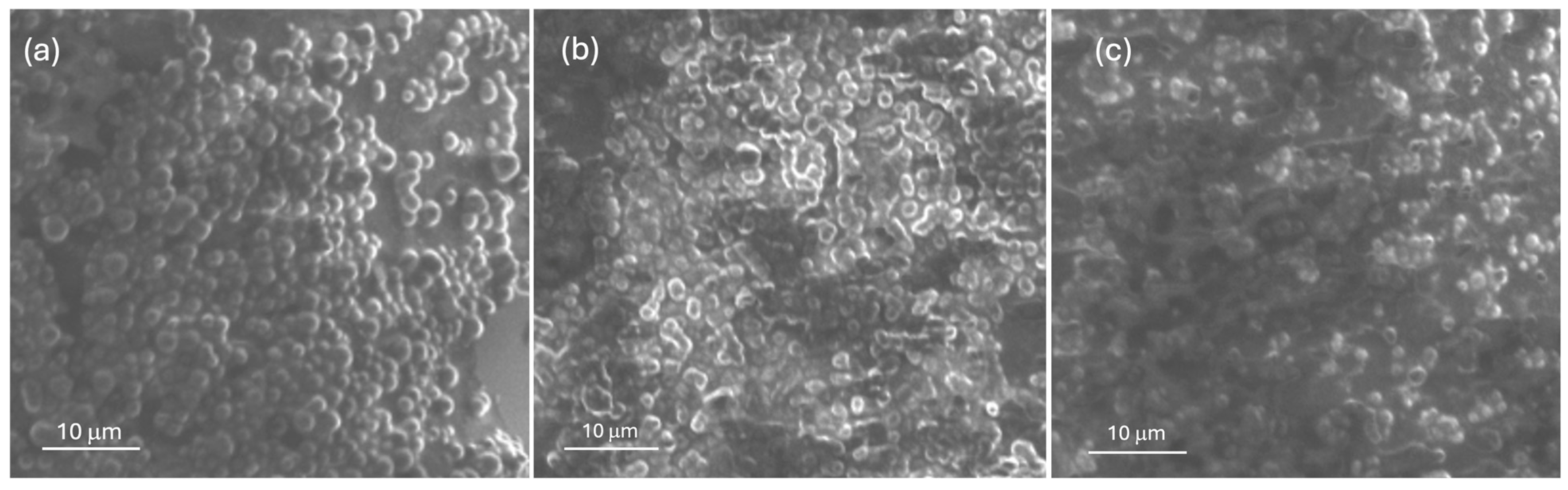
To investigate whether Emf-4 influences the formation mechanism of carbon residue, SEM images of two Ramsbottom carbon residues, generated from neat diesel and from the emulsifier–diesel solution D95/Emf-4, were collected. Both samples consist of fine carbon grains; however, the residue derived from neat diesel clearly exhibits larger particles than that from D95/Emf-4, although both fall within an approximate size range of 0.1–1 μm. This size difference can be attributed to distinct nucleation pathways. In neat diesel, flash vaporization followed by pyrolysis generates PAH species with higher C/H ratios, which undergo adjacent aggregation (nucleation) to form larger carbon grains [42]. In contrast, when the emulsifier–diesel solution is subjected to pyrolysis, Emf-4 micelles provide nucleation seeds for carbonization, resulting in smaller grains composed of smaller PAH units. Such an effect is further supported by the results obtained with another emulsifier–diesel solution, D95/Emf-6, which produces even smaller carbon grains (< 0.5 μm) than D95/Emf-4 (Figure 5c). This behavior is likely attributable to the stronger micellization tendency of Emf-6, which arises from the substitution of a bulky tert-butyl group on the hydrophilic main chain and its slightly lower HLB value (i.e., greater hydrophobicity; Table 3) compared with Emf-4. This interpretation is based on the premise that oligomer molecules are more prone than diesel molecules to forming carbonaceous nuclei during heating, thereby promoting more widespread nucleation in the soot formation process.
3.3. Determination of Solvent-Soluble PAHs Embedded in Ransbottom Carbon
It is well established that carbon particles are composed of pyrogenic PAH compounds that undergo π–π stacking or random aggregation, forming various graphite crystallites and carbonaceous substances. The simultaneous association of these species leads to the formation of soot and char during pyrolysis at 550 °C. Based on the above micrographic determination of particle sizes, it is essential to semi-quantitatively assess PAH compounds embedded in or attached to soot and char as an indicator of the carcinogenic potential of the carbon particles [43]. As described in Section 2.6, the Ransbottom carbon residues deposited in the various test bulbs were thoroughly soaked in equal volumes of chloroform (CHCl3) to extract all soluble PAHs. The PAH solids recovered from the chloroform extract were subsequently subjected to cyclohexane (C6H12) extraction to separate cyclohexane-soluble fractions. The dissolution of PAH compounds in organic solvents is primarily governed by dispersion forces and π–hydrogen bonding interactions [44]. As an effective solvent, CHCl3 exhibits a permanent dipole moment while also possessing these dual interaction capabilities. Consequently, CHCl3 is expected to efficiently extract PAHs that are either attached to or embedded within small graphite crystallites and aggregated graphene-like structures constituting soot and char.
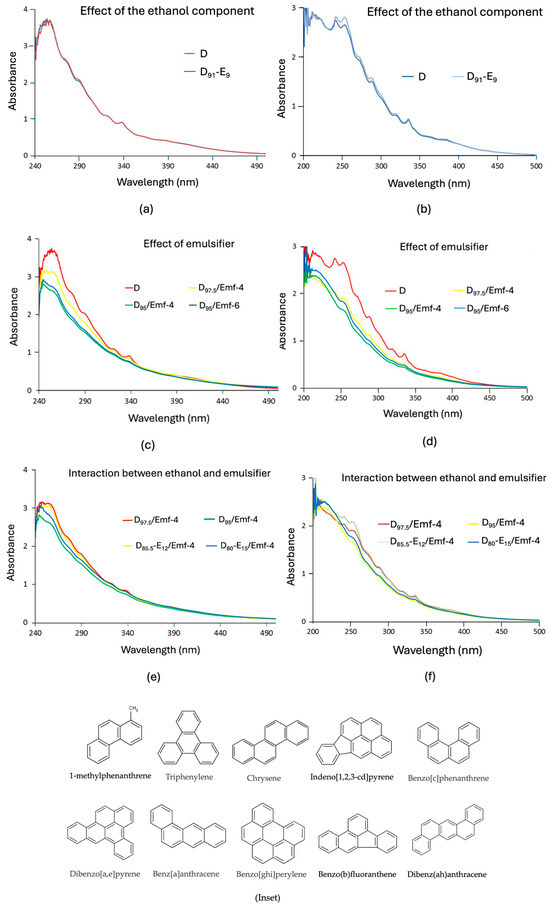
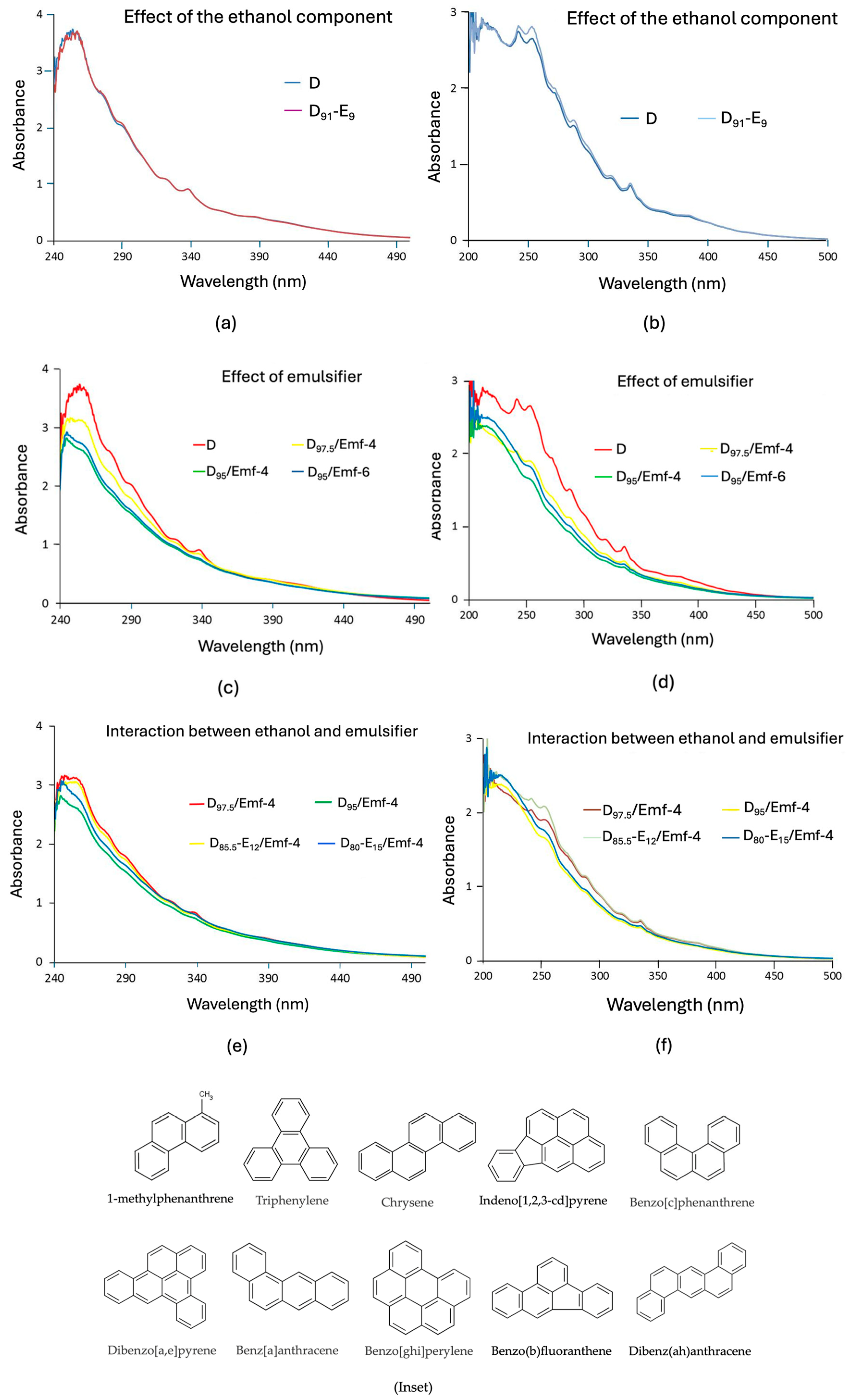
The UV-Vis spectra of the initial CHCl3 extracts and the subsequent C6H12 extracts are presented in Figure 6. As the amounts of CHCl3 and C6H12 used for the extraction are identical across the board, this allows for an intuitive comparison of the absorbance peak intensities, which is a semi-quantitative comparison. Each extract shows a UV absorption band spanning ultraviolet C (100–280 nm) and B (280–315 nm) ranges, and, specifically, all the CHCl3 extracts show a maximum absorption wavelength (λmax) at approximately 260 nm, whereas the λmax of C6H12 extracts appear at 220 nm, 245 nm and 260 nm, respectively. This spectroscopic outcome aligns with the established fact that almost all PAHs display absorption bands in the UV range of 190–360 nm [45]. Table 6 presents the PAH molecules selected because their λmax falls in the absorption wavelength range of the spectra displayed in Figure 6. The following assessment focuses on, firstly, how the presence of ethanol, an emulsifier, or both of them in diesel impacts the generation of soluble PAHs, and, secondly, how these two additives impact the generation of nonpolar PAHs soluble in C6H12.
Figure 6.
UV-Vis spectra of the chloroform extracts ((a,c,e)—left column) and the cyclohexane extracts ((b,d,f)—right column). The absorbance scale is as follows: 1 unit means 90% of light is absorbed, 2 means 99%, and 3 means 99.9%. Inset: Possible PAHs collectively contributing to the UV absorption bands in the above spectra.
Table 6.
The proposed compounds generated in the pyrolysis test of the samples listed in Table 5.
According to the UV absorbance intensity, Figure 6a,b show that the presence of 9 wt.% ethanol in diesel does not noticeably change the total amount of CHCl3-soluble PAHs (Figure 6a), but it promotes the formation of non-polar PAHs (Figure 6b) during the pyrolysis process. Figure 6c indicates that incorporating the emulsifier Emf-4 in diesel reduces the formation of CHCl3-soluble PAHs, and this effect becomes more pronounced as the emulsifier dosage increases from 2.5% to 5%. In contrast, the use of a slightly more hydrophobic emulsifier, Emf-6, results in marginally higher PAH yields compared to Emf-4. As shown in Figure 6d, neat diesel produces a higher proportion of C6H12-soluble PAHs than the diesel–emulsifier solutions containing 2.5% Emf-4 (yellow curve). Furthermore, the presence of either Emf-4 or Emf-6 at a 5% dosage leads to an even lower number of C6H12-soluble PAHs, with Emf-4 exhibiting a greater effect than Emf-6. This behavior is attributed to micelle formation by the emulsifiers in diesel, which promotes increased carbon residue formation (Section 3.2), likely by facilitating the transformation of PAHs into small graphite crystallites and other carbonaceous species, thereby reducing the number of soluble PAHs.
Furthermore, Figure 6e,f compare the amounts of PAHs extracted from the carbon residues of two selected E-Diesels, D85.5–E12/Emf-4 and D80–E15/Emf-4, with those obtained from their corresponding emulsifier–diesel solutions (without ethanol), under the condition that the Emf-4 content remains unchanged within each comparison pair. It is observed (6e) that the PAH content generated from D85.5–E12/Emf-4 is only marginally higher than that from D97.5/Emf-4, whereas the PAH content generated from D80–E15/Emf-4 is noticeably higher than that from D95/Emf-4. This indicates that increasing the ethanol content favors PAH formation, even though the carbon residues from D95/Emf-4 and D80–E15/Emf-4 are identical. Furthermore, regarding the influence of ethanol on the generation of C6H12-soluble PAHs (6f), although the effect is relatively complex, two wavelength regions allow a clearer interpretation. In the absence of ethanol, fewer PAHs absorbing shorter-wavelength UV light (<240 nm) are present compared with the two E-Diesels counterparts. Meanwhile, irrespective of whether ethanol is present, a higher Emf-4 content (5%) results in fewer PAHs absorbing longer-wavelength UV light (>240 nm) than a lower Emf-4 content (2.5%). In summary, the presence of an emulsifier in both diesel solutions and E-Diesels reduces the formation of the total (CHCl3-soluble) PAHs, presumably by promoting the in situ conversion of PAHs into carbonaceous species. In contrast, ethanol in E-Diesels promotes the formation of PAHs, likely due to its role in enhancing free-radical reactions.
3.4. Cooperative Combustion Between Diesel and Ethanol in the Presence of Emulsifier
As ethanol has a far lower gross calorific value (GCV) than diesel, there is an adverse aspect to adding ethanol into diesel. The blending of both would lead to a loss of GCV (or LCV) with respect to neat diesel [47]. However, the reduction in the measured GCV does not exactly follow the gravimetric proportion relation because of the complex combustion mechanism: possessing a high vaporization latent heat, ethanol initially cools the dual-fuel mixture. However, it has a faster burning rate once ignited, and hydroxyl groups enhance the heat release rate and overall efficiency [28].
Table 7 displays the combustion analysis of three groups; the analysis unveils the influence of ethanol, EMF-4, or both on the GCV of the combined fuels under investigation. Although the experimental GCV of Emf-4 was not experimentally available, it could be estimated according to the monomeric structure (Figure 2), which consists of three moieties: isopropanate (25.9 wt.%), ethanolamine (14.4 wt.%), and hexadecane (59.7 wt.%). The GCV of the three moieties are available in the literature: 5.1, 15.2, and 42.5 in MJ/kg, respectively. Therefore, the GCV of Emf-4 can be approximated using the moiety contribution concept: Σwti%·GCVi. This gives 28.9 MJ/kg.
Table 7.
An examination of the effect of Emf-4 on the GCV of the selected fuel.
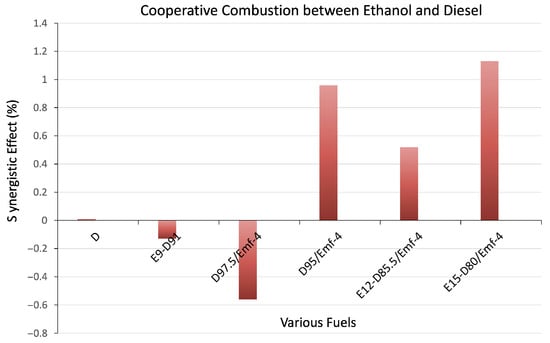
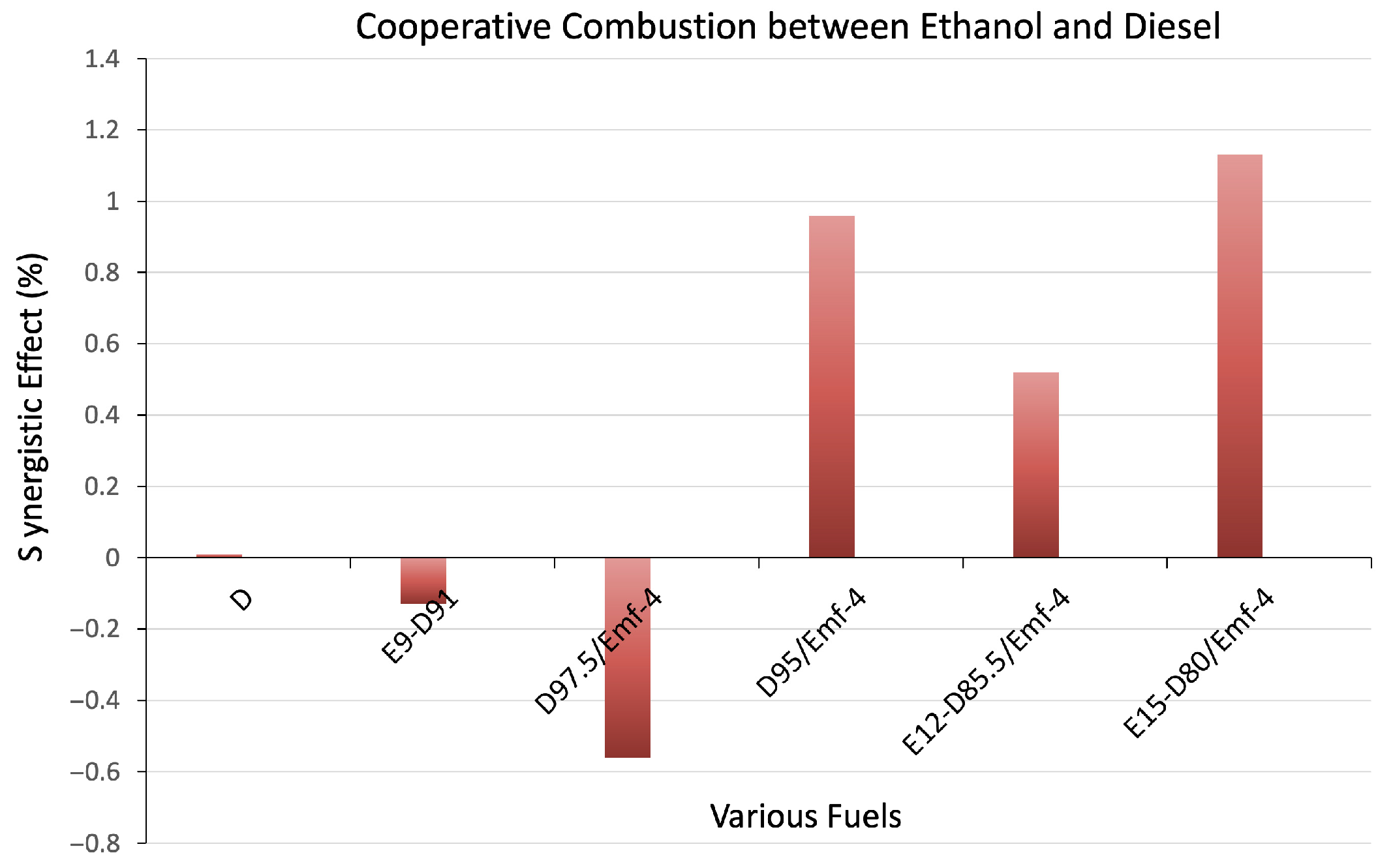
Compared to the pristine diesel (No. 1), the ethanol–diesel solution E9-D91 (No. 2) shows a lower measured GCV than the calculated one, leading to a slightly negative synergistic effect in combustion (SEc % < 0), defined in the footnote of Table 7. This loss can be attributed to the absorption of a part of the heat by ethanol during vaporization. In the case of the emulsifier–diesel solutions (Nos. 3 and 4), the D97.5/Emf-4 solution exhibits a negative SEc%, whereas the corresponding D95/Emf-4 solution shows a positive SEc% (Figure 7). This difference can be attributed to the aggregation state of the Emf-4 molecules. Although the critical micelle concentration (CMC) of Emf-4 in diesel was not directly measured, it is inferred to be close to 5%, as the turbidity of D95/Emf-4 (9.24 NTU) is only slightly higher than that of neat diesel (9.08 NTU). Based on this reasoning, the D97.5/Emf-4 solution likely contains individually dispersed Emf-4 molecules, each surrounded by diesel molecules. This molecular arrangement decreases the diesel density due to the incompatibility between the hydrophilic main chain of Emf-4 and diesel hydrocarbons. In contrast, the positive SEc% observed for D95/Emf-4 may result from micelle formation, which increases the fuel density [48]. This effect is likely caused by the parallel extension of hexadecyl tails from each micelle into the diesel bulk, promoting the closer packing of aliphatic diesel chains and thereby increasing the experimentally measured GCV [49].
Figure 7.
The variation in the synergistic combustion effect (defined in Table 7) resulting from changes in fuel composition.
Furthermore, the inclusion of ethanol into the above two emulsifier–diesel solutions leads to the formation of microemulsion fuels (No. 5 and 6), namely E12-D85.5/Emf-4 and E15-D80/Emf-4, respectively. Notably, the resulting microemulsion fuels exhibit positive SEc % values, which increase with increasing ethanol content. This positive synergistic effect can be attributed to the oxygen supply role of ethanol molecules during combustion. The hydroxyl groups act as active oxidation sites to promote CO2 formation, an exothermic step [28], which compensates for the vaporization latent heat of ethanol and contributes to the overall heat released. This effect relies on the colloidal stabilization role provided by Emf-4, which ensures the dispersion of ethanol as numerous microdroplets within diesel, as shown in Figure 1. It is therefore rational to assume that these ethanol microdroplets persist until combustion, thereby substantially reducing the vaporization heat demand prior to burning. Meanwhile, unlike the determination of the Ramsbottom carbon residue, the measurement of gross calorific value (GCV) is conducted in a closed, oxygen-filled system that leaves no carbon residue. This measurement also differs from diesel engine performance tests, which focus on fuel consumption, thermal efficiency, and emissions [50]. In conclusion, when an E–Diesel microemulsion fuel undergoes combustion, the collaboration between Emf-4 and ethanol enhances the synergistic effect. This enhancement is attributed to the microemulsion stability ensured by the comb-like chain architecture of the emulsifier.
3.5. Test of Emulsifier for Its Lubricating Capability While Mixing with Diesel
In this study, various emulsifiers (Emf-i; Figure 1) were examined by fixing the emulsifier content at 5 wt.% in diesel fuel. Accordingly, only Emf-i–diesel solutions, rather than E-Diesel microemulsions, were evaluated, as described in Section 2.8. Previous studies have reported that the inclusion of ethanol in biodiesel–diesel blends does not significantly alter lubricity over a wide range of ethanol concentrations [51]. Therefore, it is appropriate to focus the present investigation on Emf-i–diesel solutions. For diesel fuels, their lubricity levels are maintained through the formation of a film of organic compounds adsorbed onto the metal surfaces of the ball and disk; the film reduces metal-to-metal friction and, consequently, the resulting wear scar diameter. Although sulfur- and nitrogen-containing aromatic heterocyclic compounds are substantially reduced during the hydrotreating process used to produce diesel #2 from mid-distillate fractions, the heavier hydrocarbon constituents of diesel #2 still provide inherent lubricating properties. As a result, its wear scar diameter, which inversely reflects the lubricity (row 1 in Table 8), remains below 520 µm, which is the maximum allowable wear scar diameter specified by ASTM D975-24 [52].
Table 8.
Wear scar test of the selected emulsifier–diesel solutions at 60 °C.
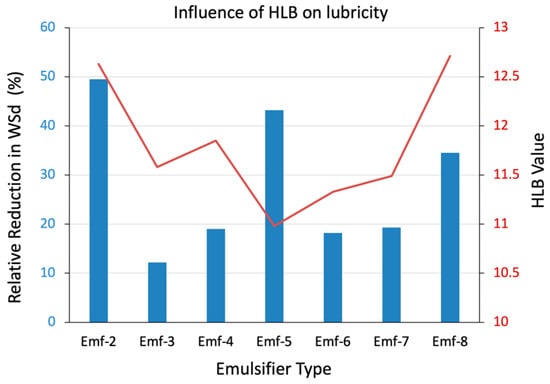
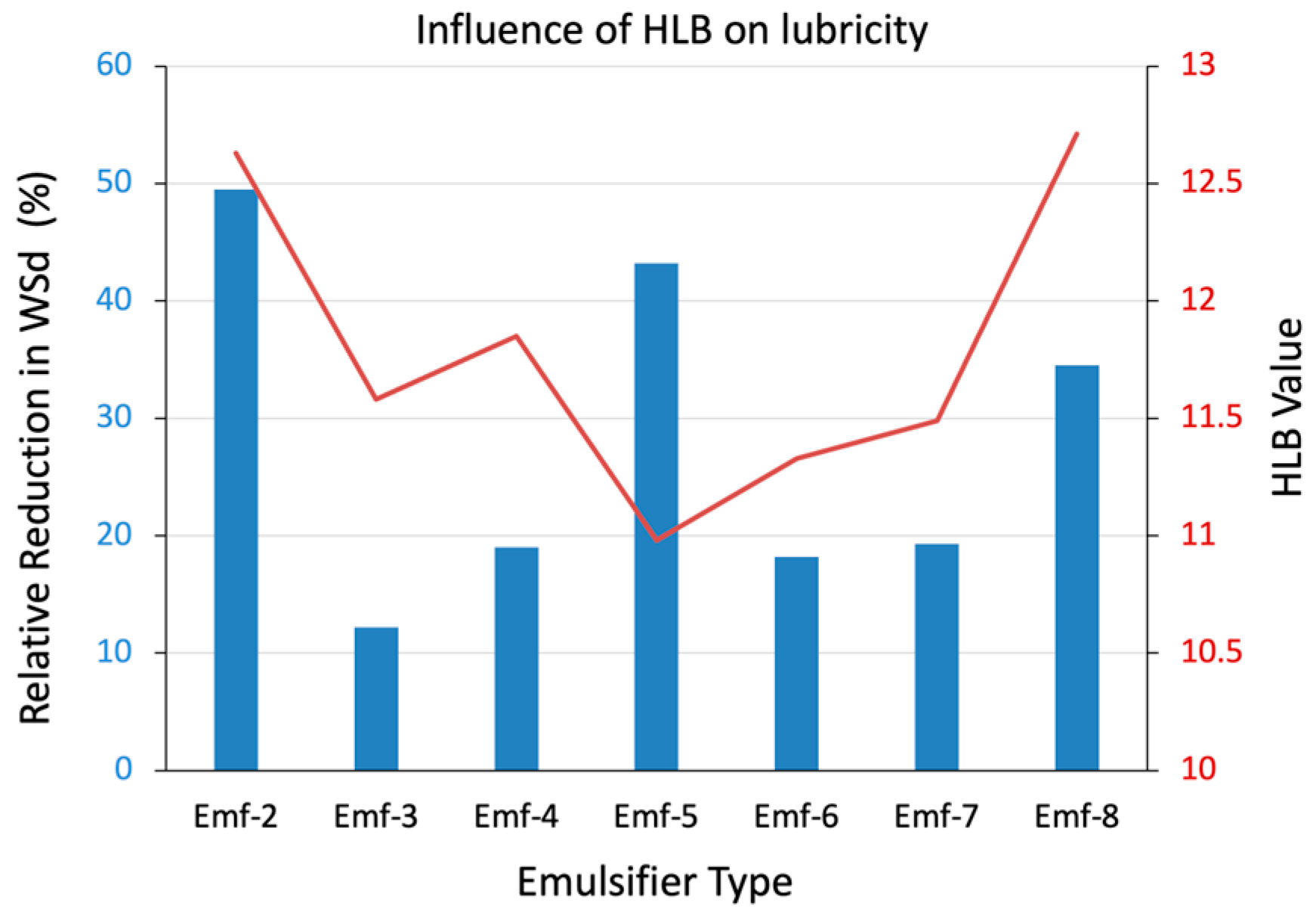
On this basis, we examined the ability of different emulsifiers to promote the lubricity of diesel #2. The relative WSd reduction percentages (column 5 in Table 8) indicate the influence of HLB values on lubricity improvement, i.e., the higher the percentage, the better the lubrication effect achieved. This effect was previously recognized in a study [53], which reported a substantial reduction in the WSd of bio-hydrogenated diesel, from 515 to 167.5 μm, upon the addition of 5% Span-80. This behavior is attributed to the strong lipophilicity of Span-80, which ensures high solubility in diesel, while its hydrophilic moiety, containing multiple oxygenated groups, enhances its adsorption onto metal surfaces. Compared with Span-80, the oligomeric emulsifiers (Emf-i) possess higher HLB values yet remain soluble in diesel within the specified dosage range. The Emf-i structures consist of a hydrophilic backbone and, in some cases, both hydrophilic and lipophilic side chains. Notably, Emf-i with HLB values lower than 11 or higher than 12 exhibits a greater ability to reduce WSd than that with HLB values between 11 and 12. The latter group includes four emulsifiers (i = 3, 4, 6, and 7). Figure 8 demonstrates a clear correlation between the magnitude of the relative reduction in WSd (%) and the HLB profile.
Figure 8.
Correlation of the relative reduction (%) in WSd with the HLB of emulsifier.
In the former group, the two relatively more hydrophilic emulsifiers, Emf-i (i = 2 and 8), both possess hydrophilic side chains in addition to the hydrophobic HAD long tail. The hydrophilic side chains, in combination with the hydrophilic backbone, are considered to contribute to the formation of multiple adsorption sites on the metal surface, thereby enabling the development of a well-adhered film on the friction surfaces. In contrast, the relatively more hydrophobic Emf-5 also demonstrates a strong lubricating ability, which is likely attributable to the random distribution of its two types of lipophilic side chains. This structural feature facilitates more expanded chain conformations, supporting versatile dynamic rearrangements of the adsorption film in response to frictional motion. With respect to the latter group, Emf-i (i = 3, 4, 6, and 7), all except Emf-3 exhibit comparable capabilities in improving lubricity. The inferior lubricating performance of Emf-3 can be attributed to strong hydrogen bond-assisted crosslinking among its HEMA side chain groups, which restricts the oligomeric chain flexibility and consequently hinders the formation of a flexible film on metal surfaces. Overall, the lubricity of emulsifier–diesel solutions is governed by the hydrophilic–lipophilic balance (HLB) of Emf-i, with emulsifiers exhibiting either a pronounced hydrophilic or lipophilic character demonstrating a superior efficacy in forming lubricating films on friction surfaces.
Although Section 3.1, Section 3.2, Section 3.3, Section 3.4 and Section 3.5 elucidate the experimental data from different fundamental perspectives, they follow a simple and coherent framework: the HLB level and the uniformity of the oligomer’s side chains determine the colloidal environment of emulsified ethanol, which in turn influences the formation of carbonaceous species through PAHs, the cooperative combustion behavior between ethanol and diesel, and the fuel lubricity.
4. Conclusions
This study proposes a type of oligomeric emulsifier for stabilizing ethanol-in-diesel microemulsions. These emulsifiers have a hydrophilic backbone anchored by adjacent -COO-, -OH, and -NH- and -NR3 lipophilic groups, along with hydrophobic aliphatic C11–16 chains. The emulsifiers were synthesized in diesel #2 to circumvent the redissolution difficulty. The main findings of this study are summarized as follows:
- The synthesized emulsifiers exhibit hydrophilic–lipophilic balance (HLB) values in the range approximately 11 to 13, where lower HLB values correspond to a better microemulsion stability. The variation in the uniformity of the aliphatic side chains has only a subtle effect, slightly reducing the lipophilic trait of the emulsifier.
- Homogeneous ethanol–diesel solutions produce a greater amount of Ramsbottom carbon residue than neat diesel. Similarly, the addition of Emf-4 into diesel increases the carbon residue, attributed not only to its higher molecular weight but also to the micelle seeding effect during carbonization. In Emf-4-stabilized E-Diesel microemulsions, ethanol plays a dual role: it promotes free-radical reactions leading to polycyclic aromatic hydrocarbon (PAH) formation, while simultaneously supplying oxygen that facilitates carbon burnout.
- Both emulsifier–diesel solutions and E-Diesel microemulsions yield lower amounts of soluble PAHs compared with neat diesel, suggesting the effect of the emulsifier in assisting the conversion of PAHs to a carbonaceous substance. However, the ethanol in E-Diesel favors the formation of soluble PAHs.
- The formation of Emf-4 reverse micelles in diesel promotes a synergistic combustion effect. This effect is further enhanced by ethanol in the Emf-4-stabilized microemulsion, owing to the highly dispersed state of ethanol droplets and their intrinsic oxygen content.
- The synthesized oligomeric emulsifiers demonstrate a notable ability to promote the lubricity of diesel #2, with relative reductions (based on diesel) in WSd ranging from 12% to 43%. Emulsifiers with HLB values above 12 or below 11 are more effective in lubricity enhancement. Emf-4, with an intermediate HLB value, reduces the WSd of diesel by approximately 19%.
Finally, considering the future application of this type of oligomeric emulsifier in formulating E-Diesel fuels, the emulsifier must first be prepared in a suitable solvent—such as diesel, a paraffinic fuel, or biodiesel—to form a stock solution. This stock solution can then be incorporated at a controlled dosage into diesel and ethanol to formulate E-Diesel. Compared with conventional low-molecular-weight emulsifiers, this additional preparation step represents a limitation. Another drawback is the increase in the carbon residue associated with the use of this oligomeric emulsifier. This issue may be mitigated by introducing ether groups into the C–C backbone of the oligomer.
Supplementary Materials
The following supporting information can be downloaded at: https://www.mdpi.com/article/10.3390/lubricants14030137/s1, Figure S1. Photos of the glass bulb used to determine Ramsbottom carbon residue of a diesel-based specimen. Figure S2. The photographs illustrate the beginning (left) and completion (right) of the Ramsbottom carbon residue examination of a diesel-based specimen in the test apparatus. Table S1. Individual chemical groups constituting the synthesized oligomeric emulsifiers. Table S2. The estimated HLB values of the oligomeric emulsifiers according to Davies method.
Author Contributions
Conceptualization, L.H.; methodology, L.H. and S.W.Q.; validation, both; formal analysis, both; investigation, both; resources, L.H.; data curation, both; writing—original draft preparation, L.H.; writing—review and editing, L.H.; visualization, L.H.; supervision, L.H.; project administration, L.H. All authors have read and agreed to the published version of the manuscript.
Funding
This research received no external funding.
Data Availability Statement
This manuscript was drafted from the master’s thesis “Enhancing diesel lubricity effect and mitigating PAHs emission through designing a comb-like acrylic polymer additive” by the first author. The thesis was deposited in the e-library of NUS on 23 July 2019. URI https://scholarbank.nus.edu.sg/handle/10635/164206 (accessed on 15 November 2025).
Acknowledgments
We acknowledge the Department of Chemical and Biomolecular Engineering at National University of Singapore (NUS) for providing the materials, lab, and equipment to allow this lab-based research project to be completed during the period from November 2016 to November 2018.
Conflicts of Interest
The authors declare no conflicts of interest.
Abbreviations
The following abbreviations are used in this manuscript:
| ASTM | American society for testing and materials |
| tBMA | Tert-butyl methacrylate |
| CI | Compression ignition |
| CMC | Critical micellar solution |
| DEA | Diethanolamine |
| DDA | 1-dodecylamine |
| Dy/Emf-i | A binary solution of Emf-i in diesel |
| EA | Ethanolamine |
| E-Diesel | Ethanol-in-diesel microemulsion |
| Ex-Dy | Ethanol–diesel binary solution with x % ethanol |
| Ex-Dy/Emf-i | An E-Diesel stabilized by Emf-I with a loading of (100 − x − y) wt.% |
| Emf-i | Emulsifier type i |
| FE-SEM | Field-emission scanning electron microscope |
| GCV | The gross combustion value |
| HEMA | 2-Hydroxyethryl methacrylate |
| HDA | 1-Hexadecylamine |
| HHV | High heating value |
| HLB | Hydrophilic–lipophilic balance |
| LMA | Lauryl methacrylate |
| PAHs | Polycyclic aromatic hydrocarbons |
| R-GMA | Alkyl chain-substituted glycidyl methacrylate |
| SEc % | The synergistic effect in combustion |
| Span-80 | Sorbitan oleate, a nonionic surfactant |
| WSd | Wear scar diameter |
References
- Rajeswari, S.; Baskaran, D.; Saravanan, P.; Rajasimman, M.; Rajamohan, N.; Vasseghian, Y. Production of ethanol from biomass—Recent research, scientometric review and future perspectives. Fuel 2022, 317, 123448. [Google Scholar] [CrossRef] [Scilit]
- Dees, J.; Kafayat Oke, K.; Goldstein, H.; McCoy, S.T.; Sanchez, D.L.; Simon, A.J.; Li, W. Cost and life cycle emissions of ethanol produced with an oxyfuel boiler and carbon capture and storage. Environ. Sci. Technol. 2023, 57, 5391−5403. [Google Scholar] [CrossRef] [Scilit]
- Rakopoulos, D.C.; Rakopoulos, C.D.; Kakaras, E.C.; Giakoumis, E.G. Effects of ethanol–diesel fuel blends on the performance and exhaust emissions of heavy-duty DI diesel engine. Energy Convers. Manag. 2008, 49, 3155–3162. [Google Scholar] [CrossRef] [Scilit]
- Ge, J.C.; Wang, L.; Luo, L.; Choi, N.J. Investigation of bioethanol low-carbon fuel for diesel engines under idling conditions: Combustion, engine performance and emissions. Green Energy Resour. 2024, 2, 100100. [Google Scholar] [CrossRef] [Scilit]
- Hamdi, F.; Yahya, I.; Gassoumi, M.; Boutar, Z.; Raja Ahsan Shah, R.M.; Al Qubeissi, M.; Ennetta, R.; Soyhan, H.S. Effects of ethanol addition to diesel–biodiesel blends on the CI engine characteristics. Sci. Technol. Energy Transit. 2024, 79, 33. [Google Scholar] [CrossRef] [Scilit]
- Batista, M.M.; Guirardello, R.; Krähenbühl, M.A. Determination of the Hansen solubility parameters of vegetable oils, biodiesel, diesel, and biodiesel–diesel blends. J. Am. Oil Chem. Soc. 2015, 92, 95–109. [Google Scholar] [CrossRef] [Scilit]
- Alshehri, S.; Hussain, A.; Ahsan, M.N.; Ali, R.; Siddique, M.U.M. Thermodynamic, computational solubility parameters in organic solvents and in silico gastroplus based prediction of ketoconazole. ACS Omega 2021, 6, 5033−5045. [Google Scholar] [CrossRef] [Scilit]
- Bisht, Y.S.; Shah, S.K.; Rana, V.S. Road map for ethanol blending & prospective scope towards sustainable development in Indian scenario. Mate Today Proc. 2023; in press. [CrossRef] [Scilit]
- El-Sheekh, M.M.; El-Nagar, A.A.; Medhat ElKelawy, M.; Bastawissi, H.A.-E. Solubility and stability enhancement of ethanol in diesel fuel by using tri-n-butyl phosphate as a new surfactant for CI engine. Sci. Rep. 2023, 13, 17954. [Google Scholar] [CrossRef] [Scilit]
- Wu, Y.; Zhang, X.; Zhang, Z.; Wang, X.; Geng, Z.; Jin, C.; Liu, H.; Yao, M. Effects of diesel-ethanol-THF blend fuel on the performance and exhaust emissions on a heavy-duty diesel engine. Fuel 2020, 271, 117633. [Google Scholar] [CrossRef] [Scilit]
- Tarai, M.; Kumar, K.; Mishra, A.K. Study on the Miscibility behavior of diesel–n-butanol–ethanol blends and fluorimetric estimation of diesel fraction. Energy Fuels 2016, 30, 1096–1102. [Google Scholar] [CrossRef] [Scilit]
- Parray, R.A.; Bhattacharys, T.K. Effectiveness of ethyl acetate, 1-octanol, and soy biodiesel in stabilizing ethanol−diesel fuel blends and performance of compression ignition engine on stabilized fuel blends. ACS Omega 2022, 7, 1648–1657. [Google Scholar] [CrossRef] [Scilit]
- Katz, C.A.; Calzola, Z.J.; Mbindyo, J.K.N. Structure and Solvent Properties of Microemulsions. J. Chem. Educ. 2008, 85, 263. [Google Scholar] [CrossRef] [Scilit]
- Nikolaev, B.; Yakovleva, L.; Fedorov, V.; Li, H.; Gao, H.; Shevtsov, M. Nano- and microemulsions in biomedicine: From theory to practice. Pharmaceutics 2023, 15, 1989. [Google Scholar] [CrossRef] [Scilit] [PubMed]
- Kumar, H.; Sarma, A.K.; Kumar, P. A comprehensive review on preparation, characterization, and combustion characteristics of microemulsion based hybrid biofuels. Renew. Sustain. Energy Rev. 2020, 117, 109498. [Google Scholar] [CrossRef] [Scilit]
- Jin, C.; Hu, J.; Ding, C.; Geng, Z.; Xu, T.; Li, X.; Dong, J.; Liu, J.; Liu, H. Effects of different surfactant and furan cosolvents on the macroscopic and microscopic properties of ethanol-diesel fuel blends. J. Energy Eng. 2025, 151, 04024038. [Google Scholar] [CrossRef] [Scilit]
- Arpornpong, N.; Attaphong, C.; Charoensaeng, A.; Sabatini, D.A.; Khaodhiar, S. Ethanol-in-palm oil/diesel microemulsion-based biofuel: Phase behavior, viscosity, and droplet size. Fuel 2014, 132, 101–106. [Google Scholar] [CrossRef] [Scilit]
- El Nagy, H.A.; Abd El-Aziz Mohamed, M. Stable diesel microemulsion using diammonium ionic liquids and their effects on fuel properties, particle size characteristics and combustion calculations. Sci. Rep. 2024, 14, 7728. [Google Scholar] [CrossRef] [Scilit]
- N.A., M.M.; Hagos, F.Y.; Aziz, A.R.A.; Abdulah, A.A.; Karim, Z.A.A. Combustion characteristics of tri-fuel (diesel-ethanol-biodiesel) emulsion fuels in CI engine with micro-explosion phenomenon attributes. Fuel 2022, 312, 122933. [Google Scholar] [CrossRef] [Scilit]
- de Oliveira, I.P.; Caires, A.R.L.; Baskar, K.; Ponnusamy, S.; Lakshmanan, P.; Veerappan, V. Biodiesel as an additive for diesel-ethanol (diesohol) blend: Physical-chemical parameters and origin of the fuels’ miscibility. Fuel 2020, 263, 116753. [Google Scholar] [CrossRef] [Scilit]
- McCormick, R.L.; Parish, R. Milestone Report: Technical Barriers to the use of Ethanol in Diesel Fuel; National Renewable Energy Laboratory: Golden, CO, USA, 2001. Available online: https://afdc.energy.gov/files/pdfs/barriers_ediesel.pdf (accessed on 20 November 2025).
- Bhurat, S.S.; Pasupuleti, S.R.; Kunwer, R.; Gugulothu, S.K.; Sanjeev Kumar Joshi, S.K. Effect of ethanol-diesel blend on compression ignition engine: A mini review. Mater. Today Proc. 2022, 69, 459–462. [Google Scholar] [CrossRef] [Scilit]
- Hamid, M.F.; Teoh, Y.H.; Idroas, M.Y.; Mohamed, M.; Sa’ad, S.; Mat, S.C.; Abdullah, M.K.; Le, T.D.; How, H.G.; Nguyen, H.T. A review of the emulsification method for alternative fuels used in diesel engines. Energies 2022, 15, 9429. [Google Scholar] [CrossRef] [Scilit]
- Hansen, A.C.; Zhang, Q.; Lyne, P.W.L. Ethanol–diesel fuel blends—A review. Bioresour. Technol. 2005, 96, 277–285. [Google Scholar] [CrossRef] [Scilit]
- Tadros, T. Principles of emulsion stabilization with special reference to polymeric surfactants. J. Cosmet. Sci. 2006, 57, 153–169. [Google Scholar]
- Ng, Y.-H.; Tay, S.W.; Hong, R.S.; Hong, L. In situ formation of reverse polymeric micelles in liquid alkanes to lodge alcohol micro droplets. RSC Adv. 2015, 5, 21033–21041. [Google Scholar] [CrossRef] [Scilit]
- Maji, N.C.; Rastogi, P.; Krishnasamy, A.; Aidhen, I.S.; Kaisare, N.S.; Basavaraj, M.G. Storage and temperature stability of emulsified biodiesel−diesel blends. ACS Omega 2022, 7, 44762−44771. [Google Scholar] [CrossRef] [Scilit] [PubMed]
- Zheng, F.; Cho, H.M. Exploring the effects of synergistic combustion of alcohols and biodiesel on combustion performance and emissions of diesel engines: A review. Energies 2024, 17, 6274. [Google Scholar] [CrossRef] [Scilit]
- Hasannuddin, A.K.; Yahya, W.J.; Sarah, S.; Ithnin, A.M.; Syahrullail, S.; Sugeng, D.A.; Razak, I.F.A.; Abd Fatah, A.Y.; Aqma, W.S.; Rahman, A.H.A.; et al. Performance, emissions and carbon deposit characteristics of diesel engine operating on emulsion fuel. Energy 2018, 142, 496–506. [Google Scholar] [CrossRef] [Scilit]
- Yilmaz, N.; Atmanli, A.; Vigil, F.M.; Donaldson, B. Comparative Assessment of Polycyclic Aromatic Hydrocarbons and Toxicity in a Diesel Engine Powered by Diesel and Biodiesel Blends with High Concentrations of Alcohols. Energies 2022, 15, 8523. [Google Scholar] [CrossRef] [Scilit]
- Hong, F.T.; Singh, E.; Sarathy, S.M. On the origins of lubricity and surface cleanliness in ethanol-diesel fuel blends. Fuel 2021, 302, 121135. [Google Scholar] [CrossRef] [Scilit]
- Gad, S.C. Diesel Fuel. In Encyclopedia of Toxicology, 2nd ed.; Wexler, P., Ed.; Elsevier: Amsterdam, The Netherlands, 2005; pp. 19–22. [Google Scholar] [CrossRef] [Scilit]
- ASTM D524-10; Standard Test Method for Ramsbottom Carbon Residue of Petroleum Products. ASTM: West Conshohocken, PA, USA, 2015. Available online: https://store.astm.org/d0524-10.html (accessed on 20 November 2025).
- ASTM D240-09; Standard Test Method for Heat of Combustion of Liquid Hydrocarbon Fuels by Bomb Calorimeter. ASTM: West Conshohocken, PA, USA, 2009.
- ASTM D6079-24; Standard Test Method for Evaluating Lubricity of Diesel Fuels by the High-Frequency Reciprocating Rig (HFRR). ASTM: West Conshohocken, PA, USA, 2024. Available online: https://store.astm.org/standards/d6079 (accessed on 20 November 2025).
- Takeda, M.; Kusano, T.; Matsunaga, T.; Endo, H.; Shibayama, M.; Shikata, T. Rheo-SANS studies on shear-thickening/thinning in aqueous rodlike micellar solutions. Langmuir 2011, 27, 1731–1738. [Google Scholar] [CrossRef] [Scilit]
- Goodwin, J. Colloids and Interfaces with Surfactants and Polymers, 2nd ed.; John Wiley & Sons Ltd.: Hoboken, NJ, USA, 2009; pp. 222–225. [Google Scholar]
- Wang, D.-Q.; Yin, D.-Y.; Wang, J.-D.; Zhou, Y.-Z.; Zhang, C.-L. Prediction and programming of microemulsion phase behavior simulation. Pet. Sci. 2022, 19, 1401–1410. [Google Scholar] [CrossRef] [Scilit]
- Lapuerta, M.; Rodríguez-Fernandez, J.; García-Contreras, R.; Bogarra, M. Molecular interactions in blends of alcohols with diesel fuels: Effect on stability and distillation. Fuel 2015, 139, 171–179. [Google Scholar] [CrossRef] [Scilit]
- Jia, J.; Wu, Y.; Zhao, D.; Wang, F.; Wang, D.; Yang, Q.; Xing, Y. Study on combustion reaction products and free radicals of aliphatic hydrocarbon functional groups in coal based on ML potential MD. Sci. Rep. 2025, 15, 10144. [Google Scholar] [CrossRef] [Scilit]
- Yusuf, A.A.; Veza, I.; Ampah, J.D.; Afrane, S.; Sarikoç, S.; Mujtaba, M.A.; Yahuza, I. Experimental study on emissions and particulate characteristics of diesel engine fueled with plastic waste oil, acetone-butanol-ethanol and diesel blends. Proc. Saf. Env. Prot. 2024, 191, 1419–1431. [Google Scholar] [CrossRef] [Scilit]
- Xing, K.; Huang, H.; Zhang, L.; Lu, H.; Wang, Y.; Lin, T.; Qin, Y.; Guo, X. Physical and chemical nucleation of soot particles from small polycyclic aromatic hydrocarbons at different number concentrations: A reactive molecular dynamics study. Chem. Eng. Sci. 2026, 322, 123090. [Google Scholar] [CrossRef] [Scilit]
- Kim, K.-H.; Jahan, S.A.; Kabir, E.; Brown, R.J.C. A review of airborne polycyclic aromatic hydrocarbons (PAHs) and their human health effects. Environ. Int. 2013, 60, 71–80. [Google Scholar] [CrossRef] [Scilit]
- Camargo, M.C.R.; de Souza, E.T.; Staudt, P.B.; Soares, R.P. Prediction of polycyclic aromatic hydrocarbons solubility in different solvents. Fluid Phase Equilibria 2024, 579, 114013. [Google Scholar] [CrossRef] [Scilit]
- Mansouri, E.; Yousefi, V.; Ebrahimi, V.; Eyvazi, S.; Hejazi, M.S.; Mahdavi, M.; Mesbahi, A.; Tarhriz, V. Overview of ultraviolet-based methods used in polycyclic aromatic hydrocarbons analysis and measurement. Sep. Sci. Plus 2020, 3, 112–120. [Google Scholar] [CrossRef] [Scilit]
- Patel, A.B.; Shaikh, S.; Jain, K.R.; Desai, C.; Madamwar, D. Polycyclic aromatic hydrocarbons: Sources, toxicity, and remediation approaches. Front. Microbiol. Sec. Microbiotechnol. 2020, 11, 562813. [Google Scholar] [CrossRef] [Scilit]
- Pradelle, F.; Braga, S.L.; Fonseca de Aguiar Martins, A.R.; Turkovics, F.; Chaar Pradelle, R.N. Experimental assessment of some key physicochemical properties of diesel-biodiesel-ethanol (DBE) blends for use in compression ignition engines. Fuel 2019, 248, 241–253. [Google Scholar] [CrossRef] [Scilit]
- Amararene, A.; Gindre, M.; Le Huerou, J.-Y.; Urbach, W.; Valdez-Perez, D.; Waks, M. Adiabatic compressibility of AOT [sodium bis(2-ethylhexyl)sulfosuccinate] reverse micelles: Analysis of a simple model based on micellar size and volumetric measurements. Phys. Rev. E 2000, 61, 682. [Google Scholar] [CrossRef] [Scilit] [PubMed]
- Darkwah, L.; Danquah, K.O. Assessment of diesel fuel quality. Heliyon 2024, 10, e24733. [Google Scholar] [CrossRef] [Scilit] [PubMed]
- SandalcJ, T.; Yasin Karagöz, Y.; Emre Orak, E.; Yüksek, L. An experimental investigation of ethanol-diesel blends on performance and exhaust emissions of diesel engines. Adv. Mech. Eng. 2014, 6, 409739. [Google Scholar] [CrossRef] [Scilit]
- Lapuerta, M.; Reyes García-Contreras, R.; Agudelo, J.R. Lubricity of ethanol-biodiesel-diesel fuel blends. Energy Fuels 2010, 24, 1374–1379. [Google Scholar] [CrossRef] [Scilit]
- ASTM D975-24; Standard Specification for Diesel Fuel. ASTM: West Conshohocken, PA, USA, 2024. Available online: https://store.astm.org/d0975-24.html (accessed on 20 November 2025).
- Phatthanaphon, A.; Sukjit, E.; Hansungnoen, P.; Maneedaeng, A. Effect of different functional head groups of nonionic surfactants as lubricity additives in bio-hydrogenated diesel. Int. J. Low Carbon Technol. 2025, 20, 1865–1874. [Google Scholar] [CrossRef]

Disclaimer/Publisher’s Note: The statements, opinions and data contained in all publications are solely those of the individual author(s) and contributor(s) and not of MDPI and/or the editor(s). MDPI and/or the editor(s) disclaim responsibility for any injury to people or property resulting from any ideas, methods, instructions or products referred to in the content. |
© 2026 by the authors. Licensee MDPI, Basel, Switzerland. This article is an open access article distributed under the terms and conditions of the Creative Commons Attribution (CC BY) license.