Article

Tribological and Rheological Performance of Gasoline Engine Surface Specimens Lubricated with B4C, hBN, HSG, and Hybrid Additive-Containing Oils

by
Recep Çağrı Orman
Department of Machine and Metal, Vocational School of Technical Sciences, Gazi University, 06374 Ankara, Türkiye
Lubricants 2026, 14(3), 135; https://doi.org/10.3390/lubricants14030135
Submission received: 21 January 2026 / Revised: 16 March 2026 / Accepted: 18 March 2026 / Published: 21 March 2026
(This article belongs to the Special Issue Recent Advances in Automotive Powertrain Lubrication, 2nd Edition)

Abstract

In this study, the effect of boron carbide (B4C), hexagonal boron nitride (hBN), holy super graphene (HSG), and hybrid (B4C + hBN + HSG) nano-additives on the tribological performance of SAE 5W-30 gasoline engine oil was investigated on Al-Si-based samples (Al 4032) prepared by cutting from a single-cylinder gasoline engine block. The addition of nano-additives regularly increased the kinematic viscosity; the 63.80 mm2/s (BO) value rose to 68.90 mm2/s at the highest level of B4C and to 70.50 mm2/s in the hybrid oil (≈10.5% increase). The lowest and most stable friction performance was found in the hybrid 0.025 g/25 mL nano-additive oil, which remained between 0.03 and 0.05 during the entire COF test. The EDS mapping and line scan results confirmed the formation of tribofilm by identifying the additive elements (B for B4C, B and N for hBN, C for HSG) in the wear scar, and the presence of increased O elements showed the restricted formation of tribo-oxidation. The results show that hybrid nano-additive oils provide the most effective friction and wear improvement, especially at low concentrations, while at high additive levels, performance does not show a consistent increase due to particle accumulation and third-body effects.

1. Introduction

In the current years of a rapidly changing industrial environment and an increasing awareness level about the environment, it has become an increasingly important task to reduce the environmental pollution caused by internal combustion engines. In this respect, energy saving and the reduction of fossil fuel consumption are directly associated with the control of friction and wear losses. In advanced lubrication systems, friction and surface damage between engine parts are reduced, thereby increasing engine efficiency and reducing fuel consumption and exhaust emissions [1,2,3]. Internal combustion engines operate with different types of lubrication depending on operating conditions. Particularly when the lubricating film is insufficient, metal surfaces may come into direct or occasional contact. This leads to operating conditions where friction and wear are most intense. Under these conditions, the chemical composition of the lubricant and its additives emerge as a key factor determining the interaction between surfaces [4,5,6,7]. Although conventional engine oils are designed as complex formulations containing anti-wear and friction-reducing additives, they do not always perform adequately under the high surface stresses and variable load conditions seen in modern engines [8]. This situation has led to research into adding nano-additives to engine oils within liquid lubricants. In this context, advanced carbon structures such as boron carbide (B4C), hexagonal boron nitride (hBN), and graphene derivatives stand out in tribological applications due to their high mechanical strength and low sliding resistance characteristics [9,10,11]. Among the prominent nano-additives in this context, boron carbide has been found to be of particular importance due to its unique properties and requires more detailed investigation from a tribological perspective. Boron carbide (B4C) stands out as a load-bearing nanoparticle in tribological applications due to its high hardness, low density, and chemical stability. The literature has concluded that B4C-containing oils reduce wear by providing micro-scale load distribution in the contact area, particularly under operating conditions where the tribo-film is limited [12,13]. In some studies, it has been indicated that B4C particles reduce direct metal–metal contact by inserting themselves between surface roughness, thereby reducing the two-body wear mechanism. However, it has also been emphasized that, due to its high hardness, it can cause third-body wear when used at inappropriate concentrations [14,15,16,17]. Similar to B4C, hexagonal boron nitride (hBN), another boron-based lubricant, is also extensively studied in research aimed at improving tribological performance. Hexagonal boron nitride (hBN) exhibits solid lubricant properties due to its graphite-like layered crystal structure and low sliding resistance. Previous studies have shown that hBN-containing engine oils significantly reduce the coefficient of friction and stabilize friction behavior [18,19]. It has been observed that hBN reduces friction by forming a thin and continuous sliding layer on the surface and contributes to wear scars exhibiting more uniform morphologies. However, some studies have also indicated that the wear reduction effect of hBN is strongly dependent on the contribution ratio and uniformity of distribution [20,21,22,23,24]. In addition to these boron-based materials with a layered structure as solid lubricants, carbon-based two-dimensional structures have also been intensively researched in recent years to improve tribological performance. Graphene and graphene-based additives have emerged as a significant area of research in the literature because of their high surface area, high mechanical strength, and high adhesion to surfaces [25,26,27,28]. Researchers have investigated the role of advanced graphene-based additives, such as Holey Super Graphene (HSG), in the creation of a protective tribofilm layer on the contact surface through physical adhesion and friction-induced chemical reactions. The tribofilms have been shown to play a role in the reduction of the coefficient of friction and an equalized distribution of wear damage. However, it is noted that graphene-based additives need to be optimized because of their influence on agglomeration and rheological properties [29,30,31]. On the other hand, the effect of solid nano additives on engine oils is significant not only in terms of tribological properties but also rheological and physical properties. Changes in parameters such as viscosity, flash point, and density affect oil film formation, low-temperature behavior, and overall lubrication performance. Therefore, improvements in friction and wear performance must be evaluated in combination with the rheological properties of the oil [32,33].
In this study, the tribological and rheological behavior of gasoline engine oil formulations containing B4C, hBN, HSG, and hybrid combinations of these additives was comprehensively investigated with a focus on identifying low-loading formulations that can still deliver strong friction reduction. Experimental studies were conducted in a lubricated environment using samples obtained from actual gasoline engine surfaces; the friction coefficient, wear behavior, surface morphology, and oil properties were evaluated using a comprehensive approach. The results obtained are intended to contribute to the design of new generation engine oils with advanced hybrid additive systems and to support energy efficiency and environmental sustainability goals.

2. Materials and Methods

Scope and base-oil selection. A fully formulated commercial SAE Castrol EDGE 5W-30 LL (Turkey) engine oil was selected to maximize practical relevance, because real engines operate with complex additive packages rather than neat base stocks. The present work is designed as a comparative screening study: the commercial additive package is kept constant for all formulations, and the only intentional variable is the type and concentration of the introduced nano-additive. Consequently, the reported changes should be interpreted as the net incremental effect of nanoparticle addition to this specific commercial oil. Possible antagonistic interactions with proprietary additives are acknowledged as a limitation and are not fully deconvoluted in the present study.

2.1. Specimen Preparation

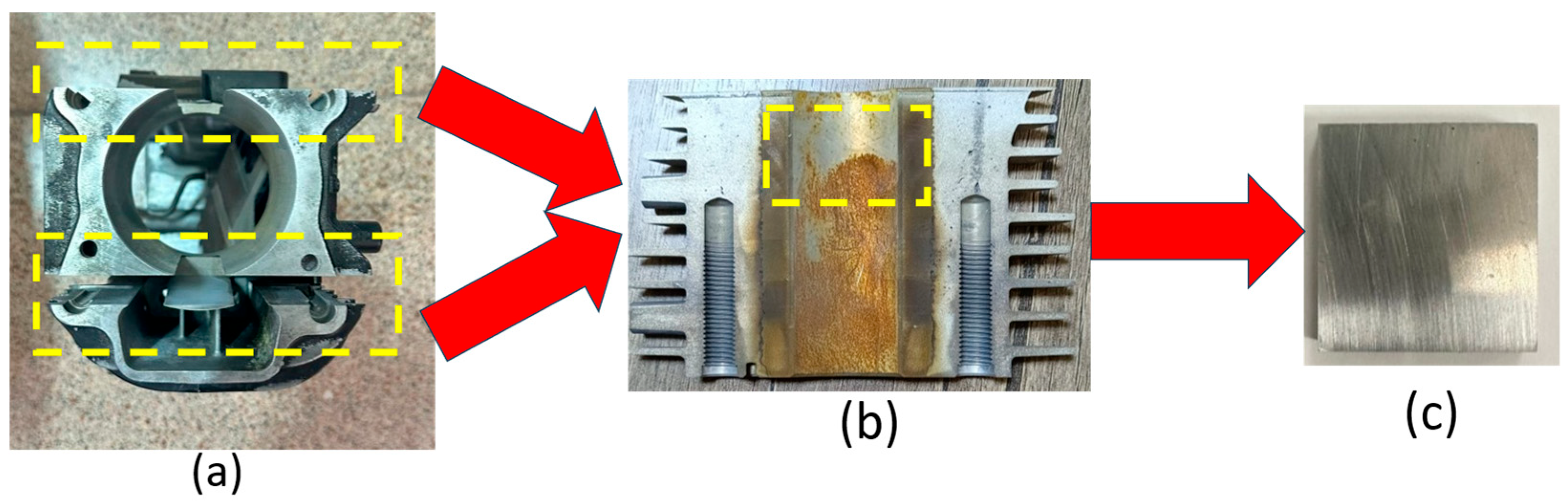
The substrate samples used in the experiments were prepared by cutting from a single-cylinder gasoline engine block, and the samples cut from this engine block are shown in Figure 1. XRD results confirmed that the substrate exhibited an Al-Si-based structure and corresponded to the characteristics of the 4032 Al alloy. The specimens were extracted from a commercial single-cylinder gasoline engine block; the substrate corresponds to a high-silicon piston alloy (AA/EN AW-4032). The nominal chemical composition range of the 4032 alloy is provided in Table 1 (wt.%). The phase constitution of this alloy is primarily based on an α-Al (FCC) matrix with Si-rich phases, which is consistent with the XRD results presented in Section 3.3.
The substrate samples used in the experiments were prepared by sectioning a commercial single-cylinder gasoline engine block. The specimens were extracted by wire electrical discharge machining (WEDM) in order to obtain representative material from the real engine component while avoiding the large mechanical cutting forces associated with conventional machining. Since WEDM may generate a thin thermally affected recast layer on the as-cut surface, the sectioned surface was not used directly for tribological testing. Instead, rectangular specimens of 30 × 30 × 5 mm were subjected to a controlled sequential grinding procedure using SiC abrasive papers from 120 to 2000 grit to remove the cutting-affected surface layer and to establish a uniform and reproducible initial surface condition. After grinding, the specimens were ultrasonically cleaned in alcohol for 20 min and then dried with compressed air. In this way, WEDM was used only as a specimen-extraction method, whereas the final tribological surface was generated by standardized post-sectioning preparation. Therefore, the measured tribological differences reflect the lubricant formulation effects rather than uncontrolled surface damage introduced during specimen extraction.

2.2. Preparation of Nano-Additive Lubricant Formulations and Rheological Test

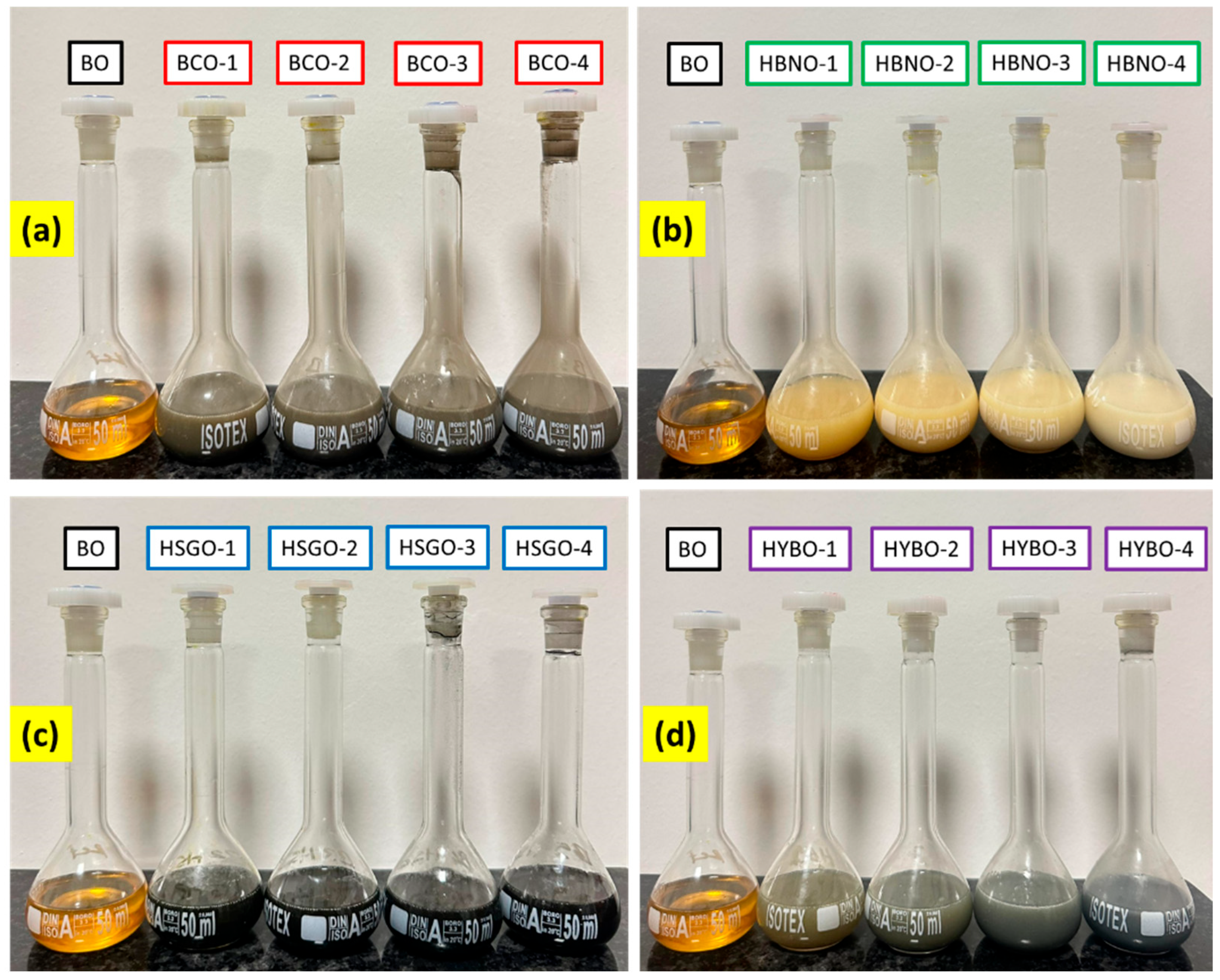
In all experiments, a commercially available SAE 5W-30 gasoline engine oil supplied by Castrol was used as the base lubricant. Boron carbide (B4C), hexagonal boron nitride (hBN), and holy super graphene (HSG) nano-additives were procured from Nanografi and incorporated into the base oil either individually or in hybrid combinations. The representative particle size of the additives was characterized by particle size distribution analysis, and the median particle size (D50) values were determined as 0.0527 µm for B4C, 3.29 µm for hBN, and 15.9 µm for HSG. These D50 values are reported to clarify the characteristic size scale of each additive in the lubricant formulations. To ensure consistency among different additive formulations, a constant oil volume of 25 mL was maintained for all samples. The detailed compositions and additive concentrations are shown in Table 2, and the visual appearance of the prepared nano-additive lubricant formulations is presented in Figure 2.
The required amounts of nano-additives were first introduced into the 5W-30 base oil and pre-dispersed using a mechanical stirrer (VELP OHS 60 Advance, VELP Scientifica, Usmate Velate, Italy) with a speed of 300–500 rpm for a period of 1 h. The resulting mixtures were then further treated using ultrasonic agitation for a period of 3 h to further improve the dispersion of the nanoparticles. Because the formulations are suspensions, dispersion quality can influence repeatability. Therefore, all nano-lubricants were prepared using an identical two-step protocol (mechanical stirring followed by ultrasonication) and were handled under the same conditions prior to testing to reduce batch-to-batch variability. Visual opacity is inherent to particle-containing oils and does not alone indicate instability; nevertheless, possible sedimentation and agglomeration in long-term storage are acknowledged. The above procedure was followed for all lubricant samples before any tribological and rheological tests. Viscosity measurements were performed to determine the effect of nano-additive addition on the rheological behavior of the oil. In this context, kinematic viscosity tests were conducted using an Anton Paar SVM 3001 viscometer (Anton Paar GmbH, Graz, Austria), and measurements were repeated for each formulation under the same procedure. A dedicated long-term dispersion stability and filterability assessment (e.g., extended static sedimentation, particle size evolution, and filtration and clogging tendency under engine-relevant shear) was not the focus of this screening study. Therefore, the present results should be interpreted as short-term comparative performance under controlled laboratory preparation and testing conditions, and further formulation engineering would be required before practical deployment.

2.3. Tribological Characterization

Tribological tests were conducted using a reciprocating test configuration on a CSM THT tribometer (Anton Paar, Baden, Switzerland). An Al2O3 ball with a diameter of 6 mm and a surface roughness of Ra = 20 ± 5 nm was employed as the counter body. The experiments were performed under lubricated sliding conditions using a reciprocating motion in order to realistically simulate the boundary at 75 °C and mixed lubrication regimes commonly encountered in gasoline engine contacts. For each test, the corresponding SAE 5W-30 lubricant formulation (either neat oil or oil containing nano-additives) was supplied directly to the contact zone, ensuring continuous lubrication throughout the sliding process. The experiments were performed under fully flooded lubricated sliding at 75 °C, with the aim of screening the nano-additive formulations under boundary lubrication conditions relevant to severe gasoline–engine contacts (e.g., near dead centers). The reciprocation parameters were: full stroke (peak-to-peak) of 10.0 mm and frequency of 5.0 Hz, which correspond to a maximum linear speed of 0.157 m/s and an average sliding speed of 0.10 m/s. A constant normal load of 20 N was applied. The total sliding distance was 500 m (≈25,000 cycles; total test duration ≈83 min). Using Hertzian elastic contact theory for a 6 mm Al2O3 ball on the Al-Si substrate, the nominal mean and maximum contact pressures were estimated as p_m ≈ 0.83 GPa and p0 ≈ 1.25 GPa, respectively (initial contact). During the tests, the coefficient of friction (COF) was continuously recorded as a function of sliding distance and time.

2.4. Surface and Microstructural Characterization

After each tribological test, the wear scars formed on the specimen surfaces were initially examined using an optical microscope to obtain a preliminary assessment of wear morphology and scar dimensions. Before the tribological experiments, the surface roughness of the sample cut from the gasoline engine was measured. This technique enabled the precise evaluation of wear scar depth, width, volume loss, and surface topography caused by different lubricant formulations. To provide a more detailed understanding of the wear mechanisms and surface damage characteristics, the tested specimens were carefully cleaned to remove residual lubricant and loosely adhered wear debris. Subsequently, scanning electron microscopy (SEM) analyses were performed using a Maia3 TESCAN (TESCAN, Brno, Czech Republic) to examine the wear scars at higher magnifications. The phase composition and crystal structure of the specimens were determined by X-ray diffraction (XRD). XRD measurements were performed using a Bruker D8 Advance diffractometer with Cu Kα radiation (λ = 1.5406 Å) over a 2θ range of 20–80°. The resulting diffraction patterns were analyzed to evaluate possible phase formations and structural changes in the samples.

3. Results and Discussion

3.1. Characterization of Powder Materials

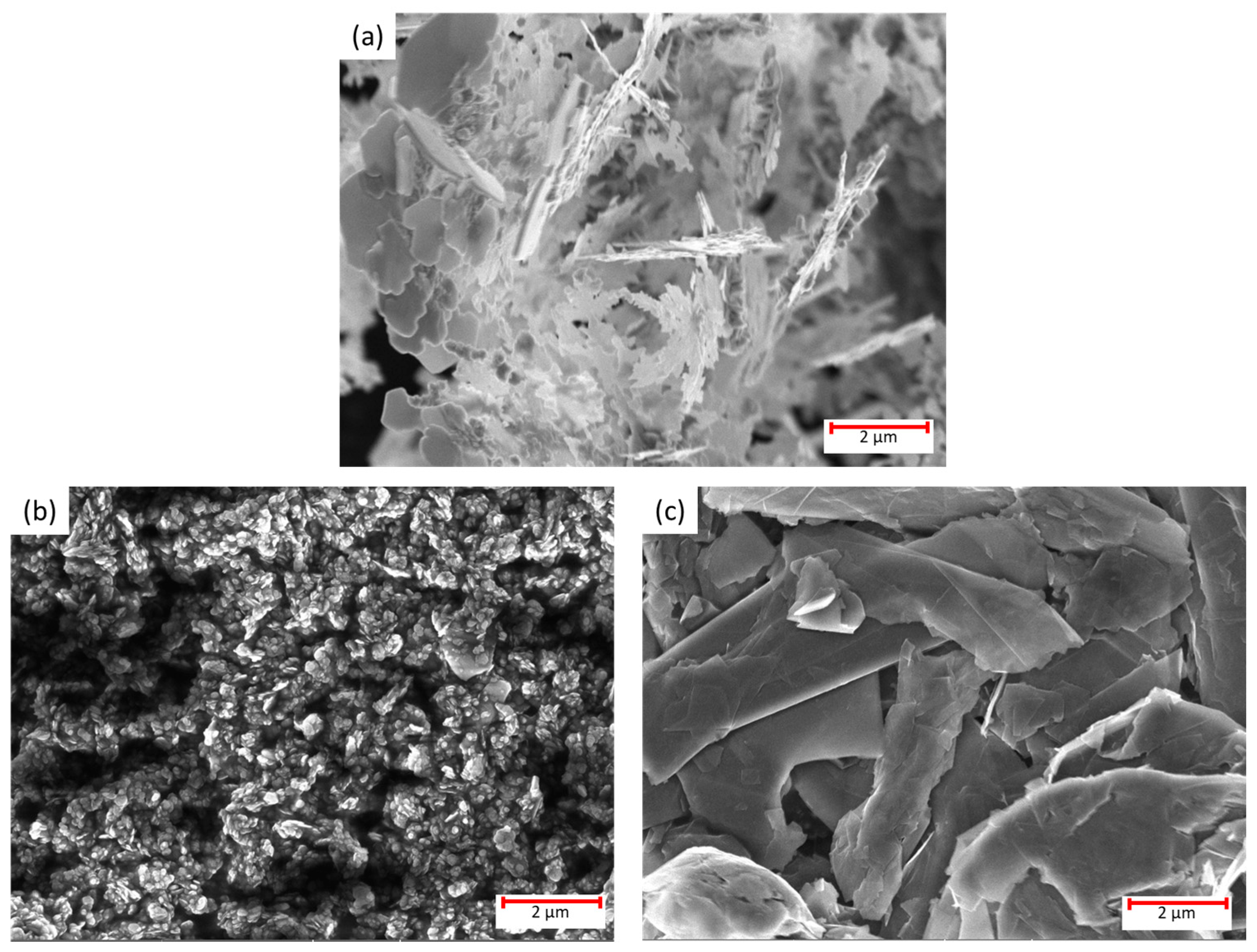
SEM characterization was performed to examine the morphological properties of nano-additives and their potential agglomeration tendencies. SEM images of B4C, hBN, and HSG additives are presented in Figure 3 (scale: 2 µm).
In Figure 3a, it is observed that B4C nanoparticles exhibit an irregular, polygonal morphology with sharp edges. It is also notable that smaller particles are clustered on larger grains in places. This morphology indicates that B4C is suitable as a hard third body for load transfer. However, when sharp-edged grains are not homogeneously distributed on the surface, it is thought that the abrasive effect may increase in the contact areas [32]. In Figure 3b, it can be seen that thin lamellae come together to form dense and compact clusters, consistent with the layered structure of hBN. This morphology indicates that hBN may require more intensive mixing during preparation due to its high surface area and interlayer interactions [33]. Figure 3c clearly shows that HSG has a layered and sheet-like carbon morphology. The layering and deformed structure provide a suitable surface structure for the formation of a carbon-based tribofilm at the contact interface. This morphology also indicates that the particles may have a high tendency to agglomerate [34,35].

3.2. Viscosity Analysis of Nano-Additive Oils

The kinematic viscosity values of nano-additive oils are presented in Table 3. The kinematic viscosity was measured at 40 °C as a comparative parameter to evaluate the effect of nano-additive incorporation on the flow behavior of the prepared formulations. The viscosity index was not determined because it requires kinematic viscosity data at both 40 °C and 100 °C according to ASTM D2270 [36]. Therefore, the present viscosity results are intended as comparative formulation data rather than a full rheological classification of the tested lubricants. The results obtained clearly show that all B4C, hBN, HSG, and hybrid (B4C + hBN + HSG) nano-additives significantly alter the viscosity characteristics of the 5W-30 grade base oil. The reference viscosity value of 63.80 mm2/s measured for the base oil showed a decreasing trend across all additive types and concentration levels; the amount of this decrease varied depending on the additive type and additive ratio.
Table 2 presents the kinematic viscosity values, which were determined based on the fundamental principle of measuring flow time at a constant temperature, as defined in ASTM D445 [37], using methods based on the standard capillary viscometer principle. The kinematic viscosity results in the table show that the viscosity of the oil without additives is 63.80 mm2/s in sample BO, and that the viscosity increases steadily in all samples with nanoparticle additions. Among the single nano-additive oils, the most significant viscosity increase was observed in B4C, with the value increasing from 64.45 mm2/s in BCO-1 to 68.90 mm2/s in BCO-4. This trend can be attributed to the hard ceramic B4C particles increasing the effective volumetric ratio of the oil during flow, thereby strengthening the hydrodynamic flow resistance. In hBN containing oils, the increase was observed at a lower level, with viscosity rising from 64.20 mm2/s in HBNO-1 to 67.10 mm2/s in HBNO-4; Although the shear stress effect of the layered crystal structure facilitates shear, the behavior can be explained by the inevitable increase in flow resistance as the additive level rises [38]. The HSG additive oil series has the most balanced nano-additive oil, with viscosity reaching 66.40 mm2/s in HSGO-4 from 64.05 mm2/s in HSGO-1. The easy movement of two-dimensional carbon derivatives in the oil caused the increase in viscosity to remain at a low level [39,40]. The highest viscosity values were obtained in the formulation containing hybrid additives. The viscosity of 64.80 mm2/s in HYBO-1 hybrid additive nano-particle oil increased to 70.50 mm2/s in HYBO-4. This increase is associated with the combination of B4C, hBN, and HSG particles, which creates a denser microstructural structure by enhancing both interparticle and particle oil interactions [41,42]. This structure significantly affects the viscous behavior of the oil medium. In terms of viscosity increase at the same additive ratios, hybrid-additive oils showed the highest increase, followed by B4C, hBN, and HSG-additive oils, respectively. This shows that viscosity is significantly affected not only by the amount of additives but also by the hardness and shape of the particles and their flow (rheological) behavior under shear conditions [43,44].

3.3. XRD Analysis

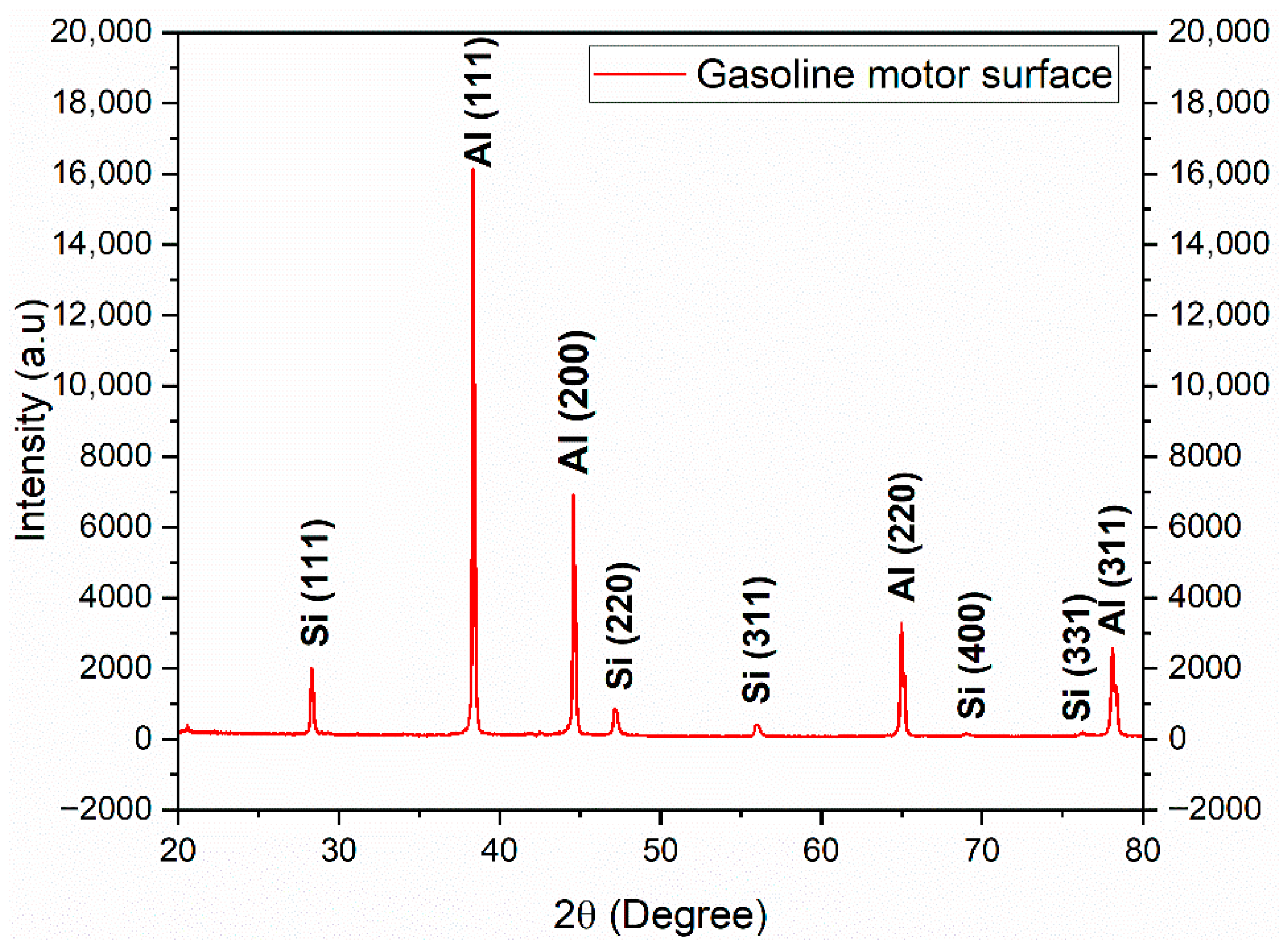
Figure 4 shows the XRD peaks of the sample prepared by cutting a section from a single-cylinder gasoline engine. The peaks generally indicate an Al-Si-based matrix and show that the composition is consistent with the 4032 Al alloy. Distinct Al and Si peaks reveal that the surface has a microstructure consisting of Al-rich phases and Si-containing phases.
The XRD pattern confirms that the sample is an Al-Si-based 4032 aluminum alloy and shows that the face-centered cubic (FCC) Al and diamond-type crystal structure Si phase are dominant. The significance of the Al(111) peak with the highest intensity, along with the Al(200), Al(220), and Al(311) peaks, suggests that the surface is aluminum dominant and that the prominence of the Al(111) peak in particular may indicate that aluminum is dominant on the measured surface. However, the observed Si(111), Si(220), Si(311), Si(400), and Si(331) peaks indicate the presence of the Si phase in the alloy structure and show a phase distribution consistent with the expected high Si content microstructural components in the 4032 alloy [45,46]. In addition to phase identification, the diffraction profiles provide information on the near-surface substructure, which can be modified by specimen finishing. The sequential SiC grinding (120–2000 grit) applied before testing is expected to introduce a shallow mechanically affected layer with increased dislocation density and residual stresses, which may manifest as minor changes in peak breadth (FWHM) and relative intensities of the Al reflections (texture effects). It should also be noted that the tribofilms formed under mixed lubrication are typically very thin compared to the massive Al-Si substrate; therefore, conventional θ-2θ XRD has limited sensitivity to detect tribofilm chemistry after testing. For this reason, the post-test interfacial modifications were primarily assessed using SEM/EDS mapping and line-scan analyses (Section 3.4), which directly confirmed additive-derived elements (B, N, C) and tribo-oxidation (O) across the wear track.

3.4. Friction and Wear Analysis

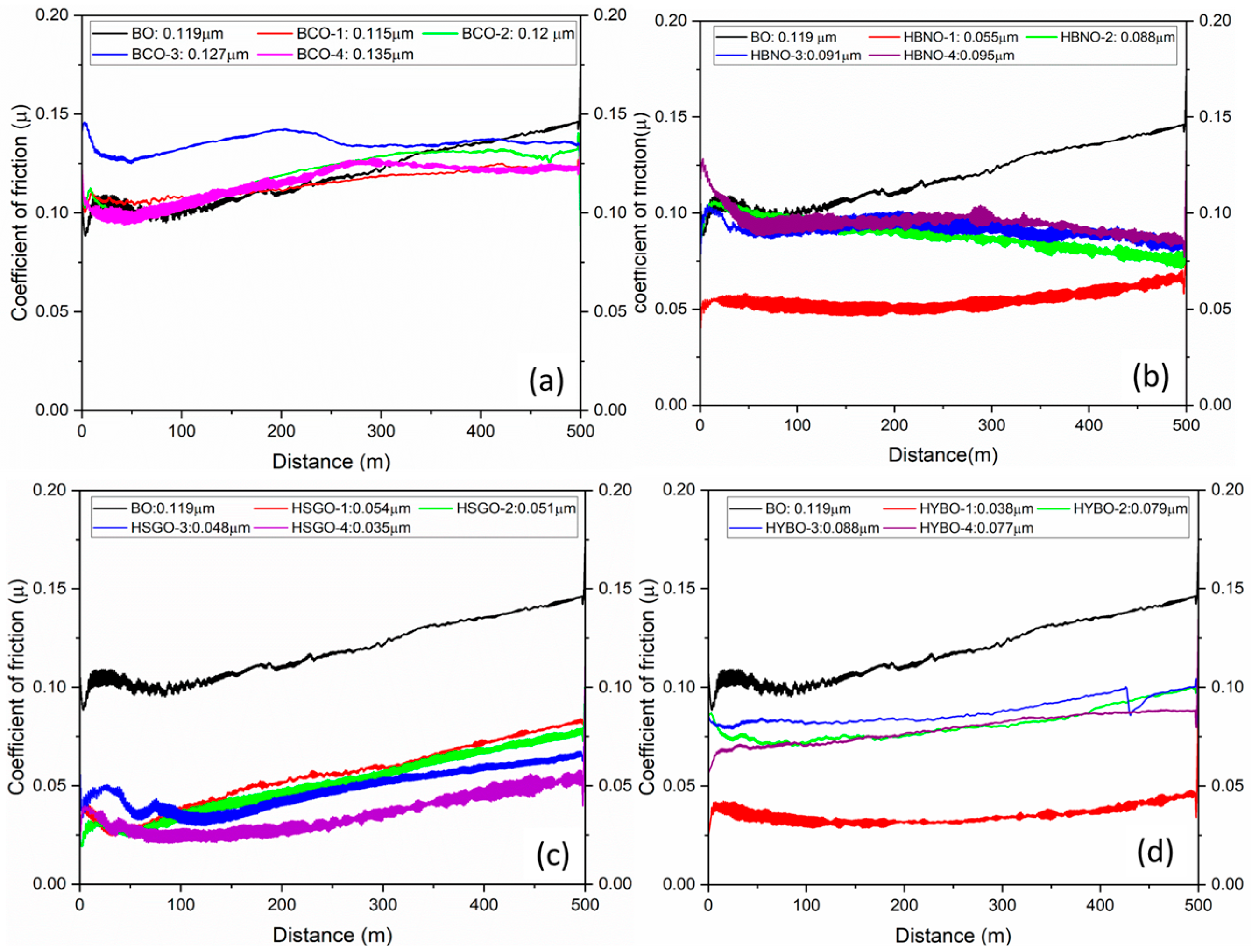
Figure 5 shows the evolution of the coefficient of friction (COF) and average COF values over a distance of 0–500 m in tests conducted with base oil (BO) and nano-additive oils.
In the base oil (BO) test sample, the coefficient of friction (COF) gradually increased during the test, and the average COF was measured as 0.119. In the B4C-additive oil series (Figure 5a), the average COF value decreased to 0.115 in the BCO-1 (0.025 g/25 mL) and BCO-4 (0.2 g/25 mL) oils with low and high additive ratios, respectively, providing a slight reduction compared to BO. The average COF value of the BCO-2 sample was 0.120, which is similar to that of the BO sample. In contrast, the increase in the average COF to 0.135 in the BCO-3 sample indicates that B4C particles at this additive ratio may cause irregular third-body wear at the interface, thereby increasing sliding resistance. In general, lower friction values were obtained with B4C addition, especially at low addition levels [47]. A significant decrease in the coefficient of friction was observed in all concentrations of hBN nano-additive oils (Figure 5b) compared to the base oil (BO). The lowest friction value in the hBN oil series was obtained with HBNO-1, which had an average COF of 0.055. As the additive level increased, the average COF values in HBNO-2, HBNO-3, and HBNO-4 nano-additive oils increased to the range of 0.088–0.095. This indicates that the accumulation of particles at high nano-additive ratios may negatively affect tribofilm formation, leading to an increase in friction [48]. In HSG nano-additive oils (Figure 5c), the coefficient of friction (COF) gradually decreased as the additive concentration increased. While the average COF value for HSGO-1 was 0.055, this value decreased to 0.035 in the HSGO-4 sample. This situation shows that the HSG additive reduces sliding resistance by forming a more homogeneous and stable carbon-based tribofilm on the contact surface [49,50]. In the hybrid additive oil series (Figure 5d), the lowest coefficient of friction (COF) of 0.036 was obtained with HYBO-1. This indicates that at low hybrid additive levels, the film effect of hBN and HSG, which provides low sliding resistance, can work effectively in conjunction with the load-carrying properties of B4C [51]. The increase in the average COF value to the range of 0.079–0.088 at higher hybrid additive levels indicates that excessive accumulation and irregular transport in a multi-particle environment may increase the third-body effect, thereby raising friction again [52].
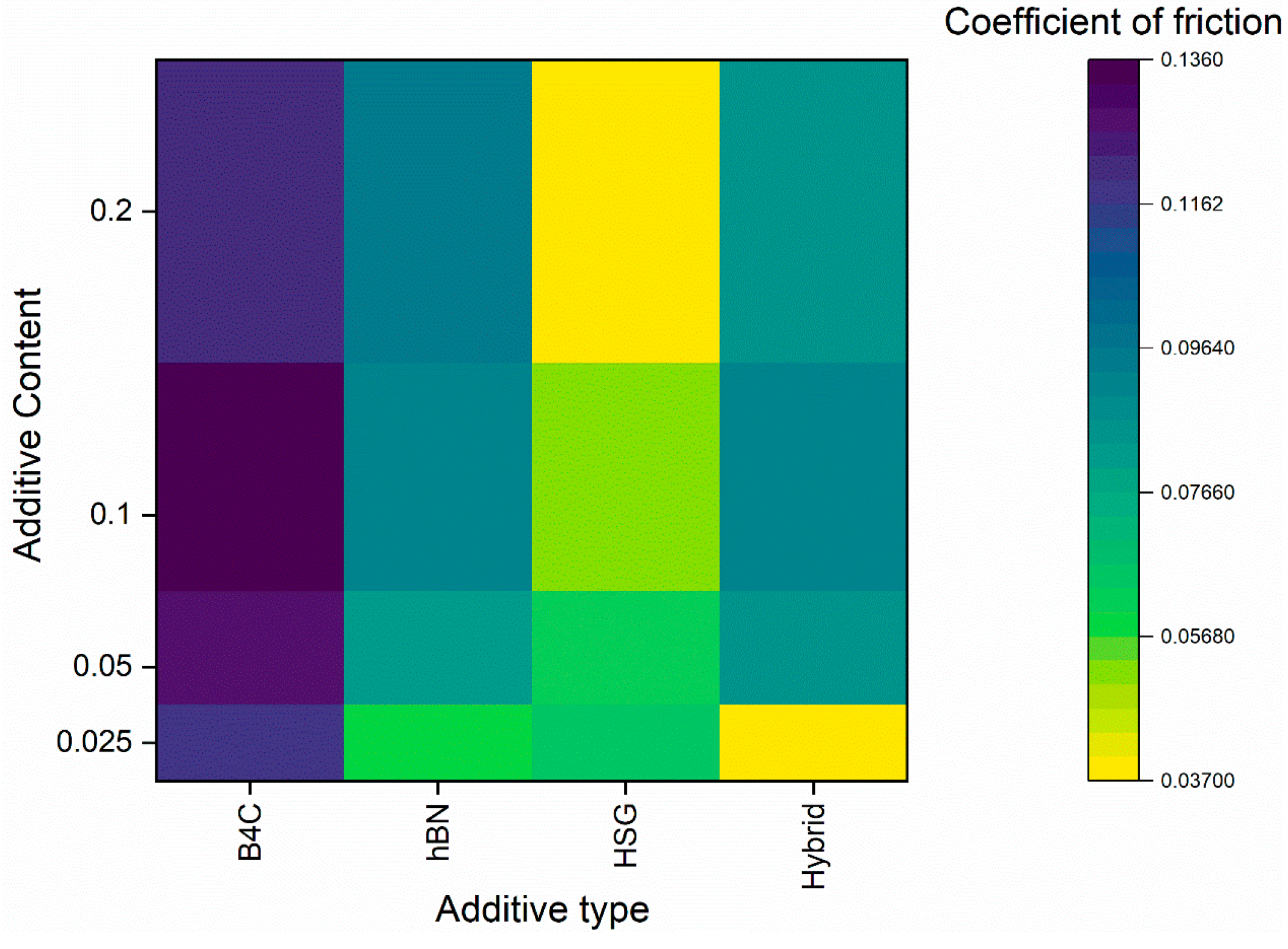
The heat map is shown in Figure 6, with the color scale representing the COF values; lower COF values are shown in lighter tones, while higher COF values are shown in darker tones.
Figure 6 shows that the additive type and additive ratio determine the friction behavior together, and that this effect is not linear. It is observed that the friction coefficient in B4C-additive oils is highly sensitive to changes in the additive ratio, with friction increasing in oils containing 0.1% B4C, while COF changes are more limited at other ratios [53]. In hBN-additive oils, the friction coefficient decreased at low additive ratios (0.025–0.05 wt.%) and then increased again as the additive ratio increased. In HSG nano-additive oils, the low-friction region was wider, and lower COF values were obtained as the additive ratio increased. In hybrid-additive oils, the COF values increased with increasing additive ratios [54,55].
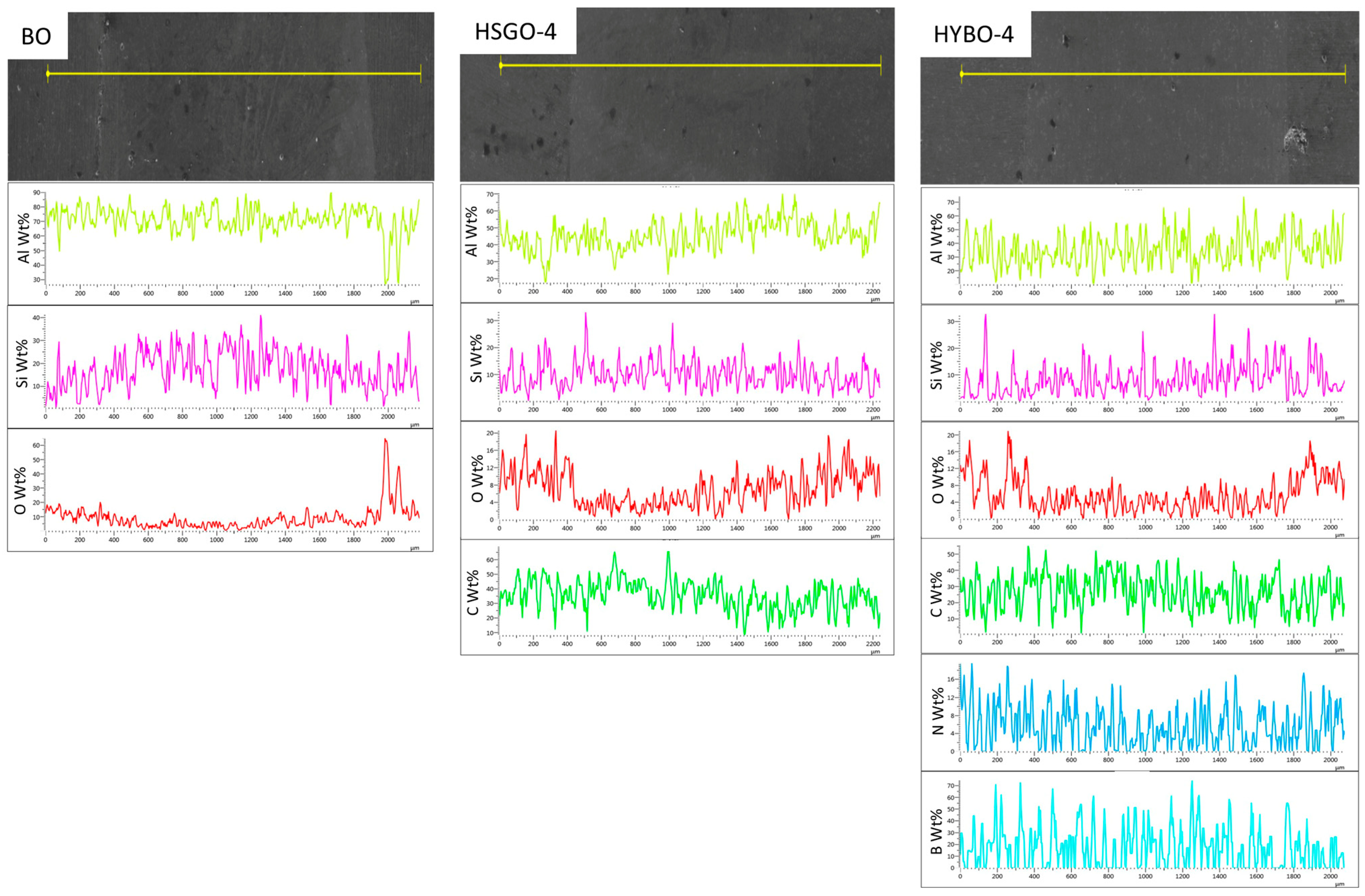
Figure 7 shows the EDX spectra and atomic percentage (At%) distributions of elements obtained from the wear trace region of the hybrid nanoparticle-added samples.
It should be noted that the base fluid is a fully formulated commercial engine oil containing a proprietary additive package; therefore, the interfacial chemistry can be complex. In this context, SEM/EDS results are interpreted qualitatively and comparatively: they indicate the distribution of additive-related elements and tribo-oxidation features across the wear track, but they do not uniquely resolve the complete tribofilm chemistry or isolate all contributions of the commercial additives. Accordingly, the proposed mechanism is presented as being consistent with additive-assisted tribofilm formation rather than as a fully deconvoluted tribochemical pathway. These comparative EDS line-scan results show that the element distribution at the contact interface changes significantly between the BO oil without additives and the oils containing graphene (HSGO-4 and hybrid HYBO-4). The generally high levels of Al and Si element lines on the sample surface in BO oil and the concentration of the O element in some areas indicate that local oxidation (tribo-oxidation) occurred during friction [56,57]. In HSGO-4 oil (0.2 g/25 mL additive), the Al and Si elements in the sample continue to represent the chemical composition of the substrate material. However, the significant and continuous distribution of the C element along the wear track indicates that the graphene-derived HSG has been transferred to the contact surface and formed a surface film with high carbon content. This film can reduce friction resistance during sliding, thereby directly reducing metal-to-metal contact and thus decreasing wear tendency [58]. In the hybrid-additive HYBO-4 oil, the C element was strongly observed on the sample surface along the wear track. Additionally, the detection of N and B elements in the same areas indicates that the graphene-based film layer forms a multi-component tribo-film structure together with BN components from hBN [59]. In both samples, the carbon phase containing graphene formed a continuous film on the surface, and in the hybrid oil, BN also contributed to this structure. This situation indicates that a more protective sliding layer is formed compared to the BO sample, which is consistent with lower friction and wear behavior.
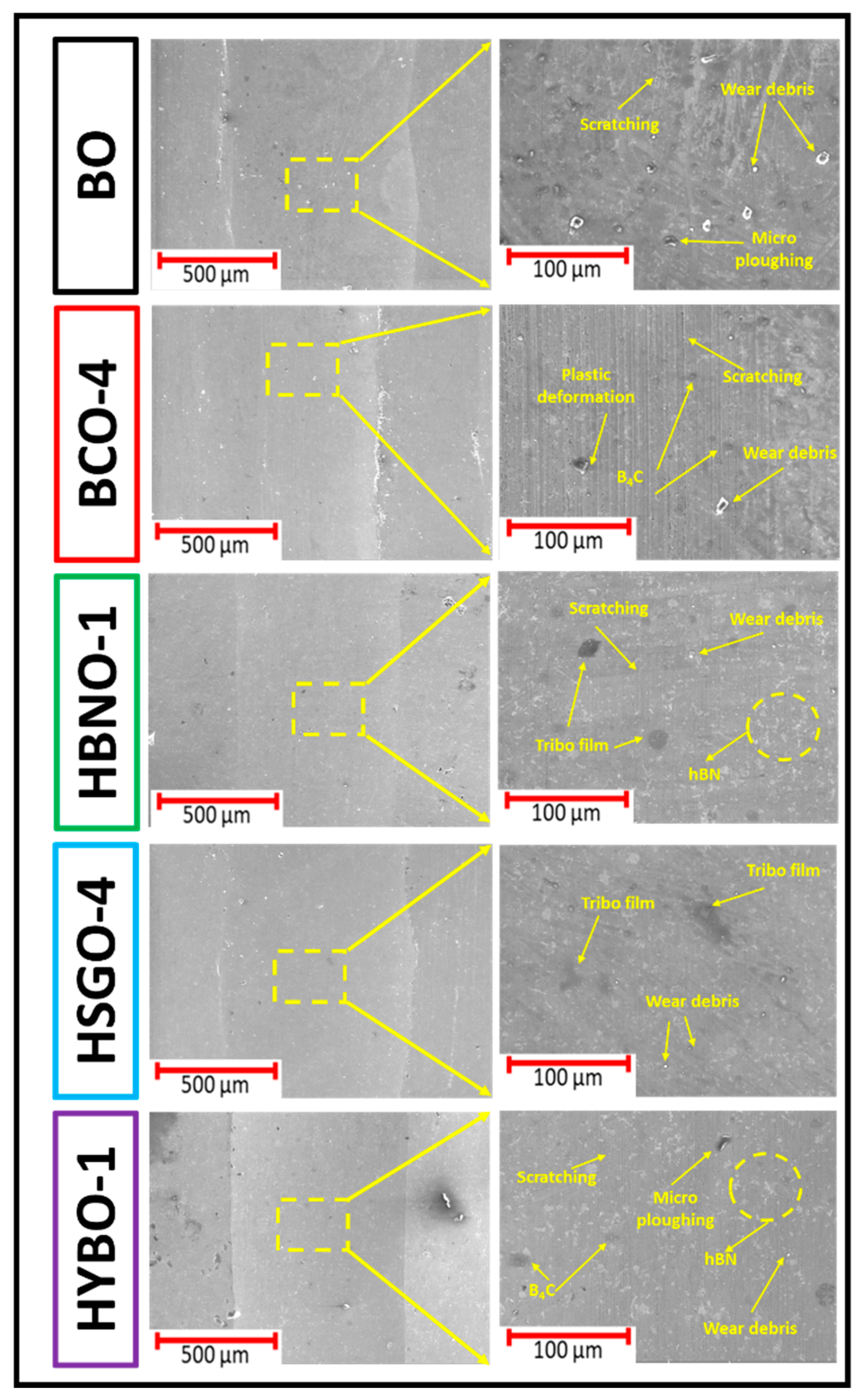
Figure 8 shows SEM images (general view and magnified areas) of the wear surface after wear tests on the gasoline engine base material. Figure 8 shows that the sample in base oil without additives exhibits more aggressive wear, with obvious scratch traces and dense wear particles, along with micro ploughing. In the BCO-4 (0.2 g/25 mL) oil, scratch and plastic deformation marks are observed on the sample surface, along with accumulations corresponding to B4C particles. This indicates that the particles create a third-body effect in the contact area but also provide some limited surface protection. The wear track of the sample surface in HBNO-1 (hBN 0.025 g/25 mL nano-additive) oil has a more regular appearance. The scratching intensity is reduced, and tribofilm formation is more clearly visible in some areas. This is consistent with hBN forming a more lubricious film layer at the contact interface due to its layered structure, thereby reducing friction and surface damage [60,61]. The test sample in HSGO-4 (HSG 0.025 g/25 mL nano-additive) oil is distinguished from other samples by its distinct tribofilm traces and more homogeneous wear scar appearance. This indicates that graphene-derived HSG forms a carbon-based protective layer on the contact surface and reduces the effect of wear particles [51,62]. In the HYBO-1 (0.025 g hybrid additive) oil sample surface, local traces indicating the transfer of solid phases from B4C and hBN to the surface are observed, along with a significant reduction in micro grooving. This situation demonstrates that the hybrid additive formulation, at appropriate additive ratios, can limit surface damage in a more balanced manner by forming a multi-component tribofilm.
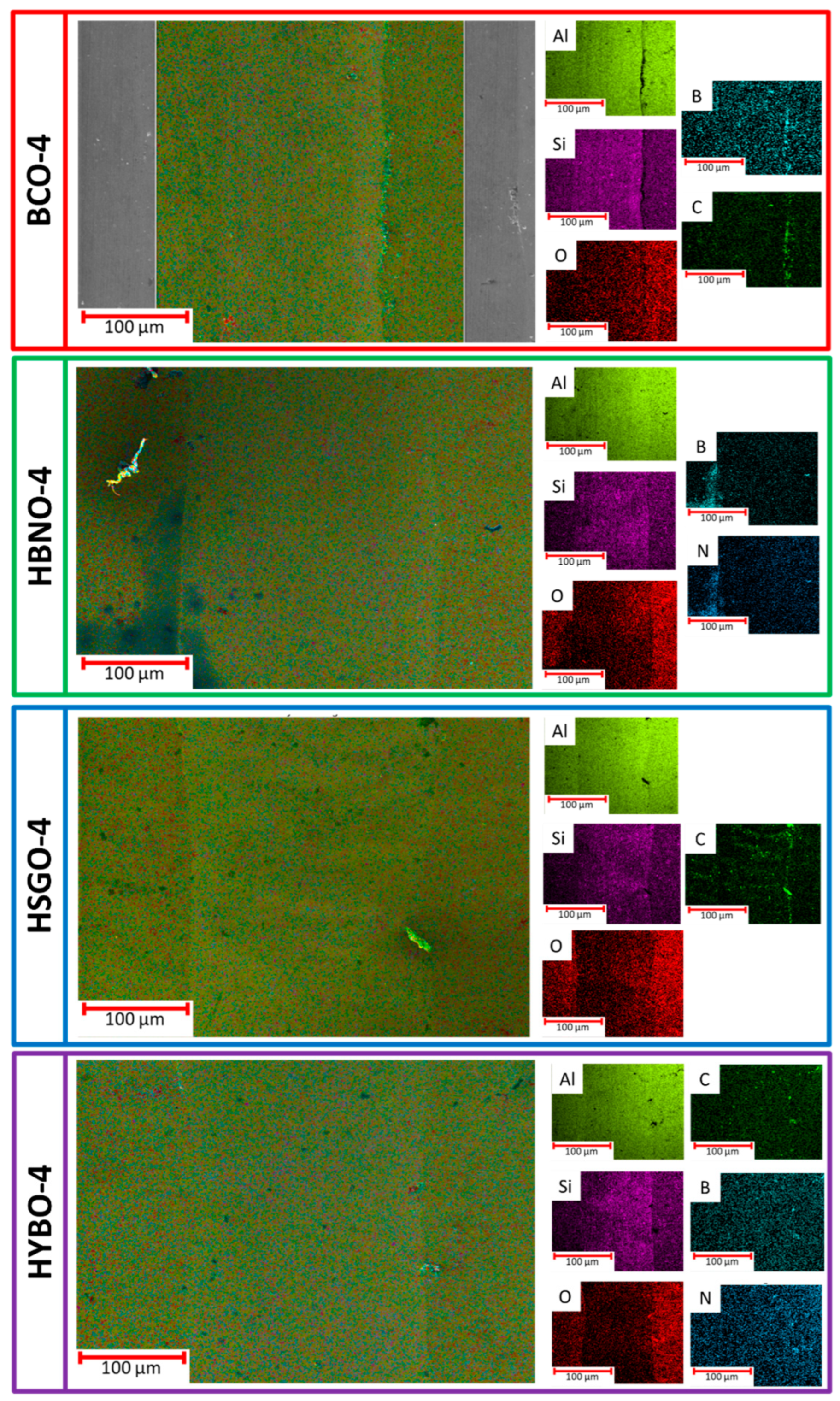
Figure 9 shows EDS mapping (element distribution maps) images from the wear track area of the gasoline engine substrate material.
A comparative analysis of Figure 9 shows that the Al and Si elements belonging to the base material are generally continuously distributed throughout the wear track in all samples. In contrast, the concentration of the O element in some areas indicates oxidized areas formed as a result of tribo-oxidation due to friction heat [63]. The presence of B and C elements together in the same areas in the B4C-added sample indicates that phases from boron carbide are transferred to the contact surface and can function as a third body or a partially protective phase there [64]. The detection of B and N elements together in the same regions in the hBN-additive sample indicates that hBN is present at the contact interface along the wear trace. This supports the idea that hBN contributes to the formation of a film layer that facilitates sliding due to its layered structure [65,66]. In oils containing HSG, the more intense and widespread distribution of the C element in the test samples indicates that graphene-derived carbon phases are transported to the contact surface, forming a tribofilm layer with high carbon content [27,67]. In the hybrid sample, the presence of B and N elements alongside C in the same wear zone suggests the development of a multi-component tribofilm and the contribution of different additive phases at the interface.

4. Conclusions

This study aimed to compare the tribological performance of B4C, hBN, HSG, and hybrid (B4C + hBN + HSG) nano-additives in an SAE 5W-30 gasoline engine oil on an Al-Si (4032) engine-block alloy substrate under reciprocating mixed lubrication. The results demonstrate that the friction response is strongly governed by additive chemistry and loading level. The rheological results show that nanoparticle addition increases the kinematic viscosity of the base oil (BO: 63.80 mm2/s), with the largest increase observed for the hybrid formulation (up to 70.50 mm2/s in HYBO-4), indicating a stronger particle oil interaction and higher flow resistance at elevated solid contents. The base oil exhibited an average coefficient of friction (COF) of 0.119, whereas the additives provided substantial reductions depending on concentration. Among the tested formulations, low-additive hBN (HBNO-1) yielded a pronounced friction decrease (COF ≈ 0.055), indicating that even a small amount of hBN can effectively reduce shear at the interface. In contrast, HSG showed a concentration-dependent improvement, reaching the lowest COF in the study at the highest HSG loading (HSGO-4, COF ≈ 0.035), consistent with the formation of a more continuous carbon-based tribofilm. The hybrid formulation produced very low friction at low additive (HYBO-1, COF ≈ 0.036), while higher hybrid loadings tended to increase friction, suggesting that excessive multi-particle accumulation can enhance third-body effects and disrupt film uniformity. These numerical trends suggest that tribological improvement is controlled by an optimum balance between additive chemistry, particle morphology, and interfacial film stability rather than by additive presence alone. The superior behavior of low-loading hBN is consistent with its layered structure, which can facilitate easy shear and formation of a lubricious protective layer at the sliding interface. The concentration-dependent improvement in the HSG series indicates that graphene-derived carbon phases require sufficient surface coverage to generate a more continuous carbon-based tribofilm. By contrast, the unstable friction response of B4C at intermediate loading and the friction increase at higher hybrid loadings suggest that excessive solid accumulation may promote irregular third-body effects and reduce the uniformity of the protective film. This interpretation is consistent with the FE-SEM/EDS observations, where additive-derived elements and tribofilm-related interfacial modification were detected along the wear track. XRD confirmed that the substrate is dominated by α-Al (FCC) and Si phases, and no evidence of bulk phase transformation was observed, indicating that the observed improvements mainly originate from interfacial mechanisms. SEM/EDS observations support that the best-performing oils promote a protective surface state through additive-derived transfer and tribofilm formation and by limiting severe abrasive features. Overall, the findings identify HBNO-1 (low-additive hBN) and HSGO-4 (high-additive HSG) as the most effective strategies for friction reduction on the studied Al-Si substrate, while hybrid oils require optimized (low) total loading to avoid adverse third-body behavior. These results directly address the objective of selecting the most efficient additive type and concentration for improved mixed lubrication performance.

Funding

This research received no external funding.

Data Availability Statement

The data presented in this study are available from the corresponding author upon reasonable request.

Conflicts of Interest

The author declares no conflicts of interest.

References

  1. Domínguez-García, S.; Béjar-Gómez, L.; López-Velázquez, A.; Maya-Yescas, R.; Nápoles-Rivera, F. Maximizing Lubricant Life for Internal Combustion Engines. Processes 2022, 10, 2070. [Google Scholar] [CrossRef]
  2. Taylor, R.I.; Coy, R.C. Improved Fuel Efficiency by Lubricant Design: A Review. Proc. Inst. Mech. Eng. Part J J. Eng. Tribol. 2000, 214, 1–15. [Google Scholar] [CrossRef]
  3. Holmberg, K.; Erdemir, A. Influence of Tribology on Global Energy Consumption, Costs and Emissions. Friction 2017, 5, 263–284. [Google Scholar] [CrossRef]
  4. Kumar, V.; Sinha, S.K.; Agarwal, A.K. Tribological Studies of an Internal Combustion Engine. In Advanced Engine Diagnostics; Springer: Singapore, 2018; pp. 237–253. [Google Scholar]
  5. Spikes, H. The History and Mechanisms of ZDDP. Tribol. Lett. 2004, 17, 469–489. [Google Scholar] [CrossRef]
  6. Tamura, K.; Kasai, M.; Nakamura, Y.; Enomoto, T. Impact of Boundary Lubrication Performance of Engine Oils on Friction at Piston Ring-Cylinder Liner Interface. SAE Int. J. Fuels Lubr. 2014, 7, 875–881. [Google Scholar] [CrossRef]
  7. Zhang, S.; Yan, Z.; Liu, Z.; Jiang, Y.; Sun, H.; Wu, S. Experimental and Numerical Study of the Mixed Lubrication Considering Boundary Film Strength. Materials 2023, 16, 1035. [Google Scholar] [CrossRef]
  8. Wong, V.W.; Tung, S.C. Friction, Lubrication, and Wear of Internal Combustion Engine Parts. In Friction, Lubrication, and Wear Technology; ASM International: Materials Park, OH, USA, 2017. [Google Scholar]
  9. Demirtas, S.; Kaleli, H.; Khadem, M.; Kim, D.-E. Characterization of the Friction and Wear Effects of Graphene Nanoparticles in Oil on the Ring/Cylinder Liner of Internal Combustion Engine. Ind. Lubr. Tribol. 2019, 71, 642–652. [Google Scholar] [CrossRef]
  10. Zhao, J.; Huang, Y.; He, Y.; Shi, Y. Nanolubricant Additives: A Review. Friction 2021, 9, 891–917. [Google Scholar] [CrossRef]
  11. Jiang, Z.; Sun, Y.; Liu, B.; Yu, L.; Tong, Y.; Yan, M.; Yang, Z.; Hao, Y.; Shangguan, L.; Zhang, S. Research Progresses of Nanomaterials as Lubricant Additives. Friction 2024, 12, 1347–1391. [Google Scholar] [CrossRef]
  12. Zhang, W. A Review of Tribological Properties for Boron Carbide Ceramics. Prog. Mater. Sci. 2021, 116, 100718. [Google Scholar] [CrossRef]
  13. Sharma, A.K.; Tiwari, A.K.; Dixit, A.R. Mechanism of Nanoparticles Functioning and Effects in Machining Processes: A Review. Mater. Today Proc. 2015, 2, 3539–3544. [Google Scholar] [CrossRef]
  14. Canakci, A.; Arslan, F. Abrasive Wear Behaviour of B4C Particle Reinforced Al2024 MMCs. Int. J. Adv. Manuf. Technol. 2012, 63, 785–795. [Google Scholar] [CrossRef]
  15. Singh, K.M.; Chauhan, A.K. Fabrication, Characterization, and Impact of Heat Treatment on Sliding Wear Behaviour of Aluminium Metal Matrix Composites Reinforced with B4C. Adv. Mater. Sci. Eng. 2021, 2021, 5554837. [Google Scholar] [CrossRef]
  16. Akanksh, V.N.; Hegde, P.; Siddharth, S.; Siddaraju, C.; Nagaral, M.; Manjunath, A.B. Microstructural Characterization, Mechanical and Wear Behaviour of Al2024-B4C Composites for Aerospace Applications. J. Mines Met. Fuels 2022, 70, 138. [Google Scholar] [CrossRef]
  17. Özer, E.; Ayvaz, M. Dry Tribological Behaviour of Microwave-Assisted Sintered AA2024 Matrix Hybrid Composites Reinforced by TiC/B4C/Nano-Graphite Particles. Mater. Test. 2024, 66, 233–247. [Google Scholar] [CrossRef]
  18. Vats, P.; Khanna, N.; Kumar, A.; Gajrani, K.K. Tribological Performance of HBN and Graphene-Enriched Hybrid Nanofluids on Tool Wear and Hole Surface Quality in Drilling: A Comparative Study on WAAM and Wrought Inconel 625. Wear 2025, 574–575, 206090. [Google Scholar] [CrossRef]
  19. Wang, L.; Bai, Y.; Ma, Z.; Ge, C.; Guan, H.; Zhang, X. Tribological Performances of Hexagonal Boron Nitride Nanosheets via Surface Modification with Silane Coupling Agent. SN Appl. Sci. 2021, 3, 368. [Google Scholar] [CrossRef]
  20. Gupta, M.K.; Bijwe, J.; Padhan, M. Role of Size of Hexagonal Boron Nitride Particles on Tribo-performance of Nano and Micro Oils. Lubr. Sci. 2018, 30, 441–456. [Google Scholar] [CrossRef]
  21. Song, W.; Liu, D.; Wang, F.; Zhang, L. The Development of Hexagonal Boron Nitride Crystal Growth Technologies and Their Applications in Neutron Detection. Nanomaterials 2025, 15, 1256. [Google Scholar] [CrossRef]
  22. Morshed, A.; Wu, H.; Ren, M.; Xing, Z.; Jiao, S.; Jiang, Z. A Study of Water-Based Nanolubricants Using Hexagonal Boron Nitride (HBN)-Based Nanocomposites as Lubricant Additives. Lubricants 2024, 12, 123. [Google Scholar] [CrossRef]
  23. Bin Abdollah, M.F.; Amiruddin, H.; Alif Azmi, M.; Mat Tahir, N.A. Lubrication Mechanisms of Hexagonal Boron Nitride Nano-Additives Water-Based Lubricant for Steel–Steel Contact. Proc. Inst. Mech. Eng. Part J J. Eng. Tribol. 2021, 235, 1038–1046. [Google Scholar] [CrossRef]
  24. Ma, Z.-S.; Ding, H.-L.; Liu, Z.; Cheng, Z.-L. Preparation and Tribological Properties of Hydrothermally Exfoliated Ultrathin Hexagonal Boron Nitride Nanosheets (BNNSs) in Mixed NaOH/KOH Solution. J. Alloys Compd. 2019, 784, 807–815. [Google Scholar] [CrossRef]
  25. Srivyas, P.D.; Charoo, M.S. Graphene: An Effective Lubricant for Tribological Applications. Adv. Eng. Des. Sel. Proc. FLAME 2018, 2019, 239–258. [Google Scholar] [CrossRef]
  26. Berman, D.; Erdemir, A.; Sumant, A. V Graphene: A New Emerging Lubricant. Mater. Today 2014, 17, 31–42. [Google Scholar] [CrossRef]
  27. Gao, Q.; Liu, S.; Hou, K.; Li, Z.; Wang, J. Graphene-Based Nanomaterials as Lubricant Additives: A Review. Lubricants 2022, 10, 273. [Google Scholar] [CrossRef]
  28. Sun, J.; Du, S. Application of Graphene Derivatives and Their Nanocomposites in Tribology and Lubrication: A Review. RSC Adv. 2019, 9, 40642–40661. [Google Scholar] [CrossRef]
  29. Li, Q.; Lu, R.; Tani, H.; Kawada, S.; Koganezawa, S.; Liu, X.; Cong, P. Tribofilm Formation and Friction Reduction Performance on Laser-Textured Surface with Micro-Grooved Structures. Lubricants 2024, 12, 91. [Google Scholar] [CrossRef]
  30. Huynh, K.K.; Pham, S.T.; Tieu, K.A.; Wan, S. Tribocatalysis Induced Carbon-Based Tribofilms—An Emerging Tribological Approach for Sustainable Lubrications. Lubricants 2023, 11, 327. [Google Scholar] [CrossRef]
  31. Yin, X.; Mu, L.; Jia, Z.; Pang, H.; Chai, C.; Liu, H.; Liang, C.; Zhang, B.; Liu, D. Nanostructure of Superlubricating Tribofilm Based on Friction-Induced AC: H Films under Various Working Conditions: A Review of Solid Lubrication. Lubricants 2024, 12, 40. [Google Scholar] [CrossRef]
  32. Ahmed, N.S.; Nassar, A.M. Lubrication and Lubricants. In Tribology—Fundamentals and Advancements; IntechOpen: London, UK, 2013; pp. 55–76. [Google Scholar] [CrossRef]
  33. Bartels, T.; Bock, W.; Braun, J.; Busch, C.; Buss, W.; Dresel, W.; Freiler, C.; Harperscheid, M.; Heckler, R.; Hörner, D. Lubricants and Lubrication. In Ullmann’s Encyclopedia of Industrial Chemistry; Wiley: Hoboken, NJ, USA, 2000. [Google Scholar] [CrossRef]
  34. Nair, F.; Hamamcı, M. Effect of In-Situ Synthesized Boride Phases on the Impact Behavior of Iron-Based Composites Reinforced by B4C Particles. Metals 2020, 10, 554. [Google Scholar] [CrossRef]
  35. Chen, X.; Chen, W.; Zhang, L.; Zeng, M.; Yang, S.; Yang, Z.; Ola, O.; Thummavichai, K.; Wang, N.; Zhu, Y. Implanting MnO2 into Hexagonal Boron Nitride as Nanoadditives for Enhancing Tribological Performance. Crystals 2022, 12, 451. [Google Scholar] [CrossRef]
  36. Standard’s ASTM D2270-10; Standard Practice for Calculating Viscosity Index from Kinematic Viscosity at 40 and 100 °C. ASTM International: West Conshohocken, PA, USA, 2016.
  37. Standard’s ASTM D445-24; Standard Test Method for Kinematic Viscosity of Transparent and Opaque Liquids (and Calculation of Dynamic Viscosity). ASTM International: West Conshohocken, PA, USA, 2024.
  38. Huang, J.-B.; Patra, J.; Lin, M.-H.; Ger, M.-D.; Liu, Y.-M.; Pu, N.-W.; Hsieh, C.-T.; Youh, M.-J.; Dong, Q.-F.; Chang, J.-K. A Holey Graphene Additive for Boosting Performance of Electric Double-Layer Supercapacitors. Polymers 2020, 12, 765. [Google Scholar] [CrossRef] [PubMed]
  39. Rajput, N.S.; Al Zadjali, S.; Gutierrez, M.; Esawi, A.M.K.; Al Teneiji, M. Synthesis of Holey Graphene for Advanced Nanotechnological Applications. RSC Adv. 2021, 11, 27381–27405. [Google Scholar] [CrossRef]
  40. Zhao, C.; Zhang, P.; Zhou, J.; Qi, S.; Yamauchi, Y.; Shi, R.; Fang, R.; Ishida, Y.; Wang, S.; Tomsia, A.P. Layered Nanocomposites by Shear-Flow-Induced Alignment of Nanosheets. Nature 2020, 580, 210–215. [Google Scholar] [CrossRef] [PubMed]
  41. Kuang, X.; Yang, X.; Bian, H.; Kuang, R.; Hu, N.; Li, S. Performance Evaluation of Nano-Graphene Lubricating Oil with High Dispersion and Low Viscosity Used in Diesel Engines. PLoS ONE 2024, 19, e0307394. [Google Scholar] [CrossRef]
  42. Marlinda, A.R.; Thien, G.S.H.; Shahid, M.; Ling, T.Y.; Hashem, A.; Chan, K.-Y.; Johan, M.R. Graphene as a Lubricant Additive for Reducing Friction and Wear in Its Liquid-Based Form. Lubricants 2023, 11, 29. [Google Scholar] [CrossRef]
  43. Sepehrnia, M.; Maleki, H.; Hamidi, A.; Davoodi, A.; Golmohammadi, H. Rheological Behavior of MWCNT-SnO2/SAE50 Hybrid Nanolubricant: Experimental Evaluation and Viscosity Prediction Using Optimized Machine Learning Model. Alex. Eng. J. 2025, 127, 771–786. [Google Scholar] [CrossRef]
  44. Finke, B.; Sangrós Giménez, C.; Kwade, A.; Schilde, C. Viscosity Model for Nanoparticulate Suspensions Based on Surface Interactions. Materials 2021, 14, 2752. [Google Scholar] [CrossRef]
  45. Cui, J.; He, Z.; Zhang, G.; Cai, X. Rheological Properties of Sprayable Ultra-High Performance Concrete with Different Viscosity-Enhancing Agents. Constr. Build. Mater. 2022, 321, 126154. [Google Scholar] [CrossRef]
  46. Martini, A.; Ramasamy, U.S.; Len, M. Review of Viscosity Modifier Lubricant Additives. Tribol. Lett. 2018, 66, 58. [Google Scholar] [CrossRef]
  47. Cahyo, F.N.; Soegijono, B. Effect of Solution Heat Treatment of Aluminum Alloy 4032 on the Structure and Corrosion Resistance in 3, 5% and 10, 5% NACL Solution. IOP Conf. Ser. Mater. Sci. Eng. 2019, 694, 012043. [Google Scholar] [CrossRef]
  48. Bibik, N.; Metel, A.; Cherenda, N.; Sotova, C.; Astashynski, V.; Kuzmitski, A.; Melnik, Y.; Vereschaka, A. Structure of Eutectic Al-Si Alloy Subjected to Compression Plasma Flow Impact. Metals 2024, 14, 1415. [Google Scholar] [CrossRef]
  49. Baradeswaran, A.; Perumal, A.E. Influence of B4C on the Tribological and Mechanical Properties of Al 7075–B4C Composites. Compos. B Eng. 2013, 54, 146–152. [Google Scholar] [CrossRef]
  50. Berman, D.; Erdemir, A. The Role of Tribocatalysis in Friction and Wear: A Review. Lubricants 2025, 13, 442. [Google Scholar] [CrossRef]
  51. Wang, D.; Zeng, X.; Nan, F. Tribological Behaviors of an Attapulgite–Graphene Nanocomposite as an Additive for Mineral Lubricating Oil. RSC Adv. 2024, 14, 16411–16420. [Google Scholar] [CrossRef]
  52. Jason, Y.J.J.; How, H.G.; Teoh, Y.H.; Sher, F.; Chuah, H.G.; Teh, J.S. Tribological Behaviour of Graphene Nanoplatelets as Additive in Pongamia Oil. Coatings 2021, 11, 732. [Google Scholar] [CrossRef]
  53. Li, X.; Wei, S.; Yang, Q.; Gao, Y.; Zhong, Z. Tribological Performance of Self-Matching Pairs of B4C/HBN Composite Ceramics under Different Frictional Loads. Ceram. Int. 2020, 46, 996–1001. [Google Scholar] [CrossRef]
  54. Çelebi, M.; Karabacak, A.H.; Özkaya, S.; Çelik, E.; Sekban, D.M.; Çanakçı, A.; Yanar, H. Effect of B4C Amount on Microstructural and Mechanical Properties of Cu/h-BN/B4C Metal Matrix Composites Fabricated via Spark Plasma Sintering. Metals 2025, 15, 1283. [Google Scholar] [CrossRef]
  55. Liu, W.; Qiao, X.; Liu, S.; Chen, P. A Review of Nanomaterials with Different Dimensions as Lubricant Additives. Nanomaterials 2022, 12, 3780. [Google Scholar] [CrossRef]
  56. Ayanda, O.S.; Mmuoegbulam, A.O.; Okezie, O.; Durumin Iya, N.I.; Mohammed, S.E.; James, P.H.; Muhammad, A.B.; Unimke, A.A.; Alim, S.A.; Yahaya, S.M. Recent Progress in Carbon-Based Nanomaterials: Critical Review. J. Nanopart. Res. 2024, 26, 106. [Google Scholar] [CrossRef]
  57. Nasr, J.; Cursaru, D.-L. The Performance of Carbon-Based Nanomaterials in Different Base Oils and an Oil Blend. Lubricants 2024, 12, 90. [Google Scholar] [CrossRef]
  58. Zakerin, N.; Morshed-Behbahani, K.; Bishop, D.P.; Nasiri, A. Review of Tribological and Wear Behavior of Alloys Fabricated via Directed Energy Deposition Additive Manufacturing. J. Manuf. Mater. Process. 2025, 9, 194. [Google Scholar] [CrossRef]
  59. Kim, H.-J.; Emge, A.; Karthikeyan, S.; Rigney, D.A. Effects of Tribooxidation on Sliding Behavior of Aluminum. Wear 2005, 259, 501–505. [Google Scholar] [CrossRef]
  60. Kimura, Y.; Wakabayashi, T.; Okada, K.; Wada, T.; Nishikawa, H. Boron Nitride as a Lubricant Additive. Wear 1999, 232, 199–206. [Google Scholar] [CrossRef]
  61. Peng, H.; Meng, Z.; Shangguan, L.; Liu, L.; Yang, C.; Guo, L. Research on the Application of Nano-Additives in Gel-like Lubricants. Gels 2025, 11, 546. [Google Scholar] [CrossRef] [PubMed]
  62. Bhowmick, S.; Yang, Z.; Alpas, A.T. Tribochemical Stability and Friction Mechanisms of Graphene Nanoplatelets in Engine Oil at Elevated Temperatures. Diam. Relat. Mater. 2025, 159, 112838. [Google Scholar] [CrossRef]
  63. Yang, S.; Gao, S.; Xue, W.; Wu, B.; Duan, D. Tribo-Driven Evolution of Specific Nano-Heterostructures to Achieve Exceptional Wear Resistance in Composites. Adv. Compos. Hybrid Mater. 2025, 8, 343. [Google Scholar] [CrossRef]
  64. Huynh, K.K.; Pham, S.T.; Tieu, A.K.; Collins, S.M.; Lu, C.; Wan, S. Tribo-Induced Catalytically Active Oxide Surfaces Enabling the Formation of the Durable and High-Performance Carbon-Based Tribofilms. Tribol. Int. 2023, 184, 108476. [Google Scholar] [CrossRef]
  65. Abdullah, M.I.H.C.; Abdollah, M.F.B.; Amiruddin, H.; Tamaldin, N.; Nuri, N.R.M. The Potential of HBN Nanoparticles as Friction Modifier and Antiwear Additive in Engine Oil. Mech. Ind. 2016, 17, 104. [Google Scholar] [CrossRef]
  66. Eßler, J.; Woelk, D.; Utu, I.-D.; Marginean, G. Impact of HBN Content on the Tribological Behavior and Thermal Diffusivity of HVOF-Sprayed Cr3C2-NiCr Coatings. Materials 2024, 17, 5470. [Google Scholar] [CrossRef] [PubMed]
  67. Liu, Y.; Yu, S.; Shi, Q.; Ge, X.; Wang, W. Graphene-Family Lubricant Additives: Recent Developments and Future Perspectives. Lubricants 2022, 10, 215. [Google Scholar] [CrossRef]
Figure 1. (a) The area from which the sample was taken from the single-cylinder gasoline engine block, (b) the sectional piece cut from the engine surface, and (c) the final sample prepared for tribological tests.
Lubricants 14 00135 g001
Figure 2. (a) B4C nano-additive lubricant; (b) hBN nano-additive lubricant; (c) HSG nano-additive lubricant; and (d) B4C, hBN, and HSG at the same nano-additive concentration.
Lubricants 14 00135 g002
Figure 3. SEM morphologies of nano-additives: (a) B4C, (b) hBN, and (c) HSG.
Lubricants 14 00135 g003
Figure 4. XRD peaks of the gasoline engine surface.
Lubricants 14 00135 g004
Figure 5. Change in the coefficient of friction (COF, µ) as a function of sliding distance in tribological tests performed with base oil (BO) and nano-additive oils: (a) B4C nano-additive oils (BCO-1–BCO-4), (b) hBN nano-additive oils (HBNO-1–HBNO-4), (c) HSG nano-additive oils (HSGO-1–HSGO-4), and (d) hybrid nano-additive oils (HYBO-1–HYBO-4).
Lubricants 14 00135 g005
Figure 6. Heat map of the friction coefficient (COF) measured depending on the type of additive (B4C, hBN, HSG, and hybrid) and the additive ratio (0.025–0.2 wt.%).
Lubricants 14 00135 g006
Figure 7. FE-SEM/EDS line-scan analysis results along the wear tracks of the base (BO) and HSGO-4 and HYBO-4 samples.
Lubricants 14 00135 g007
Figure 8. SEM images of the wear surface of the BO, BCO-4, HBNO-1, HSGO-4, and HYBO-1 gasoline engine substrate material.
Lubricants 14 00135 g008
Figure 9. EDS mapping images of the wear track area on the gasoline engine surface.
Lubricants 14 00135 g009
Table 1. Chemical composition of 4032 alloy used as substrate (wt.%).
Elementwt.%
Al85.0
Si12.2
Mg1.0
Cu0.90
Ni0.90
Table 2. Composition of nano-additive-containing SAE 5W-30 engine oil.
Sample CodeAdditive TypeAdditive Content (g/25 mL Oil)
BOSAE 5W-30 (neat)0.00
BCO-1B4C0.025
BCO-2B4C0.05
BCO-3B4C0.10
BCO-4B4C0.20
HBNO-1hBN0.025
HBNO-2hBN0.05
HBNO-3hBN0.10
HBNO-4hBN0.20
HSGO-1HSG0.025
HSGO-2HSG0.05
HSGO-3HSG0.10
HSGO-4HSG0.20
HYBO-1B4C + hBN + HSG (hybrid)0.025
HYBO-2B4C + hBN + HSG (hybrid)0.05
HYBO-3B4C + hBN + HSG (hybrid)0.10
HYBO-4B4C + hBN + HSG (hybrid)0.20
Table 3. Kinematic viscosity values of 5W-30 engine oils with nanoparticle additives.
SampleKinematic Viscosity (mm2/s)Δ Kinematic Viscosity (%)
BO63.800.00
BCO-164.45+1.02
BCO-265.10+2.04
BCO-366.35+4.00
BCO-468.90+7.99
HBNO-164.20+0.63
HBNO-264.85+1.65
HBNO-365.70+2.98
HBNO-467.10+5.17
HSGO-164.05+0.39
HSGO-264.55+1.18
HSGO-365.20+2.19
HSGO-466.40+4.08
HYBO-164.80+1.57
HYBO-265.95+3.37
HYBO-367.80+6.27
HYBO-470.50+10.50
Disclaimer/Publisher’s Note: The statements, opinions and data contained in all publications are solely those of the individual author(s) and contributor(s) and not of MDPI and/or the editor(s). MDPI and/or the editor(s) disclaim responsibility for any injury to people or property resulting from any ideas, methods, instructions or products referred to in the content.