
Molybdenum Abundances in MINCE Stars



Abstract
1. Introduction
2. Observational Data
3. Abundance Analysis
4. Results and Discussion
5. Conclusions
- The Mo i absorption lines at 550.6 nm, 557.0 nm, and 603.0 nm have proven to be reliable in measuring Mo abundance in giant stars with [Fe/H] . In particular, the 603.0 nm line is detectable down to [Fe/H] = , while the other lines are detectable down to [Fe/H] = .
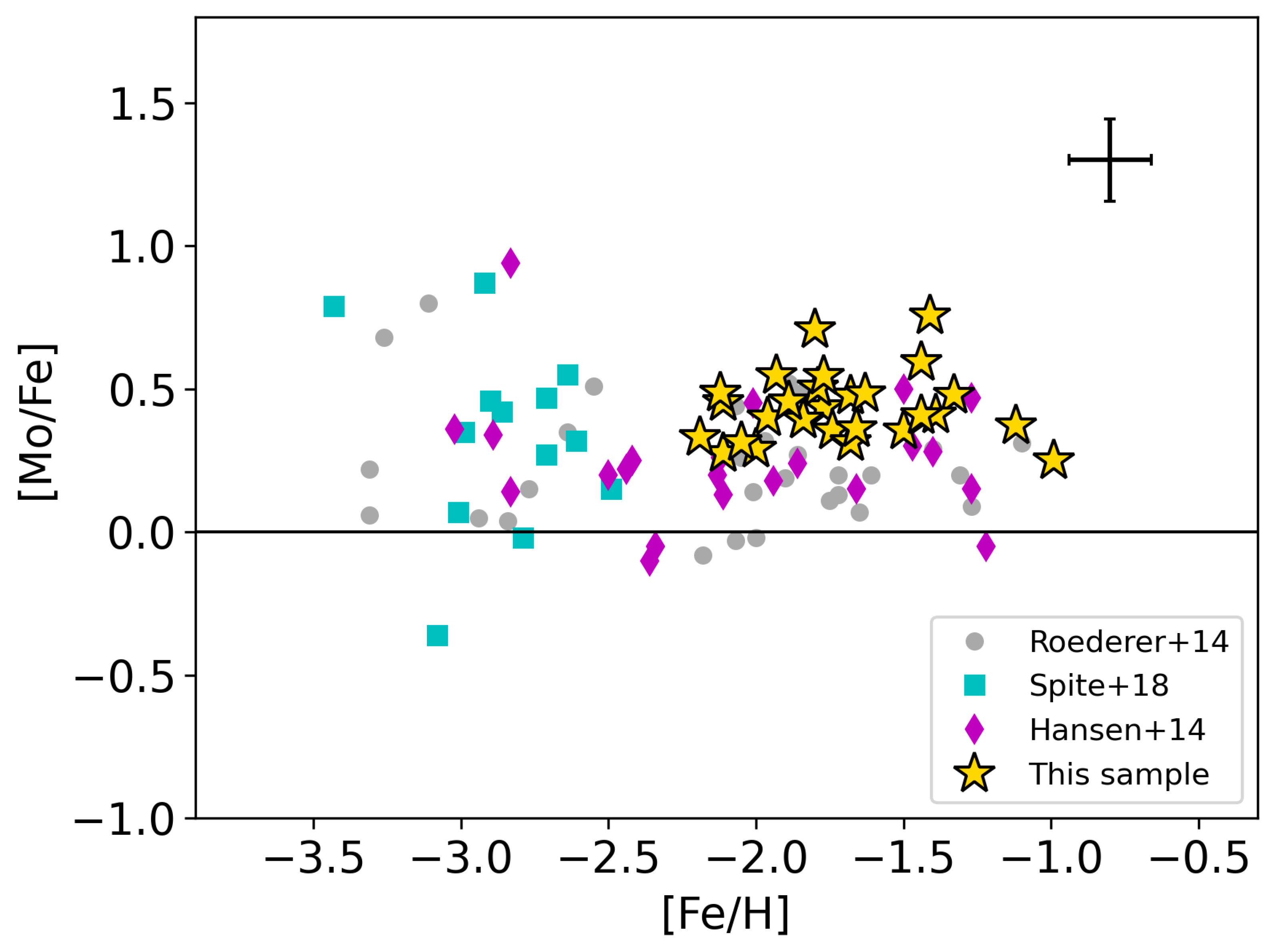
- The general trend observed for [Mo/Fe] as a function of [Fe/H] is in good agreement with the results of previous studies, even if the derived values of [Mo/Fe] are on average higher than the ones in other samples at similar metallicity. We believe that this may be due either to an observational bias or to NLTE effects.
- Currently, there are no NLTE corrections available for Mo i lines in the literature. Our results emphasise the need for these corrections in order to better understand the nucleosynthesis and chemical evolution of this element.
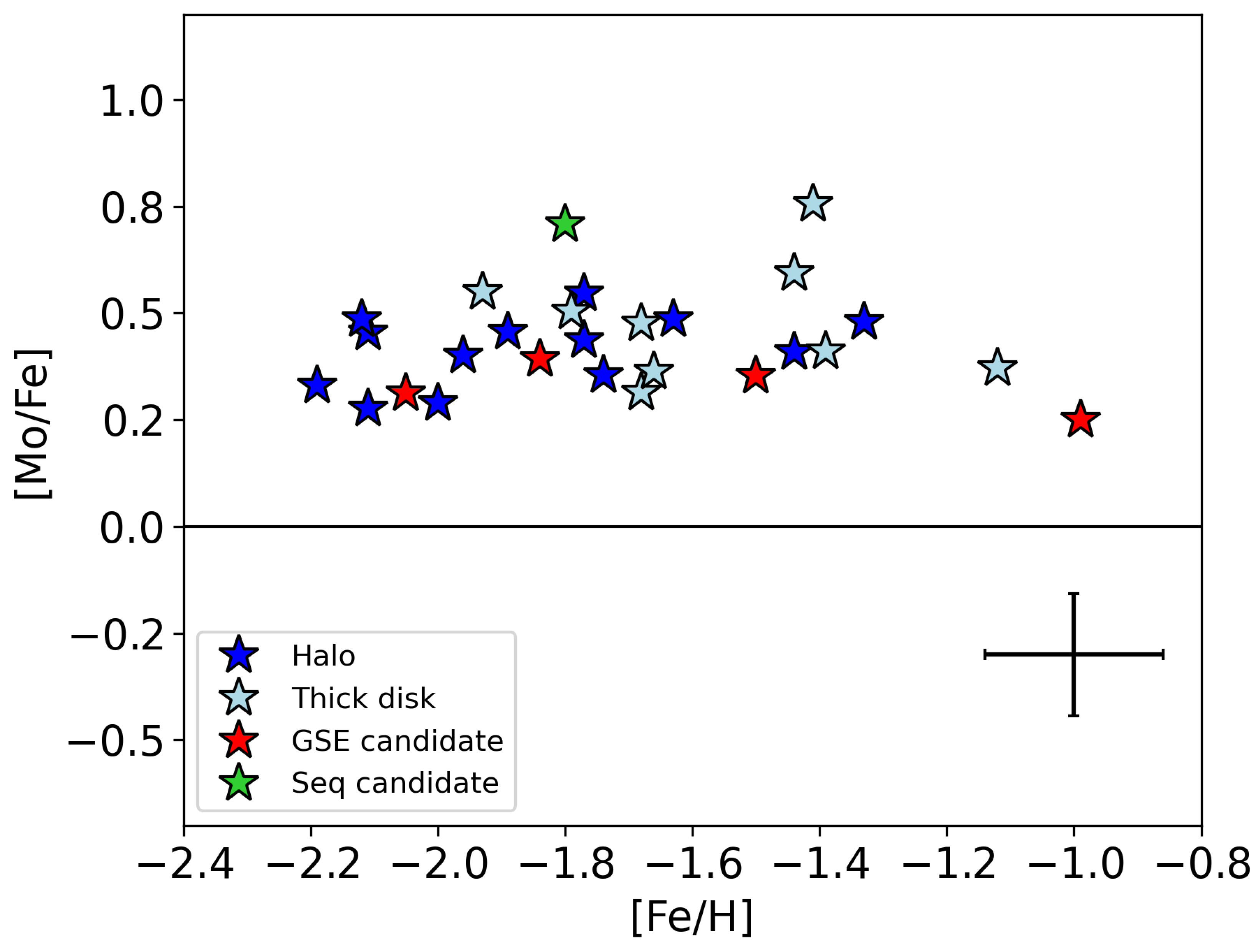
- In our sample, stars that are GSE candidates show [Mo/Fe] marginally below the sample average, while the only Sequoia candidate star has a higher [Mo/Fe] than most stars in the sample. However, the limited number of stars prevents us from drawing firm conclusions about [Mo/Fe] trends in these substructures.
Author Contributions
Funding
Data Availability Statement
Acknowledgments
Conflicts of Interest
References
- Arnould, M.; Goriely, S. The p-process of stellar nucleosynthesis: Astrophysics and nuclear physics status. Phys. Rep. 2003, 384, 1–84. [Google Scholar] [CrossRef]
- Pignatari, M.; Göbel, K.; Reifarth, R.; Travaglio, C. The production of proton-rich isotopes beyond iron: The γ-process in stars. Int. J. Mod. Phys. E 2016, 25, 1630003. [Google Scholar] [CrossRef]
- Lugaro, M.; Pignatari, M.; Reifarth, R.; Wiescher, M. The s Process and Beyond. Annu. Rev. Nucl. Part. Sci. 2023, 73, 315–340. [Google Scholar] [CrossRef]
- Cowan, J.J.; Sneden, C.; Lawler, J.E.; Aprahamian, A.; Wiescher, M.; Langanke, K.; Martínez-Pinedo, G.; Thielemann, F.K. Origin of the heaviest elements: The rapid neutron-capture process. Rev. Mod. Phys. 2021, 93, 015002. [Google Scholar] [CrossRef]
- Cowan, J.J.; Rose, W.K. Production of 14C and neutrons in red giants. Astrophys. J. 1977, 212, 149–158. [Google Scholar] [CrossRef]
- Côté, B.; Denissenkov, P.; Herwig, F.; Ruiter, A.J.; Ritter, C.; Pignatari, M.; Belczynski, K. i-process Contribution of Rapidly Accreting White Dwarfs to the Solar Composition of First-peak Neutron-capture Elements. Astrophys. J. 2018, 854, 105. [Google Scholar] [CrossRef]
- Arcones, A.; Montes, F. Production of Light-element Primary Process Nuclei in Neutrino-driven Winds. Astrophys. J. 2011, 731, 5. [Google Scholar] [CrossRef]
- Psaltis, A.; Jacobi, M.; Montes, F.; Arcones, A.; Hansen, C.J.; Schatz, H. Neutrino-driven Outflows and the Elemental Abundance Patterns of Very Metal-poor Stars. Astrophys. J. 2024, 966, 11. [Google Scholar] [CrossRef]
- Lodders, K.; Palme, H.; Gail, H.P. Abundances of the Elements in the Solar System. Landolt–Börnstein 2009, 4B, 712. [Google Scholar] [CrossRef]
- Nicolussi, G.K.; Pellin, M.J.; Lewis, R.S.; Davis, A.M.; Amari, S.; Clayton, R.N. Molybdenum Isotopic Composition of Individual Presolar Silicon Carbide Grains from the Murchison Meteorite. Geochim. Cosmochim. Acta 1998, 62, 1093–1104. [Google Scholar] [CrossRef]
- Stephan, T.; Hoppe, P.; Davis, A.M.; Korsmeyer, J.M.; Regula, A.; Richards, H.E. Correlated Molybdenum, Ruthenium, and Barium Isotope Anomalies in Presolar Silicon Carbide Grains. Astrophys. J. 2025, 981, 201. [Google Scholar] [CrossRef]
- Peterson, R.C. The Extreme Overabundance of Molybdenum in Two Metal-poor Stars. Astrophys. J. 2011, 742, 21. [Google Scholar] [CrossRef]
- Peterson, R.C. Molybdenum, Ruthenium, and the Heavy r-process Elements in Moderately Metal-poor Main-sequence Turnoff Stars. Astrophys. J. Lett. 2013, 768, L13. [Google Scholar] [CrossRef]
- Hansen, C.J.; Andersen, A.C.; Christlieb, N. Stellar abundances and presolar grains trace the nucleosynthetic origin of molybdenum and ruthenium. Astron. Astrophys. 2014, 568, A47. [Google Scholar] [CrossRef]
- Roederer, I.U.; Preston, G.W.; Thompson, I.B.; Shectman, S.A.; Sneden, C.; Burley, G.S.; Kelson, D.D. A Search for Stars of Very Low Metal Abundance. VI. Detailed Abundances of 313 Metal-poor Stars. Astron. J. 2014, 147, 136. [Google Scholar] [CrossRef]
- Spite, F.; Spite, M.; Barbuy, B.; Bonifacio, P.; Caffau, E.; François, P. Abundance patterns of the light neutron-capture elements in very and extremely metal-poor stars. Astron. Astrophys. 2018, 611, A30. [Google Scholar] [CrossRef]
- Lucertini, F.; Sbordone, L.; Caffau, E.; Bonifacio, P.; Monaco, L.; Cescutti, G.; Lallement, R.; François, P.; Spitoni, E.; Hansen, C.J.; et al. MINCE: III. Detailed chemical analysis of the UVES sample. Astron. Astrophys. 2025, 695, A36. [Google Scholar] [CrossRef]
- Dekker, H.; D’Odorico, S.; Kaufer, A.; Delabre, B.; Kotzlowski, H. Design, construction, and performance of UVES, the echelle spectrograph for the UT2 Kueyen Telescope at the ESO Paranal Observatory. In Proceedings of the Optical and IR Telescope Instrumentation and Detectors; Iye, M., Moorwood, A.F., Eds.; Society of Photo-Optical Instrumentation Engineers (SPIE) Conference Series; SPIE: Bellingham, DC, USA, 2000; Volume 4008, pp. 534–545. [Google Scholar] [CrossRef]
- Mishenina, T.; Pignatari, M.; Gorbaneva, T.; Travaglio, C.; Côté, B.; Thielemann, F.K.; Soubiran, C. Enrichment of the Galactic disc with neutron-capture elements: Mo and Ru. Mon. Not. R. Astron. Soc. 2019, 489, 1697–1708. [Google Scholar] [CrossRef]
- Forsberg, R.; Ryde, N.; Jönsson, H.; Rich, R.M.; Johansen, A. Abundances of disk and bulge giants from high-resolution optical spectra. V. Molybdenum: The p-process element. Astron. Astrophys. 2022, 666, A125. [Google Scholar] [CrossRef]
- Mishenina, T.; Kurtukian-Nieto, T.; Gorbaneva, T.; Amarsi, A.M.; Psaltis, A.; Pignatari, M. Molybdenum and ruthenium in the Galactic disk: A closer look at their nucleosynthesis components. arXiv 2025, arXiv:2511.21190. [Google Scholar] [CrossRef]
- Sbordone, L.; Caffau, E.; Bonifacio, P.; Duffau, S. MyGIsFOS: An automated code for parameter determination and detailed abundance analysis in cool stars. Astron. Astrophys. 2014, 564, A109. [Google Scholar] [CrossRef]
- Kurucz, R.L. ATLAS12, SYNTHE, ATLAS9, WIDTH9, et cetera. Mem. Della Soc. Astron. Ital. Suppl. 2005, 8, 14. [Google Scholar]
- Sbordone, L.; Bonifacio, P.; Castelli, F.; Kurucz, R.L. ATLAS and SYNTHE under Linux. Mem. Della Soc. Astron. Ital. Suppl. 2004, 5, 93. [Google Scholar] [CrossRef]
- Heiter, U.; Lind, K.; Bergemann, M.; Asplund, M.; Mikolaitis, Š.; Barklem, P.S.; Masseron, T.; de Laverny, P.; Magrini, L.; Edvardsson, B.; et al. Atomic data for the Gaia-ESO Survey. Astron. Astrophys. 2021, 645, A106. [Google Scholar] [CrossRef]
- Whaling, W.; Brault, J.W. Comprehensive transition probabilities in Mo I. Phys. Scr. 1988, 38, 707–718. [Google Scholar] [CrossRef]
- Cescutti, G.; Bonifacio, P.; Caffau, E.; Monaco, L.; Franchini, M.; Lombardo, L.; Matas Pinto, A.M.; Lucertini, F.; François, P.; Spitoni, E.; et al. MINCE. I. Presentation of the project and of the first year sample. Astron. Astrophys. 2022, 668, A168. [Google Scholar] [CrossRef]
- Bergemann, M.; Cescutti, G. Chromium: NLTE abundances in metal-poor stars and nucleosynthesis in the Galaxy. Astron. Astrophys. 2010, 522, A9. [Google Scholar] [CrossRef]
- Mashonkina, L.; Gehren, T.; Shi, J.R.; Korn, A.J.; Grupp, F. A non-LTE study of neutral and singly-ionized iron line spectra in 1D models of the Sun and selected late-type stars. Astron. Astrophys. 2011, 528, A87. [Google Scholar] [CrossRef]
- Bergemann, M.; Lind, K.; Collet, R.; Magic, Z.; Asplund, M. Non-LTE line formation of Fe in late-type stars—I. Standard stars with 1D and <3D> model atmospheres. Mon. Not. R. Astron. Soc. 2012, 427, 27–49. [Google Scholar] [CrossRef]



| Wavelength [Å] | Excitation Potential [eV] | log gf | Reference | gfflag | synflag |
|---|---|---|---|---|---|
| 5506.493 | 1.335 | 0.060 | [26] | Y | U |
| 5570.444 | 1.335 | −0.337 | [26] | Y | U |
| 6030.644 | 1.531 | −0.523 | [26] | Y | Y |
| Star | Teff [K] | log g [dex] | vturb [km/s] | [Fe/H] [dex] | Nlin | [Mo/H] [dex] | [dex] |
|---|---|---|---|---|---|---|---|
| BD-11 3235 | 4158 | 0.90 | 1.93 | −2.11 | 1 | −1.83 | |
| BD-13 934 | 4245 | 0.91 | 1.97 | −1.93 | 2 | −1.38 | 0.02 |
| BD-13 3195 | 4280 | 1.15 | 1.81 | −1.41 | 2 | −0.65 | 0.02 |
| BD-15 5449 | 4230 | 0.80 | 2.01 | −2.19 | 1 | −1.86 | |
| BD-16 2232 | 4367 | 0.98 | 1.96 | −1.77 | 2 | −1.33 | 0.03 |
| BD-17 3143 | 4344 | 0.48 | 2.19 | −1.68 | 2 | −1.20 | 0.02 |
| CD-23 1855 | 4551 | 1.23 | 1.96 | −1.96 | 1 | −1.56 | |
| CD-27 16505 | 4046 | 0.80 | 1.85 | −1.33 | 3 | −0.85 | 0.05 |
| CD-28 10039 | 4100 | 0.71 | 1.91 | −1.12 | 2 | −0.75 | 0.01 |
| CD-28 16762 | 4291 | 0.96 | 1.93 | −1.63 | 2 | −1.15 | 0.05 |
| CD-28 17446 | 4063 | 0.75 | 1.93 | −1.84 | 3 | −1.45 | 0.02 |
| CD-29 15930 | 4105 | 0.72 | 1.96 | −1.79 | 2 | −1.29 | 0.03 |
| CD-33 2721 | 4343 | 0.78 | 2.06 | −1.89 | 2 | −1.43 | 0.01 |
| CD-33 15063 | 4140 | 0.90 | 1.89 | −1.80 | 3 | −1.09 | 0.06 |
| CD-36 518 | 4424 | 1.24 | 1.86 | −1.74 | 2 | −1.39 | 0.02 |
| CD-39 6037 | 4082 | 0.92 | 1.79 | −0.99 | 3 | −0.74 | 0.01 |
| CD-39 9313 | 4323 | 1.03 | 1.93 | −1.68 | 3 | −1.37 | 0.04 |
| CD-43 7161 | 4167 | 0.82 | 1.93 | −1.50 | 3 | −1.15 | 0.01 |
| CD-44 12644 | 4564 | 1.15 | 2.00 | −1.44 | 2 | −0.85 | 0.05 |
| CD-44 15269 | 4265 | 1.00 | 1.87 | −1.39 | 3 | −0.98 | 0.02 |
| CD-57 1959 | 4342 | 1.09 | 1.93 | −2.00 | 1 | −1.71 | |
| CD-62 15 | 4584 | 1.26 | 1.97 | −2.11 | 1 | −1.66 | |
| HD 6518 | 4285 | 1.15 | 1.81 | −1.44 | 2 | −1.03 | 0.07 |
| HD 19367 | 4345 | 0.74 | 2.10 | −2.12 | 1 | −1.63 | |
| TYC 6199-351-1 | 4111 | 0.99 | 1.82 | −1.66 | 2 | −1.30 | 0.02 |
| TYC 8161-753-1 | 4266 | 1.25 | 1.80 | −1.77 | 2 | −1.22 | 0.03 |
| TYC 8633-2281-1 | 4118 | 0.58 | 2.06 | −2.05 | 2 | −1.74 | 0.02 |
Disclaimer/Publisher’s Note: The statements, opinions and data contained in all publications are solely those of the individual author(s) and contributor(s) and not of MDPI and/or the editor(s). MDPI and/or the editor(s) disclaim responsibility for any injury to people or property resulting from any ideas, methods, instructions or products referred to in the content. |
© 2026 by the authors. Licensee MDPI, Basel, Switzerland. This article is an open access article distributed under the terms and conditions of the Creative Commons Attribution (CC BY) license.
Share and Cite
Lombardo, L.; Lucertini, F. Molybdenum Abundances in MINCE Stars. Galaxies 2026, 14, 17. https://doi.org/10.3390/galaxies14020017
Lombardo L, Lucertini F. Molybdenum Abundances in MINCE Stars. Galaxies. 2026; 14(2):17. https://doi.org/10.3390/galaxies14020017
Chicago/Turabian StyleLombardo, Linda, and Francesca Lucertini. 2026. "Molybdenum Abundances in MINCE Stars" Galaxies 14, no. 2: 17. https://doi.org/10.3390/galaxies14020017
APA StyleLombardo, L., & Lucertini, F. (2026). Molybdenum Abundances in MINCE Stars. Galaxies, 14(2), 17. https://doi.org/10.3390/galaxies14020017