Integrating Patient-Reported Outcomes into Clinical Pathways in Atrial Fibrillation: A Framework Aligned with the AF-CARE Model

 , , ,
, , ,  ,
,
Abstract
1. Introduction
2. Materials and Methods
- Physical functionality
- Symptoms
- Emotional well-being
- Social functionality
- Cognitive function
- Treatment satisfaction
- Economic burden
- Health perception
- Sexual health
- Sleep quality
- •
- Core QoL domains (captured by existing PROMs)
- •
- Extended domains (underrepresented but clinically and socially relevant)
- •
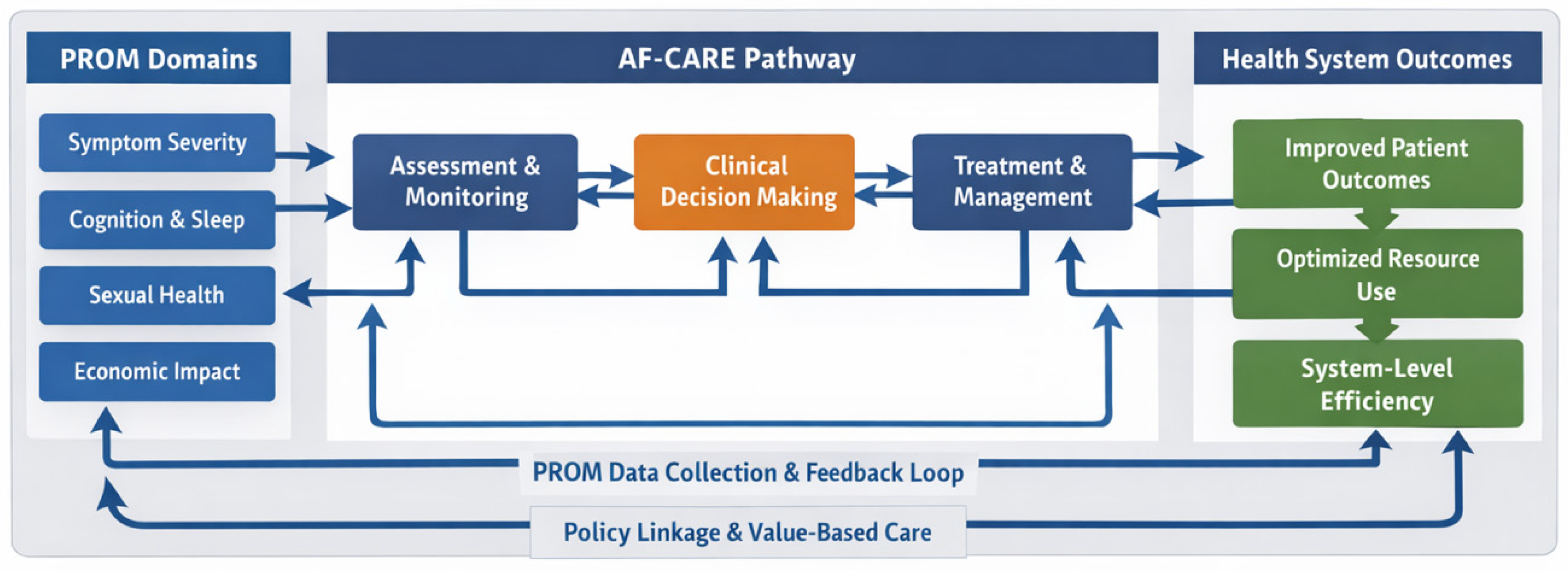
- System integration layer (linking PROMs to clinical decision-making and policy outcomes)
3. Results
3.1. Comparative Analysis of QoL Instruments
3.1.1. QoL Instruments, Domain Coverage and Variability
3.1.2. Identification of Gaps in QoL Measurement
3.2. Framework Development
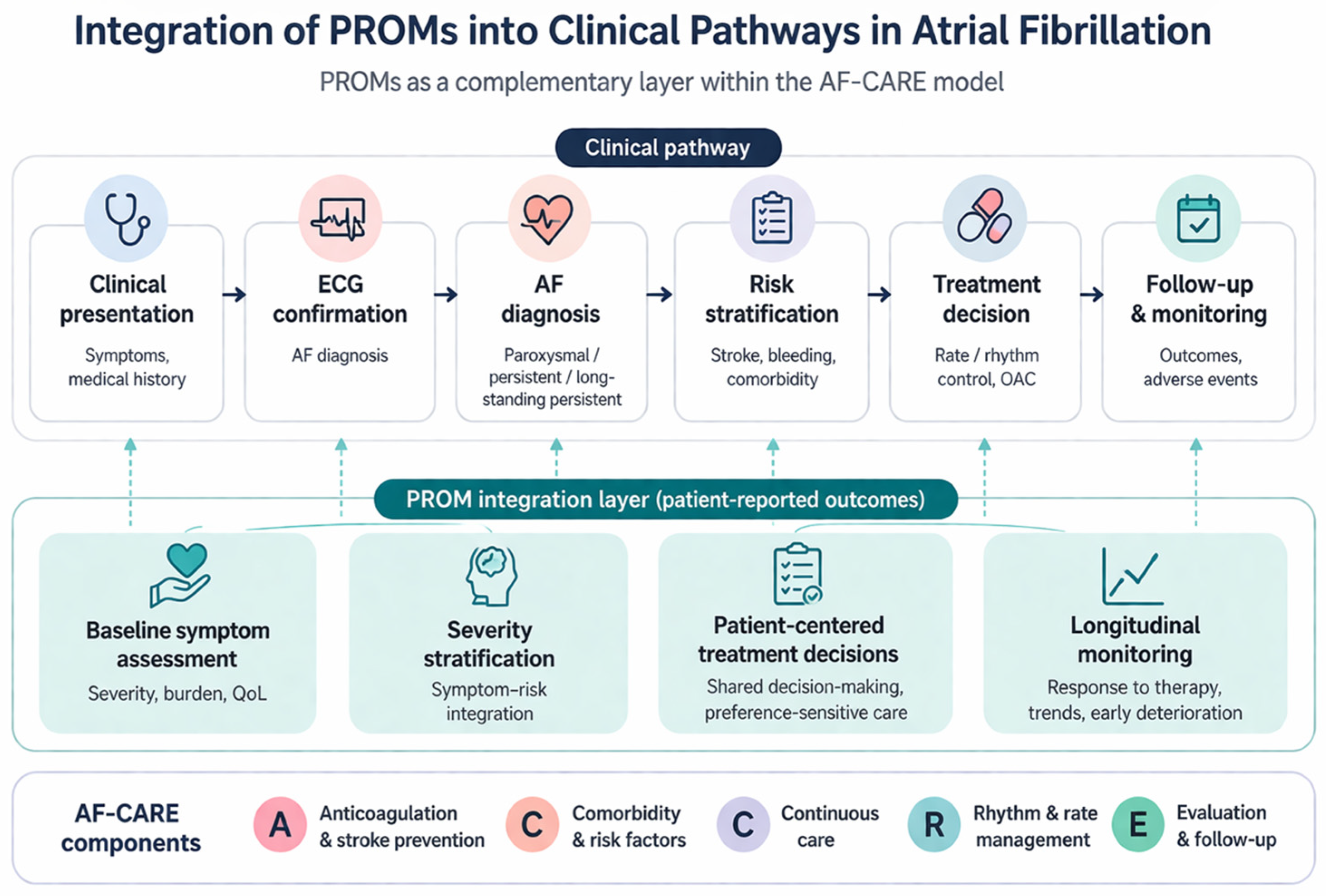
Mapping to AF-CARE Pathway
- •
- C (Comorbidity and risk factors) → cognition, sleep
- •
- A (Avoid stroke) → health perception and functional status
- •
- R (Rate and rhythm control) → symptom burden
- •
- E (Evaluation and follow-up) → dynamic PROM monitoring
3.3. Implications for Health Systems
3.3.1. Policy Implications and System Integration
- •
- C (Comorbidity and risk factors): PROM domains such as cognitive function and sleep quality may be used to identify comorbid conditions and risk modifiers. For example, reported cognitive decline may prompt neurological evaluation, while impaired sleep quality may trigger screening for sleep apnea or other modifiable risk factors.
- •
- A (Avoid stroke): Although PROMs do not directly assess thromboembolic risk, domains such as health perception and functional status may provide additional context for treatment adherence and patient engagement, potentially influencing anticoagulation strategies.
- •
- R (Rate and rhythm control): Symptom-related PROM domains may support decisions between rate and rhythm control strategies, help evaluate treatment response, and guide therapy adjustments based on patient-reported burden.
- •
- E (Evaluation and follow-up): Longitudinal PROM monitoring enables tracking of symptom progression, treatment effectiveness, and quality-of-life changes over time. Changes in PROM scores may act as triggers for clinical reassessment and modification of treatment strategies.
3.3.2. PROM Integration
3.4. Health System Context: The Case of Latvia
4. Discussion
4.1. Strengths and Limitations
4.2. Potential Harms and Implementation Barriers
4.3. Cross-Cultural and Health System Considerations
4.4. Future Research Directions
- Does routine PROM integration into AF clinical pathways improve patient-reported quality of life? A stepped-wedge cluster randomized trial comparing AF-CARE with versus without integrated PROMs, with the primary outcome of AFEQT overall score at 12 months and secondary outcomes of AF-related hospitalization rate and patient satisfaction, would provide the strongest evidence.
- Does PROM-triggered clinical reassessment reduce unplanned hospitalizations? A pragmatic pre-post implementation study within a defined AF cohort, measuring hospitalization rates before and after the introduction of PROM-triggered reassessment protocols (e.g., clinical review triggered by ≥5-point AFEQT decline), could assess clinical impact with lower resource requirements.
- What is the cost-effectiveness of PROM integration in AF care? A health economic evaluation alongside either of the above study designs, incorporating direct healthcare costs, PROM implementation costs, and quality-adjusted life years (QALYs), would provide the evidence base needed to inform reimbursement and policy decisions.
- Is the framework acceptable and feasible across different healthcare systems? A multi-country qualitative study using semi-structured interviews with clinicians, policymakers, and patients across diverse healthcare settings (e.g., Latvia, Ireland, and Germany) would assess contextual barriers and facilitators to implementation.
5. Conclusions
Supplementary Materials
Author Contributions
Funding
Institutional Review Board Statement
Informed Consent Statement
Data Availability Statement
Acknowledgments
Conflicts of Interest
Abbreviations
| AF | Atrial Fibrillation |
| AF-CARE | Comorbidity, Avoid stroke, Rate/rhythm control, Evaluation |
| AFEQT | Atrial Fibrillation Effect on Quality of Life |
| AFSS | Atrial Fibrillation Severity Scale |
| EACTS | European Association for Cardio-Thoracic Surgery |
| ECG | Electrocardiogram |
| EHR | Electronic Health Record |
| ePROM | Electronic Patient-Reported Outcome Measure |
| EQ-5D | EuroQoL 5-Dimensions |
| ESC | European Society of Cardiology |
| ICHOM | International Consortium for Health Outcomes Measurement |
| MeSH | Medical Subject Headings |
| MLHFQ | Minnesota Living with Heart Failure Questionnaire |
| MOS | Medical Outcomes Study |
| OECD | Organisation for Economic Co-operation and Development |
| PROs | Patient-Reported Outcomes |
| PROMs | Patient-Reported Outcome Measures |
| QoL | Quality of Life |
| SF-36 | Short Form Health Survey 36 |
| VBHC | Value-Based Healthcare |
| WHO | World Health Organization |
References
- Chugh, S.S.; Havmoeller, R.; Narayanan, K.; Singh, D.; Rienstra, M.; Benjamin, E.J.; Gillum, R.F.; Kim, Y.-H.; McAnulty, J.H., Jr.; Zheng, Z.-J.; et al. Worldwide Epidemiology of Atrial Fibrillation: A Global Burden of Disease 2010 Study. Circulation 2014, 129, 837–847. [Google Scholar] [CrossRef]
- Krijthe, B.P.; Kunst, A.; Benjamin, E.J.; Lip, G.Y.; Franco, O.H.; Hofman, A.; Witteman, J.C.; Stricker, B.H.; Heeringa, J. Projections on the Number of Individuals with Atrial Fibrillation in the European Union, from 2000 to 2060. Eur. Heart J. 2013, 34, 2746–2751. [Google Scholar] [CrossRef]
- Hindricks, G.; Potpara, T.; Dagres, N.; Arbelo, E.; Bax, J.J.; Blomström-Lundqvist, C.; Boriani, G.; Castella, M.; Dan, G.A.; Dilaveris, P.E.; et al. 2020 ESC Guidelines for the Diagnosis and Management of Atrial Fibrillation. Eur. Heart J. 2021, 42, 373–498. [Google Scholar] [CrossRef]
- Cheng, S.; He, J.; Han, Y.; Han, S.; Li, P.; Liao, H.; Guo, J. Global Burden of Atrial Fibrillation/Atrial Flutter and Its Attributable Risk Factors from 1990 to 2021. Europace 2024, 26, euae195. [Google Scholar] [CrossRef]
- Sale, A.; Yu, J. Quality of Life Instruments in Atrial Fibrillation: A Systematic Review of Measurement Properties. Health Qual. Life Outcomes 2022, 20, 143. [Google Scholar] [CrossRef]
- Rienstra, M.; Lubitz, S.A.; Mahida, S.; Magnani, J.W.; Fontes, J.D.; Sinner, M.F.; Van Gelder, I.C.; Ellinor, P.T.; Benjamin, E.J. Symptoms and Functional Status of Patients with Atrial Fibrillation. Circulation 2012, 125, 2933–2943. [Google Scholar] [CrossRef]
- Anderson, M.; van Kessel, R.; Wood, E.; Stokes, A.; Fistein, J.; Porter, I.; Mossialos, E.; Valderas, J.M. Understanding factors impacting PROMs integration in routine clinical practice: An umbrella review. Qual. Life Res. 2024, 33, 2773–2796. [Google Scholar] [CrossRef] [PubMed]
- Van Gelder, I.C.; Rienstra, M.; Bunting, K.V.; Casado-Arroyo, R.; Caso, V.; Crijns, H.J.G.M.; De Potter, T.J.R.; Dwight, J.; Guasti, L.; Hanke, T.; et al. 2024 ESC Guidelines for the Management of Atrial Fibrillation. Eur. Heart J. 2024, 45, 3314–3414. [Google Scholar] [CrossRef] [PubMed]
- Spertus, J.; Dorian, P.; Bubien, R.; Lewis, S.; Godejohn, D.; Reynolds, M.R.; Lakkireddy, D.R.; Wimmer, A.P.; Bhandari, A.; Burk, C. Development and Validation of the AFEQT Questionnaire. Circ. Arrhythm. Electrophysiol. 2011, 4, 15–25. [Google Scholar] [CrossRef] [PubMed]
- EuroQol Group. EuroQol—A New Facility for the Measurement of Health-Related Quality of Life. Health Policy 1990, 16, 199–208. [Google Scholar] [CrossRef]
- Ware, J.E.; Sherbourne, C.D. The MOS 36-Item Short-Form Health Survey (SF-36). Med. Care 1992, 30, 473–483. [Google Scholar] [CrossRef] [PubMed]
- Holmes, D.N.; Piccini, J.P.; Allen, L.A.; Fonarow, G.C.; Gersh, B.J.; Kowey, P.R.; O’Brien, E.C.; Reiffel, J.A.; Naccarelli, G.V.; Ezekowitz, M.D.; et al. Defining Clinically Important Difference in the AFEQT Score. Circ. Cardiovasc. Qual. Outcomes 2019, 12, e005358. [Google Scholar] [CrossRef] [PubMed]
- Greenhalgh, J.; Gooding, K.; Gibbons, E.; Dalkin, S.; Wright, J.; Valderas, J.; Black, N. How Do PROMs Support Clinician-Patient Communication? A Realist Synthesis. J. Patient Rep. Outcomes 2018, 2, 42. [Google Scholar] [CrossRef]
- Porter, M.E. What Is Value in Health Care? N. Engl. J. Med. 2010, 363, 2477–2481. [Google Scholar] [CrossRef]
- Joglar, J.A.; Chung, M.K.; Armbruster, A.L.; Benjamin, E.J.; Chyou, J.Y.; Cronin, E.M.; Deswal, A.; Eckhardt, L.L.; Goldberger, Z.D.; Gopinathannair, R.; et al. 2023 ACC/AHA/ACCP/HRS Guideline for the Diagnosis and Management of Atrial Fibrillation. Circulation 2024, 149, e1–e156. [Google Scholar] [CrossRef]
- International Consortium for Health Outcomes Measurement (ICHOM). Atrial Fibrillation Standard Set; ICHOM: Boston, MA, USA, 2022; Available online: https://www.ichom.org/portfolio/atrial-fibrillation/ (accessed on 28 March 2026).
- Glenwright, B.G.; Simmich, J.; Cottrell, M.; O’lEary, S.P.; Sullivan, C.; Pole, J.D.; Russell, T. Facilitators and Barriers to Implementing Electronic Patient-Reported Outcome and Experience Measures: A Systematic Review. J. Patient Rep. Outcomes 2023, 7, 13. [Google Scholar] [CrossRef]
- Basch, E.; Deal, A.M.; Kris, M.G.; Scher, H.I.; Hudis, C.A.; Sabbatini, P.; Rogak, L.; Bennett, A.V.; Dueck, A.C.; Atkinson, T.M.; et al. Symptom Monitoring with Patient-Reported Outcomes during Routine Cancer Treatment: A Randomized Controlled Trial. J. Clin. Oncol. 2016, 34, 557–565. [Google Scholar] [CrossRef]
- Ferreira, M.; Oliveira, M.; Laranjo, S.; Rocha, I. Linking Sleep Disorders to Atrial Fibrillation: Pathways, Risks, and Treatment Implications. Biology 2024, 13, 761. [Google Scholar] [CrossRef]
- Porter, M.E.; Lee, T.H. The Strategy That Will Fix Health Care. Harv. Bus. Rev. 2013, 91, 50–70. [Google Scholar]
- Almeida, J.G.; Teixeira, R.; Neves, I.; Carrington, M.; Fonseca, P.; Oliveira, M.; Gonçalves, H.; Primo, J.; Fontes-Carvalho, R.; Barra, S.; et al. Digital Monitoring and Electronic Patient-Reported Outcomes Collection Following Atrial Fibrillation Ablation. Heart Rhythm O2 2025, 6, 970–979. [Google Scholar] [CrossRef]
- Cella, D.; Nolla, K.; Peipert, J.D. The Challenge of Using Patient Reported Outcome Measures in Clinical Practice: How Do We Get There? J. Patient Rep. Outcomes 2024, 8, 35. [Google Scholar] [CrossRef]
- Bonsel, J.M.; Itiola, A.J.; Huberts, A.S.; Bonsel, G.J.; Penton, H. The Use of Patient-Reported Outcome Measures to Improve Patient-Related Outcomes: A Systematic Review. Health Qual. Life Outcomes 2024, 22, 101. [Google Scholar] [CrossRef] [PubMed]
- Organisation for Economic Co-operation and Development (OECD). Patient-Reported Indicators Surveys (PaRIS); OECD Publishing: Paris, France, 2023; Available online: https://www.oecd.org/health/paris/ (accessed on 28 March 2026).
- Rector, T.S.; Cohn, J.N. Assessment of Patient Outcome with the Minnesota Living with Heart Failure Questionnaire. Am. Heart J. 1992, 124, 1017–1025. [Google Scholar] [CrossRef] [PubMed]
- Dorian, P.; Guerra, P.G.; Kerr, C.R.; O’dOnnell, S.S.; Crystal, E.; Gillis, A.M.; Mitchell, L.B.; Roy, D.; Skanes, A.C.; Rose, M.S.; et al. Validation of the Canadian Cardiovascular Society Severity in Atrial Fibrillation Scale. Circ. Arrhythm. Electrophysiol. 2009, 2, 218–224. [Google Scholar] [CrossRef]
- Kalantarian, S.; Stern, T.A.; Mansour, M.; Ruskin, J.N. Cognitive Impairment Associated with Atrial Fibrillation: A Meta-Analysis. Ann. Intern. Med. 2013, 158, 338–346. [Google Scholar] [CrossRef]
- Yamin, M.; Salim, S.; Setiati, S.; Pudianto, A.P.; Zulmiyusrini, P.; Nasution, S.A.; Wijaya, I.P.; Rusdi, L.; Karim, B.; Santoso, R.F.H. Validity and Reliability Studies of the Indonesian Version of Atrial Fibrillation Severity Scale (AFSS). BMC Cardiovasc. Disord. 2023, 23, 216. [Google Scholar] [CrossRef]
- Buja, A.; Rebba, V.; Montecchio, L.; Renzo, G.; Baldo, V.; Cocchio, S.; Ferri, N.; Migliore, F.; Zorzi, A.; Collins, B.; et al. The Cost of Atrial Fibrillation: A Systematic Review. Value Health 2024, 27, 527–541. [Google Scholar] [CrossRef] [PubMed]
- Vinciguerra, M.; Dobrev, D.; Bhatt, D.L.; Hendriks, J.M.; Lip, G.Y.; Vinter, N.; Guo, Y.; Johnsen, S. Atrial Fibrillation: Epidemiology, Screening and Digital Health. Lancet Reg. Health Eur. 2024, 37, 100786. [Google Scholar] [CrossRef]
- Kupics, K.; Maca-Kaleja, A.; Rudzitis, A.; Kalejs, O. Quality of Life in Patients with Atrial Fibrillation Undergoing Pulmonary Vein Isolation: Short-Term Follow-Up Study. Medicina 2024, 60, 1594. [Google Scholar] [CrossRef]
- World Health Organization (WHO). People-Centred and Integrated Health Services: An Overview of the Evidence; WHO: Geneva, Switzerland, 2015; Available online: https://www.who.int/publications/i/item/9789241508674 (accessed on 28 March 2026).
- Stover, A.M.; Haverman, L.; Van Oers, H.A.; Greenhalgh, J.; Potter, C.M.; On behalf of the ISOQOL PROMs/PREMs in Clinical Practice Implementation Science Work Group. Using an implementation science approach to implement and evaluate patient-reported outcome measures (PROM) initiatives in routine care settings. Qual. Life Res. 2021, 30, 3015–3033. [Google Scholar] [CrossRef] [PubMed]
- Teisberg, E.; Wallace, S.; O’HAra, S. Defining and Implementing Value-Based Health Care: A Strategic Framework. Acad. Med. 2020, 95, 682–685. [Google Scholar] [CrossRef] [PubMed] [PubMed Central]
- OECD; European Observatory on Health Systems and Policies. Latvia: Country Health Profile 2023; OECD Publishing: Paris, France, 2023. [Google Scholar] [CrossRef]
- Bouwmans, C.; Krol, M.; Severens, H.; Koopmanschap, M.; Brouwer, W.; Roijen, L.H.-V. The iMTA Productivity Cost Questionnaire: A Standardized Instrument for Measuring Health-Related Productivity Losses. Value Health 2015, 18, 753–758. [Google Scholar] [CrossRef]
- de Ligt, K.M.; Hommes, S.; Vromans, R.D.; Boomstra, E.; van de Poll, L.V.; Krahmer, E.J. Improving the Implementation of Patient-Reported Outcome Measure in Clinical Practice: Tackling Current Challenges with Innovative Digital Communication Technologies. J. Med. Internet Res. 2025, 27, e60777. [Google Scholar] [CrossRef] [PubMed]
- Sokolova, E.; Sen, S.E.; Goetz, O.; Behmane, D.; Kalējs, O. From Framework to Tool: An Interactive Dashboard for PROM-Based AF Care Planning. 2026; Manuscript in preparation.
- Theis, S.; Fruehwein, H.; Hasenburg, A.; Moehler, M.; Paul, N.W. PROMs: Patient related or patient centred? A bridge between Patient-Reported Outcome Measures (PROMs) and clinical ethics in the context of a cohort of gynaeco-oncological patients analysed by qualitative semi- structured interviews. J. Patient Rep. Outcomes 2026, 10, 55. [Google Scholar] [CrossRef]
- Bachmann, J.M.; Shiflet, M.A.; Palacios, J.R.; Turer, R.W.; Wallace, G.H.; Rosenbloom, S.T.; Rice, T.W. Patient-Reported Outcome Measures in Routine Clinical Practice: Practical Guidance for Institutional Review Boards. Ethics Hum. Res. 2024, 46, 27–37. [Google Scholar] [CrossRef]
- World Health Organization. Global Strategy on Digital Health 2020–2025; WHO: Geneva, Switzerland, 2021; Available online: https://www.who.int/publications/i/item/9789240020924 (accessed on 28 March 2026).
- Rakovich, M. Patient-Reported Outcomes (PROMs) and Public Health: Using PROMs for Population-Level Quality Monitoring. In Proceedings of the 1st International Online Conference on Healthcare, Basel, Switzerland, 25–26 March 2026. [Google Scholar]
- Bischof, A.Y.; Kuklinski, D.; Salvi, I.; Walker, C.; Vogel, J.; Geissler, A. A Collection of Components to Design Clinical Dashboards Incorporating PROMs: Qualitative Study. J. Med. Internet Res. 2024, 26, e55267. [Google Scholar] [CrossRef]
- de Souza, J.A.; Yap, B.J.; Wroblewski, K.; Blinder, V.; Araújo, F.S.; Hlubocky, F.J.; Nicholas, L.H.; O’Connor, J.M.; Brockstein, B.; Ratain, M.J.; et al. Measuring Financial Toxicity as a Clinically Relevant Patient-Reported Outcome: The Validation of the COST. Cancer 2017, 123, 476–484. [Google Scholar] [CrossRef]



| QoL Domain | AFEQT | EQ-5D | SF-36 | MLHFQ | AFSS | Clinical Relevance | Policy Relevance |
|---|---|---|---|---|---|---|---|
| Physical functioning | Full | Full | Full | Full | Partial | Functional limitation | Rehabilitation planning |
| Symptoms | Full | Partial | Partial | Partial | Full | Core AF burden | Treatment evaluation |
| Emotional well-being | Full | Full | Full | Full | Partial | Mental health impact | Integrated care |
| Social functioning | Full | Partial | Full | Partial | Partial | Participation restriction | Social support systems |
| Cognitive function | Partial | None | Partial | Partial | None | Risk of decline | Screening strategies |
| Treatment satisfaction | Full | None | None | Partial | None | Adherence | Care quality indicators |
| Economic burden | Partial | None | None | None | None | Cost awareness | Health financing |
| Health perception | Full | Full | Full | Full | Partial | Overall status | Outcome monitoring |
| Sexual health | None | None | None | None | None | QoL determinant | Patient-centered care |
| Sleep quality | Partial | None | Partial | Partial | None | AF trigger | Preventive strategies |
| PROM Domain | Clinical Relevance | Clinical Implication | AF-CARE Link |
|---|---|---|---|
| Symptoms | Reflects AF burden and symptom variability | Guides rhythm vs rate control decisions | R —Reduce Symptoms by rate and rhythm control |
| Physical functioning | Indicates functional limitation and disease impact | Supports treatment intensity adjustment | E—Evaluation and reassessment |
| Emotional well-being | Associated with psychological burden and symptom perception | May influence adherence and follow-up strategy | E—Evaluation and reassessment |
| Cognitive function | May indicate neurocognitive impairment related to AF | Triggers further neurological evaluation | C—Comorbidity and risk factors |
| Sleep quality | Linked to AF triggers and recurrence (e.g., sleep apnea) | Supports screening for comorbid conditions | C—Comorbidity and risk factors |
| Treatment satisfaction | Reflects perceived treatment effectiveness | May guide therapy optimization | E—Evaluation and reassessment |
| Economic burden | Indicates indirect disease impact and healthcare utilization | Relevant for system-level planning and resource allocation | E—Evaluation and reassessment |
| Health perception | Integrates overall patient-reported health status | Supports global disease severity assessment | E—Evaluation and reassessment |
| Domain | Captured in Current PROMs | Diagnostic Consequence |
|---|---|---|
| Cognitive function | Partially | Underrecognition of cognitive decline and neurovascular risk |
| Sleep quality | Limited | Missed identification of AF triggers (e.g., sleep apnea) |
| Sexual health | Not captured | Incomplete assessment of quality of life and treatment impact |
| Economic burden | Limited | Underestimation of healthcare utilization and patient burden |
| Social functioning | Partially | Reduced understanding of patient participation and daily limitations |
| Level | Implementation Actions | Measurable Indicators | AF-CARE Alignment |
|---|---|---|---|
| Clinical | Routine PROM collection at baseline and every 3–6 months; PROM-triggered clinical reassessment | PROM completion rates; AFEQT score changes ≥5 points; symptom-driven treatment adjustments | R—Rate/rhythm control; E—Evaluation and follow-up |
| Organizational | EHR-embedded PROMs; multidisciplinary interpretation; care coordination across settings | EHR integration rate; interdisciplinary referral frequency; care pathway adherence | C—Comorbidity management; A—Avoid stroke |
| Policy | Link PROMs to reimbursement models, national registries, and performance benchmarks | Reduction in AF-related hospitalizations; cost-effectiveness ratios; registry coverage | E—Evaluation; system-level VBHC alignment |
Disclaimer/Publisher’s Note: The statements, opinions and data contained in all publications are solely those of the individual author(s) and contributor(s) and not of MDPI and/or the editor(s). MDPI and/or the editor(s) disclaim responsibility for any injury to people or property resulting from any ideas, methods, instructions or products referred to in the content. |
© 2026 by the authors. Licensee MDPI, Basel, Switzerland. This article is an open access article distributed under the terms and conditions of the Creative Commons Attribution (CC BY) license.
Share and Cite
Sokolova, E.; Goetz, O.; Grīnberga, K.; Sen, S.E.; Kupics, K.; Mača-Kalēja, A.; Rudzītis, A.; Behmane, D.; Kalējs, O. Integrating Patient-Reported Outcomes into Clinical Pathways in Atrial Fibrillation: A Framework Aligned with the AF-CARE Model. Diagnostics 2026, 16, 1398. https://doi.org/10.3390/diagnostics16091398
Sokolova E, Goetz O, Grīnberga K, Sen SE, Kupics K, Mača-Kalēja A, Rudzītis A, Behmane D, Kalējs O. Integrating Patient-Reported Outcomes into Clinical Pathways in Atrial Fibrillation: A Framework Aligned with the AF-CARE Model. Diagnostics. 2026; 16(9):1398. https://doi.org/10.3390/diagnostics16091398
Chicago/Turabian StyleSokolova, Emma, Olav Goetz, Ketija Grīnberga, Sevinc Elif Sen, Kaspars Kupics, Aija Mača-Kalēja, Ainārs Rudzītis, Daiga Behmane, and Oskars Kalējs. 2026. "Integrating Patient-Reported Outcomes into Clinical Pathways in Atrial Fibrillation: A Framework Aligned with the AF-CARE Model" Diagnostics 16, no. 9: 1398. https://doi.org/10.3390/diagnostics16091398
APA StyleSokolova, E., Goetz, O., Grīnberga, K., Sen, S. E., Kupics, K., Mača-Kalēja, A., Rudzītis, A., Behmane, D., & Kalējs, O. (2026). Integrating Patient-Reported Outcomes into Clinical Pathways in Atrial Fibrillation: A Framework Aligned with the AF-CARE Model. Diagnostics, 16(9), 1398. https://doi.org/10.3390/diagnostics16091398