Artificial Intelligence-Based MRI Segmentation in Glioblastoma and Single Brain Metastasis: An Exploratory Study of Diagnostic and Prognostic Value

 ,
,  , , , and
Abstract
1. Introduction
2. Materials and Methods
2.1. Study Design and Ethical Approval
2.2. Patient Selection
2.3. MRI Acquisition Protocol
- ▪
- 3D T2-weighted Fluid Attenuated Inversion Recovery (FLAIR): repetition time (TR) 7000 ms, maximum echo time (TE) (approximately 120 ms), slice thickness 1.8 mm, matrix 256 × 256, freq. FOV 25.6 cm, spacing 0 mm (contiguous), variable flip angle, NEX 1.00.
- ▪
- 3D T1-weighted (3D T1W): TR 7.4 ms, TE 2.9 ms, slice thickness 2.0 mm, matrix 256 × 256, freq. FOV 25.6, spacing 0 mm (contiguous), flip angle 12°, NEX 1.00.
- ▪
- 3D Fast Spoiled Gradient Echo T1-weighted (FSPGR, post-contrast): TR 10.0 ms, TE 4.2 ms, slice thickness 1.8 mm, matrix 288 × 224, freq. FOV 25.6, spacing 0 mm (contiguous), flip angle 12°, NEX 1.00. A gadolinium-based contrast agent was administered intravenously at a standard dose of 0.1 mmol/kg body weight prior to this acquisition.
2.4. AI-Based Automated Segmentation
2.4.1. Segmentation Software
2.4.2. Segmentation Output Parameters
- -
- AI Model Total Volume: the aggregate volume of all segmented intratumoral compartments, expressed in cm3;
- -
- AI Model Edema Volume: the volume of T2/FLAIR hyperintense signal surrounding the lesion, reflecting vasogenic edema extent;
- -
- AI Model Necrosis Volume: the volume of the non-enhancing, centrally necrotic component;
- -
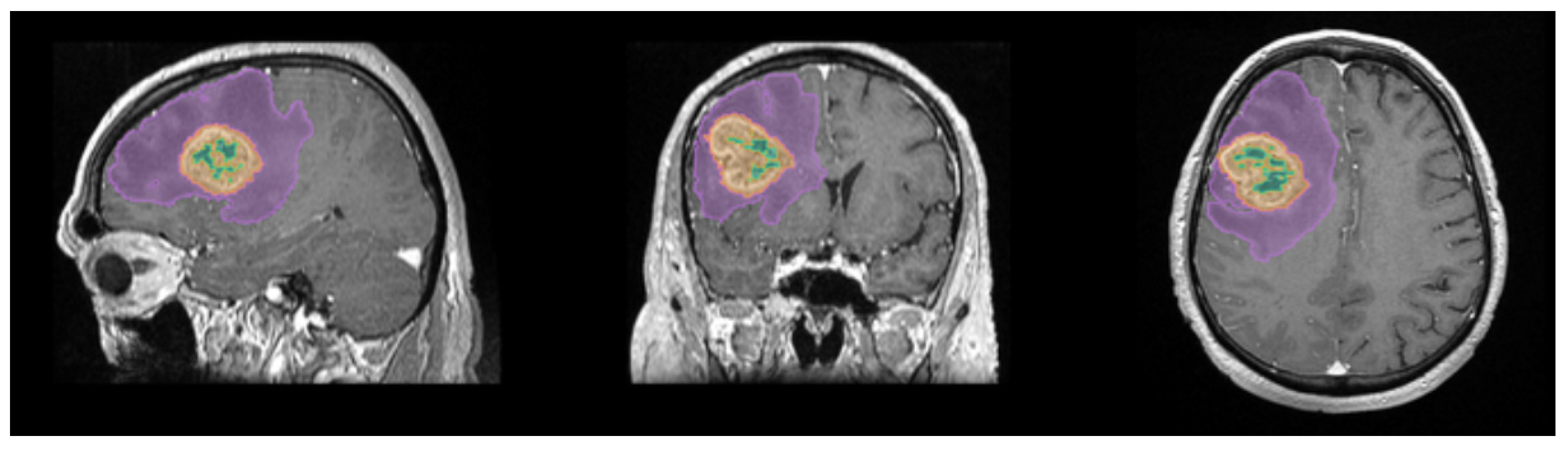
- AI Model Contrast Volume: the volume of the gadolinium-enhancing rim, corresponding to the viable, highly vascularized tumor tissue (Figure 2).
2.4.3. Segmentation Validation
2.5. Feature Engineering
- -
- AI Model Contrast Volume/AI Model Total Volume Ratio;
- -
- AI Model Necrosis Volume/AI Model Total Volume Ratio;
- -
- AI Model Edema Volume/AI Model Total Volume Ratio [44].
2.6. Survival Data and Prognostic Factors
2.7. Statistical Analysis
2.8. Predictive Modeling
2.9. Software, Packages, and Reproducibility
3. Results
3.1. Patient Demographics and Clinical Characteristics
3.2. Validation of AI-Based Automated Volumetry
3.3. Comparative Volumetric Analysis: GB vs. SBM
- -
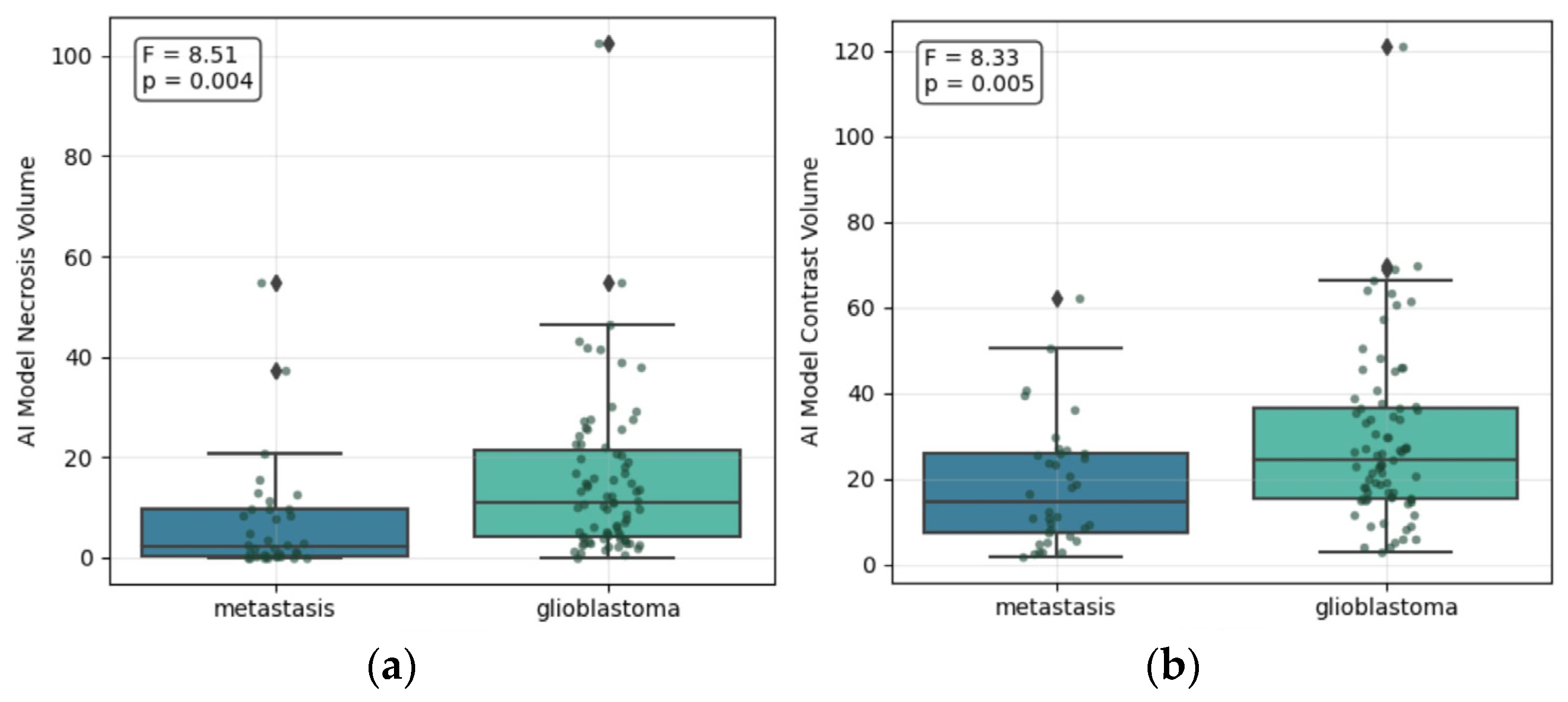
- Necrosis: GB exhibited a significantly higher necrotic fraction than SBM (p < 0.001), with a mean AI Model Necrosis Volume/AI Model Total Volume Ratio of 0.28.
- -
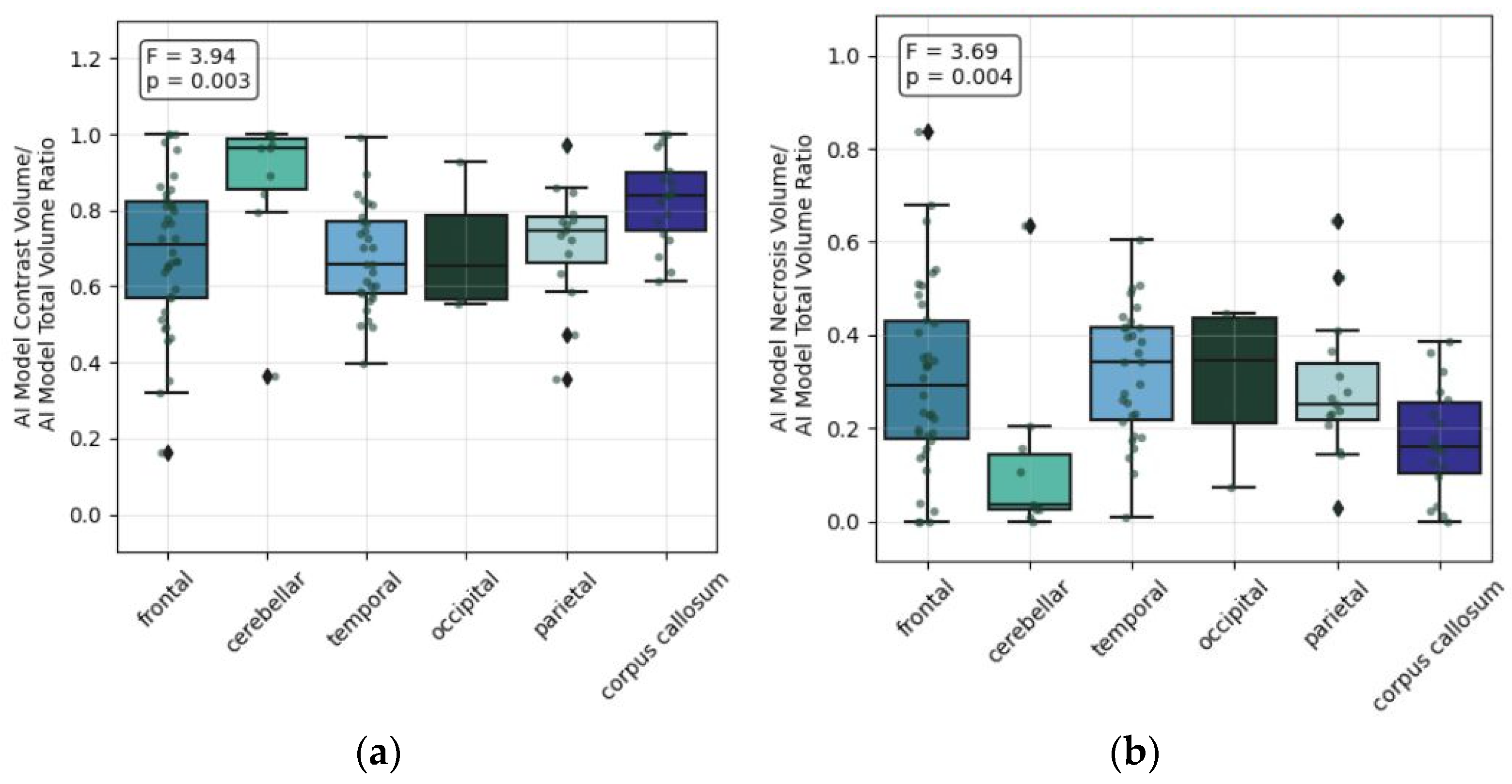
- Contrast enhancement: SBM demonstrated a significantly higher AI Model Contrast Volume/AI Model Total Volume Ratio (p < 0.001), reflecting a more homogeneous enhancement pattern (Figure 3).
- -
- Peritumoral edema: While absolute edema volume did not differ significantly (p = 0.798), the AI Model Edema Volume/AI Model Total Volume Ratio was significantly higher in SBM (p = 0.003), indicating that the relative edema burden is a superior diagnostic discriminator (see Table 3).
3.4. Survival Analysis Results
3.5. Classification ML Model Performance (6-Month Survival)
3.6. Feature Importance Analysis
4. Discussion
4.1. Diagnostic Differentiation Through AI Sub-Compartments
4.2. Bridging the Gap to Survival Prediction
4.3. Methodological Positioning Relative to End-to-End Approaches
4.4. Clinical and Biological Implications
4.5. Limitations and Future Directions
5. Conclusions
Author Contributions
Funding
Institutional Review Board Statement
Informed Consent Statement
Data Availability Statement
Acknowledgments
Conflicts of Interest
References
- Gajjar, K.; Heppenstall, L.D.; Pang, W.; Ashton, K.M.; Trevisan, J.; Patel, I.I.; Llabjani, V.; Stringfellow, H.F.; Martin-Hirsch, P.L.; Dawson, T.; et al. Diagnostic segregation of human brain tumours using Fourier-transform infrared and/or Raman spectroscopy coupled with discriminant analysis. Anal. Methods 2012, 5, 89–102. [Google Scholar] [CrossRef]
- Stoyanov, G.S.; Dzhenkov, D.L.; Kitanova, M.; Ghenev, P.; Tonchev, A.B. Demographics and Incidence of Histologically Confirmed Intracranial Tumors: A Five-year, Two-center Prospective Study. Cureus 2017, 9, e1476. [Google Scholar] [CrossRef]
- Kaifi, R. A Review of Recent Advances in Brain Tumor Diagnosis Based on AI-Based Classification. Diagnostics 2023, 13, 3007. [Google Scholar] [CrossRef]
- Mastronuzzi, A.; Franceschi, E.; D’Antonio, F.; Bennicelli, E.; Berzero, G.; Cella, E.; Filippi, M.; Lanzetta, G.; Marchioni, E.; Milanaccio, C.; et al. Diagnostic and predictive molecular biomarkers in brain tumors across the lifespan: An age-stratified consensus statement. J. Neuro-Oncol. 2025, 176, 95. [Google Scholar] [CrossRef] [PubMed]
- Chilaca-Rosas, M.F.; Contreras-Aguilar, M.T.; Pallach-Loose, F.; Altamirano-Bustamante, N.F.; Salazar-Calderon, D.R.; Revilla-Monsalve, C.; Heredia-Gutiérrez, J.C.; Conde-Castro, B.; Medrano-Guzmán, R.; Altamirano-Bustamante, M.M. Systematic review and epistemic meta-analysis to advance binomial AI-radiomics integration for predicting high-grade glioma progression and enhancing patient management. Sci. Rep. 2025, 15, 16113. [Google Scholar] [CrossRef] [PubMed]
- Hu, Y.; Gao, C.; Wang, Y.; Wen, Z.; Yang, C.; Deng, H.; Chen, S.; Li, Y.; Pang, H.; Zhou, P.; et al. Artificial intelligence in the task of segmentation and classification of brain metastases images: Current challenges and future opportunities. Front. Neurol. 2025, 16, 1581422. [Google Scholar] [CrossRef] [PubMed]
- Fecci, P.E.; Rao, G.; Brastianos, P.K.; Dunn, G.P.; Anders, C.K. Editorial: It takes a village: The expanding multi-disciplinary approach to brain metastasis. Front. Oncol. 2022, 12, 1054490. [Google Scholar] [CrossRef]
- Deshpande, K.; Buchanan, I.; Martirosian, V.; Neman, J. Clinical Perspectives in Brain Metastasis. Cold Spring Harb. Perspect. Med. 2020, 10, a037051. [Google Scholar] [CrossRef]
- Ostrom, Q.T.; Price, M.; Neff, C.; Cioffi, G.; Waite, K.A.; Kruchko, C.; Barnholtz-Sloan, J.S. CBTRUS Statistical Report: Primary Brain and Other Central Nervous System Tumors Diagnosed in the United States in 2016–2020. Neuro Oncol. 2023, 25, iv1–iv99. [Google Scholar] [CrossRef]
- Wen, P.Y.; Kesari, S. Malignant gliomas in adults. N. Engl. J. Med. 2008, 359, 492–507. [Google Scholar] [CrossRef]
- Nayak, L.; Lee, E.Q.; Wen, P.Y. Epidemiology of brain metastases. Curr. Oncol. Rep. 2012, 14, 48–54. [Google Scholar] [CrossRef]
- Richardson, T.E.; Walker, J.M.; Abdullah, K.G.; McBrayer, S.K.; Viapiano, M.S.; Mussa, Z.M.; Tsankova, N.M.; Snuderl, M.; Hatanpaa, K.J. Chromosomal instability in adult-type diffuse gliomas. Acta Neuropathol. Commun. 2022, 10, 115. [Google Scholar] [CrossRef]
- Moreau, N.N.; Valable, S.; Jaudet, C.; Dessoude, L.; Thomas, L.; Hérault, R.; Modzelewski, R.; Stefan, D.; Thariat, J.; Lechervy, A.; et al. Early characterization and prediction of glioblastoma and brain metastasis treatment efficacy using medical imaging-based radiomics and artificial intelligence algorithms. Front. Oncol. 2025, 15, 1497195. [Google Scholar] [CrossRef]
- Hernández-Hernández, A.; Reyes-Moreno, I.; Gutiérrez-Aceves, A.; Guerrero-Juárez, V.; Santos-Zambrano, J.; López-Martínez, M.; Castro-Martínez, E.; Cacho-Díaz, B.; Méndez-Padilla, J.A.; González-Aguilar, A. Primary Tumors of the Central Nervous System. Clinical Experience at a Third Level Center. Rev. Investig. Clin. 2018, 70, 177–183. [Google Scholar] [CrossRef]
- Brenner, A.W.; Patel, A.J. Review of Current Principles of the Diagnosis and Management of Brain Metastases. Front. Oncol. 2022, 12, 857622. [Google Scholar] [CrossRef]
- Musca, B.; Russo, M.G.; Tushe, A.; Magri, S.; Battaggia, G.; Pinton, L.; Bonaudo, C.; Della Puppa, A.; Mandruzzato, S. The immune cell landscape of glioblastoma patients highlights a myeloid-enriched and immune suppressed microenvironment compared to metastatic brain tumors. Front. Immunol. 2023, 14, 1236824. [Google Scholar] [CrossRef]
- Ostrom, Q.T.; Francis, S.S.; Barnholtz-Sloan, J.S. Epidemiology of Brain and Other CNS Tumors. Curr. Neurol. Neurosci. Rep. 2021, 21, 68. [Google Scholar] [CrossRef]
- Seker-Polat, F.; Pinarbasi Degirmenci, N.; Solaroglu, I.; Bagci-Onder, T. Tumor Cell Infiltration into the Brain in Glioblastoma: From Mechanisms to Clinical Perspectives. Cancers 2022, 14, 443. [Google Scholar] [CrossRef]
- Berghoff, A.S.; Rajky, O.; Winkler, F.; Bartsch, R.; Furtner, J.; Hainfellner, J.A.; Goodman, S.L.; Weller, M.; Schittenhelm, J.; Preusser, M. Invasion patterns in brain metastases of solid cancers. Neuro Oncol. 2013, 15, 1664–1672. [Google Scholar] [CrossRef]
- Huang, B.; Liu, T.; Li, H.; Li, X.; Lu, G.; Li, J. Epidemiological characteristics and prognostic factors of high-grade brainstem glioma for all ages and the establishment of a nomogram. Transl. Cancer Res. 2025, 14, 7186–7198. [Google Scholar] [CrossRef]
- Achrol, A.S.; Rennert, R.C.; Anders, C.; Soffietti, R.; Ahluwalia, M.S.; Nayak, L.; Peters, S.; Arvold, N.D.; Harsh, G.R.; Steeg, P.S.; et al. Brain metastases. Nat. Rev. Dis. Primers 2019, 5, 5. [Google Scholar] [CrossRef]
- Oike, T.; Suzuki, Y.; Sugawara, K.; Shirai, K.; Noda, S.E.; Tamaki, T.; Nagaishi, M.; Yokoo, H.; Nakazato, Y.; Nakano, T. Radiotherapy plus concomitant adjuvant temozolomide for glioblastoma: Japanese mono-institutional results. PLoS ONE 2013, 8, e78943. [Google Scholar] [CrossRef]
- Sperduto, P.W.; Mesko, S.; Li, J.; Cagney, D.; Aizer, A.; Lin, N.U.; Nesbit, E.; Kruser, T.J.; Chan, J.; Braunstein, S.; et al. Survival in Patients with Brain Metastases: Summary Report on the Updated Diagnosis-Specific Graded Prognostic Assessment and Definition of the Eligibility Quotient. J. Clin. Oncol. 2020, 38, 3773–3784. [Google Scholar] [CrossRef] [PubMed]
- Hart, M.G.; Grant, G.R.; Solyom, E.F.; Grant, R. Biopsy versus resection for high-grade glioma. Cochrane Database Syst. Rev. 2019, 6, CD002034. [Google Scholar] [CrossRef]
- Tan, A.C.; Ashley, D.M.; López, G.Y.; Malinzak, M.; Friedman, H.S.; Khasraw, M. Management of glioblastoma: State of the art and future directions. CA Cancer J. Clin. 2020, 70, 299–312. [Google Scholar] [CrossRef]
- Jain, R.K. Molecular regulation of vessel maturation. Nat. Med. 2003, 9, 685–693. [Google Scholar] [CrossRef] [PubMed]
- Abdusalomov, A.B.; Mukhiddinov, M.; Whangbo, T.K. Brain Tumor Detection Based on Deep Learning Approaches and Magnetic Resonance Imaging. Cancers 2023, 15, 4172. [Google Scholar] [CrossRef]
- Louis, D.N.; Perry, A.; Wesseling, P.; Brat, D.J.; Cree, I.A.; Figarella-Branger, D.; Hawkins, C.; Ng, H.K.; Pfister, S.M.; Reifenberger, G.; et al. The 2021 WHO Classification of Tumors of the Central Nervous System: A summary. Neuro Oncol. 2021, 23, 1231–1251. [Google Scholar] [CrossRef] [PubMed]
- Choi, A.; Hunting, J.; Lanier, C.; Douglas, E.; Triozzi, P.; Ruiz, J.; Benayoun, M.; White, J.; Chan, M. Treatment Options for Brain Metastases. Curr. Treat. Options Oncol. 2024, 25, 1011–1026. [Google Scholar] [CrossRef]
- Aftab, K.; Aamir, F.B.; Mallick, S.; Mubarak, F.; Pope, W.B.; Mikkelsen, T.; Rock, J.P.; Enam, S.A. Radiomics for precision medicine in glioblastoma. J. Neurooncol. 2022, 156, 217–231. [Google Scholar] [CrossRef]
- Hooper, G.W.; Ginat, D.T. MRI radiomics and potential applications to glioblastoma. Front. Oncol. 2023, 13, 1134109. [Google Scholar] [CrossRef]
- Poursaeed, R.; Mohammadzadeh, M.; Safaei, A.A. Survival prediction of glioblastoma patients using machine learning and deep learning: A systematic review. BMC Cancer 2024, 24, 1581. [Google Scholar] [CrossRef]
- Chirica, C.; Haba, D.; Cojocaru, E.; Mazga, A.I.; Eva, L.; Dobrovat, B.I.; Chirica, S.I.; Stirban, I.; Rotundu, A.; Leon, M.M. One Step Forward—The Current Role of Artificial Intelligence in Glioblastoma Imaging. Life 2023, 13, 1561. [Google Scholar] [CrossRef] [PubMed]
- Zhou, S.K.; Greenspan, H.; Davatzikos, C.; Duncan, J.S.; van Ginneken, B.; Madabhushi, A.; Prince, J.L.; Rueckert, D.; Summers, R.M. A review of deep learning in medical imaging: Imaging traits, technology trends, case studies with progress highlights, and future promises. Proc. IEEE Inst. Electr. Electron. Eng. 2021, 109, 820–838. [Google Scholar] [CrossRef]
- Gupta, V.; Erdal, B.; Ramirez, C.; Floca, R.; Genereaux, B.; Bryson, S.; Bridge, C.; Kleesiek, J.; Nensa, F.; Braren, R.; et al. Current State of Community-Driven Radiological AI Deployment in Medical Imaging. JMIR AI 2024, 3, e55833. [Google Scholar] [CrossRef] [PubMed]
- Chirica, C.; Dobrovăț, B.I.; Chirica, S.I.; Onicescu, O.M.; Rotundu, A.; Marciuc, E.A.; Cucu, L.E.; Pomohaci, D.; Anghel, R.C.; Popescu, M.R.; et al. Drawing the Line: From U-Net-Based Glioblastoma Segmentation to Machine Learning-Driven Survival Prediction. Med. Sci. 2026, 14, 119. [Google Scholar] [CrossRef]
- Lin, S.Y.; Lin, C.L. Brain tumor segmentation using U-Net in conjunction with EfficientNet. PeerJ Comput. Sci. 2024, 10, e1754. [Google Scholar] [CrossRef]
- Salbas, A.; Coskun, M.; Cetinoglu, Y.K.; Horoz, M.; Yogurtcu, M.; Huvez, A.; Gelal, M.F. Multiparametric MRI characteristics for differentiating primary cancer origin in brain metastases. BMC Med. Imaging 2025, 25, 415. [Google Scholar] [CrossRef]
- Obrador, E.; Moreno-Murciano, P.; Oriol-Caballo, M.; López-Blanch, R.; Pineda, B.; Gutiérrez-Arroyo, J.L.; Loras, A.; Gonzalez-Bonet, L.G.; Martinez-Cadenas, C.; Estrela, J.M.; et al. Glioblastoma Therapy: Past, Present and Future. Int. J. Mol. Sci. 2024, 25, 2529. [Google Scholar] [CrossRef]
- Verma, A.; Yadav, A.K. Brain Tumor Volume Estimation Using Ellipsoid Approximation with Shape Correction Method. In International Conference on Computer Vision and Robotics; Springer Nature: Cham, Switzerland, 2025; pp. 85–95. [Google Scholar]
- Pomohaci, D.; Marciuc, E.A.; Dobrovăț, B.I.; Popescu, M.R.; Istrate, A.C.; Onicescu Oniciuc, O.M.; Chirica, S.I.; Chirica, C.; Haba, D. Artificial Intelligence-Based MRI Segmentation for the Differential Diagnosis of Single Brain Metastasis and Glioblastoma. Diagnostics 2025, 15, 2248. [Google Scholar] [CrossRef]
- Seehafer, S.; Schmill, L.P.; Peters, S.; Jansen, O.; Aludin, S. Volumetry of Selected Brain Regions—Can We Compare MRI Examinations of Different Manufacturers and Field Strengths? Clin. Neuroradiol. 2025, 35, 363–378. [Google Scholar] [CrossRef]
- Hitziger, S.; Ling, W.X.; Fritz, T.; D’Albis, T.; Lemke, A.; Grilo, J. Triplanar U-Net with lesion-wise voting for the segmentation of new lesions on longitudinal MRI studies. Front. Neurosci. 2022, 16, 964250. [Google Scholar] [CrossRef]
- Hajianfar, G.; Haddadi Avval, A.; Hosseini, S.A.; Nazari, M.; Oveisi, M.; Shiri, I.; Zaidi, H. Time-to-event overall survival prediction in glioblastoma multiforme patients using magnetic resonance imaging radiomics. Radiol. Med. 2023, 128, 1521–1534. [Google Scholar] [CrossRef]
- Leopa, N.; Pundiche, M.; Dan, C.; Niţu, T.Ș.; Paitici, S.; Badea, A.; Nicoară, A.D.; Popescu, R.C. The impact of minimally invasive surgery in patients with colorectal cancer and type 2 diabetes mellitus. Chirurgia 2025, 120, 71–78. [Google Scholar] [CrossRef]
- Caruntu, C.; Boda, D.; Musat, S.; Caruntu, A.; Poenaru, E.; Calenic, B.; Tanase, C.; Badarau, A.I. Stress effects on cutaneous nociceptive nerve fibers and their neurons of origin in rats. Rom. Biotechnol. Lett. 2014, 19, 9517–9530. [Google Scholar]
- Onciul, R.; Brehar, F.M.; Dumitru, A.V.; Crivoi, C.; Covache-Busuioc, R.A.; Serban, M.; Radoi, P.M.; Toader, C. Predicting overall survival in glioblastoma patients using machine learning: An analysis of treatment efficacy and patient prognosis. Front. Oncol. 2025, 15, 1539845. [Google Scholar] [CrossRef] [PubMed]
- Palkar, A.; Dias, C.C.; Chadaga, K.; Sampathila, N. Empowering glioma prognosis with transparent machine learning and interpretative insights using explainable AI. IEEE Access 2024, 12, 31697–31718. [Google Scholar] [CrossRef]
- Menze, B.H.; Jakab, A.; Bauer, S.; Kalpathy-Cramer, J.; Farahani, K.; Kirby, J.; Burren, Y.; Porz, N.; Slotboom, J.; Wiest, R.; et al. The Multimodal Brain Tumor Image Segmentation Benchmark (BRATS). IEEE Trans. Med. Imaging 2015, 34, 1993–2024. [Google Scholar] [CrossRef]
- Blanc-Durand, P.; Van Der Gucht, A.; Verger, A.; Langen, K.J.; Dunet, V.; Bloch, J.; Brouland, J.P.; Nicod-Lalonde, M.; Schaefer, N.; Prior, J.O. Voxel-based 18F-FET PET segmentation and automatic clustering of tumor voxels: A significant association with IDH1 mutation status and survival in patients with gliomas. PLoS ONE 2018, 13, e0199379. [Google Scholar] [CrossRef]
- Tejada Neyra, M.A.; Neuberger, U.; Reinhardt, A.; Brugnara, G.; Bonekamp, D.; Sill, M.; Wick, A.; Jones, D.T.W.; Radbruch, A.; Unterberg, A.; et al. Voxel-wise radiogenomic mapping of tumor location with key molecular alterations in patients with glioma. Neuro Oncol. 2018, 20, 1517–1524. [Google Scholar] [CrossRef] [PubMed]
- Auer, T.A. Advanced MR techniques in glioblastoma imaging-upcoming challenges and how to face them. Eur. Radiol. 2021, 31, 6652–6654. [Google Scholar] [CrossRef]
- Simoes, R.V.; Henriques, R.N.; Olesen, J.L.; Cardoso, B.M.; Fernandes, F.F.; Monteiro, M.A.V.; Jespersen, S.N.; Carvalho, T.; Shemesh, N. Deuterium metabolic imaging phenotypes mouse glioblastoma heterogeneity through glucose turnover kinetics. eLife 2025, 13, RP100570. [Google Scholar] [CrossRef]
- Uggerly, A.S.V.; Cummins, D.D.; Nguyen, M.P.; Saggi, S.; Aghi, M.K.; Morshed, R.A. Correlation of Brain Metastasis Genomic Alterations with Preoperative Imaging Features. World Neurosurg. 2024, 181, e475–e482. [Google Scholar] [CrossRef]
- Frati, A.; Armocida, D.; Arcidiacono, U.A.; Pesce, A.; D’Andrea, G.; Cofano, F.; Garbossa, D.; Santoro, A. Peritumoral Brain Edema in Relation to Tumor Size Is a Variable That Influences the Risk of Recurrence in Intracranial Meningiomas. Tomography 2022, 8, 1987–1996. [Google Scholar] [CrossRef]
- Henker, C.; Hiepel, M.C.; Kriesen, T.; Scherer, M.; Glass, Ä.; Herold-Mende, C.; Bendszus, M.; Langner, S.; Weber, M.A.; Schneider, B.; et al. Volumetric assessment of glioblastoma and its predictive value for survival. Acta Neurochir. 2019, 161, 1723–1732. [Google Scholar] [CrossRef] [PubMed]
- Shalabi, S.; Belayachi, A.; Larrivée, B. Involvement of neuronal factors in tumor angiogenesis and the shaping of the cancer microenvironment. Front. Immunol. 2024, 15, 1284629. [Google Scholar] [CrossRef] [PubMed]
- Schiffer, D.; Annovazzi, L.; Casalone, C.; Corona, C.; Mellai, M. Glioblastoma: Microenvironment and Niche Concept. Cancers 2018, 11, 5. [Google Scholar] [CrossRef]
- Jiao, L.; Hao, J.; Li, R.; Li, L.; Liu, X.; Liu, F.; Ma, W.; Chen, P.; Huang, Z.; Yang, J.; et al. Foundation Models Meet Medical Image Interpretation. Research 2026, 9, 1024. [Google Scholar] [CrossRef]
- Wu, W.; Yang, X.; Yao, C.; Liu, O.; Zhao, Q.; Shuai, J. E-SegNet: E-Shaped Structure Networks for Accurate 2D and 3D Medical Image Segmentation. Research 2025, 8, 0869. [Google Scholar] [CrossRef]
- Cheng, X.; Zhang, M.; Ren, Z.; Tang, T.; Meng, X.; Huang, Z.; Li, H.B.; Li, W.; Yan, Q.; Chen, H.; et al. Clinical Application of Deep Learning for Spine MRI Interpretation: A Multicenter Evaluation of Artificial-Intelligence-Assisted Versus Manual Reading on Diagnostic Agreement with the Reference Standard. Research 2026, 9, 1145. [Google Scholar] [CrossRef] [PubMed]
- Schaff, L.R.; Mellinghoff, I.K. Glioblastoma and Other Primary Brain Malignancies in Adults: A Review. JAMA 2023, 329, 574–587. [Google Scholar] [CrossRef] [PubMed]
- Boire, A.; Brastianos, P.K.; Garzia, L.; Valiente, M. Brain metastasis. Nat. Rev. Cancer 2020, 20, 4–11. [Google Scholar] [CrossRef]



| Characteristic | GB | SBM | References |
|---|---|---|---|
| Incidence | ~3.2–5.0 per 100,000 person-years | ~10.0 per 100,000 person-years (overall BM), with SBM accounting for 30–50% of these cases | [9,10,11] |
| Prevalence | Most common primary malignant brain tumor (~48% of primary malignancies) | Most common overall malignant brain tumor; occurs in 20–40% of all systemic cancer patients | [9,12,13] |
| Median age at diagnosis | 64 years (peak incidence between 55 and 74 years) | 58–60 years (highly dependent on the primary cancer type) | [14,15] |
| Sex distribution (M:F) | 1.6:1 (significant male predominance) | Varies by primary (e.g., lung/melanoma higher in M; breast higher in F) overall ~1.2:1 | [14,16] |
| Common locations | Supratentorial (F and T lobes) Rarely crosses the midline via the corpus callosum | Gray-white matter junction; often distributed based on blood flow (80% supratentorial, 15% cerebellum) | [15,17] |
| Growth pattern | Infiltrative: microscopic tumor cells extend far beyond the visible MRI enhancement | Expansile: usually well-circumscribed; pushes rather than infiltrates surrounding brain tissue | [18,19] |
| Known risk factors | Ionizing radiation; specific genetic syndromes (e.g., Li-Fraumeni, Lynch) | History of systemic malignancy (lung, breast, renal, melanoma, colorectal) | [20,21] |
| Prognosis (median OS) | ~12–15 months (standard of care) <10% 5-year survival | ~6–12 months (variable; depends on “graded prognostic assessment” and systemic control) | [22,23] |
| Characteristics | Categories/Measure | No. of Patients | Average Value | Range (5–95%) |
|---|---|---|---|---|
| Sex | M | 78 | 63.4% | N/A |
| F | 45 | 36.6% | N/A | |
| Age at diagnosis (years) | Mean | 123 | 59.32 | 38.00–75.90 |
| Tumor type | GB | 84 | 68.3% | N/A |
| SBM | 39 | 31.7% | N/A | |
| Primary tumor | GB | 84 | 68.3% | N/A |
| Pulmonary | 24 | 19.5% | N/A | |
| Breast | 7 | 5.7% | N/A | |
| Digestive | 5 | 4.1% | N/A | |
| Melanoma | 3 | 2.4% | N/A | |
| Tumor localization | Supratentorial | 112 | 91.1% | N/A |
| Infratentorial | 11 | 8.9% | N/A | |
| Left | 62 | 50.4% | N/A | |
| Right | 51 | 41.5% | N/A | |
| Center | 10 | 8.1% | N/A | |
| Tumor measurements | ||||
| Manual Volume (cm3) | Mean | 123 | 33.61 | 3.43–86.80 |
| AI Model Total Volume (cm3) | Mean | 123 | 37.83 | 4.91–87.91 |
| AI Model Contrast Volume (cm3) | Mean | 123 | 25.65 | 3.70–62.52 |
| AI Model Necrosis Volume (cm3) | Mean | 123 | 12.64 | 0.03–41.63 |
| AI Model Edema Volume (cm3) | Mean | 123 | 79.77 | 18.01–169.14 |
| Manual/AI Model Total Volume Ratio | Mean | 123 | 0.87 | 0.51–1.22 |
| AI Model Contrast Volume/AI Model Total Volume Ratio | Mean | 123 | 0.72 | 0.43–1.00 |
| AI Model Necrosis Volume/AI Model Total Volume Ratio | Mean | 123 | 0.26 | 0.01–0.56 |
| AI Model Edema Volume/AI Model Total Volume Ratio | Mean | 123 | 4.12 | 0.32–9.13 |
| OS (months) | Mean | 123 | 10.66 | 1.31–27.01 |
| Volumetric Feature | GB vs. SBM (p Value) | Interpretation |
|---|---|---|
| Manual Volume | p = 0.005 | GB significantly larger |
| AI Model Total Volume | p < 0.001 | GB significantly larger |
| AI Model Contrast Volume | p = 0.002 | GB significantly larger |
| AI Model Necrosis Volume | p < 0.001 | GB is significantly more necrotic |
| AI Model Edema Volume | p = 0.798 | No significant difference |
| AI Model Contrast Volume/AI Model Total Volume Ratio | p < 0.001 | SBM has a higher contrast fraction |
| AI Model Necrosis Volume/AI Model Total Volume Ratio | p < 0.001 | GB has a higher necrotic fraction |
| AI Model Edema Volume/AI Model Total Volume Ratio | p = 0.003 | SBM has a higher relative edema burden |
Disclaimer/Publisher’s Note: The statements, opinions and data contained in all publications are solely those of the individual author(s) and contributor(s) and not of MDPI and/or the editor(s). MDPI and/or the editor(s) disclaim responsibility for any injury to people or property resulting from any ideas, methods, instructions or products referred to in the content. |
© 2026 by the authors. Licensee MDPI, Basel, Switzerland. This article is an open access article distributed under the terms and conditions of the Creative Commons Attribution (CC BY) license.
Share and Cite
Chirica, C.; Onicescu, O.-M.; Pomohaci, D.; Haba, M.Ș.C.; Chirica, S.-I.; Dinu, S.-A.; Cucu, L.-E.; Dumitrescu, G.F.; Leon, M.M.; Haba, D. Artificial Intelligence-Based MRI Segmentation in Glioblastoma and Single Brain Metastasis: An Exploratory Study of Diagnostic and Prognostic Value. Life 2026, 16, 779. https://doi.org/10.3390/life16050779
Chirica C, Onicescu O-M, Pomohaci D, Haba MȘC, Chirica S-I, Dinu S-A, Cucu L-E, Dumitrescu GF, Leon MM, Haba D. Artificial Intelligence-Based MRI Segmentation in Glioblastoma and Single Brain Metastasis: An Exploratory Study of Diagnostic and Prognostic Value. Life. 2026; 16(5):779. https://doi.org/10.3390/life16050779
Chicago/Turabian StyleChirica, Costin, Oriana-Maria Onicescu, Daniela Pomohaci, Mihai Ștefan Cristian Haba, Sabina-Ioana Chirica, Sergiu-Andrei Dinu, Laura-Elena Cucu, Gabriela Florența Dumitrescu, Maria Magdalena Leon, and Danisia Haba. 2026. "Artificial Intelligence-Based MRI Segmentation in Glioblastoma and Single Brain Metastasis: An Exploratory Study of Diagnostic and Prognostic Value" Life 16, no. 5: 779. https://doi.org/10.3390/life16050779
APA StyleChirica, C., Onicescu, O.-M., Pomohaci, D., Haba, M. Ș. C., Chirica, S.-I., Dinu, S.-A., Cucu, L.-E., Dumitrescu, G. F., Leon, M. M., & Haba, D. (2026). Artificial Intelligence-Based MRI Segmentation in Glioblastoma and Single Brain Metastasis: An Exploratory Study of Diagnostic and Prognostic Value. Life, 16(5), 779. https://doi.org/10.3390/life16050779