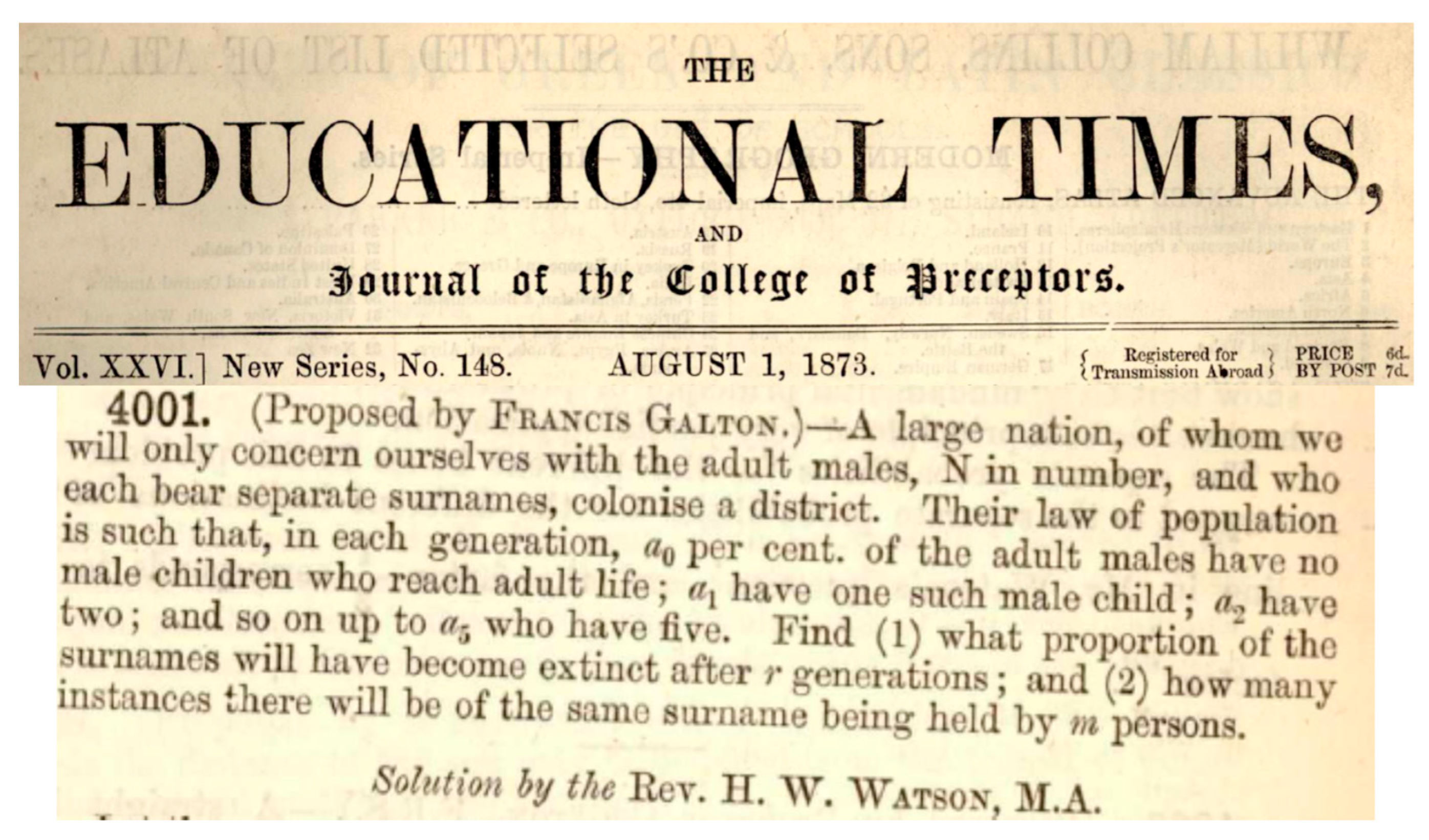
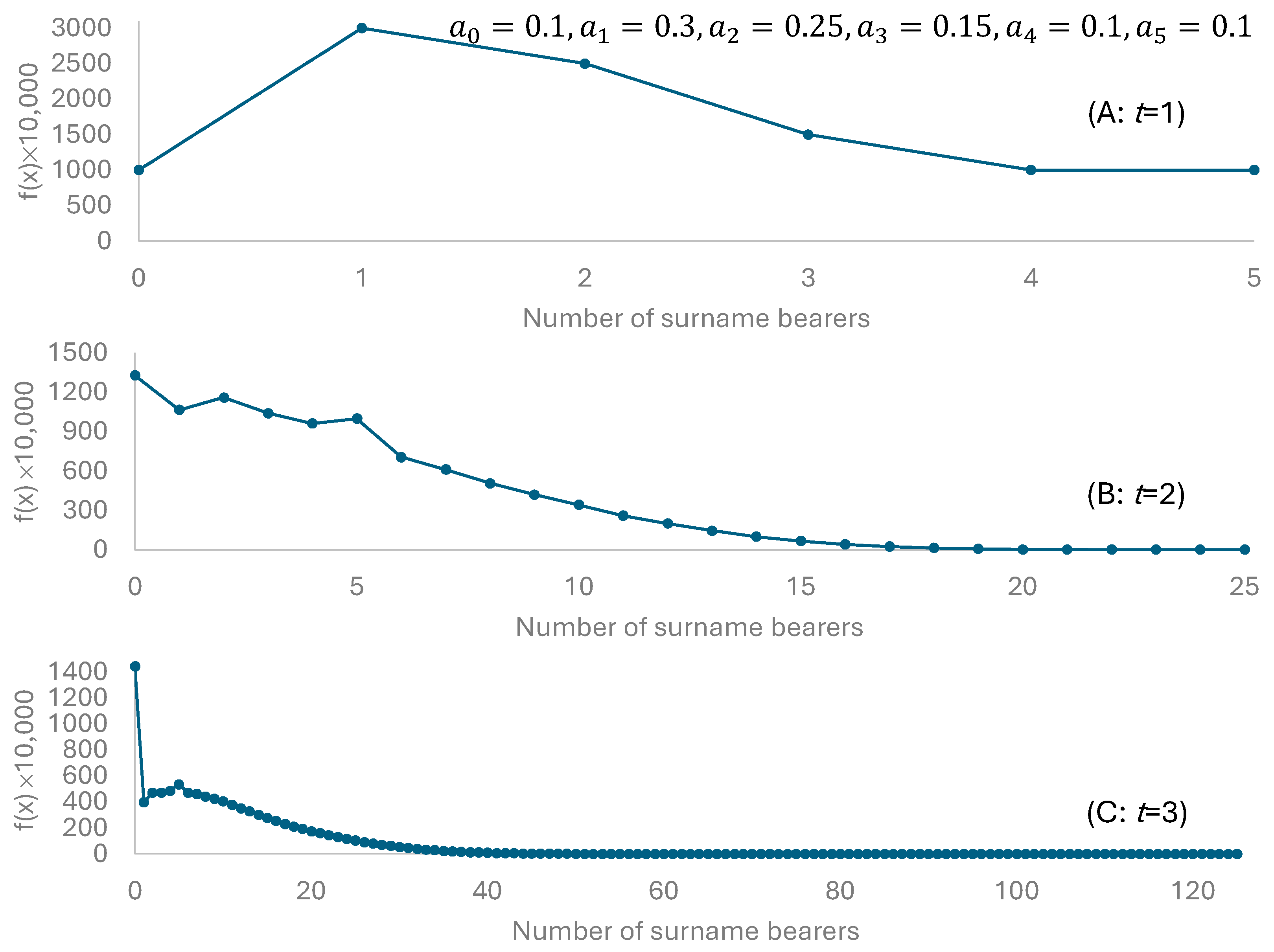
The Branching Process: A General Conceptual Framework for Addressing Current Ecological and Evolutionary Questions


Abstract
1. Introduction
2. A Branching Process with Empirical Reproductive Success
2.1. Extinction Probability Q
2.2. Extinction Time T and Var(T)
3. A Branching Process with the Reproduction Law Following a Poisson Distribution
3.1. Extinction Probability Q
3.2. Extinction Probability of a New Advantageous Allele in a Diploid Population
3.3. Extinction Time
4. Come Back to the Galton Questions
5. Extinction Probability and Extinction Time for a New Allele in a Small Population
6. Recent Extensions and Applications
7. Conclusions
Funding
Institutional Review Board Statement
Informed Consent Statement
Data Availability Statement
Acknowledgments
Conflicts of Interest
References
- Feller, W. An Introduction to Probability Theory and Its Applications; Wiley series in probability and mathematical statistics; Bradley, R.A., Kendall, D.G., Hunter, J.S., Watson, G.S., Eds.; Wiley: New York, NY, USA, 1968; Volume 1, p. 509. [Google Scholar]
- Galton, F.; Watson, H.W. On the probability of extinction of families. J. Anthropol. Inst. Great Br. Irel. 1874, 4, 138–144. [Google Scholar]
- Fisher, R.A. On the dominance ratio. Proc. Royal. Soc. Edin. 1922, 42, 321–431. [Google Scholar] [CrossRef]
- Haldane, J.B.S. A mathematical theory of natural and artificial selection. Part V. Proc. Camb. Philos. Soc. 1927, 23, 838–844. [Google Scholar] [CrossRef]
- Harris, T.E. The Theory of Branching Processes; Springer: Berlin/Heidelberg, Germany, 1963. [Google Scholar]
- Athreya, K.B.; Ney, P.E.; Ney, P.E. Branching Processes; Dover Publications: Mineola, NY, USA, 2004; p. 287. [Google Scholar]
- Freeman, A.; Xia, X. Phylogeographic Reconstruction to Trace the Source Population of Asian Giant Hornet Caught in Nanaimo in Canada and Blaine in the USA. Life 2024, 14, 283. [Google Scholar] [CrossRef]
- Xia, X. Phylogeographic Analysis for Understanding Origin, Speciation, and Biogeographic Expansion of Invasive Asian Hornet, Vespa velutina Lepeletier, 1836 (Hymenoptera, Vespidae). Life 2024, 14, 1293. [Google Scholar] [CrossRef]
- Azevedo, R.B.R.; Olofsson, P. A branching process model of evolutionary rescue. Math. Biosci. 2021, 341, 108708. [Google Scholar] [CrossRef] [PubMed]
- Fuller, S.N.; Shafiei, A.; Venzon, D.J.; Liewehr, D.J.; Mauda Havanuk, M.; Ilanchezhian, M.G.; Edgerly, M.; Anderson, V.L.; Levy, E.B.; Hoang, C.D.; et al. Tumor Doubling Time Using CT Volumetric Segmentation in Metastatic Adrenocortical Carcinoma. Curr. Oncol. 2021, 28, 4357–4366. [Google Scholar] [CrossRef]
- Felsenstein, J. Theoretical Evolutionary Genetics; Self-Published: Seattle, WA, USA, 2019. [Google Scholar]
- Corless, R.M.; Gonnet, G.H.; Hare, D.E.G.; Jeffrey, D.J.; Knuth, D.E. On the Lambert W function. Adv. Comput. Math. 1996, 5, 329–359. [Google Scholar] [CrossRef]
- Burie, J.-B.; Ducrot, A.; Seydi, O. Early-stage invasion and spreading speed in a resource-dependent dispersal model. Math. Biosci. 2026, 392, 109585. [Google Scholar] [CrossRef]
- Yuan, B.; Jiao, F. Stochastic Modeling and Transient Analysis of Epidemic Extinction Dynamics. Bull. Math. Biol. 2025, 87, 169. [Google Scholar] [CrossRef] [PubMed]
- Craddock, H.; Spencer, S.E.F.; Didelot, X. A Bayesian modelling framework with model comparison for epidemics with super-spreading. Infect. Dis. Model. 2025, 10, 1418–1432. [Google Scholar] [CrossRef]
- Rouzine, I.M.; Rodrigo, A.; Coffin, J.M. Transition between stochastic evolution and deterministic evolution in the presence of selection: General theory and application to virology. Microbiol. Mol. Biol. Rev. 2001, 65, 151–185. [Google Scholar] [CrossRef]
- Viceconte, G.; Petrosillo, N. COVID-19 R0: Magic number or conundrum? Infect. Dis. Rep. 2020, 12, 8516. [Google Scholar] [CrossRef] [PubMed]
- Williams, G.C. Sex and Evolution; Princeton University Press: Princeton, NJ, USA, 1975. [Google Scholar]
- Maynard Smith, J. The Evolution of Sex; Cambridge University Press: Cambridge, UK, 1978. [Google Scholar]
- Fisher, R.A. The Genetical Theory of Natural Selection; Clarendon Press: Oxford, UK, 1930. [Google Scholar]
- Wright, S. Statistical genetics and evolution. Bull. Amer. Math. Soc. 1942, 48, 223–246. [Google Scholar] [CrossRef][Green Version]
- Moran, P.A.P. The survival of a mutant under general conditions. Math. Proc. Camb. Philos. Soc. 1961, 57, 304–314. [Google Scholar] [CrossRef]
- Kimura, M. Some Problems of Stochastic Processes in Genetics. Ann. Math. Stat. 1957, 28, 882–901. [Google Scholar] [CrossRef]
- Kimura, M. Diffusion models in population genetics. J. Appl. Probab. 1964, 1, 177–232. [Google Scholar] [CrossRef][Green Version]
- Burden, C.J.; Griffiths, R.C. The Feller diffusion conditioned on a single ancestral founder. Theor. Popul. Biol. 2025, 166, 1–15. [Google Scholar] [CrossRef]
- Nagylaki, T. Introduction to Theoretical Population Genetics; Springer: Berlin/Heidelberg, Germany, 1992. [Google Scholar]
- Wright, S. Evolution in Mendelian populations. Genetics 1931, 16, 97–159. [Google Scholar] [CrossRef] [PubMed]
- Kimura, M.; Ohta, T. The average number of generations until fixation of a mutant gene in a finite population. Genetics 1969, 61, 763–771. [Google Scholar] [CrossRef]
- Kimura, M.; Ohta, T. The average number of generations until extinction of an individual mutant gene in a finite population. Genetics 1969, 63, 701–709. [Google Scholar] [CrossRef] [PubMed]
- Haccou, P.; Jagers, P.; Vatutin, V.A. Branching Processes: Variation, Growth, and Extinction of Populations; Cambridge University Press: Cambridge, UK, 2005. [Google Scholar]
- Cloez, B.; Daufresne, T.; Kerioui, M.; Fontez, B. A bayesian version of Galton–Watson for population growth and its use in the management of small population. Math. Action 2023, 12, 49–64. [Google Scholar] [CrossRef]
- Crump, K.S.; Howe, R.B. Nonparametric estimation of the age of a Galton-Watson branching process. Biometrika 1972, 59, 533–538. [Google Scholar] [CrossRef]
- Stigler, S.M. The Estimation of the Probability of Extinction and Other Parameters Associated with Branching Processes. Biometrika 1971, 58, 499–508. [Google Scholar] [CrossRef]
- Gillespie, D.T. Exact stochastic simulation of coupled chemical reactions. J. Phys. Chem. 1977, 81, 2340–2361. [Google Scholar] [CrossRef]
- Sagitov, S. Critical Galton–Watson Processes with Overlapping Generations. Stoch. Qual. Control 2021, 36, 87–110. [Google Scholar] [CrossRef]



| T | qt | qt − qt − 1 | 1 − qt | (2t + 1)(1 − qt) |
|---|---|---|---|---|
| 0 | 0 | 1 | 1 | |
| 1 | 0.5 | 0.5 | 0.5 | 1.5 |
| 2 | 0.7 | 0.2 | 0.3 | 1.5 |
| 3 | 0.808 | 0.108 | 0.192 | 1.344 |
| 4 | 0.872973 | 0.064973 | 0.127027 | 1.143245 |
| 5 | 0.914308 | 0.041335 | 0.085692 | 0.94261 |
| 6 | 0.941484 | 0.027176 | 0.058516 | 0.760704 |
| … | … | … | … | … |
| 37 | 0.999999 | 3.75 × 10⁻⁷ | 8.74 × 10⁻⁷ | 6.56 × 10⁻⁵ |
| 38 | 0.999999 | 2.62 × 10⁻⁷ | 6.12 × 10⁻⁷ | 4.71 × 10⁻⁵ |
| 39 | 1 | 1.84 × 10⁻⁷ | 4.28 × 10⁻⁷ | 3.38 × 10⁻⁵ |
| 40 | 1 | 1.28 × 10⁻⁷ | 3 × 10⁻⁷ | 2.43 × 10⁻⁵ |
| … | … | … | … | … |
| 92 | 1 | 1.22 × 10⁻¹⁵ | 2.55 × 10⁻¹⁵ | 4.72 × 10⁻¹³ |
| 93 | 1 | 0 | 1.89 × 10⁻¹⁵ | 3.53 × 10⁻¹³ |
| 94 | 1 | 0 | 0 | 0 |
| W0(z) | Q | Qgeometric | ||
|---|---|---|---|---|
| 1 | −0.36788 | −1 | 1 | 1 |
| 1.01 | −0.36786 | −0.99014 | 0.98034 | 0.99900 |
| 1.1 | −0.36616 | −0.90630 | 0.82391 | 0.99010 |
| 1.2 | −0.36143 | −0.82353 | 0.68627 | 0.83333 |
| 1.3 | −0.35429 | −0.75013 | 0.57702 | 0.76923 |
| 1.4 | −0.34524 | −0.68461 | 0.48901 | 0.71429 |
| 1.5 | −0.33470 | −0.62581 | 0.41720 | 0.66667 |
| 2 | −0.27067 | −0.40637 | 0.20319 | 0.5 |
| 3 | −0.14936 | −0.17856 | 0.05952 | 0.33333 |
| 4 | −0.07326 | −0.07931 | 0.01983 | 0.25 |
| 5 | −0.03369 | −0.03489 | 0.00698 | 0.2 |
| 10 | −0.00045 | −0.00045 | 0.00004 | 0.1 |
| T | qt | qt − qt−1 |
|---|---|---|
| 0 | 0.0000000000 | |
| 1 | 0.3328710837 | 0.332871084 |
| 2 | 0.4800611401 | 0.147190056 |
| 3 | 0.5644334773 | 0.084372337 |
| 4 | 0.6193261945 | 0.054892717 |
| 5 | 0.6578744403 | 0.038548246 |
| 6 | 0.6863702213 | 0.028495781 |
| 7 | 0.7082254834 | 0.021855262 |
| 8 | 0.7254580952 | 0.017232612 |
| … | … | … |
| 999 | 0.8238658564 | 0 |
| 1000 | 0.8238658564 | 0 |
| T | ||
|---|---|---|
| 0 | 0 | |
| 1 | 0.1000000000 | 0.1000000000 |
| 2 | 0.1326610000 | 0.0326610000 |
| 3 | 0.1445833203 | 0.0119223203 |
| 4 | 0.1491044603 | 0.0045211400 |
| 5 | 0.1508434063 | 0.0017389461 |
| … | … | … |
| 23 | 0.1519416037 | 0.0000000001 |
| 24 | 0.1519416038 | 0.0000000000 |
| 25 | 0.1519416038 | 0.0000000000 |
| N | p | ||||
|---|---|---|---|---|---|
| 1 | 1/2 | 2 | 2 | 2.7726 | 2.7726 |
| 2 | 1/4 | 2.9931 | 5.7793 | 3.6968 | 6.9044 |
| 4 | 1/8 | 4.0768 | 13.5534 | 4.7530 | 14.9555 |
| 16 | 1/32 | 6.5006 | 61.0634 | 7.1551 | 62.9894 |
Disclaimer/Publisher’s Note: The statements, opinions and data contained in all publications are solely those of the individual author(s) and contributor(s) and not of MDPI and/or the editor(s). MDPI and/or the editor(s) disclaim responsibility for any injury to people or property resulting from any ideas, methods, instructions or products referred to in the content. |
© 2025 by the author. Licensee MDPI, Basel, Switzerland. This article is an open access article distributed under the terms and conditions of the Creative Commons Attribution (CC BY) license (https://creativecommons.org/licenses/by/4.0/).
Share and Cite
Xia, X. The Branching Process: A General Conceptual Framework for Addressing Current Ecological and Evolutionary Questions. Life 2025, 15, 1910. https://doi.org/10.3390/life15121910
Xia X. The Branching Process: A General Conceptual Framework for Addressing Current Ecological and Evolutionary Questions. Life. 2025; 15(12):1910. https://doi.org/10.3390/life15121910
Chicago/Turabian StyleXia, Xuhua. 2025. "The Branching Process: A General Conceptual Framework for Addressing Current Ecological and Evolutionary Questions" Life 15, no. 12: 1910. https://doi.org/10.3390/life15121910
APA StyleXia, X. (2025). The Branching Process: A General Conceptual Framework for Addressing Current Ecological and Evolutionary Questions. Life, 15(12), 1910. https://doi.org/10.3390/life15121910