
Article

Hydraulic Characteristics of Large-Scale Vertical Mixed-Pump Device Under Pump as Turbine (PAT) Mode Applying Chaos Theory


1
College of Hydraulic Science and Engineering, Yangzhou University, Yangzhou 225009, China
2
Luoyun Management Division, Suqian 223800, China
3
The Eastern Route of South-to-North Water Diversion Project, Jiangsu Water Source Co., Ltd., Nanjing 210019, China
4
Department of Energy and Power Engineering, Tsinghua University, Beijing 100084, China
*
Author to whom correspondence should be addressed.
Machines 2026, 14(5), 556; https://doi.org/10.3390/machines14050556
Submission received: 15 April 2026 / Revised: 4 May 2026 / Accepted: 9 May 2026 / Published: 15 May 2026

Abstract

As an important option for energy storage projects, pumping stations can also generate electricity when the upstream has surplus water and the pump system operates as a turbine (PAT mode). When it switches from pump mode to PAT mode, the pump operation state changes significantly. This study adopts a numerical simulation to investigate the flow characteristics, time-frequency domain performance and chaotic features of pressure pulsation in a vertical mixed-flow pump device when it operates in different PAT modes. The results show that, when the pump operates in PAT mode, the flow in the straight passage remains smooth, but it deteriorates in the elbow-shaped draft tube, such as developing a spiral stream in the straight section, a disordered stream in the elbow section, and vortexes and flow separation at the beginning of the diffuser section, but it gradually becomes smooth after passing through the diffuser section. Under low-head PAT conditions, circumferential circulation cross flow occurs at the impeller inlet, reducing energy conversion efficiency. Under all PAT conditions, the flow on the blade surface near the hub is stable, but obvious vortexes happen near the shroud. As the head increases, the small-scale vortexes disappear on the mid-blade surface, and the flow becomes smoother on the blade surface near the shroud of the impeller. Except at the impeller outlet, pressure pulsation of the monitoring probes exhibits clear periodicity, with dominant frequencies corresponding to the rotational frequency, and its amplitudes decreasing from shroud to hub. Pressure pulsation under all PAT conditions is chaotic, and phase trajectories exhibit ring-shaped structures consisting of the ring circle and the ring surface. Differences in the circle spacing, size, and spatial position of the ring circle phase locus and ring surface phase locus are observed, and these variations are closely related to the PAT conditions. A correlative relationship exists between the chaotic correlation dimension and flow performance, which is of great significance for the condition monitoring and fault diagnosis of pump units. These findings not only enrich the theoretical research on the PAT mode of pumps, but also provide a reference for similar engineering applications and offer new insights into condition monitoring of hydraulic machinery.

1. Introduction

To achieve “dual carbon” goals, energy storage is an indispensable technology, within the category of which hydropower energy storage constitutes an important component [1]. To maximize the overall benefits of the pumping station, in addition to satisfying routine pumping and dispatching requirements, surplus upstream water can be regulated via control gates to adjust the upstream water level, thereby enabling operation under PAT conditions for power generation and allowing the system to function as an energy storage facility [2]. Pumps are typically operated under design pumping conditions. However, when they operate under off-design conditions or in other regions of the four-quadrant characteristic domain, the flow conditions change, and the pumps may be subjected to complex hydraulic instabilities, which affects its hydraulic performance as well as safety and stability [3]. Previous researchers have conducted extensive studies on mixed-flow pumps, PAT mode, and pressure pulsation, including the utilization of chaos theory to analyze and detect the nonlinear characteristics of pressure pulsation, but these studies lack the chaotic characteristic of pressure pulsation for mixed-flow pumps in PAT mode.
Mixed-flow pumps are characterized by a relatively wide, high-efficiency operating range and large flow capacity, and they are widely used in urban drainage, flood control, and water transfer projects such as “South-to-North Water Diversion Project”, “Dongshen Water Supply Project”, etc. [4]. Numerous studies have been conducted on the flow stability of mixed-flow pumps [5], and energy loss characteristics under unsteady flow conditions have likewise been extensively investigated [6]. Lei et al. [7] investigated the dynamic multiscale characteristics of the PFS in mixed-flow pump through model experiments and proposed a method based on variational mode decomposition and refined composite multiscale dispersion entropy with adaptive parameters. Su et al. [8] analyzed the matching characteristics between the installation angles of the impeller and the guide vane in mixed-flow pump using numerical simulations, and identified the optimal combination based on the entropy production rate, demonstrating that adjustable guide vanes can significantly improve pump performance. Sun et al. [9] investigated the effect of blade inclination angle on mixed-flow pump performance through CFD simulations, revealing that it significantly influences hydraulic loss and impeller performance, and that an appropriate inclination angle can effectively enhance efficiency. Li et al. [10] employed numerical simulation methods to investigate the effects of blade angle on the impeller energy performance, pressure pulsation characteristics, axial force, and radial force in mixed-flow pump. The results indicate that both the dominant frequency amplitude of pressure pulsation at the outlet of the impeller and the radial force increase with increasing blade angle. Zhu et al. [11] employed high-speed imaging techniques combined with synchronous pressure measurements to systematically investigate the coupling mechanism between flow separation and cavitation evolution and its influence on pressure pulsation characteristics. The frequency characteristics of cavitation-induced pressure pulsation were revealed, and it was found that the energy distribution in the high-frequency band is closely related to the dynamic evolution of cavitation.
For PAT mode, existing works mainly focus on hydraulic performance, energy conversion [12], or cavitation [13], while pressure pulsation analyses are often limited to the time-frequency domain method [14]. Fu et al. [15] analyzed the complex internal flow within the blades and the induced pressure pulsation characteristics during the load rejection process of an ultra-high-head pump-turbine. Liu et al. [16] conducted numerical simulations to investigate flow structures such as vortexes in the vaneless region and runner region of the S-shaped characteristic zone of a pump-turbine. Zhang et al. [17] investigated the startup performance in PAT mode. The results showed that, as the stable rotational speed of the PAT increased, the instantaneous rotational speed, head, hydraulic power, and conversion efficiency increased rapidly, while the flow rate and hydraulic losses decreased rapidly. Zhao et al. [18] studied a vertical mixed-flow pump operating in PAT mode. The study introduced power spectral density (PSD) estimation to analyze energy conversion characteristics under PAT conditions and to identify the dominant modes of energy transfer. Zhu et al. [19] combined CFD methods with entropy production theory to investigate the performance characteristics, flow structures, and energy dissipation mechanisms of a blade-adjustable axial-flow turbine under low-head conditions in PAT mode. Saremian and Shojaeefard [20] investigated the effects of various volute geometric parameters (cross-section shape, diffuser shape, cutwater, and design diameter) on the performance of a centrifugal pump operating in PAT mode.
For pressure pulsation, research on pressure pulsation characteristics of pumps operating in PAT mode has attracted considerable attention, particularly in terms of their distribution and evolution at key locations, but existing studies mainly adopt the time-frequency domain method. Li et al. [21] analyzed the effects of different inlet flow conditions on the pressure pulsation characteristics at key locations of a multistage centrifugal pump operating in PAT mode. Sun et al. [22] studied pump-turbines during rapid pump-to-turbine transition and found that strong pressure pulsation and vortical structures are mainly concentrated near the runner inlet and the vane leading and trailing edges. Li et al. [23] systematically analyzed the amplitude–frequency characteristics and propagation laws of pressure pulsation at low frequency, rotational frequency, blade-passing frequency, and their harmonics. The pressure pulsation at key locations such as the impeller and guide vanes exhibits pronounced periodic variations, while signals at other monitoring positions tend to exhibit no obvious periodicity. This contrast becomes particularly evident under off-design conditions, where the pressure pulsation signals tend to become increasingly irregular and disordered, exhibiting strong nonlinear characteristics. Given these complexities, traditional linear analysis methods are often insufficient to fully capture the underlying dynamics of pressure pulsation. Therefore, nonlinear analysis approaches, especially chaos theory, have been increasingly introduced to process and interpret such signals [24]. By enabling feature extraction and quantitative characterization, chaos theory provides deeper insights into the nonlinear dynamic behavior and evolution mechanisms of pressure pulsation. A number of studies have demonstrated the effectiveness of chaos-based methods in analyzing pressure pulsation. For instance, Jiao [25] experimentally investigated the chaotic characteristics under shallow-water conditions and revealed that the suction vortex significantly enhances the degree of chaos, as evidenced by more complex attractor structures and higher Lyapunov exponents. Xiao et al. [26] employed CFD to examine the chaotic features of pressure pulsation at key locations in a bidirectional axial-flow pump. Similarly, Li [27] and Cai [28] analyzed the influence of tip clearance, blade angle, and off-design conditions, confirming that pressure pulsation signals exhibit pronounced chaotic behavior under varying operating conditions. In addition, Ma et al. [29] proposed a data-driven hybrid measurement approach to predict transient pressure pulsation in the vaneless region, while Liu et al. [30] utilized dynamic mode decomposition (DMD) to extract coherent flow structures and dominant frequencies in complex flow regions.
In the application of chaos theory, the extracted nonlinear and chaotic features further provide a theoretical foundation for advanced condition monitoring and fault diagnosis of hydraulic machinery. For example, Valentín et al. [31] developed a digital twin framework integrating POD and LSTM models for real-time monitoring and pressure pulsation prediction. Siddique et al. [32] proposed an intelligent fault diagnosis model based on wavelet coherence and a hybrid CNN–KAN architecture. Shi et al. [33] demonstrated that the chaotic characteristics of pressure pulsation are closely related to operating conditions, highlighting their potential for condition monitoring. Guo [34] further introduced chaos theory into fault diagnosis by proposing a feature extraction method based on chaotic phase portraits for pump drive motor monitoring. In summary, although chaos theory has been successfully applied in the field of hydraulic machinery, studies focusing on the chaotic characteristics of pressure pulsation signals in the flow passage system of vertical mixed-flow pump devices operating under PAT conditions remain limited. Notably, after the operating mode is switched, the rear guide vanes become front guide vanes relative to the flow direction, and the helical flow downstream of the impeller loses the confinement of solid boundaries, leading to intensified flow turbulence and more complex flow structures. Therefore, further investigation into this issue is of great necessity.
In this study, the three-dimensional transient flow field of a large-scale vertical mixed-flow pump device is numerically simulated. With the generating head taken as the key variable, the flow field characteristics under different operating conditions are analyzed. Furthermore, chaos theory is introduced to explore the nonlinear characteristics of pressure pulsation signals at key locations, with the aim of providing new insights into the complex flow behavior under PAT conditions.

2. Numerical Simulation Methods

2.1. Numerical Simulation Theory

2.1.1. Governing Equation

The fluid within the pump device is assumed to be an ideal incompressible fluid, which satisfies the laws of mass conservation, energy conservation, and momentum conservation. In the present numerical simulation, heat transfer effects are neglected; therefore, only the continuity and momentum equations are considered. The governing equations are given as follows:
(1)
Continuity Equation:
u j ¯ x i = 0
(2)
Momentum equation:
u i t + x j ( u i u j ¯ ) = p ¯ x i + x i ( μ u i ¯ x j + ρ u i u j ¯ ) + f i
where u i ¯ and u j ¯ denote the Reynolds-averaged velocity components in the i and j directions of the three-dimensional flow field, respectively m/s; xi and xj represent the Cartesian coordinate components in the i and j directions, respectively m; t denotes time s; p ¯ is the pressure Pa; τ i j is the stress tensor; ρ is the fluid density kg/m3; μ denotes the dynamic viscosity Pa·s; ρ u i u j ¯ represents the Reynolds stress Pa · s ; and fi denotes the body force component, N.

2.1.2. Computational Domain and Mesh Generation

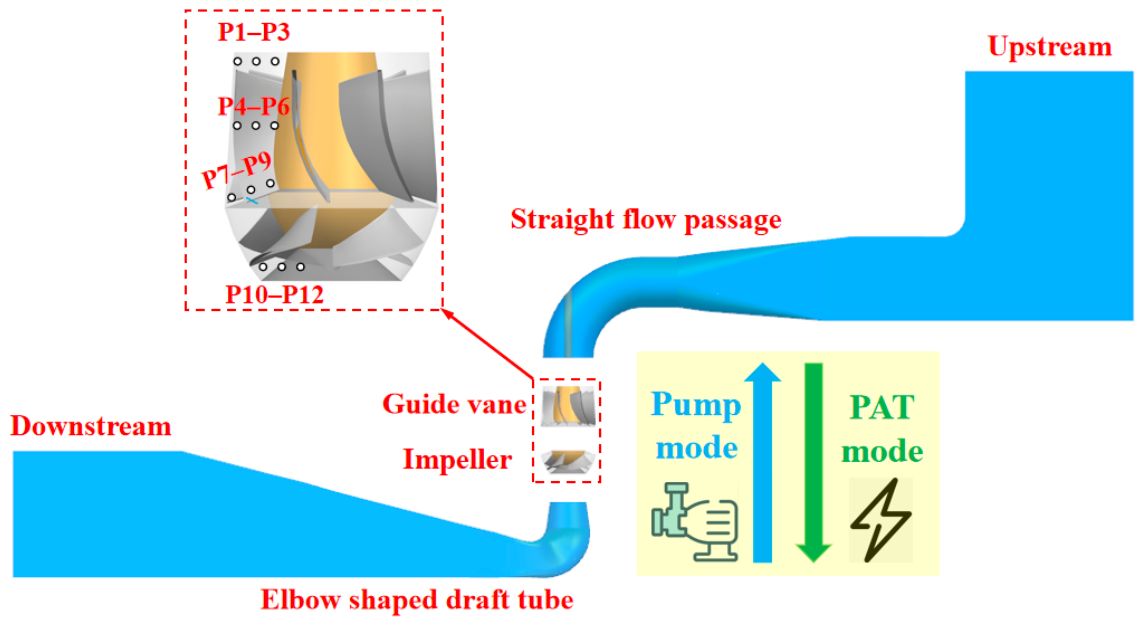
Figure 1 illustrates the three-dimensional computational fluid domain of the vertical mixed-flow pump system, which consists of six subdomains: the elbow-shaped draft tube, the guide vanes, the impeller, the straight passage, and the upstream and downstream extension sections. In PAT mode, the flow direction is completely opposite to that in pump mode; specifically, the flow passes through the straight passage, guide vanes, impeller, and elbow-shaped draft tube.
To obtain the pressure pulsation characteristics at key locations under various PAT operating conditions, a total of 12 monitoring probes were arranged. Considering the symmetric structure, the time-frequency domain variation patterns at symmetric monitoring locations are similar; therefore, monitoring probes were arranged only on one side of the pump device. Specifically, P1, P2, and P3 were uniformly distributed from the shroud to the hub at the inlet of the guide vane; P4, P5, and P6 were uniformly distributed from the shroud to the hub at the mid-section of the guide vane; P7, P8, and P9 were uniformly distributed from the shroud to the hub at the inlet of the impeller; and P10, P11, and P12 were uniformly distributed from the shroud to the hub at the outlet of the impeller, as shown in Figure 1.
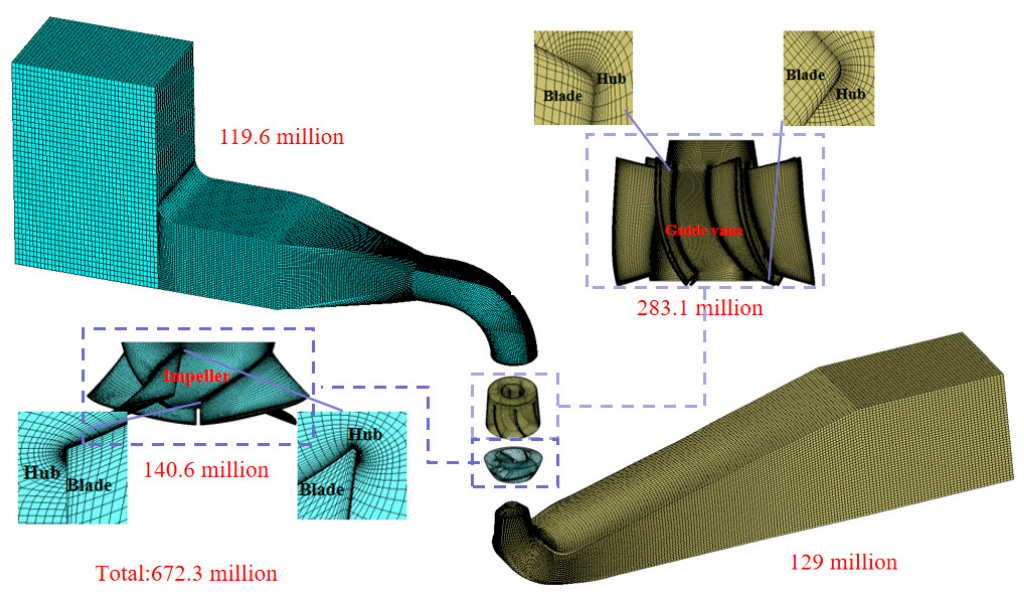
A high-quality mesh is essential for ensuring the accuracy of numerical simulation results. In this study, different meshing strategies were adopted on the ANSYS ICEM 19.2 platform to perform the discretization of the three-dimensional computational domain for each subdomain, and a structured mesh was generated, as shown in Figure 2.
A reasonable mesh size can not only ensure the accuracy of the results but also improve computational efficiency and prevent the waste of computational resources. In this study, the Grid Convergence Index (GCI) based on the Richardson extrapolation method [35] was adopted as the criterion for mesh convergence.
Table 1: Under a mesh refinement factor of 1.31, three sets of mesh schemes were generated, with mesh element numbers of 15,133,866, 6,723,175, and 2,890,736, respectively. Pressure was selected as the indicator for mesh error evaluation, with the corresponding values Φ1, Φ2, and Φ3 being 171,436 Pa, 171,112 Pa, and 170,367 Pa, respectively.
The analysis results show that, at a rotational speed of 250 rpm, e e x t 32 is 0.606%. The GCI value is 0.762%, which satisfies the GCI convergence criterion, indicating that this mesh configuration can be used for subsequent numerical simulations.

2.1.3. Boundary Conditions

Under steady-state conditions, the rotational speed in PAT mode is 250 r/min. The impeller diameter is 1.62 m, with four blades, while the number of guide vanes is seven. A pressure inlet is specified at the inlet of the straight passage, and a pressure outlet is applied at the outlet of the elbow-shaped draft tube, with a reference pressure of 1 atm. Since the impeller domain is a rotating component, its inlet and outlet are coupled with the outlet of the guide vane and the elbow-shaped draft tube inlet, respectively, as rotor–stator interfaces, and the Frozen Rotor approach is adopted. All other stationary–stationary interfaces are set as stationary interfaces. A no-slip boundary condition is applied in the near-wall region. The convergence criterion is set to 10−5. The turbulence model employed is the RNG kε model, and the rationale for selecting this model will be discussed in Section 2.3.
Under transient conditions, the inlet and outlet boundary conditions remain unchanged, while the rotor–stator interfaces are set to the Transient Rotor–Stator model. A total of 12 periods is calculated, with each period being 0.24 s, resulting in a total simulation time of 2.88 s. The sampling time interval for pressure pulsation is 0.004 s (corresponding to a 6° rotation of the impeller), and the convergence criterion remains unchanged.

2.2. Pressure Pulsation Analysis Method

To obtain the multi-dimensional characteristics of pressure pulsation data, the Fast Fourier Transform (FFT) method and chaos theory are employed in this study to analyze the pressure pulsation signals and acquire the time-frequency domain characteristics and chaotic features of pressure pulsation at key locations.

2.2.1. Fast Fourier Transform Method

Due to the poor stability of the data in the initial periods of the unsteady computation, the pressure pulsation analysis in this study excludes the first four periods and instead adopts the stable flow field data from the subsequent eight periods.
The pressure pulsation coefficient Cp and the rotational frequency coefficient Fn are introduced to analyze the periodicity and variation characteristics of pressure pulsation. The calculation formulas are as follows:
C p = P P ¯ 0.5 ρ u 2
F n = 60 F n
where p is the instantaneous pressure at the monitoring probe Pa; p ¯ is the time-averaged pressure over one rotational period at the monitoring probe Pa; ρ is the fluid density kg/m3; u is the circumferential velocity of the impeller m/s; F is the frequency obtained from the Fast Fourier Transform Hz; and n is the rotational speed rpm/min.

2.2.2. Chaotic Characteristics Analysis Method

  • Maximum Lyapunov Exponent
The numerical calculation methods for the Lyapunov exponent mainly include the definition method, Wolf method, Jacobian method, and small data set method, among others [36]. Among these, the Wolf method is based on the definition of the Lyapunov exponent and estimates the exponent by analyzing the evolution of phase locus, phase planes, and phase space volumes. It is widely applied in chaotic characteristics analysis and in the prediction of chaotic time series based on the Lyapunov exponent.
In this study, the Wolf method is adopted to calculate the maximum Lyapunov exponent. The specific method is as follows:
(1)
Consider the pressure pulsation time series { x ( t i ) ,   i   =   1 ,   2 , ,   N } ,   N , where (N) denotes the terminal index of the time series.
(2)
The time delay τ is determined using the mutual information method.
(3)
The embedding dimension m is determined by comparing the Cao method with the saturated correlation dimension (G-P) method.
(4)
The phase space is reconstructed based on the time delay τ and the embedding dimension m.
Y ( t ) = Y t + Y t + τ , , Y t + m 1 τ , t = 1 , 2 , , M
where M = N ( m + 1 ) τ .
(5)
Let the initial point in the reconstructed phase space be Y(t0), and the distance between this point and its nearest neighbor Y0(t0) be L0. The temporal evolution of these two points is then tracked. At time t1, if the evolved distance satisfies L 0   =   | Y ( t 1 )     Y ( t 0 ) |   >   ε , where (ε > 0) is a predefined threshold, the point Y(t1) is retained. Subsequently, a new neighboring point Y1(t1) is searched within the neighborhood such that L 1   =   | Y ( t 1 )     Y 1 ( t 1 ) |   <   ε while ensuring that the angle between the corresponding displacement vectors is minimized as much as possible. This procedure is repeated iteratively until the entire time series is traversed. Let the total number of iterations during the tracking process be tm-to. The maximum Lyapunov exponent can then be expressed as follows:
λ 1 = 1 t M t 0 i = 0 M ln L i L i
L i = Y t i Y t i i
L 1 = Y t i Y i t i
where Yi(ti) denotes a point within the neighborhood of radius ε centered at the state Y(ti) at time ti.
2.
Phase Space Reconstruction
In phase space reconstruction theory, Packard et al. [37] proposed in 1980 that the phase space of a dynamical system can be reconstructed from a single observed time series. They introduced two reconstruction approaches, namely derivative reconstruction and coordinate delay reconstruction. Due to limitations in available information and practical conditions, the coordinate delay reconstruction method is more widely adopted in real applications. The coordinate delay method essentially constructs an m-dimensional phase space vector from a one-dimensional time series {x(n)} by introducing a time delay τ. Specifically, the reconstructed phase space vector can be expressed as follows:
x i = x i , x i + τ , , x i + m 1 τ
In 1981, Takens [38] proposed the well-known Takens’ theorem, which states that for a scalar time series {x(n)} derived from an infinite-length, noise-free, d-dimensional chaotic attractor, an m-dimensional embedding phase space can be reconstructed when the embedding dimension satisfies m > 2d + 1. This reconstructed phase space is topologically equivalent to the original dynamical system, thereby enabling the recovery of the dynamical characteristics of the chaotic attractor. The introduction of Takens’ theorem not only provides a rigorous theoretical foundation for Packard’s idea, but also establishes the basis for reconstructing phase space from a single scalar time series.
3.
Correlation Dimension
The correlation dimension is primarily used to characterize the complexity of an attractor structure. According to Takens’ theorem, the dimension of the reconstructed chaotic phase space is generally much higher than that of the attractor. As long as the embedding dimension satisfies m > 2d + 1, where d is the attractor dimension, the dynamical behavior of the original system can be recovered in a topologically equivalent sense. Therefore, the determination of the attractor dimension is crucial to the analysis of the chaotic characteristics of the system.
In 1983, Grassberger and Procaccia proposed a method for calculating the correlation dimension based on the coordinate delay reconstruction approach, commonly referred to as the (G-P) algorithm. They introduced the concept of the correlation integral, along with its corresponding formulation, as follows [39]:
C r = 1 N 2 i , j = 1 N Θ r x i x j
where C(r) represents the probability that the distance between any two points xi and xy in the reconstructed phase space is less than r ; N is the total number of points; Θ denotes the Heaviside step function; xi, xj are points in the time series; and r is the prescribed distance, whose value is closely related to the correlation integral C(r).The relationship between C(r) and the correlation dimension D can be expressed as follows:
D = lim r 0 ln C r ln r
That is, the correlation dimension D is defined as the slope of the double logarithmic curve ln C(r) versus ln(r). The (G-P) algorithm organically relates the correlation dimension to the embedding dimension. As the embedding dimension increases, the correlation dimension gradually increases. When the embedding dimension reaches a certain threshold, the correlation dimension tends to stabilize and eventually approaches a constant value, referred to as the saturated correlation dimension. At this stage, the corresponding embedding dimension can effectively reconstruct the attractor structure. Based on the characteristic that the correlation dimension of a time series eventually reaches saturation with increasing embedding dimension, this property can be used as a criterion for identifying chaotic behavior. For chaotic time series, the correlation dimension converges to a finite value when the embedding dimension is sufficiently large; in contrast, for random time series, the correlation dimension continues to increase with the embedding dimension without exhibiting saturation.

2.3. On-Site Experimental Validation

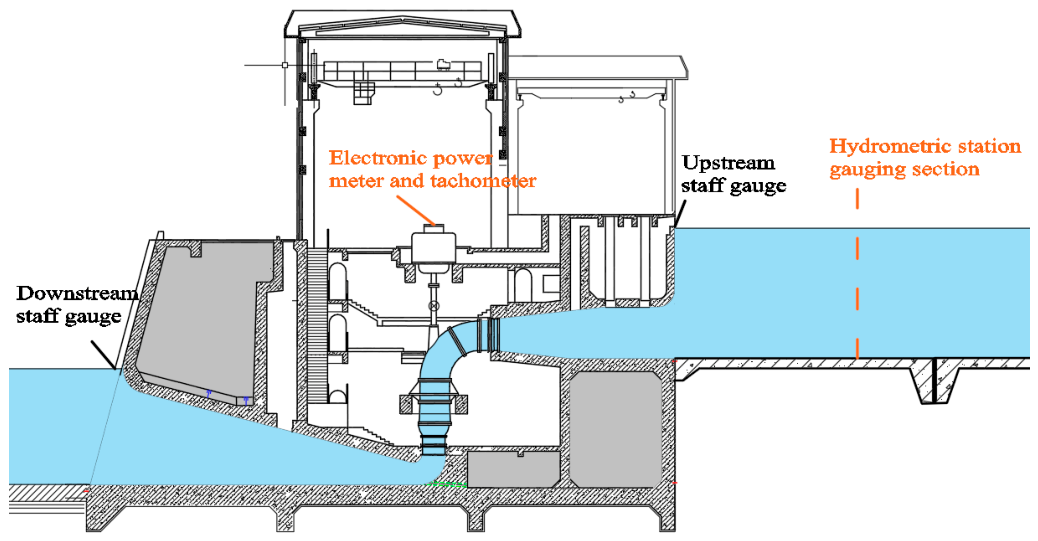
The schematic diagram of the on-site test setup is shown in Figure 3. The pumping station discharge was obtained from measurements at the hydrometric station’s gauging section. The head was determined by the difference between the upstream and downstream staff gauge water levels. The rotational speed and shaft power were measured using an electronic tachometer and an electronic power meter, respectively [40].
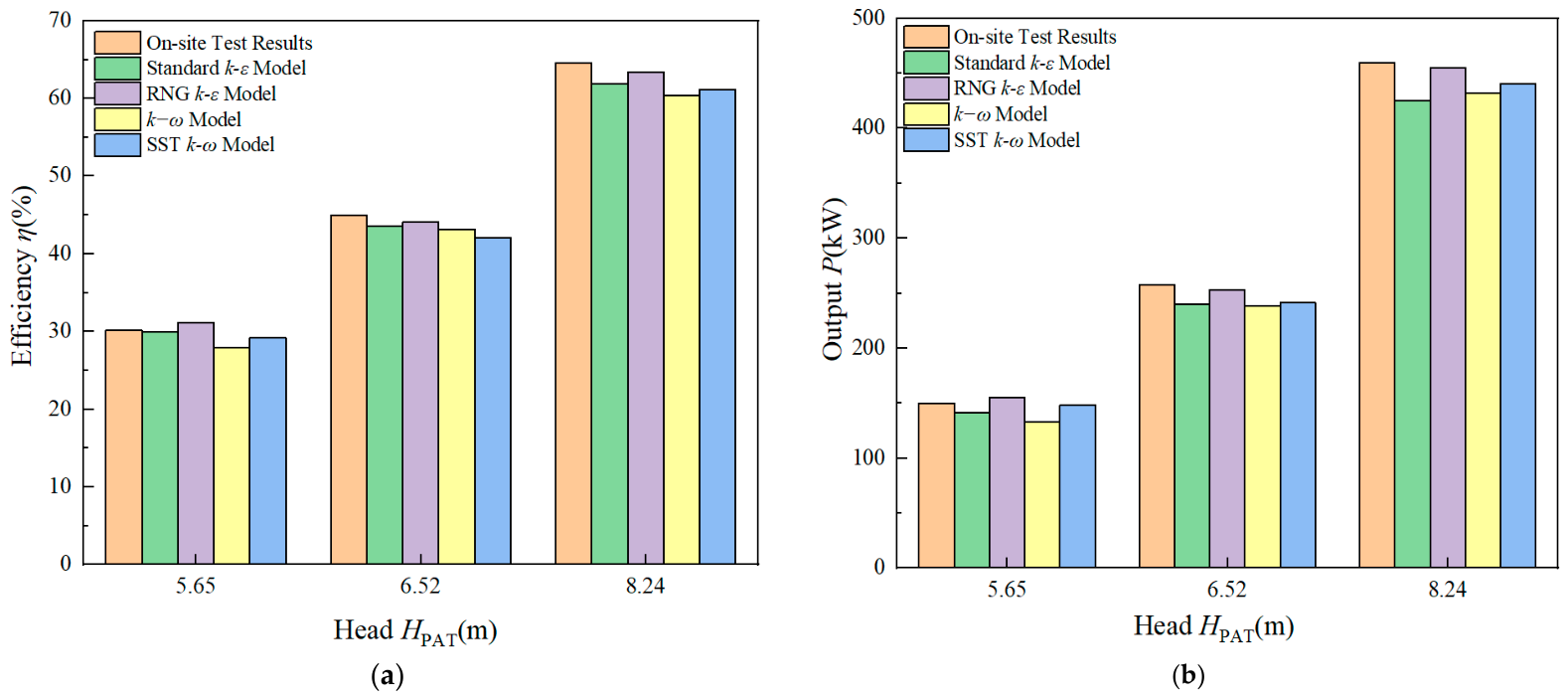
Figure 4, Table 2 and Table 3 present the comparison between the numerical simulation results and the on-site test data, respectively. The results indicate the following.
As shown in Figure 4a, the device efficiency reaches its maximum at the condition of HPAT = 8.24 m, while the minimum efficiency occurs at HPAT = 6.52 m. The smallest discrepancy between the on-site test and numerical simulation results is observed at HPAT = 5.65 m. As illustrated in Figure 4b, the device output power attains its maximum at HPAT = 8.24 m and its minimum at HPAT = 5.65 m. Meanwhile, the deviation between the on-site test and numerical simulation results is relatively small at HPAT = 6.52 m. These results indicate that the numerical simulation results under different turbulence models are in good agreement with the on-site test data.
A comparison of the data in Table 2 and Table 3 shows that, when the RNG kε turbulence model is employed, the efficiency error is 3.25% at HPAT = 5.65 m, 1.88% at HPAT = 6.52 m, and decreases further to 1.72% at HPAT = 8.24 m. This model demonstrates particularly strong performance under medium and high head conditions, significantly outperforming the kω and SST kω models, and exhibiting overall higher accuracy than the standard kε model. This advantage is even more pronounced in terms of output power. The error is 1.70% at HPAT = 6.52 m and further reduces to 1.06% at HPAT = 8.24 m, representing the lowest among all models. Even at HPAT = 5.65 m, the error of 3.32% remains within an acceptable range. These results indicate that the RNG kε turbulence model consistently outperforms the other turbulence models under different HPAT conditions. Therefore, it is selected as the turbulence model adopted in this study.

3. Results and Discussion

3.1. Hydraulic Flow Characteristics

3.1.1. Three-Dimensional Flow Characteristics

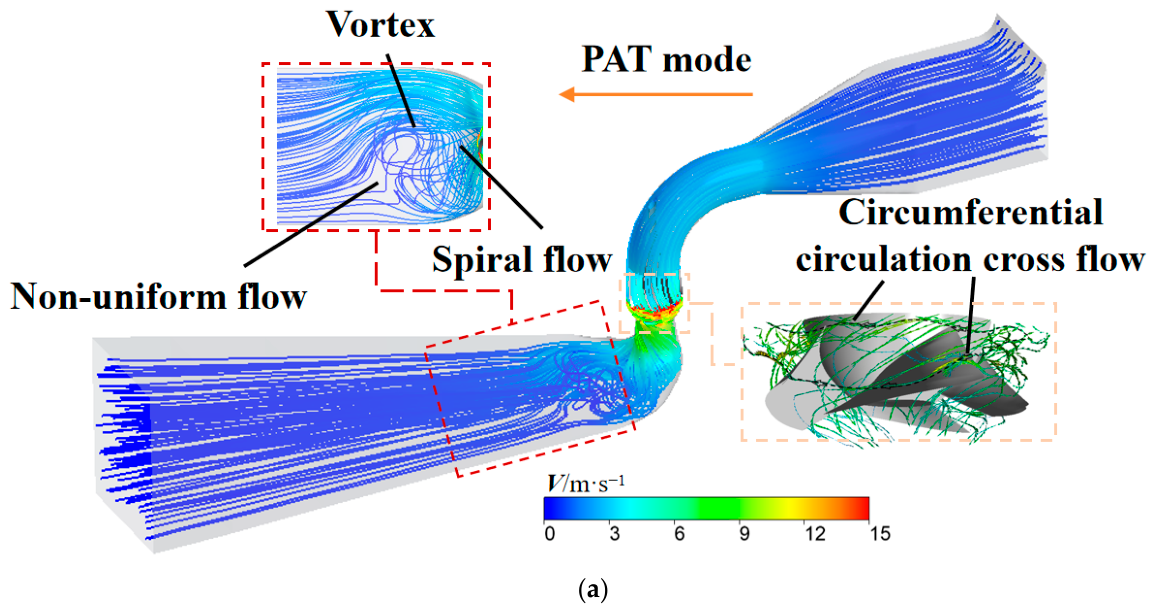
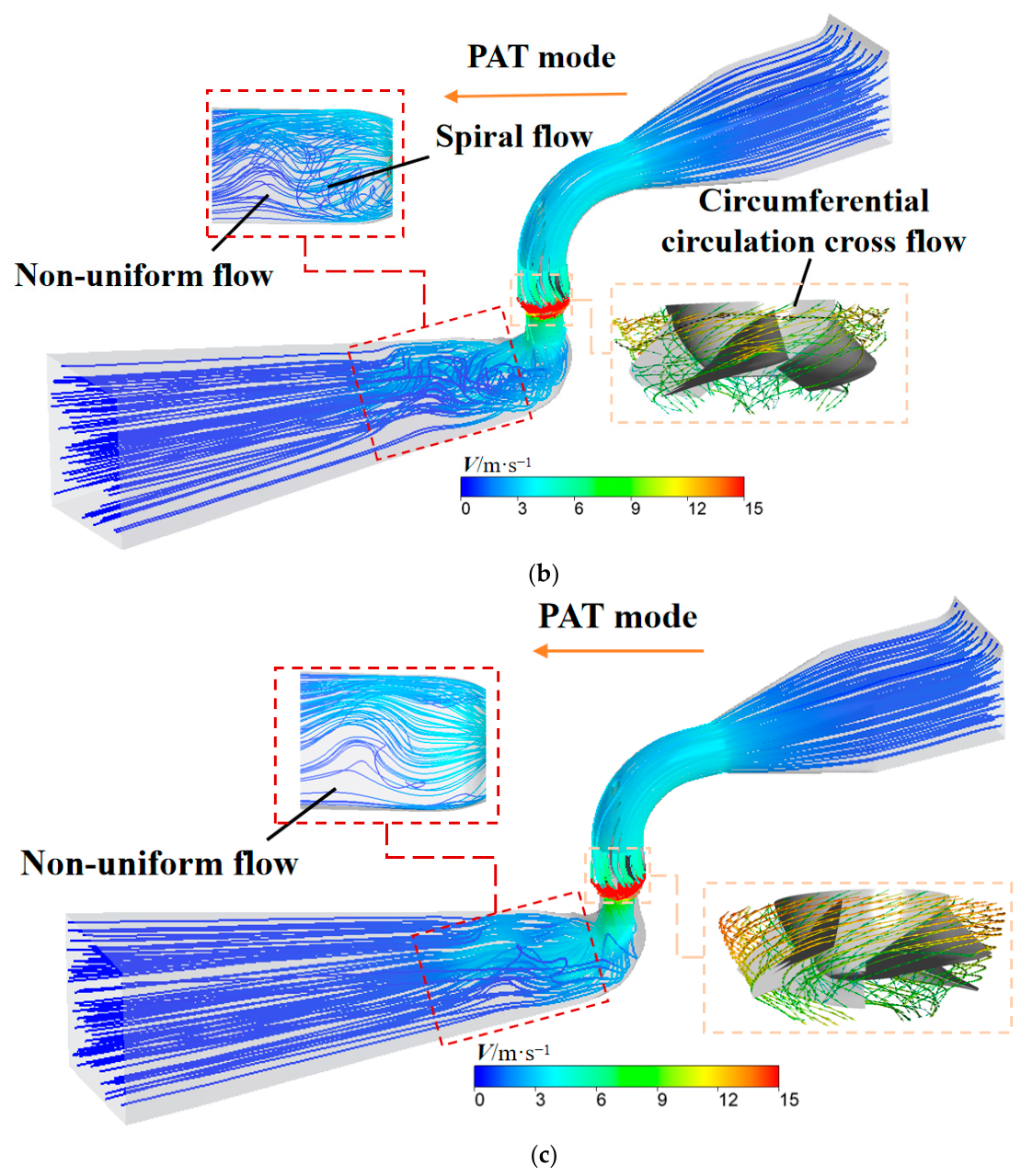
Figure 5 presents the three-dimensional streamlines under different generating head conditions. Overall, for all operating conditions, the flow in the straight passage remains uniform and smooth, with no adverse flow phenomena such as vortex formation or flow separation observed. After entering the guide vane region, the streamlines remain evenly distributed, and the flow velocity increases accordingly. Subsequently, the flow enters the impeller region, where, under the rotational effect of the impeller blades, the streamlines exhibit a pronounced rotational motion. The flow velocity further increases, and the flow pattern becomes progressively more disordered. Under low-head and medium-head conditions, a circumferential circulating cross flow occurs at the inlet of the impeller. Specifically, the fluid circulates circumferentially in the direction opposite to the impeller rotation, successively passing across the inlets of adjacent blade passages, rather than flowing toward the outlet of the impeller. This type of flow does not contribute to energy conversion. Notably, this phenomenon is absent under high-head conditions, which constitutes an important reason why the power generation efficiency under low- and medium-head conditions is lower than that under high-head conditions. When the flow enters the elbow-shaped draft tube, a helical flow develops in the straight section, while the flow in the elbow section becomes highly disordered. At the outlet of the elbow section, the flow distribution is non-uniform. In the inlet region of the diffuser, strong flow unsteadiness persists, with local occurrences of flow separation, vortex structures, and non-uniform flow patterns. Such complex flow phenomena intensify the overall flow disorder and result in significant energy losses. In the diffuser outlet section, the flow is gradually regulated by the diffuser boundaries, leading to a progressive recovery toward a more uniform and stable state, with streamlines becoming increasingly evenly distributed.
Under low-head operating conditions, the flow within the impeller is highly disordered, with a significant deviation between the inlet flow angle and the leading-edge orientation of the blades, resulting in a chaotic distribution of streamlines. Under medium-head conditions, the degree of flow disorder within the impeller is markedly reduced, and the streamlines become relatively smooth overall. The circumferential circulating cross flow at the inlet of the impeller is weakened. Meanwhile, the flow patterns in the elbow-shaped draft tube are also significantly improved. Under high-head operating conditions, the streamlines within the impeller become generally smooth, and the circumferential circulating cross flow at the inlet disappears completely. The flow incidence angle at the inlet approaches the blade leading-edge angle, resulting in a reduction in flow impingement. In addition, the flow within the elbow-shaped draft tube is further improved, with flow separation significantly suppressed and the overall flow uniformity enhanced. This indicates that, with increasing generating head in PAT mode, the flow patterns within both the impeller and the elbow-shaped draft tube are progressively improved, which is in good agreement with the corresponding external performance characteristics.

3.1.2. Transient Flow Characteristics

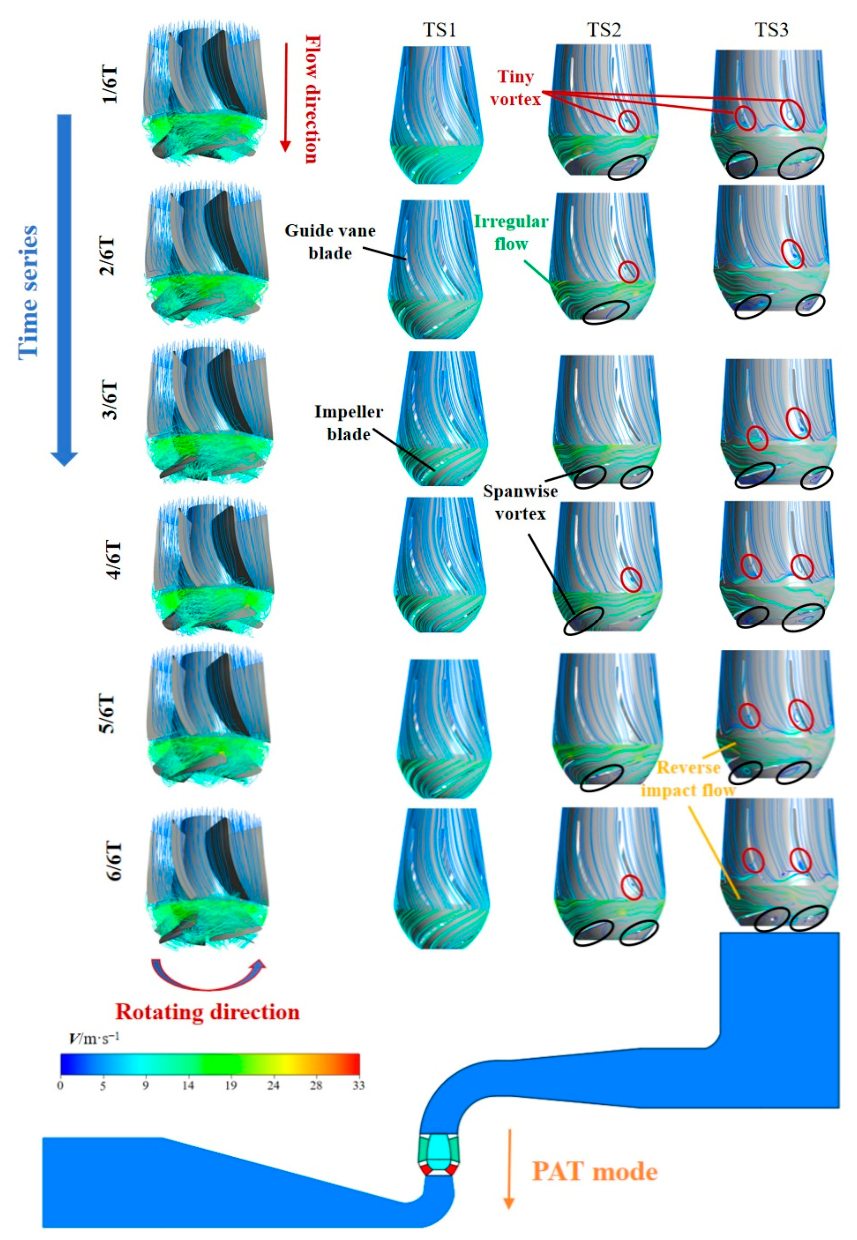
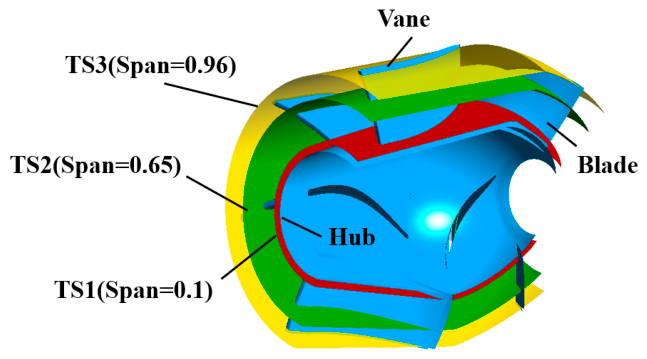
To analyze the time-domain evolution characteristics of the circumferential flow structures in a vertical mixed-flow pump operating in PAT mode, three blade surfaces were selected, as shown in Figure 6. These include the near-hub blade surface TS1 (Span = 0.1), indicated in red; the mid-blade surface TS2 (Span = 0.65), indicated in green; and the near-shroud blade surface TS3 (Span = 0.96), indicated in yellow.
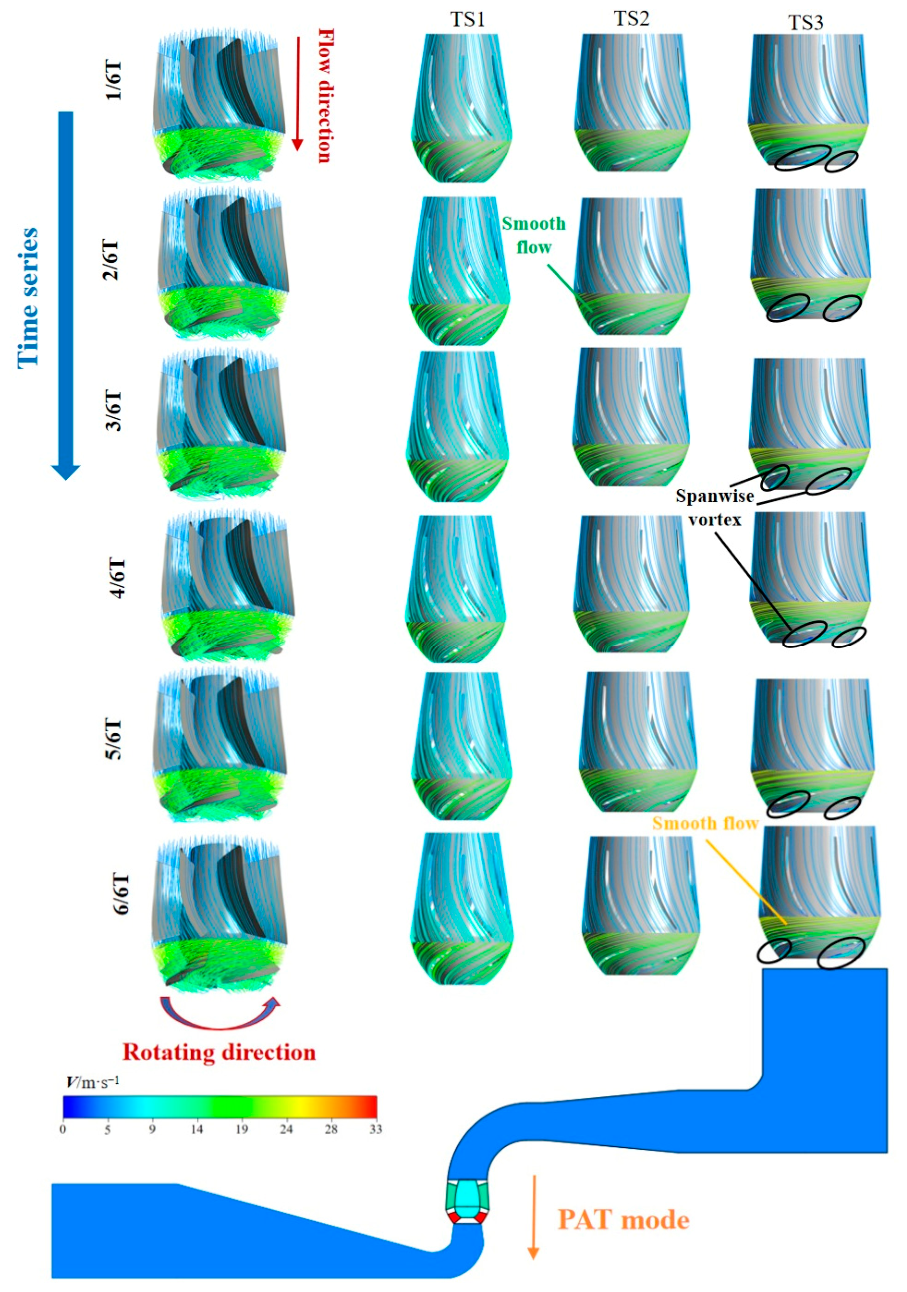
Figure 7 illustrates the streamline distributions on the rotating planes TS1, TS2, and TS3 of the mixed-flow pump at different instants within one cycle under the low-head condition (HPAT = 5.65 m). On the blade surface TS1, the flow velocity in the impeller region is significantly higher than that in the guide vane region. The flow remains relatively smooth, and no obvious vortex structures are observed. On the blade surface TS2, a small-scale vortex is observed on the pressure side of the guide vanes, indicating poor flow uniformity. In the impeller, distinct vortex structures are present on the suction side near the outlet of each blade passage, with a characteristic scale of approximately half of the outlet width. The vortex induces a flow-blocking effect. Moreover, the vortex structures exhibit pronounced unsteadiness, with their size varying over time. On the blade surface TS3, the flow near the shroud region of the guide vanes is highly non-uniform. The flow at the outlet of the guide vane is significantly obstructed, where the flow along the suction side is impeded near the outlet and interacts with the flow on the pressure side, leading to the formation of a vortex structure near the outlet pressure side. This vortex is also unstable, with its morphology varying over time. The flow direction within the impeller is opposite to that observed on TS1 and TS2, resulting in a pronounced flow impingement at the inlet of the impeller. The flow is highly non-uniform, and distinct spanwise vortexes are observed on both the pressure side near the outlet and the suction side, occupying nearly the entire outlet of the impeller. The structure, position, and morphology of the vortexes vary significantly over time. These observations collectively indicate that, under low-head operating conditions, the internal flow within the mixed-flow pump is highly unstable, accompanied by intense turbulent pulsation.
Figure 8 presents the three-dimensional streamlines in the impeller and guide vanes, as well as the streamline distributions on the blade surfaces TS1, TS2, and TS3 at different instants within one cycle under the medium-head condition (HPAT = 6.52 m). From the three-dimensional streamline distributions, it can be observed that the flow within the guide vanes is uniform and smooth. In contrast, the flow at the outlet of the impeller is disordered and unstable. A circumferential circulating cross flow is still observed near the shroud at the inlet of the impeller; however, compared with the flow pattern under low-head conditions, the flow is noticeably improved. On the TS1 blade surface, the flow remains generally smooth, and the inlet flow angle is nearly aligned with the blade leading-edge orientation. No vortex structures are observed. On the TS2 blade surface, the flow velocity is higher than that on TS1. Vortex structures are observed on the suction side near the outlet of the impeller, and their morphology varies among different blade passages. This indicates that the flow in the mid-blade surface at the outlet of the impeller is unstable under this operating condition. On the TS3 blade surface, the streamline distribution at the outlet of guide vane is non-uniform. The streamlines are concentrated and converge toward the suction side of the outlet, although no distinct vortex structures are observed. At the inlet of the impeller, the streamlines remain misaligned with the blade orientation, resulting in noticeable flow impingement. The flow is relatively disordered and lacks smoothness. At the outlet of the impeller, a large-scale spanwise vortex is observed on the suction side. The morphology of the spanwise vortex varies among different blade passages, further confirming the instability of the flow under this condition. Overall, under the medium-head condition, the vortex size on the TS2 and TS3 blade surfaces decreases, and the flow pattern is improved to some extent.
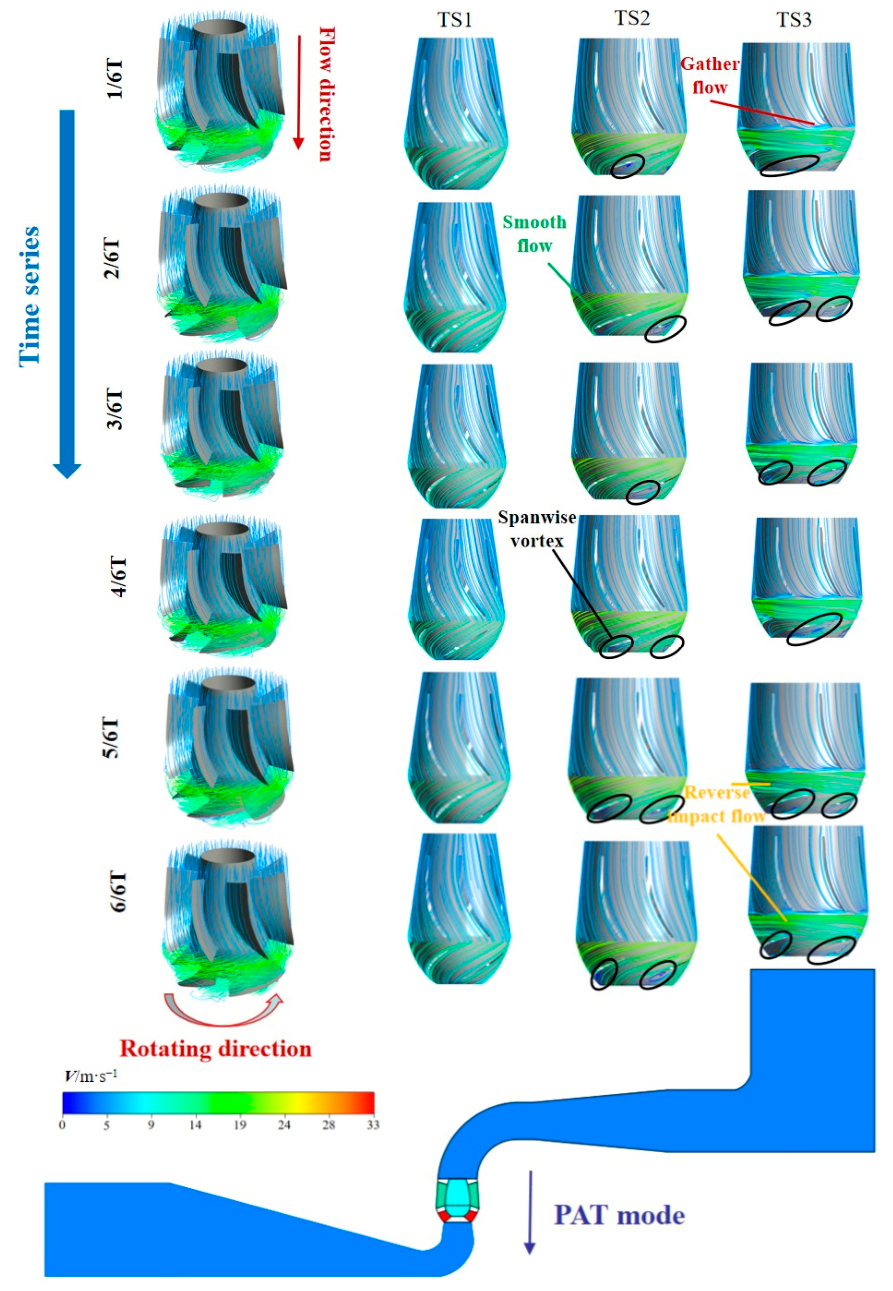
Figure 9 presents the three-dimensional streamlines in the impeller and guide vanes, as well as the streamline distributions on the blade surfaces TS1, TS2, and TS3 at different instants within one cycle under the high-head condition. Compared with the low- and medium-head conditions, the flow velocity within the impeller under the high-head condition is further increased, and the streamline distribution becomes more uniform, resulting in a significant improvement in the overall flow pattern. On the TS1 blade surface, the flow within both the impeller and the guide vanes remains smooth. On the TS2 blade surface, the flow velocity in the impeller is higher than that on TS1, whereas the flow velocity in the guide vanes is lower than that on TS1. The inlet flow angle remains well aligned with the blade leading-edge orientation, and no vortex structures are observed on this section. On the TS3 blade surface, the overall flow pattern is significantly improved. No distinct vortex structures are observed within the guide vane passages, and the outlet streamlines are more uniformly distributed, with the disappearance of streamline convergence. At the inlet of the impeller, the streamlines tend to align with the blade orientation, reducing flow impingement losses. The flow within the impeller is generally smooth, and only spanwise vortexes are observed on the suction side near the outlet. Compared with the medium- and low-head conditions, the extent of the vortexes is significantly reduced.
In summary, from the perspective of flow patterns, this section elucidates the key mechanisms responsible for the higher efficiency under high-head conditions and the reduced efficiency under medium- and low-head conditions.

3.2. Pressure Pulsation Characteristics in the Time and Frequency Domains

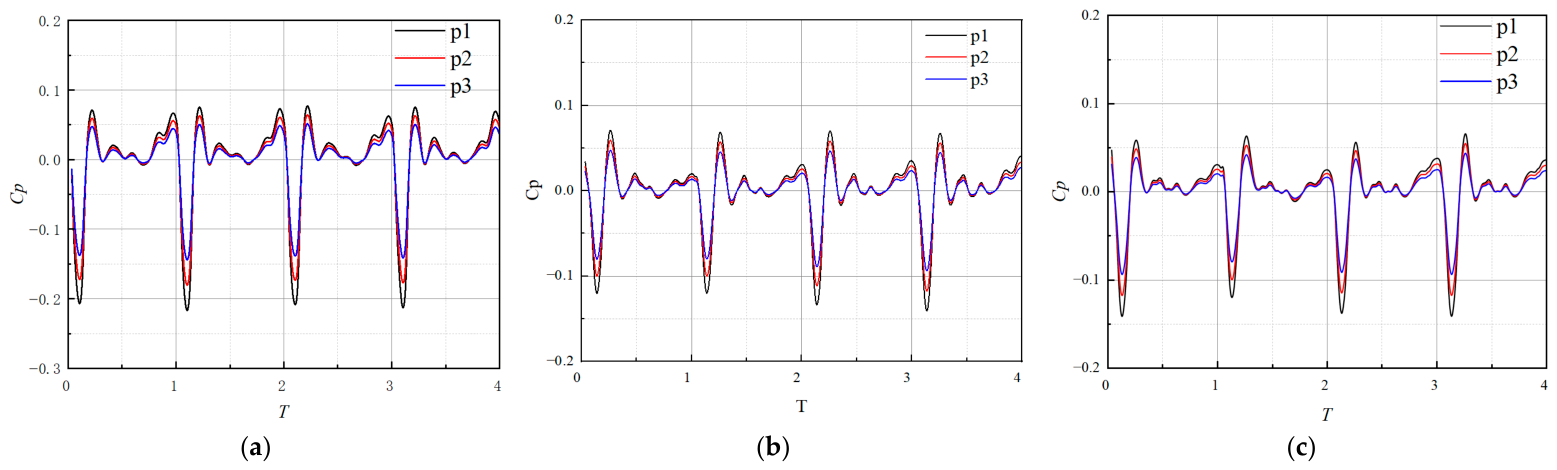
Figure 10 presents the time-domain pressure pulsation at the inlet of the guide vane under different operating conditions. The pressure pulsation at monitoring probes P1–P3 exhibits pronounced periodicity under all conditions. Four peaks and four troughs are observed within each cycle, corresponding to the number of blades, indicating that the pressure pulsation is strongly influenced by blade rotation and exhibits stable periodic behavior in the time domain. The pressure pulsation coefficient at monitoring probes P1–P3 decreases from the shroud toward the hub, with the maximum amplitude occurring near the shroud. Under low-head conditions, the pressure pulsation amplitude fluctuates within the range of −0.25 to 0.1. Under medium-head conditions, the amplitude range narrows to −0.15 to 0.1, while under high-head conditions, it remains within −0.15 to 0.1.
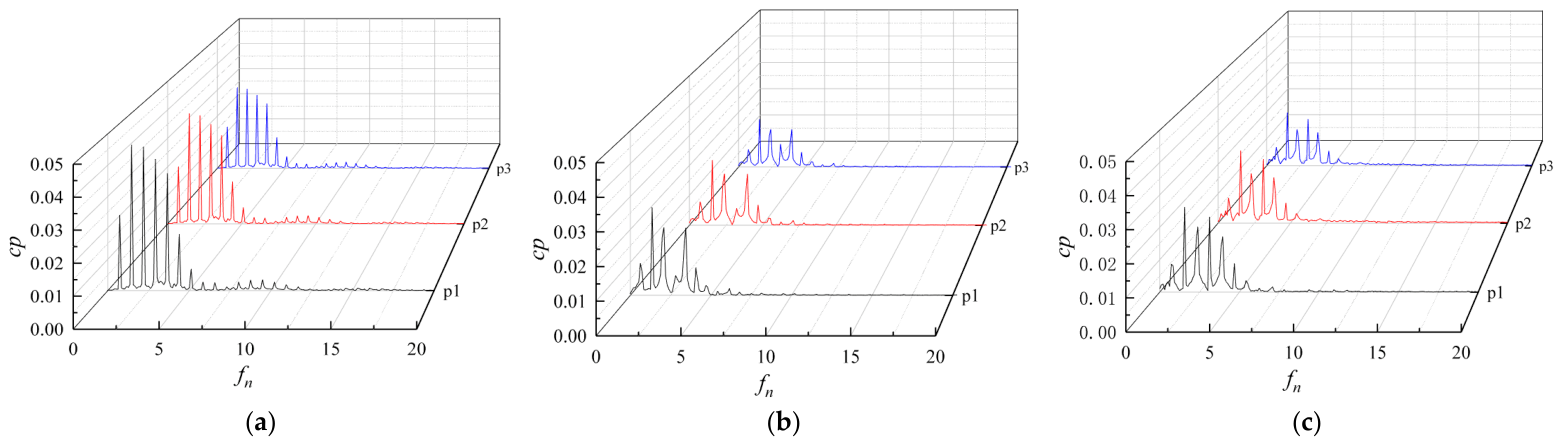
Figure 11 presents the frequency-domain characteristics of pressure pulsation at the inlet of the guide vane under different operating conditions. The dominant frequency of pressure pulsation at the inlet of the guide vane corresponds to the rotational frequency, and its amplitude gradually decreases from the shroud toward the hub. Under low-head conditions, relatively large pressure pulsation amplitudes are observed at 2, 3, and 4 times the rotational frequency. In contrast, under medium-head and high-head conditions, pronounced amplitudes mainly occur at 2 and 4 times the rotational frequency. The pressure pulsation amplitude under low-head conditions does not exceed 0.048, whereas under medium-head and high-head conditions, the amplitudes are reduced, remaining below 0.03.
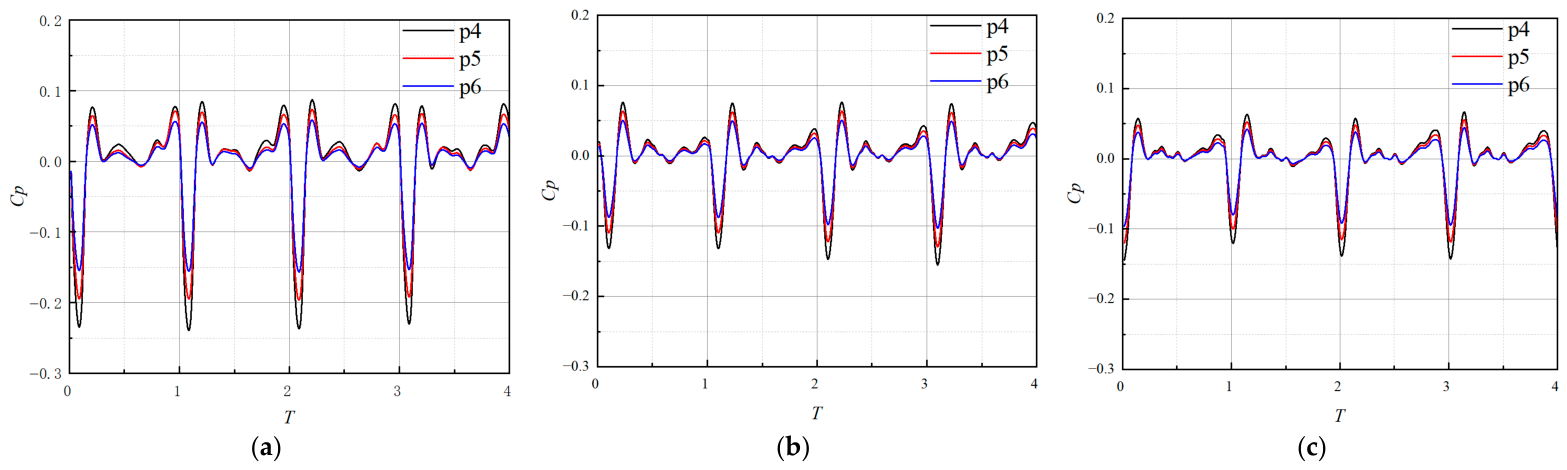
Figure 12 presents the time-domain pressure pulsation at the mid-span of the guide vane under different operating conditions. The pressure pulsation at monitoring probes P4–P6 exhibits pronounced periodicity, with four peaks and four troughs observed within each cycle. The pressure pulsation amplitudes at the mid-span of the guide vane are comparable to those at the inlet of the guide vane. The maximum amplitude occurs near the shroud and gradually decreases toward the hub, although the overall difference is relatively small. Under low-head conditions, the pressure pulsation amplitude fluctuates within the range of −0.25 to 0.1. Under medium-head and high-head conditions, the amplitudes are within the range of −0.15 to 0.1.
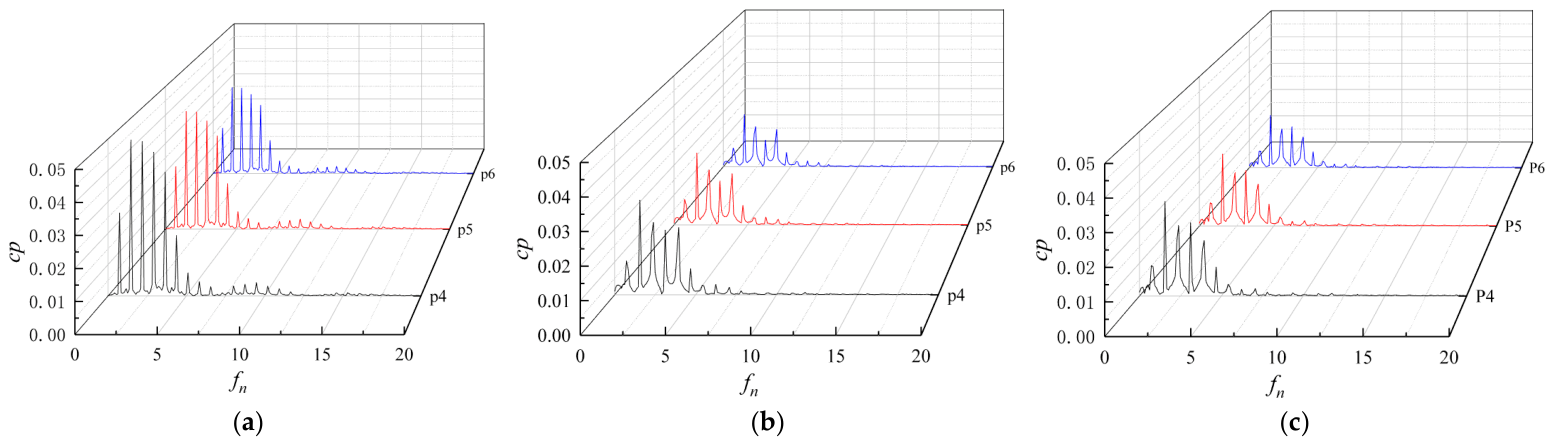
Figure 13 presents the frequency-domain characteristics of pressure pulsation at the mid-span of the guide vane under different operating conditions. The dominant frequency of pressure pulsation at the mid-span corresponds to the rotational frequency, and its amplitude gradually decreases from the shroud toward the hub. Under low-head conditions, relatively large pressure pulsation amplitudes are observed at 2, 3, and 4 times the rotational frequency. In contrast, under medium-head and high-head conditions, pronounced amplitudes mainly occur at 2 and 4 times the rotational frequency. The pressure pulsation amplitude under low-head conditions does not exceed 0.048, whereas under medium-head and high-head conditions, the amplitudes are reduced, remaining below 0.03.
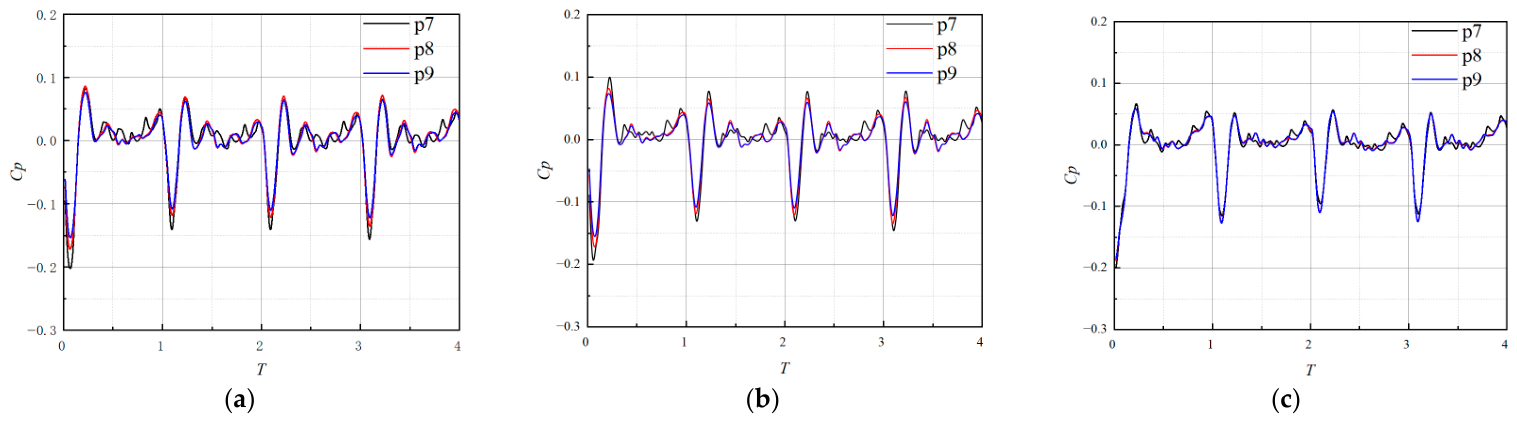
Figure 14 presents the time-domain pressure pulsation at the inlet of the impeller under different operating conditions. The pressure pulsation at monitoring probes P7–P9 exhibits pronounced periodicity under all conditions; however, the pulsation is relatively intense. The variation in pressure pulsation amplitude is generally consistent with that at the inlet of the guide vane and at the middle section. Under low-head and medium-head conditions, the pressure pulsation amplitude fluctuates within the range of −0.2 to 0.1, whereas under high-head conditions, it varies within the range of −0.15 to 0.1.
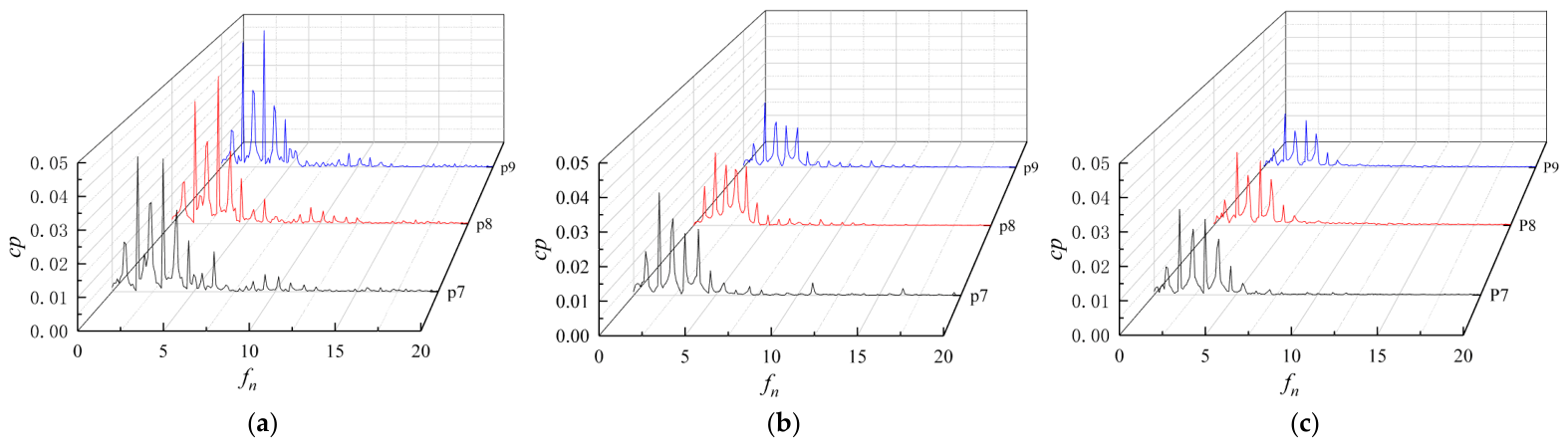
Figure 15 presents the frequency-domain characteristics of pressure pulsation at the inlet of the impeller under different operating conditions. The dominant frequency of pressure pulsation at the inlet of the impeller corresponds to the rotational frequency, and its amplitude gradually decreases from the shroud toward the hub. Under low-head conditions, relatively large pressure pulsation amplitudes are also observed at 3 times the rotational frequency. In contrast, under medium-head and high-head conditions, pronounced amplitudes occur at 2, 3, and 4 times the rotational frequency. The pressure pulsation amplitudes under low-, medium-, and high-head conditions do not exceed 0.047, 0.039, and 0.029, respectively.
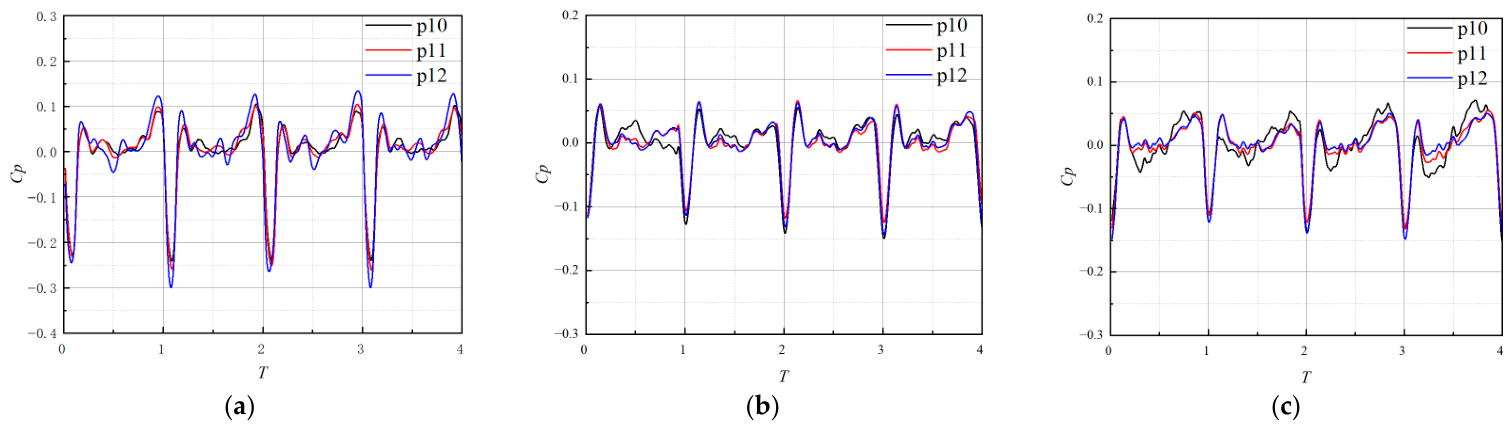
Figure 16 presents the time-domain pressure pulsation at the outlet of the impeller under different operating conditions. The pressure pulsation at monitoring probes P10–P12 exhibits pronounced periodicity under all conditions, with four peaks and four troughs observed within each cycle. The pulsation is more intense. Under low-head conditions, the pressure pulsation amplitude near the shroud is smaller than that near the hub, with the maximum pulsation occurring at the hub. The pressure pulsation amplitude under low-head conditions fluctuates within the range of −0.3 to 0.2, whereas under medium-head and high-head conditions, it remains within the range of −0.15 to 0.1.
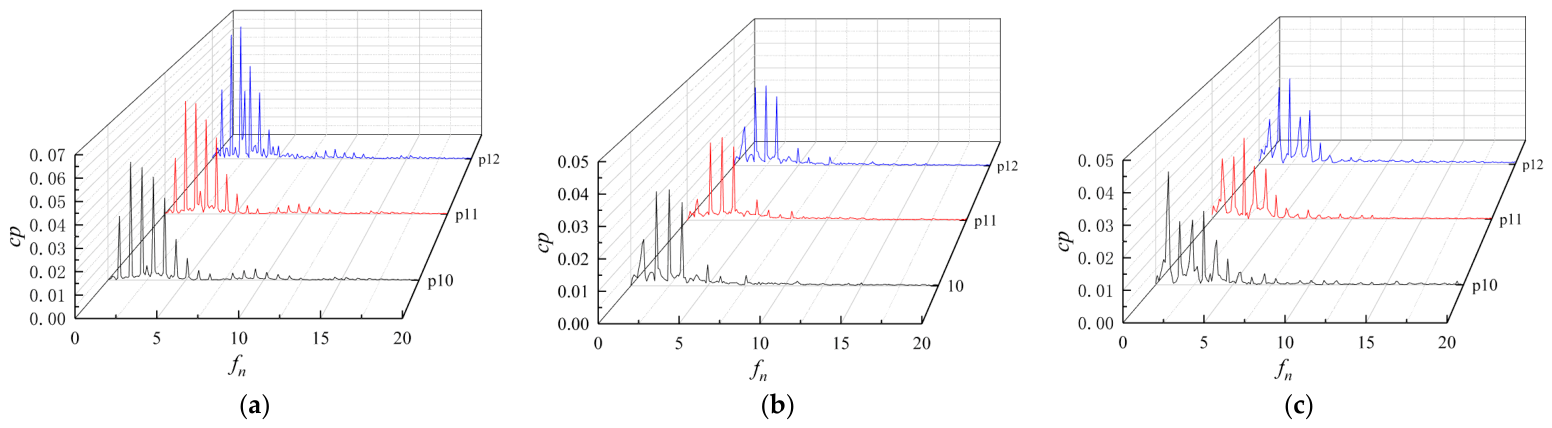
Figure 17 presents the frequency-domain characteristics of pressure pulsation at the outlet of the impeller under different operating conditions. Under low-head conditions, the dominant frequencies at monitoring probes P10 and P11 correspond to the rotational frequency, whereas that at P12 corresponds to 2 times the rotational frequency. Under medium-head conditions, the dominant frequency at all monitoring probes at the outlet of the impeller corresponds to the rotational frequency, with relatively large pressure pulsation amplitudes observed at 2 and 3 times the rotational frequency. Under high-head conditions, the dominant frequency at P10 corresponds to the rotational frequency, while those at P11 and P12 correspond to 3 times the rotational frequency. In addition, relatively large pressure pulsation amplitudes are observed at 1, 2, and 4 times the rotational frequency. The pressure pulsation amplitudes under low-, medium-, and high-head conditions do not exceed 0.065, 0.037, and 0.045, respectively.

3.3. Chaos Analysis of Pressure Pulsation

3.3.1. Analysis of the Maximum Lyapunov Exponent

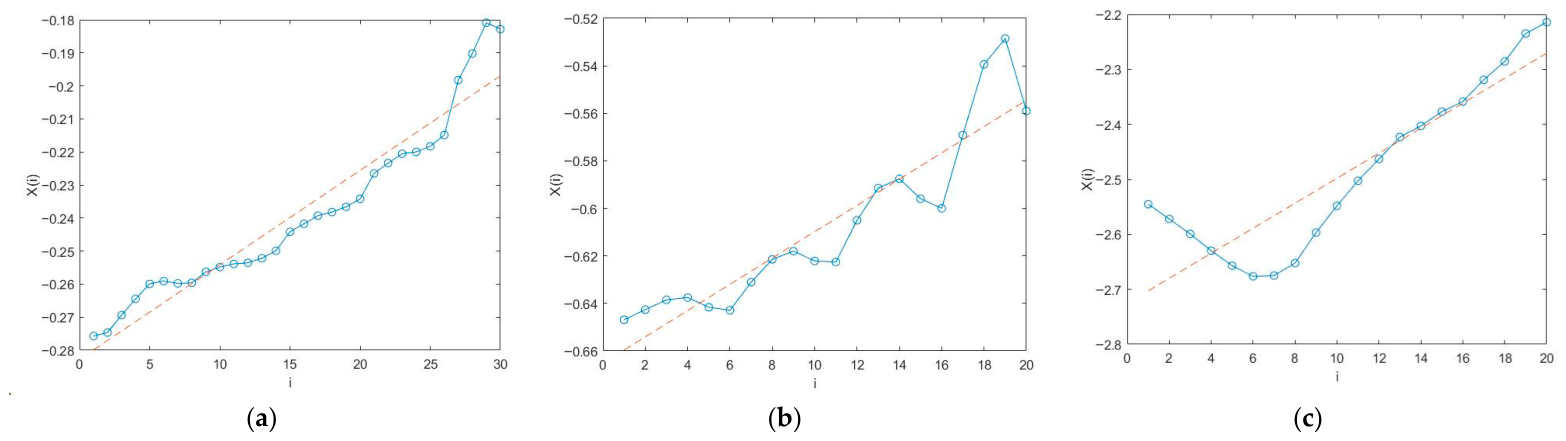
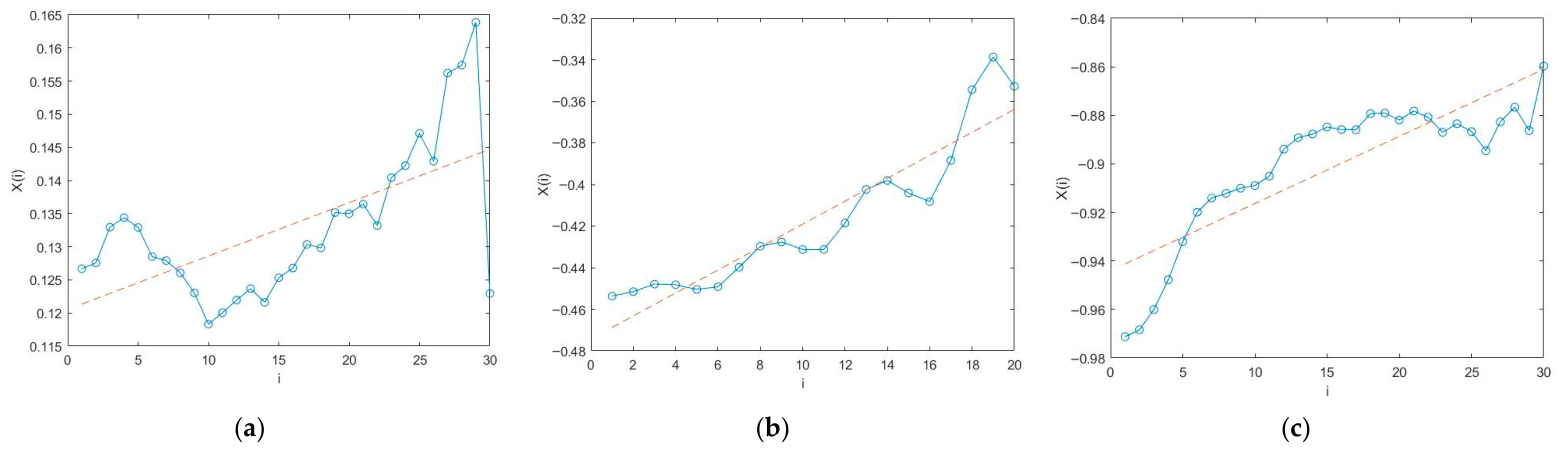
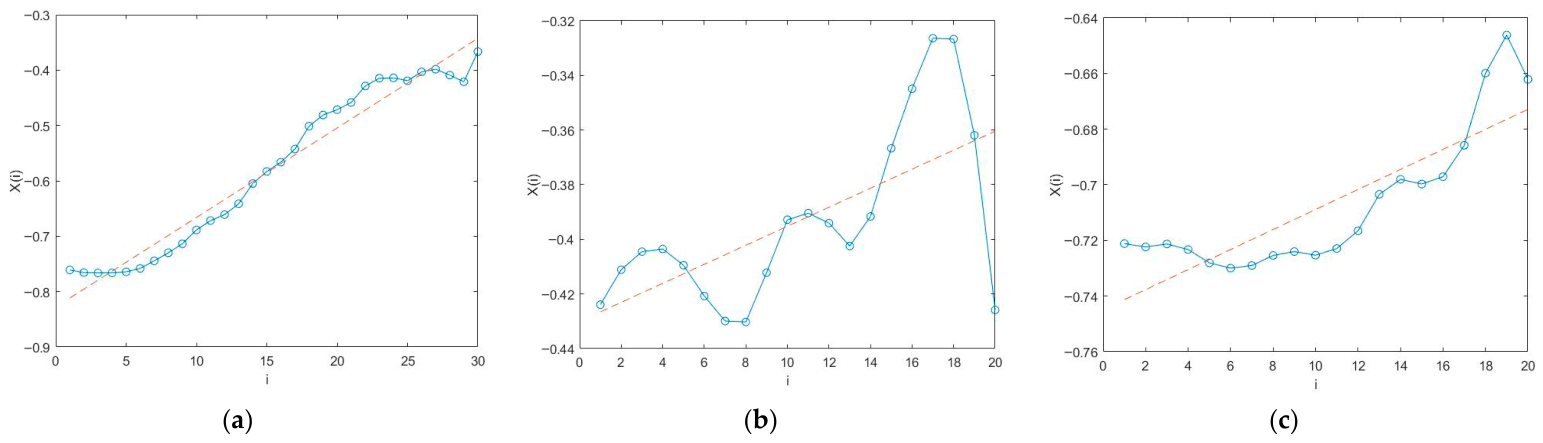
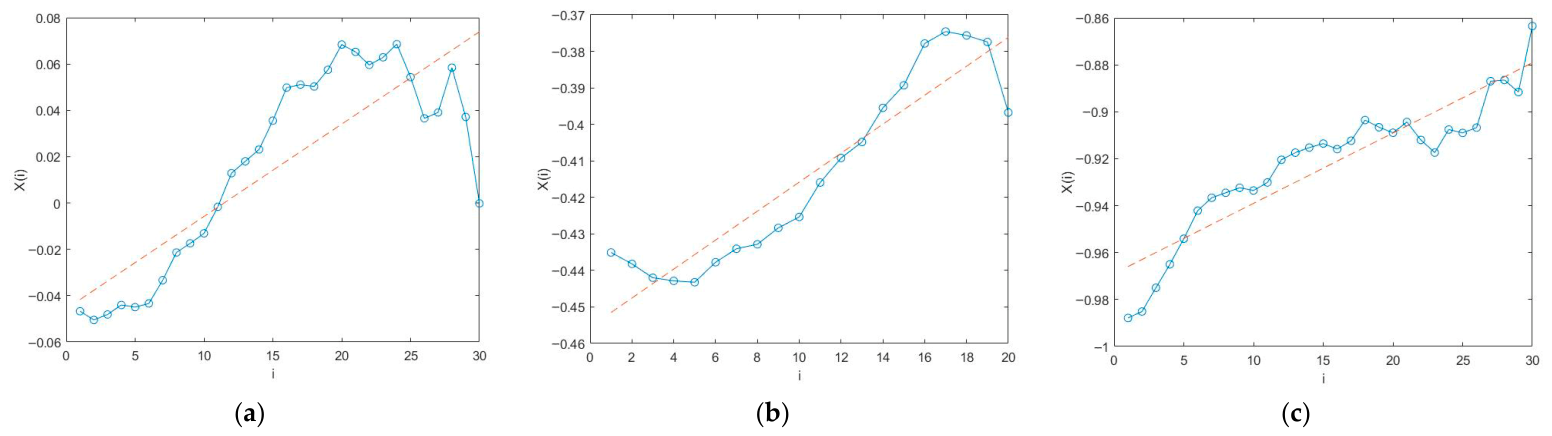
Pressure data at monitoring probes P2, P5, P8, and P11 are selected to calculate the maximum Lyapunov exponent. The X(i)-i relationship is constructed, and the slope of the fitted curve is obtained using the least-squares method. The slope of the fitted curve corresponds to the maximum Lyapunov exponent at each monitoring probe. If the exponent is greater than zero, the pressure pulsation at the corresponding monitoring probe is considered to be chaotic. Figure 18, Figure 19, Figure 20 and Figure 21 present the maximum Lyapunov exponents at each monitoring probe under different operating conditions. The results show that all maximum Lyapunov exponents are greater than zero, indicating that the pressure pulsation at all locations in PAT mode exhibits pronounced chaotic characteristics.
Furthermore, the time delay, embedding dimension, and maximum Lyapunov exponent of each monitoring probe under the three operating conditions are summarized in Table 4, providing a systematic characterization of their nonlinear dynamic behaviors.

3.3.2. Phase Locus Analysis

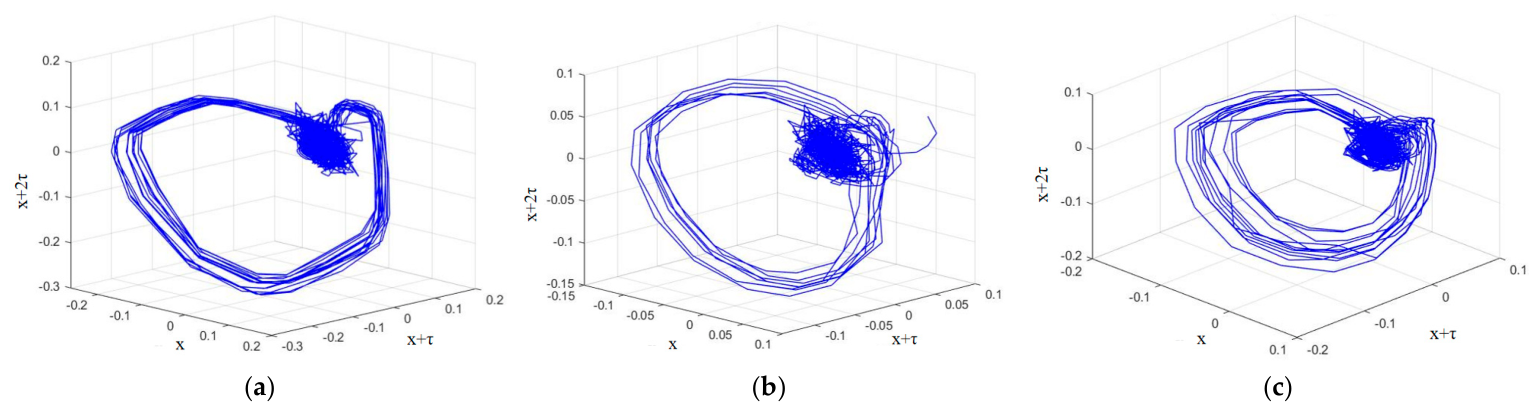
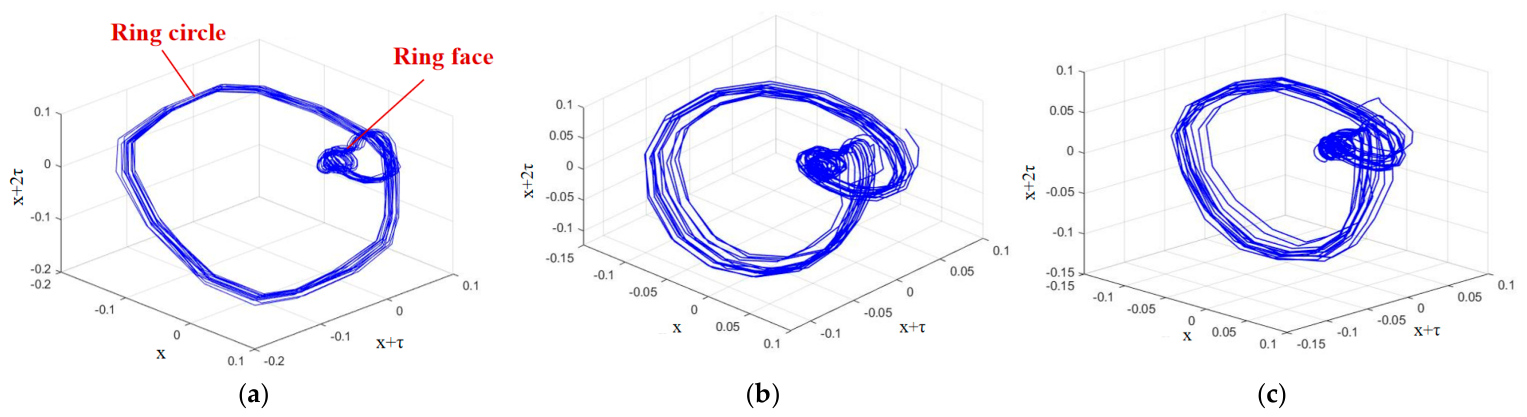
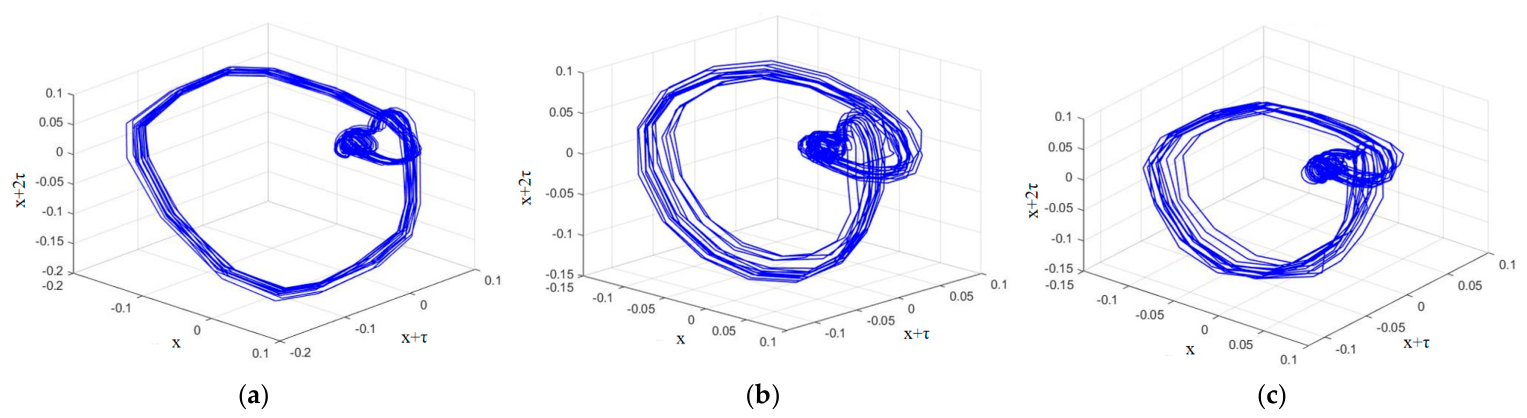
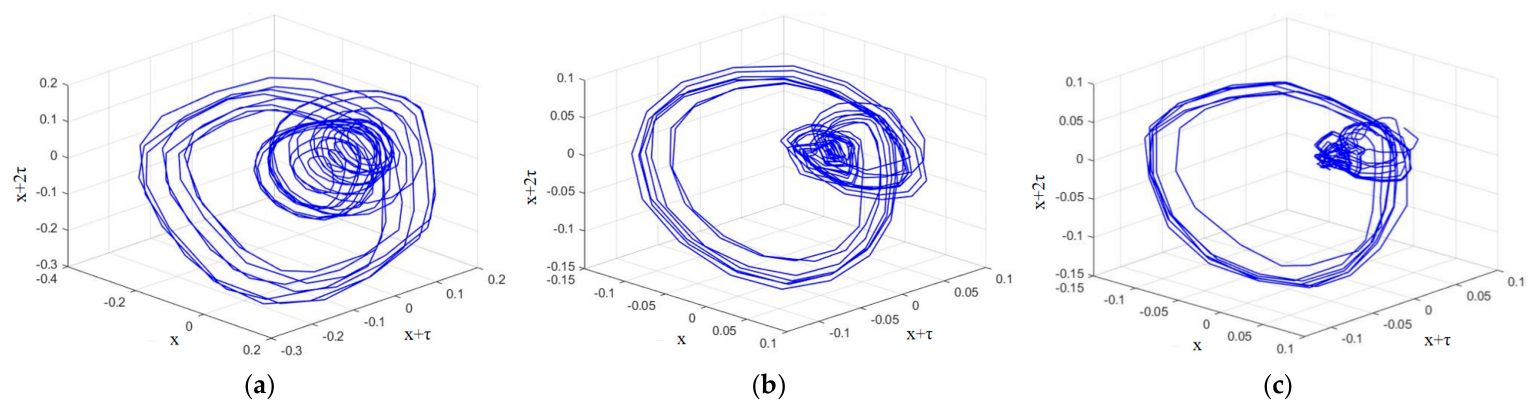
Figure 22, Figure 23, Figure 24 and Figure 25 present the phase locus under different head conditions in PAT mode. Based on the calculated time delay and embedding dimension, the phase space of the pressure pulsation time series {x(i)} is reconstructed, and a three-dimensional phase locus is obtained. In the reconstructed phase space, x, x + τ, x + 2τ denote the original time series and the reconstructed delayed sequences corresponding to the applied time delay, respectively.
Figure 22 shows the phase locus at monitoring probe P2 under different operating conditions. The phase locus exhibits a filamentary ring-shaped structure, consisting of two components: namely the ring circle phase locus and the ring surface phase locus. Under low-head conditions, the ring circle phase locus is more compact, and the ring surface phase locus exhibits a smaller spatial extent, with the distributions along the x and x + τ axes ranging from −0.2 to 0.1. Under medium-head conditions, the diameter of the ring circle phase locus decreases, while the spacing between individual loops increases. Meanwhile, the ring surface phase locus expands, with the distributions along the x and x + τ axes ranging from −0.15 to 0.1. Under high-head conditions, the diameter of the ring circle phase locus continues to decrease, with little change in loop spacing. The ring surface phase locus also shrinks, and the distribution ranges along the x and x + τ axes remain consistent with those under medium-head conditions.
Figure 23 presents the phase locus at monitoring probe P5 under different operating conditions. The overall shape of the phase locus and its variation with head conditions are generally consistent with those observed at monitoring probe P2.
Figure 24 presents the phase locus at monitoring probe P8 under different operating conditions. Compared with those at monitoring probes P2 and P5, the phase locus at P8 exhibits more dispersed characteristics. Under low-head conditions, both the ring circle phase locus and the ring surface phase locus show relatively large loop spacing, and the center of the ring surface phase locus shifts from the right side toward the center. The distributions along the x and x + τ axes range from −0.4 to 0.2 and from −0.3 to 0.2, respectively. Under medium-head conditions, the loop spacing of both the ring circle and ring surface phase loci decreases, and the center of the ring surface phase locus shifts back toward the right side. The distributions along the x and x + τ axes both range from −0.15 to 0.1. Under high-head conditions, the diameter and loop spacing of the ring circle phase locus further decrease. The spatial extent and loop spacing of the ring surface phase locus continue to shrink, while its center shifts further to the right. The distributions along the x and x + τ axes remain the same as those under medium-head conditions.
Figure 25 presents the phase locus at monitoring probe P11 under different operating conditions. Under low-head conditions, the ring circle phase locus exhibits relatively small loop spacing, while the ring surface phase locus appears highly disordered with very small loop spacing. The center position differs from those at monitoring probes P2, P5, and P8, showing a noticeable upward shift. The distributions along the x and x + τ axes both range from −0.15 to 0.1. Under medium-head conditions, the loop spacing of the ring circle phase locus increases, whereas the ring surface phase locus remains disordered with small loop spacing. The central region expands and continues to exhibit an upward shift. Under high-head conditions, the loop spacing of the ring circle phase locus further increases. The variation of the ring surface phase locus is similar to that under medium-head conditions, although its central region shows a slight reduction.
Overall, the phase locus at different monitoring locations in PAT mode exhibits distinct morphological characteristics. The trajectories at the inlet of the guide vane and mid-span are relatively similar, whereas those at the inlet of the impeller differ significantly. In addition, variations are also observed at the same location under different operating conditions, indicating that phase locus analysis can effectively distinguish both spatial positions and operating conditions. Under low-head conditions, the phase locus exhibits a wider spatial distribution and larger pulsation ranges, suggesting that they can, to some extent, reflect the intrinsic spatial characteristics embedded in the pressure pulsation time series.

3.3.3. Correlation Dimension Analysis

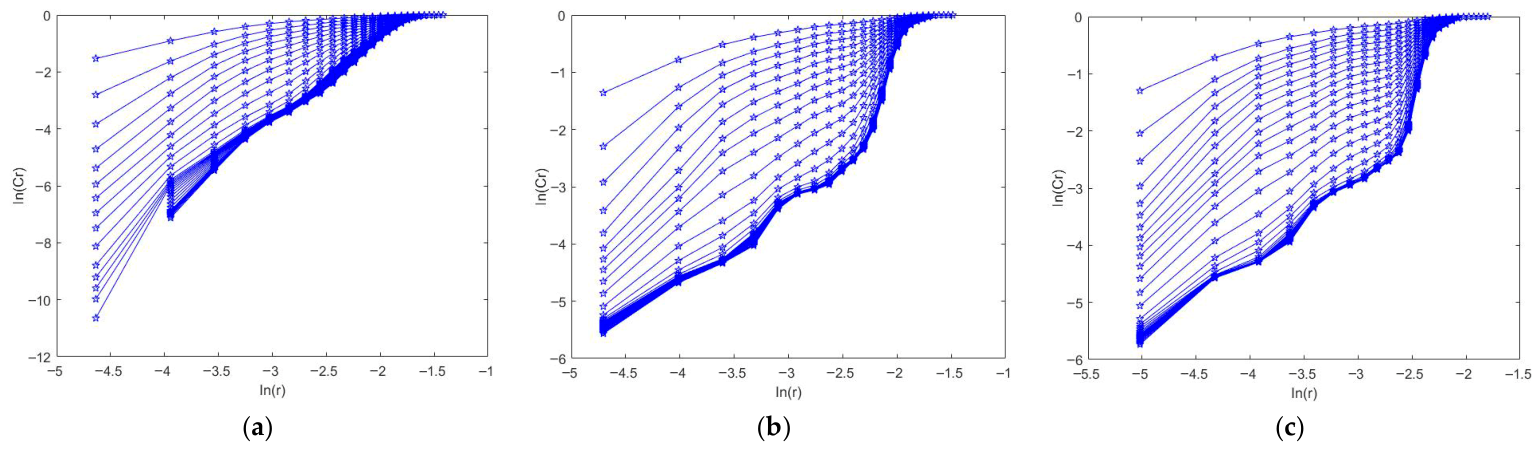
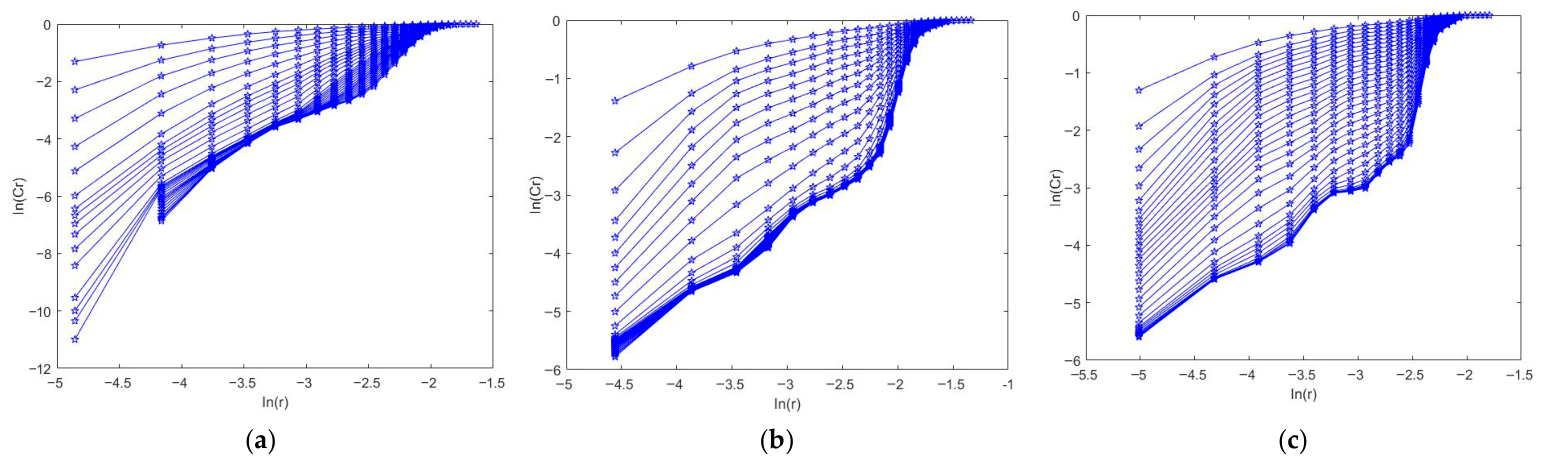
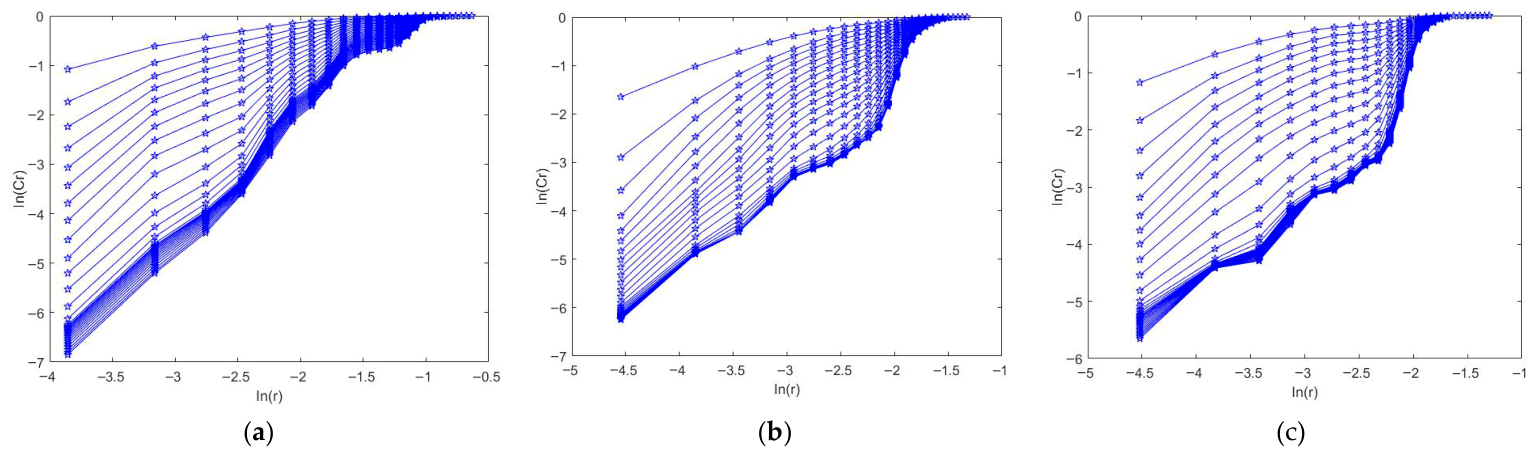
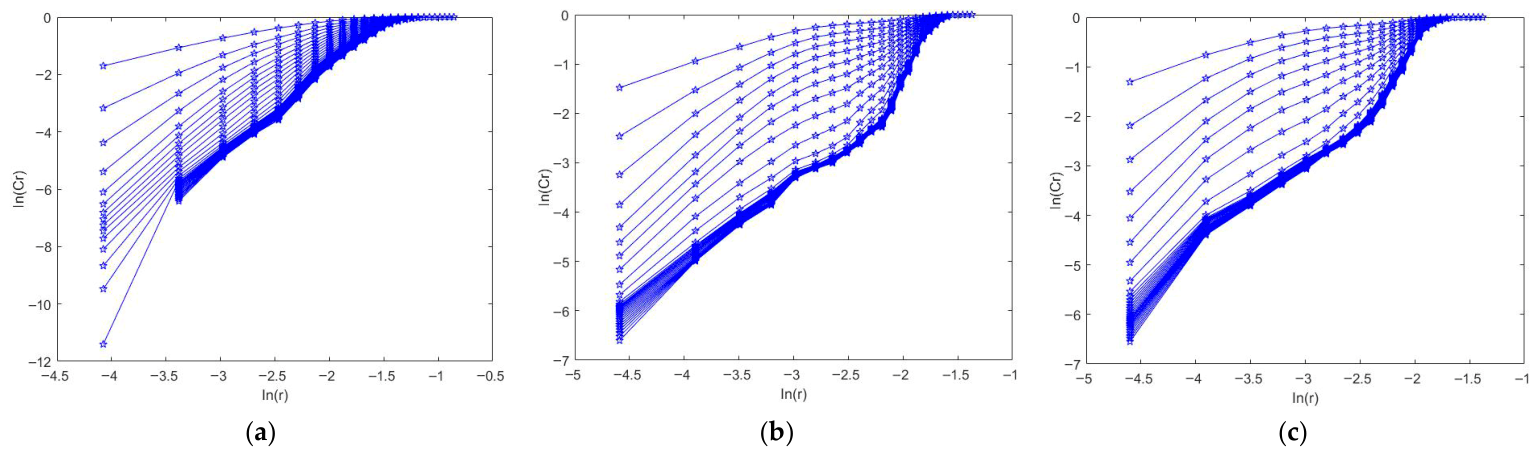
Figure 26, Figure 27, Figure 28 and Figure 29 present the correlation integral curves at the monitoring probes at the inlet and outlet of the impeller in PAT mode. r denotes the prescribed distance, and C(r) represents the correlation integral. The slope of the fitted curves corresponds to the calculated correlation dimension m. For each monitoring probe, correlation integral curves are plotted for 30 cases, with the embedding dimension d increasing from 1 to 30.
The evolution patterns of the correlation dimension curves show that, under low-head conditions, the curves at most monitoring locations—except for the inlet of the impeller—are relatively dispersed in the left-hand region. Some curves exhibit a noticeable “convergence–divergence” behavior in this region, and the spacing between curves varies more irregularly during the overall growth process. In contrast, under medium-head and high-head conditions, the correlation dimension curves at different monitoring probes exhibit a more concentrated initial distribution. During the growth process, the curves tend to evolve more synchronously and extend toward the target region in a more uniform manner. The overall compactness and morphological consistency differ significantly from those under low-head conditions. Overall, the correlation dimension curves under low-head conditions exhibit more pronounced variability, whereas those under other operating conditions display more consistent and regular trends.
The saturated correlation dimensions under different operating conditions are summarized in Table 5. For the same monitoring probe, the correlation dimension under low-head conditions is consistently higher than that under medium-head and high-head conditions, indicating a positive correlation between the correlation dimension and the hydraulic head. Among all monitoring probes, the value at the outlet of the impeller P11 (3.0481) is significantly higher than those at other locations. The average correlation dimensions under low-head, medium-head, and high-head conditions are 2.63975, 2.231475, and 2.2278, respectively, which are consistent with the overall flow unsteadiness under different head conditions.
Under all power-generation head conditions, the correlation dimension values at different monitoring locations follow a consistent descending order: outlet of the impeller, inlet of the impeller, mid-span of the guide vane, and inlet of the guide vane. This ordering corresponds well with the flow patterns at each location within the unit. Specifically, the flow at the outlet of the impeller exhibits the highest level of unsteadiness due to strong helical flow, followed by the inlet of the impeller, while the flow at the mid-span and inlet of the guide vane becomes progressively more stable.
These results further demonstrate that the correlation dimension can effectively characterize the flow state. In other words, a correlative relationship exists between the chaotic correlation dimension of pressure pulsation and the flow patterns of the unit. From an engineering perspective, due to the inaccessibility of internal flow structures and the inherent unpredictability of operating conditions, the analysis of the correlation dimension of pressure pulsation is of great significance for the identification, monitoring, and fault diagnosis of pump unit operating states.

4. Conclusions

In this study, unsteady CFD simulations were conducted to investigate the three-dimensional flow characteristics and the chaotic characteristics of pressure pulsation in a vertical mixed-flow pump operating in PAT mode under high-, medium-, and low-head conditions. The main conclusions are as follows:
(1)
By comparing the numerical simulation results with on-site test data in PAT mode, the relative errors in efficiency and output under the highest head condition are only 1.72% and 1.06%, respectively, thereby validating the reliability of the numerical simulation method.
(2)
Under all head conditions, the straight passage maintains smooth flow with uniform streamlines and no vortexes or separation. However, the elbow-shaped draft tube shows non-uniform flow with separation and vortex. Under low-head conditions, circumferential circulating flow occurs at the impeller inlet without contributing to energy conversion. As the head increases, the flow becomes more uniform and stable.
(3)
Near the hub, the flow on the blade surfaces remains relatively stable, while near the shroud it is more disturbed. Vortexes appear in both the guide vane and impeller and vary over time. Under low-head conditions, small vortexes form at the guide vane outlet and within the impeller. As the head increases, the vortexes gradually disappear and the flow becomes smoother; under high-head conditions, the flow aligns with the blade leading edge.
(4)
Except at the impeller outlet, pressure pulsation signals at the monitoring probes show clear periodicity under all conditions. The dominant frequency generally matches the rotational frequency, and the amplitude decreases from shroud to hub. At the same point, the pulsation amplitude is larger under low-head conditions than under medium- and high-head conditions.
(5)
The maximum Lyapunov exponents at all monitoring probes are greater than zero, indicating chaotic pressure pulsation. The phase trajectories show ring-shaped structures composed of ring-circle and ring-surface loci, whose differences depend on operating conditions. Phase analysis can effectively extract features of chaotic signals, and a correlative relationship exists between chaotic correlation dimension and flow performance, which is important for condition identification and fault diagnosis of pump units.

Author Contributions

Conceptualization, C.L. and L.C.; methodology, C.L. and K.J.; software, W.Z.; validation, R.C. and C.X.; formal analysis, R.C.; investigation, K.J.; resources, C.L.; data curation, C.X.; writing—original draft preparation, C.L. and K.J.; writing—review and editing, C.L. and W.Z.; visualization, B.Z. (Bowen Zhang).; supervision, B.Z. (Baojun Zhao). All authors have read and agreed to the published version of the manuscript.

Funding

This work was financially supported by Open Project Program of Engineering Research Center of High-efficiency and Energy-saving Large Axial Flow Pumping Station (grant number ECHEAP026), National Natural Science Foundation of China (grant number 52279091), Priority Academic Program Development of Jiangsu Higher Education Institutions (PAPD), China Postdoctoral Science Foundation (grant number 2023M742942).

Data Availability Statement

The raw data supporting the conclusions of this article will be made available by the authors on request.

Conflicts of Interest

Author Chenzhi Xia was employed by the company The Eastern Route of South-to-North Water Diversion Project, Jiangsu Water Source Co., Ltd. The remaining authors declare that the research was conducted in the absence of any commercial or financial relationships that could be construed as a potential conflict of interest.

Nomenclature

The following nomenclature is used in this manuscript:
Symbols
u if ¯ ,   u j ¯ Reynolds-averaged velocity, m/s
xi and xjCartesian coordinate, m
tTime, s
p ¯ Pressure, Pa
τ i j Reynolds-averaged velocity, m/s
ρ Fluid density, kg/m3
μ Dynamic viscosity, Pa·s
ρ u i u j ¯ Reynolds   stress ,   Pa · s
fiBody force, N
pInstantaneous pressure, Pa
p ¯ Time-averaged pressure, Pa
uCircumferential velocity of the impeller, m/s
FFrequency obtained from the Fast Fourier Transform, Hz
nRotational speed, r/min
NTerminal index of the time series.
Θ Heaviside step function
rPrescribed distance
DRelationship between C(r) and the correlation dimension
HPATHead
{x(i)}Pressure pulsation time series
mCorrelation dimension
dEmbedding dimension
C(r)Correlation integral
Abbreviations
PATPump-as-turbine
GCIGrid Convergence Index
RNGRenormalization Group
FFTFast Fourier Transform
G-PCao method with the saturated correlation dimension
SSTShear Stress Transport
TSTurbo Surface

References

  1. IEA. Global Energy Review 2025; IEA: Paris, France, 2025. [Google Scholar]
  2. Zhang, X.; Tang, F.; Jiang, Y. Experimental and numerical study of reverse power generation in coastal axial flow pump system using coastal water. Ocean Eng. 2023, 271, 113805. [Google Scholar] [CrossRef]
  3. Yang, F.; Li, Z.; Yuan, Y.; Lin, Z.; Zhou, G.; Ji, Q. Study on vortex flow and pressure fluctuation in dustpan-shaped conduit of a low head axial-flow pump as turbine. Renew. Energy 2022, 196, 856–869. [Google Scholar] [CrossRef]
  4. Kim, S.J.; Yang, H.M.; Park, J.; Kim, J.H. Investigation of internal flow characteristics by a Thoma number in the turbine mode of a pump–turbine model under high flow rate. Renew. Energy 2022, 199, 445–461. [Google Scholar] [CrossRef]
  5. Li, W.; Long, Y.; Ji, L.; Li, H.; Li, S.; Chen, Y.; Yang, Q. Effect of circumferential spokes on the rotating stall flow field of mixed-flow pump. Energy 2024, 290, 130260. [Google Scholar] [CrossRef]
  6. Ge, Z.G.; Feng, J.J.; Luo, X.Q.; Zhu, G.J.; He, D.H. Numerical investigation of gas–liquid two-phase performance in a mixed-flow pump by using a modified drag force model. Phys. Fluids 2023, 35, 053324. [Google Scholar]
  7. Lei, S.; Cheng, L.; Yang, W.; Xu, W.; Yu, L.; Luo, C.; Shen, J. Dynamic multiscale pressure fluctuation features extraction of mixed-flow pump as turbine and flow state recognition of the outlet passage using variational mode decomposition and refined composite variable-step multiscale multimapping dispersion entropy. Energy 2024, 305, 132230. [Google Scholar] [CrossRef]
  8. Su, C.; Zhang, Z.; Zhu, D.; Tao, R. Enhancing the operating efficiency of mixed-flow pumps through adjustable guide vanes. Water 2025, 17, 423. [Google Scholar] [CrossRef]
  9. Sun, Z.; Zhang, J.; Zhu, Y.; Chen, S.; Lyu, N.; Wang, M. Optimization and performance analysis of mixed-flow pump impeller under different blade inclination angles. Phys. Fluids 2025, 37, 087127. [Google Scholar] [CrossRef]
  10. Li, Y.; Sun, D.; Meng, F.; Zheng, Y.; Zhong, Y. Study regarding the influence of blade rotation angle deviations on the hydraulic pulsation characteristics of a mixed-flow pump. J. Mar. Sci. Eng. 2023, 11, 530. [Google Scholar] [CrossRef]
  11. Zhu, H.; Qiu, N.; Li, Y.; Li, M.; Zheng, Y.; Rao, H. Flow separation-induced cavitation dynamics and pressure pulsation in mixed-flow pumps. Phys. Fluids 2025, 37, 083368. [Google Scholar] [CrossRef]
  12. Shi, L.; Chen, Y.; Yu, X.; Han, Y.; Chai, Y.; Xue, M. Energy loss mechanism of a full tubular pump under reverse power generation conditions using entropy production theory. Proc. Inst. Mech. Eng. 2024, 238, 868–886. [Google Scholar] [CrossRef]
  13. Stephen, C.; Basu, B.; McNabola, A. Detection of cavitation in a centrifugal pump-as-turbine using time-domain-based analysis of vibration signals. Energies 2024, 17, 2598. [Google Scholar] [CrossRef]
  14. Fu, X.; Li, D.; Song, Y.; Wang, H.; Wei, X. High-amplitude pressure fluctuations of a pump-turbine with large head variable ratio during the turbine load rejection process. Sci. China Technol. Sci. 2023, 66, 2575–2585. [Google Scholar] [CrossRef]
  15. Fu, X.; Li, D.; Lv, J.; Yang, B.; Wang, H.; Wei, X. High-amplitude pressure pulsations induced by complex inter-blade flow during load rejection of ultrahigh-head prototype pump turbines. Phys. Fluids 2024, 36, 034115. [Google Scholar] [CrossRef]
  16. Liu, D.; Li, Z.; Xu, L.; Li, J.; Yang, Y.; Wang, X.; Liu, X. Vortex motion in vaneless space and runner passage of pump-turbine in S-shaped region. Phys. Fluids 2024, 36, 025115. [Google Scholar] [CrossRef]
  17. Zhang, Y.L.; Zhao, Y.J.; Zhu, Z.C. A theoretical model for predicting the startup performance of pumps as turbines. Sci. Rep. 2024, 14, 6963. [Google Scholar] [CrossRef]
  18. Zhao, H.; Cheng, L.; Jiao, W.; Xu, W.; Lei, S.; Shen, J. Study on the dynamic energy conversion mechanisms of a vertical mixed-flow pump under pump-as-turbine conditions. Energy Convers. Manag. 2025, 332, 119765. [Google Scholar] [CrossRef]
  19. Zhu, Z.; Gu, Q.; Chen, H.; Ma, Z.; Cao, B. Investigation and optimization into flow dynamics for an axial flow pump as turbine with ultra-low water head. Energy Convers. Manag. 2024, 314, 118684. [Google Scholar] [CrossRef]
  20. Saremian, S.; Shojaeefard, M.H. Study on the impact of volute geometric modification on the performance of centrifugal pump as turbine. Renew. Energy 2025, 253, 123632. [Google Scholar] [CrossRef]
  21. Li, X.; Zhou, H.; Wei, Z.; Zhu, Z. Interstage transmission and differential analysis of pressure fluctuations in multistage centrifugal pump-as-turbine. Phys. Fluids 2024, 36, 055106. [Google Scholar] [CrossRef]
  22. Sun, X.; Huang, H.; Zhao, Y.; Tong, L.; Lin, H.; Zhang, Y. A review of methods for pump as turbine performance prediction and optimal design. Fluid Dyn. Mater. Process. 2025, 21, 1261–1298. [Google Scholar] [CrossRef]
  23. Li, Y.; Hao, P.; Zhang, Z.; Zhang, L.; Hai, H.; Zhang, H.; Peng, P. Characterization of pressure pulsation propagation in a pump–turbine based on the same-frequency tracking method. Energy Sci. Eng. 2025, 13, 3588–3604. [Google Scholar] [CrossRef]
  24. Lv, J.H. Chaos Time Series Analysis and Its Applications; Wuhan University Press: Wuhan, China, 2002. [Google Scholar]
  25. Jiao, W.X. Mechanism and Control of Suction Vortex at the Inlet of a Waterjet Propulsion System During Sailing in Shallow Water Areas. Ph.D. Thesis, Yangzhou University, Yangzhou, China, 2021. [Google Scholar]
  26. Xiao, Z.M.; Yan, H.Q.; Jiang, H.Y.; Cheng, L.; Liu, Z.Q. Research on the Chaotic Characteristics of Pressure Fluctuation in Bidirectional Channel Pumping Station Based on CFD. China Rural Water Hydropower 2022, 9, 13–18. [Google Scholar]
  27. Li, J.X. Analysis of Pressure Fluctuation Characteristics of a Mixed-Flow Pump Based on Chaos Theory. Master’s Thesis, Yangzhou University, Yangzhou, China, 2023. [Google Scholar]
  28. Cai, R.M. Analysis of Pressure Fluctuation Characteristics of a Bulb Tubular Pump in Jinhu Pumping Station Based on Chaos Theory. Master’s Thesis, Yangzhou University, Yangzhou, China, 2022. [Google Scholar]
  29. Ma, W.; Vagnoni, E.; Hu, J.; Lai, X.; Yang, J.; Zhao, Z. Predictions of transient pressure pulsations in a pump-turbine from measurements for enhanced flexible operations. Energy 2025, 335, 138321. [Google Scholar] [CrossRef]
  30. Liu, B.X.; Feng, J.J.; Zhu, G.J.; Cui, W.H.; Zhang, Y.Q.; Luo, X.Q. Analysis of the causes of pressure pulsation in S-shaped region of a pump turbine based on dynamic mode decomposition. J. Hydrodyn. 2025, 37, 843–858. [Google Scholar] [CrossRef]
  31. Valentín, D.; Presas, A.; Egusquiza, M.; Egusquiza, E.; Drommi, J.L. Innovative approaches to hydraulic turbine advanced condition monitoring. IOP Conf. Ser. Earth Environ. Sci. 2024, 1411, 012019. [Google Scholar] [CrossRef]
  32. Siddique, M.; Ullah, S.; Kim, J.M. A deep learning approach for fault diagnosis in centrifugal pumps through wavelet coherent analysis and S-transform scalograms with CNN-KAN. Comput. Mater. Contin. 2025, 84, 3577–3603. [Google Scholar] [CrossRef]
  33. Shi, W.; Cai, R.M.; Li, S.B.; Sun, T.; Cheng, L.; Luo, C. Chaotic analysis of pressure fluctuation in bulb tubular pump under different flow conditions. J. Drain. Irrig. Mach. Eng. 2022, 40, 345–352. [Google Scholar]
  34. Guo, Y.Z. Research on Fault Diagnosis Method of Pumping Unit Motor Based on Chaos Theory. Master’s Thesis, Northeast Petroleum University, Daqing, China, 2023. [Google Scholar]
  35. Roache, P.J. Quantification of uncertainty in computational fluid dynamics. Annu. Rev. Fluid Mech. 1997, 29, 123–160. [Google Scholar] [CrossRef]
  36. Zhang, H.L.; Min, F.H.; Wang, E.R. The Comparison for Lyapunov Exponents Calculation Methods. J. Nanjing Norm. Univ. Eng. Technol. Ed. 2012, 12, 5–9. [Google Scholar]
  37. Packard, N.H.; Crutchfield, J.P.; Farmer, J.D.; Shaw, R.S. Geometry from a time series. Phys. Rev. Lett. 1980, 45, 712–716. [Google Scholar] [CrossRef]
  38. Takens, F. Detecting strange attractors in turbulence. In Proceedings of the Symposium on Dynamical Systems and Turbulence, Coventry, UK, 15 January 1980. [Google Scholar]
  39. Grassberger, P.; Procaccia, I. Measuring the strangeness of strange attractors. Phys. D 1983, 9, 189–208. [Google Scholar] [CrossRef]
  40. Mo, Z.X.; Jiang, M.; Zhou, H.B.; Shao, C. Discussion on related technologies of reverse power generation of unit at Shaji Station. China Rural Water Hydropower 2007, 3, 72–74. [Google Scholar]
Figure 1. Three-dimensional computational domain of the vertical mixed-flow pump device.
Machines 14 00556 g001
Figure 2. Schematic diagram of mesh generation for the pump device.
Machines 14 00556 g002
Figure 3. Schematic diagram of on-site test. (Water is marked as blue; compacted soil is marked as grey).
Machines 14 00556 g003
Figure 4. Comparison of numerical simulation and on-site test results: (a) comparison of HPAT-η; (b) comparison of HPAT-P.
Machines 14 00556 g004
Figure 5. Three-dimensional streamline under different power generation conditions: (a) low head condition (HPAT = 5.65 m); (b) medium head condition (HPAT = 6.52 m); (c) high head condition (HPAT = 8.24 m).
Machines 14 00556 g005aMachines 14 00556 g005b
Figure 6. Blade surface distribution of the impeller and guide vane. (The near-hub blade surface TS1 is marked as red; the mid-blade surface TS2 is marked as green; and the near-shroud blade surface TS3 is marked as yellow.).
Machines 14 00556 g006
Figure 7. Time-sequence distribution of streamlines on each blade surface under the low-head condition.
Machines 14 00556 g007
Figure 8. Time-sequence distribution of streamlines on each blade surface under the medium-head condition.
Machines 14 00556 g008
Figure 9. Time series distribution of streamlines on each blade surface under the high-head condition.
Machines 14 00556 g009
Figure 10. Time-domain diagram of pressure pulsation at the inlet of the guide vane: (a) low-head condition; (b) medium-head condition; (c) high-head condition.
Machines 14 00556 g010
Figure 11. Frequency-domain pressure pulsation at the inlet of the guide vane: (a) low-head condition; (b) medium-head condition; (c) high-head condition.
Machines 14 00556 g011
Figure 12. Time-domain pressure pulsation at the middle section of the guide vane: (a) low-head condition; (b) medium-head condition; (c) high-head condition.
Machines 14 00556 g012
Figure 13. Frequency-domain pressure pulsation at the middle section of the guide vane: (a) low-head condition; (b) medium-head condition; (c) high-head condition.
Machines 14 00556 g013
Figure 14. Time-domain pressure pulsation at the inlet of the impeller: (a) low-head condition; (b) medium-head condition; (c) high-head condition.
Machines 14 00556 g014
Figure 15. Frequency-domain pressure pulsation at the inlet of the impeller: (a) low-head condition; (b) medium-head condition; (c) high-head condition.
Machines 14 00556 g015
Figure 16. Time-domain pressure pulsation at the outlet of the impeller: (a) low-head condition; (b) medium-head condition; (c) high-head condition.
Machines 14 00556 g016
Figure 17. Frequency-domain pressure pulsation at the outlet of the impeller: (a) low-head condition; (b) medium-head condition; (c) high-head condition.
Machines 14 00556 g017
Figure 18. Maximum Lyapunov exponent at monitoring probe P2 at the inlet of the guide vane: (a) low-head condition; (b) medium-head condition; (c) high-head condition. (The Lyapunov exponent curve is marked as blue; and the fitting curve is marked as orange.)
Machines 14 00556 g018
Figure 19. Maximum Lyapunov exponent at monitoring probe P5 at the middle section of the guide vane: (a) low-head condition; (b) medium-head condition; (c) high-head condition. (The Lyapunov exponent curve is marked as blue; and the fitting curve is marked as orange.)
Machines 14 00556 g019
Figure 20. Maximum Lyapunov exponent at monitoring probe P8 at the inlet of the impeller: (a) low-head condition; (b) medium-head condition; (c) high-head condition. (The Lyapunov exponent curve is marked as blue; and the fitting curve is marked as orange.)
Machines 14 00556 g020
Figure 21. Maximum Lyapunov exponent at monitoring probe P11 at the outlet of the impeller: (a) low-head condition; (b) medium-head condition; (c) high-head condition. (The Lyapunov exponent curve is marked as blue; and the fitting curve is marked as orange.)
Machines 14 00556 g021
Figure 22. Phase locus at monitoring probe P2 under different operating conditions: (a) low-head condition; (b) medium-head condition; (c) high-head condition.
Machines 14 00556 g022
Figure 23. Phase locus at monitoring probe P5 under different operating conditions: (a) low-head condition; (b) medium-head condition; (c) high-head condition.
Machines 14 00556 g023
Figure 24. Phase locus at monitoring probe P8 under different operating conditions: (a) low-head condition; (b) medium-head condition; (c) high-head condition.
Machines 14 00556 g024
Figure 25. Phase locus at monitoring probe P11 under different operating conditions: (a) low-head condition; (b) medium-head condition; (c) high-head condition.
Machines 14 00556 g025
Figure 26. Correlation dimension at monitoring probe P2 at the inlet of the guide vane: (a) low-head condition; (b) medium-head condition; (c) high-head condition.
Machines 14 00556 g026
Figure 27. Correlation dimension at monitoring probe P5 at the middle section of the guide: (a) low-head condition; (b) medium-head condition; (c) high-head condition.
Machines 14 00556 g027
Figure 28. Correlation dimension at monitoring probe P8 at the inlet of the impeller: (a) low-head condition; (b) medium-head condition; (c) high-head condition.
Machines 14 00556 g028
Figure 29. Correlation dimension at monitoring probe P11 at the outlet of the impeller: (a) low-head condition; (b) medium-head condition; (c) high-head condition.
Machines 14 00556 g029
Table 1. Grid independence analysis.
ParameterΦ = Pressure
N1, N2, N315,133,866, 6,723,175, 2,890,736
r21, r321.31, 1.31
Φ1, Φ2, Φ3171,436 Pa, 171,112 Pa, 170,367 Pa
Φ ext 32 172,481.2 Pa
e a 32 0.189%
e e x t 32 0.606%
GCI0.762%
Table 2. Comparison of relative efficiency errors between numerical simulation and on-site test.
Efficiency η (%)HPAT = 5.65 mRelative
Error
HPAT = 6.52 mRelative ErrorHPAT = 8.24 mRelative
Error
On-site test results30.13 44.98 64.54
Standard kω model29.940.64%43.543.20%61.924.07%
RNG kε model31.113.25%44.131.88%63.431.72%
kω model 27.917.38%43.154.06%60.366.48%
SST kω model29.213.05%42.106.40%61.135.28%
Table 3. Comparison of relative errors between numerical simulation results and on-site-measured power output.
Output P (kW)HPAT = 5.65 mRelative
Error
HPAT = 6.52 mRelative
Error
HPAT = 8.24 mRelative
Error
On-site test results150.24 257.73 459.98
Standard kω model141.485.83%240.106.84%425.337.53%
RNG kε model155.233.32%253.351.70%455.081.06%
kω model133.1211.39%238.477.47%432.475.98%
SST k–ω model148.611.09%241.226.40%440.724.19%
Table 4. Maximum Lyapunov exponent at the inlet of the impeller and outlet under the low-head condition.
Monitoring ProbeP2P5P8P11
Time delayLow-head condition4545
Medium-head condition4435
High-head condition2366
Embedding dimensionLow-head condition1615158
Medium-head condition1616148
High-head condition66711
Maximum Lyapunov exponentLow-head condition0.00285870.00799720.00380240.046174
Medium-head condition0.00553350.00485490.00348230.0039676
High-head condition0.0041710.00318940.00216740.0097859
Table 5. Correlation dimension at the inlet of the impeller and outlet under different operating conditions.
Monitoring ProbeP2P5P8P11
Low-head condition2.46632.50742.53723.0481
Medium-head condition2.07852.09652.14372.6072
High-head condition2.04622.11962.19802.5474
Disclaimer/Publisher’s Note: The statements, opinions and data contained in all publications are solely those of the individual author(s) and contributor(s) and not of MDPI and/or the editor(s). MDPI and/or the editor(s) disclaim responsibility for any injury to people or property resulting from any ideas, methods, instructions or products referred to in the content.