Article

Control of the Finishing Zone by Roller Geometry and Compliance in a Dual-Roller Superfinishing Attachment


by
Wojciech Kacalak
1,
Katarzyna Tandecka
1,*,
Zbigniew Budniak
1 and
Thomas G. Mathia
2
1
Faculty of Mechanical Engineering and Energy, Koszalin University of Technology, 75-620 Koszalin, Poland
2
Laboratoire de Tribologie et Dynamique des Systemes (LTDS), Ecole Centrale de Lyon, Centre National de la Recherche Scientifique, 69134 Lyon, France
*
Author to whom correspondence should be addressed.
Machines 2026, 14(5), 529; https://doi.org/10.3390/machines14050529
Submission received: 1 April 2026 / Revised: 5 May 2026 / Accepted: 7 May 2026 / Published: 9 May 2026

Abstract

This study describes the design and analysis of a dual-roller superfinishing attachment for the abrasive-film microfinishing process, where two independently mounted compliant conical rollers make contact with separate zones of the abrasive film in order to manage the geometry of the contact zone. In this regard, the geometry-related simulation based on a 3D SolidWorks 2022 model was carried out to analyze the effects of the vertical shift of the contact-zone center point, h = 1–4 mm, and horizontal deformation of the abrasive film, δx = 0.1–0.5 mm. Under each setting, the contact area, Ac, the geometric interference volume, Vint, and the characteristic contact-zone length, lc, were evaluated. Increasing the value of δx from 0.1 mm to 0.5 mm resulted in the growth of the average Ac by 2.27 times, increasing from 79.42 mm2 to 180.41 mm2, and Vint by 11.4 times, growing from 5.26 mm3 to 59.94 mm3. The effect of h on Ac is relatively small, which means that h mostly affects the positioning of the contact zone, and δx controls its size and geometric interactions.

1. Introduction

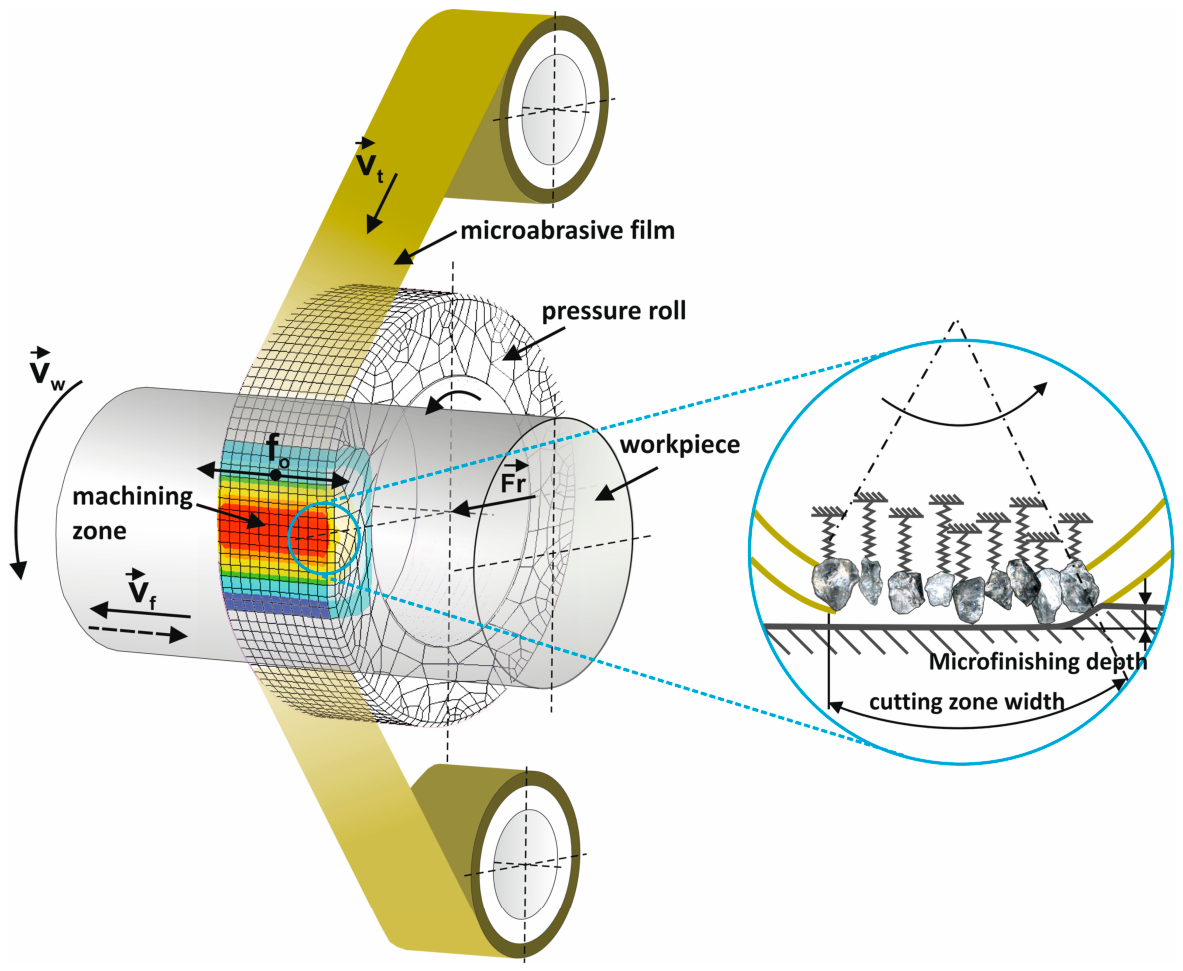
Among finishing operations, abrasive-film microfinishing is a precise method used to improve the surface texture, smoothness, and functional performance of engineering components by controlling the interaction between abrasive grains, the compliant backing, and the workpiece surface [1,2,3,4]. Current studies on the process of abrasive-film superfinishing have confirmed the strong dependency of the process on the applied process variant in terms of the kinematic motions and the location of the finishing area with respect to the work surface [5,6] (Figure 1). In addition, the effectiveness of the process of abrasive-film superfinishing has also been confirmed for difficult-to-machine materials, like Ti-6Al-4V alloys, in which considerable reductions in surface roughness and favorable changes in texture have been observed after the selection of appropriate finishing routes [7,8,9]. In the context of the micro-scale characteristics of the process, the unit load of active abrasive grains and the microchip formation have also been considered, confirming the strong dependency of the process of material removal and surface transformation on the local pressure conditions [10,11]. The structural changes in the abrasive film, with discontinuous active surfaces, have also been considered as potentially favorable in the context of debris removal and surface contact conditions [12,13,14].
The role of the pressure roller is particularly significant in the case of abrasive-film microfinishing operations because it directly controls the contact width, local pressure distribution, and effective machining zone geometry [15,16,17,18]. The effect of varying roller compliance was shown to significantly influence the contact-area dimensions, thereby affecting process aggressiveness, material removal repeatability, and surface texture characteristics [19,20]. This research is particularly close to developing new superfinishing attachments in which the geometry of the pressing system, lever mechanisms, multi-zone configurations, etc., were considered as active machine elements rather than auxiliary machine components [21]. Concurrently, there is an obvious relationship between abrasive-film microfinishing operations and functional surface engineering because of its potential to generate surface textures containing carbon as well as ultrathin layers of carbon on titanium alloys, thus extending its application range beyond conventional surface roughness reduction to surface functionalization [22,23,24].
Abrasive-film microfinishing operations must also be considered in conjunction with other abrasive belt finishing operations such as grinding in which significant scientific contributions were made to study contact mechanics, surface topography generation, as well as the active state of abrasive tools. Studies of the self-sharpness of individual grains in the belt grinding of titanium alloys were shown to reveal that significant evolution of grain geometry plays an important role in cutting potential as well as long-term stability of the process [25]. Elastic abrasive tool wear identification through machine vision has been shown to indicate that unique wear marks can be automatically determined in relation to the condition, lifetime, and performance of the tool, thus assisting in assessing the tool operation and expected machining result [26]. Similarly, stochastic as well as quantitative approaches to modeling of abrasive belt surface topography were considered in zirconia alumina belts in order to simulate surface generation [27]. Numerical as well as high-precision surface topography models of machining surface in flexible grinding by an abrasive belt were shown to reveal that elastic contact, grain path kinematics, as well as belt morphology must be considered simultaneously in order to accurately simulate surface state [28,29].
Similar trends are also found in the research dealing with the rail grinding application and other cases where the support conditions are considered to be compliant or semi-compliant. The contact mechanism of the rail grinding process with open-structured abrasive belts has also been investigated, and the significant effect of the supporting structure of the belts and the pressure transmission system on the stress distribution has been found through experimental and analytical approaches [30]. This has also been addressed through the application of the contact and simulation models based on the pressing plate approach [30] and the microscopic approach for the abrasive belts used in rail grinding processes [31]. Similar trends have also been found in the research dealing with the robotic abrasive-belt grinding application, where the removal depth was found to depend on the parameters of the process, support conditions, and the elastic conditions in the interface between the wheel and the workpiece [32,33]. The optimization of the abrasive-belt grinding process for the application in the machining of the surface of the blades of an aero-engine, along with the simulation of the kinematics of the blade-finishing operation, has also confirmed the significant effect of the local contact mechanics on the surface generation for the given application, where the vibration-sensitive process conditions are also considered to be very important for the generation of the surface with the desired quality [34,35]. Similar research on the application of the abrasive-belt grinding for the generation of the surface of the electronic substrates has also found the significant effect of the given approach on the generation of the highly differentiated states of the surface roughness [36].
The thermomechanical effects related to belt grinding titanium alloy have been examined in detail, including the combined effects of force and temperature and material responses during grinding [37]. The energy considerations related to belt grinding titanium alloy have been examined based on the effects of wear on the efficiency of belt grinding, revealing that wear evolution affects not only material removal efficiency but also affects the energy considerations [38]. Additive manufactured Ti6Al4V alloy surfaces were examined to show that belt grinding affects surface integrity and morphology formation based on process parameters and the state of the tool [39]. Similar observations were made for DD6 single-crystal superalloy surfaces, where belt grinding and removal efficiency and surface roughness predictions were related to contact conditions and grain effects [40]. Laser-assisted hybrid belt grinding for titanium alloy TC17 surfaces showed that surface integrity is significantly affected based on how mechanical and auxiliary energy contribute to contact-zone formation [41].
The results of experimental research on the use of electroplated diamond belts for machining nickel-based superalloys indicated the effects of abrasive belt wear on the height of the protrusion of the cutting grains and the cutting state of the abrasives, which play a role in the performance of the machining process [42]. Research on the wear modes and wear mechanisms of the abrasive belts in the grinding of the steel material U71Mn led to the observation of the changes in the wear modes of the abrasive belts depending on the grinding process parameters, including the transition from abrasion to other forms of wear, as well as fracture and other forms of failure [43]. The effects of the wear of the abrasive belts in the robotic grinding of the GH4169 alloy were associated with the changes in the residual stress state of the surface of the material, which is of critical interest for high-performance materials [44]. The associations between the failure of the abrasive belts and the effects of the sanding of medium-density fiberboards were the subject of research on the failure mechanisms of the abrasive belts and the wear of precision-shaped abrasive belts used for the sanding of medium-density fiberboards [45,46,47]. The above findings highlight the role of the state of the abrasive tool as a critical component of the finishing zone of the machine tool.
Thus, currently, research on abrasive belts is increasingly based on monitoring, data fusion, and machine learning. For instance, there has been research on integrating belt wear condition monitoring based on acoustic signals with convolutional and transformer models [48]. Acoustic machine learning has also been proposed for wear condition detection in wide belts used for sanding [49]. At the same time, vision-based solutions have been proposed for precise evaluation of wear conditions in abrasive belts with complex morphologies [50]. For instance, there has been research on monitoring the MRR (material removal rate) based on LightGBM models [51], CatBoost models based on belt images [52], and unified coefficient models based on images for abrasive belts [53]. Data-driven predictive models have incorporated BP (backpropagation) neural networks for abrasive belt wear prediction [54], small-sample monitoring based on multi-sensor signal image fusion and deep regression networks [55], and machine learning for robotic arm-based abrasive belt condition monitoring [56].
The optimization of process parameters for crankshaft abrasive belt polishing systems has been studied [57,58], as has the post-processing and control of multi-axis CNC abrasive belt grinding machines [59]. Furthermore, more general machine design-related research, including the design and testing of abrasive belt grinding machines [60] and more general modeling and monitoring of the abrasive belt grinding process [61], highlights the fact that the machine structure, pressing system, guiding system, and control system play a critical role in the precision and repeatability of the process.
These findings are supported by other research, including the vibration control of rail grinding vehicles using abrasive belts [62] and more general discussions of advanced abrasive processing technology and its applications [63]. The above findings can be seen to highlight the relevance of precision finishing, especially for critical materials like nickel-based superalloys and advanced biomedical alloys, for which the control of the surface condition is directly related to the functional performance of the final product [64,65]. Other precision finishing operations, including the ELID super finishing of cylindrical rollers, highlight the fact that even small changes to the state of the surface and the contact state can play a critical role in the final integrity of the surface and the accuracy of the final shape of the part being processed [66].
Nevertheless, there is a remarkable knowledge gap in the field of superfinishing attachments with abrasives. However, there is not yet a well-developed constructive concept that makes it possible to intentionally subdivide the microfinishing area and control it with the help of two independently operating pressure modules with the use of shaped and compliant rollers, redistributing the contact conditions over the width of the abrasive film. In the majority of the existing machines, the pressure element is considered as the single support element or as the integral component of the globally acting mechanism, which makes it difficult to speak of the differentiated pressure control in the machining area.
For this purpose, this study proposes a new concept of a superfinishing attachment in which the microfinishing-zone geometry may be influenced through the combined effects of roller geometry, elastic compliance, and the symmetric arrangement of two independently mounted pressure modules. Unlike conventional single-roller and globally loaded concepts, this new concept is intended to provide an additional possibility of modifying contact conditions locally along the width of the abrasive film and, hence, may improve the adaptability of the process to workpiece geometry and desired surface-conditioning changes.

2. Materials and Methods

The development of the abrasive-film superfinishing attachment concept involved the application of SolidWorks 2019 software. Innovative structural solutions for devices used in abrasive-film microfinishing were created by applying CAD/CAE tools from SolidWorks 2022. This software allows for effective modeling of parts, assemblies, and technical drawings, as well as motion simulation, kinematic calculations, and project visualization.
The geometric modeling of the superfinishing attachment structure involved three-dimensional solid modeling operations for both individual structural elements of the developed attachment and complex mechanical assemblies. Particular attention in the geometric modeling of the proposed attachment structure was paid to modeling the structure of the pressing mechanism, the structure of the abrasive-film guiding system, as well as kinematic relations in assemblies of moving elements of the superfinishing unit structure. In addition, the geometric modeling of the superfinishing unit structure involved a number of stages: modeling of fundamental structural elements of the pressing system structure, assembly of these elements in functional assemblies of the dual-roller system structure, and modeling of a developed design structure as a whole.
Next, motion analysis of the elements of the pressing mechanism of the proposed concept structure was carried out in the SolidWorks environment by means of the Motion Study add-in. Apart from that, a geometry-oriented simulation analysis of the contact zone between the abrasive film and workpiece was carried out. The goal of the geometric assessment was to investigate the impact of selected geometry variables on the location and dimensions of the microfinishing zone. The evaluation process was executed at four values of the vertical offset of the center point of the contact zone, namely, h = 1, 2, 3, and 4 mm and at five values of the horizontal indentation of the abrasive film, i.e., δx = 0.1, 0.2, 0.3, 0.4, and 0.5 mm. It is noted that the symbol h stands for the vertical displacement of the contact-zone center relative to the workpiece axis, and δx is the horizontal indentation of the abrasive film towards the cylindrical workpiece. In relation to all investigated configurations, the following geometric quantities were calculated: the abrasive film/contact area Ac (mm2); the geometric interference volume Vint (mm3); and the characteristic contact length lc (mm). The variable Vint was used purely as an indicator of contact intensity and did not represent material removal. For all calculated values, the comparison with the results obtained via the geometric evaluation based on a parametric sketch was made.
In order to demonstrate the proposed solution visually, the module of photorealistic rendering called PhotoView 360 was used for creating images of the attachment under development in the SolidWorks package. These images allowed one to create drawings and illustrations illustrating the idea of functioning, which are shown below in the paper. The design of the attachment was based on previous studies of the effect of pressure-roller geometry and their elasticity on the process of microfinishing [19].
The theoretical assumptions that form the basis of the proposed solution are based on results obtained experimentally when studying the impact of pressure-roller geometry and their elastic characteristics on microfinishing conditions. During the experiment, the workpiece rotation speed varied between 20 and 60 m/min, while the abrasive-film feed rate varied between 0.5 and 2.0 m/min, oscillation frequency varied between 2 and 5 Hz, and pressing force varied between 50 and 200 N, depending on the geometry of the roller. Experimental results concerning the elastic properties of the pressure rollers and the contact-area formation were taken from a previous study [19].

3. Results and Discussion

3.1. Influence of Pressure Roller Geometry on Contact-Zone Formation and Microfinishing Effectiveness

The results obtained by [6] indicate that the geometry of the pressure roller, as well as its compliance, directly affect the morphology of the contact zone and the efficiency of the abrasive-film microfinishing process. The rollers designed by the authors differ considerably in the deformation patterns and geometrical parameters of the contact zone, which confirms that the roller design affects not only the width of the machining zone but also the internal pressure within it.
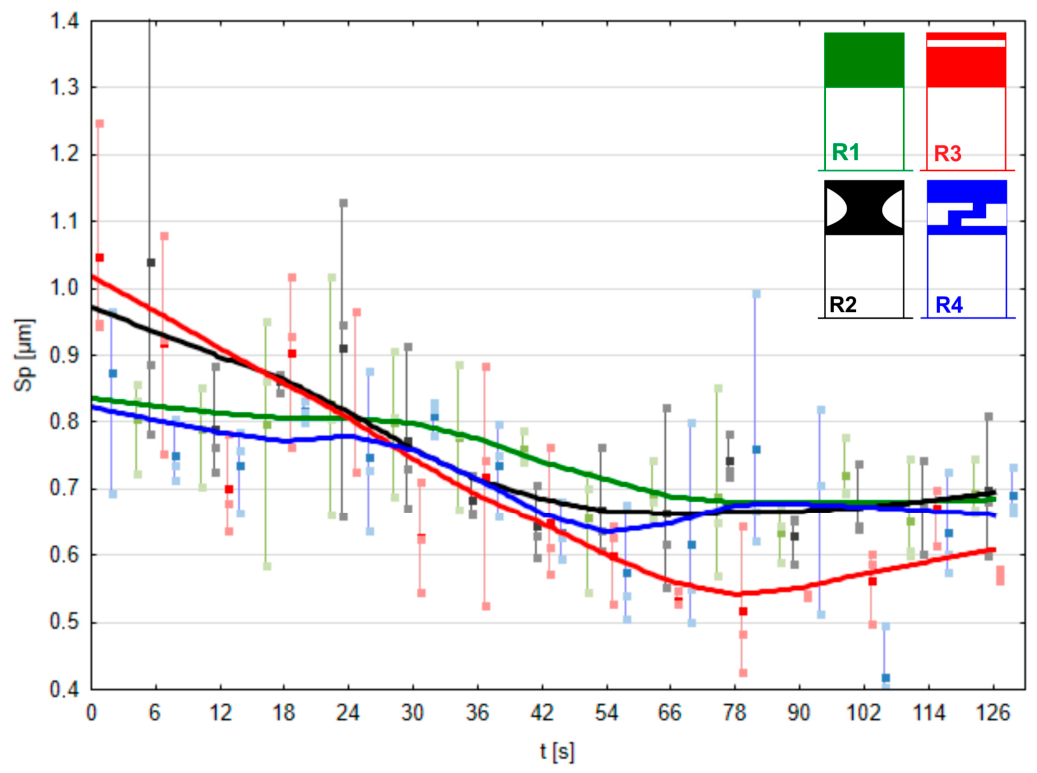
It should be noted that the rollers designed for the prototype were characterized by more positive contact behavior than the conventional solution, while roller R3 featured increased compliance as well as a stable and well-developed contact zone. The above differences in the mechanical parameters of the rollers are reflected in the technological results presented in Figure 2, which show the changes in the surface height parameter Sp for the rollers tested, indicating the differences in the rollers’ capabilities to reduce the highest surface asperities.
Roller R3 was shown to feature the highest efficiency in reducing the peak irregularities, decreasing the surface height parameter Sp, which is of particular interest because the surface peaks play a crucial role in the bearing, friction, as well as wear properties of the surface obtained after the microfinishing process. The results obtained from Figure 2 can be used to conclude that the pressure roller should be viewed as a functional element of the microfinishing system, while the development of a new attachment design, in which the zone of the contact is shaped by the design of the pressure roller, can be justified directly by the results obtained. These experimental outcomes serve as evidence in supporting the statement that not only are there variations in the contact behavior but also in the efficiency of peak formation suppression when it comes to abrasive-film microfinishing due to the geometry and flexibility of the pressure roller. Hence, these results provide the direct basis in designing a more effective architecture for the pressing setup. This research aims to expand this design basis in relation to the pressing setup consisting of two modules using two flexible pressure rollers.

3.2. Structural Development and Functional Configuration of the Proposed Superfinishing Attachments

In the context of the results obtained in Section 3.1, in which the influence of the geometry and compliance of the pressure roller on the morphology of the contact zone and the performance of the abrasive-film microfinishing process have been demonstrated, the development of a novel superfinishing unit structure has been undertaken with the objective of applying the effect of the pressure roller across the level of the entire functional system. The primary objective of the development has been the creation of a developed unit structure in which the conditions of contact between the workpiece and the abrasive film are not determined by the action of a single globally active element of pressure, but are formed by the action of two pressure modules operating in cooperation and symmetrically with respect to the workpiece axis, each of them acting on one half of the width of the abrasive film. This approach has direct correspondence with the requirement of the development of the microfinishing process of the abrasive film, with the intention of the specific shaping of the microfinishing zone with the aid of geometry-controlling pressure-generating elements [6].
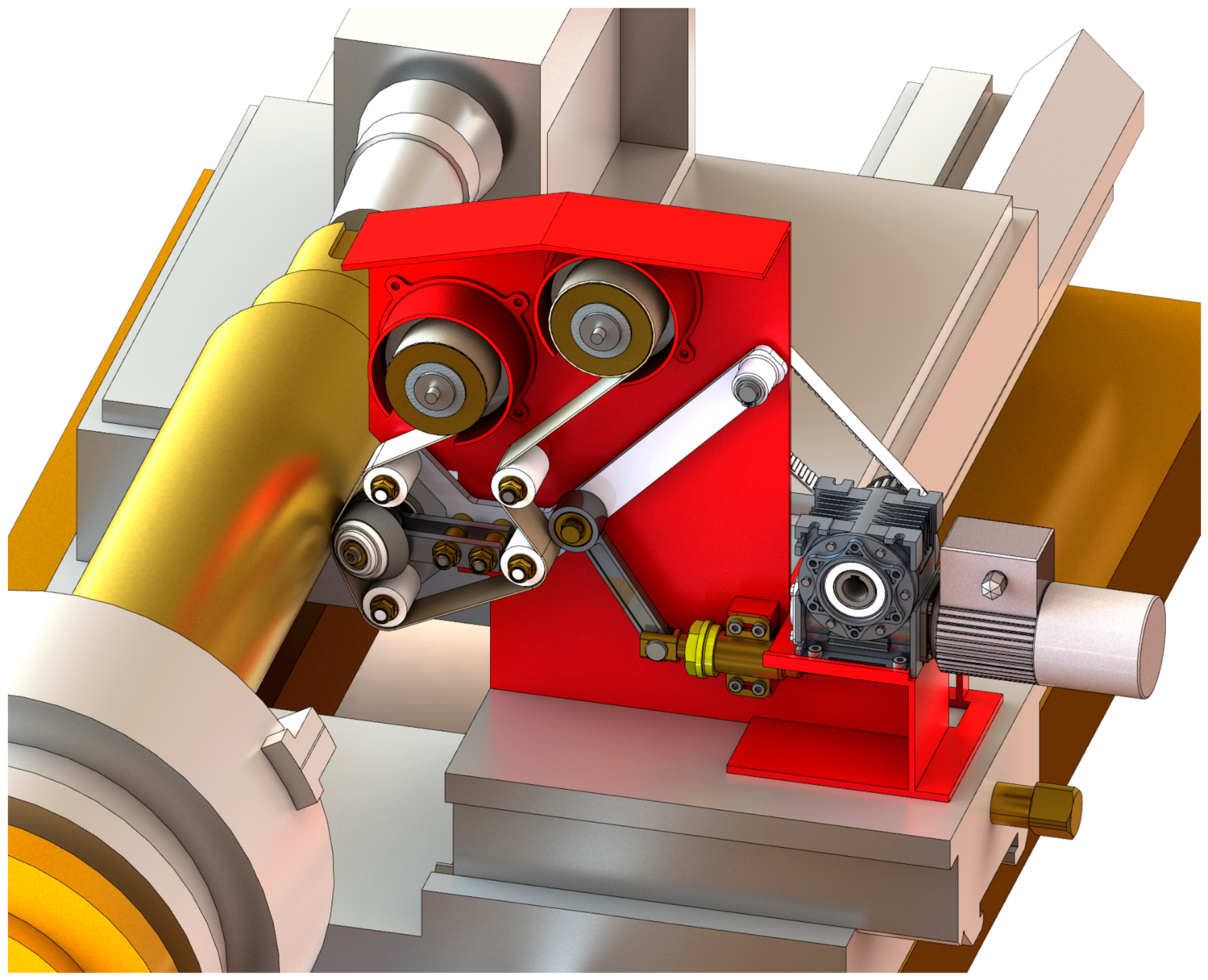
The proposed structure of the attachment system includes the film-pressing mechanism, the film-feed mechanism, the drive, and the spring-loaded pressing system, all of which are unified in the single functional unit installed on the machine slide. The novelty of the proposed structure is seen in the application of two independently operating pressure modules symmetrically with respect to the workpiece axis. In each module, there is a conical pressure roller consisting of a metallic bowl-shaped body and an elastomeric ring fixed in the stationary position. The conical or hyperboloidal surface of the roller and the variable wall thickness of the bowl are intended to enhance the deformability of the roller in the machining zone and thus increase the contact area between the abrasive film and the workpiece. In the proposed structure, the rollers are installed on the spherical supports, which makes it possible to set the angular position of the rollers and thus customize the contact conditions in conformity with the geometry of the machined surface. A broad overview of the developed dual-roller system is presented in Figure 3, showing the complete configuration of the device fixed on the machine tool for external cylindrical finishing, along with the pressure assembly, the film path, the drive unit, and the spatial relationship with the cylindrical workpiece. The device is fixed on the transverse slide and works relative to the rotating workpiece, similar to the conventional external cylindrical microfinishing, but the pressing arrangement is completely different compared to the standard single roller arrangement. The developed design is compact, yet functionally modular, allowing for the separate regulation of the pressing system, the film path system, and the force generation system, yet with kinematic coupling. The structural arrangement is of key importance, as it defines the conditions for the regulation of the microfinishing zone extension and the differentiated contact on the two halves of the abrasive film.
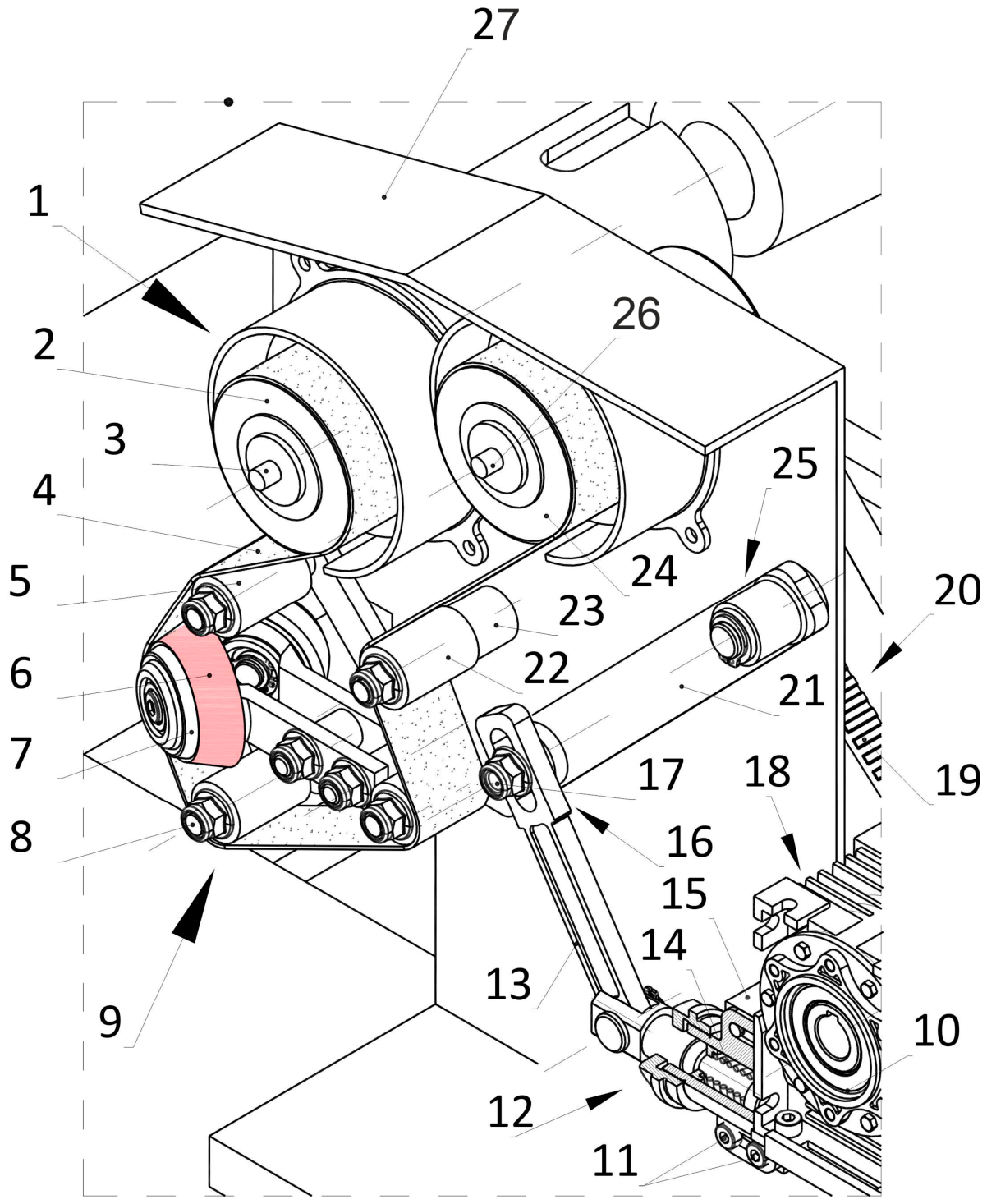
A broad overview of the developed attachment is presented in Figure 3 and Figure 4, showing the complete configuration of the device fixed on the lathe-type universal machine tool, along with the pressure assembly, the film path, the drive unit, and the spatial relationship with the cylindrical workpiece.
A more detailed description of the pressure zone can be seen in Figure 5, which shows the abrasive film being supported by two conical pressure rollers symmetrically arranged in the upper part of the superfinishing unit. As opposed to the conventional design, which uses only a single pressing roller, the proposed design divides the entire pressing process into two parts, each of which is carried out by a separate roller, but in a coordinated manner. The rollers act on different parts of the width of the abrasive film, while the geometrical relationship between the rollers enables the location of the contact-zone center between the film and the workpiece to be below the axis of the machined shaft. The location of the contact-zone center is a design feature, as it changes the geometry of the contact between the film and the workpiece, increases the finishing zone, and changes the direction of the machine marks obtained during the finishing process.
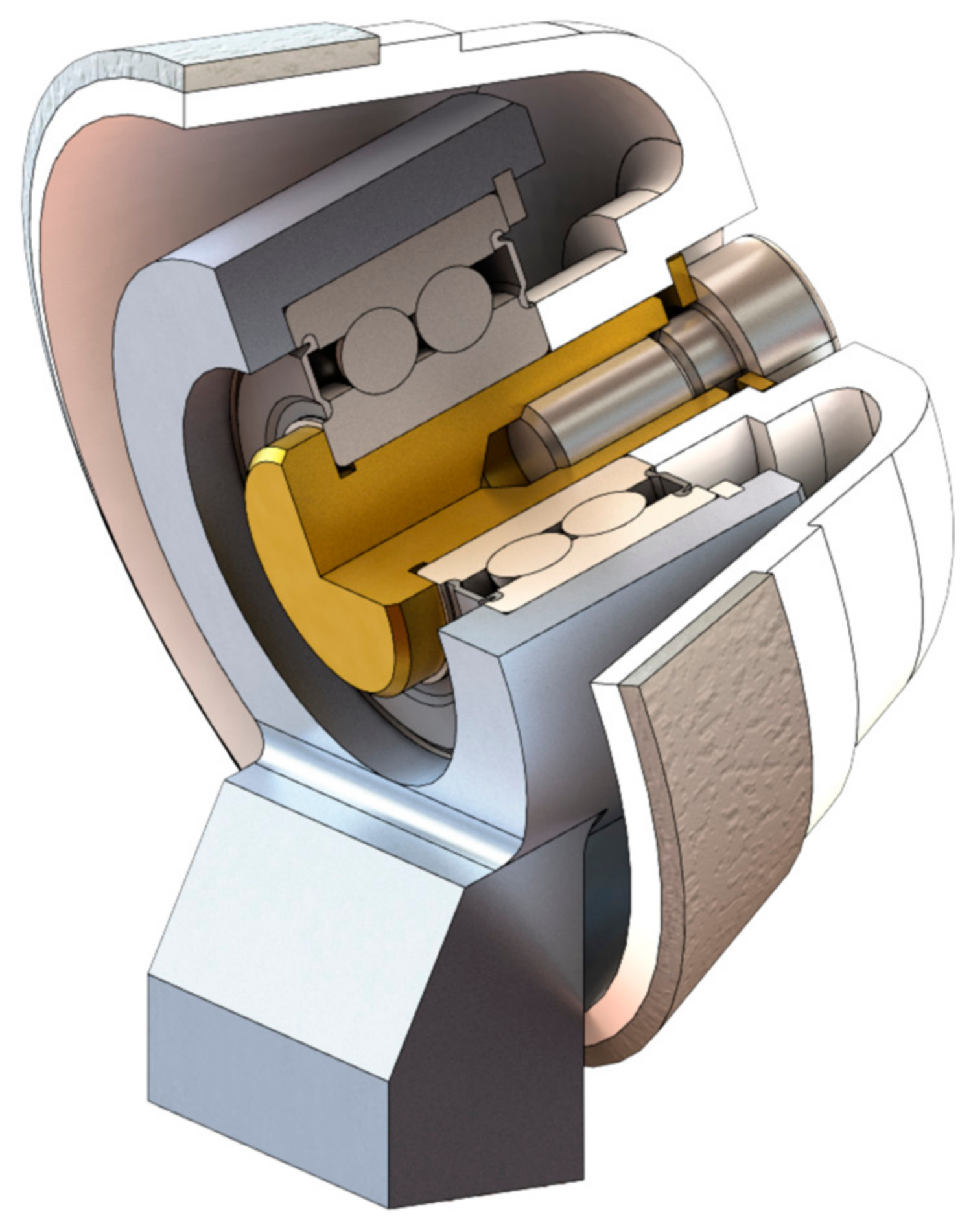
The constructive basis of the single pressure module is schematically presented in Figure 6. A conical roller on a pin and supported by a bearing node in the body of the pressing module makes up the module. The roller is driven by a spherical ring and screw connection, and the conical bowl is enveloped by an elastomeric ring of predetermined thickness. This is functionally the essential characteristic of the module, as the roller is not used as a rigid geometric boundary but rather as a compliant and orientation-adjustable element with the ability to locally modify the pressure field in the contact area. This is also associated with the possibility of selecting the compliance of the roller in accordance with the required process features, the shape and size of the finishing zone, and the location of the contact area with respect to the workpiece axis.
The superfinishing attachment has a special transport system for the abrasive film in which the film is transported between the storage and braking roller, the pulling roller, the tensioning roller, and three guiding rollers mounted on a double-arm lever. This has a more active function than auxiliary support. It stabilizes the film in terms of the moving pressing system and provides for the constant wrapping of the film around the pressure rollers during the operative stroke. The film guiding system is also integrated into the double arm lever that supports the pressure modules. This means that changes in the position of the lever will have a direct impact on the active pressing region. This can be seen in the real-world views of the prototype and is one of the advantages of the suggested superfinishing unit. It does not require any unnecessary kinematic decoupling. The force generation principle of the new attachment system is based on a spring-loaded pressing system that acts on the double arm lever using an elastic translational-rotational node. The lever supporting the two pressure modules is connected to a resilient arm that acts in turn on the adjustable spring system. This node consists of a sleeve, a pin, and elastic toroidal rings positioned in the circumferential groove. This node has two main purposes.
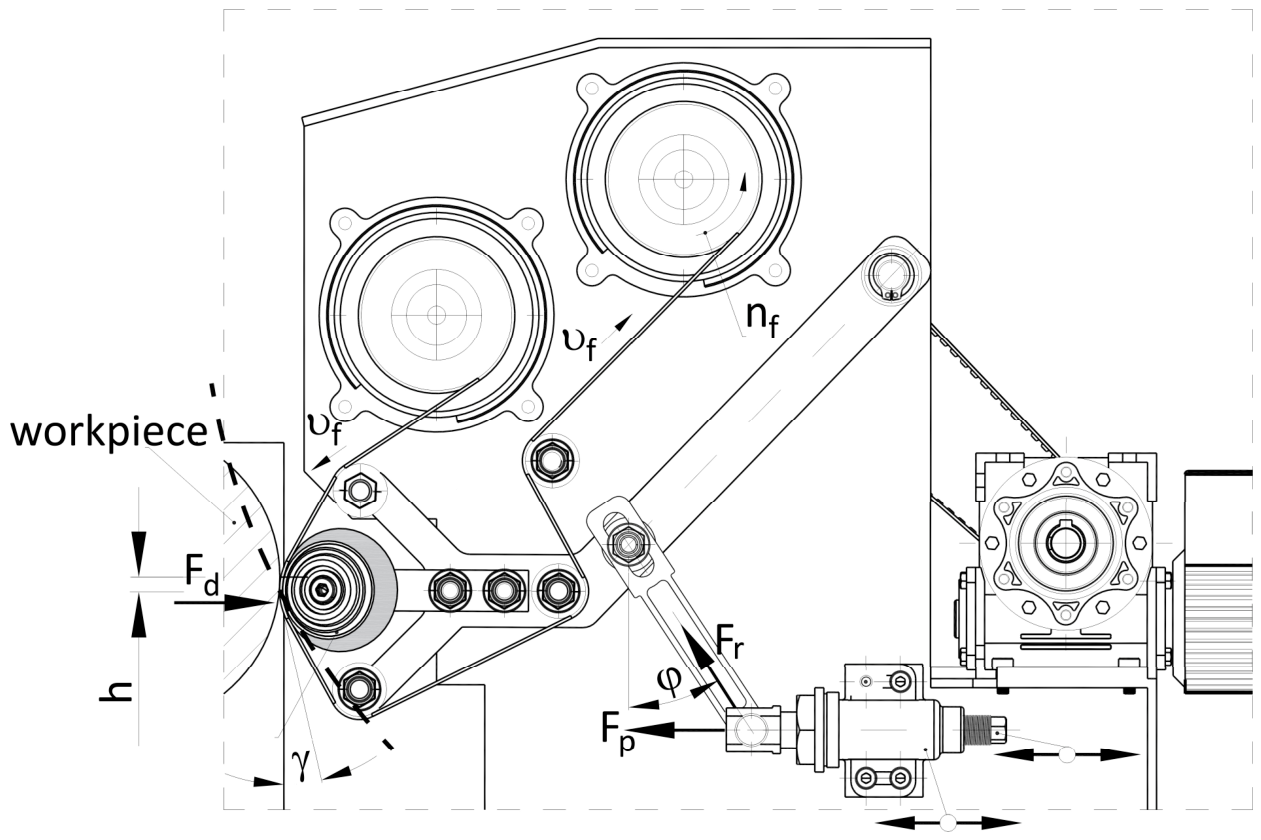
Firstly, it transmits the pressing force from the spring system to the double-arm lever and finally to the pressure modules. Secondly, it imparts local compliance and damping characteristics to the kinematic chain. This characteristic is important in microfinishing processes, in which instabilities and vibrations can have a negative impact on the quality of the processed surface. In this regard, the node has a dual function in that it enables force transmission and conditioning of the dynamic properties. The kinematic relationship between the spring system and the pressing lever is shown in Figure 6. This figure shows the double-arm lever and its relationship to the pressure modules and the arm of the spring-pressing system. In this case, the pressing force is not applied in one dimension alone. Rather, it is applied within a single plane using a lever system that is adjustable. This means that the force and its line of action can be varied. The regulation system of the mechanism allows for the displacement of the center point of the finishing zone in relation to the work axis. This is one of the parameters of the developed concept. The attachment can be regulated in terms of force and geometric position of the contact point. One of the main geometric parameters, which can be seen in Figure 6, is the offset h, the vertical distance between the workpiece axis and the center point of the finishing zone. It is not only a geometric but also a functional parameter of the proposed concept, as it influences the geometry of the contact between the abrasive film and the machined surface, thus changing the dimensions and direction of the finishing zone. If the center point of the contact is located below the workpiece axis, if there is an offset h, the pressing system moves along a circular path towards the workpiece, and at the contact-zone center; instead of a vertical direction, its tangent is at an angle γ. In this case, it is more likely for the dimensions of the finishing zone to be increased, and its direction to be changed, thus creating different finishing marks on the machined surface.
Figure 7 also shows the force and motion parameters that are characteristic of the operation of the mechanism within the working plane. The parameter Fp represents the horizontal force generated by the spring-loaded system for adjusting, while the parameter Fr represents the force that is transmitted through the lever arm to the pressing mechanism. The relative values of these two parameters are affected by the inclination angle φ, which determines the direction of the action of the load and, therefore, the value of the resulting pressing force Fd, acting within the contact area between the abrasive film and the workpiece. Thus, the operation of this mechanism also regulates the direction and the path of the action of the load. The parameters vf and nf are also indicative of the kinematic characteristics of the movement of the abrasive film, such as the speed of the film and the rotational speed of the film-driving roller, respectively.
Figure 8 shows a representation of the developed microfinishing attachment without a workpiece, which provides a general idea of the structural layout of the head. The focus of the figure is on the pressure system with special attention paid to the two-roller system. This system includes two pressure rollers located inside a common kinematic structure and connected to a double-arm lever, thus allowing the formation of two different areas of contact with the abrasive film during the microfinishing process. This structural characteristic represents a significant part of the proposed idea with regard to the level of flexibility in the definition of the finishing area with respect to the single roller system. This system is intended to support a more controlled distribution of the contact zone along the width of the abrasive film and to provide a certain level of flexibility with regard to changes in the geometry of the surface being micro-finished. In addition, the symmetrical location of the rollers within the kinematic structure is intended to support more balanced operating conditions.
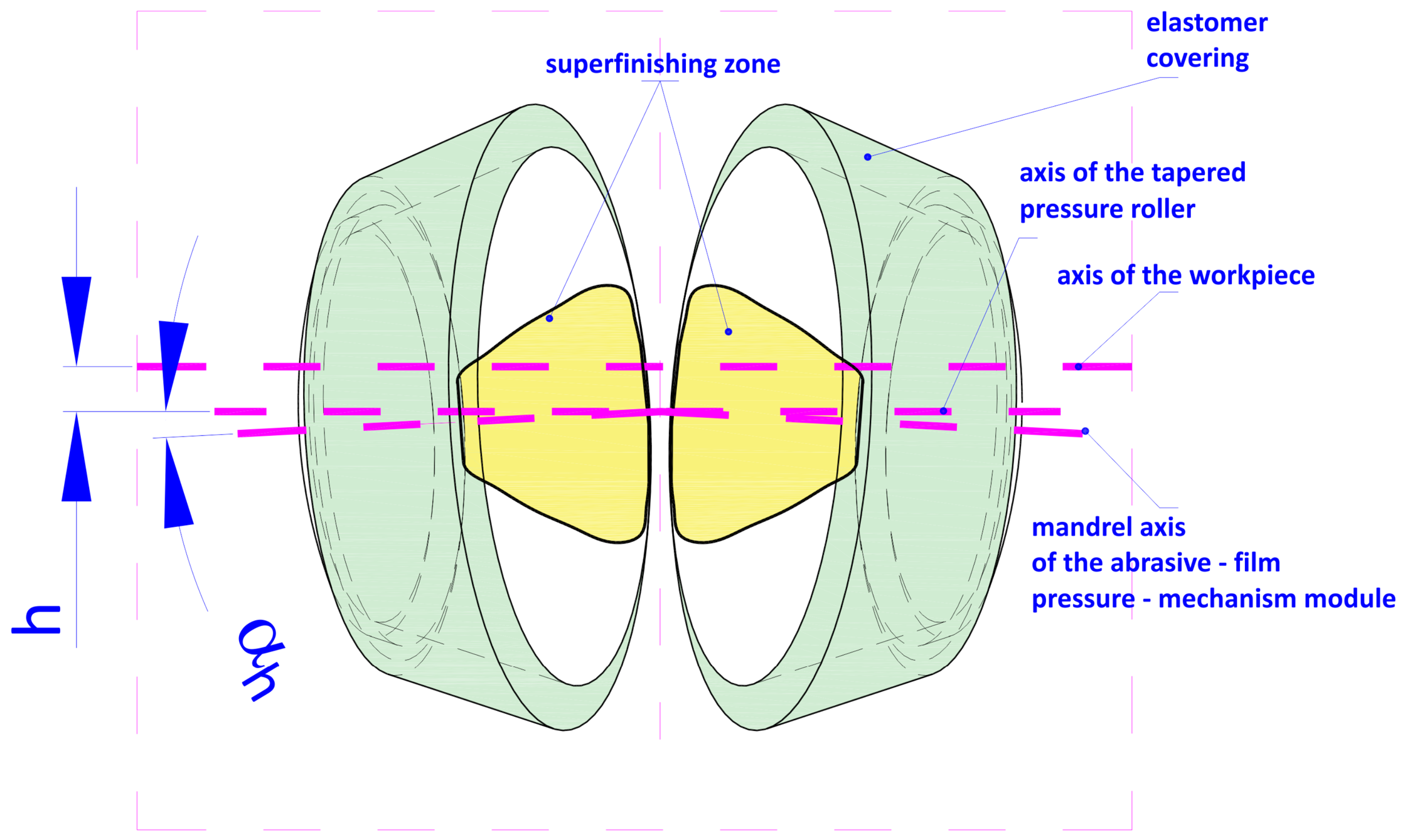
Figure 9 depicts the configuration of the contact zone created between the abrasive film and workpiece due to interaction with two pressure rollers. Particular emphasis is given to geometric and functional characteristics of the finishing zone, especially with respect to the position of its center point relative to the workpiece axis. As can be seen, the process of finishing is not localized to a single point of contact but rather is distributed between two zones created due to action of individual pressure rollers. These zones are created symmetrically relative to the central plane, though they can be shifted due to geometry and position of rollers. One of the parameters depicted in Figure 9 is h, which denotes the vertical shift of the center point of the finishing zone relative to the workpiece axis. It is obvious that this parameter directly influences the contour of the zones of contact. The application of tapered rollers with an elastomer cover may allow adaptation of the contact conditions and modification of the local contact-zone geometry. In this regard, it is possible to expand the zones of finishing and even regulate their geometry through adjusting this mechanism. It can be stated that the position of the contact zone can be influenced at the design level.
One of the significant aspects of the developed solution is the path of motion of the pressure system to the workpiece. The pressing mechanism is attached to a rotary node and moves along a circular arc path rather than a purely linear path. The tangent to the path of motion of the mechanism at the point of contact is inclined rather than vertical. This changes the nature of the introduction of the abrasive film into contact with the cylindrical surface and may support the modification of the finishing-zone geometry and the directional nature of the machining tracks. Together with the fact that the point of contact is located below the axis of the workpiece, this leads to an increase in the microfinishing zone and to an improvement in the differentiation of local finishing conditions of the two parts of the abrasive film. Another possible functional implication related to the influence of machining trace interactions on the machined surface can be discussed. In the suggested scheme with two rollers, the pressure field consists of two working areas, and the regions with maximum pressures do not have to be parallel. Therefore, there is an opportunity for micro-movements of the abrasive layer along the generator of the cylindrical surface. Micro-movements allow generating crossing machining traces, which is beneficial for eliminating the influence of surface machining direction and obtaining a more isotropic surface texture [1].
Another important structural characteristic consists of the possibility of roller inclination in all directions by a limited angle. The axis of each conical roller may be deflected relative to the module axis. This leads to increased system adaptability. This may prove to be especially useful when dealing with local workpiece surface geometric deviations, as well as when assembly inaccuracies are present. The conclusion is that the proposed concept is not a rigidly overconstrained system. On the contrary, self-adjustment capabilities are incorporated. This feature may be particularly useful to be especially useful when dealing with work surfaces where a high level of rigidity must be maintained, but at the same time, this rigidity must be limited. Such a feature may prove to be especially useful when the aim is to maintain a wide and efficient finishing zone, despite local workpiece geometry variations.
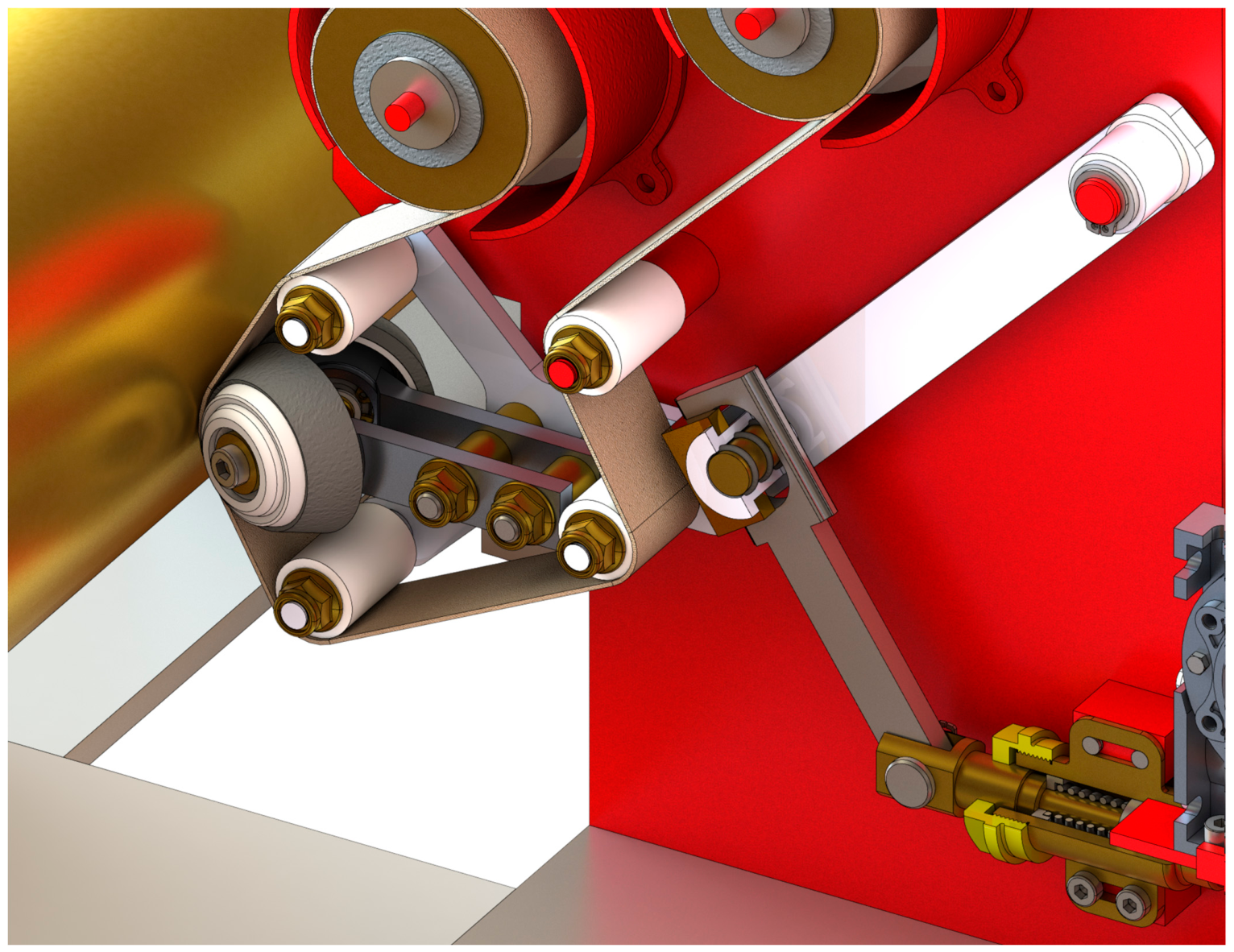
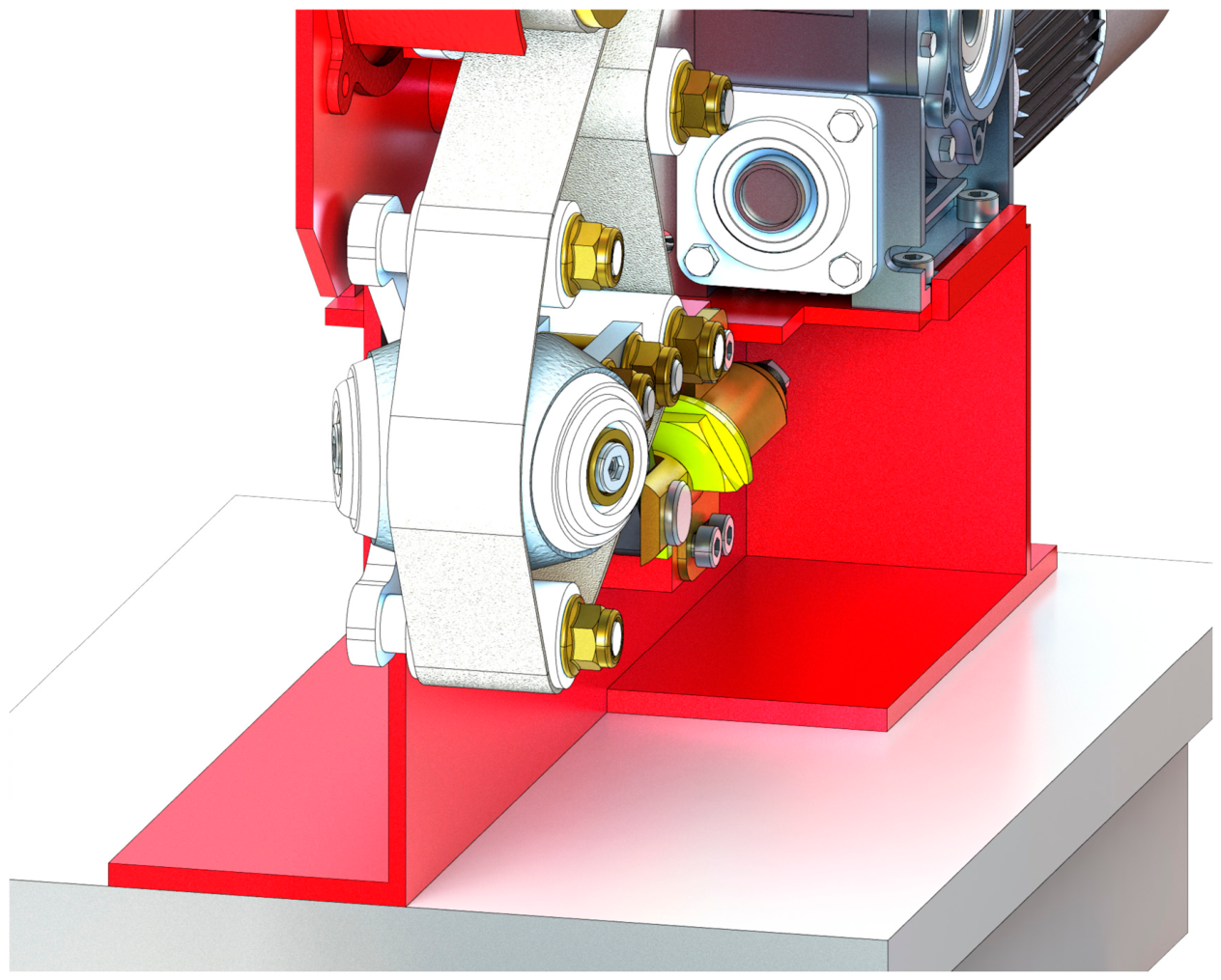
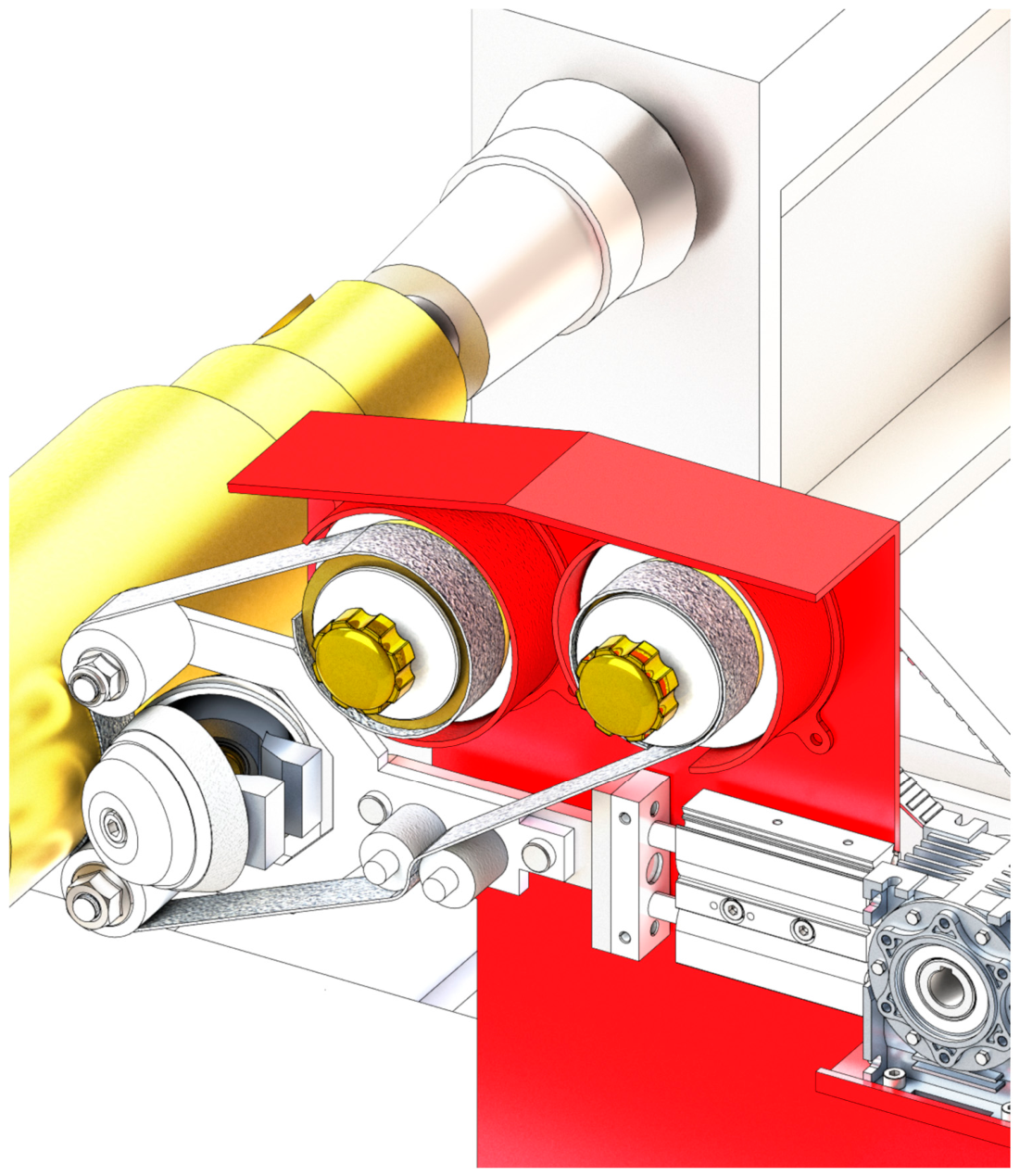
The actual visualization of the proposed concept can be seen in Figure 10, where the proposed attachment is shown. In this figure, a close-up of the active zone can be seen. The relationship between the upper pressure rollers, the abrasive film, the lower guiding rollers, and the central working roller can be easily observed. This shows that the assumptions used during the construction of the proposed superfinishing unit are consistent with the physical realization. In particular, the film path is compact and continuous, the force transmission chain is short, and the pressure system is accessible for mechanical adjustment. This can be viewed as a very important advantage when dealing with the actual visualization of the proposed attachment on a machine tool. This may prove to be especially useful when dealing with experimental studies.
The developed superfinishing attachment can be considered a design response to the identified limitations discussed in the literature and in the preceding experimental research on pressure rollers. The results of the preceding research indicated that the change in the geometry and the degree of compliance of a single roller affects the contact zone and the efficiency of the microfinishing process. The developed design can be considered a further design step in the development of abrasive-film microfinishing attachments, as it introduces a more complex structural solution involving the use of two compliant, geometrically shaped rollers combined into a single adjustable kinematic system. Therefore, the proposed attachment is more than a simple substitution of a single roller by another; it introduces a new approach to the formation of the contact zone of the microfinishing process, which is based on the symmetric use of a dual-module system of pressure generation, the regulation of the transmission of forces, the orientation of the rollers, and the shift in the contact-zone location.

3.3. Simulation-Based Evaluation of the Abrasive-Film Contact Zone

In addition to the structural description of the suggested dual-roller superfinishing unit, the numerical evaluation was performed by simulation using the geometrical approach in order to study the shape of the abrasive-film/workpiece contact zone. It should be noted that the aim of the evaluation is not to determine the resulting surface roughness or wear rate. Instead, it was necessary to reveal the dependence of several selected geometrical parameters of the unit on the area and location of the microfinishing zone. The special focus was made on such factors as the vertical offset of the contact-zone center, h; indentation of the abrasive film, δx; area of the contact, Ac; theoretical interference volume, Vint; and contact length, lc. In order to evaluate quantitatively the possibility of regulation of the contact area between the abrasive film and the cylindrical workpiece within the proposed superfinishing attachment, the simulation-based geometric analysis of the abrasive-film cylindrical workpiece contact was performed, based on the developed 3D SolidWorks model. Four vertical offsets of the contact-zone center, h = 1, 2, 3, and 4 mm, and five horizontal abrasive-film indentations, δx = 0.1, 0.2, 0.3, 0.4, and 0.5 mm, were considered. Here, h is the vertical offset of the contact-zone center relative to the workpiece axis, while δx is the horizontal indentation of the abrasive film towards the workpiece, which could be used as a measure of normal approach of the film to the workpiece. For each case, the following parameters were evaluated: contact area Ac (mm2), theoretical geometric interference volume Vint (mm3), and characteristic contact length lc (mm).
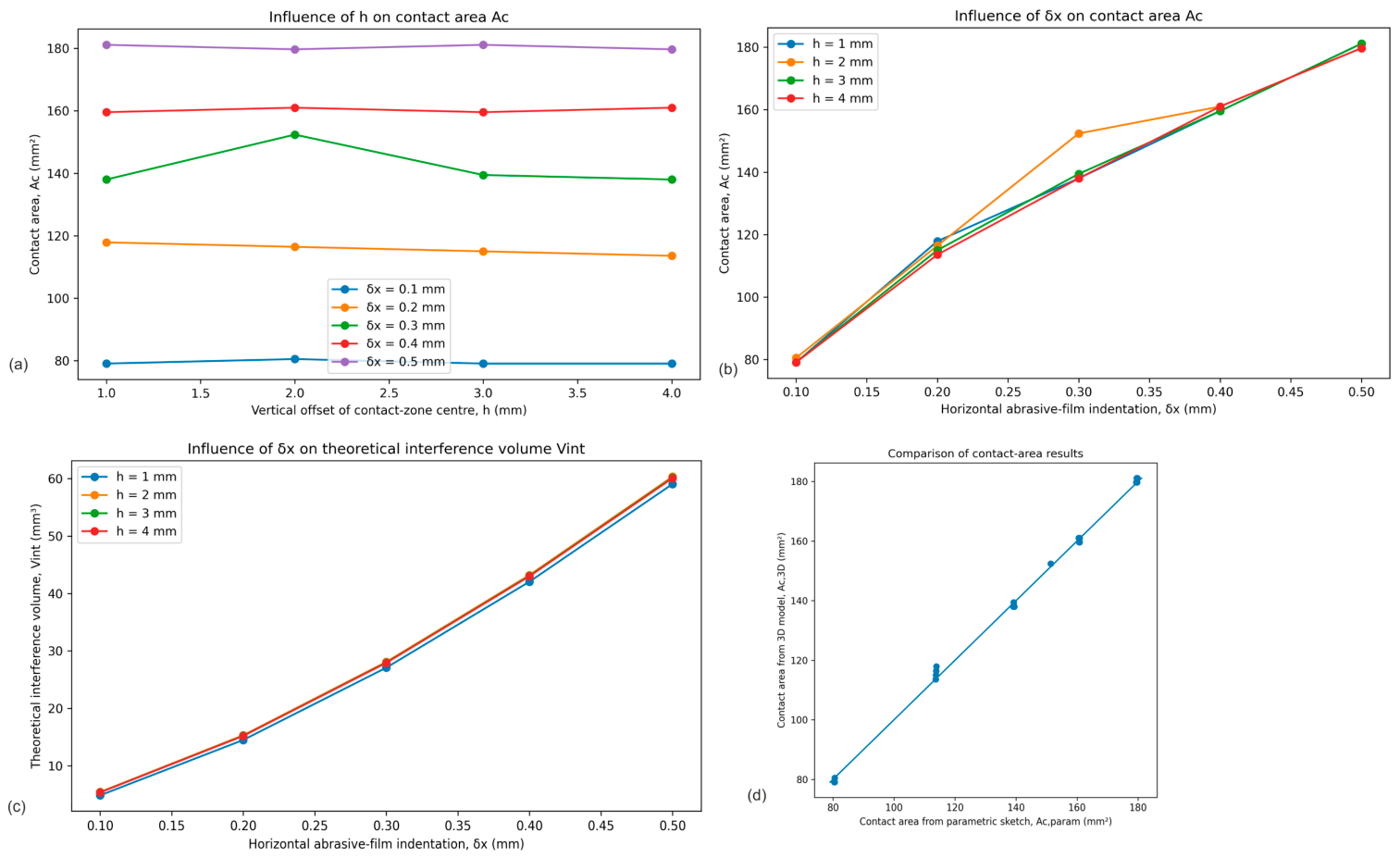
It appears that the horizontal indentation δx is the major geometric parameter defining the size of the contact zone between the abrasive film and the workpiece. As one may see from Figure 11b, the increase in δx from 0.1 to 0.5 mm led to a significant increase in the contact area Ac at all considered values of h. The average contact area Ac increased from 79.42 mm2 at δx = 0.1 mm to 180.41 mm2 at δx = 0.5 mm, that is, an approximate increase of 127%. These data show that, geometrically, the microfinishing zone could be efficiently controlled with varying the approach of the abrasive film to the workpiece.
As expected, there was a similar effect with respect to the theoretical geometric interference volume Vint, as seen from Figure 11c. The averaged value of Vint grew from 5.26 mm3 at δx = 0.1 mm to 59.94 mm3 at δx = 0.5 mm, that is, an approximately 11.4-fold increase or, equivalently, an approximate increase of 1040%. Such a highly nonlinear dependency indicates that relatively small changes in horizontal indentation could cause a drastic change in the geometrical intensity of interaction between the abrasive film and the workpiece. However, it must be stressed that Vint is a purely theoretical geometric parameter and cannot be used directly as a measure of removed material volume. Instead, it may be used as a geometrical index of the intensity of interaction between the abrasive film and the workpiece.
The impact of the parameter h on the contact area turned out to be much less significant compared to δx. As may be seen from Figure 11a, variations in Ac with changing h turned out to be significantly lower in comparison with those arising when δx varies. Therefore, it may be concluded that h is mainly the parameter determining the position of the contact zone relative to the workpiece axis, while δx determines the size and geometrical intensity of interaction of the film with the workpiece surface. This point is of significance from the design standpoint since the proposed dual roller attachment allows for the regulation of the contact-zone location and size independently as two geometric features of the process.
In order to check consistency of the calculations performed, the values of the contact area Ac, obtained using the proposed 3D model of abrasive film–workpiece contact, were compared with those evaluated using the aforementioned parametric-sketch-based geometric method. The comparison is presented in Figure 11d. One can observe good accordance between the values of Ac obtained with the help of the 3D SolidWorks model and the results of geometric calculations. The mean relative error in the calculation of Ac using the proposed auxiliary geometric approach is below 1%, and the maximal relative error does not exceed 3.5%.
Thus, the simulation-based analysis has revealed that the contact geometry in the proposed superfinishing attachment can be controlled with varying the horizontal indentation δx and vertical offset h of the contact center. Namely, δx is mainly responsible for the contact zone size and intensity, while h determines the contact-zone location. These conclusions support the functional assumptions of the developed dual roller concept and provided the quantitative basis for the design development and prospective experiments.

4. Conclusions

  • This paper presents the development and evaluation of a novel dual-roller superfinishing attachment for abrasive-film microfinishing. This concept assumes that the pressure roller is not only a passive structural support but also an active element intended to influence the geometry and location of the microfinishing zone.
  • As opposed to the conventional designs with one pressure roller, the described attachment consists of two independently supported pressure rollers that act upon two sections of the abrasive-film width. This design uses conical pressure rollers whose angular orientation can be adjusted to achieve geometrical control over the contact zone and enable the adaptive shaping of the abrasive film against the cylindrical workpiece.
  • The geometric simulations show that δx—the horizontal indentation of the abrasive film—is the main controlling parameter that defines the mean contact area Ac. As follows from the simulations, increasing δx from 0.1 mm to 0.5 mm resulted in the mean increase in Ac from 79.42 mm2 to 180.41 mm2 (by about 127%). This means that the proposed approach allows for control over the contact zone by varying the indentation δx relative to the workpiece.
  • Theoretical geometric interference volume Vint was even more sensitive due to varying δx proves to be highly pronounced. As a result, the mean value of Vint increases from 5.26 mm3 to 59.94 mm3, that is, by more than 10 times, or, approximately, by 1040%. Thus, the variation in δx can significantly affect the intensity of interaction within the contact zone. However, it should be noted that Vint is only a geometric indicator of process intensity and cannot be used to quantify the actual material removed.
  • The impact of h—vertical offset of the contact-zone center relative to the workpiece axis—on Ac is much weaker than that of δx. In other words, the parameter h can be understood mainly as a controlling parameter of contact-zone positioning, while δx controls the actual size of the contact zone and the intensity of interactions within it. Therefore, it can be concluded that this novel attachment allows achieving control over both the position and size of the contact zone independently. Therefore, it can be concluded that this novel attachment indicates the possibility of independently influencing both the position and size of the contact zone.
  • The comparison of parametric sketch-based geometric calculations with the model built in 3D SolidWorks shows high good consistency between different methods used in the study. Indeed, the mean absolute relative difference in the estimated values of Ac is below 1%, while the maximum absolute relative difference does not exceed 3.5%. In this regard, the developed geometric model can serve as a useful tool for preliminary process analysis and optimization.
  • The developed design allows implementing three main process components into one kinematically connected attachment: the pressure system, abrasive-film guidance, and force-transmission mechanism based on a spring. The simulated results provide a theoretical foundation for the proposed concept of decoupled control over the microfinishing zone. The simulated results provide a geometrical basis for the proposed concept of decoupled control over the microfinishing-zone geometry. The dual-roller arrangement may also promote the formation of crossing finishing traces due to local abrasive-film micro-displacements caused by the non-parallel pressure bands in the two active contact regions. The dual-roller arrangement may also create conditions favorable for the formation of crossing finishing traces due to possible local abrasive-film micro-displacements caused by the non-parallel pressure bands in the two active contact regions.

Author Contributions

Conceptualization, W.K., K.T. and Z.B.; methodology, W.K., Z.B. and K.T.; software, Z.B.; validation, W.K., Z.B. and K.T.; formal analysis, W.K., Z.B., K.T. and T.G.M.; investigation, W.K., Z.B., K.T. and T.G.M.; resources, W.K. and T.G.M.; data curation, Z.B. and K.T.; writing—original draft preparation, W.K., K.T. and Z.B.; writing—review and editing, W.K., K.T. and T.G.M.; visualization, Z.B. and K.T. All authors have read and agreed to the published version of the manuscript.

Funding

This research received no external funding.

Data Availability Statement

The original contributions presented in this study are included in the 845 article. Further inquiries can be directed to the corresponding author.

Conflicts of Interest

The authors declare no conflicts of interest.

References

  1. Tandecka, K.; Kacalak, W.; Mathia, T.G. Comparative Analysis of Microabrasive Film Finishing Effects across Various Process Variants. Materials 2024, 17, 3582. [Google Scholar] [CrossRef]
  2. Serpin, K.; Mezghani, S.; El Mansori, M. Multiscale assessment of structured coated abrasive grits in belt finishing process. Wear 2015, 332–333, 780–787. [Google Scholar] [CrossRef]
  3. Serpin, K.; Mezghani, S.; El Mansori, M. Wear study of structured coated belts in advanced abrasive belt finishing. Surf. Coat. Technol. 2015, 284, 365–376. [Google Scholar] [CrossRef]
  4. Mezghani, S.; El Mansori, M.; Massaq, A.; Ghidossi, P. Correlation between surface topography and tribological mechanisms of the belt-finishing process using multiscale finishing process signature. Comptes Rendus—Mec. 2008, 336, 794–799. [Google Scholar] [CrossRef]
  5. Mezghani, S.; El Mansori, M.; Zahouani, H. New criterion of grain size choice for optimal surface texture and tolerance in belt finishing production. Wear 2009, 266, 578–580. [Google Scholar] [CrossRef]
  6. Mezghani, S.; El Mansori, M.; Sura, E. Wear mechanism maps for the belt finishing of steel and cast iron. Wear 2009, 267, 86–91. [Google Scholar] [CrossRef]
  7. Tandecka, K.; Kacalak, W.; Wieczorowski, M.; Mathia, T.G. Evaluation of Surface Finishing Efficiency of Titanium Alloy Grade 5 (Ti–6Al–4V) after Superfinishing Using Abrasive Films. Materials 2024, 17, 5198. [Google Scholar] [CrossRef]
  8. Sunulahpašić, R.; Oruč, M.; Hadžalić, M.; Gigović-Gekić, A. Analysis of the influence of chemical composition and temperature on mechanical properties of Superalloys Nimonic 80A. Metalurgija 2014, 53, 13–16. [Google Scholar]
  9. Parvizi, S.; Hashemi, S.M.; Moein, S. NiTi Shape Memory Alloys: Properties; Springer: Cham, Switzerland, 2022. [Google Scholar]
  10. Tandecka, K.; Kacalak, W.; Szafraniec, F.; Mathia, T.G. Unit Load of Abrasive Grains in the Machining Zone during Microfinishing with Abrasive Films. Materials 2024, 17, 6305. [Google Scholar] [CrossRef]
  11. Tandecka, K.; Kacalak, W.; Wiliński, M.; Wieczorowski, M.; Mathia, T.G. Morphology of Microchips in the Surface Finishing Process Utilizing Abrasive Films. Materials 2024, 17, 688. [Google Scholar] [CrossRef]
  12. Tandecka, K.; Kacalak, W.; Wiliński, M.; Wieczorowski, M.; Mathia, T.G. Superfinishing with Abrasive Films Featuring Discontinuous Surfaces. Materials 2024, 17, 1704. [Google Scholar] [CrossRef]
  13. Jourani, A.; Dursapt, M.; Hamdi, H.; Rech, J.; Zahouani, H. Effect of the belt grinding on the surface texture: Modeling of the contact and abrasive wear. Wear 2005, 259, 1137–1143. [Google Scholar] [CrossRef]
  14. Bigerelle, M.; Gautier, A.; Hagege, B.; Favergeon, J.; Bounichane, B. Roughness characteristic length scales of belt finished surface. J. Mater. Process. Technol. 2009, 209, 6103–6116. [Google Scholar] [CrossRef]
  15. Mezghani, S.; El Mansori, M. Abrasiveness properties assessment of coated abrasives for precision belt grinding. Surf. Coat. Technol. 2008, 203, 786–789. [Google Scholar] [CrossRef]
  16. Khellouki, A.; Rech, J.; Zahouani, H. The effect of lubrication conditions on belt finishing. Int. J. Mach. Tools Manuf. 2010, 50, 917–921. [Google Scholar] [CrossRef]
  17. Khellouki, A.; Rech, J.; Zahouani, H. The effect of abrasive grain’s wear and contact conditions on surface texture in belt finishing. Wear 2007, 263, 81–87. [Google Scholar] [CrossRef]
  18. Jourani, A.; Hagège, B.; Bouvier, S.; Bigerelle, M.; Zahouani, H. Influence of abrasive grain geometry on friction coefficient and wear rate in belt finishing. Tribol. Int. 2013, 59, 30–37. [Google Scholar] [CrossRef]
  19. Tandecka, K.; Kacalak, W.; Rypina, Ł.; Wiliński, M.; Wieczorowski, M.; Mathia, T.G. Effects of Pressure Rollers with Variable Compliance in the Microfinishing Process Utilizing Abrasive Films. Materials 2024, 17, 1795. [Google Scholar] [CrossRef] [PubMed]
  20. Grzesik, W.; Rech, J.; Wanat, T. Surface finish on hardened bearing steel parts produced by superhard and abrasive tools. Int. J. Mach. Tools Manuf. 2007, 47, 255–262. [Google Scholar] [CrossRef]
  21. Kacalak, W.; Tandecka, K.; Budniak, Z.; Mathia, T.G. Innovative Solutions in the Design of Microfinishing Attachments for Surface Finishing with Abrasive Films. Micromachines 2025, 16, 165. [Google Scholar] [CrossRef] [PubMed]
  22. Tandecka, K.; Kacalak, W.; Panfil-Pryka, D.; Wieczorowski, M.; Mathia, T.G. Carbon Texture Formation on the Surface of Titanium Alloy Grade 5 (Ti–6Al–4V) during Finishing with Abrasive Films. Molecules 2025, 30, 514. [Google Scholar] [CrossRef]
  23. Tandecka, K.; Kacalak, W.; Szafraniec, F.; Wieczorowski, M.; Mathia, T.G. Evaluation of the Surface Topography of Microfinishing Abrasive Films in Relation to Their Machining Capability of Nimonic 80A Superalloy. Materials 2024, 17, 2430. [Google Scholar] [CrossRef]
  24. Tandecka, K.; Kacalak, W.; Wieczorowski, M.; Rokosz, K.; Chapon, P.; Mathia, T.G. Ultrathin Carbon Textures Produced on Machined Surfaces in an Integrated Finishing Process Using Microabrasive Films. Materials 2024, 17, 3456. [Google Scholar] [CrossRef]
  25. Gong, M.; Zou, L.; Li, H.N.; Luo, G.; Huang, Y. Investigation on Secondary Self-Sharpness Performance of Hollow-Sphere Abrasive Grains in Belt Grinding of Titanium Alloy. J. Manuf. Process. 2020, 59, 68–75. [Google Scholar] [CrossRef]
  26. Guo, L.; Duan, Z.; Guo, W.; Ding, K.; Lee, C.-H.; Chan, F.T.S. Machine vision-based recognition of elastic abrasive tool wear and its influence on machining performance. J. Intell. Manuf. 2024, 35, 4201–4216. [Google Scholar] [CrossRef]
  27. Wang, W.; Li, J.; Fan, W.; Song, X.; Wang, L. Characteristic Quantitative Evaluation and Stochastic Modeling of Surface Topography for Zirconia Alumina Abrasive Belt. Int. J. Adv. Manuf. Technol. 2017, 89, 3059–3069. [Google Scholar] [CrossRef]
  28. Zou, L.; Liu, X.; Huang, Y.; Fei, Y. A Numerical Approach to Predict the Machined Surface Topography of Abrasive Belt Flexible Grinding. Int. J. Adv. Manuf. Technol. 2019, 104, 2961–2970. [Google Scholar] [CrossRef]
  29. Liu, Y.; Song, S.; Xiao, G.; Huang, Y.; Zhou, K. A High-Precision Prediction Model for Surface Topography of Abrasive Belt Grinding Considering Elastic Contact. Int. J. Adv. Manuf. Technol. 2022, 125, 777–792. [Google Scholar] [CrossRef]
  30. Wu, Z.; Fan, W.; Qian, C.; Hou, G. Contact Mechanism of Rail Grinding with Open-Structured Abrasive Belt Based on Pressure Grinding Plate. Chin. J. Mech. Eng. 2023, 36, 42. [Google Scholar] [CrossRef]
  31. Fan, W.; Wang, W.; Wang, J.; Hou, G.; Wu, Z. Microscopic Contact Pressure and Material Removal Modeling in Rail Grinding Using Abrasive Belt. Proc. Inst. Mech. Eng. Part B J. Eng. Manuf. 2020, 235, 1–10. [Google Scholar] [CrossRef]
  32. Shi, D.; Xu, Y.; Wang, X.; Zhang, H. Influence of Grinding Parameters on the Removal Depth of 42CrMo Steel and Its Prediction in Robot Electro-Hydraulic-Actuated Abrasive Belt Grinding. J. Manuf. Mater. Process. 2025, 9, 76. [Google Scholar] [CrossRef]
  33. Ren, L.; Zhang, G.; Wang, Y.; Zhang, Q.; Wang, F.; Huang, Y. A new in-process material removal rate monitoring approach in abrasive belt grinding. Int. J. Adv. Manuf. Technol. 2019, 104, 2715–2726. [Google Scholar] [CrossRef]
  34. Liu, Y.; Li, Q.; Xiao, G.J.; Huang, Y. Study of the Vibration Mechanism and Process Optimization for Abrasive Belt Grinding for a Blisk-Blade. IEEE Access 2019, 7, 24829–24842. [Google Scholar] [CrossRef]
  35. He, Q.W.; Sun, S.; Wang, X.; Qu, X.T.; Zhao, J. Research on Simulation of Abrasive Belt Polishing Process for Blade Finishing. IOP Conf. Ser. Mater. Sci. Eng. 2019, 504, 012061. [Google Scholar] [CrossRef]
  36. Tao, Q.; Tran, M.; Bui, H. Study of Surface Roughness of Electronic Substrate on Abrasive Belt Grinding. IOP Conf. Ser. Mater. Sci. Eng. 2019, 540, 012013. [Google Scholar] [CrossRef]
  37. Song, K.; Xiao, G.; Chen, S.; Li, S. Analysis of Thermal-Mechanical Causes of Abrasive Belt Grinding for Titanium Alloy. Int. J. Adv. Manuf. Technol. 2021, 114, 1131–1145. [Google Scholar] [CrossRef]
  38. Li, M.; Zhao, S.; Li, H.; Huang, Y.; Zou, L.; Wang, W. On Energy Assessment of Titanium Alloys Belt Grinding Involving Abrasive Wear Effects. Chin. J. Mech. Eng. 2023, 36, 115. [Google Scholar] [CrossRef]
  39. Zhang, T.; Zou, L.; Zhao, X.; Wang, W.; Zhang, Y. Morphology Formation Mechanism and Surface Integrity of Grinding Additive Manufactured Ti6Al4V with Abrasive Belt. Int. J. Adv. Manuf. Technol. 2025, 139, 6031–6048. [Google Scholar] [CrossRef]
  40. Liu, P.; Liu, P. Study on the Abrasive Belt Grinding Removal Mechanism and Surface Roughness Prediction of DD6 Single Crystal Superalloy. Int. J. Adv. Manuf. Technol. 2025, 139, 175–195. [Google Scholar] [CrossRef]
  41. Liu, D.; Deng, Z.; Xiao, G.; Liu, G.; Li, X. Effect of Laser Abrasive Belt Processing on Surface Quality of Titanium Alloy TC17. Preprint 2023. [Google Scholar] [CrossRef]
  42. Li, H.; Zou, L.; Li, Z.; Wang, W.; Huang, Y. Investigation on Abrasive Wear of Electroplated Diamond Belt in Grinding Nickel-Based Superalloys. Int. J. Adv. Manuf. Technol. 2022, 121, 5907–5920. [Google Scholar] [CrossRef]
  43. He, Z.; Li, J.; Liu, Y.; Yan, J. Investigation on Wear Modes and Mechanisms of Abrasive Belts in Grinding of U71Mn Steel. Int. J. Adv. Manuf. Technol. 2019, 100, 1205–1215. [Google Scholar] [CrossRef]
  44. Tao, Z.; Qin, Z.; Luo, X.; Qi, J.; Hu, X.; Zhang, D. Analysis of Abrasive Belt Wear Effect on Residual Stress Distribution in Robotic Belt Grinding of GH4169. Int. J. Adv. Manuf. Technol. 2024, 133, 1651–1665. [Google Scholar] [CrossRef]
  45. Du, Y.; Sun, X.; Luo, B.; Li, L.; Liu, H. Research on Failure Mechanism of Abrasive Belt and Effect on Sanding of Medium-Density Fiberboard (MDF). Coatings 2022, 12, 621. [Google Scholar] [CrossRef]
  46. Du, Y.; Tian, B.; Zhang, J.; Li, L.; Liu, H.; Luo, B. Sanding Performance and Failure Progress of Precision-Shaped Abrasive Belt during Sanding MDF. Eur. J. Wood Wood Prod. 2024, 82, 461–472. [Google Scholar] [CrossRef]
  47. Li, C.; Du, Y.; Luo, B.; Li, L.; Liu, H. Sanding Performance and Wear Mechanism of Precision-Shaped Abrasive Belts for Medium-Density Fiberboard. Forests 2024, 15, 1934. [Google Scholar] [CrossRef]
  48. Pang, W.; Zhang, G.; Ren, L.; Wang, N. Abrasive Belt Wear Condition Monitoring Using Sound Signals: A Fusion of Convolutional Neural Networks and Vision Transformers. Int. J. Adv. Manuf. Technol. 2025, 140, 5987–6003. [Google Scholar] [CrossRef]
  49. Bundscherer, M.; Schmitt, T.H.; Bayerl, S.; Auerbach, T.; Bocklet, T. An Acoustical Machine Learning Approach to Determine Abrasive Belt Wear of Wide Belt Sanders. In Proceedings of the 2022 IEEE Sensors, Dallas, TX, USA, 30 October–2 November 2022. [Google Scholar] [CrossRef]
  50. Ren, L.; Yan, W.; Wang, N.; Pang, W.; Zhang, G. A Vision-Based Approach for Precise Wear Evaluation of Abrasive Belts with Irregular Morphology in Flexible Grinding. Coatings 2025, 15, 1257. [Google Scholar] [CrossRef]
  51. Wang, N.; Zhang, G.; Pang, W.; Ren, L.; Wang, Y. Novel Monitoring Method for Material Removal Rate Considering Quantitative Wear of Abrasive Belts Based on LightGBM Learning Algorithm. Int. J. Adv. Manuf. Technol. 2021, 114, 3241–3253. [Google Scholar] [CrossRef]
  52. Wang, Y.; Huang, X.; Ren, X.; Chai, Z.; Chen, X. In-Process Belt-Image-Based Material Removal Rate Monitoring for Abrasive Belt Grinding Using CatBoost Algorithm. Int. J. Adv. Manuf. Technol. 2022, 123, 2575–2591. [Google Scholar] [CrossRef]
  53. Huang, X.; Ren, X.; Yu, H.; Du, X.; Chen, X.; Chai, Z.; Chen, X. Partitioned Abrasive Belt Condition Monitoring Based on a Unified Coefficient and Image Processing. J. Intell. Manuf. 2024, 35, 905–923. [Google Scholar] [CrossRef]
  54. Cao, Y.; Zhao, J.; Qu, X.; Wang, X.; Liu, B. Prediction of Abrasive Belt Wear Based on BP Neural Network. Machines 2021, 9, 314. [Google Scholar] [CrossRef]
  55. Wang, N.; Pang, W.; Ren, L.; He, W.; Zhang, J.; Zhang, G. Small-Sample Monitoring Approach for Abrasive Belt Grinding Material Removal Rate Employing Multi-Sensor Data Signal Image Fusion and Deep Regression Networks. Int. J. Adv. Manuf. Technol. 2026, 142, 2653–2673. [Google Scholar] [CrossRef]
  56. Surindra, M.D.; Alfarisy, G.A.F.; Caesarendra, W.; Petra, M.I.; Prasetyo, T.; Tjahjowidodo, T.; Królczyk, G.M.; Glowacz, A.; Gupta, M.K. Use of Machine Learning Models in Condition Monitoring of Abrasive Belt in Robotic Arm Grinding Process. J. Intell. Manuf. 2025, 36, 3345–3358. [Google Scholar] [CrossRef]
  57. He, X.; Li, T.; Li, Q.; Yang, J. Optimization of Production Process Parameters for Polishing Machine Tools in Crankshaft Abrasive Belt Based on BP Neural Network and NSGA-II. Int. J. Adv. Manuf. Technol. 2024, 134, 4577–4594. [Google Scholar] [CrossRef]
  58. Yang, Z.; Huang, Z.; Wang, H.; Wang, L.; Yang, H. Process Parameter Optimization Model for Robotic Abrasive Belt Grinding of Aero-Engine Blades. Int. J. Adv. Manuf. Technol. 2024, 131, 2039–2054. [Google Scholar] [CrossRef]
  59. Qiao, H.; Wei, Z.; Deng, R.; Xu, T.; Xiang, Y. Research and Development of Multi-Axis CNC Abrasive Belt-Grinding Machine Postprocessor. Int. J. Adv. Manuf. Technol. 2023, 126, 3109–3131. [Google Scholar] [CrossRef]
  60. Matejić, M.; Matejić, M.; Živić, J.; Ivanović, L. Design and Testing of Abrasive Belt Grinder. In Proceedings of the 6th International Scientific Conference on Mechanical Engineering Technologies and Applications (COMETa 2022); Faculty of Mechanical Engineering, University of East Sarajevo; Jahorina, Bosnia and Herzegovina, 2022; pp. 527–534. ISBN 978-99976-947-6-8. [Google Scholar]
  61. Pandiyan, V.P.S. Modelling and In-Process Monitoring of Abrasive Belt Grinding Process. Ph.D. Thesis, Nanyang Technological University, Singapore, 2019. [Google Scholar] [CrossRef]
  62. Fan, W.; Zhang, S.; Wu, Z.; Liu, Y.; Yu, J. Vibration Control of the Rail Grinding Vehicle with Abrasive Belt Based on Structural Optimization and Lightweight Design. Chin. J. Mech. Eng. 2024, 37, 68. [Google Scholar] [CrossRef]
  63. Gao, Y. Editorial for the Special Issue on Advanced Abrasive Processing Technology and Applications. Materials 2026, 19, 599. [Google Scholar] [CrossRef]
  64. Zagula-Yavorska, M. Effect of Ni-Based Superalloy on the Composition and Lifetime of Aluminide Coatings. Materials 2025, 18, 3138. [Google Scholar] [CrossRef]
  65. Chaurasiya, S.; Pandey, M.N. Nano-Level Surface Finishing of Bio-Zirconium Alloys by Magnetic Field-Assisted Finishing Processes and Effect on Its Wettability Characteristics. Int. J. Adv. Manuf. Technol. 2025, 1–16. [Google Scholar] [CrossRef]
  66. Yang, J.; Shen, J.; Zhou, Y.; Hu, X.; Lyu, B. Formation and Removal Behavior of Oxide Film in Electrolytic In-Process Dressing Superfinishing of Cylindrical Rollers. Int. J. Precis. Eng. Manuf. 2026, 27, 549–574. [Google Scholar] [CrossRef]
Figure 1. Schematic representation of the rotary microfinishing operation with the use of abrasive film, showing the kinematic relationships between the tool and the workpiece. The parameters shown are the tool speed (vt), workpiece speed (vw), tool feed rate (vf), oscillating frequency of the abrasive film (fo), and the force applied by the pressing roller (Fr) [11].
Machines 14 00529 g001
Figure 2. Evolution of the measured surface parameter Sp after abrasive-film microfinishing for different pressure roller designs R1–R4 [19]. The cross-sections of the elastomeric rings of the analyzed pressure rollers R1–R4 are also shown in the figure.
Machines 14 00529 g002
Figure 3. General view of the developed superfinishing attachment mounted on the lathe-type universal machine tool, showing the arrangement of the pressure mechanism, abrasive-film path, drive unit, and the position of the attachment relative to the cylindrical workpiece.
Machines 14 00529 g003
Figure 4. General view of the developed superfinishing attachment, where 1—abrasive-film feed mechanism, 2—braking roller—abrasive-film storage roll, 3—braking roller axis, 4—abrasive film, 5—abrasive-film guiding rollers, 6—elastomeric roller ring, 7—bowl-shaped body of the conical pressure roller, 8—axes of the guiding rollers attached to the double-arm lever, 9—abrasive-film pressing mechanism, 10—gearmotor, 11—mounting screws of the spring-loaded pressing mechanism, 12—spring-loaded abrasive-film pressing mechanism, 13—arm of the spring-loaded pressing mechanism, 14—compression spring of the spring-loaded pressing mechanism, 15—spring-loaded pressing-mechanism support bracket, 16—elastic translational-rotational joint of the spring-loaded pressing mechanism, 17—pin of the translational-rotational joint, 18—abrasive-film drive assembly, 19—timing belt, 20—timing belt drive, 21—double-arm lever, 22—belt-tensioning roller, 23—axis of the tensioning roller, 24—abrasive-film pulling roller, 25—abrasive-film drive-unit rotary joint, 26—abrasive-film drive shaft, 27—abrasive-film pressing-head body.
Machines 14 00529 g004
Figure 5. View of the abrasive-film pressing zone with two symmetrically arranged pressure rollers acting on the two halves of the film width.
Machines 14 00529 g005
Figure 6. Schematic view of a single pressure module with a conical pressure roller, elastomeric ring, spherical seating, and a bearing-supported assembly enabling angular self-adjustment of the roller.
Machines 14 00529 g006
Figure 7. Kinematic representation of the spring-lever pressing mechanism, indicating the process of force transfer and geometric parameters. The mechanism is designed using a double-arm lever to transfer the force provided by the spring (Fp) to the resultant force (Fr) and the effective pressing force (Fd) acting in the contact zone. The angle of inclination (φ) is the direction of force transfer, and the contact-zone orientation is given by the angle (γ). The offset (h) is the vertical position of the center of the finishing zone relative to the axis of the workpiece. The kinematic parameters of the abrasive film are the feed speed (vf) and the rotational speed of the driving roller (nf).
Machines 14 00529 g007
Figure 8. General perspective view of the developed microfinishing attachment without the workpiece, showing the dual-roller pressure system and the double-arm lever mechanism.
Machines 14 00529 g008
Figure 9. Schematic representation of the finishing zone created by the action of two tapered pressure rollers on the abrasive film. The diagram shows the contact zone to be divided into two distinct zones, indicating the position of the zones relative to the axis of the workpiece and the offset value h, αₕ—horizontal-plane inclination angle of the pressure roller axis.
Machines 14 00529 g009
Figure 10. Close-up view of the superfinishing attachment illustrating the relation between the pressure rollers, the abrasive-film path, guiding rollers, and the actuated pressing mechanism.
Machines 14 00529 g010
Figure 11. The results from the geometric simulation analysis of the contact zone of the abrasive film/workpiece interaction are shown as follows: (a) The influence of the vertical displacement of the contact zone’s center position, h, on the contact area Ac with different horizontal indentation of the abrasive film, δx; (b) the influence of δx on Ac with different h values; (c) the influence of δx on the theoretical volume of interference, Vint, for different h values; and (d) the comparison of the values of contact area Ac calculated using the 3D SolidWorks model versus the parametric sketch method.
Machines 14 00529 g011
Disclaimer/Publisher’s Note: The statements, opinions and data contained in all publications are solely those of the individual author(s) and contributor(s) and not of MDPI and/or the editor(s). MDPI and/or the editor(s) disclaim responsibility for any injury to people or property resulting from any ideas, methods, instructions or products referred to in the content.