1. Introduction
Industrial equipment is developing towards large-scale and heavy-duty integration. To ensure the safe operation of the equipment, transmission components should be capable of simultaneously withstanding axial force, radial force and overturning moment. Due to its strong load-carrying capacity, slewing bearings are widely used in metallurgical equipment, lifting and transportation equipment, wind power generation equipment and aerospace equipment, etc. [
1]. The early failure forms of bearings mainly include plastic deformation, wear, corrosion and fatigue, among which the majority of failures are mainly caused by contact fatigue [
2]. Therefore, it is of great significance to study the contact characteristics of bearings.
To study the load distribution and load-carrying capacity of slewing bearings, many scholars have conducted extensive research. Wang Hong et al. [
3,
4,
5], based on the special structural form and actual load conditions of slewing bearings and taking the Hertz elastic contact theory as the foundation, obtained the theoretical formula for checking the contact strength of slewing bearings and the drawing methods for dynamic and static load capacity curves. The contact strength calculation and static load curve drawing of the four-point contact ball slewing bearing, the ball-cylindrical roller combined slewing bearing and the multi-row roller slewing bearing were respectively carried out. Qiao Shuguang et al. [
6] established the balance equation of force and moment of the ball and column combined slewing bearing under the combined action of multiple loads from the perspective of the relationship between rolling elements and deformation, which is significantly different from the simplified method. They also conducted strength calculations on the ball and column combined slewing bearing of the stacker-reclaim in a circular material yard of a certain power plant. The results show that the calculation results of the method proposed in this paper are closer to the actual situation The load-bearing capacity calculated is also higher than that in the literature. Li Yunfeng [
7] derived the expression of the elastic approach between the rolling elements and the raceways based on the geometric relationship of the relative displacements of the inner and outer rings of the bearing after loading, established the balance equation of the bearing, and analyzed the influence of parameters such as bearing clearance, raceway curvature radius, and contact angle on the bearing capacity of a certain type of bearing. Spiewak [
8] calculated the double-row slewing bearing using the finite element method (FEM), ADINA program, analytical Eschmann formula and classical mechanical equations, and comprehensively described the static load-bearing capacity profile curve of the bearing under combined load. Phadatare et al. [
9] established a large-scale deflection model to study the nonlinear dynamic characteristics of a lightweight flexible rotor-disk-bearing system with geometric eccentricity and mass imbalance, providing an important understanding of the dynamic performance and key operating conditions of the rotor system under geometric eccentricity and mass imbalance. Niu Rongjun et al. [
10] combined Hertz contact theory with the design method of rolling bearings to create a theoretical model of double-row four-point contact bearings with different contact angles, and obtained the load distribution curve and load-carrying capacity curve of the bearings under this theoretical model through calculation. The results show that when selecting slewing bearings, if the static load capacity is considered, the contact angles can be taken as
a01 = 35° and
a02 = 55°; if the dynamic load capacity is considered, the contact angles can be taken as
a01 =
a02 = 45°. Zou Y et al. [
11] studied the complex contact state of self-aligning roller bearings used in wind turbines under alternating loads. During the research process, a load–displacement model was established, and the motion characteristics of the bearings were analyzed using the roller cutting method. The results showed that the maximum stress of the bearings was concentrated in the contact area, which was elliptical.
With the development of high-end equipment towards high speed, heavy load, high reliability and intelligence, the research on slewing bearings has become even more important. Peiyu H et al. [
12] investigated the influence of finite element mesh size on the bearing capacity by analyzing the equivalent stress, contact stress, contact area, load distribution and full-circle deformation of single-row spherical slewing supports under different finite element mesh sizes. The results show that for the local model, when the mesh size is too large, the contact profile between the rolling elements and the raceways is not smooth, and discontinuous phenomena will occur, resulting in a reduction in the contact area and stress concentration. In the contact area between the rolling elements and the raceways, the finite element mesh should be less than half the length of the short half-axis obtained from the Hertz contact calculation. In the overall model, the mesh size has little influence on the load distribution of the inner ring, but as the mesh size decreases, the deformation of the outer ring gradually increases. Zheng J et al. [
13] established a five-degree-of-freedom mathematical model of three-row roller pitch bearings, and studied the contact force distribution under different loads, as well as the influence of the roller surface shape and different inner ring misalignment angles on the contact pressure distribution. The results show that with the increase in axial force and overturning moment, the number of upper row load-bearing rollers increases, while the number of lower row load-bearing rollers decreases. As the misalignment angle increases, the maximum contact force between the rolling elements and the raceway increases, the contact area decreases, and the contact pressure increases. Compared with convex rollers, non-convex rollers are more prone to pressure concentration. Matthis Graßmann et al. [
14] took the double-row four-point contact ball slewing bearing as an example. Under the load of My = −125 kN m, the finite element analysis results of the tangential top strain, tangential bottom strain and axial strain of the bearing were verified using the BEAT1.1 test bench, and the conclusion was drawn simultaneously: when the external load remains constant, there are significant differences in the strain of different individual bearings and the outer bearing rings at different pitch positions. Martin et al. [
15,
16] studied linear slewing bearings using finite element software and proposed an option of using nonlinear springs, which can avoid the disadvantage of requiring an iterative solution process, but the accuracy is somewhat reduced. In addition, the influence of geometric parameters of ball and crossed roller linear raceway bearings on their performance was also studied. Peiyu H et al. [
17] investigated the influence of elastic materials (E1) and three parameters of elastoplastic materials (EP1, EP2, and EP3) on the maximum contact load, contact stress, load distribution, and full-circle deformation of slewing bearings. The results indicated that when the load was large, plastic deformation would occur in the model, and the elastoplastic properties of the materials must be taken into account. In addition, compared with the elastic–plastic material parameter model, the maximum stress obtained from the elastic material model is much higher. When using elastic materials for design and calculation, it will lead to excessive weight and size of the slewing bearing. Seung-Woo Kim et al. [
18] took the finite element results of the bearing bench test as the standard and analyzed the accuracy of three methods for representing rolling elements, namely the single spring model, the iterative spring model and the finite element mesh model, in the finite element modeling process of the bearing. The results showed that the finite element mesh model had the highest accuracy. UMOHAMED ANWAR et al. [
19] studied three different contact mode assumptions between bearing balls and raceways (ball-to-ball contact, ball-to-plane contact, and ball-to-cylindrical raceways contact). The results showed that the ball-to-ball contact assumption had a smaller error under low load and a larger error under high load. In the assumption of spherical and cylindrical raceways, the obtained deformation results are smaller than the experimental results. Porziani S et al. [
20] proposed a simplified method that uses a toroidal element instead of rolling elements. The simplified method has acceptable accuracy and greatly reduces the amount of calculation. However, only the axial load was analyzed, and there was a lack of research on special cases such as inclined load. Huang Longyi et al. [
21] established an integrated slewing bearing model to study the influence of bolt preload on the load distribution of three-row roller slewing bearings. The results show that as the preload increases, the maximum load of the upper row of rolling elements also increases, while that of the lower row of rolling elements decreases. The nonlinear equilibrium equations used in the traditional method for calculating the load distribution of slewing bearings have problems such as non-convergence or convergence being easily affected by the initial values during the numerical iteration process. Qiu Bao an [
22] used the load distribution factor when calculating the load distribution, avoiding the complex mechanical modeling and the problems existing in the traditional method.
In addition, many scholars have conducted research on the fatigue life of bearings. V Balyakin et al. [
23] used the wear test data of rolling elements to create a calculation method for the fatigue life of rolling bearings considering the wear of rolling elements. The results show that the wear of rolling elements will reduce the fatigue life of the bearing. Cheng et al. [
24] based on a five-degree-of-freedom quasi-static model, combined with fatigue life theory, bearing load distribution and normal stress, studied the influence of the spatial position of rolling elements on the fatigue life of bearings. Research shows that different structural parameters of bearings and different spatial positions of rolling elements will change the mechanical properties and fatigue life of bearings. Zheng Haotian et al. [
25] conducted a comprehensive analysis of the rolling element load, contact angle, cut-off angle, equivalent tensile and compressive stress of the ring, and bolt load, and proposed a method to convert LDD into a Markov matrix using a rain-flow matrix to calculate the cumulative fatigue damage of each component of the yaw bearing. Cui Yubin et al. [
26] investigated the effects of contact angle, clearance and the thickness of raceway hardened layer on raceway load and fatigue life. The results showed that the contact load of the bearing was positively correlated with the contact angle and negatively correlated with the clearance. The thicker the raceway hardened layer, the longer the bearing life; the larger the surface roughness, the shorter the bearing fatigue life. V Balyakin et al. [
27] investigated the influence of ring misalignment on fatigue life. The results indicated that ring misalignment would increase the frictional torque. At small misalignment angles, the fatigue life of the bearing would increase, while at large misalignment angles, the fatigue life of the bearing would decrease. When Fang et al. [
28] established the theoretical model for bearing life prediction, they not only took into account the clearance changes caused by issues such as centrifugal expansion and assembly interference, but also considered factors such as the inertial force of the rolling elements and the clearance between the rolling elements and the raceways. The results show that under radial load and combined load conditions, there is always an optimal clearance value between the rolling elements and the raceways, which can maximize the fatigue life of the bearing. The optimal clearance is not only related to the load conditions but also to the bearing speed.
For the research on the mechanical properties and fatigue life of slewing bearings, some scholars, from a theoretical perspective, have simplified and innovated the calculation methods for the load-carrying capacity of different types of slewing bearings, making the theoretical calculation of slewing bearings simpler and more accurate. Another group of scholars use finite element analysis to analyze the influence of structural parameters of slewing bearings on contact loads and fatigue life. Some scholars focus on the accuracy of the simulation results of the finite element mesh, while others focus on the influence of structural parameters on their mechanical properties, paying more attention to the bearings themselves. Only a few scholars have studied the influence of bolt parameters on the mechanical properties of slewing bearings, but they have only analyzed the bolt preload. In the research process on the influence of the mechanical properties of slewing bearings, scholars only studied the parameters of the bearings or bolts.
During the operation of a slewing bearing, the load transmission path is upper support–bolt–slewing bearing. As the intermediate part connecting the slewing bearing and the support structure and transmitting the load, the structural parameters of the bolt will also affect the mechanical properties of the bearing. Therefore, this paper takes the double-row four-point contact ball slewing bearing of a certain type of crane as the research object, and uses the finite element software to establish an integrated model of the slewing bearing (including support, bolts and bearings). The influences of seven factors, including bearing structural parameters (contact angle, number of rolling elements, diameter of rolling elements and raceway curvature radius coefficient) and bolt parameters (bolt preload, number of bolts and gasket thickness), on the contact load, contact pressure and fatigue life of bearings were studied. Compared with previous studies, this paper takes into account the influence of bolt parameters, making the mechanical performance analysis of slewing bearings more comprehensive. It provides a more comprehensive reference for the design and optimization of slewing bearings and improves their reliability and durability under complex working conditions.
2. Static Theoretical Model
When a truck crane is lifting goods, the lifting speed is usually around 1 r/min, which is a typical low-speed and heavy-load working condition. The static model can meet the analysis requirements and is in line with engineering practice and industry standards.
The analytical static model presented in this section represents a well-established approach in the literature and is used to validate the finite element (FE) model described in the next section, which remains simplified in terms of element formulation and modeling assumptions.
The contact loads acting on the rolling element–raceway pairs obtained from the FE analysis will be compared with the values predicted by the analytical model.
During operation, slewing bearings are mainly subjected to the combined action of axial force, radial force and overturning moment. They mainly rely on the mutual compression between the rolling elements and the raceways to resist external loads. Therefore, it is crucial to adopt an accurate theoretical model to reflect the relationship between the contact load between the rolling elements and the raceways and the external load. Under actual working conditions, the external load is definite. Based on the external load, the contact load between the rolling elements and the raceways can be obtained by solving the static balance equation of the slewing bearing [
29].
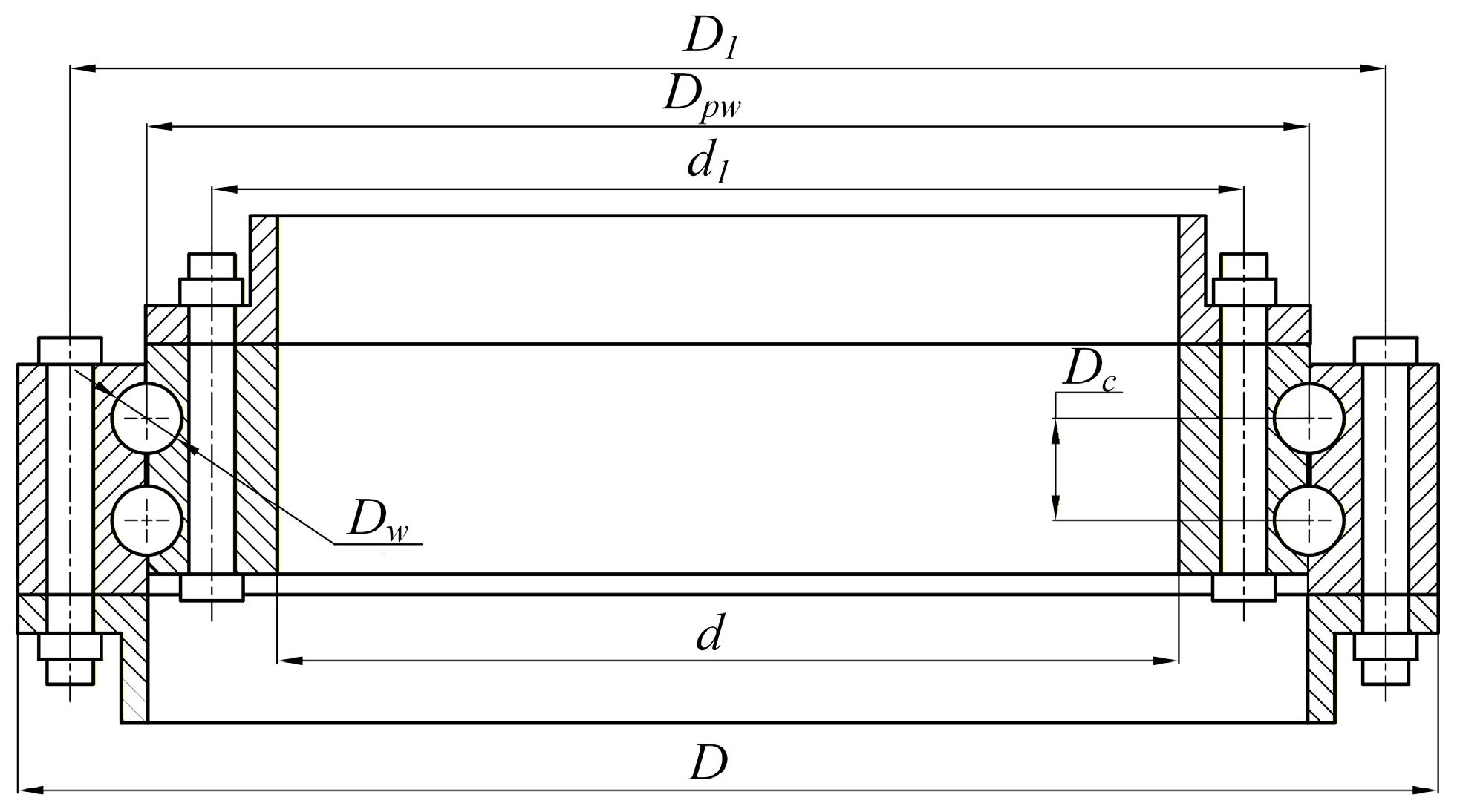
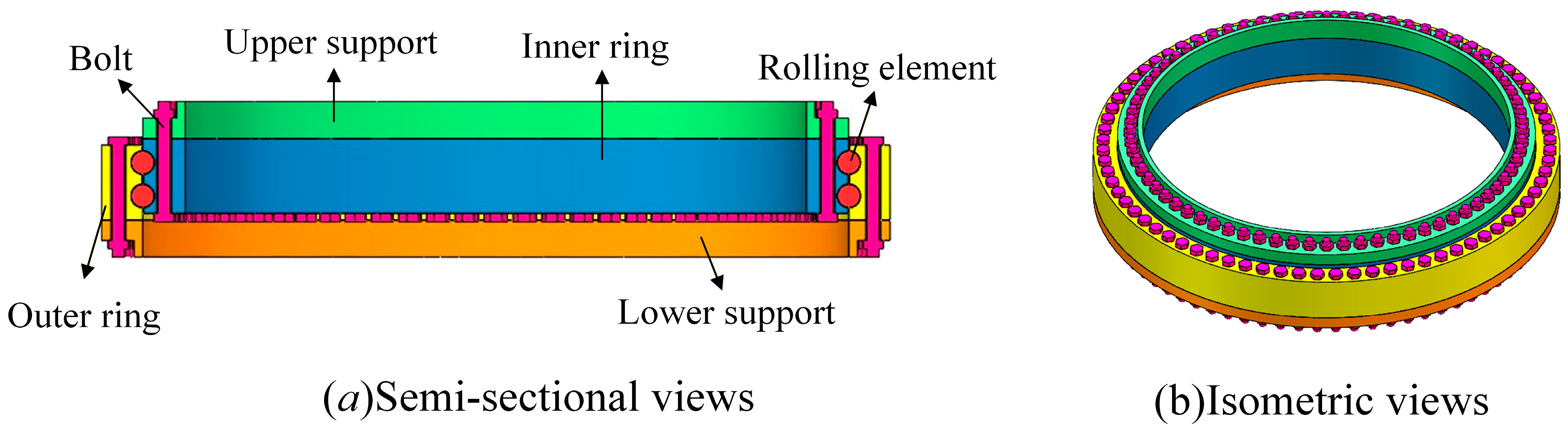
The research object of this paper is a double-row four-point contact ball slewing bearing. The basic structure is shown in
Figure 1, and the 3D model is presented in
Figure 2. The assembly mainly consists of six parts: inner ring, outer ring, rolling elements, bolts, upper support, and lower support. The detailed structural parameters are listed in
Table 1.
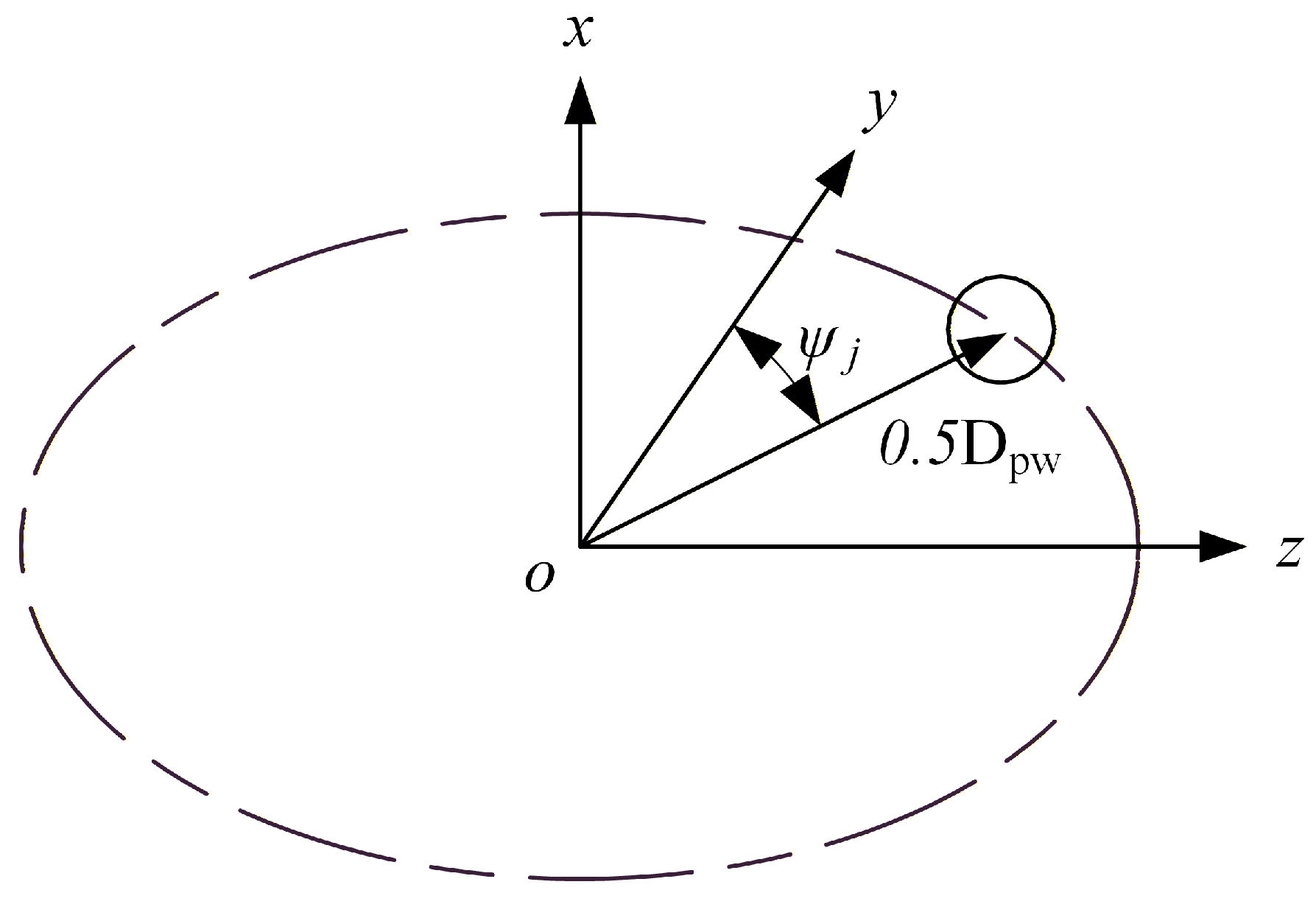
Double-row four-point contact ball slewing bearings are composed of upper and lower two rows of rolling elements and inner and outer raceways. To meet the requirements of load-carrying capacity, the number of rolling elements is usually large, and each rolling element is an independent entity. The position angle of each rolling element can be established through a coordinate system to distinguish them. The specific method is as follows: Take the center of the slewing bearing as the origin to establish a three-dimensional coordinate system. Usually, the axial direction is set as the
x-axis, and the
y-axis or
z-axis as the polar axis, as shown in
Figure 3:
In a row, each rolling element has a corresponding position angle and can be obtained by the formula [
30]:
In the formula, j represents the serial number of each rolling element (j = 1, 2, 3, …, Z), where Z represents the number of rolling elements in a single row, and ψj is the angular position of the j rolling element.
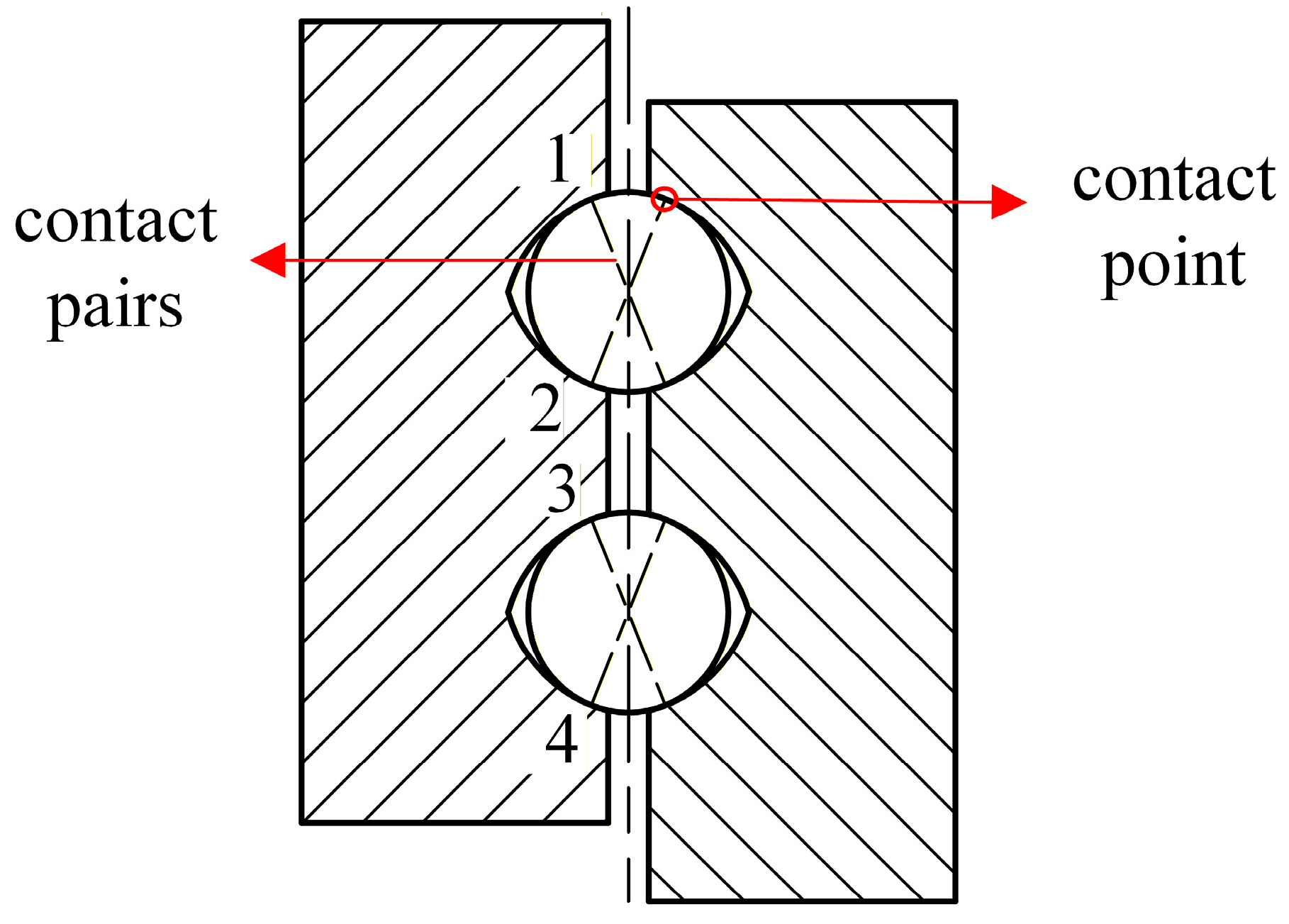
The raceway shape of ball bearings mostly adopts a peach-shaped groove structure. Four independent contact points can be established between the rolling elements and the inner and outer raceways, forming two contact pairs [
31], as shown in
Figure 4:
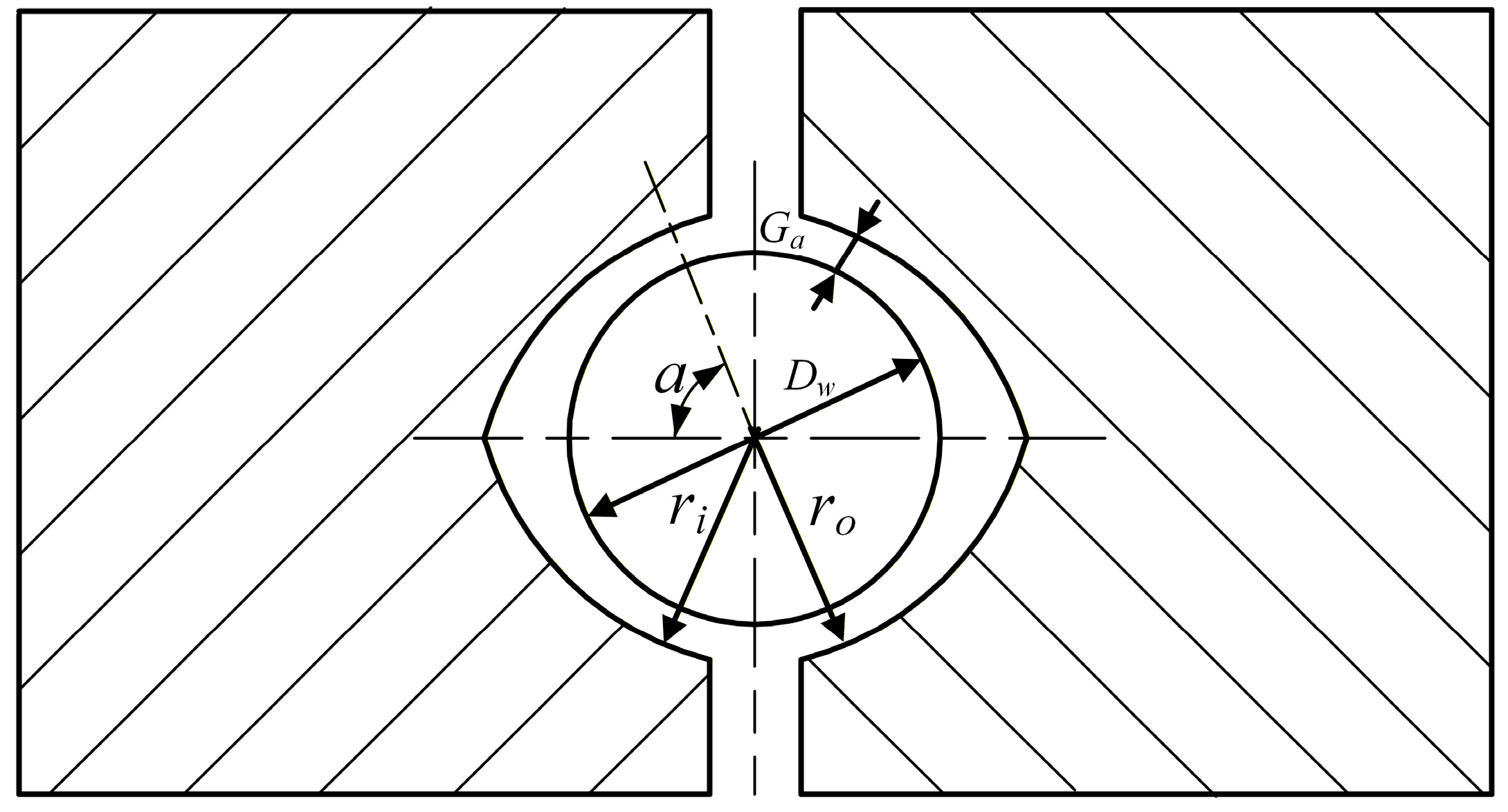
During the installation of slewing bearings, the outer ring is typically mounted on the frame, while the inner ring is connected to the upper rotating component. Due to the fixed outer ring, under the action of combined loads, the inner ring will produce axial, radial and angular displacements relative to the outer ring. The positional and angular changes in the inner ring cause the inner and outer rings to approach each other and squeeze the rolling elements, generating contact loads. The distance between any rolling element and the center of the raceway radius of curvature before loading is
In the formula,
ri and
ro represent the curvature radii of the inner and outer raceways, fi and fo are the curvature radius coefficients of the inner and outer raceways, D
w is the diameter of the rolling elements, G
a is the clearance of the bearing (in this study, a zero clearance is adopted), and α
0 is the contact angle between the rolling elements and the raceways, as shown in
Figure 5:
After loading, the distance between the curvature centers of the inner and outer raceways will cause rigid body displacement, including radial displacement, axial displacement and angular displacement.
After loading, the equivalent axial distance of the inner ring consists of the following three parts:
The equivalent radial distance of the inner ring consists of the following three parts:
Therefore, the equivalent axial distance and equivalent radial distance of the inner ring after loading are
Since the outer ring is fixed on the frame, the displacement of the raceway curvature center is 0. Therefore, the distance between the inner and outer raceway curvature centers after loading is
Based on the actual situation, the distance between the curvature centers of the inner and outer raceways of the upper row after loading is
In the formula, the upper operation sign applies to contact pair 1, and the lower operation sign applies to contact pair 2.
The distance between the curvature centers of the inner and outer raceways of the lower row is
In the formula, the upper operation sign applies to contact pair 3, and the lower operation sign applies to contact pair 4.
δa represents the axial displacement of the inner ring after loading,
δr represents the radial displacement of the inner ring after loading,
θ represents the angular displacement of the inner ring after loading, and
Ri represents the trajectory radius of the inner ring groove curvature center, where
When the inner ring is subjected to a load, it will move relative to the outer ring, and the contact angle between the rolling elements and the raceway will also change. The contact angle of the contact pair
n (
n = 1, 2, 3, 4) after the load change is
In the formula, the upper signs apply to contact pairs 1 and 3, while the lower signs apply to contact pairs 2 and 4.
The contact deformation between the rolling elements and the inner and outer rings is
The relationship between the normal contact load and contact deformation of the rolling elements at different position angles is
In the formula, Kn is defined as the total load–deformation constant between the ball and the inner and outer raceways.
For bearings made of bearing steel:
In the formula, ∑ρi represents the sum of the principal curvatures of the contact point between the steel ball and the inner raceway, ∑ρe represents the sum of the principal curvatures of the contact point between the steel ball and the outer raceway, nδi represents the coefficient related to the principal curvature function F(ρi) of the contact point between the steel ball and the inner raceway, and nδe represents the coefficient related to the principal curvature function F(ρe) of the contact point between the steel ball and the outer raceway.
The mechanical equilibrium equation in the radial direction of the bearing after it is subjected to load is
The mechanical equilibrium equation in the axial direction is
The mechanical equilibrium equation of the overturning moment is
Equations (12)–(14) are three-element nonlinear equations with δa, δr, and θ as unknowns. For a given external load, the Newton–Raphson iterative method can be used to solve the axial displacement, radial displacement, and angular displacement of the inner ring of the bearing.
For ball bearings, the contact type between the rolling elements and the raceways is elliptical point contact, and the maximum contact pressure at the midpoint of the contact surface is
In the formula, ∑ρ represents the principal curvature and function of the contact point between the steel ball and the raceway, na and nb are coefficients related to the difference function of the principal curvatures of the contact points and Qmax is the maximum normal contact load between the rolling element and the inner and outer raceways.
4. The Influence of Bearing Structural Parameters on the Mechanical Properties of Bearings
4.1. Influence of Contact Angle
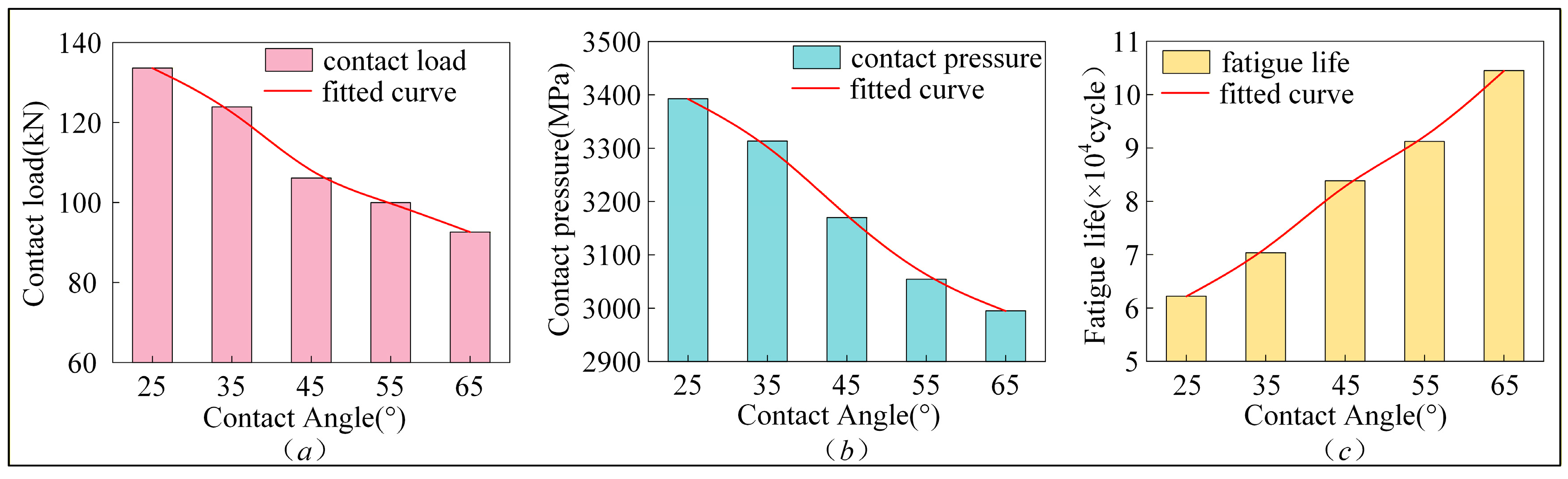
When analyzing the influence of contact angle on the mechanical properties of bearings, keeping other parameters and boundary conditions unchanged, the contact angle was uniformly taken from 25° to 65°. The calculation results are shown in
Figure 15:
As shown in the figure, the contact load and contact pressure gradually decrease with the increase in the contact angle, approximately showing a linear negative correlation, while the fatigue life gradually increases with the increase in the contact angle, approximately showing a linear positive correlation. When the contact angle increased from 25° to 65°, the contact load decreased by 30.7% (41 kN), the contact pressure decreased by 11.7% (397.6 MPa), and the fatigue life increased by 68% (4.23 × 10⁴ cycle).
The main reason for this phenomenon is that when the external load remains constant and the ratio of the radial load to the axial load is small, increasing the contact angle can reduce the component of the axial force in the normal direction of the contact between the rolling elements and the raceway, lower the contact load and contact pressure between the rolling elements and the raceway, and thereby increase the fatigue life. It is worth noting that when the contact angle is too large, the contact ellipse between the rolling elements and the raceway will be truncated [
35], resulting in excessive contact pressure and reduced fatigue life. When designing the mating antennae, edge contact should be avoided.
4.2. Influence of Rolling Element Diameter
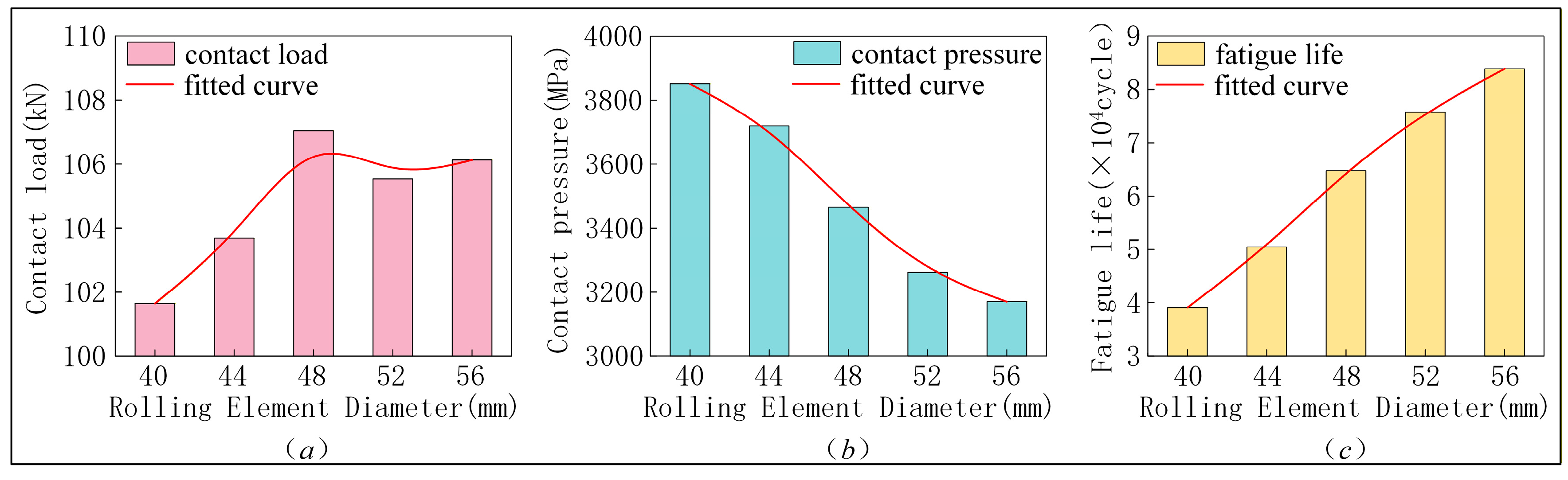
When analyzing the influence of rolling element diameter on the mechanical properties of bearings, keeping other parameters and boundary conditions unchanged, the rolling element diameter was uniformly taken from 40 mm to 56 mm. The calculation results are shown in
Figure 16:
As shown in the figure, the contact load and fatigue life gradually increase with the increase in the diameter of the rolling elements. Among them, the increase rate of the contact load is relatively fast before the diameter of the rolling elements is 48 mm. After the diameter of the rolling elements is 48 mm, although there are fluctuations, the overall trend tends to be stable. Fatigue life approximately shows a linear positive correlation, while contact pressure decreases as the diameter of the rolling elements increases, approximately showing a linear negative correlation. When the diameter of the rolling elements increased from 40 mm to 56 mm, the contact load increased by 4.4% (4 kN), the contact pressure decreased by 17.7% (681.3 MPa), and the fatigue life increased by 115% (4.48 × 10⁴ cycle).
The main reason for this phenomenon is that the external load and contact state have not changed, and the contact load changes little. However, as the diameter of the rolling elements increases, the contact area between the rolling elements and the raceway increases. The increase in the contact area will reduce the contact pressure, thereby increasing the fatigue life. When the diameter of the rolling elements increases, the size of the bearing usually also increases, and the space limitations of the installation position need to be taken into consideration. In addition, when the number of rolling elements remains unchanged, an increase in the diameter of the rolling elements will reduce the distance between the rolling elements and the thickness of the isolation blocks. To ensure the safety and reliability of the bearing operation, the thickness of the isolation blocks should not be too small.
4.3. Influence of Number of Rolling Elements
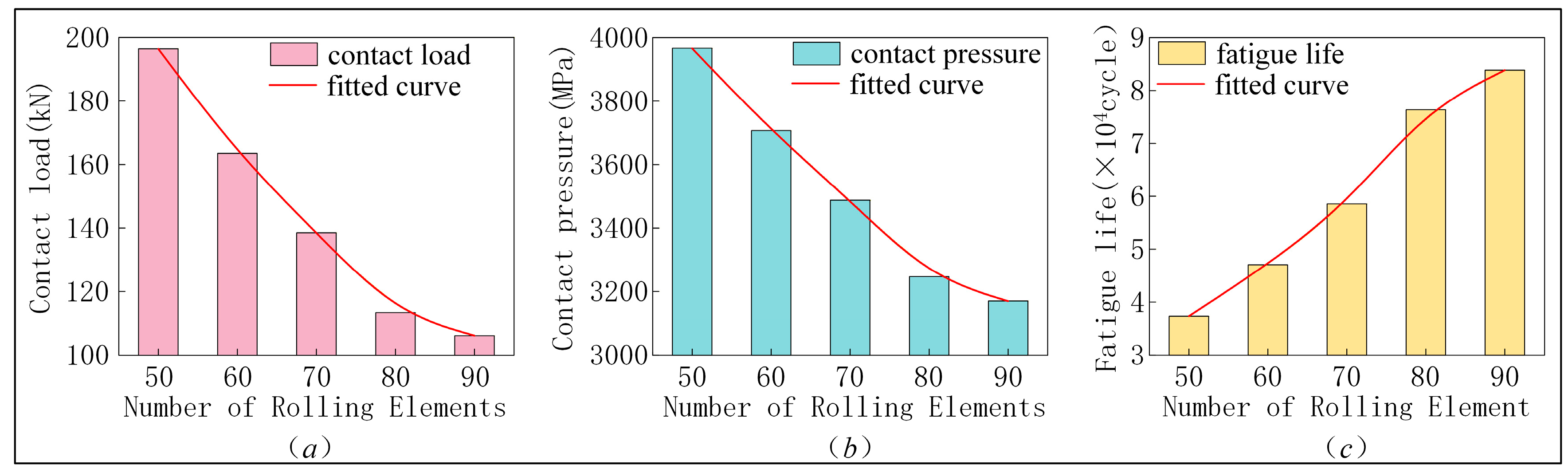
When analyzing the influence of the number of rolling elements on the mechanical properties of bearings, keeping other parameters and boundary conditions unchanged, the number of rolling elements was uniformly taken from 50 to 90. The calculation results are shown in
Figure 17:
As shown in the figure, the contact load and contact pressure gradually decrease with the increase in the number of rolling elements, and the decrease rate is relatively fast before the number of rolling elements reaches 80, and tends to be flat after the number of rolling elements reaches 80. The fatigue life gradually increases with the increase in the number of rolling elements. It approximately shows a linear positive correlation. When the number of rolling elements increased from 50 to 90, the contact load decreased by 46.0% (90 kN), the contact pressure decreased by 20.1% (796.6 MPa), and the fatigue life increased by 125% (4.65 × 10⁴ cycle).
The main reason for this phenomenon is that when the number of rolling elements increases, the number of rolling elements bearing the load also increases, and the load allocated to each individual rolling element decreases, resulting in a reduction in contact load and contact pressure, thereby enhancing fatigue life. Similarly, when the diameter of the rolling elements remains unchanged, increasing the number of rolling elements will also reduce the spacing between the rolling elements and the thickness of the isolation blocks.
4.4. Influence of Raceway Curvature Radius Coefficient
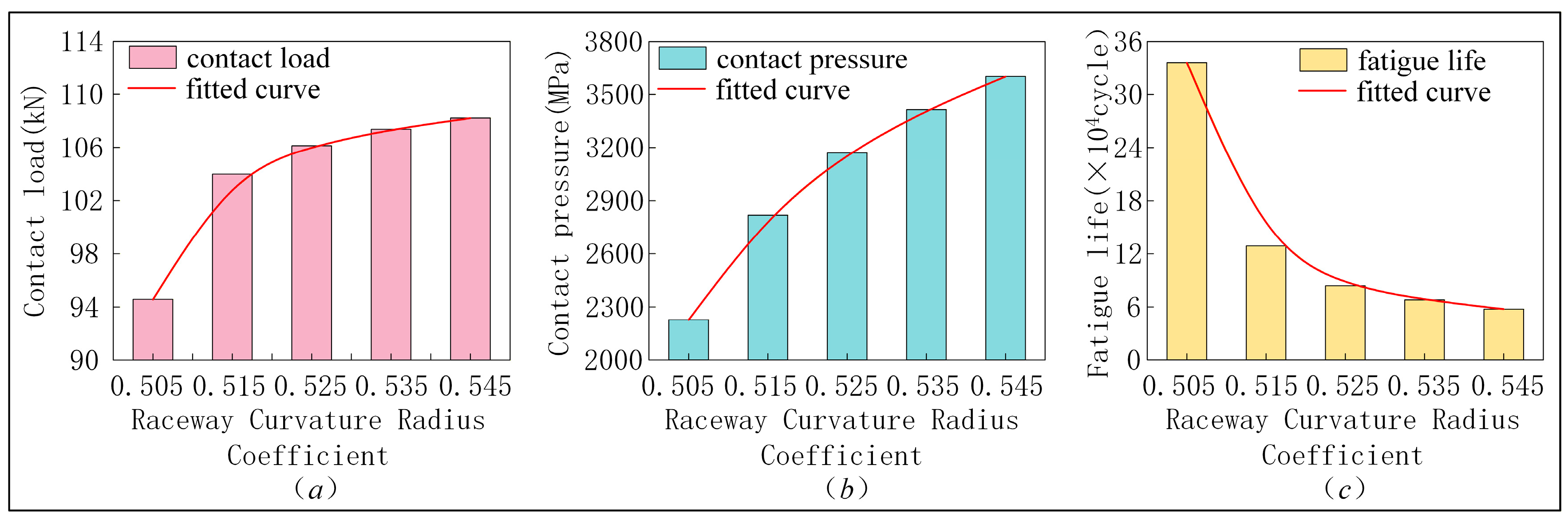
For the convenience of processing, the curvature radius coefficients of the inner and outer raceways of slewing bearings usually adopt the same value. When analyzing the influence of the curvature radius coefficient of the raceways on the mechanical properties of the bearings, keeping other parameters and boundary conditions unchanged, the curvature radius coefficients of the inner and outer raceways are uniformly taken from 0.505 to 0.545 simultaneously. The calculation results are shown in
Figure 18:
As shown in the figure, the contact load and contact pressure gradually increase with the increase in the raceway curvature radius coefficient, and the increasing rates both show a decreasing trend. This phenomenon of contact load is more obvious, and the fatigue life gradually decreases with the increase in the raceway curvature radius coefficient. The reduction degree is relatively large before the raceway curvature radius coefficient is 0.515. When the raceway curvature radius coefficient increased from 0.505 to 0.515, the contact load increased by 14.4% (14 kN), the contact pressure increased by 61.7% (1374.8 MPa), and the fatigue life decreased by 83% (27.9 × 10⁴ cycle).
The main reason for this phenomenon is that, as the radius of curvature coefficient of the raceway increases, the fit between the rolling elements and the raceway decreases and the contact area reduces, which leads to an increase in contact load and contact pressure and a decrease in fatigue life. Reducing the raceway curvature radius coefficient is beneficial for enhancing the load-bearing capacity, but it will increase the frictional torque between the rolling elements and the raceway.
4.5. Sensitivity Analysis of Bearing Structural Parameters on Mechanical Performance
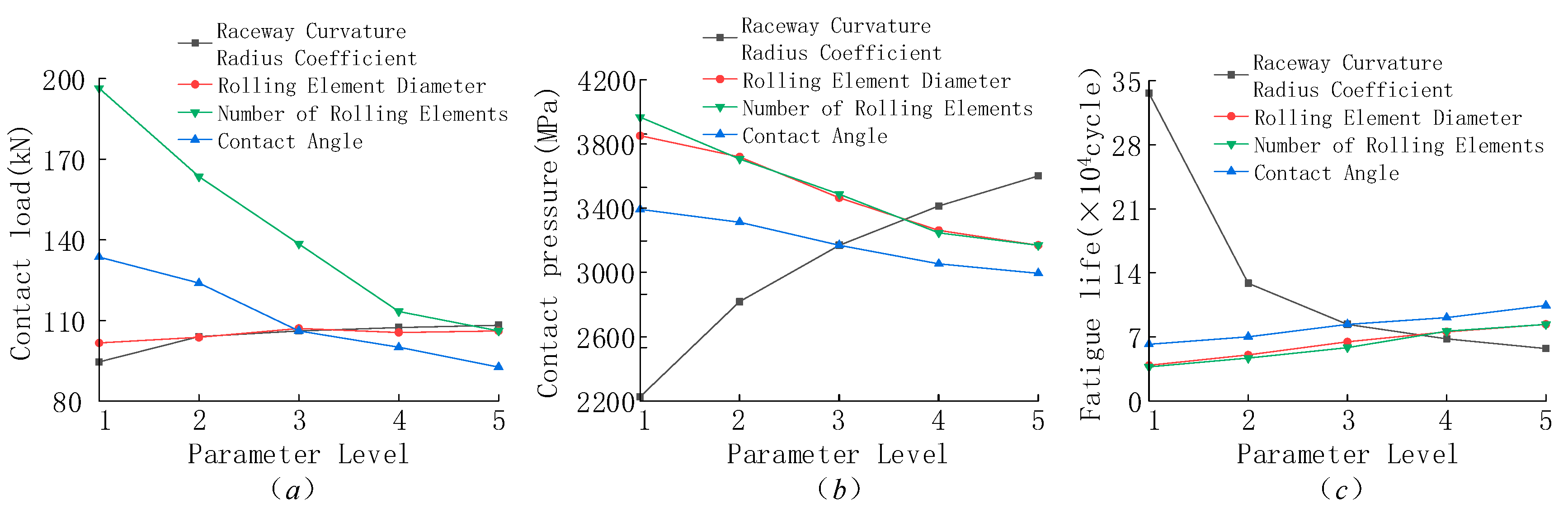
In the previous content, the influence of four bearing structural parameters on their mechanical properties has been analyzed. Each influencing factor has five values. By numbering the five values of each influencing factor from 1 to 5, a single horizontal coordinate can be used to replace the original four horizontal coordinates. The sensitivity curve of the bearing structure parameters to its contact load, contact pressure and fatigue life is shown in
Figure 19. As can be seen from
Figure 19a, the sensitivity of the bearing structure parameters to its contact load, from largest to smallest, is the number of rolling elements, contact angle, raceway curvature radius coefficient and rolling element diameter. As can be seen from
Figure 19b, the sensitivity of the bearing structure parameters to its contact pressure, from largest to smallest, is the raceway curvature radius coefficient, the number of rolling elements, the diameter of the rolling elements, and the contact angle. As can be seen from
Figure 19c, the sensitivity of bearing structural parameters to its fatigue life, from largest to smallest, is the raceway curvature radius coefficient, the number of rolling elements, the diameter of the rolling elements, and the contact angle.
5. Influence of Bolt Parameters on the Mechanical Properties of Bearings
During the process of the bearing loads, the main function of the outer bolt is to fix the outer ring of the bearing to the lower support, and it does not have a significant impact on the transmission of the load. Therefore, it is only necessary to analyze the inner ring bolt.
5.1. Influence of Number of Bolts
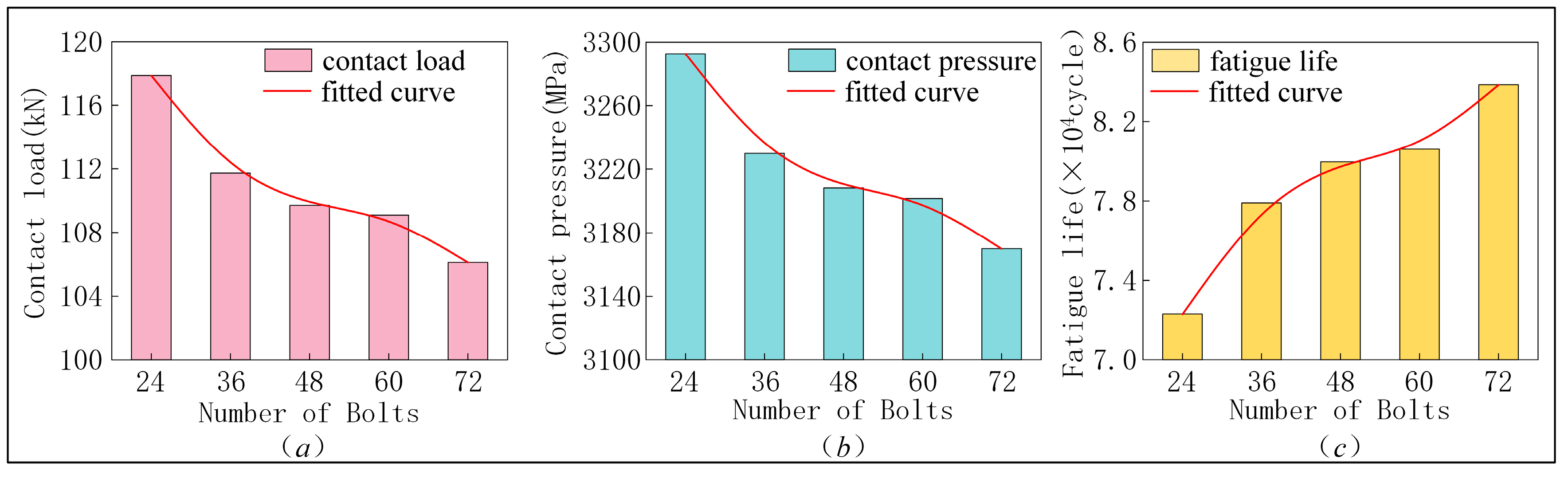
When analyzing the influence of the number of bolts on the mechanical properties of bearings, keeping other parameters and boundary conditions unchanged, the number of inner ring bolts was uniformly taken from 24 to 72. The calculation results are shown in
Figure 20:
As shown in the figure, the contact load and contact pressure decrease with the increase in the number of bolts, and the rate of decrease is relatively fast before the number of bolts reaches 36. The fatigue life also increases with the increase in the number of bolts, and the rate of increase is relatively fast before the number of bolts reaches 36. When the number of bolts increased from 24 to 72, the contact load decreased by 10.0% (12 kN), the contact pressure decreased by 3.7% (122.8 MPa), and the fatigue life increased by 16% (1.15 × 10⁴ cycle).
The main reason for this phenomenon is that when the preload of a single bolt remains unchanged, increasing the number of bolts will increase the overall preload of the bolts, resulting in greater deformation of the inner and outer rings and a more uniform load distribution. Reduce the maximum load and contact pressure, and increase the fatigue life.
5.2. Influence of Bolt Preload
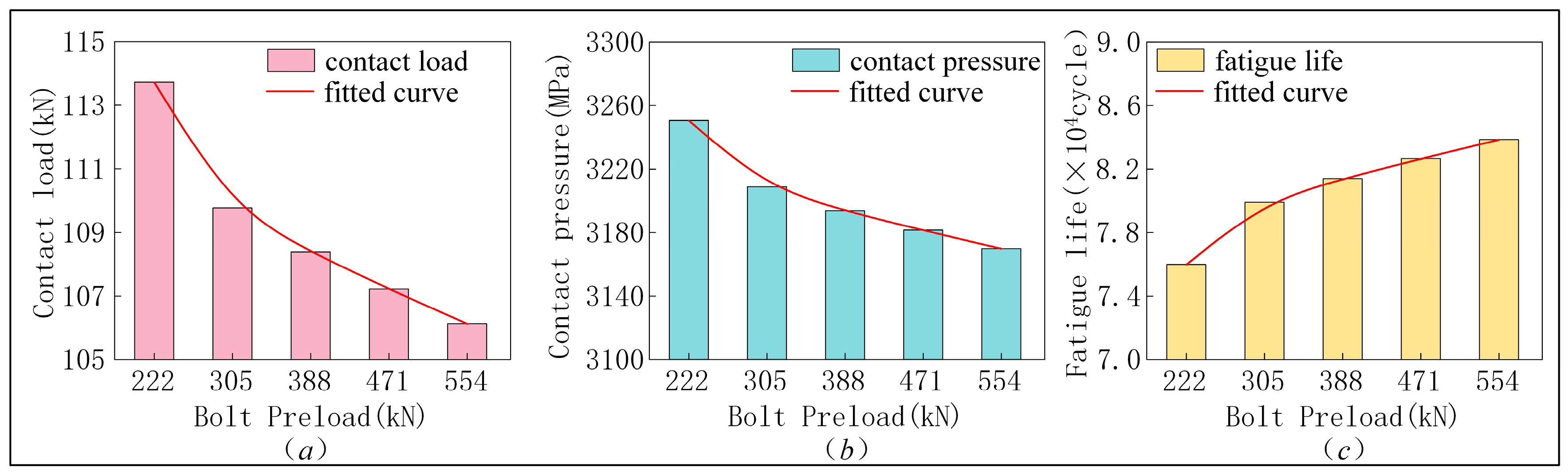
When analyzing the influence of bolt preload on the mechanical properties of bearings, keeping other parameters and boundary conditions unchanged, the preload of the inner ring bolts was uniformly taken from 222 kN to 554 kN. The calculation results are shown in
Figure 21:
As shown in the figure, the contact load and contact pressure decrease with the increase in the bolt preload. The fatigue life gradually increases with the increase in the bolt preload. When the bolt preload increased from 222 kN to 554 kN, the contact load decreased by 6.7% (8 kN), the contact pressure decreased by 2.5% (80.7 MPa), and the fatigue life increased by 10% (0.80 × 10⁴ cycle).
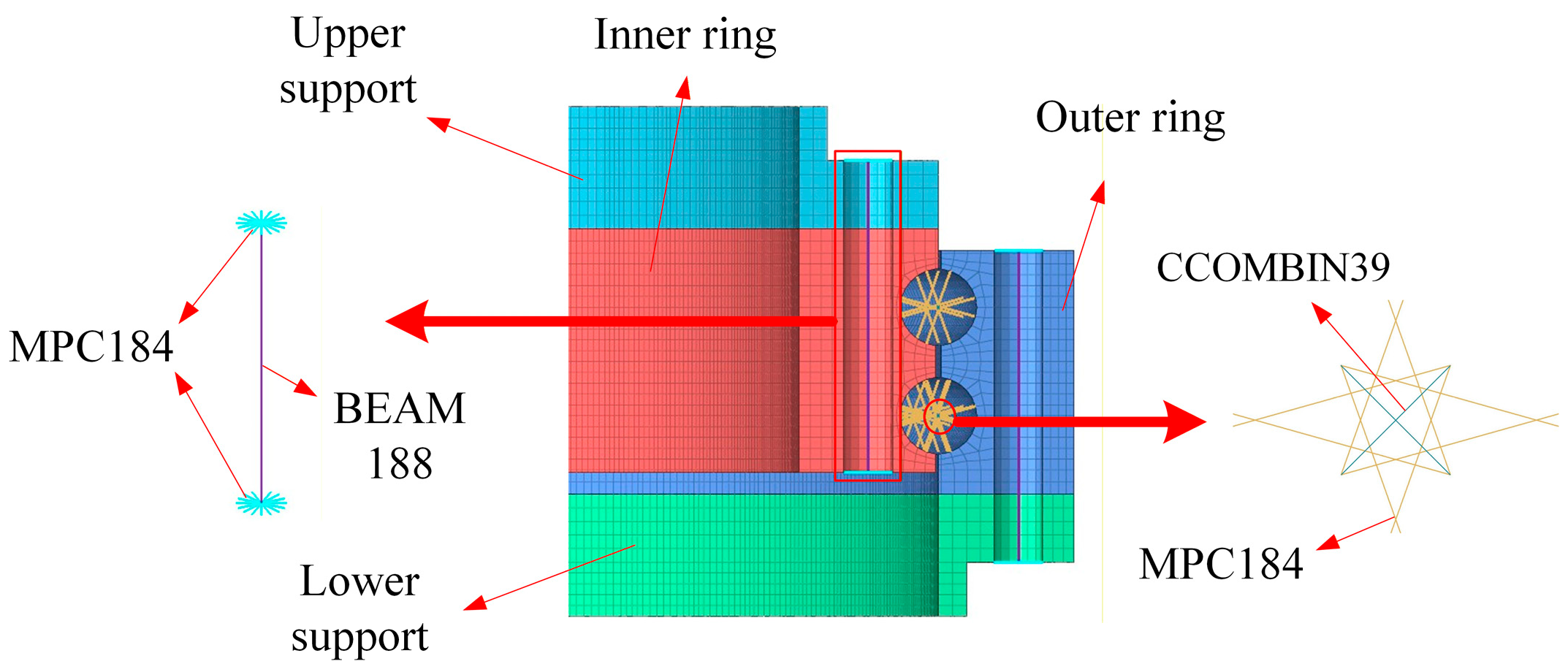
The main reason for this phenomenon is that during the process of tightening the bolts, a squeezing effect is exerted on the inner and outer rings, causing the raceway to deform. The deformation is transmitted to the nonlinear spring through the rigid rod, resulting in the deformation of the nonlinear spring unit. The load is transmitted to the inner ring of the bearing through bolts. Under the action of external loads, the preload of the bolts will offset part of the external loads, reducing the load transmitted to the bearing, the maximum load and contact pressure, and increasing the fatigue life.
5.3. Influence of Shim Thickness
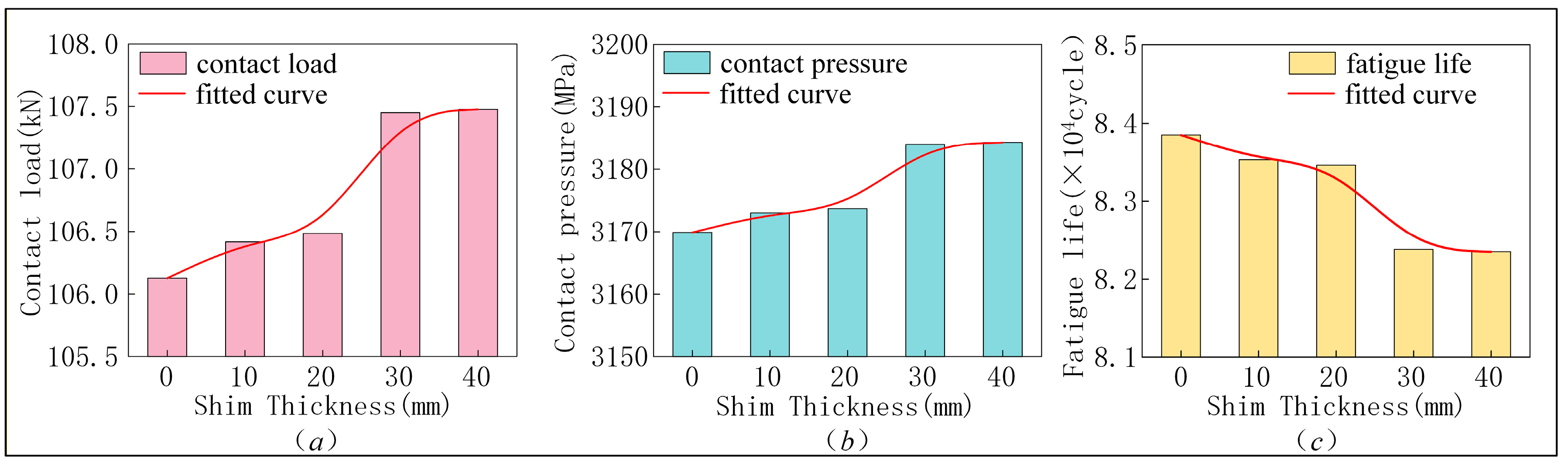
When analyzing the influence of gasket thickness on the mechanical properties of bearings, keeping other parameters and boundary conditions unchanged, the thickness of the inner ring gasket was uniformly taken from 0 mm to 40 mm. The calculation results are shown in
Figure 22:
As shown in the figure, the contact load and contact pressure increase with the increase in gasket thickness, while the fatigue life decreases with the increase in gasket thickness. The variation ranges are all relatively small. When the gasket thickness increased from 0 mm to 40 mm, the contact load increased by 1.3% (1.4 kN), the contact pressure increased by 0.5% (14.4 MPa), and the fatigue life decreased by 1.8% (0.15 × 10⁴ cycle).
The main reason for this phenomenon is the presence of gaskets, which prevent the bolt preload from being fully applied to the inner and outer rings of the bearing. The gaskets disperse the preload, resulting in an increase in the contact load of the bolts. In the connection of bearings, the main function of gaskets is to disperse the pressure generated by bolts, making the force on the surface of the supporting structure more uniform and thereby enhancing the stability of the connection.
5.4. Sensitivity Analysis of Bolt Parameters on Bearing Mechanical Properties
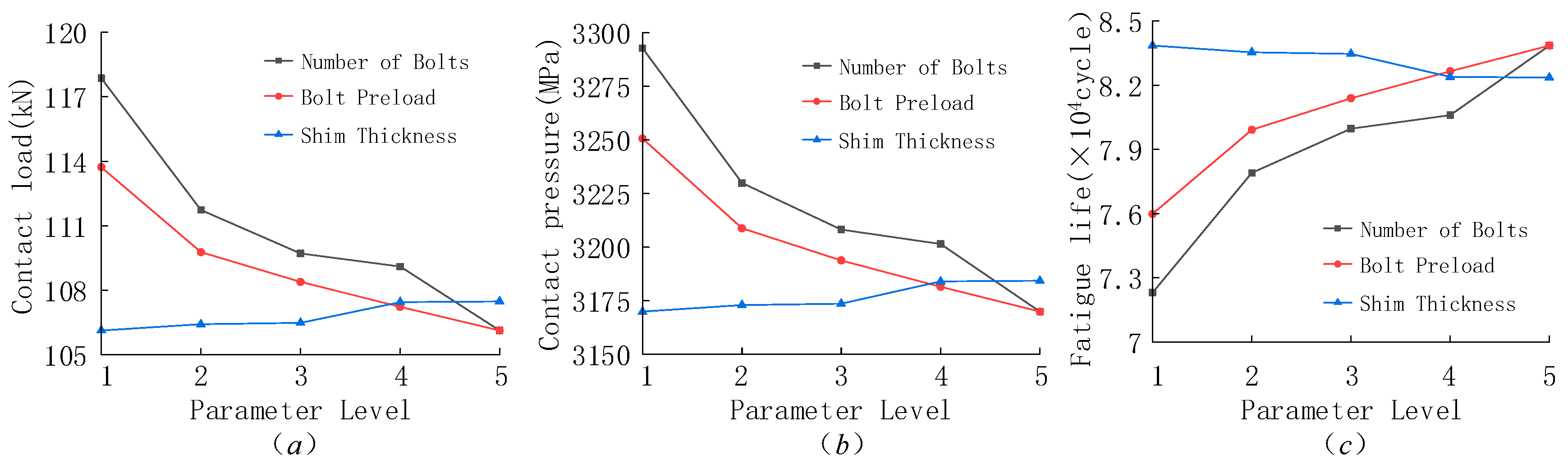
Here, the same method is adopted to number the five values of each influencing factor of the three bolt parameters from 1 to 5, and the sensitivity curves of the bolt parameters to the bearing contact load, contact pressure and fatigue life are obtained, as shown in
Figure 23. As can be seen from
Figure 23a, the sensitivity of bolt parameters to the contact load of the bearing, from largest to smallest, is the number of bolts, the bolt preload, and the thickness of the gasket. As can be seen from
Figure 23b, the sensitivity of bolt parameters to the contact pressure of the bearing, from largest to smallest, is the number of bolts, the bolt preload, and the thickness of the gasket. As can be seen from
Figure 23c, the sensitivity of bolt parameters to the fatigue life of bearings, from largest to smallest, is the number of bolts, bolt preload, and gasket thickness.