


Abstract
Bolted joints are extensively used in a wide range of industrial and commercial structures, making their condition monitoring essential for ensuring structural integrity and operational safety. Under the influence of vibration, cyclic loading, and environmental factors, bolts may gradually lose preload, which can degrade joint stiffness and eventually lead to structural failure. To address this issue, this study presents a smart percussion system developed on a Raspberry Pi platform that integrates acoustic signal acquisition, real-time signal processing, and visualization of diagnostic results. A bolt looseness detection strategy combining audio feature extraction with unsupervised learning is proposed. In contrast to traditional percussion-based approaches that depend on supervised learning and predefined baseline datasets, the proposed method does not require prior reference data, significantly improving its adaptability and ease of deployment across different structures, which shows essential practical significance. Experimental investigations demonstrate the effectiveness and advantages of the proposed system, indicating its strong potential to enhance percussion-based bolt looseness detection and to support real-time structural health monitoring, which are real-world engineering applications.
1. Introduction
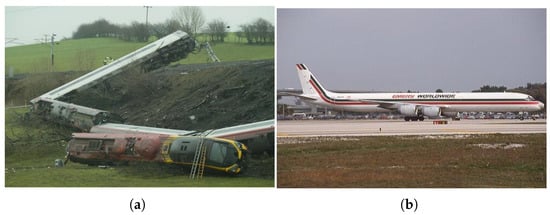
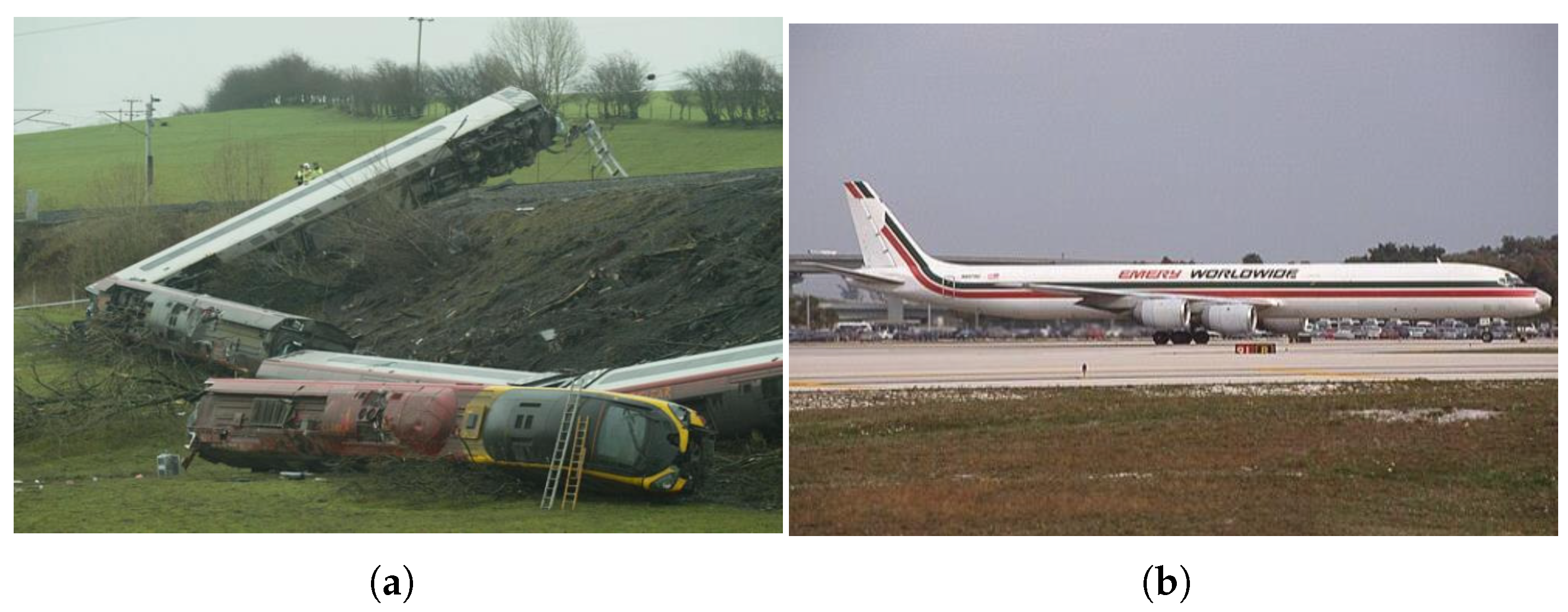
Bolted joints are extensively employed in a wide range of engineering structures. However, the clamping force provided by bolts can gradually diminish with service time. This degradation is often intensified by dynamic excitation such as mechanical vibrations, as well as by nonuniform or cyclic loading conditions acting on the joint. Failure to identify and address bolt loosening at an early stage may result in serious structural safety issues, potentially leading to catastrophic outcomes such as infrastructure malfunction, structural collapse, and threats to human life. For instance, as depicted in Figure 1, (a) a fatal railway accident happened in the North West England region of the United Kingdom in 2007 [1], and the reason was missing bolts and nuts (due to looseness) of stretcher bars that led to the loss of gauge separation, and (b) a Douglas DC-8 cargo plane’s deadly crash [2] occurred in 2000 at Mather Airport in Sacramento, California, and the accident investigation revealed that the reason should be attributed to the right elevator control tab crank fitting that had a loosening bolt caused by improper securing. Consequently, the long-term assessment and detection of bolt loosening is a critical requirement for ensuring structural integrity and operational safety.
Figure 1.
Accidents caused by bolt looseness: (a) Grayrigg derailment in 2007. (b) Emery Flight 17 crash in 2000.
Presently, in practical engineering applications, the most widely adopted approach to assess bolt looseness is manual inspection using a torque wrench [3,4]. However, this procedure is labor-intensive and time-consuming, making it unsuitable for frequent or large-scale monitoring tasks. The method typically relies on applying reference marks to the bolt and observing any subsequent angular displacement during inspection. Such an approach is inherently limited in its ability to identify incipient loosening, as measurable bolt rotation typically occurs only after a substantial reduction in preload has already taken place. Therefore, some significant research effort has been devoted to the development of alternative structural health monitoring techniques for bolted connections. A broad range of approaches [5] based on piezoelectric transducers has been investigated, including the vibration-based method [6], the electro-mechanical impedance-based (EMI) method [7,8], active sensing technique [9,10], vibration-based monitoring strategy [11], and wave-based approaches such as acousto-ultrasonic [12,13,14] and ultrasonic techniques [15].
Despite the diversity of the aforementioned bolt looseness monitoring techniques, each approach is accompanied by notable limitations. For instance, the EMI methods exhibit high sensitivity to variations in environmental and boundary conditions, which restricts their practical deployment. The active sensing approach and technique relying on piezoelectric transducers typically requires permanent sensor installation and ongoing maintenance, increasing system complexity and operational costs. In contrast, vibration-based monitoring strategies are generally better suited for global structural assessment and are less effective for identifying localized defects such as individual loosened bolts. Although ultrasonic techniques can be effective under certain conditions, their sensitivity to early-stage bolt loosening remains limited. Recently, the vision-based method [16,17] has been developed to detect bolt looseness with several advantages such as a contactless format and low cost, while this approach is insensitive to early looseness and requires external markers on the bolt structure that need to be inspected. Overall, many of the currently available structural health monitoring methods are either challenging to implement for monitoring individual bolted connections or dependent on continuous sensing hardware, making them costly and impractical for widespread field applications.
Aiming to remedy the drawbacks of the currently available structural health monitoring methods for bolt looseness monitoring, some scholars have proposed the percussion-based method [18,19,20], the concept of which is founded on the premise that the mechanical condition of a structure can be inferred from its acoustic response to an external impact [21]. In this approach, a structure is excited using a simple impact source, such as a hammer, and the resulting sound signal is recorded for analysis. The acquired acoustic data are then processed to extract representative features [22,23,24,25] that characterize the dynamic response of the structure. These features serve as inputs to supervised machine learning (ML) or deep learning (DL) models [26,27,28,29], which are designed to identify deviations from nominal behavior [30,31]. When applied to bolted connections, the method aims to distinguish between different bolt tightness conditions, thereby enabling the assessment of bolt looseness across varying torque levels [32,33].
Based on the preceding discussion, it can be observed that the percussion-based approach offers notable advantages as a portable and low-cost technique, particularly for applications in which continuous monitoring is not required. However, existing studies on percussion-based bolt assessment have predominantly relied on supervised learning models [34,35] to classify bolt tightness levels. While these supervised approaches have demonstrated high classification accuracy in experimental settings, their practical deployment in field conditions presents several challenges. A primary limitation is the need for application-specific reference data, as supervised algorithms require baseline measurements obtained under known torque conditions. In practice, this necessitates either the availability of pre-existing baseline data or the generation of new reference datasets for each structure. Furthermore, current works mainly focus on feature extraction and recognition of audio signals rather than real-time detection; i.e., there is a lack of research focusing on exploring low-cost hardware that enables the implementation of the percussion-based approach for bolt looseness detection portably. Therefore, in this paper, a new smart percussion system embedded on a Raspberry Pi is developed, and the main contributions and innovations are listed as follows:
- 1.
- A new smart percussion system that integrates audio signal acquisition, data processing algorithms, and display of detection results is developed. This system can be employed to portably detect bolt looseness in real time with low costs.
- 2.
- In terms of data processing algorithms, a new strategy that combines audio feature extraction and unsupervised learning is proposed for bolt looseness detection. Compared to current percussion-based approaches that depend on supervised learning, this strategy does not require a baseline set of data, making it easier to perform maintenance on various commercial structures.
The remaining sections of this paper are as follows. The proposed system and methodology are introduced in Section 2, and the experimental setup is discussed in Section 3. The results and discussion are given in Section 4, and the conclusions, as well as recommendations for future work, are summarized in Section 5.
2. The Proposed System and Methodology
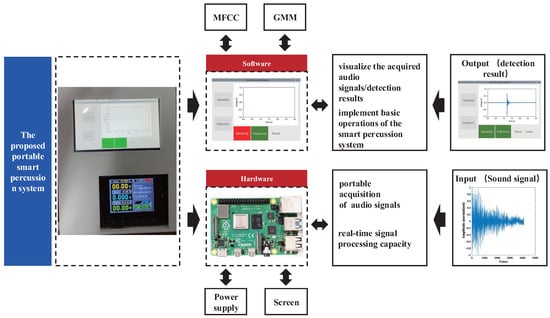
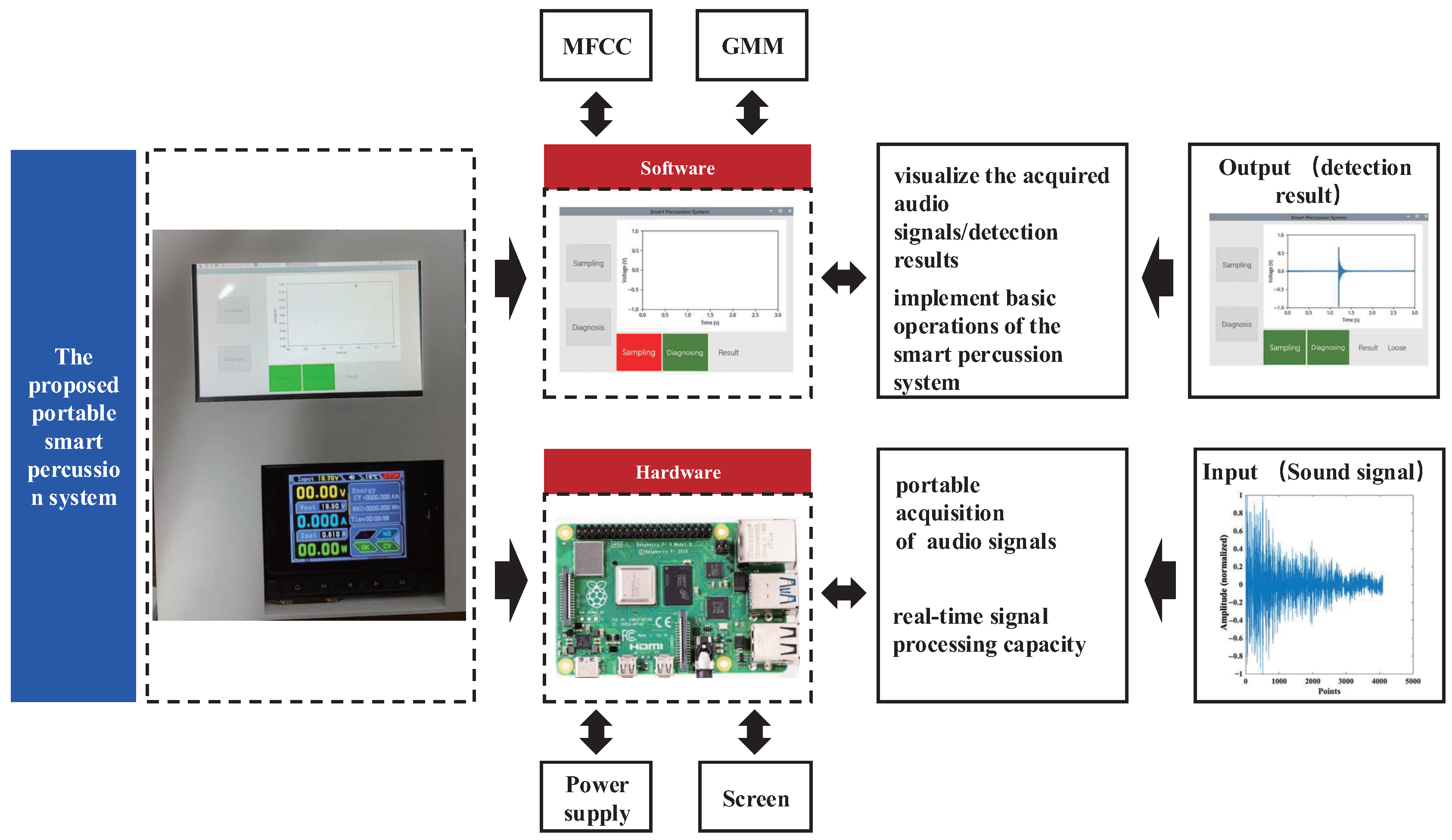
As shown in Figure 2, having the percussion method as the main core, the development of the proposed portable smart percussion system comprises two parts: hardware and software. The main objective of this proposed system is an attempt to solve several issues that current percussion approaches face, such as portable acquisition of audio signals with desirable accuracy and real-time signal processing capacity, i.e., feature extraction and classification (looseness detection). Moreover, this system should possess the necessary functions, including start/stop of audio collection and processing, as well as data storage for post-processing of historical signals. Finally, a GUI interface should be installed on the proposed portable smart percussion system, which can be used to visualize the acquired audio signals/detection results and implement basic operations of the smart percussion system.
Figure 2.
Illustration of the proposed system and methodology.
2.1. Hardware
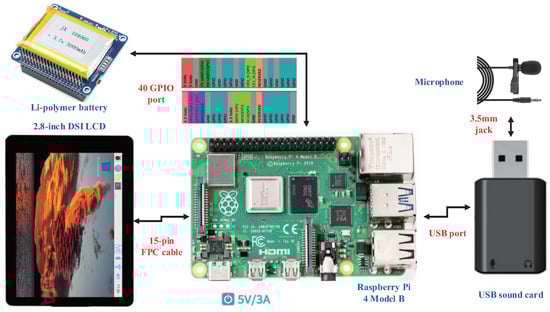
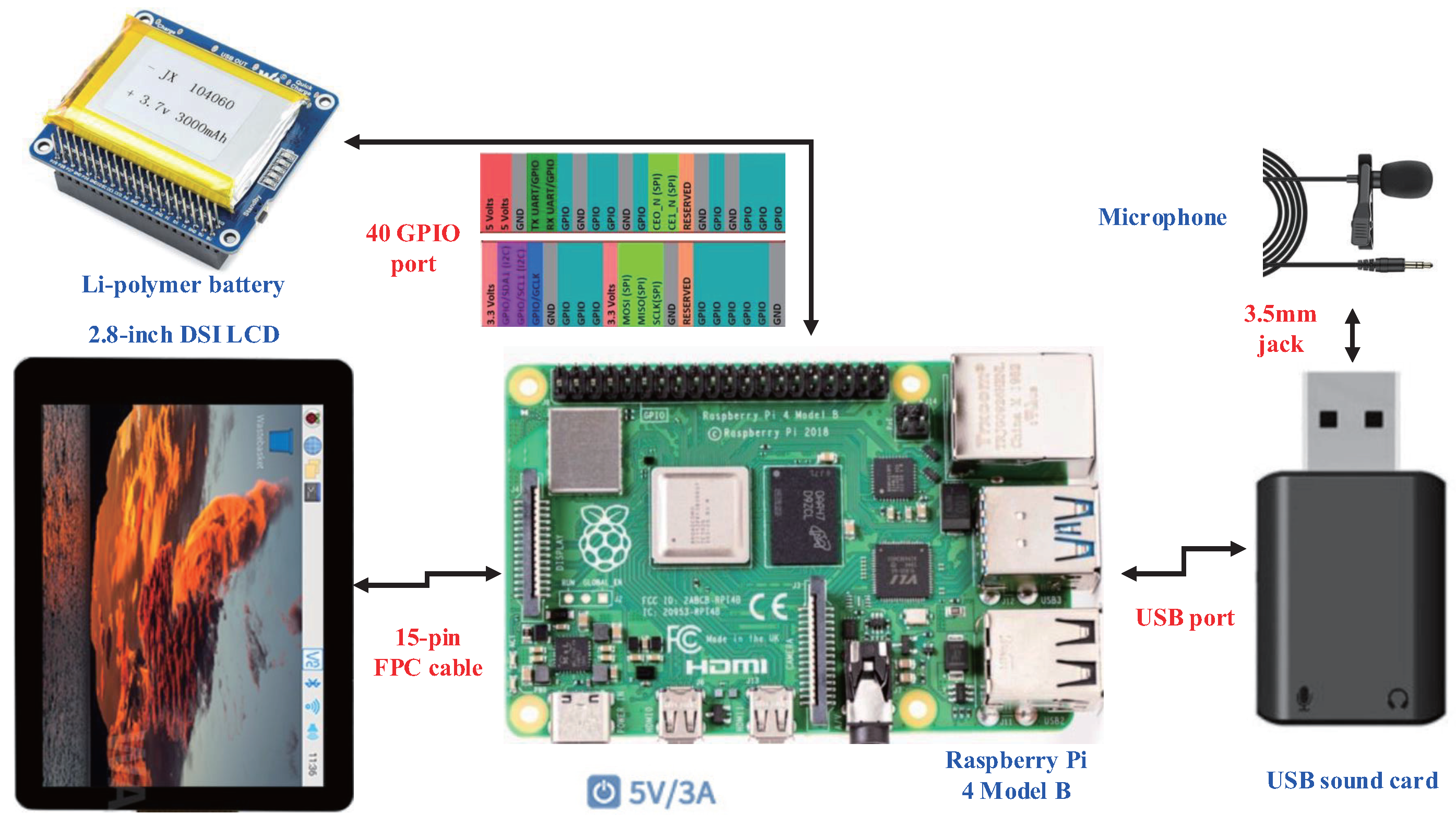
As shown in Figure 3, this section outlines the hardware implementation of the proposed smart percussion system. A Raspberry Pi 4 Model B is employed as the core processing unit due to its enhanced computational capability and compact single-board design, and it offers a favorable balance between performance, size, and cost, making it suited for portable applications.
Figure 3.
Component and architecture of the system’s hardware.
The Raspberry Pi platform offers a flexible and multifunctional environment, featuring a set of 40 programmable general-purpose input/output (GPIO) pins, as well as multiple USB interfaces. These resources enable synchronized data collection from various types of sensors. In this study, a microphone (TCM-400, TAKSTAR, Huizhou, China) is interfaced with the Raspberry Pi 4 Model B via a USB sound card (BY-EA2, BOYA, Shenzhen, China), with audio measurements (with a sampling rate of 48 kHz) acquired and managed in real time using the onboard central processing unit in conjunction with the available random access memory (RAM). This integrated hardware architecture enables efficient data storage and processing, supporting the reliable operation of the proposed smart percussion system. Moreover, a 2.8-inch DSI capacitive touchscreen (2.8-inch DSI LCD, Waveshare, Shenzhen, China) was connected to the Raspberry Pi 4 Model B (Raspberry Pi Ltd, Cambridge, UK) through a 15-pin Flexible Printed Circuit (FPC) cable, enabling the exhibition of the GUI application. Finally, the proposed smart percussion system was powered by a Li-polymer Battery HAT (SW6106, Waveshare), which was connected to the Raspberry Pi 4 Model B via the 40 GPIO port. All aforementioned components are covered in a customized plastic case made by the three-dimensional (3D) printing technique.
2.2. Software
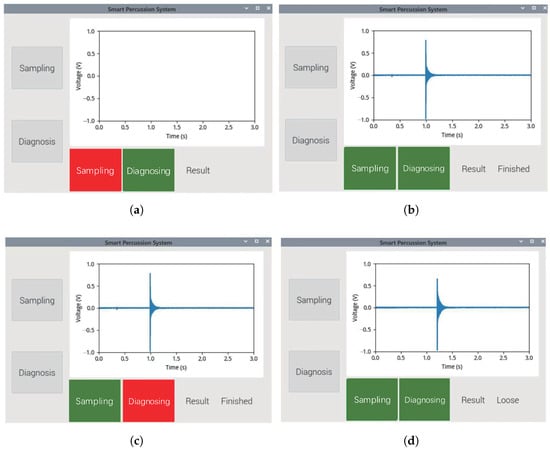
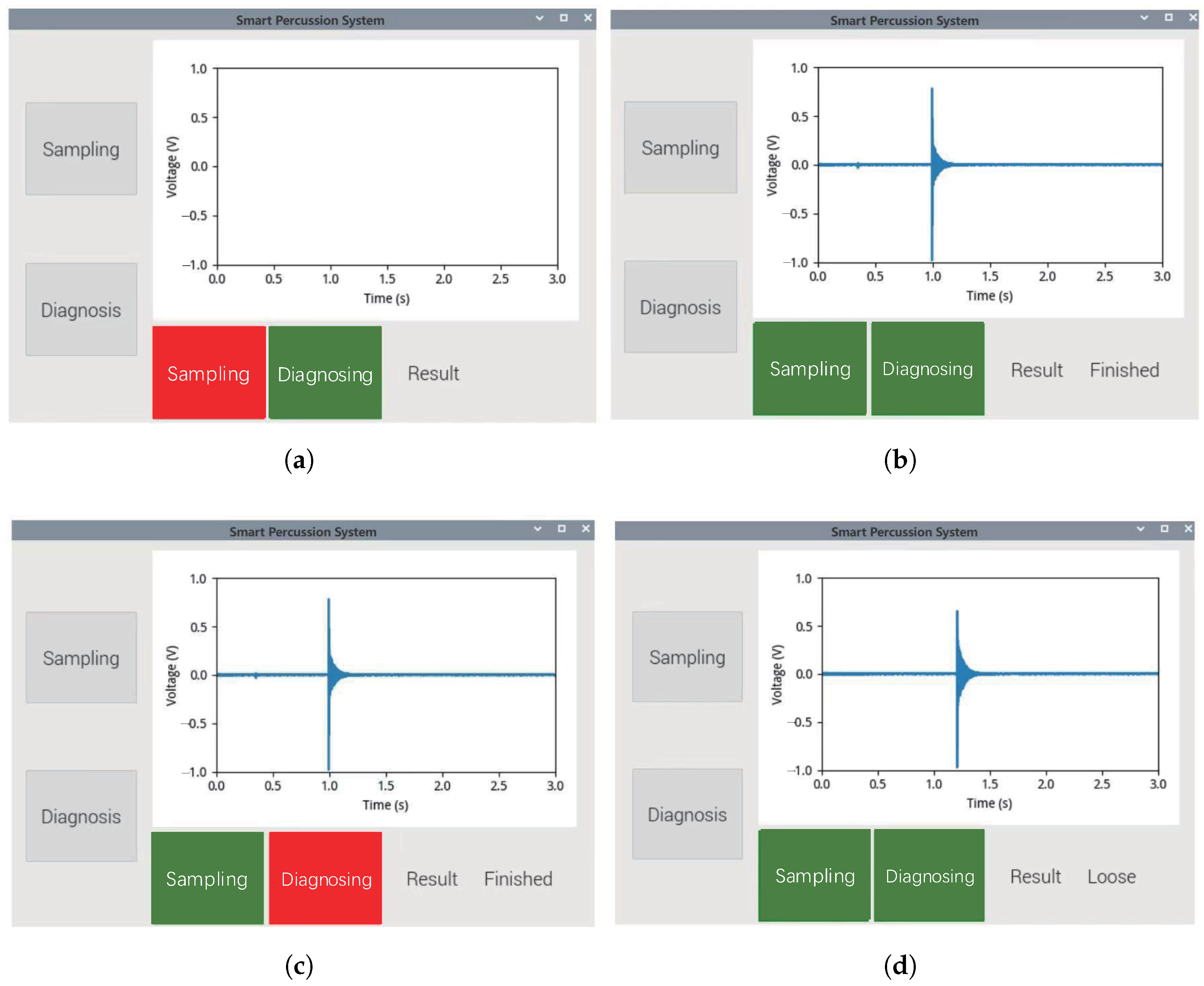
This section presents the software implementation of the proposed smart percussion system. The system is developed using an open-source Python 3.9.0 environment, which supports real-time data acquisition, storage, and processing. To facilitate the operation and visualization of the measured audio signals and detection results, a graphical user interface (GUI), illustrated in Figure 4, is implemented based on the Python PyQt library. The developed GUI allows users to implement basic operations of the smart percussion system. For instance, the audio signal collection is initiated when the “Sampling” button is activated, and the status bar of “Sampling” turns red. Then, the status bar of “Sampling” turns green after the audio signal collection is completed, and the result column will display “Finished”. Subsequently, the detection procedure is activated by clicking the “Diagnosis” button, with the “Diagnosing” status bar turning red. Finally, when the status bar of “Diagnosing” turns green, it means that the detection procedure is finished, and the diagnosis result will be given in the result column.
Figure 4.
GUI designed for the smart percussion system: (a) The audio signal collection is initiated. (b) The audio signal collection is completed. (c) The detection procedure is activated. (d) The detection procedure is finished, and the result is given.
Particularly, owing to the sufficient computational capability of the Raspberry Pi 4, the frequency-domain feature extraction of the audio signals and bolt looseness detection is accomplished by a new strategy that combines audio feature extraction (Mel-frequency cepstral coefficients, MFCCs) and unsupervised learning (Gaussian mixture model, GMM) performed onboard to obtain results. Moreover, all acquired audio signals are saved in comma-separated values (CSV) format and stored locally in the 64 GB flash memory of the Raspberry Pi, ensuring reliable data management and accessibility.
2.2.1. MFCC
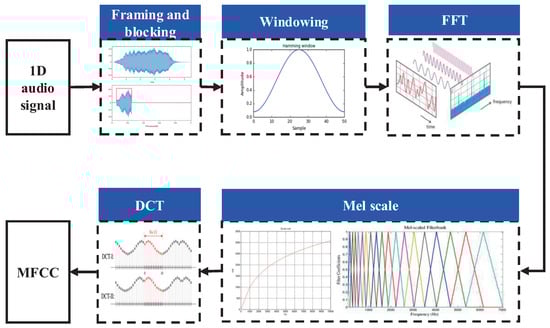
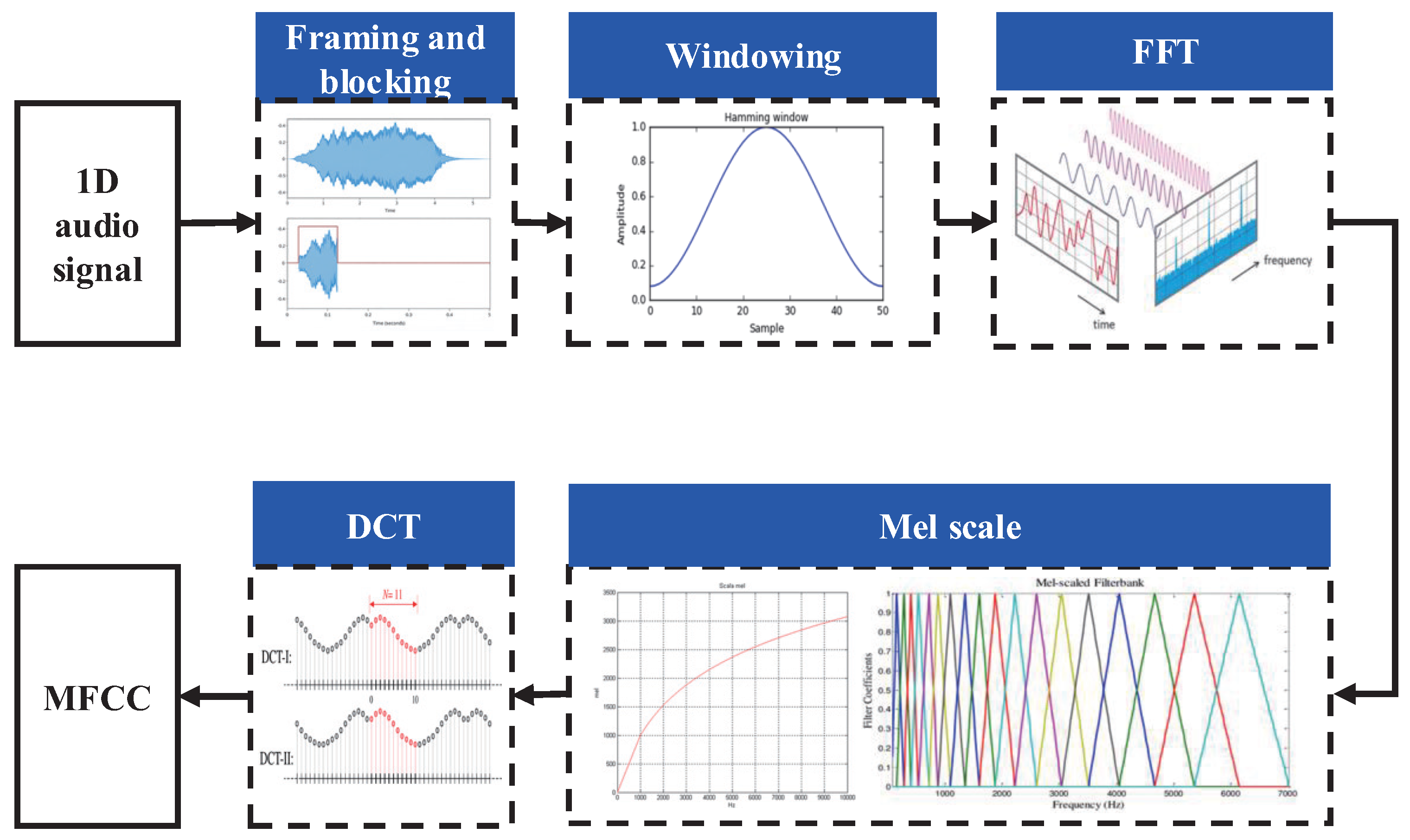
In this paper, after obtaining audio signals derived from tapping the bolted connection, the MFCC algorithm [36,37] was employed to extract features for further classification. As shown in Figure 5, the procedure for MFCC includes several steps: (1) framing and blocking, (2) windowing, (3) Fast Fourier Transform (FFT), (4) Mel scale, and (5) Discrete cosine Transform (DCT).
Figure 5.
Procedure for extracting MFCC.
In the first step, the acquired continuous one-dimensional (1D) audio signal is divided into short-time frames of length . Adjacent frames are shifted by M samples (), producing an overlap of samples. This process continues until the entire signal is segmented into overlapping frames. Each frame is then multiplied by a predefined window function , where , to reduce spectral discontinuities at the boundaries. After windowing, the resulting signal can be expressed as
where is the input frame signal, and denotes the windowed output. The Hamming window is most commonly employed in practice due to its favorable trade-off between main-lobe width and side-lobe attenuation, and it is typically defined as
Following windowing, the Fast Fourier Transform (FFT) is applied to each frame consisting of samples to transform the framed signal from the time domain into the frequency domain. The FFT is an efficient computational procedure for evaluating the Discrete Fourier Transform (DFT), which for a frame of samples can be expressed as
Although FFT and DFT are mathematically equivalent and produce identical spectra, FFT is computationally more efficient. A direct DFT processes the entire frame at once with high complexity, whereas FFT reduces computation time by decomposing the sequence and combining intermediate results. Hence, FFT is widely used in practice. The DFT coefficients are complex-valued, but only their magnitude is typically retained to represent spectral amplitude. The spectrum corresponds to positive frequencies (with sampling frequency ), indexed by . This magnitude spectrum is then used for MFCC computation.
The FFT magnitude spectrum is mapped onto the Mel scale using a bank of overlapping triangular band-pass filters (Mel filter bank) to estimate signal energy distribution. The filters are uniformly spaced on the Mel scale rather than the linear frequency axis, resulting in progressively wider bandwidths at higher frequencies. The Mel scale provides a perceptual mapping from physical frequency (Hz) to Mel frequency, which is approximately linear below 1000 Hz and logarithmic above it. The conversion from a linear frequency f (in Hz) to the Mel frequency is given by the following equation:
By applying a Mel-scaled filter bank with appropriately determined spacing, the spectral energy distribution within each perceptual frequency band can be effectively estimated. Once these band energies are obtained, their logarithmic values, commonly referred to as the log Mel spectrum, are computed.
Finally, the DCT projects the log Mel spectrum into the cepstral domain. Although both DFT and DCT transform a finite sequence into discrete coefficients, the DFT is mainly used for spectral analysis, while the DCT is preferred for data compression due to its strong energy compaction property, which concentrates most information in a few coefficients. This enables the Mel spectrum to be represented with fewer parameters while preserving key information. Therefore, the DCT is used for cepstral coefficient computation. The resulting coefficients obtained after applying the DCT are referred to as the MFCCs, which can be given as
where represents the MFCC, and m = 0, 1, …, k − 1 is the number of extracted MFCC.
2.2.2. GMM
The GMM is a probabilistic clustering method that performs soft classification by assuming that each data cluster follows a Gaussian distribution [38,39]. If we consider a dataset consisting of N samples, each represented as a K-dimensional feature vector, to be partitioned into Z clusters, then each sample can be expressed as
The objective of the GMM is to determine the model parameters that maximize the likelihood of observing the given dataset. The likelihood function is defined as
where denotes the multivariate normal distribution associated with the z-th cluster. For computational convenience, the log-likelihood is typically used:
Within the GMM framework, the probability that a given sample belongs to cluster z is estimated as
where the latent variable is binary and indicates membership of sample n in cluster z. The mixture weight represents the prior probability of cluster z, i.e., . The joint probability of the latent variable vector is given by the product of the corresponding mixture weights. Conditioned on the latent variables, the likelihood of observing a sample follows the corresponding Gaussian component. By marginalizing over all clusters, the probability of is obtained as a weighted sum of Gaussian densities:
Parameter estimation in GMM is carried out using the Expectation–Maximization (EM) algorithm, which iteratively updates the mixture weights , mean vectors M, and covariance matrices . Given initial parameters and a fixed number of clusters, the E-step computes the posterior probability (responsibility) of each cluster for a sample:
In the subsequent M-step, the model parameters are updated to maximize the expected log-likelihood based on the responsibilities. The updated parameters are computed as
And this iteration continues until a convergence is achieved.
3. Experimental Setup
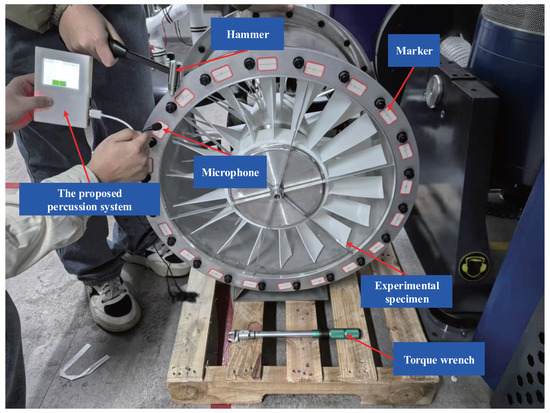
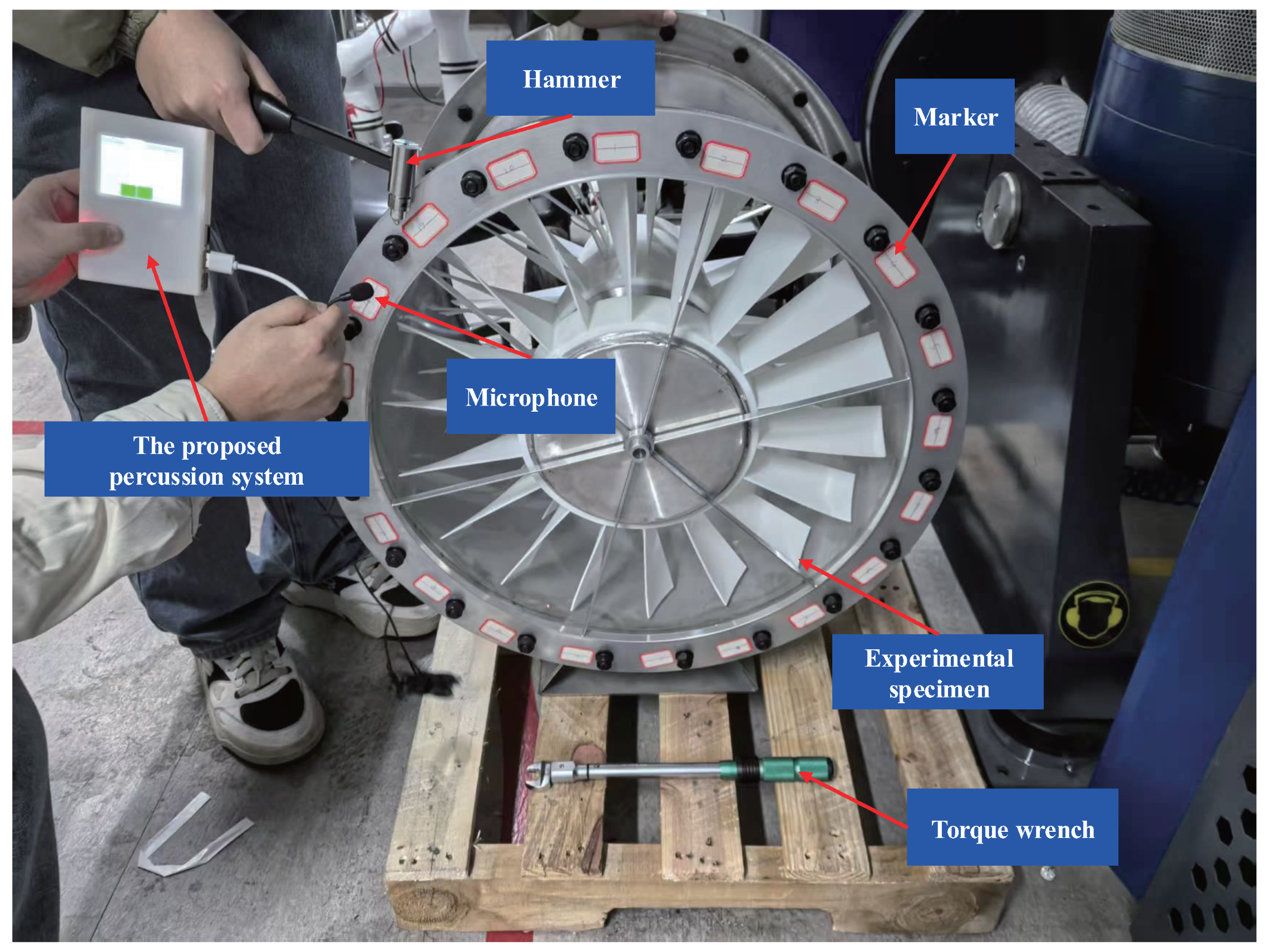
In this paper, to verify the effectiveness of the proposed portable smart percussion system, we conducted an experiment on a flange (diameter: 500 mm), which has 20 M10 bolts, and the setup is depicted in Figure 6. We numbered each of the bolts on the flange through tags (from 1 to 20), serving the purpose of denoting bolt tightening order and making it easier to declare bolt tightness status.
Figure 6.
Experimental setup.
All of the bolts were completely loosened with a torque wrench before the experiment, and then they were all tightened to 40 Nm using the same torque wrench. Four different scenarios were conducted in this experiment to set up datasets (i.e., audio signals derived from tapping tightened or loosened bolts), and the details are listed in Table 1. It can be seen that two bolts were randomly selected to be completely loosened in each scenario to create the class of “Loose”, while another two tightened bolts were employed to form the class of “Tight” stochastically.
Table 1.
Characterization of different scenarios.
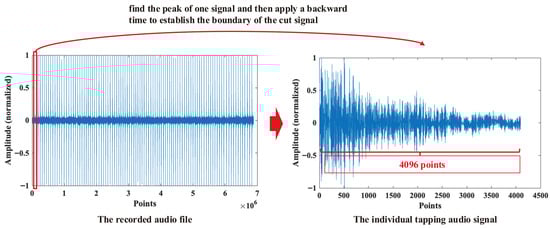
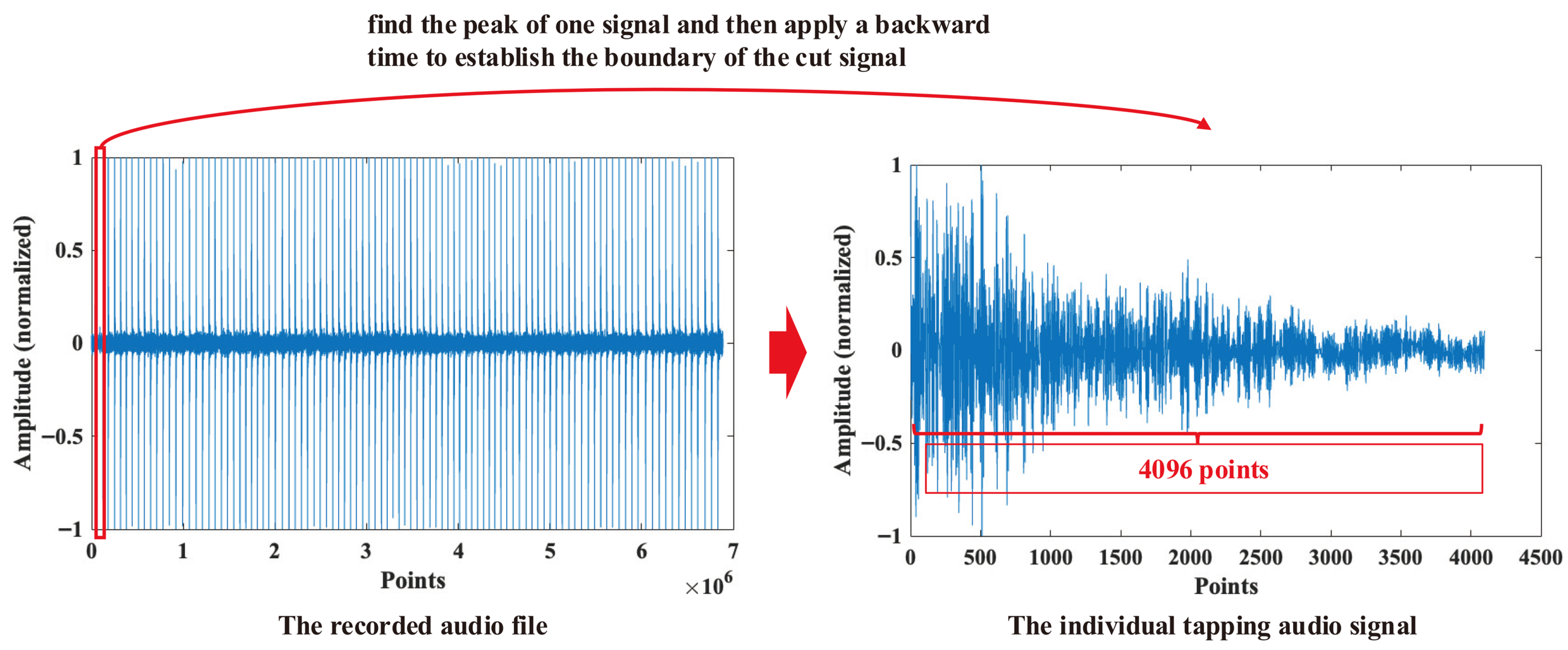
Under each scenario, a hammer was utilized to tap directly on four (tightened or loosened) bolts, and the proposed portable smart percussion system was employed to record the audio signals (sampling rate: 48 kHz). It is worth noting that the distance between the microphone and the impacted bolt was kept constant (0.2 m) across all four scenarios. For each bolt, the recorded audio files contained 100 consecutive signals; i.e., we tapped each bolt 100 times. Then, each recorded audio file was cut to isolate and obtain the individual tapping audio. As shown in Figure 7, the strategy for cutting a recorded audio file is to find the peak of one signal and then apply a backward time to establish the boundary of the cut signal. In this paper, the length of the cut signal is 4096 points (i.e., about 0.085 s). Particularly, the class of audio files was categorized as “Tight” and “Loose” when tapping directly on a tightened or loosened bolt, respectively. Finally, eight constructed datasets are given in Table 2. It is worth noting that the labels (i.e, Tight or Loose) are not used during the training process, and thus the proposed strategy is unsupervised learning.
Figure 7.
Illustration of clipping a recorded audio file and obtaining individual tapping audio.
Table 2.
Details of datasets.
4. Results and Discussion
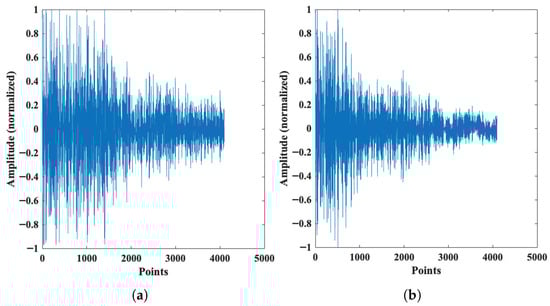
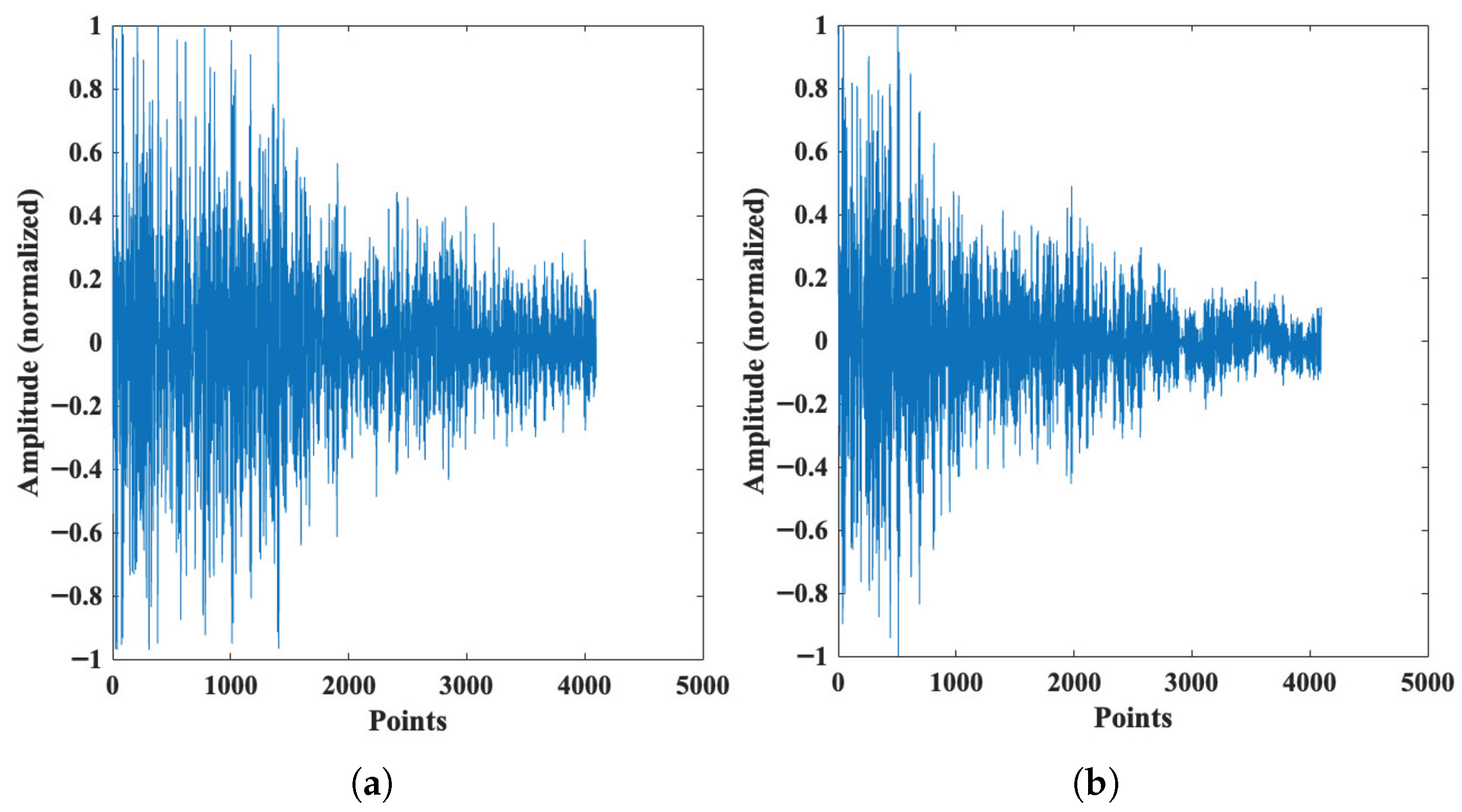
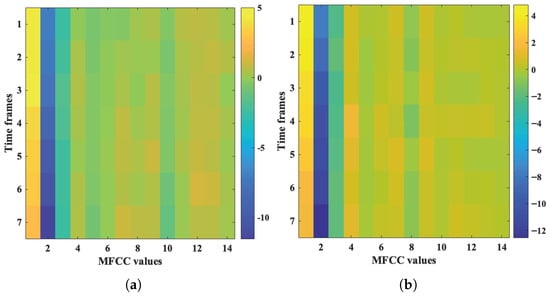
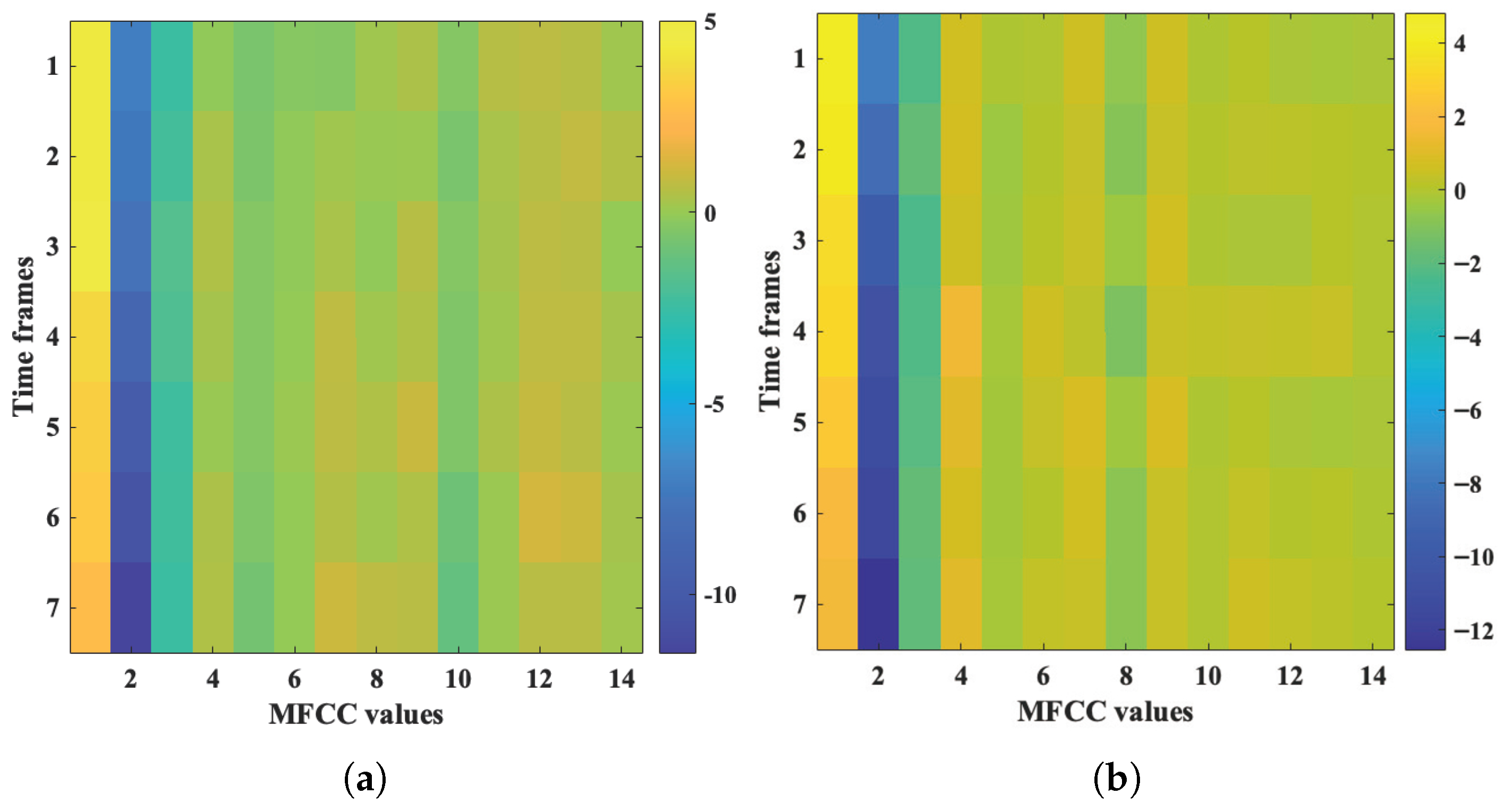
Two audio signals from classes “Tight” and “Loose” in Dataset 1 are shown in Figure 8. As observed from the time-domain responses, although the overall signal durations were largely consistent, noticeable variations existed in the way the impact sound amplitudes decayed over time. Such variations may arise not only from differences in bolt tightness but also from inconsistencies in the hammer–bolt interaction during excitation. Then, we further extracted MFCC features with procedures described in Section 2.2.1. It is worth noting that two parameters (i.e, and M) for MFCC extraction are important, since frames of insufficient length may not provide enough samples for robust spectral estimation, while overly long frames can include substantial temporal variations, thereby undermining the assumption of local signal stationarity. Therefore, in this paper, and M are set to 1024 and 512, respectively, to provide a balance between temporal resolution and the amount of information captured within each frame. Moreover, the number of retained cepstral coefficients is 14, and the window type is the Hanning Window. Another reason for setting these two parameters is to ensure that the number of extracted features is less than the overall number of samples, which can guarantee the GMM’s performance. As an example, the extracted MFCC features (a matrix of 7×14) of signals depicted in Figure 8 are given in Figure 9.
Figure 8.
Audio samples (4096 points) under two categories in Dataset 1: (a) Tight and (b) Loose.
Figure 9.
MFCC features under two categories in Dataset 1: (a) Tight and (b) Loose.
Then, to enable input into the GMM algorithm, each MFCC feature matrix was reshaped into a single row vector (i.e., a 1 × 98 vector), such that one feature vector corresponded to one individual tap. These feature vectors were then stacked to form larger feature sets for “Tight” and “Loose” classes. As a result, the “Tight” and “Loose” classes in one dataset yielded feature matrices of dimensions 200 × 98 and 200 × 98, respectively. Merging these two matrices produced a combined global feature matrix of size 400 × 98, which is the final feature set for one dataset.
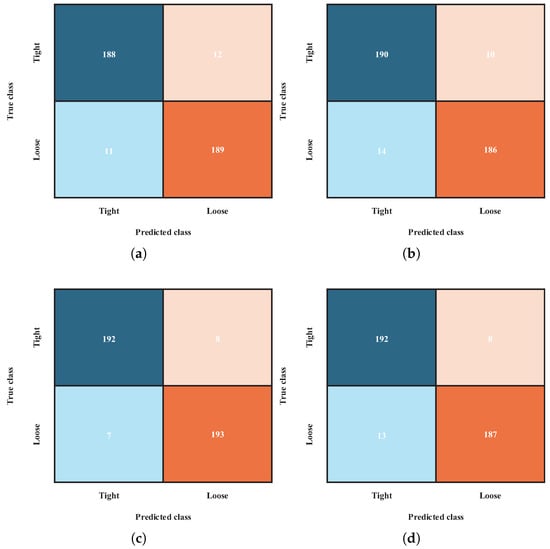
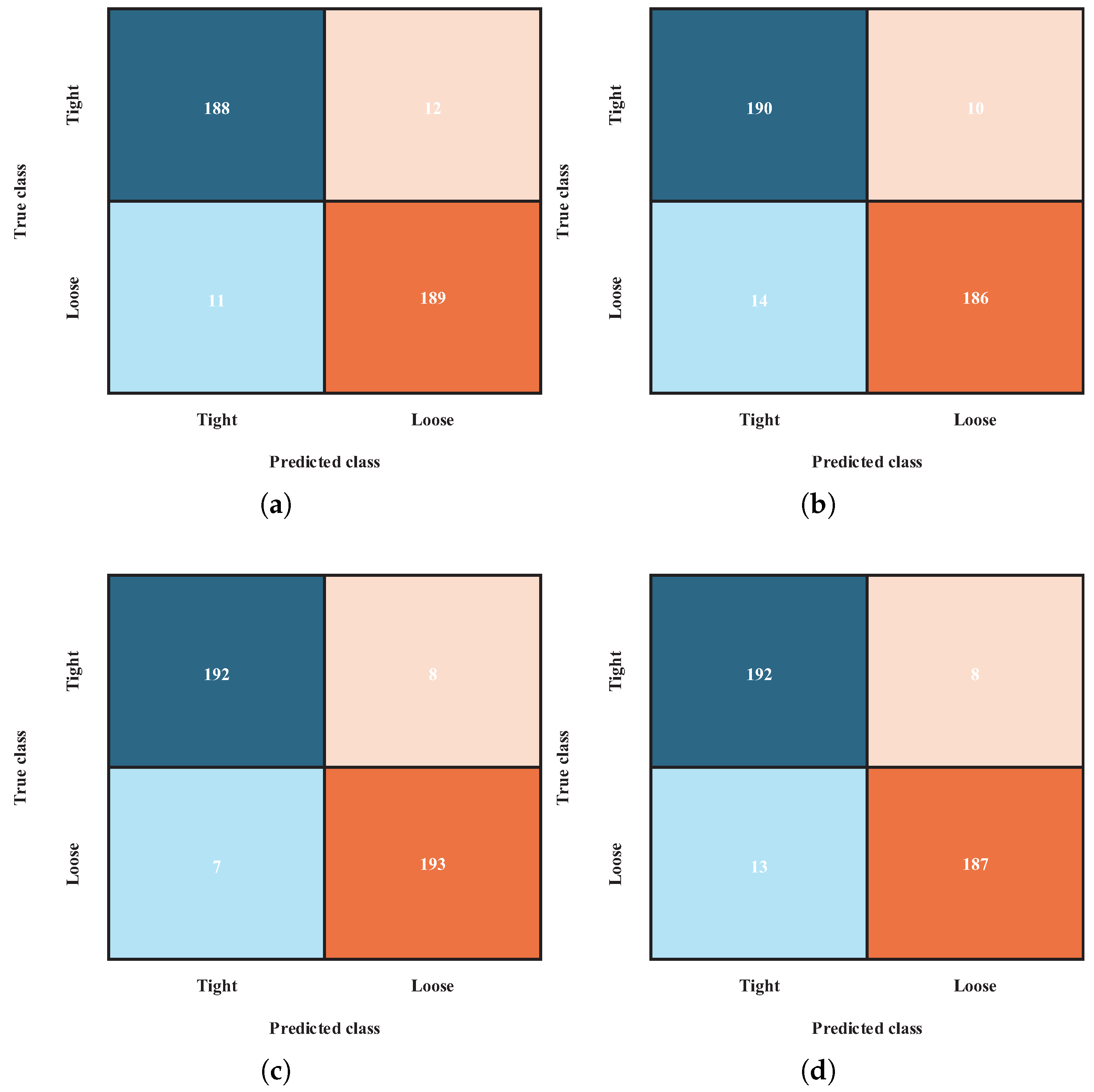
Subsequently, we trained various GMMs via Datasets 1, 2, 3, and 4, and tested their performance via Datasets 5, 6, 7, and 8, respectively. The confusion matrices of four different testing datasets are depicted in Figure 10. Moreover, Table 3 summarizes the mean classification accuracies for each dataset, which were obtained by executing each combination five times independently and reporting the average performance across all runs. The reason is that the GMM, as a typical clustering algorithm, naturally relies on random initialization that can vary between runs, leading to fluctuations in the resulting accuracy. It can be seen that the proposed method can achieve the best detection accuracy of 96.25% in Dataset 7 and be able to perform consistently throughout different datasets. In other words, we are able to say that the proposed strategy is robust enough to ignore these human-induced variances during field deployment.
Figure 10.
Confusion matrices of four datasets: (a) Dataset 5, (b) Dataset 6, (c) Dataset 7, and (d) Dataset 8.
Table 3.
Detection results for four datasets.
Moreover, to further verify the superiority of the proposed method (MFCC+GMM), we selected two other techniques, i.e., power spectrum density (PSD) working as a feature extractor and K-means, which is another widely used clustering algorithm in practice. That is to say, we can develop the other three approaches, i.e., PSD+GMM, PSD+K-means, and MFCC+K-means. Regarding PSD feature extraction of audio signals, we characterized two key factors: the locations of dominant PSD peaks and their corresponding prominence values. After identifying the prominent peaks in both “Tight” and “Loose” samples, the peak frequencies and magnitudes were compared to determine where the largest spectral differences occurred. For each selected peak, the frequency range over which the peak extended was identified by marking its start and end frequencies. These frequency bounds defined the edges of the PSD-based features. The resulting frequency intervals were then used to specify the frequency ranges employed during feature extraction. For Dataset 1, a comparison of results from four different approaches is summarized in Table 4, and we can see that the proposed method outperforms the other three approaches.
Table 4.
Detection results from different approaches (under Dataset 1).
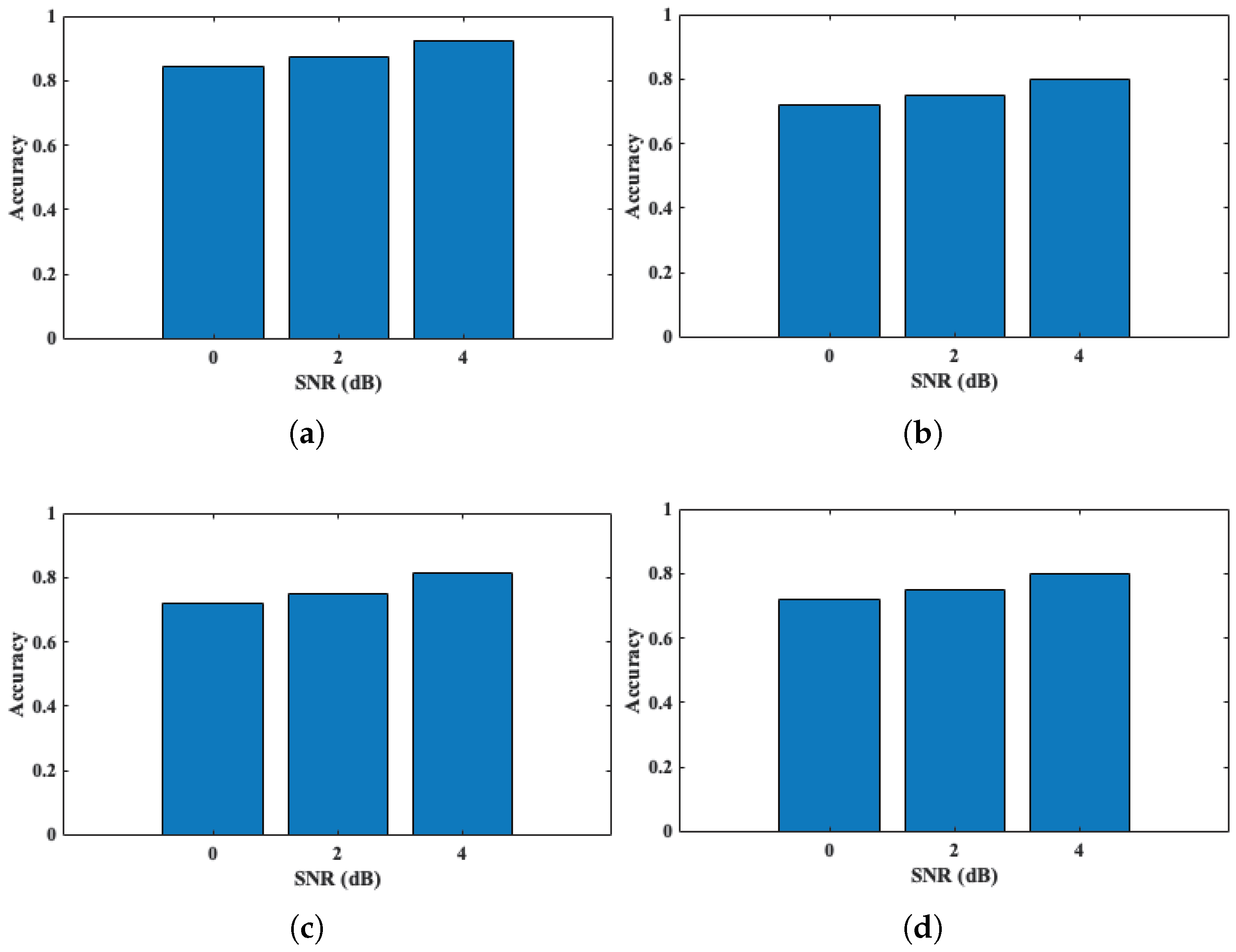
Moreover, to better simulate the real situation, all the above methods are trained on samples without noise, while we add white Gaussian noise in testing samples to achieve different signal-to-noise ratios (SNRs), whose definition in decibels can be expressed as
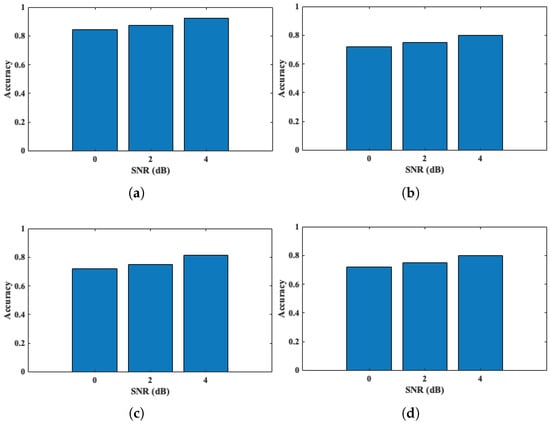
where and are the power and the amplitude of the signal, respectively, and and are the power and the amplitude of the noise, respectively. We compare the performance of all of the above methods and illustrate the results of Dataset 1 under three different SNRs (0, 2, and 4 dB) as an example in Figure 11. It can be seen that the proposed method still performs the best.
Figure 11.
Comparison of classification accuracy among different methods under noisy conditions: (a) the proposed method, (b) PSD+GMM, (c) PSD+K-means, and (d) MFCC+K-Means 8.
Finally, the well-trained GMM model was embedded into the proposed portable smart percussion system to realize bolt looseness detection in practice. In other words, the GMM model was trained offline via the training dataset and then embedded into the proposed portable smart percussion system to realize bolt looseness detection in practice. The basic concept is that a new sample (i.e., an audio signal derived by tapping a tightened or loosened bolt) is recorded, and its MFCC features can be extracted. Then, since the GMM model has been well-trained, that is, the final parameters , , and have been obtained, the posterior probability of a new sample can be calculated as
Furthermore, the class of the new sample can be determined via the following equation:
where is the inference result of the new sample , i.e., “Tight” or “Loose”. The whole aforementioned procedure has been depicted in Figure 4, and we conducted a simple verification test on the apparatus in Section 3 by randomly tightening or loosening a bolt, and the result of the proposed smart percussion system is given in Table 5. Generally, the inference time (here, inference means between the proposed system captures the audio signal and gives the final diagnosis) of the proposed system on the Raspberry Pi is about 100 ms. We can see that the performance is promising, providing strong practicality for real-world engineering applications.
Table 5.
Verification results.
5. Conclusions
In this paper, a new smart percussion system that integrates audio signal acquisition, data processing algorithms, and display of results was developed to detect bolt looseness. Particularly, the proposed system based on Raspberry Pi allows users to use it portably and cost-effectively, which significantly improves the practicality for real-world engineering applications. Moreover, a new strategy that combines MFCC and GMM is proposed for bolt looseness detection. Compared to current percussion-based approaches that depend on supervised learning, this strategy does not require a baseline set of data, making it easier to perform maintenance on various commercial structures. Definitely, for other structures in future industrial applications, the training should be implemented on data required from various connections. Several experimental results demonstrate the effectiveness and superiority of the proposed system, providing significant contributions for the development of the percussion-based approach for bolt looseness detection, even in the field of real-time SHM.
Despite the remarkable benefits of the proposed portable smart percussion system, some drawbacks exist in this investigation, which requires further exploration:
- 1.
- Several issues, including measurement accuracy of audio signals, high noise levels, and battery life, may limit commercial applications of the proposed system. Future technological advancements, as well as further evaluation and consideration of specific use cases and requirements, should alleviate these issues to make the proposed system more accessible and cost-effective in real engineering applications.
- 2.
- Since this research belongs to an exploratory study, only two statuses of bolt tightness (i.e., “Tight“ and “Loose“) are considered. The influence of different torque levels on feature distributions and more advanced algorithms (e.g., the fusion strategy) should be further investigated, which may boost the performance of the proposed system by introducing intermediate torque classes or even a predictive quality to determine where the bolt looseness will progress over time.
- 3.
- It is worth noting that this research still remains purely data-driven, while some recent advances that incorporate both knowledge-driven and data-driven techniques, such as fault evolution knowledge-driven adversarial meta-learning (FEK-AML) [40] and physics-guided degradation trajectory modeling [41], may significantly improve the performance of the proposed system. Therefore, this issue should be further investigated in future work.
- 4.
- Though the proposed system has several advantages, some challenges faced while working on the system should be noted. For instance, the memory size of more advanced models in the future may exceed the processing capacity of the Raspberry Pi. The heat dissipation problems in Raspberry Pi during long working hours cannot be ignored. Therefore, these issues should be further investigated in future work.
Author Contributions
Conceptualization, F.W.; methodology, F.W.; software, W.Z.; validation, F.W., D.Z. and K.D.; formal analysis, F.W.; investigation, F.W., W.Z., D.Z. and K.D.; resources, F.W.; data curation, D.Z. and K.D.; writing—original draft preparation, F.W.; writing—review and editing, F.W.; visualization, F.W., W.Z., D.Z. and K.D.; supervision, F.W.; project administration, F.W.; funding acquisition, F.W. All authors have read and agreed to the published version of the manuscript.
Funding
This work was partially supported by AECC Sichuan Gas Turbine Establishment (No. JSYJ-0805-2024-0002) and the National Natural Science Foundation of China (No. 52205061).
Data Availability Statement
Data are available upon request from the authors.
Conflicts of Interest
Author Furui Wang was employed by the company Nanjing Aurora Aerospace Technology Research Institute Co., Ltd. The remaining authors declare that the research was conducted in the absence of any commercial or financial relationships that could be construed as a potential conflict of interest.
Abbreviations
The following abbreviations are used in this manuscript:
| EMI | Electro-Mechanical Impedance |
| ML | Machine Learning |
| DL | Deep Learning |
| GPIO | Programmable General-Purpose Input/Output |
| RAM | Random Access Memory |
| FPC | Flexible Printed Circuit |
| 3D | Three-Dimensional |
| GUI | Graphical User Interface |
| MFCCs | Mel-Frequency Cepstral Coefficients |
| GMM | Gaussian Mixture Model |
| CSV | Comma-Separated Values |
| 1D | One-Dimensional |
| FFT | Fast Fourier Transform |
| DFT | Discrete Fourier Transform |
| DCT | Discrete Cosine Transform |
| EM | Expectation–Maximization |
| PSD | Power Spectrum Density |
| FEK | Fault Evolution Knowledge |
| AML | Adversarial Meta-Learning |
References
- Grayrigg Derailment. Wikipedia. Available online: https://en.wikipedia.org/wiki/Grayrigg_derailment (accessed on 5 November 2025).
- A Loose Bolt and Lives Lost: The Crash of Emery Flight 17. Aviation Maintenance Magazine. Available online: https://www.avm-mag.com/a-loose-bolt-and-lives-lost-the-crash-of-emery-flight-17 (accessed on 25 July 2023).
- Three Proven Methods of Verifying Torque Specifications. Mountz Torque. Available online: https://www.mountztorque.com/Three-Proven-Methods-of-Verifying-Torque-Specifications (accessed on 30 November 2018).
- How to Measure Torque on a Bolt. Peak Innovations Engineering. Available online: https://pieng.com/how-to-measure-torque-on-a-bolt/ (accessed on 22 April 2022).
- Chelimilla, N.; Chinthapenta, V.; Kali, N.; Korla, S. Review on recent advances in structural health monitoring paradigm for looseness detection in bolted assemblies. Struct. Health Monit. 2023, 22, 4264–4304. [Google Scholar] [CrossRef] [Scilit]
- Eraliev, O.; Lee, K.H.; Lee, C.H. Vibration-Based Loosening Detection of a Multi-Bolt Structure Using Machine Learning Algorithms. Sensors 2022, 22, 1210. [Google Scholar] [CrossRef] [Scilit] [PubMed]
- Chen, D.; Huo, L.; Song, G. EMI based multi-bolt looseness detection using series/parallel multi-sensing technique. Smart Struct. Syst. 2020, 25, 423–432. [Google Scholar]
- Na, W.S. Bolt loosening detection using impedance based non-destructive method and probabilistic neural network technique with minimal training data. Eng. Struct. 2021, 226, 111228. [Google Scholar] [CrossRef] [Scilit]
- Wang, F.; Chen, Z.; Song, G. Monitoring of multi-bolt connection looseness using entropy-based active sensing and genetic algorithm-based least square support vector machine. Mech. Syst. Signal Process. 2020, 136, 106507. [Google Scholar] [CrossRef] [Scilit]
- Du, F.; Xu, C.; Wu, G.; Zhang, J. Preload monitoring of bolted L-shaped lap joints using virtual time reversal method. Sensors 2018, 18, 1928–2018. [Google Scholar] [CrossRef] [Scilit] [PubMed]
- Brøns, M.; Thomsen, J.J.; Sah, S.M.; Tcherniak, D.; Fidlin, A. Estimating bolt tension from vibrations: Transient features, nonlinearity, and signal processing. Mech. Syst. Signal Process. 2021, 150, 107224. [Google Scholar] [CrossRef] [Scilit]
- Wang, F.; Song, G. Bolt early looseness monitoring using modified vibro-acoustic modulation by time-reversal. Mech. Syst. Signal Process. 2019, 130, 349–360. [Google Scholar] [CrossRef] [Scilit]
- Wang, F.; Song, G. Monitoring of multi-bolt connection looseness using a novel vibro-acoustic method. Nonlinear Dyn. 2020, 100, 243–254. [Google Scholar] [CrossRef] [Scilit]
- Zhang, Z.; Xu, H.; Liao, Y.; Su, Z.; Xiao, Y. Vibro-acoustic modulation (VAM)-inspired structural integrity monitoring and its applications to bolted composite joints. Compos. Struct. 2017, 176, 505–515. [Google Scholar] [CrossRef] [Scilit]
- Hosoya, N.; Niikura, T.; Hashimura, S.; Kajiwara, I.; Giorgio-Serchi, F. Axial force measurement of the bolt/nut assemblies based on the bending mode shape frequency of the protruding thread part using ultrasonic modal analysis. Measurement 2020, 162, 107914. [Google Scholar] [CrossRef] [Scilit]
- Cha, Y.J.; You, K.; Choi, W. Vision-based detection of loosened bolts using the Hough transform and support vector machines. Automat. Constr. 2016, 71, 181–188. [Google Scholar] [CrossRef] [Scilit]
- Kong, X.; Li, J. Image registration-based bolt loosening detection of steel joints. Sensors 2018, 18, 1000. [Google Scholar] [CrossRef] [Scilit] [PubMed]
- Kong, Q.; Zhu, J.; Ho, S.C.M.; Song, G. Tapping and listening: A new approach to bolt looseness monitoring. Smart Mater. Struct. 2018, 27, 07LT02. [Google Scholar] [CrossRef] [Scilit]
- Wang, F.; Ho, S.C.M.; Song, G. Modeling and analysis of an impact-acoustic method for bolt looseness identification. Mech. Syst. Signal Process. 2019, 133, 106249. [Google Scholar] [CrossRef] [Scilit]
- Zhang, Y.; Zhao, X.; Sun, X.; Su, W.; Xue, Z. Bolt loosening detection based on audio classification. Adv. Struct. Eng 2019, 22, 2882–2891. [Google Scholar] [CrossRef] [Scilit]
- Chen, D.; Shen, Z.; Huo, L. Percussion-based quasi real-time void detection for concrete-filled steel tubular structures using dense learned features. Eng. Struct. 2023, 274, 115197. [Google Scholar] [CrossRef] [Scilit]
- Yuan, R.; Lv, Y.; Kong, Q.; Song, G. Percussion-based bolt looseness monitoring using intrinsic multiscale entropy analysis and BP neural network. Smart Mater. Struct. 2019, 28, 125001. [Google Scholar] [CrossRef] [Scilit]
- Yang, Z.; Huo, L. Bolt preload monitoring based on percussion sound signal and convolutional neural network (CNN). Nondestr. Test. Eval. 2022, 37, 464–481. [Google Scholar] [CrossRef] [Scilit]
- Zhou, Y.; Wang, S.; Zhou, M.; Chen, H.; Yuan, C.; Kong, Q. Percussion-based bolt looseness identification using vibration-guided sound reconstruction. Struct. Control Health Monit. 2022, 29, e2876. [Google Scholar] [CrossRef] [Scilit]
- Wang, F.; Song, G. 1D-TICapsNet: An audio signal processing algorithm for bolt early looseness detection. Struct. Health Monit. 2021, 20, 2828–2839. [Google Scholar] [CrossRef] [Scilit]
- Liu, P.; Wang, X.; Chen, T.; Wang, Y.; Mao, F.; Liu, W. Research on a percussion-based bolt looseness identification method based on phase feature and convolutional neural network. Smart Mater. Struct. 2023, 32, 035010. [Google Scholar] [CrossRef] [Scilit]
- Chen, J.; Chen, Z.; Zhu, W.; Song, G. Underwater bolted flange looseness detection using percussion-induced sound and Feature-reduced Multi-ROCKET model. Struct. Health Monit. 2024, 23, 495–511. [Google Scholar]
- Chelimilla, N.; Chinthapenta, V.; Korla, S. Addressing data scarcity using audio signal augmentation and deep learning for bolt looseness prediction. Smart Mater. Struct. 2024, 33, 085012. [Google Scholar] [CrossRef] [Scilit]
- Wang, F.; Song, G. A novel percussion-based method for multi-bolt looseness detection using one-dimensional memory augmented convolutional long short-term memory networks. Mech. Syst. Signal Process. 2021, 161, 107955. [Google Scholar]
- Yan, J.; Cheng, Y.; Zhang, F.; Li, M.; Zhou, N.; Jin, B.; Wang, H.; Yang, H.; Zhang, W. Research on multimodal techniques for arc detection in railway systems with limited data. Struct. Health Monit. 2025. [Google Scholar]
- Chen, B.; Cheng, Y.; Allen, P.; Wang, S.; Gu, F.; Zhang, W.; Ball, A.D. A product envelope spectrum generated from spectral correlation/coherence for railway axle-box bearing fault diagnosis. Mech. Syst. Signal Process. 2025, 225, 112262. [Google Scholar]
- Cheng, L.; Zhang, Z.; Lacidogna, G.; Wang, X.; Jia, M.; Liu, Z. Sound Sensing: Generative and Discriminant Model-Based Approaches to Bolt Loosening Detection. Sensors 2024, 24, 6447. [Google Scholar] [CrossRef] [Scilit]
- Chen, X.; Zhou, W.; Yang, J.; Zhang, X.; He, C. A percussion method with attention-based sequence modeling for bolt looseness detection and adaptive anomaly recognition. Measurement 2025, 256, 118394. [Google Scholar] [CrossRef] [Scilit]
- Du, C.; Liu, J.; Gong, H.; Huang, J.; Zhang, W. Percussion-based loosening detection method for multi-bolt structure using convolutional neural network DenseNet-CBAM. Struct. Health Monit. 2024, 23, 2183–2199. [Google Scholar] [CrossRef] [Scilit]
- Wang, F.; Song, G.; Mo, Y.L. Shear loading detection of through bolts in bridge structures using a percussion-based one-dimensional memory-augmented convolutional neural network. Comput.-Aided Civ. Inf. 2021, 36, 289–301. [Google Scholar] [CrossRef] [Scilit]
- Turan, H.I.; Mamedov, A. Tool Wear Detection in Milling Using Convolutional Neural Networks and Audible Sound Signals. Machines 2026, 14, 59. [Google Scholar] [CrossRef] [Scilit]
- Badawy, M.; Rashed, A.; Bamaqa, A.; Sayed, H.A.; Elagamy, R.; Almaliki, M.; Farrag, T.A.; Elhosseini, M.A. From Sensors to Insights: Interpretable Audio-Based Machine Learning for Real-Time Vehicle Fault and Emergency Sound Classification. Machines 2025, 13, 888. [Google Scholar] [CrossRef] [Scilit]
- Godoy, D.R.; Mavrakis, C.; Mena, R.; Kristjanpoller, F.; Viveros, P. Advancing Predictive Maintenance with PHM-ML Modeling: Optimal Covariate Weight Estimation and State Band Definition under Multi-Condition Scenarios. Machines 2024, 12, 403. [Google Scholar] [CrossRef] [Scilit]
- Brescia, E.; Vergallo, P.; Serafino, P.; Tipaldi, M.; Cascella, D.; Cascella, G.L.; Romano, F.; Polichetti, A. Online Condition Monitoring of Industrial Loads Using AutoGMM and Decision Trees. Machines 2023, 11, 1082. [Google Scholar] [CrossRef] [Scilit]
- Yin, C.; Li, Y.; Wang, Y.; Dong, Y. Physics-guided degradation trajectory modeling for remaining useful life prediction of rolling bearings. Mech. Syst. Signal Process. 2025, 224, 112192. [Google Scholar] [CrossRef] [Scilit]
- Yin, C.; Dong, Y.; He, J.; Wang, Y. A fault evolution knowledge-driven adversarial meta-learning method for few-shot tool state recognition under variable working conditions. Eng. Appl. Artif. Intell. 2026, 167, 113806. [Google Scholar] [CrossRef] [Scilit]

Disclaimer/Publisher’s Note: The statements, opinions and data contained in all publications are solely those of the individual author(s) and contributor(s) and not of MDPI and/or the editor(s). MDPI and/or the editor(s) disclaim responsibility for any injury to people or property resulting from any ideas, methods, instructions or products referred to in the content. |
© 2026 by the authors. Licensee MDPI, Basel, Switzerland. This article is an open access article distributed under the terms and conditions of the Creative Commons Attribution (CC BY) license.