Skip to Content
MachinesMachines
  • Editor’s Choice
  • Article
  • Open Access

8 January 2026

Trajectory Tracking Control of a Six-Axis Robotic Manipulator Based on an Extended Kalman Filter-Based State Observer


,
,
,
and
School of Mechanical Engineering, Xinjiang University, Urumqi 830047, China
*
Author to whom correspondence should be addressed.

Abstract

To achieve high-precision trajectory tracking for multi-joint robotic manipulators in the presence of model uncertainties, external disturbances, and strong coupling effects, this paper proposes a nonsingular fast terminal sliding mode control (NFTSMC) scheme incorporating an extended Kalman filter-based disturbance observer. First, the Kalman filter is combined with an extended state observer to perform the real-time observation of both internal and external disturbances in the system, accurately estimating system uncertainty and external disturbances. This approach reduces noise interference while significantly improving the correction accuracy of position and tracking errors. Second, an improved nonsingular fast terminal sliding mode controller with an optimized convergence law is introduced to ensure stability during the tracking process, effectively mitigate oscillation phenomena, and accelerate the system’s convergence speed. Finally, the convergence of the proposed method is analyzed by constructing an appropriate Lyapunov function. Simulation and experimental results strongly validate the superior performance of the proposed control strategy, demonstrating that the system can achieve high-precision trajectory tracking under the complex coupled effects of a six-axis robotic manipulator, and exhibits significant advantages in terms of accuracy and robustness.

1. Introduction

In recent years, the widespread adoption of robots has significantly increased the demands on robot control performance. Among the various research topics, trajectory tracking for robotic manipulators has consistently been a core research focus. The ability of robotic manipulators to precisely follow predefined joint trajectories is crucial for executing complex tasks. To satisfy diverse performance requirements, numerous advanced control strategies have been proposed [1,2,3], including PID control [4,5,6], sliding mode control [7,8,9], fuzzy control [10,11], neural network control [12,13], adaptive control [14,15], and robust control [16,17]. However, owing to the highly nonlinear dynamics of robotic manipulators, along with model uncertainties, strong coupling effects, unknown external disturbances, and measurement noise, achieving accurate and fast trajectory tracking remains a significant challenge. Therefore, developing effective and robust trajectory tracking control methods remains an urgent and important research direction.
Sliding mode control (SMC), as a control method, has the advantages of strong robustness, fast response, high accuracy, and simple design. Nevertheless, for robots with parameter uncertainties and disturbances, SMC suffers from certain drawbacks, including overshoot problems, challenges in sliding surface design, and the possibility of inducing high-frequency oscillations. In particular, achieving the fast tracking of the desired trajectory while simultaneously avoiding chattering caused by system uncertainties and disturbances remains a challenge. To address these issues, researchers have proposed various methods. References [18,19] proposed control strategies achieving fixed-time convergence, with settling time independent of initial conditions, representing a class of fast and robust control methods. Reference [20] proposed an adaptive nonsingular fast terminal sliding mode control with model feedforward compensation, achieving fast convergence and improved trajectory tracking under high-speed variable loads. Reference [21] combined adaptive sliding mode control with NFTSMC for agricultural quadrotor UAVs, adjusting parameters to handle system uncertainties and variations. Reference [22] introduced a fractional-order sliding mode control based on a nonlinear ESO for photoelectric tracking systems, providing faster response and enhanced control performance. Reference [23] developed a PFTO-ABSTC method for deep-sea hydraulic manipulators, using adaptive parameter estimation and disturbance observation to suppress chattering and improve tracking precision. Reference [24] proposed an extended desired trajectory control strategy combined with a predefined-time sliding mode controller, using an improved non-singular fast sliding mode surface and a state observer to achieve convergence of angle tracking error within a specified time. Reference [25] proposed a time-delay sliding mode control using the previous sampling sliding variable to achieve fast convergence, minimal steady-state error, and robustness to unknown dynamics and payloads. Reference [26] designed sliding surfaces using error-shifting and barrier functions to achieve finite-time convergence under system uncertainties, input dead zone, and external disturbances.
In addition to sliding mode control, numerous other methods have been developed to handle system uncertainties and disturbances. Reference [27] introduced an observer with adaptive switching gain, which enhances disturbance rejection ability and reduces servo error. Reference [28] proposed a robust active learning (RAL) control method combining Koopman modeling, active learning, and ESO-assisted tracking for efficient learning and accurate trajectory tracking under unknown disturbances. Reference [29] developed a new extended state observer with filtering capability to estimate lumped system uncertainties and external disturbances. Reference [30] proposed a novel logarithmic power sliding mode reaching law, combined with a fast terminal sliding mode surface, to design a finite-time trajectory tracking controller.
Other advanced approaches have also been investigated. In Reference [31], an indirect adaptive control using neural networks and DEKF was proposed for wheeled mobile robots, improving tracking accuracy and computational efficiency under uncertainties. Reference [32] combined a Dual-GRU Kalman Net estimator with an adaptive ESO and nonsingular terminal sliding mode controller for robust tracking and faster, more accurate convergence. In Reference [33], EKF was applied to attitude estimation of quadrotor UAVs, demonstrating robust and accurate performance despite unpredictable external disturbances and measurement noise.
Inspired by these methods, this paper proposes a comprehensive control strategy for robotic systems subject to model uncertainties and external disturbances. The proposed approach integrates extended state observer (ESO) control, Kalman filtering, and nonsingular fast terminal sliding mode control (NFTSMC) to enhance system robustness and control accuracy. The main contributions of this paper can be summarized as follows: The main contributions of this paper can be summarized as follows:
(1) An EKF–ESO integrated disturbance observation structure is proposed by incorporating an extended Kalman filter into the ESO framework. This approach preserves fast disturbance estimation capability while effectively suppressing measurement noise, thereby significantly improving the accuracy and robustness of uncertainty and external disturbance estimation.
(2) An improved nonsingular fast terminal sliding mode reaching law is developed. By introducing a switching structure that combines nonlinear adaptive gains with a saturation function, finite-time convergence is maintained while chattering caused by high-frequency switching is effectively mitigated, resulting in smoother control inputs and improved practical implementability for robotic manipulators.
(3) A unified control framework with deep integration of the observer and controller is established. Through the coordinated design of the EKF–ESO and NFTSMC, a comprehensive optimization of trajectory tracking accuracy, convergence speed, and control input smoothness is achieved.

2. Problem Description and Preliminaries

2.1. Interaction Force Control of Industrial Robots

Based on Lagrange dynamics analysis, the 6-DOF robot dynamics is represented as:
M ( q ) q ¨ + C ( q , q ˙ ) q ˙ + G ( q ) = τ + τ d
where q , q ˙ , q ¨ R 6 × 1 denote the angle, velocity and acceleration of the robot, respectively. M ( q ) R 6 × 6 denotes the positive definite inertia matrix of the system, C ( q , q ˙ ) R 6 × 6 denotes the Coriolis force and centrifugal force matrix, G ( q ) R 6 × 1 denotes the joint gravity matrix. τ R 6 × 1 denotes the control input joint torque; and τ d R 6 × 1 denotes the external unknown disturbance matrix.
In the actual modeling process, due to unknown uncertainties in the mathematical model of the robotic manipulator, M ( q ) , C ( q , q ˙ ) , G ( q ) are usually inaccurate. Therefore, it can be expressed as:
M ( q ) = M 0 ( q ) + Δ M ( q ) C ( q , q ˙ ) = C 0 ( q , q ˙ ) + Δ C ( q , q ˙ ) G ( q ) = C 0 ( q ) + Δ C ( q )
where M 0 ( q ) , C 0 ( q , q ˙ ) , G 0 ( q ) represent the nominal components of the parameters, while Δ M ( q ) , Δ C ( q , q ˙ ) , Δ G ( q ) denote the respective uncertain deviations from these nominal values.
Substituting Equation (2) into Equation (1), the dynamic model is reformulated as:
( M 0 ( q ) + Δ M ( q ) ) q ¨ + ( C 0 ( q , q ˙ ) + Δ C ( q , q ˙ ) ) q ˙ + ( C 0 ( q ) + Δ C ( q ) ) = τ + τ d
Define the total uncertainty part due to modeling errors and external disturbances as: d ( q , q ˙ , q ¨ ) = τ d Δ M ( q ) q ¨ Δ C ( q , q ˙ ) q ˙ Δ C ( q ) . Thus, the dynamic model can be written as:
M 0 ( q ) q ¨ + C 0 ( q , q ˙ ) q ˙ + C 0 ( q ) = τ + d ( q , q ˙ , q ¨ )

2.2. Related Properties and Lemmas

Property 1. 
Inertia  M ( q )  is a symmetric positive definite matrix, and there exist positive numbers  m 1  and  m 2  that satisfy:
m 1 ς 2 ς T M ( q ) ς m 2 ς 2
Property 2. 
M ( q ) 2 C ( q , q ˙ )  is a skew-symmetric matrix and satisfies:
ϖ T ( M ( q ) 2 C ( q , q ˙ ) ) ϖ = 0
Assumption 1. 
The lumped disturbance, including modeling uncertainties and external disturbances, is assumed to be bounded,  d t d max  where  d max  is a positive constant.

3. Proposed Control Design

3.1. Extended Kalman Filter State Observer Design

Define joint angle error, angular velocity error, and angular acceleration error, respectively, as:
e = q d q e ˙ = q ˙ d q ˙ e ¨ = q ¨ d q ¨
where q d , q ˙ d , q ¨ d represent the desired displacement, angular velocity, and angular acceleration of each joint, respectively. Assume they are known differentiable signals. The error vectors are defined as:
e ˙ = ( e ˙ 1 , e ˙ 2 , , e ˙ n ) T n e α = ( e 1 α , e 2 α , , e n α ) T n | e | α = ( | e 1 | α , | e 2 | α , , | e n | α ) T n
Combining with the system dynamics model (1), it can be written as:
x ˙ ( t ) = f ( x ( t ) , u ( t ) , t )
At time k , the measurement equation consists of the base joint angle position and the end-effector rotation angle. Therefore, the measurement equation at time k is:
y ( k ) = H x ( k ) + μ ( k )
where H is the measurement matrix, and μ ( k ) denotes Gaussian white noise. Using the difference equation representation, the state prediction equation with measurement noise can be expressed. After the filtering prediction and update, the recursive formula is obtained. The prediction equation can be expressed as:
x ^ k = f ( x ^ k 1 , u k 1 , t k 1 ) P k 1 = A k P k 1 A k T + Q k
where x ^ k denotes the predicted state estimate at time k , P k 1 denotes the prediction error covariance matrix, A k is the Jacobian matrix, and Q k is the process noise covariance.
The Jacobian matrix A k is expressed as:
A k = f ( x ^ k 1 , u k 1 , t k 1 ) x ^ k 1
The update equation can be expressed as:
x ^ k = x ^ k + K k ( y k H k x ^ k ) P k = ( I K k H k ) P k
where y k is the observed value at time k , H k is the observation matrix, K k is the Kalman gain, and I is a 6 × 6 identity matrix. The Kalman gain is expressed as:
K k = P k H k T ( H k P k H k T + R k ) 1
Considering system uncertainties and external disturbances, by selecting the state variables x 1 = q and x 2 = q ˙ , the dynamic equations shown in the formula can be transformed into state-space form as follows:
x ˙ 1 = x 2 x ˙ 2 = M 0 1 ( τ C 0 q ˙ G 0 ) + M 0 1 d y = x 1
Define observation error as ϑ = z i x i . Based on this, the extended state space observer is established as:
ϑ 1 = z i 1 y 1 z ˙ i 1 = z i 2 β i 1 ϑ 1 z ˙ i 2 = z i 3 β i 2 e 2 fal ( ϑ 1 , α 1 , δ ) + M d 1 τ z ˙ i 3 = β i 3 fal ( ϑ 2 , α 2 , δ )
where β i 1 , β i 2 , β i 3 are all constant matrices, represents the observer gain; the observer output z i 1 is an estimate of the system’s joint angle q ; z i 2 is an estimate of the system’s joint angular velocity q ˙ ; z i 3 is an estimate of the system’s total disturbance d , and z i 3 is used to compensate for disturbances. f a l ( ϑ , α , δ ) is the nonlinear function defined as:
f a l ( ϑ , α , δ ) = ϑ δ 1 α ϑ δ ϑ α   sign ( ϑ ) ϑ > δ
According to Equations (15) and (16), the observation error is given by:
ϑ ˙ 1 = z ˙ i 1 x ˙ i 1 = ϑ 2 β i 1 ϑ 1 ϑ ˙ 2 = z ˙ i 2 x ˙ i 2 = ϑ 3 β i 2 f a l ( ϑ 1 , α 1 , δ ) ϑ ˙ 3 = z ˙ i 3 x ˙ i 3 = β i 3 f a l ( ϑ 2 , α 2 , δ ) ( M 0 1 ( τ C 0 q ˙ G 0 ) )
where α , δ are positive constants. The function f a l ( ϑ , α , δ ) is a nonlinear gain function.
This ensures that the extended state observer (ESO) maintains bounded estimation errors even when unmodeled dynamics and disturbances exist. By combining the EKF Equation (14) and ESO equations, the following can be obtained:
ϑ ^ = ϑ ^ + K ( y H ϑ ^ )
P = ( I K H ) P
K = P H T ( H P H T + R ) 1
Assumption 2. 
It is assumed that the measurement errors of the robot joint sensors are bounded. For the  i  joint, the sensor error  e i ( t )  satisfies: e i ( t ) e max .

3.2. Stability Analysis

Let w = ( M 0 1 ( τ C 0 q ˙ G 0 ) ) , and assume w r . The observer state-space equation can be expressed as:
ϑ ˙ = A ϑ + B
where ϑ ˙ = ϑ ˙ 1 ϑ ˙ 2 ϑ 3 , ϑ = ϑ 1 ϑ 2 ϑ 3 , A 1 = β i 1 1 0 0 0 1 0 0 0 B 1 = 0 β i 2 fal ( ϑ 1 , α 1 , δ ) β i 3 fal ( ϑ 2 , α 2 , δ ) w .
  • Case A: When ϑ δ
f a l ( ϑ , α , δ ) = ϑ δ 1 α
and the error dynamics can be rewritten as:
ϑ ˙ = A 1 ϑ + B 1 w
where A 1 = β i 1 γ 1 θ 1 0 β i 2 γ 1 θ 0 1 β i 3 γ 1 θ 0 0 , B 1 = 0 0 1 and the characteristic equation is:
λ 3 + h 1 λ 2 + h 2 λ + h 3 = 0
where h 1 , h 2 , h 3 are all positive numbers, which indicates that the eigenvalues of matrix A 1 are all negative real parts. According to the Routh-Hurwitz stability criterion, it can be concluded that all eigenvalues of A 1 have negative real parts. This implies that the ESO error eventually converges to zero and remains stable.
  • Case B: When ϑ > δ
    fal ( ϑ , α , δ ) = ϑ α sign ( ϑ )
Consider the following Lyapunov candidate function:
V 1 = ϑ ˙ β T M ( q ) β ϑ
Since the inertia matrix M ( q ) is positive definite, taking the derivative of the above expression yields:
V ˙ 1 = ϑ ˙ T β ˙ T M ( q ) β ϑ + ϑ T β T M ( q ) β ϑ + ϑ T β T M ( q ) β ϑ ˙ = ϑ T ( β β T M ( q ) β + β T ) ϑ ϑ T ( β c ς 2 + β T ) ϑ
Constructing the inequality:
β c ζ 2 + β T Υ
where Υ > 0 is a symmetric positive definite matrix. Therefore, there exists Υ > 0 , such that:
V ˙ 1 ϑ T Υ ϑ < 0
Selecting an appropriate observer gain matrix β ensures V ˙ 1 0 , which implies that the error in ESO eventually converges and remains stable.
  • Case C: From Equations (20) and (21),
    K k + 1 = P k + 1 H T ( H P k + 1 H T + R ) 1
    P k + 1 = ( I K k + 1 H ) P k + 1
Substituting the estimated state into it:
Δ = z ^ z
Substitute the update equation of the error covariance matrix into the definition of the state estimation error:
P k + 1 = ( l K k + 1 H ) P k + 1 = ( l K k + 1 ( H z ^ + Δ ) ) P k + 1 = P k + 1 K k + 1 H z ^ P k + 1 K k + 1 Δ P k + 1
By substituting the Kalman gain, we obtain:
P k + 1 = P k + 1 P k + 1 H T ( H P k + 1 H T + R ) 1 H z ^ P k + 1 P k + 1 H T ( H P k + 1 H T + R ) 1 Δ P k + 1
Because ( H P k + 1 H T + R ) 1 is a positive definite matrix, it can be concluded that:
I P k + 1 H T ( H P k + 1 H T + R ) 1 0
Thus the error covariance matrix sequence P k converges.

4. Design of the Sliding Mode Controller

4.1. Design of the Sliding Surface

Define the sliding mode surface:
s = e + p 1 Γ ( e ) + p 2 Γ ( e ˙ ) + p 3 e ˙
where p 1 , p 2 , p 3 , r 1 , r 2 are positive constants. Define:
Γ ( e ) = s i g n ( e ) e r 1
Γ ( e ˙ ) = s i g n ( e ˙ ) e ˙ r 2
The s i g n function is the following discontinuous function:
s i g n ( s ) = 1 s > 0 0 s = 0 1 s < 0
The time derivative of the sliding surface is obtained as:
s ˙ = e ˙ + p 1 r 1 s i g n ( e ) e r 1 1 e ˙ + p 2 r 2 s i g n ( e ˙ ) e ˙ r 2 1 e ¨ + p 3 e ¨ = ( 1 + p 1 r 1 s i g n ( e ) e r 1 1 ) e ˙ + p 2 r 2 s i g n ( e ˙ ) e ˙ r 2 1 + p 3 e ¨
Using the tracking error, we obtain:
s ˙ = ( 1 + p 1 r 1 s i g n ( e ) e r 1 1 ) e ˙ + p 2 r 2 s i g n ( e ˙ ) e ˙ r 2 1 + p 3 q ¨ d M 0 1 ( q ) τ + d C 0 ( q , q ˙ ) q ˙ G 0 ( q )
Define φ = 1 + p 1 r 1 sign ( e ) e r 1 1 , ψ = p 2 r 2 s i g n ( e ˙ ) e ˙ r 2 1 + p 3 , According to the definition of the sign function, it can be seen that φ 0 , ψ 0 . Therefore, Equation (40) can be simplified as:
s ˙ = φ e ˙ + ψ q ¨ d ψ ( M 0 1 ( q ) ( τ + d C 0 ( q , q ˙ ) q ˙ G 0 ( q ) ) )
The traditional approaching law control method enables the system state trajectory to move towards the designed sliding mode surface, thereby achieving convergence of the sliding mode. However, in some cases, it may result in excessively high convergence speed, causing system oscillations, or excessively low speed, leading to a slow response. In order to solve this problem, a nonlinear approaching law control method is adopted to adjust the convergence speed adaptively. Therefore, a new sliding mode approaching law is proposed in this paper.
s ˙ = e tanh ( ϵ s ) η + 1 η e s ε s i g n ( s ) k s
Among them, ε , k and ϵ are constant matrices. When s increases, the approximate linear interval range decreases, and the hyperbolic tangent function tends to saturation when s is small. The introduction of the nonlinear term, by increasing the slope of the sliding mode function, can reduce system oscillations, improve stability, or enhance response speed.
By adopting the concept of equivalent control to derive the control input, in order to ensure that the system state remains on the sliding surface, let s ˙ = 0 in Equation (43), then the equivalent control torque can be obtained as:
τ e q = M 0 ( q ) q ¨ d + M 0 ( q ) ψ 1 φ e ˙ + C 0 ( q , q ˙ ) q ˙ + G 0 ( q ) d
Considering disturbances and uncertainties, in order to ensure that the system state does not leave the sliding surface, the switching control law is designed as:
τ s w = M 0 ( q ) ψ 1 ε e tanh ( ϵ s ) s i g n ( s ) η + 1 η e s + k s
Therefore, the total control law of the system is:
τ o l d = τ e q + τ s w = M 0 ( q ) q ¨ d + M 0 ( q ) ψ 1 φ e ˙ + C 0 ( q , q ˙ ) q ˙ + G 0 ( q ) d + M 0 ( q ) ψ 1 ε e tanh ( ϵ s ) s i g n ( s ) η + ( 1 η ) e s + k s = M 0 ( q ) q ¨ d + C 0 ( q , q ˙ ) q ˙ + G 0 ( q ) d + M 0 ( q ) ψ 1 ε e tanh ( ϵ s ) s i g n ( s ) η + ( 1 η ) e s + k s + φ e ˙
Note 1: Compared with the sign function, the advantage of the saturation function in eliminating chattering lies in its smoothness, adjustable range, and ability to suppress noise. Therefore, in order to further reduce chattering, the sign function s i g n ( s ) in Equation (47) is replaced by the saturation function sat ( s ) , whose expression is:
s a t ( s ) = 1 s > δ s / δ s = δ 1 s < δ
The parameter δ > 0 is called the boundary layer. Within the boundary layer, linear feedback control is applied, while outside the boundary layer, switching control is adopted. By replacing the sign function with the saturation function, the improved non-singular fast terminal sliding mode control law with the reaching law is given as follows:
τ = M 0 ( q ) ψ 1 ε e tanh ( ϵ s ) s a t ( s ) η + ( 1 η ) e s + k s + φ e ˙ + M 0 ( q ) q ¨ d + C 0 ( q , q ˙ ) q ˙ + G 0 ( q ) d
Note 2: It should be noted that the parameters ε and k directly affect the convergence speed. Choosing a smaller ε and a larger k will achieve a faster convergence speed.

4.2. Analysis of System Stability

To analyze the convergence of the system, Lyapunov stability theory is employed. First, construct the positive definite Lyapunov function V :
V 2 = 1 2 s T M s
V 2 1 2 χ min s 2 = 1 2 χ min i = 1 n s i 2
V 2 1 2 χ max s 2 = 1 2 χ max s T s 1 2 χ max μ s 2
where χ min , χ max , μ are small positive numbers, so it can be shown that V 2 is positive definite and decreasing. Taking the derivative with respect to time:
V 2 . = 1 2 s T M 0 . s + s T M 0 s ˙ = s T M 0 s ˙ + 1 2 s T M ˙ 0 s = s T M 0 s ˙ + 1 2 s T ( M ˙ 0 2 C 0 ) s + s T C 0 s
From Property 1 and Property 2:
V ˙ 2 = s T M 0 s ˙ + s T C 0 s
Substituting Equation (43) into Equation (54) yields:
s ˙ = φ e ˙ + ψ q ¨ d ψ ( M 0 1 ( q ) ( τ + d C 0 ( q , q ˙ ) q ˙ G 0 ( q ) ) )
According to the Lyapunov stability theorem, V 2 0 , V ˙ 2 0 , and hence it can be proven that all parameters of V 2 are bounded. It should be noted that the Lyapunov analysis presented above is mainly intended to guarantee the stability of the closed-loop system and the finite-time convergence of the tracking error in the sense of sliding mode control. Due to the introduction of saturation functions and nonlinear reaching laws for chattering suppression and practical implementation, deriving a strict analytical upper bound on the convergence time would require additional conservative assumptions, which are not pursued in this work.

5. Simulation and Experimental Analysis

In this section, to verify the effectiveness of the proposed control strategy, numerical simulations are conducted based on a six-degree-of-freedom robotic manipulator. To demonstrate the superiority of the proposed scheme, NFTMC, ESONFTMC, and EKFESONFTMC are, respectively, used to control the trajectory tracking of the collaborative robot, and the control performance is analyzed and compared. To ensure the accuracy of the simulations, the basic parameters, external disturbances, and desired trajectories are all set identically. The main parameters are listed in Table 1.
Table 1. Main Parameters.
The observer gains β1, β2, and β3 were selected according to the bandwidth-based tuning principle commonly adopted in ESO design. Specifically, the observer bandwidth ω0 was first determined based on a trade-off between estimation speed and noise sensitivity. The gains were then chosen as β 1 = 3 ω 0 , β 2 = 3 ω 0 2 , and β 3 = ω 0 3 , ensuring fast convergence of the estimation error while avoiding excessive noise amplification.
In this work, ω0 was selected as 8 rad/s based on empirical tuning and preliminary simulation tests, resulting in β1 = 24, β2 = 192, and β3 = 512.
The initial positions and velocities are chosen as 0 ; 0 ; 0 ; 0 ; 0 ; 0 , and the external disturbances and desired trajectories are assumed as follows:
d = d 1 d 2 d 3 d 4 d 5 d 6 = sin ( t ) + exp ( 10 t ) 0.4 sin ( π t ) sin ( t ) + exp ( 10 t ) 0.2 sin ( 2 π t ) sin ( t ) + exp ( 10 t ) 0.4 sin ( 2 π t )   q d = q d 1 q d 2 q d 3 q d 4 q d 5 q d 6 = sin ( t ) sin ( t ) sin ( t ) sin ( t ) sin ( t ) sin ( t )

5.1. Analysis of the Control Strategy

The three control strategies share the same sliding surface, all using the s = e + p 1 Γ ( e ) + p 2 Γ ( e ˙ ) + p 3 e ˙ proposed in this paper. The reaching laws and control laws of the three control strategies are as follows:
  • Case 1: NFTSMC
Reaching Law: s ˙ = ε sign ( s ) ks
Control Law: τ = M 0 ( q ) q ¨ d + ψ 1 ε sign ( s ) + k s + φ e ˙ + C 0 ( q , q ˙ ) q ˙ + G 0 ( q ) d
Where φ = 1 + p 1 r 1 sign ( e ) | e | r 1 1 , ψ = p 2 r 2 sign ( e ˙ ) | e ˙ | r 2 1 + p 3 .
  • Case 2: NFTSMC with Improved Reaching Law Based on ESO (E-NFTSMC)
Reaching Law: s ˙ = e tanh ( ϵ s ) n + 1 n e s ε sign ( s ) ks
Control Law: τ = M 0 ( q ) q ¨ d + ψ 1 ε e t a n h ( ϵ s ) s a t ( s ) η + ( 1 η ) e s + k s + φ e ˙ + C 0 ( q , q ˙ ) q ˙ + G 0 ( q ) d
Where φ = 1 + p 1 r 1 sign ( q d z 1 ) | q d z 1 | r 1 1 , ψ = p 2 r 2 sign ( q ˙ d z 2 ) | q ˙ d z 2 | r 2 1 + p 3 .
  • Case 3: The Control Strategy Proposed in This Paper (E-E-NFTSMC)
Reaching Law: s ˙ = e tanh ( ϵ s ) n + 1 n e s ε sign ( s ) ks
Control Law: τ = M 0 ( q ) q ¨ d + ψ 1 ε e t a n h ( ϵ s ) s a t ( s ) η + ( 1 η ) e s + k s + φ e ˙ + C 0 ( q , q ˙ ) q ˙ + G 0 ( q ) d
Where φ = 1 + p 1 r 1 sign ( q d z ^ 1 ) | q d z ^ 1 | r 1 1 , ψ = p 2 r 2 sign ( q ˙ d z ^ 2 ) | q ˙ d z ^ 2 | r 2 1 + p 3 .

5.2. Analysis of Simulation Results

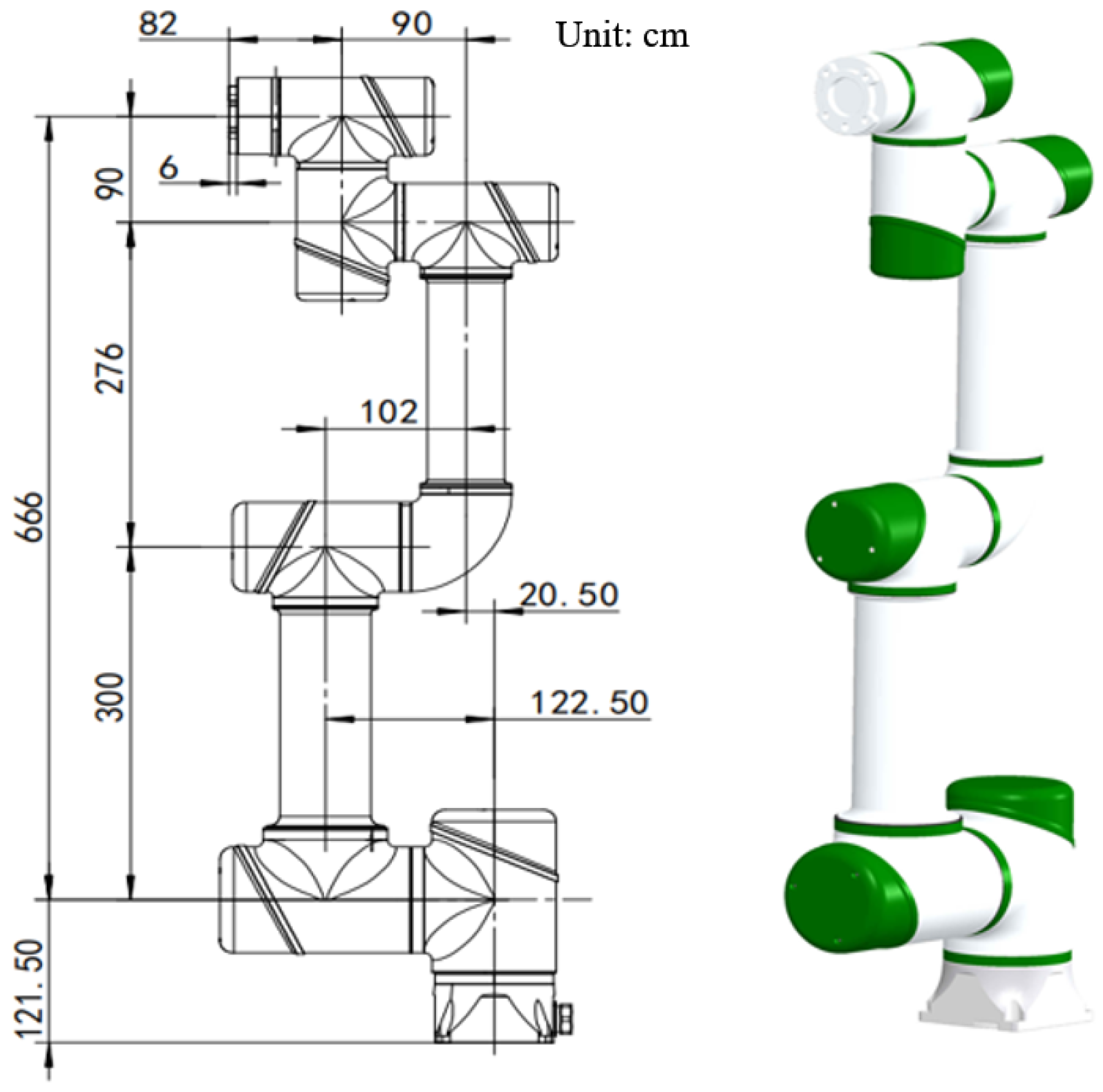
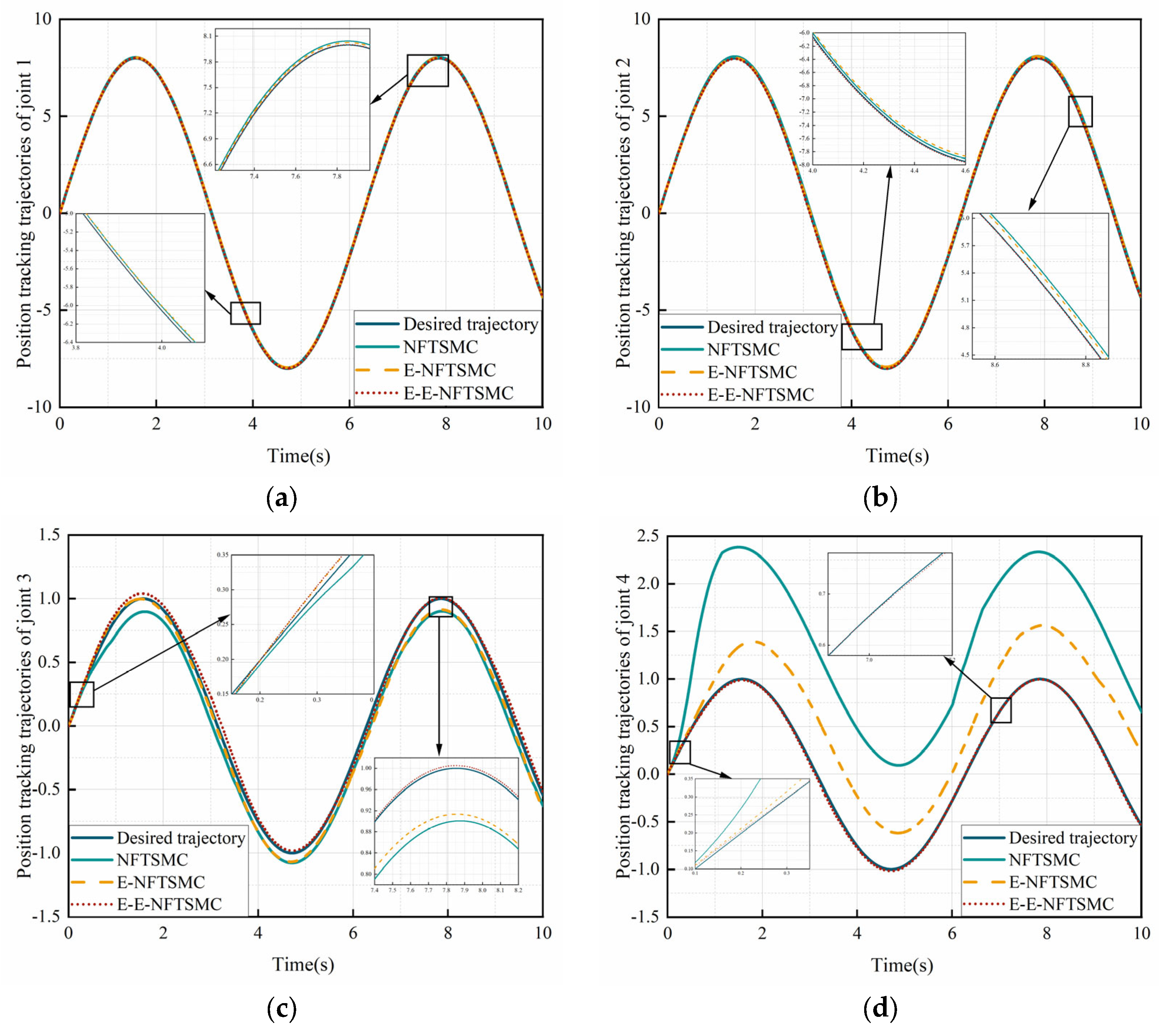
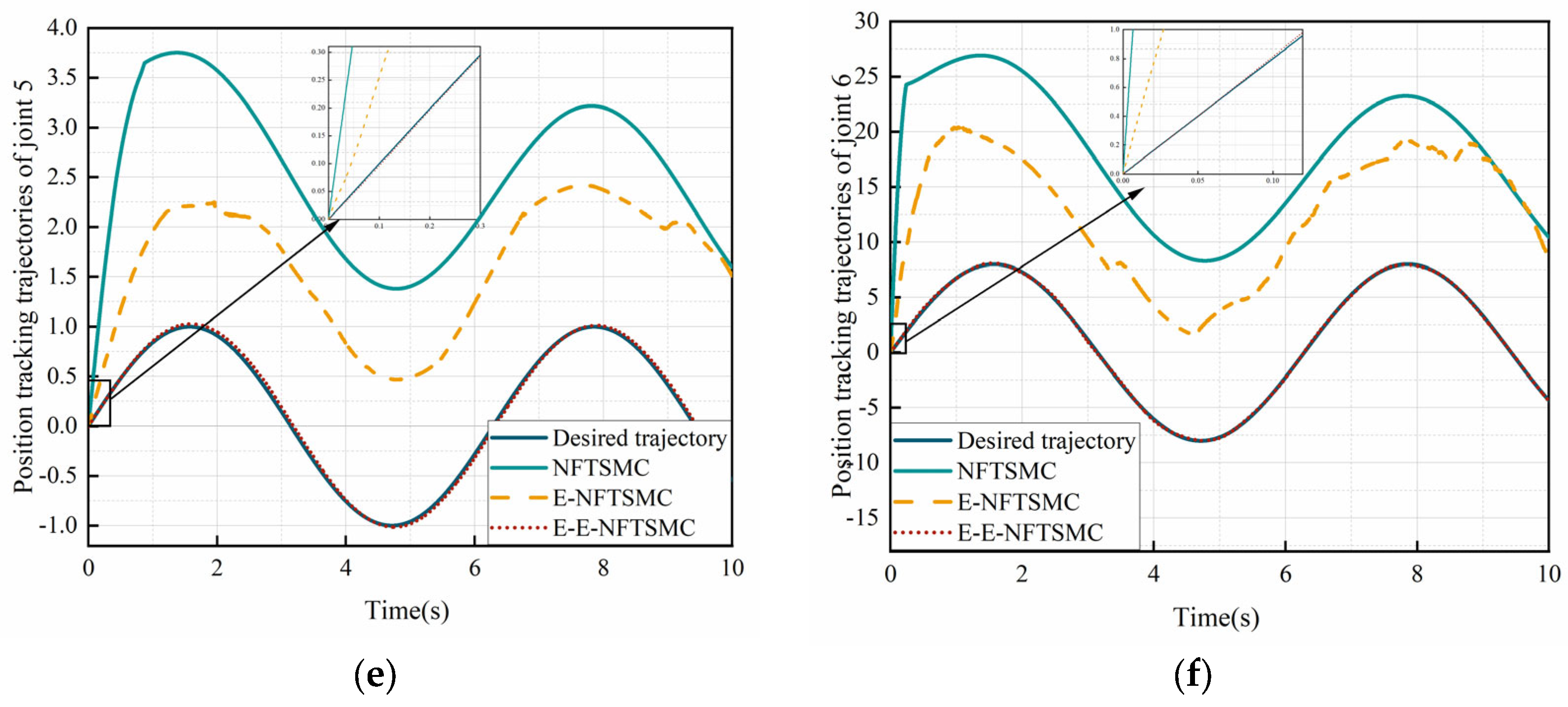
To verify the effectiveness and feasibility of the proposed control scheme, a control model is built in Simulink. In this paper, a six-axis robotic manipulator is used as the control object, with its structure shown in Figure 1. The simulation duration is set to 10 s, and the position tracking trajectory results are shown in Figure 2.
Figure 1. Structure of a six-axis robotic manipulator.
Figure 2. Joint position tracking trajectory. (a) position tracking trajectory of joint 1. (b) position tracking trajectory of joint 2. (c) position tracking trajectory of joint 3. (d) position tracking trajectory of joint 4. (e) position tracking trajectory of joint 5. (f) position tracking trajectory of joint 6.
From the joint trajectory tracking curves shown in Figure 2a,b, it can be observed that all control schemes for axes 1 and 2 are able to track the desired trajectory, but the tracking error of the E-E-NFTSMC control strategy is the smallest. From Figure 2c–f, it can be seen that, due to external disturbances and coupling effects, the NFTSMC and E-NFTSMC control strategies show poor tracking performance on axes 3–6, and even fail to track the desired trajectory. In contrast, the E-E-NFTSMC control strategy proposed in this paper can still track the trajectory well, and the tracking performance is the most satisfactory.
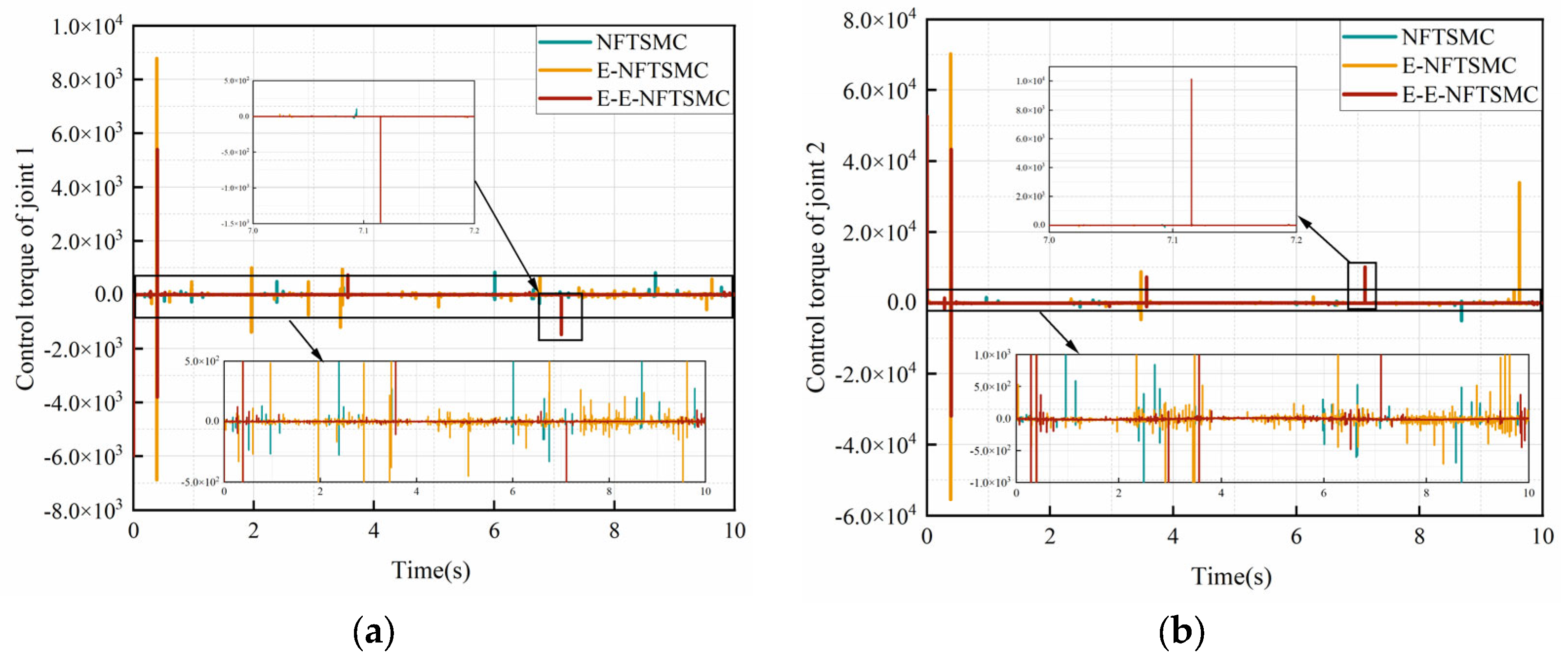
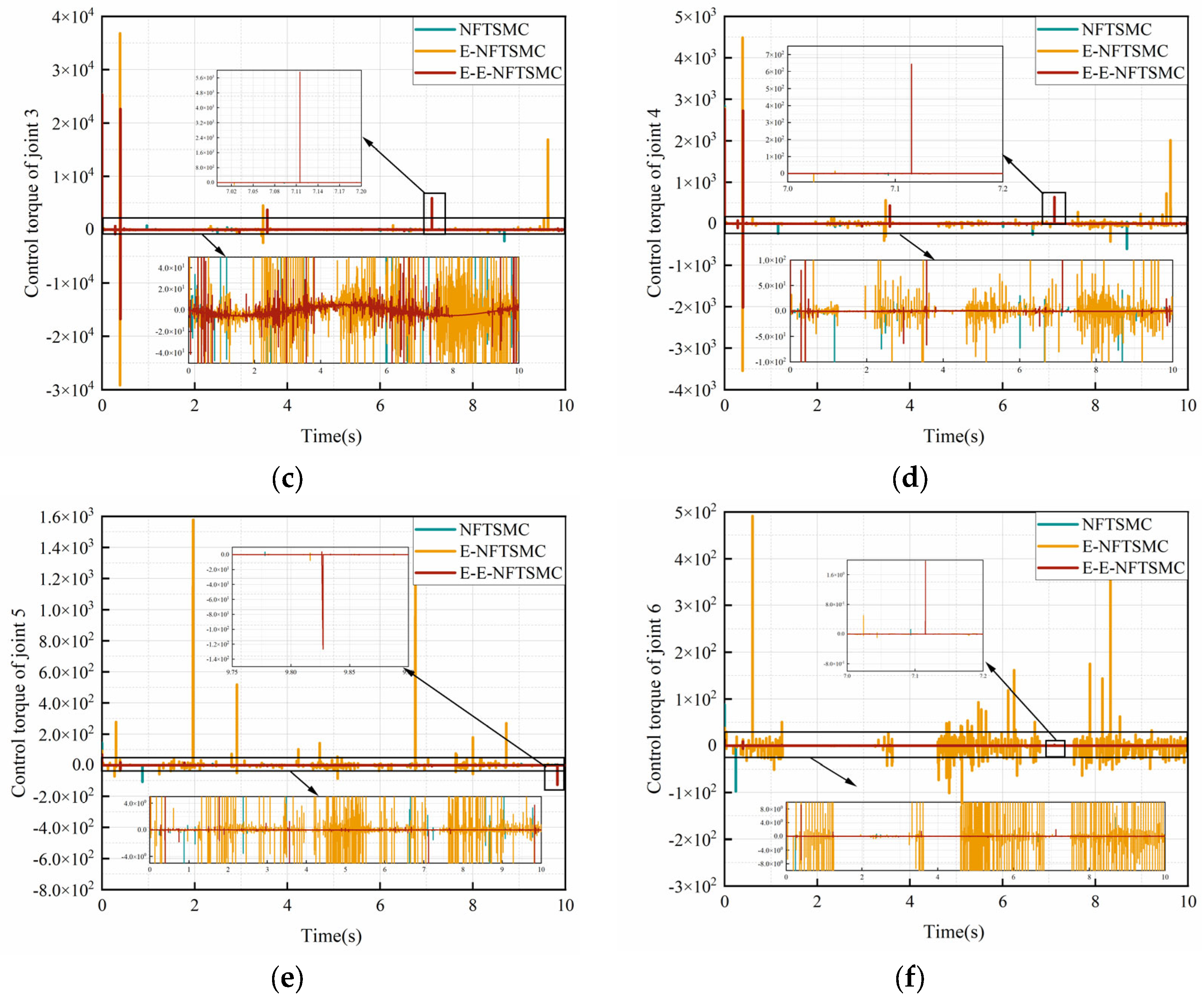
From the convergence curves of the control torque inputs in Figure 3, it can be observed that under the influence of disturbances, the torque remains relatively stable with the proposed control algorithm, while the other two methods still exhibit large fluctuations. The maximum torques of the three methods used in the simulation are −1809.7 N·m, −477.2 N·m and −111.8 N·m, respectively, which further demonstrates the superiority of the proposed method from the data.
Figure 3. Joint Torques. (a) control torque of joint 1. (b) control torque of joint 2. (c) control torque of joint 3. (d) control torque of joint 4. (e) control torque of joint 5. (f) control torque of joint 6.
Compared with the conventional NFTSMC, the proposed E-E-NFTSMC reduces the RMS value of the control torque from approximately 520 N·m to a negligible level, corresponding to a reduction of about 99.9%. In comparison with the E-NFTSMC, the proposed E-E-NFTSMC decreases the peak RMS torque from approximately 11,500 N·m to about 575 N·m, achieving a reduction of around 95%, which significantly improves control smoothness.
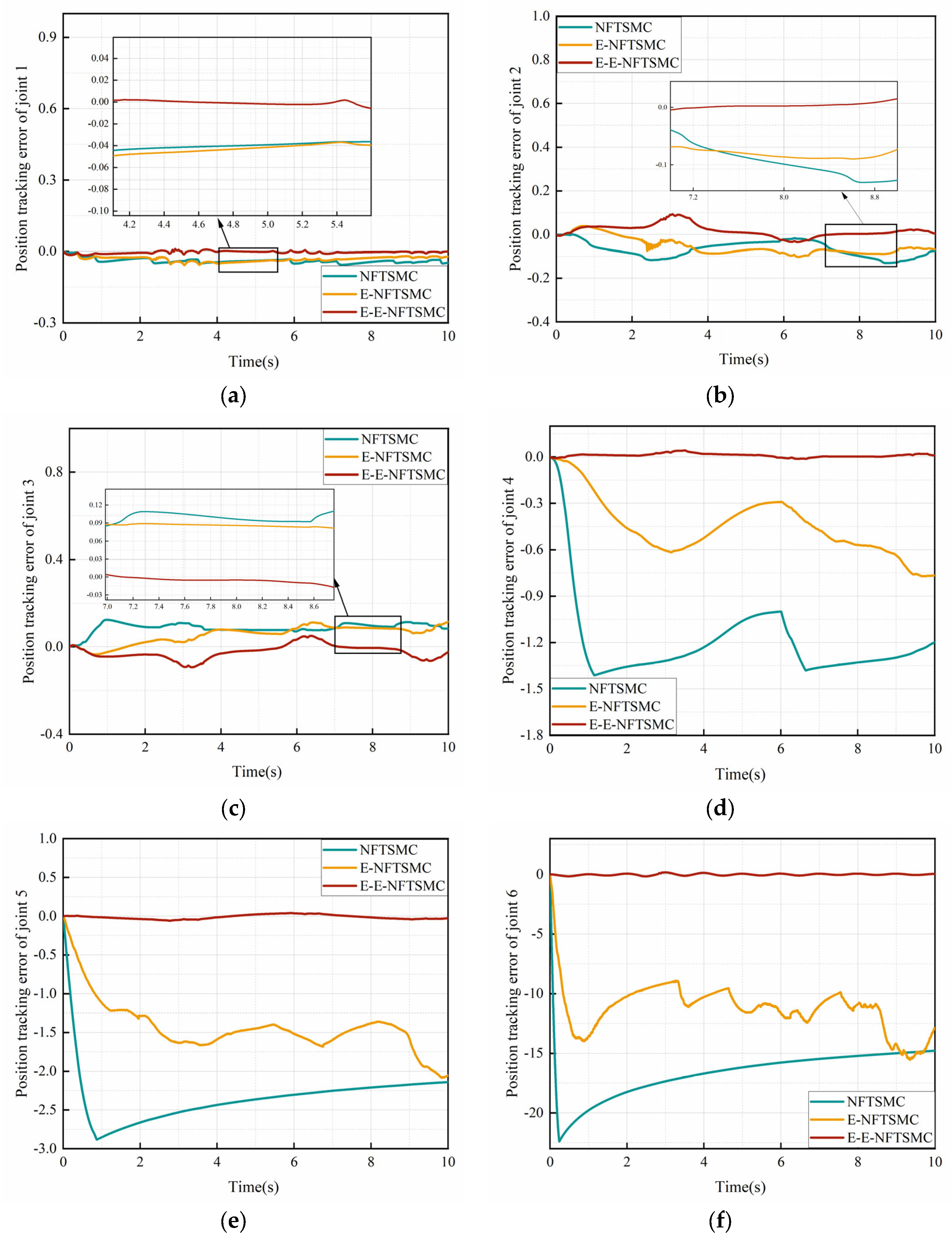
From the joint trajectory tracking error curves shown in Figure 4, it can be seen that the control method proposed in this paper has a faster convergence speed compared with the other two methods. To further evaluate the convergence rate quantitatively, the settling time is defined as the time required for the tracking error to enter and remain within a small neighborhood around zero (±5% of the steady-state value). As observed from Figure 4, the proposed E-E-NFTSMC consistently exhibits the shortest settling time among the three control strategies for all joints. This confirms that, although an explicit theoretical upper bound is not derived, the proposed method achieves significantly faster convergence in practice. Under the optimization of the proposed control strategy, the trajectory tracking error quickly converges to zero, and the error fluctuations are relatively small.
Figure 4. Joint position tracking error. (a) position tracking error of joint 1. (b) position tracking error of joint 2. (c) position tracking error of joint 3. (d) position tracking error of joint 4. (e) position tracking error of joint 5. (f) position tracking error of joint 6.
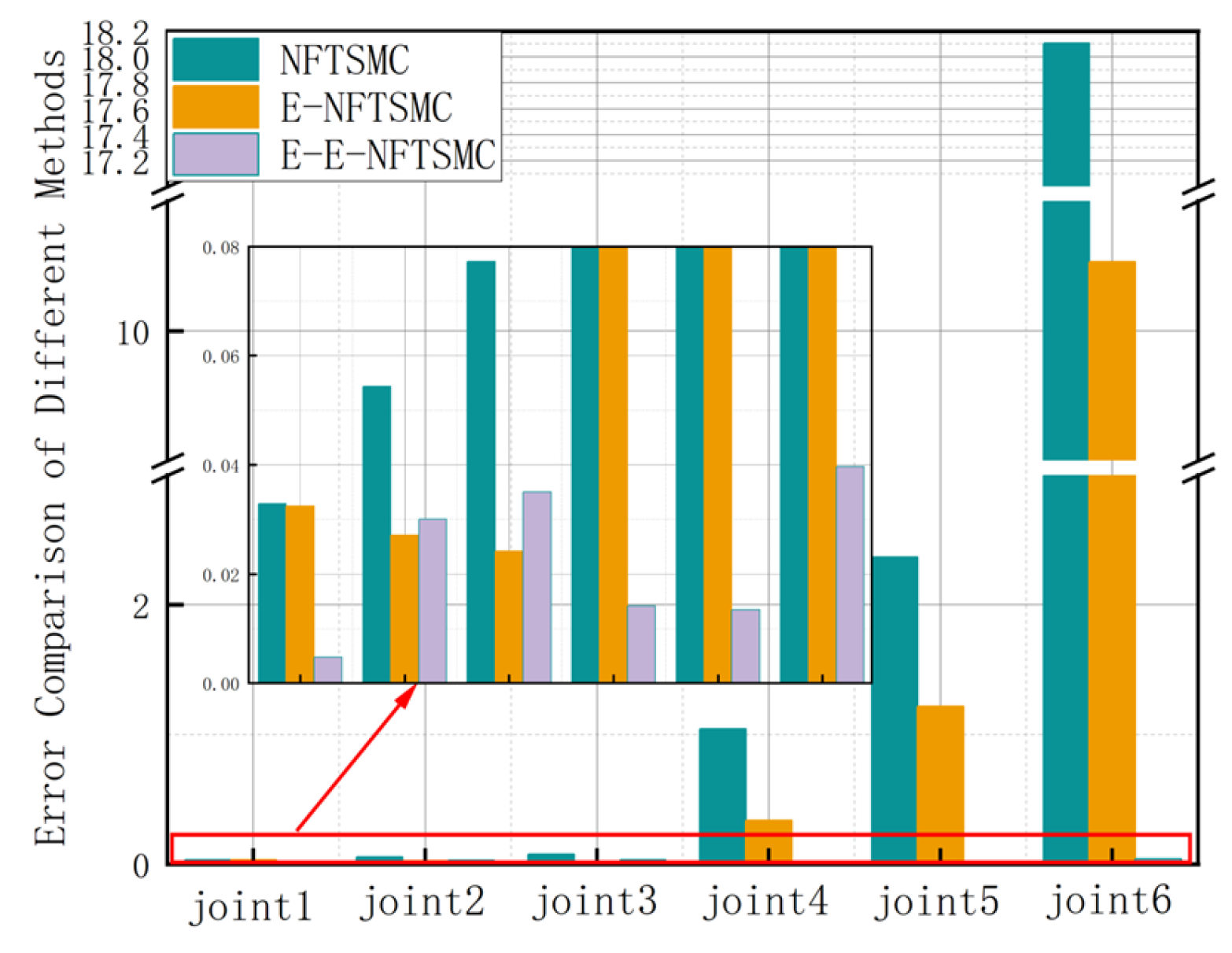
Based on the error of the six-axis robotic manipulator, the error bar chart of the six axes is obtained as shown in Figure 5, and the average error is shown in Table 2. Through the error comparison chart, it can be more intuitively observed that the errors of the method proposed in this paper are all around zero, while the other two methods have large fluctuations, especially in axes 4, 5, and 6, where there are large errors due to coupling effects. The proposed method effectively solves this problem.
Figure 5. Comparison of errors.
Table 2. Average errors.
From Figure 5 and Table 2, it can be seen that, compared with the conventional NFTSMC, the E-E-NFTSMC improves the average error by approximately 1.49%, 50.14%, 68.71%, 67.82%, 48.61%, and 41.84%, respectively; compared with the conventional NFTSMC, the E-E-NFTSMC improves the average error by approximately 85.65%, 98.09%, 93.47%, 98.65%, 99.43%, and 99.78%, respectively. The comparative analysis indicates that the proposed control method can not only significantly enhance trajectory tracking accuracy but also substantially shorten the system’s response adjustment time. This validates that the method can effectively reduce steady-state error, thereby improving both control precision and robustness.
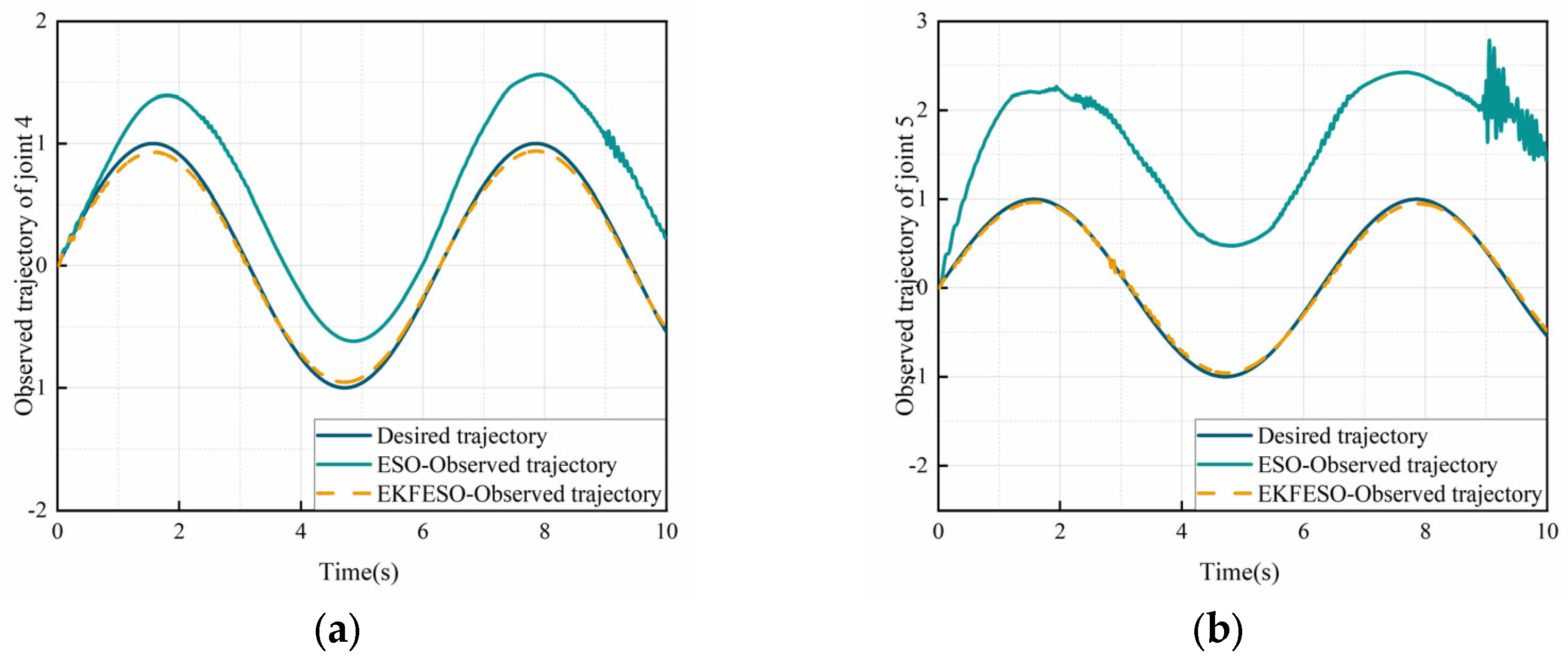
To observe the effect of the proposed observer in coping with disturbances, joints 4 and 5, which are most severely affected by coupling, were selected as examples, and the observation trajectories of the two observers were compared. The results are shown in Figure 6.
Figure 6. Observation Trajectories. (a) Joint 4 Observation Trajectory; (b) Joint 5 Observation Trajectory.
The results show that the conventional observer struggles significantly under strong coupling, exhibiting large trajectory fluctuations and substantial deviations, making it difficult to track the trajectory accurately. In contrast, the improved observer, with precise disturbance identification and a rapid compensation mechanism, produces smooth trajectories that closely follow the desired path.

5.3. Experiments and Analysis

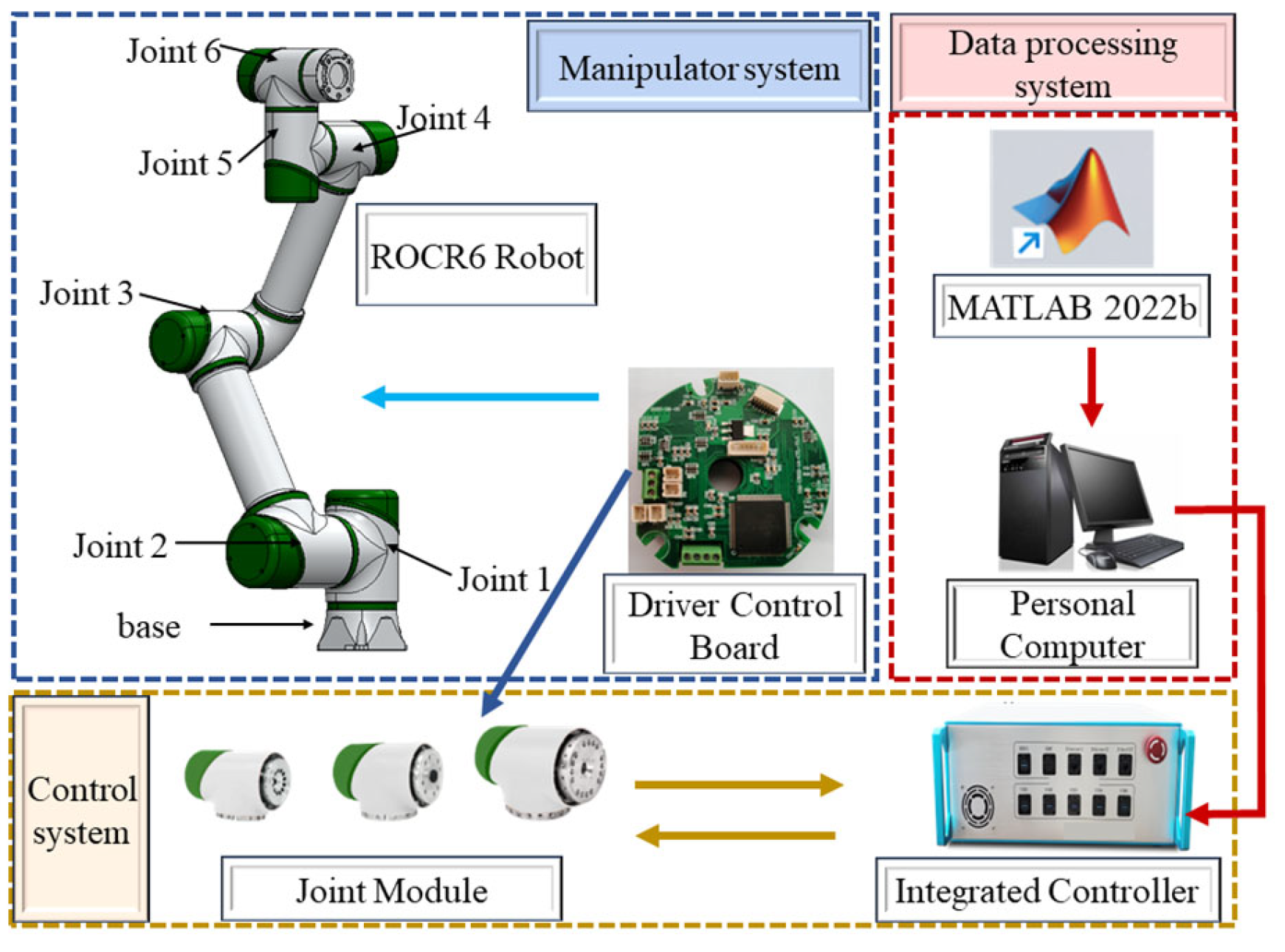
To further verify superiority of the designed controller, experiments were conducted on the ROCR6 robotic manipulator to compare the proposed control strategy with other control strategies used in the simulations. The experimental procedure is shown in Figure 7. The experimental platform consists of a 6-DOF robotic manipulator, drive boards, an integrated controller, a computer, and MATLAB 2022b for data processing. The manipulator’s joints communicate with the controller to exchange commands and state feedback. Control signals generated in MATLAB are transmitted via the computer to the controller, enabling precise trajectory tracking.
Figure 7. Experimental Procedure Diagram.
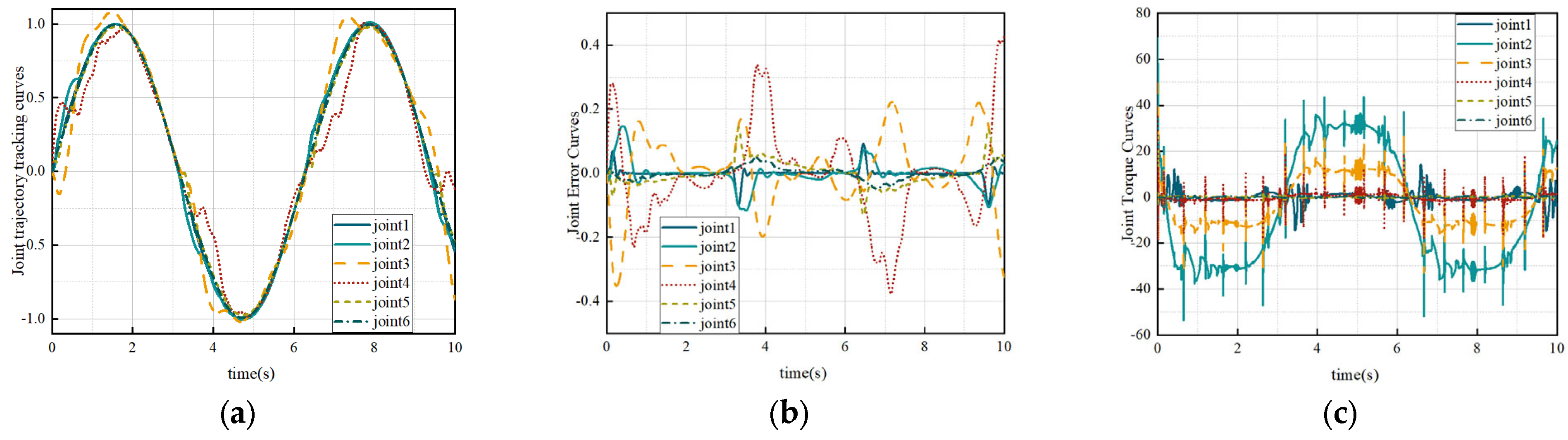
A periodic desired trajectory was set for tracking. When the ROCR6 was configured in torque control mode, the robotic manipulator experienced some deflection due to gravity. However, under the action of the controller, the actual trajectory was able to follow the desired trajectory accurately.
From the tracking performance analysis, all joints in Figure 8 are able to accurately follow the desired trajectory. Regarding the tracking error, the robotic manipulator’s joint errors remain stable within the range of [−0.4, 0.4], and the joint torques in Figure 8 stay within [−60, 50] with relatively small fluctuations. As shown in Figure 8, the tracking errors of the six joints differ. Joints 3 and 4 exhibit the largest errors because they bear higher inertial loads and are more sensitive to disturbances, unmodeled dynamics, as well as nonlinear effects such as friction, backlash, and joint coupling. Joints 1 and 2, located near the base, have smaller inertial loads but may be affected by motion errors transmitted from the base, resulting in moderate errors. Joints 5 and 6, near the end effector, experience smaller loads and require lower control torques, leading to weaker error amplification and the best tracking performance.
Figure 8. Experimental Analysis. (a) Joint Trajectory Tracking. (b) Joint Errors. (c) Joint Torques.
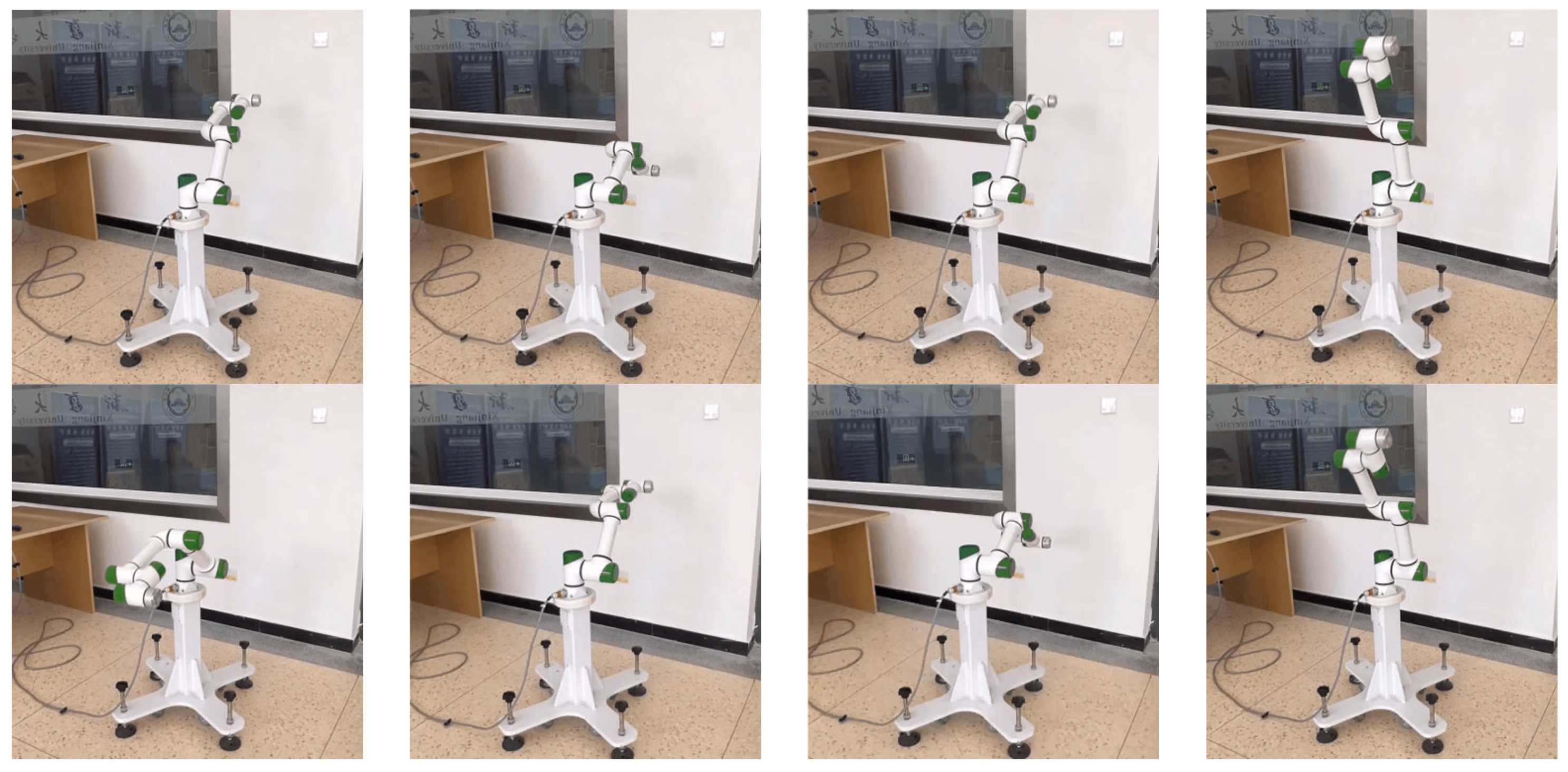
These results indicate that the proposed control strategy can maintain tracking errors within a small range during trajectory tracking, demonstrating that the strategy can achieve rapid convergence within a limited time and ensure high-precision trajectory tracking of the robotic manipulator. Figure 9 shows the process diagram of the trajectory tracking procedure.
Figure 9. Experimental Process Diagram.
During the experiments, it was observed that without filtering, the robotic manipulator exhibited varying degrees of vibration due to external disturbances and coupling effects, resulting in poor trajectory tracking performance. After introducing the filtering module, the robotic manipulator was able to effectively control the current, thereby reducing vibrations.
Both the simulation and hardware experiment results demonstrate that the proposed control scheme exhibits excellent trajectory tracking performance and rapid convergence. The control strategy meets the requirements for both precision and stability in robotic manipulator control and can effectively handle complex issues such as system nonlinearity, strong coupling, and external disturbances.

6. Conclusions

For a six-degree-of-freedom robotic manipulator subject to external disturbances, unknown system uncertainties, and coupling effects, an improved non-singular fast terminal sliding mode controller based on an extended Kalman filter (EKF) state observer is proposed. This controller can drive the tracking error to converge to zero within a finite time while effectively reducing torque chattering. The newly designed observer, composed of the improved Kalman filter and the extended state observer, can rapidly converge the estimation error to a bounded range and eventually stabilize near zero, thereby enhancing the system’s robustness to high-frequency disturbances. By designing a new reaching law to update the switching gain of the sliding function, the chattering problem is further mitigated, improving overall controller performance. To achieve finite-time convergence of the tracking error, these techniques are combined with the non-singular fast terminal sliding mode control, and the finite-time convergence property of the algorithm is proven using a Lyapunov function. Finally, the proposed method is applied to numerical simulations and experiments on a six-degree-of-freedom robotic manipulator, and the results validate the feasibility and superiority of the approach. In future work, trajectory planning methods will be investigated in conjunction with the proposed robust trajectory tracking controller to achieve a systematic integration of smooth motion planning and robust finite-time tracking control under complex operating conditions, thereby further improving motion smoothness and overall control performance in practical robotic applications.

Author Contributions

Conceptualization, J.L. and T.C.; methodology, J.L.; software, J.L.; validation, J.L., T.C. and Z.D.; formal analysis, J.L.; investigation, Z.D.; resources, X.L.; data curation, T.C.; writing—original draft preparation, J.L.; writing—review and editing, X.Z. and X.L.; visualization, J.L.; supervision, X.L.; project administration, X.Z. and X.L.; funding acquisition, X.L. All authors have read and agreed to the published version of the manuscript.

Funding

This research was funded by the National Natural Science Foundation of China project (52265003); The Tianshan Talents-Young Cedar Youth Top Talent Project of the Xinjiang Uygur Autonomous Region (20227SYCCX0061) and the Xinjiang Uygur Autonomous Region Postgraduate Research Innovation Project, grant number (XJ2025G042).

Data Availability Statement

Data are contained within the article.

Conflicts of Interest

The authors declare no conflicts of interest.

References

  1. Shojaei, K.; Kazemy, A.; Chatraei, A. An observer-based neural adaptive PID2 controller for robot manipulators including motor dynamics with a prescribed performance. IEEE/ASME Trans. Mechatron. 2020, 26, 1689–1699. [Google Scholar] [CrossRef]
  2. Tinoco, V.; Silva, M.F.; Santos, F.N.; Morais, R.; Magalhães, S.A.; Oliveira, P.M. A review of advanced controller methodologies for robotic manipulators. Int. J. Dyn. Control 2025, 13, 36. [Google Scholar] [CrossRef]
  3. Xuan, Q.N.; Cong, C.N.; Ba, N.N. Robust adaptive trajectory tracking sliding mode control for industrial robot manipulator using fuzzy neural network. J. Robot. Control (JRC) 2024, 5, 490–499. [Google Scholar] [CrossRef]
  4. Ataşlar-Ayyıldız, B. Robust trajectory tracking control for serial robotic manipulators using fractional order-based PTID controller. Fractal Fract. 2023, 7, 250. [Google Scholar] [CrossRef]
  5. Azeez, M.I.; Atia, K.R. Modeling of PID controlled 3DOF robotic manipulator using Lyapunov function for enhancing trajectory tracking and robustness exploiting Golden Jackal algorithm. ISA Trans. 2024, 145, 190–204. [Google Scholar] [CrossRef]
  6. Zhang, Q.; Mu, M.; Ji, H.; Wang, Q.; Wang, X. An adaptive type-2 fuzzy sliding mode tracking controller for a robotic manipulator. Electron. Res. Arch. 2023, 31, 3791–3813. [Google Scholar] [CrossRef]
  7. Aydın, M. Real-time sliding mode and moving sliding mode control of 3-dof linear parallel robot. Machines 2025, 13, 190. [Google Scholar] [CrossRef]
  8. Park, J.M.; Kwon, W.; Park, P.G. An improved adaptive sliding mode control based on time-delay control for robot manipulators. IEEE Trans. Ind. Electron. 2022, 70, 10363–10373. [Google Scholar] [CrossRef]
  9. Wang, Z.; Mei, L.; Ma, X. A novel generalized sliding mode controller for uncertain robot manipulators based on motion constraints. Mech. Sci. 2024, 15, 55–62. [Google Scholar] [CrossRef]
  10. Qu, J.; Zhang, Z.; Li, H.; Li, M.; Xi, X.; Zhang, R. Design and experiments of a two-stage fuzzy controller for the off-center steer-by-wire system of an agricultural mobile robot. Machines 2023, 11, 314. [Google Scholar] [CrossRef]
  11. Zhang, X.; Wang, R. Non-singular fast terminal sliding mode control of robotic manipulator with prescribed performance. J. Eng. Appl. Sci. 2024, 71, 217. [Google Scholar] [CrossRef]
  12. Xu, K.; Wang, Z. The design of a neural network-based adaptive control method for robotic arm trajectory tracking. Neural Comput. Appl. 2023, 35, 8785–8795. [Google Scholar] [CrossRef]
  13. Du, B.; Zhu, D.; Pan, Y. Fuzzy super-twisting second order sliding mode trajectory tracking control for robotic manipulator. J. Syst. Simul. 2022, 34, 1343–1352. [Google Scholar]
  14. Shan, H.; Jiang, Y.; Zhu, Y.; Liang, H.; Wang, S. Fixed-time self-triggered fuzzy adaptive control of N-link robotic manipulators. Fuzzy Sets Syst. 2025, 498, 109134. [Google Scholar] [CrossRef]
  15. Li, L.; Qiang, J.; Xia, Y.; Cao, W. Adaptive dual closed-loop trajectory tracking control for a wheeled mobile robot on rough ground. Nonlinear Dyn. 2025, 113, 2411–2425. [Google Scholar] [CrossRef]
  16. Zhou, S.; Shen, C.; Xia, Y.; Chen, Z.; Zhu, S. Adaptive robust control design for underwater multi-DoF hydraulic manipulator. Ocean. Eng. 2022, 248, 110822. [Google Scholar] [CrossRef]
  17. Song, G.I.; Park, H.Y.; Kim, J.H. The H Robust Stability and Performance Conditions for Uncertain Robot Manipulators. IEEE/CAA J. Autom. Sin. 2025, 12, 270–272. [Google Scholar] [CrossRef]
  18. Wang, C.; Tnunay, H.; Zuo, Z.; Lennox, B.; Ding, Z. Fixed-time formation control of multirobot systems: Design and experiments. IEEE Trans. Ind. Electron. 2018, 66, 6292–6301. [Google Scholar] [CrossRef]
  19. Ning, B.; Han, Q.L. Prescribed finite-time consensus tracking for multiagent systems with nonholonomic chained-form dynamics. IEEE Trans. Autom. Control 2018, 64, 1686–1693. [Google Scholar] [CrossRef]
  20. Hu, S.; Wan, Y.; Liang, X. Adaptive nonsingular fast terminal sliding mode trajectory tracking control for robotic manipulators with model feedforward compensation. Nonlinear Dyn. 2025, 113, 16893–16911. [Google Scholar] [CrossRef]
  21. Cruz-Ortiz, D.; Chairez, I.; Poznyak, A. Non-singular terminal sliding-mode control for a manipulator robot using a barrier Lyapunov function. ISA Trans. 2022, 121, 268–283. [Google Scholar] [CrossRef] [PubMed]
  22. Zhou, X.; Li, X. Trajectory tracking control for electro-optical tracking system using ESO based fractional-order sliding mode control. IEEE Access 2021, 9, 45891–45902. [Google Scholar] [CrossRef]
  23. Chen, G.; Wu, W.; Yang, C.; Hu, H.; Zhang, J.; Shi, J.; Wu, C.; Ma, Y. Practical Finite-Time Observer-Based Adaptive Backstepping Super-Twisting Sliding Mode Control for Deep-Sea Hydraulic Manipulator. In IEEE Transactions on Industrial Electronics; IEEE: Piscataway, NJ, USA, 2025. [Google Scholar]
  24. Yin, C.W.; Ding, Y.P.; Sun, H.J. Nonsingular fast predefined time convergence sliding mode control for construction robot. ISA Trans. 2025, 161, 109–121. [Google Scholar] [CrossRef] [PubMed]
  25. Yang, J.; Wang, Y.; Wang, T.; Hu, Z.; Yang, X.; Rodriguez-Andina, J.J. Time-delay sliding mode control for trajectory tracking of robot manipulators. IEEE Trans. Ind. Electron. 2024, 71, 13083–13091. [Google Scholar] [CrossRef]
  26. Zhang, Y.; Kong, L.; Zhang, S.; Yu, X.; Liu, Y. Improved sliding mode control for a robotic manipulator with input deadzone and deferred constraint. IEEE Trans. Syst. Man Cybern. Syst. 2023, 53, 7814–7826. [Google Scholar] [CrossRef]
  27. Tian, D.; Xu, R.; Sariyildiz, E.; Gao, H. An adaptive switching-gain sliding-mode-assisted disturbance observer for high-precision servo control. IEEE Trans. Ind. Electron. 2021, 69, 1762–1772. [Google Scholar] [CrossRef]
  28. Lyu, S.; Lang, X.; Wang, D. Koopman-based robust learning control with extended state observer. In IEEE Robotics and Automation Letters; IEEE: Piscataway, NJ, USA, 2025. [Google Scholar]
  29. Xu, Z.; Yang, X.; Zhou, S.; Zhang, W.; Zhang, W.; Yang, S.; Liu, P.X. Extended state observer based adaptive backstepping nonsingular fast terminal sliding-mode control for robotic manipulators with uncertainties. Int. J. Control. Autom. Syst. 2022, 20, 2972–2982. [Google Scholar] [CrossRef]
  30. Silaa, M.Y.; Bencherif, A.; Barambones, O. Indirect adaptive control using neural network and discrete extended kalman filter for wheeled mobile robot. Actuators 2024, 13, 51. [Google Scholar] [CrossRef]
  31. Hartley, R.; Ghaffari, M.; Eustice, R.M.; Grizzle, J.W. Contact-aided invariant extended Kalman filtering for robot state estimation. Int. J. Robot. Res. 2020, 39, 402–430. [Google Scholar] [CrossRef]
  32. Zhang, C.; Mao, J.; Qin, Q.; Wu, A.; Zhang, X.; Zheng, J. Vision-based trajectory tracking control for wheeled mobile robots using DG-KalmanNet and nonsingular terminal sliding mode control: C. Zhang et al. Nonlinear Dyn. 2025, 113, 33687–33719. [Google Scholar] [CrossRef]
  33. Li, L.; Cao, W.; Yang, H.; Geng, Q. Trajectory tracking control for a wheel mobile robot on rough and uneven ground. Mechatronics 2022, 83, 102741. [Google Scholar] [CrossRef]
Disclaimer/Publisher’s Note: The statements, opinions and data contained in all publications are solely those of the individual author(s) and contributor(s) and not of MDPI and/or the editor(s). MDPI and/or the editor(s) disclaim responsibility for any injury to people or property resulting from any ideas, methods, instructions or products referred to in the content.

Article Metrics

Citations

Article Access Statistics

Multiple requests from the same IP address are counted as one view.