1. Introduction and Motivation
Let
denote the family of all holomorphic functions
h that are normalized by the conditions
and
. These functions are defined in the domain of the open unit disk
. Given this normalization, the function
h has a Taylor–Maclaurin series expansion of the form
Let
be the subclass of
consisting of univalent functions in
. For an analytic function
defined in the open unit disk
satisfying the conditions of
Schwarz Lemma (i.e.,
and
,
), if we have
,
, then
H is called to be
subordinate to
G denoted by
(see [
1]). Therefore, according to Schwarz lemma the subordination
implies
and
, while if
G is univalent in
, the reverse implication holds; hence, if
G is univalent in
with
, then
In 1985, De Branges [
2] successfully resolved the notable
Bieberbach conjecture by demonstrating that for any function
, the inequality
holds for all
. Moreover, equality is achieved for all
in cases where
h is the
Koebe function or one of its rotations. This finding opens a new direction to understand the coefficients of univalent functions in geometric function theory. Prior to the conjecture’s resolution, numerous researchers endeavored to establish a proof or counterexample, resulting in the definition and exploration of several intriguing subclasses within the class
, each associated with distinct image domains.
A key result in geometric function theory is the
Koebe one-quarter theorem [
3] which ensures that the image of the open unit disk
under any univalent function
always covers the disk with center in the origin and radius at least
. Furthermore, for each function
, the existence of an inverse
(where
) is guaranteed. This inverse acts as
within the disk
, and the radius of this disk is known to be no smaller than
(
), where
From equalities (
1) and (
3), one may have
Finding the upper bounds for the modules of
Hankel determinants for various subclasses of analytic univalent functions is an active area of research in the
Geometric Function Theory. In 1976, Noonan and Thomas [
4] stated the
p-th Hankel determinant for
and
of functions
of the form (
1), as follows:
By specializing the different values of
q and
n, we can obtain Hankel determinants of different orders, as follows:
1. For
and
, we have
which is a special case of the well-known
Fekete–Szegő functional [
5]. For various subclasses of
, the maximum value of
has been obtained by different authors (see, for example, [
6,
7]).
2. For , we obtain
and it is the second Hankel determinant. The upper bound for
has been investigated by several authors (see [
8,
9,
10,
11]). Using the definition of the second Hankel determinant combined with (
3)–(
5), we have
Definition 1. (
i)
Let be a given nonnegative real number, and let h be analytic in having the form (1). We say that if the following condition holds:It is clear that for , are subclasses of B, where B is the class of all Bazilevič functions
. The class includes the starlike and bounded turning functions as the cases and , respectively.(
ii)
For the purpose of this paper, we say is a Bazilevič function of type
and order
if and only ifand we denote the class of such functions by (see [12]). Babalola [
13] defined the family
of
-pseudo-starlike functions of order
as follows:
Definition 2. A function given by (
1)
belongs to the family of-pseudo-starlike functions of order
in if and only ifwhere the power is considered to the principal branch, that is, . Remark 1. It may be noted that by taking in Definition 2, we obtain the class of starlike functions of order β, which in this context are 1
-pseudo-starlike functions of order β. We denote the class instead of when . This subclass of functions has been the subject of recent scrutiny and analysis by several researchers [14,15,16]. The study of
q-calculus has recently gained significant attention among researchers due to its various applications in mathematics and related fields. Jackson (see [
17,
18]) defined the
q-analogues of the derivative and integral operators and explored some of their applications. Subsequently, Aral and Gupta ([
19,
20]) introduced the
q-Baskakov–Durrmeyer operator using the
q-beta function. In addition, the authors of references ([
19,
21]) investigated the
q-generalizations of complex operators known as the
q-Picard and
q-Gauss–Weierstrass singular integral operators. More recently, Kanas and Răducanu [
22] developed the
q-analogue of the Ruscheweyh differential operator using convolution concepts and examined some of its properties.
Many
q-differential and
q-integral operators can be expressed in terms of convolution. We will outline the basic principles of
q-calculus, as initiated by Jackson [
18], which will assist us in our further study. Moreover, this approach can be extended to higher-dimensional domains.
For
, the
q-derivative of a function
h is defined by
provided that
exists. Thus, for a function
h given by (
1), we have
where
As
,
and
.
2. New Subclasses of Analytic Functions and Their Properties
Motivated by aforementioned works of the researchers, we define the following subclasses of as given below:
Definition 3. For , and , the class is defined bywhere , . Definition 4. For , and , the class is defined bywhere , . Note that both of the left hand sides functions from the subordinations (
9) and (
10) are analytic in
. For these, we use the well-known result, as follows: if the function
is analytic in the open set
,
, and
is a removable isolate singular point for
, which is equivalent to the existence of the finite limit
, then this function can be extended by continuity at the point
to the function
analytic in
G, that is
This analytic extension will be denoted also by
, and using this property and notation, the functions that appeared in the left hand sides subordinations (
9) and (4) represent their analytic extensions by continuity at the point
.
If the function
belongs to the class defined by (
9), for the analyticity of the left hand side of the subordination, we assume that
for
and
for all
. Similarly, in view of (
10), we assume that
and
,
.
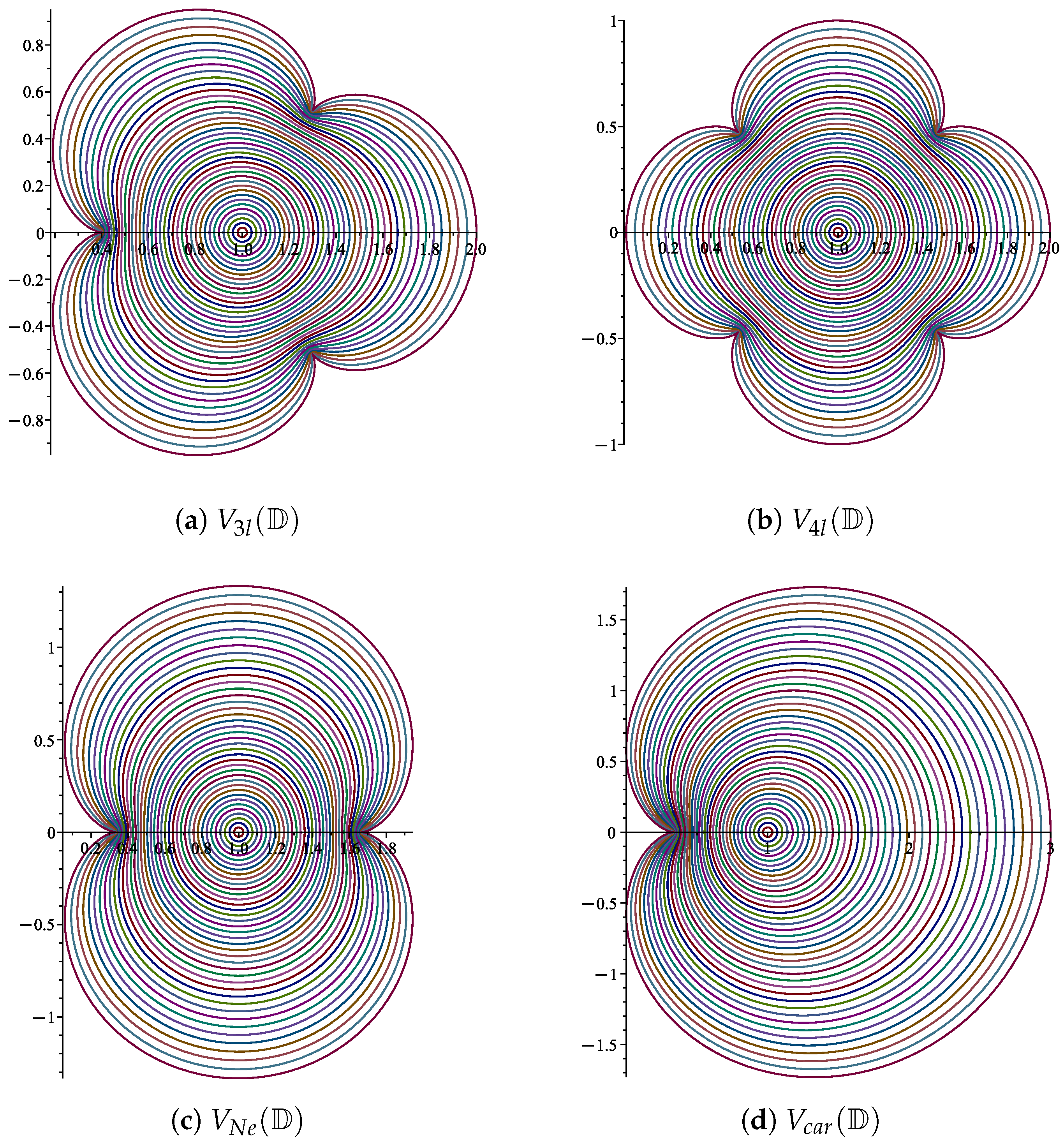
For particular values of
, we obtain different function
shown in the
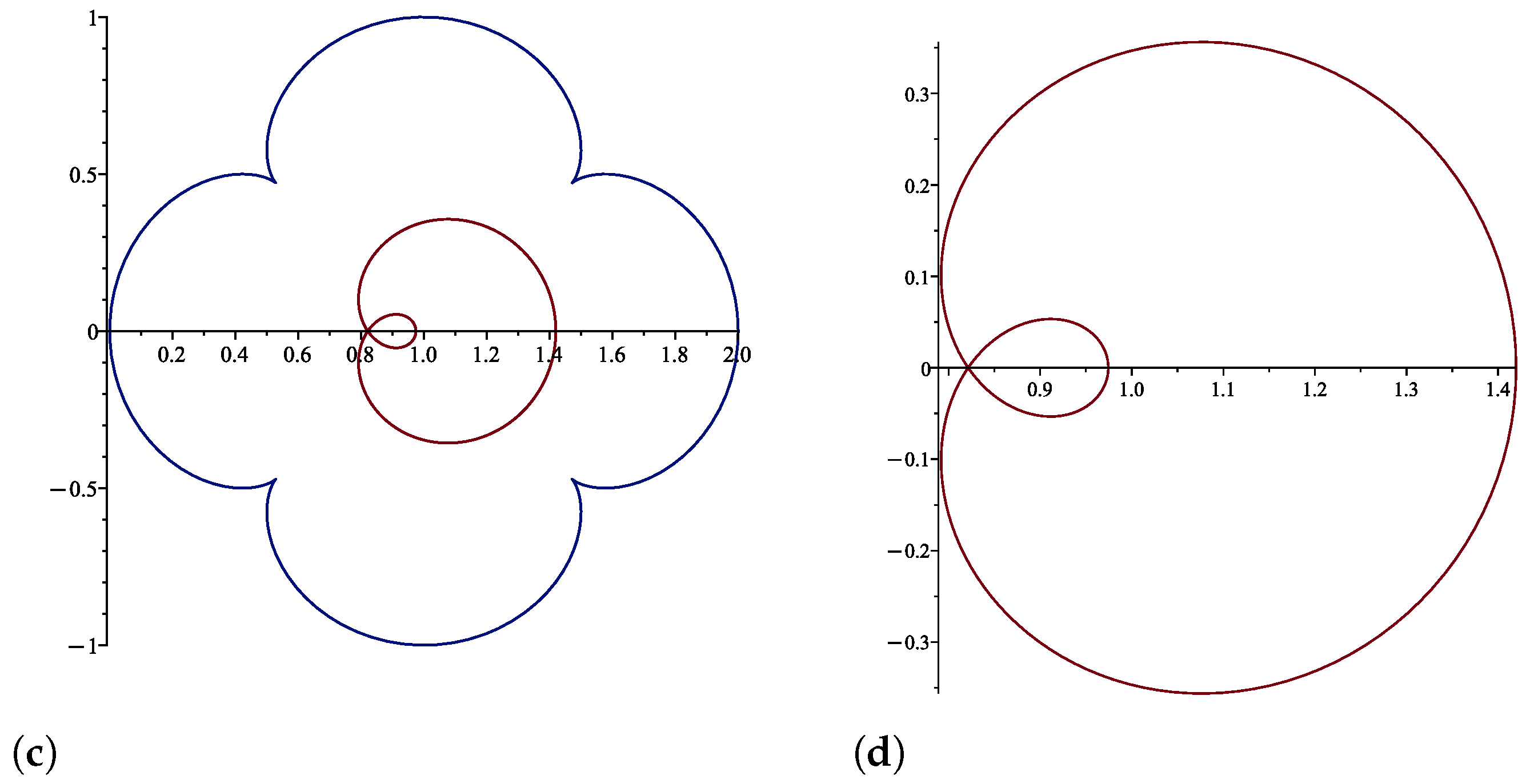
Table 1 while the images of
are presented in the
Figure 1a–d.
Remark 2. (
i)
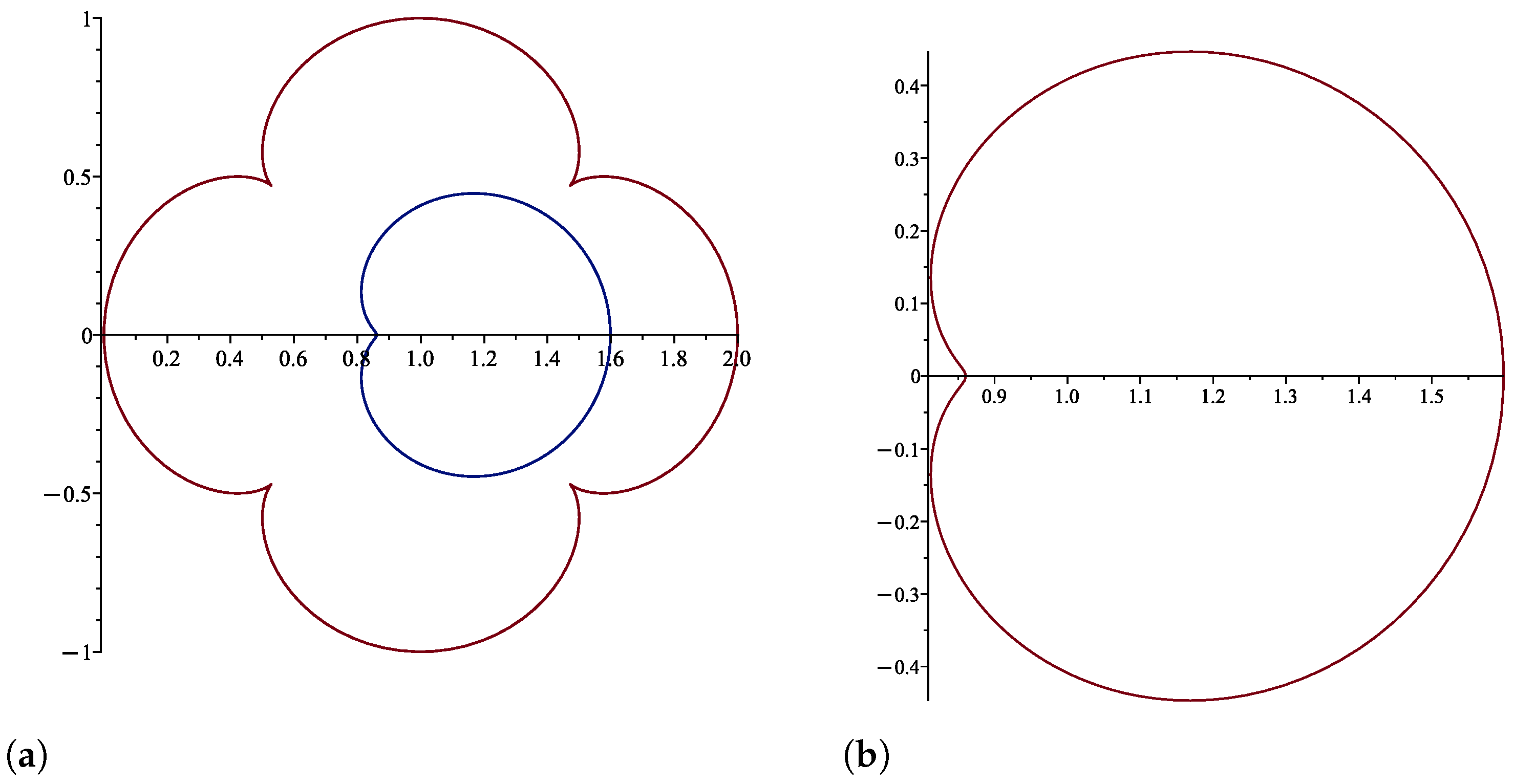
First, we will show that for appropriate choice of the parameters, the classes and are not empty, for a convenient function V. Thus, let us consider the function V to be given by . Like we proved in [23] ([Remark 1]), the function is starlike (univalent) in with respect to the point ; therefore, according to the equivalence (
2)
, we should find values of the parameters such thatwhere Considering the function , for the values , , , , and , using the 2D plot
of the MAPLE™ 2025 computer software, we obtain the images of the boundary by the functions and shown in Figure 2a. Since is univalent in , the equivalence (
2)
yields that the subordination holds whenever and (see Figure 2a). In conclusion, for the above values of the parameters; hence, the class is not empty for non-trivial values of the parameters. Let us recall the well known univalence theorem on the boundary
(see, for example, [24] Lemma 1.1, p. 13): If f is analytic in and injective on the boundary , then f is univalent in and maps onto the inner domain of the (closed) Jordan curve . For the above defined function , we have . Using the 2D plot
of the MAPLE™ 2025 computer software, the image of the boundary by the functions (see Figure 2b), we see that is a simple curve; hence, is univalent on . Thus, from the above mentioned result, we conclude that , consequently, for some values of the parameters , , and . (
ii)
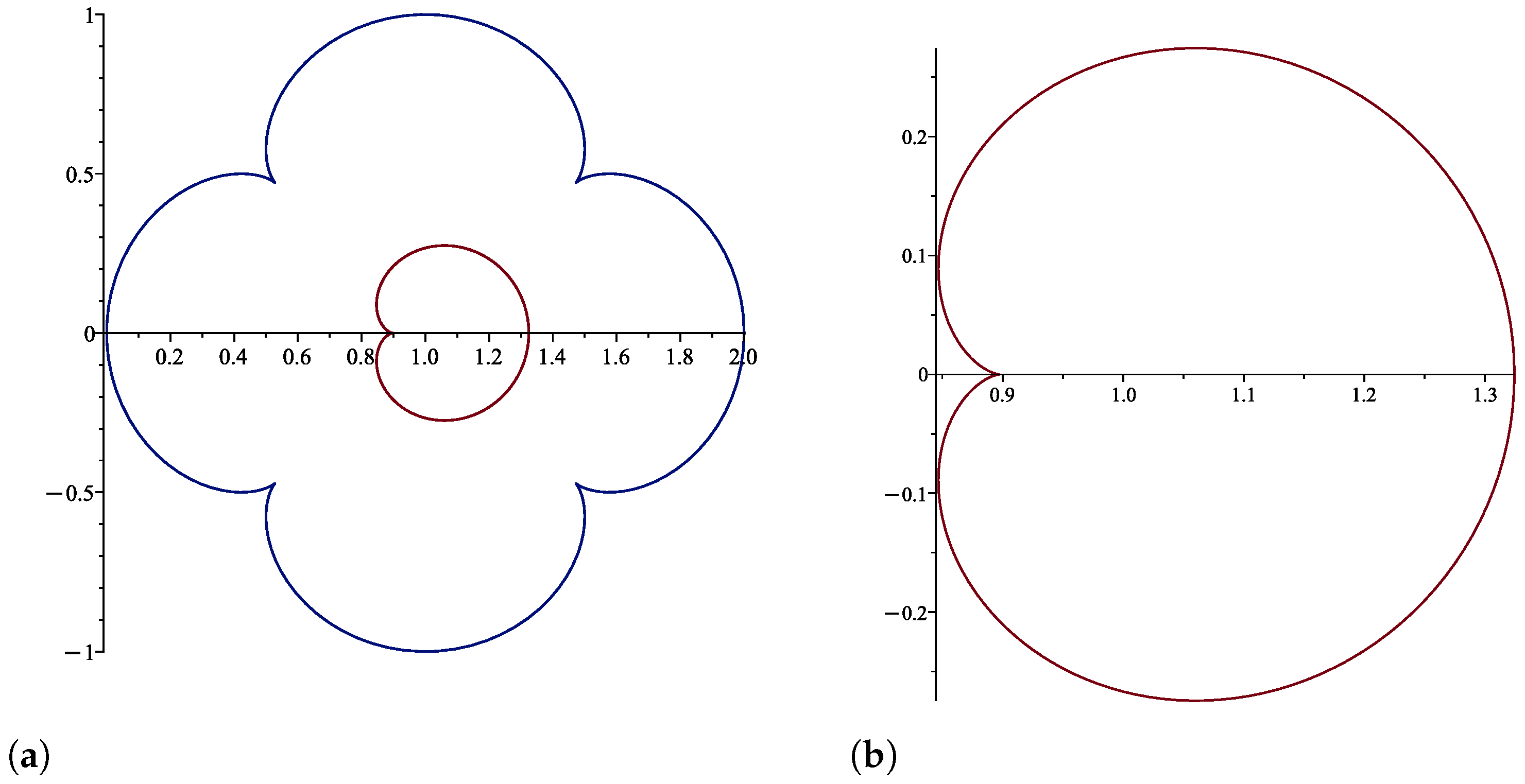
Using similar reasons to the above, if we consider the function , for the values , , , , and , using the 2D plot
of the MAPLE™ 2025 computer software, we obtain the images of the boundary by the functions and , shown in Figure 3b. Thus, for the above values of the parameters and the class is not empty for non-trivial values of the parameters.Using the 2D plot
of the MAPLE™ 2025 computer software, the image of the boundary by the functions (see Figure 3b), we obtain that is a simple curve; hence, is univalent on . We deduce that , thus for some values of the parameters , , and . (
iii)
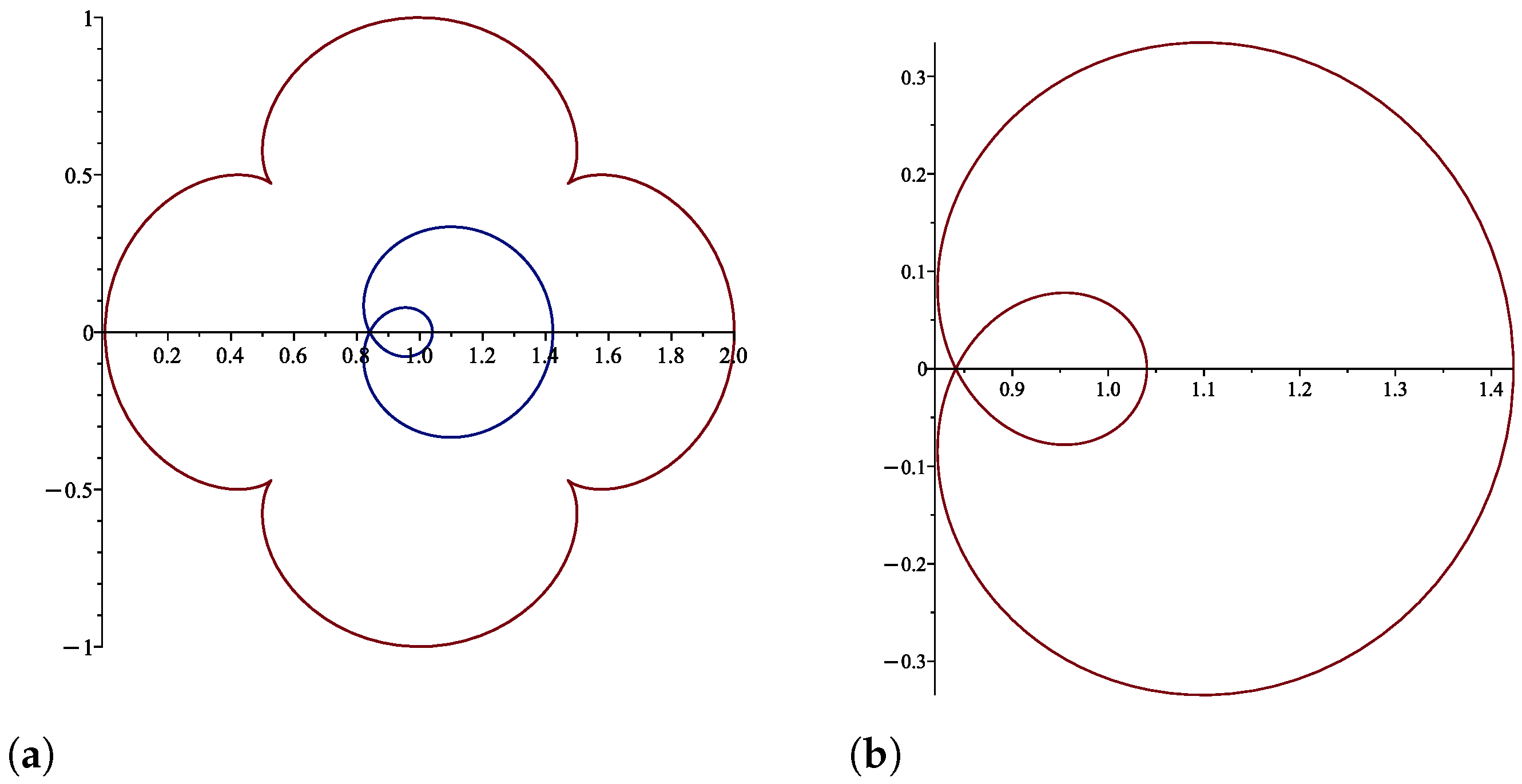
As shown in Figure 4a–d and using similar reasons as in the items (i) and (ii), we find thatfor , , , , and , whilefor , , , , and . Consequently, and for some values of the parameters.Remark 3. Within the realm of univalent function theory, which examines one-to-one (injective) analytic mappings, these particular epicycloidal and nephroid shapes are invaluable. They serve as precise target regions for the images of the unit disk under certain subclasses of univalent functions.
- (i)
In [25], Gandhi introduced the class of starlike functions connected with three leaf functions by
We mention that in 2022, the authors of the articles [26,27] introduced and studied various subclasses of analytic functions. These functions were defined through subordination to a four-leaf function, and their important properties were characterized. - (ii)
In 2020, Wani and Swaminathan [28] introduced the Ma–Minda subclass of starlike functions by choosing , associated with a nephroid-shaped domain, defined by
Furthermore, in [29], Sharma et al. discussed the class , defined by Remark 4. We emphasize that for different choices of the parameters a, b and q, our classes defined by (
9)
and (
10)
reduce to the following ones: - (a)
Taking and in Definition 3, the class reduces to , which is a subclass of the family of Bazilevič functions.
- i.
Considering in addition , these classes reduce to , which is known as the starlike functions class.
- ii.
Moreover, for , these classes reduce to , which is known as the bounded turning functions class.
- (b)
Putting and in Definition 3, the class reduces to , known as the family of 1-pseudo-starlike functions in the unit disk .
- (c)
If we take , and in Definition 2, the class reduces to , which is the convex functions class.
- (d)
Choosing and in Definition 2, the class reduces to , known as the family of 1-pseudo-convex functions.
3. Preliminaries and Main Results
Let us define by
the well-known Carathéodory class, i.e., the family of holomorphic functions
l in
that satisfies the condition
and having the form
We need the following lemmas in order to prove our results.
Lemma 1. Let be of the form (11). The inequality holds for all if and only if , . - (ii)
Furthermore, if , then
If , the inequality is sharp for the function . In the other cases, the inequality is sharp for the function . Note that the inequality (
12) is the well-known result of the Carathéodory Lemma [
30] (see also [
24] ([ Corollary 2.3, p. 41]) and [
3] ([Carathéodory Lemma, p. 41])). Inequality (
13) represents Lemma 2.3 of [
31], which for
was proven in a more general form in [
32] ([Lemma 1, p. 546]). We emphasize that the inequality (
13) remains valid for all
as it was proven in [
33] ([Theorem 1]).
3.1. Initial Coefficients and Hankel Determinants for the Class
In this subsection, our main goal is to establish precise upper bounds for the initial coefficients, specifically and . Additionally, we aim to investigate the Fekete–Szegő functional, given by , for functions within the specified class. We will also determine the modulus of the difference between the second Hankel determinant of a function and that of its inverse, i.e., .
Theorem 1. Let the function , given by (
1)
, be a member of the class . Then,where Proof. If
, from Definition 3 there exists an analytic function
v with
and
,
such that
Writing the Schwarz function
v in terms of
, that is
which is equivalent to
we obtain
Since the function
h has the form (
1), it follows that
and equating the coefficients of “
z” and “
” from the relations (
19) and (
20), we obtain
where
L,
M and
U are given by (
16).
Taking the modules on the both sides of (
21) and using the inequality (
12) of Lemma 1, we obtain our desired result (
14). Similarly, from the modules on both sides of (22), applying the inequality (
13) of Lemma 1, we obtain the estimation (15). □
Remark 5. (
i)
The values of and the upper bounds for for the particular functions V considered in the Table 1 will be those shown in Table 2. (ii) For the same functions V, if , the upper bounds for are the next ones:
- a.
For we obtain - b.
If , then - c.
In the case , we have - d.
For , we obtain
The next theorem gives the bound of Fekete–Szegő functional for the class .
Theorem 2. If has the form (
1)
, then for any complex number μ, we havewith L, M and U given by (
16)
. Proof. If
, using the relations (
21) and (22), we obtain
Taking the modules on both sides of (
24) and then applying the inequality (
13) of Lemma 1, which remains valid—as we already mentioned—for all
, it follows
where
which represents conclusion (
23) of our result. □
For the Hankel determinants
of the functions
h and
given by (
3), the following result holds:
Theorem 3. If has the form (
1)
, then we havewhere L, M and U are defined by (
16)
. Proof. Combining the relations (
21) and (22) in the equality (
6), we obtain
Taking the modules on both sides of (
26), from the inequality (
13) of Lemma 1, we obtain our conclusion (
25). □
Remark 6. Taking , or , in (25) we could obtain simple forms of the majorant for if and V is replaced by , , and . 3.2. Initial Coefficients and Hankel Determinants for the Class
In this subsection, our aim is to establish upper bounds for the coefficients and and for the Fekete–Szegő functional if . Moreover, we will analyze the existence of a majorant for difference between the second Hankel determinants of a function and its inverse, that is, .
Theorem 4. Let the function given by (1) be a member of the class . Then,where Proof. If
, by Definition 4 there exists an analytic function
v with
and
,
such that
Since the function
h has the form (
1), it follows that
and equating the coefficients of “
z” and “
” from the relations (
19) and (
31), using the notations (
29), we obtain
Taking modulus on both sides of (
32) and applying the inequality (
12) of Lemma 1, we obtain the first result (
27). Finally, from the module of (33) combined with the inequality (
13) of Lemma 1, we find the desired estimation (
29). □
Remark 7. Similarly to Remark 6, taking , or , in (
27), (28)
and replacing V by , , and , we could find simple forms of the majorant for and if . The next theorem gives the bound of the Fekete–Szegő functional for the class .
Theorem 5. If has the form (
1)
, then for any complex number μ, we havewhere A, B and G are defined by (
29)
. Proof. If
, using the equalities of (
32) and (33), we obtain
Taking now the modules on both sides of (
34) and then applying the inequality (
13) of Lemma 1, our result follows immediately. □
For the difference of the Hankel determinants of and , we obtain the next estimation:
Theorem 6. If has the form (1), then we havewhere A, B and G are defined by (29). Proof. Replacing the relations (
32) and (33) in (
6), one may obtain
and taking the modules on both sides of (
35) and applying (
13) of Lemma 1 in the resulting relation, we obtain the required inequality. □
4. Concluding Remarks
In this paper, we introduced and characterized a new class of analytic functions in the open unit disk that consists of univalent and non-univalent functions, like we mentioned in the paper. We explored fundamental bounding properties of this class like the initial coefficients bounds, which provide insights into the local behavior of the functions.
A key achievement was establishing majorants for the Fekete–Szegő functional, offering bounds for the second coefficient and highlighting the geometric features of these functions. We also computed the modules of the difference from the second Hankel determinant and the second Hankel determinant for the inverse coefficients.
We believe that the importance of the actual results reside in the following:
- –
the new definitions that extend some previous subclasses obtained for the special choices of the function
V from the right-hand sides of the subordinations (
9) and (
10);
- –
the connections between the q-calculus given by the q-analogues of the derivatives and the Geometric Function Theory of one variable function;
- –
the possibility to determine upper bounds of the first coefficients for these classes;
- –
the fact that it was possible to obtain results related to the Fekete–Szegő functionals;
- –
the estimations for the differences of particular Hankel determinants of the functions and their inverses for these classes.
That are specific problems in this field of interest. These findings enrich the literature on analytic functions and provide a framework for future research. The established bounds and geometric properties pave the way for exploring subclasses, convolution properties and applications in related fields. Future work could focus on higher-order Hankel determinants and connections with other function classes.