1. Introduction
Parameter estimation precision (PEP) is pivotal across numerous scientific and technological disciplines, where innovative approaches to assessing parameter sensitivity have often driven groundbreaking discoveries and technological progress. A primary goal in quantum estimation is to enhance and maintain precision in resolving unknown parameters that define a quantum system. Extensive research has addressed real-world challenges such as loss and decoherence in P-E [
1,
2,
3,
4,
5,
6]. Fisher information (FI), introduced by Fisher [
7], is a cornerstone of parameter estimation theory, with quantum FI quantifying a quantum state’s responsiveness to parameter variations. Quantum estimation techniques enable the identification of optimal measurements for complex systems, especially when the parameter of interest is not directly accessible. The quantum Cramér–Rao inequality establishes a lower bound dictated by QFI [
8], making QFI a critical challenge to address. This quantity captures the maximum information extractable from a measurement process about a parameter. Given that quantum systems invariably interact with their environments, open-system dynamics become relevant, leading to increased focus on how composite quantum systems interact with their surroundings, influencing various physical quantities. Such interactions introduce quantum noise, manifesting as oscillations, decoherence, and irreversible dissipation. Recent efforts have concentrated on deepening the understanding of open quantum system dynamics, particularly to elucidate memory effects [
9,
10,
11,
12,
13,
14,
15]. Notably, various theoretical frameworks for quantum non-Markovianity have been proposed [
16,
17], with some receiving experimental validation [
18,
19]. A significant breakthrough lies in the creation of novel theoretical methods to identify and measure deviations of key physical properties from Markovian behavior [
20,
21]. In reality, most processes exhibit non-Markovian characteristics, rendering the Markovian model merely an approximation for open quantum systems. Given that non-Markovianity is a valuable trait, non-Markovian quantum channels are recommended for applications in quantum optics and information processing [
22,
23]. The underlying physical mechanisms that govern whether an open quantum system’s dynamics exhibit non-Markovianity are still under investigation.
A geometric framework has recently been utilized to investigate the behavior of QFI under decoherence effects. Studies employing Ramsey interferometry have shown that collisional dephasing significantly impairs the accuracy of phase parameter estimation [
24]. The influence of decoherence on the QFI for the Greenberger–Horne–Zeilinger state with respect to SU(2) rotations has been analyzed, revealing a consistent decline in FI over time [
25]. Parameter estimation in a spin-
j system within an environment modeled by a quantum Ising chain has also been explored, indicating a monotonic decrease in QFI as the environment approaches its critical point [
26,
27]. Recent works explored the impact of non-Markovian dynamics on QFI through a detailed model of two distinct non-Markovian environments, showing that memory effects and environmental structure significantly influence the PEP [
28]. Recent studies have also highlighted the role of quantum discord in enhancing P-E, with findings indicating that discord can improve estimation accuracy in noisy quantum systems [
29]. Moreover, quantum discord’s resilience against decoherence has been shown to support robust quantum correlations, aiding precision estimation in open quantum systems [
30]. This work furthers our exploration of physical systems and physical processes that might result in high estimate precision. Specifically, we will address this problem and discuss possible implications that might lead to useful techniques for maintaining and improving the PEP. In this case, we will consider innovative method to enhance PEP in quantum systems by mitigating the detrimental effects of decoherence and environmental noise. We present a theoretical model featuring a single qubit coupled to a zero-temperature bosonic reservoir with a Lorentzian spectral density, augmented by non-interacting auxiliary qubits that provides a robust and passive strategy for mitigating decoherence in quantum systems. The analysis spans both Markovian and non-Markovian dynamical regimes, demonstrating that auxiliary qubits effectively preserve QFI and von Neumann, key metrics for precise parameter estimation and purity, respectively. Using the Kraus operator formalism, we reveal how these strategies create a decoherence-free subspace, offering a passive and scalable approach to protect quantum states. We will show that large values of QFI may be obtained according to the detuning and strength coupling parameters and its relation to LQU. Additionally, we will demonstrate that long-term protection of QFI may be accomplished without being impacted by the decoherence effect by carefully choosing the model parameters.
The manuscript is organized as follows.
Section 2 introduces the quantum system model and describes its dynamical behavior in both Markovian and non-Markovian regimes.
Section 3 details the quantum measures, including the QFI and von Neumann entropy, along with an analysis of the numerical results.
Section 4 presents the dynamics of two qubits using the Kraus operator formalism and examines the impact of auxiliary qubits and detuning control on the dynamics of QFI and LQU. The final section provides a concise summary of the key findings.
2. Quantum Model
We consider a system of
N identical two-level qubits coupled to a common zero-temperature bosonic reservoir, where one qubit serves as the target for parameter estimation, and the remaining
are non-interacting auxiliary qubits introduced to mitigate decoherence. All
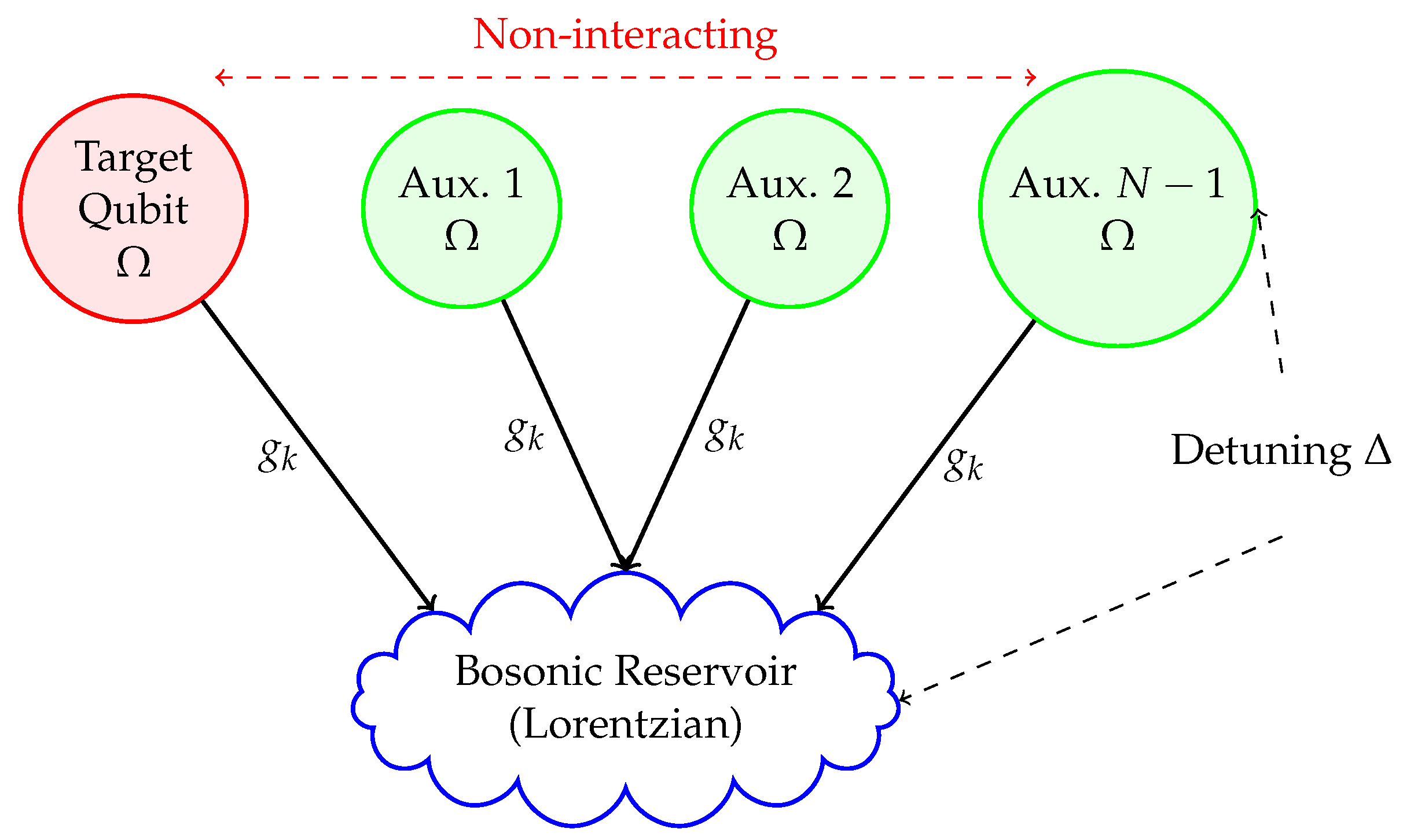
N qubits interact equivalently with the reservoir, enabling the formation of a collective decoherence-free subspace that protects the target qubit’s quantum state (see
Figure 1). The total Hamiltonian is given by
where the free Hamiltonian is
with
as the qubit transition frequency,
as the raising (lowering) operators for the
j-th qubit,
as the frequency of the
k-th reservoir mode, and
as the creation (annihilation) operators. The interaction Hamiltonian is
where
is the coupling strength between the
j-th qubit and the
k-th mode, and
are dimensionless constants (set to
for simplicity). The reservoir’s Lorentzian spectral density is [
28,
31]
where
is the coupling constant,
is the spectral width, and
is the detuning between the qubit and reservoir central frequencies.
The quantum dynamics is analyzed in the interaction picture, where the state
evolves via
and the interaction Hamiltonian becomes
Since the total excitation number operator
commutes with
H, the dynamics are confined to the single-excitation subspace. We initialize the system with the target qubit in a superposition
(where
), auxiliary qubits in
, and the reservoir in the vacuum state
, yielding to
where
, and
has the
j-th qubit in
and others in
. The evolved state is
with
(constant due to conservation). Substituting into the Schrödinger equation yields differential equations for the amplitudes
Integrating the equation for
and substituting back, we obtain integro-differential equations
where the correlation function is
. For the Lorentzian spectral density,
. Applying the Laplace transform to the integro-differential equation, with
, we have
where
. Assuming
and
for
, we solve for
, and the inverse Laplace transform yields to
with
,
, and
. The reduced density matrix of the target qubit, after tracing out the reservoir and auxiliary qubits, is
The control and preservation of quantumness measures will stem from a decoherence-free subspace that emerges with auxiliary qubits, growing with
N, allowing the target qubit’s state to reside increasingly in a protected subspace, robust across Markovian and non-Markovian regimes, with detuning
slowing decay during the dynamics.
3. Fisher Information and Entropy
In the science of measurement, whether classical or quantum, the precision with which we can estimate a physical parameter like a phase, frequency, or field strength is a fundamental concern. At the heart of this pursuit lies the Fisher Information, a concept that quantifies how much information a system carries about an unknown parameter. This section introduces the classical Fisher Information (CFI), defines it explicitly, and then bridges it to its quantum counterpart, the QFI, setting the stage for exploring precision limits in quantum metrology.
In classical statistics, we often seek to determine an unknown parameter
based on observations drawn from a probability distribution
, where
x represents the measurement outcomes. The CFI, denoted
, measures how much these outcomes reveal about
. It is defined as [
7,
8]
This formula represents the expected value of the squared rate of change of the log-likelihood with respect to
. Put simply, it tells us how sharply the probability distribution shifts as
varies. A high CFI means that even tiny adjustments to
produce noticeable changes in
, making
easier to pinpoint. The importance of this definition becomes clear through the Cramér–Rao Bound (CRB), which ties the CFI to estimation precision. For an unbiased estimator
based on
n independent measurements, the variance satisfies [
8]
This inequality shows that the CFI acts as a benchmark for accuracy. The larger
, the smaller the possible spread in our estimate, guiding us toward more effective measurement strategies. While the CFI excels in classical contexts, quantum systems demand a broader framework to capture effects like superposition and entanglement. Consider the QFI, denoted
, which extends the classical idea to quantum states. For a density matrix
that depends on
, the QFI quantifies the state’s intrinsic sensitivity to changes in that parameter, independent of any specific measurement [
32,
33]. Unlike the CFI, which hinges on a chosen measurement’s probability distribution, the QFI reflects the maximum information extractable from
. It is computed using the symmetric logarithmic derivative, an operator
L defined by [
34]
The QFI is then
This value sets the ultimate precision limit via the Quantum Cramér–Rao Bound [
32]
Here, the QFI represents the best possible precision achievable with an optimal measurement, potentially surpassing classical limits when quantum resources are leveraged. To infer the unmeasurable parameter
, a bipartite quantum state
is employed as a probe, with one of its subsystems subjected to a unitary operation
, specifically a phase shift. This operation transforms the overall state to
. Such an estimation approach finds applications in fields like gravimetry and advanced sensing technologies [
35].
Recent studies have revealed that in classical thermodynamics, the production of entropy can be interpreted as the establishment of correlations between an open quantum system and its environment [
36,
37,
38,
39]. For a qubit state
, the von Neumann entropy is expressed as
In a bipartite quantum system, the entropies of the subsystems and the composite system satisfy the bounds
where subscripts
A and
B denote the two arbitrary subsystems.
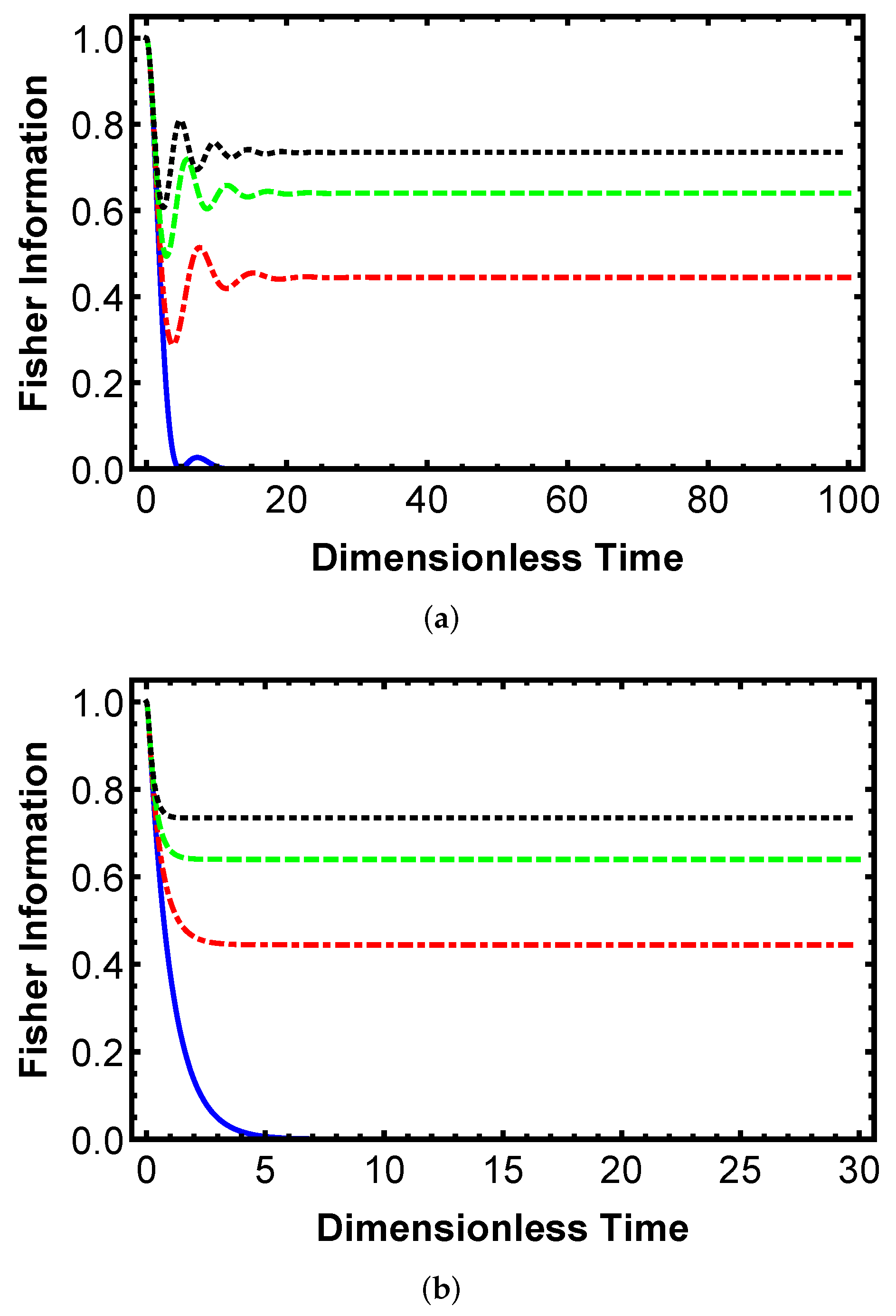
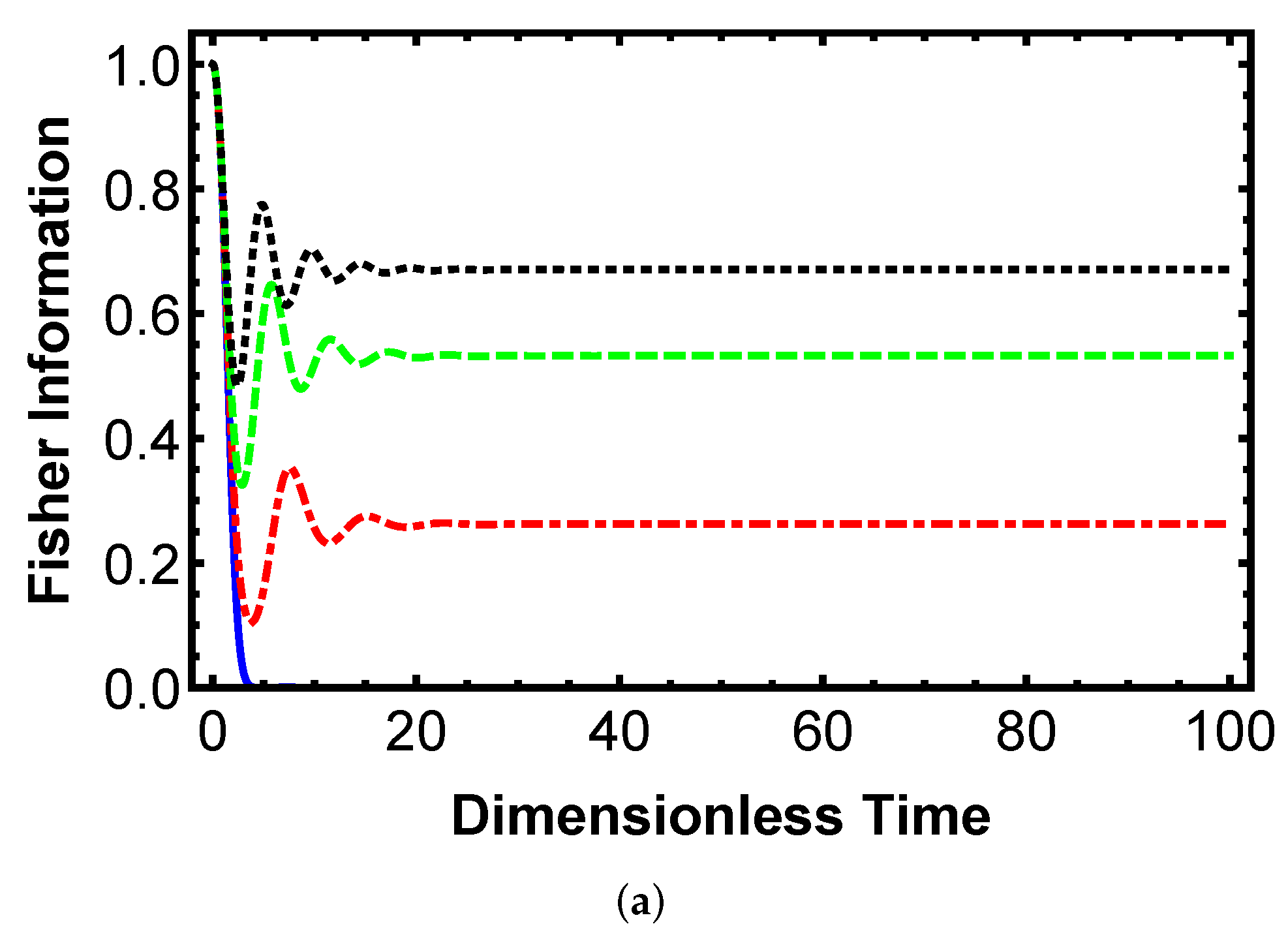
Figure 2 illustrates the QFI for the target qubit as a function of dimensionless time
for different numbers of qubits
N under zero detuning (
), highlighting contrasting dynamics in the non-Markovian (
) and Markovian (
) regimes. In the non-Markovian regime (panel a), the narrow spectral width of the reservoir (
) introduces strong memory effects, enabling the environment to act as a temporary coherence reservoir. For a single qubit (
), this results in oscillatory QFI decay, where the qubit coherently exchanges energy and information with the reservoir, driven by their prolonged correlation time. As auxiliary qubits are added (
), the QFI stabilizes at elevated, non-zero levels with increased oscillations at the beginning of interaction. This stabilization of QFI can be understood by the formation of a decoherence-free subspace as the time becomes significantly large, where the auxiliary qubits entangle with the target qubit, effectively locking its quantum state against environmental effects. In the of Markovian regime (panel b), the broad spectral width (
) eliminates memory, leading to irreversible decoherence. For
, the QFI decays exponentially to zero during the dynamics without any feedback from the environment. With auxiliary qubits, however, the QFI converges to a steady, non-zero value that scales with
N. This resilience arises because the auxiliary qubits dilute the environmental influence, redistributing the disturbance over many degrees of freedom and thereby reducing the effective decoherence experienced by the target qubit. This protection resembles a collective shielding effect, where the enlarged Hilbert space dilutes the coupling strength per qubit. The sustained QFI in both regimes is vital for quantum metrology, as it directly ties to the Quantum Cramér–Rao Bound, enhancing precision in parameter estimation. The obtained results illustrate that the auxiliary qubits offering a passive and demonstrating a robust framework for maintaining QFI across diverse environmental conditions, with significant potential for advancing quantum technologies in noisy settings.
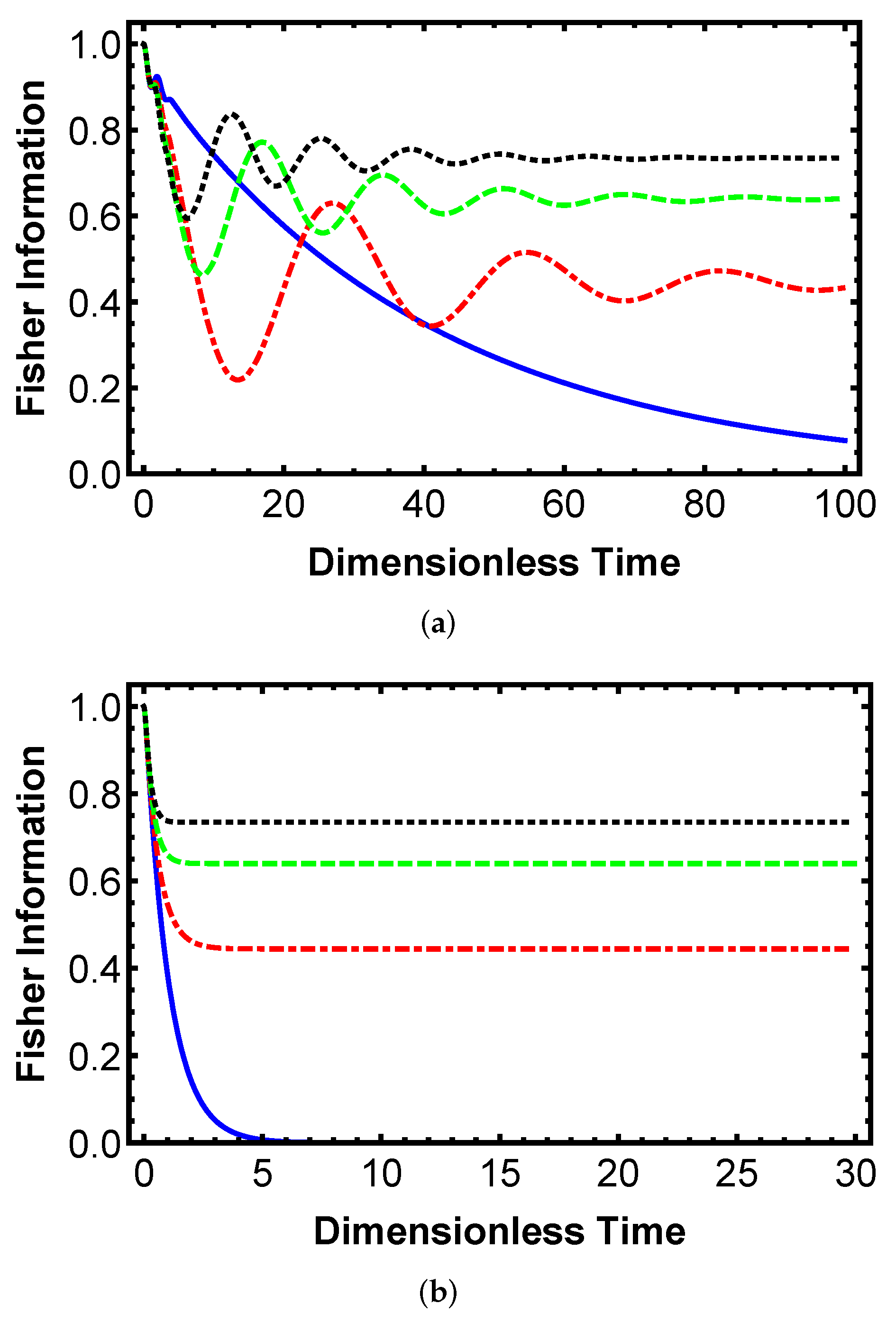
Figure 3 displays the dynamics of QFI for various numbers of qubits
N under non-zero detuning (
). In the non-Markovian regime (panel a), where memory effects and detuning are considered, the QFI for a single qubit (
) shows oscillatory decay, as detuning weakens qubit-reservoir coupling, slowing QFI loss compared to zero-detuning cases and enabling partial revivals through environmental feedback. Adding auxiliary qubits (
) enhances the amplitude of oscillations of QFI and stabilizes its values at non-zero values as the time becomes significantly large, leveraging a decoherence-free subspace that, alongside detuning, enhances protection against noise. Conversely, in the Markovian regime (panel b), the QFI for
decays monotonically in similar way as in the absence of detuning, while with auxiliary qubits, it converges to a steady non-zero value that is improved with larger
N, showing the subspace’s noise mitigation persists of QFI without memory effects.
To further elucidate the extent to which the auxiliary-qubit mechanism enhances measurement precision, we note that it operates by expanding the decoherence-free subspace (DFS), which protects a portion of the state’s initial amplitude from environmental noise. Specifically, in the long-time limit, the coherence function
approaches
(derived from Equation (
11), assuming decay of the transient terms), preserving a fraction of the initial coherence that scales favorably with
N. For
, this fraction is 0, leading to complete QFI loss and zero precision. For larger
N, the asymptotic QFI increases, raising precision beyond what a fixed-size DFS could achieve. This
N-dependent dilution of decoherence directly boosts the quantum Cram’er–Rao bound, enabling sustained parameter estimation precision that approaches the noiseless limit as
. Compared to alternative decoherence protection strategies (e.g., minimal DFS without scaling or active feedback), the present approach provides a passive, resource-efficient way to elevate precision by leveraging the collective shielding of auxiliary qubits.
The saturation of the asymptotic QFI toward the initial noiseless value as , consistent with collective-decoupling phenomena in shared-environment models. However, practical constraints limit the growth of N. Physically, achieving identical couplings to the common reservoir becomes challenging for large N due to inhomogeneities, potential crosstalk, or additional noise channels that could disrupt the DFS symmetry. Resource-based limitations include increased demands on qubit fabrication, control systems, and cryogenic infrastructure in experimental platforms like superconducting circuits or optical cavities.
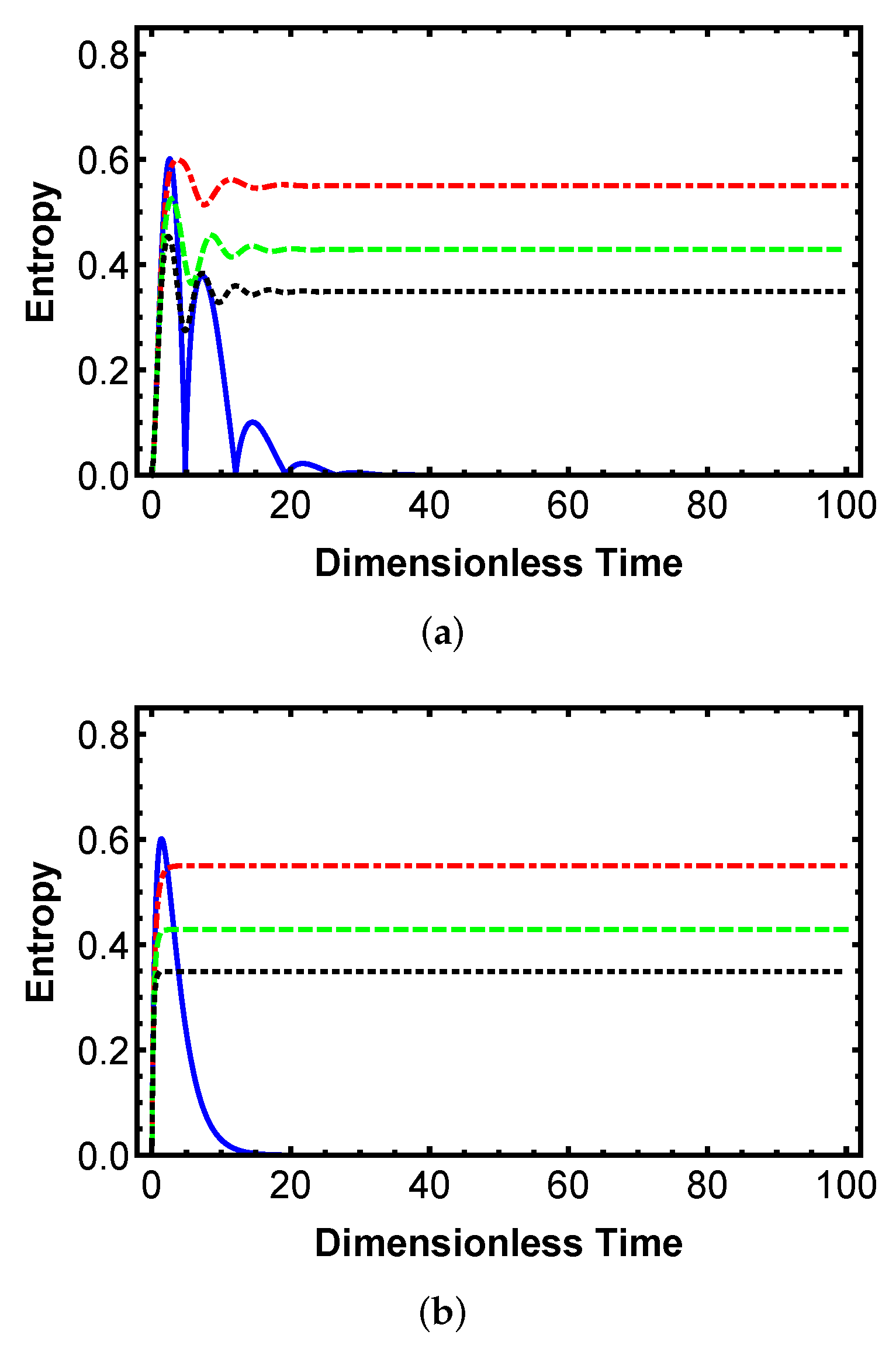
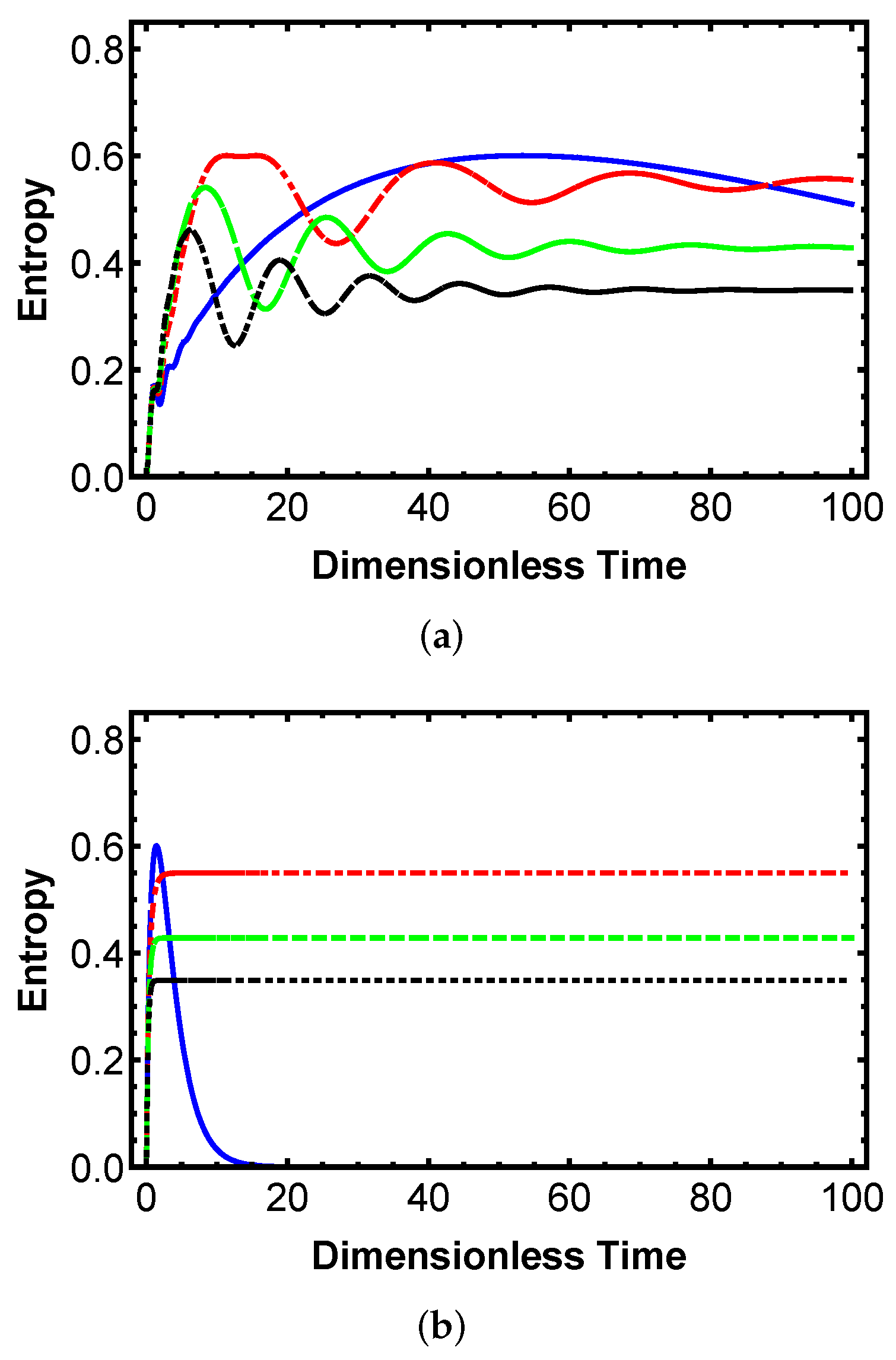
Figure 4 and
Figure 5 illustrate the time evolution of the von Neumann entropy as a function of dimensionless time
for a quantum system comprising a target qubit coupled to a zero-temperature bosonic reservoir, augmented by varying numbers of auxiliary qubits
N, under zero detuning (
) and non-zero detuning (
), respectively, comparing non-Markovian (
) and Markovian (
) dynamics to highlight the interplay of entropy, purity, and decoherence mitigation strategies. In
Figure 4 (zero detuning), the non-Markovian regime (Panel a) shows oscillatory entropy growth for a single qubit (
) due to strong memory effects, where information backflow enables the environment to temporarily store and reinject quantum information, causing periodic partial revivals of purity (
, maximal at 1 for pure states), seen as temporary entropy reductions; however, entropy rises gradually, indicating progressive purity loss. Adding auxiliary qubits (
) reduces oscillation amplitude and stabilizes entropy at lower steady-state values via a decoherence-free subspace, which acts as a dynamical shield creating noise-canceling resonance to preserve higher purity. In the Markovian regime (Panel b), a broad spectral width eliminates memory effects, leading to monotonic entropy increase for
, signifying irreversible decoherence and complete purity loss as the state becomes fully mixed, with the environment acting as a Markovian bath; auxiliary qubits (
) slow this rise and lower asymptotic entropy, leveraging the subspace’s collective damping capacity to distribute the environmental perturbations across additional degrees of freedom, thereby mitigating irreversible information loss.
Figure 5 (non-zero detuning,
) shows slower entropy growth in the non-Markovian regime (Panel a) for
, with reduced-amplitude oscillations due to detuning weakening qubit-reservoir coupling by shifting the spectral density, while memory effects facilitate partial purity revivals; auxiliary qubits (
) further suppress entropy, stabilizing it at lower values through the synergy of detuning and the decoherence-free subspace, enhancing purity preservation. In the Markovian regime (Panel b), entropy for
rises monotonically but more slowly due to reduced interaction strength, delaying purity loss, while auxiliary qubits lower the asymptotic entropy and accelerate stabilization by diluting the impact of environmental noise across the enlarged system. Across both figures and regimes, auxiliary qubits enhance purity preservation, particularly in non-Markovian dynamics where memory effects amplify their role, and detuning (
) consistently mitigates decoherence by minimizing resonant interactions, offering a scalable, tunable strategy with significant potential for preserving quantum coherence in noisy environments for quantum information processing applications.
4. Fisher Information Protection and Quantum Correlation
This section explores the QFI and quantum correlations in a bipartite quantum framework consisting of two independent qubits, labeled A and B. Each qubit interacts solely with its respective local environment, denoted and , and initially, these qubits and their environments are considered to be in a separable state, free of any mutual correlations.
Quantum discord quantifies nonclassical correlations in quantum states that extend beyond entanglement, arising fundamentally from the lack of quantum-certain local observables. Within this framework, the LQU, denoted as
and introduced in [
35], serves as both an indicator and a rigorous measure of quantum correlations between subsystems
A and
B [
40]. A key element of our analysis is the LQU [
35], defined as the minimum Wigner–Yanase skew information over all local von Neumann measurements on subsystem
A. For a bipartite state
and a local observable
, where
is Hermitian with nondegenerate spectrum
, the LQU with respect to
A is given by
This yields a family of
-dependent measures, each tied to a specific class of maximally informative local observables on
A. In practice,
, where
ranges over the special unitary group on
A,
fixes the measurement scale, and
selects the measurement basis. For any nondegenerate
, the LQU satisfies all criteria for a discord-like measure [
35,
41]: it remains invariant under local unitaries, does not increase under local operations on
B, vanishes precisely when the state exhibits zero discord for measurements on
A, and acts as an entanglement monotone for pure states. For bipartite systems of dimension
, the LQU is particularly advantageous due to its computational simplicity. In contrast to most discord measures, which require intractable optimizations even for two qubits [
41,
42,
43,
44], the LQU yields a closed-form expression for any qubit–qudit state
. Moreover, for a qubit subsystem
A, all
-dependent variants are equivalent up to a constant scaling factor [
35]. We thus omit the superscript and adopt normalized nondegenerate observables of the form
with
, ensuring unity for maximally entangled pure states. Equation (
20) then reduces to
where
denotes the largest eigenvalue of the
symmetric matrix
with entries
for
. For pure states
, Equation (
21) simplifies to the linear entropy of entanglement:
, with
the reduced state on
A.
The choice of LQU as a measure of quantum correlations in the two-qubit case merits justification, particularly regarding its relevance to metrological robustness. As established in Ref. [
35], LQU quantifies the minimal quantum uncertainty on a local observable due to noncommutativity with the reduced state of the correlated subsystem, capturing discord-like nonclassical correlations beyond entanglement. This makes LQU a suitable figure of merit for quantum technologies, including metrology, where it bounds the precision in estimating parameters by reflecting the inherent uncertainty in incompatible measurements. In the present model, tracking LQU allows us to evaluate how these correlations contribute to preserving QFI under noisy dynamics, directly linking to metrological usefulness via the quantum Cramér–Rao bound.
The time-dependent behavior of the reduced density matrix for an individual qubit (
) is captured by the quantum state outlined in Equation (
12). Using the Kraus operator formalism [
23,
45,
46], this evolution is articulated as
where
represent the Kraus operators associated with qubit
S. Owing to the non-interacting nature of the qubits, the total evolution operator for the composite system
, symbolized as
, decomposes into
. Consequently, the reduced density matrix of the two-qubit system is expressed within the Kraus framework as
This representation emphasizes the autonomous evolution of each qubit under the influence of its local environment, shedding light on the composite system’s state.
Employing the computational basis
for each qubit, we introduce the identity operator
between the Kraus operators and density matrices in Equation (
23). This results in the temporal evolution of the density matrix elements for each qubit, expressed as:
with the transition matrix elements defined by
Extending this approach to the two-qubit system per Equation (
24), the evolution of the composite system’s density matrix elements is given by
where the indices
.
The reduced dynamics of the individual qubit, fully characterized by Equation (
12), allows us—owing to the independence of the local environments—to derive analytically the complete time-dependent two-qubit reduced density matrix
. The composite system’s basis is defined as
. For an arbitrary initial state, the diagonal elements of
are
while the off-diagonal elements evolve according to
with the Hermitian condition ensuring
. Equations (
28) and (
29) deliver a thorough depiction of the two-qubit density matrix evolution, revealing the environmental impact on the system’s coherence across any initial configuration.
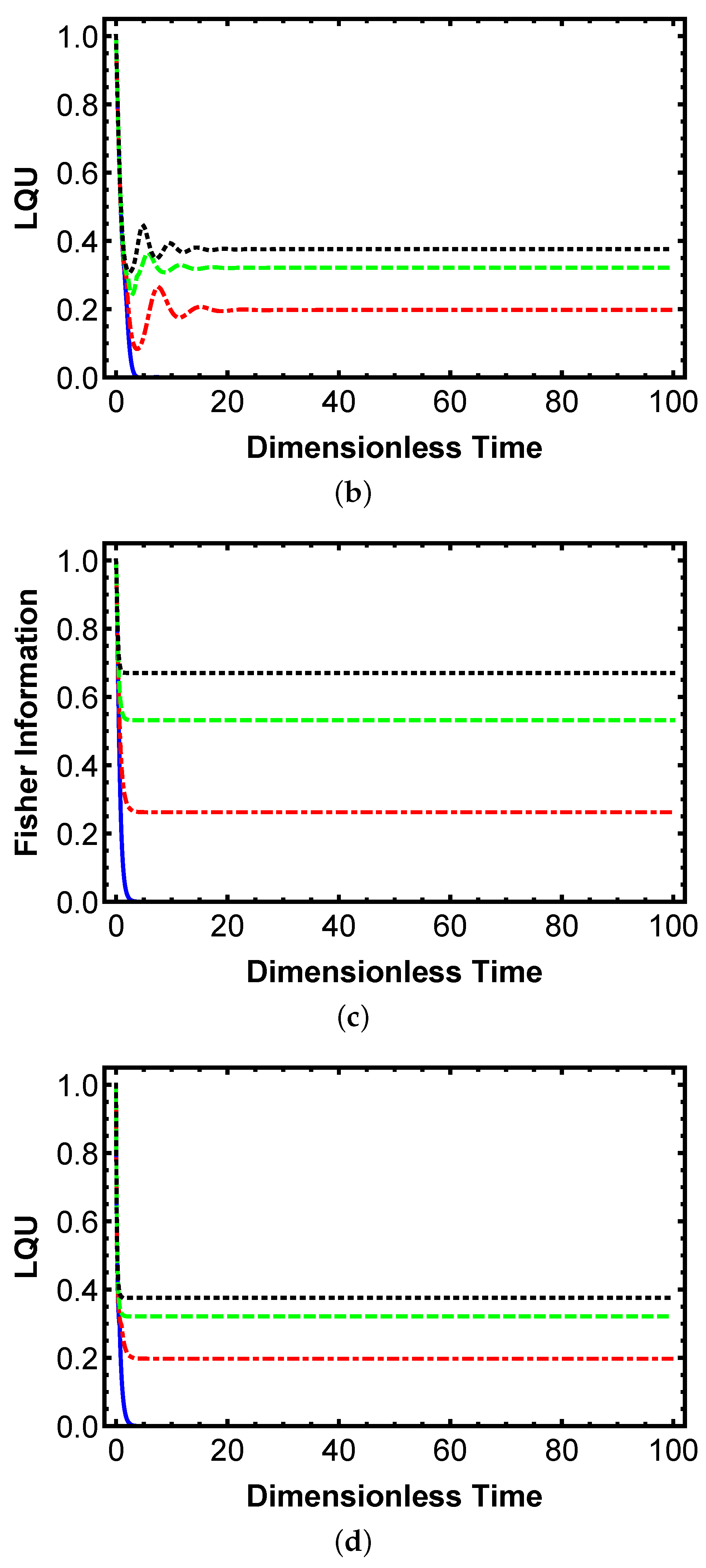
Figure 6 shows the QFI and LQU as functions of dimensionless time
for varying qubit numbers under zero detuning (
), contrasting their behavior in non-Markovian (
) and Markovian (
) dynamics. In the non-Markovian regime (panels a and b), the environment’s narrow spectral width fosters strong memory effects, enabling the system to periodically regain QFI through information backflow—a process where the environment temporarily stores and re-injects quantum information, akin to quantum memory. For a single qubit pair (
), this result in oscillatory decay of QFI and LQU, where the oscillations reflect coherence echoes from the environment’s feedback, though the overall trend is a gradual loss of quantum properties. Increasing qubit numbers (
) stabilizes these quantities at higher steady-state values with reduced oscillations, as the auxiliary qubits form a decoherence-free subspace that shields the target qubits by redistributing environmental noise across the system. In contrast, the Markovian regime (panels c and d) is characterized by a broad spectral width, leading to rapid, memoryless decoherence. Here, the environment functions as a dissipative bath, continuously scrambling the system’s quantum state without feedback, resulting in monotonic decay of QFI and LQU to zero for
. However, with auxiliary qubits, these quantities achieve non-zero steady states that improve with
N, demonstrating the subspace’s ability to mitigate noise by diluting its impact across multiple degrees of freedom. With zero detuning (
) maximizing qubit-environment coupling, the auxiliary qubits counterbalance this by channeling excess noise into less disruptive channels, effectively insulating the target qubits. This scalable approach not only preserves QFI and correlation but also enhances the system’s resilience, offering a robust strategy for quantum metrology and information processing in noisy environments.
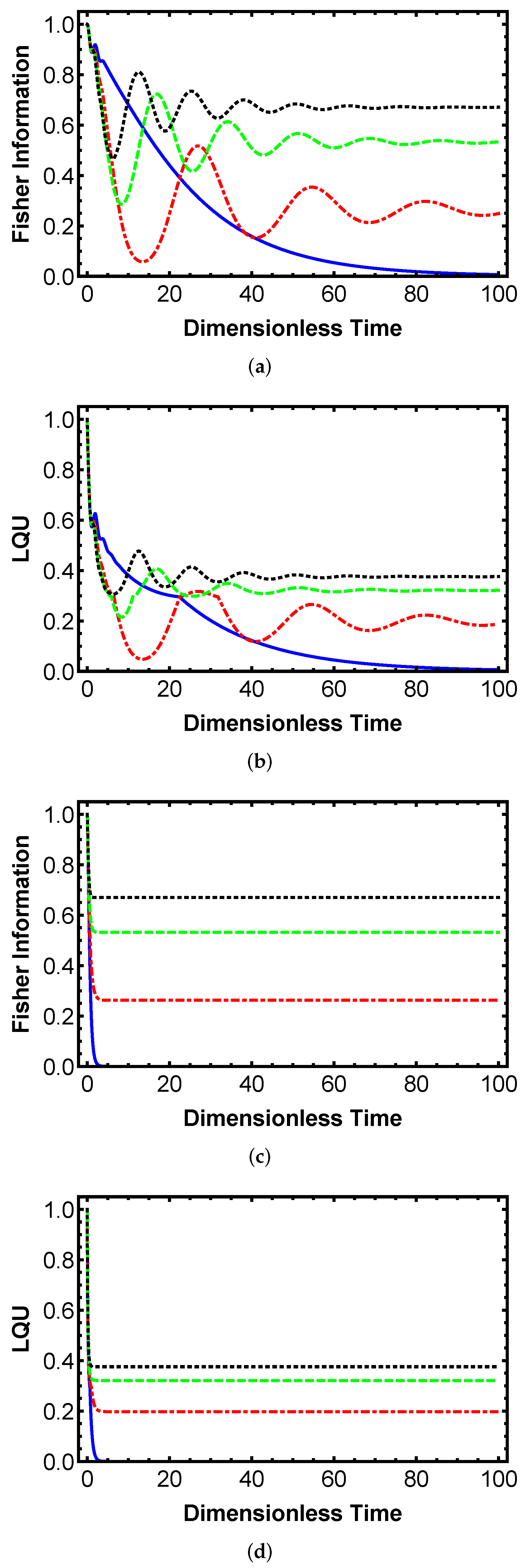
Figure 7 examines the evolution of QFI and LQU as functions of dimensionless time
for various qubit numbers under non-zero detuning (
), comparing non-Markovian and Markovian dynamics. In the non-Markovian regime (panels a and b), detuning reduces qubit-environment coupling, leading to oscillatory decay of QFI and LQU with moderated amplitude for a single qubit pair (
), while memory effects enable partial coherence revivals. Increasing qubit numbers (
) stabilizes these quantities at higher steady-state values by leveraging a decoherence-free subspace. In the Markovian regime (panels c and d), detuning slows the monotonic decay of QFI and LQU for
, and auxiliary qubits further mitigate noise, resulting in non-zero steady states that improve with
N. Across both regimes, detuning and auxiliary qubits synergistically preserve QFI and LQU, offering a scalable strategy for enhancing quantum system performance in noisy environments.