


Abstract
This paper explores a high-dimensional stochastic SIS epidemic model characterized by a mean-reverting, stochastic process. Firstly, we establish the existence and uniqueness of a global solution to the stochastic system. Additionally, by constructing a series of appropriate Lyapunov functions, we confirm the presence of a stationary distribution of the solution under . Taking 3D as an example, we analyze the local stability of the endemic equilibrium in the stochastic SIS epidemic model. We introduce a quasi-endemic equilibrium associated with the endemic equilibrium of the deterministic system. The exact probability density function around the quasi-stable equilibrium is determined by solving the corresponding Fokker–Planck equation. Finally, we conduct several numerical simulations and parameter analyses to demonstrate the theoretical findings and elucidate the impact of stochastic perturbations on disease transmission.
Keywords:
stochastic SIS epidemic model; Ornstein–Uhlenbeck process; stationary distribution; local stability; probability density function MSC:
37H05; 34F05; 37H10
1. Introduction
According to data from the United Nations AIDS Programme, approximately 38 million individuals worldwide are infected with the AIDS virus, with around 6.9 million of them not receiving HIV treatment post-infection, and about 1.5 million succumbing to AIDS or AIDS-related illnesses annually. Particularly in Africa, AIDS has emerged as a critical public health concern. In numerous countries, the prevalence of AIDS infections is alarmingly high, significantly impacting local socioeconomic progress and public health [1]. The epidemiological examination of AIDS and the comprehensive elucidation by Hyman et al. delineate that AIDS infection progresses through three phases. Despite this, effective vaccines or treatments for AIDS patients are yet to be developed. Mathematical modeling aids in comprehending the transmission of HIV/AIDS [2,3,4,5,6,7,8,9]. Notably, a standard ODE model has been devised to depict the disease’s dissemination based on its characteristics [9,10].
The model assumes that all constant rates (as in Table 1) are positive. Meanwhile, Hyman and Li [9] divided the susceptible people into n subgroups according to the susceptibility of each group of individuals and established the high-dimensional stochastic SIS epidemic model (differential susceptibility epidemic model) as follows:
where . The ODE models assume that all susceptible people are in the same situation and have the same degree of susceptibility, which ignores the random interaction between people. Since the group of AIDS patients has no effect on the overall dynamic properties of the model, the model does not take group into account [11,12], and the high-dimensional SIS model is obtained as follows:

Table 1.
The definitions of the parameters.
Notably, the mean-reverting stochastic process (Ornstein–Uhlenbeck process), with appropriate adjustments, finds application in stochastically modeling interest rates, currency exchange rates, and commodity prices [13,14,15,16,17,18,19,20]. Researchers have demonstrated that this process can account for the impact of environmental fluctuations on model parameters [17]. The financial–economic implications of the mean-reverting stochastic process were explored by Dixit and Pindyck in [18], while a study by another group investigated a three-species stochastic food chain model driven by the mean-reverting stochastic process [19]. Liu proposed a stochastic streak virus epidemic model with a logarithmic mean-reverting stochastic process [13]. However, to date, there appears to be have been no investigations into the differential susceptibility epidemic model incorporating the mean-reverting stochastic process.
In this paper, we consider that the n parameters of the n species in the stochastic SIS epidemic model are governed by a mean-reverting stochastic process. Hence, we obtain where is the mean-reverting stochastic process satisfying [19]
Note that and are all positive constants, represents the speed of reversion, represents the intensity of volatility of process , and are mutually independent Brownian motions. We obtain
where is the initial value of the mean-reverting stochastic process . We have
and is
According to Brownian motion, follows the distribution and follows the normal distribution . If we denote their density functions , according to the ergodic theorem [2],
In order to be closer to the actual nature, in this paper, we combine the two models (1) and (2) as follows:
For the deterministic SIS epidemic model (2), there are two equilibria. One is that the disease-free equilibrium points always exist. According to [3], is the basic reproduction number
where . When , is local asymptotic stable, , is unstable, and the disease will be persistent [9].
The structure of this paper is outlined as follows: the Section 2
introduces the fundamental lemma and key concepts. In the Section 3, we present the existence and uniqueness of a global positive solution for the system (3). Subsequently, the Section 4 delves into determining the system (3). Moving on, the Section 5 addresses the local stability of the equilibrium states within the system (3). Further, the Section 6 presents a probability density function analysis of the system (3) to discern the virus trends within it. Lastly, the Section 8 presents a specific example and numerical simulations to elucidate the primary findings of this study.
2. Preliminaries
Suppose is a complete probability space with a filtration . We define , . In addition, If is an integrable function on , define .
Lemma 1.
Let be a homogeneous Markov process in d-dimensional Euclidean space , satisfying the following stochastic differential equation:
where the diffusion matrix , .
Definition 1.
The Markov process has an ergodic stationary distribution if there exists a bounded domain with a regular boundary Γ and . There exists a non-negative -function V such that is negative for any . Then, the Markov process has an ergodic stationary distribution ,
which holds for all , where is an integrable function with respect to the measure π.
3. Existence and Uniqueness of Positive Solution
Theorem 1.
There is a unique solution of system (3) on t ≥ 0 for any initial value , and the solution will remain in with probability 1, namely, for all . Moreover, if , the global solution has an invariant set .
Proof.
Based on [15], the coefficients of system (3) are locally Lipschitz continuous; thus, there is a unique local solution on (0, ) for any initial value, where is an explosion time.
To prove that the local solution is global, we only need to prove a.s. Let be sufficiently large for every component of lying within the interval . For each integer , we define the stopping time
we set = ∞. Obviously, increases as . Set ; thus, a.s.; if we show that a.s., then a.s.
If a.s., then there are two constants and , such that Thus,
We define a fundamental function , that is,
Since if , we see that is a non-negative -function.
Applying I’s lemma [21], we have
where
Thus, we obtain
Integrating from 0 to and then taking the expectation, we have
Defining = for , it follows from (4) that . Note that for every , at least one of equals either or n; thus, is no less than either or . Then,
where is the indicator function of n. Taking leads to the condition
□
Remark 1.
If , then a.s.. The region
is a positively invariant set of system (3) on .
4. Stationary Distribution
Based on the Khas’miniskii theory [22], we will that there is a stationary distribution.
Define
Theorem 2.
If , then the system (3) has a stationary distribution for any initial value
Proof.
Let
where are fixed constants satisfying , and M is as follows:
Denote
where .
Applying I’s formula, we obtain
As a result, we have
Let and from the quadratic function inequality , we have
Similarly,
From the above algebra, we have
It is easy to check that
In addition,
The differential operator acting on the function leads to
Consider the bounded open subset
where is a sufficiently small constant.
In the set , we define . The following conditions hold:
We divide the following subsets,
In the following, we demonstrate that on if and only if on .
- Case 1. If , then
In view of (7), one has
- Case 2. If , then
In view of (8), one has
- Case 3. If , then
In view of (9), one has
- Case 4. If , then
5. Local Stability of the Equilibrium States of the 3-Dimensional System (3)
Considering the three-dimensional case, the stochastic SIS model becomes as follows:
Considering the threshold conditions of the system (3), the basic regeneration number is easily obtained:
For the three-dimensional deterministic SIS ordinary differential model, it is easy to obtain the disease-free equilibrium point . We first assume that it exists, and then prove that it is unique.
From system (11), we obtain the expressions of , , and , respectively
We have a function as follows:
whose domain is . We substitute the expression of I into the function to obtain the following formula:
The function is changed to contain only one variable N. To prove the existence and uniqueness of the endemic equilibrium point , we only need to prove that has a unique positive equilibrium point in . And
After extracting the common factor, we obtain
Then, we construct another function as follows:
The endpoint value of the function is easy to obtain.
We calculate the second derivative of the function.
According to Lemma 1, there is a unique to make and . The endemic equilibrium point exists and is unique. We obtain the following conclusion:
Theorem 3.
(1). If , the disease-free equilibrium point is locally asymptotically stable. (2). If , , the disease-free equilibrium point is unstable but the endemic equilibrium point is locally asymptotically stable.
Proof.
(1). If , the Jacobi matrix of system (11) is
By solving the corresponding characteristic polynomial
We obtain the eigenvalues of as . Thus, the disease-free equilibrium point is locally asymptotically stable. (2). If , the Jacobi matrix of system (11) is
By the definitions, it is easy to see that are positive, and
The corresponding characteristic polynomial is
where
Obviously, , , , and
Therefore, we obtain , which indicates that all eigenvalues of have negative real parts. If , the endemic-diseased equilibrium point is locally asymptotically stable. □
6. Density Function Analysis of the 3-Dimensional System (3)
In order to further develop the dynamics of infectious diseases, in this section, we aim to investigate the probability density function of the SIS model under the addition of two mean-reverting stochastic processes with random perturbations.
The corresponding linearized system of (14) takes the following form:
where , , , , , , , , , , , , , ,
Let
Step 1. Consider the algebraic equation
where
Let , where
thus,
Let , where
thus,
where , , , , , , ,
Let , where
thus,
where .
Let . We transform the matrix (16) into the following equation:
where and
Let we obtain
Suppose , where the standard transform matrix
can be obtained by method (I). We obtain
Suppose , where the standard transform matrix
can be obtained by method (II). Then,
where We have obtained .
Let we obtain
and
where
We have
From Theorem (4.2) in [3], we find that is positive. The congruent transformation is also positive, where we assume that
where is the minimum eigenvalue of the matrix .
Further, we obtain
Step 2. Consider the algebraic equation
where Let , where thus,
Let , where thus,
where , , , , , , ,
Let , where thus
where .
Let . We transform Equation (13) into the following equation:
where
Let we obtain
Suppose , where the standard transform matrix
can be obtained by method (I) introduced in [2]. Then,
Suppose , where the standard transform matrix
can be obtained by method (II) introduced in [2]. Then,
where We have obtained .
From Equation (43), we obtain
As in the same method in step 1, the result is obtained.
Suppose
where is the minimum eigenvalue of the matrix .
Further, we obtain
We obtain the result
Hence, is positive definite.
7. Examples and Numerical Simulations
As the higher-order method developed in [10], the corresponding discrete model of the system (3) takes the form
where is the time increment. By the D. J. Higham discretization methods [23], the discrete model of the system (14) is
where are the independent Gaussian random variables.
We choose the parameters as in Table 2 [23].
Table 2.
Parameters of the system (14).
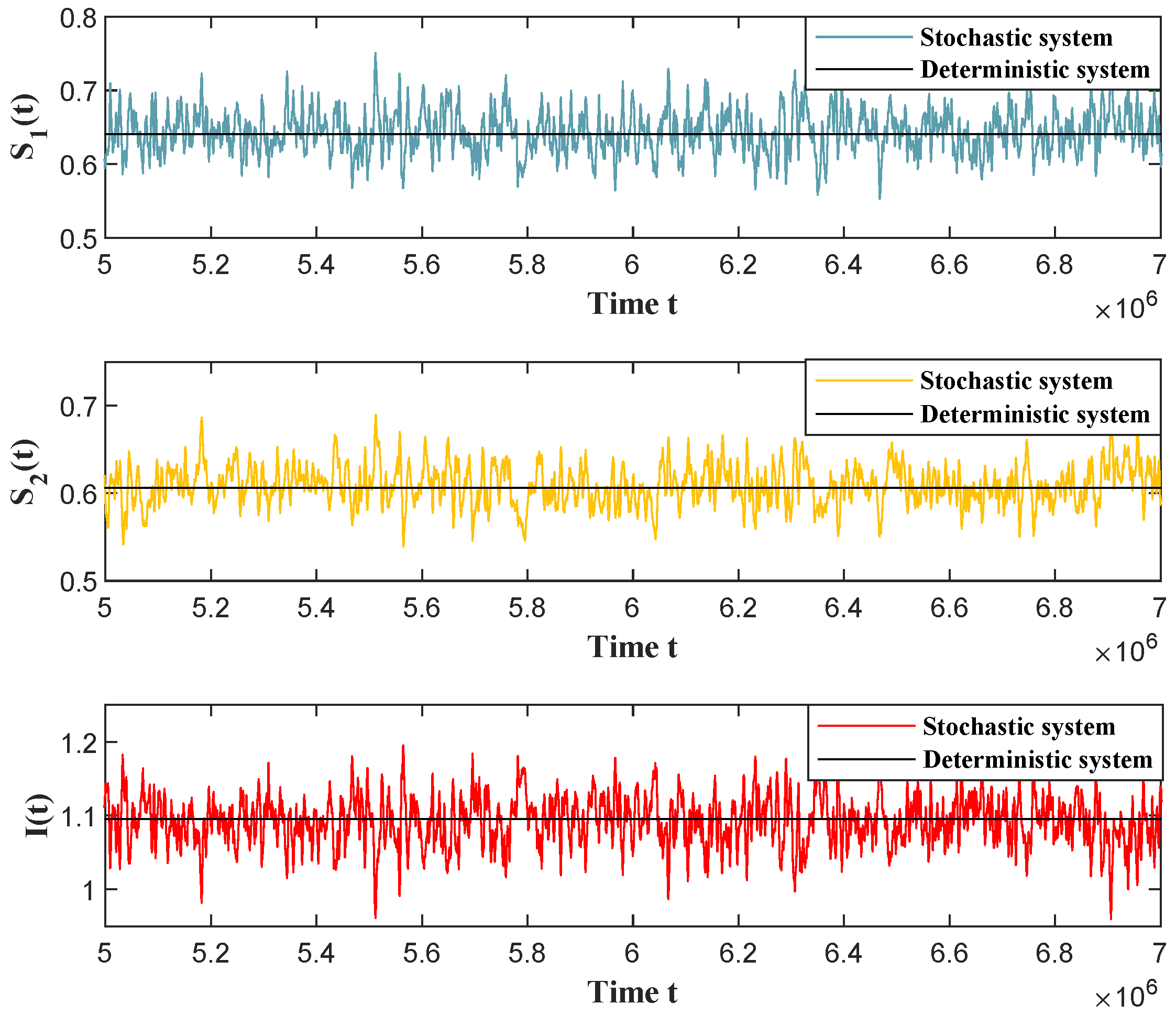
Through the trajectory images of shown in Figure 1, we can easily observe that the disease will persist for a long time near the point .
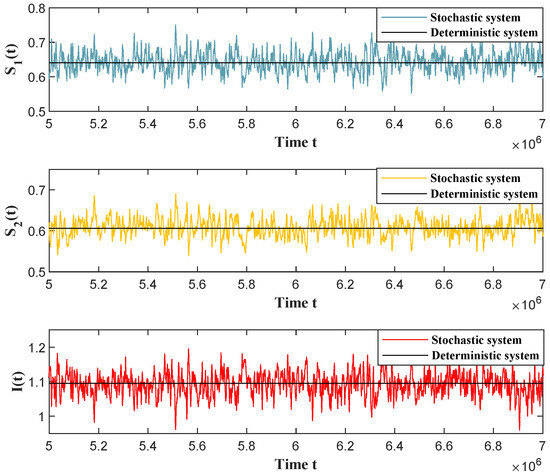
We can obtain the variables . Meanwhile, is computed by
Substituting each parameter, the exact value of the matrix can be obtained as
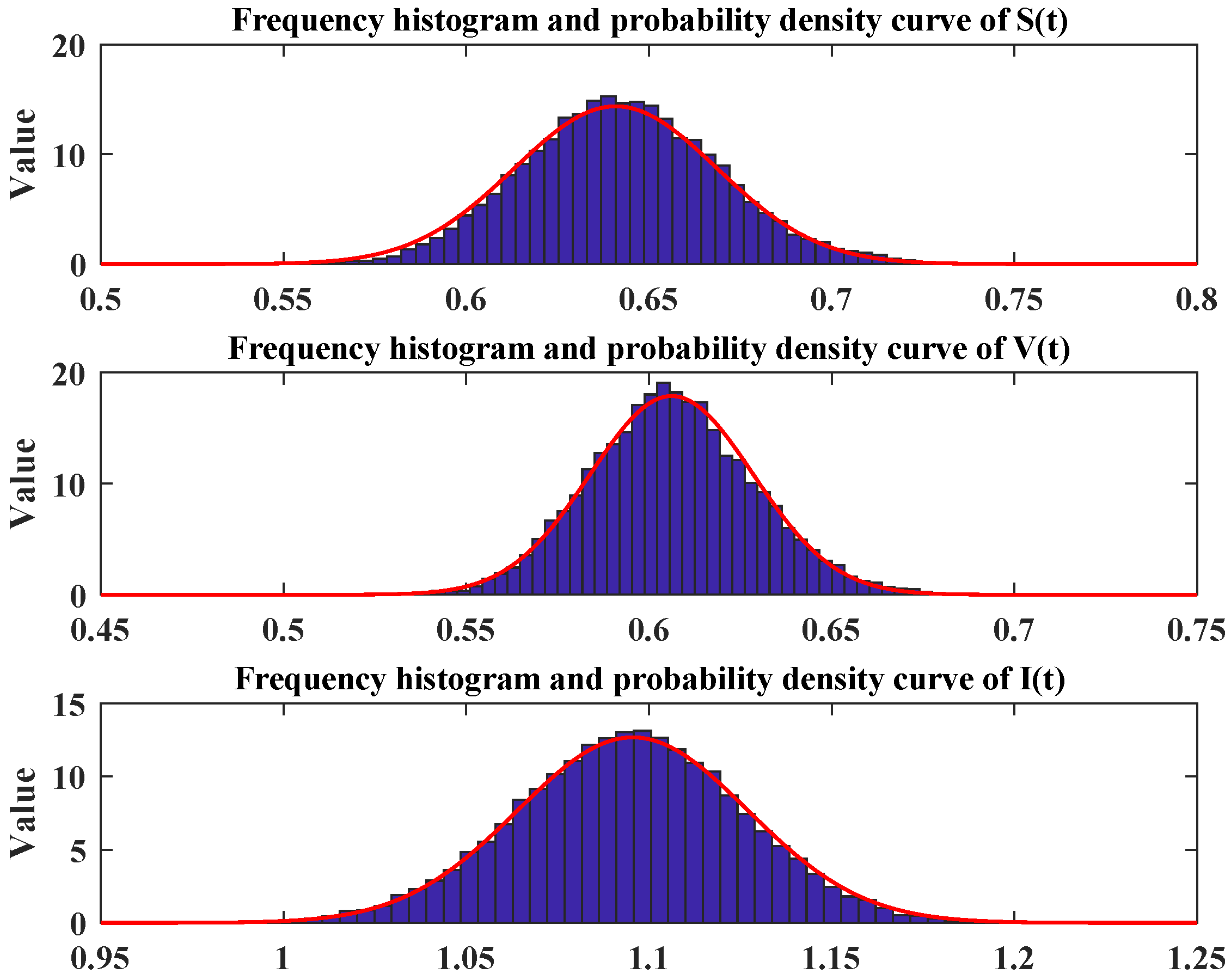
Around the quasi steady-state equilibrium point , the solutions of system (11) follow the unique normal density function is as follows:
The solutions approximately follow a normal marginal density function is shown in Figure 2. And through probability theory and mathematical statistics theory, it can be concluded that the marginal density function is as follows:
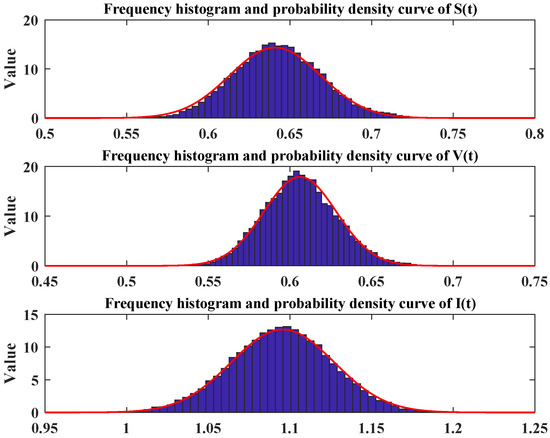
Figure 2.
The frequency histogram and marginal density function curve of .
8. Conclusions and Discussions
This paper investigates a high-dimensional stochastic SIS epidemic model, represented by the stochastic system (3), in which the effective rate is perturbed by the mean-reverting stochastic process. For the deterministic system, we establish the local asymptotic stability of both the disease-free equilibrium and the endemic equilibrium. In the corresponding stochastic model, we determine the stationary distribution by deriving a density function through the solution of the associated Fokker–Planck equation. Notably, the methodologies employed can be extended to other intriguing topics, including the computation of probability density functions for various stochastic epidemic models. However, a more comprehensive and systematic theory is needed to ascertain precise conditions and density functions effectively.
Author Contributions
Writing—Original Draft Preparation, H.Z. and J.S.; Writing—Review and Editing, H.Z. and X.W.; Funding Acquisition, J.S. All authors have read and agreed to the published version of this manuscript.
Funding
The authors were supported by Shandong Provincial Natural Science Foundation (No. ZR2021MA052).
Data Availability Statement
No new data were created or analyzed in this study. Data sharing is not applicable to this article.
Acknowledgments
The authors would like to thank the editor and reviewers for their helpful suggestions and comments that significantly improved the presentation of this work.
Conflicts of Interest
The authors declare no conflicts of interest.
References
- Rahman, K.; Mitkari, S.R.; Shaikh, S. A tuberculosis model: Validating to study transmission dynamics with vaccination and treatment. Aligarh Bull. Math. 2020, 39, 35–45. [Google Scholar]
- Zhou, B.; Zhang, X.; Jiang, D. Dynamics and density function analysis of a stochastic SVI epidemic model with half saturated incidence rate. Chaos Soliton Fract. 2020, 137, 109865. [Google Scholar] [CrossRef]
- Wang, L.; Jiang, D. Ergodicity and threshold behaviors of a predator-prey model in stochastic chemostat driven by regime switching. Math. Methods Appl. Sci. 2021, 44, 325–344. [Google Scholar] [CrossRef]
- Huang, G.; Ma, W.; Takeuchi, Y. Global analysis for delay virus dynamics model with Beddington-DeAngelis functional response. Appl. Math. Lett. 2011, 24, 1199–1203. [Google Scholar] [CrossRef]
- Liu, Q. Stationary distribution and probability density for a stochastic SISP respiratory disease model with Ornstein-Uhlenbeck process. Commun. Nonlinear Sci. Numer. Simul. 2023, 119, 107128. [Google Scholar] [CrossRef]
- Zhang, H.; Sun, J.G.; Yu, P.; Jiang, D. Dynamical Behaviors of Stochastic SIS Epidemic Model with Ornstein-Uhlenbeck Process. Axioms 2024, 13, 353. [Google Scholar] [CrossRef]
- Han, B.; Zhou, B.; Jiang, D.; Hayat, T.; Alsaedi, A. Stationary solution, extinction and density function for a high-dimensional stochastic SEI epidemic model with general distributed delay. Appl. Math. Comput. 2021, 405, 126236. [Google Scholar] [CrossRef]
- Sun, J.G.; Gao, M.; Jiang, D. Threshold Dynamics and the Density Function of the Stochastic Coronavirus Epidemic Model. Fractal Fract. 2022, 6, 245. [Google Scholar] [CrossRef]
- Hyman, J.; Li, J. An intuitive formulation for the reproductive number for the spread of diseases in heterogeneous populations. Math. Biosci. 2000, 167, 65–86. [Google Scholar] [CrossRef] [PubMed]
- Anderson, R.M.; May, R.M.; Medley, G.F.; Johnson, A. A Preliminary Study of the Transmission Dynamics of the Human Immunodeficiency Virus (HIV), the Causative Agent of AIDS. Math. Med. Biol. 1986, 3, 229–263. [Google Scholar]
- Finch, S. Ornstein-Uhlenbeck Process. Stoch. Diff. Eq. 2004, 25, 61. [Google Scholar]
- Trostab, D.C.; Overman, E.A., II; Ostroff, J.H.; Xiong, W.; March, P. A model for liver homeostasis using modified mean-reverting Ornstein-Uhlenbeck process. Comput. Math. Methods Med. 2010, 11, 27–47. [Google Scholar] [CrossRef]
- Liu, Q. Dynamical analysis of a stochastic maize streak virus epidemic model with logarithmic Ornstein-Uhlenbeck process. J. Math. Biol. 2024, 89, 30. [Google Scholar] [CrossRef] [PubMed]
- Gao, M.; Jiang, D.; Ding, J. Dynamics of a chemostat model with Ornstein-Uhlenbeck process and general response function. Chaos Solitons Fractals 2024, 184, 114950. [Google Scholar] [CrossRef]
- Mao, X. Stochastic Differential Equations and Applications; Horwood: Chichester, UK; New York, NY, USA, 1997. [Google Scholar]
- Wu, F.; Mao, X.; Chen, K. A highly sensitive mean-reverting process in finance and the Euler-Maruyama approximations. J. Math. Anal. Appl. 2008, 348, 540–554. [Google Scholar] [CrossRef]
- Allen, E. Environmental variability and mean-reverting processes. Discret. Contin. Dyn.-Syst.-Ser. 2016, 21, 2073–2089. [Google Scholar] [CrossRef]
- Dixit, A.K.; Pindyck, R.S. Investment Under Uncertainty; Princeton University Press: Princeton, NJ, USA, 1994. [Google Scholar]
- Yang, Q.; Zhang, X.; Jiang, D. Dynamical Behaviors of a Stochastic Food Chain System with Ornstein-Uhlenbeck Process. J. Nonlinear Sci. 2022, 32, 34. [Google Scholar] [CrossRef]
- Ayoubi, T.B.H. Persistence and extinction in stochastic delay Logistic equation by incorporating Ornstein-Uhlenbeck process. Appl. Math. Comput. 2020, 386, 125465. [Google Scholar] [CrossRef]
- Kunita, H. Itô’s stochastic calculus: Its surprising power for applications. Stoch. Process. Their Appl. 2010, 120, 622–652. [Google Scholar] [CrossRef]
- Khas’miniskii, R.Z. Stochastic Stability of Differential Equations; Horwood: Chichester, UK, 1997. [Google Scholar]
- Higham, D.J. An algorithmic introduction to numerical simulation of stochastic differential equations. SIAM Rev. 2001, 43, 525–546. [Google Scholar] [CrossRef]
Disclaimer/Publisher’s Note: The statements, opinions and data contained in all publications are solely those of the individual author(s) and contributor(s) and not of MDPI and/or the editor(s). MDPI and/or the editor(s) disclaim responsibility for any injury to people or property resulting from any ideas, methods, instructions or products referred to in the content. |
© 2024 by the authors. Licensee MDPI, Basel, Switzerland. This article is an open access article distributed under the terms and conditions of the Creative Commons Attribution (CC BY) license (https://creativecommons.org/licenses/by/4.0/).