


Abstract
The paper deals with the problem of representation of Horn’s hypergeometric functions via continued fractions and branched continued fractions. We construct the formal continued fraction expansions for three ratios of Horn’s hypergeometric functions The method employed is a two-dimensional generalization of the classical method of constructing a Gaussian continued fraction. It is proved that the continued fraction, which is an expansion of each ratio, uniformly converges to a holomorphic function of two variables on every compact subset of some domain of and that this function is an analytic continuation of such a ratio in this domain. To illustrate this, we provide some numerical experiments at the end.
Keywords:
Horn function; continued fraction; holomorphic functions of several complex variables; numerical approximation; convergence MSC:
33C65; 30B70; 32A10; 33F05; 40A15
1. Introduction
Families of hypergeometric functions (such as Appell [1,2], Horn [3,4,5], Lauricella [6], and others) were and remain the object of our research, as they have many different applications both in mathematics and in other fields of science [7,8,9,10]. In particular, their properties [11,12,13,14], integral representations [15,16,17,18], and representations in the form of branched continued fractions [19,20,21,22,23,24,25,26] are studied.
In [27], the expansion of the Horn’s hypergeometric function into a branched continued fraction, which is a continued fraction according to its structure, was obtained. However, this do not provide an opportunity to apply the well-known results from the analytical theory of continued fractions through the so-called ’figure approximants’ (see, for example, [28])—that is, different approaches to the determining of approximants. Therefore, the question naturally arises: is there an expansion of Horn’s hypergeometric function into a pure continued fraction?
In this paper, we give a partial answer to the above question by converting three expansions of certain ratios of Horn’s hypergeometric functions into continued fractions as functions of two complex variables. To do this, using the technique of establishing recurrence relations [29], it is shown that one three- and two four-term recurrence relations for the function are valid. It is proved that every continued fraction, which is an expansion of a certain ratio, uniformly converges to a holomorphic function on every compact subset of some domain of and that this function is an analytic continuation of such a ratio in this domain. At the end of the paper, we undertake some numerical experiments.
2. Expansions
Horn’s hypergeometric function is defined by double power series (see, [3,4,5])
where , and are complex constants, and are not equal to a non-positive integer, is the Pochhammer symbol defined for any complex number and non-negative integer n by , and
Let us prove the three- and four-term recurrence relations for function (1).
Lemma 1.
The following relations hold true:
Proof.
By definition (1), we get
and this means that the four-term recurrence relation (2) is correct.
Let us prove the four-term recurrence relation (3). We have
which had to be proved.
Finally,
which is the desired three-term recurrence relation. □
We set
and
Then, dividing (2) by (3) by and (4) by we get
and
Using the recurrence relations (5)–(7), it is possible to convert the formal expansions of the relations into branched continued fractions, as it is for Horn’s hypergeometric functions and in works [27,30,31]. We will show that for certain values of the parameters, it is possible to convert the formal expansions of these ratios into continued fractions.
The following is true.
Theorem 1.
A ratio
has a formal continued fraction of the form
where
Proof.
We set Then, at Step 1.1 from (6), we obtain
At Step 1.2, replacing by and respectively, in (5), we get
which gives us
Since it follows from (7) that
at Step, 1.3 we have
We will continue with the next construction of a continued fraction using the ideas outlined in Steps 1.1–1.3.
By analogy, it is clear that for all the following relation holds:
Substituting relation (12) with in (11) in Steps 2.1–2.3 we obtain
Next, by recurrence relation (12) after the nth block of Steps n.1–n.3, we get
Finally, by (12), one obtains the continued fraction (9) for ratio (8). □
The following two theorems can be proved analogously.
Theorem 2.
A ratio has a formal continued fraction of the form (9), where
Theorem 3.
A ratio has a formal continued fraction of the form (9), where
3. Convergence of Continued Fraction Expansions
To prove our next result, we recall the following theorem (see, [32], Theorem 4.42).
Theorem 4.
If all elements of a continued fraction
lie in a parabolic region
then the continued fraction converges to a finite value if and only if at least one of the series
is divergent.
The following is true.
Theorem 5.
Let a be a real constant such that for all and let
where
Then:
- (A)
- The continued fraction (9), whose coefficients are defined by (10), converges uniformly on every compact subset of (15) to a function holomorphic in
- (B)
- The function is an analytic continuation of (8) in the domain
Proof.
Let be an arbitrary number from the interval and let be an arbitrary fixed point from It is clear that the coefficients of (9) satisfy the conditions of Theorem 4. This yields the uniform convergence of (9) to a holomorphic function on all compact subsets of and, consequently, in whole domain by virtue of arbitrariness This proves part (A). Proof of (B) is analogous to the proof of Theorem 3 [27], so it is omitted. □
An analogous two theorems could be proved in a similar way.
Theorem 6.
Let a be a real constant such that for all and let
where
Then:
- (A)
- The continued fraction (9), whose coefficients are defined by (13), converges uniformly on every compact subset of (16) to a function holomorphic in
- (B)
- The function is an analytic continuation of in the domain
Theorem 7.
Let a be a real constant such that for all Then:
- (A)
- The continued fraction (9), whose coefficients are defined by (14), converges uniformly on every compact subset of (15) to a function holomorphic in
- (B)
- The function is an analytic continuation of in the domain
4. Numerical Experiments
By Theorem 5, one obtains
where
is an incomplete gamma function, and
The continued fraction in (17) converges and represents a single-valued branch of the function
in the domain (15).
The numerical illustration of series
and the continued fraction (17) is given in the Table 1.

Table 1.
Relative error of 10th partial sum and 10th approximant for (18).
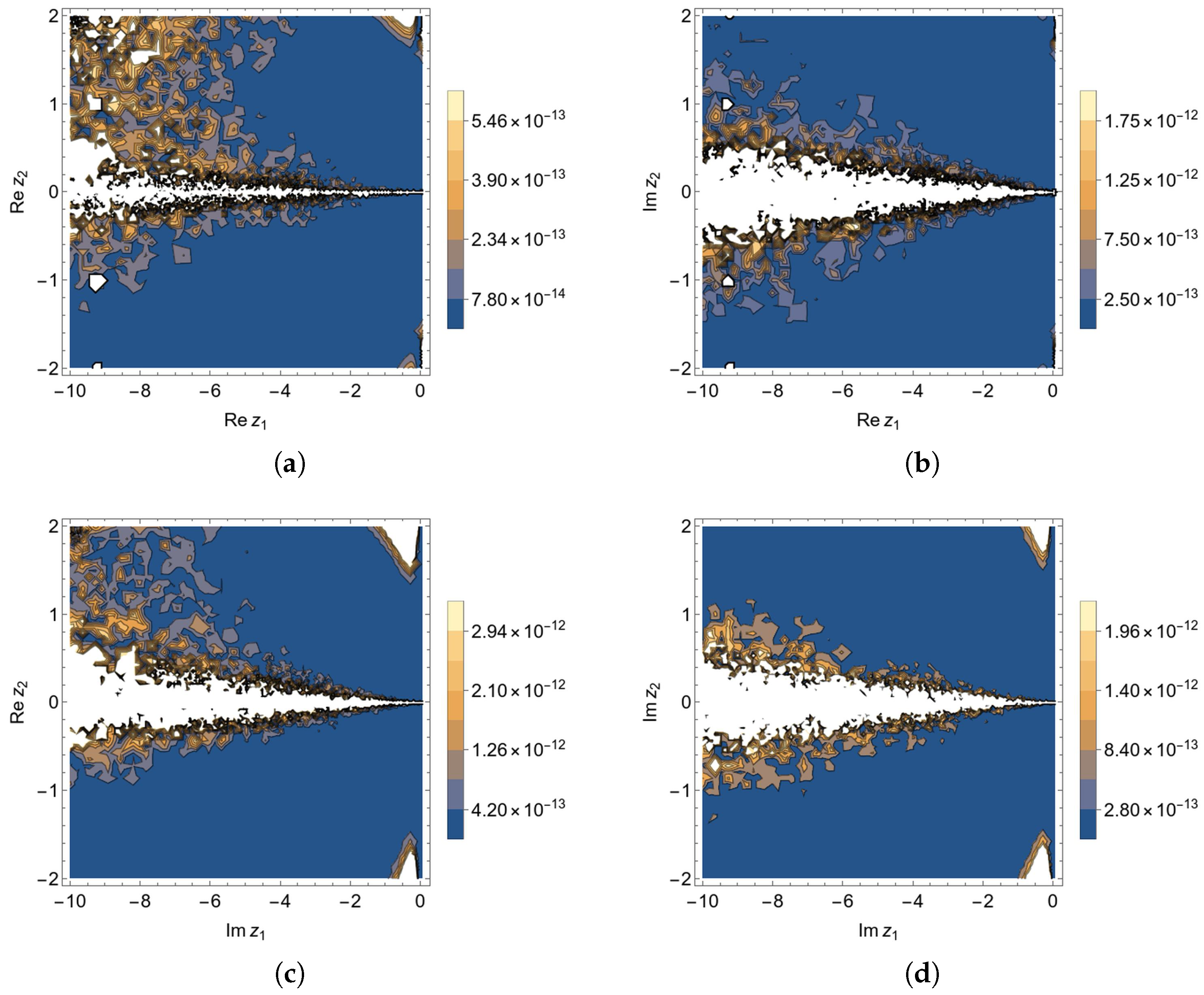
In Figure 1a–d, we can see the plots where the 20th approximant of (17) guarantees certain truncation error bounds for function (18).
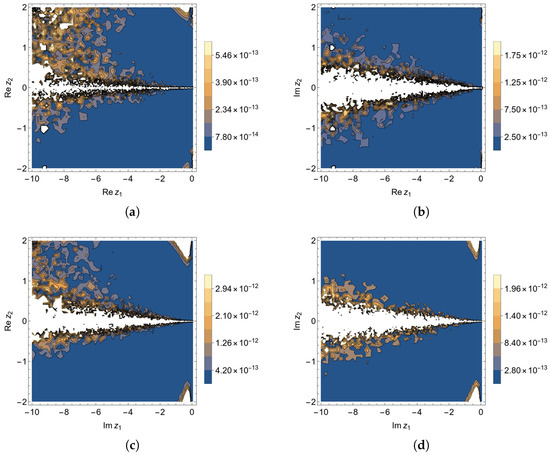
Figure 1.
The plots where the approximant of (17) guarantees certain truncation error bounds for function (18).
Calculations and plots were performed using Wolfram Mathematica software 13.1.0.0 for Linux.
5. Discussion
In this work, for the first time, expansions of ratios of hypergeometric functions of two complex variables into continued fractions were constructed. This made it possible to apply one of the well-known convergence criteria of continued fractions—the parabolic theorem—to the study of convergence. Numerical experiments showed that the domain of convergence of the constructed expansions is wider; that is, the problem of studying the convergence of such fractions remains open. One should the specific periodicity of the coefficients of the constructed expansions. One should also note that the method of establishing an analytical continuation remains the same as for branched continued fractions. More on branched continued representations of the functions of several variables can be found in the papers [33,34,35,36,37,38,39,40].
Finally, let us point out a rather interesting and promising direction of investigation: representing discrete hypergeometric series (see, [41]) via branched continued fractions.
Author Contributions
All authors contributed equally to this work. All authors have read and agreed to the published version of the manuscript.
Funding
This research received no external funding.
Data Availability Statement
Not applicable.
Acknowledgments
The authors were partially supported by the Ministry of Education and Science of Ukraine, project registration number 0122U000857.
Conflicts of Interest
The authors declare no conflict of interest.
References
- Appell, P. Sur les séries hyper géométriques de deux variables et sur des équations différentielles lineaires aux dérivées partielles. C. R. Acad. Sci. Paris 1880, 90, 296–298,731–734. [Google Scholar]
- Appell, P. Sur les fonctions hypergéométriques de deux variables. J. Math. Pures Appl. 1882, 8, 173–216. [Google Scholar]
- Horn, J. Hypergeometrische Funktionen zweier Veränderlichen. Math. Ann. 1931, 105, 381–407. [Google Scholar] [CrossRef]
- Horn, J. Hypergeometrische Funktionen zweier Veränderlichen. Math. Ann. 1935, 111, 638–677. [Google Scholar] [CrossRef]
- Horn, J. Hypergeometrische Funktionen zweier Veränderlichen. Math. Ann. 1937, 113, 242–291. [Google Scholar] [CrossRef]
- Lauricella, G. Sulle funzioni ipergeometriche a piu variabili. Rend. Circ. Matem. 1893, 7, 111–158. [Google Scholar] [CrossRef]
- Bailey, W.N. Generalised Hypergeometric Series; Cambridge University Press: Cambridge, UK, 1935. [Google Scholar]
- Erdélyi, A.; Magnus, W.; Oberhettinger, F.; Tricomi, F.G. Higher Transcendental Functions; McGraw-Hill Book Co.: New York, NY, USA, 1953; Volume 1. [Google Scholar]
- Exton, H. Multiple Hypergeometric Functions and Applications; Horwood, E., Ed.; Halsted Press: Chichester, UK, 1976. [Google Scholar]
- Srivastava, H.M.; Karlsson, P.W. Multiple Gaussian Hypergeometric Series; Horwood, E., Ed.; Halsted Press: Chichester, UK, 1985. [Google Scholar]
- Brychkov, Y.A.; Savischenko, N.V. On some formulas for the Horn functions H4(a,b;c,c′;w,z) and H7c(a,b;c,c′;w,z). Integral Transform. Spec. Funct. 2021, 32, 969–987. [Google Scholar] [CrossRef]
- Chetry, A.S.; Kalita, G. Lauricella hypergeometric series FA(n) over finite fields. Ramanujan J. 2022, 57, 1335–1354. [Google Scholar] [CrossRef]
- Kim, I.; Rathie, A.K. A Note on Certain General Transformation Formulas for the Appell and the Horn Functions. Symmetry 2023, 15, 696. [Google Scholar] [CrossRef]
- Shpot, M.A. A massive Feynman integral and some reduction relations for Appell function. J. Math. Phys. 2007, 48, 123512–123525. [Google Scholar] [CrossRef]
- Brychkov, Y.A.; Savischenko, N. On some formulas for the Horn functions H6(a,b;c;w,z) and H8(c)(a;b;w,z). Integral Transform. Spec. Funct. 2021, 33, 651–667. [Google Scholar] [CrossRef]
- Brychkov, Y.A.; Savischenko, N.V. On some formulas for the Horn functions H3(a,b;c;w,z),H6(c)(a;c;w,z) and Humbert function Φ3(b;c;w,z). Integral Transform. Spec. Funct. 2020, 32, 661–676. [Google Scholar] [CrossRef]
- Chelo, F.; López, J.L. Asymptotic expansions of the Lauricella hypergeometric function FD. J. Comput. Appl. Math. 2003, 151, 235–256. [Google Scholar]
- Mimachi, K. Integral representations of Appell’s F2,F3, Horn’s H2 and Olsson’s Fp functions. Kyushu J. Math. 2020, 74, 1–13. [Google Scholar] [CrossRef]
- Antonova, T.; Dmytryshyn, R.; Sharyn, S. Generalized hypergeometric function 3F2 ratios and branched continued fraction expansions. Axioms 2021, 10, 310. [Google Scholar] [CrossRef]
- Antonova, T.M. On convergence of branched continued fraction expansions of Horn’s hypergeometric function H3 ratios. Carpathian Math. Publ. 2021, 13, 642–650. [Google Scholar] [CrossRef]
- Bodnar, D.I.; Manzii, O.S. Expansion of the ratio of Appel hypergeometric functions F3 into a branching continued fraction and its limit behavior. J. Math. Sci. 2001, 107, 3550–3554. [Google Scholar] [CrossRef]
- Hoyenko, N.; Hladun, V.; Manzij, O. On the infinite remains of the Nörlund branched continued fraction for Appell hypergeometric functions. Carpathian Math. Publ. 2014, 6, 11–25. (In Ukrainian) [Google Scholar] [CrossRef]
- Hladun, V.R.; Hoyenko, N.P.; Manzij, O.S.; Ventyk, L. On convergence of function F4(1,2;2,2;z1,z2) expansion into a branched continued fraction. Math. Model. Comput. 2022, 9, 767–778. [Google Scholar] [CrossRef]
- Manzii, O.S. Investigation of expansion of the ratio of Appel hypergeometric functions F3 into a branching continued fraction. Approx. Theor. Appl. Pr. Inst. Math. NAS Ukr. 2000, 31, 344–353. (In Ukrainian) [Google Scholar]
- Petreolle, M.; Sokal, A.D. Lattice paths and branched continued fractions II. Multivariate Lah polynomials and Lah symmetric functions. Eur. J. Combin. 2021, 92, 103235. [Google Scholar] [CrossRef]
- Petreolle, M.; Sokal, A.D.; Zhu, B.X. Lattice paths and branched continued fractions: An infinite sequence of generalizations of the Stieltjes-Rogers and Thron-Rogers polynomials, with coefficientwise Hankel-total positivity. arXiv 2020, arXiv:1807.03271v2. [Google Scholar]
- Antonova, T.; Dmytryshyn, R.; Lutsiv, I.-A.; Sharyn, S. On some branched continued fraction expansions for Horn’s hypergeometric function H4(a,b;c,d;z1,z2) ratios. Axioms 2023, 12, 299. [Google Scholar] [CrossRef]
- Bodnar, D.I. Branched Continued Fractions; Naukova Dumka: Kyiv, Ukraine, 1986. (In Russian) [Google Scholar]
- Dmytryshyn, R.I.; Lutsiv, I.-A.V. Three- and four-term recurrence relations for Horn’s hypergeometric function H4. Res. Math. 2022, 30, 21–29. [Google Scholar] [CrossRef]
- Antonova, T.; Dmytryshyn, R.; Kravtsiv, V. Branched continued fraction expansions of Horn’s hypergeometric function H3 ratios. Mathematics 2021, 9, 148. [Google Scholar] [CrossRef]
- Antonova, T.; Dmytryshyn, R.; Sharyn, S. Branched continued fraction representations of ratios of Horn’s confluent function H6. Constr. Math. Anal. 2023, 6, 22–37. [Google Scholar]
- Jones, W.B.; Thron, W.J. Continued Fractions: Analytic Theory and Applications; Addison-Wesley Pub. Co.: Reading, MA, USA, 1980. [Google Scholar]
- Bodnar, D.I. Expansion of a ratio of hypergeometric functions of two variables in branching continued fractions. J. Math. Sci. 1993, 64, 1155–1158. [Google Scholar] [CrossRef]
- Bodnar, D.I. Multidimensional C-fractions. J. Math. Sci. 1998, 90, 2352–2359. [Google Scholar] [CrossRef]
- Bodnarchuk, P.I.; Skorobogatko, V.Y. Branched Continued Fractions and Their Applications; Naukova Dumka: Kyiv, Ukraine, 1974. (In Ukrainian) [Google Scholar]
- Dmytryshyn, R.I. Two-dimensional generalization of the Rutishauser qd-algorithm. J. Math. Sci. 2015, 208, 301–309. [Google Scholar] [CrossRef]
- Dmytryshyn, R.I.; Sharyn, S.V. Approximation of functions of several variables by multidimensional S-fractions with independent variables. Carpathian Math. Publ. 2021, 13, 592–607. [Google Scholar] [CrossRef]
- Hoyenko, N.P. Correspondence principle and convergence of sequences of analytic functions of several variables. Mat. Visn. Nauk. Tov. Im. Shevchenka. 2007, 4, 42–48. (In Ukrainian) [Google Scholar]
- Hoyenko, N.P.; Manzij, O.S. Expansion of Appel F1 and Lauricella FD(N) hypergeometric functions into branched continued fractions. Visnyk Lviv. Univ. Ser. Mech.-Math. 1997, 48, 17–26. (In Ukrainian) [Google Scholar]
- Manzii, O.S. On the approximation of an Appell hypergeometric function by a branched continued fraction. J. Math. Sci. 1998, 90, 2376–2380. [Google Scholar] [CrossRef]
- Bohner, M.; Cuchta, T. The generalized hypergeometric difference equation. Demonstr. Math. 2018, 51, 62–75. [Google Scholar] [CrossRef]
Disclaimer/Publisher’s Note: The statements, opinions and data contained in all publications are solely those of the individual author(s) and contributor(s) and not of MDPI and/or the editor(s). MDPI and/or the editor(s) disclaim responsibility for any injury to people or property resulting from any ideas, methods, instructions or products referred to in the content. |
© 2023 by the authors. Licensee MDPI, Basel, Switzerland. This article is an open access article distributed under the terms and conditions of the Creative Commons Attribution (CC BY) license (https://creativecommons.org/licenses/by/4.0/).