
Article

A Joint Location–Allocation–Inventory Spare Part Optimization Model for Base-Level Support System with Uncertain Demands

1
School of Reliability and System Engineering, Beihang University, Beijing 100191, China
2
Science and Technology on Reliability and Environmental Engineering Laboratory, Beihang University, Beijing 100191, China
3
School of Aeronautic Science and Engineering, Beihang University, Beijing 100191, China
*
Author to whom correspondence should be addressed.
Axioms 2023, 12(1), 46; https://doi.org/10.3390/axioms12010046

Submission received: 23 November 2022 / Revised: 25 December 2022 / Accepted: 26 December 2022 / Published: 1 January 2023
(This article belongs to the Special Issue Advances in Uncertain Optimization and Applications)

Abstract

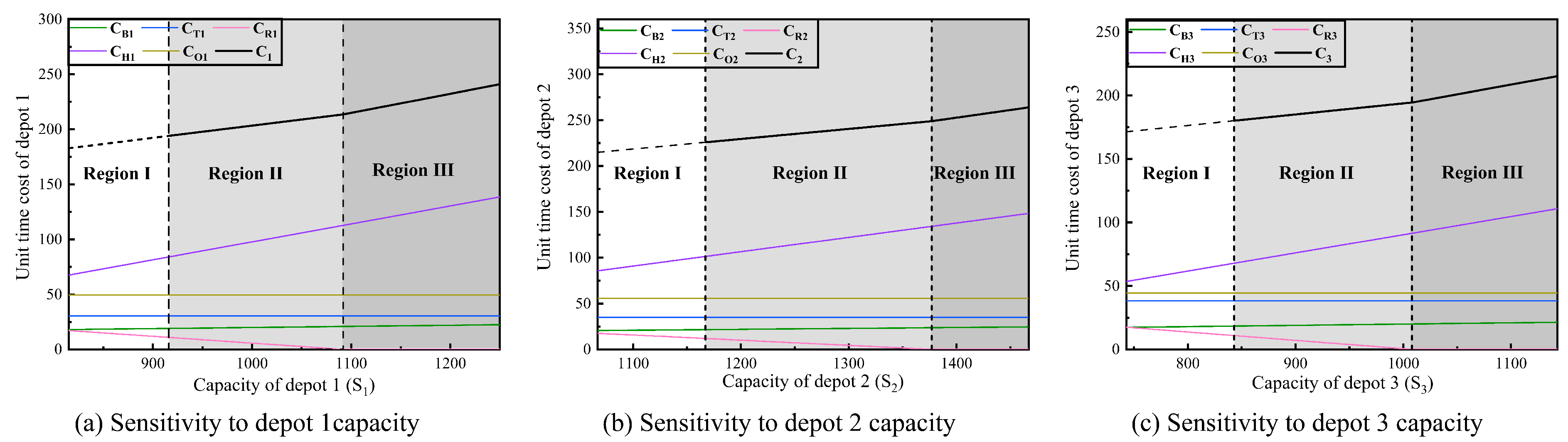
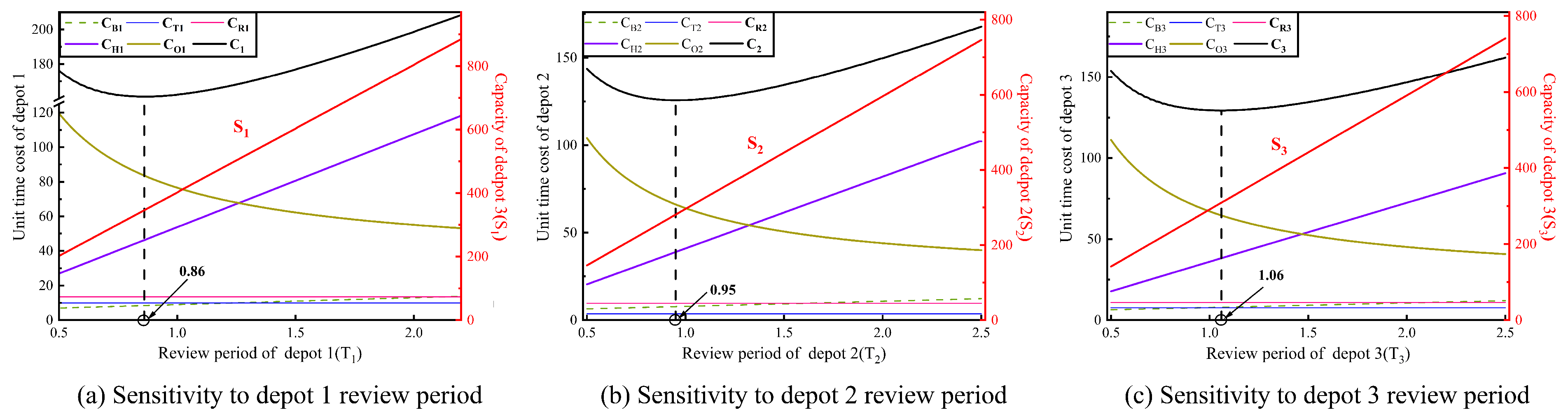
This paper copes with a joint Location-Allocation-Inventory problem in a three-echelon base-level spare part support system with epistemic uncertainty in uncertain demands of bases. The aim of the paper is to propose an optimization model under the uncertainty theory to minimize the total cost, which integrates crucial characterizations of the inventory control decisions and the location-allocation scheme arrangement under a periodic review order-up-to-S (T, S) policy. Uncertainty theory is introduced in this paper to characterize epistemic uncertainty, where demands are treated as uncertain variables and stockout loss is represented by value-at-risk in uncertain measurement. To solve the original uncertain optimization model, an equivalent deterministic model is derived and addressed by an improved bilevel genetic algorithm. Moreover, the proposed models and algorithm are encoded into numerical examples for supply chain programming. The results highlight the applicability of the model and the algorithm’s effectiveness in approaching the optimal solution compared with traditional genetic algorithm. Sensitivity analyses are further made for the impacts of review time and inventory capacity on different cost components.
Keywords: Location-Allocation-Inventory; base-level spare part; uncertainty theory; bilevel genetic algorithm Location-Allocation-Inventory; base-level spare part; uncertainty theory; bilevel genetic algorithm