


Abstract
Banded iron formations (BIFs) are marine chemical sedimentary rocks comprised of alternating siliceous- and iron-rich bands and deposited from Eoarchean to early Paleoproterozoic. Due to their geological antiquity, BIFs normally have been overprinted by postdepositional tectono-thermal events, leading to large uncertainties with respect to their depositional age and field occurrence. The studied Gongyiming BIF-type iron deposit, which is a typical example of its metamorphosed Archean counterparts, is preserved within the Guyang Greenstone Belt, the North China Craton (NCC). The formation age of this BIF and effects of postdepositional tectono-thermal events on this BIF have not yet been well determined, limiting our understanding of its geological implication and the current occurrence of its orebodies. In this study, we provided new geological and zircon U-Pb geochronological evidence for the Gongyiming BIF that supports a possibly early Neoarchean depositional age (>2.66 Ga). This finding not only helps to fill the early Neoarchean age gap in BIF records in China, but also supports the previously documented multi-stage crustal growth model for the NCC. Furthermore, a metamorphic age of ~2.50 Ga is recorded by the BIF-bearing plagioclase amphibolite and monzogranitic gneiss that intruded into the plagioclase amphibolite. This metamorphic age is consistent with the time for an extensively identified late Neoarchean tectonic event in the NCC. The identification of a 1.90 Ga old potassium feldspar granite within this BIF indicates the plausible influence of the regional late Paleoproterozoic tectono-thermal event. This event is likely to have caused the development of a large-scale scale dextral shearing in the Gongyiming mining area, which ultimately shaped the field occurrence of its No. 2 and No. 3 ore bodies. Collectively, a structurally controlled exploration model was established for the Gongyiming BIF-type iron deposit, which facilitates the understanding of its ore body reworking processes and guides further regional iron deposit exploration and prospecting efforts.
1. Introduction
The North China Craton (NCC) is one of the oldest cratonic blocks in the world and has a long geological history dating back to ca. 3.8 Ga ago [1,2]. Similar to other cratonic blocks worldwide, the NCC experienced multiple stages of crustal growth, during which a significant volume of mantle-derived material was added to its continental crust during the late Mesoarchean to early Neoarchean [3]. After that, the NCC was subjected to large-scale tectono-thermal events at the end of the Neoarchean, resulting in the extensive overprinting and reworking of pre-existing continental crustal materials [4,5,6]. Globally, as predominant components of the early continental crust, trondhjemite–tonalite–granodiorite (TTG) gneisses and contemporaneous greenstone belts (i.e., Precambrian supracrustal sequences that were composed of metamorphosed volcanic–sedimentary rock series [7]) are spatially associated (e.g., refs. [7,8]). For the NCC, TTG gneisses of early Mesoarchean to early Neoarchean ages have been widely identified; however, contemporaneous supracrustal rocks are rarely discovered [9]. This phenomenon has significantly weakened the argument [3] that the peak period of continental crust growth for the NCC is late Mesoarchean to early Neoarchean.
Banded iron formations (BIFs) are marine chemical sediments characterized by relatively high iron content (TFe > 15 wt.%) and composed of alternating iron- and silica-rich bands [10]. As a significant component of Archean greenstone belts, BIFs are widely developed within ancient cratons worldwide and record key information on the tectonic evolution of the early continental crust [11,12,13,14,15,16,17,18,19,20,21]. Furthermore, BIF-related iron deposits constitute the most important source of global iron resources [11] and account for approximately 64% of all identified iron mineral resources in China [15]. In the NCC, BIFs primarily formed during the late Neoarchean (2.6–2.5 Ga; Refs. [22,23]) and early Paleoproterozoic [15], and are distributed in regions such as Anshan, Benxi, Eastern Hebei, Guyang, Lüliang and Huoqiu. Significantly, previous studies have suggested that massive BIF mineralization in the NCC is closely related to the significant continental crustal growth event at the late Mesoarchean to early Neoarchean [3,6]. However, the relative scarcity of late Mesoarchean to early Neoarchean BIFs in the NCC renders this interpretation inadequate.
As aforementioned, the NCC was subjected to extensive metamorphic–magmatic events (i.e., cratonization) at the end of the Neoarchean (~2.51–2.45 Ga, refs. [4,5,6]). Although this may have helped to explain the absence of late Mesoarchean to early Neoarchean BIFs as these sediments and their associated rocks might have been significantly altered during the multi-stage tectono-thermal event, more works with respect to the depositional ages of BIFs in the NCC are still warranted. To address these challenges, we conducted geological and geochronological studies on the Gongyiming BIF of Guyang Greenstone Belt (GGB), NCC. This was coupled with systematic macro- and microstructural characteristics of the BIF and its associated rocks. Notably, this BIF has suffered intense deformation and been separated into different blocks by plutonic intrusions of various ages, making it a typical example of its Archean counterparts in the NCC. For this study, we interpret the depositional age of the Gongyiming BIF according to our new field observations and zircon U-Pb age dating, before assessing its tectonic deformation processes. By doing so, an early Neoarchean formation age and a structurally controlled exploration model were established for this BIF.
2. Geological Background
2.1. Regional Geology
The NCC is bounded by the Central Asian Orogenic Belt to the North, the Qinling–Dabie Orogenic Belt to the South, and the Su–Lu Orogenic Belt to the East (Figure 1a). It is comprised predominantly of ca. 3.8–2.5 Ga migmatite, TTG gneisses, amphibolite, schist and BIFs, which are overlaid by the vast Phanerozoic cover. Based on tectonic disparities, the Precambrian basement of the NCC is further divided into the Eastern and Western blocks, and the intervening Trans-North China orogen [24,25]. The collision time of the two blocks along the Trans-North China orogen is controversial: either at ca. 1.85 Ga [24,26,27], or at ca. 2.5 Ga [28,29,30]. The Eastern Block is dominated by Archean basement that contains early to late Archean TTG gneisses, granitoids and subordinate greenstone belts [1,31,32]. In contrast, the Western Block is a stable continent with a thick platform sedimentary cover. Several greenstone belts, including the Qingyuan, Yanlingguan, Wutai and Guyang Greenstone Belt, which were believed to be Neoarchean in age, are developed along the northern margin of the NCC (Figure 1a). In comparison to typical greenstone belts worldwide, these terranes are characterized by intense metamorphism and deformation, limited distribution, and a lower proportion of mafic rocks [6,33]. Nevertheless, they provide crucial targets for investigating the Precambrian evolution of the NCC.
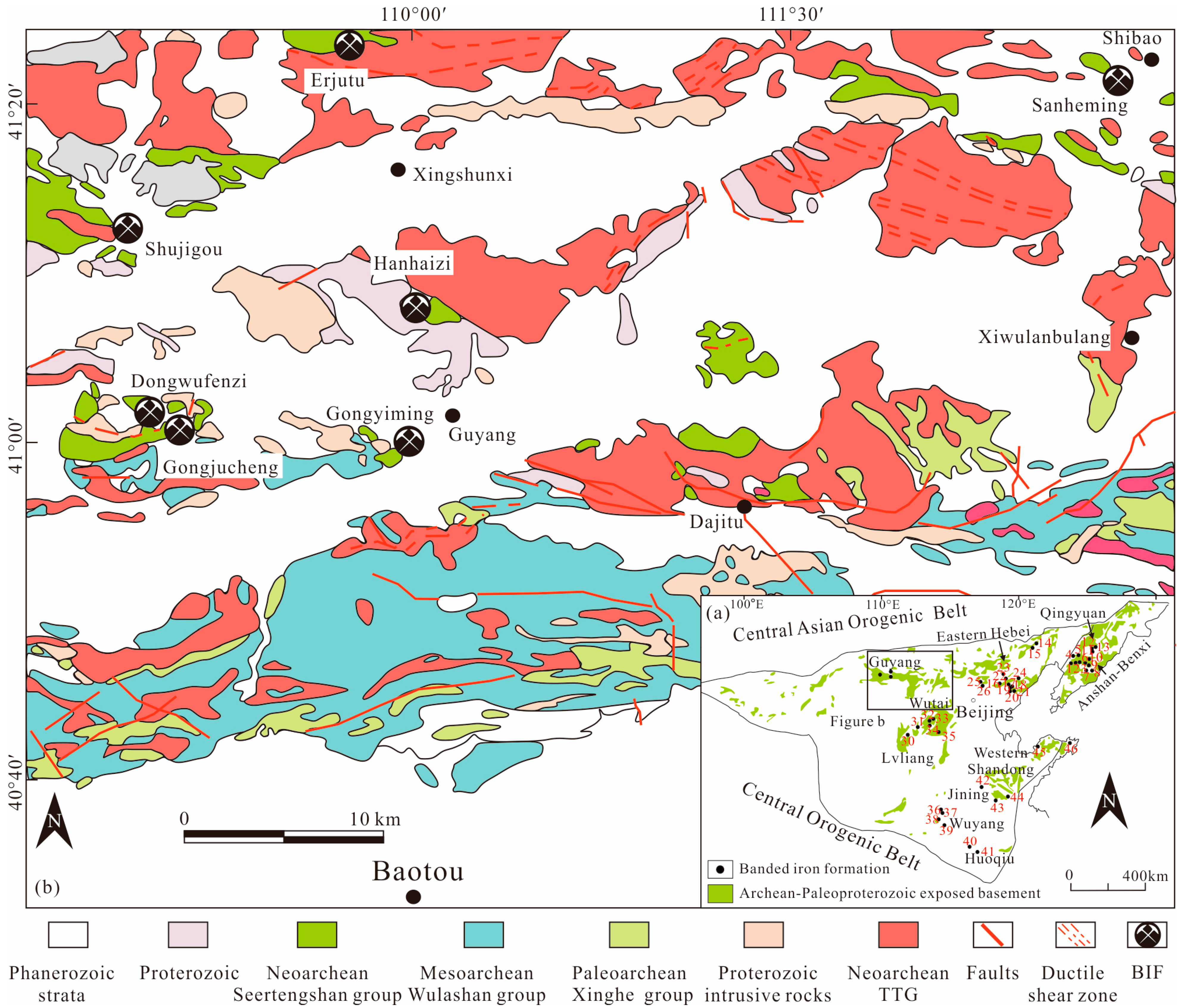
The present study area is a part of the GGB, which is located at the northern margin of the Eastern Block of the NCC (Figure 1a). The Early Precambrian basement in this area is primarily classified into the Paleoarchean Xinghe Group, Mesoarchean Wulashan Group, Neoarchean Se’ertengshan Group, and Paleoproterozoic Maidaizhao Group [34]. These ancient strata, together with Archean charnockites, Neoarchean TTG suites and Paleoproterozoic intrusions, constitute the Early Precambrian basement of this region (Figure 1b). The Neoarchean Se’ertengshan Group, the main component of the GGB, is distributed in an E-W trend across the north-central part of Guyang area. It comprises a volcanic–sedimentary sequence that underwent greenschist to lower amphibolite facie metamorphism [34,35]. Previous researchers have subdivided the Se’ertengshan Group, from bottom to top, into three formations: (i) the lowermost Dongwufenzi Formation, characterized by ultramafic and mafic rocks intercalated with BIFs; (ii) the overlying Liushugou Formation, dominated by meta-intermediate-mafic rocks; and (iii) the uppermost Dianlisutai Formation, containing more intermediate-felsic volcanic rocks, with marble and quartzite occurring at the top of the sequence [34,35,36]. However, as previously mentioned, the early Precambrian rocks in the GGB have been variably modified by metamorphism and deformation, resulting in different degrees of metamorphism between the northern and southern parts of the GGB [34,35], as well as large uncertainties with respect to their relatively stratigraphic relationships.
Banded iron formations, including Erjutu, Shujigou, Hanhaizi, Dongwufenzi, Gongjucheng, Gongyiming and Sanheming deposits, are mainly preserved within the Dongwufenzi Formation that is distributed eastward in the central-western part of GGB (Figure 1b). These BIFs are in conformable contact with underlying amphibolite and biotite schist, occasionally with amphibolite as an interlayer, and are overlaid by quartzite. The contact between BIF and overlying quartzite is conformable with a gradual decrease in iron content upwards. Moreover, these BIFs were affected by postdepositional tectonic events, resulting in locally divergent attitudes and well-developed folds and faults.
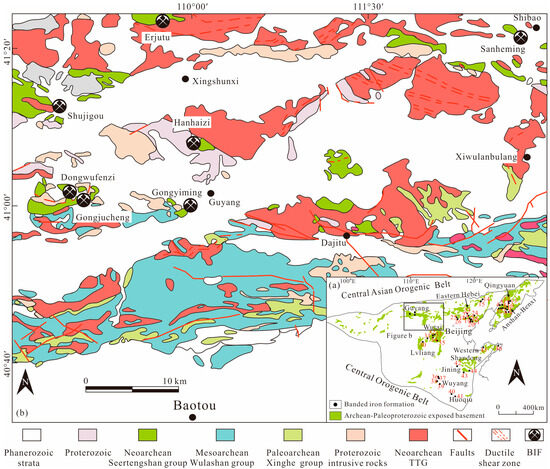
Figure 1.
(a) The distribution of BIFs and Precambrian terranes in the North China Craton (modified from [37]). The numbers represent the BIFs, which can be found in reference [37]. (b) Simplified geological map of the Guyang Greenstone Belt (according to [38]).
Figure 1.
(a) The distribution of BIFs and Precambrian terranes in the North China Craton (modified from [37]). The numbers represent the BIFs, which can be found in reference [37]. (b) Simplified geological map of the Guyang Greenstone Belt (according to [38]).
2.2. Geology of the Gongyiming BIF
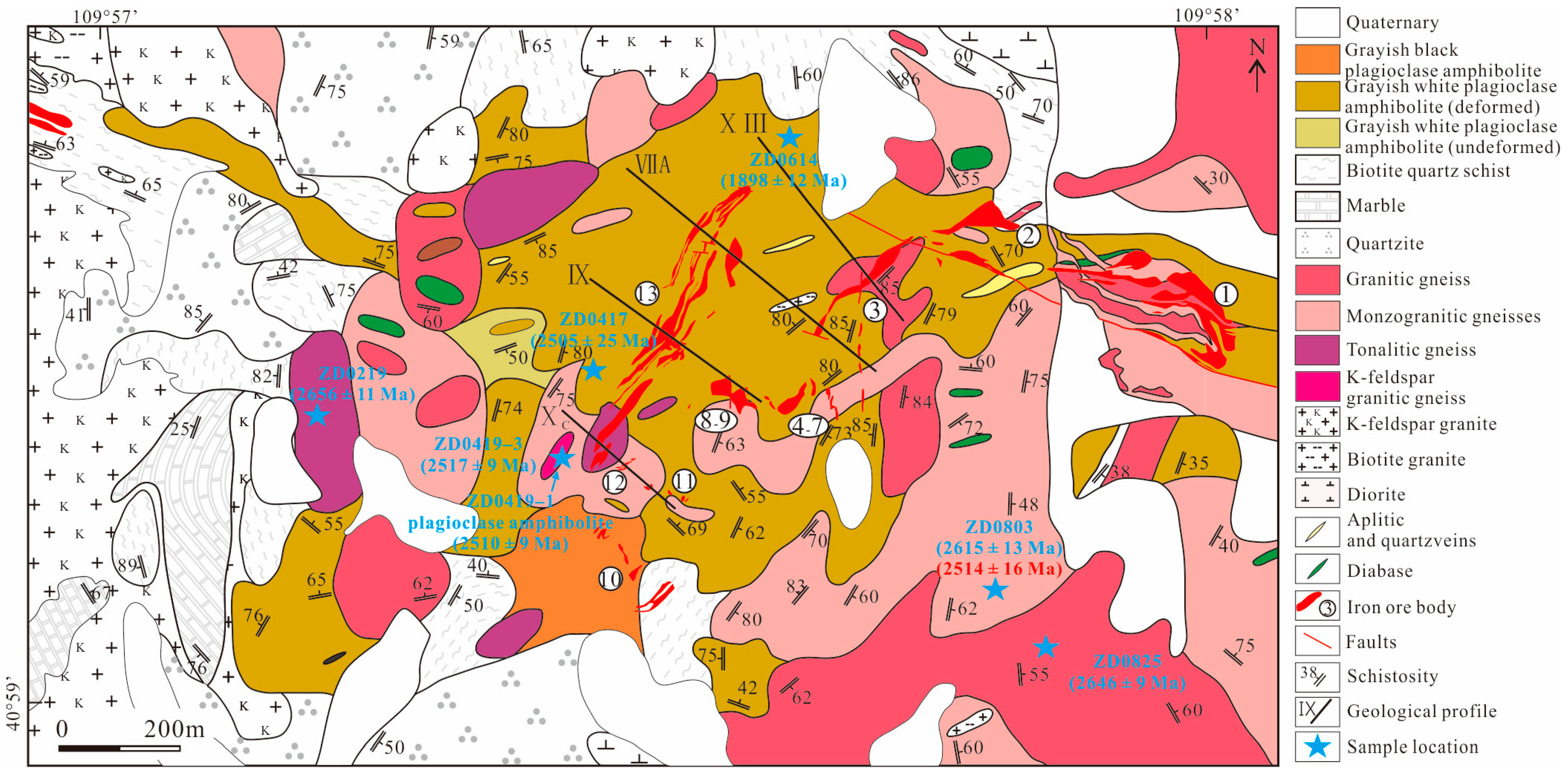
The rocks exposed in the Gongyiming BIF-type iron ore deposit include biotite quartz schist, plagioclase amphibolite, tonalitic gneiss, monzogranitic gneiss and granitic gneiss. Among them, plagioclase amphibolite is the main BIF-bearing rock. The magmatic rocks exposed in the ore district include diabase, gabbro, diorite, potassium feldspar granite, granite and aplite, among which the potassium feldspar granite exposed on the west side of the ore district is the most abundant (Figure 2).
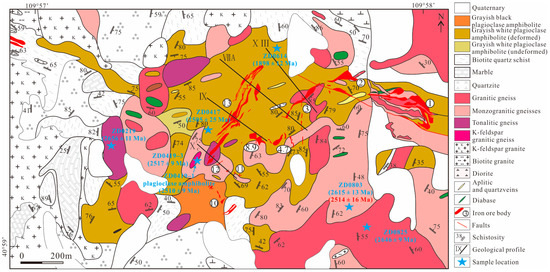
Figure 2.
Simplified geological map of the Gongyiming BIF-type iron ore deposit, Inner Mongolia.
There are a total of 13 ore bodies exposed in the ore district (Figure 2), among which the main ore bodies are No. 1, No. 3 and No. 13. At present, the No. 1 ore body has been exhausted. The No. 3 ore body is NE-trending, extending about 230 m and inclining northwest at an angle of 60–70°. The middle part of this orebody is about 20 m in thickness and gradually thins to the north and south sides at a thickness of about 3 m. By comparison, the No. 13 ore body is NE-trending, extending about 560 m, and has a complex inclination with variable inclination towards southeast or northwest at an angle of 60–75°. The No. 13 orebody can be divided into multiple ore layers with a thickness of about 55 m in the middle and gradually thinning to the north and south sides at a thickness of about 15 m. The total explored tonnage of iron resource of the Gongyiming BIF is almost 1800 Mt, with an average total iron content of 33 wt%. Moreover, due to its relative high silicon content (with an average SiO2 abundance of 47.5 wt%), which is used in the steel-making industry, the Gongyiming BIF is now a significant iron resource base of the Baotou Iron and Steel Group, Baotou, China.
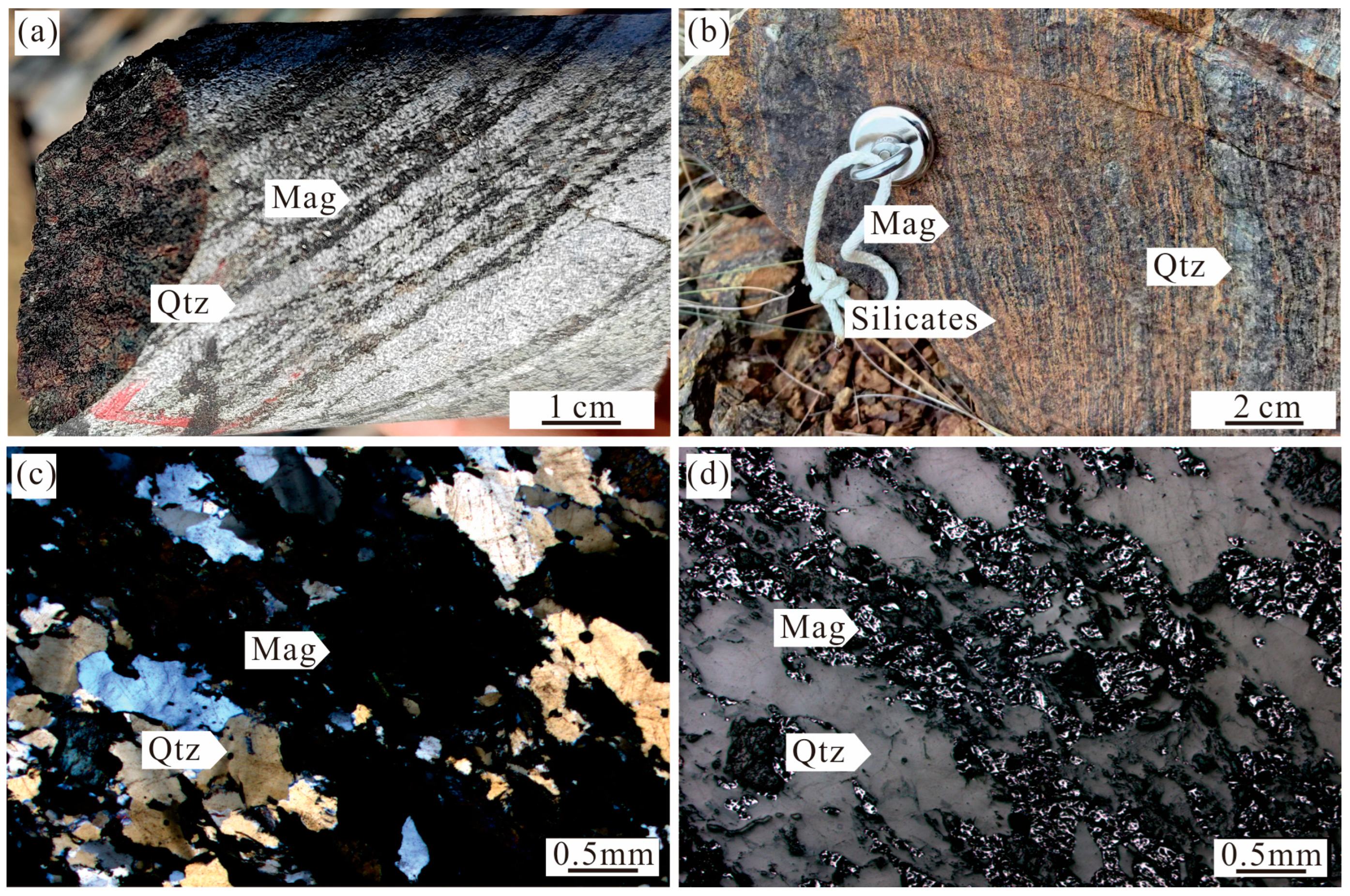
The main metallic minerals in the Gongyiming deposit include magnetite, hematite, pyrite and chalcopyrite. Non-metallic minerals include quartz, amphibole, biotite, garnet, carbonate minerals, chlorite, epidote and apatite. The ore has a granoblastic texture and inequigranular texture with banded structures. The bands consist of dark-colored bands composed of magnetite, amphibole, biotite, etc., and light-colored bands composed of quartz and minor magnetite and silicates (Figure 3). The dark- and light-colored bands were interbedded. The thickness of the bands is less than 2 cm, but varies greatly.
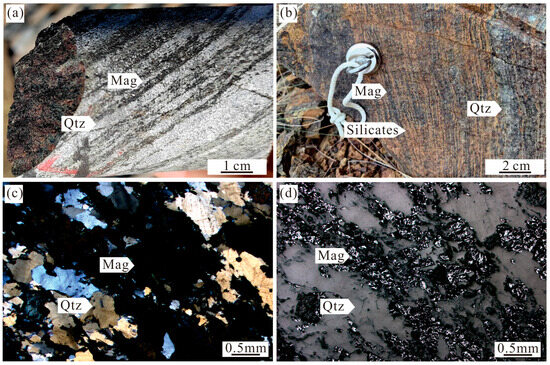
Figure 3.
Photos and microphotos showing the typical banded texture and dominant mineral composition of the Gongyiming BIF. (a) BIF sample from drill core showing alternating quartz- and magnetite-rich bands; (b) Field outcrop of BIF showing interlayered silica- and iron-rich bands; (c,d) Microscopical pictures showing oriented quartz and magnetite along the bands. Qtz—quartz, Mag—magnetite, (c)—transmission light, (d)—reflected light.
The scale of faults in the ore district is relatively small, but still cause significant dislocation of the ore bodies. The NE-trending faults are mainly located at edges of the No. 13 and No. 3 ore bodies, while the NW-trending faults are mainly located near the No. 1 and No. 2 ore bodies. Based on the occurrence of schistosity within the ore district, previous researchers suggested that the No. 13 and No. 3 ore bodies could be limbs of a large-scale syncline, and speculated that the No. 3 and No. 13 ore bodies were connected in the deep part [39].
3. Samples and Analytical Methods
3.1. Samples
3.1.1. Gneissic Rocks
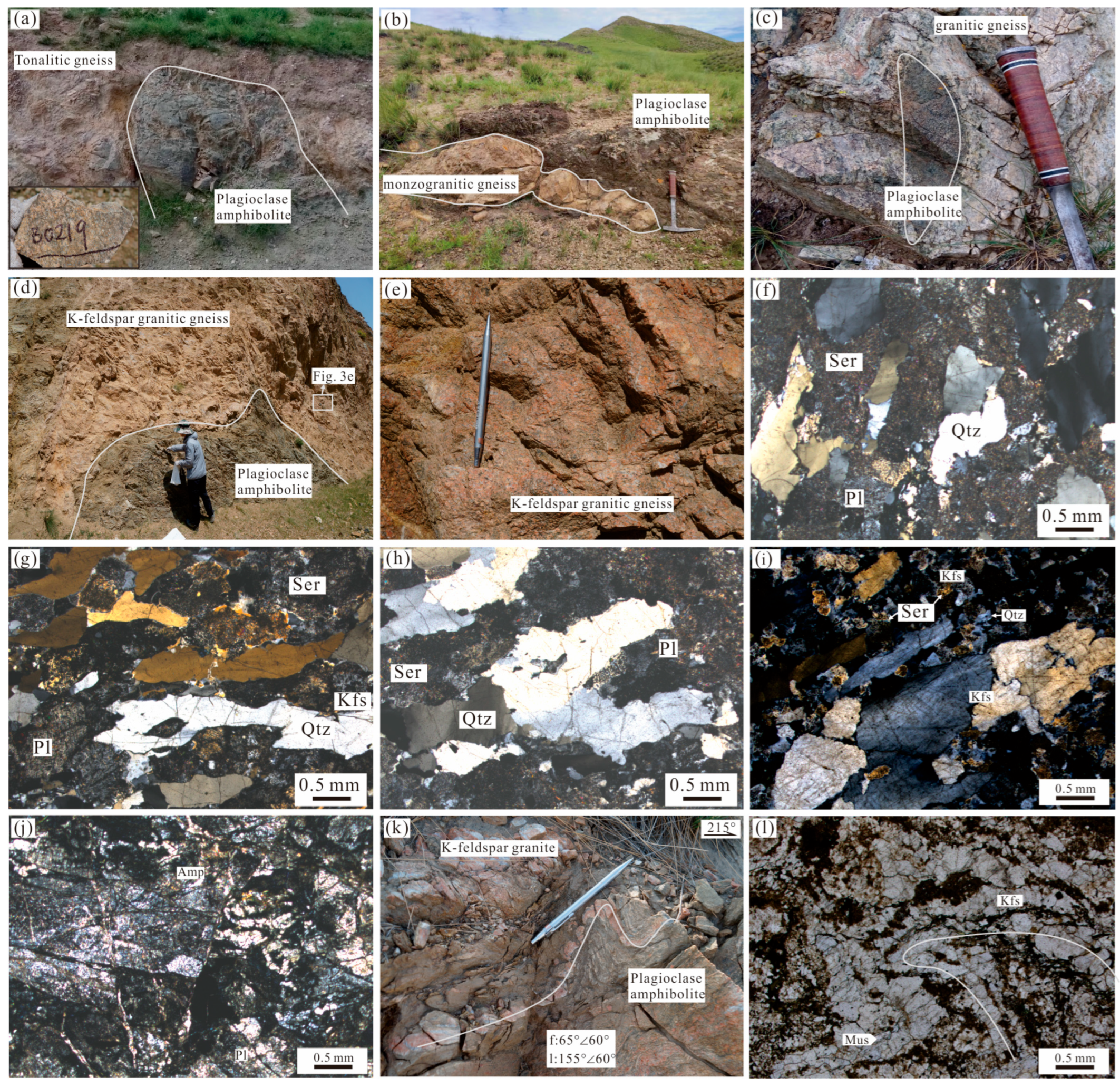
In order to provide a better constraint on the depositional age of Gongyiming BIF, various types of gneissic rocks that intruded into and/or enclosed the BIF-bearing plagioclase, including the tonalitic gneiss, granitic gneiss, monzogranitic gneiss and K-feldspar granitic gneisses (Figure 4a–e, Table 1), were collected from different locations of the mining area (see Figure 2 for all sample locations) for zircon U-Pb dating.
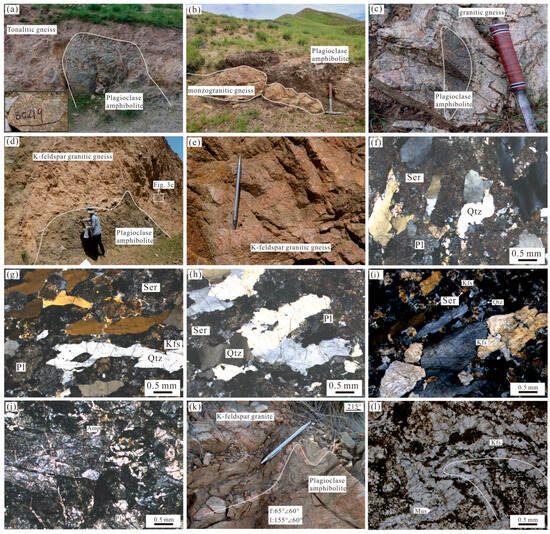
Figure 4.
Photos and micrographs showing the characteristics of various types of rock within the Gongyiming BIF. (a,f) Tonalitic gneiss (sample ZD0219), (b,g) monzogranitic gneiss (sample ZD0803), (c,h) granitic gneiss (sample ZD0825), (d) plagioclase amphibolite xenolith (ZD0419-1) in the potassium feldspar granitic gneiss (ZD0419-3), (e,i) potassium feldspar granitic gneiss, (j) plagioclase amphibolite, (k) synchronous deformation of potassium feldspar granite (ZD0614) and plagioclase amphibolite, and (l) microscopic features of syntectonic potassium feldspar granite. Qtz—quartz; Kfs—potassium feldspar; Pl—plagioclase; Amp—amphibolite; Ser—sericite; Mus—muscovite.

Table 1.
Lithology and mineralogy of various types of rocks from the Gongyiming BIF.
The tonalitic gneiss (sample ZD0219) exhibits a granoblastic texture and a gneissic structure. The presence of plagioclase amphibolite xenolith within this type of rock (Figure 4a) indicates it was formed later than the plagioclase amphibolite. The tonalitic gneiss is composed of plagioclase (40%~60%), quartz (20%~30%), biotite (10%~15%) and a minor amount of hornblende (Figure 4f). Among them, the plagioclase normally occurs as subhedral to anhedral grains, approximately 0.5–1.5 mm in size, and shows alterations such as sericitization and argillic alteration, which often obscure their primary polysynthetic twinning. By comparison, smaller quartz grains (about 0.2–1.0 mm) are anhedral in shapes and occur either as individual grains or as inclusions within the plagioclase. The quartz grains have been noticeably elongated and oriented during deformation, with their long axes aligned parallel to the gneissosity (Figure 4f). Both the hornblende and biotite are poorly euhedral, brown in color, and irregular in shape. They are developed within the interstices between plagioclase and quartz grains and also display a certain degree of preferred orientation.
The monzogranitic gneiss (sample ZD0803) normally displays a medium- to coarse-grained texture, and shows an intrusive relationship with the plagioclase amphibolite (Figure 4b). It is composed of plagioclase (30%~35%), K-feldspar (30%~35%), quartz (15%~25%), and minor biotite (1%–5%). Similar to the tonalitic gneiss, most of the minerals within the monzogranitic gneiss have undergone significant oriented elongation during deformation (e.g., quartz is stretched into ribbon-like bands), resulting in considerable variation in grain sizes (Figure 4g).
The granitic gneiss (sample ZD0825) also exhibits a medium- to coarse-grained granitic texture and a gneissic structure. Plagioclase amphibolite xenoliths of variable sizes are also observed within this type of rock (Figure 4c). The granitic gneiss comprises of quartz (40%~45%), plagioclase (30%~35%), K-feldspar (15%~20%), and lesser amount of biotite. Among these minerals, quartz mainly occurs as anhedral grains and shows undulatory extinction and abundant fractures (Figure 4h). Furthermore, most of the quartz grains are elongated and oriented, with their long axes parallel to the gneissosity. Significant alterations such as sericitization and chloritization are observed for the plagioclase and biotite, respectively.
The potassium feldspar granitic gneiss (sample ZD0419-3) has an intrusive relationship to the plagioclase amphibolite (Figure 4d). It exhibits a granitic texture and gneissic structure (Figure 4e) and is composed of potassium feldspar (40%–50%), plagioclase (20%–30%), and subordinate quartz (10%–15%) (Figure 4i). The potassium feldspar is granular in shape and displays distinct tartan twinning. Moreover, this mineral is weakly oriented and has undergone argillic alteration on its surface. By compression, quartz shows a wavy extinction characteristic and occurs in irregular shapes, while plagioclase is present in lesser amounts and has undergone intense sericitization.
3.1.2. Plagioclase Amphibolite and Granite
The plagioclase amphibolite is the main ore-bearing rock in the Gongyiming BIF. It is extensively exposed in the central part of the mining district and extends towards the northeast (Figure 2) and locally occurs as occurs as xenoliths within the gneissic rocks. Based on their field appearance, the plagioclase amphibolite in the study area can be further divided into three types: grayish-black massive amphibolite, grayish-white massive plagioclase amphibolite, and grayish-white banded plagioclase amphibolite.
For this study, a grayish-white massive plagioclase amphibolite xenolith (sample ZD0419-1) within the potassium feldspar granitic gneiss (sample ZD0419-3) and a grayish-white banded plagioclase amphibolite (sample ZD0417) close to the 8th-9th orebodies were selected for zircon U-Pb dating. Generally, the two types of amphibolite are distinguished by their massive or banded structures, while their dominant minerals are similar and mainly comprise of hornblende (45%~50%) and plagioclase (40%~45%), as well as minor biotite and quartz (Figure 4j). Both the plagioclase and hornblende have undergone intense sericitization and chloritization, respectively, leading to it being difficult to observe their original cleavage. In addition, there are abundant fractures within the above minerals, which are filled with micro veinlets of carbonate and other minerals (Figure 4j).
The potassium feldspar granite (sample ZD0614) used for zircon U-Pb dating was collected in the north part of the No. 13 orebody (Figure 2). Field observation shows that the K-feldspar granite intruded into the plagioclase amphibolite (Figure 4k) and both folded during the deformation. In intense deformed areas, the dip direction of the foliation and fold axial plane is 60° (Figure 4k); however, when it moves away from the deformation zone, the dip direction of the plagioclase amphibolite gradually changes to 120~150°. Given that all the K-feldspar granite have participated in the deformation, and that the deformation intensity is consistent, the K-feldspar granite is interpreted to the syntectonic vein. The potassium feldspar granite is mainly composed of potassium feldspar, quartz and a small amount of muscovite and clay minerals, among which the potassium feldspar is granular in shape with a particle size of 0.2–1.0 mm and a content of 70%~75% (Figure 4l). Locally, the feldspar becomes irregular in shape due to compression related to the regional deformation, and the particles are parallel to each other and form the gneissosity (Figure 4l). Both the muscovite and clay minerals (<5%) are small and difficult to identify, and are sandwiched between potassium feldspar and quartz particles.
3.2. Analytical Methods
Zircon grains were separated from the rocks in the Langfang Shangyi Rock and Mineral Testing Co., Ltd., Hebei Province, China. Unaltered samples were selected in the field. The samples were mechanically crushed using a steel crusher, and heavy minerals were sorted using heavy liquid and magnetic methods. Intact zircons of various shapes and colors were selected under binocular. The zircons were embedded in epoxy resin at Nanjing Hongchuang Geological Exploration Technology Service Co., Ltd., Nanjing, China. After polishing to expose the core of most zircons, cathodoluminescence (CL) images were then obtained to determine the internal structure of the zircons. Transmission and reflection images were also captured to identify inclusions and cracks.
Zircon U-Pb dating was completed at the Institute of Mineral Resources, Chinese Academy of Geological Sciences, using a laser ablation inductively coupled plasma mass spectrometer (LA-ICP-MS, Thermo Finnigan Neptune, Thermo Finnigan Corporation, San Jose, CA, USA) along with a Newwave UP213 laser ablation system. The laser beam has a diameter of 32 μm and a frequency of 10 Hz. Zircon standards including SRM610; two GJ-1 samples and one zircon Plesovice sample were tested every 10 sampling points. See [40] for detailed instrument parameters and operating procedures. Data for isotopic ratios, ages, and errors were processed offline using ICPMS Data Cal 10.1 software [41]. Zircons older than 1.0 Ga were analyzed using the 207Pb/206Pb. ISOPLOT (3.0 version) was used to calculate the weighted average value and draw concordance diagrams [42].
4. Results
4.1. Reworking Processes
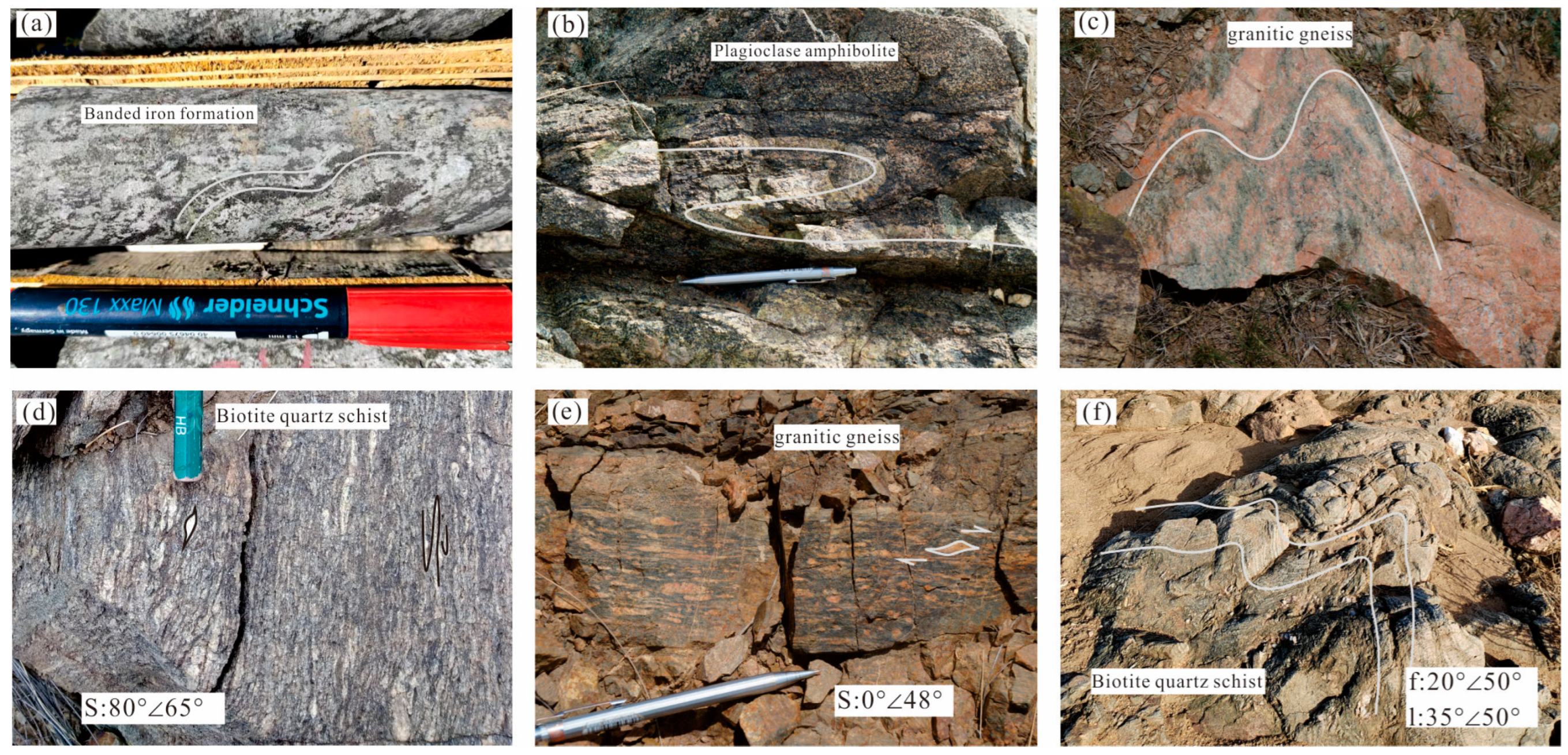
Most of the rocks in the Gongyiming BIF have undergone extensive deformation. Overall, their structures can be divided into the north-east and east-west directions (Figure 5). The general deformation characteristics of rocks are summarized as follows.
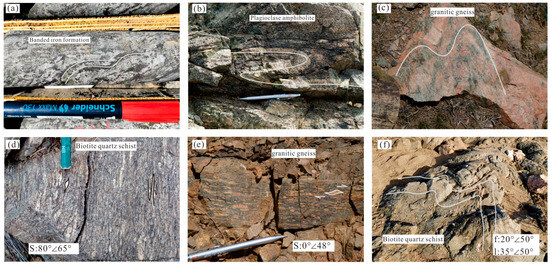
Figure 5.
Deformation characteristics of plagioclase amphibolite in the Gongyiming deposit. (a) Folded magnetite in the banded iron formation; (b) the thick-top fold in the plagioclase amphibolite; (c) similar folds developed inside K-feldspar granitic gneiss; (d) rotated porphyroclast and tight folds inside the biotite quartz schist; (e) the potassium feldspar rotated porphyroclast indicates dextral shear; (f) folds developed inside the biotite quartz schist. The solid black and white lines in figures a-c and f represent the deformed foliations.
The NE-trending structure is the most prevailing strike for rocks in the ore district. Both the ore body and surrounding rock extend in the NE direction, which is discordant with the regional east–west tectonic line in the Daqingshan area, indicate the presence of tectonic reworking within the ore district. Evidence from the field shows that the BIF in the drill hole has been significantly bent after formation, and the magnetite, as the deformation surface, underwent folding transformation (Figure 5a). As the main BIF-bearing rock, plagioclase amphibolite is widely distributed in the central part of the ore district, exhibiting a banded structure with a locally preserved massive structure. The aligned light-colored minerals such as feldspar and dark minerals such as amphibole form alternating bands within the rock. Locally, interlayer tight folds or rootless hooked folds can be seen within the bands and the bands are compressed into puddings. This evidence indicates that these bands underwent intense compression during their formation and were the product of structural transposition (Figure 5b).
Granite gneiss and monzogranitic gneiss are exposed in the central-eastern part of the ore district, occurring as large-scale independent plutons or intruding into plagioclase amphibolite. Their gneissosity is also NE-trending and shows banded structures characterized by alternating red (potassium feldspar) and white (quartz) or green (biotite) and white (quartz + plagioclase) bands. Granite gneiss and monzogranitic gneiss have also undergone deformation, with bands as deformation surfaces to form similar folds, while the width of the deformation surfaces remains consistent (Figure 5c). Biotite quartz schist is distributed in the northern part of the ore district. Biotite and quartz are arranged parallel to each other to form the foliation, and a large number of tight folds are developed inside (Figure 5d), reflecting intense compression. The rotated porphyroblasts indicate a shearing action during the compression (Figure 5d).
On the north and south sides of the ore district, the foliation extends along the EW direction (Figure 2), consistent with the regional tectonic line. Within the east–west tectonic zone, mylonitized granite gneiss is developed, in which potassium feldspar is sheared along the strike to form a large number of rotated porphyroclasts, reflecting the dextral shear along the EW direction (Figure 5e). On the southwest side of the ore district, biotite quartz schist is deformed to form a large number of interlayer folds, while the overall strike of the rocks is also close to EW, with a dip angle of 45–60° (Figure 5f). On the north side of the ore district, the No. 1 and No. 2 ore bodies are separated from No. 3 ore body by dextral strike slip faults, which indicates that a large-scale dextral strike slip process occurred in the Gongyiming deposit, resulting in an uncoordinated NE-trending structural line within the ore district.
4.2. Zircon U-Pb Ages
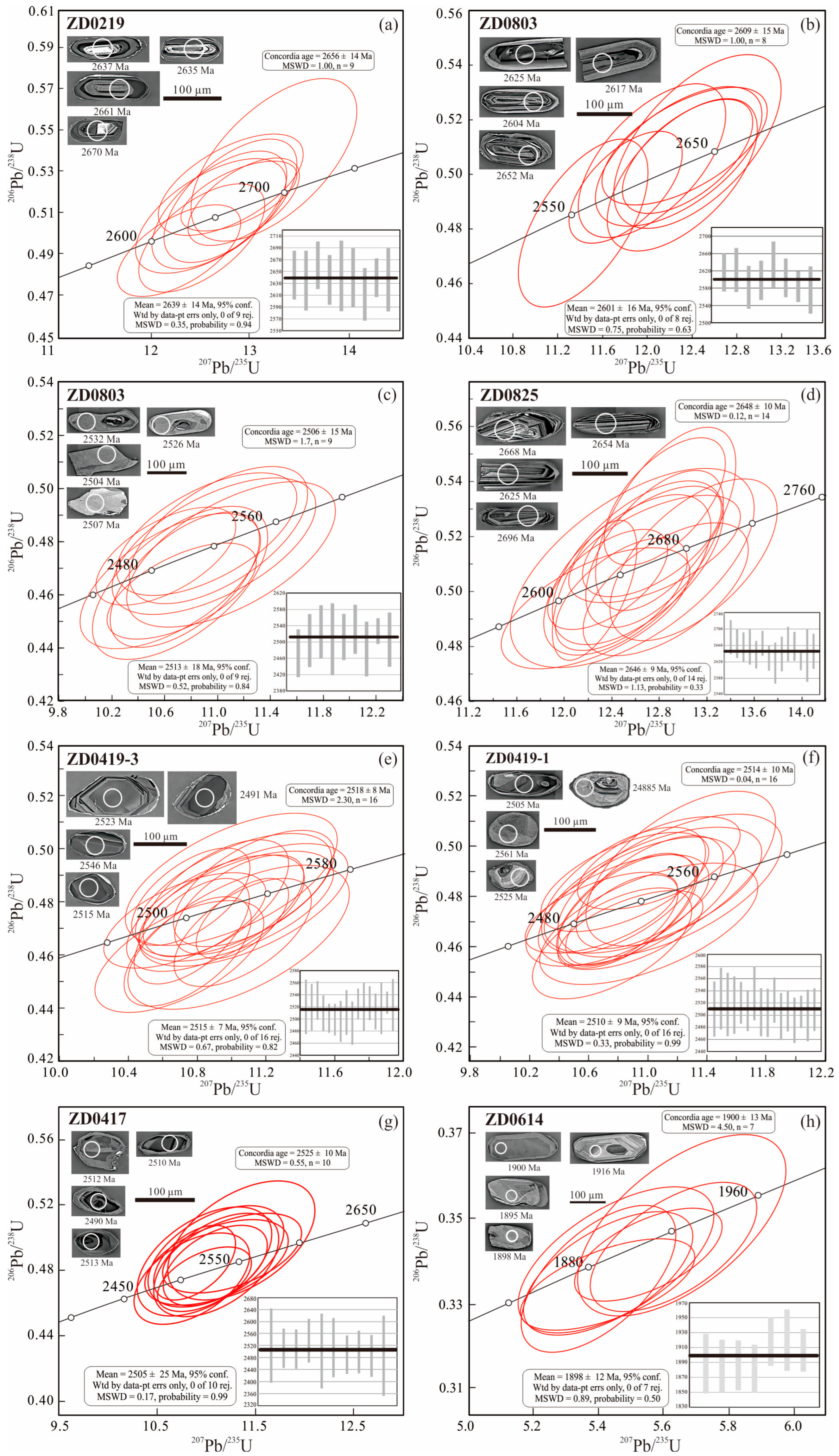
Zircon U-Pb dating results for all samples include the tonalitic gneiss, monzogranitic gneiss, granitic gneiss, potassium feldspar granitic gneiss, plagioclase amphibolite and potassium feldspar granite from the Gongyiming BIF are summarized in Table 2 and shown in Figure 6.
Table 2.
Zircon LA-ICP-MS U-Pb isotopic data of rocks in the Gongyiming BIF.
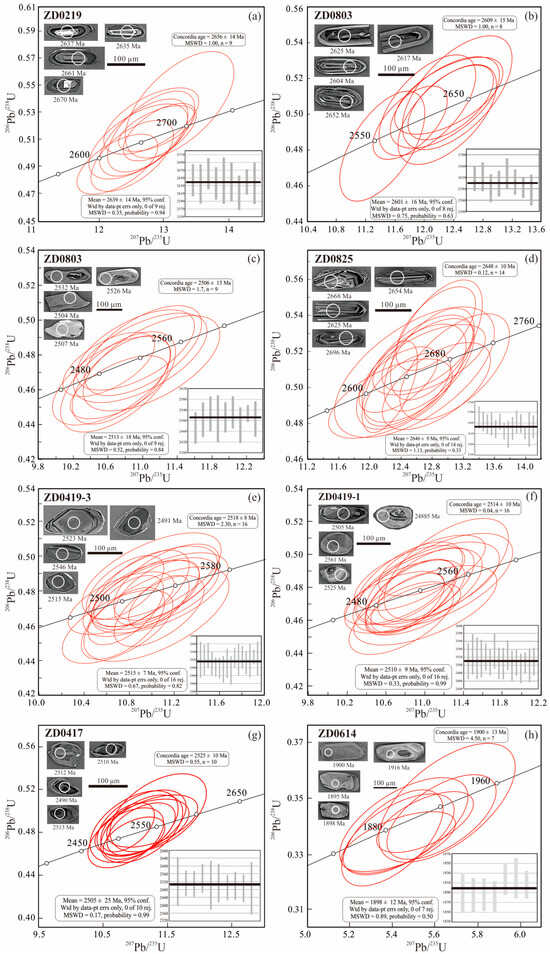
Figure 6.
Zircon U-Pb concordia diagrams of the tonalitic gneiss ((a), sample ZD0219), monzogranitic gneiss ((b,c), sample ZD0803), granitic gneiss ((d), sample ZD0825), potassium feldspar granitic gneiss ((e), sample ZD0419-3), plagioclase amphibolite xenolith ((f), sample ZD0419-1), banded plagioclase amphibolite ((g), sample ZD0417) and potassium feldspar granite ((h), sample ZD0614) from the Gongyiming BIF-type iron deposit.
4.2.1. Gneissic Rocks
Zircon grains separated from the gneissic rocks generally have elongated to prismatic shapes, with length and aspect ratios of 100~200 µm and 3:1~4:1, respectively (Figure 6a–e). In the cathodoluminescence (CL) images, apart from some of the metamorphic zircon of sample ZD0803 (monzogranitic gneiss) (Figure 6c), all of the zircon grains show clear oscillatory (Figure 6a,b,d) or slightly blurred zoning (Figure 6e), indicating an undisputed magmatic origin. In comparison, the metamorphic zircon grains of sample ZD0803 show patchy to homogenous internal structures (Figure 6c).
Nine analyses on magmatic zircon grains of sample ZD0219 (tonalitic gneiss) revealed relatively variable Th/U ratios of 0.12~0.68 and yielded a concordant age of 2656 ± 14 Ma (MSWD = 1.00). Furthermore, these analyses yielded a weighted mean 207Pb/206Pb age of 2639 ± 14 Ma (MSWD = 0.35), which is interpreted as the crystallization age of these zircon grains.
A total of 19 analyses were conducted on zircon extracted from sample ZD0803 (monzogranitic gneiss), among which the magmatic zircons have relatively constant Th/U ratios of 0.17~0.51, while the metamorphic zircons show highly variable Th/U ratios of 0.19~1.63. In addition, analyses on magmatic and metamorphic zircon grains yielded concordant ages of 2609 ± 15 Ma (MSWD = 1.00) and 2506 ± 15 Ma (MSWD = 1.70), respectively, as well as weighted mean ages of 2601 ± 16 Ma (MSWD = 0.75) and 2513 ± 18 Ma (MSWD = 0.52), respectively.
Fourteen analyses on magmatic zircon grains from sample ZD0825 (granitic gneiss) revealed Th/U ratios of 0.14~0.73 and yielded a concordant age of 2648 ± 10 Ma (MSWD = 0.12) and a weighted mean age of 2646 ± 9 Ma (MSWD = 1.13), respectively. These two ages are consistent within analytical error, and are interpreted as the formation age of granitic gneiss.
A total of sixteen analyses were performed on zircon grains separated from sample ZD0419-3 (potassium feldspar granitic gneiss). These analyses revealed relatively low Th/U ratios of 0.04~0.16, and yielded a concordant age of 2518 ± 8 Ma (MSWD = 2.30) as well as a weighted mean age of 2517 ± 9 Ma (MSWD = 0.67). We interpreted the later weighted mean age as the formation time of the potassium feldspar granitic gneiss.
4.2.2. Plagioclase Amphibolite and Granite
Zircon grains from the plagioclase amphibolite samples (ZD0419-1 and ZD0417) are mostly oval to stubby in shape with aspect ratios of 1:1–1.5:1 and show patchy to homogenous internal structures in CL images (Figure 6f,g) that are typical for zircons of metamorphic origin. In comparison, magmatic zircon grains extracted from the potassium feldspar granite (ZD0614) are prismatic or fragmented crystals with length/width ratios of 2:1~3:1 and show a blurred oscillatory or sector zone (Figure 6h).
Sixteen analyses on zircons from sample ZD0419-1 revealed moderate Th/U ratios of 0.25~0.53 and yielded a concordant age of 2514 ± 10 Ma (MSWD = 0.04), which is consistent with their weighted mean age of 2510 ± 9 Ma (MSWD = 0.33) (Figure 6f). Notably, this age approximates the timing of the widespread regional metamorphic event (2.52~2.48 Ga) documented for the NCC [3,4,6].
A total of ten analyses on zircon grains from sample ZD0417 also yielded moderate Th/U ratios of 0.13~0.50, as well as a concordant age of 2525 ± 10 Ma (MSWD = 0.55) and a weighted mean age of 2505 ± 25 Ma (MSWD = 0.17) (Figure 6g).
Seven zircon grains from sample ZD0614 were selected for U-Pb dating. As shown in Figure 6h, all analyses plot on a well-defined concordant line with a concordia age of 1900 ± 13 Ma (MSWD = 4.50). Moreover, these analyses have Th/U ratios ranging from 0.18 to 0.66, and 207Pb/206Pb ages vary between 1879 Ma and 1934 Ma, with a weighted average of 1898 ± 12 Ma (MSWD = 0.89) (Figure 6h).
5. Discussion
5.1. Depositional Age of the Gongyiming BIF
Based on zircon U-Pb dating of volcanic interlayers of BIFs or intrusions that intruded into the BIF-bearing sequences, depositional ages of most BIFs within the NCC have been constrained to the late Neoarchean (2.6–2.5 Ga, refs. [22,23]). This age is slightly younger than the early Neoarchean peak period (~2.7 Ga) for the deposition of BIFs worldwide [11], but corresponding approximately to time for the cratonization of the NCC (~2.5 Ga, refs. [4,5]). Given that extensive magmatic events are likely to contribute to the formation of seafloor hydrothermal vents, which are believed to be the dominant source of iron for Precambrian BIFs [11,12], the temporal coherence between the NCC cratonization and the deposition of these BIFs seems quite reasonable [6].
For the Gongyiming BIF of the GGB, previous study has dated the formation ages of the BIF-associated amphibolite and the tonalite that intruded into the BIF-bearing sequence to 2569 ± 78 Ma and 2555 ± 56 Ma, respectively [38]. Thus, in combination with the published depositional age of 2562 ± 14 Ma for the Sanheming BIF of GGB [43], Liu [38] concluded that the formation age of BIFs in the GGB was ca. 2.57–2.56 Ga. As mentioned before, this age seems synchronous with the formation ages of most BIFs [22,23] from the NCC but is older than the age documented for amphibolite from the footwall of Dongwufenzi BIF of the GGB (2538 ± 9 Ma, ref. [44]). Moreover, Liu [38] also argued that the reason why the formation age of these BIFs is slightly older than those for the meta-dacite, andesite and quartzite from the GGB (2.53–2.50 Ga, refs. [36,45,46]) is because the mafic volcanics and BIFs occur at horizons lower than the intermediate-acidic volcanic rocks and sedimentary rocks. Nevertheless, the above conclusion of a late Neoarchean depositional age for the Gongyiming BIF is poorly supported by a relatively large dating error of 60–80 Ma. Furthermore, it is also noticed that zircons extracted from the amphibolite (see Figure 6 of [38]) lack typical oscillatory zoning indicative of magmatic origin, and that only one of twenty analyses for the amphibolite has a 207Pb/206Pb age older than 2.50 Ga (see Table 1 of [38]). Thus, we argue that the previous age data need to be treated cautiously.
In this study, we conducted systematic zircon U-Pb dating on different types of intrusions exposed in the Gongyiming iron deposit, including tonalitic gneiss (ZD0219), monzogranitic gneiss (ZD0803), granitic gneiss (ZD0825) and potassic granite (ZD0419-3). The clear field occurrences for these rocks are shown in Figure 4, which reveal an undisputed intrusive and/or xenolith–host rock relationship between these intrusions and the BIF-bearing plagioclase amphibolite. Among them, the tonalitic gneiss (ZD0219), monzogranitic gneiss (ZD0803) and granitic gneiss (ZD0825) that intruded into the BIF-bearing rocks have emplacement ages of 2639 ± 14 Ma, 2601 ± 16 Ma and 2646 ± 9 Ma, accordingly. In comparison, the potassium feldspar granitic gneiss (ZD0419-3) that also has the plagioclase amphibolite as xenolith possesses a crystallization age of 2515 ± 7 Ma. Given the above constraints, it is clear that the formation age of the BIF-bearing plagioclase amphibolite should be older than ~2.66 Ga.
Furthermore, we also obtained three metamorphic ages of 2513 ± 18 Ma, 2510 ± 9 Ma and 2505 ± 25 Ma for the monzogranitic gneiss (ZD0803) and two plagioclase amphibolite samples (i.e., the xenolith ZD0419-1 and the BIF-bearing sample ZD0417), accordingly. The above metamorphic ages are consistent within analytical error and are in line with the crystallization age of the potassium feldspar granitic gneiss, indicating that the regional metamorphism might be related to the emplacement of this type of granite.
Collectively, we suggest that the Gongyiming BIF was deposited prior to 2.66 Ga; however, due to the absence of dateable rocks, we are unable to constrain the lower depositional limit of this BIF. Considering that Archean greenstone belts are always spatially associated with TTG gneisses (tonalitic and granitic gneisses for the Gongyiming case) and that the former should be slightly older in age [7], we tentatively posit an early Neoarchean depositional age for the Gongyiming BIF. This formation age is similar to those documented for BIFs in Ontario and Nunavut in Canada, and for BIFs in Southern Zimbabwe, Karnataka Province, southern India, and Para’ State, Brazil [11], corresponding to the ~2.7 Ga depositional age peak for BIFs worldwide [12].
5.2. Tectonic Model and Tectonic Reworking
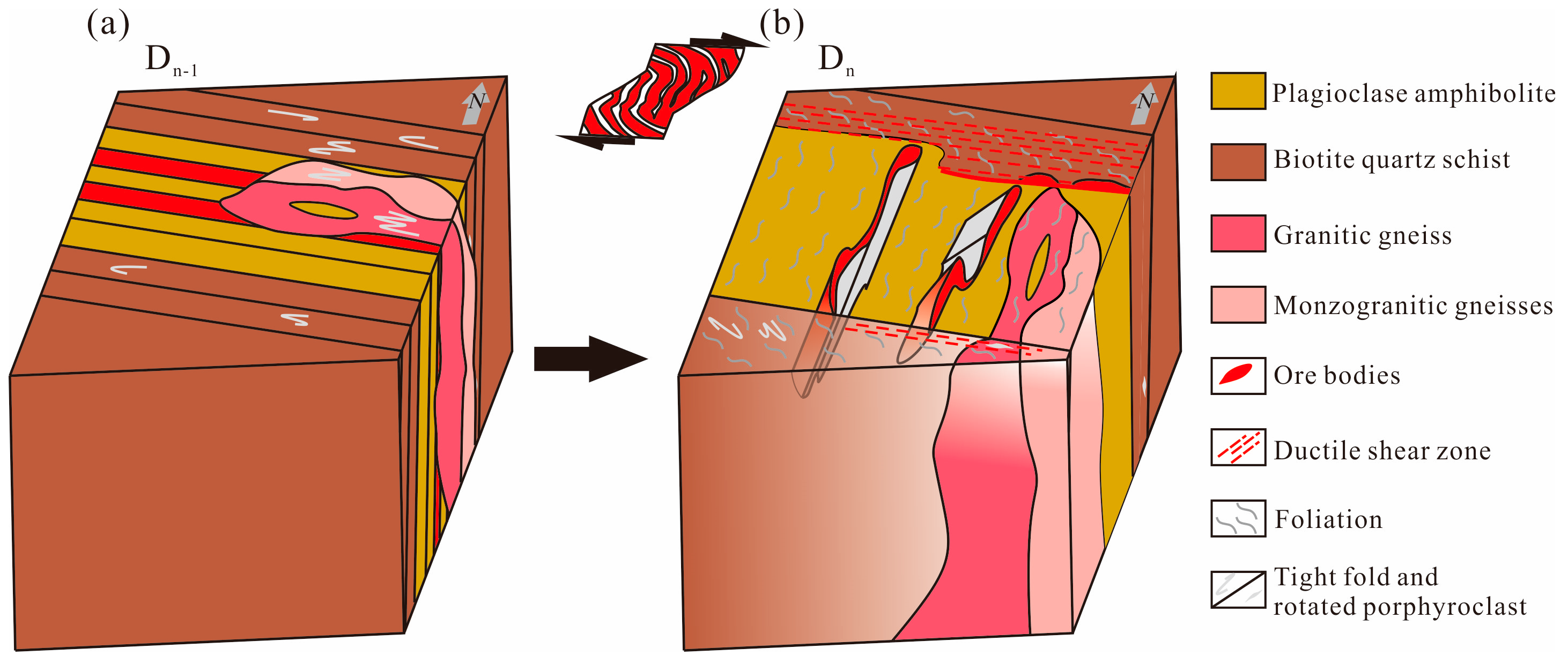
Based on the geological description and chronological data mentioned above, it is suggested that the ore district has undergone at least two periods of tectonic activities. The strata have been transformed by folding and shearing, forming its current pattern. According to the contact relationship between various rocks in the field, it can be roughly inferred that basic volcanic rocks (i.e., protolith of plagioclase amphibolite) and clastic sedimentary rocks or volcanic clastic rocks (protolith of biotite quartz schist) were developed in the study area before deformation, and that the BIF type iron ore was also formed at this stage. Subsequently, potassium feldspar granite (protolith of potassium feldspar granitic gneiss) and monzogranite (protolith of monzogranitic gneiss) intruded into and partially captured the surrounding rock.
Regarding Dn-1, N-S direction compression, along with the collision between Yinshan and Erdos blocks [28,29], the study area has developed intense regional deformation and metamorphism, causing rocks to be metamorphosed and develop obvious gneissosity. During this process, biotite quartz schist, banded plagioclase amphibolite, granitic gneiss, and monzogranitic gneiss still retain early foliation/bedding that has not been completely replaced, forming tight folds or rootless hooked folds. The potassium feldspar granite that intrudes along the foliations undergoes synchronous deformation with the surrounding rock and also forms tight folds. During the compression, thrusting along the inclination also occurred, resulting in the formation of rotated porphyroclasts in biotite quartz schist (Figure 5d).
Regarding Dn, dextral shearing, in the late stage of compression, strike slip action develops along the collision belt, and a large number of ductile shear zones occur in the rocks (Figure 5). Near the ore district, there are many rotated porphyroclasts formed by potassium feldspar of granitic gneiss, indicating a dextral shearing direction along the E-W direction. On the north side of the ore district, large faults developed with a nearly E-W direction. Referring to the ore body as a marker, it can be inferred that the shearing action roughly shifted the No. 1 and No. 2 ore bodies to the right by about 200 m. During this period, the strike slip action also led to a significant deviation between the NE-trending strike (inside the Gongyiming ore district) and the nearly EW-trending strike in the region. As it moves away from the ore district, the structural line becomes consistent with the EW-trending structure of the Yinshan area. For example, in the biotite quartz schist on the southwest side of the ore district, the fold axial plane and structural line are both oriented in a nearly E-W direction (Figure 5f).
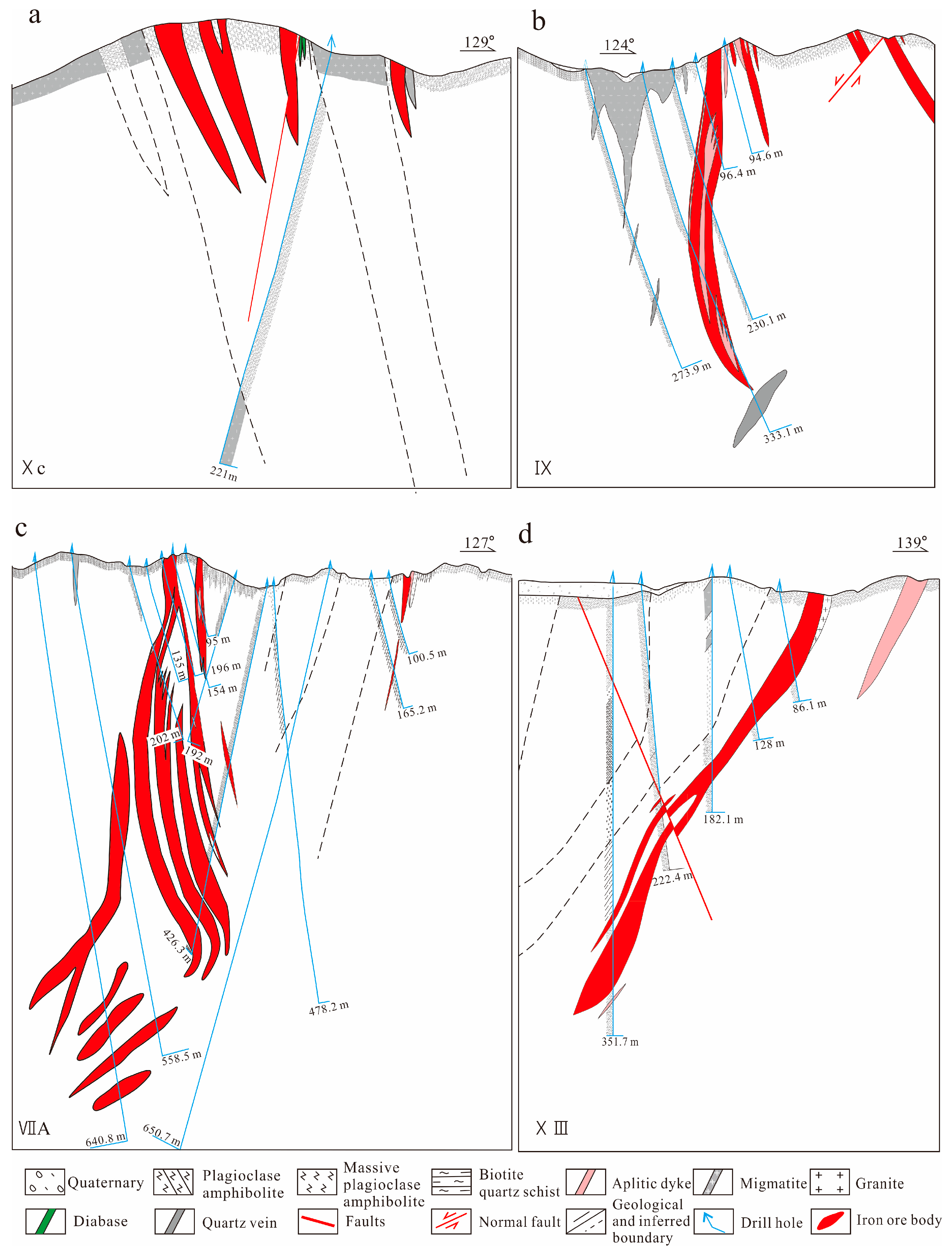
The ore body revealed by drilling can serve as a good indicator layer in the process of structural research (Figure 7). The geological profile of the exploration line in the ore district shows that the occurrence of the No. 13 ore body is relatively complex, with a wavy shape along the dip direction (Figure 7). The ore body on the south side dips to the southeast, while the middle and northern ore bodies dip northwest in the shallow part with a steep dip angle and dip southeast in the deep part, while the No. 3 ore body shows a northwest inclination from top to bottom. Therefore, it is unreasonable for previous researchers to simply associate the No. 13 and No. 3 ore bodies with synclines based on the occurrence relationship on the surface [39]. A drilling project was carried out in the core according to the “syncline” pattern, but no ore body was found in the deep part, which also confirms the above speculation.
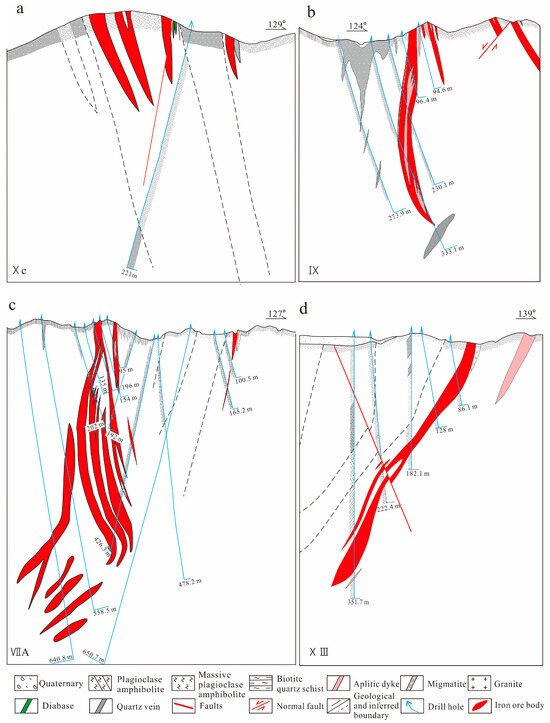
Figure 7.
Geological profile of the Gongyiming deposit (specific locations of each section are shown in Figure 2). (a) The profile for Xc exploration line; (b) The profile for IX exploration line; (c) The profile for VII exploration line; (d) The profile for XIII exploration line.
Based on the verification of existing ore bodies through drilling and the deformation characteristics of rocks in the field, we believe that the No. 13 and No. 3 ore bodies are two independent ore bodies (Figure 8). The No. 13 ore body has a relatively steep dip and its inclination alternates between northwest and southeast, forming a wavy shape. In some areas, the ore body is pulled apart at the folded wings, forming independent lenses. Therefore, our model suggests that the No. 13 ore body has a steep northwest inclination overall, but exhibits a wavy shape, making it more promising for mineral exploration.
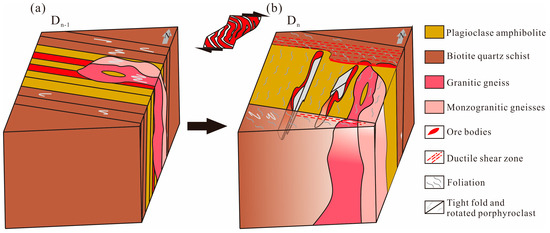
Figure 8.
Tectonic model of the Gongyiming deposit. (a) The distribution of orebody during Dn-1 stage; (b) The distribution of orebody during Dn stage.
5.3. Implications for BIF Preservation During Tectonic Evolution Processes
5.3.1. BIF Formed in the Early Neoarchean and Its Significance
As mentioned before, the ca. 2.7 Ga extensively developed tectono-thermal event has led to the rapid formation of continental crust within a short period worldwide (e.g., refs. [47,48]). Although the NCC is characteristic for its ~2.5 Ga tectono-thermal event [4,5,6,32], a major phase of continental growth for the NCC at ca. 2.7 Ga (e.g., refs. [3,49,50]) correlates with the global growth of the Earth’s crust recognized from other regions. This earlier continental growth event in the NCC is supported by the widely distributed detrital zircons of 2.7 Ga in age [32,51,52,53,54] and the fact that many ~2.5 Ga rocks underwent intracrustal recycling or were assimilated by crustal materials with whole-rock neodymium and zircon hafnium isotopic depleted mantle model ages of 2.9~2.7 Ga [50,55,56]. Furthermore, the Western Shandong region is one of the few areas where early Neoarchean supracrustal rocks have been recognized [9], while in other regions of the NCC supracrustal rocks that are contemporaneous to the late Mesoarchean to early Neoarchean, TTG rocks are relatively rare. The supracrustal rocks in the Western Shandong region can be subdivided into the early Neoarchean (2.75~2.70 Ga) Yanlingguan-Liuhang rock series and the late Neoarchean (2.55–2.51 Ga) Shancaoyu-Jining rock series [9]. The identification of these early Neoarchean supracrustal rocks also supports the above view that ca. 2.7 Ga is a major phase of continental growth in the NCC.
As a significant component of Earth’s early continental crust, the deposition of BIFs has been proved to be genetically related to the 2.7 Ga tectono-thermal event worldwide, because those extensional tectonic processes during this event are believed to have contributed the development of extensive submarine hydrothermal vents that supplied iron to the anoxic ocean [11,12,57]. Nevertheless, in contrast to the global ca. 2.7 Ga peak period for BIF formation, there is a lack of robust evidence for the presence of early Neoarchean BIFs in the NCC [23]. Recently, a 2.73 Ga zircon U-Pb formation age was reported for the BIF-bearing metamorphosed felsic volcanic rock from the Laizhou-Changyi area of the Jiaobei terrane, Shandong Province [58], indicating the existence of early Neoarchean BIF in the NCC. Thus, in combination with the present geochronological study on Gongyiming BIF, we propose that consistent with other global cratons where the peak period of BIF deposition and mineralization was ~2.7 Ga, the NCC also developed early Neoarchean BIFs.
It is noteworthy that more and more TTG gneisses of late Mesoarchean to early Neoarchean in age have been widely identified in the NCC, among which early Neoarchean (2.75~2.70 Ga) TTG gneisses has been reported ten different areas including Liaonan, Jiaodong, Changyi, Luxi, Huoqiu, Hengshan, Fuping, Zanhuang, Zhongtiao and Wuchuan [56]. Considering that supracrustal sequences commonly formed earlier than, or contemporaneously with, intrusive rocks of TTG series, it is expected that BIFs commonly preserved within Archean supracrustal rocks should exist. However, the current scale of early Neoarchean BIFs in the NCC is significantly smaller than that in other cratons worldwide, even if we take the Gongyiming BIF into consideration. This discrepancy could be attributed to the extensive late Neoarchean tectono-thermal event in the NCC [4,5,6,32], which likely destroyed the original greenstone belt terranes hosting BIFs. Nevertheless, the determination of the depositional age for the Gongyiming BIF-type iron deposit not only fills the gap of lacking early Neoarchean BIF records in the GGB but also holds significant geological implications for understanding the early crustal evolution of the NCC. We have reason to believe that with ongoing research, more BIFs that formed during the late Mesoarchean to early Neoarchean will be discovered in the NCC. This will further refine the model of “multi-stage early continental crust growth and BIF mineralization in the NCC” proposed by previous researchers [6].
5.3.2. Overprinting of the Late Neoarchean and Late Paleoproterozoic Tectono-Thermal Events
Previous studies have shown that at the end of the Neoarchean (2.55–2.50 Ga), with multiple ancient micro blocks existing in the ocean, the NCC was formed through archipelagic arc tectonic environment. Subsequently, different blocks began to merge with each other with subduction and collision [4]. The assembly of micro-continents suggests a shift from early vertical structures to horizontal–vertical structures at the end of the Neoarchean, characterized by small-scale subduction and arc–continent and continent–continent collision [59]. This process also led to the development of Neoarchean magmatism in the northern margin of the NCC, with the formation of large-scale crustal granite, namely potassium-rich granite, marking the initial cratonization of the NCC [59,60]. In this study, the monzogranitic gneiss, plagioclase amphibolite and potassium feldspar granite veins exposed in the Gongyiming ore district were selected for dating, and the ages of the late Neoarchean (~2.5 Ga) and late Paleoproterozoic (~1.8 Ga) were obtained. Research has shown that the most important Archean tectono-thermal event within the region occurred in the late Neoarchean (~2.5 Ga), and all Archean rock were affected by this tectono-thermal event, including Yinshan and Daqingshan [60,61,62]. The Gongyiming ore district is located within the Yinshan block. The evidences from sedimentation, magmatism, and other aspects show that the final time for the cratonization of the NCC was around 2.45 Ga [62,63]. Based on the above discussion, it is believed that the age of the late Neoarchean (~2.5 Ga) recorded in the rocks of the Gongyiming iron ore deposit reflects the tectono-thermal events, which leads to intense metamorphism and foliation of the rocks.
After the final formation of the NCC, a series of rift basins developed during 2.3–2.0 Ga and gradually evolved into small ocean basins [64]. Subsequently, the closure of the ocean basin triggered subduction, accretion, and collision, resulting in the formation of multiple active zones in the late Paleoproterozoic (~2.0–1.8 Ga), a process known as the “Lüliang Movement” [65]. These late Proterozoic tectono-thermal events are widely present in the NCC [62], which not only caused significant high-temperature and high-pressure metamorphism [66] but also resulted in intense deformation of potassium-rich granites formed in the late Neoarchean [60]. Unlike the tectonic movements of the Archean, the tectonic system of the Proterozoic showed lateral movements, even though their scale was relatively small compared to the Phanerozoic [64]. As reported by Fu [67], rocks in the potassium-rich granite belt in the northern part of the NCC underwent dextral strike slip at around 1.8 Ga. During this process, the development of the dextral shearing in the Gongyiming ore district resulted in a series of rotated porphyroclasts in the rocks and changed the direction of the structural lines within the ore district.
6. Conclusions
In this study, zircon U-Pb isotope dating and deformation characteristics of various types of rocks within the Gongyiming BIF-type iron deposit in Inner Mongolia were investigated. Our findings support the possible existence of early Neoarchean BIF in the NCC, challenging the previous view that most Algoma-type BIFs in the NCC were deposited in the late Neoarchean. The following conclusions were drawn regarding the formation and evolutionary history of the deposit:
- (1)
- This study revealed that the Gongyiming BIF was deposited before 2.66 Ga, filling the early Neoarchean age gap in BIF records in the Western Block of the NCC.
- (2)
- The Gongyiming deposit was affected by two tectono-thermal events that occurred in the late Neoarchean (~2.5 Ga) and late Paleoproterozoic (~1.8 Ga), respectively.
- (3)
- Based on the structural analysis in the ore district, it is thought that ore bodies have been significantly affected by tectonic activity. A structural, ore-controlling model has been established, indicating that the ore bodies extend along a monocline rather than following a syncline.
Author Contributions
Conceptualization Z.P. and D.W.; Methodology D.W., Z.P., Y.L. and C.K.; Investigation Z.P., D.W., P.Q., F.G., Y.M., H.W., Z.G., Y.L., C.K. and H.S.; Data curation D.W.; Writing—original draft D.W. and Z.P.; Writing—review and editing Z.P., D.W., Y.L., C.K., R.L., J.W., P.Q., F.G., Y.M., H.W. and Z.G.; Funding acquisition Z.P. and P.Q. All authors have read and agreed to the published version of the manuscript.
Funding
This research was funded by the Science and Technology Achievements Transformation Projects (HE2503) and the National Natural Science Foundation of China (42272082 and 42572080).
Data Availability Statement
The original contributions presented in this study are included in the article. Further inquiries can be directed to the corresponding authors.
Acknowledgments
We are very grateful to the Editor for their hard work and efficient editorial handling. We gratefully acknowledge three anonymous reviewers for their suggestions. The thorough constructive criticism and comments of the anonymous reviewers significantly improved this manuscript. We appreciate the field assistance provided by Shengquan Zhou and Yang Hu during this study.
Conflicts of Interest
Authors Pengyuan Qin, Fei Geng, Yongyue Ma, Hong Wang, Zhengxiang Gao were employed by the Baotou Iron and Steel Group Guyang Mining Co., Ltd. The remaining authors declare that the research was conducted in the absence of any commercial or financial relationships that could be construed as a potential conflict of interest.
References
- Liu, D.Y.; Nutman, A.P.; Compston, W.; Wu, J.S.; Shen, Q.H. Remnants of ≥3800 Ma crust in the Chinese part of the Sino-Korean Craton. Geology 1992, 20, 339–342. [Google Scholar] [CrossRef]
- Song, B.; Nutman, A.P.; Liu, D.Y.; Wu, J.S. 3800 to 2500 Ma crustal evolution in the Anshan area of Liaoning Province, northeastern China. Precambrian Res. 1996, 78, 79–94. [Google Scholar] [CrossRef]
- Wan, Y.S.; Liu, D.Y.; Dong, C.Y.; Xie, H.Q.; Kröner, A.; Ma, M.Z.; Liu, S.J.; Xie, S.W.; Ren, P. Formation and evolution of Archean continental crust of the North China Craton. In Precambrian Geology of China; Springer Geology; Springer: Berlin/Heidelberg, Germany, 2015; pp. 59–136. [Google Scholar]
- Zhai, M.G. Tectonic evolution and metallogenesis of North China Craton. Miner. Depos. 2010, 39, 24–36, (In Chinese with English abstract). [Google Scholar]
- Zhai, M.G.; Santosh, M. The early Precambrian odyssey of North China Craton: A synoptic overview. Gondwana Res. 2011, 20, 6–25. [Google Scholar] [CrossRef]
- Zhai, M.G.; Zhu, X.Y. Corresponding Main metallogenic epochs to key geological events in the North China Craton: An example for secular changes in the evolving earth. In Main Tectonic Events and Metallogeny of the North China Craton; Zhai, M., Zhao, Y., Zhao, T., Eds.; Springer Geology; Springer: Singapore, 2016; pp. 1–26. [Google Scholar]
- Anhaeusser, C.R. Archaean greenstone belts and associated granitic rocks-A review. J. Afr. Earth Sci. 2014, 100, 684–732. [Google Scholar] [CrossRef]
- Windley, B.F. The Evolving Continents; Wiley: New York, NY, USA, 1995; 544p. [Google Scholar]
- Wan, Y.S.; Liu, D.Y.; Nutman, A.; Zhou, H.Y.; Dong, C.Y.; Yin, X.Y.; Ma, M.Z. Multiple 3.8–3.1 Ga tectono-magmatic events in a newly discovered area of ancient rocks (the Shengousi Complex), Anshan, North China Craton. J. Asian Earth Sci. 2012, 54–55, 18–30. [Google Scholar] [CrossRef]
- James, H.L. Sedimentary facies of iron-formation. Econ. Geol. 1954, 49, 235–293. [Google Scholar] [CrossRef]
- Bekker, A.; Slack, J.F.; Planavsky, N.J.; Krapež, B.; Hofmann, A.; Konhauser, K.O.; Rouxel, O.J. Iron formation: The sedimentary product of a complex interplay among mantle, tectonic, oceanic, and biospheric processes. Econ. Geol. 2010, 105, 467–508. [Google Scholar] [CrossRef]
- Konhauser, K.O.; Planavsky, N.J.; Hardisty, D.S.; Robbins, L.J.; Warchola, T.J.; Haugaard, R.; Lalonde, S.V.; Partin, C.A.; Oonk, P.B.H.; Tsikos, H.; et al. Iron formations: A global record of Neoarchean to Paleoproterozoic environmental history. Earth Sci. Rev. 2017, 172, 140–177. [Google Scholar] [CrossRef]
- Lantink, M.L.; Davies, J.H.F.L.; Mason, P.R.D.; Schaltegger, U.; Hilgen, F.J. Climate control on banded iron formations linked to orbital eccentricity. Nat. Geosci. 2019, 12, 369–374. [Google Scholar] [CrossRef]
- Zhang, Z.C.; Li, H.M.; Li, J.W.; Song, X.Y.; Hu, H.; Li, L.X.; Chai, F.M.; Hou, T.; Xu, D.R. Geological settings and metallogenesis of high-grade iron deposits in China. Sci. China Earth Sci. 2021, 64, 691–715. [Google Scholar] [CrossRef]
- Tang, R.Z.; Chen, X.K.; Cao, J.S.; Chen, Y.J. Depositional Environment and Biological Activity Implications of the Jining BIF, Western Shandong Province, China: Evidence from Elements and C-O Isotopic Compositions. Minerals 2025, 15, 1298. [Google Scholar] [CrossRef]
- Shan, E.H.; Xiao, Y.L.; Wang, Y.Y.; Tan, D.B.; Sun, H. Lithium isotopic compositions of the Neoarchean Huoqiu BIF and the Paleoproterozoic Yuanjiacun BIF from North China Craton: Implications for the triggering mechanism of the Great Oxidation Event. Precambrian Res. 2024, 411, 107527. [Google Scholar] [CrossRef]
- Chen, Y.R.; Li, X.P.; Li, Z.S.; Li, D.P.; Kong, F.M.; Schertl, H.P.; Chen, Y.J. Geochemistry and P-T-t evolution of Paleoproterozoic metapelites of the Zhengjiapo BIF-type iron mine, Jiaobei terrane, North China Craton. Precambrian Res. 2024, 403, 107305. [Google Scholar] [CrossRef]
- Sun, J.L.; Qian, Y.; Li, Y.J.; Zhang, P.; Qiao, J.F.; Shen, Y.J.; Sun, F.Y. Age and geochemistry of the Naxiguole banded iron formation (BIF), NW China: Recurrence of superior-type BIF in the Neoproterozoic. Int. Geol. Rev. 2023, 65, 2235–2255. [Google Scholar] [CrossRef]
- Lan, C.Y.; Long, X.P. Redox-stratified seawater during the GOE: Evidences from rare earth elemental and C-O isotopic compositions of Paleoproterozoic BIF and carbonate rocks from the Taihua Group, North China Craton. Ore Geol. Rev. 2023, 157, 105424. [Google Scholar] [CrossRef]
- Wang, E.D.; Zhang, D.Q.; Luan, J.P.; Men, Y.K.; Wang, R.; Xia, J.M.; Zhang, S.B. Fe–Si–O Isotope Characteristics and Ore Formation Mechanisms of the Hugushan Area BIF-Type Iron Deposits in the Central North China Craton. Minerals 2025, 15, 996. [Google Scholar] [CrossRef]
- Li, H.M.; Zhang, Z.J.; Li, L.X.; Zhang, Z.C.; Chen, J.; Yao, T. Types and general characteristics of the BIF-related iron deposits in China. Ore Geol. Rev. 2014, 57, 264–287. [Google Scholar] [CrossRef]
- Zhang, L.C.; Zhai, M.G.; Wan, Y.S.; Guo, J.H.; Dai, Y.P.; Wang, C.L.; Liu, L. Study of the Precambrian BIF-iron deposits in the North China Craton: Progreese and problems. Acta Petrol. Sin. 2012, 28, 3431–3445, (In Chinese with English abstract). [Google Scholar]
- Wan, Y.S.; Dong, C.Y.; Xie, H.Q.; Wang, S.J.; Song, M.C.; Xu, Z.Y.; Wang, S.Y.; Zhou, H.Y.; Ma, M.Z.; Liu, D.Y. Formation ages of early Precambrian BIFs in North China Craton: SHRIMP zircon U-Pb dating. Acta Geol. Sin. 2012, 86, 1447–1478, (In Chinese with English abstract). [Google Scholar]
- Zhao, G.C.; Sun, M.; Wilde, S.A.; Li, S.Z. Late Archean to Paleoproterozoic evolution of the North China Craton: Key issues revisited. Precambrian Res. 2005, 136, 177–202. [Google Scholar] [CrossRef]
- Zhao, G.C.; Zhai, M.G. Lithotectonic elements of Precambrian basement in the North China Craton: Review and tectonic implications. Gondwana Res. 2013, 23, 1207–1240. [Google Scholar] [CrossRef]
- Wilde, S.A.; Cawood, P.A.; Wang, K.Y.; Nemchin, A.A.; Zhao, G.C. Determining Precambrian crustal evolution in China: A case-study from Wutaishan, Shanxi Province, demonstrating the application of precise SHRIMP U-Pb geochronology. J. Lond. Geol. Soc. 2004, 226, 5–25. [Google Scholar] [CrossRef]
- Guo, J.H.; Sun, M.; Chen, F.K.; Zhai, M.G. Sm-Nd and SHRIMP U-Pb zircon geochronology of high-pressure granulites in the Sanggan area, North China Craton: Timing of Paleoproterozoic continental collision. J. Asian Earth Sci. 2005, 24, 629–642. [Google Scholar] [CrossRef]
- Kusky, T.M.; Li, J.H. Paleoproterozoic tectonic evolution of the North China Craton. J. Asian Earth Sci. 2003, 22, 383–397. [Google Scholar] [CrossRef]
- Zhai, M.G.; Liu, W.J. Paleoproterozoic tectonic history of the North China Craton: A review. Precambrian Res. 2003, 122, 183–199. [Google Scholar] [CrossRef]
- Zhong, Y.; Kusky, T.H.; Wang, L.; Polat, A.; Liu, X.; Peng, Y.; Luan, Z.; Wang, C.; Wang, J.; Deng, H. Alpine-style nappes thrust over ancient North China continental margin demonstrate large Archean horizontal plate motions. Nat. Commun. 2021, 12, 6172. [Google Scholar] [CrossRef] [PubMed]
- Geng, Y.S.; Liu, F.L.; Yang, C.H. Magmatic event at the end of the Archean in eastern Hebei Province and its geological implication. Acta Geol. Sin. 2006, 80, 819–833. [Google Scholar]
- Wan, Y.S.; Liu, D.; Wang, W.; Song, T.; Kröner, A.; Dong, C.; Zhou, H.; Yin, X. Provenance of Meso to Neoproterozoic cover sediments at the Ming Tombs, Beijing, North China Craton: An integrated study of U-Pb dating and Hf isotopic measurement of detrital zircons and whole-rock geochemistry. Gondwana Res. 2011, 20, 219–242. [Google Scholar] [CrossRef]
- Shen, B.F.; Zhai, A.M.; Chen, W.M.; Yang, C.; Hu, X.; Cao, X.; Gong, X. Precambrian Mineralization in China; Geological Publishing House: Beijing, China, 2006; pp. 1–362. (In Chinese) [Google Scholar]
- Nan, J.B.; Huang, H.; Wang, C.L.; Peng, Z.D.; Tong, X.X.; Zhang, L.C. Geochemistry and depositional setting of Banded Iron Formations in Guyang greenstone belt, Inner Mongolia. Geol. China 2017, 44, 331–345, (In Chinese with English abstract). [Google Scholar]
- Liu, X.S. Progressive metamorphic genesis of Archaean granulites in central Nei Mongol. Acta Petrol. Sin. 1996, 2, 287–298, (In Chinese with English abstract). [Google Scholar]
- Chen, Z.Y.; Zheng, F.S.; Wang, Z.; Li, S.; Wang, F. The sertengshan rock group in middle-west Inner Mongolia: Revision and its geological significance. Geol. Resour. 2007, 16, 7, (In Chinese with English abstract). [Google Scholar]
- Wang, C.L.; Xie, S.J.; Zhang, X.; Tong, X.X.; Bai, Y.; Peng, Z.D.; Dong, Z.G.; Zhang, L.C.; Wan, B. Deciphering the source of banded iron formations in the North China Craton. Precambrian Res. 2024, 402, 107–298. [Google Scholar] [CrossRef]
- Liu, L.; Zhang, L.C.; Dai, Y.P. Formation age and genesis of the banded iron formations from the Guyang greenstone belt, western North China Craton. Ore Geol. Rev. 2014, 63, 388–404. [Google Scholar] [CrossRef]
- Baotou Iron and Steel Company; Guyang Mining Co., Ltd. Report on Iron Ore Reserves in the Gongyiming Ore District, Guyang County, Inner Mongolia Autonomous Region; Baotou Iron and Steel Company: Baotou, China; Guyang Mining Co., Ltd.: Guiyang, China, 2009. (In Chinese) [Google Scholar]
- Hou, K.J.; Li, Y.H.; Tian, Y.Y. In situ U-Pb zircon dating using laser ablationmulti ion counting-ICP-MS. Miner. Depos. 2009, 28, 481–492, (In Chinese with English abstract). [Google Scholar]
- Liu, Y.S.; Hu, Z.C.; Zong, K.Q.; Gao, C.G.; Gao, S.; Xu, J.; Chen, H.H. Reappraisement and refinement of zircon U-Pb isotope and trace element analyses by LA-ICP-MS. Chin. Sci. Bull. 2010, 55, 1535–1546, (In Chinese with English abstract). [Google Scholar] [CrossRef]
- Ludwig, K.R. Isoplot 3.0-A Geochronological Toolkit for Microsoft Excel; Berkeley Geochronology Center: Berkeley, CA, USA, 2003; Volume 4, pp. 1–70. [Google Scholar]
- Liu, L.; Zhang, L.C.; Dai, Y.F.; Wang, C.L. Formation age, geochemical signatures and geological significance of the Sanheming BIF-type iron deposit in the Guyang greenstone belt, Inner Mongolia. Acta Petrol. Sin. 2012, 28, 3623–3637, (In Chinese with English abstract). [Google Scholar]
- Ma, X.D.; Fan, H.R.; Guo, J.H. Neoarchean magmatism, metamorphism in the Yinshan Block: Implication for the genesis of BIF and crustal evolution. Acta Petrol. Sin. 2013, 29, 2329–2339, (In Chinese with English abstract). [Google Scholar]
- Jian, P.; Zhang, Q.; Liu, D.Y.; Jin, W.J.; Jia, X.Q.; Qian, Q. SHRIMP dating and geological significance of Late Achaean high-Mg diorite (sanukite) and hornblende-granite at Guyang of Inner Mongolia. Acta Petrol. Sin. 2005, 21, 151–157, (In Chinese with English abstract). [Google Scholar]
- Jian, P.; Kröner, A.; Windley, B.F.; Zhang, Q.; Zhang, W.; Zhang, L. Episodic mantle melting-crustal reworking in the late Neoarchean of the northwestern North China Craton: Zircon ages of magmatic and metamorphic rocks from the Yinshan Bloc. Precambrian Res. 2012, 222–223, 230–254. [Google Scholar] [CrossRef]
- Condie, K.C. Episodic continental growth models: Afterthoughts and extensions. Tectonophysics 2000, 322, 153–162. [Google Scholar] [CrossRef]
- Condie, K.C.; O’Neill, C.; Aster, R.C. Evidence and implications for a widespread magmatic shutdown for 250 My on earth. Earth Planet. Sci. Lett. 2009, 282, 294–298. [Google Scholar] [CrossRef]
- Shan, H.X.; Zhai, M.G.; Mitchell, R.N.; Liu, F.; Guo, J.H. Comparative studies on two phases of Archaean TTG magmas from different blocks of the North China Craton: Petrogenesis and constraints on crustal evolution. Geol. Mag. 2020, 158, 459–474. [Google Scholar] [CrossRef]
- Geng, Y.S.; Du, L.; Ren, L. Growth and reworking of the early Precambrian continental crust in the North China Craton: Constraints from zircon Hf isotopes. Gondwana Res. 2012, 21, 517–529. [Google Scholar] [CrossRef]
- Liu, S.W.; Pan, P.M.; Li, J.H.; Li, Q.G.; Zhang, J. Geological and isotopic geochemical constraints on the evolution of the Fuping Complex, North China Craton. Precambrian Res. 2002, 117, 41–56. [Google Scholar] [CrossRef]
- Cheng, Y.Q.; Yang, C.H.; Wang, Y.S.; Liu, Z.X.; Zhang, X.P.; Du, L.L.; Zhang, S.G.; Wu, J.S.; Gao, J.F. Early Precambrian Geological Characteristics and Anatectic Reconstruction of Crust in Northern Part of Middle Taihang Mountain; Geological Publishing House: Beijing, China, 2004; pp. 1–191. (In Chinese) [Google Scholar]
- Jahn, B.M.; Liu, D.Y.; Wan, Y.S.; Song, B.; Wu, J.S. Archean crustal evolution of the Jiaodong Peninsula, China, as revealed by zircon SHRIMP geochronology, elemental and Nd-isotope geochemistry. Am. J. Sci. 2008, 308, 232–269. [Google Scholar] [CrossRef]
- Yang, C.H.; Du, L.L.; Ren, L.D.; Song, H.X.; Wan, Y.S.; Xie, H.Q.; Geng, Y.S. Delineation of the ca. 2.7Ga TTG gneisses in the Zanhuang Complex, North China Craton and its geological implications. J. Asian Earth Sci. 2013, 72, 178–189. [Google Scholar] [CrossRef]
- Wu, F.Y.; Yang, J.H.; Liu, X.M.; Li, T.S.; Xie, L.W.; Yang, Y.H. Hf isotopes of the 3.8 Ga zircons in eastern Hebei Province, China: Implications for early crustal evolution of the North China Craton. Chin. Sci. Bull. 2005, 50, 2473–2480. [Google Scholar] [CrossRef]
- Wan, Y.S.; Xie, S.W.; Yang, C.H.; Kröner, A.; Ma, M.Z.; Dong, C.Y.; Du, L.; Xie, H.; Liu, D. Early Neoarchean (*2.7 Ga) tectono-thermal events in the North China Craton: A synthesis. Precambrian Res. 2014, 247, 45–63. [Google Scholar] [CrossRef]
- Klein, C. Some Precambrian banded iron-formations (BIFs) from around the world: Their age, geologic setting, mineralogy, metamorphism, geochemistry, and origins. Am. Mineral. 2005, 90, 1473–1499. [Google Scholar] [CrossRef]
- Wang, H.C.; Kang, J.L.; Ren, Y.W.; Chu, H.; Lu, S.N.; Xiao, Z.B. Identification of ~2.7Ga BIF in North China Craton: Evidence from geochronology of iron-bearing formation in Laizhou-Changyi area, Jiaobei terrane. Acta Petrol. Sin. 2015, 31, 2991–3011. [Google Scholar]
- Zhai, M.G.; Zhang, X.H.; Zhang, Y.B.; Wu, F.Y.; Peng, P.; Li, Q.L.; Li, Z.; Guo, J.; Li, T.S.; Zhao, L.; et al. The geology of North Korea: An overview. Earth-Sci. Rev. 2019, 194, 57–96. [Google Scholar] [CrossRef]
- Wan, Y.S.; Dong, C.Y.; Xie, H.Q.; Li, P.C.; Liu, S.j.; Li, Y.; Wang, Y.Q.; Wang, K.L.; Liu, D.Y. Neoarchean magmatism in the North China Craton: Implication for tectonic regimes and cratonization. Earth Sci. Front. 2024, 31, 77–94, (In Chinese with English abstract). [Google Scholar]
- Dong, C.Y.; Wan, Y.S.; Wilde, S.A.; Xu, Z.; Ma, M.Z.; Xie, H.Q.; Liu, D.Y. Early Paleoproterozoic supracrustal rocks at Daqingshan in the Khondalite belt of North China Craton: Evidence from SHRIMP zircon U-Pb dating. Gondwana Res. 2014, 25, 1535–1553. [Google Scholar] [CrossRef]
- Wan, Y.S.; Xie, H.Q.; Dong, C.Y.; Liu, D.Y. Timing of Tectonothermal Events in Archean Basement of the North China Craton. Earth Sci. 2020, 45, 3119–3160. [Google Scholar]
- Zhai, M.G. Multi-stage crustal growth and cratonization of the North China Craton. Geosci. Front. 2015, 5, 457–469. [Google Scholar] [CrossRef]
- Zhai, M.G.; Zhu, X.Y.; Zhou, Y.Y.; Zhao, L.; Zhou, L.G. Continental crustal evolution and synchronous metallogeny through time in the North China Craton. J. Asian Earth Sci. 2020, 194, 104169. [Google Scholar] [CrossRef]
- Zhao, Z.P. Precambrian Crustal Evolution of the Sino-Korean Paraplatform; Science Press: Beijing, China, 1993; pp. 389–390. (In Chinese) [Google Scholar]
- Zhai, M.G. Two kinds of granulites (HT-HP and HT-UHT) in North China Craton: Their genetic relation and geotectonic implications. Acta Petrol. Sin. 2009, 25, 1753–1771, (In Chinese with English abstract). [Google Scholar]
- Fu, J.H.; Liu, S.W.; Zhang, B.; Guo, R.R.; Wang, M.J. A Neoarchean K-rich granitoid belt in the northern North China Craton. Precambrian Res. 2019, 328, 193–216. [Google Scholar] [CrossRef]
Disclaimer/Publisher’s Note: The statements, opinions and data contained in all publications are solely those of the individual author(s) and contributor(s) and not of MDPI and/or the editor(s). MDPI and/or the editor(s) disclaim responsibility for any injury to people or property resulting from any ideas, methods, instructions or products referred to in the content. |
© 2026 by the authors. Licensee MDPI, Basel, Switzerland. This article is an open access article distributed under the terms and conditions of the Creative Commons Attribution (CC BY) license.