Provenance and Transport Patterns of Clay-Size and Silt-Size Sediments in the Jianggang Sand Ridges from the Southwestern Yellow Sea

Abstract
1. Introduction
2. Regional Setting
3. Materials and Methods
3.1. Sampling
3.2. Pre-Treatments and Analytical Methods
3.3. Quantitative Analysis of the Sediment Provenance
3.4. Data Processing and Plot Editing
4. Results
4.1. Elemental Geochemical Characteristics of Sediments
4.2. Isotopic Characteristics of Sediments
5. Discussions
5.1. The Influence of Particle Size Sorting on Elemental Geochemistry
5.2. Sediment Provenance of Clay and Silt Fractions in the Jianggang Sand Ridges
5.2.1. Qualitative Estimation
5.2.2. Quantitative Calculation
5.3. Source-Sink Transport Patterns of Sediments in the Jianggang Sand Ridges
5.4. Recommendation to Maintain the Area of Jiangsu Tidal Flats
6. Conclusions and Prospects
- (1)
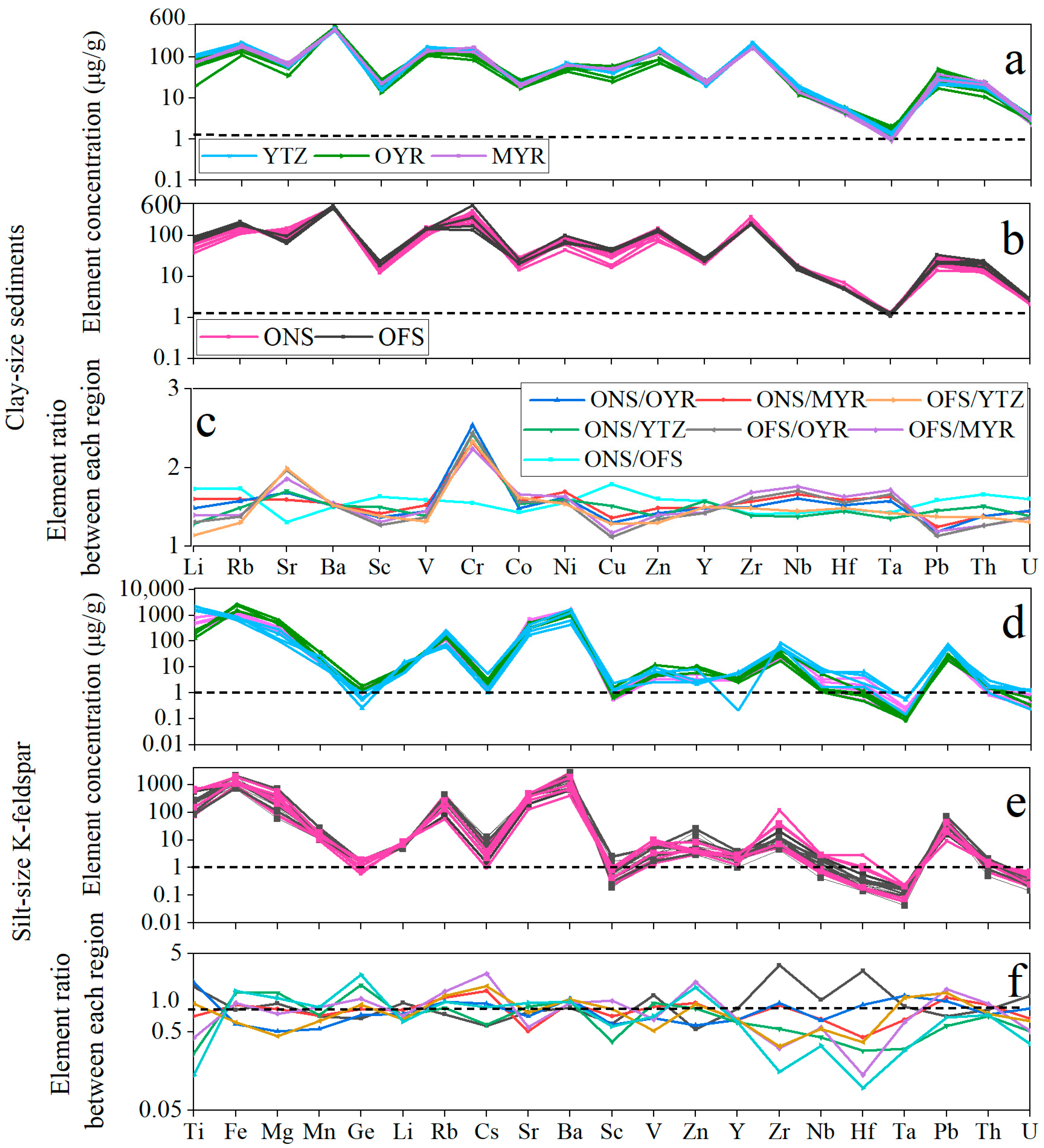
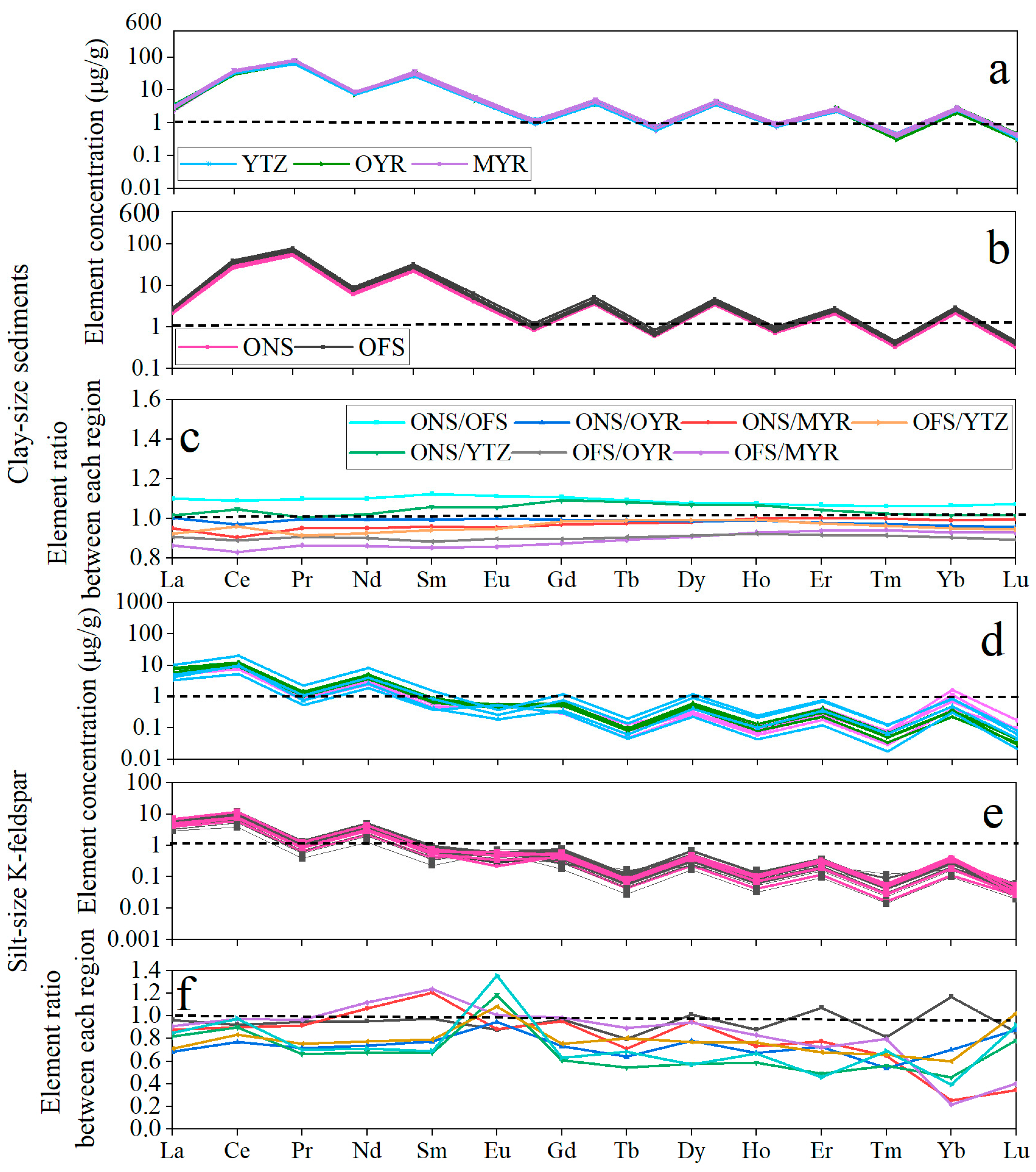
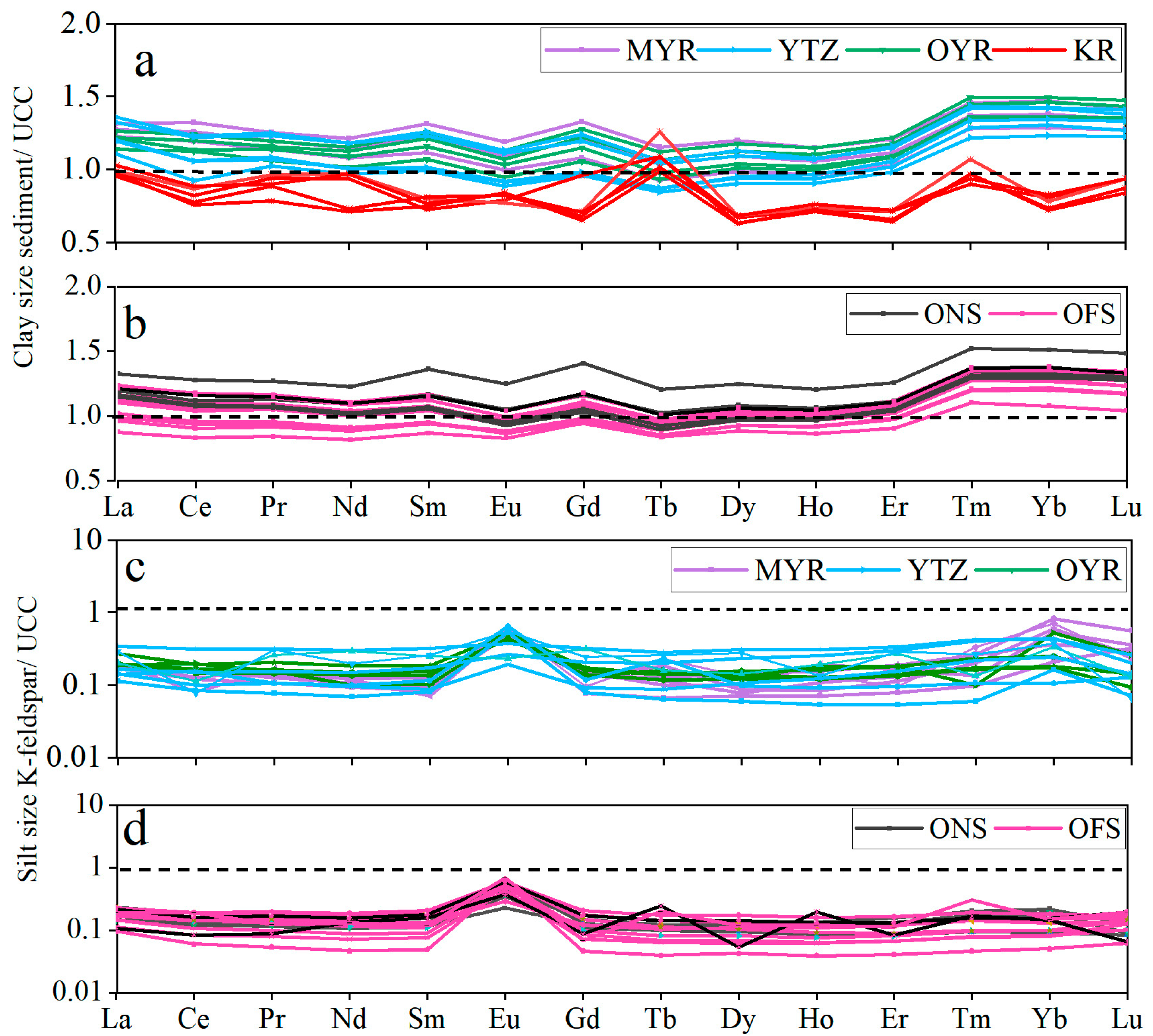
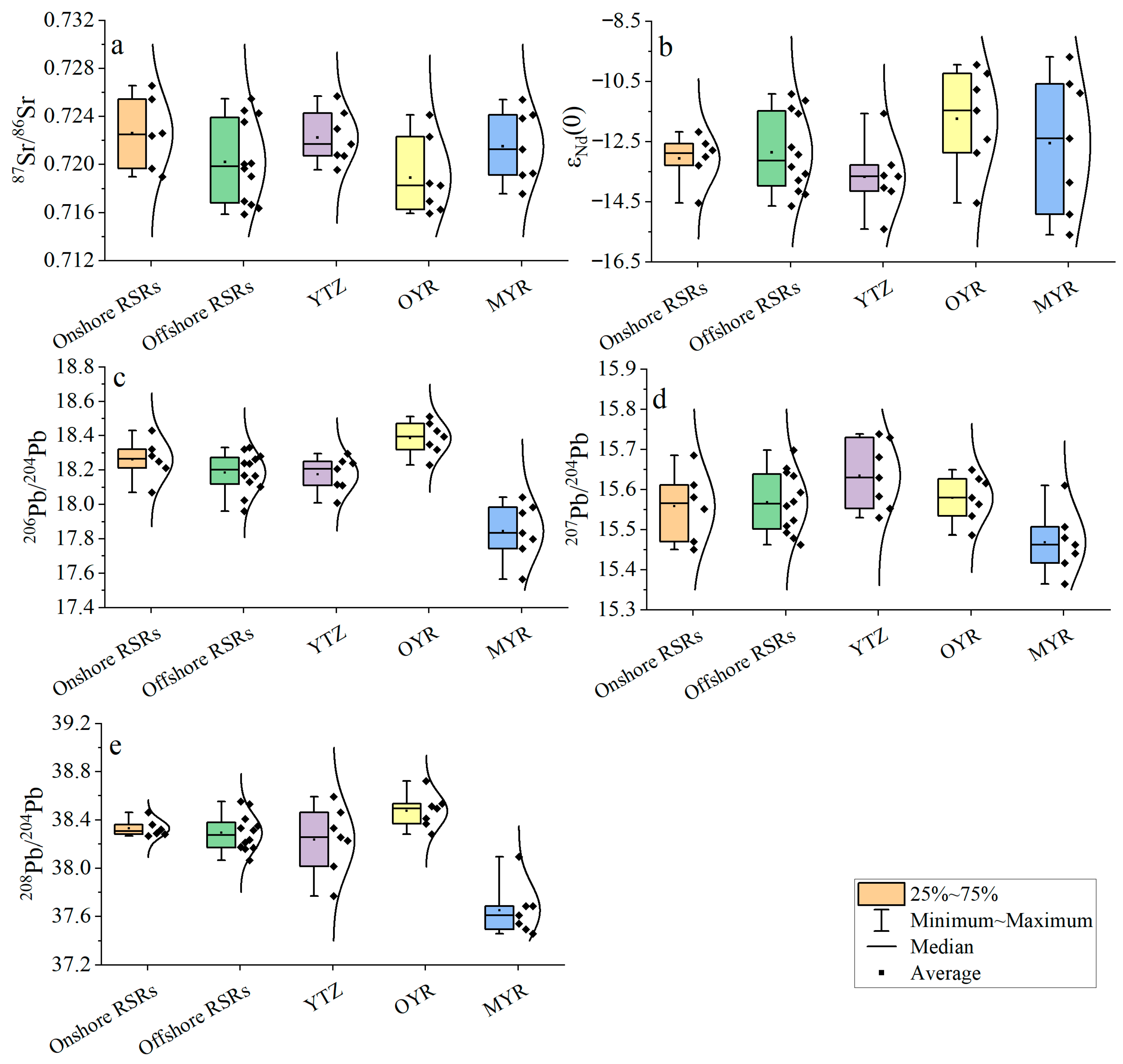
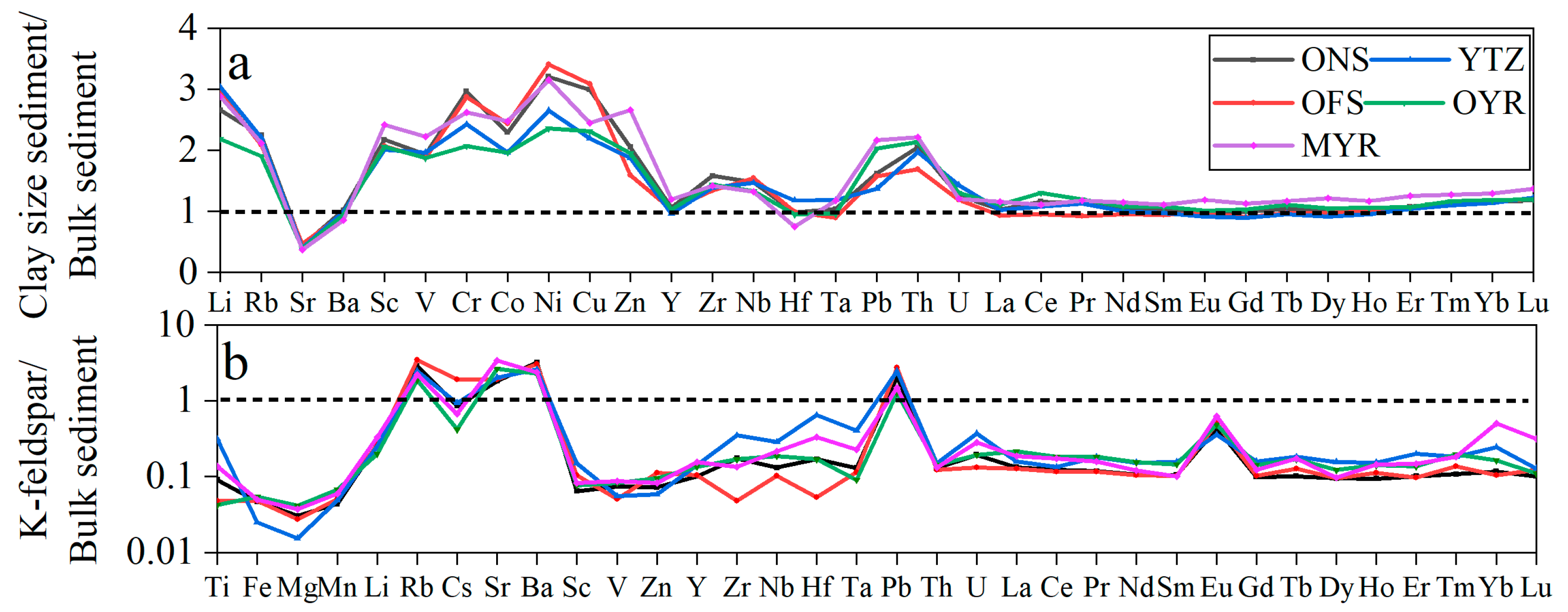
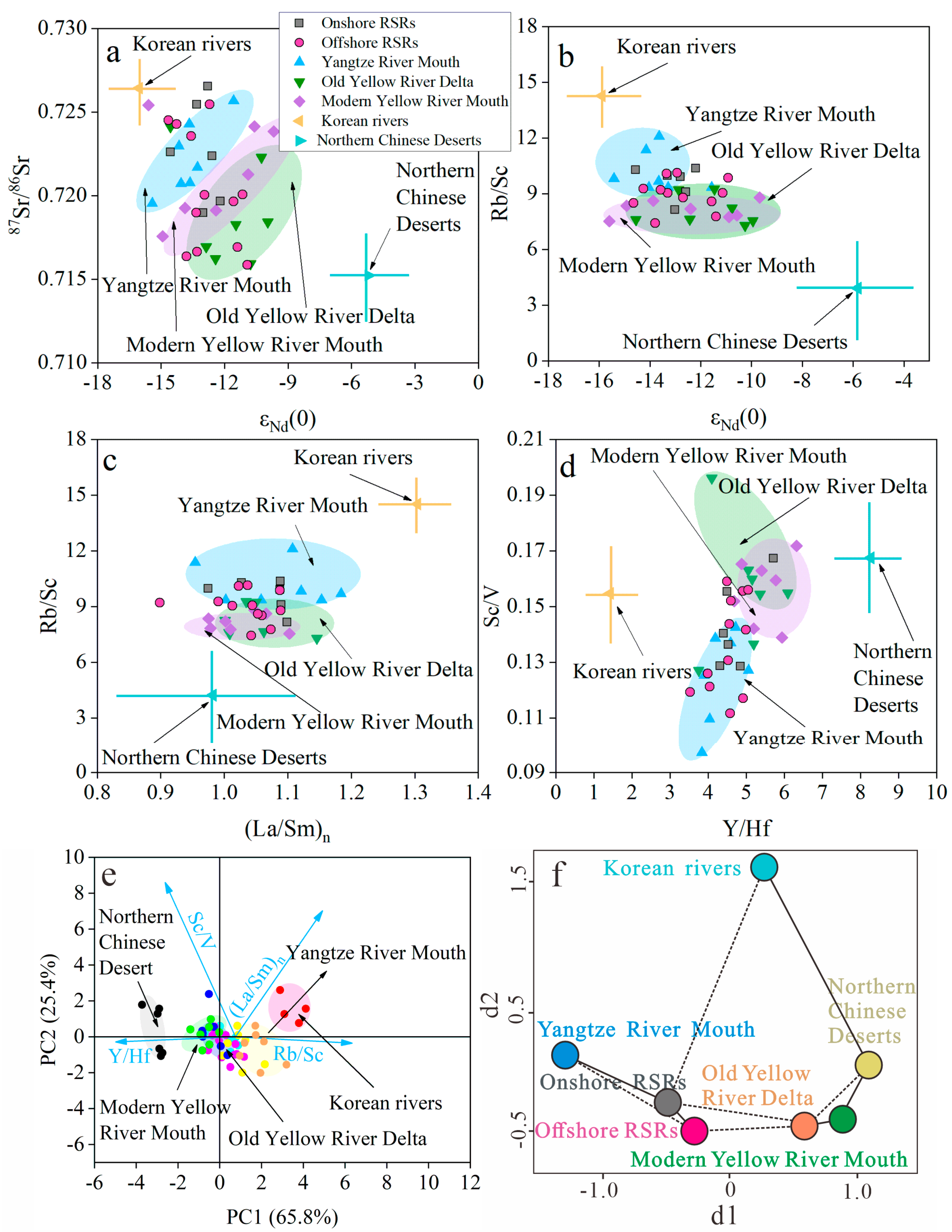
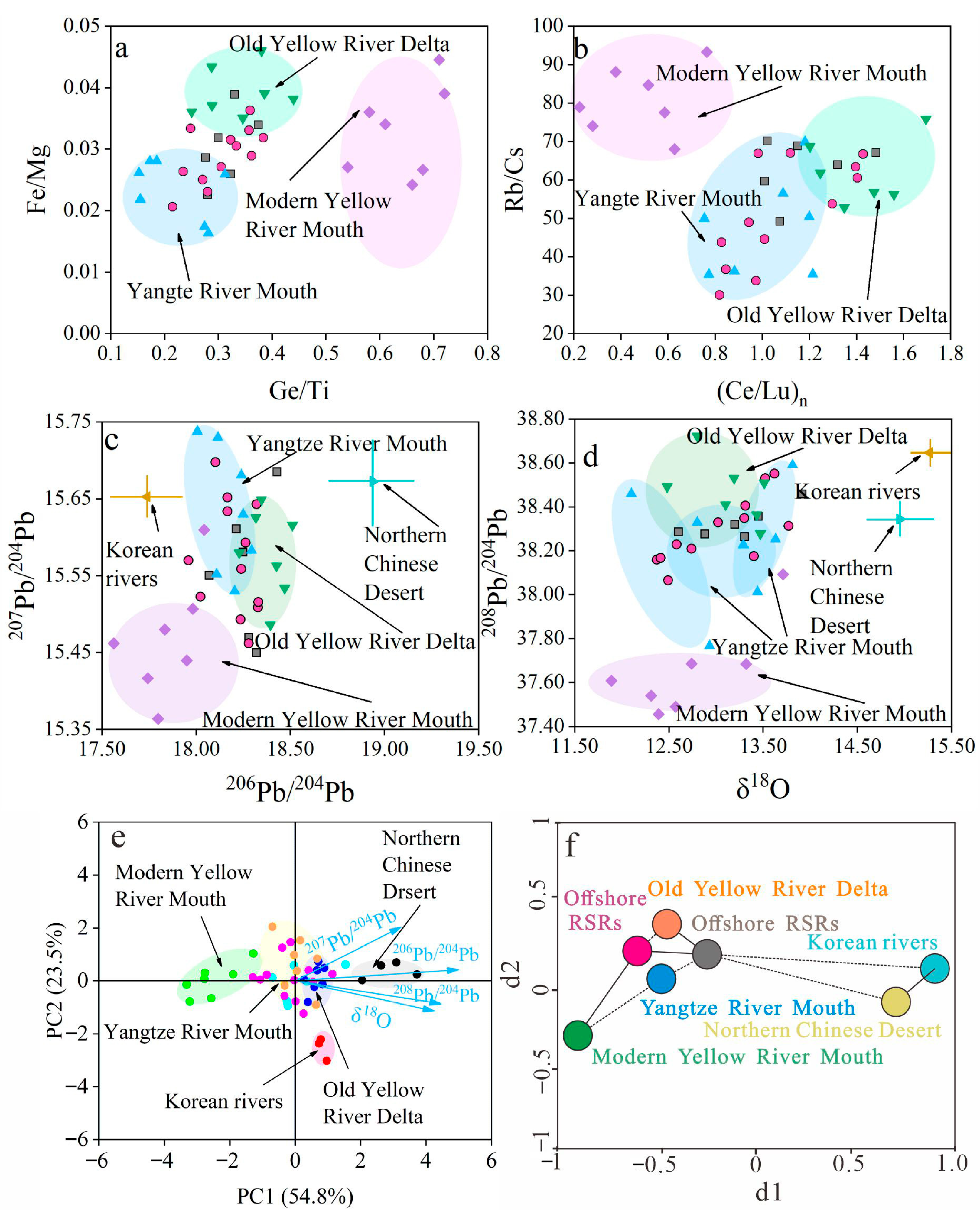
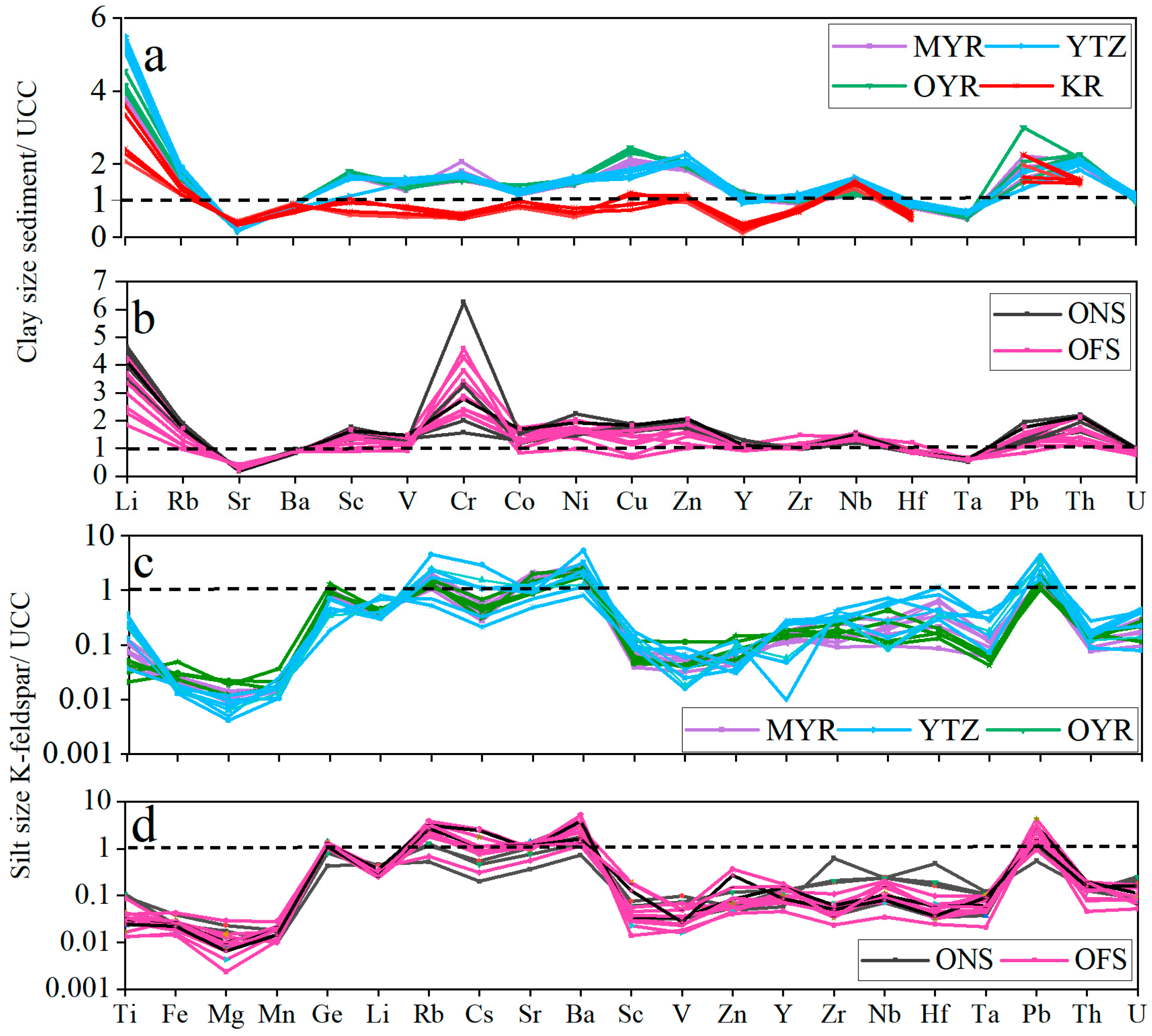
- The clay-size sediments and K-feldspar of silt-size sediments of the Jianggang sand ridges have the highest content of Ba. Compared with the Yangtze River Mouth, the Modern Yellow River Mouth, and the Old Yellow River Delta, the clay fraction of Jianggang sand ridges has significantly higher contents of Sr, Cr, Ni, Co, and Lu, while the K-feldspar of silt fraction have higher contents of Rb and Ba. Compared with the bulk sediments, the clay-size sediments are enriched in Sc, Co, Ni, Cu, Li, Rb, Pb, and Th, while the K-feldspar of silt-size sediments are enriched in Rb, Sr, Ba, and Pb, indicating the adsorption of characteristic elements by clay minerals and K-feldspar. The ranges of the Sr and Nd isotopic compositions in clay-size sediments from the Jianggang sand ridges are wider and narrower than those from the Old Yellow River Delta, respectively, while the ranges of Pb isotopic compositions in K-feldspar from the research areas are only narrower than those from the Modern Yellow River Mouth. These isotopic and geochemical differences indicate that the provenance of different size fractions in the Jianggang sand ridges are diverse.
- (2)
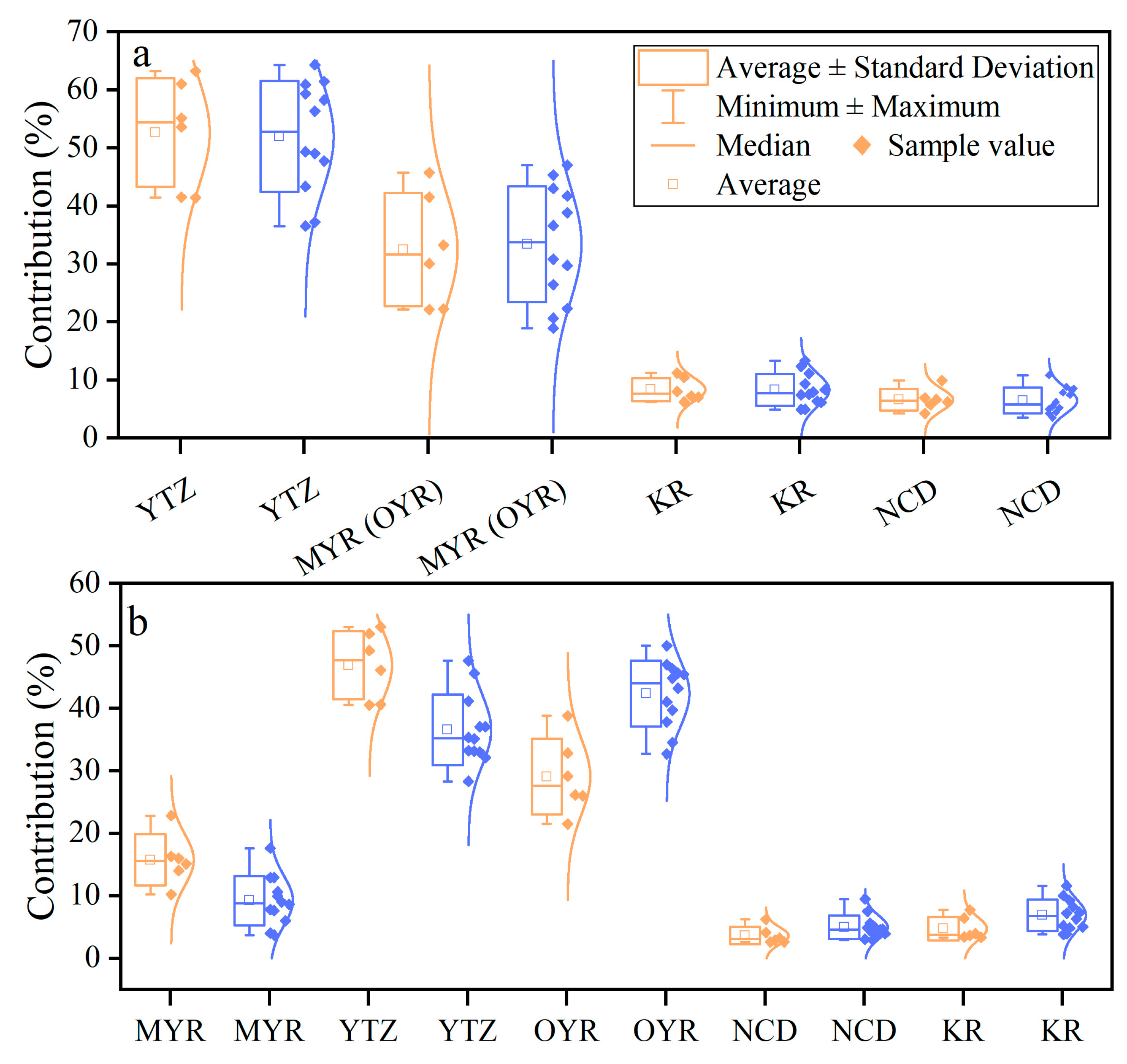
- Provenance analysis shows that the Yangtze River Mouth is the main source of clay-sized sediments in the onshore and offshore sand ridges, contributing approximately 53.9 ± 8.8% and 51.9 ± 8.4%, respectively. The Modern and the Old Yellow River are the secondary ones (approximately 34.6 ± 8.7% and 35.8 ± 8.1%, respectively). The contributions from the Northern Chinese Deserts and the Korean rivers are both less than 7%. For silt-size sediments, the Yangtze River Mouth contributed 46.8 ± 5.5% and 36.5 ± 5.7% to the onshore and offshore sand ridges, respectively, making it the main provenance. The Old Yellow River Delta, which is the subordinate one, contributed 29.1 ± 6.1% and 42.4 ± 5.3% to the onshore and offshore regions, respectively. The Modern Yellow River Mouth contributes less than 16%, while the contributions from the Northern Chinese Deserts and Korean rivers are less than 7% to the study areas. The reason for the conclusions may be that the Yangtze River and the Old Yellow River are close to the study area, and there are stable circulations around them. Moreover, their sediment transport is relatively sufficient.
- (3)
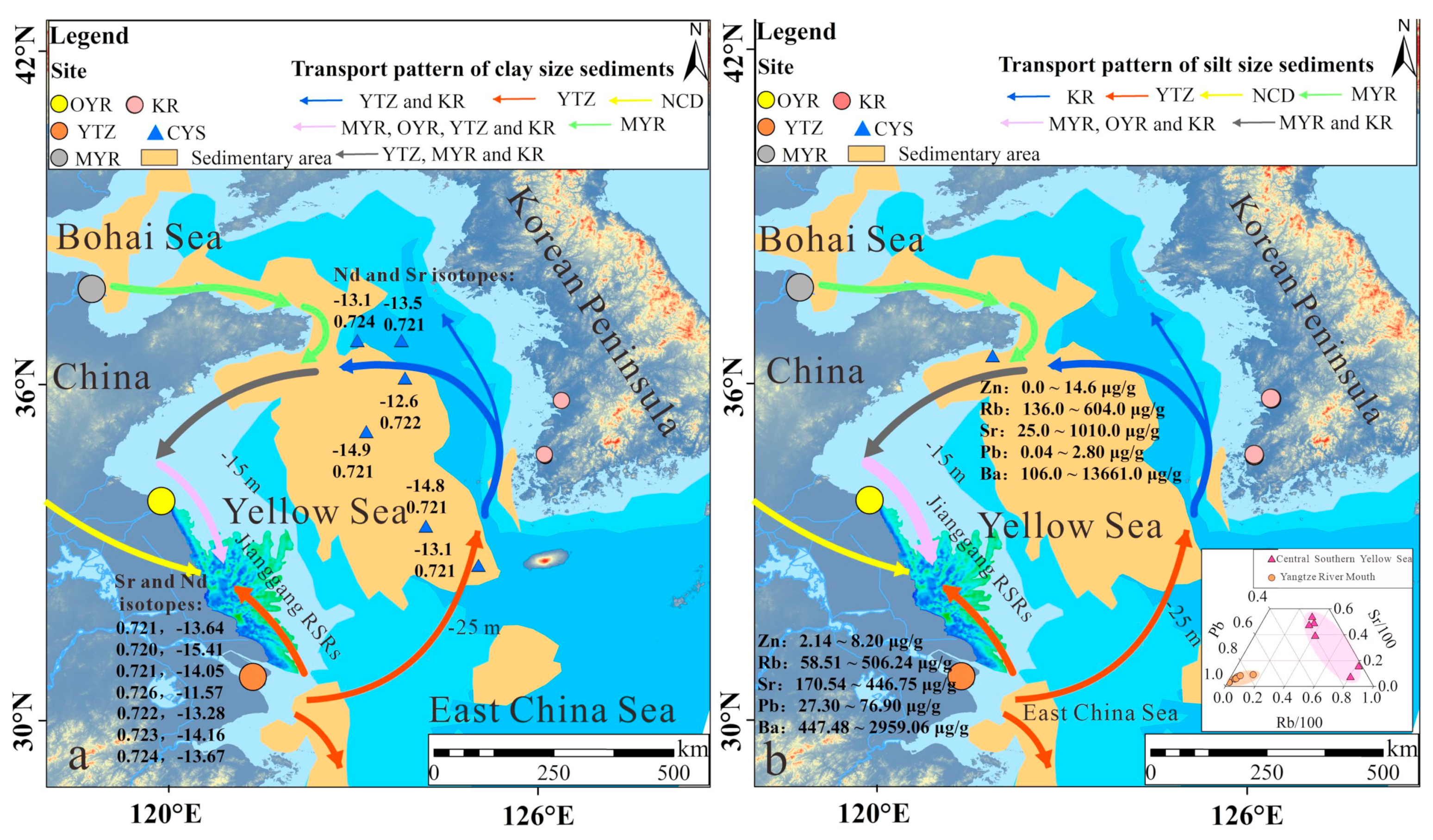
- Based on the distribution of tracer indicators, it was shown that the clay-size sediments in the Yangtze River Mouth have a specific migration path, which moved through the central Yellow Sea to the Jianggang sand ridges under the influence of the Yellow Sea Warm Current and the Subei Coastal Current. In contrast, this path is limited for silt-size sediments from the Yangtze River Mouth, which mainly rely on the northward Subei Coastal Current and the Yangtze River Diluted Water to reach the sand ridges. The clay and silt fractions of the Modern and the Old Yellow River sediments migrate to the study areas mainly through the southward coastal currents. At the same time, sediments of the two fractions in the Korean rivers reach the Jianggang sand ridges with the support of the Yellow Sea Warm Current and the southward coastal currents, while those from the Northern Chinese Deserts reach the study area mainly through the influence of the East Asian Winter Monsoon.
Supplementary Materials
Author Contributions
Funding
Data Availability Statement
Acknowledgments
Conflicts of Interest
References
- Chiarella, D.; Longhitano, S.G.; Mosdell, W.; Telesca, D. Sedimentology and Facies Analysis of Ancient Sand Ridges: Jurassic Rogn Formation, Trøndelag Platform, Offshore Norway. Mar. Pet. Geol. 2020, 112, 104082. [Google Scholar] [CrossRef] [Scilit]
- Longhitano, S.G.; Rossi, V.M.; Chiarella, D.; Mellere, D.; Tropeano, M.; Dalrymple, R.W.; Steel, R.J.; Nappi, A.; Olita, F. Anatomy of a Mixed Bioclastic–Siliciclastic Regressive Tidal Sand Ridge: Facies-based Case Study from the Lower Pleistocene Siderno Strait, Southern Italy. Sedimentology 2021, 68, 2293–2333. [Google Scholar] [CrossRef] [Scilit]
- He, L.; Ye, S.; Xue, C.; Zhao, G.; Yang, S.; Amorosi, A. Sedimentology and Evolution of the Holocene Radial Tidal Sand Ridge in the South Yellow Sea, China. Front. Earth Sci. 2023, 10, 1107495. [Google Scholar] [CrossRef] [Scilit]
- Liu, B.; Wu, H.; Zhang, Z.; Wei, G.; Wang, Y.; Zheng, J.; Ji, X.; Jiang, S. Recent Evolution of the Intertidal Sand Ridge Lines of the Dongsha Shoal in the Modern Radial Sand Ridges, East China. Int. J. Environ. Res. Public Health 2021, 18, 1573. [Google Scholar] [CrossRef] [Scilit]
- Shang, Y.; Nian, X.; Zhang, W.; Wang, F. Yellow River’s Contribution to the Building of Yangtze Delta During the Last 500 Years—Evidence from Detrital Zircon U-Pb Geochronology. Geophys. Res. Lett. 2021, 48, e2020GL091896. [Google Scholar] [CrossRef] [Scilit]
- Li, C.X.; Zhang, J.Q.; Fan, D.D.; Deng, B. Holocene Regression and the Tidal Radial Sand Ridge System Formation in the Jiangsu Coastal Zone, East China. Mar. Geol. 2001, 173, 97–120. [Google Scholar] [CrossRef] [Scilit]
- Li, H.; Zhang, Y.; Tang, H.; Shi, X.; Rivkin, R.B.; Legendre, L. Spatiotemporal Variations of Inorganic Nutrients Along the Jiangsu Coast, China, and the Occurrence of Macroalgal Blooms (Green Tides) in the Southern Yellow Sea. Harmful Algae 2017, 63, 164–172. [Google Scholar] [CrossRef] [Scilit]
- Wang, Y. Environment and Resources of the Radial Sand Ridges in the South Yellow Sea; Ocean Press: Beijing, China, 2014. [Google Scholar]
- Bian, C.; Jiang, W.; Greatbatch, R.J. An Exploratory Model Study of Sediment Transport Sources and Deposits in the Bohai Sea, Yellow Sea, and East China Sea: A Model Study of Sediment Transport. J. Geophys. Res. Ocean. 2013, 118, 5908–5923. [Google Scholar] [CrossRef] [Scilit]
- Mao, C.; Rao, W.; Li, T.; Jin, K.; Wang, S. Lead Isotope Compositions and Modern Sediments Sources in the Radial Sand Ridges from the Jiangsu Coast, East China. Appl. Geochem. 2024, 160, 105858. [Google Scholar] [CrossRef] [Scilit]
- Sanità, E.; Di Rosa, M.; Della Porta, G.; Catanzariti, R.; Pandolfi, L.; Marroni, M. Trench Sediment Heterogeneity Controls Accretion Mechanisms in Subduction Zone. Sci. Rep. 2025, 15, 34793. [Google Scholar] [CrossRef] [Scilit]
- Zhang, W.; Ma, H.; Ye, L.; Dong, C.; Yu, L.; Feng, H. Magnetic and Geochemical Evidence of Yellow and Yangtze River Influence on Tidal Flat Deposits in Northern Jiangsu Plain, China. Mar. Geol. 2012, 319–322, 47–56. [Google Scholar] [CrossRef] [Scilit]
- Su, J.; Rao, W.; Wang, Y.; Mao, C. Detrital Zircon Geochronology of the Radial Sand Ridge System of Jiangsu Coast, East China: Implication for Sediment Provenance. J. Earth Sci. 2018, 29, 144–154. [Google Scholar] [CrossRef] [Scilit]
- Wang, X.; Ke, X. Grain-Size Characteristics of the Extant Tidal Flat Sediments Along the Jiangsu Coast, China. Sediment. Geol. 1997, 112, 105–122. [Google Scholar] [CrossRef] [Scilit]
- Rao, W.; Mao, C.; Wang, Y.; Su, J.; Balsam, W.; Ji, J. Geochemical Constraints on the Provenance of Surface Sediments of Radial Sand Ridges off the Jiangsu Coastal Zone, East China. Mar. Geol. 2015, 359, 35–49. [Google Scholar] [CrossRef] [Scilit]
- Wang, L.; Hu, S.; Yu, G.; Ma, M.; Liao, M. Paleoenvironmental Reconstruction of the Radial Sand Ridge Field in the South Yellow Sea (East China) since 45ka Using the Sediment Magnetic Properties and Granulometry. J. Appl. Geophys. 2015, 122, 1–10. [Google Scholar] [CrossRef] [Scilit]
- Johnson, S.P.; Kirkland, C.L.; Evans, N.J.; McDonald, B.J.; Cutten, H.N. The Complexity of Sediment Recycling as Revealed by Common Pb Isotopes in K-Feldspar. Geosci. Front. 2018, 9, 1515–1527. [Google Scholar] [CrossRef] [Scilit]
- Muhs, D.R. Evaluation of Simple Geochemical Indicators of Aeolian Sand Provenance: Late Quaternary Dune Fields of North America Revisited. Quat. Sci. Rev. 2017, 171, 260–296. [Google Scholar] [CrossRef] [Scilit]
- Wang, Y.P.; Gao, S.; Jia, J.; Thompson, C.E.L.; Gao, J.; Yang, Y. Sediment Transport over an Accretional Intertidal Flat with Influences of Reclamation, Jiangsu Coast, China. Mar. Geol. 2012, 291–294, 147–161. [Google Scholar] [CrossRef] [Scilit]
- Xing, F.; Wang, Y.P.; Wang, H.V. Tidal Hydrodynamics and Fine-Grained Sediment Transport on the Radial Sand Ridge System in the Southern Yellow Sea. Mar. Geol. 2012, 291–294, 192–210. [Google Scholar] [CrossRef] [Scilit]
- Lu, J.; Li, A.; Zhang, J.; Huang, P. Yangtze River-Derived Sediments in the Southwestern South Yellow Sea: Provenance Discrimination and Seasonal Transport Mechanisms. J. Asian Earth Sci. 2019, 176, 353–367. [Google Scholar] [CrossRef] [Scilit]
- Wu, H.; Shen, J.; Zhu, J.; Zhang, J.; Li, L. Characteristics of the Changjiang Plume and Its Extension Along the Jiangsu Coast. Cont. Shelf Res. 2014, 76, 108–123. [Google Scholar] [CrossRef] [Scilit]
- MWR (Ministry of Water Resources of China). Chinese River Sediment Bulletin; China Water and Power Press: Beijing, China, 2018. Available online: http://www.mwr.gov.cn/sj/tigb/zghlnsgb/202107/t20210721_1530261.html (accessed on 15 May 2025). (In Chinese)
- Zhou, L.; Liu, J.; Saito, Y.; Zhang, Z.; Chu, H.; Hu, G. Coastal Erosion as a Major Sediment Supplier to Continental Shelves: Example from the Abandoned Old Huanghe (Yellow River) Delta. Cont. Shelf Res. 2014, 82, 43–59. [Google Scholar] [CrossRef] [Scilit]
- Yang, S.Y.; Li, C.X.; Jung, H.S.; Lim, D.I.; Choi, M.S. Geochemistry of trace elements in Chinese and Korean river sediments. Mar. Geol. Quat. Geol. 2003, 23, 19–24. [Google Scholar]
- Yan, Y.; Sun, Y.; Chen, H.; Ma, L. Oxygen Isotope Signatures of Quartz from Major Asian Dust Sources: Implications for Changes in the Provenance of Chinese Loess. Geochim. Cosmochim. Acta 2014, 139, 399–410. [Google Scholar] [CrossRef] [Scilit]
- Geldmacher, J.; Haase, K.M.; Devey, C.W.; Garbe-Schönberg, C.D. The petrogenesis of Tertiary cone-sheets in Ardnamurchan, NWScotland: Petrological and geochemical constraints on crustal contamination and partial melting. Contrib Miner. Pet. 1998, 131, 196–209. [Google Scholar] [CrossRef] [Scilit]
- Lim, D.; Jung, H.S.; Choi, J.Y. REE Partitioning in Riverine Sediments around the Yellow Sea and Its Importance in Shelf Sediment Provenance. Mar. Geol. 2014, 357, 12–24. [Google Scholar] [CrossRef] [Scilit]
- Rudnick, R.L.; Gao, S. Composition of the Continental Crust. In Treatise on Geochemistry; Elsevier Science Ltd.: Amsterdam, The Netherlands, 2014. [Google Scholar]
- Lim, D.; Choi, J.Y.; Shin, H.H.; Rho, K.C.; Jung, H.S. Multielement Geochemistry of Offshore Sediments in the Southeastern Yellow Sea and Implications for Sediment Origin and Dispersal. Quat. Int. 2013, 298, 196–206. [Google Scholar] [CrossRef] [Scilit]
- Jonell, T.N.; Li, Y.; Blusztajn, J.; Giosan, L.; Clift, P.D. Signal or Noise? Isolating Grain Size Effects on Nd and Sr Isotope Variability in Indus Delta Sediment Provenance. Chem. Geol. 2018, 485, 56–73. [Google Scholar] [CrossRef] [Scilit]
- Heier, K.S. Trace elements in feldspars—A review. Nor. Geol. Tidsskr. 1962, 42, 415–454. [Google Scholar]
- Kessarkar, P.M.; Rao, V.P.; Ahmad, S.M.; Babu, G.A. Clay Minerals and Sr–Nd Isotopes of the Sediments Along the Western Margin of India and Their Implication for Sediment Provenance. Mar. Geol. 2003, 202, 55–69. [Google Scholar] [CrossRef] [Scilit]
- Carter, S.C.; Griffith, E.M.; Clift, P.D.; Scher, H.D.; Dellapenna, T.M. Clay-Fraction Strontium and Neodymium Isotopes in the Indus Fan: Implications for Sediment Transport and Provenance. Geol. Mag. 2020, 157, 879–894. [Google Scholar] [CrossRef] [Scilit]
- Choi, S.H.; Mukasa, S.B.; Kwon, S.-T.; Andronikov, A.V. Sr, Nd, Pb and Hf Isotopic Compositions of Late Cenozoic Alkali Basalts in South Korea: Evidence for Mixing Between the Two Dominant Asthenospheric Mantle Domains beneath East Asia. Chem. Geol. 2006, 232, 134–151. [Google Scholar] [CrossRef] [Scilit]
- Zhao, W.C. Geochemistry Characteristics of Clay-Sized Fractions from Deserts-Mineral Dust Provenance, Transport and Tracer. Ph.D. Thesis, Nanjing University, Nanjing, China, 2015. [Google Scholar]
- Chen, J.; Li, G.; Yang, J.; Rao, W.; Lu, H.; Balsam, W.; Sun, Y.; Ji, J. Nd and Sr Isotopic Characteristics of Chinese Deserts: Implications for the Provenances of Asian Dust. Geochim. Cosmochim. Acta 2007, 71, 3904–3914. [Google Scholar] [CrossRef] [Scilit]
- Rao, W.B.; Chen, J.; Yang, J.D.; Ji, J.F.; Li, G.J. Sr-Nd isotopic characteristics of different particle-size fractions of eolian sands in the deserts of Northern China. Geol. J. China Univ. 2009, 15, 159–164. [Google Scholar]
- Lim, D.; Jung, H.; Xu, Z.; Jeong, K.; Li, T. Elemental and Sr–Nd Isotopic Compositional Disparity of Riverine Sediments around the Yellow Sea: Constraints from Grain-Size and Chemical Partitioning. Appl. Geochem. 2015, 63, 272–281. [Google Scholar] [CrossRef] [Scilit]
- Mizota, C.; Endo, H.; Um, K.T.; Kusakabe, M.; Noto, M.; Matsuhisa, Y. The Eolian Origin of Silty Mantle in Sedentary Soils from Korea and Japan. Geoderma 1991, 49, 153–164. [Google Scholar] [CrossRef] [Scilit]
- Cheong, C.-S.; Chang, H.-W. Sr, Nd, and Pb Isotope Systematics of Granitic Rocks in the Central Ogcheon Belt, Korea. Geochem. J. 1997, 31, 17–36. [Google Scholar] [CrossRef] [Scilit]
- Nie, F.J.; Pei, R.F.; Wu, L.S.; Zhang, H.T.; Arne, B. Lead and sulfur isotope studies of the Wulashan K-feldspar and quartz vein gold deposit, Southwestern Inner Mongolia. Miner. Depos. 1994, 13, 106–117. [Google Scholar]
- Youn, J.; Kim, T.-J. Geochemical Composition and Provenance of Muddy Shelf Deposits in the East China Sea. Quat. Int. 2011, 230, 3–12. [Google Scholar] [CrossRef] [Scilit]
- Lin, X.; Liu, J.; Wu, Z.H.; Wang, S.M.; Zhao, X.T.; Chen, Y.; Li, Z.N.; Liu, H.J. Detrital zircon U-Pb ages and K-feldspar main and trace elements provenance studying from fluvial to marine sediments in northern China. Acta Geol. Sin. 2020, 94, 3024–3035. [Google Scholar]
- Wang, M.; Jin, B.; Gao, J.; Wang, X.; Jia, J. Identification of Sediment Provenance in the South Yellow Sea Using Detrital Amphibole Geochemistry. Mar. Geol. 2022, 450, 106857. [Google Scholar] [CrossRef] [Scilit]
- Lim, D.; Kim, J.; Xu, Z.; Jung, H.; Yoo, D.-G.; Choi, M.; Kim, S.-Y. Quantitative Reconstruction of Holocene Sediment Source Variations in the Yellow and Northern East China Seas and Their Forcings. Mar. Geol. 2020, 430, 106345. [Google Scholar] [CrossRef] [Scilit]
- Ai, L.; Han, Z.; Wu, X.; Liu, S.; Bi, N.; Saito, Y.; Shi, X.; Wang, H. How Did the Climate and Human Activities Modulate the Sedimentary Evolution of the Central Yellow Sea Mud, China. J. Asian Earth Sci. 2022, 235, 105299. [Google Scholar] [CrossRef] [Scilit]
- Qin, Y.-C.; Xue, C.; Jiang, X. Tidal Current-Dominated Depositional Environments in the Central-Northern Yellow Sea as Revealed by Heavy-Mineral and Grain-Size Dispersals. Mar. Geol. 2018, 398, 59–72. [Google Scholar] [CrossRef] [Scilit]
- Tan, S.-C.; Shi, G.-Y.; Wang, H. Long-Range Transport of Spring Dust Storms in Inner Mongolia and Impact on the China Seas. Atmos. Environ. 2012, 46, 299–308. [Google Scholar] [CrossRef] [Scilit]
- Zhang, Y.Y.; Gao, Z.Q.; Song, D.B.; Li, D.X.; Ning, J.C. Remote sensing monitoring of tidal flat changes near the Radial Sand Ridges in Jiangsu Coastal Zone. Resour. Environ. Yangtze Basin 2019, 28, 1938–1946. [Google Scholar]





| Sampling Area | 87Sr/86Sr | 143Nd/144Nd | εNd(0) | |||
|---|---|---|---|---|---|---|
| Average | Range | Average | Range | Average | Range | |
| Onshore JSR (6) | 0.7226 | 0.7190~0.7265 | 0.511968 | 0.511892~0.512013 | −13.07 | −14.55~−12.19 |
| Offshore JSR (12) | 0.7202 | 0.7158~0.7255 | 0.511978 | 0.511887~0.512078 | −12.87 | −14.65~−10.92 |
| Yangtze River Mouth (7) | 0.7222 | 0.7195~0.7257 | 0.511937 | 0.511848~0.512045 | −13.68 | −15.41~−11.57 |
| Old Yellow River Delta (7) | 0.7189 | 0.7159~0.7241 | 0.512035 | 0.511892~0.512128 | −11.75 | −14.55~−9.95 |
| Mouth Yellow River Mouth (7) | 0.7215 | 0.7176~0.7254 | 0.511993 | 0.511838~0.512141 | −12.56 | −15.60~−9.68 |
| Sampling Area | 206Pb/204Pb | 207Pb/204Pb | 208Pb/204Pb | |||
|---|---|---|---|---|---|---|
| Average | Range | Average | Range | Average | Range | |
| Onshore JSR (6) | 18.26 | 18.07~18.43 | 15.56 | 15.45~15.69 | 38.33 | 38.26~38.46 |
| Offshore JSR (12) | 18.19 | 17.96~18.33 | 15.57 | 15.46~15.69 | 38.29 | 38.07~38.55 |
| Yangtze River Mouth (7) | 18.17 | 18.01~18.29 | 15.64 | 15.53~15.74 | 38.23 | 37.77~38.59 |
| Old Yellow River Delta (7) | 18.39 | 18.23~18.51 | 15.58 | 15.49~15.65 | 38.47 | 38.28~38.72 |
| Modern Yellow River Mouth (7) | 17.85 | 17.56~18.04 | 15.47 | 15.36~15.61 | 37.65 | 37.46~38.09 |
Disclaimer/Publisher’s Note: The statements, opinions and data contained in all publications are solely those of the individual author(s) and contributor(s) and not of MDPI and/or the editor(s). MDPI and/or the editor(s) disclaim responsibility for any injury to people or property resulting from any ideas, methods, instructions or products referred to in the content. |
© 2026 by the authors. Licensee MDPI, Basel, Switzerland. This article is an open access article distributed under the terms and conditions of the Creative Commons Attribution (CC BY) license.
Share and Cite
Li, T.; Rao, W.; Zheng, F.; Wang, S.; Mao, C. Provenance and Transport Patterns of Clay-Size and Silt-Size Sediments in the Jianggang Sand Ridges from the Southwestern Yellow Sea. Minerals 2026, 16, 100. https://doi.org/10.3390/min16010100
Li T, Rao W, Zheng F, Wang S, Mao C. Provenance and Transport Patterns of Clay-Size and Silt-Size Sediments in the Jianggang Sand Ridges from the Southwestern Yellow Sea. Minerals. 2026; 16(1):100. https://doi.org/10.3390/min16010100
Chicago/Turabian StyleLi, Tianning, Wenbo Rao, Fangwen Zheng, Shuai Wang, and Changping Mao. 2026. "Provenance and Transport Patterns of Clay-Size and Silt-Size Sediments in the Jianggang Sand Ridges from the Southwestern Yellow Sea" Minerals 16, no. 1: 100. https://doi.org/10.3390/min16010100
APA StyleLi, T., Rao, W., Zheng, F., Wang, S., & Mao, C. (2026). Provenance and Transport Patterns of Clay-Size and Silt-Size Sediments in the Jianggang Sand Ridges from the Southwestern Yellow Sea. Minerals, 16(1), 100. https://doi.org/10.3390/min16010100