

The Impact of Diagenesis on the Reservoir Properties of the Carboniferous Sandstones of Western Pomerania (NW Poland)


Abstract
1. Introduction
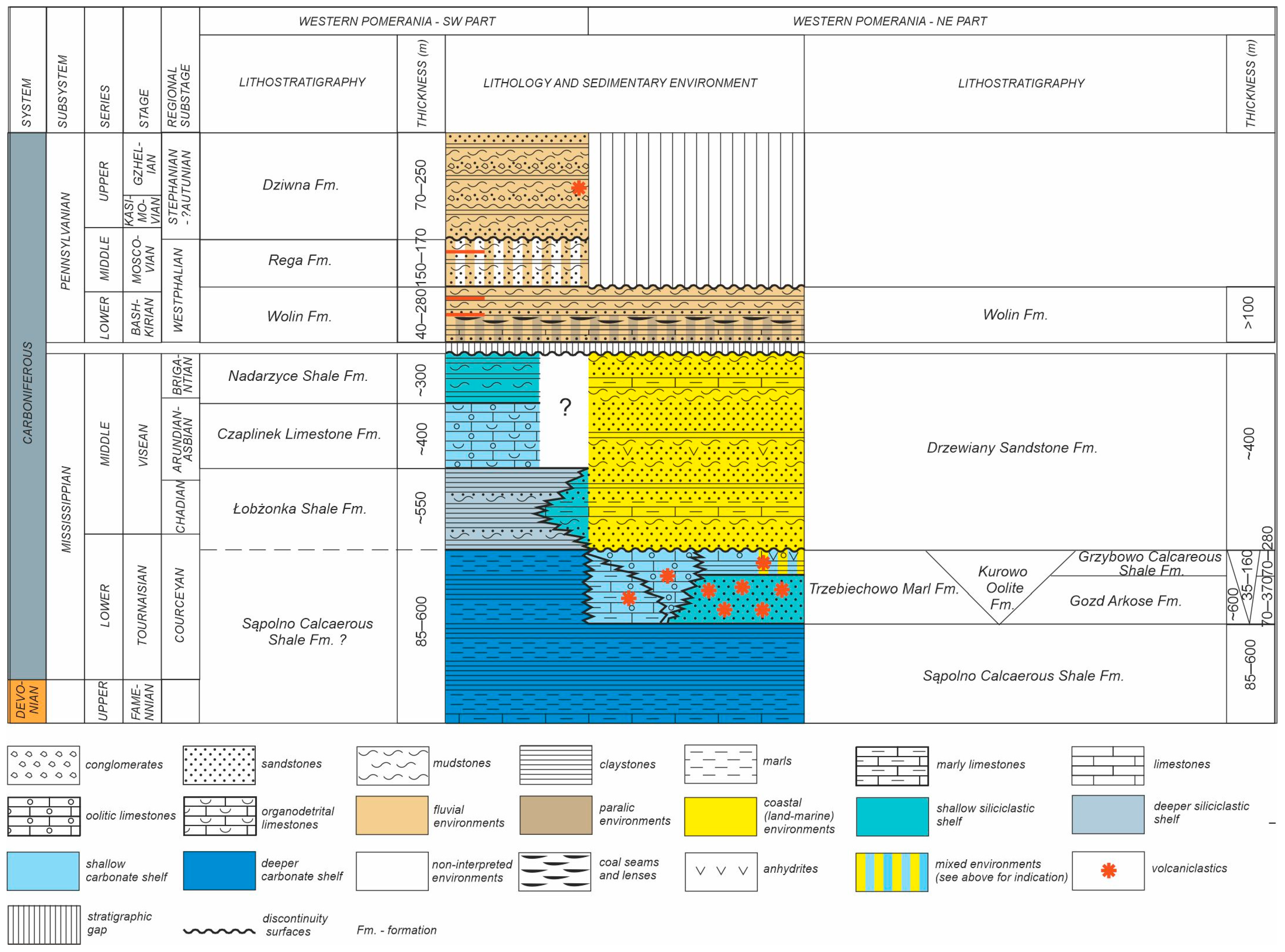
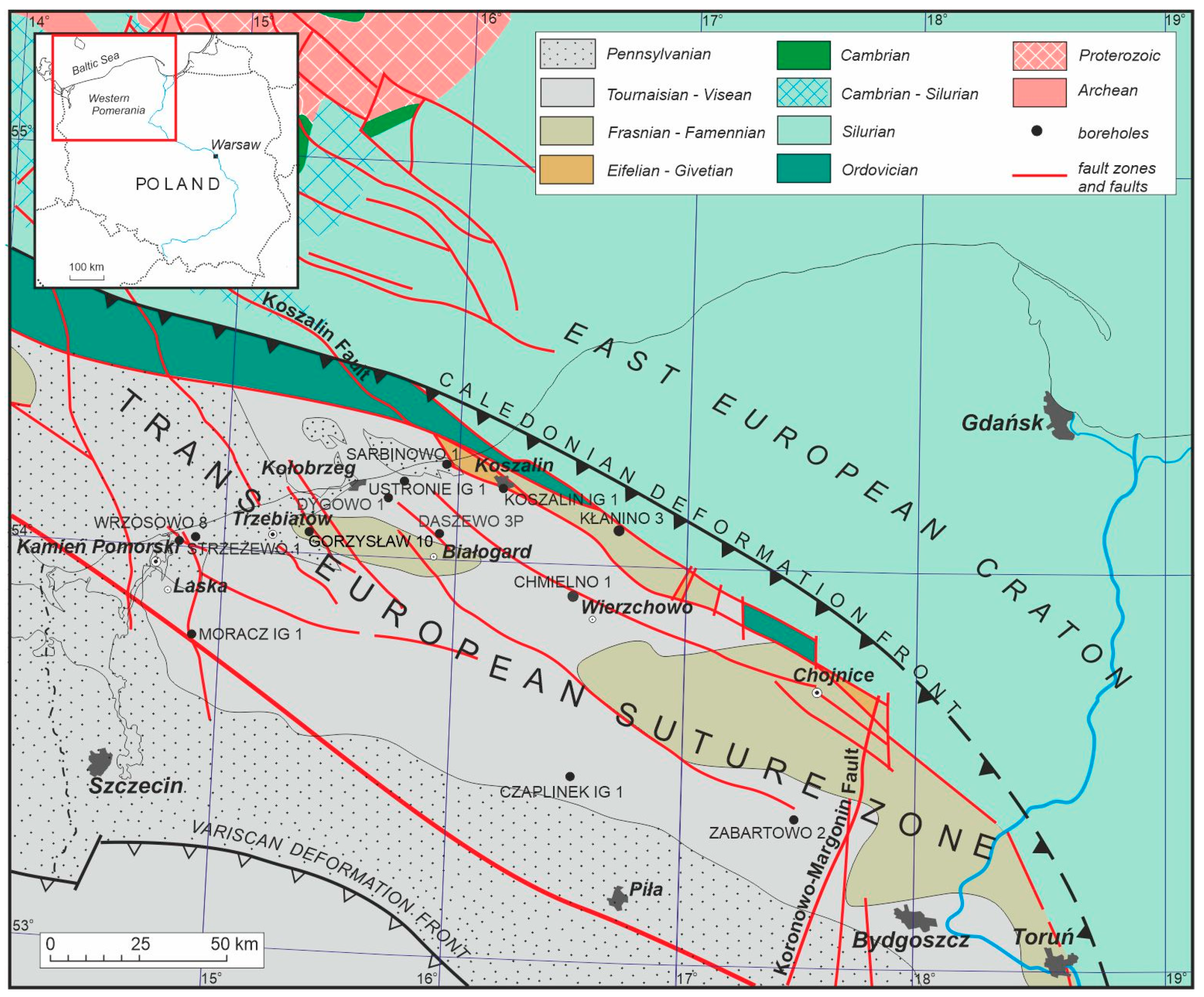
2. Geological Setting
3. Materials and Methods
4. Results
4.1. Petrographic Characterization
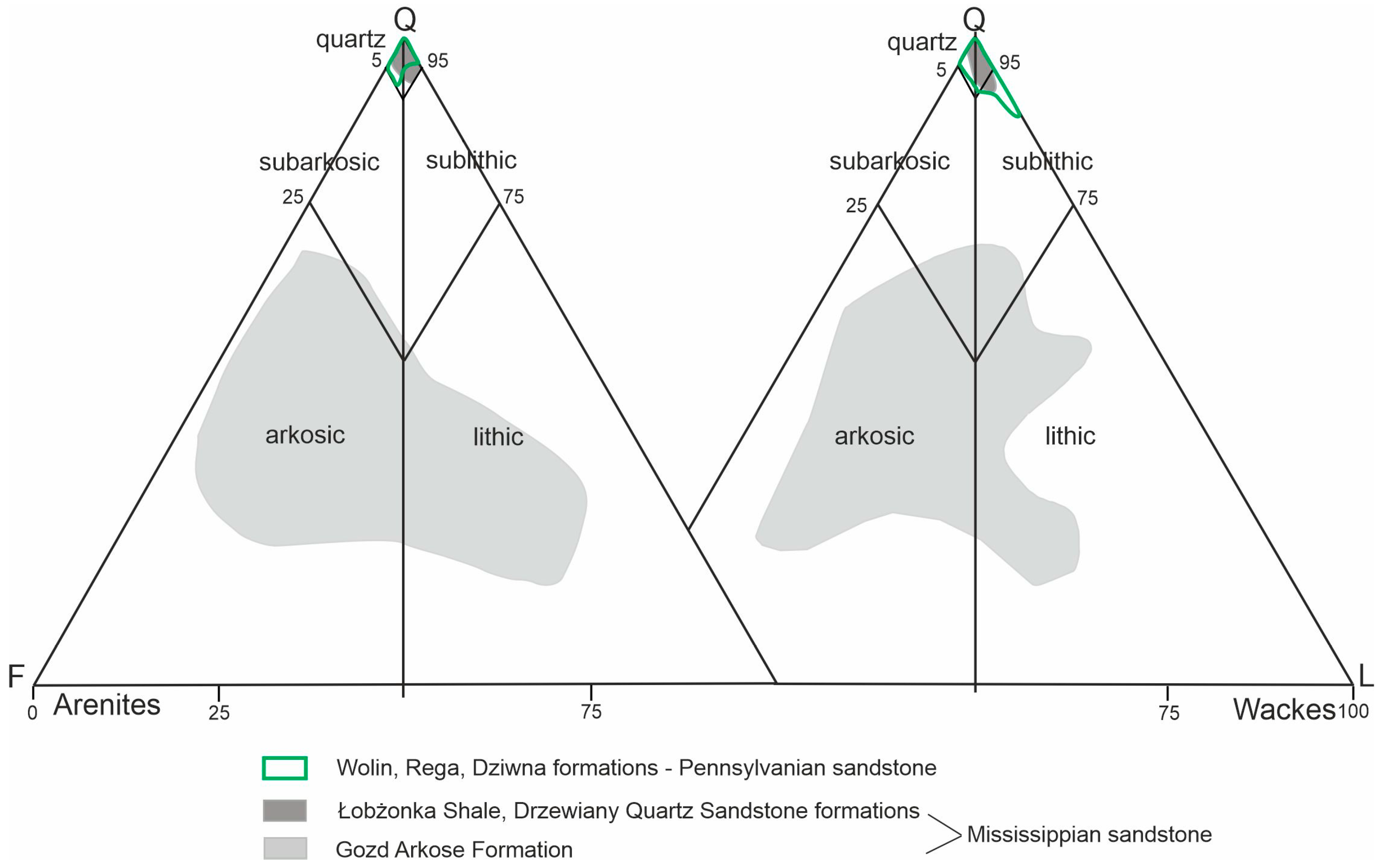
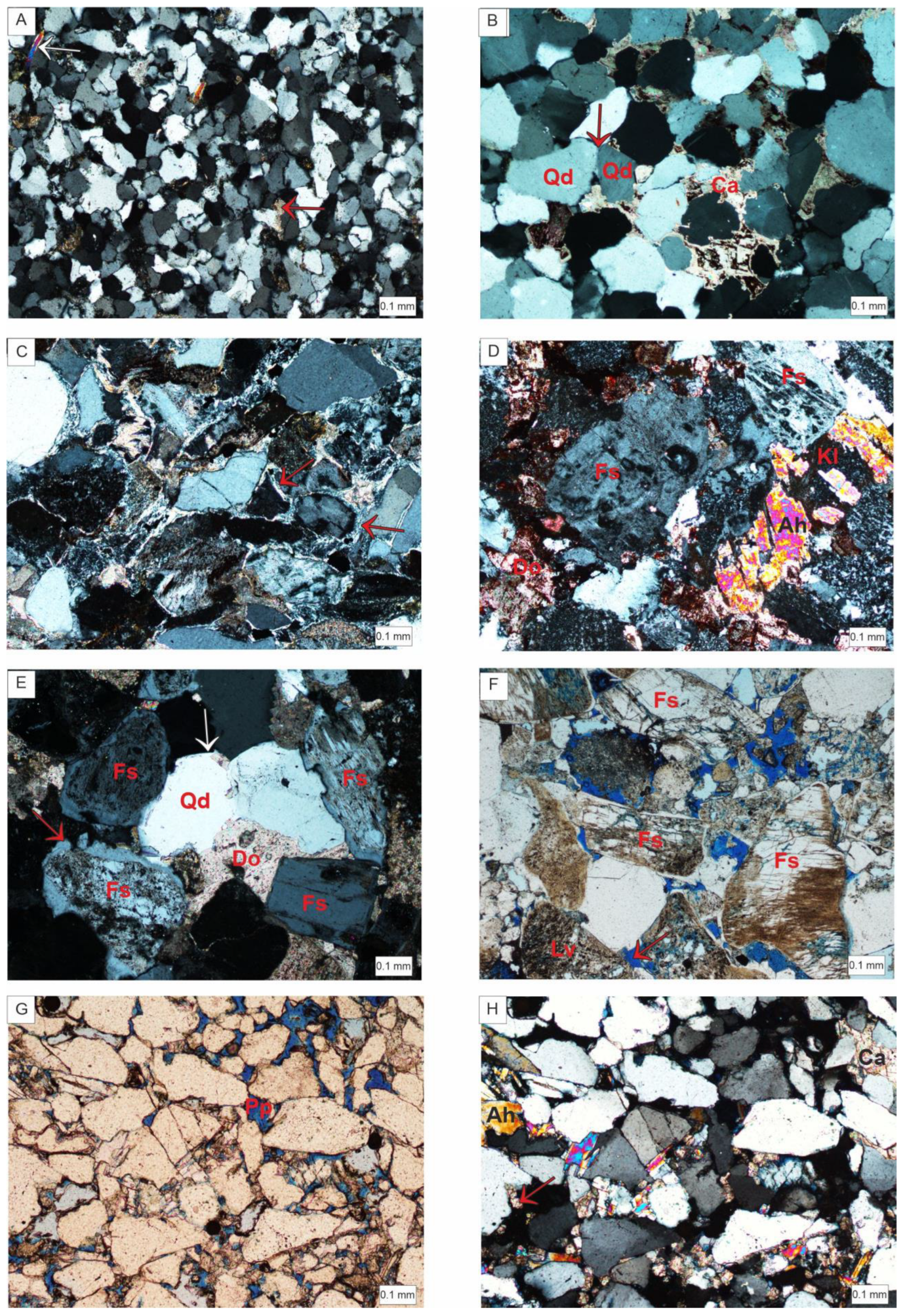
4.1.1. Mississippian Deposits (Figure 2)
4.1.2. Pennsylvanian Deposits (Figure 2)
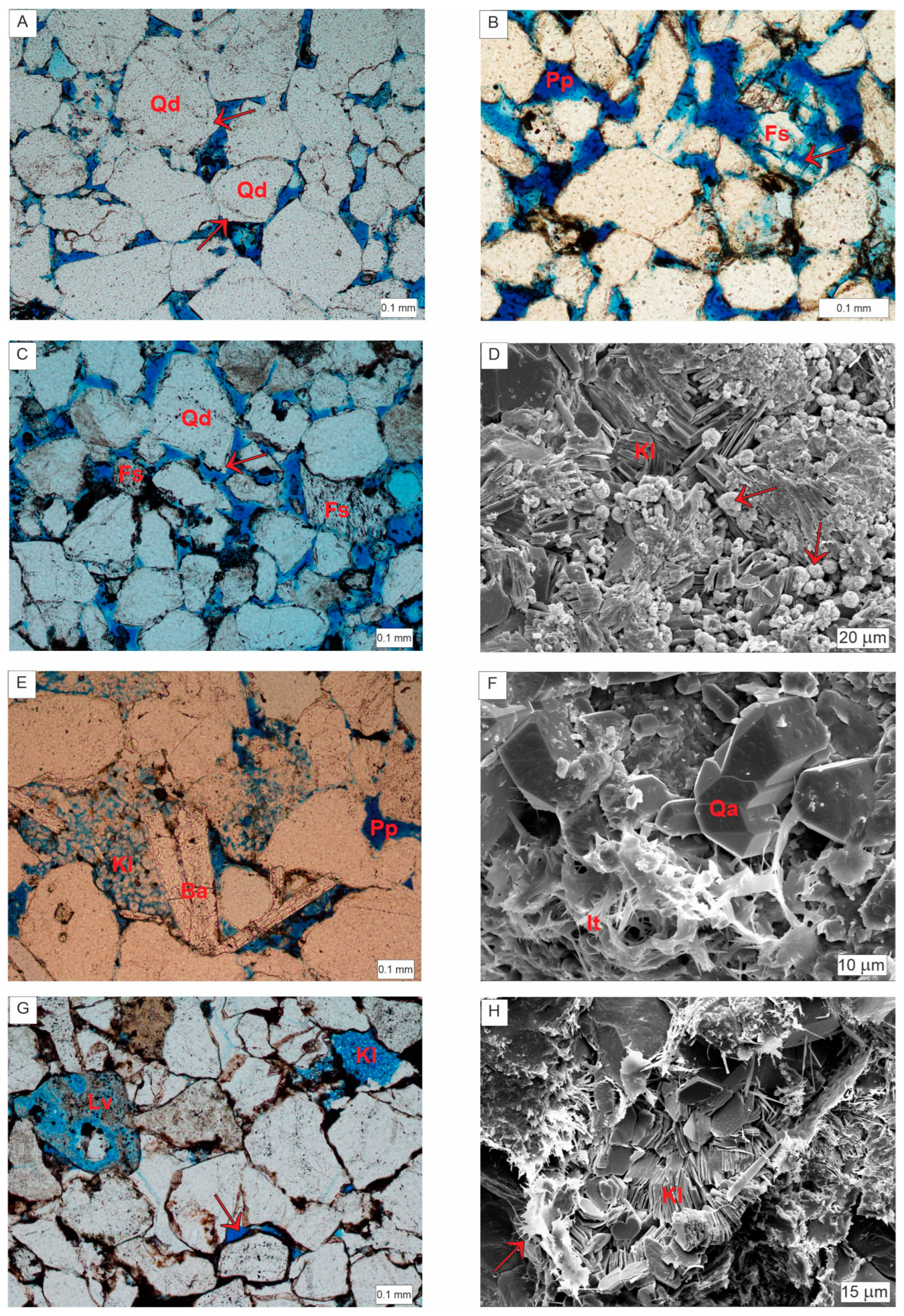
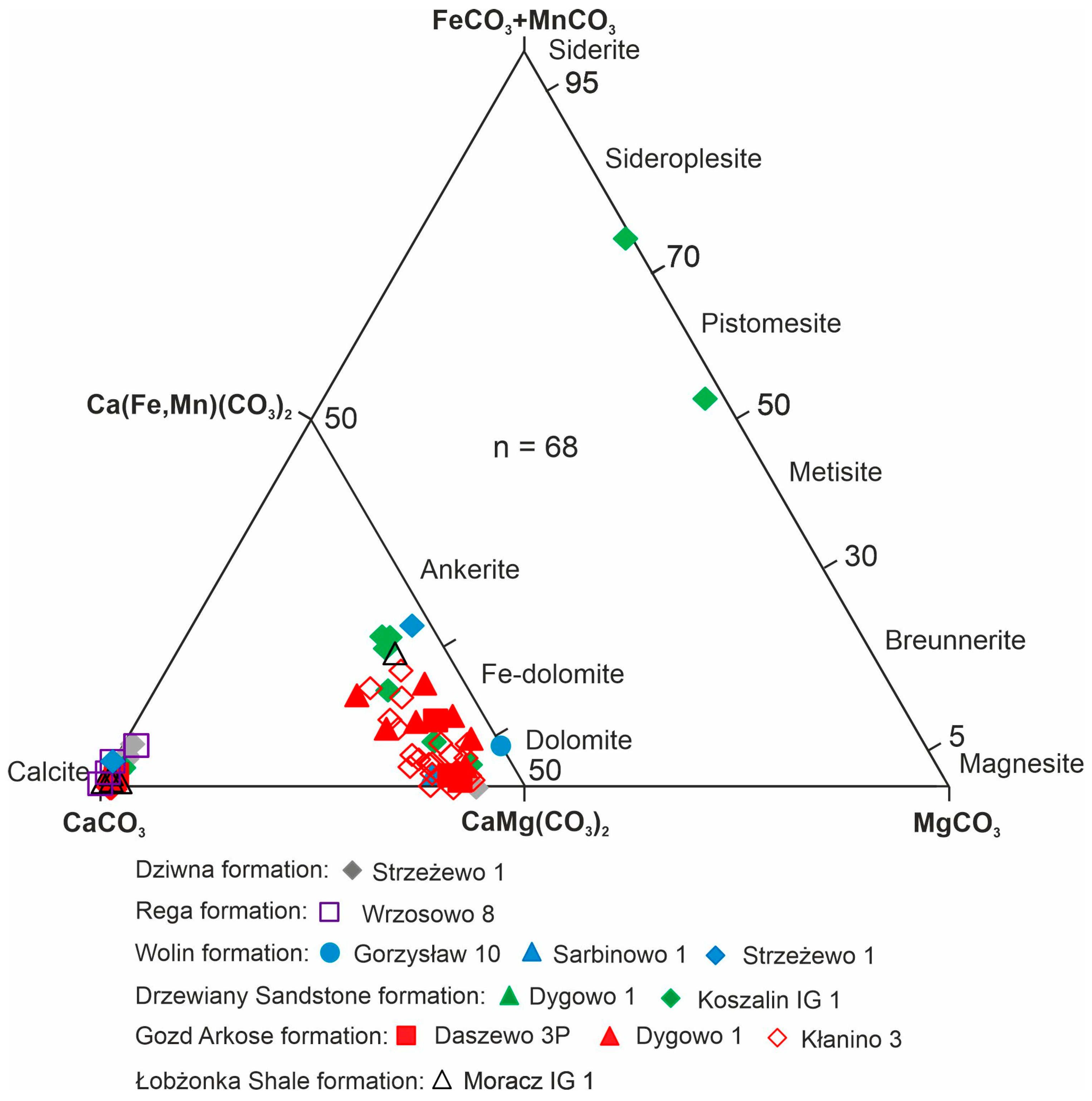
4.1.3. Authigenic Minerals
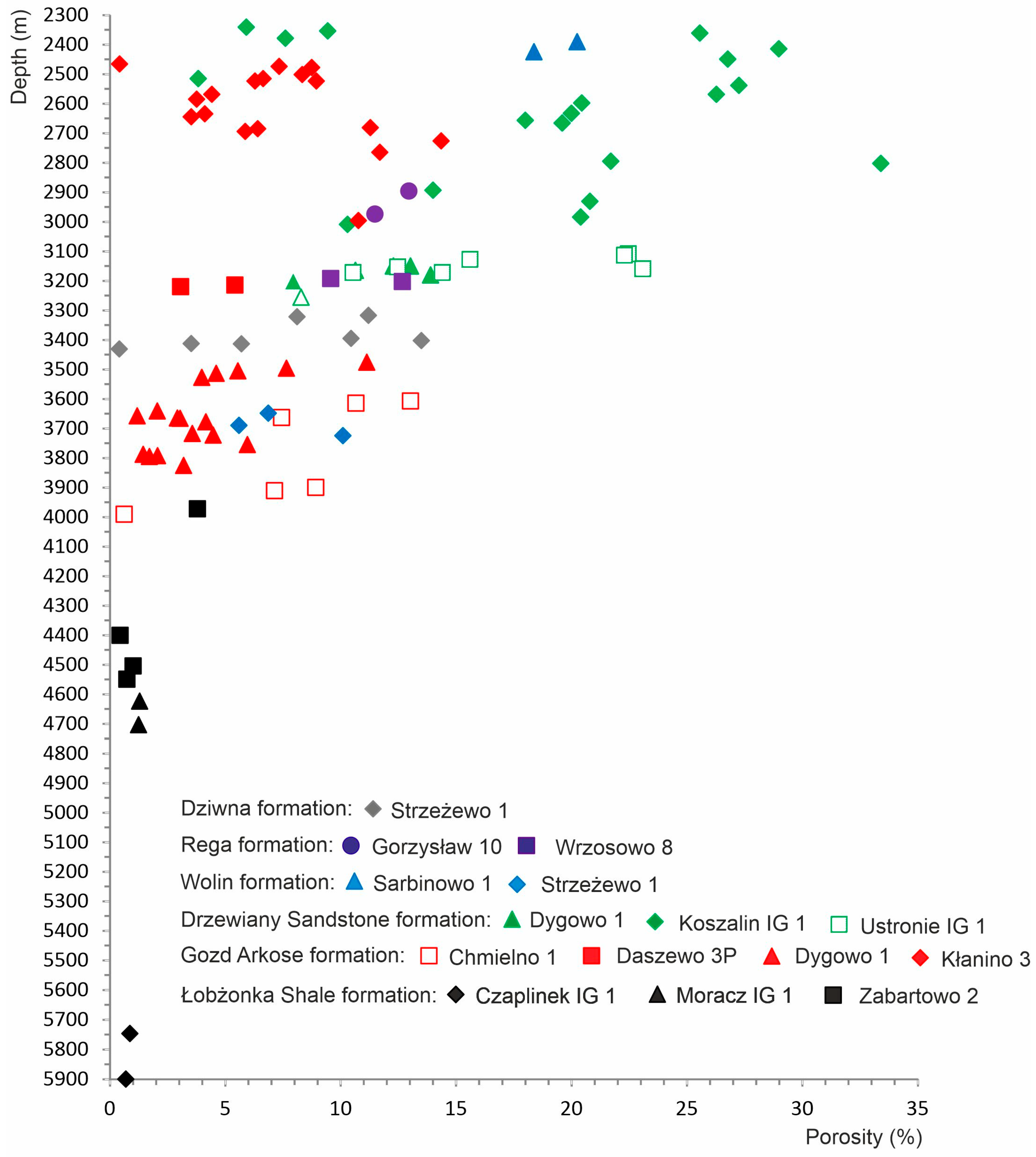
4.2. Pore Space
5. Discussion
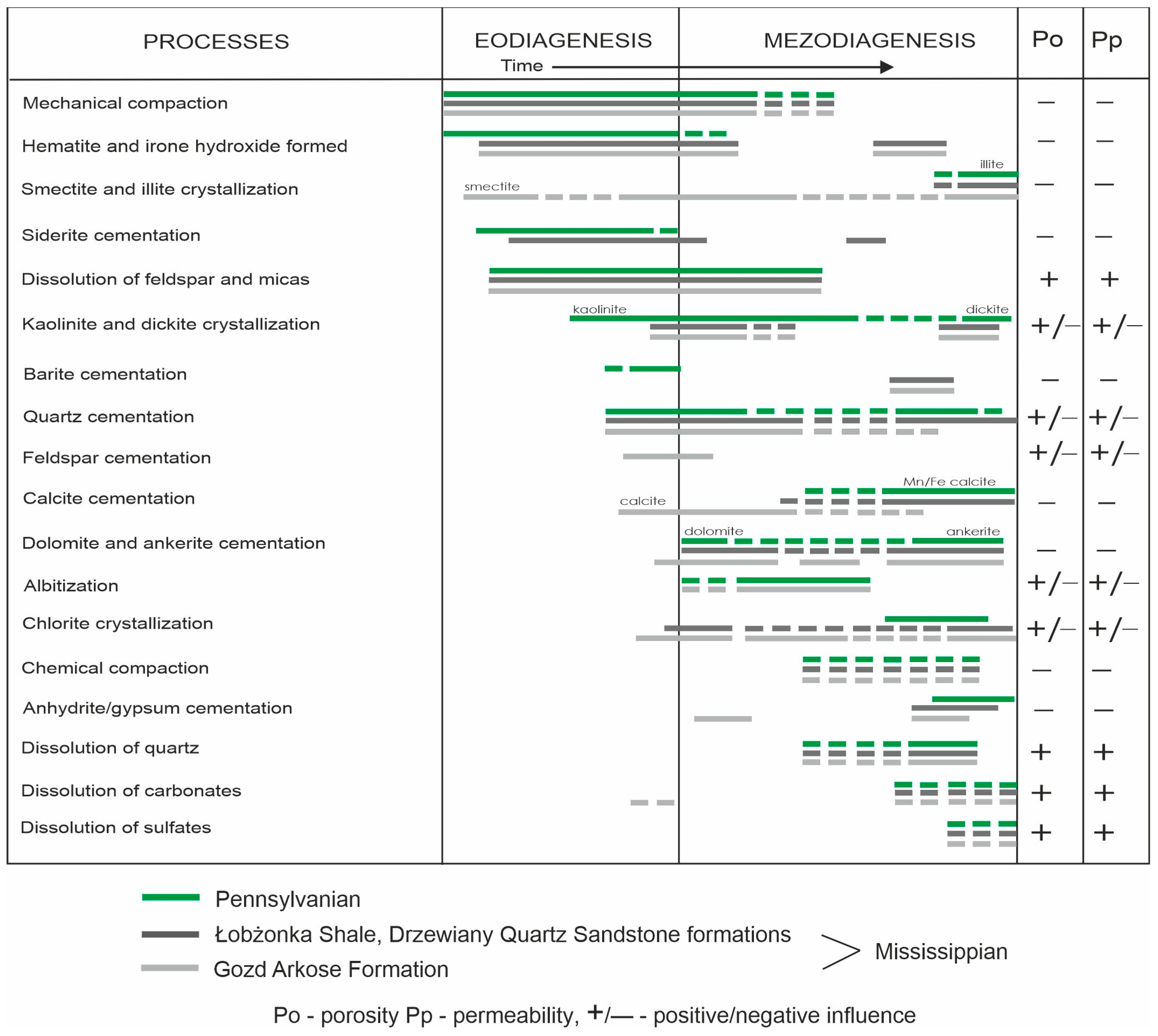
5.1. Formation of Authigenic Minerals Against the Background of Diagenesis History
5.2. Reservoir Properties
5.2.1. Mississippian Sandstones
5.2.2. Pennsylvanian Sandstones
6. Conclusions
- The Mississippian sandstones are represented mainly by arkosic and lithic arenites and wackes of the Gozd Arkose Formation, as well as quartz arenites and wackes of the Drzewiany Sandstone and Łobżonka Shale formations. The rocks differ in terms of their grain composition and the type and content of their cementing materials. In the sandstones of the Gozd Arkose Formation, the grain framework is composed of feldspars, quartz, and lithoclasts, mostly of volcanic origin. The cementing materials are represented by a matrix and cements, the most important of which are carbonate and anhydrite. In the Drzewiany Sandstone and Łobżonka Shale sandstones, the main grain component is quartz, bound by quartz cement and matrix and locally by carbonates and anhydrite.
- The Drzewiany Sandstone Formation sandstones, among the Mississippian sandstones, are excellent reservoir rocks for hydrocarbon accumulation thanks to their mineralogical and textural maturity. Their primary porosity accounts for a significant portion of the rock’s total porosity. With increasing depth, their reservoir properties deteriorate due to increasing silicification in the sandstones. The average porosity of the sandstones is about 18%, with a permeability of even over 1000 mD. The best reservoir properties are found in quartz arenites cemented with authigenic quartz in the form of very thin overgrowths on quartz grains. The Gozd Arkose Formation sandstones may be prospective, but due to their very complex diagenetic history, their petrophysical properties are not very favorable. These rocks exhibit mainly secondary porosity (dissolution of feldspar grains and lithoclasts). They are characterized by a porosity of typically <5%, locally around 10%, and are usually impermeable. The Łobżonka Shale Formation sandstones show unfavorable reservoir properties. They occur at the greatest depths within the studied section of the Mississippian sandstones. These are massive, strongly diagenetically altered rocks. They are characterized by a porosity of about 1% and are impermeable.
- The Pennsylvanian sandstones of the Wolin, Rega, and Dziwna formations are represented by arenites and quartz wackes, locally subarcosic. The main component of the grain framework is quartz, with much smaller amounts of mica, feldspars, and rock clasts. The main components of the cementing materials are a matrix and cements: quartz, kaolinite, carbonate, anhydrite, and hematite.
- The sandstones of the Wolin and Rega formations are characterized by good reservoir properties, while the Dziwna Formation sandstones have poorer properties. The porosity of the Pennsylvanian sandstones ranges from <1 to >20%. Primary porosity dominates, while secondary porosity (dissolution of grains and cements, microcrystalline) accounts for a negligible percentage. The permeability of the sandstones of the Wolin and Rega formations exceeds 200 mD in places, most often amounting to several tens of mD. The Dziwna Formation sandstones are often impermeable. In the Pennsylvanian sections, quartz arenites, whose main cementing components are authigenic quartz and kaolinite, exhibit the best reservoir qualities.
Funding
Data Availability Statement
Acknowledgments
Conflicts of Interest
References
- Rahman, M.J.J.; Worden, R.H. Diagenesis and its impact on reservoir quality of Miocene sandstones (Surma Group) from the Bengal Basin, Bangladesh. Mar. Petr. Geol. 2016, 77, 898–915. [Google Scholar] [CrossRef] [Scilit]
- Kozłowska, A.; Waksmundzka, M.I. Diagenesis, sequence stratigraphy and reservoir quality of the Carboniferous deposits of the southeastern Lublin Basin (SE Poland). Geol. Quart. 2020, 64, 422–459. [Google Scholar] [CrossRef]
- Javed, A.; Khan, K.F.; Quasim, M.A.; Asjad, S. Diagenetic characteristics and their implications on the reservoir potencial of Bajocian Sandstone, Jaisalmer Basin, western Rajasthan. Geosyst. Geoenvir. 2023, 100219. [Google Scholar] [CrossRef] [Scilit]
- Munir, M.N.; Zafar, M.; Ehsan, M.; Chen, R.; Abdelrahman, K.; Ullah, J.; Hayat, T.; Rahim, H.U. Diagenetic and mineralogical impacts on clastic reservoir; A case study from the lower Indus Basin, Pakistan. J. Asian Earth Sc. 2025, 283, 106539. [Google Scholar] [CrossRef] [Scilit]
- Lipiec, M.; Matyja, H. Depisitional architecture of the Lower Carboniferous sedimentary basin in Pomerania. In Sedimentary Basin Analysis of the Polish Lowlands; Narkiewicz, M., Ed.; Prace Państwowego Instytutu Geologicznego: Warsaw, Poland, 1998; Volume 165, pp. 101–111, (In Polish with English Summary). [Google Scholar]
- Matyja, H. Stratigraphy and facies development of Devonian and Carboniferous deposits in the Pomeranian basin and in the western part of the Baltic Basin and palaeography of the northern TESZ during Late Palaeozoic times. Prace Państw. Inst. Geol. 2006, 186, 79–122, (In Polish with English Summary). [Google Scholar]
- Matyja, H. Pomeranian basin (NW Poland) and its sedimentary evolution during Mississipian times. Geol. Jour. 2008, 43, 123–150. [Google Scholar] [CrossRef] [Scilit]
- Żelichowski, A.M. Carboniferous. Development of sedimentation. In Geological Structure of the Pomeranian Swell and Its Basement; Raczyńska, A., Ed.; Prace Instytutu Geologicznego: Warsaw, Poland, 1987; Volume 119, pp. 26–51, (In Polish with English Summary). [Google Scholar]
- Łaszcz-Filakowa, B. Perspectives for the gas potential of the Carboniferous sediments. In Geological Structure of the Pomeranian Swell and Its Basement; Raczyńska, A., Ed.; Prace Instytutu Geologicznego: Warsaw, Poland, 1987; Volume 119, pp. 225–227, (In Polish with English Summary). [Google Scholar]
- Dadlez, R.; Wagner, R. Exploration for oil and gas in North-Western Poland in the years 1955–1985. Prz. Geol. 1986, 34, 422–427, (In Polish with English Summary). [Google Scholar]
- Muszyński, M. The mineralogical and petrographical characterization of the Carboniferous sedimentary rocks of the Pomeranian Trough (the region of Bobolice). Prace Mineral. 1976, 48, 3–67, (In Polish with English Summary). [Google Scholar]
- Muszyński, M.; Biernacka, J.; Lorenc, S.; Protas, A.; Urbanek, Z.; Wojewoda, J. Petrology and depositional environment of Lower Carboniferous rocks, near Dygowo and Kłanino (the Koszalin-Chojnice zone). Geologos 1996, 1, 93–126, (In Polish with English Summary). [Google Scholar]
- Połońska, M. Petrological features of Carboniferous sandstones from the Western Pomerania and their petrophysical parameters. In Proceedings of the 2nd Conference on the Geochemical and Petrophysical Investigations in Oil and Gas Exploration, Cracow, Poland, 10–12 April 1996; IGNiG: Kraków, Poland, 1996; pp. 230–231. [Google Scholar]
- Połońska, M. Studies the diagenesis of the Carboniferous sediments from the Western Pomerania. In Sedimentary Basin Anaysis of the Polish Lowlands—The Carboniferous Basin; Narkiewicz, M., Ed.; Archive materials; Central Geological Archive, Polish Geological Institute: Warszawa, Poland, 1996. No 3586/96. (In Polish) [Google Scholar]
- Połońska, M. Assessment of the Nature of Diagenetic Changes in the Carboniferous Sandstones of the Western Pomerania Based on Selected Boreholes; Archive materials; Central Geological Archive, Polish Geological Institute: Warszawa, Poland, 1996. No 504/97. (In Polish) [Google Scholar]
- Połońska, M. Carbonate cements in sandstone formations of the Lower Carboniferous in the West Pomerania. Prz. Geol. 2000, 48, 924–928, (In Polish with English Summary). [Google Scholar]
- Darłak, B.; Kowalska-Włodarczyk, M.; Kobyłecka, A.; Leśniak, G.; Such, P. Review of reservoir and filtration properties of selected reservoir rocks from the Devonian to Permian basins of the Polish Lowlwnds. In Sedimentary Basin Analysis of the Polish Lowlands; Narkiewicz, M., Ed.; Prace Państwowego Instytutu Geologicznego: Warszawa, Poland, 1998; Volume 165, pp. 147–153, (In Polish with English Summary). [Google Scholar]
- Lipiec, M.; Połońska, M.; Such, P. Influence of diagenesis on reservoir properties of the Carboniferous deposits of Pomerania. In Sedimentary Basin Analysis of the Polish Lowlands; Narkiewicz, M., Ed.; Prace Państwowego Instytutu Geologicznego: Warszawa, Poland, 1998; Volume 165, pp. 155–166, (In Polish with English Summary). [Google Scholar]
- Kozłowska, A. Diagenesis and pore space evolution in Pennsylvanian sandstones from Western Pomerania. Biul. Państw. Inst. Geol. 2008, 430, 1–28, (In Polish with English Summary). [Google Scholar]
- Kuberska, M. The sandstones from the Pennsylvanian/Lower Permian transition in Western Pomerania: Diagenesis and its role in reservoir quality. Biul. Państw. Inst. Geol. 2008, 430, 29–42, (In Polish with English Summary). [Google Scholar]
- Kozłowska, A. Thermal conditions during diagenesis of Pennsylvanian sandstones in the Baltic Sea area. Prz. Geol. 2019, 67, 167–168, (In Polish with English Summary). [Google Scholar] [CrossRef] [Scilit]
- Kozłowska, A.; Waksmundzka, M.I. Sedimentological and petrographic characteristics of the Dziwna Formation (Stephanian-?Autunian) in the Strzeżewo 1 borehole section from Western Pomerania. Prz. Geol. 2025, 73, 391–397, (In Polish with English summary). [Google Scholar] [CrossRef] [Scilit]
- Połońska, M. Lithofacies development of the Lower Carboniferous sediments [Archive materials]. In Characteristics of Mineral Fillings in Fractures and Pore Spaces Based on Comprehensive Petrological Studies; Jackowicz, E., Ed.; Task No. 3. Cements in the Carboniferous and Rotligend sandstones of the Western Pomerania; Central Geological Archive, Polish Geological Institute: Warszawa, Poland, 2004. No 2239/2004. (In Polish) [Google Scholar]
- Biernacka, J. Diagenetic changes of the Lower Carboniferous arkose sandstones of the Western Pomerania. In Geological and Petrological Position of the Permian Basement Rocks in the Koszalin-Chojnice Zone; Protas, A., Mikołajewski, Z., Buniak, A., Eds.; Bogucki Wydawnictwo Naukowe: Poznań, Poland, 2004; pp. 29–41. (In Polish) [Google Scholar]
- Kuberska, M.; Kozłowska, A.; Maliszewska, A.; Buniak, A. Evolution of pore space in the Upper Carboniferous and Lower Permian sandstones from Western Pomerania. Prz. Geol. 2007, 55, 853–860, (In Polish with English Summary). [Google Scholar]
- Dadlez, R. Pomeranian Caledonides (NW Poland), fifty years of controversies: A review and new concept. Geol. Quart. 2000, 44, 221–236. [Google Scholar]
- Królikowski, C.; Petecki, Z.; Żółtowski, Z. Main structural units in the Polish part of the East European Platform in the light of gravimetric data. Biul. Państw. Inst. Geol. 1999, 386, 5–58, (In Polish with English Summary). [Google Scholar]
- Lipiec, M.; Żelichowski, A.M. Carboniferous. In Geological Structure of the Variscan Strata and the Permian Cover in the Wierzchowo–Koszalin Region; Archive materials; Central Geological Archive, Polish Geological Institute: Warszawa, Poland, 1995. No 2233 /95. (In Polish) [Google Scholar]
- Pettijohn, F.J.; Potter, P.E.; Siever, R. Sand and Sandstones; Springer: New York, NY, USA, 1972. [Google Scholar]
- Jaworowski, K. Petrographic canon of the most common sedimentary rocks. Prz. Geol. 1987, 4, 205–209. (In Polish) [Google Scholar]
- Ryka, W.; Maliszewska, A. Dictionary of Petrology, 2nd ed.; Wydawnictwo Geologiczne: Warszawa, Poland, 1991. (In Polish) [Google Scholar]
- Czerwonka, A. Selected issues of diagenesis of the Upper Carboniferous sediments in the Western Pomerania. Naft. i Gaz 1992, 5/6, 140–153, (In Polish with English Summary). [Google Scholar]
- Burley, S.D.; Worden, R.H. Sandstone diagenesis: The evolution of sand to stone. In Sandstone Diagenesis; Recent and Ancient; Burley, S.D., Worden, R.H., Eds.; International Association of Sedimentologists: Ghent, Belgium, 2023; Volume 4, pp. 3–44. [Google Scholar] [CrossRef] [Scilit]
- Kozłowska, A. Diagenesis of the Upper Carboniferous sandstones occurring at the border of the Lublin Trough and the Warsaw Block. Biul. Państw. Inst. Geol. 2004, 411, 5–86, (In Polish with English Summary). [Google Scholar]
- Baker, J.C.J.; Kassan, J.; Hamilton, P.J. Early diagenetic siderite as indicator of depositional environment in the Triassic Rewan Group, Southern Bowen basin, eastern Australia. Sedimentology 1995, 43, 77–88. [Google Scholar] [CrossRef] [Scilit]
- Van Keer, I.; Muchles, P.H.; Viaene, W. Clay mineralogical variations and evolutions in sandstones sequences near a coal seam and shales in the Westphalian of the Campine Basin (NE Belgium). Clay Miner. 1998, 33, 159–169. [Google Scholar] [CrossRef] [Scilit]
- Osborne, M.; Haszeldine, R.S.; Fallick, A.E. Variation in kaolinite morphology with growth temperature in isotopically mixed pore-fluids, Brent Group, UK North Sea. Clay Miner. 1994, 29, 591–608. [Google Scholar] [CrossRef] [Scilit]
- Bjørlykke, K. Sedimentology and Petroleum Geology; Springer: Berlin/Heidelberg, Germany, 1989. [Google Scholar]
- Ehrenberg, S.N.; Aagaard, P.; Wilson, M.J.; Fraser, A.R.; Duthie, D.M.L. Depth—Dependent transformation of kaolinite to dickite in sandstones of the Norwegian Continental Shelf. Clay Miner. 1993, 28, 325–352. [Google Scholar] [CrossRef] [Scilit]
- Beaufort, D.; Cassagrabere, A.; Petit, S.; Lanson, B.; Berger, G.; Lacharpagne, J.C.; Johansen, H. 1998 Kaolinite—To—Dickite reaction in sandstone reservoirs. Clay Miner. 1998, 33, 237–316. [Google Scholar] [CrossRef] [Scilit]
- McAulay, G.E.; Burley, S.D.; Johnes, L.H. Silicate mineral authigenesis in the Hutton and NW Hutton fields: Implications for sub—Surface porosity development. In Petroleum Geology of Northwest Europe: Proceeding of the 4th Conference; Parker, J.R., Ed.; Geological Society: London, UK, 1993; pp. 1377–1394. Available online: http://pgc.lyellcollection.org (accessed on 25 July 2013).
- Strong, G.E.; Milodowski, A.E. Aspects of the diagenesis of the Sherwood sandstones of the Wessex Basin and their influence on reservoir characteristics. In Diagenesis of Sedimentary Sequences; Marshall, J.D., Ed.; Geological Society Special Publication: Bath, UK, 1987; Volume 36, pp. 325–337. [Google Scholar] [CrossRef] [Scilit]
- Morad, S.; Bergan, M.; Knarud, R.; Nystuen, J.P. Albitization of detrital plagioclase in Triassic reservoir sandstones from the Snorre Field, Norwegian North Sea. J. Sedim. Petrol. 1990, 60, 411–425. [Google Scholar] [CrossRef] [Scilit]
- Aagard, P.; Egeberg, P.K.; Saigal, G.C.; Morad, S.; Bjørlykke, K. Diagenetic albitization of detrital K-feldspars in Jurassic, Lower Cretaceous and Tertiary clastic reservoir rocks from offshore Norway, II. Formation water chemistry and kinetic considerations. J. Sedim. Petrol. 1990, 60, 575–581. [Google Scholar] [CrossRef] [Scilit]
- Boles, J.R. Active albitization of plagioclase, Gulf Coast Tertiary. Amer. J. Sci. 1982, 282, 165–180. [Google Scholar] [CrossRef] [Scilit]
- Walderhaug, O.; Porten, K.W. Temperatures of albitization of plagioclase in sandstones from the Norwegian continental shelf. J. Sedim. Res. 2025, 95, 544–561. [Google Scholar] [CrossRef] [Scilit]
- Boles, J.R.; Franks, S.G. Clay diagenesis in Wilcox sandstones of Southwest Texas: Implications of smectite diagenesis on sandstones cementation. J. Sedim. Petrol. 1979, 49, 55–70. [Google Scholar] [CrossRef] [Scilit]
- Hesse, R.; Abid, I.A. Carbonate cementation—The key to reservoir properties of four sandstone levels (Cretaceous) in the Hibernia Oilfield Jeanne d’Arc Basin, Newfoundland, Canada. Spec. Publ. Int. Ass. Sediment 1998, 26, 363–393. [Google Scholar] [CrossRef] [Scilit]
- Ehrenberg, S.N.; Nadeau, P.H. Formation of diagenetic illite in sandstone of the Garn formation, Haltenbanken area, mid—Norwegian continental shelf. Clay Miner. 1989, 24, 233–253. [Google Scholar] [CrossRef] [Scilit]
- Bjørlykke, K.; Aagaard, P. Clay minerals in North Sea sandstones. In Origin, Diagenesis and Petrophysics of Clay Minerals in Sandstones; Hauseknecht, D.W., Pittman, E.D., Eds.; Spectator Publishing: New York, NY, USA, 1992; Volume 47, pp. 65–80. [Google Scholar] [CrossRef] [Scilit]
- Lanson, B.; Beaufort, D.; Berger, G.; Baradat, J.; Jacharpagne, J.C. Illityzation of diagenetic kaolinite—To—Illite conversion series: Late—Stage diagenesis of the Lower Permian Rotliegend sandstone reservoirs, offshore of the Netherlands. J. Sedim. Res. 1996, 66, 501–518. [Google Scholar] [CrossRef] [Scilit]
- Chuhan, F.A.; Bjørlykke, K.; Lowrey, C. Close system diagenesis in reservoir sandstones: Examples from the Garn Formation at Haltenbanken area, offshore Mid-Norway. J. Sedim. Res. 2001, 71, 15–26. [Google Scholar] [CrossRef] [Scilit]
- Jenyon, M.K. Oil and Gas Traps. In Aspects of Their Seismostratigraphy, Morphology and Development; John Wiley and Sons: Hoboken, NJ, YSA, 1990. [Google Scholar]
- Levorsen, A.I. Geology of Petroleum; Freeman and Company: San Francisco, CA, USA, 1956. [Google Scholar]
- Houseknecht, D.W. Assessing the relative importance of compaction processes and cementation to reduction of porosity in sandstones. AAPG Bull. 1987, 71, 633–642. [Google Scholar] [CrossRef] [Scilit]
- Ehrenberg, S.N. Assessing the relative importance of compaction processes and cementation to reduction of porosity in sadndtones: Discussion; Compaction and porosity evolution of Pliocene sandstones, Ventura Basin, California: Discussion. AAPG Bull. 1989, 73, 1274–1276. [Google Scholar] [CrossRef] [Scilit]



| Age | Formation | Borehole | Depth/Thickness [m] | Number of Samples |
|---|---|---|---|---|
| Pennsylvanian | Dziwna | Gorzysław 10 | 2859.0–2807.0/52.0 | 12 |
| Strzeżewo 1 | 3442.5–3199.0/243.5 | 16 | ||
| Wrzosowo 8 | 3180.0–3077.5/102.5 | 11 | ||
| Rega | Gorzysław 10 | 3010.0–2884.0/126.0 | 14 | |
| Strzeżewo 1 | 3608.0–3442.5/165.5 | 4 | ||
| Wrzosowo 8 | 3310.0–3180.0/130.0 | 10 | ||
| Wolin | Gorzysław 10 | 3058.5–3010.0/48.5 | 1 | |
| Sarbinowo 1 | 2494.0–2387.0/107.0 | 7 | ||
| Strzeżewo 1 | 3890.0–3608.0/282.0 | 13 | ||
| Mississippian | Drzewiany Sandstone | Dygowo 1 | 3133.5–3218.5/85.0 | 19 |
| Koszalin IG 1 | 3012.0–2349.0/663.0 | 80 | ||
| Ustronie IG 1 | 3180.6–3105.5/75.0 | 6 | ||
| Gozd Arkose | Chmielno 1 | 3952.0–3578.0/374.0 | 15 | |
| Daszewo 3P | 3205.0–3260.0/45.0 | 20 | ||
| Dygowo 1 | 3831.0–3450.0/381.0 | 50 | ||
| Kłanino 3 | 3048.0–2456.0/592.0 | 80 | ||
| Łobżonka Shale | Czaplinek IG 1 | 6006.0–5703.5/302.5 | 12 | |
| Moracz IG 1 | 4722.0–4581.0/140.0 | 17 | ||
| Zabartowo 2 | 4569.5–3900.0/669.5 | 8 |
| Authigenic Minerals | Formations | |||||
|---|---|---|---|---|---|---|
| Łobżonka Shale | Gozd Arkose | Drzewiany Sandstone | Wolin | Rega | Dziwna | |
| kaolinite/dickite | +/?+ | +/?+ | + | +/+ | +/+ | +/+ |
| illite | + | + | − | + | + | + |
| mixed-layer illite/smectite | − | + | − | + | + | − |
| chlorite | + (Fe/Mg) | + | + (Fe) | − | − | + (Fe) |
| quartz/chalcedony | + | +/+ | + | + | + | + |
| calcite | + (Mn) | + (Mn/Fe) | + (Mn) | + (Mn) | + (Mn/Fe) | + (Mn) |
| dolomite/ankerite | +/+ | +/+ | +/+ | +/+ | +/+ | +/+ |
| siderite | + | − | + | + | − | − |
| anhydrite/gypsum | + | + | +/+ | + | + | + |
| barite | − | + | + | + | + | + |
| hematite | + | + | + | + | + | + |
| pyrite | + | + | + | + | + | + |
| feldspar | − | + | − | − | − | − |
| Age | Borehole | Depth (m) | Mg wt.% | Ca wt.% | Mn wt.% | Fe wt.% | MgCO3 mol% | CaCO3 mol% | MnCO3 mol% | FeCO3 mol% | Carbonate Type |
|---|---|---|---|---|---|---|---|---|---|---|---|
| Pennsylvania | Dziwna Formation | ||||||||||
| Strzeżewo 1 | 3318.46 | 0.14 | 38.19 | 1.32 | 0.00 | 0.5 | 96.7 | 2.8 | 0.0 | Mn-calcite | |
| 3349.71 | 0.27 | 37.61 | 2.91 | 0.00 | 0.9 | 93.1 | 6.0 | 0.0 | Mn-calcite | ||
| 0.33 | 37.90 | 1.92 | 0.00 | 1.2 | 94.8 | 4.0 | 0.0 | Mn-calcite | |||
| 3402.06 | 0.25 | 37.41 | 2.11 | 0.00 | 0.9 | 94.6 | 4.5 | 0.0 | Mn-calcite | ||
| 12.97 | 22.72 | 0.02 | 0.03 | 44.4 | 55.5 | 0.0 | 0.1 | dolomite | |||
| Rega Formation | |||||||||||
| Wrzosowo 8 | 3187.6 * | 0.05 | 39.48 | 0.81 | 0.03 | 0.2 | 98.0 | 1.7 | 0.1 | Mn/Fe-calcite | |
| 3192.4 * | 0.45 | 37.18 | 1.95 | 0.77 | 1.6 | 92.8 | 4.1 | 1.6 | Mn/Fe-calcite | ||
| 0.28 | 37.85 | 1.56 | 0.20 | 1.0 | 95.3 | 3.3 | 0.4 | Mn/Fe-calcite | |||
| 3193.6 * | 0.00 | 38.06 | 2.40 | 0.00 | 0.0 | 95.0 | 0.5 | 0.0 | Mn-calcite | ||
| 0.00 | 39.83 | 2.51 | 0.00 | 0.0 | 97.8 | 3.4 | 0.0 | Mn-calcite | |||
| Wolin Formation | |||||||||||
| Gorzysław 10 | 3043.3 * | 12.92 | 19.79 | 2.72 | 0.00 | 44.9 | 49.4 | 5.7 | 0.0 | dolomite | |
| Sarbinowo 1 | 2455.3 * | 10.56 | 22.84 | 0.89 | 0.00 | 38.3 | 59.7 | 2.0 | 0.0 | dolomite | |
| Strzeżewo 1 | 3463.1 * | 0.00 | 36.74 | 1.51 | 0.00 | 0.0 | 96.6 | 3.4 | 0.0 | Mn-calcite | |
| 3888.5 * | 7.42 | 21.08 | 1.52 | 9.28 | 25.5 | 52.2 | 3.2 | 19.1 | ankerite | ||
| Mississippian | Drzewiany Sandstone Formation | ||||||||||
| Dygowo 1 | 3157.4 | 0.34 | 39.61 | 0.91 | 0.26 | 1.2 | 96.5 | 1.8 | 0.5 | Mn-calcite | |
| Koszalin IG 1 | 2577.7 | 11.79 | 22.78 | 0.56 | 1.42 | 39.4 | 54.3 | 1.1 | 5.2 | Fe-dolomite | |
| 2675.8 | 0.46 | 44.49 | 0.99 | 0.59 | 1.4 | 95.8 | 1.8 | 1.0 | Mn/Fe-calcite | ||
| 7.0 | 25.50 | 1.05 | 9.99 | 22.0 | 57.4 | 2.0 | 18.6 | ankerite | |||
| 7.81 | 23.58 | 1.98 | 4.41 | 27.4 | 59.3 | 4.1 | 9.2 | Fe-dolomite | |||
| 6.70 | 21.78 | 0.64 | 9.08 | 23.9 | 55.6 | 1.3 | 19.2 | ankerite | |||
| 12.03 | 0.83 | 1.72 | 22.19 | 44.9 | 2.2 | 3.9 | 49.0 | pistomesite | |||
| 2687.3 | 7.29 | 23.94 | 0.92 | 8.75 | 24.2 | 56.8 | 1.8 | 17.2 | ankerite | ||
| 7.32 | 0.34 | 1.93 | 35.41 | 24.7 | 0.8 | 3.9 | 70.7 | sideroplesite | |||
| 2803.6 | 12.35 | 22.44 | 0.43 | 1.14 | 42.1 | 54.7 | 0.9 | 2.3 | Fe-dolomite | ||
| Gozd Arkose Formation | |||||||||||
| Daszewo 3P | 3207.7 | 11.49 | 22.81 | 0.44 | 0.41 | 40.4 | 57.8 | 0.9 | 0.9 | dolomite | |
| 3219.0 | 12.87 | 24.38 | 0.43 | 0.08 | 42.0 | 57.0 | 0.8 | 0.2 | dolimite | ||
| 3228.2 | 0.32 | 40.78 | 0.36 | 0.60 | 1.1 | 97.0 | 0.7 | 1.2 | Fe/Mn-calcite | ||
| 11.05 | 24.40 | 1.02 | 3.79 | 35.0 | 55.8 | 2.0 | 7.2 | Fe-dolomite | |||
| Dygowo 1 | 3459.6 | 0.00 | 42.05 | 0.52 | 0.29 | 0.0 | 98.4 | 1.0 | 0.6 | Mn/Fe-calcite | |
| 7.71 | 28.49 | 1.25 | 5.61 | 24.0 | 63.4 | 2.3 | 10.3 | ankerite | |||
| 3513.8 | 11.03 | 26.74 | 1.95 | 3.60 | 33.6 | 56.6 | 3.5 | 6.3 | Fe-dolomite | ||
| 13.87 | 25.33 | 0.59 | 0.34 | 40.5 | 52.8 | 6.1 | 0.6 | dolomite | |||
| 3257.5 | 13.79 | 26.64 | 0.77 | 0.48 | 41.1 | 56.7 | 1.4 | 0.8 | dolomite | ||
| 3634.8 | 0.31 | 42.16 | 0.00 | 0.58 | 1.0 | 98.9 | 0.0 | 1.1 | Fe-calcite | ||
| 8.46 | 24.84 | 0.00 | 3.91 | 29.7 | 62.2 | 0 | 8.1 | Fe-dolomite | |||
| 3651.0 | 0.41 | 44.04 | 0.11 | 0.59 | 1.2 | 97.5 | 0.2 | 1.1 | Fe-calcite | ||
| 9.97 | 24.68 | 0.15 | 4.45 | 32.8 | 58.2 | 0.3 | 8.7 | Fe-dolomite | |||
| 3792.0 | 0.35 | 43.16 | 0.30 | 0.27 | 1.1 | 97.9 | 0.5 | 0.5 | Mn/Fe-calcite | ||
| 13.59 | 25.36 | 0.32 | 1.36 | 41.6 | 55.4 | 0.6 | 2.4 | Fe-dolomite | |||
| 9.98 | 24.36 | 0.46 | 7.22 | 31.2 | 54.6 | 0.8 | 13.4 | ankerite | |||
| Kłanino 3 | 2506.6 | 12.39 | 22.19 | 0 | 0.57 | 43.4 | 55.5 | 0.0 | 1.1 | dolomite | |
| 12.55 | 22.80 | 0.15 | 0.69 | 42.8 | 55.7 | 0.3 | 1.4 | dolomite | |||
| 2512.8 | 0.34 | 39.58 | 0.00 | 0.00 | 1.2 | 98.8 | 0.0 | 0.0 | calcite | ||
| 9.89 | 21.97 | 0.26 | 1.31 | 37.5 | 59.1 | 0.5 | 2.9 | Fe-dolomite | |||
| Kłanino 3 | 0.34 | 40.06 | 0.12 | 0.00 | 1.2 | 98.6 | 0.2 | 0.0 | calcite | ||
| 2525.5 | 0.44 | 46.25 | 0.00 | 0.00 | 1.4 | 98.6 | 0.0 | 0.0 | calcite | ||
| 9.21 | 22.65 | 0.27 | 1.74 | 34.6 | 60.9 | 0.6 | 3.9 | Fe-dolomite | |||
| 8.07 | 22.25 | 0.72 | 5.12 | 29.4 | 58.3 | 1.5 | 10.8 | ankerite | |||
| 2563.9 | 0.39 | 40.58 | 0.38 | 0.36 | 1.3 | 97.2 | 0.8 | 0.7 | Mn/Fe-calcite | ||
| 10.74 | 22.96 | 0.42 | 2.57 | 37.2 | 56.7 | 0.9 | 5.2 | Fe-dolomite | |||
| 9.57 | 23.53 | 0.34 | 1.03 | 35.2 | 61.9 | 0.7 | 2.2 | Fe-dolomite | |||
| 7.99 | 21.87 | 0.41 | 3.10 | 31.1 | 60.8 | 1.0 | 7.1 | Fe-dolomite | |||
| 7.71 | 22.34 | 0.32 | 3.78 | 29.5 | 61.2 | 0.8 | 8.5 | Fe-dolomite | |||
| 2672.4 | 10.10 | 22.18 | 0.26 | 0.65 | 38.2 | 59.8 | 0.6 | 1.4 | dolomite | ||
| 7.52 | 21.62 | 0.86 | 6.45 | 27.5 | 56.5 | 1.9 | 14.1 | ankerite | |||
| 2694.2 | 12.04 | 23.04 | 0.50 | 1.66 | 41.2 | 54.7 | 0.9 | 3.2 | Fe-dolomite | ||
| 2755.0 | 14.34 | 28.10 | 0.00 | 0.00 | 41.7 | 58.3 | 0.0 | 0.0 | dolomite | ||
| 13.94 | 28.07 | 0.00 | 2.69 | 39.2 | 56.3 | 0.0 | 4.5 | Fe-dolomite | |||
| 2778.0 | 11.52 | 22.93 | 0.26 | 2.65 | 40.3 | 57.3 | 0.5 | 5.5 | Fe-dolomite | ||
| 2996.2 | 6.51 | 22.25 | 0.93 | 7.69 | 25.1 | 61.3 | 2.1 | 11.5 | ankerite | ||
| 10.65 | 23.45 | 0.16 | 0.00 | 38.8 | 60.9 | 0.3 | 0.0 | dolomite | |||
| 10.35 | 23.30 | 0.40 | 1.14 | 37.1 | 59.6 | 0.8 | 2.5 | Fe-dolomite | |||
| 3038.9 | 9.52 | 22.56 | 0.00 | 1.72 | 35.7 | 60.4 | 0.0 | 3.9 | Fe-dolomite | ||
| Łobżonka Shale Formation | |||||||||||
| Moracz IG 1 | 4649.3 | 0.25 | 41.11 | 0.24 | 0.26 | 0.9 | 98.2 | 0.5 | 0.5 | Mn/Fe-calcite | |
| 0.61 | 41.61 | 0.00 | 0.44 | 2.0 | 97.2 | 0.0 | 0.8 | Fe-calcite | |||
| 4714.2 | 0.00 | 39.01 | 0.00 | 0.39 | 0.0 | 99.2 | 0.0 | 0.8 | Fe-calcite | ||
| 0.15 | 40.34 | 0.00 | 0.98 | 0.5 | 97.6 | 0.0 | 1.9 | Fe-calcite | |||
| 7.28 | 22.39 | 0.33 | 8.50 | 25.6 | 56.1 | 0.7 | 17.6 | ankerite | |||
| Age | Formation | Borehole | Depth | Grain | Effective | Bulk | Porosimeter | Porosimeter | Average | Specific | Pores | Threshold | Hysteresis | Permeability |
|---|---|---|---|---|---|---|---|---|---|---|---|---|---|---|
| Density | Density | Porosity | Density | Porosity | Capillary | Surface | >1 µm | Diameter | ||||||
| [m] | [g/cm3] | [%] | [g/cm3] | [g/cm3] | [%] | [µm] | [m2/g] | [%] | [µm] | [%] | [mD] | |||
| Pennsylvanian | Dziwna | Strzeżewo 1 | 3317.50 | 2.62 | 11.20 | 2.71 | 2.35 | 10.24 | 0.11 | 1.56 | 53.00 | 2.50 | 68 | n.p. |
| 3321.50 | 2.63 | 8.11 | 2.69 | 2.43 | 7.63 | 0.54 | 0.23 | 57.00 | 3.00 | 70 | n.p. | |||
| 3395.10 | 2.60 | 10.45 | 2.70 | 2.36 | 9.50 | 0.22 | 0.74 | 62.00 | 5.00 | 72 | 2.33 | |||
| 3402.20 | 2.67 | 13.50 | 2.75 | 2.34 | 12.48 | 0.13 | 1.62 | 62.00 | 4.00 | 67 | 7.44 | |||
| 3412.20 | 2.63 | 3.52 | 2.70 | 2.55 | 3.28 | 0.06 | 0.87 | 21.00 | 0.20 | 32 | n.p. | |||
| 3413.20 | 2.55 | 5.70 | 2.68 | 2.43 | 5.05 | 0.45 | 0.19 | 47.00 | 1.50 | 74 | n.p. | |||
| 3431.10 | 2.46 | 0.41 | 2.75 | 2.45 | 0.32 | 0.00 | 0.00 | n.d. | n.d. | n.d. | n.p. | |||
| Rega | Gorzysław 10 | 2896.20 | 2.60 | 12.95 | 2.67 | 2.29 | 12.12 | 0.88 | 0.24 | 82.00 | 35.00 | 26 | 40.7107 | |
| 2973.60 | 2.59 | 11.48 | 2.67 | 2.32 | 10.69 | 0.51 | 0.37 | 70.00 | 15.00 | 53 | <0.1 | |||
| Wrzosowo 8 | 3192.40 | 2.64 | 9.57 | 2.69 | 2.40 | 9.17 | 0.20 | 0.76 | 56.00 | 3.00 | 54 | 1.2975 | ||
| 3202.80 | 2.57 | 12.67 | 2.70 | 2.28 | 11.21 | 1.17 | 0.17 | 81.00 | 30.00 | 33 | n.d. | |||
| Wolin | Sarbinowo 1 | 2390.10 | 2.61 | 20.25 | 2.68 | 2.12 | 18.90 | 0.52 | 0.69 | 85.00 | 30.00 | 35 | 230.9008 | |
| 2424.50 | 2.70 | 18.38 | 2.67 | 2.19 | 18.91 | 0.34 | 1.00 | 74.00 | 25.00 | 32 | 28.6291 | |||
| Strzeżewo 1 | 3648.50 | 2.64 | 6.86 | 2.68 | 2.47 | 6.61 | 0.23 | 0.47 | 32.00 | 3.00 | 50 | n.d. | ||
| 3689.70 | 2.67 | 5.59 | 2.44 | 2.33 | 4.55 | 0.83 | 0.09 | 71.00 | 6.00 | 65 | 7.52 | |||
| 3724.20 | 2.62 | 10.10 | 2.66 | 2.36 | 9.67 | 0.58 | 0.28 | 70.00 | 9.00 | 57 | 4.2415 | |||
| Mississippian | Drzewiany Sandstone | Dygowo 1 | 3149.90 | 2.68 | 12.29 | 2.67 | 2.34 | 12.17 | 1.19 | 0.17 | 90.00 | 25.00 | 10 | 77.40 |
| 3150.50 | 2.66 | 13.03 | 2.61 | 2.29 | 12.38 | 2.56 | 0.08 | 91.00 | 25.00 | 9 | 92.12 | |||
| 3164.40 | 2.68 | 10.64 | 2.59 | 2.33 | 9.76 | 0.97 | 0.17 | 85.00 | 9.00 | 34 | 39.60 | |||
| 3180.20 | 2.67 | 13.89 | 2.55 | 2.24 | 12.43 | 0.72 | 0.31 | 80.00 | 15.00 | 50 | 66.56 | |||
| 3202.70 | 2.69 | 7.95 | 2.56 | 2.40 | 7.03 | 0.81 | 0.14 | 76.00 | 10.00 | 30 | 24.10 | |||
| Koszalin IG 1 | 2340.70 | 2.73 | 5.91 | 2.14 | 2.06 | 3.73 | 0.24 | 0.30 | 50.00 | n.d. | 25 | 335.30 | ||
| 2354.00 | 2.72 | 9.44 | 2.66 | 2.42 | 8.91 | 0.46 | 0.32 | 84.00 | 25.00 | 10 | 57.50 | |||
| 2360.90 | 2.74 | 25.56 | 2.63 | 2.03 | 23.05 | 3.67 | 0.12 | 98.00 | 30.00 | 2 | 1084.25 | |||
| 2378.20 | 2.77 | 7.61 | 2.15 | 2.05 | 4.72 | 0.17 | 0.54 | 54.00 | n.d. | 44 | 476.48 | |||
| 2414.70 | 2.71 | 28.98 | 2.58 | 1.92 | 25.57 | 1.06 | 0.50 | 92.00 | 25.00 | 7 | n.d. | |||
| 2449.50 | 2.69 | 26.77 | 2.66 | 1,96 | 25.99 | 4.61 | 0.11 | 96.00 | 30.00 | 4 | 1091.90 | |||
| 2463.25 | 2.69 | 12.36 | 2.67 | 2.34 | 12.12 | 0.37 | 0.56 | 89.00 | 12.00 | 20 | 56.64 | |||
| 2515.00 | 2.71 | 3.83 | 2.70 | 2.60 | 3.80 | 0.10 | 0.58 | 24.00 | 2.50 | 55 | n.p. | |||
| 2538.50 | 2.72 | 27.25 | 2.62 | 1.97 | 24.82 | 0.86 | 0.59 | 97.00 | 35.00 | 3 | 971.18 | |||
| 2568.85 | 2.72 | 26.28 | 2.63 | 2.00 | 24.11 | 0.72 | 0.67 | 94.00 | 27.00 | 8 | 457.42 | |||
| 2597.80 | 2.74 | 20.45 | 2.62 | 2.14 | 18.19 | 3.29 | 0.10 | 94.00 | 30.00 | 3 | 187.19 | |||
| 2632.40 | 2.68 | 19.67 | 2.64 | 2.14 | 18.92 | 1.45 | 0.24 | 93.00 | 30.00 | 7 | 154.30 | |||
| 2657.00 | 2.70 | 17.69 | 2.59 | 2.18 | 15.94 | 0.61 | 0.48 | 78.00 | 15.00 | 36 | 75.80 | |||
| 2665.90 | 2.71 | 19.61 | 2.69 | 2.18 | 19.23 | 1.21 | 0.29 | 91.00 | 20.00 | 9 | 156.70 | |||
| Ustronie IG 1 | 3108.10 | 2.60 | 22.45 | 2.72 | 2.08 | 20.03 | 1.76 | 0.22 | 85.00 | 35.00 | 5 | 199.80 | ||
| 3112.50 | 2.70 | 22.29 | 2.60 | 2.07 | 20.25 | 2.37 | 0.17 | 82.00 | 30.00 | 6 | 154.08 | |||
| 3126.90 | 2.69 | 15.61 | 2.58 | 2.22 | 14.06 | 0.49 | 0.52 | 88.00 | 15.00 | 24 | 18.39 | |||
| 3152.70 | 2.74 | 12.47 | 2.58 | 2.30 | 10.83 | 0.39 | 0.49 | 82.00 | 15.00 | 27 | 75.23 | |||
| 3159.40 | 2.69 | 23.09 | 2.79 | 2.08 | 25.65 | 0.52 | 0.95 | 95.00 | 20.00 | 25 | 290.47 | |||
| 3171.20 | 2.71 | 14.41 | 2.49 | 2.19 | 11.85 | 0.42 | 0.52 | 85.00 | 8.00 | 55 | 54.77 | |||
| 3171.40 | 2.70 | 10.55 | 2.49 | 2.27 | 8.72 | 0.76 | 0.20 | 88.00 | 10.00 | 48 | 23.01 | |||
| Gozd Arkose | Chmielno 1 | 3606.60 | 2.67 | 13.02 | 2.55 | 2.25 | 11.55 | 0.10 | 1.99 | 19.00 | 2.00 | 78 | n.p. | |
| 3614.30 | 2.67 | 10.66 | 2.60 | 2.34 | 9.00 | 0.09 | 1.93 | 15.00 | 1.50 | 72 | n.p. | |||
| 3662.50 | 2.69 | 7.44 | 2.61 | 2.43 | 6.88 | 0.07 | 1.72 | 5.00 | 0.70 | 74 | n.p. | |||
| 3899.70 | 2.27 | 8.92 | 2.57 | 2.37 | 7.79 | 0.07 | 1.77 | 65.00 | 6.00 | 51 | 15.09 | |||
| 3910.40 | 2.67 | 7.14 | 2.59 | 2.42 | 6.60 | 0.07 | 1.46 | 26.00 | 2.00 | 69 | n.p. | |||
| 3990.50 | 2.72 | 0.62 | 2.57 | 2.56 | 0.54 | 4.09 | 0.00 | 85.00 | 85.00 | n.d. | n.p. | |||
| Daszewo 3P | 3214.20 | 2.65 | 5.42 | 2.60 | 2.46 | 5.15 | 0.06 | 1.50 | 50.00 | 2.00 | 36 | n.p. | ||
| 3220.10 | 2.80 | 3.07 | 2.62 | 2.59 | 2.59 | 4.75 | 0.00 | 94.00 | n.d. | 52 | n.p. | |||
| Dygowo 1 | 3505.20 | 2.65 | 5.55 | 2.60 | 2.46 | 5.27 | 0.16 | 0.55 | 76.00 | 6.00 | 30 | n.p. | ||
| 3513.80 | 2.67 | 4.61 | 2,59 | 2.48 | 4.27 | 0.05 | 1.32 | 34.00 | 2.00 | 43 | n.d. | |||
| 3527.50 | 2.66 | 3.98 | 2.62 | 2.52 | 3.83 | 0.05 | 1.11 | 33.00 | 2.00 | 55 | n.d. | |||
| 3641.10 | 2.67 | 2.05 | 2.62 | 2.57 | 1.95 | 0.14 | 0.21 | 76.00 | n.d. | 35 | n.d. | |||
| 3657.30 | 2.71 | 1.19 | 2.73 | 2.70 | 1.21 | 0.35 | 0.05 | 71.00 | n.d. | 21 | n.p. | |||
| 3664.50 | 2.68 | 2.93 | 2.65 | 2.57 | 2.86 | 1.23 | 0.04 | 74.00 | 4.00 | 35 | n.p. | |||
| 3665.90 | 2.67 | 3.04 | 2.62 | 2.54 | 2.90 | 0.10 | 0.45 | 55.00 | 2.50 | 41 | n.d. | |||
| 3677.90 | 2.68 | 4.16 | 2.65 | 2.54 | 4.04 | 0.25 | 0.25 | 80.00 | n.d. | 20 | n.d. | |||
| 3717.10 | 2.68 | 3.57 | 2.64 | 2.55 | 3.42 | 0.73 | 0.07 | 69.00 | 5.00 | 26 | n.p. | |||
| 3722.40 | 2.74 | 4.48 | 2.74 | 2.62 | 4.48 | 0.05 | 1.34 | 22.00 | 1.00 | 63 | n.d. | |||
| 3755.10 | 2.64 | 5.96 | 2.56 | 2.42 | 5.51 | 0.13 | 0.72 | 57.00 | 3.00 | 55 | 0.01 | |||
| 3787.50 | 2.64 | 1.45 | 2.58 | 2.53 | 1.97 | 0.30 | 0.10 | 64.00 | 1.50 | 30 | n.p. | |||
| 3792.00 | 2.63 | 2.07 | 2.62 | 2.56 | 2.05 | 0.13 | 0.25 | 56.00 | 2.00 | 45 | n.p. | |||
| 3795.30 | 2.76 | 1.72 | 2.68 | 2.63 | 1.58 | 0.13 | 0.18 | 26.00 | 0.60 | 61 | n.p. | |||
| 3825.70 | 2.77 | 3.20 | 2.68 | 2.60 | 2.94 | 0.04 | 1.07 | 25.00 | 0.60 | 49 | n.d. | |||
| Kłanino 3 | 2465.30 | 2.68 | 0.42 | 2.58 | 2.57 | 0.39 | 0.02 | 0.29 | 7.00 | 0.05 | 95 | n.p. | ||
| 2473.70 | 2.65 | 7.33 | 2.62 | 2.43 | 7.12 | 0.06 | 1.91 | 19.00 | 1.00 | 65 | n.p. | |||
| 2477.60 | 2.64 | 8.74 | 2.61 | 2.39 | 8.47 | 0.07 | 2.13 | 18.00 | 0.40 | 61 | n.p. | |||
| 2501.10 | 2.73 | 8.33 | 2.72 | 2.50 | 8.25 | 0./11 | 1.16 | 43.00 | 2.00 | 75 | n.d. | |||
| 2515.50 | 2.70 | 6.64 | 2.60 | 2.44 | 6.00 | 0.12 | 0.82 | 42.00 | 4.00 | 67 | n.p. | |||
| 2523.50 | 2.67 | 6.29 | 2.59 | 2.44 | 5.80 | 0.24 | 0.39 | 56.00 | 3 | 78 | n.p. | |||
| 2523.70 | 2.65 | 8.94 | 2.59 | 2.37 | 8.44 | 0.16 | 0.91 | 60.00 | 2 | 73 | 0.1 | |||
| 2568.70 | 2.71 | 4.42 | 2.65 | 2.54 | 4.17 | 0.03 | 1.98 | 11.00 | 0 | 62 | n.p. | |||
| 2585.40 | 2.67 | 3.76 | 2.60 | 2.51 | 3.51 | 0.02 | 2.40 | 13.00 | 0 | 60 | n.d. | |||
| 2634.80 | 2.71 | 4.11 | 2.61 | 2.51 | 3.74 | 0.06 | 0.97 | 23.00 | 1 | 53 | n.d. | |||
| 2644.50 | 2.70 | 3.53 | 2.66 | 2.57 | 3.39 | 0.04 | 1.51 | 33.00 | 2 | 55 | 0.1 | |||
| 2681.20 | 2.72 | 11.28 | 2.61 | 2.34 | 10.09 | 0.07 | 2.42 | 10.00 | 0.60 | 72 | n.p. | |||
| 2684.80 | 2.65 | 6.41 | 2./62 | 2.45 | 6.22 | 0.06 | 1.84 | 49.00 | n.d. | 57 | n.p. | |||
| 2694.20 | 2.72 | 5.87 | 2.67 | 2.52 | 5.59 | 0.04 | 2.21 | 14.00 | 0.20 | 66 | n.p. | |||
| 2726.60 | 2.62 | 14.35 | 2.55 | 2.21 | 13.41 | 0.16 | 1.48 | 57.00 | 8.00 | 65 | 3.4 | |||
| 2764.60 | 2.71 | 11.70 | 2.66 | 2.37 | 11.14 | 0.09 | 2.11 | 14.00 | 1 | 69 | n.p. | |||
| 2996.20 | 2.65 | 10.77 | 2.59 | 2.33 | 10.16 | 0.14 | 1.26 | 33.00 | 4.00 | 77 | n.p. | |||
| Łobżonka Shale | Czaplinek IG 1 | 5746.00 | 2.74 | 0.87 | 2.73 | 2.71 | 0.86 | 0.11 | 0.12 | 40.00 | 0.20 | 44 | n.d. | |
| 5900.00 | 2.70 | 0.69 | 2.66 | 2.64 | 0.66 | 0.00 | 0.00 | n.d. | n.d. | n.d. | n.p. | |||
| Moracz IG 1 | 4623.40 | 2.70 | 1.29 | 2.66 | 2.63 | 1.24 | 0.04 | 0.43 | 35.00 | 0.20 | 57 | n.d. | ||
| 4703.00 | 2.69 | 1.24 | 2.68 | 2.65 | 1.23 | 3.69 | 0.01 | 83.00 | 8.00 | 10 | n.p. | |||
| Zabartowo 2 | 3971.70 | 2.64 | 3.80 | 2.66 | 2.54 | 0.25 | 0.63 | 0.23 | 17.00 | 0.90 | 62 | n.p. | ||
| 4400.70 | 2.71 | 0.45 | 2.70 | 2.69 | 0.45 | 0.10 | 0.07 | 70.00 | 0.15 | 25 | n.p. | |||
| 4504.20 | 2.69 | 1.01 | 2.64 | 2.61 | 0.96 | 0.13 | 0.11 | 90.00 | n.d. | 35 | n.p. | |||
| 4549.40 | 2.68 | 0.74 | 2.66 | 2.64 | 0.73 | 0.05 | 0.24 | 46.00 | 0.10 | 48 | n.p. |
Disclaimer/Publisher’s Note: The statements, opinions and data contained in all publications are solely those of the individual author(s) and contributor(s) and not of MDPI and/or the editor(s). MDPI and/or the editor(s) disclaim responsibility for any injury to people or property resulting from any ideas, methods, instructions or products referred to in the content. |
© 2026 by the author. Licensee MDPI, Basel, Switzerland. This article is an open access article distributed under the terms and conditions of the Creative Commons Attribution (CC BY) license.
Share and Cite
Kozłowska, A. The Impact of Diagenesis on the Reservoir Properties of the Carboniferous Sandstones of Western Pomerania (NW Poland). Minerals 2026, 16, 101. https://doi.org/10.3390/min16010101
Kozłowska A. The Impact of Diagenesis on the Reservoir Properties of the Carboniferous Sandstones of Western Pomerania (NW Poland). Minerals. 2026; 16(1):101. https://doi.org/10.3390/min16010101
Chicago/Turabian StyleKozłowska, Aleksandra. 2026. "The Impact of Diagenesis on the Reservoir Properties of the Carboniferous Sandstones of Western Pomerania (NW Poland)" Minerals 16, no. 1: 101. https://doi.org/10.3390/min16010101
APA StyleKozłowska, A. (2026). The Impact of Diagenesis on the Reservoir Properties of the Carboniferous Sandstones of Western Pomerania (NW Poland). Minerals, 16(1), 101. https://doi.org/10.3390/min16010101