1. Introduction
The Unruh effect [
1,
2,
3,
4] stands as a cornerstone prediction of Quantum Field Theory (QFT) in curved spacetimes, asserting that an observer undergoing uniform proper acceleration
a perceives the Minkowski vacuum as a thermalized state. Conversely, an inertial observer detects a vacuum at
K. The Unruh temperature
T, defined by the fundamental coupling
, establishes a deep-seated correspondence between quantum dynamics, thermodynamics, and gravitation, serving as a flat-space analog to Hawking radiation. Despite the prohibitive accelerations required for laboratory-scale verification, the effect’s theoretical implications are being actively explored through quantum simulators and analog gravity systems.
In this context, while the Unruh temperature remains negligible at macroscopic scales (where a 1 g acceleration corresponds to a thermal shift of ~ K), it emerges as a critical factor in high-energy regimes. Modern ultra-intense laser facilities, particularly those operating in the petawatt regime, can subject electrons to extreme proper accelerations over sub-micron scales. Under such intense electromagnetic flux, the Unruh effect ceases to be a theoretical curiosity and becomes a non-negligible contribution to the particle’s radiative dynamics and the surrounding vacuum fluctuations.
In state-of-the-art ultra-intense laser facilities—particularly those reaching the petawatt scale—electrons undergo extreme proper accelerations to relativistic velocities over micron-scale distances. Within these intense electromagnetic backgrounds, the Unruh effect transitions from a theoretical nuance to a non-negligible dynamical factor. The resulting ‘Unruh radiation’ imprints a distinctive thermal signature onto the electron’s Larmor emission spectrum; identifying this signature remains a primary objective for experimental verification and serves as a high-precision diagnostic for characterizing high-energy plasma environments. In this work, we explore a modified relativistic dynamics framework emerging from this thermal vacuum background. Under this formalism, the Unruh-induced thermal bath perceived by the accelerated particle necessitates a quantum–thermal correction to the relativistic energy relation . By accounting for this thermal field, we effectively reintroduce a preferred frame—an ‘ultra-referential’—wherein the particle’s kinematic variables are defined relative to a privileged vacuum state, offering a novel perspective on the interplay between acceleration and spacetime symmetry.
The ontological status of absolute space remains a central theme in the discourse regarding the origin of inertia. While the Machian [
5] and Sciama [
6] paradigms attempt to ground inertial properties in the global distribution of matter, Schrödinger’s formalism [
7] typically aligns with relativistic principles by avoiding absolute frames. In the cosmological scenario, the Cosmic Microwave Background (CMB) provides a quasi-isotropic reference—a ’cosmic rest frame’—that, while not violating General Relativity’s local Lorentz invariance, serves as a natural frame for large-scale structure. We propose that Doubly Special Relativity (DSR), when unified with the Unruh effect, effectively restores a privileged reference frame in the form of a thermal vacuum. Crucially, this ’ultra-referential’ is distinct from the Newtonian vacuum; it is a dynamical, thermalized state rather than an empty container. We consider that a particle’s energy is fundamentally non-local, emerging from its interaction with this universal thermal background. Within this framework, the energy
is coupled to the vacuum’s thermal field, necessitating a temperature-dependent correction to the standard energy–mass equivalence.
Within a simplified cosmological scenario involving a single particle accelerating relative to this privileged frame, we demonstrate that the speed of light c emerges as an effective velocity , parameterized by the temperature T. In this regime, the effective energy exhibits a divergence as T approaches the Planck scale. We further derive the temperature-dependent speed of light, , showing that it undergoes a drastic decay during the inflationary epoch. This rapid transition offers a novel, non-standard resolution to the horizon problem.
The investigation of deformed relativistic dynamics and the re-emergence of a preferred frame aligns with contemporary trends in phenomenological quantum gravity and the search for the Lorentz Invariance Violation (LIV). Recent literature suggests that the Unruh effect and thermal vacuum fluctuations may bridge the infrared and ultraviolet regimes of gravity, with the Planck scale acting as a natural regulator for spacetime symmetries [
8,
9]. Moreover, the concept of a temperature-dependent
and its cosmological implications remain a robust frontier, particularly in models where quantum–gravitational effects modify the dispersion relations of fundamental particles [
10,
11,
12,
13,
14,
15,
16,
17,
18,
19]. By situating our model within this framework, we contribute to the ongoing discourse regarding the emergence of classical spacetime from a fundamentally thermalized, quantum-deformed background.
2. Modified Dispersion Relations in a Thermalized Vacuum Background
Within the standard framework of Special Relativity (SR), the relativistic energy–mass relation is conventionally expressed via the Lorentz factor as . Alternatively, by evaluating the relativistic momentum through Newton’s second law, the force equation yields: .
In this dynamical context, the coefficient
is identified as the longitudinal inertial mass. It is remarkable that
exhibits a greater divergence than the relativistic mass
(or
). The conceptual distinction between these two mass definitions remains a point of subtle debate in relativistic kinematics [
20,
21,
22,
23,
24,
25]. Strictly speaking, inertia characterizes the functional resistance to acceleration, which—due to the non-linear structure of the Lorentz transformations—does not numerically coincide with the relativistic mass
. Consequently, the Newtonian-like identity
is generally invalid in the relativistic regime.
An attractive resolution for the discrepancy between
and
may lie in the influence of an isotropic background field [
26]. Within this framework, the universal field interacts with the particle, ‘dressing’ its relativistic mass and giving rise to an effective mass
. This dressed mass explains the longitudinal inertia
, satisfying the inequality
. Consequently, we define
. We conclude that
possesses a fundamentally non-local origin consistent with Sciama’s gravitational induction [
6], representing a dynamical interaction with a background field associated with a privileged ‘ultra-referential’ frame [
26]. This conceptualization aligns with the Machian perspective [
5] and Schrödinger’s early interpretations [
27], providing the foundation for the emergence of inertia in the collective global state of the vacuum.
By introducing the dimensionless scaling factor
, we define the effective mass as
, where
encapsulates the non-local coupling induced by the isotropic background field relative to the particle’s velocity
v [
26]. Within this framework, the notion of an isolated free particle is replaced by its interaction with the global cosmic structure, leading to a modified energy relation
. This effective energy
is partitioned into the standard relativistic energy
E (defined in a
vacuum) and a thermal shift
, which represents the non-local interaction with the thermalized vacuum of the universe:
.
We hypothesize that the energy shift
is sourced directly from the universal thermal background. Consequently, a formal duality must exist between the dynamical and thermal frameworks used to derive the deformed relativistic dispersion relations. To this end, we establish a mapping for the factor
:
which yields the temperature-dependent functional form
. Here,
K represents the Planck temperature, an invariant scale coupled to the Planck length
m and the ultraviolet energy cutoff
GeV (where
kg). In accordance with Equation (
1),
exhibits a characteristic divergence as the system approaches the Planckian regime (
).
By mapping the thermal ansatz from Equation (
1) onto the energy relation (
), we derive the modified relativistic energy:
where we adopt the simplified notation
and
. Crucially, the velocity
v is defined with respect to a thermalized background, such as the CMB rest frame. This framework offers a novel insight: the coupling between the thermal vacuum and relativistic dynamics is further elucidated by embedding the Unruh effect into Equation (
2), consistent with the formalisms discussed in [
28].
3. Unruh-Induced Modifications to the Relativistic Energy Spectrum
Think of the temperature
T in Equation (
2) as a kind of “thermal friction” felt by a particle while passing through the vacuum. This is not just any heat; it is the Unruh effect in action, where acceleration
a translates directly into a background thermal bath:
. Following this logic, we can identify the Planck temperature
defined by the absolute ceiling of acceleration:
.
The scale here is staggering. The Planck acceleration is about . This limit is set by the Planck time s—the shortest tick on the universe’s clock. When we weave these fundamental limits into our energy equations, Einstein’s classic formula gets a deformed transformation: . In this modified version of relativity where , the energy is not just about speed, it represents the asymptotic limit of a particle’s energy as it “feels” the Planck temperature close to the Planck acceleration .
Equation (
2) presents a modification to the conventional relativistic energy formula, introducing a deformed or modified dispersion relation influenced by the Unruh effect and the concept of a thermal vacuum. This framework suggests that a particle’s energy exhibits a superluminal increase, asymptotically approaching infinity as its proper acceleration tends towards the Planck acceleration limit,
. This phenomenon introduces a theoretical upper bound on measurable acceleration and indicates that kinematic quantities are defined relative to a fixed cosmic background frame. The relationship can be expressed using the following fundamental scale-dependent equations:
or
.
Here, GeV represents the Planck energy scale—the ultimate energy ceiling.
Echoes of the Big Bang
Notably, the derived expression is structurally isomorphic to the Magueijo–Smolin (MS) dispersion relation, a cornerstone of Doubly Special Relativity (DSR) that posits an invariant Planck energy scale. In this model, however, such an invariance is not merely a postulated symmetry; it emerges phenomenologically from the interaction with a high-density thermal bath induced by Planck-scale acceleration. This provides a robust physical mechanism for the energetic divergence at the Planck threshold, offering insights into the extreme energy densities and primordial acceleration regimes characteristic of the inflationary epoch and the early universe.
4. Deformed Dispersion Relations (DDRs)
When considering a single particle accelerating within a thermal vacuum, the momentum deviates from standard Lorentz kinematics. The Unruh effect necessitates a deformed momentum correspondence, reflecting the constraints imposed by fundamental physical constants. Whether parameterized by temperature (
T), energy (
E), or proper acceleration (
a), the momentum exhibits an asymptotic divergence as it approaches the Planck-scale threshold:
In this framework, where
, the acceleration is coupled to the energy scale via
. This suggests a dynamical regime, where the Planck-scale topology of spacetime effectively constrains the phase space of the particle.
A comprehensive analysis requires the evaluation of the four-momentum (
), the covariant vector consolidating the energy and momentum of the system. Under the influence of the Unruh effect, this canonical vector undergoes a non-linear deformation. Whether parameterized via temperature, energy, or acceleration, the particle’s kinematic representation within the spacetime manifold is fundamentally reshaped as it approaches the Planck limit:
In this formulation, both the energy (
E) and the spatial momentum (
) are not merely increased; they are systematically rescaled by the coupling to the background thermal vacuum. This suggests that the vacuum’s thermal fluctuations act as a dynamical regulator, modifying the particle’s four-momentum as the acceleration magnitude nears the Planckian threshold.
The fundamental implications of this model are most evident in the energy–momentum relation, the cornerstone of relativistic kinematics. By evaluating the scalar invariant
, we derive a deformed dispersion relation that modifies the canonical Einsteinian equilibrium. In this framework, the standard identity
is rescaled by a factor defined as
, yielding:
This shift, whether parameterized by the thermal gradient of the vacuum (
), the energy scale (
), or the proper acceleration magnitude (
), provides a consistent and unified description of high-energy phenomenology. These expressions are not merely analytical alternatives; they represent isomorphic representations of how the thermal vacuum imposes a fundamental threshold on the kinematic phase space, effectively redefining the invariant limits of the spacetime manifold.
4.1. Physical Interpretation: Effective Dynamics in a Thermal Vacuum
Our results demonstrate that the vacuum state is not a passive background but functions as a dynamic thermal medium that undergoes a phase-like transition in response to proper acceleration. In standard General Relativity, inertia is treated as an intrinsic kinematic property. However, within this framework, the Unruh effect necessitates a paradigm shift: an accelerating particle becomes coupled to a thermal reservoir of energy and momentum. This interaction leads to a renormalization of the particle’s effective state. As the acceleration magnitude approaches the Planck scale, this vacuum-induced coupling non-linearly amplifies the energy–momentum tensor, resulting in the observed asymptotic divergence of the particle’s energy.
4.2. Analogy: Spacetime as a Cosmic Fluid
Consider a particle propagating through a vacuum that exhibits the characteristics of a non-linear dynamical medium, where the effective resistance is a function of proper acceleration. In low-acceleration regimes, the influence of this medium—mediated by the thermal vacuum—is negligible, maintaining correspondence with standard Lorentz kinematics. However, as the system approaches extreme acceleration scales, the vacuum–particle coupling intensifies, inducing a non-linear increase in the effective inertia of the system.
At the Planck acceleration threshold (), the vacuum undergoes a transition to an asymptotically rigid state. Mathematically, this is manifested as a divergence in the energy–momentum relation, where the vacuum acts as an impenetrable kinematic barrier. This phenomenon effectively establishes the vacuum as a fundamental regulator of spacetime, imposing a cosmic horizon that preserves the structural integrity of physical laws under the extreme energy densities characteristic of the primordial universe.
5. Varying Speed of Light in the Scenario of the Unruh Effect
The scaling function
is dictated by the local Unruh temperature perceived within the particle’s co-accelerating frame. We propose an ansatz wherein
modulates the invariant speed of light (
c), as opposed to the rest mass (
m), while the canonical Lorentz factor (
) continues to govern the dynamical evolution of the relativistic mass. Under this prescription, we reformulate the energy–momentum relation derived from
as:
Here, the thermal contribution
serves as a scaling operator for the velocity constant, inducing an effective speed of light defined as
. This framework implies a temperature-dependent evolution of the local propagation velocity:
This result demonstrates theoretical consistency with the modified kinematic formalisms previously established in [
28].
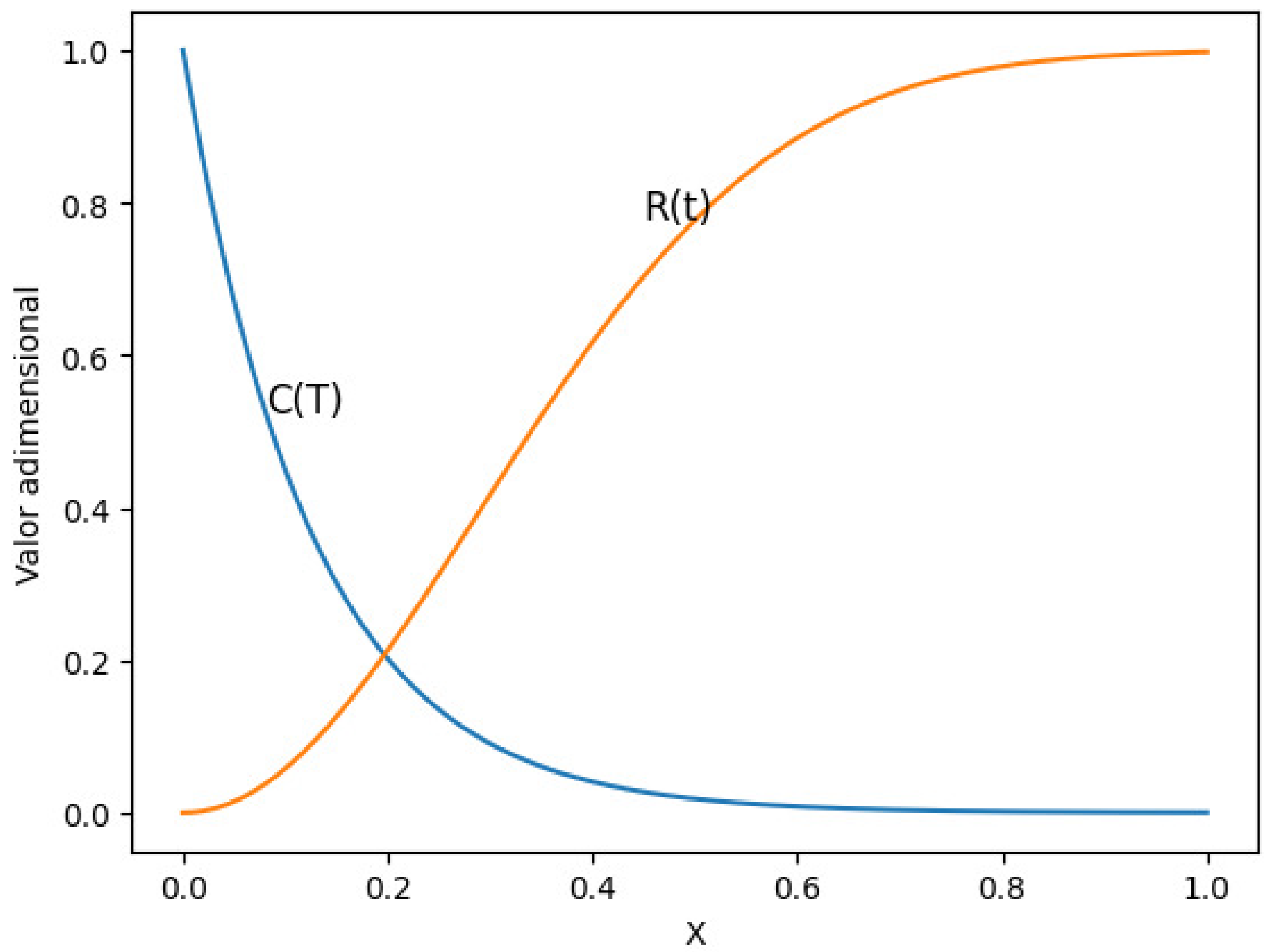
Figure 1 illustrates the functional evolution of the effective speed of light
within the primordial epoch, correlated with the rapid expansion of the cosmic scale factor during inflation. By invoking the Unruh-mediated correspondences
(as established in Equation (
3)), the velocity relation in Equation (
7) can be mapped into energy- and acceleration-dependent parameterizations:
In the Planckian limit (
)—characterizing the onset of the inflationary phase for an accelerated test particle—the effective speed of light exhibits an asymptotic divergence. This is followed by a rapid attenuation as the system relaxes from the Planckian regime toward a lower energy density. The local velocity shift from the canonical vacuum constant
c is quantified by the deviation:
In the sub-Planckian regime (), the variation vanishes (), ensuring the recovery of the standard Lorentz-invariant limit and classical relativistic kinematics.
Equation (
9) demonstrates that the velocity deviation
, characterized by an asymptotic divergence at the Planck scale (
), undergoes a sharp attenuation during the inflationary expansion mediated by the invariant Planck acceleration (
). These results for
and
present a significant challenge to conventional Varying Speed of Light (VSL) paradigms [
10,
29,
30,
31,
32,
33] traditionally employed to address the horizon problem.
As established in [
28], the present model maintains strict adherence to the postulates of Special Relativity (SR); the superluminal regime is phenomenologically confined to the extreme, non-classical conditions of the primordial universe at the Planckian temperature threshold. Consequently, current VSL frameworks require a critical re-evaluation, as our findings suggest that superluminality emerges not from a violation of Lorentz symmetry, but as a consequence of the vacuum-induced deformation of the kinematic phase space under extreme acceleration [
28].
The fluctuations in the speed of light, induced by the coupling between an accelerated test particle and the thermalized vacuum background, are parameterized by the following scaling relations:
or, equivalently, via the energy and acceleration parameterizations:
In the sub-Planckian regime (
), the deviation vanishes (
), ensuring the recovery of the canonical vacuum constant and standard Minkowski kinematics. These expressions demonstrate that while
exhibits an asymptotic singularity at the Planck threshold, it undergoes a rapid decay that facilitates a trans-Planckian expansion of the cosmic scale factor within inflationary formalisms.
In summary, the temperature-dependent evolution of
c presented herein provides a rigorous alternative to the heuristic foundations of traditional Varying Speed of Light (VSL) theories [
10,
29,
30,
31,
32,
33]. This dynamical behavior, as explored in [
28], preserves the structural integrity of relativistic postulates while offering a robust mechanism for early-universe causality without necessitating a violation of local Lorentz invariance.
5.1. Physical Interpretation of Varying Speed of Light Within the Inflationary Scenario
Our results suggest that the speed of light is not an immutable fundamental constant, but rather an emergent property arising from the vacuum’s thermal state. Within this framework, the primordial vacuum functions as a super-conductive medium for information exchange. At the Planck scale, extreme Unruh acceleration induces a vacuum energy density of such magnitude that c exhibits an asymptotic divergence (). This ensures that the global manifold achieves causal connectivity at the temporal singularity, providing a robust resolution to the horizon problem at the onset of the inflationary epoch.
The subsequent sharp decay toward the canonical value of c suggests that as the proper acceleration falls below the Planckian threshold, the vacuum undergoes a topological phase transition from its primordial high-energy configuration to its current low-energy state. This mechanism effectively ‘freezes’ the primordial homogeneity into the observed Cosmic Microwave Background (CMB), grounding the uniformity of the early universe in a dynamical, acceleration-dependent vacuum transition.
5.2. Analogy: The Primordial Vacuum as a Superfluid
To conceptualize the physical mechanism, we may treat the primordial vacuum as a supercritical fluid and information propagation as an acoustic-like perturbation within this medium. This perspective bridges the gap between quantum field theory and the thermodynamics of horizons—paralleling the behavior of Hawking–Unruh radiation in black hole physics:
(a) The Planckian ‘Super-conductive’ regime: At the Planck threshold, the vacuum energy density and the associated Unruh temperature are so extreme that the spacetime fabric behaves as a perfectly elastic, zero-viscosity medium. In this state, the effective speed of light diverges (), analogous to a superfluid where excitations propagate near-instantaneously. This allows the global manifold to achieve thermal equilibrium at the moment of ‘ignition,’ ensuring causal connectivity across the entire primordial horizon.
(b) The Symmetry-Breaking Phase Transition: As the proper acceleration relaxes below the Planckian limit , the vacuum undergoes a topological phase transition—akin to a metal solidifying from a melt. This process effectively ‘quenches’ the vacuum, causing the speed of light to decay abruptly to its standard value c. This transition marks the emergence of the current Lorentz-invariant vacuum structure.
(c) Cosmological Imprint: Consequently, although the cosmic expansion (inflation) subsequently stretches the manifold and the speed of light is capped at c, the initial homogeneity is already ‘frozen’ into the system’s topology. The causal ‘news’ of the universe’s thermal state was distributed during the trans-Planckian burst, prior to the imposition of the relativistic speed limit.
6. Some Interesting Questions and Perspectives
According to the Unruh relation (), the hypothesis of vanishing proper acceleration () necessitates a vacuum state at absolute zero ( K). However, such a quiescent vacuum would effectively recover a Newtonian absolute space—a purely immaterial construct that is physically precluded by quantum–gravitational phenomenology. Consequently, absolute zero must be treated as a singular, unattainable limit to prevent the re-emergence of Galilean absolutes; this implies that particle dynamics are intrinsically coupled to acceleration, maintaining a non-vanishing thermal vacuum.
Within this quantum-deformed vacuum, where gravitational interactions are ubiquitous, acceleration becomes a fundamental dynamical necessity. This line of reasoning invites a pivotal inquiry: Does there exist an invariant minimum acceleration () that, as a dual to the Planck acceleration (), prevents the system from reaching the absolute zero threshold? Admitting such a limit for the sake of fundamental symmetry leads to a profound corollary: Is the thermal vacuum associated with a privileged reference frame defined by an invariant minimum speed, establishing a theoretical symmetry with the invariance of c?
These considerations motivate the formulation of a deformed relativity characterized by a quadruple of fundamental invariants: two velocity scales and two acceleration scales. We are currently situated at an intermediate stage of this theoretical development; Symmetrical Special Relativity (SSR)—a Doubly Special Relativity (DSR) framework postulating a universal invariant minimum speed (
V) at the quantum limit—has been recently formalized [
34].
The present objective is to generalize this framework into Deformed Symmetrical Special Relativity (DSSR), which incorporates an invariant minimum acceleration threshold mediated via the Unruh effect. This four-invariant DSSR architecture will be analyzed in detail in forthcoming research. In this section, we delineate the foundational axioms of SSR [
34] to characterize the conceptual and symmetry-based challenges inherent in the pursuit of a fully symmetric, multi-invariant DSSR.
6.1. Relativistic Momentum and Energy Functionals Within the SSR Framework
We begin by identifying the four-velocity vector within the Symmetrical Special Relativity (SSR) manifold. The components are defined as follows:
where the deformation factor
is introduced to account for the dual-limit topology:
Here,
V denotes the invariant minimum velocity scale [
34]. Notably, the SSR four-velocity recovers the standard Minkowskian limit
in the regime where
or
. The four-momentum
in SSR is constructed via the mapping
. Substituting the expression from Equation (
12), we obtain:
From this modified dispersion relation, the total energy
E in SSR is cast as:
At the characteristic velocity
m/s, the energy reduces to the well-known rest energy
. However, this scale
is identified as the
quantum rest velocity [
34] within the SSR framework. Consistent with the dual-limit constraints, the energy vanishes as
(
) and exhibits a standard divergence as
(
). Finally, the SSR-modified relativistic momentum is given by:
In the Lorentzian limit (
), the formalism yields a smooth transition back to the standard SR identities,
and
.
6.2. Toward Momentum and Energy in DSSR
As established, Symmetrical Special Relativity (SSR) [
34] incorporates a dual kinematic invariant structure: the universal speed of light
c and an invariant minimum velocity
V. The present work extends this Deformed Special Relativity (DSR) phenomenology by accounting for the thermal vacuum background emerging from the Unruh effect. Our subsequent objective is the formal development of Deformed Symmetrical Special Relativity (DSSR) within this thermodynamic framework. The DSSR manifold necessitates the inclusion of both a minimum acceleration (
) and a corresponding minimum temperature (
), providing a complete set of infrared and ultraviolet cutoffs. Specifically, we aim to derive a generalized scaling function
, where
(parameterizing the asymptotic approach to absolute zero) is implemented via the Unruh scenario. Consequently, the DSSR four-momentum is projected to take the form:
The resulting modified energy and momentum relations are thus defined as:
The derivation of the explicit functional form of
represents a primary theoretical challenge. Our goal is to construct a robust DSSR framework governed by four fundamental invariants: two velocity scales (
) and two acceleration/temperature scales (
and
), establishing a fully symmetric phase-space topology via the Unruh effect.
6.3. Coupling Between Thermal Vacuum Dynamics and Spontaneous Spacetime Symmetry Breaking
The central thesis of this work explores the non-trivial interplay between Lorentz invariance and the emergence of a privileged reference frame mediated by the thermalized vacuum state. In the standard Minkowskian paradigm of Special Relativity (SR), the vacuum remains strictly invariant under the Lorentz group, ensuring that all inertial observers perceive a degenerate, quiescent state. In contrast, the present research proposes a symmetry breaking (or deformation) within this framework, characterized by the following foundational pillars:
- 1.
Symmetry Deformation: DSR and DSSR Formalisms
Rather than a primitive violation of Lorentz invariance, this work is situated within the framework of Deformed (or Doubly) Special Relativity (DSR). In this paradigm, the fundamental symmetry is reformulated to accommodate a multi-invariant topology. Whereas the Minkowskian limit recognizes only the vacuum velocity
c as a universal constant, we propose Deformed Symmetrical Special Relativity (DSSR), which preserves structural covariance by introducing a dual-velocity invariant set
[
34] and a dual-acceleration invariant set
. This construction represents a higher-order symmetry, wherein the fundamental laws of physics remain invariant under a non-linear set of modified transformations, effectively mapping the dynamics across both the infrared and ultraviolet limits of the theory.
- 2.
Dynamical Symmetry Breaking via the Unruh Mechanism
The Unruh effect serves as a fundamental mechanism for distinguishing non-inertial manifolds from the inertial Minkowski vacuum. In this work, the proper acceleration a effectively ’lifts’ the vacuum degeneracy, inducing a phase transition from a quiescent state into a thermalized bath. This process can be interpreted as a dynamical symmetry breaking, where the emergence of a non-vanishing temperature T defines a privileged thermal frame. This framework establishes a physical ‘anchor’—functionally equivalent to the cosmic rest frame—providing a robust theoretical basis for resolving the dichotomy between absolute and relative motion within the high-energy regimes of the primordial universe.
- 3.
Causal Symmetry and the Resolution of the Horizon Problem
The asymptotic divergence of the velocity of light, , at the Planck scale restores causal symmetry within the primordial manifold. In the standard cosmological model, the horizon problem is characterized as a causal symmetry defect, where observed large-scale homogeneity exists despite an apparent lack of prior causal contact between disparate regions. By parameterizing c as a function of the vacuum temperature, this model ensures that the global manifold achieved causal closure at the Planckian onset (). This mechanism effectively symmetrizes the initial state of the cosmos, establishing that the observed isotropy is the natural consequence of a perfectly correlated, thermalized initial condition.
- 4.
The Avoidance of ’Metaphysical’ Asymmetry
By postulating a minimum acceleration threshold and a minimum velocity invariant, we preclude the structural asymmetry associated with a singular vacuum (i.e., the Newtonian absolute rest state). Within the DSSR framework, global symmetry is maintained by ensuring that the manifold cannot converge toward a state of absolute rest or zero temperature. This architecture establishes a Dual Symmetry (UV–IR correspondence): the Ultra-Violet (UV) limit is governed by the Planck-scale regulators and , while the Infra-Red (IR) limit is stabilized by the invariant quantum/cosmic scales V and .
This research establishes that the thermalized vacuum, emerging via the Unruh mechanism, induces a deformation of the standard Lorentz group rather than a primitive violation. By proposing a DSSR formalism characterized by four fundamental invariants, we reconcile the emergence of a privileged cosmological frame with the core tenets of relativity. Symmetry is thus preserved not through the absence of background fields, but through the invariant topology of the fundamental scales () that mediate the coupling between matter and the quantum vacuum.
In forthcoming research, we will present a rigorous derivation of the DSSR manifold and its associated four-invariant spacetime geometry.
7. Concluding Remarks and Future Perspectives
In this work, we have demonstrated that the vacuum is not a passive backdrop but a dynamical thermal manifold that fundamentally redefines relativistic dynamics. By embedding the Unruh mechanism [
3] within a Deformed Special Relativity (DSR) framework, we derived a temperature-dependent correction to the energy–mass equivalence, where the Planck scale emerges as a natural ultraviolet (UV) regulator [
35]. This formalism provides a robust physical basis for the energy divergence at the Planckian limit and offers a novel resolution to the horizon problem via an emergent, temperature-dependent velocity of light,
, intrinsic to the vacuum’s thermodynamic state.
Furthermore, this research establishes the foundational mapping for the transition from Symmetrical Special Relativity (SSR) to a comprehensive Deformed Symmetrical Special Relativity (DSSR). By postulating a manifold governed by four kinematic invariants—dual velocity scales and dual acceleration thresholds —we propose a topology where absolute rest and absolute zero temperature are precluded by the quantum-geometric constraints of spacetime. This perspective aligns with the Machian view of inertia as a non-local interaction with the cosmic background.
7.1. Extensions to Curved Spacetimes and Horizon Thermodynamics
The implications of this four-invariant DSSR extend naturally into General Relativity (GR) and the physics of horizons. The transition from the flat Minkowski metric to the Rindler wedge [
36]—describing a uniformly accelerated observer—highlights that the thermal vacuum is not merely a local effect but a global topological feature. By invoking Tortoise coordinates (
) near the event horizon of a black hole, the divergence of
proposed here may offer new insights into the black hole information paradox [
37] and the stretched horizon dynamics. In this regime, the ‘freezing’ of
c at the
limit suggests a link between the infrared (IR) cutoff and the cosmological constant
, potentially identifying the invariant minimum acceleration with the Hubble scale.
7.2. New Future Outlook
Future investigations will focus on the explicit derivation of the DSSR four-momentum within curved spacetime manifolds, exploring its coupling with the Schwarzschild and Kerr geometries. We hypothesize that the interplay between the thermal vacuum and proper acceleration is the primary driver for the emergence of classical spacetime from a quantum-deformed primordial state. This framework not only preserves the fundamental principles of covariance but also bridges the gap between subatomic kinematics and black hole thermodynamics, offering a promising pathway toward a unified quantum–gravitational phenomenology.
7.3. Explicit Derivation of the DSSR Four-Momentum in Curved Manifolds
The transition from flat Minkowski space to curved pseudo-Riemannian manifolds necessitates a reformulation of the Deformed Special Relativity (DSR) generators. Future research will focus on defining the DSSR four-momentum operator as a covariant derivative acting on the deformed phase space. This involves the following:
- (1)
Non-linear Momentum Addition Laws: Analyzing how the presence of a minimal length scale (Planck scale) modifies the parallel transport of the four-momentum vector along geodesics.
- (2)
Metric Coupling: Utilizing the Einstein Field Equations to evaluate how the energy–momentum tensor, modified by DSSR corrections, acts as a source for the gravitational field.
7.4. Another Important Implication of DSSR
- (3)
Thermal Vacuum and Proper Acceleration as Drivers of Emergent Spacetime
This hypothesis aims to use the Unruh Effect and the Fulling–Davies–Unruh vacuum [
38,
39,
40,
41,
42,
43,
44,
45,
46,
47,
48,
49,
50] to propose that spacetime is not fundamental but emergent, and DSSR will help us to go deeper into this issue in future works.