


Abstract
In this paper, a non-classical symmetry method for obtaining the symmetries of differential–difference equations is proposed. The non-classical symmetry method introduces an additional constraint known as the invariant surface condition, which is applied after the infinitesimal transformation. By solving the governing equations that satisfy this condition, we can obtain the corresponding reduced equation. This allows us to determine the non-classical symmetry of the differential–difference equation. This method avoids the complicated calculation involved in extending the infinitesimal generator and allows for a wider range of symmetry forms. As a result, it enables the derivation of a greater number of differential–difference equations. In this paper, two kinds of (2+1)-dimensional Toda-like lattice equations are taken as examples, and their corresponding symmetric and reduced equations are obtained using the non-classical symmetry method.
1. Introduction
A lattice system is a mathematical representation of a network or lattice of particles. It can be used to describe various phenomena, such as the vibrations of atoms and molecules in a matrix or the oscillations of particles connected by a spring [1]. Nonlinear lattice dynamics has a wide range of applications in physics, biology, statistical physics, acoustics, optics, condensed matter physics, and other fields [2,3]. The mathematical model of a lattice system often takes the form of nonlinear differential–difference equations [4].
The Lie symmetry method is not only an effective approach for obtaining exact solutions of partial differential equations but also for differential–difference equations [5,6]. The Lie symmetry analysis method has also been proposed for finding similarity reduction and exact solutions of nonlinear evolution equations [7]. In 1993, Levi [8] proposed the classical Lie symmetry method for differential–difference equations. The Toda equation is a classical model of differential–difference equation [9,10,11,12], whose symmetries have been studied [13] and the differential–difference Lie symmetry method was applied to solve a class of Toda-like lattice equations [14]. In 2022, a survey of the connection between orthogonal polynomials, Toda lattices and related lattices, and Painlevé equations (discrete and continuous) was given [15].
In 1969, Bluman and Cole [16] generalized the classical symmetry method of Lie to a non-classical method. They proposed the non-classical symmetry method for the first time and obtained a new exact solution of the one-dimensional heat conduction equation using this new method. For a partial differential equation, we know that the given system of partial differential equations is invariant under symmetry in the usual symmetry method. In the non-classical method [17,18], not only is the given system invariant, but the invariant surface conditions and their differential consequences are also invariant under the corresponding symmetry. Moreover, the over-determined system of partial differential equations is nonlinear in the non-classical method. This implies that by using non-classical symmetry analysis, one could obtain new symmetries that go beyond those obtained by using the classical symmetry method. Bluman and Tian [19] utilized the non-classical symmetry method to solve the nonlinear Kompaneets equation. Xin et al. [20] obtained nonlocal symmetries and solutions for the (2+1) dimension integrable Burgers equation. ARRIGO et al. [21] discussed nonclassical symmetry solutions and the methods between Bluman–Cole and Clarkson–Kruskal. Subhankar and Raja Sekhar [22] studied nonclassical symmetry analysis and conservation laws of a one-dimensional macroscopic production model and the evolution of nonlinear waves.
We consider the invariance of a given differential equation
together with its invariant surface condition
where . Equation (2) describes the solution surface, which remains invariant under a one parameter group of transformations with the infinitesimal generator
is the m-order prolongation of
where
with .
It is assumed that Equation (1) is invariant under the action of infinitesimal generators (3) and invariant surface conditions (2), if and only if the system of governing equations is satisfied
In this way, the non-classical symmetry of Equation (1) can be obtained.
The question that naturally arises is whether the non-classical method can be extended to discuss discrete equations. To the best of our knowledge, this question has not been reported so far. Based upon the discrete Lie symmetry method [23], we extend the infinitesimal generator and its prolongation to the discrete performance to analyze the non-classical symmetries of differential–difference equations in this Letter.
In Section 2, the non-classical symmetry method for differential–difference equations is introduced. In Section 3 and Section 4, the non-classical symmetry method of differential–difference equations is applied to study two types of (2+1)-dimensional Toda-like lattice equations. The determinant equations of the equation are derived, and the corresponding reduced equations are obtained by solving the determinant equations. Conclusions are finally presented in Section 5.
2. Non-Classical Symmetry of Differential–Difference Equations
In this paper, we will introduce the non-classical symmetric method using an example of a differential–difference equation of order m that contains both continuous variables and a discrete variable n. The equation is formulated as follows:
where all are finite non-negative integers, . The infinitesimal generators acting on Equation (7) are as follows:
is the m-order prolongation of , which is formed as
where
with
To better understand the non-classical symmetry of differential–difference equations, consider a differential–difference equation involving and as an example.
Then the infinitesimal transformation acting on this equation is
The infinitesimal transformation is derived from the following equation
The Equation (13) is about taking the derivative and expanding it; thus, it can be written as follows
Equation (14) is called the invariant surface condition of differential–difference equation.
According to the classical Lie symmetry method, the differential–difference Equation (11) is assumed to be invariant under the infinitesimal transformations . The non-classical symmetry method adds invariant surface conditions on this basis, which is also invariant under infinitesimal transformations; that is, the governing equations are satisfied for and at the same time:
where the infinitesimal generator is
For the convenience of later calculation, the first order and second order continuation are given respectively
where , are non-negative integers, for short , , ; hence,
We substituted (18)–(22) into the governing Equation (17) by solving the determining Equation (15); that is, the coefficient equations of the derivative of u to , the expression about , , can be obtained and its corresponding characteristic equation can also be obtained under the integral of the invariant surface conditions
By solving this characteristic equation, the invariants of Equation (1) can be found. In this article, we only need to consider two cases under the invariant surface condition (8): and .
The invariant surface condition introduced a new correlation equation for the derivative of Equation (11). We substitute the invariant surface condition into the governing system (15), replacing the related terms and further reducing the governing system (15) to obtain the determining system of sum , and . The system of determining equations obtained by the non-classical symmetric method is usually nonlinear, while solving the system of determining equations gives a reduced equation with the same solution as the control equation. Finally, the group invariant solutions of Equation (11) can be obtained by solving the reduced equations. This is the non-classical symmetric approach to differential–difference equations. In simple terms, the non-classical symmetry method seeks the invariance of the original equation under the invariant surface condition.
Summarizing the above, two theorems are obtained.
Theorem 1.
Suppose is a symmetry of the following differential–difference equations,
then U is the group invariant solution of the equation corresponding to the invariant group of if and only if
where δ is a difference operator and ∂ is a differetial operator.
Theorem 2.
Suppose (24) is a system of differential–difference equations defined on with a maximum rank. G is the group of local transformations acting on , and if any of the generators of G are true when
then G is the invariant group of this system of equations, where .
Theorem 2 can be called the Lie criterion for non-classical Lie symmetry.
3. Non-Classical Symmetry of (2+1)-Dimensional Toda Lattice Equations
The (2+1)-dimensional Toda equation is a completely integrable differential–difference equation with a Lax pair, an infinitely multiple conservation law, a Backlund transform, a soliton solution, and the general characteristics of integrable models. The study of the Toda equation is of great significance in the study of fully integrable nonlinear systems. The (2+1)-dimensional Toda lattice Equation [8] has the following form
where is the function of .
The invariant surface condition is
As a brief note , , , the system of equations determining the non-classical symmetry of Equation (27) is obtained from the following governing Equation (15).
The infinitesimal generator is
Its second-order prolongation is
where
Substituting (31)–(36) into (30), the control system (15) will take the following form:
According to the non-classical symmetry method, the non-classical symmetries of the (2+1) dimensional Toda-like lattice Equation (27) only need to be discussed in two cases; one is and the other case is :
Case 1. When , the system of equations of and is determined by
Using the symbolic computing software Maple to solve Equation (38), the solutions are
where is an arbitrary function about , is an arbitrary function of .
Accordingly, the non-classical symmetry of Equation (27) is given by
Choose , where and are arbitrary constants as an example. Substituting the non-classical symmetry to the invariant surface condition (28), the following system of equations, also called symmetry reduction, is obtained:
By simplifying Equation (41), a reduced equation of the same dimension as Equation (27) can be obtained
If we choose and , Equation (42) will be simplified to
Case 2. When , the determining system of equations of is
Using the symbolic computing software Maple to solve the Equation (44), we can obtain
where is an arbitrary function of .
Accordingly, the non-classical symmetry of Equation (27) is given by
If we choose , with arbitrary constants p and q as an example, and substitute the non-classical symmetry to the invariant surface condition (28), we obtain the following system of equations:
By simplifying the Equation (47), a reduced equation of the same dimension as Equation (17) can be obtained
With the help of Maple, the reduced Equation (48) could be solved under the initial condition and ; that is,
By using the non-classical symmetry method, the two symmetries and obtained are about the change of the functions , and , respectively. According to the different functions selected, the corresponding reduced equations of different forms can be obtained.
The above solving process can be summarized as the following theorem.
Theorem 3.
The two symmetries and are changed according to and individually. Depending on which is selected between and , different reduced equations can be obtained.
In [23], four Lie point symmetries were given
It could be easily seen that was included by .
4. Non-Classical Symmetry of Another Type of (2+1)-Dimensional Toda Lattice Equations
The other (2+1)-dimensional Toda lattice equation has the following form:
The invariant surface condition is
The system of equations determining the non-classical symmetry of Equation (50) is obtained from the following governing Equation (15). Where the infinitesimal generator and its second-order prolongation are
where = , = , = for short. Hence,
The non-classical symmetries of the (2+1) dimensional Toda-like lattice Equation (50) in two cases, and , are discussed as follows:
Case 3. When , the system of determining equations about and , is
Using the symbolic computing software Maple to solve the Equation (55), we will obtain
where are arbitrary constants, and , and are arbitrary functions of x.
Accordingly, the non-classical symmetry of Equation (50) are represented as
Substituting into the non-classical symmetry and applying it to the invariant surface condition (51) for example, we obtain the following system of equations
By simplifying the Equation (60), a reduced equation of the same dimension as Equation (50) can be obtained
With the help of Maple, the reduced Equation (61) could be solved under the initial condition , that is
If we choose to substitute into the non-classical symmetry to the invariant surface condition (51) as an example, the following system of equations are obtained:
By simplifying the Equation (63), a reduced equation of the same dimension as Equation (50) can be obtained:
Substituting and into the non-classical symmetry and applying it to the invariant surface condition (51), the following system of equations is as follows:
By simplifying the Equation (65), a reduced equation of the same dimension as Equation (50) can be obtained
Case 4. When , the system of determining equations about is
Using the symbolic computing software Maple to solve the Equation (67), then
where is an arbitrary function of x, and is an arbitrary function of .
Accordingly, the non-classical symmetry of Equation (50) is expressed as
If we choose and for in the invariant surface condition (51), we obtain
By simplifying the Equation (70), a reduced equation of the same dimension as Equation (50) can be obtained
With the help of Maple, the reduced Equation (71) could be solved under the initial condition and ; that is,
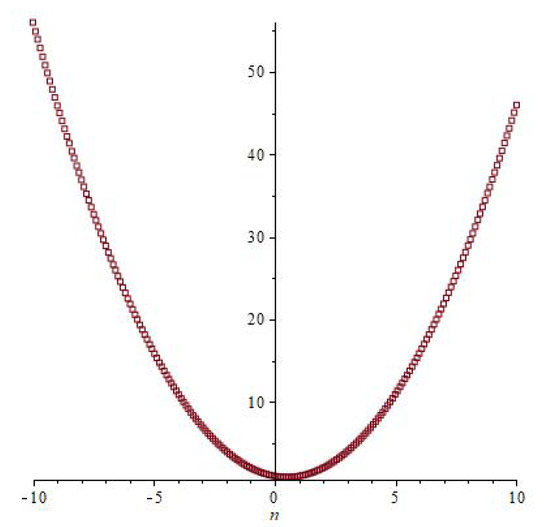
Figure 1.
The plot of (72).
The above solving process can be summarized as the following theorem:
Theorem 4.
The (2+1)-dimensional Toda equation (50) has four non-classical symmetries, as follows
The four symmetries and are changed according to , and individually. Depending on which function is selected, different reduced equations can be obtained.
The main steps for solving lattice equations by using the differential–difference non-classical symmetry method are as follows:
Step 1: The non-classical Lie symmetry algorithm is used to calculate the Lie transform group, which can be described by its infinitesimal generator, which preserves the form of the equation on its extension space.
Step 2: Extend the Lie group and its infinitesimal generators to include the space of independent variables, function variables, and finite-order derivatives of function variables, in order to obtain the extended expressions.
Step 3: Assuming that the differential–difference equation is invariant under infinitesimal transformations, the invariant surface condition remains unchanged under infinitesimal transformations. As a result, the system of governing equations is obtained.
Step 4: Further reduce the system of governing equations to obtain a system of deterministic equations and a definite system of equations, with respect to infinitesimal generators.
Step 5: The non-classical symmetry of the differential–difference equation can be obtained by solving the system of equations using Maple 2020 software.
Step 6: Depending on the specific circumstances, various parameter equations can be chosen to derive low-dimensional reduction equations that yield the same solutions as the differential–difference equation.
5. Conclusions
In this paper, we combine the classical Lie-symmetry method of differential–difference equations proposed by Levi with the non-classical symmetry method of nonlinear partial differential equations proposed by Bluman. Our aim is to extend the non-classical symmetry method to differential–difference equations in order to get more symmetries of differential–difference equations. This method incorporates the invariant surface condition (2) into the classical Lie symmetry method in order to derive the governing equations of the studied differential–difference equation. By solving the governing equations under the or , we can obtain its determination systems and then work out the non-classical symmetries of the equation and the corresponding symmetry reduction. The non-classical symmetries are only applicable to solutions that satisfy the invariant surface conditions. This implies that nonclassical symmetry only leaves a small sub-manifold of the solution manifold invariant. Finally, the effectiveness of this method is illustrated by considering examples of two types of (2+1)-dimensional Toda-like lattice equations. It can be seen that this method not only simplifies the calculation steps with the help of the invariant surface condition as an additional equation but also yields many new functional symmetries (40) and (46) of Toda-like lattice Equation (27), which cannot be obtained by the classical Lie symmetry method [23]. According to the selected arbitrary functions , , of the infinitesimal generators, one can obtain the corresponding non-classical symmetries and the corresponding reduced equation of the (2+1)-dimensional Toda-like lattice equations.
Author Contributions
Methodology, W.L.; software, Y.C. and W.L.; investigation, W.L. and K.J.; writing, W.L. and Y.C. All authors have read and agreed to the published version of the manuscript.
Funding
This research was funded by the Hainan Provincial Natural Science Foundation of China grant number 122QN332.
Data Availability Statement
Data are contained within the article.
Conflicts of Interest
The authors declare no conflict of interest.
References
- Toda, M. Theory of Nonlinear Lattices; Springer: Berlin/Heidelberg, Germany, 1989; pp. 159–176. [Google Scholar]
- Zhang, J.; Meng, J.; Zheng, C. Folded solitary waves and foldons in the (2+1) -dimensional breaking soliton Equation. Chaos Soliton Fractals 2004, 20, 523–527. [Google Scholar] [CrossRef]
- Elkenany, B.; Alfrnwani, O.A. Behavior of lattice dynamics, electronic, optical, and mechanical properties of pentanary GaxIn1-xPySbzAs1-y-z alloy lattice matched to GaSb substrate under temperature. J. Phys. Chem. Solids 2023, 175, 111192. [Google Scholar] [CrossRef]
- Antoniades, C.; Christofides, P.D. Feedback control of nonlinear differential–difference equation systems. Chem. Eng. Sci. 1999, 54, 5677–5709. [Google Scholar] [CrossRef]
- Olver, P. Applications of Lie Groups to Differential Equations; Springer: Berlin/Heidelberg, Germany, 1986; pp. 242–379. [Google Scholar]
- Bakkyaraj, T.; Thomas, R. Lie symmetry analysis and exact solution of (2+1)-dimensional nonlinear time-fractional differential–difference equations. Pramana J. Phys. 2022, 96, 225. [Google Scholar] [CrossRef]
- Sahoo, S.; Ray, S.S. Lie symmetry analysis and exact solutions of (3+1) dimensional Yu–Toda–Sasa–Fukuyama equation in mathematical physics. Comput. Math. Appl. 2017, 73, 253–260. [Google Scholar] [CrossRef]
- Levi, D.; Winternitz, P. Symmetries and conditional symmetries of differential–difference equations. J. Math. Phys. 1993, 34, 3713–3730. [Google Scholar] [CrossRef]
- Duarte, V.N. A class of solutions of the two-dimensional Toda lattice equation. Phys. Lett. A 2021, 385, 126979. [Google Scholar] [CrossRef]
- Wattis, J.A.D.; Gordoa, P.R.; Pickering, A. Behaviour of the extended Toda lattice. Commun. Nonlinear Sci. Numer. Simul. 2015, 28, 138–150. [Google Scholar] [CrossRef]
- Guseinov, G.S.H. A class of complex solutions to the finite Toda lattice. Math. Comput. Model. 2013, 57, 1190–1202. [Google Scholar] [CrossRef]
- Bracciali, C.F.; Pérez, T.E. Bivariate orthogonal polynomials, 2D Toda lattices and Lax-type pairs. Appl. Math. Comput. 2017, 309, 142–155. [Google Scholar] [CrossRef]
- Qian, X.; Lou, S. Symmetries of the (2+1)-dimensional discrete Toda equation. Acta Phys. Sin. 1996, 45, 721–728. [Google Scholar] [CrossRef]
- Shen, S.; Pan, Z.; Zhang, J. Symmetries of a (2+1)-Dimensional Toda-like Lattice. Commun. Theor. Phys. 2004, 42, 805–806. [Google Scholar]
- Van Assche, W. Orthogonal polynomials, Toda lattices and Painlevé equations. Phys. D Nonlinear Phenom. 2022, 434, 133214. [Google Scholar] [CrossRef]
- Bluman, G.; Cole, J. The general similarity solution of the heat equation. J. Appl. Math. Mech. 1969, 18, 1025–1042. [Google Scholar]
- Arrigo, D.J.; Beckham, J.R. Nonclassical symmetries of evolutionary partial differential equations and compatibility. J. Math. Anal. Appl. 2004, 289, 55–65. [Google Scholar] [CrossRef]
- Murata, S. Nonclassical symmetry analysis for hyperbolic partial differential equation. Commun. Nonlinear Sci. Numer. Simul. 2008, 13, 1472–1474. [Google Scholar] [CrossRef]
- Bluman, G.; Tian, S.; Yang, Z. Nonclassical analysis of the nonlinear Kompaneets equation. J. Eng. Math. 2014, 84, 87–97. [Google Scholar] [CrossRef]
- Xin, X.; Jin, M.; Yang, J.; Xia, Y. Nonlocal symmetries and solutions of the (2+1) dimension integrable Burgers equation. Appl. Math. Lett. 2024, 148, 108867. [Google Scholar] [CrossRef]
- Arrigo, D.J.; Broadbridge, P.; Hill, J.M. Nonclassical symmetry solutions and the methods of Bluman–Cole and Clarkson–Kruskal. J. Math. Phys. 1993, 34, 4692–4703. [Google Scholar] [CrossRef]
- Subhankar, S.I.L.; Sekhar, T.R. Nonclassical symmetry analysis, conservation laws of one-dimensional macroscopic production model and evolution of nonlinear waves. J. Math. Anal. Appl. 2021, 497, 124847. [Google Scholar]
- Levi, D.; Winternitz, P.; Yamilov, R.I. Lie point symmetries of differential–difference equations. J. Phys. A Math. Theor. 2010, 43, 292002. [Google Scholar] [CrossRef]
Disclaimer/Publisher’s Note: The statements, opinions and data contained in all publications are solely those of the individual author(s) and contributor(s) and not of MDPI and/or the editor(s). MDPI and/or the editor(s) disclaim responsibility for any injury to people or property resulting from any ideas, methods, instructions or products referred to in the content. |
© 2023 by the authors. Licensee MDPI, Basel, Switzerland. This article is an open access article distributed under the terms and conditions of the Creative Commons Attribution (CC BY) license (https://creativecommons.org/licenses/by/4.0/).