Article

Comparison of Random Subspace and Voting Ensemble Machine Learning Methods for Face Recognition

1
Institute for Analysis and Scientific Computing, Vienna University of Technology, Vienna 1040, Austria
2
College of Engineering, Effat University, Jeddah 21478, Saudi Arabia
*
Author to whom correspondence should be addressed.
Symmetry 2018, 10(11), 651; https://doi.org/10.3390/sym10110651
Submission received: 9 October 2018 / Revised: 12 November 2018 / Accepted: 14 November 2018 / Published: 19 November 2018

Abstract

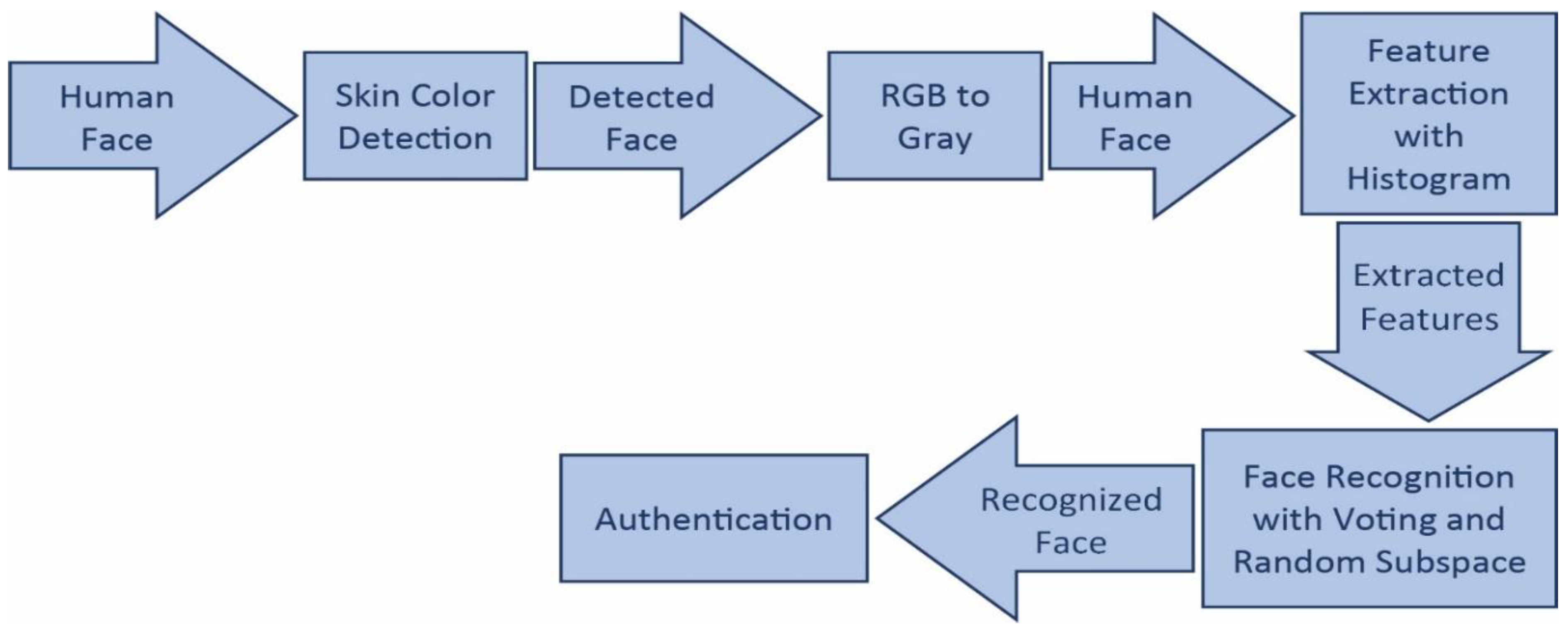
Biometry based authentication and recognition have attracted greater attention due to numerous applications for security-conscious societies, since biometrics brings accurate and consistent identification. Face biometry possesses the merits of low intrusiveness and high precision. Despite the presence of several biometric methods, like iris scan, fingerprints, and hand geometry, the most effective and broadly utilized method is face recognition, because it is reasonable, natural, and non-intrusive. Face recognition is a part of the pattern recognition that is applied for identifying or authenticating a person that is extracted from a digital image or a video automatically. Moreover, current innovations in big data analysis, cloud computing, social networks, and machine learning have allowed for a straightforward understanding of how different challenging issues in face recognition might be solved. Effective face recognition in the enormous data concept is a crucial and challenging task. This study develops an intelligent face recognition framework that recognizes faces through efficient ensemble learning techniques, which are Random Subspace and Voting, in order to improve the performance of biometric systems. Furthermore, several methods including skin color detection, histogram feature extraction, and ensemble learner-based face recognition are presented. The proposed framework, which has a symmetric structure, is found to have high potential for biometrics. Hence, the proposed framework utilizing histogram feature extraction with Random Subspace and Voting ensemble learners have presented their superiority over two different databases as compared with state-of-art face recognition. This proposed method has reached an accuracy of 99.25% with random forest, combined with both ensemble learners on the FERET face database.
Keywords: face detection; face recognition; histogram; random subspace; voting; ensemble classifiers; pattern recognition face detection; face recognition; histogram; random subspace; voting; ensemble classifiers; pattern recognition