


Abstract
Land use and land cover change (LULCC) constitutes a major challenge to sustainability worldwide. This also applies to Japan, where urbanization in coastal lowlands is contrasted with widespread agricultural abandonment in rural landscapes. In this systematic review we synthesized the main LULCC trajectories, their driving forces, and specific effects in Japan from 1994 to 2024. Following PRISMA guidelines, 158 peer-reviewed articles were analyzed using quantitative co-occurrence analyses, Chi-squared tests, and Sankey diagrams to map land-use flows. Two dominant and opposing trajectories were confirmed: urban expansion and agricultural abandonment. The most significant land transition flow involved the conversion of agricultural land to forests/natural vegetation, while the conversion of agricultural land to built-up areas came in second place. These transitions were primarily driven by economic and demographic factors, but reforestation trends were strongly influenced by policy and institutional factors (35.70%), reflecting national regreening initiatives. Ecological and biodiversity impacts of LULCC were the most often documented effects (>40% of records). While the published literature describes trends in land-use transformations, the mechanistic understanding of LULCC remains limited. There is an urgent need to move toward process-based predictive modeling that integrates socio-economic variables. Future policies should balance urban density management with the strategic use of rural abandonment for ecosystem services provision and climate mitigation.
1. Introduction
Land resources are vital to human survival through their intrinsic links with biodiversity, ecosystem functions and the provision of ecosystem services [1,2]. Land use systems are characterized by complex dynamics that often include stochastic processes [3,4,5]. Changes in land use and land cover (LULC), resulting from both anthropogenic drivers and natural processes, have significant implications for sustainability, affecting human well-being and biological diversity, across local, regional, and global scales [6,7]. In particular, agricultural expansion and intensification have contributed to biodiversity loss over the past decades [4,8]. Consequently, LULC change (LULCC) has become a central focus of research aimed at improving our understanding of its spatial and temporal dynamics, underlying drivers, and socio-ecological consequences.
Understanding historical land-use dynamics is becoming increasingly important as many industrialized nations in Europe (e.g., the Mediterranean and Eastern Europe) and other developed regions experience demographic decline. Japan is a prominent example of the “shrinking society” phenomenon, with rural marginalization leading to substantial land abandonment, similar to trends in European countries like Italy and Spain [9]. Japan’s situation is compounded by geographical constraints (e.g., mountainous topography and coastal vulnerability), socio-economic transitions, population contraction following economic expansion, and recurring natural disasters, all of which influence land-use patterns [10]. Over recent decades, key drivers of LULCC have included urbanization, agricultural expansion and contraction, as well as shifts in industrial development [10].
According to [11], urban land use expanded from 2.9% to 10.1% of Japan’s land area over the past 135 years (1850–1985), primarily at the expense of agricultural land and, to a lesser extent, forests. Agricultural areas also expanded, most notably in Hokkaido, where large-scale conversion of forests and wetlands for agriculture occurred during that period. Changes in forest composition have also been documented, particularly decreases in deciduous forests and increases in conifer plantations. Since the 1990s, farmland abandonment has become pronounced [12,13]. This trend has continued to the present, with a significant increase in the extent of abandoned farmland. Forest area remained relatively stable during this period after an earlier increase, resulting in part from the considerable efforts undertaken by the government through the large-scale implementation of national regreening projects after the Pacific War [14]. Since the early 2000s, urban expansion has entered a phase of ‘stabilization and contraction’, where the primary challenge in many areas is no longer urban sprawl, but rather managing the ‘shrinkage’ of urban areas and the emergence of underutilized land on the outskirts of cities [15]. Simultaneously, Japan’s forest cover, which currently represents about 67% of the territory, is governed by existing forest management legislation [e.g., the Basic Plan for Forest and Forestry; revised in 2021]. Unlike the policies of the mid-20th century that focused on increasing production [14], current legislation prioritizes the ‘cyclical use’ of forest resources and the conversion of unmanaged artificial forests into diverse natural woodlands to achieve the goals of the 2050 Carbon Neutral Strategy [16]. Additionally, the Great Eastern Japan Earthquake and Tsunami in 2011 induced significant LULC changes in parts of the Tohoku region, encompassing direct damage to coastal forests and agricultural lands, as well as abandonment due to radioactive contamination [17].
Policies related to land use have developed considerably over the last decades, including the implementation of the Basic Environment Law and subsequent sustainability initiatives, aimed at mitigating environmental degradation and promoting sustainable land management practices [18]. Nevertheless, the impacts of LULCC on Japanese ecosystems, such as fragmentation of diverse natural habitats, accelerated decline of endemic biodiversity, and disruption of critical hydrological regimes, remain a major challenge [10,19]. In addition, socio-economic dynamics, including an aging population, pronounced rural depopulation, and the expansion of urban agglomerations, have intensified these environmental challenges, thereby creating multifaceted ecological pressures [10,13].
In this systematic review, we aim to provide a synthesis of the current state of knowledge regarding LULCC and its driving forces in Japan between 1994 and 2024. We (1) analyze spatio-temporal trends in research efforts, (2) identify the main driving forces of LULCC, (3) discuss knowledge gaps that require further research.
2. Materials and Methods
2.1. Search Scope and Timeframe Selection
Our systematic review followed the Preferred Reporting Items for Systematic Reviews and Meta-Analysis (PRISMA) method [20,21]. We employed this methodological framework to compile and critically analyze the literature on LULCC and its driving forces in Japan over the past three decades (1994–2024). Specifically, publications identified as documenting the causes of LULCC, its effects (e.g., socio-environmental impacts), and the forecasting of land-use change were included in this systematic review. Studies that also addressed the types of LULCC (e.g., agricultural land conversion, changes in forest cover, hydrological cycle, soil properties, vegetation, etc.) and their potential underlying drivers (e.g., urban growth, population decline, natural disasters, rural depopulation, etc.) were also included. Only peer-reviewed articles published in English within the defined timeframe were considered for this systematic review. Papers reporting results of original research and review articles were both included. Non-peer-reviewed materials such as theses, technical manuals, guidelines, letters, encyclopedia entries, case reports, or books were excluded.
In addition, the study period (1994–2024) was selected to coincide with the digital revolution in Japanese spatial sciences, initiated by the release of the National Digital Land Information System (DNLI) in the early 1990s. The choice of this period was also important to capture the critical socio-economic shift from a ‘growth-oriented’ bubble economy to the contemporary era characterized by aging/depopulation, urban ‘compact city’ policies, and large-scale agricultural abandonment.
2.2. Literature Search Strategy
The search for relevant literature on LULCC and its driving forces was conducted in April 2025. A multi-database search approach was adopted to ensure a comprehensive coverage of publications on LULCC, given that search engines have been shown to return different results for the same set of search terms [22,23]. Four online databases were included: Web of Science (www.webofscience.com, accessed on 3 April 2025), Google Scholar (www.scholar.google.com, accessed on 10 April 2025), ScienceDirect (www.sciencedirect.com, accessed on 17 April 2025), and CiNii (https://cir.nii.ac.jp, a primary Japanese academic database; accessed on 24 April 2025). The complete list of Boolean search strings used to gather relevant articles on LULCC in each database is provided in Table 1 to allow for reproducibility. The variation in search strings was necessary to accommodate the specific indexing architectures and character limits of the four online search engines. For example, ‘CiNii platform’ required simplified strings to capture broader local transitions, while ‘Web of Science’ allowed for complex, multi-nested Boolean logic. We have ensured that the “Core Keyword Set” (Japan + Land Use and Land Cover Change/LULCC + Drivers) remained identical across all search databases to maintain consistency.

Table 1.
Boolean search strings and academic databases used in the systematic review.
2.3. Screening and Selection of Relevant Publications
The relevant publications recorded were first screened according to predefined inclusion criteria (see Section 2.1; Figure 1). The selection process comprised three steps: (1) the title screening (i.e., initial screening of titles to eliminate irrelevant studies), (2) the abstract screening (i.e., detailed screening of abstracts to assess the potential relevance of remaining studies), (3) the full-text screening (i.e., thorough review of full texts to determine final eligibility based on the predefined inclusion and exclusion criteria; (see Table 2). The entire screening process was conducted independently by two reviewers to minimize bias, while discrepancies were resolved through discussion until consensus was reached. In cases of persistent disagreement, a third reviewer was consulted. This screening process of records was conducted manually using Microsoft Excel to facilitate customized thematic tagging.
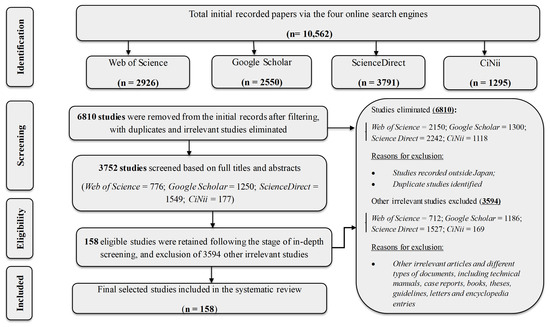
Figure 1.
Flowchart showing the comprehensive screening processes and selection of the 158 relevant articles included in the systematic review of LULCC and its driving forces in Japan between 1994 and 2024 using the PRISMA approach.
Table 2.
Inclusion and exclusion criteria for the systematic review of LULCC in Japan (1994–2024).
The following information was extracted and compiled from the 158 selected publications: (i) bibliographic information, (ii) keywords of the publications; (iii) names of geographical regions and prefectures covered by the studies in the country; (iv) thematic foci addressed in the studies (effects of LULCC, causes of LULCC, and predictive modeling of land-use change); (v) types of LULCC addressed; (v) change drivers addressed; (vii) main conclusions.
2.4. Data Analysis
The data extracted from the 158 selected articles, organized in the comprehensive Microsoft Excel database, was subjected to a multi-stage statistical analysis plan. The overarching goal was to synthesize the qualitative and quantitative heterogeneity of the primary studies into a coherent narrative that directly addresses the systematic review’s objectives.
2.4.1. Data Standardization, Harmonization and Pre-Processing
Three key standardization methods, including the LULC transition normalization, area change normalization, and temporal standardization, were employed to integrate disparate data from the primary literature into a unified dataset before proceeding with different analyses of raw extracted data.
First, the heterogeneous LULC class names reported by individual studies were systematically standardized into a cohesive classification system comprising six major LULC classes: “agriculture”, “forest/natural vegetation”, “built-up”, “water”, “wetlands”, and “bare/other”. All reported transitions (e.g., “paddy to urban”) were mapped to the corresponding six-class transition (e.g., “agriculture to built-up”). To ensure consistency across the reviewed literature, ‘agricultural abandonment’ was categorized according to its observed successional state. The transition from ‘agriculture to forest’ specifically denotes the transition from cultivated land to secondary forest (e.g., Satoyama forest) through passive natural succession, a dominant trajectory in rural Japan. Cases in which abandoned fields remained as scrubland or herbaceous cover were classified as ‘natural vegetation’. Studies reporting “abandoned agricultural land” without specifying the subsequent cover type were retained under “agriculture”.
Second, all reported LULCC areas, originally recorded in units of km2 or ha, were uniformly converted and standardized to square kilometers (km2). Third, the study duration (Δt in years) was calculated as the difference between the reported start and end years for each quantitative observation. This duration was essential for converting the total area change into an annual rate. Appendix A summarizes the quantitative metrics and statistical formulas applied to the LULCC data extracted from the 158 selected articles.
2.4.2. Bibliometric and Descriptive Analysis
A temporal trend analysis (i.e., counting the frequency of articles based on their ‘year of publication’) was performed to illustrate the trend in research productivity over the study period (1994–2024) within the country. This enabled the identification of peak periods of research activity on LULCC and the temporal span covered by the selected studies.
A geographical scope analysis (i.e., calculating the frequency distribution of studies at the national, regional, prefecture/local geographical level) was also performed to identify the most frequently studied regions. This involved classifying the geographical extent of each primary study (e.g., national, regional, or prefectural scale) to assess the spatial representation and focus of the assembled dataset. A map showing the spatial distribution of aggregated records from the primary literature was drawn using the R (version 4.5.0) packages ‘ggplot2’ and ‘sf’ to display the location points of LULCC studies identified with precise geographical coordinates, as well as the regional count of LULCC studies, which is color-coded according to geographic scale.
A thematic foci analysis (i.e., analysis of the frequency of specific types of LULCC addressed in the literature, and other aspects of LULCC-related issues, in relation to its causes, effects, quantitative spatial analysis and its predictive modeling) was conducted to provide a crucial understanding of the research focus in all selected publications. This involved conducting a qualitative tally of the frequency with which specific aspects of LULCC-related issues were reported in the primary literature. This analysis also provided a preliminary, bibliometrically based indication of the most studied LULCC pathways.
2.4.3. Quantitative Flow Analysis
Identifying LULCC transitions and quantifying dynamic trends required a qualitative analysis of dominant LULCC transition pathways, quantification of change magnitude and net change, and calculation of the annual rate of change. Specifically, an alluvial flow diagram (Sankey diagram, using the R package ‘ggalluvial’) was generated to visually represent the magnitude and direction of the total aggregated LULCC flows between the standardized LULC classes. This provided a visual basis for interpreting the dominant inter-class transformations. The total reported area change was summed to determine the cumulative quantified area for each class, yielding the total loss (“outflow”) and total gain (“inflow”). These values were used to calculate the net change (i.e., the “inflow” minus the “outflow”) for each land use and land cover class. To ensure comparability between studies with heterogeneous durations, the annual rate of change (km2/year) was calculated for each unique transition pathway. This was achieved by dividing the total aggregated area change (km2) by the total aggregated study duration (years) for that specific transition. This metric was used to quantitatively rank the intensity of the LULCC processes. All statistical analyses, including frequency analyses, spatial mapping, and visual preparations, were performed using Microsoft Excel for initial data management and standardization and R statistical software, version 4.5.0. (with additional packages such as ‘tidyverse’, ‘knitr’, ‘stringr’, and ‘scales’ for advanced manipulations and visualization).
The final phase of the primary literature synthesis applied quantitative statistical analysis, combining descriptive frequency analysis, inferential association testing, and visual mapping to determine significant relationships among the LULCC factors (i.e., LULC transitions, specific effects, change drivers, and categories of knowledge gaps identified).
We first quantified the article foci in terms of “change drivers and LULCC effects mentioned” across the dataset through simple frequency analysis. Textual entries relating to specific change drivers were classified into the following sub-categories (i.e., ‘economic’, ‘demographic’, ‘natural & physical’, and ‘policy & institutional’), while those concerning the effects of LULCC were classified as follows: ‘ecological & biodiversity effects’, ‘biogeochemical & climatic effects’, ‘hydrological & soil effects’, ‘planning & landscape aesthetics’, and ‘socio-economic & health effects’. These categorizations were used to determine the absolute and relative frequencies of their citations in the collected literature. Parallel frequency analyses of the thematic categorization in the “simplified LULC transitions (e.g., agricultural abandonment & extensification, deforestation & forest loss, hydrological dynamics, reforestation & natural recovery, urbanization & intensification),” and in the “specific knowledge gaps (e.g., data & monitoring, impact & process mechanisms, methodology & technical, socio-economic & management),” as primarily addressed in the literature, were performed not only to describe their occurrences, but also to prioritize critical future research directions objectively.
2.4.4. Inferential Statistics
Before analysis, the raw qualitative content, often containing multi-valued entries (where single studies reported multiple drivers, effects, or gaps), was first cleaned and unnested [24]. This procedure converted the literature entries into discrete, quantifiable co-occurrence events, which were then compiled into four distinct, non-overlapping contingency tables. The resulting cross-tabulated co-occurrence data (count matrices) were visually mapped using heatmaps to illustrate the magnitude and spatial pattern of co-occurrence between factor categories, with color intensity corresponding to the frequency of linkage in the literature. A Chi-Squared (χ2) Test of Independence was performed on the contingency tables to assess the statistical independence between pairs of classified factors. This determined if the visually apparent co-occurrence patterns were due to a non-random association or merely chance, given the marginal frequency of each category. We specifically tested four critical associations: “driver category vs. LULC transition simplified”, “driver category vs. specific effect”, “LULC transition simplified vs. specific effect”, and “specific effect vs. knowledge gap category”. The statistical significance threshold for rejecting the null hypothesis of independence was set at α = 0.05. To validate the robustness of the Chi-squared results to the independence of observations, a sensitivity analysis was conducted by restricting the dataset to one primary entry per publication (n = 158) [25]. The results (Appendix B) remained consistent with the primary analysis, with key associations (e.g., LULC Transition vs. Specific Effect) showing increased significance (p from 0.053 to <0.01), thereby confirming that the multi-valued ‘exploded’ approach did not artificially inflate the outputs of the Chi-squared test. All statistical procedures were performed using R software (version 4.5.0).
3. Results
3.1. Bibliometric Overview and Temporal Trends in the Primary Literature
Following a multi-stage screening process, a total of 10,404 records were systematically excluded as they either constituted duplicates, failed to meet thematic relevance, or represented ineligible document types (e.g., technical manuals, books, and theses), in strict accordance with the predefined criteria detailed in Table 2 and illustrated in the PRISMA flow diagram (Figure 1). A total of 158 relevant articles addressing issues related to LULCC (i.e., its causes, effects, predictive modeling and simulation, different LULC types, and main drivers) were finally retained for this systematic review after a full-text screening (Figure 1). These studies were published in 101 different journals, of which 52 were identified in Google Scholar, 49 in Web of Science, 17 in Science Direct and 5 in CiNii. A total of 18 journals that occurred simultaneously in more than one specific online search engine were recorded, with the majority (n = 10) of them concentrated in both Web of Science and Google Scholar (Appendix C). A comprehensive table of the publications selected for the present review is provided as Supplementary Material S1.
The analysis of the temporal trends in LULCC publications and its driving forces in Japan between 1994 and 2024 (Figure 2) revealed not only a clear three-phase evolution but also an increase in the total number of publications per year, from one to two in the late 1990s and early 2000s to ‘4–13’ in the years after 2004 (mean = 7). Specifically, the initial phase (1994–2003) was characterized by few and sporadic records, often totaling fewer than two articles per year. This was followed by a period of steady but modest publication activity (2004–2013), averaging about six publications annually. A sharp upward trajectory was observed during the last decade (2014–2024), with maxima (13 records) in 2020 and 2024.
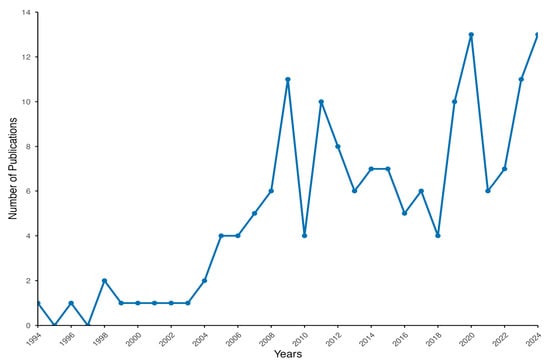
Figure 2.
Variation in the number of publications on LULCC and its driving forces from 1994 to 2024 in Japan.
3.2. Geographical Distribution and Scope of Studies on LULCC and Its Driving Forces in Japan Between 1994 and 2024
The Kanto region emerged as the primary geographical focus of the analyzed literature (n = 34), representing Japan’s largest lowland area on the island of Honshu and the socio-economic hub surrounding the capital, Tokyo. Significant research activity was also recorded for the northern island of Hokkaido (n = 21), recognized for its distinct climatic and biogeographical characteristics and its role in national agricultural production, and for Kyushu (n = 21), the third-largest island located in the southwest of the archipelago (Figure 3). Some studies focused on other regions in the island of Honshu, namely the Tohoku (n = 15), Kinki (n = 12), Chubu (n = 11) and Chugoku (n = 10) regions (Figure 3). For the fourth-largest island of Shikoku, four studies were published during the study period (Figure 3).
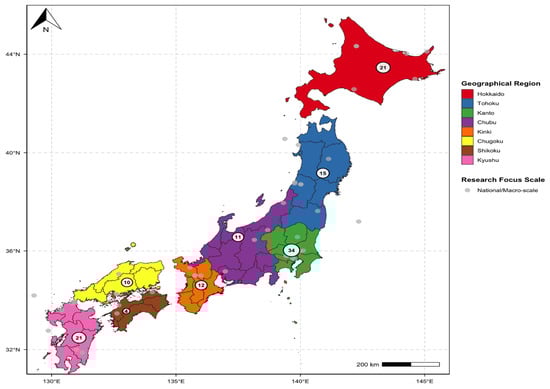
Figure 3.
Spatial distribution of studies on LULCC and its driving forces across Japan’s eight major regions (1994–2024). The white circle represents the number (n) of unique articles that focused on a given region.
The geographical scope analysis (Appendix D) of the 158 articles revealed a bias toward localized studies over broader spatial assessments. A total of 90 studies, accounting for approximately 57% of the selected articles, were focused on the prefecture/local scale. In contrast, 24% of remaining studies addressed the LULCC issues at the regional scale (n = 38), while 19% of them were identified as national/macro-scale studies (n = 30).
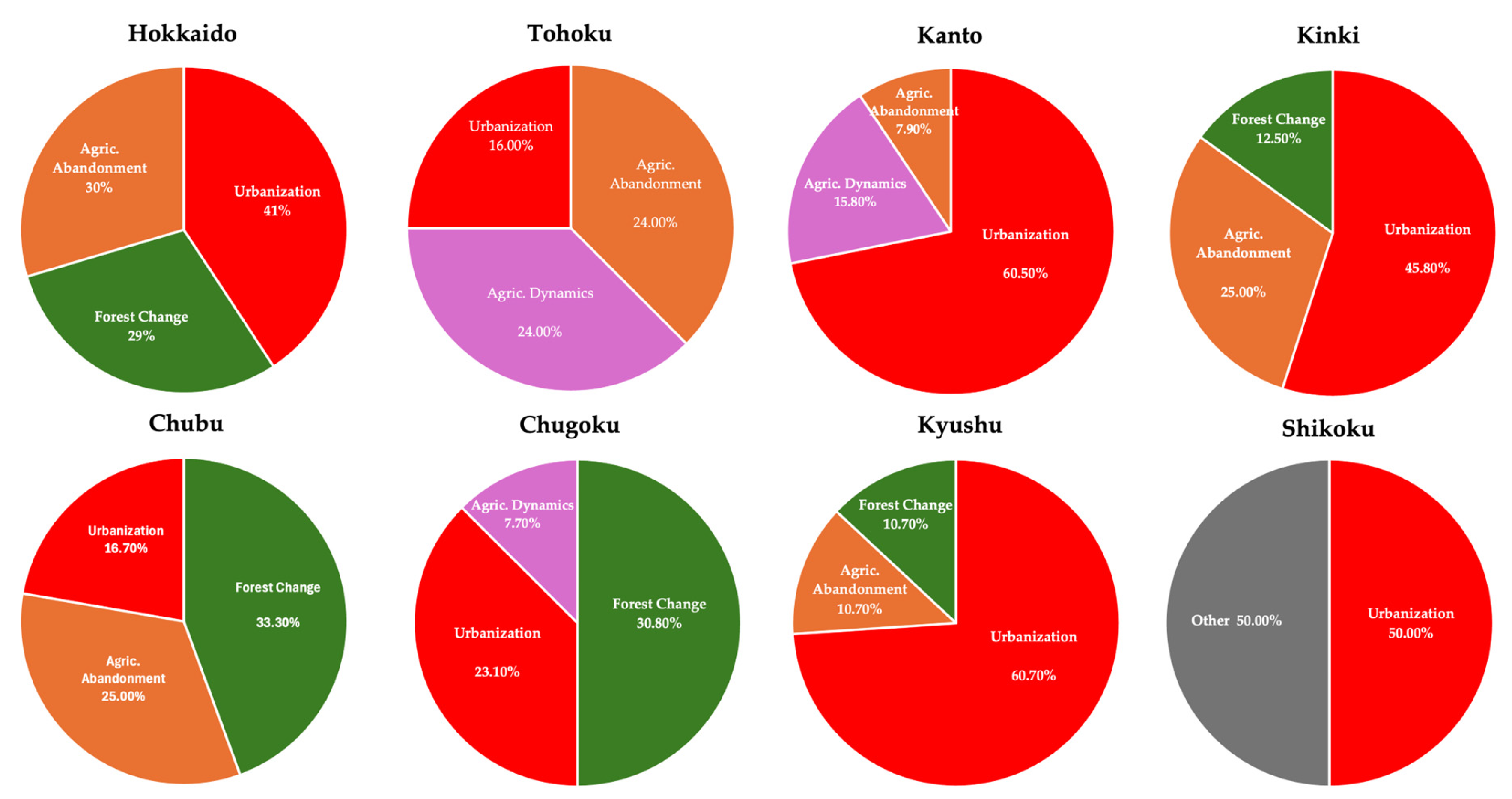
The analysis of the thematic distribution across regions revealed a distinct spatial heterogeneity in research priorities (Figure A1; Appendix E). While urbanization dominated the literature in Japan’s major metropolitan regions (Kanto and Kyushu, >60%), the Chubu and Chugoku regions served as the primary nodes for studying forest recovery trajectories. Tohoku was the only region where ‘agricultural abandonment’ and ‘agricultural dynamics’ (48% combined) greatly outweigh urban-centric studies, reflecting the region’s specific socio-ecological challenges. The Kinki and Shikoku regions also showed the relatively highest thematic specialization, with over 45% of research devoted to urbanization and built-up expansion. Unlike the mainland, Hokkaido research was evenly split between urbanization (41%), forest change (29%), and agricultural abandonment (30%), reflecting its unique role as a vast, multi-functional land system.
3.3. Thematic Foci of Studies on LULCC
The studies included in this review covered various aspects of LULCC issues, including assessment of its causes, its potential effects, and attempts to forecast change through predictive modeling and simulation. Most of the publications dealt with the four key thematic foci: causes (67.10%), effects (84.20%), and aspects related to quantitative spatial analysis (58.23%) and predictive modeling (13.92%) of land-use change (Table 3).
Table 3.
Global trends in thematic foci addressed by the LULCC literature in Japan (n = 158) between 1994 and 2024.
The quantitative assessment of LULCC causes revealed that the literature is primarily focused on anthropogenic and systemic forces, with economic and market forces being the dominant thematic focus addressed in 26.60% (n = 42) of the articles. Closely following is the attention paid to policy, planning and institutional factors, addressed in 24.05% (n = 38) of the literature, indicating that Japanese LULCC is widely recognized as a regulated process.
The analysis of LULCC effects revealed that the research community in Japan is primarily focused on environmental impacts, particularly those related to water and ecosystems. The most studied consequence of land change is hydrological and soil effects, addressed by 34.81% (n = 55) of the articles. The second major area of focus is ecological effects (29.11%, n = 46), reflecting strong scientific attention on the conservation implications of LULCC, such as habitat fragmentation and the loss of ecosystem services. However, the socio-economic and health effects were the least addressed (3.80%, n = 6).
While general quantitative spatial analyses represented the most frequent methodological approach (58.23%; n = 92), predictive modeling remained a niche focus within the Japanese LULCC literature (13.92%; n = 22). Of these, scenario-based projections were the most common (n = 11), followed by spatio-temporal models such as CA-Markov and CLUE-S (n = 8).
Furthermore, frequency analysis of specific types of LULCC clearly identified two dominant phenomena (i.e., agricultural land dynamics and urbanization/built-up area expansion) that motivated research efforts in Japan over the past few decades (Figure 4). Specifically, agricultural land dynamics (n = 117) was the most documented type of LULCC, highlighting the massive land shifts resulting from Japan’s postwar agricultural policy and rural socioeconomic changes. These encompass all changes related to cropland, paddy fields, or farmland, and especially land abandonment. The high frequency of agricultural land dynamics further suggests that farmland abandonment and conversion into natural vegetation, driven by depopulation, aging, and low profitability, was the most pressing land-use issue studied. In addition, the near-equal focus on urbanization and built-up expansion (n = 107) reflects that LULCC research has primarily addressed the consequences of Japan’s rapid urbanization and suburban sprawl over the study period. These two core themes, rural contraction (abandonment) and urban expansion, collectively dominated the literature, far surpassing attention paid to all forms of forest cover change (loss, gain, and composition totaling 60 records) and hydrological changes (n = 19). This contrast reinforces the narrative that socio-economic and policy drivers (as noted in the analysis of LULCC causes) are creating a dual landscape of intensive development and widespread abandonment, which are becoming the main concerns for LULCC science in Japan.
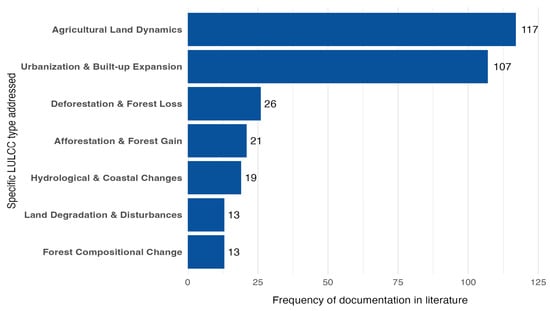
Figure 4.
Frequency of documented specific types of LULCC in the literature in Japan over the period 1994–2024.
Specifically, forest cover changes (deforestation and afforestation) were addressed in 47 records. Studies indicated that deforestation was primarily driven by infrastructure development and urban expansion in the 1990s, while more recent forest loss was linked to commercial timber harvesting cycles. In contrast, afforestation and reforestation trends were increasingly associated with ‘passive recovery.’ For instance, over 40% of these targeted studies discussing forest gain identified the abandonment of marginal agricultural lands as the primary catalyst, with the cessation of human management allowing natural secondary succession, particularly in mountainous regions.
3.4. Identification of Dominant LULCC Transition Pathways, Temporal Analysis of Change Drivers, and Quantification of Change Magnitude
3.4.1. Dominant Transition Pathways of LULCC Dynamics in the Primary Selected Studies
The qualitative analysis of LULCC identified 224 distinct transitions across all reviewed studies, highlighting the dominant change pathways that reflect the LULC trends specific to contemporary Japan, particularly rural abandonment and sustained pressure on productive lands. The transition frequency analysis revealed that LULCC is primarily driven by processes linked to socio-economic shifts, rather than solely by urban expansion. The top five most frequently cited transitions accounted for 64% of all recorded changes (144 out of 224 transitions, Figure 5). The single most dominant transition was the conversion of Forest/Natural Vegetation into Bare land and other categories, including vacant lots, parking lots, and wasteland (n = 35). This transition represents the management failure in non-timber forestlands (like Satoyama), exacerbated by the aging and out-migration of the rural population. It also signifies a loss of traditional land management rather than purely aggressive deforestation in the Japanese context. The primary transition originating from Agriculture was Agriculture to Bare/Other (n = 31). This pathway is a key indicator of ‘kōchi hōki’ (i.e., farmland abandonment) across Japan, where unprofitable or geographically challenging paddies/fields are left, converting to unused land. The two key transitions leading to built-up areas were Agriculture to Built-up (n = 27) and Forest/Natural Vegetation to Built-up (n = 25). These transitions reflect the sustained, localized pressure for housing, industrial sites, and infrastructure, particularly in peri-urban areas or flatter, accessible coastal plains.
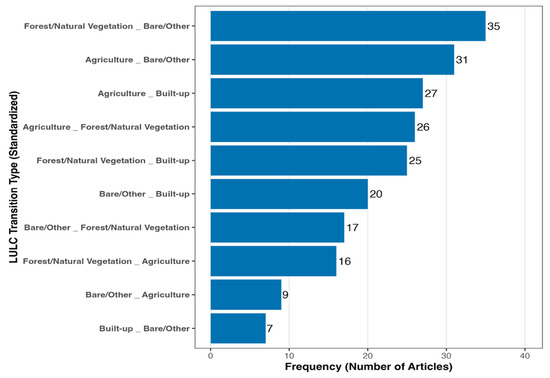
Figure 5.
Frequency of the top 10 LULC transitions cited in the literature.
The analysis of the transition matrix (Appendix F) confirmed the dual nature of LULC change in Japan, characterized by a net gain in the urban-built sector, coupled with a net loss in the managed and semi-natural sectors. Agriculture and Forest/Natural Vegetation (also known as productive lands) recorded the largest net losses (−60 and −31, respectively, Appendix F). This reflects the national trends that show a continuous decline in cultivated area due to rural depopulation and policy shifts favoring land consolidation or retirement. However, the Built-up class (identified as sinks of change) showed the largest net gain (+67), reflecting the national focus on centralized infrastructure and continued, localized urban intensification (or expansion in peripheral cities). Crucially, the Bare/Other class also saw a significant net gain (+29).
3.4.2. Analysis of Temporal Evolution of LULCC Drivers in the Primary Selected Studies
The temporal analysis of reported LULCC drivers revealed a paradigm shift in the Japanese land system. This shift is characterized by a transition from a development-centric era (1994–2003) dominated by economic (66.67%) and policy (55.56%) drivers to a contemporary era (2014–2024) defined by biophysical/hazard factors (31.46%) and economic drivers (~33%) as well (Table 4). This temporal analysis also demonstrated that the factors driving land-use change in Japan are not static. They have transitioned from an economic–policy nexus in the 1990s to an economic–environmental nexus over the last decade (2014–2024).
Table 4.
Summary of the temporal analysis of reported LULCC drivers in Japan between 1994 and 2024.
3.4.3. Quantified Land-Use/Land-Cover Change Flows, Net Balances, and Dominant Transitions
The quantitative synthesis of LULCC transitions, derived from the systematic extraction of area-change data across the primary literature, revealed a dominant and unidirectional transformation pattern within the Japanese archipelago. It is important to clarify that the absolute area totals presented in the subsequent analyses do not represent a single national census; rather, they constitute a meta-synthesis of the cumulative LULC changes reported across the diverse spatial and temporal extents of the 158 included studies.
A critical methodological distinction involved the “Aggregated Duration” (reported in Table 5), which for several transition pathways exceeds 400 or even 600 study-years (e.g., 659 years for Forest to Bare Land transitions). These values do not denote a single chronological timeline. Instead, they represent a bibliometric aggregation, which is a cumulative sum of the specific observational periods extracted from all independent primary studies. This aggregated duration serves as an evidence-based denominator that weights the total reported area change by the total “research effort” or observational intensity dedicated to a specific transition. By applying this aggregation approach, the resulting Annual Change Rates (km2/years) effectively standardize the magnitude of change across three decades of research, allowing for a sound comparison between studies of varying durations and scales.
Table 5.
Annual change rate metrics and dominant LULCC transition pathways in Japan, based on aggregated primary data (1994–2024).
Consequently, the scientific significance of this synthesis focused on the standardized annual rates (Table 5) and the net change balances (Table 6), which provide empirical evidence of dominant national trends. The analysis of net changes in Table 6 revealed a pronounced structural imbalance that mirrors Japan’s broader socio-demographic trajectories, specifically population decline and concentrated urbanization.
Table 6.
Net LULC change quantification and class balance based on aggregated primary data (1994–2024).
“Agriculture” was identified as the most unstable LULC class, registering a massive net loss of 319,478.84 km2. This indicates that agricultural abandonment, driven by rural depopulation and the “aging society” phenomenon, is the primary source of land for other categories. The “Forest/Natural Vegetation” category recorded the most significant compensatory net gain (+237,334.01 km2), reflecting widespread forest succession on abandoned fields. This was followed by a substantial net expansion in “Built-up areas” (+55,004.81 km2), highlighting the persistent intensity of urban development in coastal and peri-urban corridors despite overall national population stagnation.
Furthermore, the analysis of the Sankey diagram (Figure 6) and the annual change rate metrics (Table 6) identified two basic and counter-directional processes that dominate LULCC, namely ecological reversion (natural forest succession) and LULC intensification (urbanization). First, the most intense transition is the conversion from “agriculture” to “forest or natural vegetation,” at a rate of 684 km2/year. This rate is over eight times the magnitude of the reverse flow (“forest” to “agriculture,” 83.6 km2/year), providing quantitative evidence that natural forest succession on abandoned agricultural land is the principal physical process of the landscape restructuring. The secondary but significant flow is driven by LULC intensification. The largest inflow to the “built-up” stratum came from the “agriculture” stratum, at a rate of 78.5 km2/year. This demonstrates that urban and infrastructural expansion preferentially targets the accessible, low-lying plains historically used for agriculture, a pattern consistent with the long-term centralization of economic activity in metropolitan areas. The third highest rate, from the “bare/other” stratum to the “built-up” stratum (48.5 km2/year), suggests that marginal or previously degraded lands are increasingly being leveraged for the development and modernization projects across the country.
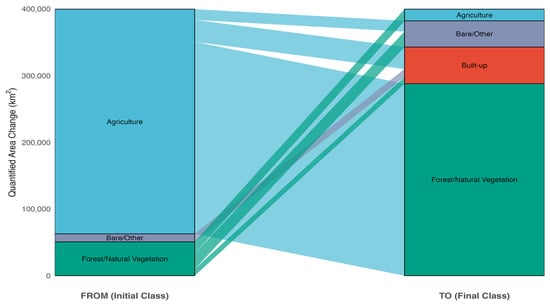
Figure 6.
Quantified LULC flows from the findings in the primary literature.
3.5. Quantitative Assessment of Factor Linkages and Research Gaps: Frequency, Co-Occurrence, and Prioritization
The Chi-Squared Test of Independence was employed to evaluate the non-random association between four key factor pairs (Appendix G). The analysis indicated that none of the factor co-occurrence patterns were found to be statistically significant (p > 0.05).
This general pattern of non-significant results, despite the visually striking patterns in the heatmaps (Figure 7a–c), is a critical finding. It suggests that while high-magnitude co-occurrence patterns exist within the sampled literature (dark cells in the heatmaps), the observed frequencies are often consistent with the expected counts when considering the low total sample size and the overall distribution of categories across the entire contingency table. Consequently, the visual patterns reflect the intensity of research foci, but the formal χ2 test limits the inferential claim regarding non-random causality.
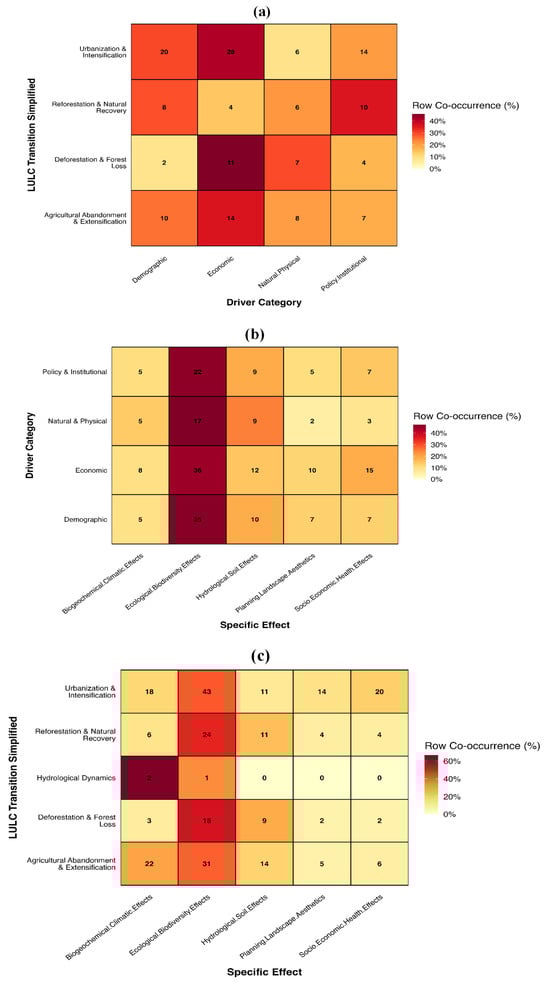
Figure 7.
(a) Interlinkages between LULC Transitions and Driver Categories of LULCC. (b) Interlinkages between Driver Categories and Specific Effects of LULCC. (c) Interlinkages between LULC Transition and Specific Effects.
3.5.1. Change Driver and LULC Transition Co-Occurrence
Analysis of the relationship between LULC transitions and their reported drivers revealed distinct patterns across the country (Figure 7a; Appendix H.1). For ‘urbanization/intensification’ (total n = 68), the dominant driving forces were ‘economic’ (41.18%; n = 28) and ‘demographic’ (29.41%; n = 20). This concentration reflects the strong pull of metropolitan centers driven by economic opportunity and internal migration patterns common in a highly developed nation like Japan.
Similarly, ‘agricultural abandonment/extensification’ (total n = 39) was principally governed by ‘economic’ (35.90%; n = 14) and ‘demographic’ (25.64%; n = 10) factors. This is highly pertinent to Japan, where the combination of rural depopulation and an aging farming community (‘demographic’) alongside issues of low agricultural profitability (‘economic’) drives the widespread phenomenon of ‘kôchi hôchi’ (abandoned cultivated land).
In contrast, ‘reforestation/natural recovery’ (total n = 28) was most frequently associated with ‘policy/institutional’ (35.71%; n = 10) and ‘demographic’ (28.57%; n = 8) drivers. The prominence of policy/institutional factors highlights the critical role of national and local forestry management policies in Japan, while demographic drivers likely reflect natural forest succession on former agricultural land abandoned due to rural exodus.
Finally, ‘deforestation/forest loss’ (total n = 24) was most driven by ‘economic’ (45.83%; n = 11) and ‘natural/physical’ (29.17%; n = 7) factors, the latter being a significant consideration in Japan due to the high frequency of natural disasters such as typhoons and seismic activity.
3.5.2. Change Driver and Specific Effect Co-Occurrence
Across all four driver categories, “ecological/biodiversity effects” represented the dominant consequence (ranging from 44.4% to 47.2% of all reported effects per driver). This highlights a clear focus in LULCC research on the environmental outcomes of land use change in the compiled literature (Figure 7b; Appendix H.2). The “socio-economic/health effects” are most associated with economic drivers (18.5%) and policy/institutional drivers (14.6%). This connection implies that economic decisions, such as those related to land speculation or intensive agriculture, are quickly translated into human-centric impacts. The hydrological/soil effects received substantial attention under natural/physical drivers (25.0%), indicating that researchers frequently link geological and climatic phenomena (e.g., heavy rainfall, landslide, soil erosion) directly to hydrological consequences.
3.5.3. LULC Transition and Specific Effect Co-Occurrence
Across all major LULC transitions analyzed, ‘ecological/biodiversity effects’ emerged as the most reported outcome (Figure 7c; Appendix H.3), highlighting the prevailing research focus on biological impacts in existing literature.
For ‘urbanization/intensification’ (total n = 106), ‘ecological/biodiversity effects’ were dominant (40.57%; n = 43), followed by the ‘socio-economic/health effects’ (18.87%; n = 20). Notably, ‘planning/landscape aesthetics’ also registered a significant contribution (13.21%; n = 14), reflecting the high value placed on landscape quality and urban design standards.
The LULC transitions related to forest cover loss and gain showed a clear duality in reported effects. For instance, ‘deforestation/forest loss’ (total n = 34) was characterized by ‘ecological/biodiversity effects’ (52.94%; n = 18) and ‘hydrological/soil effects’ (26.47%; n = 9). The ‘reforestation/natural recovery’ (total n = 49) also showed a similar pattern with ecological/biodiversity effects (48.98%; n = 24) and hydrological/soil effects (22.45%; n = 11). This mention of the ‘hydrological/soil effects’ for both forest transitions is particularly relevant to Japan’s environmental context, where a mountainous landscape and heavy rainfall necessitate forest cover for slope stability and erosion control, making the hydrological consequences of LULC change a vital research focus.
Lastly, ‘agricultural abandonment/extensification’ (total n = 78) showed ‘ecological/biodiversity effects’ (39.74%; n = 31) and ‘biogeochemical/climatic effects’ (28.21%; n = 22) as the most prevalent outcomes. This emphasizes that agricultural land change in Japan is primarily studied for its role in altering successional trajectories (‘ecological’) and its implications for carbon cycling and greenhouse gas fluxes (‘biogeochemical’).
3.5.4. Co-Occurrence of Specific Effects and Knowledge Gaps
The analysis of co-occurrence between specific effects and knowledge gap categories revealed distinct research priorities and methodological limitations across different domains of LULC impact assessment.
- Overall knowledge gap distribution in the primary literature
Across all specific effects, the most frequently cited knowledge gap was ‘methodology/technical’ (n = 110), accounting for approximately 39.7% of all gaps (Appendix I). This dominant pattern, followed by ‘impact/process mechanisms’ (n = 74; 26.7%) and ‘socio-economic/management’ (n = 47; 17.0%), suggests that the primary research challenge lies in improving the tools, techniques, and theoretical models used to study the LULC dynamics and their impacts in the country.
The most studied effect category was ‘ecological/biodiversity effects’ (n = 86), followed by the ‘biogeochemical/climatic effects’ (n = 65), collectively representing over half of all effect–gap co-occurrences (Appendix I).
- Effect-Specific Knowledge Gap Priorities
An examination of the linkages between the four single-effect and knowledge gap categories (Appendix I) revealed important differences in research needs:
- -
- The ecological/biodiversity effects and hydrological/soil effects showed a clear hierarchy, with ‘methodology/technical’ category (i.e., 38.4% of ecological/biodiversity effects–gaps; 36.7% of hydrological/soil effects–gaps) and ‘impact/process mechanisms’ category (i.e., 25.6% of ecological/biodiversity effects–gaps, 30.0% of hydrological/soil effects–gaps), constituting the two most critical needs. This emphasis points to the persistent difficulty in modeling and quantifying the complex ecological and physical processes associated with LULC change, a challenge that is particularly relevant for the management of Japan’s biodiverse but fragmented natural landscapes and their steep, erosion-prone topography.
- -
- The biogeochemical/climatic effects demonstrated the highest concentration in the non-data-related categories, with ‘methodology/technical’ (40.0%) and ‘impact/process mechanisms’ (36.9%), forming over three-quarters of the cited gaps. The low share of ‘data/monitoring’ gaps (13.8%) suggests that while data may be available (e.g., remote sensing, national inventories), the capability to translate that data into process-driven understanding, such as the carbon dynamics in Japan’s extensively managed forests or abandoned farmlands, remains underdeveloped.
- -
- The socio-economic/health effects showed a unique distribution, with the gaps in data/monitoring (37.5%) and methodology/technical (37.5%) sharing the highest citation frequency. Specifically, the ‘impact/process mechanisms’ (12.5%) was the lowest-cited gap for this effect, contrasting sharply with all other single effects, where it ranked second. For instance, in the Japanese context, where rapid urbanization/intensification (a primary LULC transition) co-occurs with an aging and shrinking population, this pattern highlights a distinct research need: generating primary socio-economic and health data (e.g., field surveys, high-resolution demographic data) is as pressing as developing the appropriate methodologies (e.g., integrated assessment models, spatial equity analysis) to study the impacts of LULC change on quality of life and public services in dense metropolitan regions across the country.
4. Discussion
The discussion is structured into four subsections to systematically interpret the main findings, considering the initial objectives of our review and the existing literature on land-use change.
4.1. The Dual Dominance of Urbanization and Agricultural Abandonment over the Decades
Our findings revealed the existence of a clear dual process, characterized by the intensification of urban areas and the abandonment of agricultural lands, as documented in the literature. This trend reflects the major land transformations that have shaped the Japanese landscape over the past few decades. Such findings also align with the socio-economic context of Japan, characterized by high population concentration in coastal metropolitan areas and simultaneous rapid aging and depopulation in rural areas.
Indeed, the urbanization-related issues resulting from LULCC were not only the subject of much debate but also addressed in the most-studied Kanto region (34 unique articles; Figure 3) across the country. This observation is unsurprising given the high population density of this region, dominated by economic activities, which have invariably led to the massive conversion of productive lands into built-up areas over the years. For instance, the megalopolis of Tokyo in the Kanto region was particularly identified as undergoing increasing ecological disturbances due to the phenomenon of urbanization since 1990, with significant impacts on the local biodiversity and provision of ecosystem services [26]. This is also confirmed by [27], who described the Kanto region as a rapidly urbanizing area with the highest urban population densities and the country’s main economic hubs. Similar observations were made by [28], who recently found that the midstream and downstream areas of Tokyo and Kanagawa prefectures in the Kanto region were rapidly urbanized as residential and industrial zones over the past decades, resulting in the deterioration of local water resources and changes in the dynamics of natural vegetation.
In addition, this transition (urbanization/intensification) is primarily driven by economic (41.2%) and demographic (29.4%) forces [Figure 7a; Appendix H.1]. Economic drivers such as infrastructural development, industrial expansion, and real estate investment appear to be the direct mechanisms of this transformation, while demographic factors, particularly internal migration and local population growth, have certainly fueled the demand for these urban spaces. Conversely, the low contribution of natural/physical factors (8.8%; Appendix H.1) underscores the anthropocentric nature of urban growth in Japan, where policies and economic dynamism dictate land-use planning. This low contribution also reveals the geological and meteorological vulnerabilities inherent to Japan, where natural hazards (earthquakes, tsunamis, typhoons, landslides, etc.) frequently reshape landscapes and influence land-use patterns. For example, the potential influence of natural disasters on land transformations was mentioned in previous studies, which have highlighted significant changes in LULC after earthquakes in certain regions [29,30,31].
Agricultural land abandonment is the second most studied transition and constitutes a complex and emerging land issue in Japan for several decades. This abandonment is also primarily driven by economic (35.9%) and demographic (25.6%) factors [Figure 7a; Appendix H.1]. Economic pressures could be attributed to the low profitability of domestic agriculture and competition from the global market, while the aging agricultural workforce and a lack of new farmers epitomize the demographic forces. Thus, the resulting land abandonment often leads to natural succession, a critical phenomenon for ecological and biogeochemical studies across the country. For example, ref. [10] identified rural depopulation as a major driver of land-use change, highlighting the central role of rural decline in land abandonment and, consequently, in land cover changes, particularly in remote areas of Japan. Similar observations were made by [13], who predicted a significant increase in farmland abandonment over the coming decades (i.e., by 2050), especially in the Hokkaido and Kyushu regions, under a scenario of rapid population decline. These authors also highlighted the ecological impacts of agricultural land abandonment, which were identified as threatening both native biodiversity and the provision of ecosystem services nationwide.
4.2. Policy and Physical Influences on Forest Dynamics
The forest cover dynamics reveal the importance of natural resource management in Japan, where forests occupy a significant portion of the land. Indeed, changes observed in the forestland-use range from initial clearing for ‘development perspectives’ to afforestation/reforestation efforts for ‘restoration purposes’, illustrating the evolution of forests over decades within the Japanese geographical context. These changes in forest coverage have occurred according to different driving forces.
Specifically, the reforestation is highly influenced by policy/institutional factors (35.7%), followed by demographic factors (28.6%) [Figure 7a; Appendix H.1]. Thus, the strong policy link can be traced back to post-war afforestation programs and current forest management legislation. In particular, the reported ‘relative increase and stable’ trends in Japan’s forest cover over decades are not solely attributable to the expansionist policies of the mid-20th century [14], but also to current forest management legislation [e.g., the Basic Plan for Forest and Forestry; revised in 2021]. This national plan prioritizes the conservation and sustainable management of forest resources and ecosystems, as well as carbon sequestration, with a view to achieving the goals of the 2050 Carbon Neutral Strategy [16]. Meanwhile, the demographic factor here often manifests as passive natural recovery, where rural depopulation leads to decreased human interference, allowing forests to regenerate on abandoned farmlands and marginal lands. For instance, while approximately 35.7% of studies attributed forest changes to the enforcement of policy frameworks (e.g., Forest and Forestry Basic Act, Direct Payment for Hilly and Mountainous Areas), which emphasized timber self-sufficiency and headwater conservation, other research identifies natural succession as the primary driver. This phenomenon is inextricably linked to the ‘lack of maintenance’ in traditional Satoyama landscapes. Thus, what may appear as a policy-driven ‘greening’ could be, in fact, a symptom of agricultural decline and the withdrawal of human land management, phenomena fueled by rural depopulation and the aging of the agricultural workforce. Consequently, this trend reflects more the complex and indirect impact of social changes on land cover and calls for in-depth research to clearly determine the relative contribution of demographic shifts to shaping land-use/land-cover patterns in the current context of environmental change.
In contrast, the transition linked to deforestation (forest loss), although less frequently reported in the literature than other transitions, is primarily due to economic (45.8%) and natural/physical (29.2%) factors [Figure 7a; Appendix H.1]. This suggests that forest loss results mainly from direct resource extraction and land conversion (economic factors) as well as vulnerability to natural hazards such as typhoons, landslides, and volcanic activity (natural/physical factors), rather than from broad demographic shifts. Thus, according to [14], forest loss peaked in the early 20th century and continued until the national government launched regreening projects after the Pacific War. But to date, forest ecosystems widely cover the country’s mountainous areas following the intensive implementation of restoration initiatives. This has therefore led to a reduction in the previous impacts caused by the degradation of forest resources and corroborates the findings of [32], who highlighted the major contributions of the growing forest stock to reducing floods and sediment-related disasters in Japan.
4.3. The Preeminence of Ecological Consequences from LULCC Impacts
Although the statistical association between LULC transitions and their specific effects was marginal (p = 0.053), the analysis clearly highlights a disciplinary research bias.
Indeed, the ecological/biodiversity effects emerged as the most frequently studied consequence for all the major land-use transitions analyzed (Figure 7c). This trend reflects the scientific community’s concern for Japan’s rich but threatened biodiversity, particularly in the context of urban sprawl and forest fragmentation. This finding is also scientifically sound and practically imperative, as it aligns with previous studies, which have already demonstrated that understanding the impacts of land-use change on ecosystem health, native biodiversity, and human well-being often drives the urgency of research and policy interventions [33,34]. Thus, a broad range of studies were conducted on the effects of LULCC in the country by exploring LULCC potential impacts on fungal communities, species distribution in wetlands, and vegetation dynamics [28,35,36], as well as on the landslide size–frequency distribution in mountainous regions [37,38].
Furthermore, the co-occurrence analysis of the relationships between LULC transitions and their specific effects revealed two highly relevant couplings. Firstly, agricultural abandonment showed a substantial contribution to studies on biogeochemical and climatic effects (28.2% of its effects; Figure 7c). This crucial finding suggests that the regeneration of abandoned land acts as a significant localized carbon sink, making this transition a focal point for climate change mitigation studies in Japan. Secondly, the urbanization/intensification also generated a relatively high number of studies on socio-economic and health effects (n = 20 cases) as well as on land-use planning and landscape aesthetics (n = 14 cases). This reflects a growing need for research on the quality-of-life impacts of dense urban living, including heat island effects, urban green space benefits, and landscape planning. These trends are illustrated by [39], who have already examined the spatial interconnections between land surface temperatures (LST) and land use/cover in the Tokyo metropolitan area.
4.4. Knowledge Gaps Identified and Future Methodological Imperatives
The knowledge gap analysis revealed a critical need for methodological advancements and a better understanding of the mechanisms underlying LULC dynamics in Japan.
Overall, the most significant gaps identified concerns with methodological approaches and the assessment of impact and process mechanisms. This collective gap suggests that research efforts often remain at the descriptive stage (e.g., inventorying or mapping of land-use changes) and struggle to evolve toward robust, predictive, and causal analysis. As a result, future research on LULCC in Japan should strategically prioritize advanced spatial modeling techniques, such as agent-based modeling or machine learning, and dedicate effort to understanding the how and why (mechanisms) of observed LULCC impacts, within the context of emerging socio-environmental challenges (i.e., increasing abandonment of farmland, disaster risks, and potential impacts of climate change). In this regard, Reference [40] established that predictive modeling can move beyond historical analysis to anticipate future scenarios, providing crucial tools for proactive land-use planning, policy formulation, and vulnerability assessments.
Furthermore, the lack of studies addressing the socio-economic and management aspects of land-use change was particularly relevant given the predominance of demographic and economic drivers. This underlines the need for greater interdisciplinary integration, focused on the role of specific policies, regulatory frameworks, and social behaviors in shaping land-use trajectories in the country.
4.5. Key Implications for Policy Initiatives and Sustainable Conservation
The main findings of this systematic review hold important and practical implications for land-use planning, rural sustainability, and mechanistic research on land-use/cover dynamics in the country.
First, the dual process of urban expansion and the abandonment of agricultural land in remote areas requires integrated regional planning. Thus, context-specific policies should simultaneously aim to manage concentrated urban growth to minimize its ecological footprint in metropolitan regions, while actively guiding the ecological trajectories of abandoned farmlands in rural areas to ensure the continuity of ecosystem service provision (e.g., carbon sequestration, watershed protection).
Second, our review highlighted the impact of demographic and economic factors on the maintenance of agricultural lands. In this regard, future policies should prioritize moving beyond simple agricultural subsidies to implement comprehensive rural revitalization strategies that address the root causes of farmland abandonment, such as promoting non-traditional uses (e.g., ecotourism, small-scale renewable energy) on marginal lands to ensure regional sustainability.
Third, the emphasis placed on ecological effects, coupled with prevalent gaps in methodological approaches and impact/process mechanisms, implies that research funding and future investigations should be directed towards causal and predictive studies. Thus, researchers should be able to clearly formalize the quantitative links between drivers, transitions, and effects to provide reliable forecasts for policymakers.
4.6. Limitations of the Study
This systematic review presents an overview of the existing literature on land-use/cover dynamics in Japan between 1994 and 2024, providing a solid basis for understanding past trends, current knowledge, and future directions.
However, this study has certain limitations, attributable not only to publication or language biases, but also to the thematic simplification employed and the marginal statistical significance noted. Like all systematic reviews, the findings are limited by the available peer-reviewed literature. Therefore, biases toward studies published in English, those indexed in major databases, or authors’ preferences for specific thematic areas can result in underreporting certain types of land-use changes or their effects in existing literature. For example, excluding non-English sources and non-peer-reviewed materials, such as technical manuals, reports, or books, from this review might lead to missing important studies published only in Japanese, potentially overlooking regional or local insights often not covered in English-language articles. Furthermore, to facilitate quantitative analysis, the complex processes of land-use change, their driving forces, and effects were grouped into simplified categories. This thematic aggregation may thus mask some of the finer-scale, localized complexities and nuances of land-use change dynamics. Additionally, the Chi-squared tests revealed a marginal, rather than a strong, statistically significant association between the “driver-transition” and “transition-effect” categories (p ≈ 0.05). While this suggests a general trend, it may also indicate that the land-use change analysis system is so complex that simple categorical links are weak, or that the categorization scheme could be further refined.
Moreover, we acknowledge that the quantitative synthesis of LULC change rates presented in Table 5 and Table 6 and the Sankey dynamics in Figure 6 are subject to the inherent methodological heterogeneity of the source literature. The reviewed studies vary widely in spatial scale, remote sensing sensors (e.g., MODIS and high-resolution aerial photography) used, and ancillary datasets. These variations mean that ‘net change’ values reflect the collective academic consensus but should be treated as indicative trends rather than absolute physical measurements. In sum, future research should incorporate all these limitations to ensure a more comprehensive and inclusive review of studies on land-use change over several decades in the country.
5. Conclusions and Research Perspectives
This systematic review provides a comprehensive synthesis of the existing literature on land-use change in Japan over the past thirty years, highlighting the predominance of two key processes: the intensification of land use in urban areas and the abandonment of agricultural lands. These major transitions are primarily due to a high concentration of population in coastal metropolitan areas and, simultaneously, to the rapid aging of the population and the depopulation of rural areas. Policies and institutional factors have also played a crucial role in stabilizing the country’s forest coverage over time. Most studies have focused on the ecological impacts of land-use change, while emphasizing the particular importance of studying the biogeochemical and climatic effects of rural land abandonment. Ultimately, LULCC in Japan constitutes a complex system of human-driven transformations that requires advanced spatial modeling techniques (agent-based modeling, machine learning) to clearly understand the mechanisms behind the observed impacts, within the context of growing socio-environmental challenges and a sustainable development perspective.
Based on the identified knowledge gaps and analytical limitations, we propose the following research directions for studying land-use/cover dynamics in Japan:
- (i)
- Future studies should prioritize formal causal modeling, going beyond simply describing changes to bridge the gap related to impact and process mechanisms. This implies the use of advanced statistical techniques or integrated spatial models (e.g., agent-based models) to quantify the specific mechanisms through which the driving forces cause different land-cover transitions and their subsequent effects.
- (ii)
- Given the importance of policies and institutional factors, research should explicitly focus on the effectiveness and long-term consequences of previously implemented land-use planning policies to address the gap related to socio-economic and management aspects. This could include assessing the economic and social outcomes of forest management laws and agricultural subsidy programs already implemented in remote rural areas.
- (iii)
- There is also a need to broaden the scope of impact studies, particularly to include understudied areas like specific socio-economic and health effects (e.g., quantifying the social costs of rural depopulation) and the cumulative impacts on hydrological and soil systems in major regions of Japan.
- (iv)
- Future research should also aim for greater replicability and transparency in setting methodological approaches (by bridging the gap between methodology and technical aspects), adopting standardized classification schemes, and free and open-source computational tools to facilitate future meta-analyses and data integration.
Supplementary Materials
The following supporting information can be downloaded at: https://www.mdpi.com/article/10.3390/land15030448/s1, S1. Complete list of 158 articles selected for the present systematic review on LULCC in Japan [Data set] on Zenodo.
Author Contributions
Conceptualization, J.S.H.H.; methodology, J.S.H.H. and S.H.; validation, S.H. and A.E.A.; formal analysis, J.S.H.H. and S.H.; data curation, J.S.H.H.; writing—original draft preparation, J.S.H.H.; writing—review and editing, J.S.H.H., S.H., F.N. and S.M.; visualization, A.E.A.; supervision, S.H.; funding acquisition, J.S.H.H. All authors have read and agreed to the published version of the manuscript.
Funding
This research was funded by Japan Society for the Promotion of Science (KAKENHI Grant-in-Aid), grant number ‘24KF0069’, and the APC was funded by Stefan Hotes.
Data Availability Statement
The data supporting the results presented are provided in Supplemental Material S1, in spreadsheet form, which compiles the full list of the 158 articles selected for this systematic review.
Acknowledgments
The authors are also grateful to all who contributed to the initial preparation of this review manuscript.
Conflicts of Interest
The authors declare no conflicts of interest. The funder had no role in the design of the study; in the collection, analyses, or interpretation of data; in the writing of the manuscript; or in the decision to publish the results.
Appendix A
Table A1.
Quantitative metrics and statistical formulas applied for the LULCC synthesis.
Table A1.
Quantitative metrics and statistical formulas applied for the LULCC synthesis.
| Metric | Mathematical Formula | Purpose |
|---|---|---|
| Standardized Area (Astd) | Astd = Aha × 0.01 | To ensure spatial uniformity (km2) across heterogeneous datasets before aggregation. |
| Net Change (ΔL) | ΔL = ∑ Gain − ∑ Loss | To determine the absolute balance of land-use transitions for each standardized class. |
| Aggregated Duration (∑Δt) * | ∑Δt = ∑ (Yearend − Yearstart) | To quantify the cumulative “research-years” dedicated to a specific land-use transition. |
| Annual Rate of Change (Rann) ** | Rann = ∑ (Total Area Change in km2)/(∑ Δt in years) | To standardize change intensity across studies of varying temporal scales. |
| Relative Frequency (f %) | f = (n/N) × 100 | To quantify the distribution of research foci, drivers, and other LULCC-related aspects across the article dataset. |
* Aggregated Duration: represents the cumulative sum of observational years across all 158 studies. This is a bibliometric measure of “sampling intensity” rather than a chronological timeline. For example, if 5 independent studies each monitored a 10-year period, the aggregated duration is 50 study-years, providing a foundation for the annual rate calculation. ** Annual Rate Calculation: By dividing the total reported area change by the aggregated duration, we generate a weighted mean that reflects the LULCC intensity, normalizing the influence of individual studies with short versus long monitoring periods.
Appendix B
Table A2.
Summary of the sensitivity analysis results for statistical independence.
Table A2.
Summary of the sensitivity analysis results for statistical independence.
| Association | χ2 Statistic | DF | p-Value (Refined) |
|---|---|---|---|
| Driver vs. LULC Transition | 15.45 | 9 | 0.079 |
| Driver vs. Specific Effect | 5.46 | 9 | 0.792 |
| LULC Transition vs. Specific Effect | 27.18 | 12 | 0.007 |
| Specific Effect vs. Knowledge Gap | 6.03 | 9 | 0.737 |
Appendix C
Table A3.
Overview of the selected articles, publication journal, and the top journals publishing on LULCC in Japan (1994–2024).
Table A3.
Overview of the selected articles, publication journal, and the top journals publishing on LULCC in Japan (1994–2024).
| Selected articles and journals within the search databases | ||||
| Type of database | Articles selected (n = 158) | Publication journals | ||
| Number | Percentage (%) | Number | Percentage (%) | |
| Web of Science | 64 | 40.51 | 49 | 39.84 |
| Google Scholar | 64 | 40.51 | 52 | 42.28 |
| Science Direct | 22 | 13.92 | 17 | 13.82 |
| CiNii | 8 | 5.06 | 5 | 4.07 |
| Distribution of co-occurred journals within the search databases | ||||
| Type of database | Co-occurred journal identified (n = 18) | |||
| Number | Percentage (%) | |||
| Web of Science, Google Scholar | 10 | 55.56 | ||
| Web of Science, Science Direct | 2 | 11.11 | ||
| Google Scholar, Science Direct | 2 | 11.11 | ||
| Web of Science, Google Scholar, Science Direct | 2 | 11.11 | ||
| Google Scholar, CiNii | 1 | 5.56 | ||
| Web of Science, Google Scholar, CiNii | 1 | 5.56 | ||
| Identification of the top journals publishing on LULCC in Japan | ||||
| Type of database | Name of journal with occurrence (n) | |||
| Web of Science | Remote Sensing (n = 4); Sustainability (n = 4) and Sustainability Science (n = 4) | |||
| Google Scholar | Landscape and Urban Planning (n = 3); Earth and Environmental Science (n = 3); and to a lesser extent, Applied Geography (n = 2); Frontiers in Environmental Science (n = 2) and Landscape Ecology (n = 2) | |||
| Science Direct | International Journal of Applied Earth Observation and Geoinformation (n = 3); and to a lesser extent, Ecological Indicators (n = 2); Geoderma n = 2) and Urban Forestry & Urban Greening (n = 2) | |||
| CiNii | Journal of Forest Planning (n = 3); and Remote Sensing (n = 2) | |||
Appendix D
Table A4.
Geographical scope distribution of LULCC studies in Japan (1994–2024).
Table A4.
Geographical scope distribution of LULCC studies in Japan (1994–2024).
| Geographical Scope | No. of Articles (n) | Percentage (%) |
|---|---|---|
| Prefecture/Local | 90 | 56.96 |
| Regional | 38 | 24.05 |
| National/Macro-scale | 30 | 18.99 |
| Total studies | 158 | 100 |
Appendix E
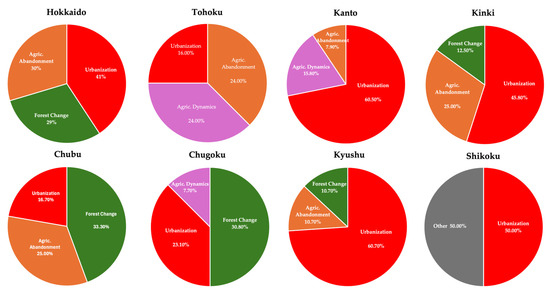
Figure A1.
Spatial Distribution and Thematic Heterogeneity in the ‘two or three’ Top LULCC Research in major regions of Japan (1994–2024).
Figure A1.
Spatial Distribution and Thematic Heterogeneity in the ‘two or three’ Top LULCC Research in major regions of Japan (1994–2024).
Appendix F
Table A5.
LULC transition matrix and global trends in the net balance of land-use transitions for various LULC categories based on findings recorded in the primary literature.
Table A5.
LULC transition matrix and global trends in the net balance of land-use transitions for various LULC categories based on findings recorded in the primary literature.
| LULC transition matrix | ||||||
| LULC_FROM | Agriculture | Bare/Other | Built-up | Forest/Nat Veget | Water | Wetlands |
| Agriculture | 0 | 31 | 27 | 26 | 0 | 2 |
| Bare/Other | 9 | 0 | 20 | 17 | 0 | 0 |
| Built-up | 0 | 7 | 0 | 2 | 0 | 0 |
| Forest/Nat Veget * | 16 | 35 | 25 | 0 | 0 | 0 |
| Water | 0 | 0 | 2 | 0 | 0 | 0 |
| Wetlands | 1 | 2 | 2 | 0 | 0 | 0 |
| Global trends in the net balance of land-use transitions for each LULC category | ||||||
| Category | Outflow (Loss) | Inflow (Gain) | Net Change | |||
| Agriculture | 86 | 26 | −60 | |||
| Forest/Nat Veget * | 76 | 45 | −31 | |||
| Built-up | 9 | 76 | +67 | |||
| Bare/Other | 46 | 75 | +29 | |||
| Water | 2 | 0 | −2 | |||
| Wetlands | 5 | 2 | −3 | |||
* Forest/Nat Veget = Forest/Natural Vegetation.
Appendix G
Table A6.
Summary of the Chi-Squared Test results between four critical factor pairs association.
Table A6.
Summary of the Chi-Squared Test results between four critical factor pairs association.
| Association | χ2 Statistic | DF | p-Value |
|---|---|---|---|
| Driver vs. LULC Transition | 16.59 | 9 | 0.056 |
| Driver vs. Specific Effect | 5.21 | 12 | 0.951 |
| LULC Transition vs. Specific Effect | 31.20 | 20 | 0.053 |
| Specific Effect vs. Knowledge Gap | 71.82 | 69 | 0.385 |
Appendix H
Appendix H.1
Table A7.
Descriptive co-occurrence of the driver–LULC transition linkages.
Table A7.
Descriptive co-occurrence of the driver–LULC transition linkages.
| LULC Transition | Demographic | Economic | Natural/Physical | Policy/Institutional |
|---|---|---|---|---|
| Agricul Aband/Extens | 10 | 14 | 8 | 7 |
| Defor/Forest Loss | 2 | 11 | 7 | 4 |
| Hydrologic Dynamics | 0 | 0 | 0 | 0 |
| Refor/Nat Recovery | 8 | 4 | 6 | 10 |
| Urban/Intensif | 20 | 28 | 6 | 14 |
Agricul Aband/Extens = Agricultural Abandonment/Extensification; Defor/Forest Loss = Deforestation/Forest Loss; Hydrologic Dynamics = Hydrological Dynamics; Refor/Nat Recovery = Reforestation/Natural Recovery; Urban/Intensif = Urbanization/Intensification.
Appendix H.2
Table A8.
Descriptive co-occurrence of the driver-specific effect linkages.
Table A8.
Descriptive co-occurrence of the driver-specific effect linkages.
| Driver Category | Biogeo/Climat Effects | Ecolog/Biodiv Effects | Hydro/Soil Effects | Planning/Land Aesthetic | Socio-Eco/Health Effects |
|---|---|---|---|---|---|
| Demographic | 5 | 25 | 10 | 7 | 7 |
| Economic | 8 | 36 | 12 | 10 | 15 |
| Natural/Physical | 5 | 17 | 9 | 2 | 3 |
| Policy/Institutional | 5 | 22 | 9 | 5 | 7 |
Biogeo/Climat Effects = Biogeochemical/Climatic Effects; Ecolog/Biodiv Effects = Ecological/Biodiversity Effects; Hydro/Soil Effects = Hydrological/Soil Effects; Planning/Land Aesthetic = Planning/Landscape Aesthetics; Socio-Eco/Health Effects = Socio-Economic/Health Effects.
Appendix H.3
Table A9.
Descriptive co-occurrence of the LULC transition-specific effect linkages.
Table A9.
Descriptive co-occurrence of the LULC transition-specific effect linkages.
| LULC Transition | Bio/Clim Effects | Ecolo/Biod Effects | Hydro/Soil Effects | Plan/LandAes | Socio/Health Effects |
|---|---|---|---|---|---|
| Agricul Aband/Extens | 22 | 31 | 14 | 5 | 6 |
| Defor/Forest Loss | 3 | 18 | 9 | 2 | 2 |
| Hydrologic Dynamics | 2 | 1 | 0 | 0 | 0 |
| Refor/Nat Recovery | 6 | 24 | 11 | 4 | 4 |
| Urban/Intensif | 18 | 43 | 11 | 14 | 20 |
Agricul Aband/Extens = Agricultural Abandonment/Extensification; Defor/Forest Loss = Deforestation/Forest Loss; Hydrologic Dynamics = Hydrological Dynamics; Refor/Nat Recovery = Reforestation/Natural Recovery; Urban/Intensif = Urbanization/Intensification; Bio/Clim Effects = Biogeochemical/Climatic Effects; Ecolo/Biod Effects = Ecological/Biodiversity Effects; Hydro/Soil Effects = Hydrological/Soil Effects; Plan/LandAes = Planning/Landscape Aesthetics; Socio/Health Effects = Socio-Economic/Health Effects.
Appendix I
Table A10.
Descriptive co-occurrence of the linkages between specific effects and the knowledge gap categories.
Table A10.
Descriptive co-occurrence of the linkages between specific effects and the knowledge gap categories.
| Specific_Effect | Data/Monitoring | Impact/Process Mechanisms | Methodology/Technical | Socio-Economic/Management |
|---|---|---|---|---|
| Bio/Clim Effects | 9 | 24 | 26 | 6 |
| Bio/Clim Effects, Ecolo/Biod Effects | 1 | 1 | 2 | 1 |
| Bio/Clim Effects, Ecolo/Biod Effects, Hydro/Soil Effects | 1 | 1 | 1 | 0 |
| Bio/Clim Effects, Ecolo/Biod Effects, Hydro/Soil Effects, Socio/Health Effects | 2 | 1 | 2 | 1 |
| Bio/Clim Effects, Ecolo/Biod Effects, Socio/Health Effects | 0 | 0 | 1 | 1 |
| Bio/Clim Effects, Hydro/Soil Effects | 0 | 1 | 2 | 1 |
| Bio/Clim Effects, Hydro/Soil Effects, Socio/Health Effects | 0 | 1 | 0 | 0 |
| Bio/Clim Effects, Socio/Health Effects | 1 | 1 | 0 | 0 |
| Ecolo/Biod Effects | 11 | 22 | 33 | 20 |
| Ecolo/Biod Effects, Hydro/Soil Effects | 1 | 3 | 9 | 1 |
| Ecolo/Biod Effects, Hydro/Soil Effects, Socio/Health Effects | 0 | 1 | 1 | 0 |
| Ecolo/Biod Effects, Plan/LandAes | 4 | 0 | 4 | 6 |
| Ecolo/Biod Effects, Plan/LandAes, Socio/Health Effects | 2 | 0 | 1 | 1 |
| Ecolo/Biod Effects, Socio/Health Effects | 3 | 7 | 8 | 3 |
| Hydro/Soil Effects | 5 | 9 | 11 | 5 |
| Hydro/Soil Effects, Plan/LandAes | 0 | 0 | 4 | 0 |
| Hydro/Soil Effects, Socio/Health Effects | 3 | 1 | 1 | 0 |
| Socio/Health Effects | 3 | 1 | 3 | 1 |
| Socio/Health Effects, Plan/LandAes | 0 | 0 | 1 | 0 |
Bio/Clim Effects = Biogeochemical/Climatic Effects; Ecolo/Biod Effects = Ecological/Biodiversity Effects; Hydro/Soil Effects = Hydrological/Soil Effects; Plan/LandAes = Planning/Landscape Aesthetics; Socio/Health Effects = Socio-Economic/Health Effects.
References
- Himiyama, Y. World Land Resources at Stake. In Human Geoscience; Springer: Singapore, 2020; pp. 61–73. [Google Scholar]
- Millington, A. Land—A Multidisciplinary Journal Addressing Issues at the Land Use and Sustainability Nexus. Land 2012, 1, 1–4. [Google Scholar] [CrossRef]
- Verburg, P.H.; Crossman, N.; Ellis, E.C.; Heinimann, A.; Hostert, P.; Mertz, O.; Nagendra, H.; Sikor, T.; Erb, K.H.; Golubiewski, N.; et al. Land System Science and Sustainable Development of the Earth System: A Global Land Project Perspective. Anthropocene 2015, 12, 29–41. [Google Scholar] [CrossRef]
- Wang, S.W.; Munkhnasan, L.; Lee, W.K. Land Use and Land Cover Change Detection and Prediction in Bhutan’s High Altitude City of Thimphu, Using Cellular Automata and Markov Chain. Environ. Chall. 2021, 2, 100017. [Google Scholar] [CrossRef]
- You, S.; Zheng, Q.; Chen, B.; Xu, Z.; Lin, Y.; Gan, M.; Zhu, C.; Deng, J.; Wang, K. Identifying the Spatiotemporal Dynamics of Forest Ecotourism Values with Remotely Sensed Images and Social Media Data: A Perspective of Public Preferences. J. Clean. Prod. 2022, 341, 130715. [Google Scholar] [CrossRef]
- Hassan, Z.; Shabbir, R.; Ahmad, S.S.; Malik, A.H.; Aziz, N.; Butt, A.; Erum, S. Dynamics of Land Use and Land Cover Change (LULCC) Using Geospatial Techniques: A Case Study of Islamabad Pakistan. SpringerPlus 2016, 5, 812. [Google Scholar] [CrossRef] [PubMed]
- Umar, D.A.; Ramli, M.F.; Tukur, A.I.; Jamil, N.R.; Zaudi, M.A. Detection and Prediction of Land Use Change Impact on the Streamflow Regime in Sahelian River Basin, Northwestern Nigeria. H2Open J. 2021, 4, 92–113. [Google Scholar] [CrossRef]
- Yamaura, Y.; Amano, T.; Koizumi, T.; Mitsuda, Y.; Taki, H.; Okabe, K. Does Land-Use Change Affect Biodiversity Dynamics at a Macroecological Scale? A Case Study of Birds over the Past 20 Years in Japan. Anim. Conserv. 2009, 12, 110–119. [Google Scholar] [CrossRef]
- Döringer, S.; Uchiyama, Y.; Penker, M.; Kohsaka, R. A Meta-Analysis of Shrinking Cities in Europe and Japan. Towards an Integrative Research Agenda. Eur. Plan. Stud. 2020, 28, 1693–1712. [Google Scholar] [CrossRef]
- Kobayashi, Y.; Higa, M.; Higashiyama, K.; Nakamura, F. Drivers of Land-Use Changes in Societies with Decreasing Populations: A Comparison of the Factors Affecting Farmland Abandonment in a Food Production Area in Japan. PLoS ONE 2020, 15, e0235846. [Google Scholar] [CrossRef] [PubMed]
- Nishikawa, O.H.Y.; Nishikawa, O.; Himiyama, Y. Atlas of Environmental Changes in the Japanese Archipelago; Asakura Publishing: Tokyo, Japan, 1995. [Google Scholar]
- Shoyama, K.; Matsui, T.; Hashimoto, S.; Kabaya, K.; Oono, A.; Saito, O. Development of Land-Use Scenarios Using Vegetation Inventories in Japan. Sustain. Sci. 2019, 14, 39–52. [Google Scholar] [CrossRef]
- Huang, W.; Hashimoto, S.; Yoshida, T.; Saito, O.; Meraj, G. Understanding Japan’s Land-Use Dynamics between 1987 and 2050 Using Land Accounting and Scenario Analysis. Sustain. Sci. 2024, 19, 1561–1577. [Google Scholar] [CrossRef]
- Tsukamoto, Y. Devastation Process of Forests and Surface Soils by Human Impacts-Devastation and Denudation of Low Relief Mountains in Japan. J. Jpn. Soc. Eros. Control Eng. 2001, 54, 82–92. [Google Scholar] [CrossRef]
- Hattori, K.; Kaido, K.; Matsuyuki, M. The Development of Urban Shrinkage Discourse and Policy Response in Japan. Cities 2017, 69, 124–132. [Google Scholar] [CrossRef]
- Ministry of Agriculture, Forestry, and Fisheries. [MAFF] Basic Plan for Forest and Forestry; Ministry of Agriculture, Forestry, and Fisheries: Tokyo, Japan, 2021.
- Harada, I.; Hara, K.; Park, J.; Asanuma, I.; Tomita, M.; Hasegawa, D.; Short, K.; Fujihara, M. Monitoring of Rapid Land Cover Changes in Eastern Japan Using Terra/MODIS Data. Int. Arch. Photogramm. Remote Sens. Spat. Inf. Sci. 2015, XL-7-W3, 403–408. [Google Scholar] [CrossRef]
- Kohsaka, R.; Kohyama, S. State of the Art Review on Land-Use Policy: Changes in Forests, Agricultural Lands and Renewable Energy of Japan. Land 2022, 11, 624. [Google Scholar] [CrossRef]
- Noda, A.; Kondoh, A.; Nishihiro, J. Changes in Land Cover and Grassland Area over the Past 120 Years in a Rapidly Urbanised Area in Japan. One Ecosyst. 2019, 4, e37669. [Google Scholar] [CrossRef]
- Afuye, G.A.; Nduku, L.; Kalumba, A.M.; Santos, C.A.G.; Orimoloye, I.R.; Ojeh, V.N.; Thamaga, K.H.; Sibandze, P. Global Trend Assessment of Land Use and Land Cover Changes: A Systematic Approach to Future Research Development and Planning. J. King Saud Univ.-Sci. 2024, 36, 103262. [Google Scholar] [CrossRef]
- Kora, H.A.S.; Houndonougbo, J.S.H.; Noulèkoun, F.; Agoyi, E.E.; Assogbadjo, A.E.; Sinsin, B. Three Decades of the Practice of Decentralised Forest Management in Africa: A Systematic Review of Current Knowledge and Prospects. Glob. Ecol. Conserv. 2025, 59, e03525. [Google Scholar] [CrossRef]
- Waltman, L. A Review of the Literature on Citation Impact Indicators. J. Informetr. 2016, 10, 365–391. [Google Scholar] [CrossRef]
- Zupic, I.; Čater, T. Bibliometric Methods in Management and Organization. Organ. Res. Methods 2015, 18, 429–472. [Google Scholar] [CrossRef]
- van Vliet, N.; Mertz, O.; Heinimann, A.; Langanke, T.; Pascual, U.; Schmook, B.; Adams, C.; Schmidt-Vogt, D.; Messerli, P.; Leisz, S.; et al. Trends, Drivers and Impacts of Changes in Swidden Cultivation in Tropical Forest-Agriculture Frontiers: A Global Assessment. Glob. Environ. Change 2012, 22, 418–429. [Google Scholar] [CrossRef]
- Agresti, A. An Introduction to Categorical Data Analysis, 3rd ed.; Wiley: Hoboken, NJ, USA, 2018. [Google Scholar]
- Sato-Takabe, Y.; Hirose, S.; Hori, T.; Hanada, S. Abundance and Spatial Distribution of Aerobic Anoxygenic Phototrophic Bacteria in Tama River, Japan. Water 2020, 12, 150. [Google Scholar] [CrossRef]
- Bagan, H.; Yamagata, Y. Landsat Analysis of Urban Growth: How Tokyo Became the World’s Largest Megacity during the Last 40 years. Remote Sens. Environ. 2012, 127, 210–222. [Google Scholar] [CrossRef]
- Fatmawati, A.; Aurora, R.M.; Thong, T.D.; Furuya, K. Impact of Urbanization on the Vegetation Dynamic in Tama River Basin. Int. Rev. Spat. Plan. Sustain. Dev. 2024, 12, 119–137. [Google Scholar] [CrossRef]
- Chen, Y.; Nakatsugawa, M. Analysis of Changes in Land Use/Land Cover and Hydrological Processes Caused by Earthquakes in the Atsuma River Basin in Japan. Sustainability 2021, 13, 13041. [Google Scholar] [CrossRef]
- Ishihara, M.; Tadono, T. Land Cover Changes Induced by the Great East Japan Earthquake in 2011. Sci. Rep. 2017, 7, srep45769. [Google Scholar] [CrossRef] [PubMed]
- Iwasaki, Y.; Tamaki, T.; Murata, K.; Koga, A.; Fujimoto, K. Detection of Land Cover Changes before and after the 2016 Kumamoto Earthquake in Japan Using Remote Sensing for Evaluation of Environmental Impacts. In IOP Conference Series: Earth and Environmental Science, Proceedings of the 2020 10th International Conference on Future Environment and Energy, Kyoto, Japan, 7–9 January 2020; IOP Publishing Ltd.: Bristol, UK, 2020; Volume 581, p. 012044. [Google Scholar] [CrossRef]
- Sato, T.; Shuin, Y. Impact of National-Scale Changes in Forest Cover on Floods and Rainfall-Induced Sediment-Related Disasters in Japan. J. For. Res. 2023, 28, 106–110. [Google Scholar] [CrossRef]
- Foley, J.A.; DeFries, R.; Asner, G.P.; Barford, C.; Bonan, G.; Carpenter, S.R.; Chapin, F.S.; Coe, M.T.; Daily, G.C.; Gibbs, H.K.; et al. Global Consequences of Land Use. Science 2005, 309, 570–574. [Google Scholar] [CrossRef]
- World Resources Institute. Millennium Ecosystem Assessment Ecosystems and Human Well-Being: Biodiversity Synthesis; World Resources Institute: Washington, DC, USA, 2005. [Google Scholar]
- Kim, J.Y.; Nishihiro, J. Responses of Lake Macrophyte Species and Functional Traits to Climate and Land Use Changes. Sci. Total Environ. 2020, 736, 139628. [Google Scholar] [CrossRef] [PubMed]
- Miura, A.; Urabe, J. Riparian Land Cover and Land Use Effects on Riverine Epilithic Fungal Communities. Ecol. Res. 2015, 30, 1047–1055. [Google Scholar] [CrossRef]
- Kimura, T. Effects of Land Cover Changes and Rainfall Variation on the Landslide Size–Frequency Distribution in a Mountainous Region of Western Japan. Geosciences 2024, 14, 59. [Google Scholar] [CrossRef]
- Kimura, T.; Sato, G.; Ozaki, T.; Van Thang, N.; Wakai, A. Land Cover Trajectories and Their Impacts on Rainfall-Triggered Landslide Occurrence in a Cultivated Mountainous Region of Western Japan. Water 2023, 15, 4211. [Google Scholar] [CrossRef]
- Liu, F.; Hou, H.; Murayama, Y. Spatial Interconnections of Land Surface Temperatures with Land Cover/Use: A Case Study of Tokyo. Remote Sens. 2021, 13, 610. [Google Scholar] [CrossRef]
- Verburg, P.H.; Schot, P.P.; Dijst, M.J.; Veldkamp, A. Land Use Change Modelling: Current Practice and Research Priorities. GeoJournal 2004, 61, 309–324. [Google Scholar] [CrossRef]
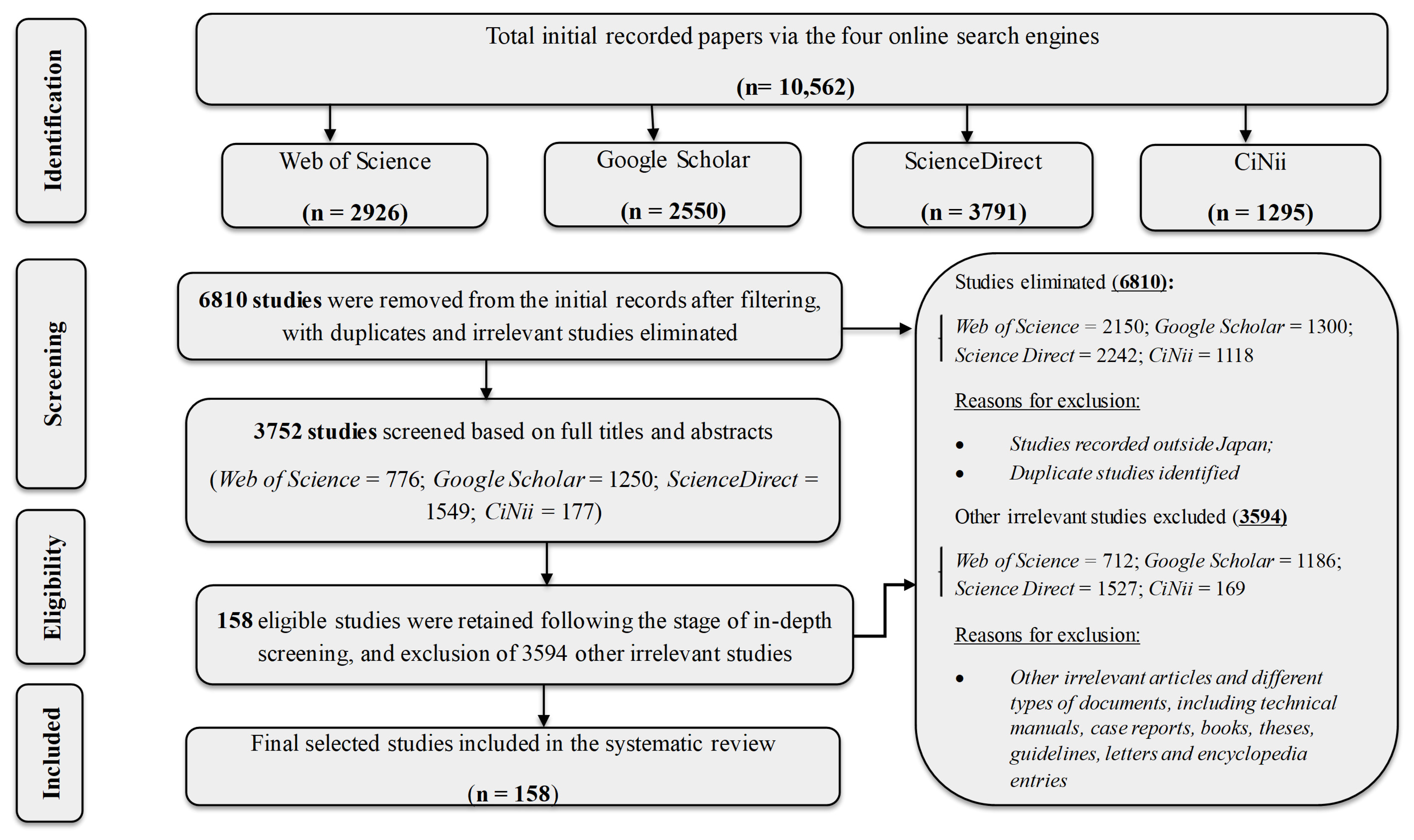
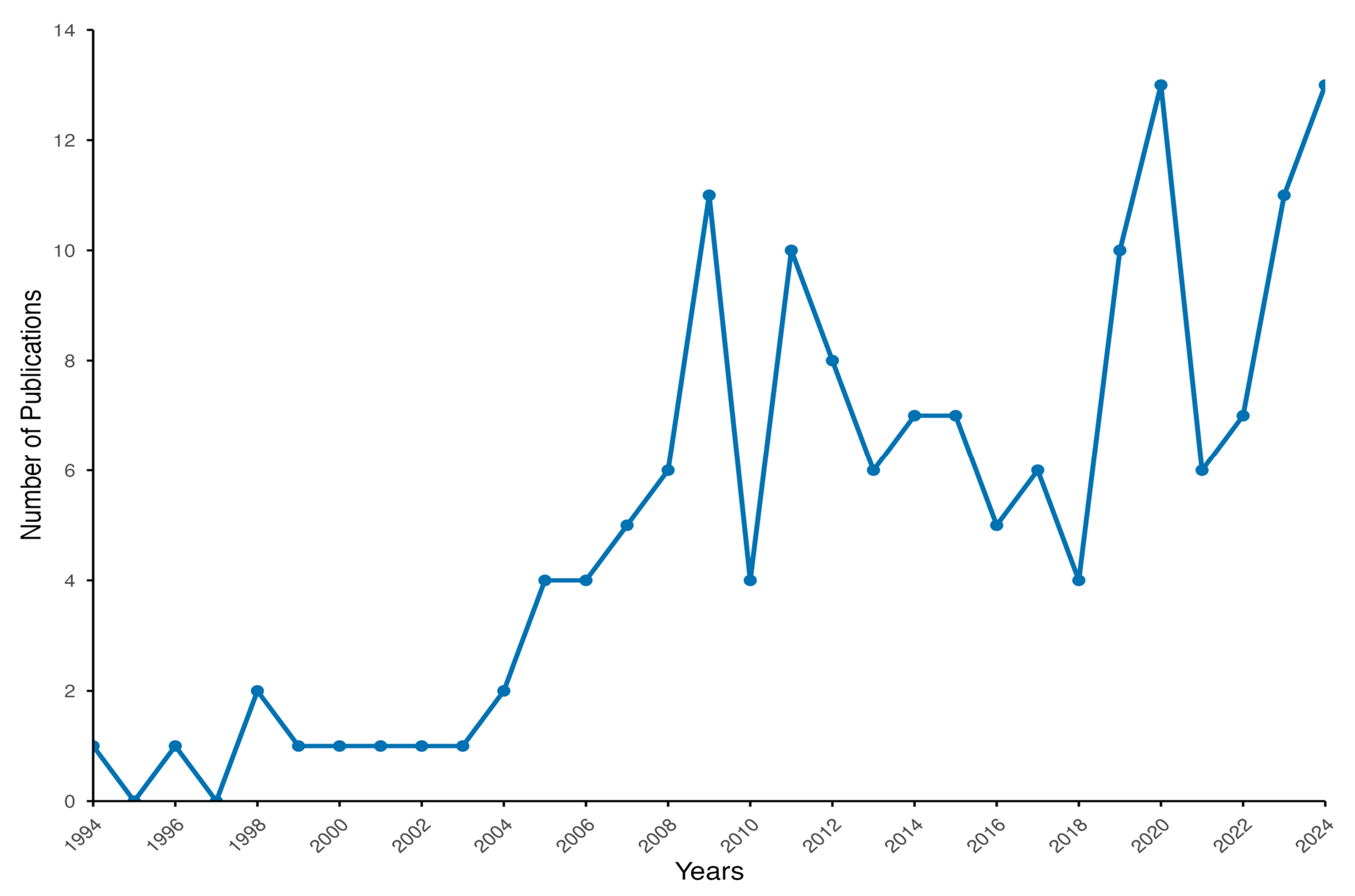
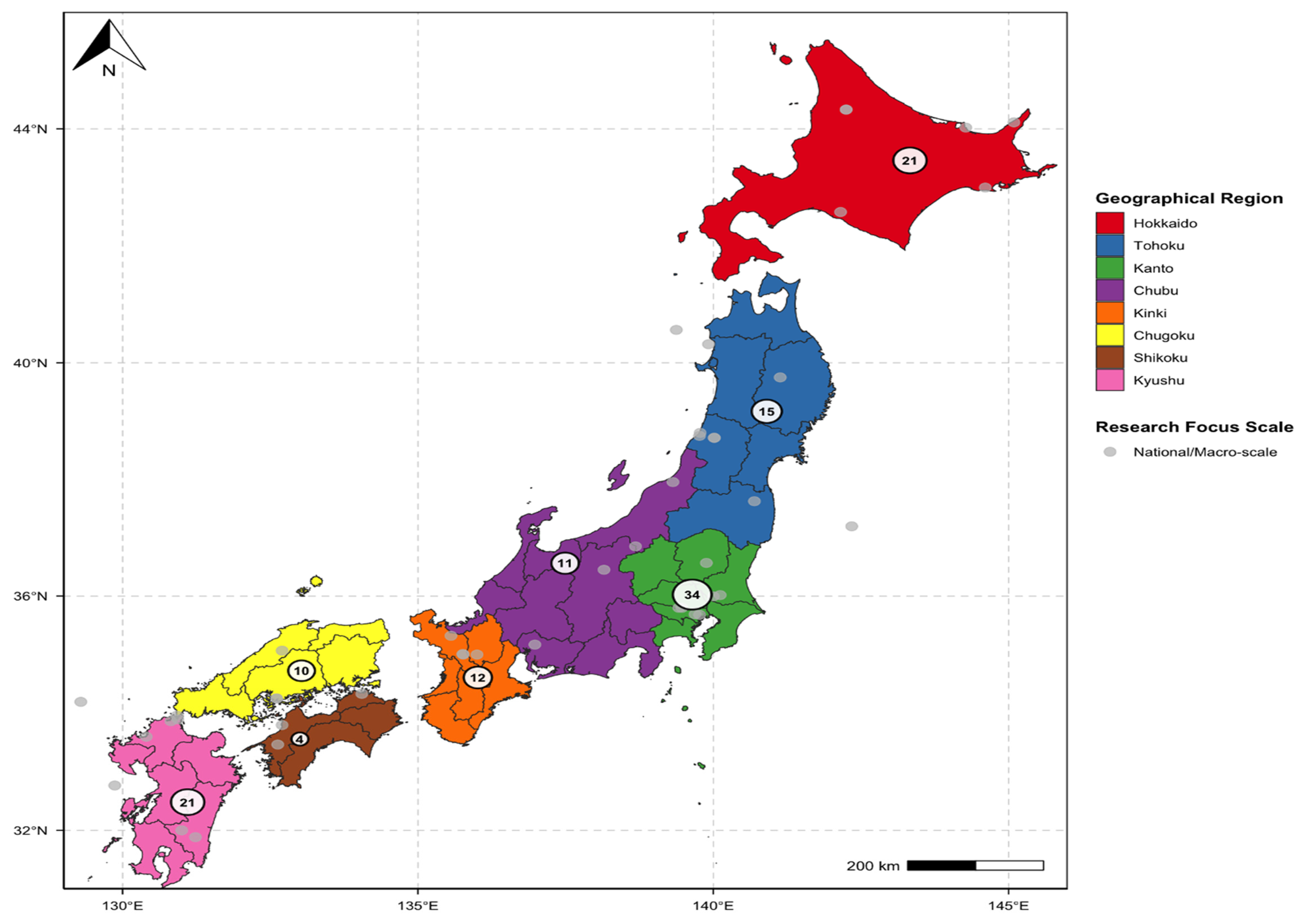
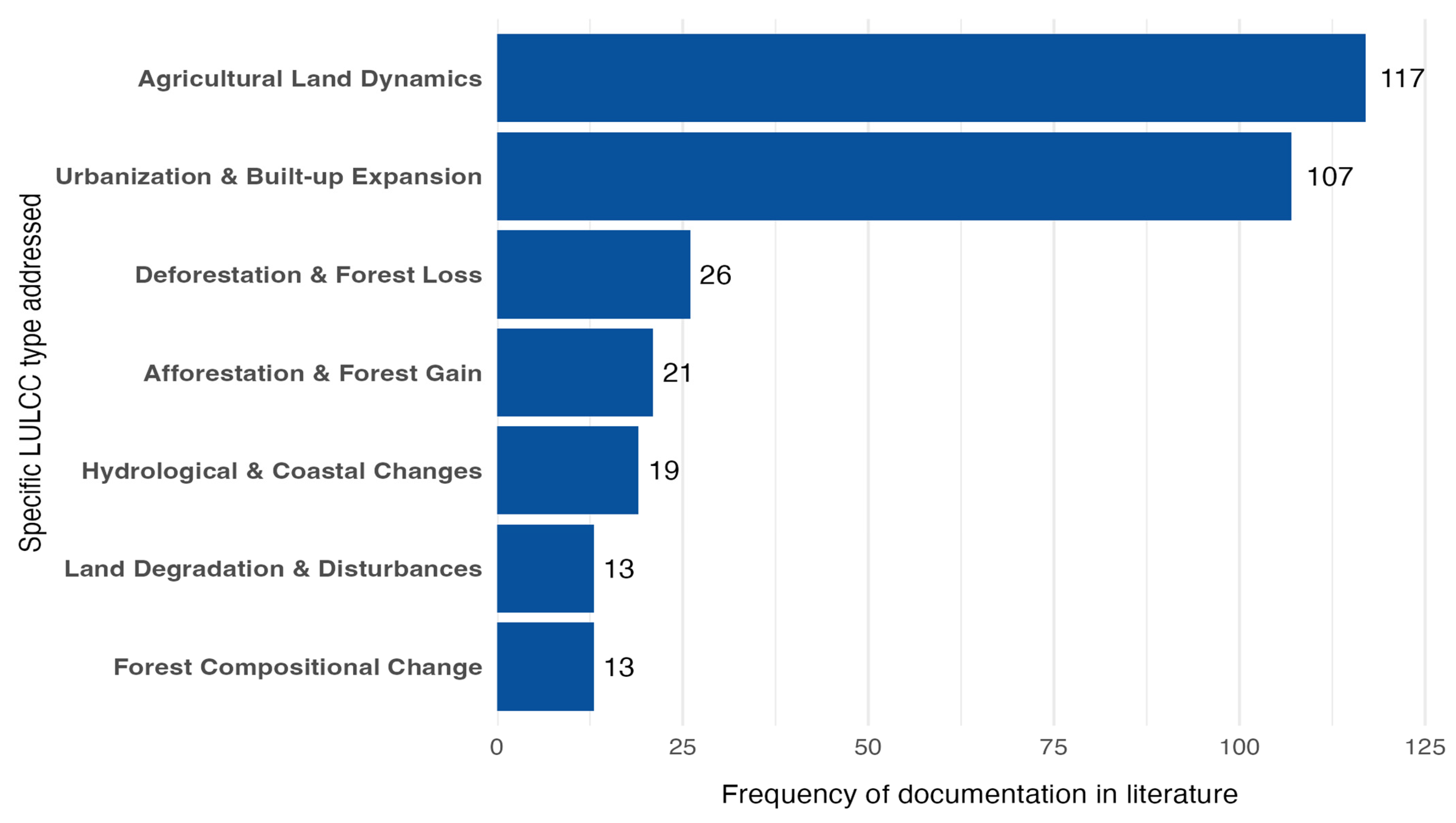
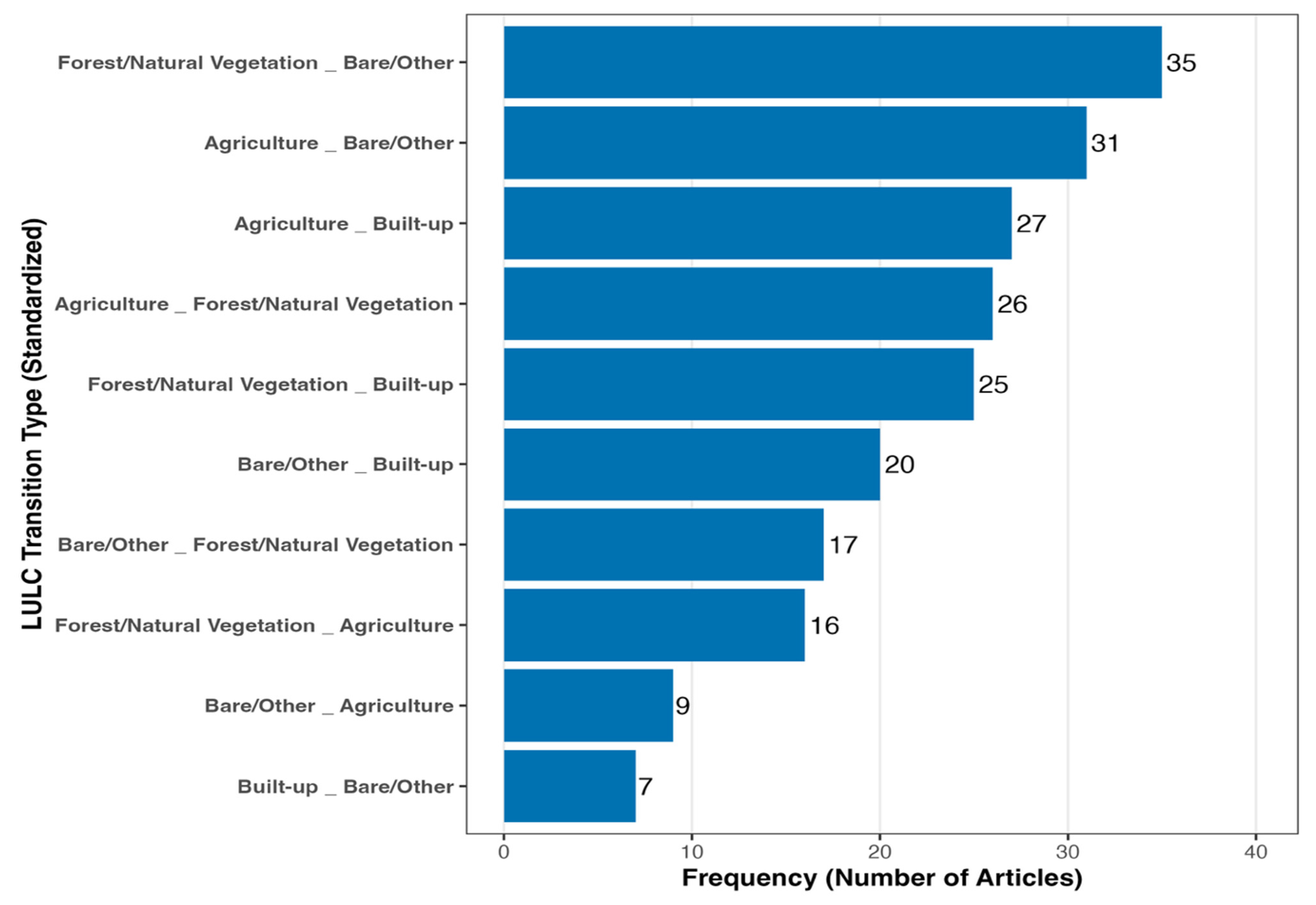
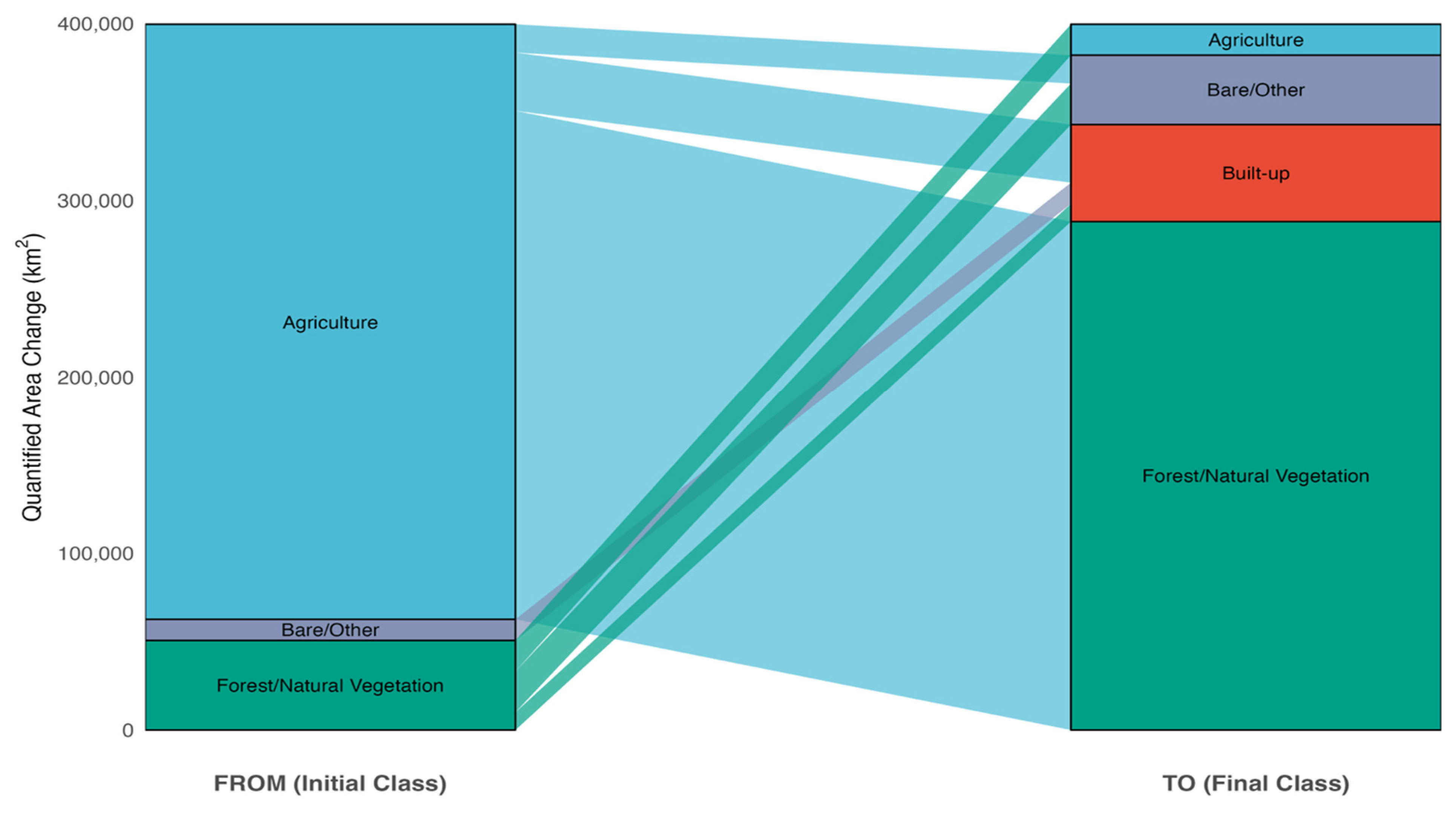
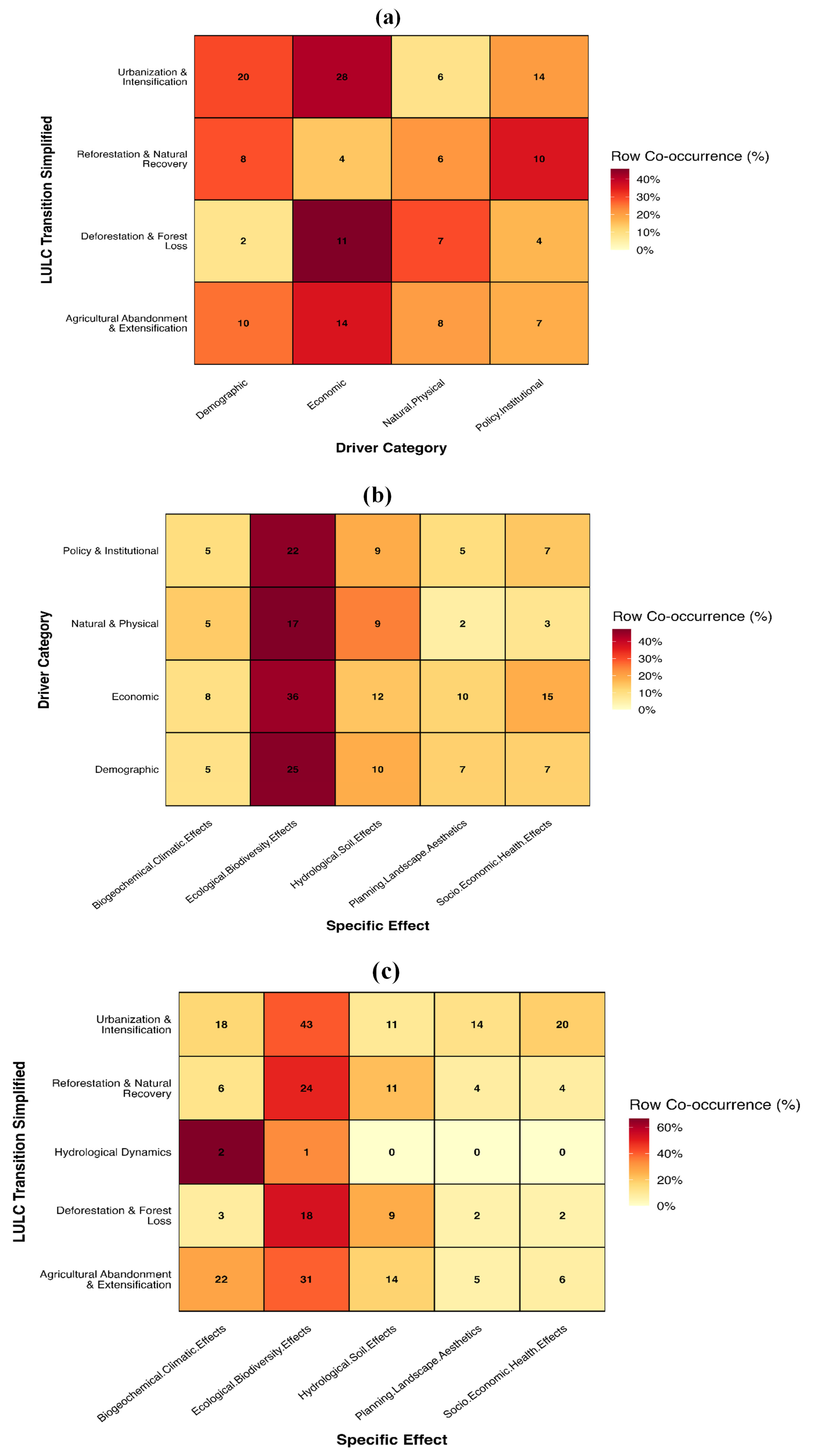
Disclaimer/Publisher’s Note: The statements, opinions and data contained in all publications are solely those of the individual author(s) and contributor(s) and not of MDPI and/or the editor(s). MDPI and/or the editor(s) disclaim responsibility for any injury to people or property resulting from any ideas, methods, instructions or products referred to in the content. |
© 2026 by the authors. Licensee MDPI, Basel, Switzerland. This article is an open access article distributed under the terms and conditions of the Creative Commons Attribution (CC BY) license.