Article

How Changes in Transfer Prices Affect the Healthy Utilization of Farmland: Effect Transition and Spatiotemporal Heterogeneity


1
Jiangxi Provincial Natural Resources Rights and Reserve Guarantee Center, Nanchang 330025, China
2
College of Resources Science and Technology, Beijing Normal University, Beijing 100875, China
3
School of Government, Central University of Finance and Economics, Beijing 100081, China
*
Authors to whom correspondence should be addressed.
These authors contributed equally to this work.
Land 2026, 15(3), 447; https://doi.org/10.3390/land15030447
Submission received: 17 February 2026 / Revised: 7 March 2026 / Accepted: 10 March 2026 / Published: 11 March 2026

Abstract

Following the transfer of farmland, new agricultural entities exhibit clearer profit-oriented goals and heightened sensitivity to changes in profitability. Changes in farmland transfer prices significantly affect producers’ crop selection, input choices, technology adoption, farming methods, and intensity. This study establishes a motivation–behavior–outcome analytical framework by integrating producer behavior theory with the mechanism of farmland health formation, suggesting that rising transfer prices may prompt producers to exhibit five types of positive or negative behaviors. The SBM-DEA model is employed to measure the grain green total factor productivity of farmland across 102 counties in China’s Henan Province from 2017 to 2022, reflecting the healthy utilization of farmland. Results from the two-way fixed-effects and threshold effect models reveal an inverted U-shaped relationship, indicating initially positive and later negative impacts of increasing transfer prices on farmland health utilization. GTWR model findings highlight that economic disparities and the pace of price increases dictate the intensity of producers’ positive and negative motivations, while the economic capacity for absorbing shocks and the natural endowment capacity for absorbing shocks influence the likelihood and magnitude of these effects. Government regulation should, therefore, focus on regulating producer interests.

1. Introduction

Balancing the enhancement of grain production with the conservation of farmland ecosystems represents a critical global challenge. The Intergovernmental Panel on Climate Change (IPCC) Special Report on Climate Change and Land states that the sustainable utilization of farmland is essential for eradicating hunger, mitigating ecosystem degradation, and addressing climate change. In 2024, China’s grain imports (158 million tons) accounted for 22.40% of its total grain production (706.5 million tons). Risks to global food security are meanwhile escalating owing to climate change and geopolitical conflicts [1], while the supply–demand equilibrium remains in a state of persistent tightness [2]. China’s grain production has grown continuously for 21 years, resulting in significant ecological costs [3]. The excessive use of nitrogen and phosphorus fertilizers, pesticides, solid waste accumulation, heavy metal pollution, and the widespread hormone and antibiotic contamination caused by livestock waste, collectively threaten the long-term productivity of China’s farmland [4,5]. To ensure long-term food security and public health, implementing land-based grain reserves and promoting the sustainable utilization of farmland is crucial. Farmland health is fundamentally determined by natural conditions [6], while its degradation mainly results from unsustainable human practices [7], economic incentives being a primary underlying cause [8]. Notably, economic returns on land utilization represent the most critical factor shaping agricultural production decisions.
The existing literature predominantly defines farmland health through the lens of stability and suitability of its fundamental components, incorporating key indicators like soil constituents [9,10], the carbon-nitrogen cycle [11], environmental quality [12,13], production and management conditions [14] and impacts on human health [15]. These multidimensional metrics inform farmland health assessment frameworks [16]. The ‘behavior-factor’ analytical framework has been proposed as one method of elucidating the mechanisms through which human activities impact cultivated land health [17]. Empirical studies further illustrate the perturbation effects of cropping structure [18] and tillage practices [19] on critical land constituents, yielding mitigation strategies like technological interventions [20], surveillance [16], spatial planning [21], fallowing [22], land consolidation [23] and incentive compensation [24]. Studies indicate that institutional changes significantly influence farmland use patterns, leading to alterations in farmland quality and environmental conditions [5,25].
The most significant institutional factor affecting farmland use in China recently has been the transfer of farmland management rights. This policy was designed to mitigate farmland fragmentation resulting from decentralized household contracting. It critically distinguishes between contracting rights and management rights. Farmers retain contracting rights to secure long-term benefits, while management rights can be transferred to agribusinesses, family farms, and other new agricultural entities through leasing or shareholding arrangements. This enables consolidated, efficient farming practices.
New agricultural entities are thus replacing numerous smallholder farmers as direct users of farmland, mitigating the fragmentation of farmland protection responsibilities and promoting large-scale, integrated conservation [26,27]. They may also improve economies of scale, enabling operators to acquire the financial capacity and willingness to adopt green cultivation technologies [28]. However, these operators are profit-driven enterprises rather than individual landowners, making their long-term commitment to farmland protection highly dependent on economic incentives. Fluctuations in profitability may increase the risk of short-sighted practices, such as overexploitation [29]. Additionally, the separation of land rights, responsibilities, and benefits complicates oversight, potentially leading to regulatory gaps or accountability disputes in cases of pollution or degradation [30,31]. Currently, the impact of farmland transfer on land health utilization remains unclear. Existing studies have primarily examined the effects of transfer scale on environmental outcomes, while little attention has been paid to the consequences of rising transfer price on farmland sustainability [32,33].
In practice, farmland transfer price is a key economic factor that directly affects new agricultural entities. Economic development and rising agricultural production efficiency have led to a rise in farmland transfer prices in most Chinese regions; this is generally viewed as a positive indicator of agricultural growth and farmer income improvement. However, the upward trend in transfer prices inevitably leads to a reduction in operators’ profit margins [34], influencing their decisions with regard to crop selection, cultivation intensity, input use, and technology adoption, ultimately affecting farmland health. While these cost increases could theoretically be passed through to consumer prices, such transmission is moderated in China by price stabilization policies and market structure [35]; our analysis therefore focuses on the producer behavior mechanism as the primary pathway through which transfer prices affect farmland health. Studies suggest that higher transfer prices may incentivize operators to improve land quality and adopt green technologies to enhance productivity and product value, thus promoting sustainable land use [24]. However, our field investigations in China’s major grain-producing regions, including Henan, Hunan, Sichuan, and Shanghai, reveal that rising farmland transfer prices often lead operators to prioritize high-profit cash crops over grain production. Furthermore, they drive excessive land-use intensification and disproportionate agrochemical inputs to boost short-term yields [36,37] or result in reduced quality of production factors to offset the rising land costs. As a result, farmers’ willingness to improve farmland quality and engage in fallowing practices is weakened. These behaviors suggest that the magnitude and rate of farmland transfer price increases vary across regions owing to differences in local natural, economic, and social conditions, leading to a variety of impacts on the interests of new agricultural entities. Consequently, the intensity of adjustments to farmland use and the resulting effects on farmland health utilization may also differ, potentially exhibiting spatiotemporal heterogeneity. However, existing research has provided limited insights into these dynamics.
Henan Province, situated in China’s central grain belt, provides an ideal setting for this investigation. As a major grain-producing region accounting for one-tenth of national grain output (66.2 million tons in 2023), Henan has experienced rapid farmland transfer expansion, with over one-third of cultivated land now operated through transfers by 2022. The province’s substantial spatial heterogeneity (from mountainous northern, western, and southern terrain to eastern alluvial plains, with urban clusters around the Zhengzhou-Luoyang metropolitan area) enables robust analysis of spatiotemporal variations in the price–health relationship. Intensive farmland utilization coupled with emerging challenges of overexploitation and environmental degradation further underscores its relevance for studying sustainable agricultural land use. By providing empirical evidence from this representative region, our study contributes to a broader understanding of how farmland rental markets influence sustainable land use outcomes.
This study applies producer behavior theory to examine how rising farmland transfer prices influence operators’ incentives and ultimately shape the “motivation–behavior–outcome” mechanism of sustainable land use. It uses county-level panel data from Henan Province, China (2017–2022), where one of the country’s earliest agricultural civilizations flourished with intensive farmland use. We measure the green grain total factor productivity (GGTFP) through the slack-based measure data envelopment analysis (SBM-DEA) model (which accounts for undesirable outputs), as a comprehensive indicator of healthy farmland utilization that reflects production efficiency, environmental sustainability, and intensity rationality. We employ the two-way fixed-effects model incorporating quadratic terms to analyze nonlinear relationships and supplement it with threshold regression and geographically and temporally weighted regression (GTWR) to identify the aggregate effects, transitional dynamics and spatiotemporal heterogeneity. This study thus deepens available insights into how farmland pricing mechanisms can shape sustainable land use outcomes, providing evidence-based policy implications for China and other countries seeking to reconcile food security goals with ecological sustainability under the broader agenda of land use transition and environmental protection.

2. Theoretical Framework

Existing studies define farmland health through two perspectives: a “condition-based approach” and an “output-based approach”. A condition-based approach focuses on assessing whether farmland possesses the capacity to maintain high but sustainable productivity, employing methods like soil sampling tests and comprehensive factor evaluation to measure land health through compositional status. Lilburne [38], Qiang Li [39], and Kening Wu [40] have developed farmland health evaluation frameworks incorporating indicators like soil properties, water, fertilizer, light, and heat conditions; environmental quality; and production capacity. Creamer [41] and Willoughby [42] have since expanded these systems by including biological activity and pollutant metrics alongside traditional factors like soil texture, nutrients, moisture, and temperature.
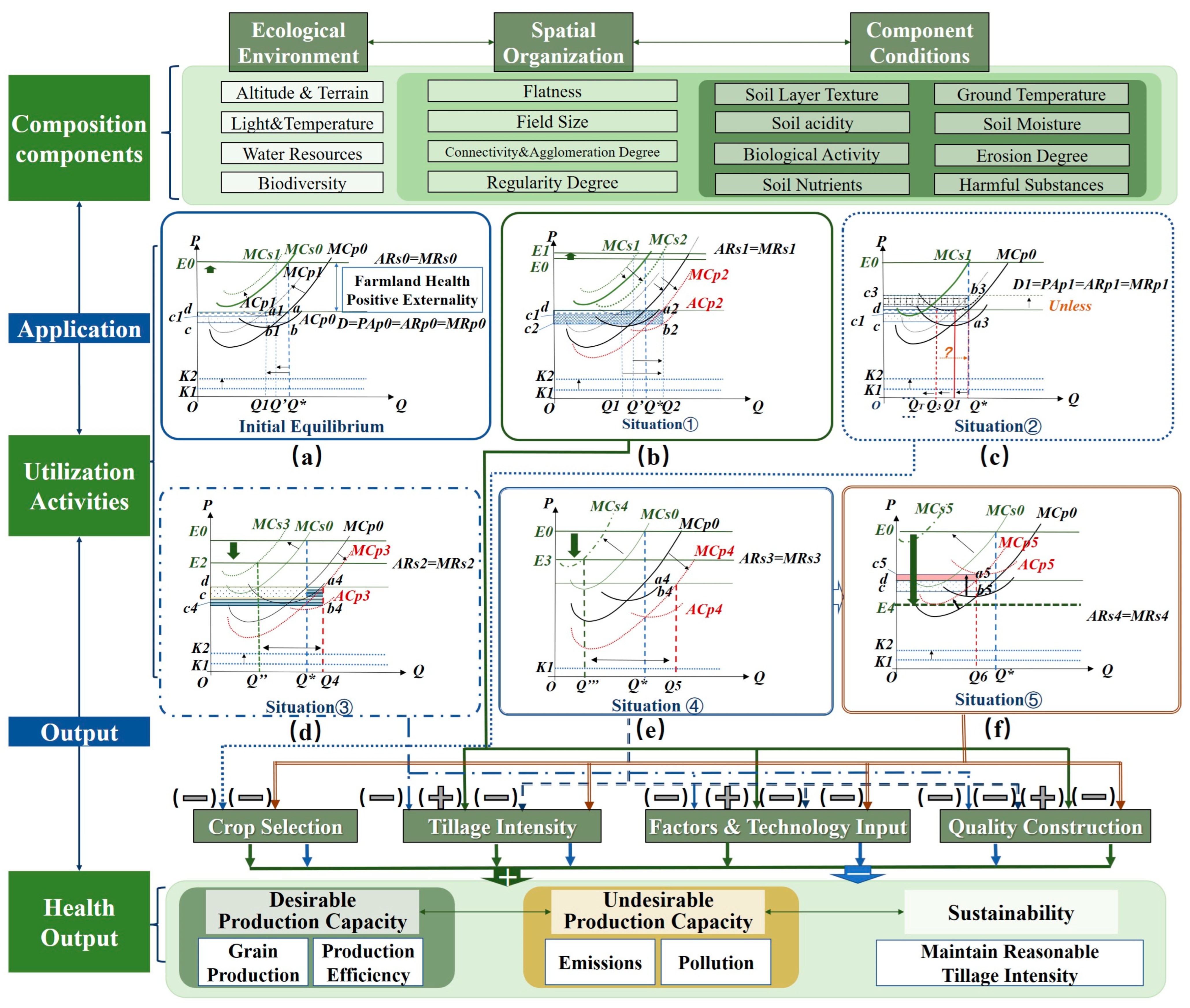
These studies categorize the foundational components of farmland health into three aspects (Figure 1). First, the ecological context of farmland (altitude, light, heat, water resources, biodiversity) largely determines its baseline productivity, sustainability, and resilience to disturbances [43]. The second is the spatial organization of farmland systems, including field agglomeration, connectivity, and regularity. Studies show that more contiguous farmland exhibits stronger disturbance resistance and better landscape service quality. Additionally, fields with regular shapes and adequate acreage are utilized more efficiently and are less prone to abandonment [44]. Third is the farmland’s component conditions, including soil texture, moisture, nutrients, temperature, acidity, and biological activity, along with adverse factors like erosion susceptibility and pollution.
Meanwhile, an output-based approach emphasizes statistical facts, measuring farmland health by quantifying its positive and negative outputs (or observed states) and their sustainability. Common indicators include grain yield [45], levels of agrochemical input [46], and landscape quality [47]. An output-based approach is focused on the ultimate goal of protecting farmland health, which involves safeguarding human wellbeing and supporting socioeconomic development [45]. In line with the COP30 Presidency’s Action Agenda, which calls for restoring degraded agricultural land, building resilient food systems, and advancing sustainable farming practices through initiatives such as RAIZ (Resilient Agriculture Investment for Net-Zero Land Degradation), farmland health can be assessed by evaluating whether its outputs support healthy human development.
The key criterion in an output-based approach is whether farmland can sustainably provide desired outputs with minimal undesirable byproducts (Figure 1). The contradiction between global population growth and grain production capacity has long persisted, meaning that protecting farmland health must primarily focus on safeguarding grain productivity. Farmland must be reserved for genuine agricultural use, avoiding misallocation to non-agricultural purposes, which defines its functional health. Healthy farming practices should maintain food output while minimizing negative byproducts like carbon emissions and environmental pollution, termed “output health”. Third, healthy farmland will maintain the sustainability of high positive outputs and low negative outputs.
In summary, although the condition-based and output-based approaches adopt different perspectives, their definitions of farmland health have overlaps. As illustrated in Figure 1, a process-based framework for achieving farmland health integrates three essential components: composition components, utilization activities, health output. This process builds on suitable soil composition through science-based farming practices to yield sufficient, safe, and sustainable agricultural products. Crucially, the farmland transfer price acts as an exogenous variable in this system. Changes in transfer price primarily influence the economic incentives of new agricultural entities, thereby altering land use practices. Such adjustments thereby influence production health, ultimately affecting farmland composition.
Existing research indicates that farmland utilization primarily involves four key practices: crop selection, cultivation intensity, input allocation (including factors and technology), and land quality improvement [15]. Therefore, the impact of transfer price on farmland health can be analyzed by examining how its changes alter the motivations and behaviors of new agricultural business entities, forming a “motivation–behavior–outcome” framework. Based on producer behavior theory, the analytical model assumes (Figure 1a) that farmland input and output follow the law of diminishing marginal returns and that the grain market is perfectly competitive, meaning new agricultural entities face a horizontal demand curve in which price equals both average revenue (AR) and marginal revenue (MR), in which D = grain market price, (Pap0) = average revenue, and (ARp0) = marginal revenue (MRp0). Here, the farmland transfer price represents a fixed cost (K1) independent of output. For new agricultural entities, the private marginal cost is MCp0, and the average cost is ACp0. According to cost theory, the marginal cost curve (MCp) intersects the average cost curve (ACp) at its minimum point. After accounting for the external benefits and costs of farmland use, the social average revenue (ARs0) and marginal revenue (MRs0) curves coincide at level E0 (E0 = ARs0 = MRs0), while the social marginal cost curve is MCs0.
In a state of initial equilibrium, social welfare objectives align with the interests of new agricultural entities. These operators determine their optimal output Q* where private marginal revenue (MRp0) equals private marginal cost (MCp0) at price Pap0. Notably, the optimal grain output corresponding to the point where the social marginal revenue (MRs0) equals social marginal cost (MCs0) is also Q*. During initial equilibrium, the profit of new agricultural entities equals the quadrilateral area Sabcd, calculated as:
π = A R p 0 ×   Q *   A C p 0 ×     Q *
When farmland transfer prices rise from K1 to K2, the private marginal and average cost curves shift upward from MCp0 and ACp0 to MCp1 and ACp1, while the social marginal cost curve increases from MCs0 to MCs1. In a perfectly competitive market, individual operators cannot influence grain prices, leaving average revenue (ARp0) and marginal revenue (MRp0) unchanged. Consequently, their profit-maximizing output declines to Q1, reducing profits to the smaller quadrilateral area Sa1b1c1d. Meanwhile, the socially optimal output falls to Q′ (where Q′ > Q1), imposing a social welfare loss owing to underproduction. Faced with declining profitability, rational operators may adopt five possible behaviors.

2.1. Possible Behavior 1

As depicted in Figure 1b, when unable to alter marginal revenue while facing rising fixed costs, new agricultural entities may implement proactive measures through three approaches: optimizing cultivation intensity, enhancing factor and technological inputs, and improving land quality management. Through these measures, operators can enhance production efficiency and reduce variable costs. This leads to a gradual decline in private marginal costs from MCp1 toward MCp0, subsequently pulling the social marginal cost curve down from MCs1 to MCs0. Consequently, the optimal output level may recover from Q1 toward the original equilibrium Q*. Improved productivity further incentivizes and enables agricultural operators to invest in land quality enhancement.
This leads to two simultaneous effects: private production costs decline further to MCp2, and social marginal costs fall correspondingly. Concurrently, the enhanced positive externality of farmland health elevates both social average and marginal revenue curves from E0 = ARs0 = MRs0 to E1 = ARs1 = MRs1. As a result, a new equilibrium emerges at a higher output level Q2, at which point private and social optimality converge. This creates a win-win outcome from which both society and modern agricultural operators benefit. The mutually reinforcing relationship between grain output and farmland health enhances expected land productivity while improving sustainability.

2.2. Possible Behavior 2

As shown in Figure 1c, shrewd producers may not reduce costs through improved production methods. Instead, the rising fixed costs will further squeeze the already narrow profit margins in grain cultivation. This financial pressure could compel modern agricultural operators to shift toward higher-profit cash crops, a negative crop selection behavior that exacerbates declines in grain production. Unless the government permits and coordinates collective action among all producers to raise grain prices from PAp0 to PAp1, society is forced to bear the consequences of reduced production.
Government intervention would shift the demand curve and the average/marginal revenue curves for new agricultural entities to D1 = PAp1 = ARp1 = MRp1, thereby restoring profits to area Sa3b3c3d. Thus, while the physical composition of a farmland may remain largely unaffected in this scenario, its actual use fails to align with societal needs, resulting in diminished productive potential. Conventional farmland health assessments based solely on soil composition cannot capture this critical discrepancy.

2.3. Possible Behavior 3

As shown in Figure 1d, producers may engage in detrimental practices across three key dimensions: cultivation intensity, factor and technological inputs, and land quality management. To mitigate rising transfer prices, producers may resort to unsustainable practices, such as excessive cultivation with reduced fallow periods, the substitution of high-quality agricultural inputs with inferior alternatives, and reduced investments in land improvement. While these measures can result in short-term decreases in production costs, they compromise long-term farmland health and productivity. Such cost-cutting measures depress variable costs, decreasing both marginal and average cost curves from MCp0 and ACp0 to MCp3 and ACp3, respectively.
These practices may temporarily increase yields, potentially exceeding the initial equilibrium level Q* to reach Q4, thereby compensating for private profit losses. However, the unsustainable land use reduces the positive externalities while increasing the environmental costs. Consequently, the social average and marginal revenue curves decline to E2 = Ars2 = MRs2, while the marginal cost curve rises to MCs3. This results in a socially optimal output level Q″ that is lower than the privately achieved Q4. The rising transfer prices may thus lead to destructive farming practices that temporarily boost expected output but simultaneously increase undesirable byproducts and undermine the long-term sustainability of farmland health.

2.4. Possible Behavior 4

As illustrated in Figure 1e, continuously rising farmland transfer prices may lead to emerging agricultural operators who have acquired land rights to become concerned about future profitability. This could then incentivize short-term profit-seeking behaviors at the expense of sustainable practices. Even without changes in land use costs, these operators may still engage in three detrimental practices: excessive cultivation, reduced input quality, and diminished long-term land investments. Such behaviors shift the marginal cost curve downward to MCp4, resulting in a substantially higher profit-maximizing output level at Q5. However, excessive utilization intensity at this stage further reduces social benefits to E3 = ARs3 = MRs3 while increasing costs to MCs3. Consequently, the socially optimal output declines to Q‴ (Q‴ < Q5), generating additional unhealthy production capacity.

2.5. Possible Behavior 5

As illustrated in Figure 1f, when emerging agricultural operators pursue short-term gains through unsustainable practices, the cultivated land inevitably degrades, becomes polluted, or suffers damage. Over time, this leads to rising production costs, pushing both marginal and average costs up to MCp5 and ACp5. Under such systemic risks, producers can no longer adjust costs and face unavoidable losses (Sa5b5c5d), which ultimately forces them to exit grain production. This undermines the confidence of emerging agricultural operators, discourages further farmland transfers, and ultimately hinders the positive effects of land consolidation, including large-scale land stewardship, economies of scale, and financial support for adopting green technologies and improving soil quality.

2.6. Hypotheses

The net effect of rising farmland transfer prices on farmland health utilization depends on two key factors: the relative strength of positive versus negative practices adopted by emerging agricultural operators and the magnitude of these practices’ impacts on farmland. First, given variations in the magnitude of farmland transfer price increases, producers’ perceptions and consequently their tendencies to adopt various behaviors are likely to vary. Moderate transfer price increases may encourage emerging agricultural operators to adopt sustainable practices, such as boosting land use efficiency or investing in new technologies to offset costs. In contrast, sharp transfer price surges often exceed compensation capacity, increasing the likelihood of detrimental practices.
According to the law of diminishing marginal benefits, the economic viability of sustainable farmland management depends on achieving economies of scale. Only when farm operations remain within the scale economy phase can emerging agricultural operators enhance productivity and reduce variable costs through positive practices. The gap between the intensity of current land use and the scale economy’s threshold represents the economic capacity for absorbing shocks (ECAS) impacting farmland health utilization. This margin determines the likelihood of operators being able to profitably improve land quality and intensify production while maintaining sustainability. Empirical evidence shows that farmland in more economically developed regions tends to have longer cultivation histories and thus a higher land-use intensity [48]. Narrower economic margins for new agricultural entities may, therefore, incentivize unsustainable practices. In contrast, economically less developed regions have a relatively greater potential for farmland improvement and additional investment. Meanwhile, in topographically flatter regions with higher farmland contiguity, the marginal costs of land improvement decrease significantly. This creates economic incentives for new agricultural entities to intensify cultivation and adopt mechanization, given the higher returns on capital investments in such environments. These lands also exhibit greater resilience to human-induced disturbances [49]. This phenomenon can be termed the natural endowment capacity for absorbing shocks (NCAS) in farmland health utilization.
Based on the above discussion, this study proposes the following hypotheses:
H1. 
The effect of rising farmland transfer prices on farmland health changes from positive to negative once transfer prices exceed a critical threshold.
H2. 
Higher regional economic development increases the likelihood of rising farmland transfer prices to negatively affect farmland health.
H3. 
Flatter, more contiguous farmland areas are more likely to experience the positive effects of rising farmland transfer prices on farmland health.

3. Data Acquisition and Methods

3.1. Methods

3.1.1. SBM-DEA Model Incorporating Undesirable Outputs

Protecting farmland health utilization ultimately serves human health and societal wellbeing. While a condition-based approach can help identify constraints on farmland health utilization, it reflects potential conditions rather than actual outcomes. Moreover, changes in individual factors may not entail predictable shifts in farmland health utilization, as counteracting effects from other factors can offset them. The output-based approach measures farmland health utilization by its actual desired outputs, undesired outputs, and sustainability outcomes rather than potential conditions. The SBM-DEA model extends traditional DEA by incorporating slack variables to eliminate subjectivity in directional vector selection [50].
Total Factor Productivity (TFP) measures farmland input–output efficiency, in which higher efficiency indicates better land conditions [51]. This metric is widely used to assess human impacts on land systems. This study incorporates undesirable outputs into the SBM-DEA model to calculate Grain Green Total Factor Productivity (GGTFP). This approach simultaneously evaluates farmland’s desired outputs, undesirable outputs, and input factor efficiency, providing a comprehensive assessment of both land conditions and the sustainability of production practices. The model is as follows:
G G T F P = m i n 1 m i 0 = 1 m x ¯ i 0 x i 0 i 2 1 s 1 + s 2   ( r = 1 s 1 y ¯ r g y r i 2 g + i 1 = 1 s 2 y ¯ i 1 b y i 1 i 2 b )  
s . t . x i 2 = X λ + S ,     y i 2 g = Y g λ S g ,   y i 2 b = Y b λ S b x ¯     i 1 = 1 , 0 n λ i 1 x i 1 , y ¯ g     i 1 = 1 , 0 n λ i 1 y i 1 g , y ¯ b     i 1 = 1 , 0 n λ i 1 y i 1 b x ¯     x i 2 ,   y ¯ g     y i 2 g ,   y ¯ b     y i 2 b i 1 = 1 , 0 n λ i 1 = 1 ,     S 0 ,   S g 0 ,     S b 0 ,     y ¯ g 0 ,     λ 0
The x denotes input factors, while y g and y b represent desired and undesired outputs, respectively. The slack variables s g and s b correspond to these outputs. The parameters m , s 1 , and s 2 indicate the number of input factors, desired outputs, and undesired outputs, respectively. The weight vector is denoted by λ , with i 0 , i 1 , and i 2 representing the evaluated decision-making units.

3.1.2. Panel Threshold Model Specification

To test hypothesis H1, we construct regression model introducing the squared term of the independent variable and threshold effect model:
G G T F P i t = α + β F P i t + β 0 F P i t 2 + β 1 C o n t r o l i t + μ i + ν t + ε i t
G G T F P i t = α + β 1 F P i t × I E i t λ 1 + β 2 β F P i t × I E i t > λ 1 + + β n F P i t × I E i t λ n + β n + 1 F P i t × I E i t > λ n + β n + 2 C o n t r o l i t + μ i + ν t + ε i t
The F P i t and F P i t 2 represent farmland transfer price and its squared term, respectively, while C o n t r o l i t denotes control variables. The model includes individual fixed effects μ i , time fixed effects ν t , and random disturbance term ε i t , in which i indicates the evaluation unit and t denotes the year. The intercept term is α . The model employs an indicator function, I , that takes a value of 1 when the specified condition holds and 0 otherwise. Here, E i t represents the threshold variable with λ 1 ,   λ 2 λ n being the estimated threshold values.

3.1.3. Geographically and Temporally Weighted Regression

This study constructs a Geographically Weighted Regression with Time (GTWR) model to simultaneously account for spatiotemporal non-stationarity, analyzing the dynamic heterogeneity of the impact of farmland transfer price increases on GGTFP to test hypotheses H2 and H3:
G G T F P = β 0 u i , v i , t i + k = 1 p β k u i , v i , t i x i k + ε i
Here, u i ,   v i ,   t i denotes the spatial coordinates (longitude, latitude) and temporal dimension of observation unit i. The term β 0 u i ,   v i ,   t i represents the local intercept, while β k u i , v i , t i corresponds to the k-th regression coefficient for unit i . The random error term ε i follows a normal distribution with zero mean and variance σ 2 .

3.2. Variable Selection

3.2.1. Explained Variable: GGTFP Accounting for Undesirable Outputs

This study incorporates undesirable outputs and improves the measurement of input factors when calculating GGTFP. As shown in Table 1, we employ the conversion coefficient method to distinguish input factors allocated to grain versus other crops. For labor inputs, we assume a dynamic equilibrium in the marginal returns between grain production and other agricultural activities within the primary sector during the study period, as evidenced by the absence of unilateral labor migration. The conversion coefficient equals the ratio of grain output value to total agricultural output value, with the former calculated by multiplying production quantities by government-guided purchase prices. Regarding pesticides, agricultural films, fertilizers (converted to pure content), and total agricultural machinery power, we apply the proportion of grain-sown area to total crop-sown area as the conversion coefficient to estimate the area allocated to grain production [52].
For desirable outputs, the study converts wheat, corn, and rice yields into energy equivalents using solar transformity values from Zhou et al.’s [53] energy evaluation table for Henan’s ecological-economic system. For the undesirable outputs, agricultural non-point source pollution is estimated following Liang et al.’s [54] inventory analysis method, accounting for fertilizer, pesticide, and agricultural film pollution sources. The emissions of non-point source pollution are calculated based on their respective utilization rates and recovery rates and then adjusted according to the proportion of the grain-sown area. For the agricultural carbon emissions, following the method by Li et al. [55], the total carbon emissions from fertilizers, pesticides, agricultural plastic films, diesel fuel, tillage, and irrigation are estimated by aggregating carbon emission intensity indicators. These emissions are then converted using the proportion of grain-sown area. Finally, the study employs the SBM-DEA model with undesirable outputs, using the MaxDEA-X12.0 software to calculate GGTFP. The results range between 0 and 1, where values closer to 1 indicate better farmland health utilization in the evaluation units.

3.2.2. Explanatory Variable: Farmland Rent

As derived in Section 2, rising farmland transfer prices directly increase the actual costs of newly leased farmland while also altering the cost–benefit expectations of existing agricultural operators who have already acquired land-use rights. This shift affects such operator’s confidence in long-term profitability and their willingness to expand operations through further farmland transfers, ultimately influencing land-use decisions. To quantify this psychological impact on agricultural operators, this study constructs a farmland rent (FR) index.
The index is calculated using 1318 farmland transfer observations across 102 counties in Henan Province from 1 January 2016 to 31 December 2022, collected via Python (version 3.9) scraping of the Tuliu platform. Based on the mode of transfer durations observed in the samples, we calculated a year-adjustment coefficient using the one-year fixed deposit interest rate published by the People’s Bank of China. This coefficient is applied to standardize all sample prices to a uniform 15-year transfer duration, expressed as the per-mu transfer price. Subsequently, the county-level FR index is calculated as the weighted average of sample prices, using the proportion of each sample’s transferred area to the total transferred area in that year as the weighting factor. To align with the agricultural production cycle, the resulting FR index was lagged by one period. The model is as follows:
  F R = i = 1 n R i × A i i = 1 n A i
R i = R i 0 × L e a s e   T e r m   A d j u s t m e n t   F a c t o r
R i represents the rent per unit area for the i-th farmland transfer case, A i denotes the area of the i -th transfer, and n is the total number of farmland transfer transactions in a given year and region. R i 0 refers to the original per-unit rent value of the sampled transaction.

3.2.3. Control Variables

To account for environmental influences, we incorporate 11 control variables spanning resource endowment, economic development, and social conditions. Resource endowment variables include farmland quality grade (expected to positively influence GGTFP) and agricultural mechanization level (with ambiguous effects due to potential trade-offs between efficiency gains and increased emissions). Economic development variables comprise GDP per capita, bank deposit and loan balances, rural disposable income per capita, and industrial value-added growth, all of which may affect farmers’ capacity for green technology adoption or incentives for intensification. Social conditions variables include the urban–rural income gap (larger gaps may encourage short-term exploitation), government budget for agriculture (fiscal support can promote sustainable practices), urbanization rate (affecting labor availability and land use intensity), and number of agribusinesses (influencing technology diffusion and resource competition). Additionally, we control for county-level farmland transfer rates to address regional variations in farmland transaction intensity.

3.3. Study Area and Data Sources

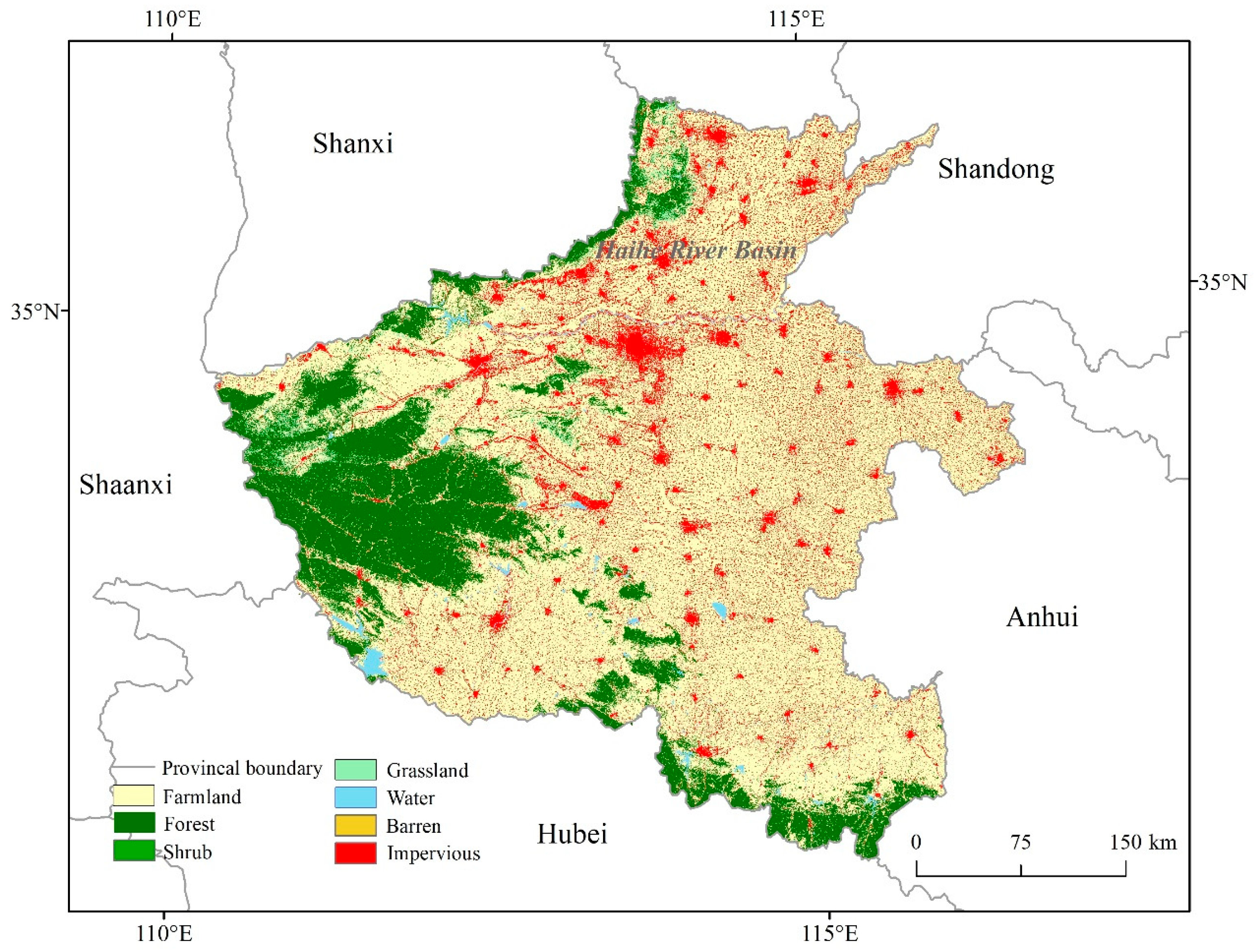
Henan, a province located in China’s central grain production belt, spans the transitional zone between a warm temperate and a subtropical climate. Spanning the Haihe, Yellow, Huaihe, and Yangtze River basins, the study area comprises plains and basins covering 55.7% of province’s total territory. Cultivated land exceeds 7.3 million hectares. In 2023, Henan achieved a total grain output of 66.2 million tons. Farmland transfer transactions accounted for more than one-third of Henan’s cultivated land by 2022, thus emerging as a key factor shaping agricultural land use. As shown in Figure 2, mountainous terrain dominates northern, western, and southern Henan, with concentrated forest and grassland coverage. Urban land use primarily clusters in the northern and central regions, particularly around the Zhengzhou-Luoyang metropolitan area, while cultivated land remains widely distributed across the province.
After excluding counties with missing data or complete urbanization during the study period, we obtained panel data for 102 counties in Henan Province from 2017 to 2022 (Table 2). Grain production input–output data are compiled from multiple sources, including the China Rural Statistical Yearbook, China County Statistical Yearbook, Henan Statistical Yearbook, CNKI database, CEIC database, China Land Market Network, and CSMAR database. Economic and social data came from Henan Statistical Yearbook and Wind database. Some data have been manually collected through local government information disclosure channels. Missing values (less than 2% of total data) are interpolated using exponential smoothing. Cultivated land quality grades originated from the Henan Cultivated Land Quality Report, calculated as area-weighted averages at the county level. Farmland transfer rates are derived from annual survey statistics in the China Rural Management Statistical Yearbook and China Rural Policy and Reform Statistical Yearbook.

4. Results

4.1. Spatiotemporal Distribution Characteristics of GGTFP

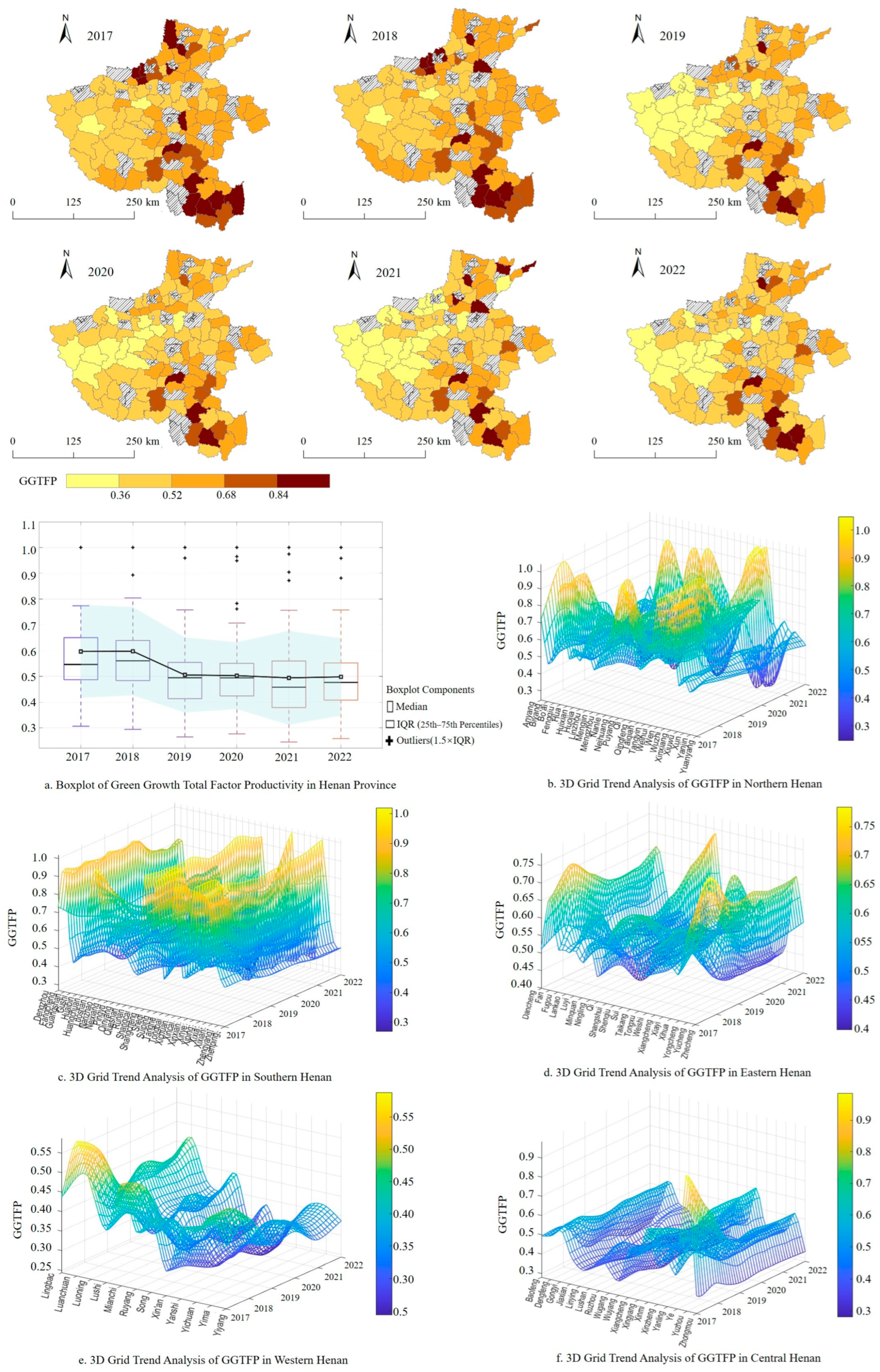
During the study period, the average GGTFP across sampled counties declined from 0.59 to 0.50, accompanied by increasing regional disparities. Figure 3 reveals a relatively stable spatial pattern of GGTFP generally increasing from west to east, corresponding with natural factors like terrain and cultivated land concentration. Low-value clusters of counties are predominantly in the mountainous western counties, including Luanchuan, Songxian, and Ruyang. Medium-value areas concentrate in central and southern regions such as Yanling, Xiayi, and Wuyang within the Nanyang Basin. High-value zones appear mainly in the northeastern foothills of the Taihang Mountain and southeastern Tongbai-Dabie Mountain areas, exemplified by Guangshan, Zhengyang, and Xiping. These findings indicate a province-wide decline in cultivated land health during the study period, particularly pronounced in areas with poorer natural endowments. Northern Henan generally maintains higher farmland health levels compared to the province’s eastern, southeastern, central and western regions. Regional differentiation proves most significant in northern Henan; it is moderate in eastern and southern areas and relatively limited in western and central counties, where values show minimal variation.

4.2. Coupling of FR and GGTFP

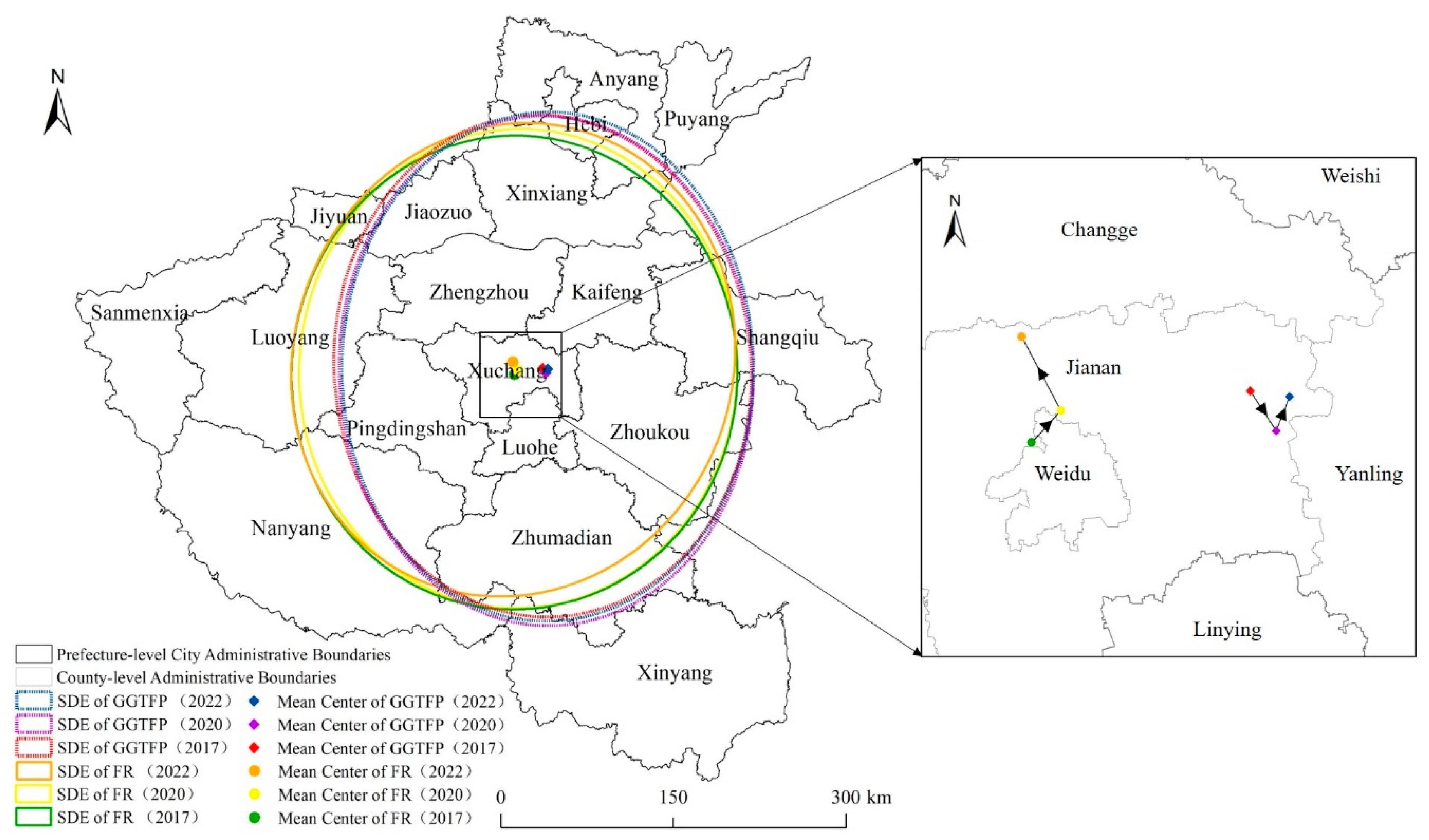
The standard deviation ellipses of FR and GGTFP exhibit similar spatial distributions, with their major-to-minor axis ratios approaching 1, indicating uniform dispersion patterns. The orientation of FR’s ellipse shifted from northwest-southeast to northeast-southwest, reflecting more pronounced growth in farmland transfer prices across the western and northwestern regions (Figure 4). In contrast, GGTFP’s ellipse maintained a stable northwest-southeast alignment throughout the study period.
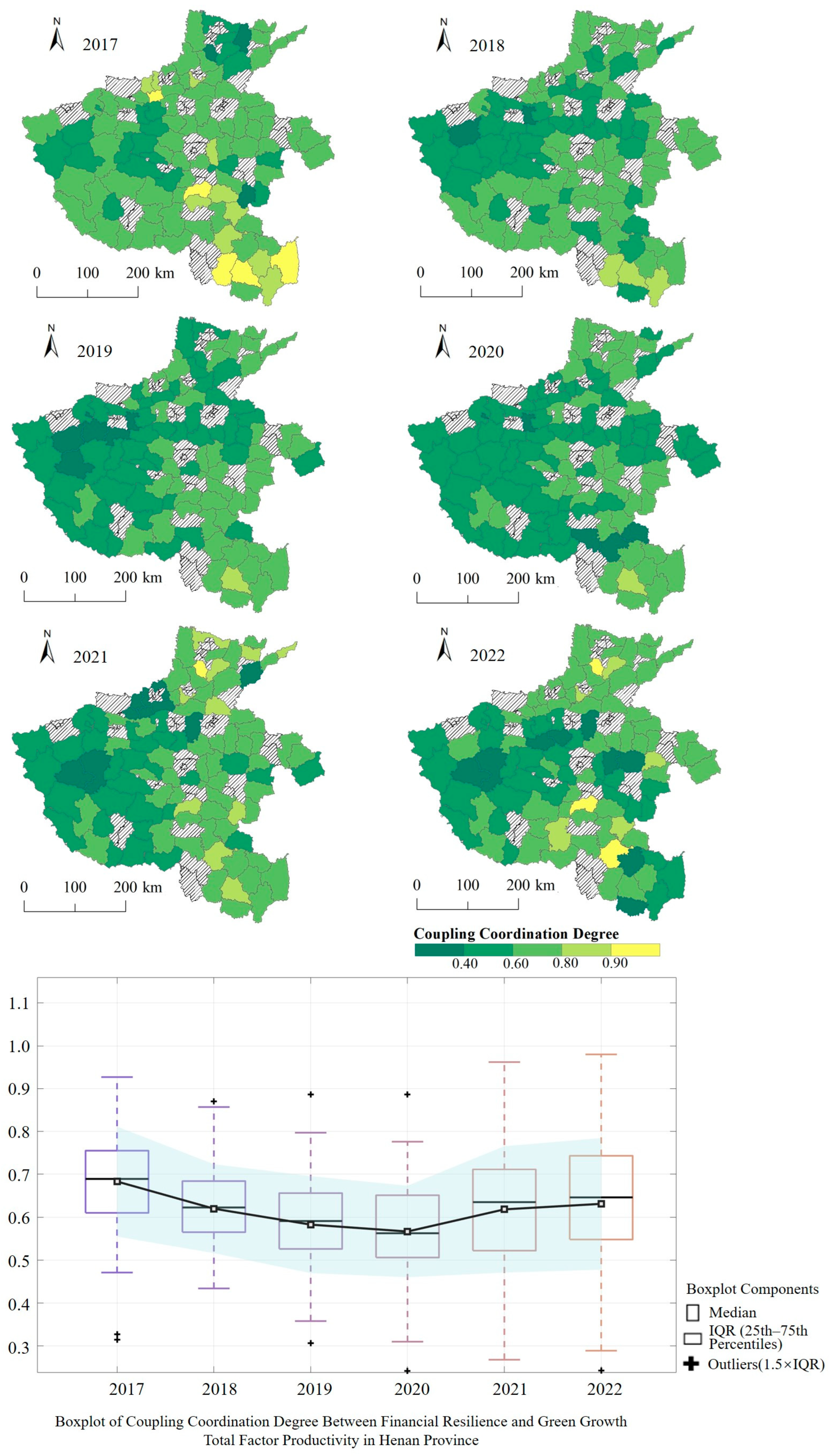
During the study period, the coupling coordination degree between FR and GGTFP ranged from 0.4 to 0.8, with its mean value initially decreasing from 0.68 to 0.57, before partially recovering to 0.63. Spatially, counties with marginal or moderate coordination imbalances first increased then decreased, particularly in the central and western regions where such imbalances are more pronounced (Figure 5).

4.3. Impact Transition of FR on GGTFP

A multicollinearity test confirmed that all variance inflation factors (VIF) for the study variables were below 10. The Hausman test supported the use of a fixed effects model. Subsequent tests incorporating time dummy variables revealed statistically significant time fixed effects, leading to the adoption of a two-way fixed effects model controlling for both individual and time effects. As shown in Table 3, FR exhibited a positive coefficient while its squared term shows a negative coefficient, both statistically significant at the 10% level. These results demonstrate an inverted U-shaped relationship between FR and GGTFP.
Further analysis using Hansen’s bootstrap method reveals the potential threshold effects of FR on GGTFP. Table 4 shows that the single threshold model produces a statistically significant F-statistic of 24.34 at the 5% level, while double and triple threshold models showed insignificant results. This confirms a single threshold effect with the estimated threshold value of 614.125.
As shown in Table 5, FR exhibits an inverted U-shaped effect on GGTFP across the threshold value, with statistically significant results at the 1% level. Below this threshold, the positive incentive effect of FR on producers outweighs negative motivations, promoting sustainable farmland utilization. However, when FR exceeds the threshold, negative producer motivations and behavioral effects gradually intensify. These findings support H3.

4.4. The Spatiotemporal Heterogeneity of FR’s IMPACT on GGTFP

The spatial autocorrelation analysis of GGTFP (Table 6) reveals consistently positive global Moran’s I indices for county-level farmland GGTFP in Henan, 2017–2022. Prior to conducting this analysis, we verified the absence of severe multicollinearity among the independent variables, which further supports the reliability of the bivariate Moran’s I results. This indicates significant spatial dependence among counties’ GGTFP values, justifying the application of the GTWR model for further analysis.
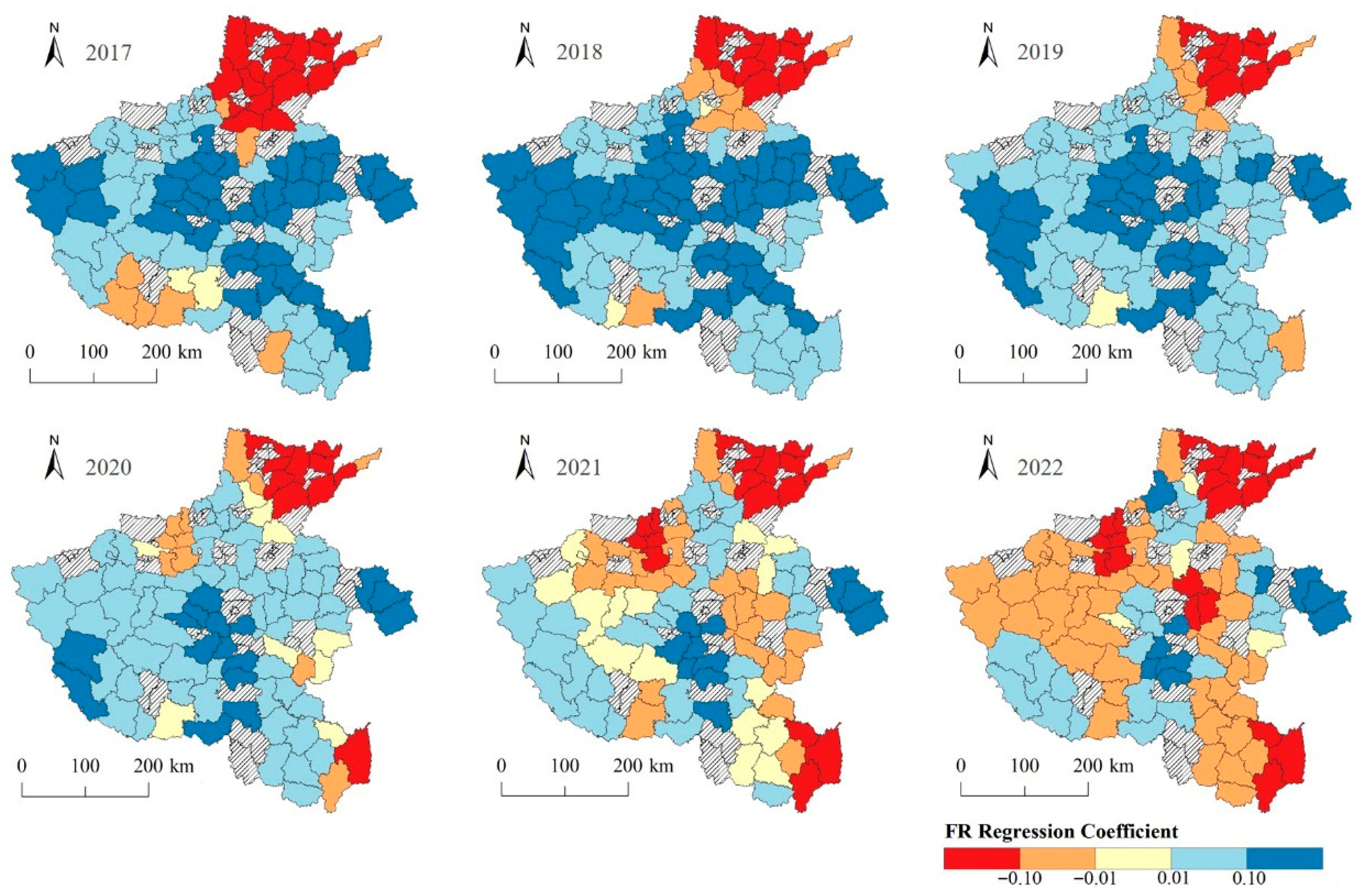
The GTWR model diagnostics in Table 7 demonstrate that including control variables yields significantly lower AICc values and residual sum of squares, along with a higher R2. This confirms that accounting for environmental factors improves model’s fit. Based on the GTWR estimation results, Figure 6 presents the spatiotemporal distribution of FR’s regression coefficients on GGTFP.
During the study period, the counties in which FR exerts negative effects on GGTFP increased from 28 (27.5%) to 32 (31.4%), exhibiting an expansion gradient from the northeastern region to the northern/central areas and further extending toward the western zone. Standard deviational ellipse analysis reveals that these regions primarily belong to the Zhengzhou-Luoyang metropolitan area, characterized by rapid economic growth, higher urbanization, and industrialization levels, including cities such as Jiaozuo, Xinxiang, and Xuchang. These areas exhibit greater urban–rural development disparities, faster farmland transfer price growth, and stronger perceived income gaps among new agricultural entities, making them more sensitive to income losses from rising transfer prices.
Producers who scientifically increase inputs to enhance productivity have less ECAS to offset the rising land costs. As a result, they are more likely to engage in negative behaviors such as crop substitution, excessive increase in tillage intensity, and reduction in factor input quality. From the perspective of natural conditions, the area lies within the Yellow River and Hai River basins, transitioning from the southern Taihang Mountains to the hills of the Loess Plateau. Urban expansion has exacerbated farmland fragmentation, occupation, and pollution. Meanwhile, the western region gradually transitions into the Xiong’er-Funiu mountainous area, which features steeper terrain and more fragmented farmland. Here, negative practices exert stronger adverse effects on GGTFP. Consequently, rising farmland transfer prices increasingly translate into deteriorating farmland health utilization in these regions.
In contrast, eastern and southern Henan exhibit relatively lower economic development levels. These regions are situated within the alluvial plains of the Yellow-Huai River basin and the Nanyang Basin, which are characterized by flat terrain and deep fertile soils. Here, the urban encroachment on farmland remains limited, resulting in higher spatial continuity of agricultural plots. Under these conditions, new agricultural entities can have greater ECAS by improving farmland and promoting mechanized production to enhance production efficiency. As a result, they may have a stronger motivation to undertake positive practices. Moreover, contiguous farmland demonstrates stronger resilience against detrimental land use behaviors. Consequently, a higher proportion of counties in these areas experience the positive impacts of transfer price increases on farmland health utilization.
These spatial patterns align with the theoretical expectations of H2 and H3. The observed reduction in positively affected areas suggests diminishing marginal returns in farmland utilization within the region. As discussed in Section 2, this likely indicates that the producers’ capacity for offsetting rising farmland transfer prices through productivity gains and cost reductions is approaching exhaustion.

5. Discussion

Understanding the mechanisms through which institutional changes affect environmental resources remains a key research challenge. Previous studies mostly follow empirical enumeration and inductive approaches. Liu and Luo [56], Kassis and Bertrand [57], and Chai et al. [58,59] have examined how institutional changes influence farmland quality protection of farmland quality through the behavioral responses of affected groups. These scholars have analyzed mechanisms like farmland conservation policies, land tenure certification, and government supervision in shaping farmers’ conservation awareness, capital investments, and consumption intentions. Their research evaluates behavioral drivers by assessing the strength of both positive and negative motivations while considering internal and external factors influencing decision-making [58,59].
This study treats producer psychology and behavior as the mediating mechanism between institutional policy and farmland health utilization. Grounded in producer behavior theory, it explains the causal chain as “motivation–behavior–outcome”. The analysis further accounts for spatiotemporal heterogeneity in these effects by incorporating environmental variations. This framework can be broadly applied to examine how institutional changes impact resource environments. This study addresses a research gap regarding the impact of farmland transfer prices on farmland health utilization. Fei et al. [60], Li and Shen [61], and Ma et al. [62] have demonstrated that farmland transfer scale influences farmland quality and ecological conditions through changes in land-use patterns and intensity, as well as investments. However, few studies have examined these effects through the lens of producer characteristics and behavioral changes while accounting for the role of transfer prices. Although transfer prices have traditionally been viewed as positive indicators reflecting land quality, farming profitability, and farmer benefits, this study reveals that rising transfer prices may actually undermine farmland health utilization. One reason for this effect lies in the institutional specifics of China’s grain market. Prices for staple products are stabilized by minimum purchase price policies, which effectively decouple farm-gate prices from short-term cost fluctuations [35]. Consequently, when transfer prices rise, producers cannot pass these costs on to consumers but must absorb them within existing revenue streams. As Wu et al. [35] demonstrate, rising land costs exert significant negative impacts on farmers’ income, confirming that producers bear the primary burden of cost increases. This cost-price squeeze mechanism drives the behavioral responses central to our theoretical framework. Facing compressed profit margins without the ability to adjust output prices, producers adapt through changes in crop selection, input intensity, technology adoption, and farming practices. These behaviors ultimately shape farmland health outcomes.
Assessing farmland health utilization based on desirable and undesirable outputs alongside sustainability better aligns with the goal of farmland protection than assessing it based on compositional components. Many studies have used the ecological functions and biological conditions of farmland as important indicators for evaluating its health utilization. Resultantly, in areas with dense vegetation, especially mountainous and hilly regions with superior ecological conditions, the farmland health utilization evaluation results are relatively high. However, in these areas, the grain-production function of farmland is secondary. Meanwhile, regions with flat terrain, concentrated farmland, and high productivity exhibit poorer results.
Farmland represents human-modified resources serving explicit needs, such that food production is the primary health criterion rather than the preservation of pristine ecosystems. As shown in Figure 3, the evaluation method proposed in this study accounts for the fact that farmland that is contiguous, concentrated, and makes substantial contributions to actual productivity (rather than merely meeting ecological conditions) receives a more equitable evaluation. This clearly aligns with the purpose of human farmland utilization and echoes the international consensus on balancing hunger elimination, human development promotion, and climate change mitigation. The analysis also reveals a pattern of declining farmland health utilization trends during the study period, consistent with findings by Shen et al. [63], Yang et al. [64] and Zhou et al. [65], confirming that the ecological costs associated with China’s rapid grain production growth remain consistently high. Notably, in Henan, the regions in which farmland health utilization has declined and rising transfer prices have exerted negative impacts all feature relatively poor natural farming conditions, potentially exacerbating local environmental fragility.
Furthermore, rising transfer prices exhibit an inverted U-shaped relationship with farmland health utilization, marking initially improving but eventually degrading conditions. This is consistent with previous studies’ findings that the area of farmland transfer exhibits nonlinear effects on the environment. Li et al. [66] observed similar inverted U-curve effects of operational scale on environmental efficiency, while Kuang et al. have documented comparable nonlinear impacts on agricultural total factor productivity [67]. These findings suggest that diminishing marginal returns commonly characterize institutional factors’ environmental effects. Existing explanations attribute positive phases to economies of scale or factor dividends, while negative phases are blamed on ecological carrying capacity being exceeded. This study introduces producers’ behavioral changes as a new explanatory perspective, analyzing the mechanism by examining how institutional factors influence producers’ psychology. It treats scale economies and natural conditions as environmental conditions that shape the intensity of producers’ positive and negative behaviors and their behaviors.
Finally, the original land-use intensity, reflecting the stage of marginal returns, determines whether producers adopt positive practices (e.g., efficiency-enhancing investments to offset profit losses) rather than resorting to negative behaviors (e.g., crop substitution, moral hazards). This represents the ECAS in farmland health. Ye et al. [68] have confirmed that land-use intensity correlates with a reduced potential for productivity. Natural conditions like terrain, field concentration, and connectivity also influence the likelihood of producers choosing positive behaviors while reflecting the system’s capacity to absorb institutional shocks. This represents the NCAS in farmland health. The empirical results suggest that major grain-producing regions like Henan, historically densely populated with intensive farming, exhibit limited ECAS. These areas, often at the forefront of industrialization and urbanization, also possess constrained NCAS. In more developed regions, the stronger upward pressure on transfer prices combines with greater profit incentives, creating a dual cost-push, profit-driven mechanism that heightens the risks of negative behaviors. This manifests as declining GGTFP and expanding areas in which rising transfer prices negatively impact productivity. These findings underscore the need to control transfer price increases in regions with poorer natural endowments. Specifically, in areas with high ECAS but low NCAS, policies should support productivity-enhancing investments that help producers offset rising land costs without exacerbating environmental fragility. Conversely, in regions with high NCAS but low ECAS, interventions should strengthen economic resilience through rent stabilization funds or credit access, preventing financially constrained producers from resorting to negative behaviors. For areas with both low ECAS and low NCAS, direct regulation of transfer price growth combined with payments for ecosystem services may be necessary.

6. Conclusions

Changes in farmland transfer prices following farmland transfers influence the economic interests of new agricultural entities, potentially triggering five behavioral responses among producers. The net impact on farmland health utilization depends on the relative strength of these positive and negative behaviors, shaped by two key factors. The first of these is the magnitude of change in institutional factors. In Henan, varying degrees of transfer price increases demonstrate an inverted U-shaped relationship with farmland health utilization, with an effect reversal threshold at 614.125. The second factor is that local farmland conditions constrain producers’ behavior choices. The GTWR model results reveal that economically developed regions with intensive land use exhibit lower ECAS, making transfer price increases more likely to negatively impact farmland health utilization. Conversely, flatter, more contiguous farmland areas demonstrate greater NCAS, maintaining higher probabilities of positive health outcomes from rising transfer prices. During the study period, Henan’s declining overall farmland health pointed to a spatial pattern in which northern regions outperformed eastern and southeastern areas, which in turn surpassed central and western zones. Notably, negative health utilization impacts from rising transfer prices predominantly occurred in ecologically fragile mountainous and hilly areas with poorer natural conditions, while regions demonstrating positive rent–health utilization relationships gradually diminished.
Governments can intervene in farmland health utilization through two primary approaches. Direct interventions like monitoring systems and land remediation technologies can improve farmland conditions but remain reactive measures that are unable to prevent detrimental practices at the individual level. The best solution lies in institutional innovation and incentive realignment, combining policy regulation with economic instruments to guide new agricultural entities toward sustainable land use through mechanisms that both constrain undesirable practices and motivate sustainable behavior. The key here is interest governance, which involves safeguarding farmers’ interests while also protecting those of new agricultural business entities.
First, the stability of farmland transfer contracts must be ensured through legislation and the establishment of dispute mediation mechanisms, thereby encouraging long-term conservation and investment behaviors by these entities. Meanwhile, a dynamically adjusted guidance system must be established for farmland transfer prices, tailored to local conditions to guide and regulate transfer price increases. Second, efforts should be made to expand the NCAS and ECAS of farmland. Following a model of government-led initiatives in key regions combined with encouragement and guidance in other regions, the government should assume responsibility for long-term investment in the improvement of cropland quality for areas with significant declines in farmland health utilization and prominent production and ecological functions. Subsidies should also be provided for green infrastructure and technology adoption on high-health farmland, targeted according to differences in farmland health utilization. These subsidies must be linked to grain production to expand the scope for scale economies in farmland and reduce the costs of producers’ positive behaviors. While leveraging the advantage of the centralized supervision of farmland transfer, credit guarantees and marketing support should be provided for green and organic grains, ensuring that healthy grains produced on healthy farmland achieve higher returns.
Meanwhile, to help new agricultural business entities reduce variable costs while lowering direct costs through subsidies for production factors and agricultural machinery, market information transparency must be enhanced, agricultural insurance must be developed, and the costs of producers’ risk must be mitigated. This will grant producers greater natural and economic shock resistance alongside stronger endogenous motivation to improve grain production efficiency and returns by introducing green technologies, enhancing farmland quality and scientifically increasing utilization intensity. In addition, taxation and transfer payments should be utilized for the establishment of an economic incentive–discipline mechanism tied to farmland health, in which rewards and penalties are linked to farmland health outcomes.
Technological advancements may expand the behavioral options available to farmland producers beyond the scope of this study. Future research could employ theoretical frameworks like the theory of planned behavior, using interviews and field surveys to enhance behavioral analysis. When analyzing the influencing factors of behaviors, this study considers the utilization intensity and natural conditions of farmland. Meanwhile, future research could utilize a moderation effect model to further quantify their effects and incorporate factors like differences in the types of new agricultural business entities and variations in government interventions.

Author Contributions

Conceptualization, X.L., J.D. and D.C.; methodology, X.L., J.D. and D.C.; software, Y.Z.; validation, X.L. and J.D.; formal analysis, Y.Z. and J.D.; investigation, X.L. and Y.Z.; resources, D.C.; data curation, Y.Z.; writing—original draft preparation, X.L. and J.D.; writing—review and editing, X.L., J.D., Y.Z. and D.C.; visualization, J.D. and Y.Z.; supervision, D.C.; project administration, D.C.; funding acquisition, D.C. All authors have read and agreed to the published version of the manuscript.

Funding

This research was funded by China’s “general program of National Natural Science Foundation” (Grant 71974220).

Data Availability Statement

Data supporting the findings of this study can be provided upon reasonable request to the corresponding author.

Acknowledgments

The authors thank all the anonymous reviewers for their valuable comments and suggestions on this article.

Conflicts of Interest

The authors declare no conflicts of interest.

Abbreviations

The following abbreviations are used in this manuscript:
ECASEconomical capacity for absorbing shocks
FRFarmland rent index
GGTFPGrain green total factor productivity
GTWRGeographically and temporally weighted regression
SBM-DEASlacks-based measure data envelopment analysis
TFPTotal factor productivity
NCASNatural endowment capacity for absorbing shocks

References

  1. Mirzabaev, A.; Bezner Kerr, R.; Hasegawa, T.; Pradhan, P.; Wreford, A.; Cristina Tirado von der Pahlen, M.; Gurney-Smith, H. Severe Climate Change Risks to Food Security and Nutrition. Clim. Risk Manag. 2023, 39, 100473. [Google Scholar] [CrossRef]
  2. Wei, Y.; Fang, D.; Wei, X.; Ye, Z. Assessing the Equilibrium of Food Supply and Demand in China’s Food Security Framework: A Comprehensive Evaluation, 1980–2017. Front. Sustain. Food Syst. 2024, 8, 1326839. [Google Scholar] [CrossRef]
  3. Ren, K.; Xu, M.; Li, R.; Zheng, L.; Liu, S.; Reis, S.; Wang, H.; Lu, C.; Zhang, W.; Gao, H.; et al. Optimizing Nitrogen Fertilizer Use for More Grain and Less Pollution. J. Clean. Prod. 2022, 360, 132180. [Google Scholar] [CrossRef]
  4. Guo, L.; Li, H.; Cao, A.; Gong, X. The effect of rising wages of agricultural labor on pesticide application in China. Environ. Impact Assess. Rev. 2022, 95, 106809. [Google Scholar] [CrossRef]
  5. Wang, S.; Feng, Y.; Jin, M.; Cao, F. How does farmers lease more agricultural land affect pesticide inputs? Microscopic evidence from Chinese farmers. Environ. Impact Assess. Rev. 2025, 115, 108024. [Google Scholar] [CrossRef]
  6. Song, W.; Zhang, H.; Zhao, R.; Wu, K.; Li, X.; Niu, B.; Li, J. Study on Cultivated Land Quality Evaluation from the Perspective of Farmland Ecosystems. Ecol. Indic. 2022, 139, 108959. [Google Scholar] [CrossRef]
  7. Chen, X.; Jiang, L.; Zhang, G.; Meng, L.; Pan, Z.; Lun, F.; An, P. Green-Depressing Cropping System: A Referential Land Use Practice for Fallow to Ensure a Harmonious Human-Land Relationship in the Farming-Pastoral Ecotone of Northern China. Land Use Policy 2021, 100, 104917. [Google Scholar] [CrossRef]
  8. Yin, Y.; Zhang, Y.; Wang, S.; Xu, K.; Zhang, Y.; Dogot, T.; Yin, C. Integrating Production, Ecology and Livelihood Confers an Efficiency-Driven Farming System Based on the Sustainable Farmland Framework. Agric. Syst. 2024, 220, 104049. [Google Scholar] [CrossRef]
  9. Shestak, C.J.; Busse, M.D. Compaction Alters Physical but Not Biological Indices of Soil Health. Soil Sci. Soc. Am. J. 2005, 69, 236–246. [Google Scholar] [CrossRef]
  10. Lehmann, J.; Bossio, D.A.; Kögel-Knabner, I.; Rillig, M.C. The Concept and Future Prospects of Soil Health. Nat. Rev. Earth Environ. 2020, 1, 544–553. [Google Scholar] [CrossRef]
  11. Hu, J.; Jin, V.L.; Konkel, J.Y.; Schaeffer, S.M.; Schneider, L.G.; DeBruyn, J.M. Soil Health Management Enhances Microbial Nitrogen Cycling Capacity and Activity. Msphere 2021, 6, 10. [Google Scholar] [CrossRef] [PubMed]
  12. Bouma, J. Land Quality Indicators of Sustainable Land Management across Scales. Agric. Ecosyst. Environ. 2002, 88, 129–136. [Google Scholar] [CrossRef]
  13. Wang, Y.; Zhu, Y.; Zhang, S.; Wang, Y. What Could Promote Farmers to Replace Chemical Fertilizers with Organic Fertilizers? J. Clean. Prod. 2018, 199, 882–890. [Google Scholar] [CrossRef]
  14. Wu, F.; Mo, C.; Dai, X.; Li, H. Spatial Analysis of Cultivated Land Productivity, Site Condition and Cultivated Land Health at County Scale. Int. J. Environ. Res. Public Health 2022, 19, 12266. [Google Scholar] [CrossRef] [PubMed]
  15. Collins, A.E. Health Ecology, Land Degradation and Development. Land Degrad. Dev. 2001, 12, 237–250. [Google Scholar] [CrossRef]
  16. Shepherd, K.D.; Shepherd, G.; Walsh, M.G. Land Health Surveillance and Response: A Framework for Evidence-Informed Land Management. Agric. Syst. 2015, 132, 93–106. [Google Scholar] [CrossRef]
  17. Zaredar, N.; Jozi, S.A.; Khorssani, N.; Shariat, S.M. Climate-Induced Land Health Risk in Farmland Systems: A Case Study of Qarasou Sub-Basin in Karkheh River Basin. Hum. Ecol. Risk Assess. Int. J. 2016, 22, 379–392. [Google Scholar] [CrossRef]
  18. Kumar, S.; Garg, A.K.; Aulakh, M.S. Effect of Conservation Agriculture Practices on Physical, Chemical and Biological Attributes of Soil Health under Soybean–Rapeseed Rotation. Agric. Res. 2016, 5, 145–161. [Google Scholar] [CrossRef]
  19. Angon, P.B.; Anjum, N.; Akter, M.M.; KC, S.; Suma, R.P.; Jannat, S. An Overview of the Impact of Tillage and Cropping Systems on Soil Health in Agricultural Practices. Adv. Agric. 2023, 2023, 8861216. [Google Scholar] [CrossRef]
  20. Kumar, D.; Sinha, N.K.; Mohanty, M.; Jayaraman, S.; Kumar, J.; Verma, S.; Mishra, R. Technological Interventions for Soil Health Improvement and Sustainable Agriculture. Indian Farming 2022, 72, 18–21. [Google Scholar]
  21. Barton, H. Land Use Planning and Health and Well-Being. Land Use Policy 2009, 26, S115–S123. [Google Scholar] [CrossRef]
  22. Żarczyński, P.J.; Krzebietke, S.J.; Sienkiewicz, S.; Wierzbowska, J. The Role of Fallows in Sustainable Development. Agriculture 2023, 13, 2174. [Google Scholar] [CrossRef]
  23. Liu, Y.; Dai, L.; Long, H. Theories and Practices of Comprehensive Land Consolidation in Promoting Multifunctional Land Use. Habitat Int. 2023, 142, 102964. [Google Scholar] [CrossRef]
  24. Stevens, A.W. The Economics of Land Tenure and Soil Health. Soil Secur. 2022, 6, 100047. [Google Scholar] [CrossRef]
  25. Zhu, Y.; Zhang, Y.; Ma, L.; Yu, L.; Wu, L. Simulating the Dynamics of Cultivated Land Use in the Farming Regions of China: A Social-Economic-Ecological System Perspective. J. Clean. Prod. 2024, 478, 143907. [Google Scholar] [CrossRef]
  26. Gong, M.; Zhong, Y.; Zhang, Y.; Elahi, E.; Yang, Y. Have the New Round of Agricultural Land System Reform Improved Farmers’ Agricultural Inputs in China? Land Use Policy 2023, 132, 106825. [Google Scholar] [CrossRef]
  27. Zheng, L. Big Hands Holding Small Hands: The Role of New Agricultural Operating Entities in Farmland Abandonment. Food Policy 2024, 123, 102605. [Google Scholar] [CrossRef]
  28. Zhang, Q.; Chu, Y.; Xue, Y.; Ying, H.; Chen, X.; Zhao, Y.; Ma, W.; Ma, L.; Zhang, J.; Yin, Y.; et al. Outlook of China’s Agriculture Transforming from Smallholder Operation to Sustainable Production. Glob. Food Secur. 2020, 26, 100444. [Google Scholar] [CrossRef]
  29. Herrick, J.E.; Neff, J.; Quandt, A.; Salley, S.; Maynard, J.; Ganguli, A.; Bestelmeyer, B. Prioritizing Land for Investments Based on Short- and Long-Term Land Potential and Degradation Risk: A Strategic Approach. Environ. Sci. Policy 2019, 96, 52–58. [Google Scholar] [CrossRef]
  30. Wang, Q.; Zhang, X. Three Rights Separation: China’s Proposed Rural Land Rights Reform and Four Types of Local Trials. Land Use Policy 2017, 63, 111–121. [Google Scholar] [CrossRef]
  31. Xu, Y.; Huang, X.; Bao, H.X.H.; Ju, X.; Zhong, T.; Chen, Z.; Zhou, Y. Rural Land Rights Reform and Agro-Environmental Sustainability: Empirical Evidence from China. Land Use Policy 2018, 74, 73–87. [Google Scholar] [CrossRef]
  32. Li, J.; Jiang, L.; Zhang, S. How Land Transfer Affects Agricultural Carbon Emissions: Evidence from China. Land 2024, 13, 1358. [Google Scholar] [CrossRef]
  33. Liao, X.; Qin, S.; Wang, Y.; Zhu, H.; Qi, X. Effects of Land Transfer on Agricultural Carbon Productivity and Its Regional Differentiation in China. Land 2023, 12, 1358. [Google Scholar] [CrossRef]
  34. Koguashvili, P.; Ramishvili, B. Specific of Agricultural Land’s Price Formation. Ann. Agrar. Sci. 2018, 16, 324–326. [Google Scholar] [CrossRef]
  35. Wu, J.; Zhang, M.; Yang, X.; Wu, B. Effects of Land and Labor Costs Growth on Agricultural Product Prices and Farmers’ Income. Land 2024, 13, 1754. [Google Scholar] [CrossRef]
  36. Gangwar, J.; Kadanthottu Sebastian, J.; Puthukulangara Jaison, J.; Kurian, J.T. Nano-Technological Interventions in Crop Production—A Review. Physiol. Mol. Biol. Plants 2023, 29, 93–107. [Google Scholar] [CrossRef]
  37. Hu, Y.; Liu, Y. Impact of Fertilizer and Pesticide Reductions on Land Use in China Based on Crop-Land Integrated Model. Land Use Policy 2024, 141, 107155. [Google Scholar] [CrossRef]
  38. Lilburne, L.; Sparling, G.; Schipper, L. Soil Quality Monitoring in New Zealand: Development of an Interpretative Framework. Agric. Ecosyst. Environ. 2004, 104, 535–544. [Google Scholar] [CrossRef]
  39. Li, Q.; Peng, W.; Wang, J.; Zhao, Y. Health assessment and driving mechanism analysis of cultivated land in the township enterprises developed region. J. Nat. Resour. 2015, 30, 1499–1510. (In Chinese) [Google Scholar]
  40. Wu, K.N.; Yang, Q.J.; Zhao, R. A discussion on soil health assessment of arable land in China. Acta Pedol. Sin. 2021, 58, 537–544. (In Chinese) [Google Scholar] [CrossRef]
  41. Creamer, R.E.; Barel, J.M.; Bongiorno, G.; Zwetsloot, M.J. The Life of Soils: Integrating the Who and How of Multifunctionality. Soil. Biol. Biochem. 2022, 166, 108561. [Google Scholar] [CrossRef]
  42. Willoughby, C.M.; Topp, C.F.E.; Hallett, P.D.; Stockdale, E.A.; Walker, R.L.; Hilton, A.J.; Watson, C.A. Soil Health Metrics Reflect Yields in Long-Term Cropping System Experiments. Agron. Sustain. Dev. 2023, 43, 65. [Google Scholar] [CrossRef]
  43. Xu, K.; Fan, Y.; Hou, Y.; Ma, S.; Wang, J.; Wang, S. Uncovering the Impact Mechanism and Spatiotemporal Evolution between Farmland Ecosystem Health and Optimal Crop Patterns. J. Clean. Prod. 2025, 494, 144959. [Google Scholar] [CrossRef]
  44. Al-Amin, A.K.M.A.; Lowenberg-DeBoer, J.; Franklin, K.; Behrendt, K. Economics of Field Size and Shape for Autonomous Crop Machines. Precis. Agric. 2023, 24, 1738–1765. [Google Scholar] [CrossRef]
  45. Zhang, X.; Wu, K.; Zhao, R.; Yang, Q. Evaluation of Healthy Productivity of Cultivated Land at County Scale. Res. Soil Water Conserv. 2020, 27, 294–300. (In Chinese) [Google Scholar]
  46. Novikova, A.; Startiene, G. Analysis of Farming System Outputs and Methods of Their Evaluation. Res. Rural. Dev. 2018, 2, 138–145. [Google Scholar] [CrossRef]
  47. Zhang, Y.; Huang, J.; Yu, L.; Wang, S. Quantitatively Verifying the Results’ Rationality for Farmland Quality Evaluation with Crop Yield, a Case Study in the Northwest Henan Province, China. PLoS ONE 2016, 11, e0160204. [Google Scholar] [CrossRef] [PubMed]
  48. Zang, Y.; Hu, S.; Liu, Y. Rural Transformation and Its Links to Farmland Use Transition: Theoretical Insights and Empirical Evidence from Jiangsu, China. Habitat Int. 2024, 149, 103094. [Google Scholar] [CrossRef]
  49. Yang, S.; Song, S.; Li, F.; Yu, G.; He, G.; Cui, H.; Wang, R.; Sun, B.; Du, D.; Chen, G.; et al. Evaluating Farmland Ecosystem Resilience and Its Obstacle Factors in Ethiopia. Ecol. Indic. 2023, 146, 109900. [Google Scholar] [CrossRef]
  50. Zhang, C.; Chen, P. Applying the Three-Stage SBM-DEA Model to Evaluate Energy Efficiency and Impact Factors in RCEP Countries. Energy 2022, 241, 122917. [Google Scholar] [CrossRef]
  51. Sheng, Y.; Tian, X.; Qiao, W.; Peng, C. Measuring Agricultural Total Factor Productivity in China: Pattern and Drivers over the Period of 1978–2016. Aust. J. Agric. Resour. Econ. 2020, 64, 82–103. [Google Scholar] [CrossRef]
  52. Lu, X.H.; Cui, H.Y.; Ke, S.G.; Kuang, B. Coupling coordination and driving mechanism of green transition of farmland use and total factor productivity of grain in Hubei Province. China Land Sci. 2022, 36, 75–84. (In Chinese) [Google Scholar] [CrossRef]
  53. Zhou, J.; Zhang, Y.C.; Yuan, D.Y. Study on energy analysis of ecological–economic system and sustainable development in Henan Province. Arid. Zone Res. 2007, 24, 728–733. (In Chinese) [Google Scholar] [CrossRef]
  54. Liang, L.T.; Feng, S.Y.; Qu, F.T. Forming mechanism of agricultural non-point source pollution: A theoretical and empirical study. China Popul. Resour. Environ. 2010, 20, 74–80. (In Chinese) [Google Scholar]
  55. Li, B.; Zhang, J.; Li, H. Research on spatial-temporal characteristics and affecting factors decomposition of agricultural carbon emission in China. China Popul. Resour. Environ. 2011, 21, 80–86. (In Chinese) [Google Scholar]
  56. Liu, H.; Luo, X.; Liu, H.; Luo, X. Understanding Farmers’ Perceptions and Behaviors towards Farmland Quality Change in Northeast China: A Structural Equation Modeling Approach. Sustainability 2018, 10, 3345. [Google Scholar] [CrossRef]
  57. Kassis, G.; Bertrand, N. Institutional Changes in Farmland Governance Emerging from a Collective Land Preservation Procedure Upholding Local Food Projects: Evidence from a French Case Study. Land Use Policy 2022, 120, 106295. [Google Scholar] [CrossRef]
  58. Chai, D.; Meng, T.; Zhang, D.; Chai, D.; Meng, T.; Zhang, D. Influence of Food Safety Concerns and Satisfaction with Government Regulation on Organic Food Consumption of Chinese Urban Residents. Foods 2022, 11, 2965. [Google Scholar] [CrossRef]
  59. Chai, D.; Yu, S.; Meng, T. Do Moral Constraints and Government Interventions Promote the Willingness and Behaviors of Food Saving among Urban Residents in China? An Empirical Study Based on Structural Equation Model. Food Policy 2024, 129, 102767. [Google Scholar] [CrossRef]
  60. Fei, R.; Lin, Z.; Chunga, J. How Land Transfer Affects Agricultural Land Use Efficiency: Evidence from China’s Agricultural Sector. Land Use Policy 2021, 103, 105300. [Google Scholar] [CrossRef]
  61. Li, B.; Shen, Y. Effects of Land Transfer Quality on the Application of Organic Fertilizer by Large-Scale Farmers in China. Land Use Policy 2021, 100, 105124. [Google Scholar] [CrossRef]
  62. Ma, G.; Dai, X.; Luo, Y.; Ma, G.; Dai, X.; Luo, Y. The Effect of Farmland Transfer on Agricultural Green Total Factor Productivity: Evidence from Rural China. Int. J. Environ. Res. Public Health 2023, 20, 2130. [Google Scholar] [CrossRef]
  63. Shen, L.; Sun, R.; Liu, W. Examining the Drivers of Grain Production Efficiency for Achieving Energy Transition in China. Environ. Impact Assess. Rev. 2024, 105, 107431. [Google Scholar] [CrossRef]
  64. Yang, J.; Gao, B.; Xia, F.; Wei, H.; Fan, S. Internalizing the External Costs to Achieve Environmental and Economic Goals: A Case Study of Rice Production in China. Food Policy 2025, 132, 102857. [Google Scholar] [CrossRef]
  65. Zhou, X.; Liang, Y.; Li, X.; Chai, D. The spatiotemporal evolution and driving factors of farmland system health: Taking the middle and lower reaches of the Yangtze River as an example. J. Nat. Resour. 2024, 39, 1174–1192. (In Chinese) [Google Scholar] [CrossRef]
  66. Li, M.; Zhao, W.; Tian, C.; Li, Y.; Feng, X.; Guo, B.; Yao, Y. Moderate Operation Scales of Agricultural Land under the Greenhouse and Open-Field Production Modes Based on DEA Model in Mountainous Areas of Southwest China. Heliyon 2023, 9, e21290. [Google Scholar] [CrossRef]
  67. Kuang, Y.; Yang, J.; Abate, M.-C. Farmland Transfer and Agricultural Economic Growth Nexus in China: Agricultural TFP Intermediary Effect Perspective. China Agric. Econ. Rev. 2021, 14, 184–201. [Google Scholar] [CrossRef]
  68. Ye, S.; Ren, S.; Song, C.; Cheng, C.; Shen, S.; Yang, J.; Zhu, D. Spatial Patterns of County-Level Arable Land Productive-Capacity and Its Coordination with Land-Use Intensity in Mainland China. Agric. Ecosyst. Environ. 2022, 326, 107757. [Google Scholar] [CrossRef]
Figure 1. Motivation-Behavior-Effect Analysis Model of Farmland Transfer Price on Farmland Health.
Land 15 00447 g001
Figure 2. Research area and main indicators of farmland use.
Land 15 00447 g002
Figure 3. Spatial Differentiation of Henan’s County-Level Grain Green Total Factor Productivity, 2017–2022.
Land 15 00447 g003
Figure 4. Standard Deviation Elliptical Distribution of Farmland Rent and Grain Green Total Factor Productivity.
Land 15 00447 g004
Figure 5. Spatiotemporal Evolution Pattern of the Coupling and Coordination Degree between Farmland Rent and Grain Green Total Factor Productivity.
Land 15 00447 g005
Figure 6. Impact of Farmland Rent on Grain Green Total Factor Productivity in Henan.
Land 15 00447 g006
Table 1. Input–Output Table for Grain Green Total Factor Productivity.
Objective LayerTypeVariableVariable DefinitionCalculation Formula
InputLandLandGrain sown area
(1000 hectares)
A f (grain sown area)
LaborLaborEquivalent labor for grain production
(10,000 persons)
L = L 0 × P f P 0 (7)
Capital factorsAgricultural filmAgricultural film used in grain production (tons) P l = P l 0 × A f A F (8)
PesticidePesticides used in grain production (tons) P e = P e 0 × A f A F (9)
Pure fertilizerPure fertilizer used in grain production (tons) F = F 0 × A f A F (10)
Management and technologyMachineryTotal machinery power in grain production
(10,000 kW)
M = M 0 × A f A F (11)
OutputDesirable
outputs
Grain yieldTotal energy equivalent of grain productionEnergy analysis
Undesirable outputsAgricultural non-point source pollutionTotal equivalent of
pollution products
P s = U i ( 1 η i ) × A f A F (12)
Agricultural carbon emissionsEmissions from agrochemicals and machinery O = O i × A f A F (13)
Note: The variables L 0 ,   P l 0 ,   P e 0 ,   F 0 , and M 0 represent the total labor force in the primary sector and the aggregate inputs of plastic film, pesticides, fertilizers, and machinery, respectively. The ratio P f P 0 denotes the proportion of grain output value to the total output value of agriculture, forestry, animal husbandry, and fishery. The term E f E F indicates the proportion of the grain-sown area to the total crop-sown area. The variable Ps quantifies the total non-point source pollution emissions from grain production, where Ui represents the emission intensity of individual pollution sources. Similarly, O measures the total carbon emissions from grain production, with O i denoting emissions from individual carbon sources.
Table 2. Descriptive Statistics of 102 Counties.
Variable TypeVariableMinMaxMeanStandard Deviation
Explained variableLand (1000 hectares)2.30288.81102.6657.95
Labor (10,000 persons)0.2431.1711.155.93
Agricultural film (tons)9.8712,681.531088.001394.57
Pesticides (tons)18.4612,380.19860.50846.62
Pure fertilizer (tons)911.90203,927.1549,677.2434,014.69
Machinery (10,000 kW)1.11253.3475.5041.00
Grain yield (sej)0.88 × 1022148.21 × 102255.06 × 102232.78 × 1022
Agricultural non-point source pollution (tons)4913.80986,258.43326,489.20196,636.78
Agricultural carbon emissions (kg·kg−1)9.098780.56556.12611.73
GGTFP0.251.000.530.17
Explanatory variableFR (yuan/mu)445.081438.66952.20247.11
Controlled variableFarmland transfer rate (%)0.240.880.350.46
Farmland quality grade (1–10)3.438.776.881.20
GDP per capita (yuan)12,033.00127,199.0744,765.5821,143.04
Bank deposits (billion yuan)76.23737.55235.20113.36
Bank loan balance (billion yuan)27.59731.02123.7885.34
Rural disposable income per capita (yuan)7277.9626,605.3013,522.243508.08
Urban–rural income gap (yuan)6394.7531,976.1313,161.842822.30
Government budget: agriculture (billion yuan)0.4725.636.743.11
Industrial value-added growth (%)27.00−81.777.558.04
Urbanization rate (%)26.3697.0043.249.32
Number of agribusinesses (firms)125.007910.001796.871291.52
Agricultural mechanization level (%)0.253.240.790.34
Table 3. Two-Way Fixed-Effects Regression Model Estimation Results.
VariablesCoef.St. Errt-Valuep-Value
FR0.0125 **0.03840.330.045
FR2−0.021 *0.0183−0.040.068
Farmland transfer rate0.24230.02981.010.134
Farmland quality grade−0.268888 ***0.0856−3.140.002
GDP per capita−3.88 × 10−7 *6.84 × 10−7−0.570.057
Bank deposits0.050057 **0.02442.050.041
Bank loan balance0.0014070.00170.840.403
Rural disposable income per capita0.0011430.00130.850.395
Urban–rural income gap0.0398550.0261.510.131
Government budget: agriculture−9.08 × 10−6 *4.86 × 10−6−1.870.063
Industrial value-added growth1.95 × 10−63.44 × 10−60.570.57
Urbanization rate0.00077210.00041.550.122
Number of agribusinesses−5 × 10850.00001−0.530.599
Agricultural mechanization level−0.120786 ***0.0278−4.340
_cons2.184104 ***0.46634.680
R-squared0.8163Number of obs612
F-test18.76Prob > F0
Adj R-squared0.7728Root MSE0.07957
*, **, and *** denote significance at the 10%, 5% and 1% levels, respectively.
Table 4. Threshold Effect Test Results.
TestFstatProbCrit10Crit5Crit1
Single threshold24.340.0217.860320.957925.8233
Double threshold10.860.4919.570221.271331.4069
Triple threshold25.170.2736.112841.325064.3754
Table 5. Variable Coefficient Estimation Results of Threshold Panel Model.
VariablesCoef.St. Errt-Valuep-Value
Farmland transfer price
≤614.125
0.0222 ***0.00613.640
Farmland transfer price
>614.125
−0.0088 ***0.00305−2.890.005
Cons0.9613895 ***0.081851511.750
R-squared0.2792Number of obs612
F-test9.81Prob > F0
*** denote significance at the 1% levels.
Table 6. Global Moran’s I Values for Grain Green Total Factor Productivity in Henan, 2017–2022.
YearMoran’s IZ-Scorep-Value
20170.434 **6.200.00
20180.414 **5.910.00
20190.425 **6.120.00
20200.461 **6.650.00
20210.352 **5.060.00
20220.343 **4.980.000001
** Moran’s I > 0.01.
Table 7. The Estimation Outcomes of the Geographical and Temporal Weighted Regression Model.
VariablesAICcR2 AdjustedResidual Squares
Without Controls−772.6950.5136638.27877
With Controls−948.1460.8839323.61173
Disclaimer/Publisher’s Note: The statements, opinions and data contained in all publications are solely those of the individual author(s) and contributor(s) and not of MDPI and/or the editor(s). MDPI and/or the editor(s) disclaim responsibility for any injury to people or property resulting from any ideas, methods, instructions or products referred to in the content.