1. Introduction
The structure of historic settlements represents constant connections within urban space, even if their many features at different scales are demolished or transformed [
1]. Urban morphology, as a scientific field, investigates these urban spaces as carriers of a long series of patterns, traces, and voids, and whether these are continuous, complex interactions of the formation and transformation process on top of each other [
2]. Urban heritage sites can be defined as systems within contemporary cities that persist despite the passage of time and dynamic change articulated in the built environment. For instance, the transformation within cities does not stop at the juxtaposition of premodern and modern. In the case of many large cities, persistent spatial patterns of urban heritage can also be observed, where the effects of the post-modern era can be examined [
3] and the answer can be sought as to how the contemporary urban structure, urban fabric, and current spatial distribution of urban functions came into being [
4].
Urban juxtaposition often creates tension and forces us to clarify changes at the different levels as a result in the long term of the variable and periodic accumulation of different types of urban fabric [
5]. Approaches to urban morphology address these variances and deviations between temporal and spatial relations within the cities.
At the spatio-temporal scale of historical geographical change, at the lowest level of resolution, Muratori and Caniggia in Italy and Conzen in Great Britain approached the question of urban morphology in very different ways: with a focus on the principles and methodological approaches that describe how different historical periods left their mark on the appearance of settlements, and how the layers of connections between temporal and spatial relations are recognizable in built-up areas.
The Conzen tradition of the urban morphological approach emphasizes the structural organization and historical development of urban form by integrating qualitative interpretation and quantitative description. The Italian school, rather than focusing on the typological process of towns and buildings with qualitative logic, provides systematic, analytical, and comparative methods for identifying specific types in the process of formation and transformation.
Within a city, urban changes are not only visible in the transformation of buildings, but also in the changes in spatial structures and how space is used. The interactions between spatial structures and space use determine the development of the urban fabric [
6].
Conzen’s historical geographical approach has three fundamental principles that follow the conception of a hierarchical relationship for the identification of the elements of built form with the spatio-temporal perspective. The first is that the urban landscape is formed and transformed through the continuous, complex interaction of three form complexes—town plan, land utilization pattern, and building fabric [
7]. The second principle is that the internal structural patterns of the city can be revealed by the identification of the three complexes of plan elements—streets, plots and buildings—which show the development paths that are characteristic of different periods [
8]. The third pivotal point is that the city is constantly adapting, transforming, and reciprocating its morphological elements. According to Conzen’s view, the researcher is not only faced with an organic historical geographical development but they can also perceive other spatial and temporal processes [
9]. The relationship between the buildings and urban development, such as the detailed examination of the structures of the built environment and the historical process of its formation, is also key to the morphological development of the city.
This approach is contrasted or paralleled by the Italian school of urban morphology, the school of Saverio Muratori and the Italian scholars, considering buildings as elements for the formation of the urban tissue [
10], whose aggregation process further leads to the identification of the structures or systems of towns or cities [
11]. In both cases, it can be said that the given approaches were motivated by a deeper underlying morphological principle or reasoning to understand the process of patterns in the relationship. Muratori and the Italian approach did not only find the key to the topic in the description of the geographically layered historical heritage, but put the process of typological approach to the fore [
12]. The essence of this is seeking the formative processes and evolution of building types through their formation/transformation/cyclical change [
5,
10,
11] and their internal logic.
According to Muratori, the different architectural forms that become dominant within a city can be inscribed in a complex urban narrative. This historical–geographical explanation is particularly important for understanding how a historic settlement moves from one development phase to another, how the process takes place, and how different architectural expressions manifest themselves [
13]. At the multi-level scale, the two markedly different methodologies of Caniggia and Maffei [
14] and Karl Kropf [
5] stand out, examining the system of connections between temporal and spatial relations that are recognizable in built-up areas, using different principles. Caniggia highlighted the importance of coexistence and derivation; that is, on the one hand, it is necessary to examine what kinds of buildings and building complexes existed together, where, and how in a given historical period; on the other hand, the focus of the analysis should also be on how today’s conditions within the city can be derived from these earlier coexistences. Kropf organized his system of views around three basic principles: position, outline, and internal arrangement [
5]. Kropf’s theory therefore treats geographical space as a central element, not only temporal changes. The work “
The social logic of space” by Hillier and Hanson (1984) [
15] is a significantly important contribution to the analytical tradition of urban morphology, as it developed Space Syntax theory for the quantitative assessment of urban form and architectural space. Space Syntax is a pioneering, unambiguously analytical method in urban morphology. The theory centers on the idea of a mutual relationship between the spatial configuration of the built environment and human experience. This includes analyzing the street network and configurational properties by employing syntactic analysis to divide urban spaces into segments, which are then transformed into graphs for numerical analysis [
16].
The central principle is seeking obvious reasonings about the development processes that structure urban form with respect to the transformation of previous development, to show how settlements and buildings are subject to differentiation, modification, or redevelopment, which are characterized in time and space [
17]. This objective is accomplished within these approaches through the recognition of different types of differentiation—historical variations—at different scales. At the highest level of specificity, urban heritage sites and their tangible patterns are the most persistent layers of contemporary urban spaces, where transformation is significant. Thus, the oldest parts of the settlements are the better data for exploring all possible configurational statements and provide extensive coverage information about how the historical and real-time pattern parameters have changed over time.
The challenge for the urban morphology field in applying multi-level methodology is processing and modeling the spatiotemporal datasets and their changes, where rapid advancement in digital computations enables the large-scale analysis of different sources of data. Indeed, linking advances in new technologies and methods and the latest wave of artificial intelligence, which is involved in everything else, could provide a rigorous framework for relating spatial and temporal data integration and data analysis in urban morphology analytically, and could provide potential to discover meaningful patterns in such data where human-intelligence-based formalized methods and logics are challenged in pattern recognition [
18], classification, or clustering types.
Martin Fleischmann [
19,
20] and his colleagues [
21] quantify and classify patterns in urban morphology by encoding them, and promotes the science of urban morphology with open-source software, like Python 3.10 packages for data handling and spatial analysis of cities, and highlights the open opportunities about morphometric assessments of urban form to represent the constituent elements of urban form as data to allow for measurement. But there is, to the best of our knowledge in the field of urban morphology, no methodological contribution in the literature yet, considering the interaction between deep learning, artificial intelligence, and built form, as we could be able to discriminate and generate forms [
18] of the process of the spatiotemporal formation and transformation of cities.
This paper thus aims to model this methodological link at the multi-level scale, analyzing urban heritage sites that are located in different parts of the historical city center of Istanbul as case studies, to extract patterns with a convolutional neural networks (CNNs)-based approach (automatic segmentation using OpenCV and NumPy in Python) on both historical and contemporary map sources, while recognition of their patterns or types are achieved through urban morphological analysis and AI-based reasoning.
Our approach would be the ability to develop a more robust, more comprehensive framework for the evaluation of cities inherently, so the contribution is precisely threefold: to address the link between the qualitative features and quantification (science and technology) of urban morphology [
22], (i) we first look at the indicators of urban form at different levels of scale, seeking to identify the generative principles that give urban heritage sites a unique identity—a qualitative description of the types—and quantifying variables simultaneously; (ii) we then establish a model for pattern recognition or classification of types from maps by using models from deep learning to define where the patterns (spatial hierarchies of features) are truly adaptive and generative; and (iii) based on the results integrated with human intelligence and the CNNs model, we generate several prompts to AI for better reasoning in the process of pattern recognition, aiming to obtain GPT-4o’s assumptions to compare the results produced by humans and AI. This study aims to develop an integrated methodological framework that combines urban morphology with deep learning and artificial intelligence. The contribution of the AI here is its methodological novelty, while urban morphology faces limitations in processing large-scale and multi-temporal spatial datasets. In this framework, AI employs a reasoning and validation layer, rather than a replacement for urban morphological reasoning, enabling pattern recognition at different levels of resolution beyond human-based assessment. The core analytical structure remains grounded in established urban morphology theories, while deep learning and AI-based reasoning are used to extend the capacity of pattern recognition beyond human assessment. The research addresses the challenge of recognizing historically layered urban forms by linking human-led morphological reasoning with AI-based reasoning as a complementary analytical tool.
The rest of the paper is organized as follows:
Section 2 introduces the integrated method used, based on the human and AI, and provides a detailed description of the study site context and the data used for the analysis.
Section 3 presents the results from the urban morphological analysis at different levels of scale, the results from the deep-learning-based object detection, and then the AI-prompt-based results that identified urban form types.
Section 4 discusses the correlation between the results obtained from the human and AI, and the further potential applications of this method for the conservation of urban heritage sites. We draw the conclusion in the final section (
Section 5).
2. Methodology
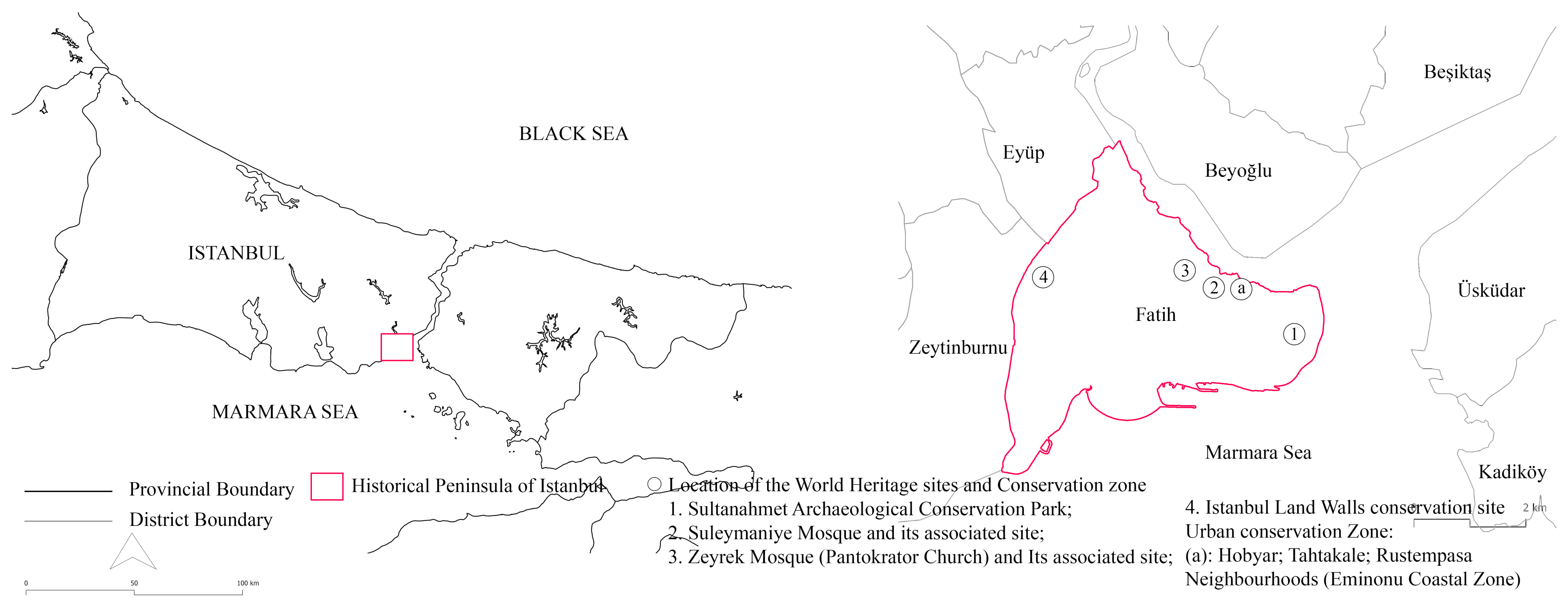
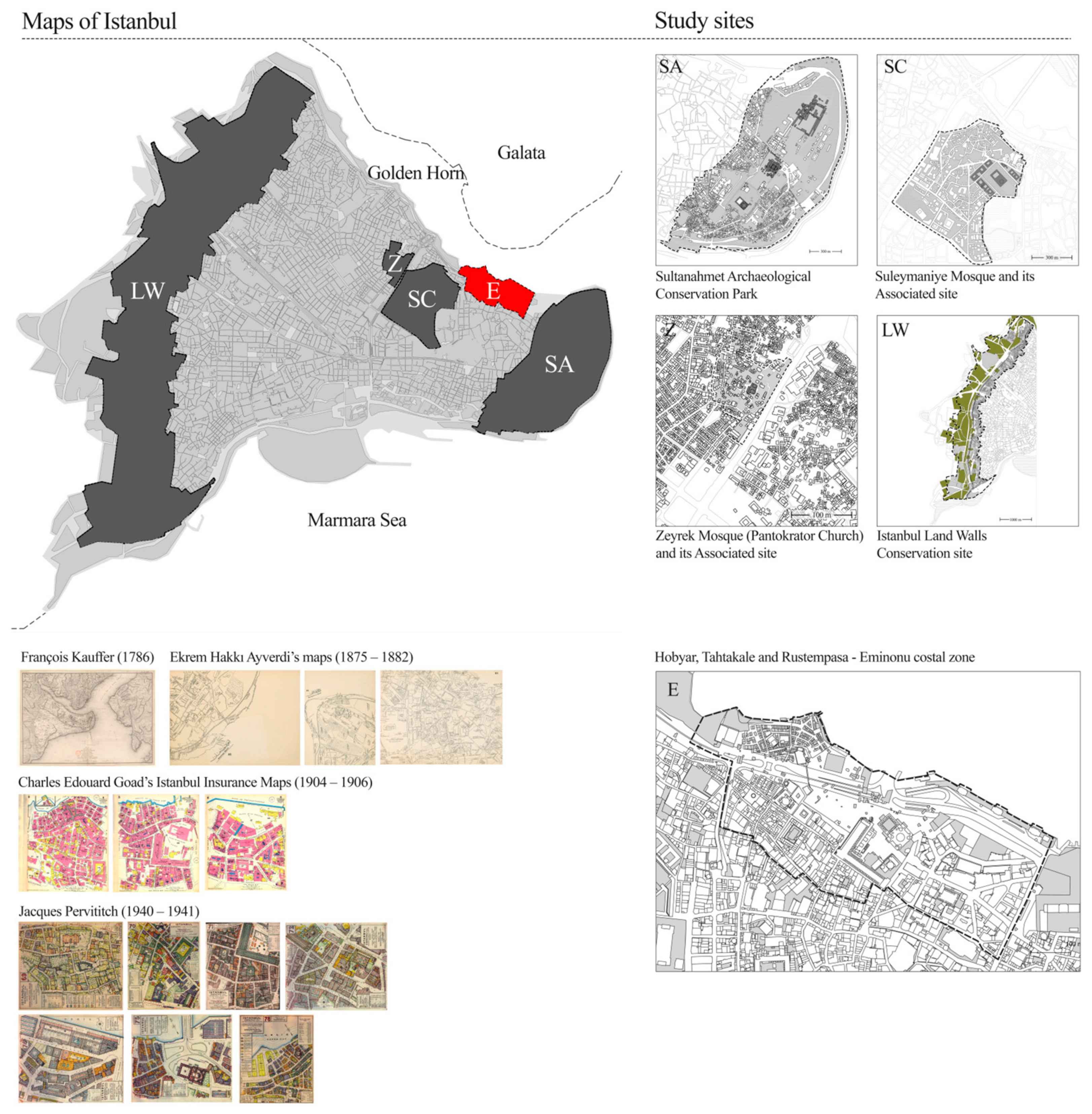
The methodology for this study structured for the Istanbul Historical Peninsula, which contains four World Heritage sites and an urban conservation zone, as their locations are shown in
Figure 1.
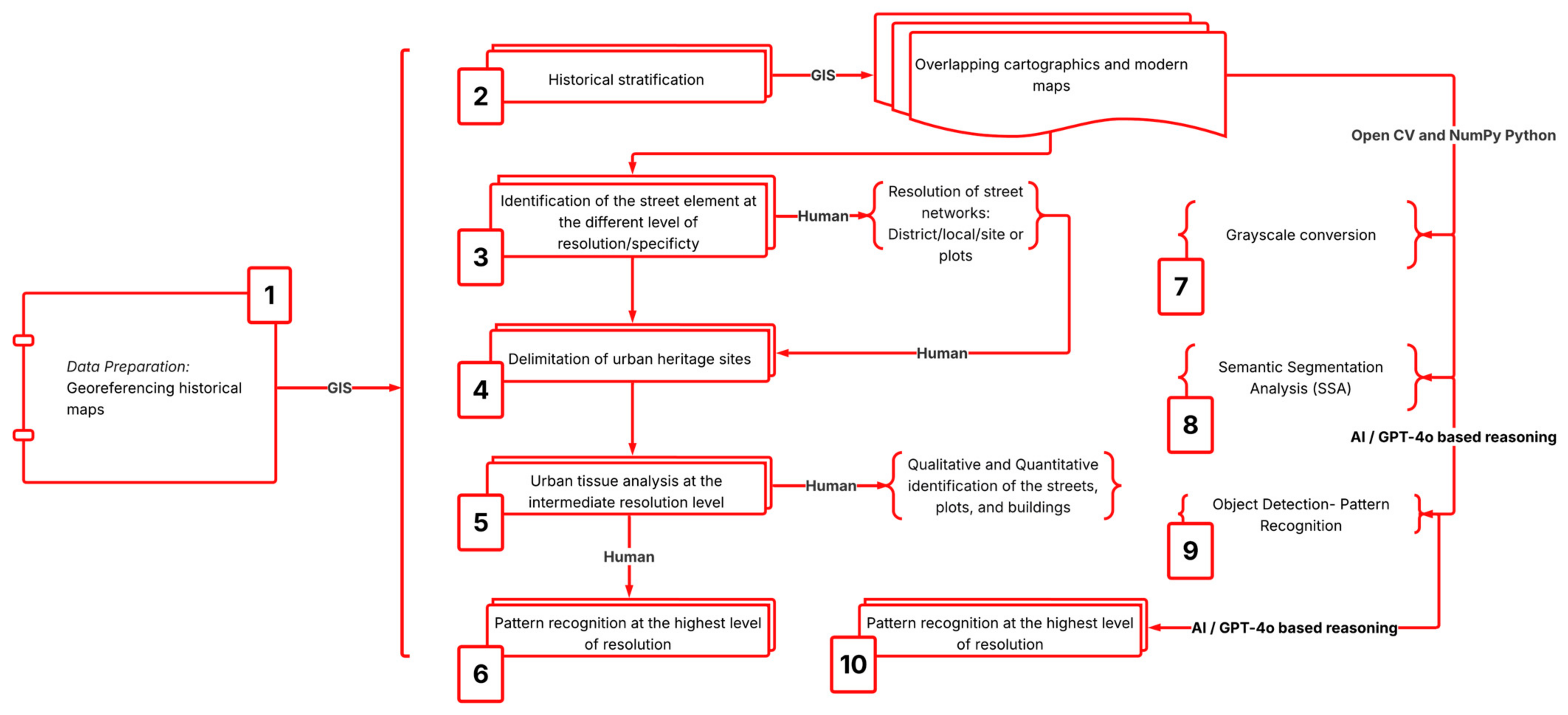
Figure 2 presents the overall workflow of the pattern recognition method, integrating urban morphology, deep learning, and artificial intelligence.
Section 2.1 describes the study area definition stage, followed by
Section 2.2, which details the data preparation process, including the data sources, preprocessing steps, and GIS-based preparation within the study area. Following this,
Section 2.3 introduces the methodological framework, where the analysis proceeds through successive steps of urban morphological analysis, deep-learning-based segmentation, and AI-assisted reasoning, as structured in
Figure 2.
2.1. Study Area
The city of Istanbul, located on the historical peninsula, was the capital city of the Ottoman Empire, and since then, Istanbul has been the most populous city in Türkiye. The area of the historical peninsula covered within today’s Istanbul city has a population of 443,090 and an area of 16.08 km
2 [
23]. Historically, Byzantium was founded the city in the 7th century BC, and it was reestablished as Constantinople in 330 AD, and later served as the capital of the Roman (Byzantine) Empire. The city boomed in its development in the Byzantine Era and Ottoman Era, due to its capital role for these empires and its geographical features that span two continents [
24].
After the city was conquered by the Ottoman Empire in the mid-15th century, the urban structure was formed above the existing diversity of interactions of the heterogeneous structures of the Byzantine and Roman Empires that directly influenced today’s form of the peninsula. On the other hand, after the conquest by the Ottomans, the Islamization of Byzantine Constantinople somehow brought new urban management and urban planning policy changes to the city, which were also needed to encourage the reshaping of the new Islamic building types (urban tissue). Because after the city was conquered by the Turks, the view in the architecture of the city contained a high proportion of Byzantine transformed buildings, it still clearly exhibited Byzantine Istanbul.
Afterwards, the Islamic ornamental arts and great buildings brought by Sultan Suleyman, his son, and grandson to architecture were great evolutions that brought a new character to Istanbul’s urban landscape [
25]. So, the urban landscape of Istanbul in the last Ottoman period was characterized by major monuments, which exhibited the creative works of Byzantine and Ottoman architects, including Hagia Sophia, reflecting 6th century Byzantine imperial architecture; the Pantokrator Church, today known as the Zeyrek Mosque, remaining from the first quarter of the 12th century; the Süleymaniye Mosque, Mimar Sinan’s major 16th century work whose külliye complex significantly reorganized the surrounding urban tissue; and the Sultanahmet Mosque, built opposite Hagia Sophia in the 17th century.
The European modernism agenda of the city of Istanbul has been carried over to the Republican era, even though most regulations of the Ottoman Empire stopped. In line with the spirit of the republic, the city has now taken on the task of becoming a global city, not as the capital of the country, but as a business and economic center. However, the proposed works were not carried out due to the regime changes and the economic difficulties caused by the Second World War [
26], but the city managed to preserve its historical tissue [
27].
Since the Second World War, due to the political, cultural, economic, and migration-related population changes in Istanbul, new urban tissue phenomena (shanty houses or illegal buildings) and dramatic changes in the physical structure have emerged in Turkish architecture and urbanism. Most of the patterns and processes of the 20th-century urban tissue are still being repeated and replicated today. Although the urban typology that emerged in Istanbul during the modernization process and urban development constitutes an overwhelming residential tissue, it is a mixture of all unique historical, architectural, and socio-cultural layers, reflected by a complex metropolis in pattern and diversity.
Despite the heritage of monumental tissues (such as domes, minarets, and tombs) that are left from the past, upon which Istanbul’s urban landscape is based, its face is rapidly changing, and new layers continue to be added to the historical urban pattern. From the above historical background of the process of development of historical urban sites, one can say that in the system of structural changes established—the symbolic urban form of the Byzantine period and the lack of basic geometry [
28] of the Islamic belief in the Ottoman period—the characteristics of urban complexity can be more appropriately defined by evaluating and comparing the urban types of urban heritage sites.
We used interaction methods of urban morphological approaches as our base of analysis to examine every step (different dimensions at different scale levels) in the process between the past and the future during modernization; it revealed the types of urban tissues that were added, changed, or have remained the same (between continuity and change) within the complexity of the urban form. As such, four World Heritage sites were analyzed in this study.
Figure 1 illustrates the study areas with the boundaries of the historical peninsula of Istanbul on the left and one inset map on the right, showing the locations of the World Heritage sites and urban conservation zone in its historical peninsula district.
2.2. Data
To conduct spatial–temporal layering analysis in the historical peninsula, the base data (cartographic maps) are required to be converted into grayscale raster images that normalize pixel values, where built-up areas are shown as black pixels and non-built-up areas as white pixels. The selected maps for the peninsula were obtained from different types of sources. The Byzantine and Roman era of Istanbul is most depicted within the contextual data sources, and for this period, we used the research of Albrecht Berger on the streets and public spaces in Constantinople [
29] to detect the simple geometry of the city. The maps of the 18th19th and 20th century were obtained from Salt Research [
30]
https://archives.saltresearch.org/ (accessed on 7 December 2025), which has open-source historical maps, which are the map of Istanbul by Francois Kauffer (1786), and the most descriptive historical maps of Ottoman architecture for the 19th century are Ekrem Hakkı Ayverdi’s maps (1875–1882), supplemented by Charles Edouard Goad’s Istanbul Insurance Maps (1904–1906) and Jacques Pervititch’s Insurance Maps (1940–1941), which illustrate the city’s transformation. Contemporary spatial data of the Istanbul Historical Peninsula was received from the Fatih Municipality in .dwg and .shp formats.
Subsequently, we merged all map formats to produce one vector data layer and used the sources of the UNESCO World Heritage Sites Plan [
31] for the delimitation of the study area boundaries to narrow the research area to the neighborhood scale.
2.3. Methodological Framework for Pattern Recognition
After having characterized the boundaries of urban heritage sites, understanding cities historically can be accomplished as a new layer in investigating urban heritage sites at different levels of resolution, through integration with the urban morphological approach to deep learning. We propose to gain direct knowledge on processes involved in the emergence of the urban form through identifying patterns by introducing a model of urban heritage site morphogenesis, which aims to recognize types by empirical investigation and artificial intelligence reasoning.
The general principles of the model are the following successive stages that are presented as red colour in
Figure 2. As the first step, the implementation of historical (inherited) variables requires data preparation steps, georeferencing, and aligning cartographic maps in GIS to the projection system of the study areas. So, the model structure is designed based on the principles of the different levels of resolutions/specificity, and the second step follows the layering map process with the aid of the Geographical Information System (GIS). After that, the identification of the patterns is in the very lower resolution; we consider street or road structure as being the initial state to investigate patterns within these levels of specificity.
High levels of complexity of urban heritage environment confirm the needs to narrow the research areas for the identification of the variables for the model at this level. Therefore, we characterized the research area’s boundaries, focusing on the ability of the model to capture types more particularly.
The principal constituent or unit of urban growth and transformation is urban tissue, following composition rules that smaller-scale elements (streets, plots, and buildings) come together to create place characters. So, urban tissue analysis is added to independently classify types of elements within the tissues of urban heritage sites. Then, we extracted the street, block, and building features from historical and contemporary map data with the aid of the CNN-based automatic semantic segmentation. The pattern recognition process was subsequently performed by integrating the resulting segmented layers with information obtained from human-based urban morphological analysis and AI-based reasoning within the different levels of scale.
For the pattern recognition process, first we have to apply data standardization processing—collection and georeferencing of historical maps—in a GIS environment. To detect patterns, we have to apply CNN-based automatic segmentation, using OpenCV and NumPy (Python 3.10) on both historical maps and the contemporary map to apply edge detection to identify streets and to apply contour detection to find urban blocks and buildings. To achieve this, we performed a grayscale conversion image preprocessing step in the Python (OpenCV) environment to reduce the complexity of the maps. We then used the OpenCV and NumPy libraries in Python for image processing to perform automatic segmentation. After this preprocessing step, we were able to create a historical stratification model through spatial overlay of segmented map layers. Finally, we moved into the AI reasoning phase to recognize patterns (object detection). We input segmentation maps into the GPT-4o environment and developed several prompts for identification of the types of elements within the different resolution levels across the different time periods.
3. Results
3.1. Identification of the Street Elements at the Different Levels of Resolution/Specificity
In most quantitative and qualitative models—such as models of urban space or urban character—the focus is on the way combinations of different morphological elements—streets, plots, and buildings—give an area its unique character. This should also be reflected at the different levels of resolution of the urban form or urban tissue. Therefore, we propose the use of their position, type, and arrangement within the settlement as the basis for the identification process.
In the general idea that the elements are connected in a hierarchy, the street pattern is defined in this hierarchy as a simple tissue by Karl Kropf [
11], where the identification of the streets and routes has provided traces of the spatial development or transformation process in urban tissues. According to Blaut [
32], the spatial arrangement and rearrangement of urban elements in time emphasize that there is an implicit existence of a temporal model in each spatial model. In this study, this spatial and temporal aspect is considered to reflect the main characteristics of the settlements.
Streets/Routes
The historical peninsula of Istanbul represents the traces of multicultural morphological periods of the Roman, Byzantine, and Ottoman empires, and then the Republic. The city was surrounded by historical walls during the Byzantine period, and monuments and architectural elements were established on the Seven Hills [
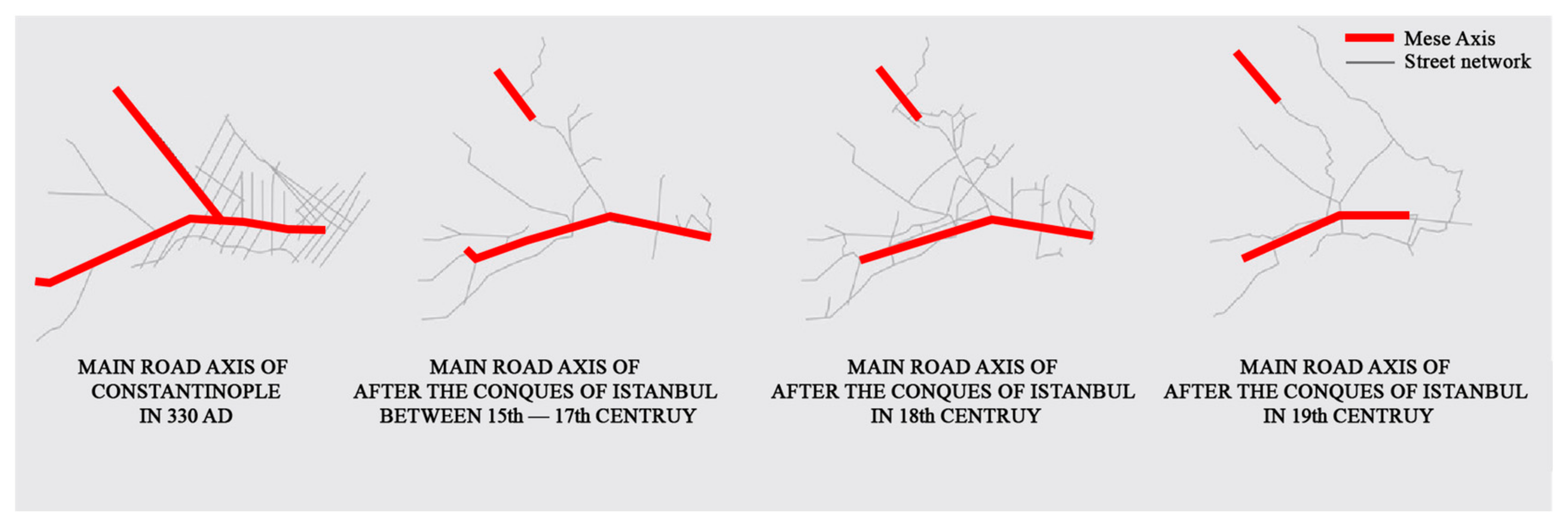
33]. The Roman-made “Mese” axis, which constitutes the spine of the city and was built by Constantine on the basis of connecting the seven hills of the city, determined the exact route of the city and remained the same throughout history.
The morphological structure of the historical peninsula developed around the axis of the “Mese,” and this 25 m-wide road passing through the middle of the peninsula was named “Mese,” which means middle, because it is at an equal distance to both Marmara and the coasts of the Golden Horn [
34,
35]. In the street layout of this period, the street grid is easily identifiable from Berger Albrecht’s [
29], as follows: the shape of the seven hills is equipped with either straight or very steep stairs extending perpendicular to the streets and slopes, or as the topography allows. After the conquest by the Ottoman Empire, with the effect of the new empire, changes were made in the urban form and function along with the way of life in the city. Unlike the Byzantine period, the development of the city continued outside the city walls.
The “Mese” axis preserved its function as the spine of the city until the late period of the Ottoman Empire, but over time, it was named Divanyolu. So, we find certain complementarity between the urban morphological characteristics of the historical peninsula and its street structure from the past that was built to have a certain organization. When considering this relationship in the morphological concept and temporal perspective [
36], the basic backbone of the morphology of cities [
8] is shaped by the nature of the hierarchy of the street network elements or the regular or less orderly sequences of the elements. Thus, the historical layering of the street patterns is captured, and the street morphology and street typology is obtained at different resolution levels within the city: roads that connect directly or indirectly to all settlements.
We, however, obtained a good quantitative descriptive key of the urban tissue, according to the way that the street patterns connected to the different parts of the city.
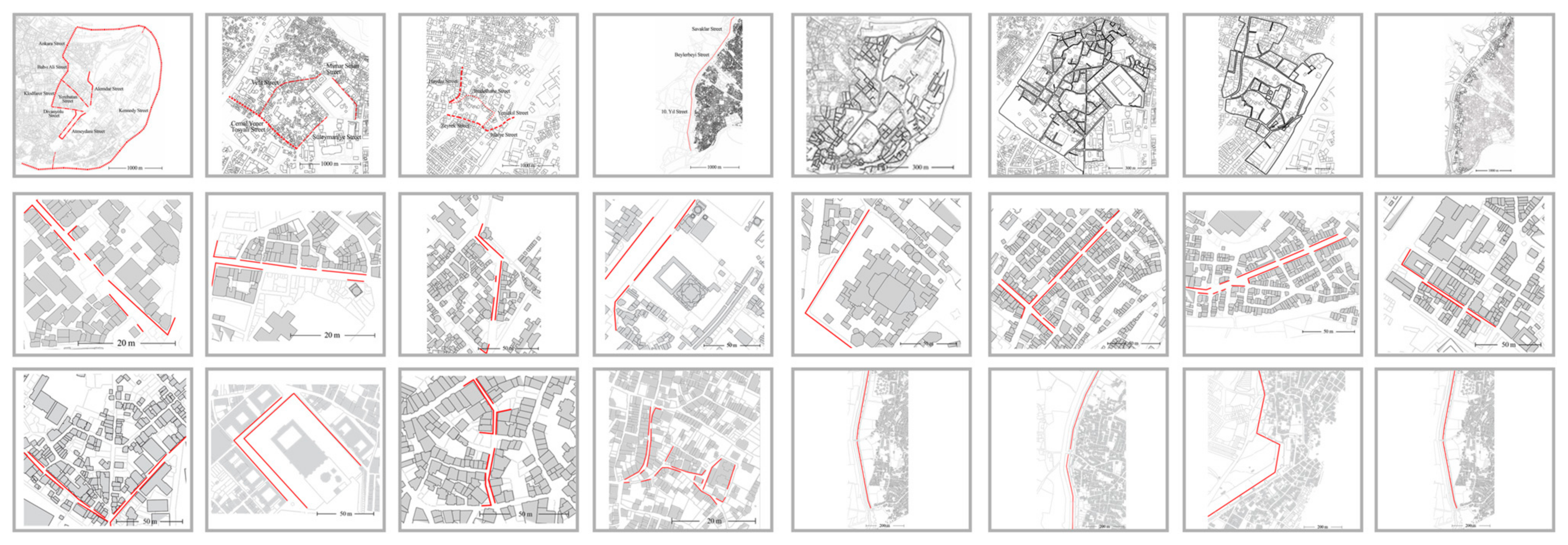
Figure 3 demonstrates the results of the historical layering of the streets/roads that were sprawled from the main transportation axis, which still keeps the earlier function (Mese) of the historical core to the outer neighborhoods and is connected directly and indirectly to different settlements. We have put forward the reasons behind how internal settlements formed different and irregular patterns, depending on the force of dew development direction. Accordingly, each connection solidified diversity on different levels of resolution of the city by inviting us to create new patterns.
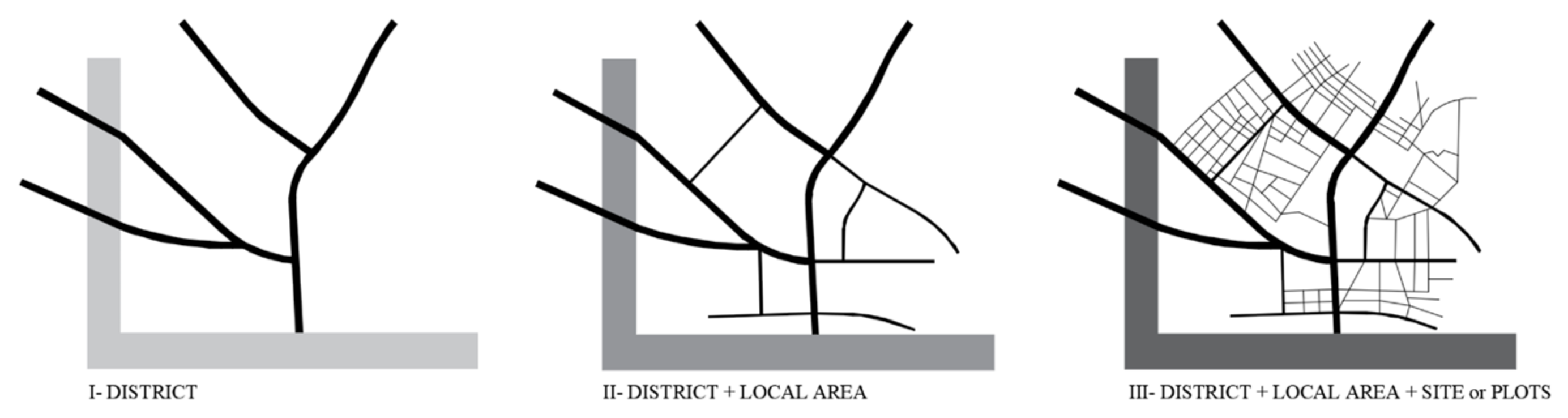
We further demonstrate the connections of street pattern diversity/variance according to the resolution of scale in
Figure 4. This confirms that the degree of resolution of street networks led to the classification of street types into typological clusters that vary at different types of scales—regional connections with major routes, neighborhood-level connections with streets, or settlement-level connections with roads.
As a result, the growth and transformations of the streets of the historical peninsula are based on the role of the main old routes. The old route has shaped today, with the intersection of arteries toward the historical center or the redirection of new and existing routes, which confirms that it has consistently provided a route to the settlements and maintained its strategic role. Therefore, as the first step in the route analysis process, we have determined the route types at the low-resolution level, that is, outside of the centers or only at the settlement level, in order to determine the routes that will extend to the settlements. Here, all street types are specified by their structural organization within the morphological hierarchy of the street network, according to their position in the network and their spatial relationship to the historical center.
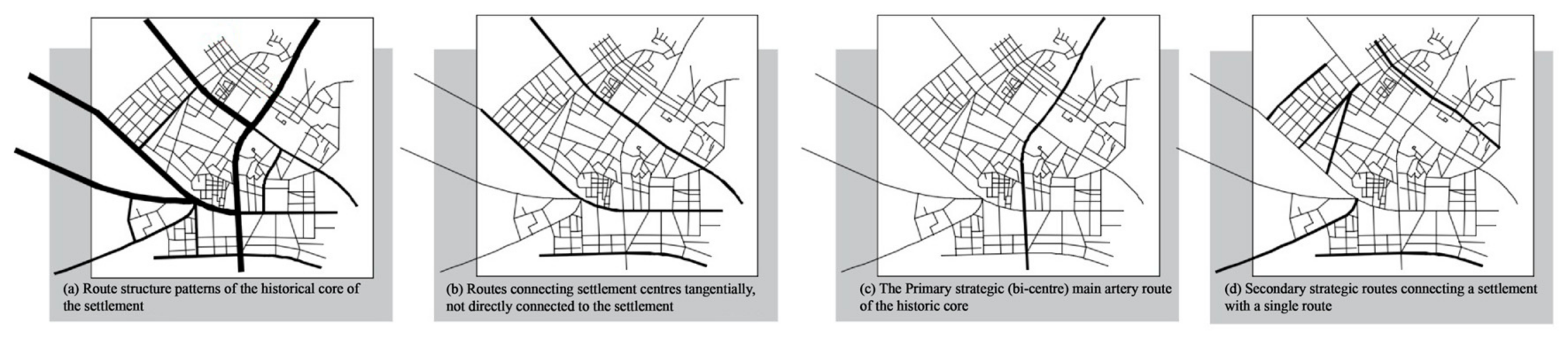
In this respect, when the route types are examined in
Figure 5, three types of strategic route features have been identified in the historical city center from (a): (b) roads connecting the district where the historical city center is located to the surrounding central district settlements tangentially; (c) primary arterial roads with two centers—at either end—and extending from the center of the local area of the historical city center, connecting from either end of the historical city center to the center of another district; and (d) secondary strategic routes that connect to a settlement center at one end and transition routes at the other end.
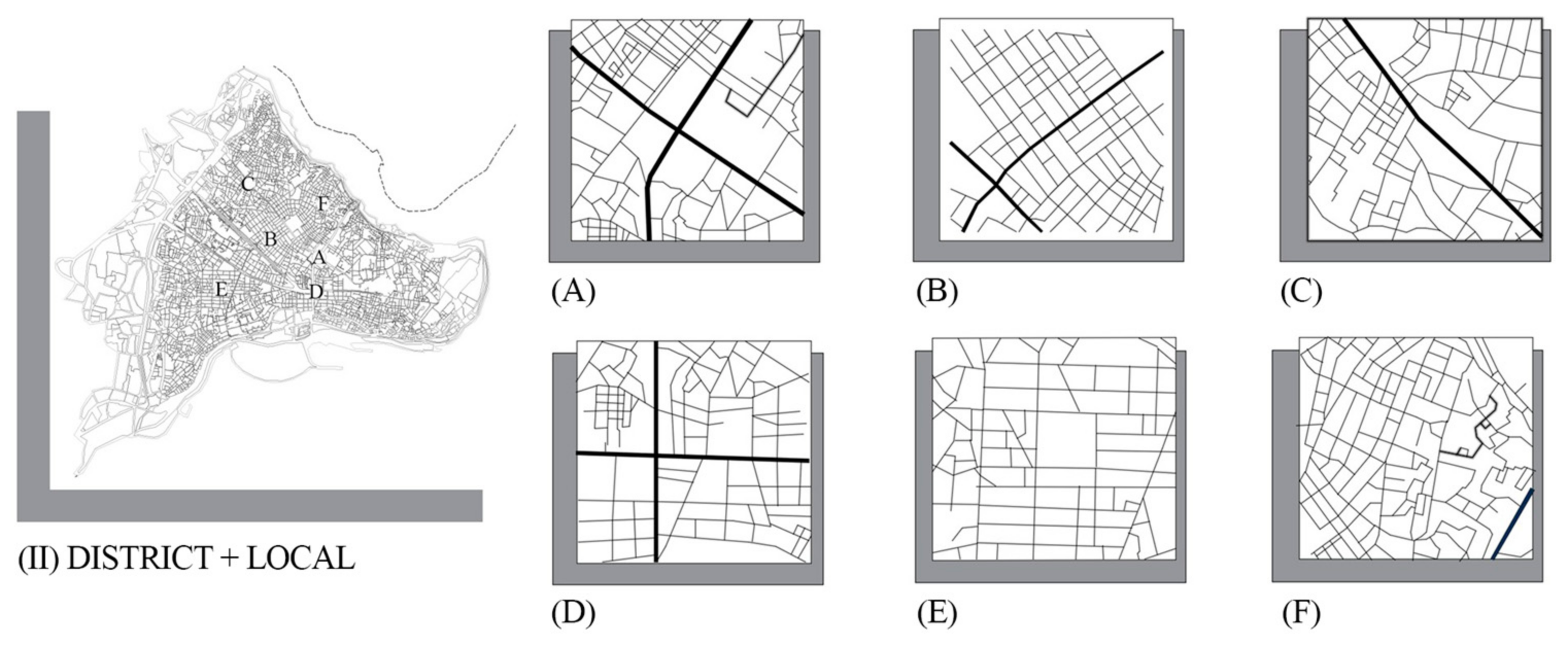
The typology above has been developed as a set of qualitative descriptors in order to identify the typical street patterns corresponding to the types in the characterization of the historical core. The six types were identified most commonly—at the intermediate resolution (
Figure 6)—by considering the prominent street patterns extending from the historical core settlements to the suburbs. The typology shows the characteristics of irregular, sometimes planned or unplanned, street patterns in resolutions from the main axis to the outer areas and settlements. These street networks are distinguished most commonly as follows: the mix of planned and unplanned traditional street patterns associated with T- and X-shaped connections (A); the shape of the street as a complementary grid, but with vertical connections with traditional networks, still creating a more irregular grid-like tissue (B); irregular, narrow, and curved streets, varying in width and going in all directions (C); street patterns coexisting with connective street networks and main arteries, creating dead-end networks that fit together (D); occupying a region with different structural consistency than the traditional model, revealing a characteristic street pattern (E); and some emerging as a grid-like pattern, but evolving to follow a loop and intermittent pattern (F).
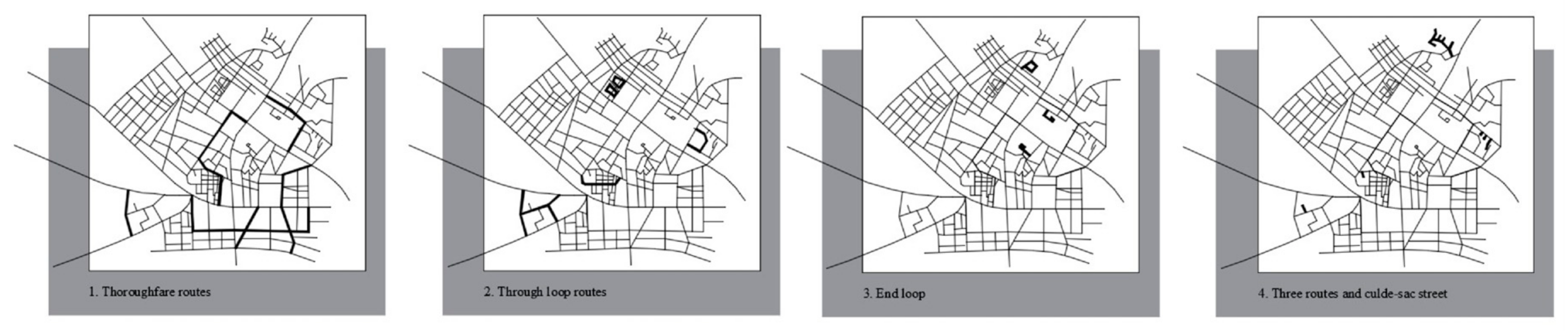
After determining the local routes, the next step is to distinguish the settlement route types that take the arteries to settlements. These routes are shaped by combinations of different access types of settlement networks. In the graphical representation of the local settlement street structures of the historical city center (where the links become the edges in the graph and become the endpoint or change points), the features of the routes were identified as bold black line in
Figure 7 as the following: 1. thoroughfare routes, defined based on a different route at each end—a local route system in which the main axes are linked by different routes at each end; 2. through loop routes, connecting or reconnecting at both ends in the transition loop of the routes; 3. an end loop local route system, linked to another route with only one connection at one end; or 4. a tree-like route composition with a single external link from one end to the other, with all paths being cul-de-sac streets that connect from one end.
On the other hand, the most important feature of the routes of the city center is that the main route connects the district where the historical core is located to other settlements, and passes among the tissues that create the settlement as a whole. The connection developed laterally along these main routes. Although graphically represented route types define different route access, they cannot fully describe the specific structure and hierarchy types of the layout routes. So, we need to consider different alternative forms of analysis that can more accurately represent street networks.
Bill Hillier and Julienne Hanson have developed an analysis method (Space Syntax) to understand the configurational structure of the settlements [
15]. Space Syntax theory defines the structure of streets by quantifying their configurational properties that enable systematic and mathematical representation—in our case classification—of street patterns, based on their geometric properties. So, Space Syntax analysis is implemented in QGIS 3.44.4 (Space Syntax Toolkit plugin) [
37], integrated with depthmapXnet-0.35 [
38].
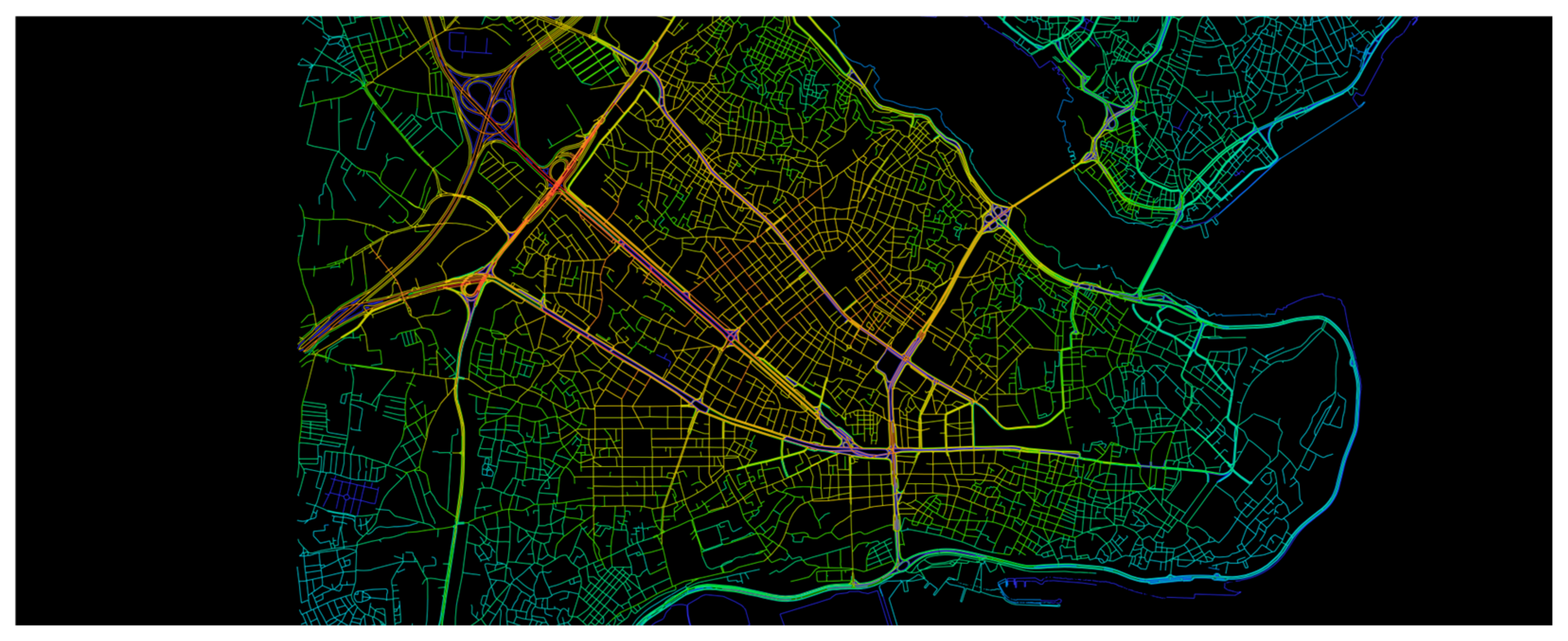
We identified the configurational structure of the settlements. In defining the structure of the routes of the historical city center, axial maps show different intersection angles and different intersection degrees and types, due to differences in the geometry of the tissue. Therefore, different regions contain different configurational properties, according to the intersections.
Figure 8 demonstrates the configurational features of the routes of Istanbul’s historic city center. It reveals the degree of configurational connection (red–blue color codes) and the types of routes at different levels of scale. As expected, the main arteries and sections leading to the urban core of the historic city center form an integrated strategic route with the highest configurational degree. This core is connected to the lateral routes leading from the end to the center and it falls between the center and the lateral routes of the local settlements. The configuration of the local routes also revealed both the direction of development and the density of the city.
3.2. Delimitation of Urban Heritage Sites
The basic principle is to look at specific features found in different parts of the historical city center and to identify areas with different urban tissue types at the lowest level of resolution. To do this, we considered the World Heritage sites in Istanbul, and regions were delimitated as in the UNESCO guide (
Figure 9): 1. Sultanahmet Archaeological Conservation Park (SA); 2. Suleymaniye Mosque and its associated site (SC); 3. Zeyrek Mosque (Pantokrator Church) and its associated site (Z); and 4. the Istanbul Land Walls Conservation Site (LW) [
31]. Based on this identification, we specified the position, outline, and internal arrangements of each region to be able to identify and define variations in patterns and pattern types systematically. When specifying each selected site in the delimitated way, we constructed a three-level identification process related to the hierarchical relationship of the elements, which allowed us to make urban tissue analysis for the next step. Accordingly, urban tissue analysis is specified as follows: we first analyzed the structures of streets and routes; then, we investigated blocks’ and parcel series’ geometric features; and lastly, we examined plots and buildings based on their morphometric properties in qualitative and quantitative ways—such as blocks and plot dimensions, and blocks and plot types. This type-based recognition was also applied in the urban conservation zone in the historical peninsula (I), which is highlighted in red in
Figure 9, covering the Hobyar, Tahtakale, and Rüstempaşa neighborhoods—the Eminönü coastal zone—for the artificial intelligence to determine types based on the four World Heritage Sites’ tissue-type information.
3.3. Urban Tissue Analysis at the Intermediate Level of Resolution—Qualitative and Quantitative Identification of the Streets, Plots and Buildings
After defining the process of urban tissue analysis, we would like to explore a slightly more detailed investigation of the heritage elements by increasing resolution levels in morphometric characteristics (attributes) that could define types. As already addressed, labeling the streets and route types depends on the configurational properties of the region, which contain quantitative and qualitative information on street types. Therefore, the analysis is based on the geometrical and topological properties of the streets for each selected heritage area, and based on their configurational scale (red to blue), we could be able to provide a more accurate identification process of the types of roads, streets, and routes.
So, types of blocks are determined by the angular connections of the streets or routes. For instance, a route bounded by a block or a series of plots on one or both sides constitutes the simplest unit of the urban tissue [
39]. Depending on the patterns created by the routes, simple tissues can create tissue types on their own [
40], or they can be combined to create a complex tissue. Thus, in complex urban tissues, plots and streets always behave as interlocking elements. Next, we turned to revealing the block boundaries for the selected sites and their distinct morphometric characteristics—such as block areas and block shapes.
The blocks identified in the case of (SA) contains 137 features: 103 block features for SC, 27 features for (Z), 194 features for the (LW), and 63 features for (E). Block types are identified as a mixture of rectangular and polygonal shapes around the Sultanahmet mosque case (SA), and predominantly irregular-shaped geometry is observed. In the case of the Süleymaniye Mosque and its associated site (SC), blocks are varied, and six types of typologies are identified as follows: triangular, trapezoidal, rectangular, polygonal-shaped, irregular-shaped, and blocks forming historic buildings (unique category). Block shapes have triangular, sometimes polygonal, and sometimes rectangular variations around the Süleymaniye Mosque, due to the diagonal routes. Organic and radial street structures shaped the triangular and trapezoidal shapes of the blocks [
16].
Zeyrek Mosque and its surroundings (Z) are characterized mainly by irregular blocks that exhibit a strong historical orientation as they follow the pre-existing street order, with some polygonal and rectangular shape variations.
Types of blocks also vary in the case of the Land Walls (LW), and seven typologies are identified as follows: rectangular, square-shaped, polygonal-shaped, triangular, trapezoidal, irregular-shaped, and historic-feature-shaped blocks (unique category). The rectangular or polygonal-shaped blocks on the inside of the historical walls are predominantly scattered along the historic walls.
The existing urban tissue in the neighborhoods of Hobyar, Tahtakale, and Rüstempaşa (E) follows irregular block patterns across the Eminönü coastal road with integration into the primary strategic road axes. The blocks are trapezoidal- or polygonal-shaped around the inner settlements (Tahtakale). Tissues of those block patterns are presented by the thoroughfare and through-loop roads, and some of them are linked to other routes with only one connection at one end with end-loop route types. Plots generally follow a series of narrow and shallow typologies and wide and deep ones. Landmark buildings are located in larger plots, predominantly surrounded by open spaces. However, the building tissue is gradually enduring towards the inner settlements, which results mostly in courtyard and multi-courtyard building typologies.
While urban tissue is mainly characterized by the streets and block boundaries, the patterns of the buildings are the most important elements in the urban tissue that make it possible to define urban tissue types. While there is an increase in complexity from part to whole in a sort of sequence hierarchy, buildings are the most identifiable/visible in this complexity [
41]. The location of the buildings within the plots constitutes the visible part of the urban tissue by defining the adjacent relationship with other elements in different composition types. Although the urban tissue is a synthesis of all components, the higher the visibility at different levels, the more information it contains [
11]. The locations and boundaries of the component drawings of the plots, and the buildings that fill these components and their geometrical properties, contain more specificity [
42]. The results are displayed at the high specificity level for this purpose to identify the visible elements of the heritage sites, and their positions or patterns (tangible/permanent dimensions) are also revealed.
Figure 10 also demonstrates the typologies of streets, blocks, plots, and buildings that were identified at the highest levels of resolution.
With detailed analysis of the urban tissue, the main pattern types of urban elements that make up the heritage areas will be revealed in the next section. Identifying all possible variants led to the pattern recognition process at the highest levels of specificity. The exposure of these leading types can only be recognized in contemporary developments of the urban heritage sites, because the urban tissue of the historical areas is settled and fortified, and only responds to changes on a very small scale [
43]. The recognition of type typologies obtained by reaching different resolution levels from the multilevel urban tissue structure summarizes the types of elements. Thus, the leading pattern types that are recognized represent the complex structures of heritage sites.
3.4. Pattern Recognition at the Highest Levels of Specificity—Human Assessment
After the detailed analysis of the urban tissue of the heritage sites, we have identified that the leading types are significant in terms of their position, and are outlined across the urban heritage sites and urban conservation zone. The zones of the Sultanahmet Mosque and Hagia Sophia (SA—Sm, and SA—Hs), the Suleymaniye Mosque and its surrounding zone for (SC), the Zeyrek Mosque and the settlement tissue covering the mosque for (Z), and the Tekfur Palace of the Land Walls (LW—Tp) are selected as leading tissues within the contemporary urban setting. Then, we applied element separation analysis (object-based detection). We sought to define patterns of zones, encouraged by the successful results of urban tissue analysis.
The extracted block typologies are displayed in
Table 1. Each of them have different variance, while we can determine some shared qualitative indicators of their pattern shape types.
We have identified seven unique routes and street types, as follows: primarily strategic route (SA; LW; E), through loops (SA; Z; E), thoroughfare (SC; LW; E), tree-like (SC;LW), cul-de-sac (SA;SC; Z; LW), and end loop (SA).
The pattern recognition results show that irregular patterns are dominant across the tissue zones. This confirms that the position and size of the buildings (mosques or their complexes) in the blocks are inherently complex and they resulted in typologies with varied irregular types. Furthermore, all irregular patterns besides the heritage irregular block patterns are mostly delimited as multi-courtyard buildings or courtyard buildings, as a result of the enclosure and some empty corners.
Following this, rectangular, trapezoidal, and triangular block typologies appear as the most common patterns in the surroundings of the heritage building patterns. We noticed that the additions (new layers) to the old patterns influenced the block dimensions (shapes), where rectangular, trapezoidal, or triangular patterns resulted from the historical stratification process in these regions.
We can conclude that each block is characterized by different building patterns. We found that heritage blocks are generally surrounded by courtyard-type complex buildings. This is in some way in harmony with the courtyard-type typologies around it. Particularly typologies (SC), (Z), and (E), and the typology of the built environment around them, are mostly courtyard type or multiple courtyard type. The patterns that the buildings create in blocks, detached/independently, and without forming a certain shape, are generally more common in the tissue zones (SA–Sm, SA–Hs, and LW–Tp). We also recognized that the detached building patterns are common in the (Z) and (LW–Tp) cases. This means that Zeyrek Mosque and its surroundings and Istanbul Land Wall areas reflect more diversity of blocks and building patterns because of the highest degree of historical stratification. This makes the formalization of a pattern language logic in the case of the historical peninsula from those areas, which is typologically based, logical. On the other hand, the Sultanhamet and Suleymaniye cases vary with contemporary and historical patterns, which promises the distinctions of new patterns (additions).
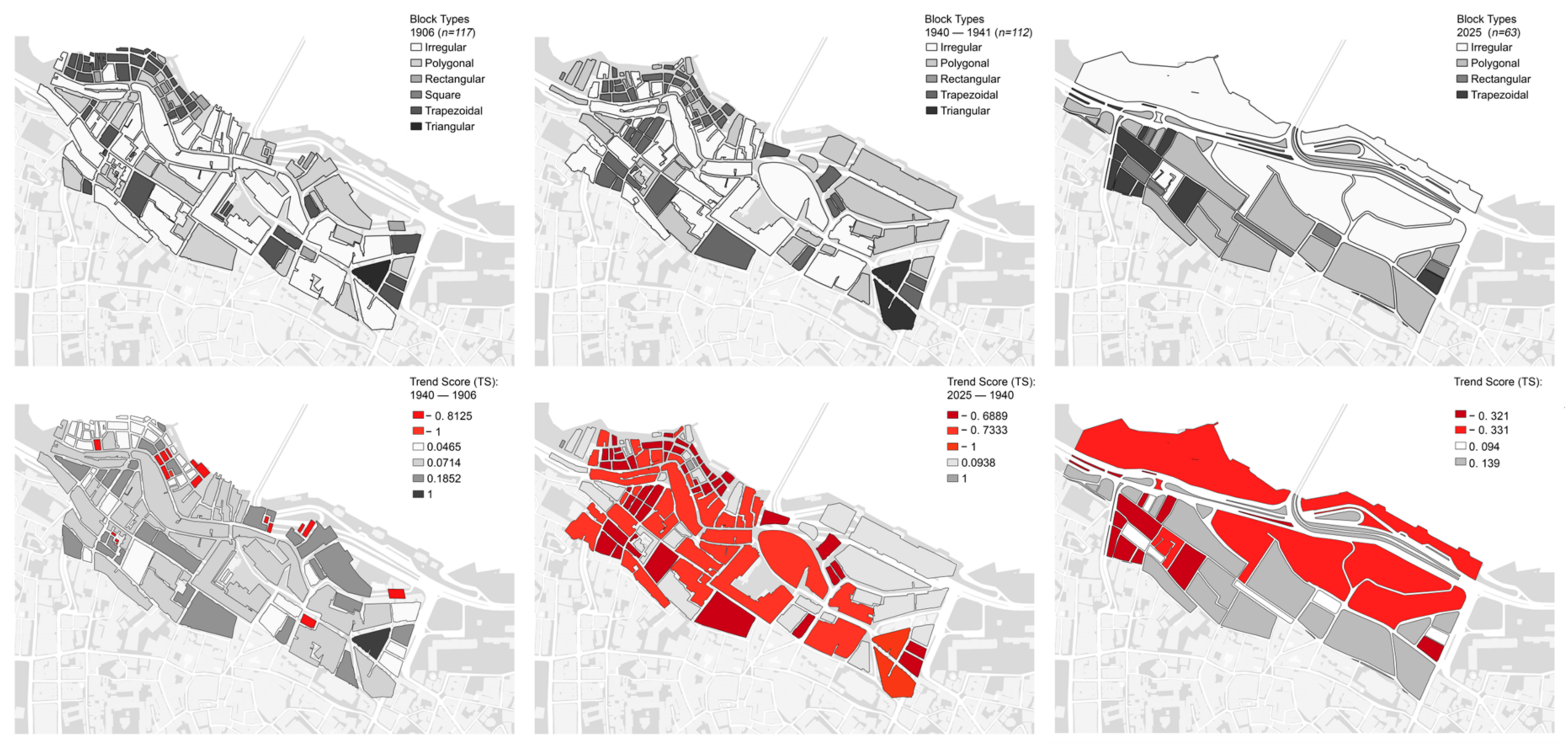
After that, we applied the pattern recognition process at the highest levels of resolution. To do this, we used the map data that were available for the highest levels of specificity of urban form, which are depicted in the maps of the 20th century. The recognition for this resolution is covered with the block-level separation. We followed several steps for the pattern recognition. As a first step, we counted blocks for each period and identified types, counting them both spatially (
Figure 11) and temporally (
Table 2). As a last step, pattern recognition logic is structured to define the stability of a block type over time, based on the trend score.
Calculation of the trend score (TS) is formulized as follows:
The results show that irregular, polygonal, rectangular, and trapezoidal pattern types can be recognizable, but each of them demonstrates increased or decreased trends over time. Among the patterns, only the polygonal type shows a positive trend. It is almost not possible to recognize the rectangular type between the periods of 1940 and 1906, which demonstrates a significant decline but shows its presence again in the contemporary setting. Irregular and triangular types have declined trend values around −0.3, but they still remain. There is no long-term persistency for the square and triangular block typologies.
Next, we introduced the obtained leading patterns from the World Heritage site tissue samples into the deep learning and AI intelligent framework to prompt it to apply zones of the Hobyar, Tahtakale and Rustempasa—Eminonu coastal zone (E)—where the changes in urban structure were significant over time to identify inherited urban tissue types. This kind of structure helped us to use AI-based pattern recognition (no human in the identification) to recognize types that were shaped by spatial and historical characteristics. This brought us to opportunities to accurately assess the input of textual knowledge about the morphological and historical characteristics of settlements given to AI, but the inputs were clearly defined by human logic, with strong unsupervised learning methods and systematically conceptualized resolutions or layers for identification.
3.5. Pattern Recognition at the Highest Levels of Specificity—Deep Learning and Artificial Intelligence Assessment
To initiate the pattern recognition process at the highest levels of specificity, we first applied automatic semantic segmentation (ASS) analysis, using the Python and OpenCV (cv2) environment, to both the historical maps and the contemporary map sources. These map sources were converted into a machine-readable vector format, allowing for the transformation of the complex unstructured data into structured data in which an understanding of its features allows for perfect, cleaned spatial data integration into AI for identification of the tissue types. The Python code used for automatic segmentation, based on CNN, is available in
Appendix A. The 18th and 19th century maps were used to detect where spatial change is significant at the lowest levels of resolution. The scale of these maps is very high, so it gave us the opportunity to detect changes at the street and block level.
The maps used for the pattern recognition analysis cover the period of the 20th century because their scale represents more details about the urban morphology, and the CNN model did not struggle to capture the pattern structures.
The obtained semantic maps were fed into the AI, GPT-4o environment, and three distinct prompts were developed for the interpretation of the maps that represent spatial geometry by segments.
The role of the AI was as the reasoning agent for the pattern recognition. The GPT-4o AI model was selected because of its ability to read the multimodal inputs, such as visual and linguistic data types, and its ability to generate integrated reasoning over those data from various types, rather than for autonomous pattern extraction. Input to the AI formed by the semantically segmented historical maps as green colour (
Table 3 and
Table 4) generated through CNN-based image processing in Python, joined with structured textual descriptions that covered the human-based identification on the urban tissue.
The interaction with AI followed a prompt-based strategy designed to guide interpretation within predefined morphological criteria. Prompts were formulated to restrict the analysis to spatial and structural characteristics. The exact wording of the prompts used is provided in
Appendix B.
For the first prompt, we directly asked GPT-4o to determine any changed zones at the lowest resolution level, based on the spatial geometry of the streets and blocks from the overlay of the maps of different time periods. Those period map sources’ scales are extensive and are able to detect the zones across the historical peninsula. An obvious route is to increase the model’s ability to detect where the added, removed, or modified street networks appeared. Our findings confirm that the AI reason-based determination of the tissue zone result (as shown in
Table 3) typically parallels the urban tissue typologies of the World Heritage sites (remain) and urban conservation zones (changed or modified).
Our results also reveal the need for AI and machine learning tools to create a historical stratification model, which depends on the readability of the urban morphology that forms the basis for the pattern recognition and typological comparison of the settlements.
For the second prompt, we requested AI to define its own types at the highest levels of resolution, based on the output of the CNN model of the segmentation results of the 20th century maps (as shown in
Table 4) and input of textual knowledge (results in
Section 3.1 and
Section 3.3) about the morphological characteristics of tissue zones given to AI for accurate identification. Detection of types from the semantic maps’ skeleton was requested to consider four aspects as follows: configuration, position, outline, and internal arrangement. The matching results of human and AI-based identification of the urban patterns are shown in
Table 5. The results revealed that AI was able to reason (identify) pattern types both spatially and temporally, and demonstrated perfect agreement with the human-based identification, with only some minor differences within the streets’ and plots’ typologies. AI and the human perfectly agreed on the type of buildings identification. Differences only occurred in the period of the 18th and 19th centuries; because of the scale of those maps, AI struggled to detect the pattern. AI and the human used almost the same vocabulary for the building type identification across all tissue zones. But, for the street and plot pattern identification, artificial intelligence needed deeper knowledge.
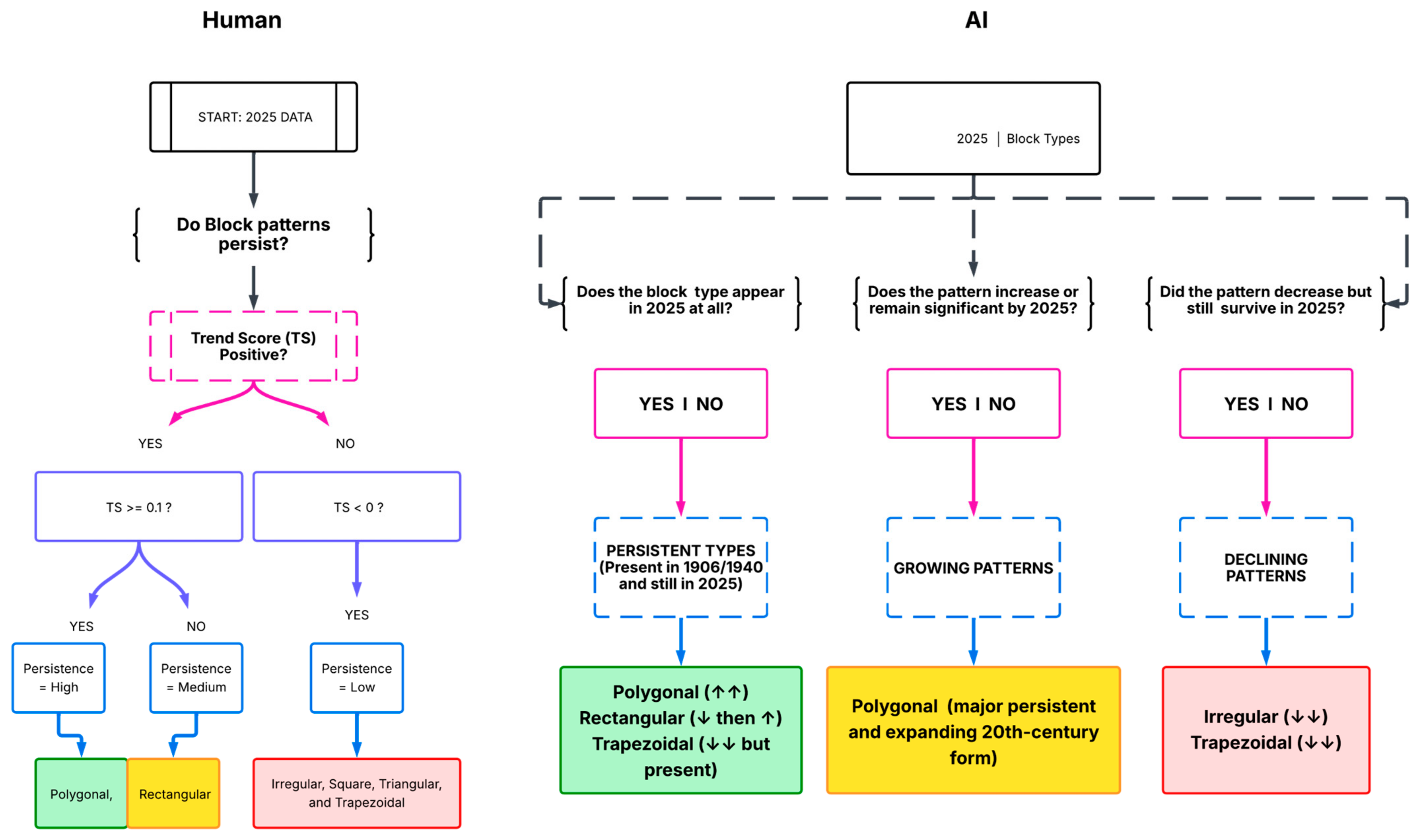
Based on the obtained tissue typologies, we asked AI, using a final prompt, to create decision logic that identified which patterns from the 20th century persist over time. This process enabled systematic pattern recognition analysis.
Figure 12 demonstrates comparative decision logic between humans and AI. In
Section 3.4, we have already defined the stability of a block type over time, using a trend score model. Based on human logic, polygonal blocks represented the most stable type; on the other hand, rectangular typology exhibited medium partial stability. Conversely, block types—irregular, square, triangular, and trapezoidal—followed low persistency, with a trend of zero in the case of the square and triangular types.
However, the AI results showed almost the same results with a different interpretation. AI indicated that the polygonal type not only has an increased (upward) trend but also contributes to the direction of the development.
4. Discussion
This study applies a model based on the integration of the methods to urban morphology, deep learning, and artificial intelligence to define and recognize the characteristics of the basic elements of urban forms at different resolution levels and reveal the patterns of heritage in the historical peninsula of Istanbul. In terms of the empirical analysis of historical cities or settlements, spatial and temporal relationships can be brought to light within the descriptive and analytical framework of urban morphology and the integration of new technologies for pattern recognition, based on qualitative and quantitative variables at different levels of resolution. This multi-level scale of the spatial and temporal dimension is based on Kropf’s conception, Conzen’s “compositional hierarchy,” and Caniggia’s “typological process”; the street type information is based on Stephan Marshall’s street and pattern classification; the street pattern relationships with the blocks, plots, and buildings are based on the Italian school of urban morphology—Muratori, Caniggia, and Maffei—and its evolution and development of urban types approach; and the quantitative dimensions of the street are based on Bill Hillier’s Space Syntax theory.
In urban morphology, the formations of types and their variables (configurations) depend on the relationships between the elements or structural overlap, and configuration and urban tissue analysis can be identified at different levels in the generic structure. So, we used the configurational approach to identify types of route structure, and, based on the types of route structure, we were able to identify types of urban tissue [
44]. The types of route aggregation make it possible to identify distinct types of urban tissues. In this sense, the configurational approach can provide a simpler approach to spatial analysis of cities, and it can be used as an effective approach for bridging the other approaches when the aggregation scale of the urban form is increased. So, the connections of street pattern diversity/variance according to the resolution of scale [
45] included different types of routes—regional connections with major routes, neighborhood-level connections with streets, or settlement-level connections with roads.
Where the historical peninsula is concerned, the results show that different types of urban tissues are structured by the basic backbone of the Mese road that shaped the further configurative features of the routes and their degree of configurational connections over time. This is depicted in the pattern where permeability increases from strategic routes to the lateral routes leading from the end to the center, and it falls between the center and lateral routes of the local settlements. The highest configurational values follow the location/position of the four World Heritage sites, and average and lower values were observed in their surroundings or neighborhoods (mostly urban conservation zones), indicating the levels of place diversity in Istanbul. Thus, we were able to determine the delimitations of urban tissues of those zones by the spatial analysis of the street networks. The types of tissues have different variations, contributed by the changes in the degree (configuration) of the street networks, as demonstrated in
Figure 4,
Figure 5,
Figure 6 and
Figure 7; they contributed to the emergence of different block layouts, plot, and building patterns (
Figure 10).
The findings for each selected tissue zone’s relevant blocks, plots, and building patterns are summarized in
Table 1, which plays a critical role in the recognition of types and in maintaining leading patterns in a city. For the pattern recognition process, we used those parameters for a rigorous decision and inductive reasoning about the patterns of persistency and changes. However, if we want to deeply explore the types of patterns and recognize them in a complex system such as the historically stratified city we demonstrated, these descriptive frames will be limited. The reason for this is the challenge to strive for the reliability of a conclusion reached with inductive reasoning of the urban morphology, depending on the completeness of the observations. Karl Popper [
46] claims that in his book,
The Logic of Scientific Discovery, all inductive evidence is insurmountable (probable inference, or probability logic), and objective knowledge evidence is limited. To achieve this, new technologies for pattern recognition, such as deep learning and artificial intelligence, will play an irreplaceable role in urban morphology. One of the basic properties of the pattern recognition process is the scaling process; different maps bear different unit sizes and different types of elements.
Deep learning—CNN—models have difficulty understanding pattern structures at the lowest levels of resolution, which reduces the result accuracy in capturing very high-resolution tissue details—for instance, struggling to detect building patterns or capture street tissue types. Thus, we have to adopt the highest levels of specificity to identify the local spatial features of the urban form. So, AI successfully captured the objects of the map data obtained from the CNN-model-based semantic segmentation analysis, based on the generated several prompts.
Table 4 displays patterns obtained from the AI and human analysis. This analysis finds a strong relationship between AI and human assessment, but an important question should be discussed here about some possible misunderstanding in AI-based pattern recognition. To make a model for urban morphological studies, we must find an effective approach and method to identify spatio-temporal parameters; the numerical geographical parameters are significant, so quantitative methods cannot be ignored. Algorithms can generate meaningful and accurate results if fed by domain knowledge grounded in human expertise. This could occur if there is unpredictability in data sources.
5. Conclusions
This research proposes a novel method integrating deep learning and artificial intelligence into the urban morphological approach for the identification and recognition of patterns as existing types in the built environment at different levels of resolution, which excels in capturing the elements/variations in both spatial and temporal dimensions. The key strength of the deep learning approach lies in its innovative method of processing maps: convolutional neural networks and semantic segmentation analysis are employed for the historical stratification model, and the libraries OpenCV and NumPy in Python are leveraged to optimize the map data to correct pixel distortion on the maps.
To validate the strength of the proposed model, a case study of the historical peninsula of Istanbul is selected where historical stratification is significant. We investigate patterns in the four World Heritage sites—Sultanahmet, Suleymaniye, Zeyrek, and Land Walls—and an urban conservation zone—Hobyar, Tahtakale, and Rüstempaşa neighborhoods—for the periods between the 18th century and the present. Different types or different configurations of street or route patterns are identified within the different resolution levels, manually. They are used as a guide for the identification of the urban tissue types in general. These are used for identification of the block types, which are then applied to plots and buildings. The composition of those patterns supports urban tissue analysis for the delimited zones. Zone or neighborhood tissues are clearer to define or recognize specific types.
Seven block typologies are identified: rectangular, square-shaped, polygonal-shaped, triangular, trapezoidal, irregular-shaped, and historic-feature-shaped blocks (a unique category). The polygonal typology is dominant over time, followed by the building pattern. The pattern recognition results demonstrate that artificial intelligence significantly outperforms the process. Another key advantage of AI is its ability to capture patterns that exhibit persistency and change at a higher level of specificity. Analysis and discussion are extended to derive the interaction between urban morphology and new technologies to develop rigorous reasoning about pattern evolution, formations, and transformations, revealing variation across different time periods.
Despite the progress made in this study, several limitations remain for the application of CNN models on the entire city scale. Further research should aim to integrate different approaches within different disciplines into our method to overcome these issues.