
Article

Spatiotemporal Assessment of As, Cd, and Cu Concentrations in the <63 µm Fraction of Loa River Basin Sediments: Implications for Sediment Quality in the Atacama Desert

1
Laboratorio de Toxicología Acuática (AQUATOX), Instituto de Ciencias Naturales Alexander von Humboldt, Facultad de Ciencias del Mar y Recursos Biológicos, Universidad de Antofagasta, Antofagasta 1270300, Chile
2
Programa de Doctorado en Ciencias Aplicadas Mención Sistemas Acuáticos, Facultad de Ciencias del Mar y Recursos Biológicos, Universidad de Antofagasta, Antofagasta 1270300, Chile
3
Departamento de Ciencias Acuáticas y Ambientales, Facultad de Ciencias del Mar y Recursos Biológicos, Universidad de Antofagasta, Antofagasta 1270300, Chile
*
Author to whom correspondence should be addressed.
Land 2026, 15(2), 226; https://doi.org/10.3390/land15020226
Submission received: 13 November 2025 / Revised: 6 January 2026 / Accepted: 22 January 2026 / Published: 29 January 2026

Abstract

The Atacama Desert in northern Chile is characterized by its naturally high metal concentrations; however, human activities have significantly increased their availability and concentration in aquatic environments. In the Loa River basin, copper mining is the main economic activity, and the extremely arid conditions contribute to high levels of evaporation and salinity. This study evaluated the concentrations of As, Cd, and Cu in the 63 µm sediment fraction from three areas, Lequena, La Finca, and Quillagua, during the years 2014, 2015, 2017, and 2023. Contamination levels were assessed using multiple approaches, including the Geoaccumulation Index (Igeo), the Enrichment Factor (EF), the Pollution Load Index (PLI), and the mean Probable Effect Concentration Ratio (m-PEC-Q). The results showed that Lequena (upper river zone) had no evidence of anthropogenic contamination over time; however, the ecological risk assessment highlighted the significant natural contribution of arsenic, representing a potential risk to the ecosystem. In contrast, La Finca (mid-river zone) and Quillagua (river mouth) showed significantly high levels of contamination. The Geoaccumulation Index consistently classified these sites as “moderately” to “heavily” contaminated or “heavily contaminated” for arsenic, while the Enrichment Factor indicated “very high enrichment” for arsenic, reflecting a strong anthropogenic influence. Ecological risk assessments indicated a persistent 76% probability of toxicity at La Finca throughout all sampling years, a level also observed at Quillagua in 2017 and 2023, with concentrations frequently exceeding international sediment quality guidelines. These patterns are attributed to the proximity of mining activities in the middle zone and the downstream transport of contaminated sediments to the river’s mouth, resulting in persistently high ecological risks over time. This study provides important baseline information for pollution control and ecological safety in the Loa River basin.

1. Introduction

The Atacama Desert, in northern Chile, is characterized by its high concentrations of metals [1,2]. However, anthropogenic activities such as mining, agriculture, urban growth, and industrial processes have contributed to a continuous increase in their concentration and availability in aquatic environments, drastically reducing water quality and impacting surrounding ecosystems [1,3,4,5], often resulting in concentrations that exceed national and international regulations [1,2,6,7,8,9,10,11].
To identify the widespread impact of anthropogenic activities, numerous studies worldwide have employed ecological risk assessments to determine the hazards posed by heavy metals in river sediments, particularly in mining-affected regions. For example, studies conducted in the Central Highlands of Peru have comprehensively assessed the ecological and human health risks associated with heavy metals present in river sediments impacted by mining activities, highlighting the exceedance of ecological risk thresholds for certain elements, which necessitates the implementation of continuous monitoring and remediation strategies [12]. In areas with active and abandoned mines, indices such as the Enrichment Factor and the Geoaccumulation Index have been used to characterize sediment contamination and assess potential harmful effects on benthic fauna [13]. Furthermore, studies conducted in various Chinese river systems also frequently apply the Geoaccumulation Index, the Pollutant Load Index, and potential ecological risk indices to assess heavy metal pollution and inform environmental management agencies [14,15,16,17]. These previous investigations underscore the crucial need for robust methodologies to distinguish between natural levels of metals and anthropogenic contributions, thereby providing a scientific basis for decision-making aimed at safeguarding aquatic ecosystems. While these studies highlight the importance of assessing ecological risks to support environmental management, there is still a need for the comprehensive spatiotemporal assessment of arsenic, cadmium, and copper concentrations in the Loa River basin, and their associated ecological risks. In particular, the implications of such assessments for environmental management and decision-making in this unique arid ecosystem have not been fully addressed.
In the Loa River basin (northern Chile), copper mining is the main economic activity, associated with large mineral deposits such as Chuquicamata, Radomiro Tomic, and El Abra. Furthermore, the extremely arid conditions of the region lead to high evaporation rates and salinity levels. Consequently, all the rivers in the area are seasonal or endorheic, except for the Loa River, which is permanently exoreic. Its flow varies along different sections of the river and fluctuates according to the month or season [18,19,20,21]. Variability of the flow and the arid conditions significantly influence the transport and deposition of metals [22]. The Loa River drains a basin rich in metals and metalloids, with arsenic concentrations reaching up to 27 mg L−1, which have been attributed to anthropogenic and natural sources, in particular, for the latter, to the El Tatio geothermal field, highlighting that high levels of copper, boron, chloride and sulfate have also been reported in the basin [1,6,23,24].
Sediments are reliable indicators of the degree of contamination in watersheds due to the lower spatiotemporal variability [25]. Unlike the water column, where some contaminants such as metals rapidly precipitate and exhibit short residence times, sediments can preserve evidence of environmental events occurring in the water matrix over time [9]. This characteristic ensures a more accurate assessment of the contaminant load present in the environment [26,27]. Studies highlight spatiotemporal variations in metal concentrations in surface water and sediments, which supports the use of sediments as reliable indicators of long-term trends [28]. Furthermore, sediments allow the determination of specific characteristics of their composition and origin, whether geological, natural, or anthropogenic [9], owing to their capacity to incorporate inorganic and organic elements [29] over periods of up to millions of years, thereby enabling a better evaluation of contamination and its spatiotemporal variation [9].
To provide a robust and integrated assessment of pollution levels, potential anthropogenic influences and ecological risks, studies commonly incorporate sediment quality indices [30,31,32,33] such as the Geoaccumulation Index [34], the Enrichment Factor [35], and the Pollution Load Index [36]. Additionally, Ecological Risk Assessment [32,33,37] are employed to establish safety thresholds for accumulated metal concentrations and their potential ecological effects, thereby supporting environmental management strategies, enabling the identification of pollution sources, and providing a scientific basis for the formulation of policies that safeguard the ecological health of basins exposed to metal pollution [38,39,40,41,42,43,44]. Furthermore, the application of these indices is crucial for the assessment of the ecological and human health risks posed by heavy metals in mining-impacted river sediments [12].
Therefore, this study aims to evaluate the spatiotemporal dynamics and sources of As, Cd, and Cu contamination in the <63 µm fraction of the sediments of the Loa River basin from 2014 to 2023. This comprehensive assessment seeks to characterize the current contamination status, identify potential anthropogenic influences, and assess the associated ecological risks across distinct impact zones (Pre-impact, Impact, and Post-impact) through the application of an integrated suite of sediment quality indices, including the Geoaccumulation Index (Igeo), Enrichment Factor (EF), Pollution Load Index (PLI), and mean Probable Effect Concentration Quotient (m-PEC-Q), using different reference background values previously described for Northern Chile. Our findings could be the baseline for providing crucial information for effective environmental management and conservation efforts in this arid ecosystem.

2. Materials and Methods

2.1. Study Area

The study area is located within the Atacama Desert, one of the driest non-polar places on Earth, characterized by hyper-arid conditions with average rainfall typically lower than 5 mm Year−1, and some areas receiving less than 1 mm Year−1 [45]. This extreme aridity results from a combination of factors, including subtropical atmospheric subsidence, temperature inversion associated with the cold Humboldt Current, continentality, and the rain-shadow imposed by the Andes Mountains [46,47]. Consequently, the region experiences high evaporation rates and intense solar radiation [45]. Despite the predominant arid conditions, the Loa River, the only exoreic river crossing the desert from the Andes to the Pacific Ocean, exhibits marked seasonal hydrological variability influenced by the ‘Altiplano Winter’ or ‘Bolivian Winter.’ During December to March, heavy rains in the high Andes can lead to substantial increases in the river’s flow, sometimes by several orders of magnitude [1].
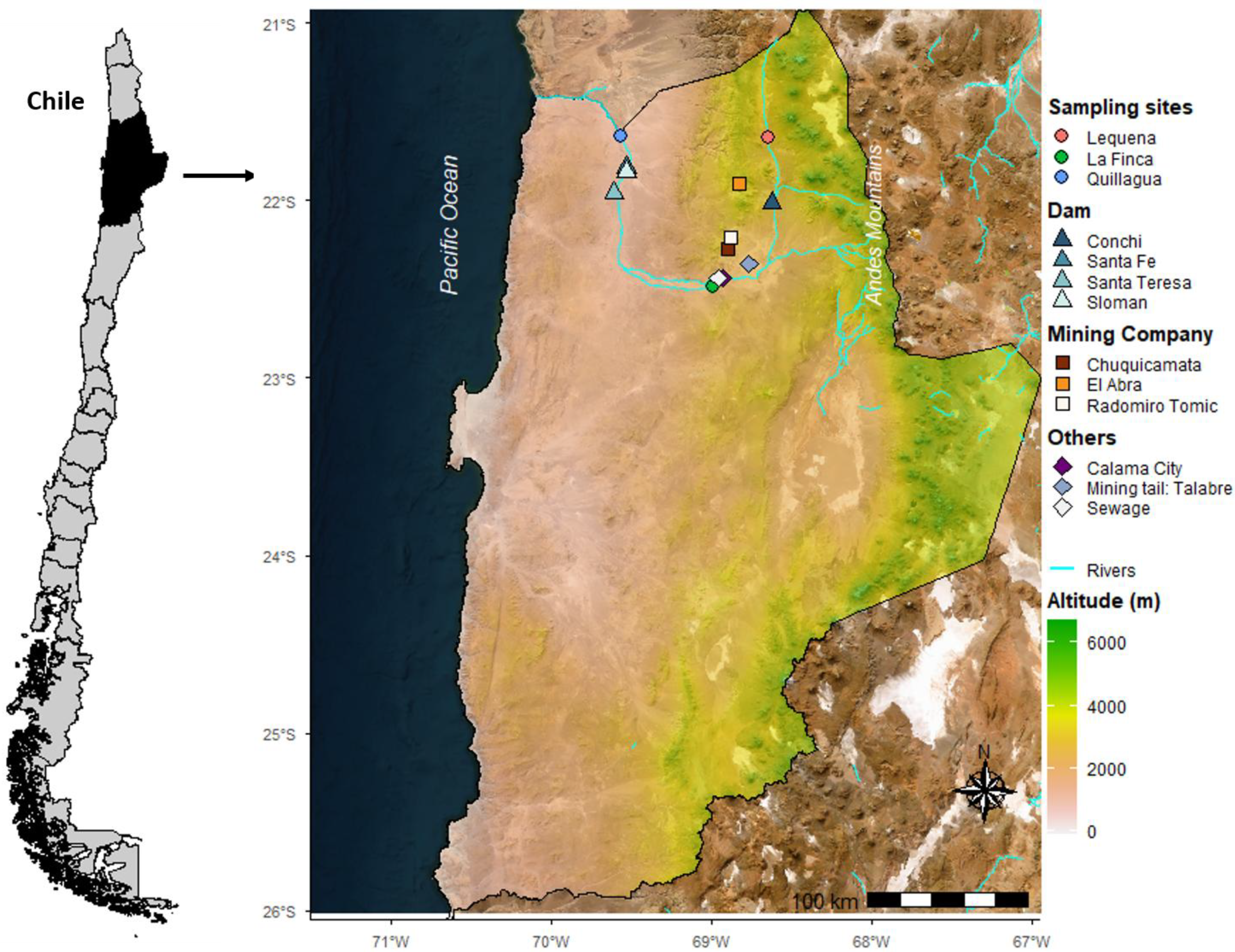
The Loa River basin extends for 440 km, originating at the northern base of the Miño Volcano, near the border between the Tarapacá and Antofagasta Regions (21°15′ S) [48], highlighting that the river basin is significantly impacted by anthropogenic activities (see Figure 1). Its main tributaries are the San Pedro, El Salado, and San Salvador rivers, all of which originate in the high Andes [49]. The hydromorphology of the lower Loa basin has undergone significant changes since the early 20th century due to the construction of four dams, Sloman, Santa Fe, Santa Teresa, and Conchi, which have regulated river flow and altered the natural transport of sediments from the Andes to the Pacific Ocean. Along the river, three distinct zones (high, middle, and lower) have been described along the river, with the middle and lower zones being the most affected by human activities [1].
The basin is located within a prominent metallogenic geological belt in northern Chile, characterized by a high abundance of porphyry copper deposits that formed during the tectono-magmatic activity of the Late Eocene–Early Oligocene [50,51,52]. These world-class mining operations primarily extract copper, commonly associated with molybdenum, silver, and gold [6,53]. For example, Chuquicamata, one of the world’s largest copper deposits, has complex mineralization comprising leached, oxidized (atacamite, chrysocolla), sulfide-rich (chalcocite, covellite), and primary sulfide (chalcopyrite-bornite-digenite and pyrite-molybdenite-chalcopyrite) zones [6]. The El Abra deposit exhibits a similar pattern, with an oxide zone dominated by chrysocolla and a mixed zone containing chrysocolla, cuprite, native copper, and chalcocite [6,54]. Radomiro Tomic shares similar mineralization characteristics to those of Chuquicamata, including chalcopyrite-bornite and pyrite-chalcopyrite assemblages [6]. Historically, copper exploitation at Chuquicamata dates back to pre-Hispanic times [55], with large-scale open-pit operations commencing in the early 20th century (specifically 1920) [6,56]. In contrast, the Radomiro Tomic and El Abra mines began operations more recently, during the 1990s [56].
Following the description of anthropogenic influences, three representative sampling sites were selected along an altitudinal gradient of the Loa River: Lequena, located in the upper part of the river, where drinking water for human consumption is collected (Pre-impact zone); La Finca, an agricultural area situated in the middle section downstream of the major mining activity and the city of Calama downtown (Impact zone); and Quillagua, an agricultural and grazing area in the lower riverbed, near the river mouth (Post-impact zone) (Figure 1).

2.2. Sampling

Samples were collected in triplicate from each site during 2014, 2015, 2017, and 2023. For metal(loid) analysis, the sediment fraction <63 µm was selected to minimize the influence of spatiotemporal variability on the particle size distribution (Table S1, Figure S1). Since this fraction is widely recognized as the main one for the accumulation of metallic contaminants, it allows more reliable comparisons between samples with different particle sizes and greater metal bioavailability, which could improve subsequent risk assessment [57,58,59,60]. After sieving, 400–600 mg of each sample (from riverbank sediments and sediment cores) was digested in Teflon pumps.
The digestion protocol involved 10 mL HNO3 + 1 mL HClO4 + 0.5 mL HF in a MARS-X microwave digestion system (ICEM model 350), following the US-EPA 3051A procedure [61]. The concentrations of As, Cd and Cu in the digested sediment samples were analyzed by Atomic Absorption Spectroscopy using a Shimadzu 6300 instrument. The accuracy and precision of the analytical methods were evaluated using the NIST 1646a estuarine sediment standards, provided by the National Research Council of Canada. Subsequently environmental quality indices were calculated based on the determined metal(oid) concentrations.
Figure 1. Map of the Loa River basin in the Antofagasta region, Chile. It shows the sediment sampling sites classified by their degree of anthropogenic disturbance. Lequena (Pre-impact) represents an upstream reference area with minimal human pressure; La Finca (Impact) is located downstream of Calama and is directly influenced by mining activities, tailings, and urban effluents; and Quillagua (Post-impact) corresponds to the lower basin, near the river mouth. This map was generated using Rstudio 4.5.2 [62].
Land 15 00226 g001

2.3. Statistical Analysis of Spatial and Temporal Evaluation of Metal Concentrations in the Loa River

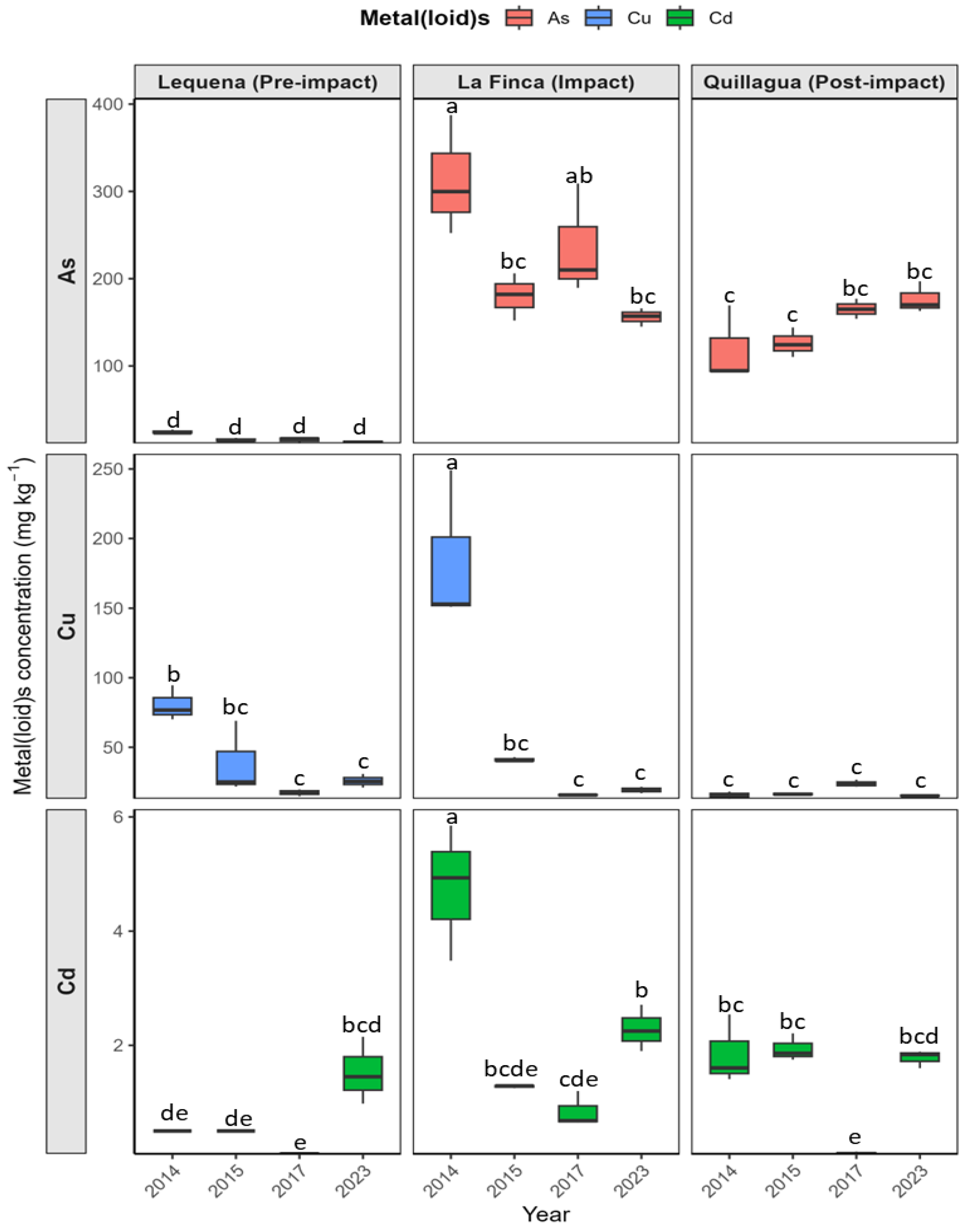
A one-way ANOVA was conducted using the base stats package in Rstudio. Pairwise comparisons were carried out with the agricolae package, applying Tukey’s HSD test to identify statistically significant differences among groups. Boxplots were created using the ggplot2 package to display the distribution of metal concentrations among groups. Lowercase letters above the boxplots represent the results of Tukey HSD test [62].
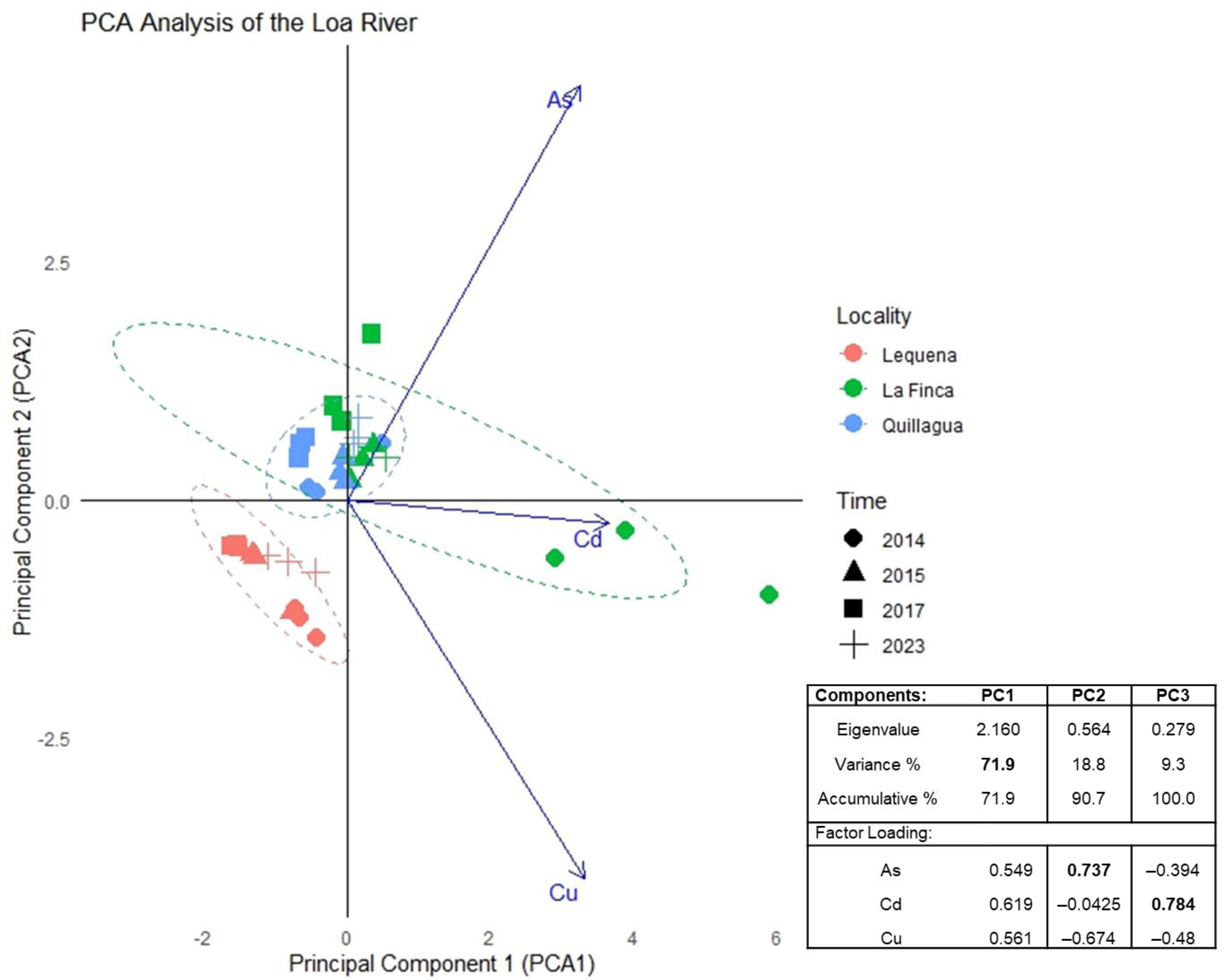
Principal Component Analysis (PCA) was performed using the prcomp function in Rstudio 4.5.2 [62] to reduce the dimensionality of the dataset by transforming the original metal (Cd and Cu) and metaloid (As) concentrations into uncorrelated components (PCs). The two components, PC1 and PC2, explaining most of the variance, were visualized in a biplot constructed with ggplot2. This biplot included points representing observations (locality and year), ellipses representing locality variability, and vectors indicating the contributions of each metal.

2.4. Geo-Accumulation Index (Igeo)

The Igeo (Equation (1)) evaluates the levels of metal pollution in the <63 µm sediment fraction by comparing current concentrations with pre-industrial background levels. It classifies contamination into distinct categories, ranging from uncontaminated to extremely contaminated [34].
I g e o = l o g 2 C n 1.5   X   B n
where Cn = the measured concentration of the element and Bn = the geochemical background concentration of metals. All calculations are based on a set of 6 references background levels representative of different natural sources from northern Chile, including regional soils, aeolian dust, uncontaminated marine bays, shales and sedimentary rocks, Jurassic intrusive rocks, and Jurassic volcanic rocks, previously reported by Valdés et al. (2019) [9]. The Igeo results were analyzed using the Müller (1979) [34] scale, which categorizes contamination levels (Table 1). This multi-background approach provides a comprehensive assessment of contamination levels under different geochemical baseline conditions.

2.5. Enrichment Factor (EF)

The EF (Equation (2)) evaluates whether metal concentrations are affected by natural processes or human activities by normalizing against a conservative reference element, typically Al, Fe, or Ti. It classifies enrichment levels ranging from no enrichment to extremely high enrichment [35].
E F = M X s a m p l e ÷ M X b a c k g r o u n d
where M = the concentration of the metal of interest and X = the concentration of the Fe reference (47,200 mg kg−1 according to the world soil average value [63]), which reflects natural conditions and is unaffected by human activities. Background concentrations of metals (M) were defined according to the same set of 6 geochemical references used for the Igeo calculations, including regional soils, aeolian dust, uncontaminated bays, shales and sedimentary rocks, Jurassic intrusive rocks, and Jurassic volcanic rocks [9].
The EF values are interpreted in Table 2 [35]. The consistent application of multiple background references allows a robust evaluation of enrichment patterns across different geological contexts while maintaining a uniform normalization framework.

2.6. Pollution Load Index (PLI)

The PLI (Equation (3)) evaluates the overall contamination status of a site by integrating multiple metal concentrations relative to background levels. It indicates whether the fine sediment fraction quality is baseline (uncontaminated) or deteriorated due to pollution [36].
P L I = ( C F 1 x C F 2 x C F 3 x C F n ) 1 n
where CFn = C m C b represents the contamination factor for each metal, Cm = the measured concentration of the metal in the sample and Cb = the background concentration [9], and n = the number of metals analyzed. PLI values were also calculated using the same set of 6 geochemical background references applied for the Igeo and EF indices, ensuring more representative analysis and methodological consistency across all contamination indicators.
The PLI provides a single value that reflects the cumulative pollution impact from multiple metals. A PLI value of 1 indicates baseline or uncontaminated conditions, PLI < 1 signifies no or low contamination, and PLI > 1 indicates contamination, with higher values representing greater levels of pollution [9].

2.7. Modified Ecological Risk Assessment (m-PEC-Q)

According to the SQG procedure, the Ecological Risk Assessment (ERA) reported by Long et al. (1995) [32] was utilized to evaluate the risks associated with contaminated sediments. This assessment considered the mean Probable Effect Concentration PEC quotient for freshwater ecosystems [33] which is a modification of the mean Effect Range-Median quotient (m-ERM-Q) for marine and estuarine sediments. The mean m-PEC-Q (Equation (4)) represents the impact of multiple anthropogenic contaminations, and it is calculated using a modified formula from Trifuoggi et al. (2017) [64]:
m - P E C - Q = i 1 Q C i P E C i n
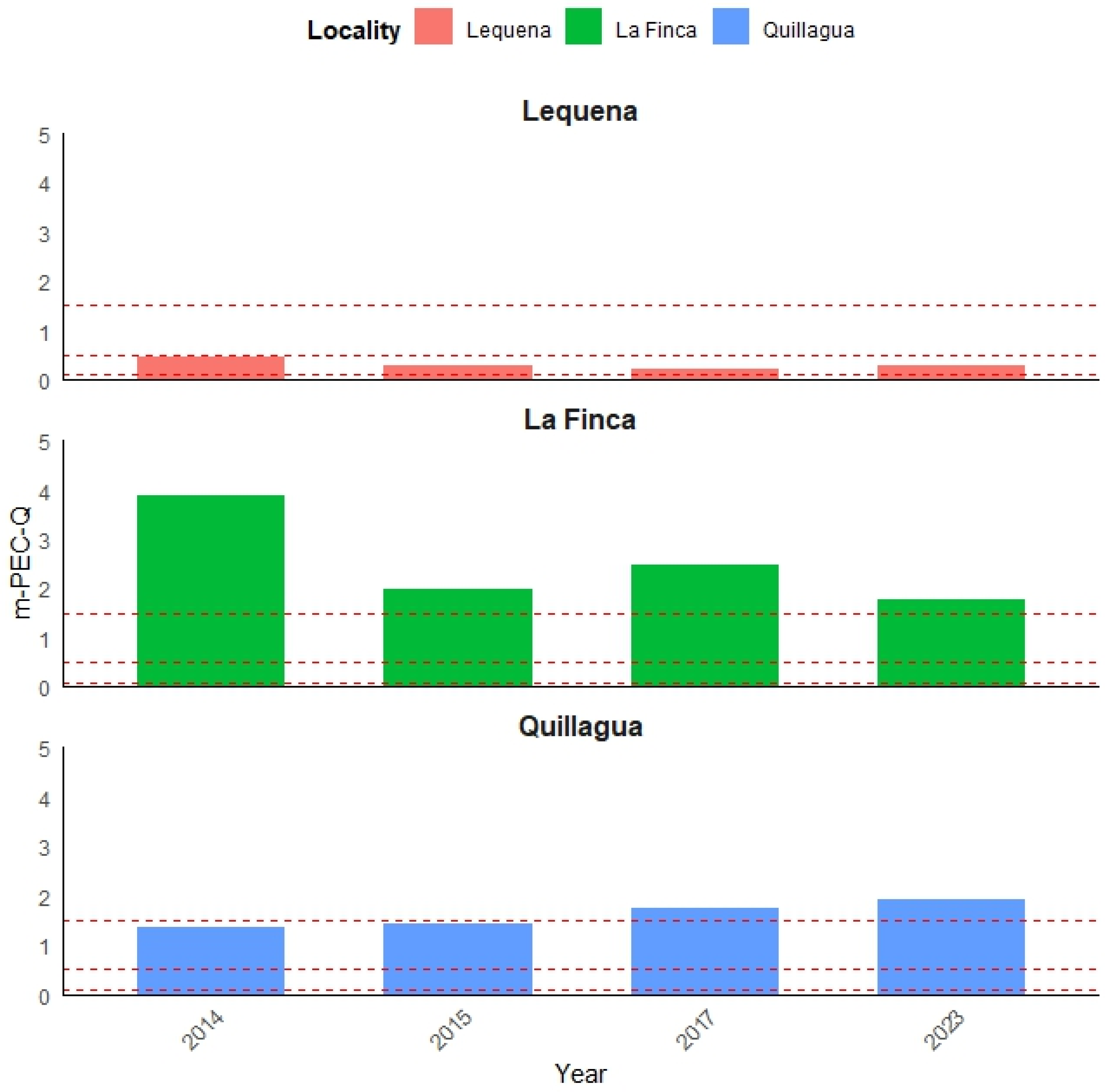
where Ci = the concentration of the measured metal i, PECi = the PEC value of metal i, and n = the number of metals. The results were compared with Long and Macdonald (1998) [37] thresholds of toxicity probability for biota, depending on the value of m-PEC-Q: m-PEC-Q < 0.1, reveals 9% probability of toxicity, 0.1 ≤ m-PEC-Q < 0.5 denotes 21% probability of toxicity, 0.5 ≤ m-PEC-Q < 1.5 denotes 49% probability of toxicity, and 1.5 ≤ m-PEC-Q denotes 76% probability of toxicity.
All index analyses were conducted in R using the dplyr and ggplot2 packages for data processing and visualization. Graphical outputs were created to illustrate contamination and ecological risk levels across different metals, years, and locations. These included bar plots with annotated thresholds to emphasize contamination categories and risk levels.

3. Results

3.1. Spatial and Temporal Distribution of Metal Concentrations in the Loa River

Across the three locations—Lequena, La Finca, and Quillagua—this analysis provided a comprehensive spatiotemporal view of metal(oid) (As, Cd, and Cu) concentrations, measured in <63 µm fraction, during the years 2014, 2015, 2017, and 2023, revealing notable variations associated with the sampling site and year.
Lequena, located in the pre-impact zone, consistently showed the lowest metal concentrations, serving as a reference point with minimal human influence and reflecting natural background levels (Figure 2). Significantly lower levels of As were observed (as indicated by the statistical grouping letter “d” in Tukey’s HSD test), consistently low Cd concentrations, except for a significant increase observed in 2023, and Cu levels were significantly higher in 2014, but decreased in subsequent years. The rise of the <63 µm fraction observed in 2017 did not mean there was an increase in metal(loid) concentrations, confirming it as a control area. In contrast, La Finca, located in the middle section of the river within the Impact Zone and heavily affected by human activities such as industrial operations and agricultural runoff, exhibited the highest concentrations of As, Cd, and Cu in 2014 (statistical grouping “a”), which is correlated with the observed increase in the <63 µm fraction (Figure S1). Tukey’s HSD results indicated that metal concentrations in La Finca often statistically overlapped with those in Quillagua.
Quillagua, representing the post-impact zone in downstream areas, displayed intermediate but variable concentrations of metals, showing a slight increasing trend for As over the years. Fluctuations in metal levels suggest that while some pollutants, such as Cu, may dissipate or settle from upstream to downstream, residual contamination persists, even though a slight decrease in the <63 µm fraction is observed (Figure S1). This persistence is likely influenced by cumulative inputs from upstream sources and natural processes like sediment transport. Arsenic (As) concentrations remained consistently high over time, similar to those observed at La Finca, indicating significant input from the middle part of the river. Similarly, Cd and Cu levels were significantly high at la Finca in 2014 but showed a notable decrease in 2017, remaining stable thereafter. However, Cu levels in Quillagua were significantly lower than those recorded in Lequena and La Finca in 2014. Tukey’s groupings indicated overlaps with both La Finca and, at times, Lequena, suggesting that this site is influenced by upstream contributions while also experiencing some dilution or dissipation effects.
Temporal differences observed between 2014 and 2015 indicated stable and low metal concentrations in Lequena (except for Cu), while La Finca showed elevated levels of all metal(loid)s in 2014, which drastically decreased towards 2015. Quillagua displayed a less abrupt transitional pattern with variable concentrations, highlighting its role as a receptor of upstream influences from river sources. A significant increase in As concentrations was noted at La Finca in 2017, a trend also reflected in Quillagua, although its concentrations were slightly lower, probably due to downstream dilution and deposition processes.
By 2023, Lequena remained a low-impact site with stable concentrations of As and Cu. La Finca and Quillagua continued to exhibit persistent As and Cd contamination, although levels were slightly lower than those observed in 2017. Quillagua exhibited ongoing variability, with Cd concentrations remaining notably elevated, underscoring its susceptibility to persistent downstream contamination.
Lequena consistently appeared in distinct Tukey groups, highlighting its status as a reference area (Pre-impact) that is relatively unaffected by human activities. In contrast, La Finca frequently formed unique groups, particularly in relation to arsenic (As), indicating its role as a contamination hotspot influenced by both anthropogenic and natural inputs (Impact zone). Quillagua exhibited overlapping groupings, suggesting a combination of upstream influences and natural dilution processes (Post-impact zone).

3.2. Principal Component Analysis (PCA)

The PCA highlights the spatial and temporal patterns of metal concentrations (As, Cd, and Cu) along the Loa River sediments (<63 µm fraction). The first two components, PC1 and PC2, account for most of the variance, with PC1 representing the main gradient of variability and PC2 capturing the secondary source of variation (Figure 3).
The separation of points along the axes indicates differences in metal concentration patterns, with vectors showing the influence of each metal on the components. The direction and magnitude of the vectors suggest that arsenic (As) contributes most to PC1, while cadmium (Cd) and copper (Cu) show distinct contributions to both PC1 and PC2. These results emphasize the spatiotemporal variability in metal contamination across the Loa River basin.
Lequena (red group) clusters are in the negative PC1 region, indicating low As and Cu concentrations with low internal variability, thereby confirming its status as a pre-impact area. La Finca (green group) shows greater dispersion along the positive PC1 axis, suggesting higher As and Cd concentrations with increased variability. Quillagua (blue group), located downstream near the river mouth, exhibits intermediate to low metal concentrations and low internal variability.
Data from 2014 and 2015 shows a wider distribution of points across all locations, especially in La Finca, which could reflect annual variability. In contrast, the 2023 observations show reduced variability, particularly in Quillagua and Lequena. This could be related to the fact that the Loa River basin is strongly influenced by natural disturbances such as the intense summer rains in the high mountains, known as the “Altiplano winter,” which can cause the river flow to fluctuate between 500 and 3000 L   s 1 [65]. The observed decrease in metal concentrations from La Finca to Quillagua is also attributed to the fact that the Quillagua samples were collected downstream of the Sloman Dam, which can retain contaminants upstream and thus influence downstream concentrations [1]

3.3. Geoaccumulation Index (Igeo)

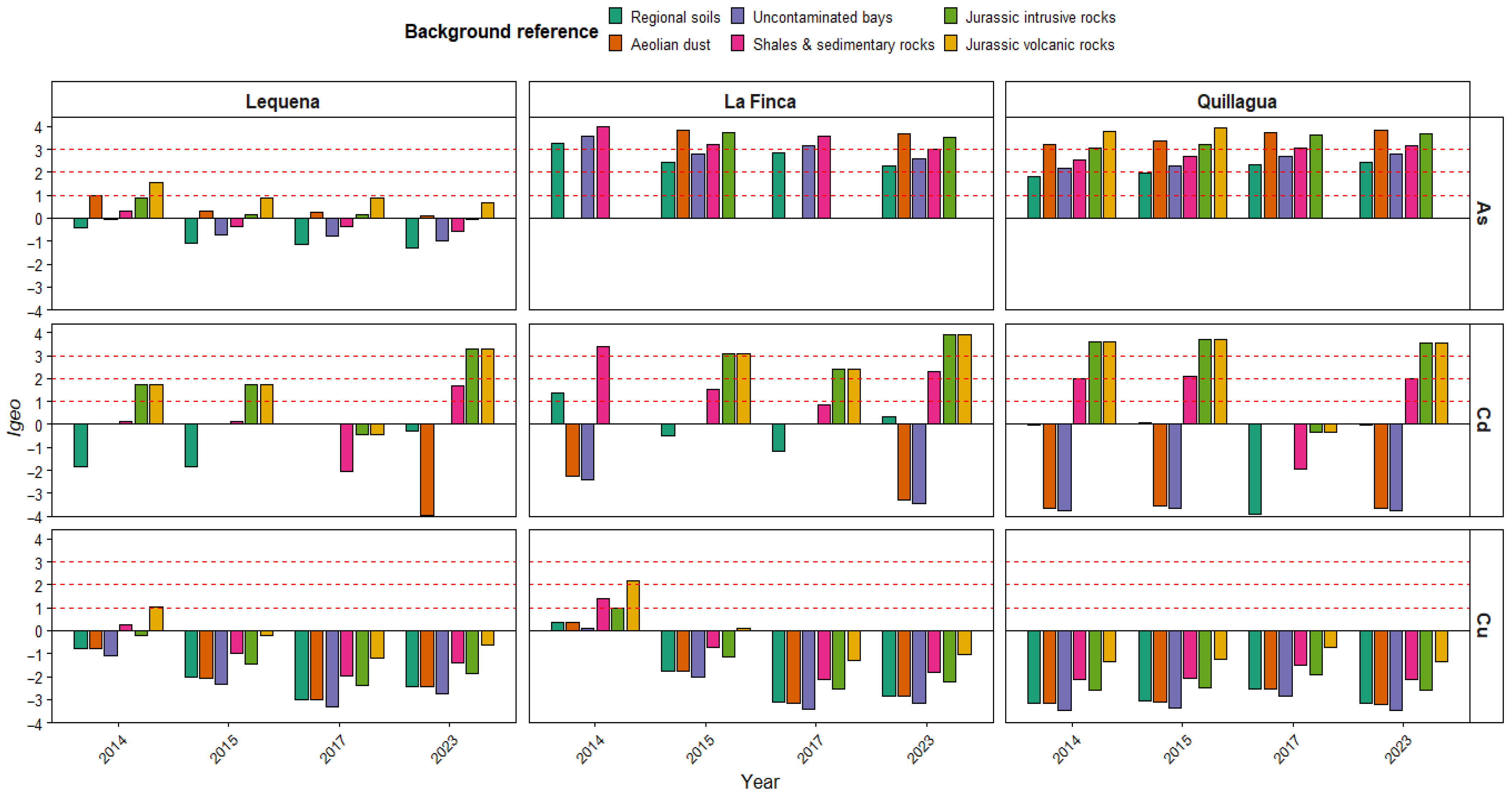
The spatiotemporal analysis of Igeo for As, Cd, and Cu highlights varying levels of contamination in the <63 µm sediment fraction across Lequena, La Finca, and Quillagua during 2014, 2015, 2017, and 2023, depending on the background value used. In general, Lequena Igeo values for As and Cu remained “Not-polluted” across all sampling years, reflecting the expected conditions of a reference site and indicating negligible anthropogenic impact, except for the use of intrusive and volcanic rock backgrounds that tend to overestimate the Igeo of Cd from “moderately polluted to polluted”, especially in 2023.
Conversely, La Finca’s and Quillagua’s Igeo values categorized this locality as “heavily polluted” with As during all sampling times, independent of the background used. This pattern indicates significant anthropogenic input over time, suggesting persistent downstream impacts and accumulation. These findings are summarized in Figure 4, illustrating the temporal evolution and contamination levels for each metal across the three localities.

3.4. Enrichment Factor (EF)

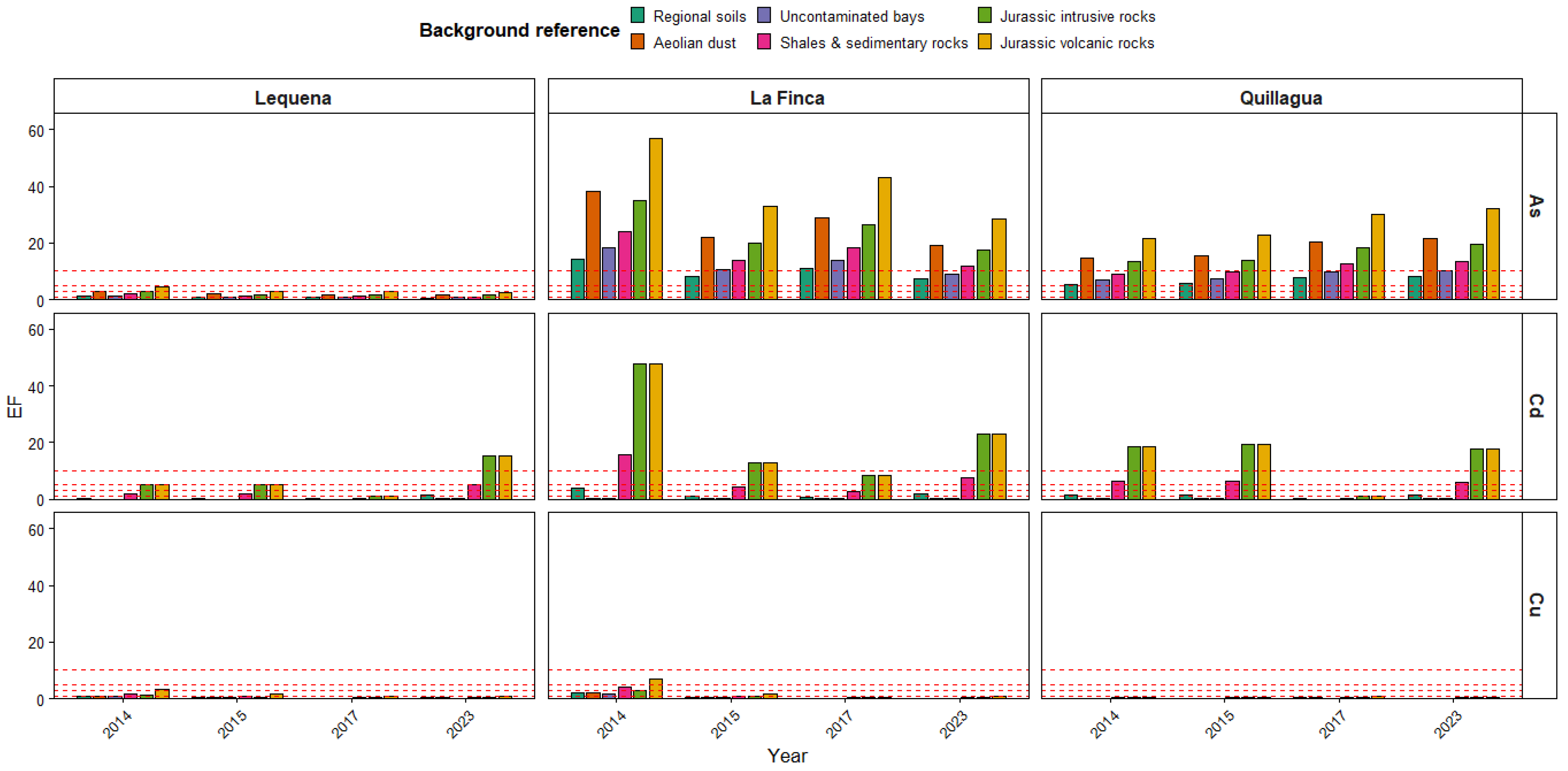
The enrichment factor (EF) analysis provides insight into the extent of human influence on metal concentrations in the <63 µm sediment fraction, using Fe as a reference element (Figure 5). In Lequena (Pre-impact), all metal(loid)s consistently demonstrate EF levels ranging from “no enrichment” to “minor enrichment,” reflective of natural background levels. In La Finca (Impact zone), EF values also differ according to the background baseline used. higher EF values indicate “minor enrichment” to “moderate enrichment” for Cd, “No enrichment” for Cu, and “very high enrichment” for As. Similar patterns were exhibited for Quillagua (Post-impact), indicating the downstream transport of contaminants.

3.5. Pollution Load Index (PLI)

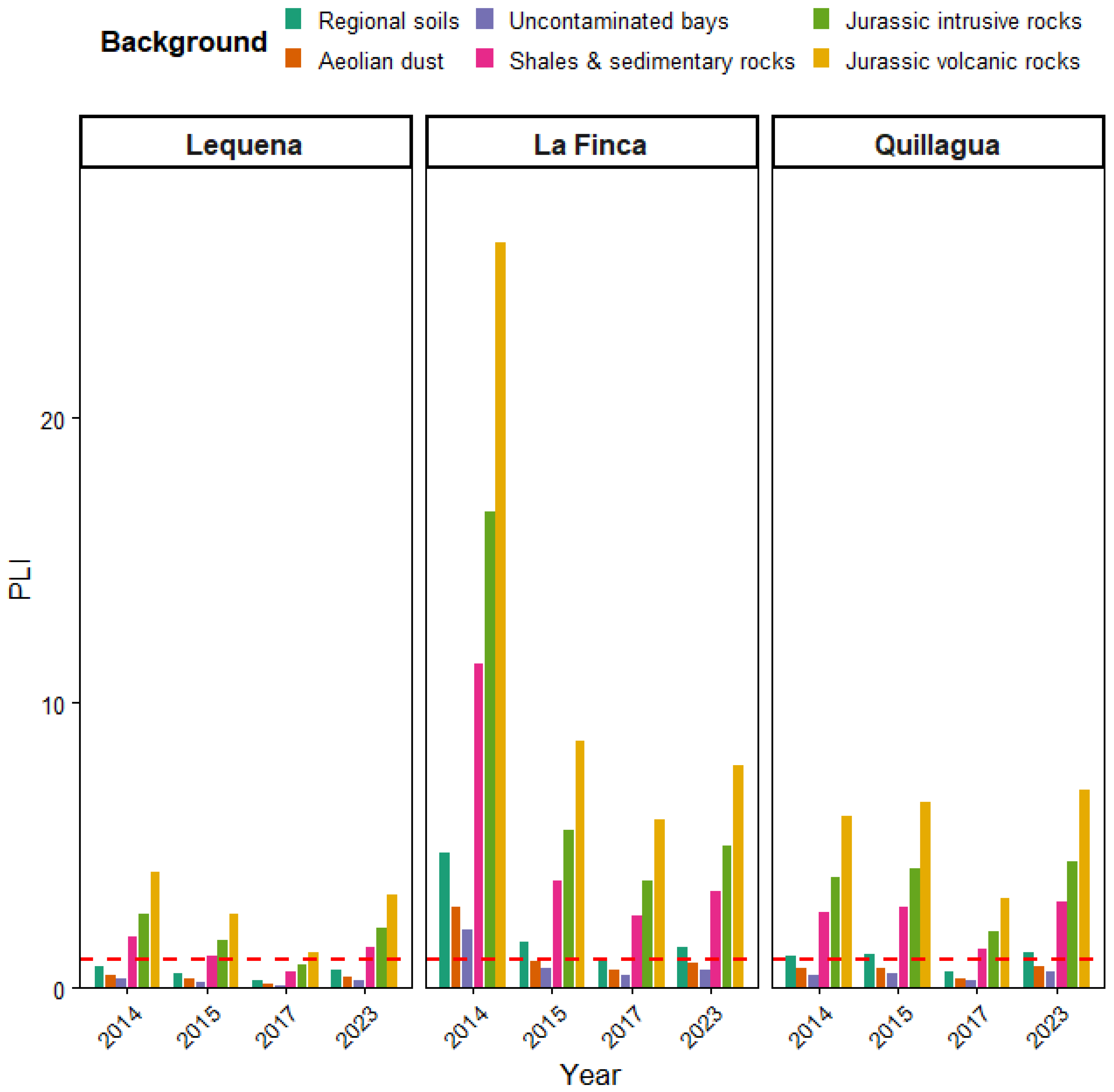
The PLI evaluates the cumulative impact of metal pollution in the <63 µm sediment fraction at each locality over time (Figure 6). Although there are PLI variations depending on the background baseline used, Lequena (Pre-impact) shows PLI values consistently below or near to 1 across all years, suggesting as unpolluted or very slightly polluted. Conversely La Finca (Impact), elevated PLI values continuously are exceeding the reference value of 1, highlight significant cumulative pollution. In Quillagua (Post-impact), PLI values indicate persistent cumulative pollution in 2015 and 2023, although the intensity was slightly lower than in La Finca, suggesting some downstream dilution.
In general, the results tend to be more conservative when backgrounds metal(loid) concentration in regional aeolian dust and soils are used, compared to intrusive and volcanic rock background references.

3.6. Ecological Risk Assessment (m-PEC-Q)

The m-PEC-Q results assess ecological risk based on sediment quality guidelines for toxic metals in freshwater ecosystems (Figure 7). In Lequena, m-PEC-Q values consistently indicated a 21% probability of toxicity (0.1 < m-PEC-Q < 0.5) across all sampling years. In contrast, in La Finca, toxicity risk levels exceeded the 76% ecological risk threshold in all years. Finally, in Quillagua, ecological risk levels were 49% in 2014 and 2015, increasing to 76% in 2017 and 2023, highlighting a progressive increase in ecological risk over time, likely associated with midstream-to-downstream accumulation of contaminated sediments.

4. Discussion

Our assessment of metal(loid) contamination in the <63 µm sediment fraction across the Loa River reveals an altitudinal gradient with spatiotemporal distinct patterns that denote environmental risks. These findings provide insight into both anthropogenic influences and natural variability within this freshwater ecosystem, which is impacted by natural inflows and mining activities. Understanding these complex dynamics, particularly in mining-impacted river systems, is crucial for assessing ecological and human health risks and for the development of effective management strategies [12].

4.1. Spatial Distribution of Metal(loid)s Contamination and Altitudinal Gradient in the Loa River Basin

The study identified a clear and consistent altitudinal gradient in metal concentrations in the <63 µm sediment fraction, with Lequena, representing the Pre-impact zone (Figure 2), consistently exhibiting the lowest concentrations of As and Cd compared to La Finca (Impact zone) and Quillagua (Post-impact zone) (Table 3), serves as a natural reference point, minimally influenced by human activity and reflecting natural background levels across sampling years. The concentrations of As and Cu found in Lequena are lower than those reported by Miller et al. (2019) [2] in the upper Loa River area (Table 3 and Table 4), while Cd concentrations are comparable. Similarly, As and Cu concentrations were markedly lower than those reported by Romero et al. (2003) [6], although that study also identified Lequena as the section with the lowest metal concentrations along the Loa River course. These concentrations were also lower than those reported for other mining-impacted river basins, including the Rimac River (Peru) [66], the Tigris River (Turkey) [67], and the Axios River (Greece) [68], where Cu concentrations are generally higher (Table 4), reaffirming that Lequena is a potential reference area for As and Cd. The Cu concentration in Lequena, which reached up to 80.48 mg kg−1 in some sampling years, was higher than global average soil values (25 mg kg−1 reported by Romero et al. (2003), reflecting the geologically metal-rich nature of the Loa River basin [50]. This natural copper enrichment implies that, unlike As and Cd, Cu levels may exhibit greater variability at Lequena. Indeed, previous studies in the upper Loa River have reported elevated Cu concentrations in surface sediments, suggesting a complex interplay between natural sources and episodic sediment transport processes [2].
La Finca, the Impact zone, exhibited high metal concentrations in the <63 µm fraction (Table 3). Mean arsenic concentrations in La Finca indicate a severe departure from natural background levels, reinforcing its role as a contamination hotspot. These findings are consistent with those reported by Miller et al. (2019) [2], who identified elevated As concentrations in sediment cores collected near the confluence of the Salado and Loa rivers, close to La Finca. They also coincide with the concentrations reported by Romero et al. (2003) for the middle section of the Loa River (Table 4). The concentrations of As and Cu in La Finca greatly exceed those reported in highly impacted basins such as the Tigris (Turkey), Yahgtze (China), Axios (Greece), Moche (Peru), and Buriganga (Bangladesh) rivers (Table 4). A common observation across these studies is that the highest metal concentrations are typically found in the middle river sections, which are often significantly impacted by anthropogenic activities, particularly mining.
For example, the Rimac River (Peru) shows higher concentrations of As, Cd, and Cu than those observed in this study, a pattern directly linked to intensive mining operations within its basin [66]. Similarly, the Tigris River (Turkey) showed extremely high concentrations of Cu (up to 1334 mg kg−1) and Cd (up to 3.02 mg kg−1) than those found in the Loa River, particularly downstream of a copper mining facility [67]. The Axios River (Greece) has also exceeded sediment quality criteria for As due to anthropogenic pressures [68]. Likewise, the Moche River in Peru is affected by heavy metal contamination primarily associated with mining tailings, highlighting the global scale of river pollution related to mining activities [69]. This spatial pattern, in which elevated metal concentrations are concentrated in mid-river sections as a result of anthropogenic influences, is a recurring feature reported in global studies of river pollution and is frequently attributed to mining-related activities [12,70].
The post-impact zone, Quillagua, showed metal concentrations similar to those observed in La Finca, but with a clear trend of temporary arsenic accumulation. Unlike Lequena, these results suggest complex sedimentation and dilution processes along the upstream-midstream-downstream gradient of the river, indicating that anthropogenic inputs from La Finca are continuously transported and deposited. However, these concentrations were lower than the arsenic concentrations reported in previous studies of the Loa River basin for Quillagua and its surrounding areas [1,6,24]. The persistent contamination in downstream areas, even after dilution, highlights the challenge of contaminant dispersal over long distances from historical mining sites. An example of this is the Gardón River, where contaminants are dispersed due to high flow conditions [71]. This is a critical finding, as there are river systems where the water flow is so high that it can carry sediments, causing significant dilution of contaminants. This is the case of the Yangtze River in China. However, the river exhibits localized anthropogenic inputs of Cd, indicating that the pollution present at the river’s mouth is both natural and anthropogenic [29,72]. The altitudinal gradient of As concentrations along the Loa River showed a spatial pattern consistent with agricultural activities associated with the areas defined as pre-impact, impact, and post-impact (Figure 2).
Table 4. Comparative global analysis of the average concentrations of As, Cu and Cd in local and international sediments.
Sediment Concentrations (mg kg−1)
River BasinAsCdCuPaper ID
Loa (Chile)413--[1]
Loa (Chile)2481.0316.9[2]
Loa (Chile)400-156[6]
Loa (Chile)654-13.7[24]
Yahgtze (China)29.91293.4[29]
Yinma (China)6.190.2923.80[38]
Shatt Al-Arab (Iraq)7.1-37.9[39]
Warta (Poland)-1.1317.0[41]
Weihr (China)15.421.0529.47[42]
Tamnava (Serbia)4.020.2818.11[43]
Cunas (Perú)11.50.37.2[12]
Rimac (Perú)154331790[66]
Tigris (Turkey)5.83.021334[67]
Axios (Greece)4011180[68]
Yangtze (China)-0.4328.25[72]
Moche (Perú)0.0160.0121.240[69]
Buriganga (Bangladesh)8.2-47.21[73]
Dhaleshwari (Bangladesh)--2.55[63]
La Charrasquilla (Spain)28.0514.744.3[74]

4.2. Identification of Metal Sources: Natural Geological vs. Anthropogenic Influences

The assessment of spatiotemporal patterns of As, Cu, and Cd in the <63 µm sediment fraction in the Loa River basin reveals a significant degree of anthropogenic influence. The use of the Igeo and EF indices provides strong evidence to differentiate whether the widespread increase in metal concentrations originates from natural geological contributions or anthropogenic influences [44,63]. In this study, the Igeo values showed that contamination levels varied by location and metal (Figure 4). In Lequena, the As, Cd, and Cu Igeo values remained below the “Uncontaminated” threshold throughout all sampling years, consistent with the expected conditions of a reference site indicating minimal anthropogenic impact. Furthermore, the EF values (Figure 5) consistently showed minimal or no enrichment, confirming that the measured metal concentrations have a natural geological origin. While the arsenic originates naturally, primarily from the El Tatio geothermal springs [6,49], the high concentrations found in Lequena suggest a 21% probability of toxicity according to the m-PEC-Q index. This indicates that even naturally occurring concentrations can reach levels high enough to pose a potential risk to the ecosystem, underscoring the importance of understanding baseline risks, even in areas considered pristine. Miller et al. (2019) [2] also reported extremely high arsenic concentrations in the Loa River, attributing them to both natural geothermal sources and the accumulation of arsenic in alluvial sediments from surface water infiltration. This emphasizes the importance of accurately assessing contamination and identifying sensitive aquatic organisms that could be affected by the ecological risk posed by this accumulation [75]. However, further studies are needed that focus on evaluating the biological responses of endemic organisms in the area, in order to establish a more accurate ecological risk assessment.
In contrast, La Finca, located in the middle section of the river, near industrial activity and the center of Calama, showed significantly elevated Igeo and EF values, unequivocally indicating a significant anthropogenic contribution. The Igeo index obtained in this study indicates “no contamination” for Cu, but changes to “moderate contamination” in 2014, increasing to “strong contamination” in subsequent years (2015, 2017, and 2023) for As. Furthermore, the EF analysis revealed “very high enrichment” of As in 2014 and 2017, and “high enrichment” in 2015 and 2023, along with “minor enrichment” of Cu in 2023, denoting the impact of anthropogenic activities on the river. Taken together, the results reflect the naturally high concentrations of Cu and As in the area, along with the effect of anthropogenic contributions from mining activities, industrial discharges, urban effluents from Calama, and agricultural runoff [17,76]. Due to the non-biodegradable nature of these elements, coupled with poor mining waste management practices, their accumulation is exacerbated [12]. Furthermore, the dynamics of the Loa River’s tributaries allow for the transport of these elements along its course, leading to seasonal and temporary accumulations in this area. It is also important to note that the intricate behavior of metals in natural water systems is influenced by sediment composition and water chemistry, as metals undergo dynamic changes in their speciation due to dissolution, precipitation, sorption, and complexation, which affect their behavior and bioavailability [76,77].
Several similar conclusions have been reached in other studies worldwide, where mining and industrial effluents are significant contributors to heavy metal pollution in aquatic environments. For example, in the Yangtze River, Igeo indices indicate “moderate pollution” in areas associated with wastewater discharges and industrial activities [72]. Similarly, in the study by Tamim et al. (2016), the Igeo and EF indices were used to assess the level of pollution in the Buriganga River (Bangladesh), resulting in a classification of “moderate” to “heavy,” especially in surface soils near pollution sources associated with tanning industries [73]. High EF indices were also recorded for Cd, Co, Cu, Ni, Pb, and Zn in sediments of the Tigris River (Turkey), which were attributed to wastewater discharge from a copper mining plant. Therefore, the EF values for Cu were >30, indicating a very high degree of contamination (Table 2) and giving it an Igeo classification of “very highly contaminated” [67]. This aligns with our findings on the mobility and bioavailability of anthropogenic industrial metals in water bodies, as they represent potential adverse effects on aquatic species [77]. Similarly, the Yinma River in China showed anthropogenic origins for Cd, Pb, Ni, and Zn, exhibiting greater mobility and bioavailability [38]. The Shatt al-Arab River in Iraq also showed significant increases in heavy metal levels after the confluence of tributaries carrying domestic wastewater and industrial effluents [39]. Also, Rahman et al. (2021) [63] assessed the heavy metal pollution of an industrial tanning estate in Bangladesh, highlighting the presence of heavy metals such as Cr, Pb, Mn and Cu in river sediments.
All the metal inputs observed in La Finca accumulate downstream in the Quillagua area, which exhibits similar pollution patterns to those of La Finca, categorizing Quillagua as a post-impact zone. The arsenic Igeo indices in Quillagua increased from “moderate” pollution levels in 2014 and 2015 to “heavy pollution” in 2017 and 2023. At the same time, “very high” enrichment was observed throughout the years studied for As according to the EF (Environmental Factor) analysis, indicating persistent downstream impacts and accumulation, largely driven by the transport of contaminated sediments from upstream sources. Sediments, which serve as a primary sink, can store up to 30–98% of the total metal load entering the river system [76]. Bugueño et al. (2013) [1] found that, at the Quillagua site, the concentration of As was strongly correlated with Mn and organic matter, suggesting that these factors control the immobilization and accumulation of As.

4.3. Ecological Risk Assessment and Sediment Quality Guidelines

The results of the Probable Effect Concentration Quotient (m-PEC-Q) provide a quantitative assessment of ecological risk, based on sediment quality guidelines for toxic metals in freshwater ecosystems. In Lequena, m-PEC-Q values indicated a constant probability of toxicity of 21% across all years, confirming that even naturally occurring arsenic levels in the <63 µm fraction in this area represent a potential, albeit minor, ecological threat. This underscores the importance of accurately assessing pollution and identifying sensitive aquatic organisms facing ecological risks, even in areas without direct anthropogenic impact. However, further studies on the biological responses of local organisms are needed for a more precise ecological risk assessment, as this categorization can vary considerably across different river reaches when a complex combination of potentially toxic pollutants is involved [70].
In contrast, La Finca showed a 76% toxicity risk according to m-PEC-Q throughout all sampling years, suggesting a constant influx of pollution that endangers aquatic life in the area. This is a critical finding, as it demonstrates the acute impact of anthropogenic pollution in this section of the river. Quillagua also shows an alarming upward trend, with percentages increasing from 49% in 2014 and 2015 to a critical 76% in 2017 and 2023, indicating downstream accumulation and persistent ecological threats. This increased mobility and accumulation of contaminants, with high concentrations of arsenic (As) and cadmium (Cd) exceeding ecological risk thresholds in the lower basins, contributes to a greater potential for toxicity and bioaccumulation [12], as contaminated sediments can adversely impact benthic fauna and flora, and metals can accumulate in biological tissues, entering the human food chain [39]. The study by Custodio et al. (2025) [12] also found high concentrations of arsenic (As) and cadmium (Cd) in the lower Cunas River basin, exceeding ecological risk thresholds, with specific hotspots directly linked to mining activities, creating a clear spatial risk gradient. The Warta River in Poland also exceeded the PEC limits for chromium (Cr), cadmium (Cd), lead (Pb), and zinc (Zn) during some seasons, indicating a high probability of adverse effects on aquatic organisms [41]. Similarly, the study by Herrera et al. (2019) [24] concluded that arsenic near the mouth of the Loa River is mobile and bioavailable, representing a potentially high ecological risk.
Arsenic concentrations in the <63 µm fraction in the Loa River, particularly in La Finca and Quillagua, often exceeded international sediment quality guidelines, such as those established by the Canadian Council of Ministers of the Environment (CCME). Similar exceedances have been reported in the Zambezi River, where mining and geochemical activities contribute to high levels of arsenic (As) [78]. This information is crucial for regulatory agencies to make informed decisions and implement appropriate mitigation measures [79]. Such comprehensive assessments are vital for environmental management and conservation efforts, especially in ecosystems affected by mining activities, such as the Loa River basin [11,12].

4.4. Temporal Dynamics and Environmental Factors Influencing Metal Concentrations

The spatiotemporal assessment revealed complex temporal dynamics influenced by human activities as well as natural environmental processes. While the relative dynamics of contamination among pre-impacted, impacted, and post-impacted locations remained constant, certain specific metals showed notable changes over time. For example, Cd concentrations showed a decreasing trend throughout the basin between 2014 and 2017, remaining stable thereafter, a pattern supported by historical concentrations identified in the sedimentary core of Lake Inka Coya [80]. This decrease has therefore been attributed to atmospheric deposition and the influx of tributaries described in previous studies [1,6]. However, this trend was not observed for arsenic, as its contamination persisted and even intensified in Quillagua, reaching levels of “strong contamination” according to Igeo in 2017 and 2023. This long-term downstream accumulation, despite the dilution of other metals, highlights the polluting nature of arsenic and the efficiency of its transport and deposition mechanisms in arid river systems.
On the other hand, As and Cu concentrations were higher in 2014, subsequently decreasing from 2015 onward, which was also attributed to atmospheric deposition and tributary influx [1,6]. However, this temporal variability also appears to be influenced by seasonal changes, such as the El Niño-Southern Oscillation (ENSO), which affects river flow due to its impact on ocean-atmosphere-desert interactions in the region [1,81,82]. These phenomena can lead to the transport of a greater flow of metals to the lower reaches of the basin, a dynamic supported by research on the critical changes in trace metal transport under varying river flows [22], which triggers increased metal transport to the lower reaches of the basin. Therefore, the 2015–2016 ENSO event during the Altiplano winter may have contributed to variations in metalloid levels in sediments from the upper reaches to the impact and post-impact zones. It is worth noting that the Loa basin is significantly influenced by the summer rains that occur in the High Andes, as these play a critical role in the remobilization and transport of sediments along with their associated metals. Their effect is most pronounced in dry riverbeds, as they contribute to the episodic leaching and deposition of contaminants downstream. Furthermore, the decrease in metal concentrations from La Finca to Quillagua, for some metals, or their varied accumulation, is attributed to the fact that the samples taken in Quillagua were collected downstream of the Sloman Dam, which can retain upstream contaminants and thus influence downstream concentrations and the overall mass contaminant mass balance. This highlights how environmental changes and extreme events, such as torrential rains, can significantly influence metal deposition in arid environments [74], and this interaction between anthropogenic inputs, hydrological variability, and dam effects creates a complex and dynamic system for metal distribution.

4.5. Implications for Pollution Control and Environmental Management Strategies

This spatiotemporal assessment highlights the complex dynamics of pollution in the Loa River, offering crucial information for the development of specific pollution control and environmental management strategies. Specifically, the river is characterized by distinct impact zones: Lequena serves as a pre-impact zone or natural reference site. La Finca represents the critical impact zone due to direct anthropogenic activities, and Quillagua functions as a mixed post-impact zone, experiencing cumulative and long-term effects. Our findings emphasize that efforts to manage and mitigate metal pollution must prioritize maintaining the integrity of the river upstream of Lequena, and the critical need for immediate and targeted mitigation measures, particularly for La Finca, to protect the ecological and human health of both the impact areas and downstream regions such as Quillagua. Specifically, these strategies should include:
  • Stricter Regulation and Enforcement: Implement and enforce stricter regulations on industrial and mining discharges into the Loa River and its tributaries, particularly in the vicinity of La Finca. This could involve advanced wastewater treatment technologies and regular environmental monitoring to minimize metal emissions, as pollution prevention, control, and remediation measures have been shown to effectively mitigate environmental pollution in other watersheds [83]. Stricter controls have resulted in a decrease in metal discharges from industrial activities in some regions [71].
  • Continuous Monitoring Programs: Establish high-resolution, continuous monitoring programs for both natural geochemical baselines (Lequena) and anthropogenic contributions, focusing on key metals and their speciation in sediments and water. Monitoring should be extended to downstream areas such as Quillagua, which show intensifying pollution, to track long-term accumulation trends and assess the effectiveness of mitigation measures. Continuous monitoring is strongly recommended to reduce ecological and health risks [12]. As demonstrated by Jaskula et al. (2021) [41], continuous monitoring is essential in the Warta River to track temporal changes in pollution levels and ecological risk.
  • Sediment management: Investigate strategies for managing contaminated sediments, especially in areas of high accumulation such as La Finca and Quillagua. This could involve technologies such as phytoremediation, used in the Cunas River and other mining-affected regions [12]. The aim is to stabilize or remove metals from contaminated soils and sediments, although careful consideration of their climatic feasibility in arid zones is essential [12,84,85].
  • Informing regulatory agencies: The robust quantitative data and the clear identification of contamination sources and ecological risks provided by this study offer a strong scientific basis for environmental agencies to develop and update regulatory policies, particularly regarding acceptable discharge limits and quality guidelines for sediments from arid river systems. Improving mining practices is also crucial for mitigating the main anthropogenic sources of contamination [12].
The observed trends are consistent with global patterns of river metal pollution, where midstream reaches are dominated by anthropogenic impacts, while upstream and downstream areas typically benefit from natural attenuation processes. However, this study highlights significant downstream accumulation in arid zones. Comparisons with other river systems worldwide underscore the urgent need for sustainable management practices to preserve water quality and the health of the Loa River ecosystem.
In summary, it is important to mention that focusing the analysis on the <63 µm sediment fraction, while crucial for identifying the most mobile and potentially bioavailable contaminant pool, inherently presents certain limitations. This approach does not fully represent the total bulk sediment contamination of the environment. Consequently, direct quantitative comparisons of absolute pollution levels with studies that use bulk sediment analysis should be made with caution, as the concentrations reported here may appear elevated due to the natural tendency of metals to concentrate in finer particles [86]. This focus could also lead to an overestimation of overall environmental pollution if interpreted as representing the entire sediment matrix, given that coarser fractions, which can exert a dilution effect on total metal concentrations, are not included.
Despite these considerations, our methodology is specifically designed to provide a consistent and sensitive basis for detecting spatiotemporal variability and trends in contamination levels within this highly reactive sediment component. The observed correlations, such as the increase in metal concentrations linked to a higher proportion of the <63 µm fraction in La Finca in 2014, illustrate how changes in grain-size distribution can influence apparent metal enrichment. Conversely, the persistence of residual contamination in Quillagua, even with a slight decrease in the <63 µm fraction, underscores the strong influence of upstream inputs despite potential dilution effects. The application of a comprehensive set of six regional background levels for normalization further strengthens the contextualization of our findings, allowing for a more precise distinction between natural geochemical variability and anthropogenic contributions within this specific, environmentally critical fraction.

5. Conclusions

This study provides a comprehensive spatiotemporal assessment of As, Cd, and Cu concentrations in the <63 µm sediment fraction of the Loa River basin, revealing crucial information about the dynamics of metalloid contamination in this arid ecosystem. These findings highlight a clear altitudinal gradient in metal concentrations, with Lequena (Pre-Impact Zone) exhibiting the lowest concentrations (mean: 13.2–24.5 mg kg−1), reinforcing its role as a natural reference site. In contrast, La Finca (Impact Zone) showed significantly elevated levels (mean: 156–313 mg kg−1), reaching concentrations considerably higher than those of Lequena.
The study also demonstrated the predominance of anthropogenic sources in La Finca and Quillagua (Impact and Post-Impact Zones). For example, arsenic Igeo values in La Finca were consistently classified as “moderate to high contamination” (Igeo > 2.0 in 2014, 2015, 2017, and 2023), while FE values indicated “significant” to “high” enrichment throughout the study period. Furthermore, the m-PEC-Q index revealed a 76% probability of toxicity to aquatic biota in La Finca during all sampling years, extending to Quillagua in 2017 and 2023, underscoring a persistent and serious ecological risk downstream.
Comparatively, arsenic concentrations in La Finca and Quillagua frequently exceeded international sediment quality guidelines, confirming the severity of the contamination. Spatiotemporal analysis is particularly innovative for the Loa River, as it reveals that while Cd and Cu levels in La Finca showed a notable decrease between 2014 (average Cd: 4.75 mg kg−1) and 2017 (average Cd: 0.84 mg kg−1), arsenic contamination persisted and even intensified in Quillagua, reaching “high contamination” levels according to Igeo in 2017 and 2023. This temporal variability, combined with consistent spatial patterns, provides crucial information on long-term pollution dynamics and the effectiveness of potential mitigation measures in this arid environment.
Certain aspects considered, such as the presence of metal(loid)s in rivers basin such as Loa River, can be explained by multiple natural as well as anthropogenic factors. The use of different background baseline levels showed differences that justify continuing to work to establish reference levels that better reflect local reality, which is why these results should be considered with caution.
Our findings allow us to differentiate these background natural inputs from severe anthropogenic impacts; providing an important level of detail for the ecosystem will contribute to the formulation of more specific and effective management strategies. This does not diminish the urgent need to mitigate industrial discharges in the impact zone and implement continuous monitoring programs of natural geochemical baselines and anthropogenic inputs. All of this is aimed at protecting the fragile river ecosystems of the Loa River, located in a desert region where water resources are scarce and valuable.

Supplementary Materials

The following supporting information can be downloaded at: https://www.mdpi.com/article/10.3390/land15020226/s1. Figure S1. Granulometric distribution of sediment samples from the Loa River basin. The graph illustrates the percentage of different grain size fractions within the sediment (SgimaPlot10.0). Table S1. Loa River sediments grain size distribution and statistics analysis (GRADISTAT Version 8.0).

Author Contributions

Conceptualization, N.L.-P. and R.O.; methodology, N.L.-P., M.G. and R.O.; software, N.L.-P.; validation, N.L.-P. and R.O.; formal analysis, N.L.-P.; investigation, N.L.-P.; resources, N.L.-P., M.G. and R.O.; data curation, N.L.-P.; writing—original draft preparation, N.L.-P.; writing—review and editing, N.L.-P. and R.O.; visualization, N.L.-P.; supervision, R.O.; project administration, R.O.; funding acquisition, N.L.-P. All authors have read and agreed to the published version of the manuscript.

Funding

This research was funded by the Nacional Agency for Research and Development (ANID, Chile), through the National Doctoral Fellowship [21211948] and the PhD Thesis Support fellowship by Minera Centinela, and “The APC was funded by University of Antofagasta”.

Data Availability Statement

All data are available in this work.

Acknowledgments

Thanks to the University of Antofagasta, the Doctoral Program in Applied Science in Aquatic System and the Postgraduates School for supporting this research.

Conflicts of Interest

The authors declare no conflicts of interest. The funders had no role in the design of the study; in the collection, analyses, or interpretation of data; in the writing of the manuscript; or in the decision to publish the results.

References

  1. Bugueno, M.P.; Acevedo, S.E.; Bonilla, C.A.; Pizarro, G.E.; Pasten, P.A. Differential Arsenic Binding in the Sediments of Two Sites in Chile’s Lower Loa River Basin. Sci. Total Environ. 2014, 466, 387–396. [Google Scholar] [CrossRef]
  2. Miller, J.R.; Walsh, D.; Villarroel, L.F. Use of Paleoflood Deposits to Determine the Contribution of Anthropogenic Trace Metals to Alluvial Sediments in the Hyperarid Río Loa Basin, Chile. Geosciences 2019, 9, 244. [Google Scholar] [CrossRef]
  3. Carpenter, S.R.; Caraco, N.F.; Correll, D.L.; Howarth, R.W.; Sharpley, A.N.; Smith, V.H. Nonpoint Pollution of Surface Waters with Phosphorus and Nitrogen. Ecol. Appl. 1998, 8, 559–568. [Google Scholar] [CrossRef]
  4. Pizarro, J.; Vergara, P.M.; Rodriguez, J.A.; Valenzuela, A.M. Heavy Metals in Northern Chilean Rivers: Spatial Variation and Temporal Trends. J. Hazard. Mater. 2010, 181, 747–754. [Google Scholar] [CrossRef] [PubMed]
  5. Tapia, J.S.; Valdés, J.; Orrego, R.; Tchernitchin, A.; Dorador, C.; Bolados, A.; Harrod, C. Geologic and Anthropogenic Sources of Contamination in Settled Dust of a Historic Mining Port City in Northern Chile: Health Risk Implications. PeerJ 2018, 2018, e4699. [Google Scholar] [CrossRef]
  6. Romero, L.; Alonso, H.; Campano, P.; Fanfani, L.; Cidu, R.; Dadea, C.; Keegan, T.; Thornton, I.; Farago, M. Arsenic Enrichment in Waters and Sediments of the Rio Loa (Second Region, Chile). Appl. Geochem. 2003, 18, 1399–1416. [Google Scholar] [CrossRef]
  7. Valdes, J.; Roman, D.; Guinez, M.; Rivera, L.; Morales, T.; Avila, J.; Cortes, P. Distribution and Temporal Variation of Trace Metal Enrichment in Surface Sediments of San Jorge Bay, Chile. Environ. Monit. Assess. 2010, 167, 185–197. [Google Scholar] [CrossRef]
  8. Valdes, J.; Castillo, A. Evaluacion de La Calidad Ambiental de Los Sedimentos Marinos En El Sistema de Bahias de Caldera (27 S), Chile. Lat. Am. J. Aquat. Res. 2014, 42, 497–513. [Google Scholar] [CrossRef]
  9. Valdes, J.; Tapia, J.S. Spatial Monitoring of Metals and As in Coastal Sediments of Northern Chile: An Evaluation of Background Values for the Analysis of Local Environmental Conditions. Mar. Pollut. Bull. 2019, 145, 624–640. [Google Scholar] [CrossRef]
  10. Aguilar, S.C.M. Estudio Geoquímico Ambiental y Mapa de Riesgos de la Cuenca del Río Huasco, III Región de Atacama, Chile; Repositorio Academico de la Universidad de Chile: Santiago de Chile, Chile, 2017. [Google Scholar]
  11. Zanetta-Colombo, N.C.; Manzano, C.A.; Brombierstäudl, D.; Fleming, Z.L.; Gayo, E.M.; Rubinos, D.A.; Jerez, Ó.; Valdés, J.; Prieto, M.; Nüsser, M. Blowin’ in the Wind: Mapping the Dispersion of Metal(Loid)s from Atacama Mining. GeoHealth 2024, 8, e2024GH001078. [Google Scholar] [CrossRef]
  12. Custodio, M.; Pizarro, S.; Huarcaya, J.; Ortega, K. Ecological and Human Health Risk Assessment of Heavy Metals in Mining-Affected River Sediments in the Peruvian Central Highlands. Toxics 2025, 13, 783. [Google Scholar] [CrossRef] [PubMed]
  13. Atibu, E.K.; Devarajan, N.; Laffite, A.; Giuliani, G.; Salumu, J.A.; Muteb, R.C.; Mulaji, C.K.; Otamonga, J.P.; Elongo, V.; Mpiana, P.T.; et al. Assessment of Trace Metal and Rare Earth Elements Contamination in Rivers around Abandoned and Active Mine Areas. The Case of Lubumbashi River and Tshamilemba Canal, Katanga, Democratic Republic of the Congo. Chem. Erde 2016, 76, 353–362. [Google Scholar] [CrossRef]
  14. Fu, K.; Su, B.; He, D.; Lu, X.; Song, J.; Huang, J. Pollution Assessment of Heavy Metals along the Mekong River and Dam Effects. J. Geogr. Sci. 2012, 22, 874–884. [Google Scholar] [CrossRef]
  15. Sun, C.; Zhang, Z.; Cao, H.; Xu, M.; Xu, L. Concentrations, Speciation, and Ecological Risk of Heavy Metals in the Sediment of the Songhua River in an Urban Area with Petrochemical Industries. Chemosphere 2019, 219, 538–545. [Google Scholar] [CrossRef] [PubMed]
  16. Wang, J.; Zhang, X.-X.; Chen, A.-F.; Wang, B.; Zhao, Q.-B.; Liu, G.-N.; Xiao, X.; Cao, J.-N. Source Analysis and Risk Evaluation of Heavy Metal in the River Sediment of Polymetallic Mining Area: Taking the Tonglüshan Skarn Type Cu-Fe-Au Deposit as an Example, Hubei Section of the Yangtze River Basin, China. China Geol. 2022, 5, 649–661. [Google Scholar] [CrossRef]
  17. Li, W.; Qian, H.; Xu, P.; Zhang, Q.; Chen, J.; Hou, K.; Ren, W.; Qu, W.; Chen, Y. Distribution Characteristics, Source Identification and Risk Assessment of Heavy Metals in Surface Sediments of the Yellow River, China. Catena 2022, 216, 106376. [Google Scholar] [CrossRef]
  18. Garreaud, R.; Vuille, M.; Clement, A.C. The Climate of the Altiplano: Observed Current Conditions and Mechanisms of Past Changes. Palaeogeogr. Palaeoclimatol. Palaeoecol. 2003, 194, 5–22. [Google Scholar] [CrossRef]
  19. Direccion General de Aguas (DGA). Analisis Integrado Rio Loa Region de Antofagasta; Direccion General de Aguas (DGA): San Jose, Costa Rica, 2014. [Google Scholar]
  20. Ministerio de Obras Públicas, Dirección General de Aguas, Definifición de Estudios y Planificación; Gobierno de Chile. Sectorización de Los Acuíferos de La Cuenca Del Río Loa: Resumen Ejecutivo. Sectorización de los Acuíferos de la Cuenca del Río Loa: Resumen Ejecutivo (S.I.T. No. 358); Gobierno de Chile: Santiago de Chile, Chile, 2014; 228p.
  21. Centro de Ecología Aplicada Ltda. Guía Metodológica para la Estimación del Caudal Ambiental en la Cuenca del Río Loa; Gobierno Regional de Antofagasta: Santiago de Chile, Chile, 2019.
  22. Byrne, P.; Onnis, P.; Runkel, R.L.; Frau, I.; Lynch, S.F.L.; Edwards, P. Critical Shifts in Trace Metal Transport and Remediation Performance under Future Low River Flows. Environ. Sci. Technol. 2020, 54, 15742–15750. [Google Scholar] [CrossRef]
  23. Espinoza, S.; Keegan, T.; Fanfani, L.; Alonso, H.; Droguett, F. Resultados Preliminares de un Estudio de Sedimentos de Fondo en el Rio Loa, 2a Region, Chile. In Proceedings of the VI Congreso Internacional de Ciencias de la Tierra de Chile: Ponencias en Ciencias Físicas y Humanas, Santiago, Chile, 7–11 August 2000. [Google Scholar]
  24. Herrera, V.; Carrasco, C.; Araneda, P.; Varas, V.; Rojo, C. Ecological Potential Risk by Arsenic in the Loas’s River Mouth, North of Chile. Rev. Int. Contam. Ambient. 2019, 35, 609–622. [Google Scholar] [CrossRef]
  25. Jannat, J.N.; Mia, M.Y.; Jion, M.M.M.F.; Islam, M.S.; Ali, M.M.; Siddique, M.A.B.; Rakib, M.R.J.; Ibrahim, S.M.; Pal, S.C.; Costache, R.; et al. Pollution Trends and Ecological Risks of Heavy Metal(Loid)s in Coastal Zones of Bangladesh: A Chemometric Review. Mar. Pollut. Bull. 2023, 191, 114960. [Google Scholar] [CrossRef]
  26. Alahabadi, A.; Malvandi, H. Contamination and Ecological Risk Assessment of Heavy Metals and Metalloids in Surface Sediments of the Tajan River, Iran. Mar. Pollut. Bull. 2018, 133, 741–749. [Google Scholar] [CrossRef] [PubMed]
  27. Fang, X.; Peng, B.; Wang, X.; Song, Z.; Zhou, D.; Wang, Q.; Qin, Z.; Tan, C. Distribution, Contamination and Source Identification of Heavy Metals in Bed Sediments from the Lower Reaches of the Xiangjiang River in Hunan Province, China. Sci. Total Environ. 2019, 689, 557–570. [Google Scholar] [CrossRef] [PubMed]
  28. Eldridgne, S.L.C.; Hornberger, M.I. Spatiotemporal Variations in Copper, Arsenic, Cadmium, and Zinc Concentrations in Surface Water, Fine-Grained Bed Sediment, and Aquatic Macroinvertebrates in the Upper Clark Fork Basin, Western Montana—A 20-Year Synthesis, 1996–2016; US Geological Survey: Reston, VA, USA, 2023; No. 2023-5. [Google Scholar]
  29. Yuan, X.; Zhang, L.; Li, J.; Wang, C.; Ji, J. Sediment Properties and Heavy Metal Pollution Assessment in the River, Estuary and Lake Environments of a Fluvial Plain, China. Catena 2014, 119, 52–60. [Google Scholar] [CrossRef]
  30. de Deckere, E.; de Cooman, W.; Leloup, V.; Meire, P.; Schmitt, C.; von der Ohe, P.C. Development of Sediment Quality Guidelines for Freshwater Ecosystems. J. Soils Sediments 2011, 11, 504–517. [Google Scholar] [CrossRef]
  31. Ingersoll, C.G.; MacDonald, D.D.; Wang, N.; Crane, J.L.; Field, L.J.; Haverland, P.S.; Kemble, N.E.; Lindskoog, R.A.; Severn, C.; Smorong, D.E. Predictions of Sediment Toxicity Using Consensus-Based Freshwater Sediment Quality Guidelines. Arch. Environ. Contam. Toxicol. 2001, 41, 8–21. [Google Scholar] [CrossRef]
  32. Long, E.R.; Macdonald, D.D.; Smith, S.L.; Calder, F.D. Incidence of Adverse Biological Effects within Ranges of Chemical Concentrations in Marine and Estuarine Sediments. Environ. Manag. 1995, 19, 81–97. [Google Scholar] [CrossRef]
  33. MacDonald, D.D.; Ingersoll, C.G.; Berger, T.A. Development and Evaluation of Consensus-Based Sediment Quality Guidelines for Freshwater Ecosystems. Arch. Environ. Contam. Toxicol. 2000, 39, 20–31. [Google Scholar] [CrossRef]
  34. Müller, G. Schwermetalle in den Sedimenten des Rheins—Veränderungen Seit 1971. Umschau 1979, 79, 133–149. [Google Scholar]
  35. Tribovillard, N.; Algeo, T.J.; Lyons, T.; Riboulleau, A. Trace Metals as Paleoredox and Paleoproductivity Proxies: An Update. Chem. Geol. 2006, 232, 12–32. [Google Scholar] [CrossRef]
  36. Bhuiyan, M.A.H.; Parvez, L.; Islam, M.A.; Dampare, S.B.; Suzuki, S. Heavy Metal Pollution of Coal Mine-Affected Agricultural Soils in the Northern Part of Bangladesh. J. Hazard. Mater. 2010, 173, 384–392. [Google Scholar] [CrossRef]
  37. Long, E.R.; Macdonald, D.D. Human and Ecological Risk Assessment: An Recommended Uses of Empirically Derived, Sediment Quality Guidelines for Marine and Estuarine Ecosystems. Hum. Ecol. Risk Assess. 1998, 4, 1019–1039. [Google Scholar] [CrossRef]
  38. Guan, J.; Wang, J.; Pan, H.; Yang, C.; Qu, J.; Lu, N.; Yuan, X. Heavy Metals in Yinma River Sediment in a Major Phaeozems Zone, Northeast China: Distribution, Chemical Fraction, Contamination Assessment and Source Apportionment. Sci. Rep. 2018, 8, 12231. [Google Scholar] [CrossRef] [PubMed]
  39. Allafta, H.; Opp, C. Spatio-Temporal Variability and Pollution Sources Identification of the Surface Sediments of Shatt. Sci. Rep. 2020, 10, 6979. [Google Scholar] [CrossRef] [PubMed]
  40. Hao, J.; Ren, J.; Tao, L.; Fang, H.; Gao, S.; Chen, Y. Pollution Evaluation and Sources Identification of Heavy Metals in Surface Sediments from Upstream of Yellow River. Pol. J. Environ. Stud. 2021, 30, 1161–1169. [Google Scholar] [CrossRef]
  41. Jaskuła, J.; Sojka, M. Analysis of Spatial Variability of River Bottom Sediment Pollution with Heavy Metals and Assessment of Potential Ecological Hazard for the Warta River, Poland. Minerals 2021, 11, 327. [Google Scholar] [CrossRef]
  42. Xu, Y.; Liao, X.; Guo, B. Assessment of Heavy Metal Pollution in Water Sediment and Study on Pollution Mechanism—Taking the Weihe River Basin in China as an Example. Processes 2023, 11, 416. [Google Scholar] [CrossRef]
  43. Vasic, M.V.; Radomirovic, M.; Velasco, P.M.; Mijatovic, N. Geochemical Profiles of Deep Sediment Layers from the Kolubara District (Western Serbia): Contamination Status and Associated Risks of Heavy Metals. Agronomy 2024, 14, 3009. [Google Scholar] [CrossRef]
  44. Laaraj, M.; Brahim, Y.A.; Mesnage, V.; Bensalem, F.; Lahmidi, I.; Mliyeh, M.M.; Fattasse, H.; Arari, K.; Benaabidate, L. Heavy Metal Contamination of Sediments in the Inaou è Ne Watershed (Morocco): Indices, Statistical Methods, and Contributions to Sustainable Environmental Management. Sustainability 2025, 17, 4668. [Google Scholar] [CrossRef]
  45. Gamboa, C.; Godfrey, L.; Herrera, C.; Custodio, E.; Soler, A. The Origin of Solutes in Groundwater in a Hyper-Arid Environment: A Chemical and Multi-Isotope Approach in the Atacama Desert, Chile. Sci. Total Environ. 2019, 690, 329–351. [Google Scholar] [CrossRef]
  46. Astorga-Eló, M.; Zhang, Q.; Larama, G.; Stoll, A.; Sadowsky, M.J.; Jorquera, M.A. Composition, Predicted Functions and Co-Occurrence Networks of Rhizobacterial Communities Impacting Flowering Desert Events in the Atacama Desert, Chile. Front. Microbiol. 2020, 11, 571. [Google Scholar] [CrossRef]
  47. Ritter, B.; Wennrich, V.; Medialdea, A.; Brill, D.; King, G.; Schneiderwind, S.; Niemann, K.; Fernández-Galego, E.; Diederich, J.; Rolf, C.; et al. Climatic Fluctuations in the Hyperarid Core of the Atacama Desert during the Past 215 Ka. Sci. Rep. 2019, 9, 5270. [Google Scholar] [CrossRef] [PubMed]
  48. Stegen, S.; Queirolo, F.; Cortes, S.; Pastenes, J.; Ostapczuk, P.; Backhaus, F.; Mohl, C. Use of the Fresh Water Plants Zannichellia palustris and Myriophyllum acuatium for Biomonitoring of Cd, Pb, and Cu in Anden Rivers of Chile. Bol. LA Soc. Chil. Quim. 2000, 45, 449–459. [Google Scholar] [CrossRef]
  49. Pell, A.; Márquez, A.; López-Sánchez, J.F.; Rubio, R.; Barbero, M.; Stegen, S.; Queirolo, F.; Díaz-Palma, P. Occurrence of Arsenic Species in Algae and Freshwater Plants of an Extreme Arid Region in Northern Chile, the Loa River Basin. Chemosphere 2013, 90, 556–564. [Google Scholar] [CrossRef] [PubMed]
  50. Aránguiz-Acuña, A.; Pizarro, H.; Flores-Varas, A.; Tapia, J.; Herrera, J.; Maza, S. Geochemical and Magnetic Properties in Fluvial and Lacustrine Systems as Environmental Quality Proxies in the Atacama Desert. Environ. Earth Sci. 2025, 84, 28. [Google Scholar] [CrossRef]
  51. Rabbia, O.M.; Correa, K.J.; Hernández, L.B.; Ulrich, T. “Normal” to Adakite-like Arc Magmatism Associated with the El Abra Porphyry Copper Deposit, Central Andes, Northern Chile. Int. J. Earth Sci. 2017, 106, 2687–2711. [Google Scholar] [CrossRef]
  52. Urzúa, F. Geology, Geochronology and Structural Evolution of La Escondida Copper District, Northern Chile. Ph.D. Thesis, University of Tasmania, Dynnyrne, TAS, Australia, 2009. [Google Scholar]
  53. John, D.A.; Ayuso, R.A.; Barton, M.D.; Bodnar, R.J.; Dilles, J.H.; Gray, F.; Graybeal, F.T.; Mars, J.C.; McPhee, D.K.; Seal, R.R.; et al. Porphyry Copper Deposit Model. In USGS Scientific Investigation Report 2010-5070-B; US Geological Survey: Reston, VA, USA, 2010; p. 169. [Google Scholar]
  54. Valente, D.L. The Geology, Geochemistry and Geochronology of the El Abra Mine, Chile, and the Adjacent Pajonal-El Abra Suite of Intrusions; Australian National University: Canberra, ACT, Australia, 2008. [Google Scholar]
  55. Núñez, L.; Agüero, C.; Cases, b.; De Souza, P. El Campamento Minero Chuquicamata-2 y La Explotación Ciprífera Prehispánica En El Desierto de Atacama. Estud. Atacameños 2003, 25, 7–34. [Google Scholar]
  56. Zanetta-Colombo, N.C.; Scharnweber, T.; Christie, D.A.; Manzano, C.A.; Blersch, M.; Gayo, E.M.; Muñoz, A.A.; Fleming, Z.L.; Nüsser, M. When Another One Bites the Dust: Environmental Impact of Global Copper Demand on Local Communities in the Atacama Mining Hotspot as Registered by Tree Rings. Sci. Total Environ. 2024, 920, 170954. [Google Scholar] [CrossRef]
  57. Valdés, J.; Quiroga, E. Metals and Metaloid Preserved in Marine Sediments of an Industrial Complex of Central Chile. Environmental Assessment Using Different Background Values. Environ. Sustain. Indic. 2024, 22, 100373. [Google Scholar] [CrossRef]
  58. Özşeker, K.; Erüz, C.; Terzi, Y. Evaluation of Toxic Metals in Different Grain Size Fractions of Sediments of the Southeastern Black Sea. Mar. Pollut. Bull. 2022, 182, 113959. [Google Scholar] [CrossRef]
  59. Ma, J.; Li, Y.; Liu, Y.; Lin, C.; Cheng, H. Effects of Soil Particle Size on Metal Bioaccessibility and Health Risk Assessment. Ecotoxicol. Environ. Saf. 2019, 186, 109748. [Google Scholar] [CrossRef]
  60. Chuan, O.M.; Yunus, K. Sediment and Organisms as Marker for Metal Pollution. In Monitoring of Marine Pollution; IntechOpen: Rijeka, Croatia, 2019. [Google Scholar] [CrossRef]
  61. U.S. Environmental Protection Agency. Method 3051A: Microwave Assisted Acid Digestion of Sediments, Sludges, Soils, and Oils (Revision 1). In Test Methods for Evaluating Solid Waste, Physical/Chemical Methods; U.S. Environmental Protection Agency: Washington, DC, USA, 2007. [Google Scholar]
  62. R Studio Team. RStudio: Integrated Development Environment for R 2024; R Foundation for Statistical Computing: Vienna, Austria, 2024. [Google Scholar]
  63. Rahman, M.S.; Ahmed, Z.; Seefat, S.M.; Alam, R.; Islam, A.R.M.T.; Choudhury, T.R.; Begum, B.A.; Idris, A.M. Assessment of Heavy Metal Contamination in Sediment at the Newly Established Tannery Industrial Estate in Bangladesh: A Case Study. Environ. Chem. Ecotoxicol. 2022, 4, 1–12. [Google Scholar] [CrossRef]
  64. Trifuoggi, M.; Donadio, C.; Mangoni, O.; Ferrara, L.; Bolinesi, F.; Nastro, R.A.; Stanislao, C.; Toscanesi, M.; Di Natale, G.; Arienzo, M. Distribution and Enrichment of Trace Metals in Surface Marine Sediments in the Gulf of Pozzuoli and off the Coast of the Brownfield Metallurgical Site of Ilva of Bagnoli (Campania, Italy). Mar. Pollut. Bull. 2017, 124, 502–511. [Google Scholar] [CrossRef] [PubMed]
  65. Garhin Programa Gestión Ambiental de Recursos Hídricos en Zonas Áridas y su Litoral. Evaluación de Recursos Hídricos de la II Región; Departamento de Química, Facultad de Ciencias, Universidad Católica del Norte: Antofagasta, Chile, 1994. [Google Scholar]
  66. Butler, L.; Lall, U.; Luc, B. Modeling Cumulative Effects of Heavy Metal Contamination in Mining Areas of the Rimac Basin. Ph.D. Thesis, Earth and Environmental Engineering Department, Columbia University, New York, NY, USA, 2017; pp. 1–27. [Google Scholar]
  67. Varol, M.; Şen, B. Assessment of Nutrient and Heavy Metal Contamination in Surface Water and Sediments of the Upper Tigris River, Turkey. Catena 2012, 92, 1–10. [Google Scholar] [CrossRef]
  68. Karageorgis, A.P.; Nikolaidis, N.P.; Karamanos, H.; Skoulikidis, N. Water and Sediment Quality Assessment of the Axios River and Its Coastal Environment. Cont. Shelf Res. 2003, 23, 1929–1944. [Google Scholar] [CrossRef]
  69. Moreno, F.H.; García, E.M.; León, V.Q.; Arévalo, F.H. Contaminación Por Metales Pesados En La Cuenca Del Río Moche, 1980–2010, La Libertad–Perú. Sci. Agropecu. 2012, 3, 235–247. [Google Scholar]
  70. Smolders, A.J.P.; Lock, R.A.C.; Van der Velde, G.; Medina Hoyos, R.I.; Roelofs, J.G.M. Effects of Mining Activities on Heavy Metal Concentrations in Water, Sediment, and Macroinvertebrates in Different Reaches of the Pilcomayo River, South America. Arch. Environ. Contam. Toxicol. 2003, 44, 314–323. [Google Scholar] [CrossRef]
  71. Resongles, E.; Casiot, C.; Freydier, R.; Dezileau, L.; Viers, J.Ô.; Elbaz-Poulichet, F. Persisting Impact of Historical Mining Activity to Metal (Pb, Zn, Cd, Tl, Hg) and Metalloid (As, Sb) Enrichment in Sediments of the Gardon River, Southern France. Sci. Total Environ. 2014, 481, 509–521. [Google Scholar] [CrossRef]
  72. Zhang, W.; Feng, H.; Chang, J.; Qu, J.; Xie, H.; Yu, L. Heavy Metal Contamination in Surface Sediments of Yangtze River Intertidal Zone: An Assessment from Different Indexes. Environ. Pollut. 2009, 157, 1533–1543. [Google Scholar] [CrossRef]
  73. Tamim, U.; Khan, R.; Jolly, Y.N.; Fatema, K.; Das, S.; Naher, K.; Islam, M.A.; Islam, S.M.A.; Hossain, S.M. Elemental Distribution of Metals in Urban River Sediments near an Industrial Effluent Source. Chemosphere 2016, 155, 509–518. [Google Scholar] [CrossRef]
  74. Cuevas, J.; Faz, Á.; Mart, S.; Beltr, J.; Acosta, J.A. Integrated Assessment of Metal Contamination of Soils, Sediments, and Runoff Water in a Dry Riverbed from a Mining Area Under Torrential Rain Events. Land 2024, 13, 1892. [Google Scholar] [CrossRef]
  75. Tang, Z.; Liu, X.; Niu, X.; Yin, H.; Liu, M.; Zhang, D. Ecological Risk Assessment of Aquatic Organisms Induced by Heavy Metals in the Estuarine Waters of the Pearl River. Sci. Rep. 2023, 13, 9145. [Google Scholar] [CrossRef]
  76. Mazilamani, L.S.; Annammala, K.V.; Martin, P.; Qi, L.Y.; Sugumaran, D.; Ling, Y.E.; Reynard, P.S.; Nurhidayat, A.; Syawal, M.S.; Sutapa, I.D.A. Comprehensive Assessment of Water and Sediment Quality to Support Sustainable Management Practices and Mitigate Potential Risks of Trace Metal Pollution in the Johor River Basin, South Peninsular Malaysia. Ecohydrol. Hydrobiol. 2024, 25, 215–329. [Google Scholar] [CrossRef]
  77. Vu, C.T.; Lin, C.; Shern, C.C.; Yeh, G.; Le, V.G.; Tran, H.T. Contamination, Ecological Risk and Source Apportionment of Heavy Metals in Sediments and Water of a Contaminated River in Taiwan. Ecol. Indic. 2017, 82, 32–42. [Google Scholar] [CrossRef]
  78. Ahoulé, D.G.; Lalanne, F.; Mendret, J.; Brosillon, S.; Maïga, A.H. Arsenic in African Waters: A Review. Water. Air. Soil Pollut. 2015, 226, 302. [Google Scholar] [CrossRef]
  79. Moreno-Aguirre, S.B.; Vértiz-Osores, J.J.; Paredes-Espinal, C.E.; Meseth, E.; Vílchez-Ochoa, G.L.; Espino-Ciudad, J.A.; Flores del Pino, L. Ecological Risk of Metals in Andean Water Resources: A Framework for Early Environmental Assessment of Mining Projects in Peru. Heliyon 2024, 10, e30739. [Google Scholar] [CrossRef]
  80. Cerda, M.; Evangelista, H.; Valdés, J.; Siffedine, A.; Boucher, H.; Nogueira, J.; Nepomuceno, A.; Ortlieb, L. A New 20th Century Lake Sedimentary Record from the Atacama Desert/Chile Reveals Persistent PDO (Pacific Decadal Oscillation) Impact. J. S. Am. Earth Sci. 2019, 95, 102302. [Google Scholar] [CrossRef]
  81. Rutllant, J.A.; Fuenzalida, H.; Torres, R.; Figueroa, D. Interacción Océano-Atmósfera-Tierra En La Región de Antofagasta (Chile, 23° S): Experimento DICLIMA. Rev. Chil. Hist. Nat. 1998, 71, 405–427. [Google Scholar]
  82. Izquierdo, T.; Rivera, A.L.; Galeano, Á.; Gallardo, D.; Salas, V.; Aparicio, O.; Buylaert, J.P.; Ruiz, F.; Abad, M. Historical Catastrophic Floods at the Southern Edge of the Atacama Desert: A Multi-Archive Reconstruction of the Copiapó River Extreme Events. Glob. Planet. Change 2024, 236, 104411. [Google Scholar] [CrossRef]
  83. Li, D.; Pan, B.; Han, X.; Li, G.; Feng, Z.; Wang, X. Human Activities Affect the Concentrations and Distributions of Trace Metals in the Heavily Sediment-Laden Yellow River. J. Environ. Chem. Eng. 2023, 11, 109714. [Google Scholar] [CrossRef]
  84. Liang, H.Y.; Zhang, Y.H.; Du, S.L.; Cao, J.L.; Liu, Y.F.; Zhao, H.; Ding, T.T. Heavy Metals in Sediments of the River-Lake System in the Dianchi Basin, China: Their Pollution, Sources, and Risks. Sci. Total Environ. 2024, 957, 177652. [Google Scholar] [CrossRef]
  85. Li, X.; Liu, X.; Cao, N.; Fang, S.; Yu, C. Adaptation Mechanisms of Arsenic Metabolism Genes and Their Host Microorganisms in Soils with Different Arsenic Contamination Levels around Abandoned Gold Tailings. Environ. Pollut. 2021, 291, 117994. [Google Scholar] [CrossRef]
  86. Vdović, N.; Lučić, M.; Mikac, N.; Bačić, N. Partitioning of Metal Contaminants between Bulk and Fine-grained Fraction in Freshwater Sediments: A Critical Appraisal. Minerals 2021, 11, 603. [Google Scholar] [CrossRef]
Figure 2. Boxplots of As, Cu, and Cd concentrations (mg   kg 1 ) in sediments (<63 µm fraction) from the three localities of the Loa River: Lequena (Pre-impact), La Finca (Impact), and Quillagua (Post-impact) across the sampling years 2014, 2015, 2017 and 2023. Lowercase letters above the boxplots indicate the results of Tukey’s HSD post hoc test, where groups sharing the same letter are not significantly different (p < 0.05).
Land 15 00226 g002
Figure 3. Principal Component Analysis (PCA) biplot illustrating the relationships among sampling localities (color-coded) and sampling years (represented by shapes) based on metal concentrations (As, Cd, and Cu) in the Loa River sediments (<63 µm fraction). The X-axis (PC1) and Y-axis (PC2) represent the first two principal components, which collectively explain the majority of variance in the dataset (bold values in the table > 0.7). The dashed ellipses indicate variability within the location, while the vectors represent the contributions of each metal to the PCA, indicating its influence on the components through their direction and magnitude.
Land 15 00226 g003
Figure 4. Geoaccumulation Index (Igeo) values for As, Cd, and Cu across sampling localities and years in the Loa River sediments (<63 µm fraction). Bars represent mean annual Igeo values for each metal and locality, calculated using multiple geochemical background references representative of different natural sources. The horizontal dashed lines indicate reference contamination thresholds: practically unpolluted (0), slightly polluted (1), moderately polluted (2), and moderately to heavily polluted (3).
Land 15 00226 g004
Figure 5. Enrichment Factor (EF) values for As, Cd, and Cu across sampling localities and years in the Loa River sediments (<63 µm fraction). Bars represent mean annual EF values for each metal and locality, calculated using multiple geochemical background references representative of different natural sources. Horizontal dashed lines mark enrichment categories according to: no enrichment (natural origin); ≤ 1 < no enrichment to minor enrichment; ≤ 3 < minor to moderate enrichment; ≤ 5 < moderate to significant enrichment; ≤ 10 < significant to high enrichment.
Land 15 00226 g005
Figure 6. Pollution Load Index (PLI) values across sampling localities and years in the Loa River sediments (<63 µm fraction). Bars display PLI values calculated using multiple geochemical background references representative of different natural sources. The horizontal reference dashed line indicates the threshold that differentiates between baseline (uncontaminated) conditions (PLI < 1) and polluted conditions (PLI > 1).
Land 15 00226 g006
Figure 7. Mean Probable Effect Concentration Quotient (m-PEC-Q) values across sampling localities and years in the Loa River sediments (<63 µm fraction). Bars represent the mean m-PEC-Q values for each year and locality. The horizontal dashed lines correspond to the ecological risk thresholds and their associated probabilities of toxicity for biota: <0.1 = 9% probability of toxicity; 0.1= 21% probability of toxicity; 0.5 = 49% probability of toxicity; and 1.5 = 76% probability of toxicity).
Land 15 00226 g007
Table 1. Sediment quality based on the Igeo classification [34].
IgeoCategorySediment Quality
>56Extremely polluted
4–55Heavily to extremely polluted
3–44Heavily polluted
2–33Moderately to heavily polluted
1–22Moderately polluted
0–11Not polluted to moderately polluted
>00Not polluted
Table 2. EF classification categories.
Enrichment LevelEF Value Range
No enrichment≤1
No enrichment to minor enrichment1 < EF < 3
Minor to moderate enrichment3 < EF < 5
Moderate to significant enrichment5 < EF < 10
Significant to high enrichment10 < EF < 25
High to very high enrichment25 < EF < 50
Extremely high enrichment50 < EF
Table 3. Mean, standard deviation (SD), maximum and minimum values (mg kg−1) of As, Cd and Cu in the <63 µm fraction of stream sediments of the Rio Loa Basin. The letter “n” represents the number of samples taken at each sampling point.
2014201520172023
Zonen AsCdCuAsCdCuAsCdCuAsCdCu
Pre-impact36Mean24.4980.50080.47615.3670.50038.56715.2410.10717.34013.2001.52725.767
SD2.2520.00012.6471.9860.00026.4083.4170.0122.4621.3000.5894.905
Max27.0960.50094.57217.6000.50069.00017.7500.12019.65014.7002.15030.800
Min23.0990.570.12213.8000.50021.70011.3500.10014.75012.4000.980021.000
Impact36Mean313.1634.754184.337180.0331.28041.133236.1670.84315.653156.0002.28719.267
SD68.5291.19256.07127.1040.0261.53763.9030.3090.55510.5360.4062.350
Max387.3945.847249.072206.1001.30042.900309.0001.20016.210166.0002.71021.600
Min252.3063.483151.014152.0001.25040.100189.0000.65015.100145.0001.90016.900
Post-impact36Mean119.1161.85215.512126.2331.94016.293165.3330.11323.857176.6671.77715.200
SD43.5210.6052.58116.9830.2400.90711.5040.0232.59417.9540.1550.436
Max169.3672.54218.153144.1002.21017.230177.0000.14026.700197.0001.89015.700
Min93.4951.40912.996110.3001.75015.420154.0000.10021.620163.0001.60014.900
Disclaimer/Publisher’s Note: The statements, opinions and data contained in all publications are solely those of the individual author(s) and contributor(s) and not of MDPI and/or the editor(s). MDPI and/or the editor(s) disclaim responsibility for any injury to people or property resulting from any ideas, methods, instructions or products referred to in the content.