


Abstract
Cities demand strategic projects and sustainable indicators to improve the citizen quality of life. The research objective investigates how sustainable city strategies in Curitiba, Brazil, align with the United Nations Sustainable Development Goals (SDGs), offering valuable insights for urban planners, policymakers, and academic institutions. Based on open public data and employing a case study methodology, the research analyzes 29 municipal strategies categorized into environmental, social, and economic components. Findings reveal a high correlation between the strategies and SDG 11 (Sustainable Cities and Communities) and SDG 17 (Partnerships for the Goals), with 100% alignment. A moderate correlation trend is identified with SDG 3, SDG 10, and SDG 12, while the remaining twelve SDGs show lower levels of association. These results emphasize the multidimensional nature of sustainable urban planning and the varying degrees of integration across different SDGs. The research concludes that when city strategies are tailored to local contexts and supported by institutional collaboration, they can become effective mechanisms for fostering environmental stewardship, social equity, and urban economic resilience. The conclusion reiterates how localized planning can drive global sustainability agendas and highlights the importance of strategic alignment between urban policy and international development frameworks in the Strategic Digital City context.
1. Introduction
Sustainable cities and Strategic Digital City projects are developed and sustained through strategic efforts that foster environmental resilience, equitable healthcare, and inclusive economic growth. Recent research indicates that investments in mass transit, clean energy, and infrastructure for walking and cycling can bring transformative economic and health benefits to cities and their broader ecosystems [1]. As a result, sustainable city strategies have gained importance among local governments due to their potential to shape urban development through a forward-looking, integrative planning approach. These strategies can contribute to sustainable urban management and are directly linked to improvements in the quality of life for urban populations [2,3], such as Strategic Digital City projects [4].
In this context, the Sustainable Development Goals (SDGs) have emerged as a critical framework guiding the formulation of city strategies. As internationally recognized objectives adopted by over 190 countries under the auspices of the United Nations [5], the SDGs offer clearly defined targets and indicators that help cities align local policies with global sustainability benchmarks. The intersection of urban strategies and the SDGs creates an opportunity for producing knowledge that is directly applicable to the challenges of urban planning. This alignment supports not only local governments but also urban planning institutions and academic communities in crafting effective, evidence-based territorial management tools [6,7].
One initiative within this scope is the Strategic Digital City (SDC) project; this urban planning concept integrates SDG-related objectives into municipal strategic planning and urban policy-making processes. By focusing on sustainability as a central axis, the project aims to improve the quality of life through the coordinated use of planning instruments, information systems, public services, and digital infrastructure [4]. However, contemporary cities remain increasingly vulnerable to environmental degradation, social inequality, and economic challenges, often due to the absence of integrated sustainable strategies and restricted access to funding mechanisms [2]. Furthermore, while various methodologies have been proposed to assess the sustainability of urban strategies [8,9,10], there remains a gap in systematically addressing the influence of local political and policy dynamics on the adoption and implementation of such strategies [3].
According to these research problems, the SDC framework faces challenges in practical application. It rests on four main constructs: city strategies, municipal information, public services, and the technological infrastructure needed to support digital governance [11]. Despite this comprehensive structure, many cities struggle to articulate their strategic objectives in a way that reflects local realities, creating obstacles to effective policy outcomes [4,12]. This gap raises a fundamental research question: are there identifiable relationships between the municipal strategies adopted by the city of Curitiba and the Sustainable Development Goals?
In response to this question, the research objective is to analyze Curitiba’s city strategies through the lens of the SDG framework. This analysis is justified by the growing interest among local governments in aligning urban policies with sustainability principles that emphasize environmental protection, social inclusion, and economic viability [2,3]. The implementation of sustainable strategies has become a key indicator of effective urban governance and an essential component of improving citizen well-being [4]. City Strategic Planning, therefore, plays a pivotal role in identifying theoretical foundations, understanding local limitations, and designing long-term objectives for sustainable development [13].
Corroborating the research justifications, recent evidence has shown that sustainable urban strategies and urban agriculture, for example, have been recognized by residents, academics, and practitioners as powerful strategies for addressing food insecurity, especially in underserved communities [14]. Similarly, broader strategies such as investing in renewable energy, enhancing public transportation and active mobility, promoting circular economies, preserving biodiversity, reusing buildings adaptively, encouraging mixed-use developments, and fostering environmental ethics have all demonstrated the potential for reinforcing urban sustainability across multiple dimensions [15,16]. The Strategic Digital City concept has emerged as a city participatory planning tool that helps municipalities face the complexities of contemporary urban management through inclusive and data-informed strategic design with sustainable strategies [11,12].
2. Dimensions Under Study and Literature Review
2.1. Sustainable City Strategies
The concept of strategy, from a broader perspective, is defined as a set of actions, projects, and initiatives that make up the progress of a smart city [17]. On the other hand, the sustainable city strategy is seen as an urban planning approach with the purpose of guaranteeing long-term urban growth and development [18]. The consolidation of sustainable city strategies is mainly based on the integration of the strategic component in urban projects [19]. The participation of local governments is fundamental to determining sustainable strategies and creating community and social capital networks [20]. In addition, citizen participation is essential in the strategy design process for the cooperative construction of objectives and goals related to the different components of sustainability and the effective development of measures to achieve them [21].
Contemporary cities should create and implement strategies in the mid- and long-term aimed at the local realities of their territories and towards sustainability [22]. These city strategies can be associated with different contexts: environmental, social, and economic. To promote environmental protection, social equity, and economic development [3], the urgency of ensuring that sustainable city strategies are imbibed by cities is important; hence, there is a pressing need to actively engage the local dimension of including mayors and city administrations to enhance the attainment of the SDGs, thus expediting the process. There is a pressing need to translate international strategies into actionable plans at the national and local levels, and it is crucial to define implementation strategies for the SDGs by aligning local development plans with the targets and indicators outlined in the 2030 Agenda [23].
2.2. Sustainable Development Goals
The Sustainable Development Goals (SDGs) were implemented in the 2030 Agenda for Sustainable Development by 193 countries in 2015 as a universal demand for action to end poverty, protect the planet, and ensure that by 2030, all people enjoy peace and prosperity. The 17 SDGs are integrated and recognize that action in one area will affect outcomes in others and that development must balance environmental, social, and economic sustainability. Countries have committed to prioritize progress for those furthest behind. The SDGs are designed to combat poverty, hunger, aids, and discrimination against women and girls. Creativity, knowledge, technology, and financial resources from across society are needed to achieve the SDGs in all contexts [5].
Research shows that SDGs should be seen and used as services that enable the well-being of the human species; services that provide opportunity for all humans; services that manage resources for all humans; economic services for work and growth for all humans; services from institutions that offer fair and sustainable living for all humans; service ecosystems with the planet; and collaboration services for sustainable development partnerships. Researchers are urged to pursue collaborative research that reduces suffering, improves well-being, and enables well-becoming for the sustainability and prosperity of Planet Earth [24].
2.3. Strategic Digital City (SDC)
Strategic Digital City (SDC), a concept and sediment model coined by Rezende [25], can be understood as information technology resources applied in city management, including information and services provided to citizens, based on the city objectives and strategies of city management. Unlike the concept of conventional digital city and smart city, SDC goes beyond digitally including citizens in the global computer network, not just focusing on software alternatives. It is based on the city’s strategies to meet the objectives of the different public thematic or municipal functions of the city, aimed at improving the citizens’ quality of life. SDC can also be seen as a Strategic Smart City Project, where the citizen is the priority rather than technology [4].
City public thematic or municipal functions are the macro activities present in all cities (or municipalities); they are not city areas and not municipal departments. For example, agriculture; science, technology, and innovation; dissemination or marketing or commerce; culture; education; sports; housing; industry; legal affairs; leisure; logistics or materials; environment; health; sanitation; security; social; transport or mobility; tourism; urban; and rural; among others. Each one can be divided into modules or subsystems, which can also be called municipal affairs or subject, theme, or issue systematized and integrated [4,12,25].
SDC is divided into four subprojects: city strategies (to achieve the city’s objectives); city information (to assist in the decisions of citizens and city managers); public services (to increase the citizens’ life quality); and information technology resources applied in cities. For the adequate implementation of the SDC model [25], it is necessary to elaborate on four projects: city strategic planning with objectives and strategies covering all city public thematic or municipal functions; city information planning; city public service planning; and city information technology planning, also considering the municipality, prefecture, and municipal public organizations involved [4]. The SDC can also be understood as a public policy for city management and urban planning included in different city themes [26,27,28], being a consolidated city model for a decade [4,12,29,30,31].
2.4. Conceptual Relationships
Modern cities present various challenges, which require strategic planning mechanisms in the urban context. These mechanisms are called sustainable city strategies, which are projected in the medium and long term according to local realities. The objective of these strategies is to project sustainable cities in the future through the implementation of present actions in which sustainability is contemplated in the environmental, social, and economic components that constitute the urban system [3,22].
The Sustainable Development Goals (SDGs) established in the 2030 Agenda for Sustainable Development in 2015 are designed to combat poverty, hunger, discrimination against women, and environmental protection, among other global issues. They are aligned with the vision of sustainable city strategies and are associated with the sustainable development components of cities. Of the seventeen SDGs implemented, four SDGs, “Gender Equality (SDG 5), Decent Work and Economic Growth (SDG 8), Sustainable Cities and Communities (SDG 11), Climate Action (SDG 13)”, require the implementation of actions and programs integrated to city strategies. [5]. The Strategic Digital City project is understood as an urban planning tool, which is based on the strategic planning of city objectives and strategies based on the different themes of the city, such as environment, economy, and social [4]. It can help contribute to the sustainable planning of cities in the medium and long term and thus be associated with the objectives of sustainable development.
Cities should have a long-term strategy for sustainable development that demonstrates its commitment to achieving Sustainable Development Goals and improving the quality of life of its inhabitants. They are expected to align with Sustainable Development Goals and the elements of the intervention model in urban areas as they will show a clear commitment to sustainable development at the local level [32,33].
3. Materials and Methods
Regarding the research method, the present research adopts a case study to explore the relationship between city strategies and the Sustainable Development Goals (SDGs) in the context of Curitiba, Paraná, Brazil. The case study method is well-suited to urban research, allowing for an in-depth, context-specific analysis of complex systems and strategic practices [34]. The research scope or choice of research focuses on Curitiba—a city internationally recognized for its innovations in urban planning and sustainability—and the research situates itself within a real-world setting that exemplifies the potential for integrating global development frameworks with local urban policy.
Based on open public data, with the observation unit ensuring methodological robustness, the research applied both qualitative and quantitative techniques at different phases of the research, adopting a mixed-methods approach [35,36]. Qualitative methods were employed to conduct a content analysis of the “Curitiba Sustainable City World Barcelona 2023” document, which provided essential information about the names, structure, and scope of the city’s strategic programs across environmental, social, and economic components. These insights enabled a thematic understanding of Curitiba’s urban planning efforts.
Complementing the qualitative phase, the quantitative analysis involved the statistical examination of the strategies identified in the official document. This included categorizing strategies by component, associating each with relevant SDGs, and calculating the proportion of strategies aligned with each goal. Data were systematized using Excel spreadsheets, enabling the researchers to visualize patterns, identify correlations, and measure the distribution of SDG associations among the 29 recorded strategies.
The research unfolded in four key phases. First, a data preparation phase involved a comprehensive literature review and bibliometric analysis of foundational concepts using major academic databases such as Scopus and Web of Science. This provided a theoretical grounding in sustainable city strategies and digital city planning. In the second phase, data collection was conducted through technical visits to Curitiba’s City Hall and the Urban Planning and Research Institute of Curitiba (IPPUC), where primary material was gathered to construct a detailed profile of the city’s strategic planning document. Other technical documents were also considered: Curitiba Master Plan, Climate Plan, and Food and Nutrition Security Plan–IPPUC. The research protocol determined these variables: name of the city program, SGD number, name of the sustainable indicator, name of the sustainable strategy, and name of sustainability (environmental, social, economic, cultural, and political–institutional).
For the third research phase, during the data analysis phase, each strategy was coded and evaluated based on its thematic focus and alignment with specific SDGs. This enabled a quantitative summary of the city’s engagement with the global development agenda. Finally, in the research documentation (fourth phase), findings were synthesized into conclusion, considerations, contributions to the field, and a discussion of methodological limitations, ensuring transparency and scientific reproducibility.
Although focused primarily on Curitiba, the research scope encompassed the broader conceptual context of sustainable urban governance, offering insights applicable to other cities aiming to align local strategies with the SDGs. By integrating qualitative content analysis with quantitative evaluation and grounding the case study in field engagement and the scholarly literature, this methodology contributes to the advancement of innovative urban planning approaches. It reinforces the strategic value of aligning municipal planning instruments with global sustainability frameworks while offering a replicable model for cities seeking to enhance resilience, citizen engagement, and sustainable development outcomes.
Table 1 illustrates the research methodology procedures through an infographic.

Table 1.
Research infographic.
The research development and documentation period extended from May 2024 to April 2025.
4. Results—Curitiba Sustainable City Strategies Analyses
The analysis of Curitiba’s sustainable city strategies reveals a multidimensional approach structured around three interconnected dimensions: environmental, social, and economic. These dimensions were examined to understand how the city’s strategic programs align with the SDGs and contribute to urban sustainability. In the environmental dimension, Curitiba demonstrates a strong commitment to ecological preservation and resilience, with initiatives focused on green infrastructure, mobility, biodiversity, and renewable energy. The social dimension highlights efforts aimed at reducing inequality, improving quality of life, and promoting inclusive access to public services, education, and housing. Meanwhile, the economic dimension encompasses strategies designed to foster innovation, sustainable entrepreneurship, and economic diversification, reinforcing the city’s adaptive capacity and long-term prosperity. This triadic framework enables a comprehensive understanding of Curitiba’s urban strategies and offers insights into the integrative planning required to achieve sustainable development in complex urban systems, integrated with the concept and model of the Strategic Digital City project, which assumes that the city’s strategies are always sustainable.
4.1. Component: Environmental Sustainability Analyses
Curitiba is a city that seeks to preserve the environment, rivers, and water basins and expand its green areas while working closely with the citizens so that environmental education is part of the sustainability process and for everyone to do their part about sustainability. Table 2 illustrates all current programs regarding environmental strategies in execution by the city administration.
Table 2.
Environmental Strategies.
4.2. Component: Social Sustainability Analyses
Curitiba takes care of its citizens and provides them with social assistance and opportunities to access the job market and have a better quality of life. Curitiba, with its socially sustainable approach, is known as the “City that Never Sleeps”. In addition, valuing and supporting local culture is also an important axis of social and economic sustainability. Table 3 presents a summary of all social strategies programs that are on course.
Table 3.
Social strategies.
4.3. Component: Economic Sustainability Analyses
Curitiba supports entrepreneurship, startup development, and business growth through programs of entrepreneurial training, consultancies, public co-workings, and assistance for individual microentrepreneurs and micro and small businesses. Moreover, the city has fiscal incentives for companies that invest in innovation and technology, fomenting the job market within the city. Table 4 illustrates the economic strategies programs in execution by the city.
Table 4.
Economic strategies.
4.4. Analysis of the Strategies with the Type of Component
The city of Curitiba has developed and implemented a comprehensive set of 29 sustainability strategies (city program), systematically categorized into four distinct component classes: environmental, social, economic, and a hybrid category combining both environmental and social dimensions. This classification enables a clearer understanding of how the municipality’s initiatives address multiple facets of sustainable urban development, as presented in Table 5.
Table 5.
Number of strategies per component.
In the environmental component (Class I), nine strategies have been identified, each aimed at enhancing ecological sustainability and resilience. These include “Curitiba More Energy”, “Friends of the River (Amigos do Rio)”, “Honey Gardens”, “Leaves Family (Família Folhas)”, “PlanClima”, “Planting 100,000 Trees/Year”, “Sustainable Mobility”, “Waste Management”, and “Water Reserve for the Future.” Collectively, these initiatives demonstrate the municipal commitment to climate action, biodiversity, renewable energy, and natural resource conservation.
The social component (Class II) also comprises nine strategies focused on fostering social equity and citizen well-being. These include programs such as “Family Markets (Armazém da Família)”, “Food Bank (Banco de Alimentos)”, “Fruit and Vegetable Fair (Sacolão da Família)”, “Lighthouse of Knowledge and Innovation (Faróis do Saber e Inovação)”, “Local Culture”, “Popular Restaurant (Restaurante Popular)”, “Social Action Foundation Assistance”, “Solidarity Table (Mesa Solidária)”, and “Speaks Curitiba (Fala Curitiba).” These initiatives address food security, cultural inclusion, participatory governance, and social protection for vulnerable populations.
In the economic component (Class III), another nine strategies have been categorized, emphasizing innovation, employment, and economic diversification. The programs include “1º EmpregoTech and EmpregoTech 40+”, “Debureaucratization”, “Entrepreneurship Support”, “Fab Lab”, “First Job Program”, “Guarantee Fund”, “Lyceums of Craft Innovation and Creativity”, “Tecnoparque”, and “Worktiba”. These strategies reveal a forward-looking approach to economic development rooted in technology, education, and entrepreneurship.
Finally, two initiatives—“Caximba New Neighborhood” and “Urban Agriculture”—fall under the integrated environmental and social component (Class IV). These strategies reflect a holistic vision by addressing both ecological sustainability and social equity simultaneously, illustrating how urban redevelopment and food sovereignty can be interconnected to improve quality of life.
Together, these 29 initiatives form a robust strategic framework that reflects Curitiba’s commitment to sustainable development, balancing environmental stewardship, social inclusion, and economic innovation in alignment with the Sustainable Development Goals (SDGs), in line with what the concept and model of the Strategic Digital City project advocates, which assumes that the city’s strategies are always sustainable.
5. Discussion
The relationship between the strategies and the SDGs is shown in Table 6, in which the 29 city strategies (city program) were related to the 17 SDGs based on the description of the strategies and the description of the Sustainable Development Goals in accordance with the established research protocol.
Table 6.
Association between strategies and SDGs.
Considering these two variables of analysis, the results of the comparative analysis between the strategies and the SDGs visualized in Figure 1 show that two SDGs, “Sustainable Cities and Communities (SDG 11) and Partnerships for the Goals (SDG 17)”, are associated with the 29 strategies, equivalent to 100% (high correlation trend). On the other hand, three SDGs, “Good Health and Well-Being (SDG 3), Reduce Inequalities (SDG 10), and Responsible Consumption and Production (SDG 12)”, are associated with between 16 and 19 of the strategies, equivalent to 55% and 66% (moderate correlation trend). Finally, 12 SDGs, “No Poverty (SDG 1), Zero Hunger (SDG 2), Quality Education (SDG 4), Gender Equality (SDG 5), Clean Water and Sanitation (SDG 6), Affordable and Clean Energy (SDG 7), Decent Work and Economic Growth (SDG 8), Industry, Innovation and Infrastructure (SDG 9), Climate Action (SDG 13), Life Below Water (SDG 14), Life on Land (SDG 15), and Peace Justice and Strong Institutions (SDG 16)”, are associated with between one and twelve of the strategies, equivalent to 3% and 41% (low correlation trend).
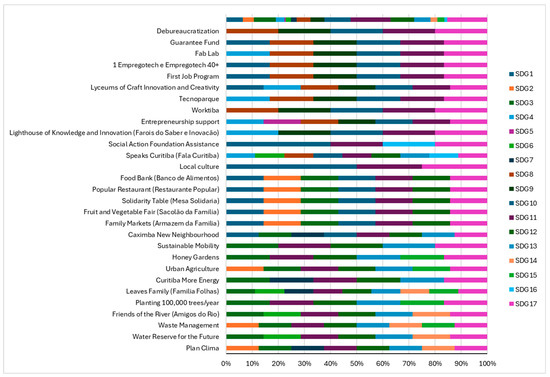
Figure 1.
Proportion of SDGs within the strategies of the city of Curitiba. Source: Authors (2025).
These findings highlight the varying degrees of alignment between municipal strategies and the global Sustainable Development Goals (SDGs), with a notable emphasis on SDG 11 (Sustainable Cities and Communities) and SDG 17 (Partnerships for the Goals). The high frequency of these associations suggests that local government increasingly recognizes the centrality of urban sustainability and collaborative governance in addressing complex urban challenges.
To deepen this analysis, it is important to contextualize these results within the broader literature on digital cities, smart cities, and urban governance. Just like the concept of strategic smart cities, the smart city concept has evolved beyond a technocentric view and now encompasses holistic models of urban development that integrate digital innovation, participatory governance, and sustainable policy frameworks [10,37,38]. Recent studies emphasize that truly “smart” cities are those capable of fostering inclusive, adaptive, and resilient systems that respond not only to economic and technological imperatives but also to social and environmental priorities [39,40], corroborating the applied concept of Strategic Digital City project [4,25].
In this sense, the results of this study come to meet the ongoing discourse on policy coherence for sustainable development (PCSD), a concept central to the 2030 Agenda, which advocates for the systematic alignment of local policies with the SDGs [41]. While several city-level frameworks have emerged to track this coherence, few studies offer empirical insights into how city strategic planning tools operationalize these global objectives in local contexts. By comparing the degree of integration of SDGs across a wide array of urban strategies, this research bridges the gap between normative sustainability frameworks and concrete municipal action.
Moreover, this analysis responds to calls within the literature for more grounded, comparative empirical studies that examine how cities internalize global sustainability agendas through strategic governance practices [42]. It shows that while some SDGs are more intuitively embedded in urban strategies, others—particularly those dealing with social equity (SDG 10), health (SDG 3), and resource efficiency (SDG 12)—remain under-addressed, suggesting a need for more comprehensive and integrated city planning approaches.
The unique relevance of this study lies in its methodological integration of strategy mapping with SDG analysis, offering a replicable tool for assessing urban sustainability alignment. It advances both theoretical and practical understandings of how cities interpret, translate, and prioritize global goals in their sustainable strategic frameworks. Other forms of research may extend this approach to include dynamic assessments over time, stakeholder analyses, or cross-national comparisons to better understand how institutional, political, and socioeconomic factors shape SDG coherence at the urban level.
The analytical model proposed in this study shows the advancement of the state of the art by offering a structured and replicable framework for assessing the alignment between city strategic planning and the Sustainable Development Goals (SDGs). Unlike conventional approaches that focus narrowly on individual projects or sector-specific policies, this model adopts a systems-oriented view, enabling a more comprehensive evaluation of how diverse urban strategies contribute to sustainable development. By systematically mapping strategic actions to specific SDGs, the model enhances transparency in policy evaluation and supports more coherent decision-making at the municipal level. Its application provides policymakers, planners, and researchers with a diagnostic tool to identify priority areas, reveal inconsistencies, and stimulate integrative city planning practices aligned with global sustainability agendas.
Despite these innovative approaches proposed, they also present challenges that should be addressed. First, the mapping of strategies to SDGs relies on qualitative interpretation of strategy documents, which may introduce subjectivity and reduce reproducibility across different contexts. Incorporating stakeholder input or natural language processing techniques could strengthen the objectivity of this step. Second, the current research focuses on formal city strategic plans and does not account for implementation gaps, local governance dynamics, or informal policy influences, which are critical in determining real-world impact. It is possible to search to incorporate performance indicators, longitudinal data, and multilevel governance analysis to enhance the robustness and applicability of the model. Additionally, comparative studies across cities of varying sizes, geographies, and institutional capacities could further validate the framework and inform context-sensitive adaptations.
6. Conclusions
The concept, model, and research on Strategic Digital City prioritizing city strategies and their sustainable indicators can corroborate the integrated vision of cities in relation to their physical and digital environments, improving the quality of life of citizens, especially with their participation in the development of sustainable projects, as is the case in Curitiba.
Recovering the proposed research objective, this study reaffirms that cities demand strategic and adaptive planning to address the growing complexity of urban challenges. In this context, sustainable city strategies, when designed in accordance with the specific realities of a city, emerge as potential instruments for urban planning and governance. The case of Curitiba demonstrates that aligning municipal strategies with environmental preservation, social equity, and economic resilience is not only possible but also beneficial for long-term urban sustainability. By grounding these strategies within the framework of the SDGs, Curitiba positions itself within a globally recognized development agenda, adding both legitimacy and strategic direction to its urban initiatives. The city’s digital and strategic planning approach represents a participatory and goal-oriented model that other urban centers can adapt to suit their unique social, environmental, and economic landscapes.
The results of the analysis showed that among the twenty-nine city strategies (city programs) implemented in Curitiba, two stood out for addressing multiple thematic dimensions, thereby achieving broader systemic impact and attracting significant support from international and private sectors. While all strategies showed clear alignment with SDG 11—which emphasizes inclusive, safe, resilient, and sustainable cities—a majority also contributed meaningfully to SDGs 3, 10, and 12, highlighting their relevance to public health, social equity, and responsible consumption. However, the limited association with other SDGs reveals critical gaps, particularly in areas related to governance, innovation, and climate action. This underlines the need for a more comprehensive approach that ensures broader SDG integration across sustainable urban strategies in accordance with the assumptions of Strategic Digital City sustainable projects and subprojects.
This research offers several contributions to the field of urban management. It provides empirical evidence on the use of city strategic planning tools in aligning local policies with global sustainability goals, offering a model for other cities to replicate or adapt. Moreover, it bridges theoretical concepts from the literature with practical urban planning through a structured case study methodology, reinforcing the value of integrated, data-informed decision-making in sustainable public policy. It also demonstrates how international cooperation and public–private partnerships can enhance the viability and reach of local initiatives. Contributions can be directed to city managers who can dialogue and implement the respective SDC concept and project model and research cases. This can also be extended to the academy or relevant studies or science related to the theme SDC, which is still original with its four subprojects. In this way, researchers on related topics, including strategic smart cities, intelligent cities, and digital cities, can expand their respective studies.
Research limitations report that the SDC concept and project model cannot be generalized and applied in all cities, requiring specific projects and mainly action research to monitor the progress of the proposed projects. From a scientific point of view, there were no limitations on the SDC concept and project model; however, the challenge of the cities is related to the acceptance and application of this innovative concept and with an original model for cities that want to contemplate the strategic vision of the digital city, not expressing the reality of world cities because they have economic, environmental, cultural, and social differences, among others.
The focus on a single city and the reliance on a single planning document is one study limitation; though enriched by technical visits and stakeholder insights, it constrains the generalizability of the findings. Future research should explore comparative case studies across diverse urban contexts and consider broader data sources, including participatory inputs, longitudinal analyses, and implementation assessments.
In conclusion, this research confirms that strategically formulated sustainable city strategies—when informed by local realities and anchored in global agendas such as the SDGs—serve as essential mechanisms for modern urban management. Curitiba’s experience provides a valuable roadmap for cities worldwide seeking to enhance sustainability, inclusivity, and resilience in their urban development policies in the Strategic Digital City context, considering multiple strategic and sustainable indicators where citizens can improve their quality of life.
Author Contributions
Conceptualization, D.A.R., L.A.W.F., H.B., G.U.O. and A.R.G.; methodology, D.A.R. and L.A.W.F.; software, A.R.G.; validation, D.A.R. and L.A.W.F.; formal analysis and investigation, D.A.R., L.A.W.F., H.B., A.R.G. and G.U.O.; resources, and data curation, D.A.R.; writing—original draft preparation and writing—review and editing, D.A.R., L.A.W.F., H.B. and G.U.O.; supervision and project administration, D.A.R.; funding acquisition, D.A.R. and L.A.W.F. All authors have read and agreed to the published version of the manuscript.
Funding
This research was partially funded by the National Council for Scientific and Technological Development (Conselho Nacional de Desenvolvimento Científico e Tecnológico—CNPq), Brazil, and by Strategic Digital City Research Group, PUCPR; CNPq 4/2021-2025—Process 308772/2021-0.
Data Availability Statement
Data are contained within the article and https://www.pucpr.br/escola-de-belas-artes/urban_management/ (accessed on 6 May 2025).
Acknowledgments
CNPq: PUCPR/PPGTU.
Conflicts of Interest
The authors declare no conflicts of interest.
Abbreviations
The following abbreviations are used in this manuscript:
| SDC | Strategic Digital City |
| SDG | United Nations Sustainable Development Goal |
References
- Newman, P.; Beatley, T.; Boyer, H. Resilient Cities: Overcoming Fossil Fuel Dependence; Island Press: Washington, DC, USA, 2017. [Google Scholar]
- Allarané, N.; Atchadé, A.J.; N’Dilbé, T.-R.; Azagoun, V.V.A.; Hetcheli, F. Integrating Climate Change Adaptation Strategies into Urban Policies for Sustainable City Resilience: Barriers and Solutions in the Central African City of N’Djaména. Sustainability 2024, 16, 5309. [Google Scholar] [CrossRef]
- Berry, J.M.; Portney, K.E. Sustainability and Interest Group Participation in City Politics. Sustainability 2013, 5, 5. [Google Scholar] [CrossRef]
- Rezende, D.A.; Almeida, G.G.F.; Fumagalli, L.A.W. Strategic Digital City: Multiple Projects for Sustainable Urban Management. Sustainability 2024, 16, 5450. [Google Scholar] [CrossRef]
- UNDP. Sustainable Development Goals. The SDGs in Action. 2024. Available online: https://www.undp.org/sustainable-development-goals (accessed on 9 January 2025).
- Acuto, M.; Parnell, S.; Seto, K.C. Building a global urban science. Nat. Sustain. 2018, 1, 2–4. [Google Scholar]
- Caprotti, F.; Cowley, R.; Datta, A.; Broto, V.C.; Gao, E.; Georgeson, L.; Herrick, C.; Odendaal, N.; Joss, S. The New Urban Agenda: Key opportunities and challenges for policy and practice. Urban Res. Pract. 2017, 10, 367–378. [Google Scholar]
- Berardi, U. A Framework to Evaluate Urban Sustainability Performance: Comparative Analysis of European Cities. Land 2021, 10, 706. [Google Scholar] [CrossRef]
- Pugliese, T.; Bifulco, F. Urban Strategies for Sustainability in Smart Cities: A Comparative Analysis of Italian Cases. Land 2022, 11, 63. [Google Scholar] [CrossRef]
- Yigitcanlar, T.; Desouza, K.C.; Butler, L.; Roozkhosh, F. Contributions and Risks of Artificial Intelligence (AI) in Building Smarter Cities: Insights from a Systematic Review of the Literature. Energies 2020, 13, 1473. [Google Scholar] [CrossRef]
- Rezende, D.A. Digital city projects: Information and public services offered by Chicago (USA) and Curitiba (Brazil). Int. J. Knowl. Soc. Res. 2016, 7, 16–30. [Google Scholar] [CrossRef]
- From, D.A.; Rezende, D.A.; Sequeira, D.F.Q. IoT-Based Framework for Connected Municipal Public Services in a Strategic Digital City Context. IoT 2025, 6, 20. [Google Scholar] [CrossRef]
- Mutambik, I. Unlocking the Potential of Sustainable Smart Cities: Barriers and Strategies. Sustainability 2024, 16, 5061. [Google Scholar] [CrossRef]
- Colson-Fearon, B.; Versey, H.S. Urban Agriculture as a Means to Food Sovereignty? A Case Study of Baltimore City Residents. Int. J. Environ. Res. Public Health 2022, 19, 12752. [Google Scholar] [CrossRef]
- Ferreira, J.C.; Monteiro, R.; Silva, V.R. Planning a Green Infrastructure Network from Theory to Practice: The Case Study of Setúbal, Portugal. Sustainability 2021, 13, 15. [Google Scholar] [CrossRef]
- Larbi, M.; Kellett, J.; Palazzo, E. Urban Sustainability Transitions in the Global South: A Case Study of Curitiba and Accra. Urban Forum 2022, 33, 223–244. [Google Scholar] [CrossRef]
- Clement, J.; Ruysschaert, B.; Crutzen, N. Smart city strategies—A driver for the localization of the sustainable development goals? Ecol. Econ. 2023, 213, 107941. [Google Scholar] [CrossRef]
- Alshuwaikhat, H.M.; Adenle, Y.A.; Almuhaidib, T. A Lifecycle-Based Smart Sustainable City Strategic Framework for Realizing Smart and Sustainability Initiatives in Riyadh City. Sustainability 2022, 14, 8240. [Google Scholar] [CrossRef]
- Saiu, V. The three pitfalls of sustainable city: A conceptual framework for evaluating the theory-practice gap. Sustainability 2017, 9, 2311. [Google Scholar] [CrossRef]
- da Silva Neiva, S.; Prasath, R.A.; de Amorim, W.S.; de Andrade Lima, M.; Barbosa, S.B.; Ribeiro, J.M.P.; Ceci, F.; Schneider, J.; Deggau, A.B.; de Andrade Guerra, J.B.S.O. Sustainable urban development: Can the balanced scorecard contribute to the strategic management of sustainable cities? Sustain. Dev. 2021, 29, 1155–1172. [Google Scholar] [CrossRef]
- de Andrade Guerra, J.B.S.O.; Pereira Ribeiro, J.M.; Fernandez, F.; Bailey, C.; Barbosa, S.B.; da Silva Neiva, S. The adoption of strategies for sustainable cities: A comparative study between Newcastle and Florianópolis focused on urban mobility. J. Clean. Prod. 2016, 113, 681–694. [Google Scholar] [CrossRef]
- Salas-Zapata, L.; López-Ríos, J.M.; Gómez-Molina, S.; Franco-Moreno, D.; Martínez-Herrera, E. Healthy and sustainable cities: Strategies in the search for quality of life. Rev. Fac. Nac. Salud Publica 2016, 34, 105–110. [Google Scholar] [CrossRef]
- Raimo, N.; L’Abate, V.; Marrone, A.; Vitolla, F. Toward sustainable cities: Assessing drivers of SDG performance in Italian municipalities. Sustain. Dev. 2024, 32, 554–564. [Google Scholar] [CrossRef]
- Russell-Bennett, R.; Rosenbaum, M.S.; Fisk, R.P.; Raciti, M.M. SDG editorial: Improving life on planet earth—A call to action for service research to achieve the sustainable development goals (SDGs). J. Serv. Mark. 2024, 38, 145–152. [Google Scholar] [CrossRef]
- Rezende, D.A. Strategic digital city: Concept, model, and research cases. J. Infrastruct. Policy Dev. 2023, 7, 2177. [Google Scholar] [CrossRef]
- Flores, C.C.; Rezende, D.A. Twitter information for contributing to the strategic digital city: Towards citizens as co-managers. Telemat. Inform. 2018, 35, 1082–1096. [Google Scholar] [CrossRef]
- Fumagalli, L.A.W.; Rezende, D.A.; Guimarães, T.A. Challenges for public transportation: Consequences and possible alternatives for the COVID-19 pandemic through strategic digital city application. J. Urban Manag. 2021, 10, 97–109. [Google Scholar] [CrossRef]
- Ribeiro, S.S.; Rezende, D.A.; Yao, J. Toward a model of the municipal evidence-based decision process in the strategic digital city context. Inf. Polity 2019, 24, 305–324. [Google Scholar] [CrossRef]
- Flores, C.C.; Rezende, D.A. Crowdsourcing framework applied to strategic digital city projects. J. Urban Manag. 2022, 11, 467–478. [Google Scholar] [CrossRef]
- Fumagalli, L.A.W.; Rezende, D.A.; Guimarães, T.A. Data Intelligence in Public Transportation: Sustainable and Equitable Solutions to Urban Modals in Strategic Digital City Subproject. Sustainability 2022, 14, 8. [Google Scholar] [CrossRef]
- Teixeira, A.V.; Rezende, D.A. A Multidimensional Information Management Framework for Strategic Digital Cities: A Comparative Analysis of Canada and Brazil. Glob. J. Flex. Syst. Manag. 2023, 24, 107–121. [Google Scholar] [CrossRef]
- Sánchez Trujillo, M.A.; Doblado Jiménez, B.; Campos Fito, J.M. Agenda 2030 and the Challenges of the Sustainable Urban Development Goals in France: The Case of Saint-Étienne; Huete García, M.Á., Rodríguez Miranda, A., Ugalde, V., Merinero Rodríguez, R., Eds.; Springer: Cham, Switzerland, 2023. [Google Scholar]
- Pilcher, N.; Cortazzi, M. ‘Qualitative’ and ‘quantitative’ methods and approaches across subject fields: Implications for research values, assumptions, and practices. Qual. Quant. 2024, 58, 2357–2387. [Google Scholar] [CrossRef]
- Yin, R.K. Case Study Research and Applications: Design and Methods, 6th ed.; SAGE Publications, Inc.: Thousand Oaks, CA, USA, 2017. [Google Scholar]
- Frankfort-Nachmias, C.; Nachmias, D. Research Methods in the Social Sciences, 7th ed.; Worth Publishers: New York, NY, USA, 2008. [Google Scholar]
- Tashakkori, A.; Johnson, R.B.; Teddlie, C.B. Foundations of Mixed Methods Research: Integrating Quantitative and Qualitative Approaches in the Social and Behavioral Sciences, 2nd ed.; SAGE Publications, Inc.: Thousand Oaks, CA, USA, 2020. [Google Scholar]
- Ahvenniemi, H.; Huovila, A.; Pinto-Seppä, I.; Airaksinen, M. What are the differences between sustainable and smart cities? Cities 2017, 60, 234–245. [Google Scholar] [CrossRef]
- Veloso, Á.; Fonseca, F.; Ramos, R. Insights from Smart City Initiatives for Urban Sustainability and Contemporary Urbanism. Smart Cities 2024, 7, 3188–3209. [Google Scholar] [CrossRef]
- Calzada, I. Smart City Citizenship; Elsevier: Amsterdam, The Netherlands, 2020. [Google Scholar]
- Bibri, S.E.; Krogstie, J. A novel model for data-driven smart sustainable cities of the future: A strategic roadmap to transformational change in the era of big data. Sustain. Cities Soc. 2021, 51, 101777. [Google Scholar] [CrossRef]
- OECD. Policy Coherence for Sustainable Development 2019: Empowering People and Ensuring Inclusiveness and Equality; OECD Publishing: Paris, France, 2019. [Google Scholar]
- Acuto, M.; Leffel, B. Understanding the global ecosystem of city networks. Urban Stud. 2020, 58, 1758–1774. [Google Scholar] [CrossRef]
Disclaimer/Publisher’s Note: The statements, opinions and data contained in all publications are solely those of the individual author(s) and contributor(s) and not of MDPI and/or the editor(s). MDPI and/or the editor(s) disclaim responsibility for any injury to people or property resulting from any ideas, methods, instructions or products referred to in the content. |
© 2025 by the authors. Licensee MDPI, Basel, Switzerland. This article is an open access article distributed under the terms and conditions of the Creative Commons Attribution (CC BY) license (https://creativecommons.org/licenses/by/4.0/).