Article

Understanding Grass Invasion, Fire Severity, and Acacia koa Regeneration for Forest Restoration in Hawaiʻi Volcanoes National Park

by
Natalia P. Hamilton
1,*,
Stephanie G. Yelenik
2,3,
Tara D. Durboraw
1,
Robert D. Cox
1 and
Nathan S. Gill
1
1
Department of Natural Resources Management, Texas Tech University, Lubbock, TX 79410, USA
2
U.S. Geological Survey, Pacific Island Ecosystems Research Center, Hawaii Volcanoes National Park, HI 96718, USA
3
U.S. Forest Service, Rocky Mountain Research Station, Reno, NV 89512, USA
*
Author to whom correspondence should be addressed.
Land 2021, 10(9), 962; https://doi.org/10.3390/land10090962
Submission received: 30 June 2021 / Revised: 29 August 2021 / Accepted: 1 September 2021 / Published: 10 September 2021
(This article belongs to the Special Issue Forest Landscape Restoration: Strategies, Challenges, and Impacts)

Abstract

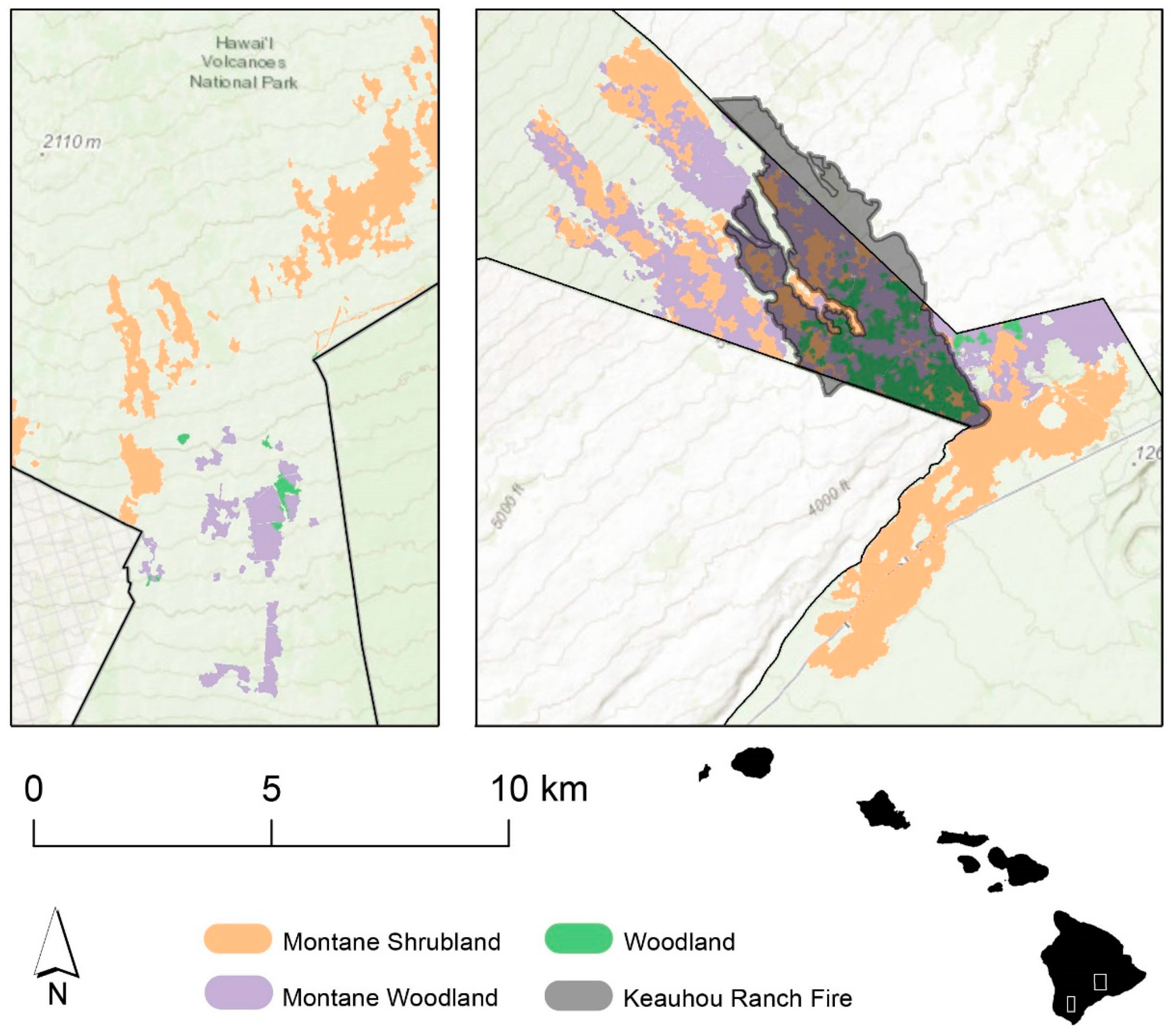
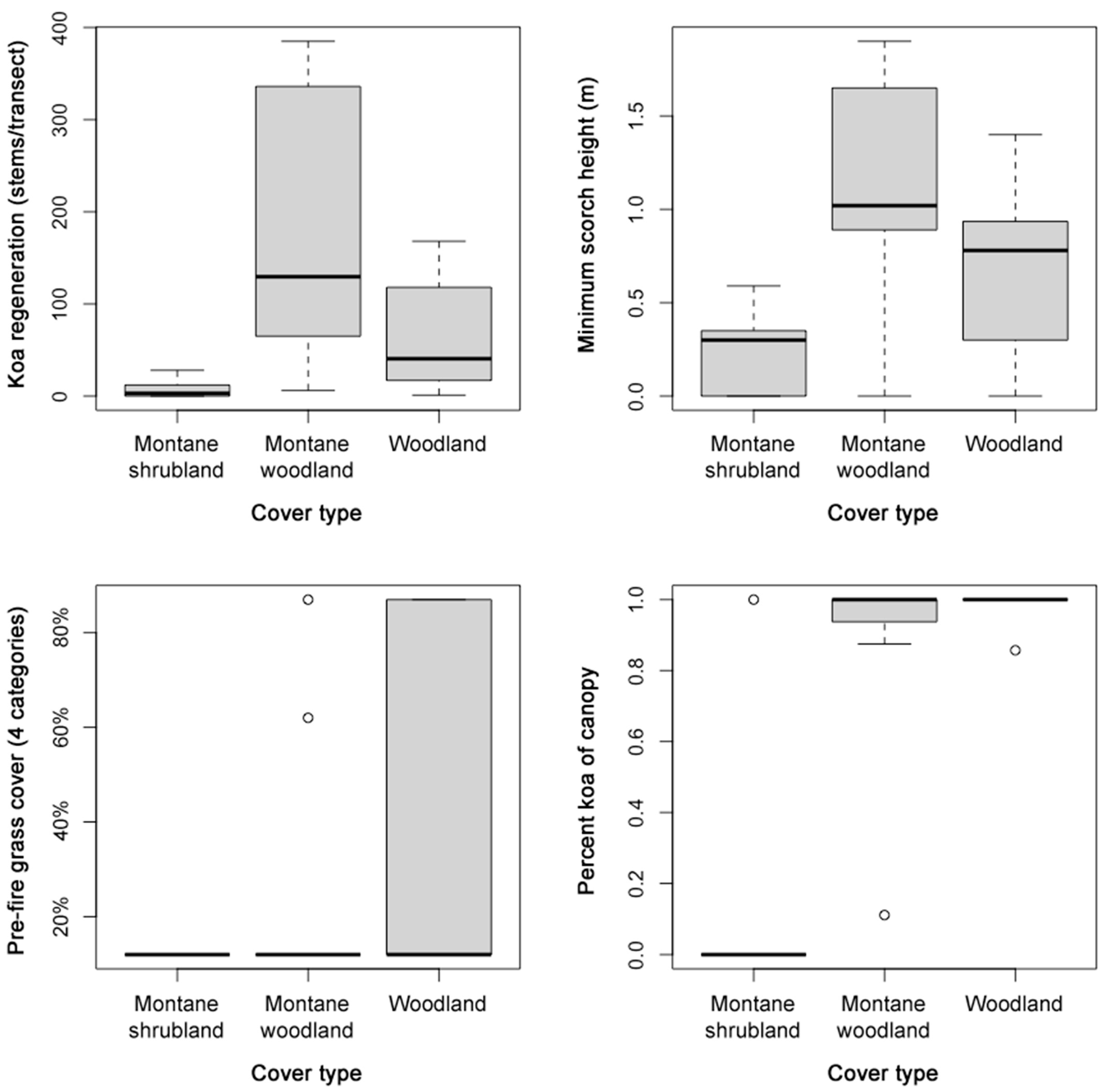
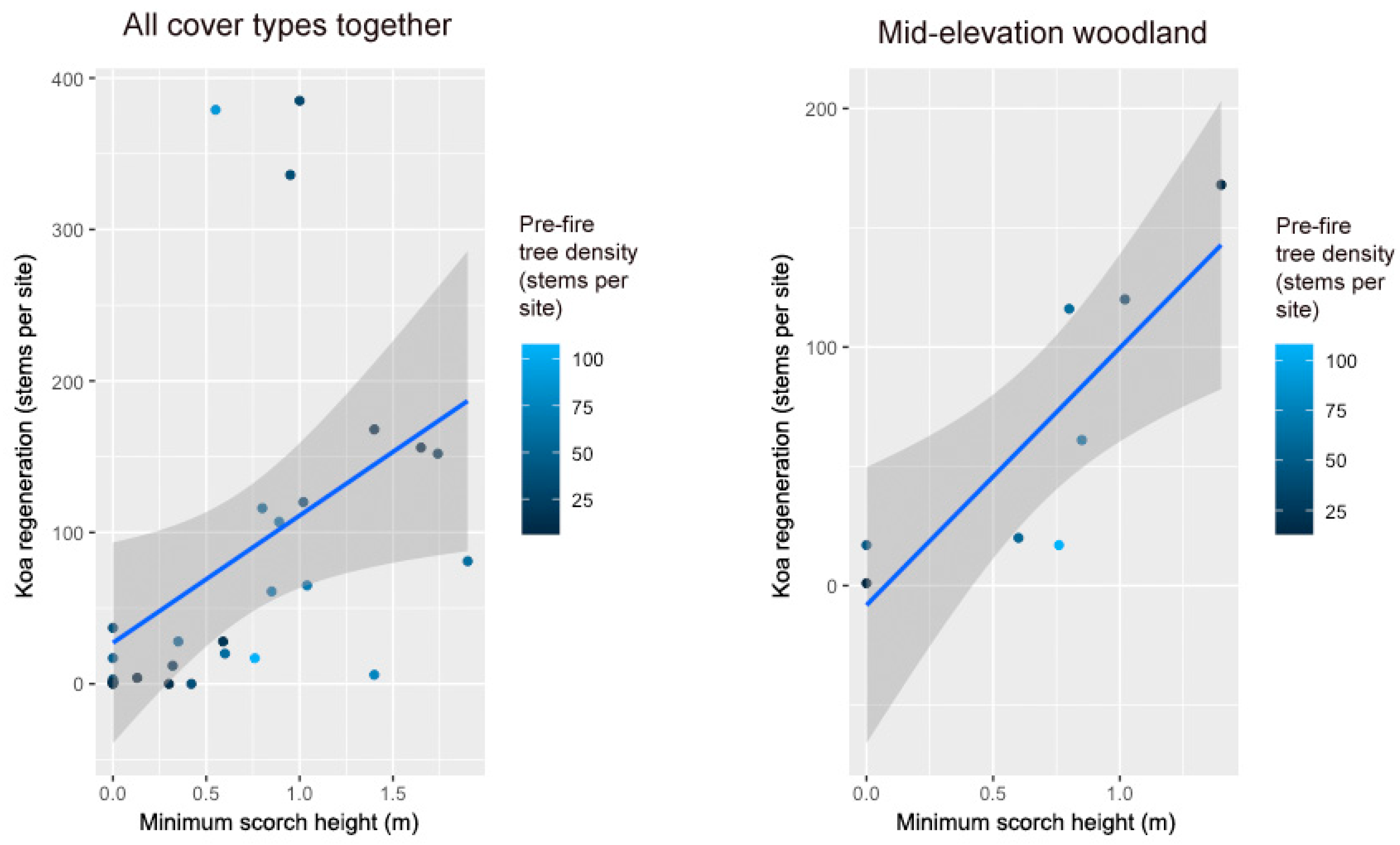
With invasive grasses increasing wildfire occurrence worldwide, a better understanding of the relationships between native plants, fire, and invasive grass is needed to help restoration plans facilitate ecosystem resilience. Invasive grasses are particularly problematic for altering fire regimes in the tropics, yet in Hawaiʻi, restoration sites are often planted with monocultures of the native tree Acacia koa, which can promote grass growth via nitrogen fixation. This, combined with the difficulty of estimating pre-fire grass cover under thick canopies, complicates attempts to restore Hawaiian ecosystems. We studied the 2018 Keauhou Ranch Fire in Hawaiʻi to investigate three questions: (1) at what level of precision can pre-fire grass cover be accurately estimated from oblique aerial photos? (2) how are post-fire A. koa regeneration densities affected by fire severity? and (3) how are post-fire A. koa regeneration densities affected by pre-fire grass cover and its interaction with fire severity? We collected burn severity and post-fire regeneration data from 30 transects stratified across mid-elevation woodland, montane woodland, and montane shrubland communities. We evaluated visual estimates of pre-fire grass cover from oblique aerial imagery with quantitative in situ data from 60 unburned transects of the same cover types. Pre-fire estimates of grass cover categories were 67% accurate in montane woodland (n = 9) and 100% accurate in montane shrubland (n = 11), but only 20% accurate in mid-elevation woodland (n = 10). In montane woodlands with low pre-fire tree densities, A. koa regeneration densities were higher with increased fire severity, but this trend reversed when pre-fire tree densities were high. We detected no effect of pre-fire grass cover, nor its interaction with fire severity, on A. koa regeneration density. This indicates that restoration through the planting of A. koa may be successful in promoting fire-resilient A. koa forest, although there are potential issues to consider regarding the effects that A. koa’s grass promotion may have on other species within the ecosystem.
Keywords: fire; Acacia koa; Ehrharta stipoides; Setaria parviflora; Cenchrus clandestinus; Andropogon glomeratus; invasive; Hawaiʻi fire; Acacia koa; Ehrharta stipoides; Setaria parviflora; Cenchrus clandestinus; Andropogon glomeratus; invasive; Hawaiʻi