Abstract
To clarify the spatio-temporal changes of water quality, pollution factors, and sources in Chaohu Lake Basin over the past five years, this study focused on the Chaohu Lake and its tributaries as the research zone. By analyzing the water quality parameters, the pollution factors of Chaohu Lake were clarified and the water quality was comprehensively evaluated using the water quality index (WQI). Correlation analysis, cluster analysis and principal component analysis (PCA) were conducted in SPSS 26.0 to identify pollutant sources. The results showed that the water of Chaohu Lake and its tributaries were, to some extent, polluted during the dry and wet seasons over the past five years. The primary excessive pollutants were COD, nitrogen, and phosphorus. The average total nitrogen (TN) and total phosphorus (TP) concentrations of Chaohu Lake were 1.74 and 0.09 mg/L in dry seasons and 1.39 and 0.08 mg/L in wet seasons, respectively, which belonged to Class IV water quality standard regulated by GB 3838-2002. Notably, in the Nanfei, Paihe, and Baishishan Rivers, TN concentrations consistently exceeded the Class V water quality standard threshold in both seasons, while TP levels exceeded the Class IV standard. Water quality assessment revealed that the water quality state was classified as “good” in Chaohu Lake, but “moderate” in its tributaries, especially in wet seasons. This finding indicated that while eutrophication remained the primary pollution issue in the lake, the overall physicochemical condition of the water body has not undergone comprehensive deterioration and still maintains a certain degree of ecological health. Source analysis indicated that domestic and industrial wastewater, and agricultural activities were the primary sources of pollution in Chaohu Lake and its tributaries. Therefore, integrated management strategies are required, including enhanced monitoring and control of nitrogen and phosphorus inputs from inflow rivers, rational industrial restructuring, and optimization of agricultural and industrial water use.
1. Introduction
In recent years, China has implemented large-scale water environment management measures, resulting in an increase in the proportion of lakes (and rivers) achieving water quality standards of Classes I to III [1]. However, under the dual pressures of climate change and human activities, the rebound in nutrient concentrations and frequent algal blooms in some lakes have severely threatened the ecological balance and sustainable use of water resources [2]. Therefore, accurately assessing lake water quality, deeply analyzing its spatio-temporal patterns and influencing factors is not only a core scientific challenge for achieving precise lake management and ecological restoration but also a critical practical need for ensuring regional ecological security and supporting the “Beautiful China” initiative [3].
Chaohu Lake, located in central Anhui Province, China, is one of China’s five largest freshwater lakes. It serves as a critical drinking water source for local communities while supporting diverse sectors, including fisheries, agricultural irrigation, and industrial water supply [4]. Chaohu Lake plays a dual role in maintaining regional ecological balance and driving economic development. In recent years, rapid urbanization, industrialization, and agricultural modernization within the watershed have led to a substantial discharge of pollutants (industrial effluents, domestic sewage, and heavy metals) into Chaohu Lake Basin, causing severe water quality degradation [5]. To date, many studies have conducted on the water quality of Chaohu Lake Basin. For example, Wu et al. assessed the water quality condition in the rivers of Chaohu Lake Basin in 2018, and exploring the crucial parameters affecting its water quality [6]. Liu et al. analyzed the trends and correlations of chlorophyll-a, major nutrients, and hydrometeorological conditions in Chaohu Lake during the 13th Five-year Plan period [7]. In addition, Wu et al. studied the spatial distribution of water environmental factors in the Chaohu Lake Basin and the trophic state of the lake was assessed using the water quality index (WQI) [8]. However, most studies have only focused on the water body of Chaohu Lake or relatively short temporal scales, such as one year or less. Few studies have examined water quality changes from a relative long temporal scale and pollution factors from the perspective of the entire river-lake system within the watershed.
Water quality can be assessed using various methods, including the single-factor assessment method [9,10], comprehensive trophic level index [11,12], fuzzy comprehensive evaluation [13], grey correlation analysis [14], and numerical models [15,16]. Among them, WQI plays a crucial role in water resource management, which is widely used in the surface water (particularly lakes and rivers) [17,18]. WQI models employ a mathematical algorithm to evaluate multiple water quality parameters based on priority, thereby enabling a comprehensive assessment of water quality [19,20,21,22]. Ni et al. assessed the water quality status using the WQI model and identified the underlying driving mechanisms within the Muling-Xingkai watershed, thereby proposed effective water management strategies [23]. Furthermore, Ning et al. used monthly water quality monitoring data from 13 stations in Dianshan Lake from 2002 to 2022, and systematically analyzed the spatio-temporal evolution of water quality and identified its dominant influencing factors through the WQI model [24]. When further combined with multivariate statistical analysis methods like principal component analysis (PCA), correlation analysis or machine learning, it enables quantitative analysis of key pollution sources and assessment of their contribution rates, thereby providing a more comprehensive scientific basis for targeted water quality management.
This study investigated the spatio-temporal characteristics of water quality in the river–lake system of the Chaohu Lake Basin during the wet seasons (2021–2025) and dry seasons (2020–2024), respectively, with the objectives of identifying the primary factors driving water quality changes and evaluating the water quality status using the WQI. This approach enables an understanding of water quality conditions in recent years and a systematic analysis of pollutant factors, which is of certain practical significance for comprehensively assessing the current state of the Chaohu Lake basin’s water environment, formulating scientifically effective pollution control measures, and ensuring ecological security and sustainable development in the watershed.
2. Materials and Methods
2.1. Study Area
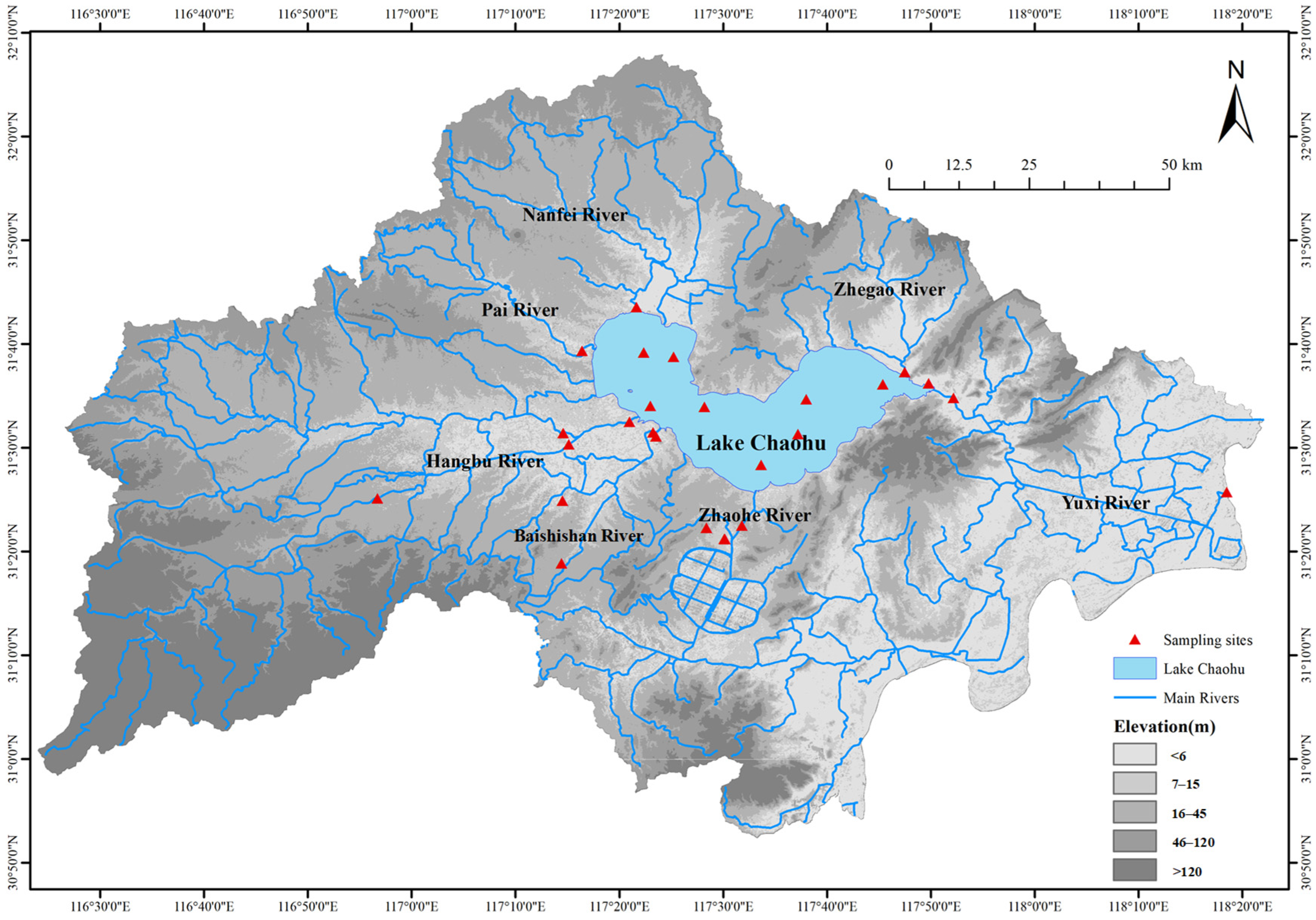
The Chaohu Lake, situated in central Anhui Province, is the fifth-largest freshwater lake in China, with a surface area of ~780 km2 and a basin area of ~13,500 km2. It lies on the north shore of the lower reaches of the Yangtze River and locates between 30°56′–32°02′ N and 117°16′–117°51′ E. The Chaohu Lake Basin encompasses several cities, including Hefei, Wuhu, and Ma’anshan, characterized by high population density and intense economic activity, making it a vital economic zone and population center in Anhui Province. The region features a subtropical humid monsoon climate with distinct seasons, exhibiting an annual average temperature of 16 °C and mean annual precipitation of 1220 mm. The Chaohu Lake Basin has a well-developed water network, primarily consisting of seven major river systems: Zhegao River, Nanfei River, Paihe River, Hangbu-Fengle River, Baishishan River, Zhaohe River, and Yuxi River. Among these, the Yuxi River is the sole outflow river, while the other six serve as inflow rivers (Figure 1). The river reaches were separated into different types, i.e., urban, agricultural, forested, and mixed river reaches according to the landscape compositions in the watersheds [25]. Here, the four types—forested watersheds (forests >50%), agricultural watersheds (cropland >60%), urban watersheds (urban >20%), and mixed watersheds (forest ≤50%, cropland ≤60%, and urban ≤20%)—were sorted and their mainstems were defined as corresponding riverine types [25]. Thus, the Zhaohe and Baishishan Rivers are defined as agricultural river reaches, whereas the Nanfei and the Paihe Rivers are defined as urban river reaches. The Hangbu river is defined as forested river reach, and Zhegao river as mixed river reach. Regarding the Yuxi River, its estuary and upper sections are mixed, while the middle and lower reaches are forested [26].
Figure 1.
The study area and sampling sites.
2.2. Sampling Sites
To represent the whole lake basin and be convenient for continuous monitoring, 26 sampling sites were carefully selected, covering the 7 rivers, the entrances and exits of Chaohu Lake as well as the entire lake body. Sampling was performed at November, 2020 to 2024, and June, 2021 to 2025, to investigate the spatial–temporal changes in Chaohu Lake water quality in the dry and wet seasons. All sites were precisely georeferenced using GPS, and their spatial distribution was illustrated in Figure 1. Water samples collected from three layers (upper, middle, and lower depths) at each site, which were evenly mixed and stored in two 500 mL pre-rinsed polyethylene containers. The collected water samples were stored at low temperature and sent back to laboratory for pretreatment and analyses. All analyses were completed within 48 h to ensure data reliability.
2.3. Analysis Methods
2.3.1. Sample Analysis
This study examined 9 water quality parameters including temperature, pH, DO, CODMn, NH4+-N, TP, TN, conductivity, and turbidity. Among them, temperature, pH, DO, conductivity, and turbidity were measured on-site using a portable instrument. At laboratory, the samples were filtered and measured according to the national standard methods. TN was determined by the persulfate oxidation method using UV spectrophotometer, while NH4+-N was analyzed using the Nessler’s reagent spectrophotometric method. TP was measured using the ammonium molybdate spectrophotometric method. Potassium persulfate and sulfuric acid were added as oxidant and digestion medium, respectively. The sealed vial was then autoclaved at 121 °C for 30 min to convert all phosphorus forms into soluble orthophosphate. CODMn was analyzed using the acidic potassium permanganate method. All measurements were carried out under strictly controlled laboratory conditions to ensure accuracy and reproducibility. The quality assurance and quality control (QA/QC) procedures were rigorously followed during the entire analytical process.
2.3.2. Trophic State and Water Quality Assessment
TN/TP is useful indicators for managing eutrophication in aquatic environments [27]. It was reported that the value of TN/TP (by mass) was used as an indicator of potential lake nutrient limitation, if TN/TP < 10, nitrogen was the only limitation; if TN/TP > 20, phosphorus was the only limitation, and co-limitation of nitrogen and phosphorus, while 20 ≥ TN/TP ≥ 10 [28].
The water quality status of Chaohu Lake and its tributaries was assessed using the WQI, which proposed by Horton in 1965 [29]. The WQI framework construction involves three key steps: (1) selecting multiple water quality parameter variables to construct the index, (2) assigning a scale value ranged from 0 to 100 to each variable, (3) specifying a relative weighting factor for each variable to indicate their importance and the impact on the water quality index [30]. The WQI is calculated as follows:
where n is the number of environmental variables, and Ci and Pi are the normalized value and the weight of variable i, respectively. Uddin et al. analyzed 21 WQI models and identified the most used parameters commonly such as Temperature, Turbidity, pH, COD, TN, DO, BOD, and NH4+-N. They also found that most models were suitable for incorporating 8–11 water quality parameters [22]. Therefore, the WQI was based on the 9 variables in this study. The values of Ci and Pi used in this study are detailed in the previous study [19,31]. The WQI score ranges from 0 to 100, with higher values indicating better water quality. Water quality is classified into five categories based on the WQI score: 0–25 (very poor), 26–50 (poor), 51–70 (moderate), 71–90 (good), and 91–100 (excellent) [32].
2.4. Data Analysis
Spatial distribution maps were generated using ArcGIS 10.7. Correlation analysis, cluster analysis and PCA were performed using IBM SPSS 26.0.
3. Results and Discussion
3.1. Water Quality Characteristics in the Study Area
This study conducted a spatio-temporal characteristic analysis in Chaohu Lake and its tributaries based on 9 water quality parameters, including temperature, pH, DO, CODMn, NH4+-N, TP, TN, conductivity and turbidity. As the organic pollution indicator, the concentration of CODMn in Chaohu Lake and its tributaries ranged from 0.40 to 7.66 mg/L, 0.48 to 10.01 mg/L in dry and wet seasons, with the average value of 3.04~4.78 and 3.02~6.36 mg/L, respectively (Table 1 and Table 2). During the dry seasons, the average CODMn level in Chaohu Lake was highest, while in the wet seasons, the highest level was found in the Zhaohe River. Apart from Chaohu Lake and the Baishishan River, all other tributaries exhibited higher CODMn contents during the wet seasons than the dry seasons.
Table 1.
The concentration of water quality parameters for the Chaohu Lake, and its tributaries in the dry seasons from 2020 to 2024.
Table 2.
The concentration of water quality parameters for the Chaohu Lake, and its tributaries in the wet seasons from 2021 to 2025.
For the nitrogen compounds, Chaohu Lake had the lowest NH4+-N levels, with five-year average values of 0.05 mg/L (dry seasons) and 0.06 mg/L (wet seasons), while the averages for TN were 1.74 mg/L and 1.39 mg/L, respectively. Additionally, the outflow river (Yuxi River) also exhibited relatively low concentrations of both NH4+-N and TN. This suggested that the aquatic ecosystem in Chaohu Lake has established an effective natural water purification system, resulting in lower nitrogen levels in the lake itself and its outflow river. In comparison, the Nanfei River had the highest NH4+-N concentrations, with average levels in dry and wet seasons over the past five years being 0.90 mg/L and 1.50 mg/L, respectively. Correspondingly, it also exhibited the highest TN levels, averaging 5.65 mg/L and 4.87 mg/L for the dry and wet seasons. For both NH4+-N and TN, the Paihe River had the second highest concentrations, following the Baishishan River. TP and conductivity exhibited a similar spatial pattern to TN, with the Nanfei and Paihe Rivers consistently having the relative higher concentrations.
According to China’s surface water quality standards (GB 3838-2002) [33], the average TN concentrations in the Baishishan River, Paihe River, and Nanfei River have consistently exceeded the Class V threshold (2.0 mg/L) during both dry and wet seasons over the past five years. For TP, the concentrations in the Baishishan River, Paihe River, and Zhegao River during both wet and dry seasons all met the Class IV water quality standard regulated by GB 3838-2002 [33], except for Nanfei River, where the TP concentration exceeded the Class V standard during the wet seasons. In this study, the average TN and TP concentrations of Chaohu Lake were 1.74 and 0.09 mg/L in dry seasons and 1.39 and 0.08 mg/L in wet seasons, respectively, which belonged to Class IV water quality standard regulated by GB 3838-2002 [33].
Based on the river reaches classification, the Nanfei and Paihe Rivers in this study are defined as urban river reaches. Urban rivers typically receive substantial nutrient inputs from various sources [26]. Correspondingly, the Nanfei and Paihe Rivers exhibited elevated levels of TN and TP. These rivers also showed higher conductivity, indicating greater ionic content and enhanced current conduction capacity, which may suggest more favorable conditions for microbial growth [34]. The Baishishan River is classified as an agricultural river reach which is characterized by dense agricultural land, with cultivated areas accounting for 81.12% of the Baishishan River basin [6]. The extensive application of phosphorus fertilizers has led to the transport of nitrogen and phosphorus nutrients into the river system through rainfall erosion and surface runoff, resulting in higher TN and TP concentrations. A previous study has analyzed the trend of water quality changes in the rivers of Chaohu Lake Basin from 2001 to 2012. The results indicated that the water quality of Nanfei and Paihe Rivers was severely polluted, while that of Zhaohe, Zhagao and Yuxi Rivers was good. Moreover, the water quality of Hangbu and Baishishan Rivers was slightly polluted and good, respectively [35]. Additionally, Xi et al. have pointed out that the pollution of Nanfei and Paihe Rivers was more serious from 2013 to 2014, while that of Zhaohe and Zhagao Rivers was relatively light [36]. Wu et al. indicated that the water quality of Hangbu and Zhagao Rivers was the best, and that of Zhaohe, Yuxi River and Baishishan Rivers was better than that of Nanfei and Paihe Rivers [8]. Compared with previous studies, this study found that while the water quality of the Nanfei and Paihe Rivers has remained stable with no significant change, a decline has been observed in the Baishishan River.
In conclusion, the nitrogen and phosphorus source management in the inflowing rivers should be strengthen. Mooney et al. [37] indicated that small tributaries typically transport water with high nutrient concentrations, posing greater potential risks for algal blooms in receiving waters. This study identified the Nanfei, Paihe and Baishishan Rivers, three small tributaries in the Chaohu Lake basin, as bearing substantial nitrogen and phosphorus nutrient loads into the lake. Consequently, it is necessary to enhance long-term dynamic monitoring of small watersheds and systematically analyze the key mechanisms of small tributaries in regional nutrient cycling and transport processes, thereby providing scientific foundations for precise pollution prevention and control.
Overall, the water of Chaohu Lake and its tributaries were to some extent polluted during the dry and wet seasons over the past five years, especially the Nanfei, Paihe and Baishishan Rivers. The main excessive pollutants were COD, nitrogen, and phosphorus. Therefore, it is necessary to take a holistic approach, control pollution emissions at the source, enhance water quality monitoring and management, and adhere to the path of sustainable development for the lake’s ecological environment.
3.2. Assessment of Trophic State and Water Quality in the Study Area
According to the data, TN/TP mass ratios in the study area ranged from 13.83 to 47.62 in dry seasons, and 16.83 to 30.03 in wet seasons over the past five years. The highest values of TN/TP during dry and wet seasons were observed at Paihe River, reaching 47.62 and 30.03, respectively, indicating a strong phosphorus limitation in this tributary. Conversely, the lowest TN/TP ratios of 13.86 and 16.83 were recorded at Zhegao River during the dry and wet seasons, suggesting a potential co-limitation of nitrogen and phosphorus in this watershed. The spatial and temporal variation in TN/TP ratios indicated that nutrient limitation patterns differed significantly between tributaries and seasons, with most sites falling within the phosphorus limitation range. This result was consistent with the previous study which indicated that compared with nitrogen loss caused by denitrification, phosphorus sedimentation was more widespread and pervasive, leading to phosphorus limitation predominated (94.4%) in most lakes all over the world [38]. In addition, Downing et al. found that the risk of blue-green algae dominance was less than 10% when TP < 0.03 mg/L, and increased to 40% when 0.03 < TP < 0.07 mg/L, and raised up to 80% when TP was close to 0.10 mg/L [39]. In this study, TP concentrations in Baishishan, Paihe, Nanfei and Zhegao rivers during the dry seasons and wet seasons were higher than 0.10 mg/L, suggesting a high risk of algal blooms in these tributaries. In Chaohu Lake, the TP concentrations were 0.09 and 0.08 mg/L in dry and wet seasons, respectively, indicating that there may be a risk of algal blooms in Chaohu Lake.
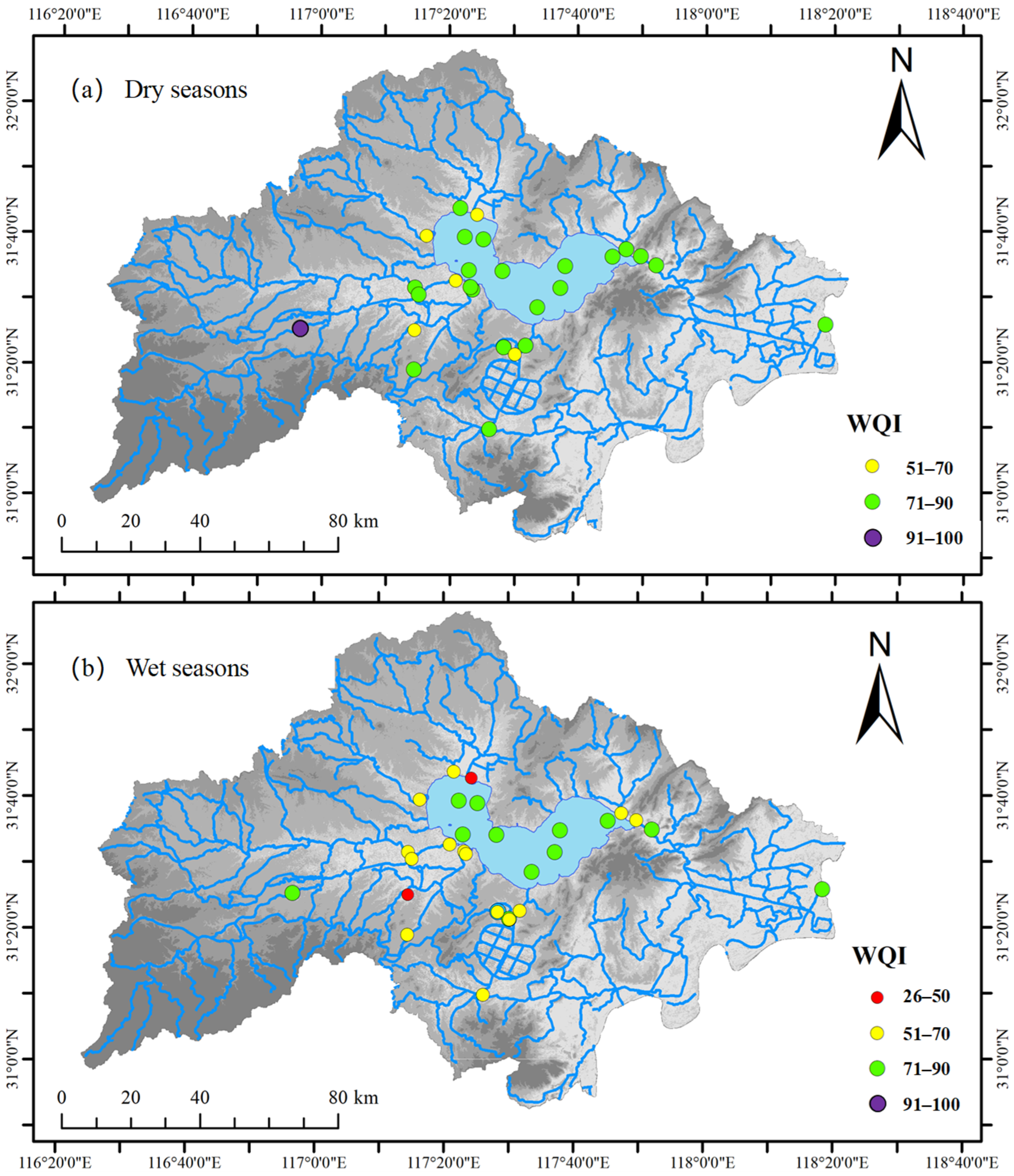
To visually understand the water quality of the Chaohu Lake and its tributaries, 9 parameters including temperature, pH, DO, CODMn, NH4+-N, TP, TN, conductivity and turbidity were selected and evaluated based on the WQI model. Figure 2 showed the WQI value of each sampling site in the study area during the dry and wet seasons over the past five years. Obviously, although the water of Chaohu Lake and its tributaries were to some extent polluted, the average WQI values of all sampling sites in Chaohu Lake in recent five years ranged from 71 to 90 during both dry and wet seasons, indicating an overall “good” water quality status of the lake. No significant temporal fluctuations were observed in the sampling sites in Chaohu Lake. This finding suggested that while eutrophication remained the primary pollution issue in the lake, the overall physicochemical condition of the water body has not undergone comprehensive deterioration and still maintains a certain degree of ecological health. Previous study has reported that the water quality of Chaohu Lake was “moderate” in 2018 when assessed based on the WQI [6]. However, it was reported that nitrogen and phosphorus nutrients were the primary factors affecting the water quality of Chaohu Lake in 2019, and the WQI values for the eastern and western parts of Chaohu Lake were 79.69 and 76.88, respectively [8]. These results indicated that the water quality of Chaohu Lake has significantly improved from 2019. However, the water quality of its tributaries, particularly during the wet seasons, were mostly rated as “moderate”, suggesting that Chaohu Lake possessed a certain self-purification capacity. The tributaries exhibited poorer water quality during the wet season compared to the dry season. Enhanced hydrological connectivity during the wet season facilitates substantial inputs of external nutrients. This phenomenon has also been observed in Dianshan Lake [24]. During the wet seasons, the sites with “poor” water quality condition were located at the inlet of the Nanfei River into Chaohu Lake and the midstream section of the Baishishan River, respectively. In contrast, the Yuxi River maintained good water quality during both dry and wet seasons over the past five years. As the only channel connecting the Lake Chaohu system to the Yangtze River, it flows southeast from the Chaohu Lake Sluice. Its estuary and upper reaches are mixed river segments, while the middle and lower reaches are forested segments. The river experiences minimal industrial, agricultural, and domestic pollution along its banks, with high artificial embankments and year-round navigation for sand-transport vessels [6].
Figure 2.
Spatial distribution pattern of WQI in the Chaohu Lake, and its tributaries in dry and wet seasons over the past five years.
As another lake of the Yangtze River Basin, the estuarine water quality of Taihu Lake has improved from 2017 to 2019 but still belongs to medium level in dry and wet seasons, respectively [40]. The dam construction, land use types, unstable hydrodynamic conditions, and trumpet-shaped estuary were the main factors that aggravated the water quality degradation [40]. Similarly, the water quality in Poyang Lake was generally “moderate” from 2009–2014 based on WQI assessment, which was best in summer and worst in winter [41]. Moreover, the water quality of Honghu Lake, which is also one of the largest shallow lakes in the Yangtze River, was in the “General” grade with a WQI value of 43.41 ± 6.66 drawing from 2009 to 2017 [42]. For the lakes in the Yangtze River Basin, the water quality of Chaohu Lake was better than Taihu, Poyang and Honghu Lakes.
3.3. Source Analysis of Different Pollutants
In this study, correlation analysis of the water quality parameters was used to deeply analyze the correlations among various chemical components, determine whether the ions in the water chemical components have the same source or similar migration and transformation paths, and thereby gain a deeper understanding of the intrinsic connections among the various water quality indicators in the study area [43,44]. The correlation relationships of various water quality parameters in the Chaohu Lake and its tributaries were shown in Table 3.
Table 3.
The relationship among the various water quality parameters.
A significant negative correlation was observed between NH4+-N and both pH (r = −0.406) and DO (r = −0.627) (p < 0.01), indicating that pH and DO were primary drivers affecting the NH4+-N concentration in the water body. Elevated pH levels shift the equilibrium of NH4+-N in water, promoting the formation of volatile ammonia gas (NH3) over the soluble NH4+, thereby reducing its concentration. During wet seasons, elevated temperatures lead to decreased DO levels in water. The resulting anaerobic conditions limit the utilization of nutrients by phytoplankton, while promoting the decomposition and ammonification of substantial organic nitrogen in the sediments [45]. Moreover, the significant positive correlation between pH and DO suggests that an alkaline environment may, to some extent, enhance the self-purification capacity of the water body [24]. TP showed significant positive correlations with CODMn, NH4+-N, and TN, with correlation indices of 0.632, 0.539, and 0.586, respectively, suggesting that phosphorus, organic compounds, and nitrogen nutrients were interrelated in the migration and transformation process in the water body.
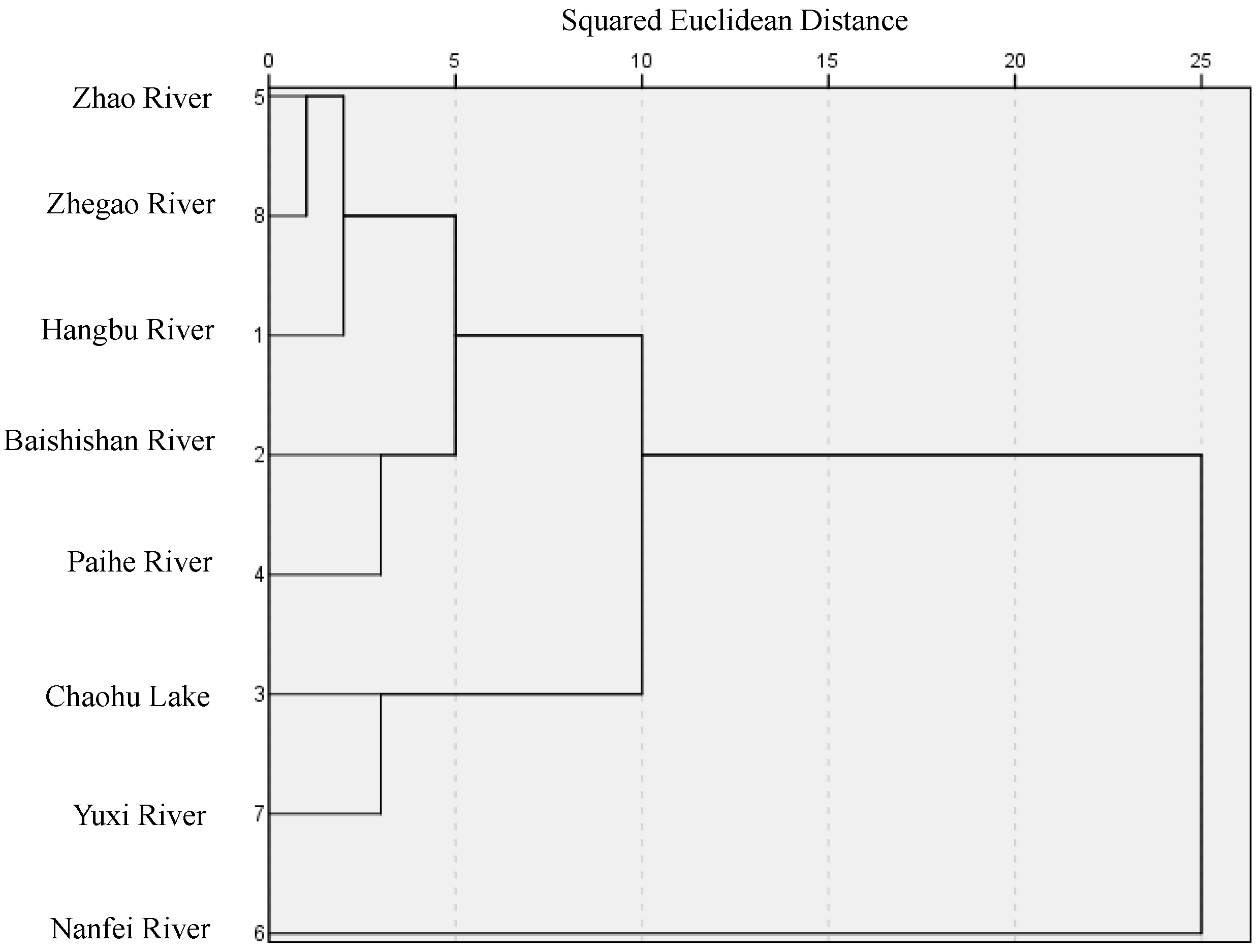
Cluster dendrogram revealed that all sampling sites were grouped into four distinct clusters (Figure 3). Cluster 1 comprised the Zhaohe, Zhegao, and Hangbu Rivers, with a relative low nutrients level; Cluster 2 included the Baishishan and Paihe Rivers; Cluster 3 contained Chaohu Lake and the Yuxi River; while Cluster 4 consisted solely of the Nanfei River, with a high level of nutrients. The Hangbu River is a forested river reach characterized by high vegetation coverage on both banks, minimal discharge of industrial, agricultural, and domestic wastewater [46]. The Zhegao River is a mixed river reach. Its upper reach features hilly terrain, with farmland as the primary land use and a low population density. The middle reach passes through Zhegao Town, where the terrain is gentle, and residential areas line the riverbanks. In the lower reach, extensive growth of aquatic plants such as water hyacinth, reed, and cattail is observed [47]. Although the Zhaohe River is an agricultural river reach, its water quality has shown significant improvement in recent years. The Baishishan and the Paihe Rivers are agricultural and urban river reaches, respectively. The Baishishan River basin has a large area of cultivated land, while the Paihe River flows through urban areas and is significantly impacted by urban runoff and domestic wastewater, resulting in relatively severe pollution. As the only outflow river of Chaohu Lake, the Yuxi River exhibited minimal differences in water quality compared to the lake. The Baishishan, Paihe, and Nanfei Rivers also demonstrated relatively small squared euclidean distances to Chaohu Lake, further confirming their significant influence on the lake’s water quality. This conclusion was consistent with the findings in Section 3.1. Therefore, this study reveals that the urban rivers (Paihe and Nanfei Rivers) and agricultural river (Baishishan River), serve as primary source of nutrients for Chaohu Lake.
Figure 3.
Cluster dendrogram of Chaohu Lake, and its tributaries in both dry and wet seasons over the past five years.
In this study, the KMO measure of sampling adequacy yielded a value of 0.83 (exceeding the threshold of 0.60), and Bartlett’s sphericity was less than 0.01. These results indicated that the water quality data of Chaohu Lake were appropriate for PCA. As shown in Table 4, four principal components were extracted from the dry and wet season data over the past five years. The PC1 accounts for 37.90% of the total variance, indicating that it concentratedly represents 37.90% of the dataset’s information. This component showed strong positive loading for NH4+-N, TP, and TN, while CODMn and conductivity also contributed considerably. As NH4+-N is a typical indicator of domestic and productive wastewater, a high contribution rate of NH4+-N can be attributed to domestic pollution [48]. Moreover, agricultural non-point source was another primary source influencing the nitrogen and phosphorus load of Chaohu Lake. Chaohu Lake Basin is one of China’s most intensive agricultural production regions, and land use is dominated by farmland (about 70%) in the catchment, with rice being the main grain crop [49]. In some regions, an insufficient wastewater treatment capacity leads to the discharge of inadequately treated sewage into water bodies via surface runoff, further elevating TN and TP concentrations. Particularly along the Nanfei and Paihe Rivers corridors, the two tributaries received 90% of the pollutant emissions from the Hefei City. Furthermore, within the Chaohu Lake Basin, the total discharge from rural domestic sewage sources has been reported to reach 2.7 × 10⁷ tons per year [50]. CODMn, on the other hand, may be linked to industrial pollution and rural livestock farming [51,52]. According to statistics, there are many livestock farms within the basin, the total number of livestock is approximately 1.2 × 10⁷ head [50]. These results suggested that the pollutants in the lake and tributaries were likely derived from agricultural runoff and domestic and industrial wastewater, which agreed well with previous findings of lakes in Inner Mongolia and Dianshan lake [11,24].
Table 4.
The component matrix of water quality parameters for Chaohu Lake, and its tributaries in both dry seasons and wet seasons over past five years.
PC2 accounted for 18.19% of the total variance, with DO and turbidity being its primary influencing factors. The contribution rates of PC3 and PC4 were 13.28% and 11.77%, respectively, with temperature and pH as their key factors. This indicated that natural sources played a dominant role in PC2, PC3 and PC4. In conclusion, this study demonstrated that domestic and industrial wastewater and agricultural activities were the primary sources of pollution in Chaohu Lake and its tributaries.
4. Limitations and Future Research
While this study provides insights into the spatio-temporal patterns and pollution sources in Chaohu Lake Basin, several limitations should be acknowledged. First, the assessment relied primarily on conventional physicochemical and nutrient parameters, leaving emerging contaminants (e.g., pharmaceuticals and personal care products) unexamined. Second, while statistical methods identified major pollution sources, the absolute contribution of specific sources (e.g., domestic sewage and agricultural runoff) remains unquantified. Future work should incorporate stable isotope tracing to improve source apportionment accuracy. Finally, integrating hydrological modeling with high-resolution land use data would help simulate the effectiveness of different management scenarios in reducing pollutant loads, thereby bridging the gap between diagnostic analysis and actionable management strategies.
5. Conclusions
Based on an analysis of water quality in Chaohu Lake and its tributaries over the past five years during both wet and dry seasons, it was found that the water quality of the tributaries was poorer than that of the main lake, particularly during the wet seasons, with COD, nitrogen and phosphorus nutrients being the primary pollutants. The most severely polluted tributaries were mainly the Nanfei, Paihe, and Baishishan Rivers due to the urban and agricultural rivers included large nutrient supply. This sufficiently demonstrated that Chaohu Lake possessed a certain self-purification capacity. The main sources of pollution in Chaohu Lake and its tributaries were primarily domestic and industrial wastewater, as well as agricultural activities. Considering urban land cover and populations will continue to expand in the future, it is imperative to implement integrated source control and ecological restoration to mitigate increasing nutrient loads.
Author Contributions
Conceptualization, Z.C., T.W. and Y.L.; methodology, Z.C. and Y.L.; validation, Z.C., F.X., T.W. and Y.L.; writing—original draft preparation, Z.C., F.X. and N.Y.; writing—review and editing, T.W., F.X., Y.L. and Z.Z.; supervision, Z.C., T.W. and Z.Z. All authors have read and agreed to the published version of the manuscript.
Funding
This research supported by the R&D program of China Construction Sixth Engineering Department Co., Ltd. (no. CSCEC6B-2023-Z-11).
Data Availability Statement
The original contributions presented in this study are included in the article. Further inquiries can be directed to the corresponding author.
Conflicts of Interest
Authors Zheng Che, Tianliang Wang, and Zhengguo Zhou were employed by the company China Construction Sixth Engineering Bureau Hydropower Construction Co., Ltd., Tianjin, China. The remaining authors declare that the research was conducted in the absence of any commercial or financial relationships that could be construed as potential conflicts of interest. The authors declare that this study received funding from the R&D program of China Construction Sixth Engineering Department Co., Ltd. The funder was not involved in the study design, collection, analysis, interpretation of data, the writing of this article or the decision to submit it for publication.
References
- Jiang, H.L.; Wang, C.H.; Bai, L.L.; Han, C.; Chen, X.F.; Wang, C.L. Advances and prospects in lake environment science and engineering: A review. J. Lake Sci. 2020, 32, 1278–1296. (In Chinese) [Google Scholar] [CrossRef]
- Gan, Y.; Li, Y.N.; Guo, L.; Tang, H. Comprehensive evaluation of sustainable water resources utilization in nine provinces of the Yellow River Basin based on water footprint. Yellow River 2024, 46, 93–99. (In Chinese) [Google Scholar]
- Shen, M.; Ding, Y.; Duan, H. Construction of “Beautiful Lakes” comprehensive assessment system based on Big Earth Data and SDG 6.3.2. Remote Sens. Technol. Appl. 2020, 35, 295–301. (In Chinese) [Google Scholar]
- Shang, G.P.; Shang, J.C. Spatial and temporal variations of eutrophication in Western Chaohu 628 Lake, China. Environ. Monit. Assess. 2007, 130, 99–109. [Google Scholar] [CrossRef]
- Liu, Y.; Zhang, J.; Wang, H.; Sun, Y.; Tang, P.; Yu, X. Water quality change and influencing factors in Chaohu Lake during the 13th five-year plan period. Environ. Monitor. China 2025, 41, 70–82. (In Chinese) [Google Scholar]
- Wu, L.; Zhang, Y.; Chen, Y.; Geng, M.; Chen, X. Distribution of water environmental factors and evaluation of trophic state in the river-lake system of Chaohu Lake Basin. J. Hydroecol. 2023, 44, 65–72. (In Chinese) [Google Scholar]
- Huang, J.; Zhang, Y.; Huang, Q.; Gao, J. When and where to reduce nutrient for controlling harmful algal blooms in large eutrophic lake Chaohu, China? Ecol. Indic. 2018, 89, 808–817. [Google Scholar] [CrossRef]
- Wu, Z.; Lai, X.; Li, K. Water quality assessment of rivers in Lake Chaohu Basin (China) using water quality index. Ecol. Indic. 2021, 121, 107021. [Google Scholar] [CrossRef]
- Li, M.; Dong, J.; Zhang, Y.; Yang, H.; Van Zwieten, L.; Lu, H.; Wang, H. A Critical Review of Methods for Analyzing Freshwater Eutrophication. Water 2021, 13, 225. [Google Scholar] [CrossRef]
- Xin, H.; Su, S.; Zhou, T.; Ma, K.; Zhao, W.; Zhang, G. Study on water quality of drinking water source in Maqu county based on different evaluation methods. Water Wastewater Eng. 2023, 49, 212–217. (In Chinese) [Google Scholar]
- Zhang, H.; Shi, X.; Zhao, S.; Quan, D.; Sun, B.; Zhang, S. Eutrophication characteristics of the East Chagannaoer Lake in Inner Mongolia and their influencing factors. Wetland Sci. 2023, 21, 842–849. (In Chinese) [Google Scholar]
- Qian, C.; Wang, X.; Luo, F.; Xu, D.; Wu, B.; Xue, Y.; Wen, X.L. Application limitations and improvement recommendation of trophic state indices in the eutrophication level assessment of small shallow lakes along the lower reach of the Yangtze River. J. Lake Sci. 2023, 35, 1173–1184. (In Chinese) [Google Scholar] [CrossRef]
- Wang, C.; Guo, Z.; Li, Q. Fuzzy comprehensive evaluation of seawater quality in Jiulongjiang Estuary. J. Appl. Oceanogr. 2023, 42, 66–74. (In Chinese) [Google Scholar]
- Shi, C.; Liu, Q.; Yang, Y.; An, D.; Liu, Y.; Zu, G. Comparative study on water quality assessment of small and medium-sized rivers in the Yellow River Basin. J. Henan Norm. Univ. (Nat. Sci. Ed.) 2024, 52, 16–27. (In Chinese) [Google Scholar]
- Ye, W.; Song, W.; Cui, C.F.; Wen, J.H. Water quality evaluation method based on a TS fuzzy neural network—Application in water environment trend analysis of Taihu lake basin. Water 2021, 13, 3127. [Google Scholar] [CrossRef]
- Yang, H.; Jia, C.; Yang, F.; Yang, X.; Wei, R. Water quality assessment of deep learning-improved comprehensive pollution index: A case study of Dagu River, Jiaozhou Bay, China. Environ. Sci. Pollut. Res. 2023, 30, 66853–66866. [Google Scholar] [CrossRef] [PubMed]
- Wu, Z.; Wang, X.; Chen, Y.; Cai, Y.; Deng, J. Assessing river water quality using water quality index in Lake Taihu Basin, China. Sci. Total Environ. 2018, 612, 914–922. [Google Scholar] [CrossRef] [PubMed]
- Li, Z.; Peng, Y.; Wang, C.; Li, G.; Cai, W. Spatial characteristics and influencing factors of water quality condition of small lakes in Dongting Lake area. Environ. Sci. Technol. 2025, 48, 152–160. (In Chinese) [Google Scholar]
- Qu, X.; Chen, Y.; Liu, H.; Xia, W.; Lu, Y.; Guang, D.; Lin, L. A holistic assessment of water quality condition and spatiotemporal patterns in impounded lakes along the eastern route of China’s South-to-North water diversion project. Water Res. 2020, 185, 116275. [Google Scholar]
- Wang, J.; Zhou, W.; Zhao, M.; Guo, X. Water quality assessment and pollution evaluation of surface water sources: The case of Weishan and Luoma Lakes, Xuzhou, Jiangsu Province, China. Environ. Technol. Innov. 2023, 32, 103397. [Google Scholar] [CrossRef]
- Patel, P.S.; Pandya, D.M.; Shah, M. A systematic and comparative study of Water Quality Index (WQI) for groundwater quality analysis and assessment. Environ. Sci. Pollut. Res. 2023, 30, 54303–54323. [Google Scholar] [CrossRef]
- Uddin, M.G.; Nash, S.; Rahman, A.; Olbert, A.I. A comprehensive method for improvement of water quality index (WQI) models for coastal water quality assessment. Water Res. 2022, 219, 118532. [Google Scholar] [CrossRef]
- Ni, B.; Liu, X.; Wu, Y.; Jiang, M.; Zou, Y. A comprehensive water quality assessment for a typical river–lake watershed in Northeast China: Implications for the water management of boundary lake. Ecol. Indic. 2025, 178, 113942. [Google Scholar] [CrossRef]
- Ning, C.T.; Yang, H.Q.; Wang, J.; Chen, Y.H.; Chen, J.Q.; Ma, Z.F. Analysis of the spatial and temporal evolution characteristics of Dianshan Lake water quality and its main influencing factors. Acta Sci. Circumstantiae. 2025. Available online: https://link.cnki.net/urlid/11.1843.X.20250908.1105.003 (accessed on 11 December 2025). (In Chinese).
- Zhang, W.; Li, H.; Xiao, Q.; Jiang, S.; Li, X. Surface nitrous oxide (N2O) concentrations and fluxes from different rivers draining contrasting landscapes: Spatio-temporal variability, controls, and implications based on IPCC emission factor. Environ. Pollut. 2020, 263, 114457. [Google Scholar] [CrossRef] [PubMed]
- Zhang, W.; Li, H.; Xiao, Q.; Li, X. Urban rivers are hotspots of riverine greenhouse gas (N2O, CH4, CO2) emissions in the mixed-landscape Chaohu lake basin. Water Res. 2021, 189, 116624. [Google Scholar] [CrossRef] [PubMed]
- Spears, B.M.; Carvalho, L.; Dudley, B.; May, L. Variation in chlorophyll a to total phosphorus ratio across 94 UK and Irish lakes: Implications for lake management. J. Environ. Manag. 2013, 115, 287–294. [Google Scholar] [CrossRef] [PubMed]
- Mamun, M.; Kwon, S.; Kim, J.E.; An, K.J. Evaluation of algal chlorophyll and nutrient relations and the N: P ratios along with trophic status and light regime in 60 Korea reservoirs. Sci. Total Environ. 2020, 741, 140451. [Google Scholar] [CrossRef]
- Horton, R.K. An index-number system for rating water quality. Water Pollut. 1965, 37, 300–306. [Google Scholar]
- Chidiac, S.; El Najjar, P.; Ouaini, N.; El Rayess, Y.; El Azzi, D. A comprehensive review of water quality indices (WQIs): History, models, attempts and perspectives. Rev. Environ. Sci. Bio/Technol. 2023, 22, 349–395. [Google Scholar] [CrossRef]
- Pesce, S.F.; Wunderlin, D.A. Use of water quality indices to verify the impact of Cordoba City (Argentina) on Suquia River. Water Res. 2000, 34, 2915–2926. [Google Scholar] [CrossRef]
- Jonnalagadda, S.B.; Mhere, G. Water quality of the Odzi River in the Eastern Highlands of Zimbabwe. Water Res. 2001, 35, 2371–2376. [Google Scholar] [CrossRef] [PubMed]
- GB3838-2002; Environmental Quality Standards for Surface Water. China Standard Press: Beijing, China, 2017. (In Chinese)
- Quick, A.M.; Reeder, W.J.; Farrell, T.B.; Tonina, D.; Feris, K.P.; Benner, S.G. Nitrous oxide from streams and rivers: A review of primary biogeochemical pathways and environmental variables. Earth-Sci. Rev. 2019, 191, 224–262. [Google Scholar]
- Tang, P.; Hu, W. Overview of the water environmental quality of Chaohu River Basin from 2001 to 2012 and a brief analysis of the main problems and reasons for changes. Sci. Technol. Inf. 2013, 25, 413–489. (In Chinese) [Google Scholar]
- Xi, S.; Zhou, C.; Liu, G.; Wu, L.; Wang, P. Spatial and temporal distributions of nitrogen and phosphate in the Chaohu Lake. Environ. Sci. 2016, 37, 542–547. (In Chinese) [Google Scholar]
- Mooney, R.J.; Stanley, E.H.; Rosenthal, W.C.; Esselman, P.C.; Kendall, A.D.; McIntyre, P.B. Outsized nutrient contributions from small tributaries to a Great Lake. Proc. Natl. Acad. Sci. USA 2020, 117, 28175–28182. [Google Scholar] [CrossRef]
- Qin, B.Q.; Zhou, J.; Elser, J.J.; Gardner, W.S.; Deng, J.M.; Justin, D.B. Water depth underpins the relative roles and fates of nitrogen and phosphorus in lakes. Environ. Sci. Technol. 2020, 54, 3191–3198. [Google Scholar] [CrossRef]
- Downing, J.A.; Watson, S.B.; Mccauley, E. Predicting cyanobacteria dominance in Lakes. Can. J. Fish. Aquat. Sci. 2001, 58, 1905–1908. [Google Scholar] [CrossRef]
- Chen, X.; Wang, Y.; Sun, T.; Chen, Y.; Zhang, M.; Ye, C. Evaluation and prediction of water quality in the dammed estuaries and rivers of Taihu Lake. Environ. Sci. Pollut. Res. 2022, 29, 12832–12844. [Google Scholar]
- Wu, Z.; Zhang, D.; Cai, Y.; Wang, X.; Zhang, L.; Chen, Y. Water quality assessment based on the water quality index method in Lake Poyang: The largest freshwater lake in China. Sci. Rep. 2017, 7, 17999. [Google Scholar] [CrossRef]
- Chen, L.; Tian, Z.; Zou, K. Water quality evaluation based on the water quality index method in Honghu Lake: One of the largest shallow lakes in the Yangtze River Economic Zone. Water Supply 2020, 20, 2145–2155. [Google Scholar] [CrossRef]
- He, J.; Zhang, Y.K.; Zhao, Y.Q.; Han, S.B.; Liu, Y.Q.; Zhang, T. Hydrochemical characteristics and possible controls of groundwater in the Xialatuo basin section of the Xianshui River. Environ. Sci. 2019, 40, 1236–1244. (In Chinese) [Google Scholar]
- Zhang, T.; Wang, M.G.; Zhang, Z.Y.; Liu, T.; He, J. Hydrochemical characteristics and possible controls of the surface water in Ranwu Lake basin. Environ. Sci. 2020, 41, 4003–4010. [Google Scholar]
- Liu, J.K. Advanced Aquatic Biology; Science Press: Beijing, China, 1999. [Google Scholar]
- Zhou, H.; Wu, L.; Ma, C.; Guan, H.; Sun, X.; Lu, S.; Shang, G.; Wang, Y.; Xu, Y.; Xu, J.; et al. Holocene environmental evolution recorded by multi-proxies from lacustrine sediments of the Hangbu River Valley, Lake Chaohu Basin, East China. J. Lake Sci. 2020, 32, 1869–1881. (In Chinese) [Google Scholar] [CrossRef]
- Chu, Y.; Zhu, J.; Xia, S.; Ma, Y.; Wang, L.; Li, Y.; Li, X. Temporal and spatial variation of water pollution in Zhegao River of Chao Lake Basin. J. Soil Water Conserv. 2011, 25, 243–248. (In Chinese) [Google Scholar]
- Guan, Y. Calculation of the load of non-point source pollution entering Wulansu Lake in the Wulansu Lake Basin. Inner Mong. Sci. Technol. Econ. 2020, 2, 49–52. (In Chinese) [Google Scholar]
- Wu, H.; Yang, T.; Liu, X.; Li, H.; Gao, L.; Yang, J.; Li, X.; Zhang, L.; Jiang, S. Towards an integrated nutrient management in crop species to improve nitrogen and phosphorus use efficiencies of Chaohu Watershed. J. Clean Prod. 2020, 272, 122765. [Google Scholar] [CrossRef]
- Feng, X.; Lin, C.; Xiong, J.; Chen, X.; Wu, Z.; Ma, R. Effects of nonpoint source pollution from different sources on lake nitrogen and phosphorus: A case study of Chaohu Lake basin. J. Agric. Resour. Environ. 2023, 40, 64–75. (In Chinese) [Google Scholar]
- Liu, J.; Sun, S.; Wu, P.; Wang, Y.; Zhao, X. Evaluation of crop production, trade, and consumption from the perspective of water resources: A case study of the Hetao irrigation district, China, for 1960–2010. Sci. Total Environ. 2015, 505, 1174–1181. [Google Scholar] [CrossRef] [PubMed]
- Adjovu, G.E.; Stephen, H.; James, D.; Ahmad, S. Measurement of total dissolved solids and total suspended solids in water systems: A review of the issues, conventional, and remote sensing techniques. Remote Sens. 2023, 15, 3534. [Google Scholar] [CrossRef]
Disclaimer/Publisher’s Note: The statements, opinions and data contained in all publications are solely those of the individual author(s) and contributor(s) and not of MDPI and/or the editor(s). MDPI and/or the editor(s) disclaim responsibility for any injury to people or property resulting from any ideas, methods, instructions or products referred to in the content. |
© 2025 by the authors. Licensee MDPI, Basel, Switzerland. This article is an open access article distributed under the terms and conditions of the Creative Commons Attribution (CC BY) license (https://creativecommons.org/licenses/by/4.0/).