
Abstract
The foundation for ensuring the sustainable utilization of natural resources and human well-being lies in achieving a harmonious balance between nature and humans. In the Yellow River basin (YRB), numerous water crises, including floods, droughts, soil erosion, and water pollution, threaten its crucial role as a significant economic belt and ecological barrier. Unfortunately, less comprehension regarding the complex human–water relationship in this region has impeded watershed water management decision-makers from identifying key priorities for intervention. Here, we selected 29 evaluation indicators, including water resources, environment, ecology, society, economy, and science and technology from three dimensions: healthy water systems, sustainable human systems, and synergy of human–water system. We applied the entropy weight method, hierarchical analysis, and Single index quantification, multiple index synthesis, and poly-criteria integration (SMI-P) methods to quantify the spatial–temporal variation of the human–water harmony degree (HWHD) in nine provinces of the YRB from 2002 to 2021. We observed a consistent increase in the HWHD across all provinces in the YRB in the past two decades. Notably, five provinces have transitioned from Complete disharmony (0 ≤ HWHD ≤ 0.2) to Nearly complete disharmony (0.2 < HWHD ≤ 0.4). Additionally, the average growth rate of the downstream provinces is faster compared to those upstream. By 2021, the HWHD of upstream provinces like Sichuan and Ningxia, constrained by slower growth, became the two lowest provinces of the YRB, at 0.19 and 0.12 respectively. These findings offer valuable guidance for the region and similar areas grappling with the complex challenges of human–water conflicts, providing insights to navigate and address such dilemmas effectively.
1. Introduction
Water serves as the fundamental resource for humanity and is indispensable for fostering social development and well-being [1,2]. As the global population and societal development continue to rise, the increasing demand for water resources exacerbates its impact on the water environment [3]. The escalating water crisis, encompassing issues like water scarcity, flood disasters, and polluted groundwater, threatens human survival and sustainable development, posing a significant challenge to global social security [4,5]. The projected global urban population experiencing water scarcity is expected to triple by 2050 compared to the levels observed in 2016 [5]. Moreover, populations exposed to river flooding are predicted to increase by 4–20 fold by the years of 2100 [6]. Therefore, comprehending the interplay between human and water systems and promoting their sustainable development has become both urgent and imperative.
The human system, centered around humanity, encompasses social activities, economic development, scientific and technological progress, and other factors critical to human survival [7]. Accordingly, the water system comprises the water consumption and demand of related sectors, as well as the environmental background conditions of water resources. The interplay between human activities and water environment status is exceptionally intricate [8]. Currently, the quantification of this relationship employs either single or comprehensive indicators. When focusing on single indicators, researchers often construct evaluation metrics based on the contrast between water supply and demand, with commonly employed measures such as water shortage index [9], water stress index [10], water use efficiency [11,12], and others. However, these single indicators reflect only one aspect of the complex relationship. Conversely, comprehensive indicators and integrated assessment models offer a more holistic approach, such as the water poverty index [13,14], water resources carrying capacity index [15], water security index [16], and human–water harmony index [17]. These comprehensive metrics offer a more nuanced understanding of the multifaceted relationship within the human–water system, helping to promote synergies between human development and water environment health.
Related research of human–water harmonious is a forward-looking exploration grounded in the mechanisms of interaction, adaptation, and balance principle within human–water system [17]. Its primary objective is to promote a virtuous cycle within the human–water system. This will enhance the self-maintenance and renewal capabilities of the water system, ensuring that water resources can offer enduring support and assurance sustainable economic growth and social development [18]. Research on human–water harmonious has evolved from qualitative inquiries at the beginning of the 21st century to a more quantitative approach today. Key components of this research now encompass the exploration of interaction mechanisms within human–water systems, the quantitative analysis and simulation of the human–water relationship, and the optimization of schemes promoting such harmony [19,20,21]. These studies have found widespread application across various scales, including national, provincial, urban, and watershed levels. In this study by Ding et al. [17], 27 indicators related to social development, system coordination, and public satisfaction were utilized to establish the Human–Water Harmony Index (HWHI) grounded in the concept of harmony with its application to five megalopolises of China. Building upon this framework, Zuo et al. [18] determined the harmonious balance constraint and regulation by quantifying the equilibrium state of the human–water relationship of six criteria in 43 countries along the Belt and Road. Duan et al. [19] constructed a human–water-nexus-based evaluation system, in which 13 indicators of 8 sustainable development goals (i.e., SDGs 2, 6, 8, 9, 11, 12, 13, and 17) associated with water, society, and ecology criteria were analyzed. These studies evaluate human–water relationship by examining specific factors related to water resources within human systems, including water quantify, water quality, water use structure, and the dynamic balance between supply and demand. Unfortunately, they primarily focus on enhancing the health of water systems and promoting the sustainable development of human systems, while overlooking the harmonized development of the two [17,22]. The latter aspect is crucial for promoting the healthy, orderly, and sustainable development of both systems simultaneously.
Yellow River Basin (YRB) serves as a representative example of human–water interaction [23,24]. The basin’s environment is significantly influenced by human activities, meanwhile, water resource scarcity emerges as a critical constraint for the socio-economic development of the region [25]. Nonetheless, a comprehensive analysis of the evolution of the human–water relationship in the YRB is hindered by the insufficient simulation on key process, vital variables, mutual feedback relationships, and a lack of comprehension regarding common mechanisms. Simultaneously, both domestically and internationally, there is a scarcity of research cases focusing on identifying the evolutionary mechanisms and assessing the external effects of the synergistic mechanism between water resources utilization and human activities in the large river basins [26].
To address these knowledge gaps, we selected 29 evaluation indicators to construct the Human–water harmony degree (HWHD) evaluation framework, encompassing three dimensions: healthy water systems, sustainable human systems, and synergy between human and water systems. Meanwhile, we combined the Entropy Weight method (EW) and Analytic Hierarchy Process (AHP) into one framework to determine every indicator’s weight. According to the harmony theory, we employed the Single index quantification, multiple index synthesis, and poly-criteria integration (SMI-P) method to quantify the HWHD. Generally, we analyzed the intricate relationship between humans and water in YRB from 2002 to 2021 and explore their synergistic development from an integrated perspective. Hence, the systematic quantification of the dynamic evolving process of the HWHD in the YRB can serve as a scientific foundation for fostering ecological health and sustainable development within the YRB. Furthermore, it can facilitate to the development of earth system science in China through integrated basin research.
2. Methods
2.1. Calculation of Comprehensive Weight
As an objective weighting method, EW judges the degree of dispersion of the index through the information entropy of the index data, while it neglects the actual demand of decision-makers for indicators [27]. AHP judges the relative importance of each indicator according to the experience of decision makers, however, the evaluation results are prone to fluctuate due to subjective human factors [28]. It is desired an integrated EW-AHP method should be developed to overcome the above issues [29]:
, , and are the comprehensive, subjective, and objective weights of the index , respectively.
2.2. Calculation of HWHD
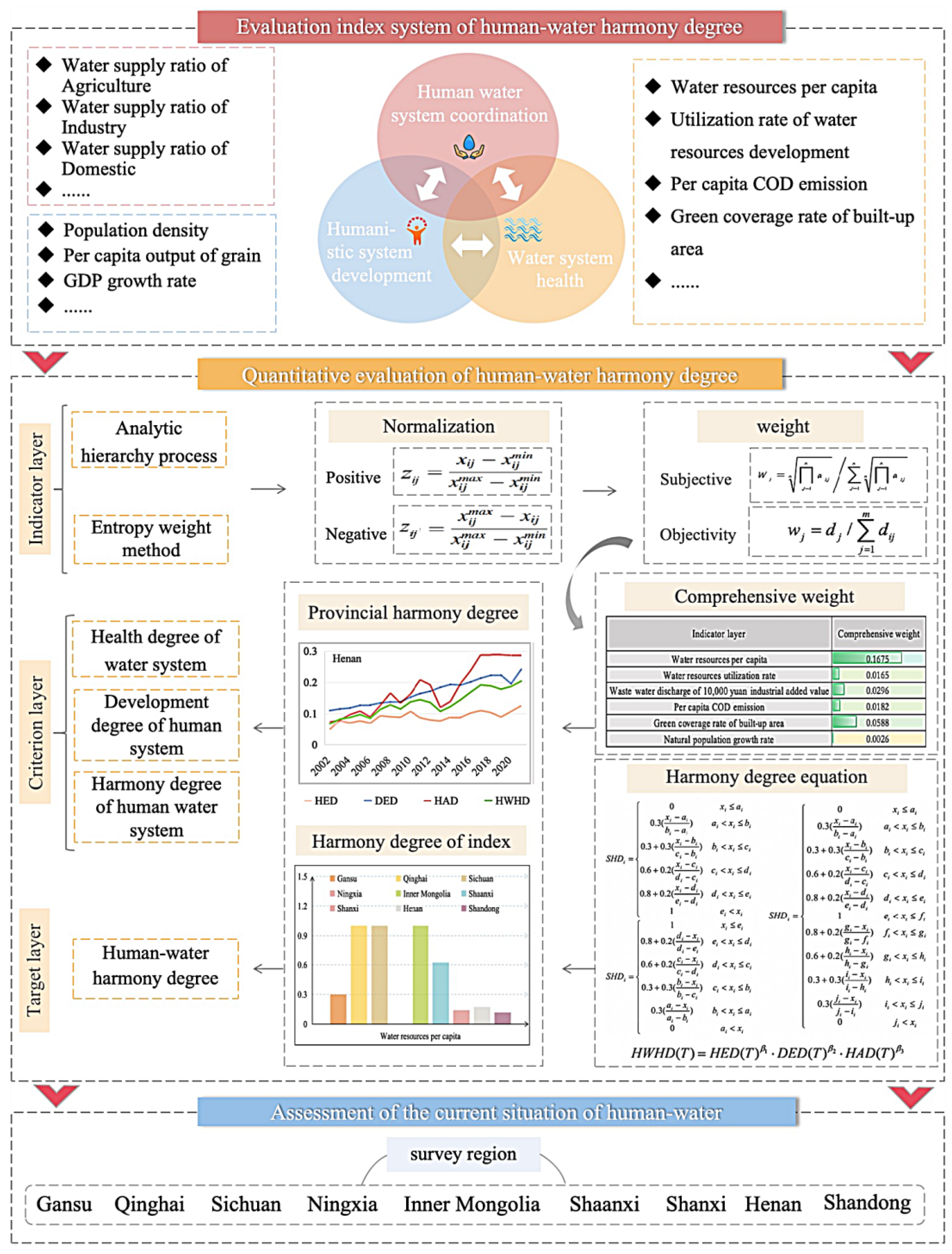
Here, we utilized the evaluation approach of SMI-P to assess the HWHD [30]. HWHD is further segmented into the three sub-harmony degrees (SHD), named healthy water systems (HED), sustainable human systems (HAD), and synergy between human and water systems (DED), respectively. The SHD of each indictor was determined based on the assumed fuzzy membership within the range of [0, 1] as shown in Figure 1 [19]. These SHD are detailed in the following calculated equations [31].
where T and n indicate the time and number of indicator; shows the indicator value; presents the indicator’s weight; indicates the sub-harmony degree; and , , and represent the sub-harmony of each criterion, respectively.
Figure 1.
Study framework.
Then, the final HWHD can be achieved as follows:
where the final human–water harmony degree; , , and are the weights of each criteria, respectively; generally, the weights of each criteria are assumed as equal (i.e., 1/3). The harmony grading standards were based on the final HWHD and were equally segmented into five intervals from 0 to 1 [31].
3. Case Study
As the second longest river in China, YRB covers approximately 7950 hm2. It constitutes 2.56% of the national total water resources, while sustains 12% of the population, irrigates 13% of farmland, and contributes 13% of food and 14% of GDP in China [27]. In 2021, the total population in YRB is 421 million, and the GDP is CNY 28,778.3 billion. However, the per capita water resources in this basin are 26,824 m3 per person, occupying about 1/4 of the world average level, which evolves into the biggest contradiction in the YRB. Due to the serious imbalance between social and economic development and natural hydrological process and ecosystem process, the YRB is one of the most prominent and complicated areas in China. It has become a national strategic plan to protect the ecological environment and promote the high-quality development of the YRB. Meanwhile, several national development plans were also published toward the harmonious human–water relationship. In detail, during the 14th Five-Year Plan, the water ecological environmental protection work should pay more attention to human–water harmony by the Ministry of Ecology and Environment of the people’s Republic of China. In the year of 2024, opinions of thoroughly promoting the construction of Beautiful China were published by the CPC and State council, aiming at accelerating the modernization of harmonious coexistence between human and nature, especially for building the pilot zone for ecological protection and high-quality development of the YRB.
Thus, we built a comprehensive human–water harmony evaluation system to promote the implementation of national strategies. As shown in Figure 1, the constructed human–water harmony evaluation system encompasses three aspects: the evaluation indicators of HWHD, calculation of weights based on AHP and EW, and the spatio-temporal analysis of HWHD in the YRB from 2002 to 2021.
To reflect the prominent contradictions between human and water systems in nine provinces of YRB in the past two decades, we employed 29 indicators to construct a human–water harmony evaluation system based on harmony theory, including three dimensions: healthy water systems, sustainable human systems, and synergy between human and water systems [21], as shown in Table 1. A healthy water system necessitates the preservation of ecological functions in rivers, lakes, groundwater, and other water sources, with robust self-repair and renewal capabilities and resistance to shocks. Thus, we chose Water resources per capita, Water resources utilization rate, and Per capita COD emission to express the health conditions. Sustainable water systems require socio-economic development to be managed in a way that doesn’t compromise life support on earth. Thus, indicators of Proportion of employees in the tertiary industry, Per capita disposable income of urban residents, and Per capita disposable income of rural residents were presented for development. Synergy between human and water systems mandates that water systems must provide necessary and robust support for human and social economic development. Meanwhile, humans are expected to continually safeguard the health of rivers and take proactive measures to transform the relationship between humans and water into a virtuous cycle. Therefore, the synergy indicators were chosen in terms of Water supply ratio of industry, Water supply ratio of domestic, and Water supply ratio of ecology.
Table 1.
Evaluation indicator standard threshold.
During the data processing, most data were obtained by the national statistical yearbooks. Some non-uniform data such as water resources per capita, proportion of output value of tertiary industry in GDP, and college students per 10,000 people were obtained by the statistical yearbooks of each province in the YRB. Several indicators such as per capita grain yields, urbanization rate, and irrigation water per mu of farmland were collected from Chinese economic and social big data research platform. A linear interpolation approach was also introduced to address the issue of missing data and fill in the continuous data from 2002 to 2021. All the source data are illustrated in this paper and are available from http://data.stats.gov.cn, https://data.cnki.net, (accessed on 30 December 2023), or the corresponding author upon reasonable request.
4. Results
4.1. Result of Weight
Weight is a parameter used to measure the contribution of each indicator to the system. The accuracy of the weights directly affects the accuracy of the evaluation results. There are many methods to determine weights, including subjective weight and objective weight. Subjective weight is determined by the evaluator’s subjective understanding of the index, which is greatly influenced by the evaluator’s subjective influences. Objective weight is determined by the objective law between the index data, which is greatly influenced by the original data of the index. In order to avoid the subjectivity and one-sidedness of a single method affecting the evaluation results, this paper adopts a comprehensive weight that uses multiple weights. Its subjective weight uses the analytic hierarchy process, its objective weight uses the entropy weight, and its comprehensive weight is used to synthesize the two weights [31]. Table 2 shows the subjective weights, objective weights, and comprehensive weights of each indicator in the nine provinces studied based on the EW-AHP method. Overall, the indicators with large subjective weights are the green coverage rate of built-up area, water resources utilization rate, and the waste water discharge per CNY 10,000 of industrial added value, which are 0.14, 0.11, and 0.10, respectively. The indicators with large objective weights are Water resources per capita and the water supply ratio of ecology, which are 0.18 and 0.07, respectively. According to the comprehensive weight calculation method which was introduced in 2.1, the comprehensive weights of the water supply ratio of ecology and the water resources per capita are relatively large: 0.22 and 0.17, respectively.
4.2. Temporal Variation of HWHD
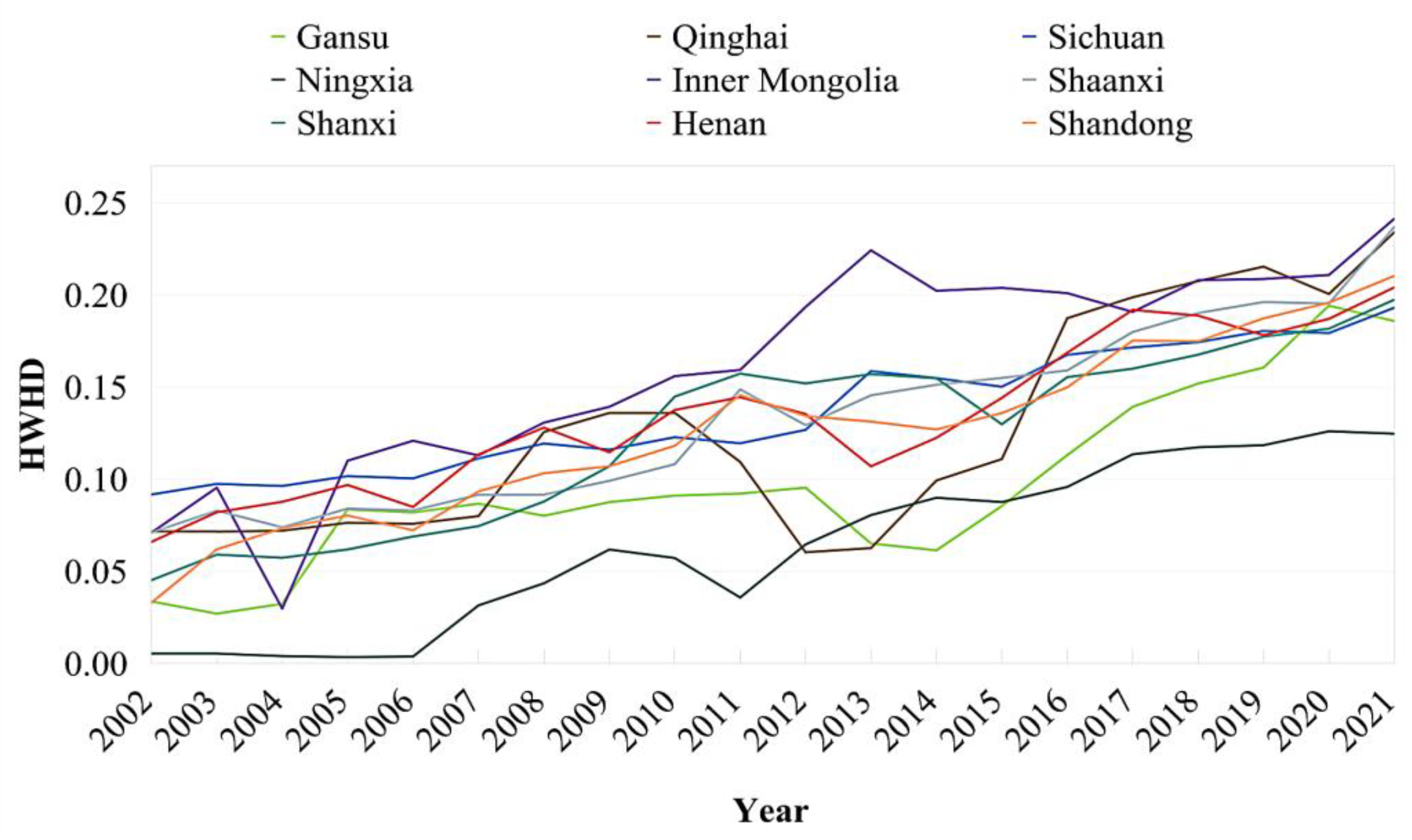
Figure 2 illustrates the temporal trend of the HWHD in the YRB during 2002–2021. Our analysis reveals that although the HWHD of the nine provinces in the Yellow River basin has remained in Nearly complete disharmony or Complete disharmony (HWHD < 0.4) over the past 20 years, there has been an upward trend. By 2021, five provinces had transitioned from Complete disharmony (0 ≤ HWHD ≤ 0.2) to Nearly complete disharmony (0.2 < HWHD ≤ 0.4). Notably, provinces such as Shandong, Inner Mongolia, and Shaanxi exhibit substantial increases in HWHD, with variations of 0.18, 0.17, and 0.17, respectively. Conversely, upstream basin provinces like Sichuan and Ningxia experience mitigated increases, rising only by 0.10 and 0.12, respectively, from 2002 to 2021 (as shown in Figure 3). In addition, the HWHD in Ningxia is notably lower than that of other provinces, consistent with the findings of Shi et al. (2023) [21]. This can be attributed to Ningxia’s lowest water resources per capita among all provinces, which holds the higher weight among all evaluation indicators. It’s also related to the disparities in economic and technological development, geographic and climatic factors, as well as pertinent national or local regulations.
Figure 2.
The temporal changes of HWHD across nine provinces in the YRB from 2002 to 2021.
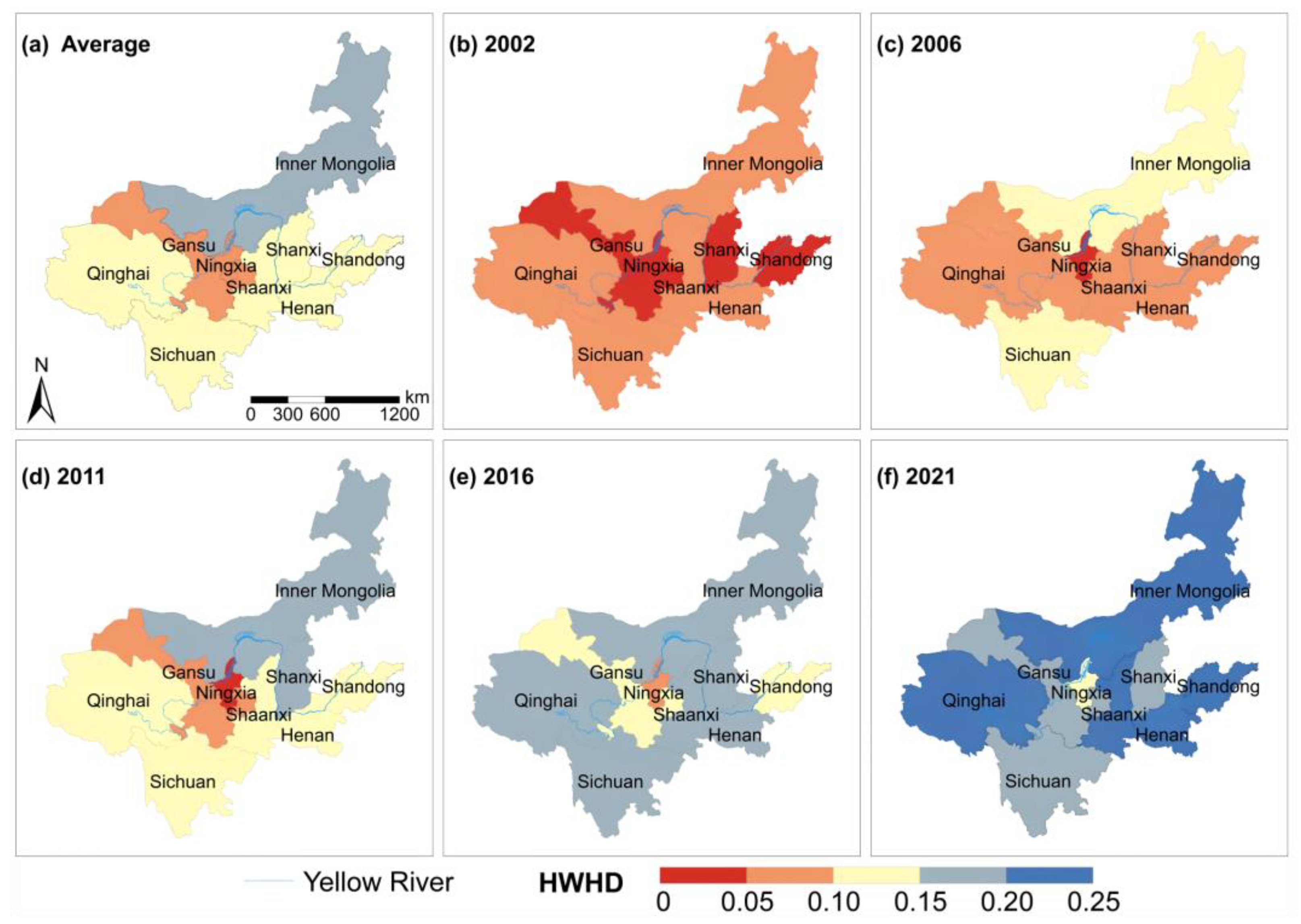
Figure 3.
Spatial distribution of HWHD across nine provinces for the mean of 2002 to 2021.
Table 2.
Comprehensive weights of indicators in nine provinces.
Table 2.
Comprehensive weights of indicators in nine provinces.
| Indicator Layer | Subjective Weight | Objective Weight | Comprehensive Weight |
|---|---|---|---|
| Water resources per capita | 0.0238 | 0.1859 | 0.1675 |
| Water resources utilization rate | 0.1190 | 0.0037 | 0.0165 |
| Waste water discharge per CNY 10,000 of industrial added value | 0.1071 | 0.0073 | 0.0296 |
| Per capita COD emission | 0.0357 | 0.0135 | 0.0182 |
| Green coverage rate of built-up area | 0.1429 | 0.0109 | 0.0588 |
| Natural population growth rate | 0.0039 | 0.0178 | 0.0026 |
| Urbanization rate | 0.0317 | 0.0216 | 0.0259 |
| population density | 0.0025 | 0.0339 | 0.0033 |
| Proportion of employees in the tertiary industry | 0.0051 | 0.0294 | 0.0057 |
| Engel’s coefficient for urban residents | 0.0204 | 0.0139 | 0.0107 |
| Per capita disposable income of urban residents | 0.0089 | 0.0586 | 0.0197 |
| Per capita disposable income of rural residents | 0.0089 | 0.0634 | 0.0214 |
| Per capita grain yields | 0.0143 | 0.0550 | 0.0298 |
| Per capita comprehensive water consumption | 0.0470 | 0.0142 | 0.0252 |
| Per capita GDP | 0.0145 | 0.0536 | 0.0294 |
| Per capita fiscal revenue | 0.0243 | 0.0634 | 0.0584 |
| Per capita total social fixed asset investment | 0.0131 | 0.0674 | 0.0335 |
| Proportion of output value of tertiary industry in GDP | 0.0183 | 0.0288 | 0.0199 |
| GDP growth rate | 0.0504 | 0.0206 | 0.0392 |
| Growth rate of output value of tertiary industry | 0.0223 | 0.0033 | 0.0028 |
| Water consumption per CNY 10,000 of GDP | 0.0251 | 0.0047 | 0.0045 |
| Water consumption per CNY 10,000 of industrial added output | 0.0381 | 0.0047 | 0.0067 |
| Irrigation water per mu of farmland | 0.0089 | 0.0116 | 0.0039 |
| Reuse rate of urban industrial water | 0.0138 | 0.0135 | 0.0071 |
| College students per 10,000 people | 0.0570 | 0.0288 | 0.0621 |
| Water supply ratio of agriculture | 0.0168 | 0.0237 | 0.0151 |
| Water supply ratio of industry | 0.0079 | 0.0395 | 0.0117 |
| Water supply ratio of domestic | 0.0376 | 0.0348 | 0.0496 |
| Water supply ratio of ecology | 0.0805 | 0.0725 | 0.2209 |
4.3. Spatial Variation of HWHD
Figure 3 gives the spatial variation of HWHD in 2002, 2006, 2011, 2016, and 2021, along with the average HWHD over the past two decades. With the exception of 2012−2015, HWHD of Ningxia has always been lower than other provinces. However, since 2006, HWHD of Ningxia has been significantly improved. It mainly due to the influence of economy, science and technology, and the per capita GDP and per capita financial revenue have notably improved. The water consumption per CNY 10,000 of GDP and growth rate of output value of tertiary industry decreased significantly. Over the past two decades, HWHD has notably improved in most of provinces, particularly in Shandong Province. Thanks to the increase in available water resources and the decrease in water consumption, the water resources utilization rate in Shandong province has decreased year by year. Consequently, its HWHD increased gradually, and the HWHD value reached 0.21 after 2020. In contrast, given the considerably lower value of the water supply ratio of ecology in Sichuan, which acts as the direct driving index of HWHD, coupled with its slow growth rate, the overall HWHD growth rate in the region is relatively sluggish. As a result, by 2020, Sichuan ranks as the third lowest in HWHD after Ningxia and Gansu. Additionally, we observed that the HWHD in downstream areas is generally higher than that in upstream areas, but this gap between upstream and downstream has been diminishing in recent years.
4.4. The Evaluation Results of Three Subsystems
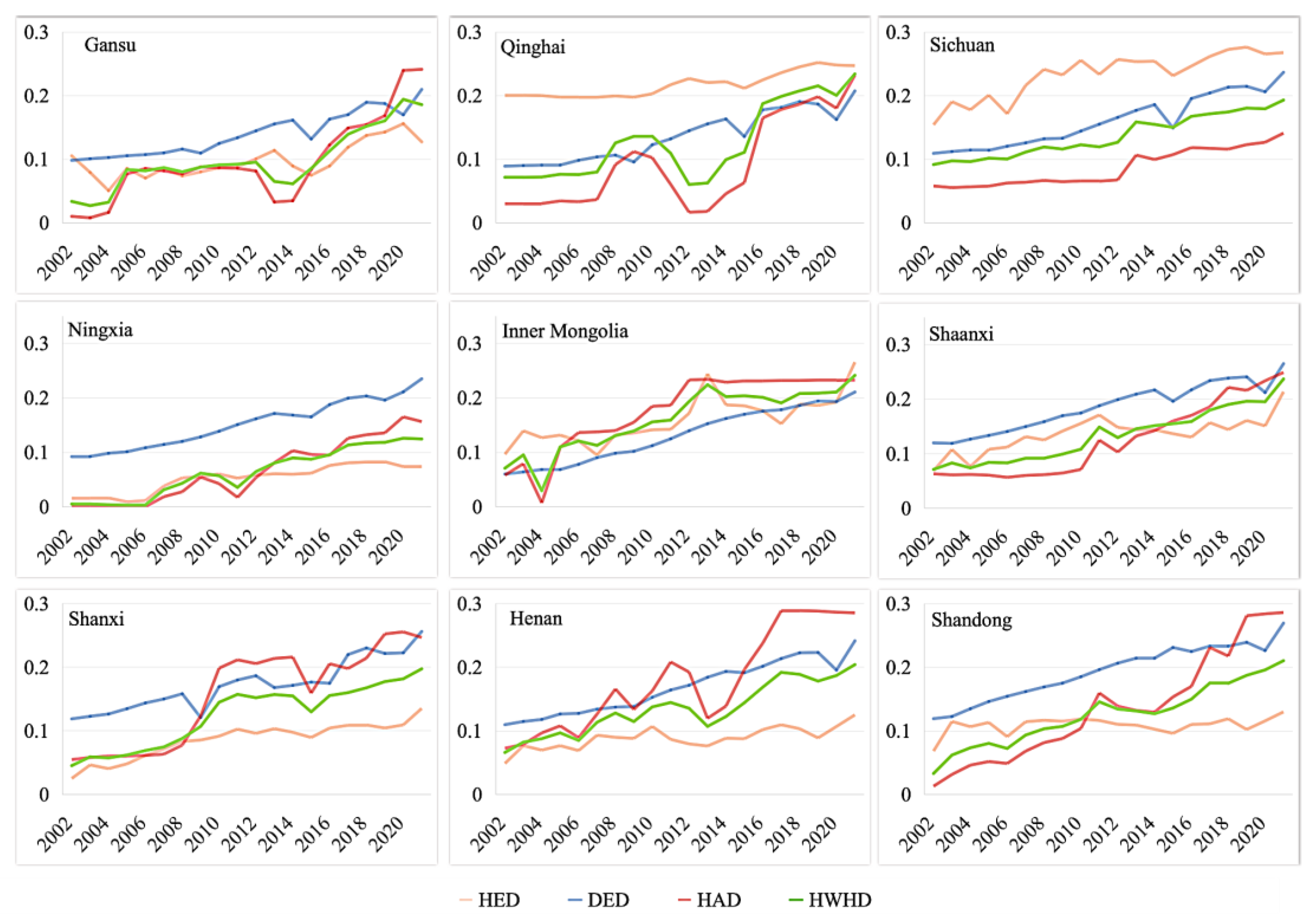
The evaluated results in the three sub-criterion, healthy water systems (HED), sustainable human systems (HAD), and synergy between human and water systems (DED), are depicted in Figure 4. Overall, the harmony degrees of each subsystem across the nine provinces improved from 2002 to 2021. Furthermore, the harmony degrees of each subsystem varied among the provinces. For instance, the HED in the nine provinces exhibited less fluctuation and maintained consistent increments from 2002 to 2021. Among these provinces, Inner Mongolia demonstrated the highest growth range, rising from 0.10 to 0.27, with a notable increase observed in 2013. This surge can be attributed to a significant reduction in Water resources utilization rate in the same year. Meanwhile, the HED of Sichuan showed a fluctuating upward trend due to changes in the total amount of water resources- and utilization rate.
Figure 4.
The four dimensions of HWHD across the nine provinces in YRB from 2002 to 2021.
The DED of nine provinces also maintained upward trends from 2002 to 2021. Notably, these provinces in downstream, such as Inner Mongolia, exhibited the highest incremental change, reaching 0.15. This change is primarily associated with societal, economic, and scientific developments. Specifically, Inner Mongolia’s per capita disposable income of urban residents, Green coverage rate of built−up area, and water consumption per CNY 10,000 of industrial added value increased from 0 (Complete disharmony) to 0.7 (Fair harmony), 0.8 (Complete harmony), and 0.8 (Complete harmony), respectively. Moreover, the DED of Inner Mongolia experienced Flat growth during 2002–2021, attributed to a series of pragmatic and effective policy measures that enhanced the potential of industrial production and improved market supply−demand relationships.
The HAD of Henan experienced significant growth over the past 20 years, with a substantial increase observed from 2013 to 2017. This notable rise can be attributed to the considerable increase in indicators such as domestic water supply and ecological water supply during this period. Specifically, the supplied water resources increased by 6.8 × 10⁸ m3 and 13.7 × 10⁸ m3, respectively. The harmony degree associated with water supply ratio of domestic and water supply ratio of ecology increased from 0.6 (Fair harmony) to 1 (Complete harmony) and from 0.3 (Nearly complete disharmony) to 1 (Complete harmony), respectively. These improvements may result from the “Most Stringent Water Resource Management System” in 2013 was put into practice, leading to adjustments in total water utilization and irrigated water.
5. Discussion
Upon quantifying the harmony between humans and water in nine provinces of the YRB, our findings underscore the decisive role of the government’s active guidance and investment in enhancing the living environment. For example, the HWHD value of Qinghai from 2011 to 2015 was notably lower than its overall change trend, reflecting extreme incoordination issues between the water system and the human system during this period. During this period, Qinghai Province actively increased its number of and investment in agricultural water conservancy projects in large and medium−sized irrigation areas, while vigorously expanding its area of efficient water−saving irrigation. Consequently, its proportion of the agricultural water supply decreased from an average of 80% during the 12th Five−Year Plan period (2011–2015) to less than 75.38% in 2016. As a result, the HWHD increased from an average of 0.09 to more than 0.18 after 2016.
Currently, the YRB faces prominent issues such as ecological fragility, water shortage, and weak resources carrying capacity. These issues interact with each other, becoming key restrictions for achieving the national development goals. Thus, it is of great significance to break the boundaries of single factors and single fields, and build a multi−dimensional, multi−objective and multi−system collaborative governance from the perspective of whole basin system. Moreover, water resources are the core factor restricting the protection and development of the YRB. The rigid constraints of water resources should be further implemented, especially for increasing the ecological water rationing in the upstream and adopting the water right replacement in the middle and downstream. Future studies should insist on using water to determine the city, land, people, and production, and improve the promote the intensive and economical water resources utilization.
6. Conclusions and Limitations
To learn about the human–water relationship in large river basins, we studied the changes in the HWHD in the YRB over the past two decades. We mainly considered 29 evaluation indicators, encompassing healthy water systems, sustainable human systems, and synergy between human and water systems in the YRB to construct an evaluation framework for human–water harmony. We analyzed the evolution trend of the overall HWHD and the above three sub−criterion in nine provinces of the YRB during 2002–2021. The results showed that there was a consistent increase in the HWHD across all provinces along the YRB in the last 20 years. Particularly noteworthy is the substantial growth in the HWHD observed in downstream provinces like Shanxi, Henan, and Shandong, exceeding 0.20 (Nearly complete disharmony) in 2021. In contrast, upstream provinces such as Ningxia have shown slower growth, at 0.11, resulting in this province having the lowest HWHD by 2021, at 0.12 (Complete disharmony).
Our results disclosed that the HWHD of the nine provinces showed a consistent increase during the past two decades; these findings provided valuable strategies for dealing with the future human–water relationship in the YRB. However, limitations need to be further considered in the future evaluation works. Due to data limitations, our analysis focused solely on the harmonious relationship between humans and water of nine provinces in the YRB, overlooking regional differences within provinces. Future studies could refine the research to the county scale or even the grid scale with sufficient survey data. This would enable the exploration of spatial differences and correlations of human–water harmony from upstream to downstream of large river basins, considering factors such as nature, climate, geographical conditions, and regional trade.
Author Contributions
L.L. collected the data, designed the evaluation system, performed the results analysis and wrote the original draft; L.H. performed the methodology and results validation, and wrote the original draft; Q.Z. coordinated the project. All authors have read and agreed to the published version of the manuscript.
Funding
This research was funded by the National Key Research and Development Program of China (no. 2021YFC3200201), the National Natural Science Foundation of China (no. 52279027).
Data Availability Statement
All the source data are illustrated in this paper.
Conflicts of Interest
The authors declare no conflicts of interest.
References
- Vörösmarty, C.J.; McIntyre, P.B.; Gessner, M.O.; Dudgeon, D.; Prusevich, A.; Green, P.; Glidden, S.; Bunn, S.E.; Sullivan, C.A.; Liermann, C.R.; et al. Global threats to human water security and river biodiversity. Nature 2010, 467, 555–561. [Google Scholar] [CrossRef]
- Mehta, L. Water and human development. World Dev. 2014, 59, 59–69. [Google Scholar] [CrossRef]
- Oki, T.; Kanae, S. Global hydrological cycles and world water resources. Science 2006, 313, 1068–1072. Available online: http://webofscience.clarivate.cn.libproxy.v.zzu.edu.cn/wos/alldb/full−record/INSPEC:13105253 (accessed on 30 December 2023). [CrossRef]
- Srinivasan, V.; Lambin, E.F.; Gorelick, S.M.; Thompson, B.H.; Rozelle, S. The nature and causes of the global water crisis: Syndromes from a meta−analysis of coupled human−water studies. Water Resour. Res. 2012, 48, W10516. [Google Scholar] [CrossRef]
- He, C.; Liu, Z.; Wu, J.; Pan, X.; Fang, Z.; Li, J.; Bryan, B.A. Future global urban water scarcity and potential solutions. Nat. Commun. 2021, 12, 4667. [Google Scholar] [CrossRef]
- Boulange, J.; Hanasaki, N.; Yamazaki, D.; Pokhrel, Y. Role of dams in reducing global flood exposure under climate change. Nat. Commun. 2021, 12, 417. [Google Scholar] [CrossRef]
- Nerubasska, A.; Palshkov, K.; Maksymchuk, B. A systemic philosophical analysis of the contemporary society and the human: New potential. Postmod. Open. 2020, 11, 275–292. [Google Scholar] [CrossRef]
- Zhou, A.; Zhang, Y.; Xie, S.; Chen, Y.; Li, X.; Wang, J.; Zou, J. Microplastics and their potential effects on the aquaculture systems: A critical review. Rev. Aquac. 2021, 13, 719–733. [Google Scholar] [CrossRef]
- Yoo, C.; Jun, C.; Zhu, J.; Na, W. Evaluation of Dam Water−Supply Capacity in Korea Using the Water−Shortage Index. Water 2021, 13, 956. [Google Scholar] [CrossRef]
- Schlosser, C.A.; Strzepek, K.; Gao, X.; Fant, C.; Blanc, É.; Paltsev, S.; Jacoby, H.; Reilly, J.; Gueneau, A. The future of global water stress: An integrated assessment. Earth’s Future 2014, 2, 341–361. [Google Scholar] [CrossRef]
- Mathias, J.M.; Thomas, R.B. Global tree intrinsic water use efficiency is enhanced by increased atmospheric CO2 and modulated by climate and plant functional types. Proc. Natl. Acad. Sci. USA 2021, 118, e2014286118. [Google Scholar] [CrossRef]
- Yu, L.; Gao, X.; Zhao, X. Global synthesis of the impact of droughts on crops’ water−use efficiency (WUE): Towards both high WUE and productivity. Agric. Syst. 2020, 177, 102723. [Google Scholar] [CrossRef]
- Garriga, R.G.; Foguet, A.P. Improved method to calculate a water poverty index at local scale. J. Environ. Eng. 2010, 136, 1287–1298. [Google Scholar] [CrossRef]
- Ladi, T.; Mahmoudpour, A.; Sharifi, A. Assessing impacts of the water poverty index components on the human development index in Iran. Habitat Int. 2021, 113, 102375. [Google Scholar] [CrossRef]
- Jia, Z.; Cai, Y.; Chen, Y.; Zeng, W. Regionalization of water environmental carrying capacity for supporting the sustainable water resources management and development in China. Resour. Conserv. Recycl. 2018, 134, 282–293. [Google Scholar] [CrossRef]
- Assefa, Y.T.; Babel, M.S.; Sušnik, J.; Shinde, V.R. Development of a generic domestic water security index, and its application in Addis Ababa, Ethiopia. Water 2018, 11, 37. [Google Scholar] [CrossRef]
- Ding, Y.; Tang, D.; Dai, H.; Wei, Y. Human−water harmony index: A new approach to assess the human water relationship. Water Resour. Manag. 2014, 28, 1061–1077. [Google Scholar] [CrossRef]
- Zuo, Q.; Diao, Y.; Hao, L.; Han, C. Comprehensive evaluation of the human−water harmony relationship in countries along the “belt and road”. Water Resour. Manag. 2020, 34, 4019–4035. [Google Scholar] [CrossRef]
- Zhou, Y.; Zou, S.; Duan, W.; Chen, Y.; Takara, K.; Di, Y. Analysis of energy carbon emissions from agroecosystems in Tarim River Basin, China: A pathway to achieve carbon neutrality. Appl. Energy 2022, 325, 119842. Available online: http://www.sciencedirect.com.libproxy.v.zzu.edu.cn/science/article/pii/S0306261922011114 (accessed on 30 December 2023). [CrossRef]
- Zhang, J.; Tang, D.; Wang, M.; Ahamd, I.; Hu, J.; Meng, Z.; Pan, S. A Regional Water Resource Allocation Model Based on the Human–Water Harmony Theory in the Yellow River Basin. Water 2023, 15, 1388. [Google Scholar] [CrossRef]
- Shi, Y.; Yang, S.; Chen, W.; Wang, X.; Feng, C. Research on the construction of a human−water harmony model in the Yellow River Basin. Water Policy 2023, 25, 742–757. [Google Scholar] [CrossRef]
- Ahmad, I.; Waseem, M.; Lei, H.; Yang, H.; Yang, D. Harmonious level indexing for ascertaining human–water relationships. Environ. Earth Sci. 2018, 77, 125. [Google Scholar] [CrossRef]
- Yin, L.; Feng, X.; Fu, B.; Wang, S.; Wang, X.; Chen, Y.; Tao, F.; Hu, J. A coupled human−natural system analysis of water yield in the Yellow River basin, China. Sci. Total Environ. 2021, 762, 143141. [Google Scholar] [CrossRef]
- Zuo, Q.; Zhang, Z.; Ma, J.; Li, J. Solutions to Difficult Problems Caused by the Complexity of Human–Water Relationship in the Yellow River Basin: Based on the Perspective of Human–Water Relationship Discipline. Water 2022, 14, 2868. [Google Scholar] [CrossRef]
- Xie, P.; Zhuo, L.; Yang, X.; Huang, H.; Gao, X.; Wu, P. Spatial−temporal variations in blue and green water resources, water footprints and water scarcities in a large river basin: A case for the Yellow River basin. J. Hydrol. 2020, 590, 125222. [Google Scholar] [CrossRef]
- Liu, S.; Zhao, L. Development and synergetic evolution of the water–energy–food nexus system in the Yellow River Basin. Environ. Sci. Pollut. Res. 2022, 29, 65549–65564. [Google Scholar] [CrossRef]
- Shannon, C.E. A mathematical theory of communication. Bell Syst. Tech. J. 1948, 27, 379–423. Available online: https://ieeexplore.ieee.org/document/6773024 (accessed on 30 December 2023). [CrossRef]
- Saaty, T.L. A scaling method for priorities in hierarchical structures. J. Math. Psychol 1977, 15, 234–281. [Google Scholar] [CrossRef]
- Ma, Y.; Shi, T.; Zhang, W.; Hao, Y.; Hung, J.; Lin, Y. Comprehensive policy evaluation of NEV development in China, Japan, the United States, and Germany based on the AHP−EW model. J. Clean. Prod. 2019, 214, 389–402. Available online: http://www.sciencedirect.com.libproxy.v.zzu.edu.cn/science/article/pii/S0959652618338277 (accessed on 30 December 2023). [CrossRef]
- Zuo, Q.; Zhang, Y.; Lin, P. Index system and quantification method for human−water harmony. J. Hydraul. Eng. 2008, 39, 440–447. Available online: http://webofscience.clarivate.cn.libproxy.v.zzu.edu.cn/wos/alldb/full−record/CSCD:3287618 (accessed on 30 December 2023).
- Zuo, Q.; Zhao, H.; Mao, C.; Ma, J.; Cui, G. Quantitative Analysis of Human−Water Relationships and Harmony−Based Regulation in the Tarim River Basin. J. Hydrol. Eng. 2015, 20, 1–11. [Google Scholar] [CrossRef]
Disclaimer/Publisher’s Note: The statements, opinions and data contained in all publications are solely those of the individual author(s) and contributor(s) and not of MDPI and/or the editor(s). MDPI and/or the editor(s) disclaim responsibility for any injury to people or property resulting from any ideas, methods, instructions or products referred to in the content. |
© 2024 by the authors. Licensee MDPI, Basel, Switzerland. This article is an open access article distributed under the terms and conditions of the Creative Commons Attribution (CC BY) license (https://creativecommons.org/licenses/by/4.0/).