

You are currently viewing a new version of our website. To view the old version click .

Atmosphere, Volume 8, Issue 4

April 2017 - 16 articles

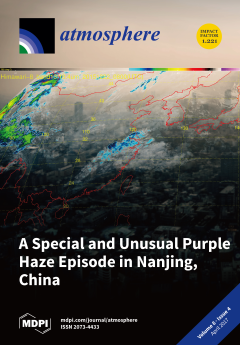
Cover Story: A special and unusual purple (magenta) haze episode was observed in Nanjing, China, at 17:00 on 22 December 2015. Many local and national news outlets reported on this event. One explanation of how a purple (combination of blue and red) light could be created is by green wavelengths being absorbed. Another way involves pollution gases or particles together with small liquid/water droplets, but this still needs further clarification. A third possibility is that the combination of transmitted red light from the sun and scattered blue light could produce a purple/magenta color in the sky. By Duanyang Liu. View this paper.
  • Issues are regarded as officially published after their release is announced to the table of contents alert mailing list .
  • You may sign up for email alerts to receive table of contents of newly released issues.
  • PDF is the official format for papers published in both, html and pdf forms. To view the papers in pdf format, click on the "PDF Full-text" link, and use the free Adobe Reader to open them.

Articles (16)

  • Article
  • Open Access
4,800 Views
14 Pages

(1) Background: To demonstrate the potential effects of missing exposure data and model choice on public health conclusions concerning the impact of heat waves on heat-related morbidity. (2) Methods: Using four different methods to impute missing exp...

  • Article
  • Open Access
21 Citations
8,499 Views
21 Pages

Q-Space Analysis of the Light Scattering Phase Function of Particles with Any Shape

  • Christopher M. Sorensen,
  • Yuli W. Heinson,
  • William R. Heinson,
  • Justin B. Maughan and
  • Amit Chakrabarti

29 March 2017

Q-space analysis is applied to the light scattering phase function of a wide variety of non-spherical and irregularly shaped particles including a great many types of dusts, fractal aggregates, spheroids, irregular spheres, Gaussian random spheres, t...

  • Article
  • Open Access
14 Citations
5,951 Views
16 Pages

Quantifying Light Absorption of Iron Oxides and Carbonaceous Aerosol in Seasonal Snow across Northern China

  • Yue Zhou,
  • Xin Wang,
  • Xueqin Wu,
  • Zhiyuan Cong,
  • Guangming Wu and
  • Mingxia Ji

28 March 2017

In this study, we attempted to quantify light absorption by insoluble light-absorbing particles (ILAPs) such as black carbon (BC), organic carbon (OC) and iron oxides in snow using an optical method directly and compared the results with those obtain...

  • Article
  • Open Access
9 Citations
5,281 Views
13 Pages

24 March 2017

The concentrations of the ozone-depleting greenhouse gas nitrous oxide (N2O) in the upper 300 m of the Subarctic and Arctic Oceans determined during the 5th Chinese National Arctic Research Expedition were studied. The surface water samples revealed...

  • Article
  • Open Access
6 Citations
5,016 Views
12 Pages

24 March 2017

To characterize atmospheric dissolved iron over Newark, a large metropolitan city on US east coast, size-segregated (0.056–18 μm in aerodynamic diameter) aerosols were collected in downtown Newark, New Jersey during August to October 2012. Aerosols s...

  • Article
  • Open Access
12 Citations
6,333 Views
14 Pages

23 March 2017

A reconstructed land use/land cover change (LUCC) dataset was used with the Community Earth System Model (CESM) to conduct a climate sensitivity analysis over the past two millennia. Compared to a controlled experiment conducted with the CESM, the LU...

of 2

Get Alerted

Add your email address to receive forthcoming issues of this journal.

XFacebookLinkedIn
Atmosphere - ISSN 2073-4433