


Abstract
This study presents a case study of the Ms5.5 Dezhou Earthquake to document the spatiotemporal characteristics of Outgoing Longwave Radiation (OLR) anomalies and their concurrent patterns with tidal force cycles. Based on NOAA satellite OLR data, synchronous monitoring and comparative analysis were conducted with tidal force variation cycles. The results show that pronounced OLR anomalies were concentrated exclusively in the co-seismic tidal cycle (Cycle C: 23 July–5 August 2023), while no significant anomalies were detected in pre-seismic Cycles A/B and post-seismic Cycle D. Temporally, the OLR anomalies in Cycle C exhibited a distinct six-stage evolutionary pattern: initial warming (31 July) → rapid intensification (1–3 August) → peak (4 August) → abrupt decline (5 August) → post-seismic pulse (6 August) → exponential decay (7–9 August). Spatially, the anomalies were closely distributed along the Liaocheng–Lankao Fault, showing a NE-trending (N35°E) distribution that matches the structural characteristics of the fault zone. Additionally, the spatial extent of OLR anomalies (within 400 km of the epicenter) is consistent with the effective detection range of co-seismic electromagnetic signals reported in existing studies. This study provides a typical observational case of OLR anomaly characteristics associated with medium-magnitude earthquakes, offering a reference for understanding the spatiotemporal evolution of seismic thermal anomalies.
1. Introduction
According to the China Earthquake Networks Center (CENC), a Ms5.5 earthquake occurred at 02:33 Beijing Time on 6 August 2023, in Pingyuan County, Dezhou City, Shandong Province (37.2° N latitude, 116.3° E longitude). This marks the largest earthquake recorded in eastern mainland China in 2023. Strengthening research on earthquake prediction is an important means to improve the understanding of earthquake preparation processes.
Earthquakes are phenomena in which faults are subjected to tectonic stress, resulting in tectonic deformation and rupture. At present, it is impossible to accurately predict the specific location, time and intensity of the incipient earthquake. While it is indeed challenging to meet such stringent requirements at present, it is both necessary and feasible to analyze and explore various physical effects associated with stress accumulation—these effects may propagate to the Earth’s surface or outer space in different forms, thereby serving as precursors to earthquakes. Since the late 1980s, many scholars have applied large-scale satellite remote sensing technology to earthquake activity monitoring and earthquake precursor research. Russian scientist Akady Glaper first proposed around 1985 that earthquake-associated electromagnetic waves had been observed by the Soviet “AUREOL-3” satellite and NASA satellites [1,2,3]. The phenomenon of pre-earthquake thermal anomaly changes has also attracted the attention of scholars [4,5]. Previous studies have shown that Outgoing longwave radiation (OLR) can reflect more atmospheric change information, is more sensitive to temperature change, and can better reflect the entire surface atmospheric system, which is conducive to the in-depth understanding of the seismic sphere coupling model [6].
The tidal force has the advantage of being accurately calculable in advance and shows a periodic variation pattern, which provides a time reference with mechanical significance for the study of seismic thermal anomalies. Meanwhile, thermal anomalies can reflect the response of the Earth’s surface to tectonic activities potentially induced by tidal forces [7,8,9]. In view of this, this study focuses on the Dezhou Ms5.5 earthquake as a typical case, combining NOAA satellite OLR data with astronomical tidal force cycle analysis to document the spatiotemporal characteristics of OLR anomalies and their concurrent patterns with tidal cycles. The study aims to provide an observational reference for similar medium-magnitude earthquake thermal anomaly research.
2. Tectonic Environment of the Study Area
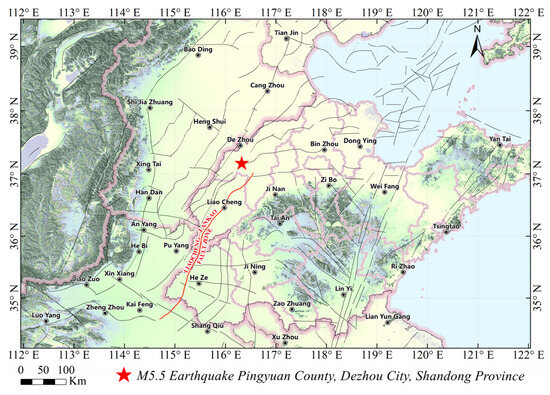
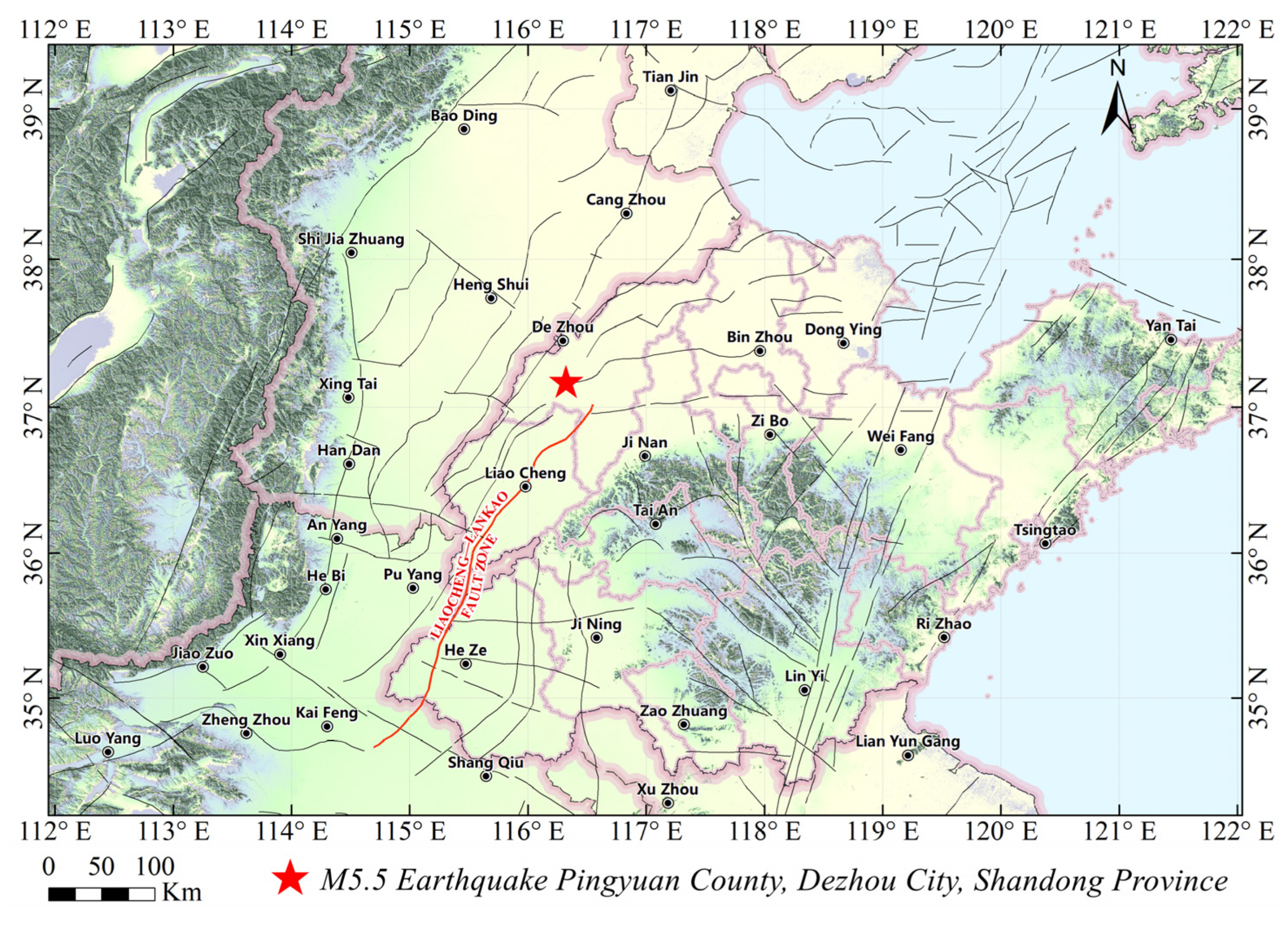
Geological structure analysis indicated that the epicenter of the Ms 5.5 earthquake was located at the northeastern extension of the Liaocheng–Lankao Fault (hereafter referred to as the Liaokao Fault), which lay within the southern segment of the North China Plain graben system. The southern end of this fault originated in Lankao County, Henan Province, extended northeastward through Liaocheng City, Shandong Province, and reached to Pingyuan County, Dezhou City, where it ultimately intersected with the Guangqi Fault. Its total length was approximately 270 km. The Liaokao fault exhibited characteristics of normal faulting, with the eastern block uplifted and the western block subsided, and constituted a crucial geological boundary separating the Luxi Uplift tectonic unit from the North China Fault Depression Basin. The distribution of major active faults around the epicenter of the Dezhou Ms5.5 earthquake is shown in Figure 1.
Figure 1.
Distribution of major active faults around the epicenter of the Dezhou Ms5.5 earthquake. Note: The Red Star is the epicenter, the black line is the regional fault, and the red line is the Liaocheng–Lankao Fault.
Geological survey data indicate that the Liaokao Fault is a shallowly buried active fault. Since the Quaternary period, its average vertical displacement rate has been maintained at 0.12 mm/a, making it a moderately active fault zone within the eastern Chinese tectonic framework [10]. As a key seismotectonic zone in western Shandong Province, the Liaokao Fault Zone exhibits prominent seismic activity characteristics. Historical earthquake records document 11 earthquakes with a magnitude of M ≥ 5.0 occurring along this fault zone, including the 1937 Heze M7.0 strong earthquake. This event caused severe damage to regional structures and triggered significant disaster chain effects. Modern seismic monitoring data confirm that the Liaokao Fault Zone remains one of the critical potential seismic source areas requiring intensive monitoring in North China.
3. Materials and Methods
3.1. NOAA Satellite OLR Data
Since the launch of the first NOAA polar-orbiting satellite in December 1970, a total of 18 satellites have been deployed consecutively, with the fifth generation being the most widely utilized. In this study, the daytime-averaged OLR data product from the NOAA-18 satellite was adopted. NOAA-18 was launched on 11 May 2005, with an orbital period of 102 min. Equipped with the Advanced Very High Resolution Radiometer/3 (AVHRR/3) sensor, the satellite features five spectral bands, including one visible red band (0.58–0.68 um), one near-infrared band (0.725–1 um), one mid-infrared band (1.58–1.64 um), and two thermal infrared bands (10.3–11.3 um and 11.5–12.5 um), with a nadir resolution of 1.1 km. The two thermal infrared bands of the AVHRR/3 sensor serve as the core data source for retrieving OLR data from NOAA satellites. By detecting longwave radiation in the 10–12.5 μm atmospheric window, these bands can directly reflect the thermal energy budget at the Earth’s surface and the top of the atmosphere—this constitutes the primary reason for their widespread application in seismic thermal anomaly monitoring [6,11]. NOAA’s OLR datasets are available in two spatial resolutions: 2.5° × 2.5° and 1.0° × 1.0°. For this research, the 1.0° × 1.0° gridded data with a daily temporal resolution (1d) were selected. The data are stored in a (360 × 180) array in ASCII format, where each value represents the OLR flux within a 1.0° × 1.0° grid cell. This dataset is publicly accessible free of charge (download URL: ftp.cpc.ncep.noaa.gov/precip/noaa18_1x1) (accessed on 15 September 2023).
3.2. Methods
There are currently a wide variety of methods for extracting pre-seismic thermal anomalies using satellite infrared data, including the background field difference analysis method [12,13], the Robust Satellite Technique (RST) method [14,15,16], the vorticity algorithm [17,18,19,20,21], and the wavelet power spectrum method [22,23,24]. However, these methods have certain limitations. On the one hand, they rely on a large amount of continuous multi-year historical data. On the other hand, a normal background field constructed based on statistical principles will, to some extent, mask minor fluctuations in the data, resulting in the omission of weak pre-seismic thermal anomaly signals. In addition, there is uncertainty in the selection of the time length for the normal background field (e.g., 5 years, 10 years), which leads to different results when different background fields are selected [25,26,27]. Earthquakes are essentially a process in which the Earth’s tectonic stress accumulates and rapidly releases energy, characterized by the significant features of persistence and short-term suddenness. The existing methods mainly rely solely on remote sensing image processing algorithms to study seismic thermal anomalies, while neglecting to explore in depth the essence of earthquake occurrence from a mechanical perspective. It is therefore of great scientific and practical significance to conduct research on thermal anomaly extraction related to mechanics. Existing research results show that when the tectonic stress during earthquake gestation approaches the pre-earthquake stage, the celestial tidal force may trigger an earthquake [7,8,9,28,29,30]. Therefore, this study adopts the tidal force method for thermal anomaly extraction.
The tidal force algorithm primarily consists of two steps: First, calculation of the lunar-solar tidal potential. The calculation of the lunar-solar tidal potential is performed to determine the tidal force cycle. Second, OLR anomaly extraction. The anomalies are extracted using the difference method, and the background field is determined based on the aforementioned tidal force cycle [7,8,9,27,31].
First step: calculation of the lunar-solar tidal potential
According to Kelvin’s classical tidal theoretical model, the tidal potential [6,12,32,33,34] generated at any point inside the Earth by any celestial body can be expressed as follows:
where represents the nth-order Legendre polynomial of , is the zenith distance of the celestial body, is the mass of the celestial body, is the gravitational constant, is the distance from the epicenter to the Earth’s core, and is the distance from the celestial body to the Earth’s core. The Moon is the closest celestial body to Earth, exerting the strongest tidal force on our planet. Although the Sun is far more distant than the Moon, its mass (S) is vastly greater than that of the Moon (M), enabling it to also generate a significant tidal force on Earth. The tidal forces induced by other celestial bodies within the Earth are several orders of magnitude smaller than those produced by the Moon and the Sun. Therefore, only the tidal forces of the Moon and the Sun are considered in this study.
The whole tide-generating potential in the Earth’s interior, caused by the Sun and Moon, can be calculated by Equation (2):
where represents the tide-generating potential in the Earth’s interior caused by the Moon, and represents the tide-generating potential in the Earth’s interior caused by the Sun.
For the Moon, under the current precision conditions, we take n = 2 and n = 3, the second-order and third-order tidal potentials generated by the Moon at any point on the Earth are shown in Equations (3) and (4), respectively. For the Sun, usually taking n = 2, the tide-generating potential in the Earth’s interior caused by the Sun is expressed as shown in Equation (5).
Second step: OLR anomaly extraction
To characterize the co-seismic and post-seismic OLR dynamics, grid-point values over the study area were calculated using Equation (6), deriving the spatial distribution of information entropy in radiation anomaly zones.
In Equation (6), represents the OLR increment of grid point , denotes the original OLR value of current grid point , refers to the reference OLR value of the same grid point on the background day, indicates the longitude grid index, indicates the latitude grid index, and represents the date identifier in the time series. The background field was determined according to the tidal force period obtained by calculating the lunar-solar tidal potential, with the phase minima of each tidal potential cycle used as the background time [7,8,9]. This selection is based on the consideration that tidal potential phase minima correspond to periods of minimal tidal stress perturbation, which helps to reflect the “undisturbed” state of the study area during each tidal cycle. It should be noted that this background field definition is specific to this case study, and alternative definitions (e.g., multi-year climatological averages) were not adopted because they may mask short-term tectonically related thermal variations.
After calculated the of each cycle according to Equation (6), the statistical analysis was carried out to determine the threshold in order to identify the anomalies. The quartile method was adopted for thermal anomaly threshold determination [6]. The lower quartile of is set as . The quartile at the midpoint is the median or second quartile . The largest quartile becomes the upper quartile or the third quartile . The interquartile distance (IQR) is obtained by , and was calculated by
Additionally, to address the potential impacts of atmospheric processes (e.g., convection, cloud cover, large-scale meteorological variability) on OLR observations, comparative analysis with FY-2G satellite cloud images was conducted to verify the relative insensitivity of the tidal force-based method to cloud interference.
4. Results
4.1. Variation Analysis of Lunar-Solar Tidal Forces in the Dezhou Ms 5.5 Earthquake
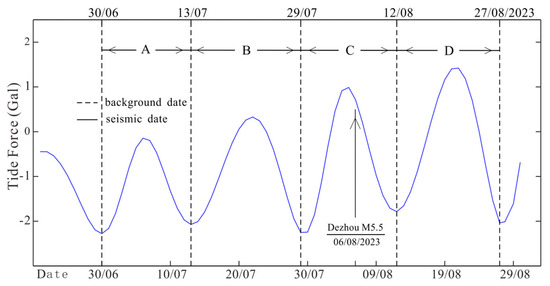
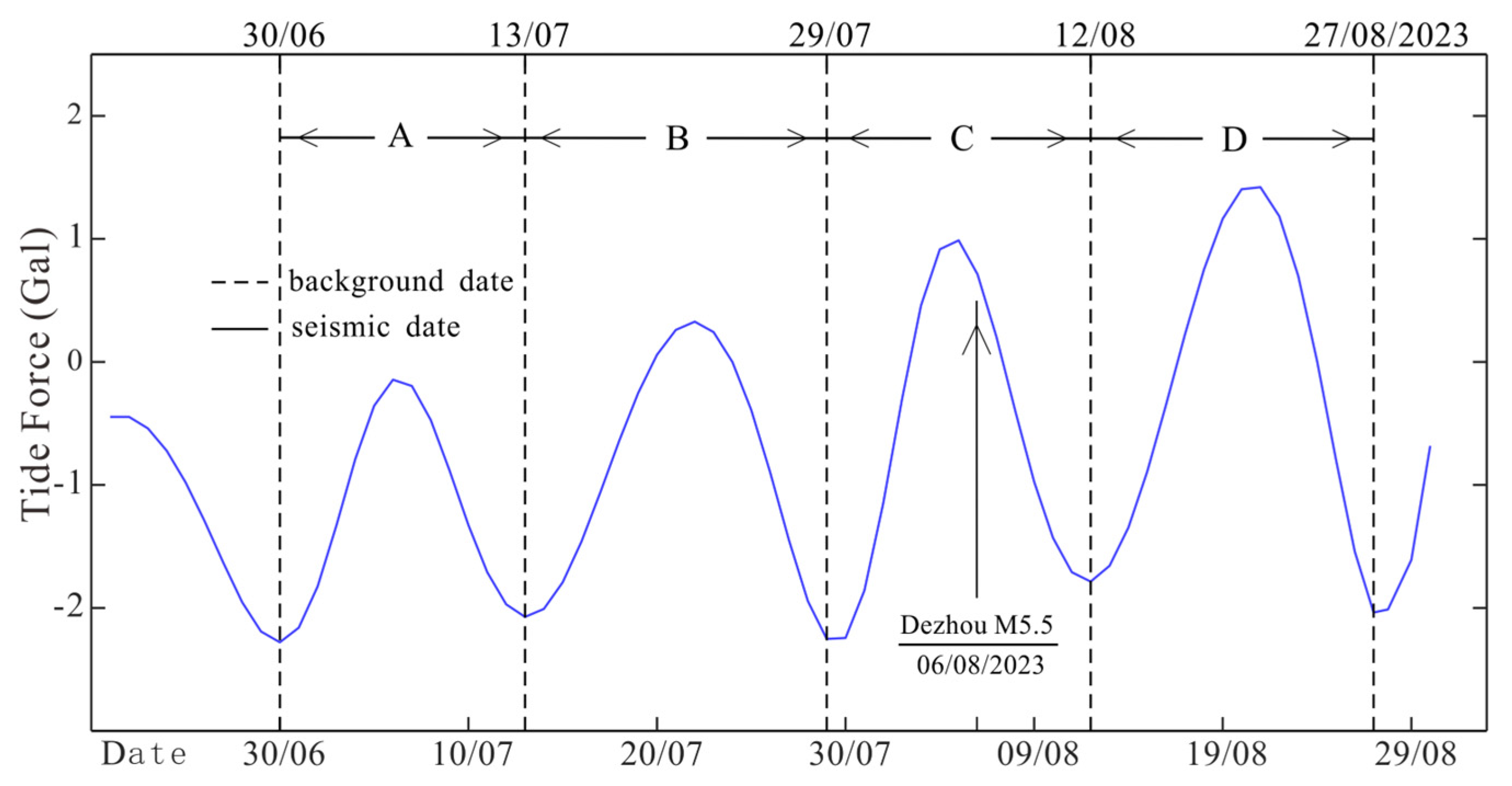
Temporal variations in lunar-solar tidal forces associated with the epicenter of the 2023 Ms 5.5 Dezhou Earthquake were calculated using Equations (2)–(5) for the period spanning 21 June to 30 August 2023 (Figure 2). Figure 2 is the vector graphic generated through algorithm compilation and initial plotting in MATLAB 2024b, followed by text editing and final export using CorelDRAW X8. The results demonstrate distinct valley–peak–valley periodic oscillations in tidal forces, which are labeled as Cycles A–D in the figure. Previous studies [23] have shown that earthquake-triggering tidal phases are dependent on fault types: reverse fault earthquakes tend to occur near tidal force valleys, whereas normal fault earthquakes are correlated with tidal force peak phases. Notably, the Dezhou Earthquake occurred on August 6, coinciding with the primary peak phase of tidal forces (Cycle C). This observation is consistent with the seismogenic structure being identified as a normal fault [33]. Although Cycles A and C exhibited analogous tidal force phases, only Cycle C triggered seismic activity. This finding suggests that tidal force-induced earthquake triggering requires the accumulation of active tectonic stress to reach a critical threshold.
Figure 2.
Variation curve of lunar-solar tidal forces with time, before and after the Dezhou earthquake.
To further advance the understanding of pre-seismic processes, future research should integrate the spatiotemporal evolution of OLR with tidal force cycle analysis to quantitatively assess tectonic stress states and improve the efficacy of earthquake risk assessment.
4.2. Spatiotemporal Evolution of OLR Anomalies in the Dezhou Ms 5.5 Earthquake
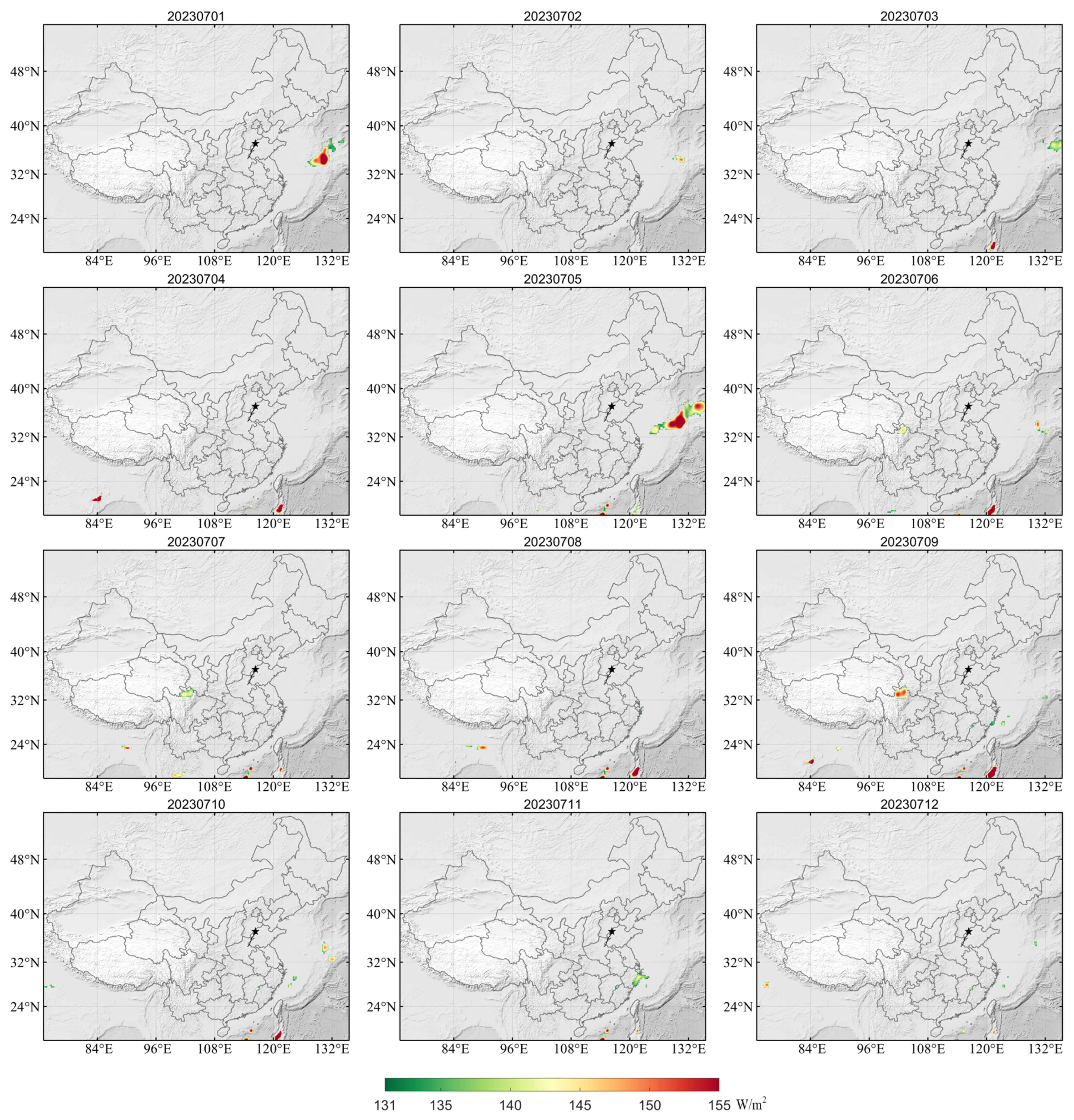
Anomaly extraction was performed based on Equation (6) described in Section 3.2, with the phase minima of each tidal potential cycle adopted to determine the temporal background for the corresponding cycle [7,8,9]. For seismogenic Cycle C (23 July–5 August 2023), OLR data from 29 July were selected as the background; for seismogenic Cycle A (21 June–12 July 2023), OLR data from 30 June were used as the background; for seismogenic Cycle B (13 July–28 July 2023), OLR data from 13 July served as the background; and for seismogenic Cycle D (12–28 August 2023), OLR data from 12 August were designated as the background.
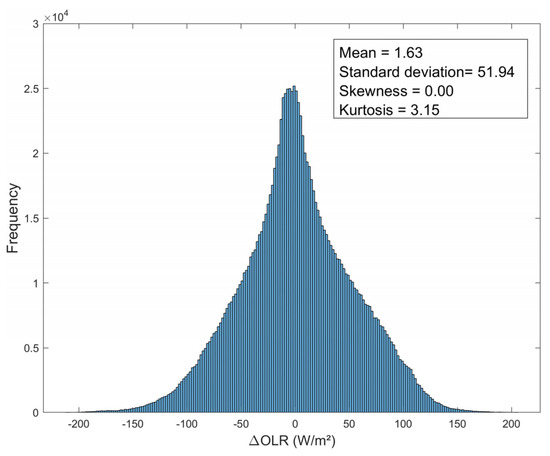
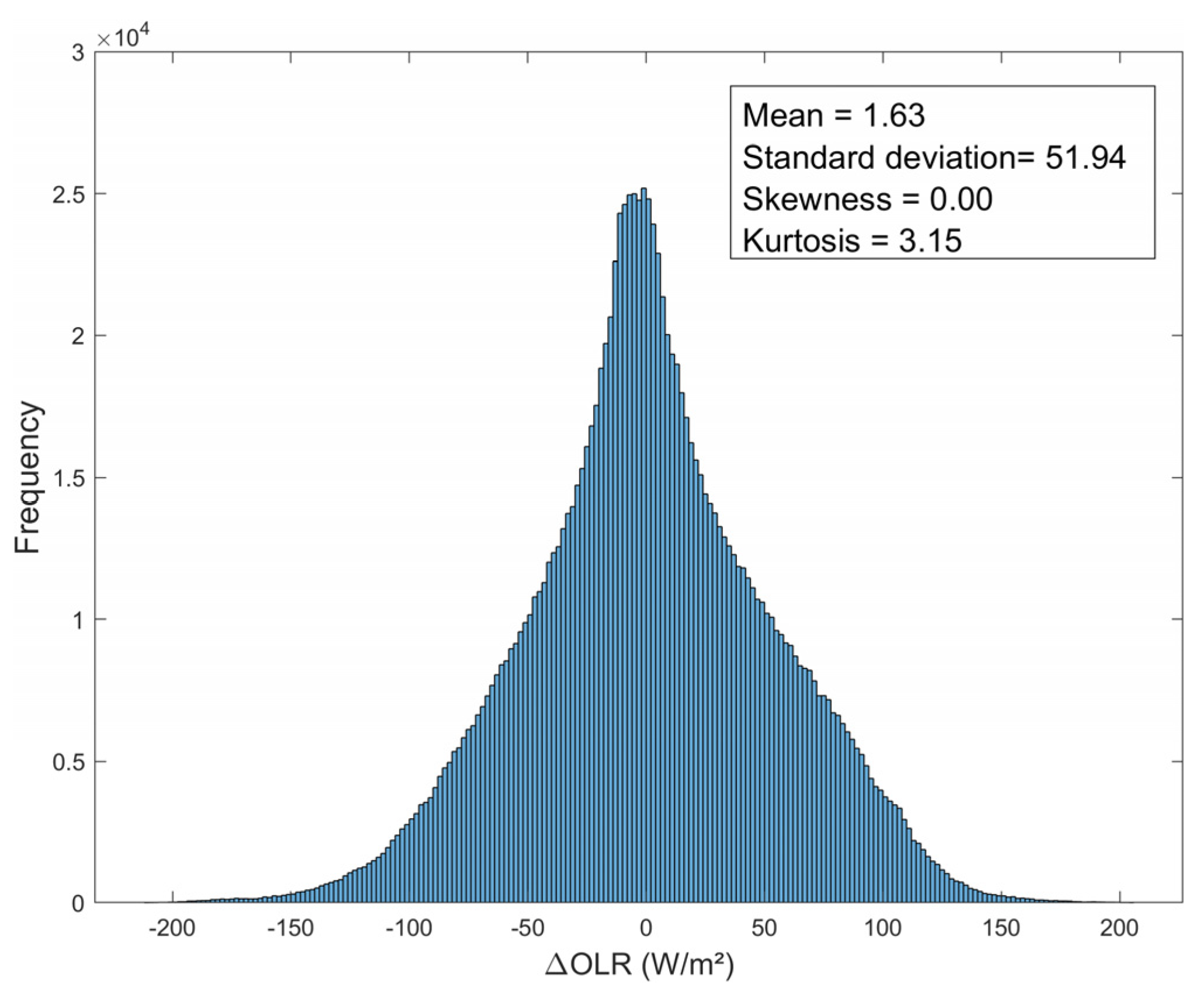
The daily were calculated by Equation (6). The spatial range of the study area is [17°~55° N, 70°~138° E], and the time range is 21 June to 30 August 2023. The histogram of was shown in Figure 3. As shown in Figure 3, negative skewness and positive kurtosis indicate that the distribution is not Gaussian. Therefore, the mean and standard deviation cannot be selected to extract anomalies. The numerical distribution of from 21 June to 30 August 2023 in the study area is statistically calculated, and the quartile parameters and thresholds are shown in Table 1. The was set as 131.64. Notably, the maximum ΔOLR excess detected in the co-seismic cycle reaches approximately 156 W/m2, which is three times the FWHM (Full Width at Half Maximum, 52 W/m2) of the anomaly distribution. This significant quantitative difference further verifies the robustness and non-randomness of the OLR anomalies associated with the Dezhou Ms5.5 earthquake, supporting the reliability of the observational results.
Figure 3.
The histogram of in the study area from 21 June to 30 August 2023. The mean, standard deviation, skewness, and kurtosis are also shown in these plots.
Table 1.
Quartile parameter and threshold of (W/m2).
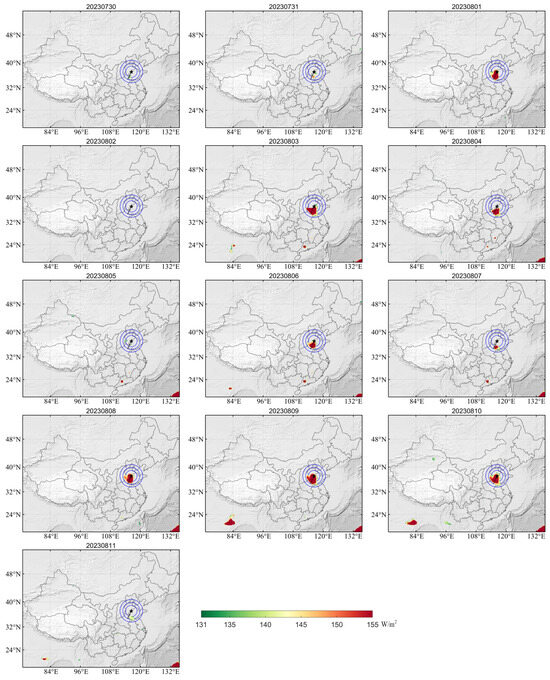
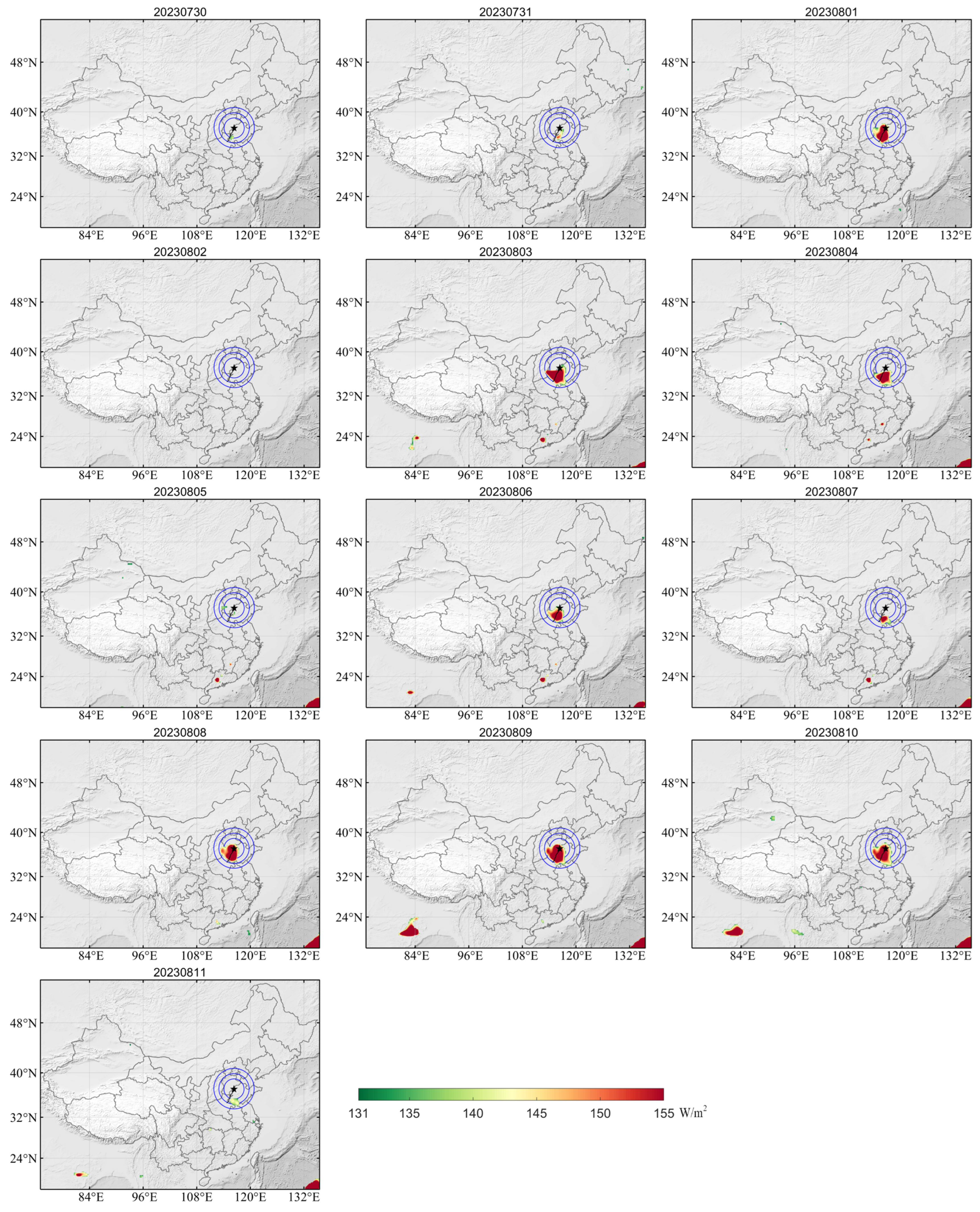
Figure 4, Figure 5 and Figure 6 were the OLR variations during different cycles. Figure 4 reveals significant fault-zone responses in OLR anomalies. Seven days before the mainshock (31 July), weak thermal anomalies emerged east of the northern segment of the Liaocheng–Lankao Fault. Within the next 2 days, anomaly intensity increased significantly and expanded bilaterally along the fault zone. On 3–4 August, anomalies peaked and covered the entire fault zone. Notably, thermal anomalies completely disappeared 1 day before the mainshock (5 August). However, on 6 August (the day of the earthquake), a large-scale anomaly occurred along the fault zone. The abnormal area shrank on 7 August and began to intensify continuously from 8 August to 10 August. Throughout the evolution, anomalies consistently aligned along a NE-trending (N35°E) distribution, fully matching the dextral strike-slip tectonic features of the Liaocheng–Lankao Fault, validating the stress guidance effect of active faults on thermal anomalies. The innermost blue circle is drawn with the epicenter at the center and a radius of 200 km, and next to it are the outer circles with radii of 300 km and 400 km, respectively. It can be observed that the anomalies are mainly distributed along the faults within 400 km.
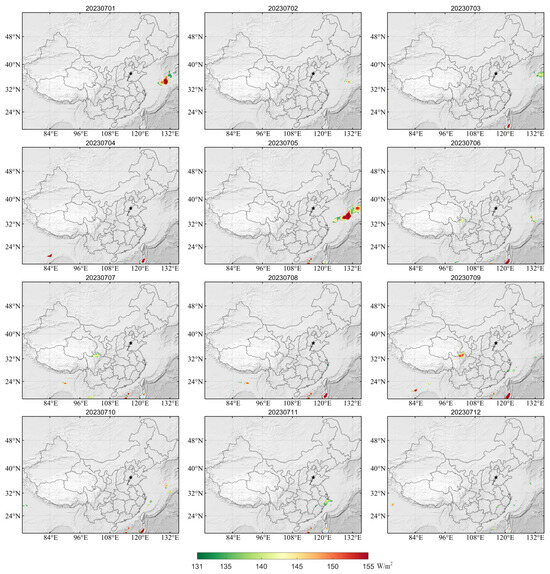
Figure 4.
OLR variations during the C cycle of the Dezhou earthquake. The title of each pot is the date. The blue circles are centered at the epicenter with radii of 200 km, 300 km, and 400 km, respectively. The black star is the epicenter.
Figure 5.
OLR variations during the A cycle of the Dezhou earthquake. The title of each pot is the date. The black star is the epicenter.
Figure 6.
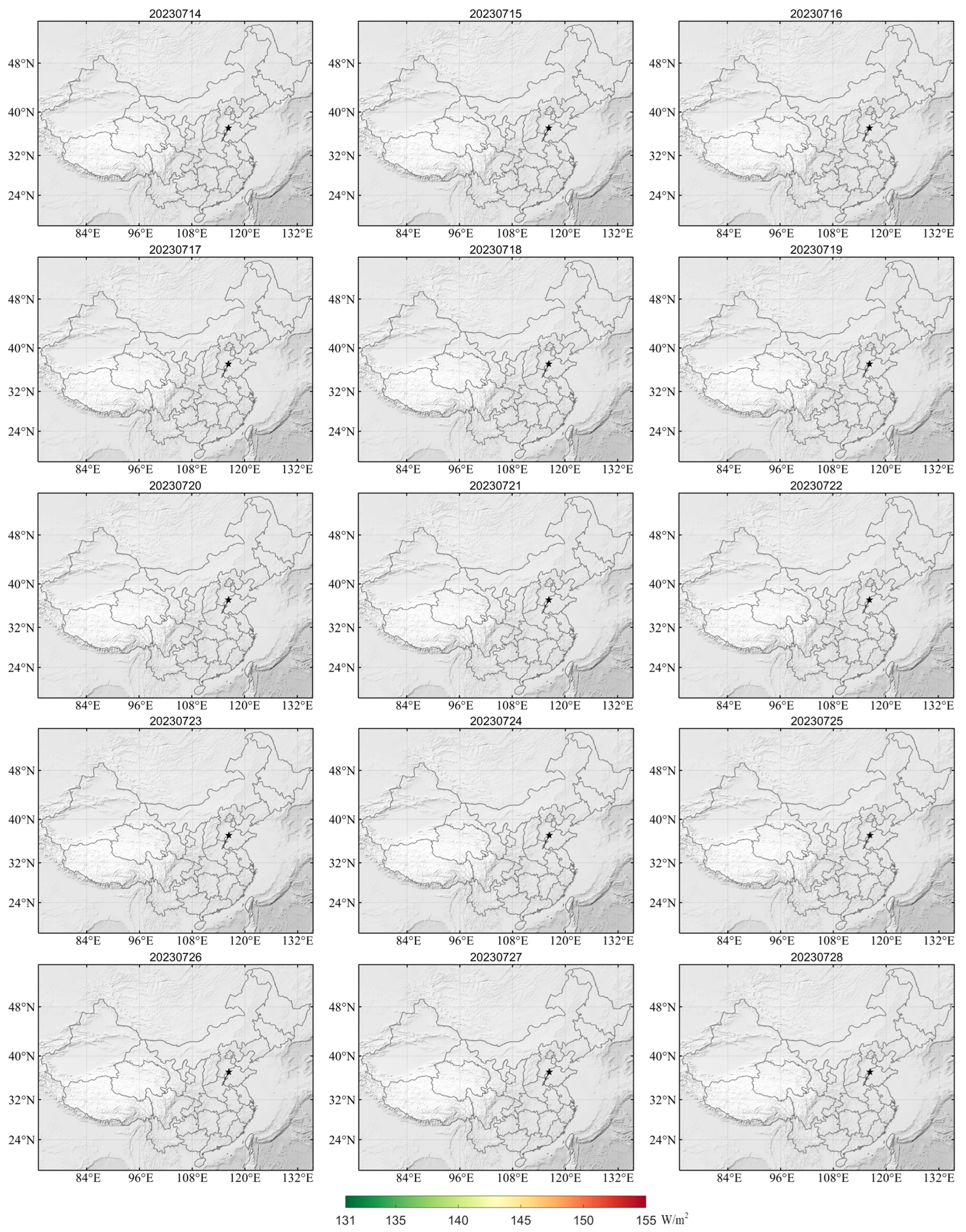
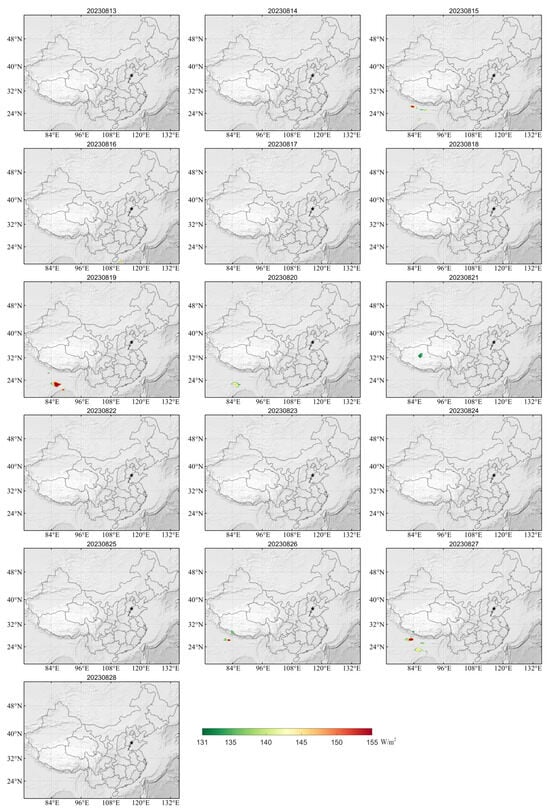
OLR variations during the B cycle of the Dezhou earthquake. The title of each pot is the date. The black star is the epicenter.
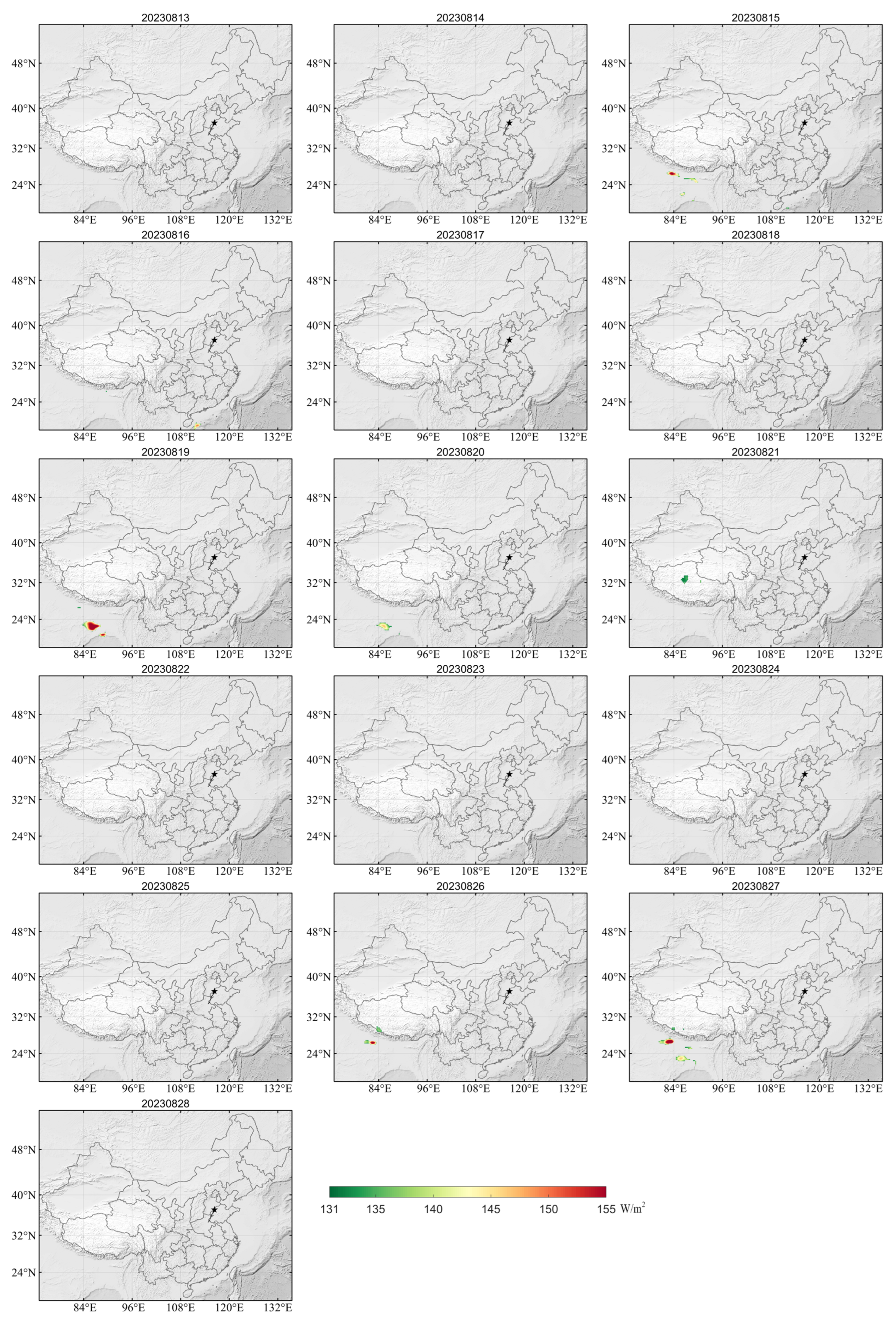
Figure 5, Figure 6 and Figure 7 revealed that no thermal anomalies were observed in the Dezhou epicenter (37.1° N, 116.7° E) or along the Liaocheng–Lankao Fault zone (N35°E strike) during cycles A/B/D, and no seismic activity occurred in these periods. The blue circular lines are primarily intended for subsequent discussion and analysis. Since no anomalies were observed near the epicenter during Cycles A, B, and D, the blue concentric circles centered at the epicenter are not plotted in Figure 5, Figure 6 and Figure 7.
Figure 7.
OLR variations during the D cycle of the Dezhou earthquake. The title of each pot is the date. The black star is the epicenter.
5. Discussion
5.1. Cloud Cover Analysis in Seismic Monitoring
Cloud contamination is an unavoidable issue in optical remote sensing imaging. Consequently, many remote sensing algorithms for extracting seismic anomalies typically include cloud removal as a preprocessing step. However, if the area above an earthquake-affected zone is persistently covered by clouds, operations such as cloud pixel clearance or replacement will significantly alter the original radiative environment, leading to substantial data loss and making it difficult to effectively extract thermal anomaly information.
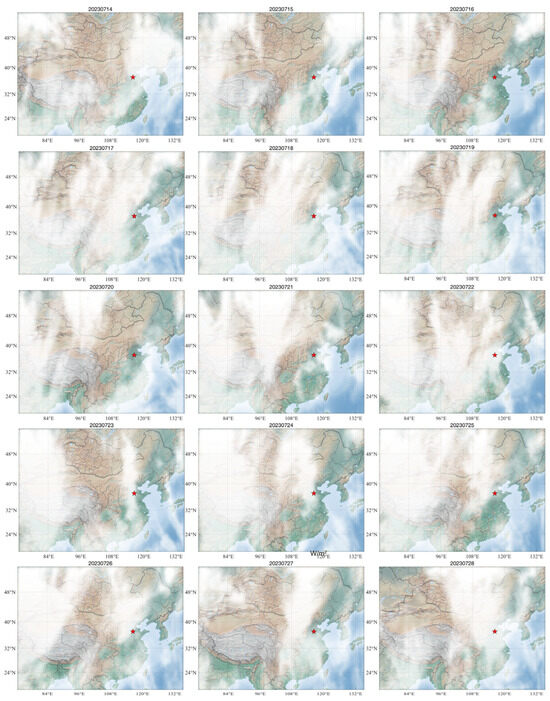
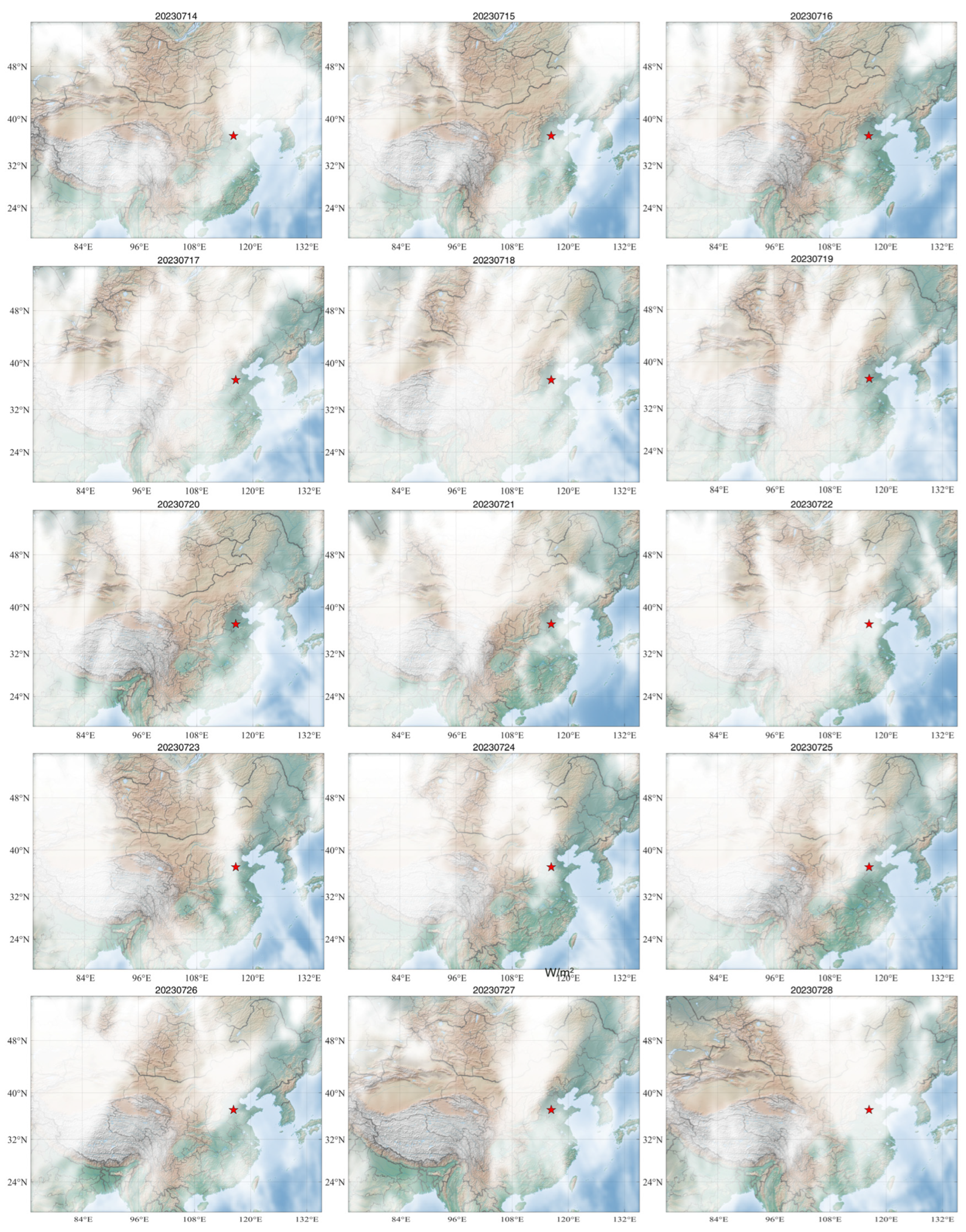
It is important to note that variations in cloud cover, as a physical component of the atmosphere, may be associated with complex geophysical processes. This raises a critical question: Are the anomalies extracted using the astronomical tidal force algorithm significantly affected by cloud cover? To investigate this issue, this study conducted a comparative analysis of satellite cloud image distributions and OLR variation distributions for three time periods: pre-earthquake (Period B), co-seismic (Period C), and post-earthquake (Period D). The cloud image data used were obtained from the Cloud Classification product of the VISSR sensor onboard the FY-2G satellite (Data access URL: https://satellite.nsmc.org.cn). To investigate this issue, this study conducted a comparative analysis of satellite cloud image distributions and OLR variations distributions extracted based on the astronomical tidal force algorithm for three time periods: pre-earthquake (Period B), co-seismic (Period C), and post-earthquake (Period D). The cloud image data used were obtained from the Cloud Classification product of the VISSR sensor onboard the FY-2G satellite (Data access URL: https://satellite.nsmc.org.cn).
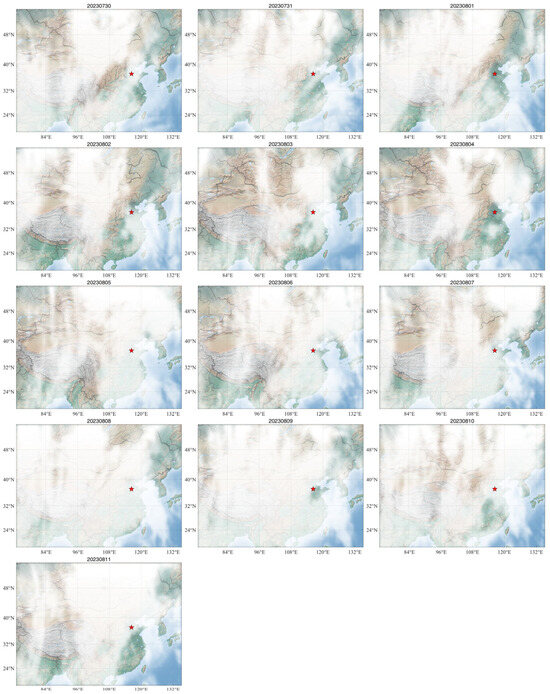
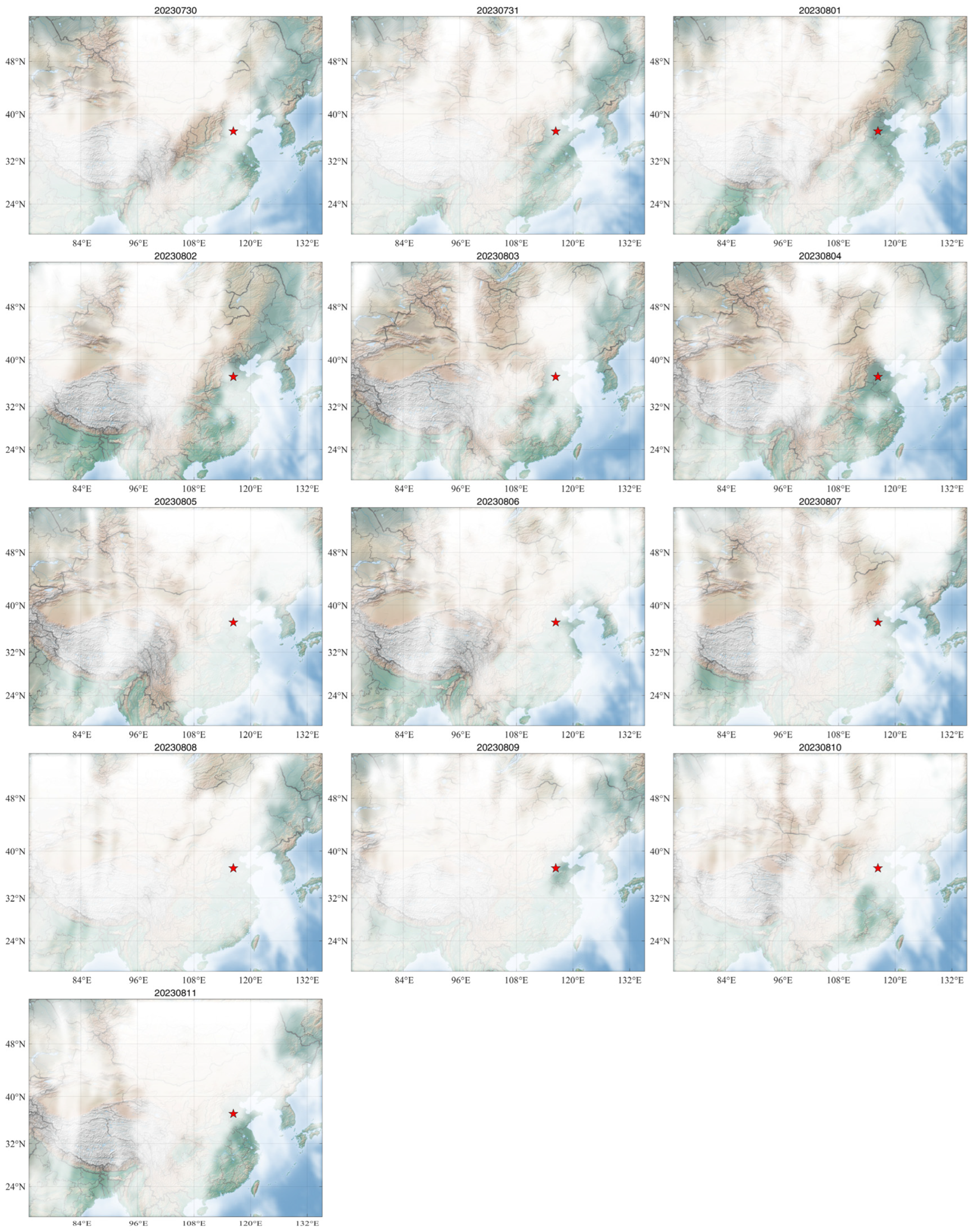
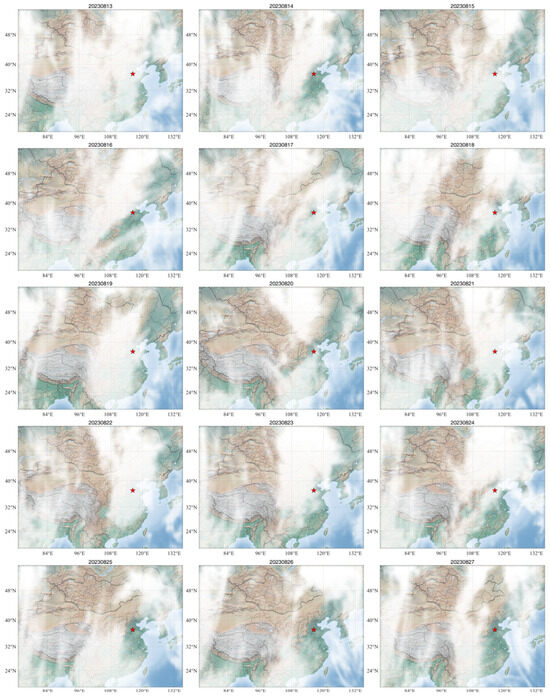
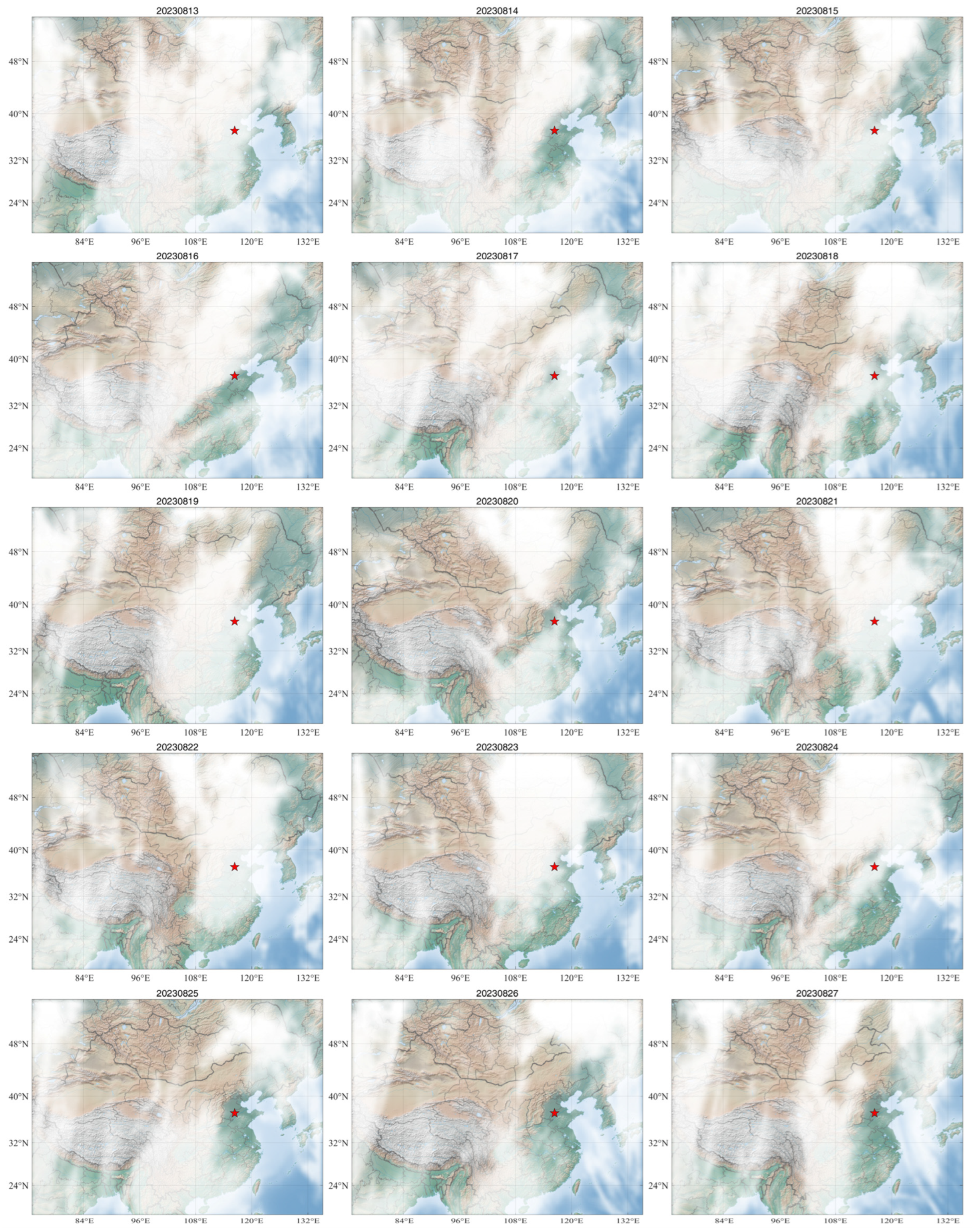
Figure 8, Figure 9 and Figure 10 show extensive cloud coverage over the study area during the pre-earthquake, co-seismic, and post-earthquake periods. A comparison of Figure 4 and Figure 9 (cloud distribution map) reveals that the locations of anomalies extracted in Figure 3 correspond to areas of dense cloud coverage in Figure 8, particularly near the epicenter on 3 August and from 7 to 11 August. Nevertheless, despite the presence of dense cloud cover, these regions in Figure 3 did not exhibit low-value anomalies. This result indicates that the astronomical tidal force-based method can effectively extract OLR anomaly information that is less susceptible to cloud contamination, providing a practical reference for seismic thermal anomaly observation under complex atmospheric backgrounds.
Figure 8.
Satellite cloud images from the FY-2G satellite data during the B cycle of the Dezhou earthquake. The red star is the epicenter.
Figure 9.
Satellite cloud images from the FY-2G satellite data during the C cycle of the Dezhou earthquake. The red star is the epicenter.
Figure 10.
Satellite cloud images from the FY-2G satellite data during the D cycle of the Dezhou earthquake. The red star is the epicenter.
5.2. Observational Characteristics of OLR Anomalies
Observations from this study indicate that no significant thermal anomalies were identified in the epicentral area (37.1° N, 116.7° E) or the Liaocheng–Lankao Fault Zone (striking N35°E) using Outgoing Longwave Radiation (OLR) data during the pre-seismic Cycles A/B (15 June–22 July) and post-seismic Cycle D (6–22 August), with no corresponding seismic activity recorded. In contrast, pronounced OLR anomalies were exclusively concentrated in the co-seismic Cycle C (23 July–5 August), which is highly consistent with the occurrence time of the mainshock.
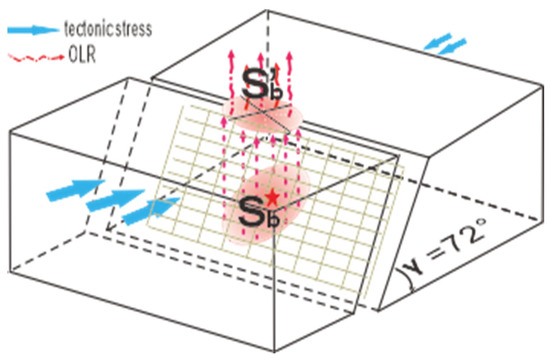
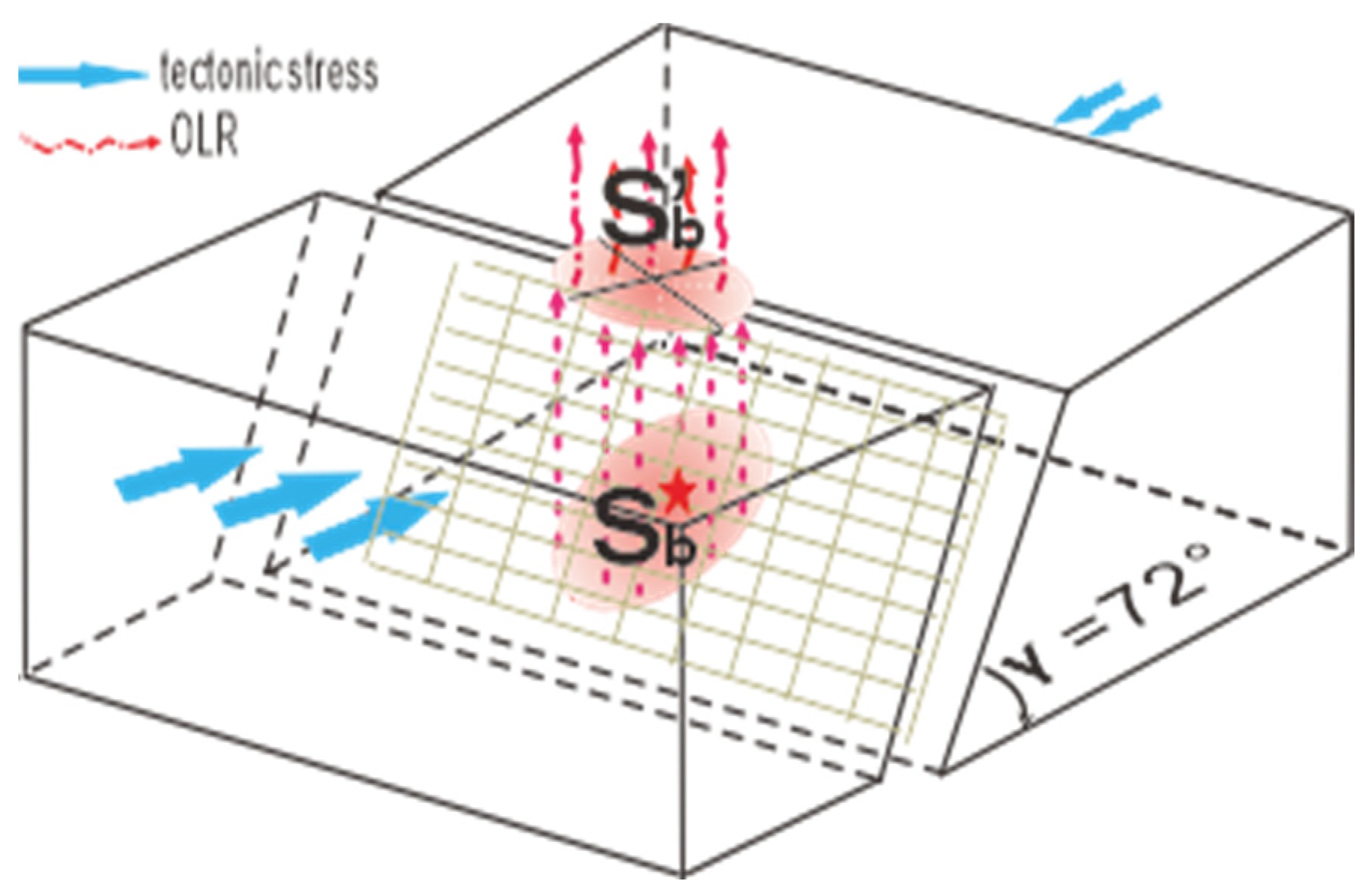
The OLR anomalies extracted in this study exhibit a precise spatial correspondence with fault locations. Anomalies during the co-seismic Cycle C (23 July–5 August, Figure 3) display a six-stage evolutionary pattern: initial warming (31 July) → rapid intensification (1–3 August) → peak (4 August) → abrupt decline (5 August) → post-seismic pulse (6 August) → exponential decay (7–9 August). This evolutionary sequence is highly consistent with the infrared radiation characteristics of rock fracturing processes reported in [35], further confirming that OLR anomalies can effectively reflect the entire process of rock deformation and fracturing under stress. Notably, the mainshock in this study occurred during the OLR anomaly decay phase, which is consistent with the observations of the 2013 Lushan M7.0 earthquake (20 April 2013) in [36]—a study that also documented pre-seismic thermal anomaly attenuation. Together, these two cases suggest that short-term stress-drop release can serve as an important seismic precursor indicator [37,38]. Spatially, the thermal anomaly zone exhibits a circular planar distribution along the fault, fully matching the right-lateral strike-slip structural characteristics of the Liaocheng–Lankao Fault. This spatial correspondence aligns with the international consensus that stress concentration in active fault zones dominates the generation of thermal anomalies [11], further consolidating the correlation mechanism of stress concentration → thermal radiation anomalies → earthquake triggering. Why does the OLR anomaly present a circular planar feature instead of two symmetrical high-value anomaly zones along both sides of the fault, or some other features? As shown in Figure 11, with the large dip angle of the fault slip plane (Sb), the surface dislocation and the surface projection area (S′b) is relatively small, the rupture mode on both sides of the fault presents shear rupture, the stress of the fault is relatively concentrated around the epicenter, and the surface projection of OLR release area (S′b) is relatively small. The infrared image of the surface therefore shows a circle-like and small-area distribution near the epicenter. Field investigations have shown that the rupture length of this earthquake was relatively short, and the dislocation amount was mainly concentrated within 10 km of the epicenter, exhibiting a clear right-lateral strike-slip nature. The changes in the stress field and deformation field were consistent, and spatially, it presented a distinct stress “petal” state [39]. This further confirmed the spatial distribution characteristics of the OLR anomaly.
Figure 11.
Schematic diagram of OLR anomaly (Sb): the fault slip plane; (S′b): the surface projection area. The red star is the epicenter.
The essence of an earthquake lies in the sudden rupture and displacement of crustal rocks driven by tectonic stress, a process accompanied by complex physical and chemical transformations that can trigger electromagnetic signals. The dominant mechanism involves earthquake-induced rock rupture, which induces intense piezoelectric, electrokinetic, and triboelectric effects—ultimately generating strong co-seismic electromagnetic pulses that are typically recorded synchronously with seismic waves. This electromagnetic response not only reflects the dynamic process of crustal deformation and rupture but also provides a complementary perspective for understanding the multi-physical field coupling characteristics during earthquake occurrence, which is closely linked to the thermal anomaly evolution observed in this study.
Fan et al. [40] analyzed the co-seismic extremely low-frequency (ELF) electromagnetic responses of the Texas Ms 5.5 earthquake using data from the Control Source Extremely Low-Frequency (CSELF) network. The network stations were uniformly equipped with Metronix (Germany) ADU-07e magnetotelluric instruments, featuring Pb-PbCl2 electrical sensors and MFS06e magnetic rods. These instruments recorded raw time series of five electromagnetic field components: the north–south (NS) electric field (Es), east–west (EW) electric field (Ey), NS magnetic field (Hx), EW magnetic field (Hy), and vertical magnetic field (Hz). Their observations revealed that co-seismic electromagnetic (electric and magnetic field) responses were detectable within 200 km of the epicenter, while magnetic field responses persisted up to 400 km from the epicenter.
Notably, this 400 km effective detection range of co-seismic electromagnetic signals is highly consistent with the spatial extent of OLR thermal anomalies extracted in this study (Figure 3). This consistency is not coincidental but reflects the inherent coupling of multi-physical processes during earthquake occurrence: tectonic stress accumulation drives both rock deformation-fracture (the root cause of thermal anomalies, as verified in our OLR observations) and the generation of electromagnetic signals (via piezoelectric/electrokinetic/triboelectric effects, as documented by Fan et al. [40]). The overlapping spatial ranges of thermal and electromagnetic anomalies further confirm that the stress concentration and release process in active fault zones (e.g., the Liaocheng–Lankao Fault Zone in this study) is a unified multi-physical field evolution process.
Cross-observations integrating multiple geophysical parameters are critical for advancing the understanding of seismic-related processes. As noted, during the Kobe earthquake, radon monitors installed in underground tunnels recorded significant abnormal increases prior to the mainshock [41], which is consistent with the mechanism that crustal rock fracture and stress accumulation (potential drivers of OLR anomalies in this study) can promote radon emission from subsurface media. The combination of OLR remote sensing and in situ radon monitoring exhibits inherent complementarity: OLR provides large-scale, synoptic spatial coverage of thermal variations, while radon monitors offer high-temporal-resolution records of subsurface crustal activity. Such integration could enhance the comprehensiveness of seismic activity monitoring and reduce the uncertainty of single-parameter observations.
However, it is important to emphasize that earthquake prediction remains a globally challenging scientific problem, as seismic occurrence involves complex multi-scale and multi-factor interactions. Relying solely on radon anomalies, OLR variations, or any single geophysical parameter is insufficient to achieve reliable prediction of major earthquakes. Future research could focus on establishing a multi-dimensional cross-observation system that integrates remote sensing (e.g., OLR), in situ geophysical measurements (e.g., radon, electromagnetic signals), and tectonic activity data. This synergistic approach may help capture the comprehensive characteristics of earthquake preparation processes and provide more robust observational support for seismic risk assessment.
It should be emphasized that this study focuses on documenting observational phenomena rather than inferring causal mechanical mechanisms. The concurrent patterns of OLR anomalies and tidal cycles observed in this case do not imply a direct mechanical connection, but rather provide an observational basis for future multi-event comparative studies to explore potential intrinsic links.
5.3. Limitations of Our Study
Background field selection and sensitivity: The background field in this study was determined based on the phase minima of each tidal potential cycle, which is a deliberate choice tailored to the focus on capturing short-term tidal cycle-coupled thermal signals. However, there is no quantitative sensitivity analysis of how different background field definitions (e.g., tidal cycle minima vs. multi-year monthly averages) fit this observational purpose. Future research should conduct systematic sensitivity analysis to evaluate the impact of different background field definitions on anomaly extraction results.
Impacts of Atmospheric and resolution factors: Although this study conducted comparative analysis with cloud images to verify the relative insensitivity of the method to cloud interference, the impacts of other atmospheric processes (e.g., convection, monsoon systems, frontal activity, the Madden-Julian Oscillation (MJO), and synoptic-scale variability) on OLR observations were only discussed qualitatively, not explicitly integrated into the methodological framework. This makes the implication of OLR variability associated with tectonic processes more indicative than demonstrative. Additionally, the 1° spatial resolution of NOAA OLR products (≈111 km at the equator) may indeed overestimate the actual rupture zone size (typically a few to tens of kilometers for Ms 5.5 earthquakes). This limitation is addressed by two approaches: first, we focused on spatial consistency between OLR anomalies and known fault structures (Liaocheng–Lankao Fault Zone) rather than precise rupture zone mapping; second, the consistency with the 400 km electromagnetic response range (Fan et al. [40]) indicates that the spatial scale of the observed anomalies reflects regional stress accumulation rather than just the immediate rupture zone. However, this study addressed this limitation by focusing on spatial consistency between OLR anomalies and known fault structures rather than precise rupture zone mapping. Future research should systematically analyze the impact of different spatial resolution datasets (e.g., 0.25° Advanced Himawari Imager, 0.5° ERA5 reanalysis) on the extraction accuracy of seismic thermal anomalies.
Generalizability of observational patterns: As a single-case study, the spatiotemporal characteristics of OLR anomalies observed herein cannot be generalized to all medium-magnitude earthquakes. The concurrent patterns of OLR variations and tidal cycles may be specific to the tectonic environment and seismic characteristics of the Dezhou area. Future research should conduct multi-event comparative analyses across different tectonic settings to verify the universality of the observed patterns.
6. Conclusions
By coupling OLR data from NOAA satellites with phase analysis of astronomical tidal force cycles, this study constructs the spatiotemporal evolution sequence of thermal anomalies before and after the Dezhou Ms5.5 earthquake. Based on the analysis and discussion of observational results, the main conclusions are drawn as follows:
The OLR anomalies associated with the Dezhou Ms5.5 Earthquake showed significant temporal selectivity, being concentrated exclusively in the co-seismic tidal cycle (Cycle C) and absent in other tidal cycles, which reflects the close temporal correspondence between OLR variations and seismic activity in this case. Temporally, the OLR anomalies in the co-seismic cycle exhibited a clear six-stage evolutionary process, and the occurrence of the mainshock coincided with the anomaly decay phase. This observational pattern is consistent with the infrared radiation characteristics of rock deformation and fracturing processes reported in existing studies, providing observational support for the correlation between thermal anomalies and seismic tectonic activities.
Spatially, the OLR anomalies were distributed along the Liaocheng–Lankao Fault, matching the fault’s structural orientation and strike-slip characteristics. The spatial extent of the anomalies (within 400 km of the epicenter) is consistent with the effective detection range of co-seismic electromagnetic signals, indicating that the observed OLR variations may be related to regional tectonic stress changes.
The astronomical tidal force algorithm adopted in this study exhibits relative insensitivity to cloud interference, which is conducive to extracting OLR anomaly information from complex atmospheric backgrounds. This provides a practical reference for seismic thermal anomaly monitoring under cloud-covered conditions.
The spatiotemporal characteristics of OLR anomalies observed in the Dezhou Ms5.5 Earthquake can serve as a typical reference for future similar studies on medium-magnitude earthquakes. Future research should conduct multi-event comparative analyses to verify the universality of the observed patterns and further explore the intrinsic links between thermal anomalies, tidal cycles, and tectonic activities.
Author Contributions
Conceptualization, T.J. and J.C.; methodology, J.L., J.C. and Q.W.; software, T.J.; validation, T.J., J.C., Q.W., Y.S. and Y.Y.; formal analysis, X.W.; investigation, J.C. and Q.W.; resources, Y.S., Y.Y. and X.W.; data curation, T.J. and J.C.; writing—original draft preparation, T.J.; writing—review and editing, J.C. and J.L.; visualization, J.C.; supervision, J.C.; project administration, J.C.; funding acquisition, J.C. All authors have read and agreed to the published version of the manuscript.
Funding
Research grants from National Institute of Natural Hazards, Ministry of Emergency Management of China (Grant Number: ZDJ2025-40).
Institutional Review Board Statement
Not applicable.
Informed Consent Statement
Not applicable.
Data Availability Statement
The OLR data of this study can be downloaded from URL: ftp.cpc.ncep.noaa.gov/precip/noaa18_1x1) (accessed on 15 September 2023).
Acknowledgments
Thanks to NOAA for the OLR data. We also thank all reviewers for their comments and suggestions.
Conflicts of Interest
The authors declare no conflicts of interest.
References
- Galperin, Y.I.; Gladyshev, V.A.; Jorjio, N.V.; Kovrazhkin, R.A.; Lissakov, Y.V.; Maslov, V.D.; Nikolaenko, L.M.; Sagdeev, R.Z.; Molchanov, O.A.; Mogilevsky, M.M.; et al. Berthelier, VLF and ELF effects in the upper ionosphere caused by large scale acoustic waves in the lower ionosphere observed from AUREOL-3 satellite. In Results of the ARCAD 3 PROJECT and of the Recent Programmes in the Magnetospheric and Ionospheric Physics; CNES, Ed.; Cepadues-Editions: Toulouse, France, 1985; pp. 661–684. [Google Scholar]
- Galperin, Y.I.; Gladyshev, V.A.; Jorjio, N.V.; Kovrazhkin, R.A.; Lissakov, Y.V.; Maslov, V.D.; Nikolaenko, L.M.; Sagdeev, R.Z.; Molchanov, O.A.; Mogilevsky, M.M.; et al. Alfven wave excited in the middle-latitude magnetosphere by a large-scale acoustic wave propagating in lower ionosphere. Izv. Phys. Solid Earth 1985, 21, 88–98. [Google Scholar]
- Galperin, Y.; Hayakawa, M. On a possibility of parametric amplifier in the stratosphere-mesosphere suggested by active MASSA experiments with the AUREOL-3 satellite. Earth Planets Space 1998, 50, 827–832. [Google Scholar] [CrossRef] [Scilit]
- Mogi, K. Fundamental Studies on Earthquake Prediction. In A Collection of Papers of International Symposium on ISC-SEP; Seismological Press: Beijing, China, 1984; pp. 619–652. [Google Scholar]
- Qiang, Z.J.; Kong, L.C.; Zheng, L.Z.; Guo, M.H.; Wang, G.P.; Zhao, Y. An experimental study on temperature increasing mechanism of satellite thermo-infrared. Acta Seismol. Sin. 1997, 10, 101–106. [Google Scholar] [CrossRef] [Scilit]
- Cui, J.; Yang, S.; Zhang, H.; Liu, J.; Jiang, W.; Wei, J.; Wang, L.; Huang, Y.; Ma, C. Response Characteristics of FY-3E Outgoing Longwave Radiation to Impending Earthquakes Based on the ATSCTF Algorithm: A Case Study of the 2023 Türkiye Double Earthquakes. IEEE J. Sel. Top. Appl. Earth Obs. Remote Sens. 2024, 17, 16154–16164. [Google Scholar] [CrossRef] [Scilit]
- Ma, W.Y.; Wang, H.; Li, F.S.; Ma, W.M. Relation between the celestial tide-generating stress and the temperature variations of the Abruzzo M = 6.3 earthquake in April 2009. Nat. Hazards Earth Syst. Sci. 2012, 12, 819–827. [Google Scholar] [CrossRef] [Scilit]
- Ma, W.Y.; Zhang, X.D.; Liu, J.; Yao, Q.; Zhou, B.; Yue, C.; Kang, C.L.; Lu, X. Influences of multiple layers of air temperature differences on tidal forces and tectonic stress before, during and after the Jiujiang earthquake. Remote Sens. Environ. 2018, 210, 159–165. [Google Scholar]
- Zhang, Y.; Meng, Q.; Wang, Z.; Lu, X.; Hu, D. Temperature Variations in Multiple Air Layers before the Mw 6.2 2014 Ludian Earthquake, Yunnan, China. Remote Sens. 2021, 13, 884. [Google Scholar] [CrossRef] [Scilit]
- Xiang, H.F.; Wang, X.C.; Guo, S.M.; Hao, S.J.; Zhang, H.; Wang, J.H.; Li, J.C.; Li, R.C.; Li, H.W. Integrated survey and investigation on the quaternary activity of the Liaocheng-Lankao buried fault. Earthq. Geol. 2000, 22, 351–359. [Google Scholar]
- Liu, J.; Cui, J.; Zhang, Y.; Zhu, J.; Huang, Y.; Wang, L.; Shen, X.H. Study of the olr anomalies before the 2023 turkey m7.8 earthquake. Remote Sens. 2023, 15, 5078. [Google Scholar] [CrossRef] [Scilit]
- Saraf, A.K.; Choudhury, S. Thermal remote sensing technique in the study of pre-earthquake thermal anomalies. J. Ind. Geophys. Union. 2005, 9, 197–207. [Google Scholar]
- Zhong, H.J.; Jing, Z.; Shan, X. Pre-seismic anomalies from optical satellite observations: A review. Nat. Hazards Earth Syst. Sci. 2018, 18, 1013–1036. [Google Scholar] [CrossRef] [Scilit]
- Tramutoli, V.; Cuomo, V.; Filizzola, C.; Pergola, C.; Pietrapertosa, C. Assessing the potential of thermal infrared satellite surveys for monitoring seismically active areas: The case of Kocaeli (Izmit) earthquake, August 17, 1999. Remote Sens. Environ. 2005, 96, 409–426. [Google Scholar] [CrossRef] [Scilit]
- Tramutoli, V.; Aliano, C.; Corrado, R.; Filizzola, C.; Genzano, N.; Lisi, M.; Martinelli, G.; Pergola, N. On the possible origin of thermal infrared radiation (TIR) anomalies in earthquake-prone areas observed using robust satellite techniques (RST). Chem. Geol. 2013, 339, 157–168. [Google Scholar] [CrossRef] [Scilit]
- Genzano, N.; Filizzola, C.; Paciello, R.; Pergola, N.; Tramutoli, V. Robust Satellite Techniques (RST) for monitoring earthquake prone areas by satellite TIR observations: The case of 1999 Chi-Chi earthquake (Taiwan). J. Asian Earth Sci. 2015, 114, 289–298. [Google Scholar] [CrossRef] [Scilit]
- Kang, C.L.; Chen, Z.W.; Chen, L.Z.; Tian, Q.J.; Liu, D.F. Analysis on the satellite infrared anomaly feature before west to Kunlun mountain pass M8.1earthquake. Northwest. Seismol. J. 2003, 25, 12–15. [Google Scholar]
- Ouzounov, D.; Liu, D.; Chunli, K.; Cervone, G.; Kafatos, M.; Taylor, P. Outgoing long wave radiation variability from IR satellite data prior to major earthquakes. Tectonophysics 2007, 431, 211–220. [Google Scholar] [CrossRef] [Scilit]
- Kang, C.L.; Zhang, Y.M.; Liu, F.D.; Jing, F. Long-Wave-Radiation Patterns prior to the Wenchuan M8.0 Earthquake. Earthquake 2009, 29, 116–120. [Google Scholar]
- Xiong, P.; Shen, X.H.; Bi, Y.X.; Kang, C.L.; Chen, L.Z.; Jing, F.; Chen, Y. Study of outgoing longwave radiation anomalies associated with Haiti earthquake. Nat. Hazards Earth Syst. Sci. 2010, 10, 2169–2178. [Google Scholar] [CrossRef] [Scilit]
- Chakraborty, S.; Sasmal, S.; Chakrabarti, S.K.; Bhattacharya, A. Observational signatures of unusual outgoing longwave radiation (OLR) and atmospheric gravity waves (AGW) as precursory effects of May 2015 Nepal earthquakes. J. Geodyn. 2018, 113, 43–51. [Google Scholar] [CrossRef] [Scilit]
- Zhang, Y.; Guo, X.; Zhong, M.; Shen, W.; Li, W.; He, B. Wenchuan earthquake: Brightness temperature changes from satellite infrared information. Chin. Sci. Bull. 2010, 55, 1917–1924. [Google Scholar] [CrossRef] [Scilit]
- Xie, T.; Kang, C.L.; Ma, W. Thermal infrared brightness temperature anomalies associated with the Yushu (China) Ms = 7.1 earthquake on 14 April 2010. Nat. Hazards Earth Syst. Sci. 2013, 13, 1105–1111. [Google Scholar] [CrossRef] [Scilit]
- Zhang, L.F.; Zhang, X.; Guo, Y.X.; Hu, W.Y.; Sun, X.H. Characteristics of thermal infrared anomalies in the middle-eastern segment of Qilian seismic belt guided by Menyuan M6.9 earthquake. China Earthq. Eng. J. 2022, 44, 398–407. [Google Scholar]
- Ren, J.; Kang, C.L.; Ma, W.Y.; Yang, T.Q.; Lin, X.Y. PreliminaryStudy on the Tidal Force and Outgoing Long-wave RadiationChange. Earthq. Res. China 2015, 31, 447–455. [Google Scholar]
- Wu, L.X.; Qin, K.; Liu, S.J. Progress in Analysis to RemoteSensed Thermal Abnormity with Fault Activity and SeismogenicProcess. Acta Geosci. Sin. 2017, 46, 1470–1481. [Google Scholar]
- Su, B.; Li, H.; Ma, W.; Jing, Z.; Qi, Y.; Jing, C.; Yue, C.; Kang, C. The Outgoing Longwave Radiation Analysis of Medium and Strong Earthquakes. IEEE J. Sel. Top. Appl. Earth Observ. Remote Sens. 2021, 14, 6962–6973. [Google Scholar] [CrossRef] [Scilit]
- Xie, C.; Lei, X.; Wu, X.; Fu, H.; Xiong, Z.; Hu, X.; Li, S. Effect of tidal stress on fault nucleation and failure of the 2007 Ms6.4 Ning’erearthquake. Sci. China Earth Sci. 2015, 59, 397–407. [Google Scholar] [CrossRef] [Scilit]
- Ide, S.; Yabe, S.; Tanaka, Y. Earthquake potential revealed by tidal influence on earthquake size–frequency statistics. Nat. Geosci. 2016, 9, 834–837. [Google Scholar] [CrossRef] [Scilit]
- Tamaribuchi, K.; Kobayashi, A.; Nishimiya, T.; Hirose, F.; Annoura, S. Characteristics of shallow low-frequency earthquakes off the Kii Peninsula, Japan, in 2004 revealed by ocean bottom seismometers. Geophys. Res. Lett. 2019, 46, 13737–13745. [Google Scholar] [CrossRef] [Scilit]
- Yu, C.; Cui, J.; Zhang, W.; Ma, W.; Ren, J.; Su, B.; Huang, J. Quasi-Synchronous Variations in the OLR of NOAA and Ionospheric Ne of CSES of Three Earthquakes in Xinjiang, January 2020. Atmosphere 2023, 14, 1828. [Google Scholar] [CrossRef] [Scilit]
- Cui, J.; Liu, J.; Ma, W.Y.; Huang, Y.L.; Ma, C.Y.; Wang, X.Q. Analysis of the Multilayer Atmospheric Temperature Rise of Yushu and Subsequent Earthquakes in Qinghai in 2010. IEEE Trans. Geosci. Remote Sens. 2025, 63, 1–12. [Google Scholar] [CrossRef] [Scilit]
- Ma, W.Y.; Xu, X.D.; Zhang, X.C.; Wu, H.F.; Xu, B.C. A preliminary study on the use of NCEP temperature images and astro-tidal-triggering to forecast short-impending earthquake. Seismol. Geol. 2006, 28, 447–455. [Google Scholar]
- Ma, W.M.; Peng, W.L.; Ma, W.Y. Tidal Force of Celestial Bodies and Temperature Change of the Three Micro. earthquakes in China, March 2009. Remote Sens. Inf. 2011, 1, 113. [Google Scholar]
- Wu, L.; Cui, C.; Geng, N.; Wang, J. Remote sensing rock mechanics (RSRM) and associated experimental studies. Int. J. Rock Mech. Min. Sci. 2000, 37, 879–888. [Google Scholar] [CrossRef] [Scilit]
- Ma, W.Y.; Kang, C.L.; Xie, T.; Ren, J.; Zhong, X.H. The changes of the tidal force and the outgoing long-wave radiation of Lushan(China) MS 7.0 earthquake. Prog. Geophys. 2014, 29, 2047–2050. [Google Scholar]
- Ma, J.; Chen, S.Y.; Liu, P.X.; Wang, Y.P.; Liu, L.Q. Temporal-spatial variations of associated faulting inferred from satellite infrared information:A case study of the N-S seismotectonic zone in China. Chin. J. Geophys. 2006, 49, 707–716. [Google Scholar] [CrossRef] [Scilit]
- Liu, S.J.; Wu, L.X.; Zhang, Y.B. Temporal-Spatial Evolution Features of Infrared Thermal lmages Before Rock Failure. J. Northeast. Univ. (Nat. Sci. Ed.) 2009, 30, 1034–1038. [Google Scholar]
- Meng, Q.; Wang, Z.T.; Zhang, H. Numerical simulation of co-seismic deformation and seismicity following the Pingyuan M 5. 5 earthquake in Shandong Province on August 6, 2023. Acta Geol. Sin. 2024, 98, 2101–2109. [Google Scholar]
- Fan, Y.; Han, X.J.; Xie, T. Extremely low frequency electromagnetic coseismic response of Dezhou Ms5.5 earthquake. South China J. Seismol. 2024, 44, 151–152. [Google Scholar]
- Kasahara, H.; Fujimori, K.; Yamamoto, T.; Ishii, H.; Saeki, S.; Igarashi, G. Radon anomalies observed in underground tunnels before the 1995 Kobe earthquake. Earth Planets Space 1998, 50, 1149–1154. [Google Scholar]

Disclaimer/Publisher’s Note: The statements, opinions and data contained in all publications are solely those of the individual author(s) and contributor(s) and not of MDPI and/or the editor(s). MDPI and/or the editor(s) disclaim responsibility for any injury to people or property resulting from any ideas, methods, instructions or products referred to in the content. |
© 2025 by the authors. Licensee MDPI, Basel, Switzerland. This article is an open access article distributed under the terms and conditions of the Creative Commons Attribution (CC BY) license.