
Analysis of the Integrated Signal Design for Near-Space Communication, Navigation, and TT&C Based on K/Ka Frequency Bands

 ,
,
Abstract
1. Introduction
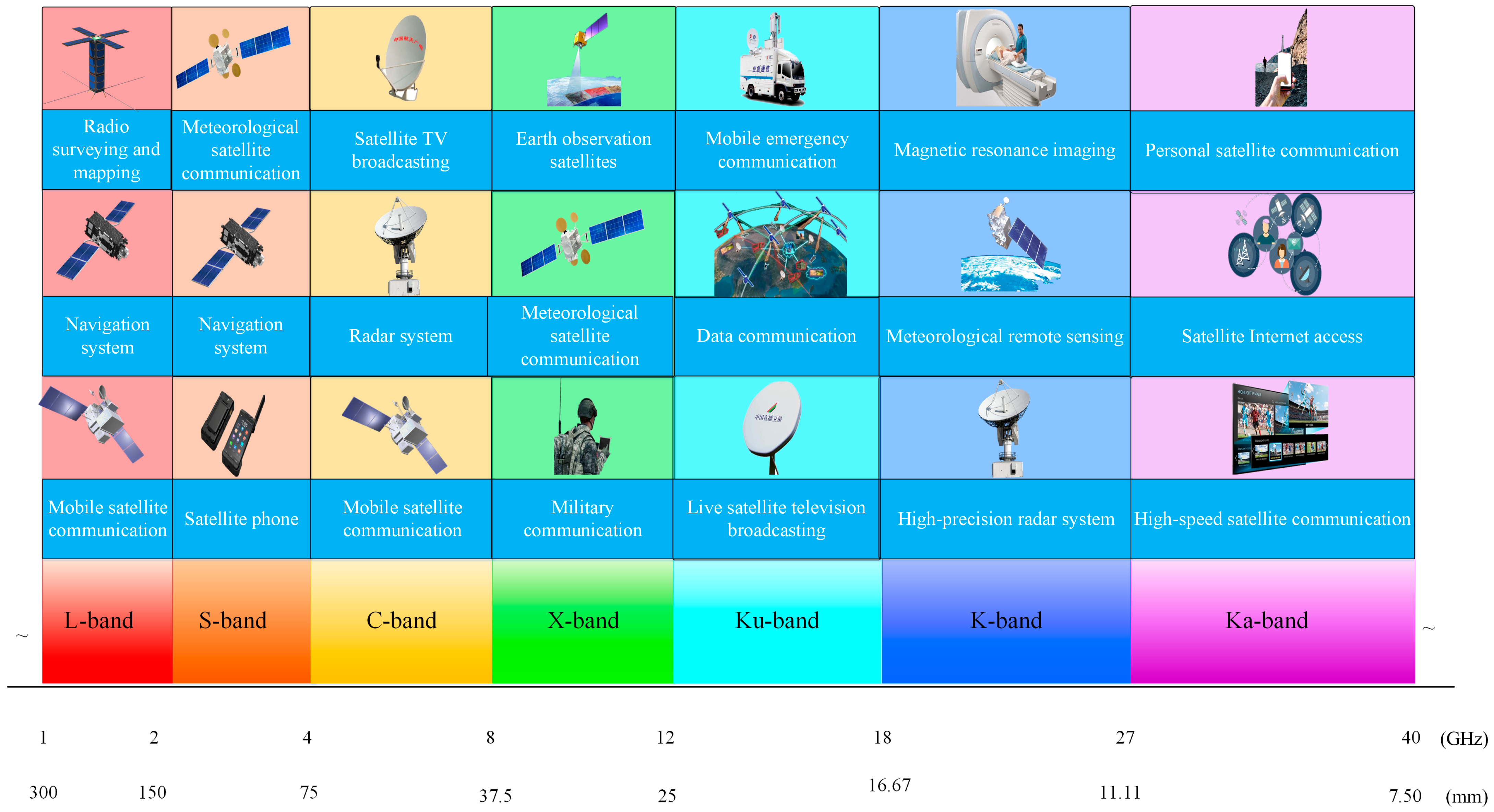
2. NS Communication, Navigation, and TT&C Integrated Frequency Selection
- (1)
- ITU spectrum division
- (2)
- High-speed Communication
- (3)
- Over-the-horizon relay
- (4)
- Plasma sheath and black barrier problem
- Increasing the power of the transmitter can offset the attenuation of radio waves by the plasma to a certain extent, but increasing the power of the transmitter is limited by various factors such as devices, and it can only be used as an auxiliary means when it is effectively coordinated with the frequency selection.
- By increasing the operating frequency, in the radio attenuation measurement experiment (RAM) in the United States, three antennas with frequencies of 220 MHz, 5700 MHz, and 9200 MHz were installed on the warhead at the same time, respectively. The recorded altitudes at which the radio signals were interrupted were 80 km, 54 km, and 40 km, and the altitude at which the signals recovered from the interruption was between 22 km and 23 km [56]. China and Russia have also conducted similar experiments, and the common conclusion is that increasing the frequency of radio waves has an obvious effect on reducing the altitude at which the blackout occurs.
- (5)
- Maturity of equipment development
3. Influence of Physical Properties of NS on Communication, Navigation, and TT&C Integration
3.1. Theoretical Loss of Signal Propagation in NS
3.2. NS Rainfall Attenuation
3.3. Atmospheric Loss in NS
3.3.1. Gas Absorption in NS
3.3.2. Cloud Attenuation in NS
3.3.3. NS Atmospheric Flicker
3.3.4. Influence of NS Plasma Sheath on Electromagnetic Wave
- (1)
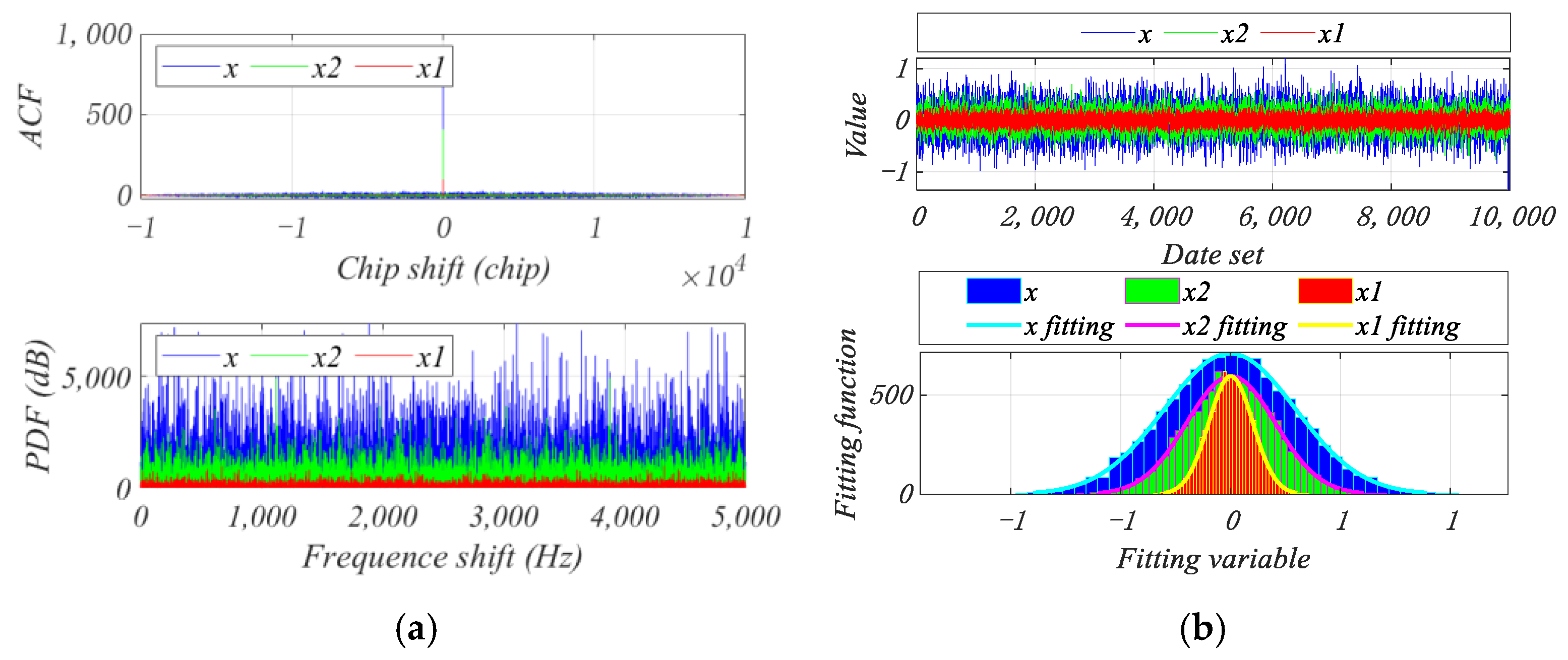
- Gaussian distribution
- (2)
- Epstein distribution
3.3.5. NS Multipath and Doppler
3.3.6. NS Noise
4. Integrated Signal Design of Communication, Navigation, and TT&C for the Requirements of the NS
- (1)
- Requirements for Modulation Technology Put Forward by the Integrated Channel of NS Communication, Navigation, and TT&C
- (2)
- General Considerations of the Modulation Technology for the Integration of NS Communication, Navigation, and TT&C
5. Conclusions and Future Works
5.1. Conclusions
- (1)
- The K/Ka frequency bands have huge potential advantages compared with the traditional L/S/C frequency bands. The K/Ka frequency bands are suitable for the ICNT in the NS.
- (2)
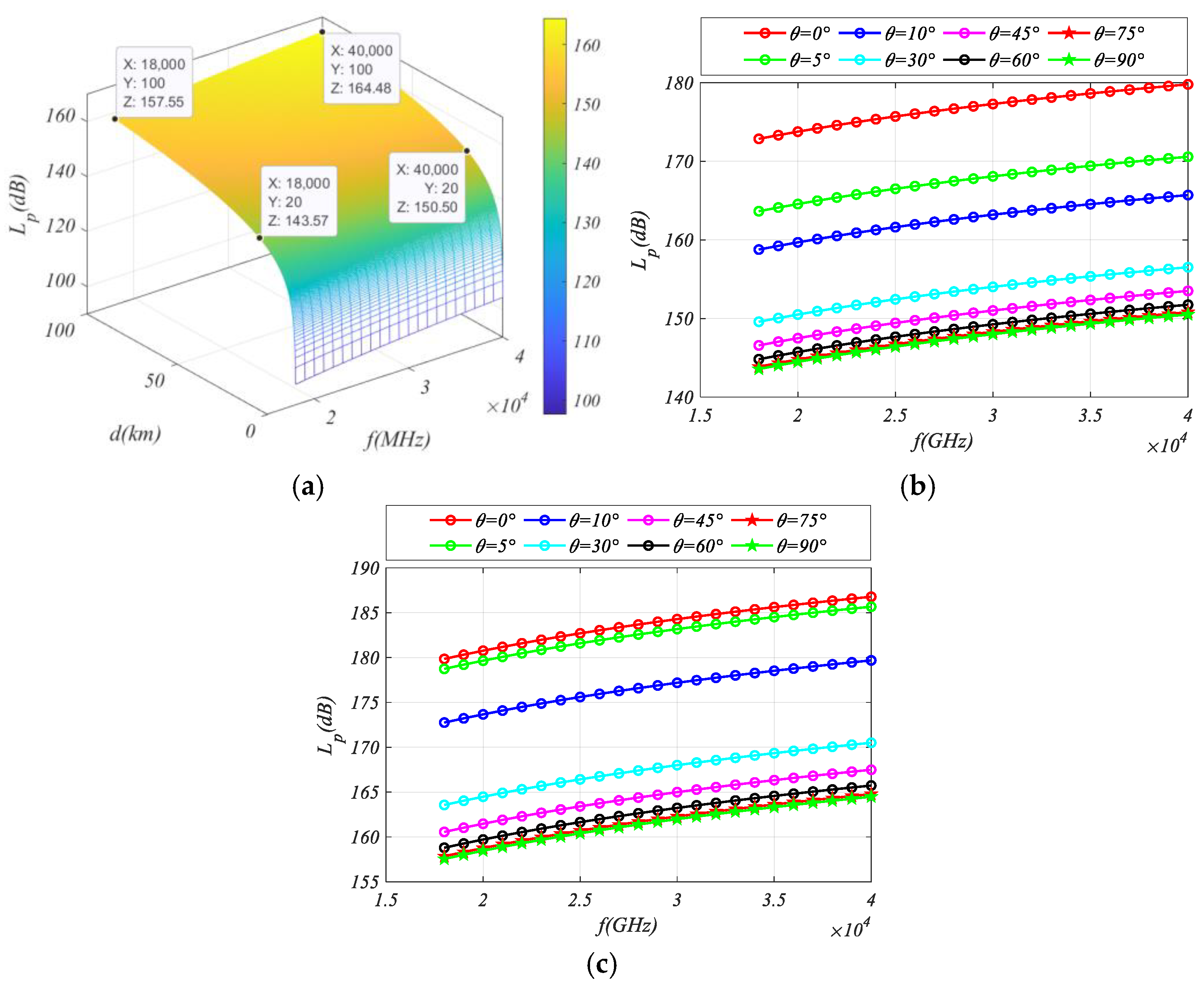
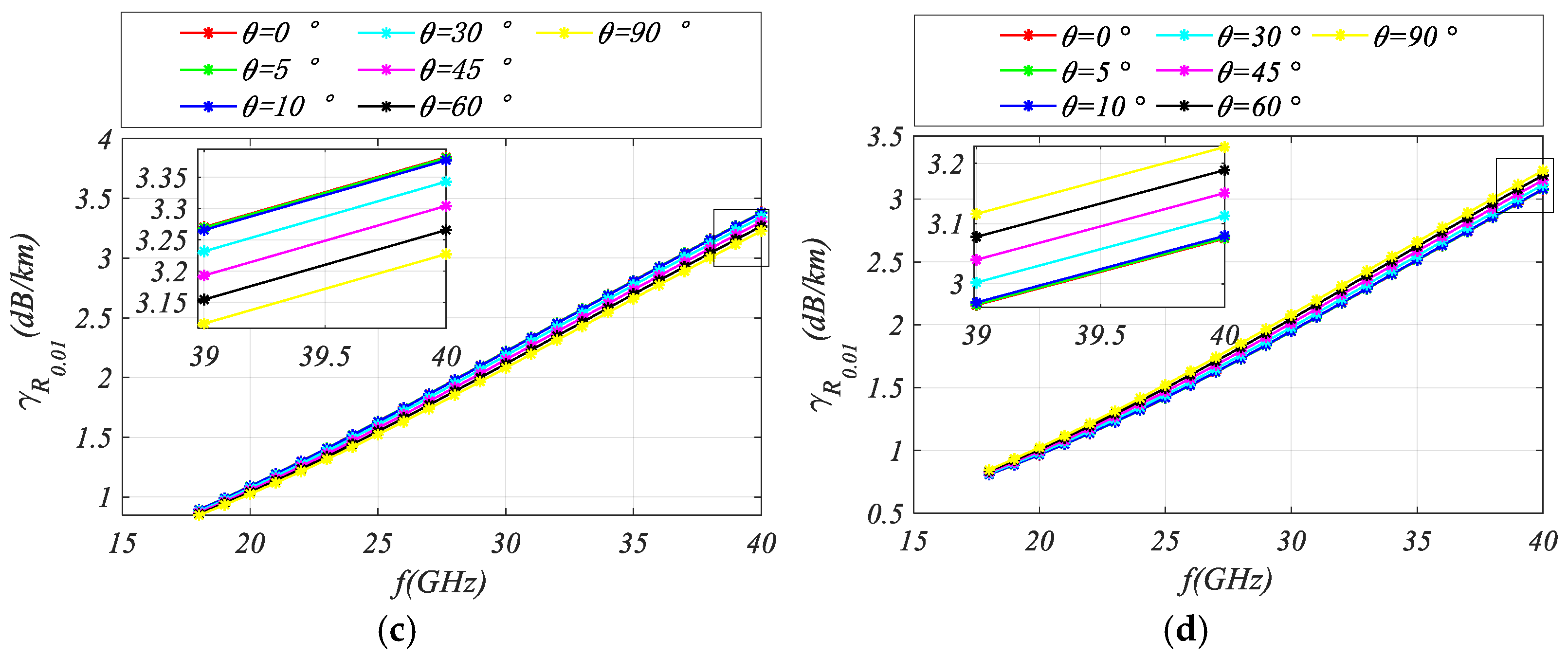
- The loss of K/Ka frequency band signals increases with the increase in frequency, and the path loss becomes greater as the elevation angle decreases.
- (3)
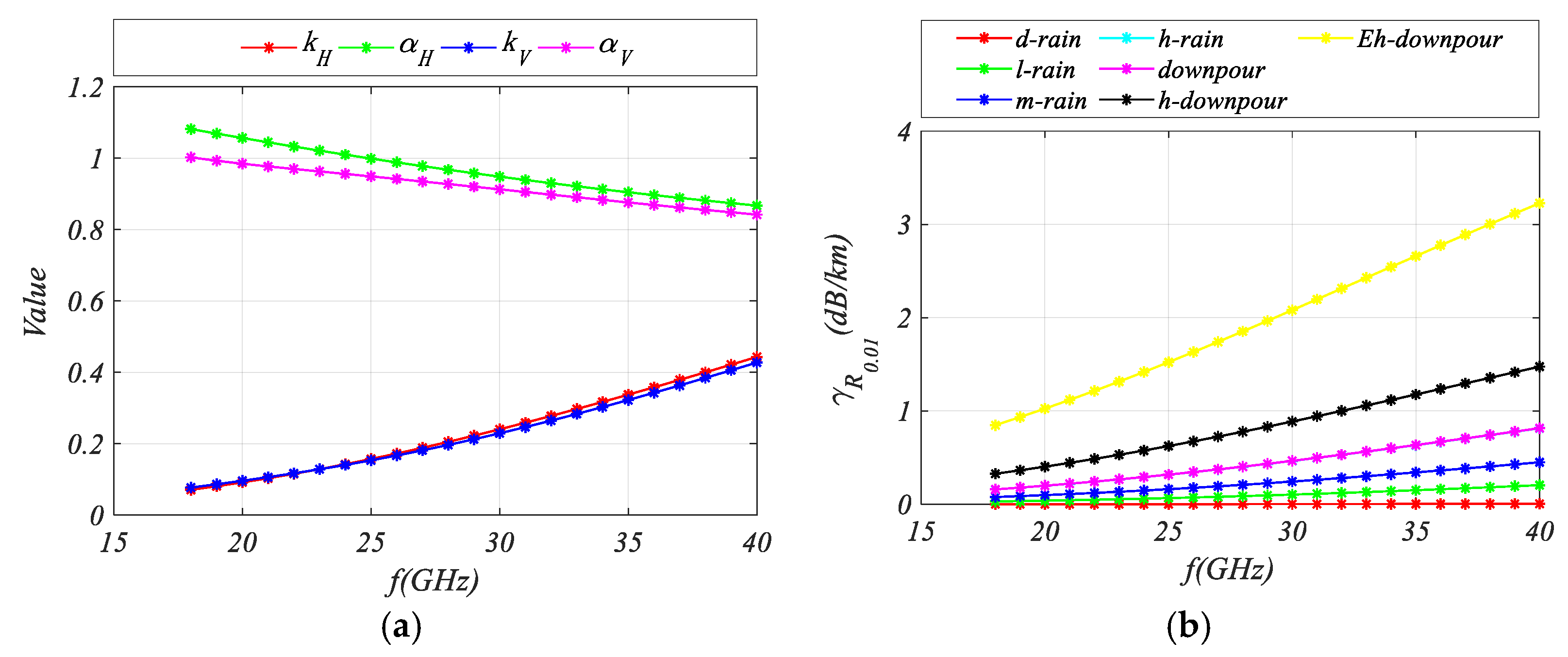
- The magnitude of rainfall loss depends on the signal frequency and the elevation angle of the beam. The larger the elevation angle, the smaller the rainfall attenuation. Conversely, the smaller the elevation angle, the greater the rainfall attenuation.
- (4)
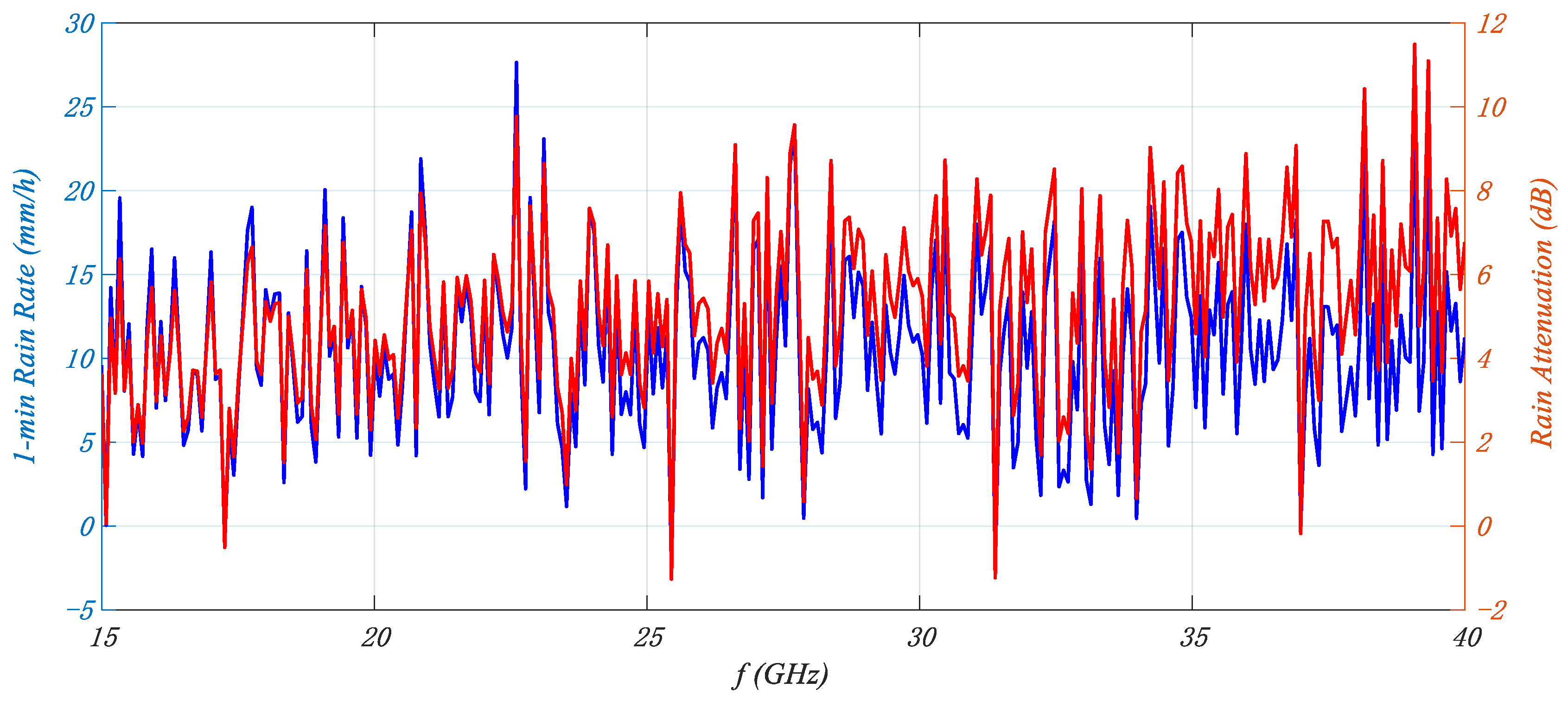
- For K/Ka frequency band signals, the 1 min rainfall rate and rainfall attenuation are closely related to the frequency. The rainfall attenuation increases with the increase in frequency, and a higher rainfall rate usually leads to greater rainfall attenuation.
- (5)
- In the atmospheric loss of the near space,
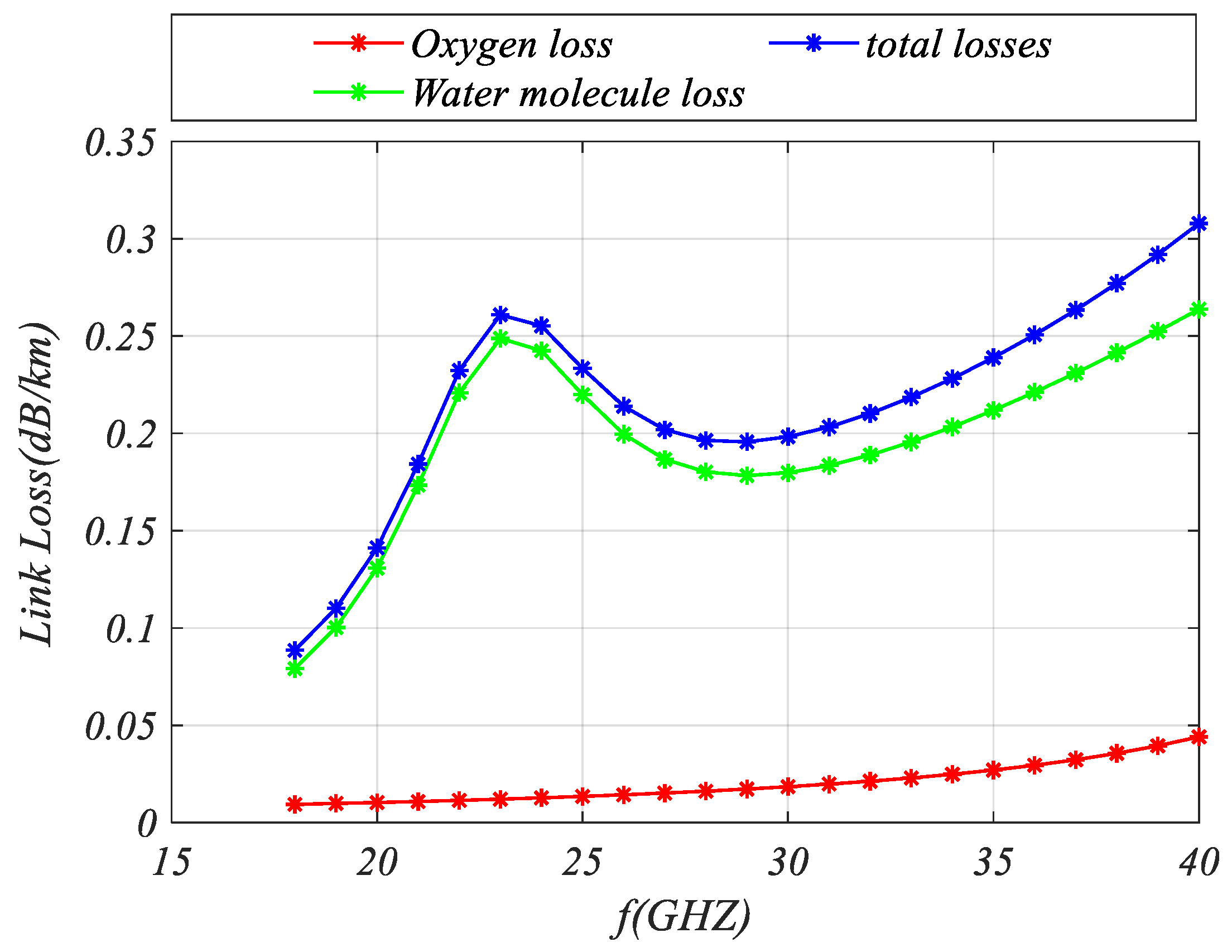
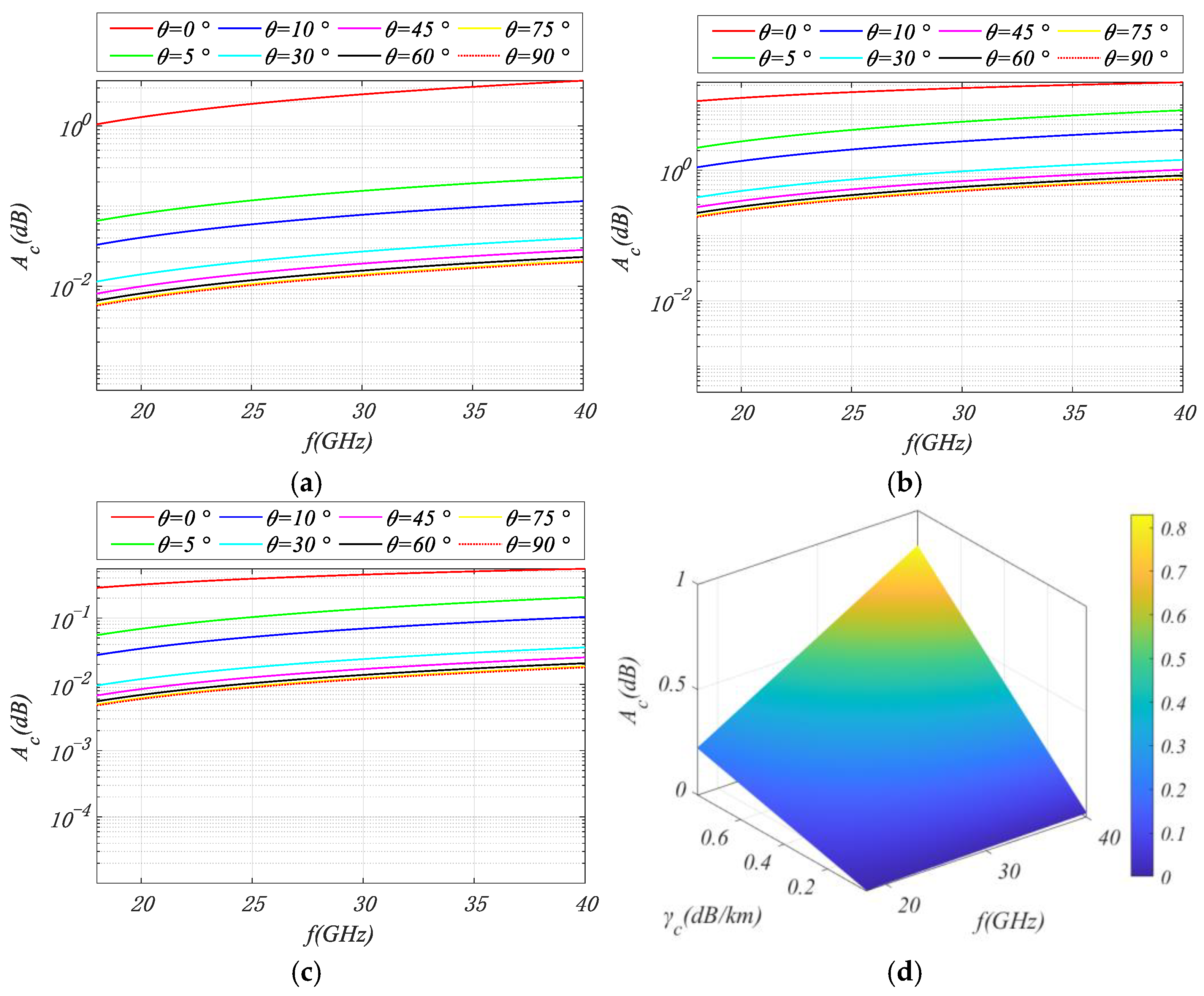
- For the K/Ka band signals, except for a relatively large absorption at 22.3 GHz due to the loss of oxygen molecules, the attenuation coefficients of both water vapor and oxygen molecules show a gradually increasing trend.
- With the increase in frequency, the cloud and fog loss of K/Ka band signals is gradually increasing, and with the decrease in the antenna elevation angle, the loss is also gradually increasing.
- The atmospheric attenuation of the K/Ka band gradually decreases with the increase in the antenna elevation angle. The lower the elevation angle, the stronger the atmospheric scintillation.
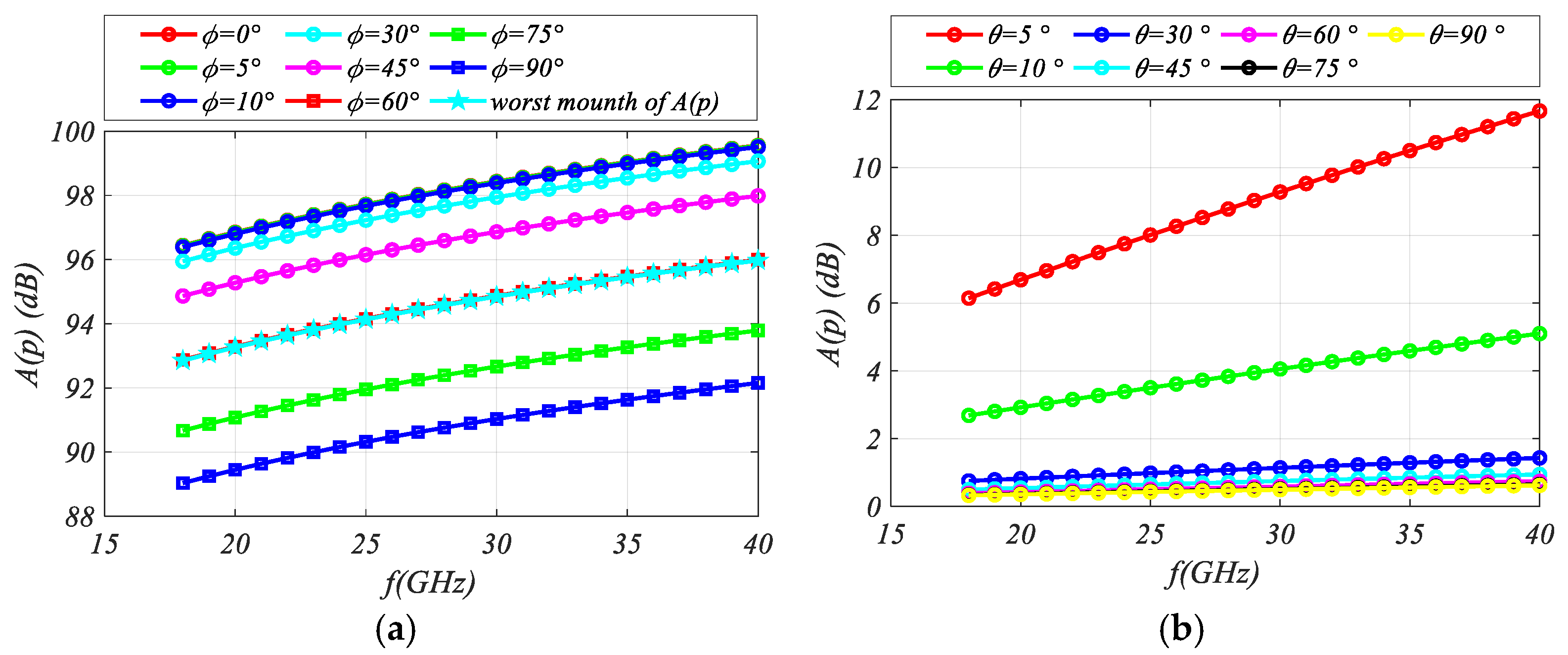
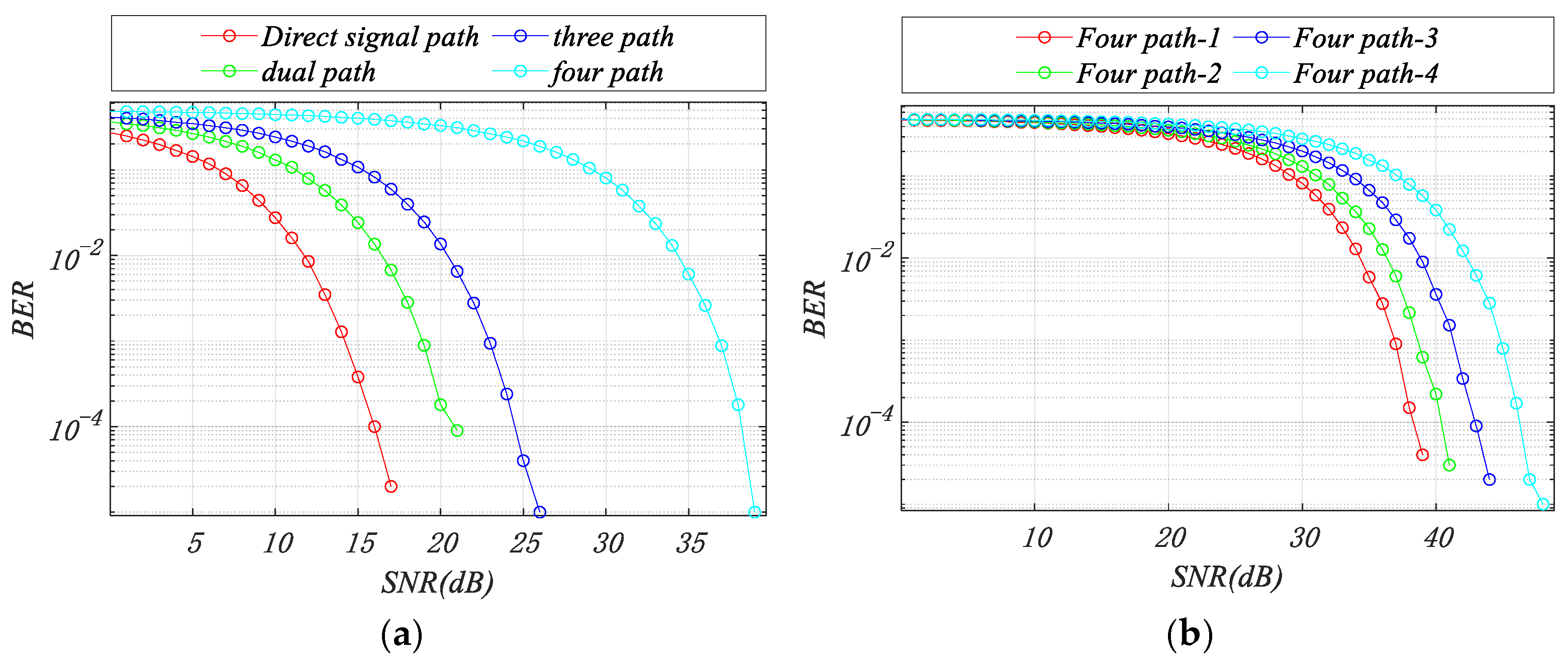
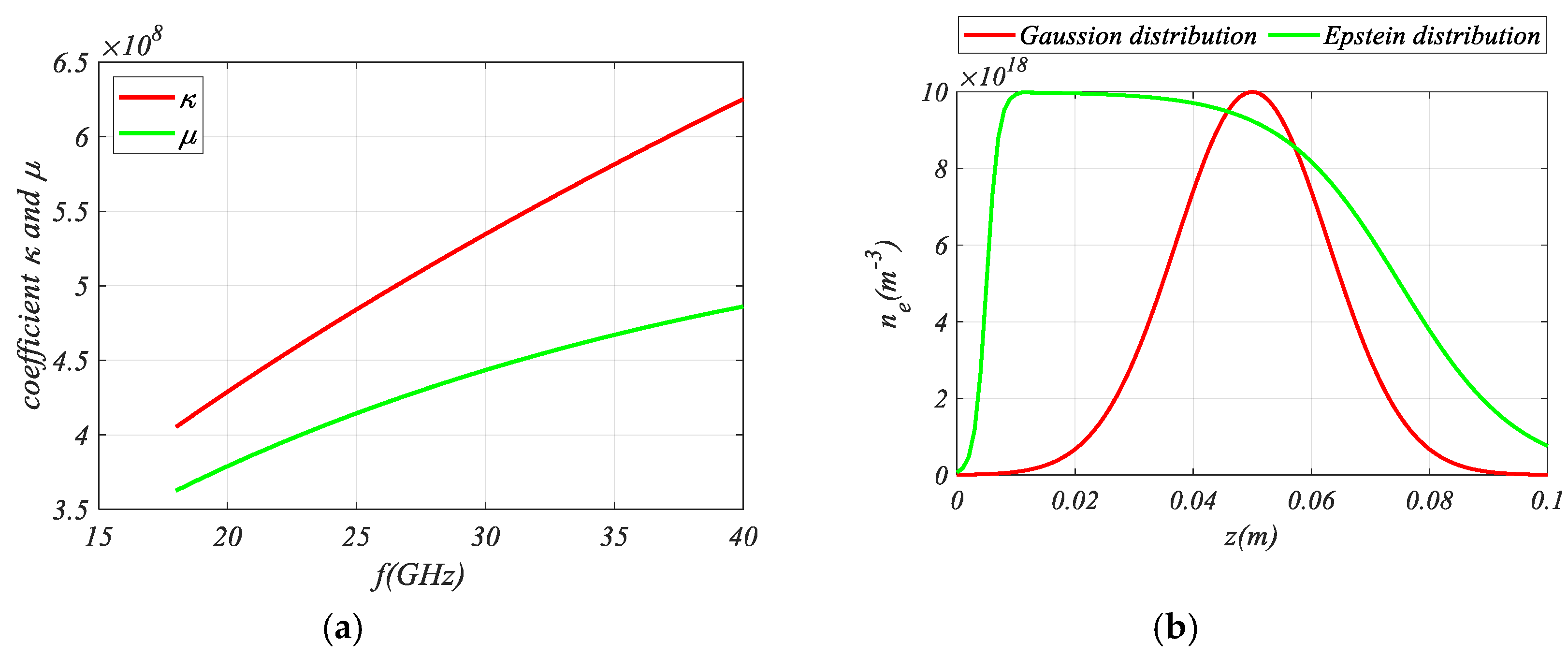
- Factors such as the plasma sheath, multipath, Doppler effect, and noise will also have a certain degree of impact on the propagation of the signal.
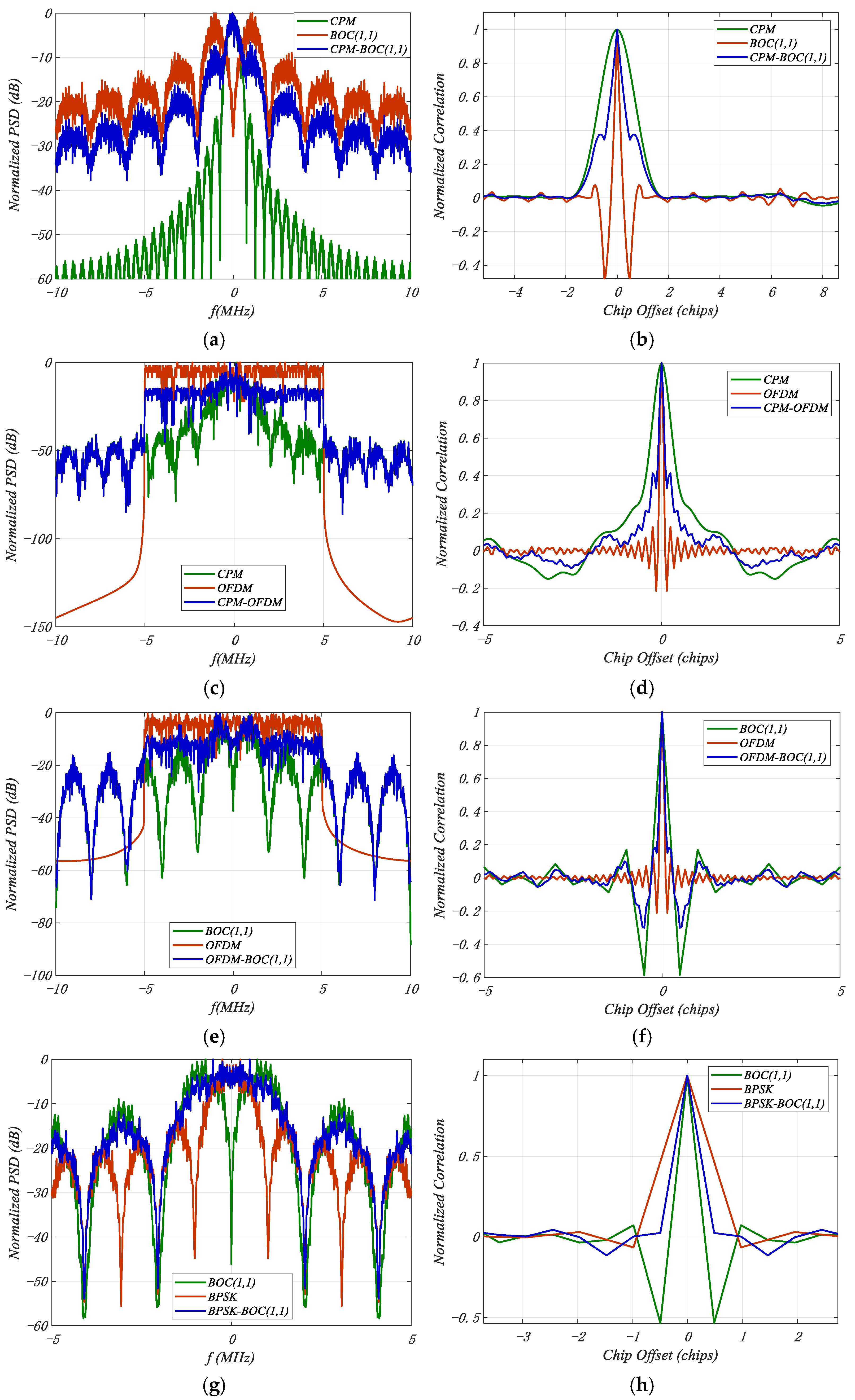
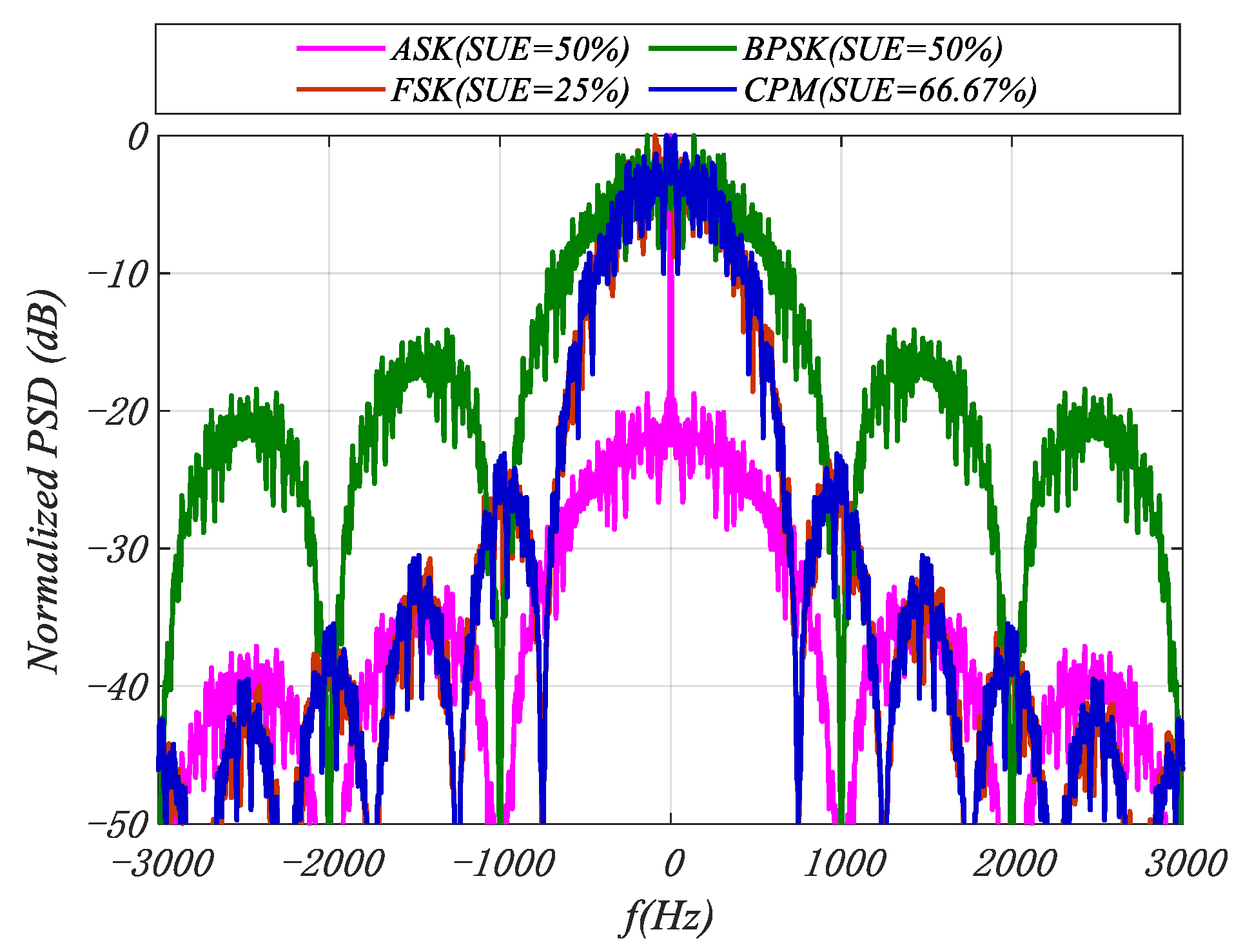
- Adopting constant envelope modulation can improve the frequency band utilization rate of the system to a certain extent. And the design scheme of integrating communication signals, navigation signals, and TT&C signals into the frequency points of a single K/Ka signal can enhance the overall performance of the system.
5.2. Future Work
- (1)
- In-depth research and extended application of frequency bands. Although the advantages of the K/Ka frequency bands in the current ICNT in the NS have been clarified, in the future, it is still necessary to conduct in-depth research on their long-term stability and reliability in complex environments. For example, during the peak period of solar activity, the impact mechanism of ionospheric disturbances on K/Ka frequency band signals is not yet fully clear, and further exploration and the formulation of countermeasures are required. In addition, with the progress of technology, the possibility of using the K/Ka frequency bands in coordination with other emerging frequency bands such as the terahertz frequency band can be explored to expand the communication bandwidth and application scenarios in NS and meet the growing demand for high-speed and large-capacity data transmission.
- (2)
- Innovation in signal loss mitigation technologies. Given the characteristics of the signal loss of the K/Ka frequency bands that change with factors such as frequency and elevation angle, efforts should be made in the follow-up to develop targeted anti-loss technologies. On the one hand, at the hardware level, by optimizing the antenna design, improving the antenna gain and pointing accuracy, the path loss and the influence of atmospheric scintillation can be reduced. On the other hand, in terms of signal processing algorithms, develop adaptive coding and modulation technologies, and dynamically adjust the coding and modulation methods according to the real-time signal loss situation to ensure the reliable transmission of signals.
- (3)
- Enhancement of adaptability to extreme environments. Rainfall attenuation has a significant impact on K/Ka frequency band signals. In the future, it is necessary to strengthen the research on signal transmission in extreme rainfall environments. By establishing a more accurate rainfall attenuation model and combining meteorological forecast data, early warning and compensation for rainfall attenuation can be achieved. At the same time, study comprehensive technical solutions to ensure stable signal transmission in extreme environments where complex interference factors such as the plasma sheath, multipath, Doppler effect, and noise coexist. For example, develop new signal processing algorithms to resist multipath interference and synchronization technologies that can effectively suppress the influence of Doppler frequency shift.
Author Contributions
Funding
Institutional Review Board Statement
Informed Consent Statement
Data Availability Statement
Conflicts of Interest
References
- Pielke, R.A. Atmosphere; Encyclopedia Britannica: Chicago, IL, USA, 2025; Available online: https://www.britannica.com/science/atmosphere (accessed on 27 February 2025).
- Hu, Y.; Guo, J.; Meng, W.; Liu, G.; Xue, W. Longitudinal Control for Balloon-Borne Launched Solar Powered UAVs in Near-Space. J. Syst. Sci. Complex. 2022, 35, 802–819. [Google Scholar] [CrossRef] [Scilit]
- Du, S. Key Basic Scientific Problems on Near-Space Vehicles; Springer: Singapore, 2023; ISBN 978-981-19-8907-0. [Google Scholar]
- Wang, W.Q.; Jiang, D. Navigation and Remote Sensing Using Near-Space Satellite Platforms; Wiley: Hoboken, NJ, USA, 2017; ISBN 9781119126485. [Google Scholar]
- James, N. Space Communications and Navigation: Planning Activities for NASAs Future SATCOM Direction; NASA Technical Reports Server: Hampton, VA, USA, 2020. Available online: https://ntrs.nasa.gov/api/citations/20200001533/downloads/20200001533.pdf (accessed on 24 April 2025).
- Elizabeth Hook-Rogers. SCAN Space Communications and Navigation: Science & Exploration, Enabled. Together; National Aeronautics and Space Administration: Washington, DC, USA, 2024. Available online: https://explorers.larc.nasa.gov/2023ESE/pdf_files/5_SCaN%20Overview_Hook-Rogers.pdf (accessed on 24 April 2025).
- Liebrecht, P.; Cornwell, D.; Israel, D.; Heckler, G. The Decade of Light: Innovations in Space Communications and Navigation Technologies. J. Space Oper. Commun. 2019, 16. Available online: https://docslib.org/doc/1189132/the-decade-of-light-innovations-in-space-communications-and-navigation-technologies (accessed on 11 May 2025).
- The State Council Information Office of the People’s Republic of China. Full Text: China’s Space Program: A 2021 Perspective. Available online: http://english.scio.gov.cn/whitepapers/2022-01/28/content_78016877.htm (accessed on 24 April 2025).
- ESA. About Horizon 2020 Satellite Navigation Programme (HSNAV). 2020. Available online: https://h2020nav.esa.int/page/about-h2020 (accessed on 24 April 2025).
- EU. EU Space Programme (2021–2027)—European Union Agency for the Space Programme. 2023. Available online: https://eur-lex.europa.eu/legal-content/EN/TXT/?uri=LEGISSUM:4526706 (accessed on 24 April 2025).
- Alyssa, L. Challenges and Priorities: Russia’s Space Program After 2024 Report. 22 July 2024. Available online: https://spaceinsider.tech/2024/07/22/challenges-and-priorities-russias-space-program-after-2024-report/ (accessed on 24 April 2025).
- Remya, P.R. Indian Space Program: Phases and Achievements. 17 January 2025. Available online: https://www.clearias.com/indian-space-program/ (accessed on 24 April 2025).
- Japan Aerospace Exploration Agency. Japan’s Space Program. 26 July 2019. Available online: https://www.nippon.com/en/japan-data/h00501/japan%E2%80%99s-space-program.html (accessed on 24 April 2025).
- Baghdady, E.; Kruse, K. Signal Design for Space Communication and Tracking Systems. IEEE Trans. Commun. Technol. 1965, 13, 484–498. [Google Scholar] [CrossRef] [Scilit]
- Yang, L.; Dong, X.; Xu, D. Precise navigation for GRACE formation flying. In Proceedings of the 2006 1st International Symposium on Systems and Control in Aerospace and Astronautics, Harbin, China, 19–21 January 2006; pp. 6–797. [Google Scholar]
- Dou, C.; Zhang, J. The Assumption of Regional Satellite Navigation System Near Space Applications. Radio Eng. 2007, 37, 31–32+36. [Google Scholar]
- Yang, L.; Zhou, J.; Hu, Y. Signal Design and Verification of the Near Space Regional Navigation Augmentation System. Telem. Track. Command. 2009, 30, 32–39. [Google Scholar]
- McCarthy, K.; Stocklin, F.; Geldzahler, B.; Friedman, D.E.; Celeste, P.B. NASA’s Evolution to Ka-Band Space Communications for Near-Earth Spacecraft. In Proceedings of the SpaceOps 2010 Conference, Huntsville, AL, USA, 25–30 April 2010; pp. 1–13. [Google Scholar]
- Li, P.; Chen, Z.; Gu, Y.; Si, Y. Spacecrafts Navigation Signal Research Based on GNSS Constellation. In Proceedings of the China Satellite Navigation Conference (CSNC) 2013 Proceedings. Lecture Notes in Electrical Engineering, Wuhan, China, 15–17 May 2013; pp. 35–48. [Google Scholar]
- Yang, J. Analysis of Key Technologies of the Regional Navigation System Based on Near Space Vehicles. Telecommun. Eng. 2014, 54, 385–391. [Google Scholar]
- Tzelepis, C.; Carreno, A. Concepts for NASA’s Communication and Navigation Architecture in Near Earth and Deep Space Domains; Strategies for Affordable and Scalable implementation of Next Generation Relay Systems with Improved Mission Experience and Reduced Burden. In Proceedings of the International Communications Satellite Systems Conferences (ICSSC), American Institute of Aeronautics and Astronautics (AIAA), ICSSE 22nd Ka and Broadband Communications Conference, AIAA 34th International Communications Satellite Systems Conference, Cleveland, OH, USA, 18–20 October 2016. [Google Scholar]
- Ling, Y.; Chen, C.; Jiang, J. Research on Propagation Properties of Near Space Vehicle Communication Signals. Comput. Simul. 2016, 33, 127–131+137. [Google Scholar]
- Martin-Mur, T.J.; Zhai, C.; Jacobs, C.; Turyshev, S.G.; Shao, M.; Peng, M. Using optical communications links for deep-space navigation. In Proceedings of the 2017 IEEE International Conference on Space Optical Systems and Applications (ICSOS), Naha, Japan, 14–16 November 2017; pp. 176–182. [Google Scholar] [CrossRef] [Scilit]
- Wu, B.; Xu, Z. Research on integrated space-air-ground TT&C and communication network based on space tracking ship. In Proceedings of the 2017 16th International Conference on Optical Communications and Networks (ICOCN), Wuzhen, China, 7–10 August 2017; pp. 1–3. [Google Scholar] [CrossRef] [Scilit]
- Wang, Y.; Yan, T.; Wang, G.; Bian, L.; Meng, Y. Analysis of Interaction Between Navigation Payload and Constant Envelope Design of Navigation Signal. In Proceedings of the China Satellite Navigation Conference (CSNC) 2019 Proceedings, Beijing, China, 22–25 May 2019; pp. 421–431. [Google Scholar]
- Hamkins, J.; Antsos, D.; Border, J.; Davis, G.; Deutsch, L.; Lazio, J.; Velazco, J. Communications and Navigation Technologies. In A White Paper in Response to the Planetary Science and Astrobiology Decadal Survey 2023–2032; The American Astronomical Society: Washington, DC, USA, 2020. [Google Scholar]
- Modenini, A.; Ripani, B. A Tutorial on the Tracking, Telemetry, and Command (TT&C) for Space Missions. IEEE Commun. Surv. Tutor. 2023, 25, 1510–1542. [Google Scholar]
- Liu, H.; Qin, T.; Gao, Z.; Mao, T.; Ying, K.; Wan, Z.; Qiao, L.; Na, R.; Li, Z.; Hu, Y. Near-Space Communications: The Last Piece of 6G Space-Air-Ground-Sea Integrated Network Puzzle. Space Sci. Technol. 2024, 4, 283. [Google Scholar] [CrossRef] [Scilit]
- Xu, C.; Xiang, L.; An, J.; Dong, C.; Sugiura, S.; Maunder, R.G.; Yang, L.L.; Haozo, L. OTFS-Aided RIS-Assisted SAGIN Systems Outperform Their OFDM Counterparts in Doubly Selective High-Doppler Scenarios. IEEE Internet Things J. 2023, 10, 682–703. [Google Scholar] [CrossRef] [Scilit]
- Xu, C.; Xiang, L.; Sugiura, S.; Maunder, R.G.; Yang, L.L.; Niyato, D.; Li, G.Y.; Schober, R.; Hanzo, L. Noncoherent Orthogonal Time Frequency Space Modulation. IEEE Trans. Wirel. Commun. 2024, 23, 10072–10090. [Google Scholar] [CrossRef] [Scilit]
- Schmitz-Peiffer, A.; Stopfkuchen, L.; Floch, J.; Felnach, D. Architecture for a Future C-band/L-band GnSS mission Part 1: C-band Services, Space-and Ground Segment, Overall Performance. Inside GNSS 2009, 47–56. Available online: https://docslib.org/doc/7004963/architecture-for-a-future-c-band-l-band-gnss-mission-part-2-signal-considerations-and-related-user-terminal-aspects (accessed on 11 May 2025).
- Schmitz-Peiffer, A.; Stopfkuchen, L.; Floch, J.; Felnach, D. Architecture for a Future C-Band/L-band GNSS Mission Part 2: Signal Considerations and Related User Terminal Aspects. Inside GNSS 2009, 52–63. Available online: https://insidegnss.com/architecture-for-a-future-c-band-l-band-gnss-mission-part-2/ (accessed on 11 May 2025).
- Pech, P.; Huang, P.; Bousquet, M.; Robert, M.; Duverdier, A. Simulation of an adaptive strategy designed for low bit rate emergency satellite communications links in Ku/Ka/Q/V bands. In Proceedings of the 2009 International Workshop on Satellite and Space Communications, Siena, Italy, 9–11 September 2009; pp. 337–340. [Google Scholar]
- Biscarini, M.; Montopoli, M.; Marzano, F.S. Evaluation of High-Frequency Channels for Deep-Space Data Transmission Using Radiometeorological Model Forecast. IEEE Trans. Antennas Propag. 2017, 65, 1311–1320. [Google Scholar] [CrossRef] [Scilit]
- Arslan, C.H. Detection and Estimation of Rainfall Through Data Analysis of Geostationary Ku-Band Satellite Signals. Ph.D. Thesis, The Pennsylvania State University, University Park, PA, USA, 2017. [Google Scholar]
- Lawal, Y.B.; Owolawi, P.A.; Tu, C.; Van Wyk, E.; Ojo, J.S. Analysis of Cross-Polarization Discrimination Due to Rain for Earth–Space Satellite Links Operating at Millimetre-Wave Frequencies in Pretoria, South Africa. Atmosphere 2025, 16, 256. [Google Scholar] [CrossRef] [Scilit]
- ITU. ITU-R S.1001-2: Use of Systems in the Fixed-Satellite Service in the Event of Natural Disasters and Similar Emergencies for Warning and Relief Operations. 2010. Available online: https://www.itu.int/rec/R-REC-S.1001-2-201001-I/en (accessed on 24 April 2025).
- ITU. ITU-R M.IMT-2020: M.2150: Detailed Specifications of the Terrestrial Radio Interfaces of International Mobile Telecommunications-2020 (Imt-2020). 2023. Available online: https://www.itu.int/rec/R-REC-M.2150/en (accessed on 24 April 2025).
- ITU. ITU-R P.619: Propagation Data Required for the Evaluation of Interference Between Stations in Space and Those on the Surface of the Earth. 2021. Available online: https://www.itu.int/rec/R-REC-P.619/en (accessed on 24 April 2025).
- ITU. ITU-R P.452: Prediction Procedure for the Evaluation of Interference Between Stations on the Surface of the Earth At Frequencies Above About 100 Mhz. 2023. Available online: https://www.itu.int/rec/R-REC-P.452/en (accessed on 24 April 2025).
- ITU. ITU-R P.531: Ionospheric Propagation Data and Prediction Methods Required for the Design of Satellite Networks and Systems. 2023. Available online: https://www.itu.int/rec/R-REC-P.531/en (accessed on 24 April 2025).
- ITU. Radio Regulations, 2020th ed.; The International Telecommunication Union: Geneva, Switzerland, 2020; Available online: https://www.itu.int/en/publications/ITU-R/Pages/publications.aspx?parent=R-REG-RR-2020&media=electronic (accessed on 24 April 2025).
- ITU. The Final Acts of WRC-23. 2023. Available online: https://www.itu.int/hub/publication/r-act-wrc-16-2024/ (accessed on 24 April 2025).
- ITU. Radio Regulations, 2024th ed., The International Telecommunication Union: Geneva, Switzerland, 2024. Available online: https://www.itu.int/hub/publication/r-reg-rr-2024/ (accessed on 24 April 2025).
- Allison, A.L. The ITU and Managing Satellite Orbital and Spectrum Resources in the 21st Century; Springer International Publishing: Berlin/Heidelberg, Germany, 2014; ISBN 978-3-319-05314-1. [Google Scholar]
- Lu, F.; Jiang, Y.; Wang, R.; Wang, H.; Zhao, P.; Wei, H.; Ma, B.; Ma, C. System demonstrations of Ka-band 5-Gbps data transmission for satellite applications. Int. J. Satell. Commun. Netw. 2022, 40, 204–217. [Google Scholar] [CrossRef] [Scilit]
- Xiao, Z.; Mao, T.; Han, Z.; Xia, X. Near Space Communications: A New Regime in Space-Air-Ground Integrated Networks. IEEE Wirel. Commun. 2022, 29, 38–45. [Google Scholar] [CrossRef] [Scilit]
- Kobayashi, M.M.; Stocklin, F.; Pugh, M.; Kuperman, I.; Bell, D.; El-Nimri, S.; Johnson, B.; Huynh, N.; Kelly, S.; Nessel, J.; et al. NASA’s high-rate Ka-band downlink system for the NISAR mission. Acta Astronaut. 2019, 159, 358–361. [Google Scholar] [CrossRef] [Scilit]
- ITU. Itu-R Sf.1601-2: Methodologies for Interference Evaluation from the Downlink of the Fixed Service Using High Altitude Platform Stations to the Uplink of the Fixed-Satellite Service Using the Geostationary Satellites Within the Band 27.5–28.35 Ghz. 2007. Available online: https://www.itu.int/rec/R-REC-SF.1601-2-200702-I/en (accessed on 27 February 2025).
- Zhao, W.H.; Zhao, J.; Zhao, S.H.; Li, Y.J.; Li, X. Resources scheduling for data relay satellite with microwave and optical hybrid links based on improved niche genetic algorithm. Optik 2014, 125, 3370–3375. [Google Scholar] [CrossRef] [Scilit]
- Zhang, J.F.; Cheng, Y.J. K-/Ka-Band Planar Shared-Aperture Beam-Scanning Array Antenna for Simultaneous Transmitting and Receiving Low Earth Orbit Satellite Communication Terminal. IEEE Trans. Antennas Propag. 2023, 71, 6617–6627. [Google Scholar] [CrossRef] [Scilit]
- LaBelle, R.; Rochblatt, D. Ka-band high-rate telemetry system upgrade for the NASA deep space network. Acta Astronaut. 2012, 70, 58–68. [Google Scholar] [CrossRef] [Scilit]
- Chelmins, D.T.; Reinhart, R.C.; Mortensen, D.; Welch, B.; Downey, J.; Evans, M. Studying NASA’s Transition to Ka-Band Communications for Low Earth Orbit. Eng. Comput. Sci. 2014, 1–7. Available online: https://ntrs.nasa.gov/api/citations/20140016968/downloads/20140016968.pdf (accessed on 11 May 2025).
- Chen, N.; Peng, D.; Ma, L.; Hu, T.; Liu, H.; Li, H. Horizontal Detection Range Estimation of Deep-Sea Acoustic Shadow Area Based on Vertical Phased Emission Array. J. Mar. Sci. Eng. 2025, 13, 9. [Google Scholar] [CrossRef] [Scilit]
- Yuan, W. The Design of High Speed Near Space Vehicle TT&C Link and Simulation Platform Implementation. Master’s Thesis, Xidian University, Xi’an, China, 2012. [Google Scholar]
- Guo, L.; Guo, L.; Li, J. Influence of a Hypersonic Ablative Plasma Wake-Field on the Performance of a Vivaldi Antenna. IEEE Trans. Plasma Sci. 2024, 52, 1474–1480. [Google Scholar] [CrossRef] [Scilit]
- Ning, R.; Bin, X.; Xiao-Fei, L. Development Status and Difficulties of the Technology of Blackout Suppression. Missiles Space Veh. 2018, 1, 122–126. [Google Scholar] [CrossRef]
- Chai, M.; Gu, N.; Han, Z.; Tian, W. Overview of global Ka-band in-orbit satellite usage. In Proceedings of the 12th Annual Conference on Satellite Communication, Beijing, China, 3 March 2016; pp. 103–108. [Google Scholar]
- Angert, M.P.; Bubnash, B.M.; Cerabona, M.A.; Dauberman, M.G.; Monaghan, C.; Heistand, C.C.; Wilkes, J.C. Frontier Radio-Multi-Lingual-A Next Generation Space Software Defined Radio. In Proceedings of the 2023 IEEE Aerospace Conference, Big Sky, MT, USA, 4–11 March 2023; pp. 1–12. [Google Scholar]
- Koosha, B.; Singh, R.; Sanders, C.; Spicer, J.; Ratana, T.; Conrad, R. SpaceLink-ISS Connectivity End-to-End Demonstration (SLICED). In Proceedings of the 2023 IEEE Aerospace Conference, Big Sky, MT, USA, 4–11 March 2023; pp. 1–10. [Google Scholar]
- Harmon, K.; Arnold, B.; Levesque, M.; Johnston, M.; Lichten, S.; Lock, P.; Berry, D.; Asmar, S.; Pham, T. Pre-launch lessons learned from NASA’S deep space network support for the artemis I mission to the moon. Acta Astronaut. 2023, 210, 589–595. [Google Scholar] [CrossRef] [Scilit]
- Zoccarato, P.; Larese, S.; Naletto, G.; Zampieri, L.; Brotto, F. Deep Space Navigation by Optical Pulsars. J. Guid. Control Dyn. 2023, 46, 1501–1512. [Google Scholar] [CrossRef] [Scilit]
- Al Homssi, B.; Chan, C.C.; Wang, K.; Rowe, W.; Allen, B.; Moores, B.; Csurgai-Horváth, L.; Fontán, F.P.; Kandeepan, S.; Al-Hourani, A. Deep Learning Forecasting and Statistical Modeling for Q/V-Band LEO Satellite Channels. IEEE Trans. Mach. Learn. Commun. Netw. 2023, 1, 78–89. [Google Scholar] [CrossRef] [Scilit]
- Cuervo, F.; Martellucci, A.; Rivera Castro, J.; Schmidt, M.; Schönhuber, M. The Alphasat Aldo Paraboni scientific and communication experiments at Ka and Q/V bands in Austria. Int. J. Satell. Commun. Netw. Munications Netw. 2019, 37, 437–448. [Google Scholar] [CrossRef] [Scilit]
- Ye, L.; Yang, Y.; Chen, B.; Pan, D.; Yang, F.; Cao, S.; Yan, Y.; Sun, F. Chaff Cloud Integrated Communication and TT&C: An Integrated Solution for Single-Station Emergency Communications and TT&C in a Denied Environment. Drones 2024, 8, 207. [Google Scholar] [CrossRef] [Scilit]
- ITU. Recommendation Itu-R P.618-12: Propagation Data and Prediction Methods Required for the Design of Earth-Space Telecommunication Systems. Available online: https://www.itu.int/dms_pubrec/itu-r/rec/p/R-REC-P.618-12-201507-S!!PDF-E.pdf (accessed on 27 February 2025).
- Samad, M.A.; Choi, D.-Y. Scaling of Rain Attenuation Models: A Survey. Appl. Sci. 2021, 11, 8360. [Google Scholar] [CrossRef] [Scilit]
- Musthafa, A.M.; Luini, L.; Riva, C.; Livieratos, S.N.; Roveda, G. A long-term experimental investigation on the impact of rainfall on short 6G D-band links. Radio Sci. 2023, 58, 1–10. [Google Scholar] [CrossRef] [Scilit]
- Acharya, R. A simple real-time frequency scaling technique for rain attenuation and its performance. Int. J. Satell. Commun. Netw. 2020, 38, 329–340. [Google Scholar] [CrossRef] [Scilit]
- Monga, S.; Taneja, A.; Saluja, N.; Garg, R.; Siag, T. Estimation of Rain Attenuation Over 10 GHz to 80 GHz Radio Band. In Proceedings of the 2022 3rd International Conference on Computing, Analytics and Networks (ICAN), Punjab, India, 18–19 November 2022; IEEE: Piscataway, NJ, USA, 2022; pp. 1–6. [Google Scholar]
- ITU. Recommendation ITU-R P.838-3. Specific Attenuation Model for Rain for Use in Prediction Methods. 2005. Available online: https://itu-rpy.readthedocs.io/en/latest/apidoc/itu838.html (accessed on 27 February 2025).
- China Meteorological Administration. Rainfall Classification. Available online: https://www.cma.gov.cn/ (accessed on 8 September 2024).
- ITU. ITU-R P.679-4. Propagation Data Required for the Design of Broadcasting-Satellite Systems. 2015. Available online: https://www.itu.int/dms_pubrec/itu-r/rec/p/R-REC-P.679-4-201507-I!!PDF-C.pdf (accessed on 27 February 2025).
- Wang, X.; Liu, Z.; Xia, G. Effects of Reentry Plasma Fluctuation on Polarization Properties of Electromagnetic Waves. Prog. Electromagn. Res. M 2017, 58, 171–181. [Google Scholar] [CrossRef] [Scilit]
- Gibbins, C.J. Erratum: Zenithal attenuation due to molecular oxygen and water vapour, in the frequency range 3–350 GHz. Electron. Lett. 1986, 22, 726. [Google Scholar] [CrossRef] [Scilit]
- ITU. ITU-R P.676-13: Attenuation by Atmospheric Gases. 2013. Available online: https://www.itu.int/dms_pubrec/itu-r/rec/p/R-REC-P.676-8-200910-S!!PDF-E.pdf (accessed on 27 February 2025).
- ITU. ITU-R P. 840-9: Attenuation Due to Clouds and Fog. 2023. Available online: https://www.itu.int/dms_pubrec/itu-r/rec/p/R-REC-P.840-9-202308-I!!PDF-C.pdf (accessed on 27 February 2025).
- ITU. ITU-R P.618-14: Propagation Data and Prediction Methods Required for the Design of Earth-Space Telecommunication Systems. 2015. Available online: https://www.itu.int/dms_pubrec/itu-r/rec/p/R-REC-P.618-14-202308-I!!PDF-C.pdf (accessed on 27 February 2025).
- Zhaoying, W.A.N.G.; Lixin, G.U.O.; Jiangting, L.I. Research on phase shift characteristics of electromagnetic wave in plasma. Plasma Sci. Technol. 2021, 23, 075001. [Google Scholar] [CrossRef] [Scilit]
- Koskinen, H.E.J.; Kilpua, E.K.J. From Charged Particles to Plasma Physics. In Physics of Earth’s Radiation Belts; Springer: Cham, Switzerland, 2022; pp. 63–83. ISBN 978-3-030-82167-8. [Google Scholar] [CrossRef] [Scilit]
- Yao, J.; Yu, Z.; Yuan, C.; Zhou, Z.; Wang, X.; Kudryavtsev, A.A. The Influence of Plasma Distribution on Microwave Reflection in a Plasma-Metal Model. IEEE Trans. Plasma Sci. 2020, 48, 359–363. [Google Scholar] [CrossRef] [Scilit]
- Jin, J.; Chen, C.; Cheng, W.; Chen, T.; Zhou, T.; Ling, Y. Properties of Terahertz Wave Propagation in Inhomogeneous Plasma Sheath. J. Syst. Simul. 2015, 27, 3109–3115. [Google Scholar]
- Deng, X.; Hu, J.; Yang, W. Near space vehicle channel modeling and simulation. In Proceedings of the Chinese Society of Astronautics Flight Vehicle Measurement and Control Committee 2007 Space Measurement and Control Technology Seminar, Hangzhou, China, 5–9 September 2007; pp. 347–351. [Google Scholar]
- Gongshun, L.I.; Zhang, T.; Geng, K.; Wen, F.; Ye, K.; Xu, L.; Zhu, X.; Zhang, X.; Zhong, F.; Zhou, Z. A mathematically-derived unified Equation for Time-Varying Doppler effect, Cosmological red-shift and Cherenkov radiation. Plasma Sci. Technol. 2024, 26, 34001. [Google Scholar] [CrossRef] [Scilit]
- Rao, K.; Swamy, M. Spectral Analysis of Signals. In Digital Signal Processing; Springer: Singapore, 2018; ISBN 978-981-10-8081-4. [Google Scholar]
- Sankar, A.; Darshan, S.; Devika, K.M.; Varghese, B.; Menon, P.R. SDR based CCSDS Shaped Offset QPSK Modulator for Aerospace Applications. In Proceedings of the 2023 9th International Conference on Smart Computing and Communications (ICSCC), Kerala, India, 17–19 August 2023; pp. 184–189. [Google Scholar]
- Kryukov, Y.V.; Pokamestov, D.A.; Rogozhnikov, E.V. Comparison of Theoretical and Real Throughput of PD-NOMA. J. Commun. Technol. Electron. 2023, 68, 88–95. [Google Scholar] [CrossRef] [Scilit]
- Xue, L.; Li, X.; Wu, W.; Yang, Y. Design of Tracking, Telemetry, Command (TT&C) and Data Transmission Integrated Signal in TDD Mode. Remote Sens. 2020, 12, 3340. [Google Scholar] [CrossRef] [Scilit]
- Xue, L.; Li, X.; Wu, W.; Dong, J. Multifunctional Signal Design for Measurement, Navigation and Communication Based on BOC and BPSK Modulation. Remote Sens. 2022, 14, 1653. [Google Scholar] [CrossRef] [Scilit]
- Wang, B.; Tang, Z.; Wei, J. Comparison and analysis of COMPASS B1C Candidate signal. In Proceedings of the 7th China Satellite Navigation Conference-S03 Satellite Navigation Signals, Changsha, China, 18–20 May 2016; pp. 83–93. [Google Scholar]
- Li, X.; Zeng, X.; Xue, L. Integrated Communication and Measurement System with BOC-Assisted OFDM. Drones 2023, 7, 14. [Google Scholar] [CrossRef] [Scilit]
- Ni, Y.; Zou, L.; Liu, R.; Chen, W.; Qin, Z.; Wang, K. L/C dual-band navigation signal modulation mode and performance evaluation of BeiDou system. Syst. Eng. Electron. 2022, 44, 327775. [Google Scholar]









| Name | Type | Applicable Conditions |
|---|---|---|
| ITU-R S.1001-2 | Standards for satellite communication integration. | Fixed satellite service (FSS) and mobile satellite service (MSS). |
| ITU-R M.IMT-2020 | Standards for satellite communication integration. | 5G satellite radio interface standard. |
| ITU-R P.619 | Recommendations of ITU-R Series P. | It is used for interference assessment, aiming at the interference paths between the space station and the ground station such as propagation in clear sky, scattering by rain and snow, etc. |
| ITU-R P.452 | Recommendations of ITU-R Series P. | It provides propagation models between the near-space and the ground to support link design and spectrum efficiency optimization. |
| ITU-R P.531 | Recommendations of ITU-R Series P. | It is used to analyze the influence of the ionosphere on near-space communication, and to provide the basis of propagation characteristics for the spectrum usage in high-frequency bands such as Ka/V frequency bands. |
| Radio Regulations, Edition of 2020 | An international treaty that regulates the use of the global radio frequency (RF) spectrum and satellite orbits. | It covers more than 40 different radio communication services, with frequencies ranging from 8.3 kHz to 3000 GHz. |
| The Final Acts of WRC-23 | Supplement to the Radio Regulations. | It is used for high-altitude platform station (HIBS), Earth station in motion for non-GEO satellite (ESIM), and space weather observation. |
| Radio Regulations, Edition of 2024 | An international treaty that regulates the use of the global radio frequency (RF) spectrum and satellite orbits. | Updates and supplements to the Radio Regulations, Edition of 2020. |
| Comparison Items | K/Ka Frequency Band | L/S/C Frequency Bands | |
|---|---|---|---|
| Frequency band distribution | K: 18–27 GH Ka: 27–40 GHz | L: 1–2 GHz S: 2–4 GHz C: 4–8 GHz | |
| Comparison of transmission characteristics | Bandwidth | Extremely large bandwidth, and supports high-speed data transmission. Typical values: 500–2000 MHz. | The bandwidth is relatively narrow, and the data rate is limited. Typical values: 20–100 MHz. |
| Atmospheric attenuation | It is significantly affected by rain attenuation and the absorption of oxygen/water vapor. Typical values: 0.3 dB/km (sunny)-10 dB/km (torrential rain). | The attenuation is relatively low. Typical values: 0.02 dB/km–0.1 dB/km. | |
| Penetration ability | Poor penetrability (it is easily blocked by buildings and vegetation). | Strong penetrability (especially in the L frequency band, which is suitable for urban and indoor coverage). | |
| Anti-interference ability | It has relatively abundant spectrum resources and relatively less interference. | The spectrum congestion is severe. | |
| Equipment and cost | Antenna size | Short wavelength and a small antenna size Typical values: 0.3–0.6 m. | The antenna size is relatively large. Typical values: 1–5 m. |
| The cost of components | The cost of high-frequency devices is high. | The cost of mature silicon-based devices is low. | |
| Power efficiency | There is a large path loss, and a high-power amplifier is required. | The path loss is small, and the power efficiency is high. | |
| Typical application scenarios | Advantages | Suitable for high-throughput scenarios, short-distance/space-to-ground links (rain attenuation needs to be compensated), and miniaturized terminals. Cases: Starlink user terminals, airborne radars, and urban 5G hotspots. | Suitable for long-distance communication, scenarios with high penetrability requirements, and low-cost wide-coverage scenarios. Cases: Satellite television broadcasting, GPS navigation, military communication. |
| Disadvantages | 1. Communication in rainy areas; 2. Long-distance transmission without repeaters. | 1. Scenarios with high-capacity requirements; 2. Scenarios with high spectrum reuse. | |
| The Number of Paths | Time Delay (μs) | Relative Power of the Direct Path (dB) |
|---|---|---|
| direct single path | 0 | 0 |
| double paths | 300 | −6 |
| three paths | 450 | −12 |
| four paths | 600 | −18 |
| The Number of Paths | Time Delay (μs) | Relative Power of the Direct Path (dB) |
|---|---|---|
| four paths -1 | 0 | 0 |
| four paths -2 | 10 | −1 |
| four paths -3 | 20 | −2 |
| four paths -4 | 30 | −3 |
Disclaimer/Publisher’s Note: The statements, opinions and data contained in all publications are solely those of the individual author(s) and contributor(s) and not of MDPI and/or the editor(s). MDPI and/or the editor(s) disclaim responsibility for any injury to people or property resulting from any ideas, methods, instructions or products referred to in the content. |
© 2025 by the authors. Licensee MDPI, Basel, Switzerland. This article is an open access article distributed under the terms and conditions of the Creative Commons Attribution (CC BY) license (https://creativecommons.org/licenses/by/4.0/).
Share and Cite
Ye, L.; Cao, S.; Gu, Z.; Pan, D.; Chen, B.; Wu, X.; Shen, K.; Yan, Y. Analysis of the Integrated Signal Design for Near-Space Communication, Navigation, and TT&C Based on K/Ka Frequency Bands. Atmosphere 2025, 16, 586. https://doi.org/10.3390/atmos16050586
Ye L, Cao S, Gu Z, Pan D, Chen B, Wu X, Shen K, Yan Y. Analysis of the Integrated Signal Design for Near-Space Communication, Navigation, and TT&C Based on K/Ka Frequency Bands. Atmosphere. 2025; 16(5):586. https://doi.org/10.3390/atmos16050586
Chicago/Turabian StyleYe, Lvyang, Shaojun Cao, Zhifei Gu, Deng Pan, Binhu Chen, Xuqian Wu, Kun Shen, and Yangdong Yan. 2025. "Analysis of the Integrated Signal Design for Near-Space Communication, Navigation, and TT&C Based on K/Ka Frequency Bands" Atmosphere 16, no. 5: 586. https://doi.org/10.3390/atmos16050586
APA StyleYe, L., Cao, S., Gu, Z., Pan, D., Chen, B., Wu, X., Shen, K., & Yan, Y. (2025). Analysis of the Integrated Signal Design for Near-Space Communication, Navigation, and TT&C Based on K/Ka Frequency Bands. Atmosphere, 16(5), 586. https://doi.org/10.3390/atmos16050586