An Analysis of Uncertainties in Evaluating Future Climate Change Impacts on Cotton Production and Water Use in China


 and
and
Abstract
1. Introduction
1.1. Climate Projection Models and Their Uncertainties
1.2. Application of Crop Models for Future Climate Impact Assessment
1.3. Impacts of Climate Change on Cotton Growth and Water Consumption
1.4. Objective of the Study
2. Materials and Methods
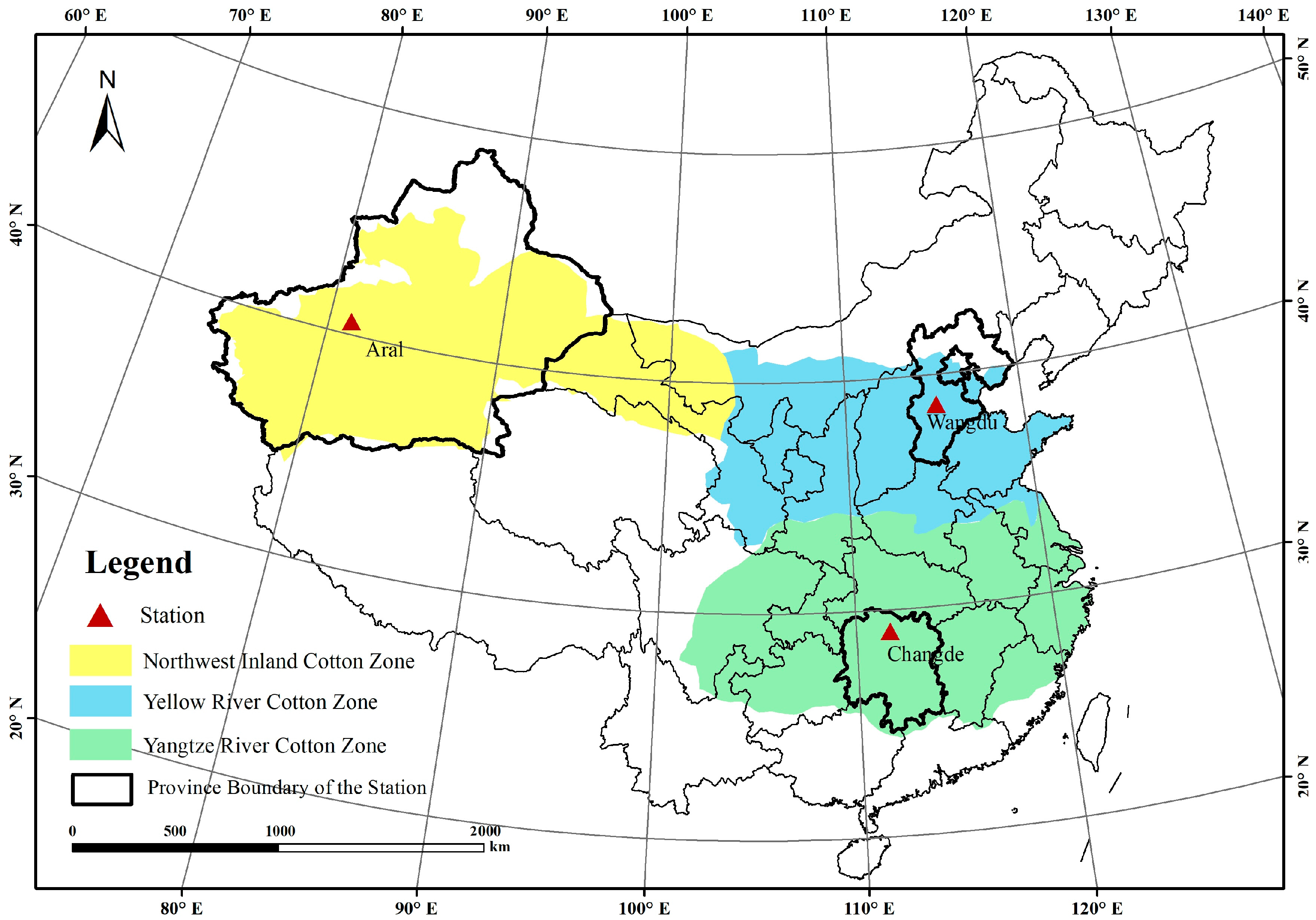
2.1. Study Area
2.2. Brief Introduction of APSIM-COTTON
2.3. Data Resources
2.3.1. Meteorological Data
2.3.2. Soil Data
2.3.3. Crop Data
2.4. Statistical Method
2.4.1. Multiple Linear Regression
2.4.2. Contribution Percentage
3. Results
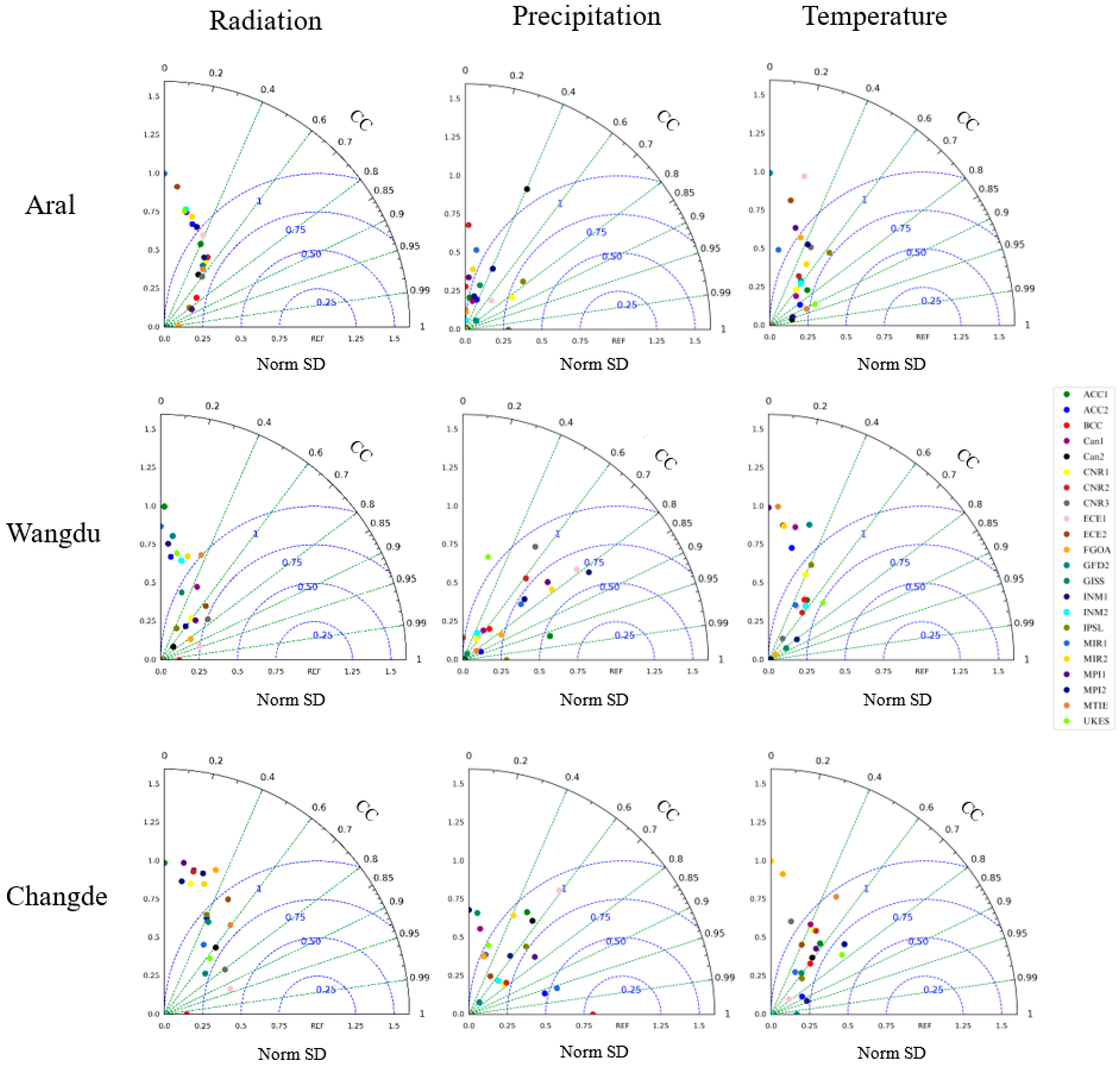
3.1. Evaluation of GCMs After Statistical Downscaling
3.2. Change of Climate for the Three Sites
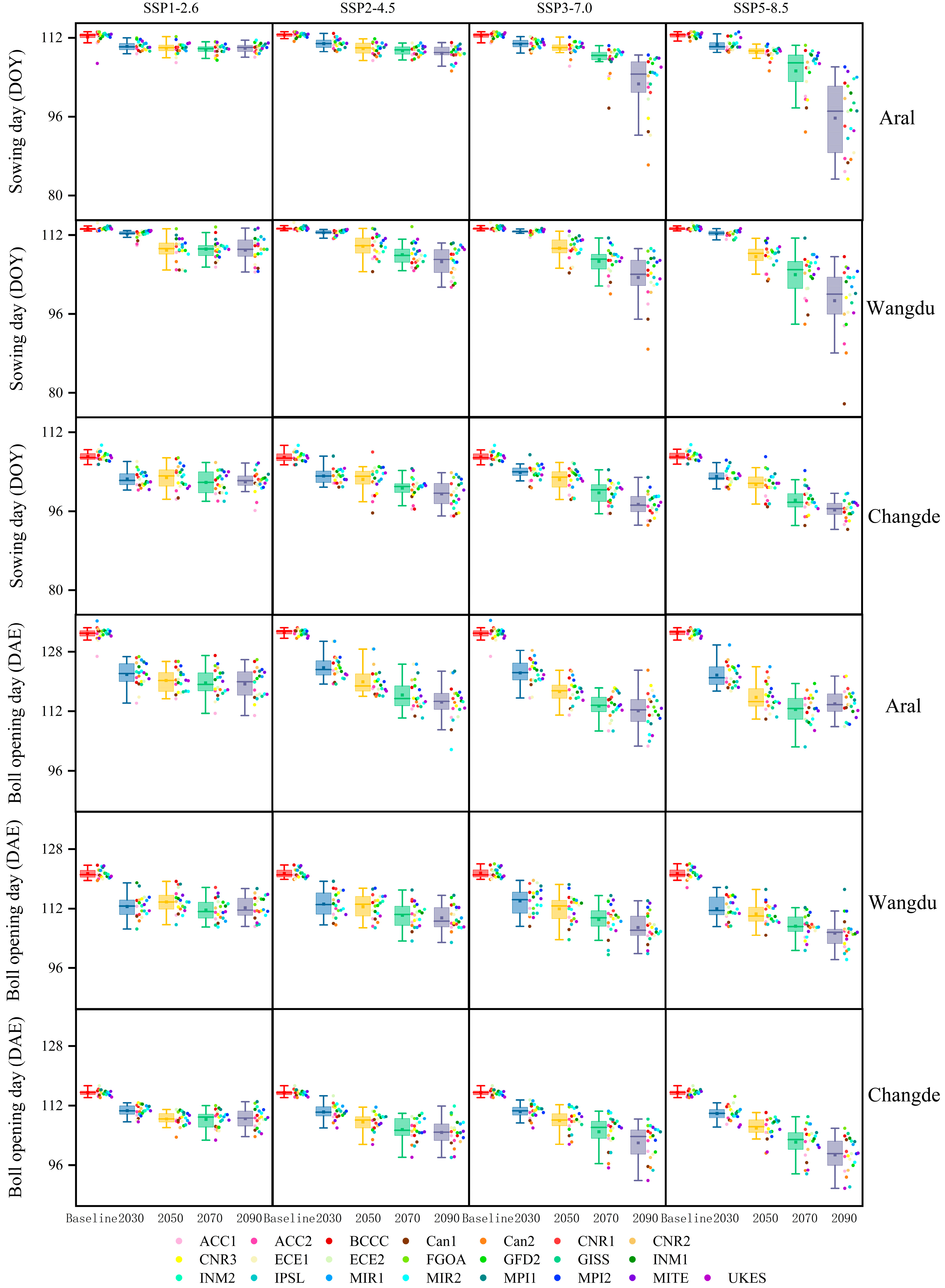
3.3. Change of the Phenology and Uncertainty
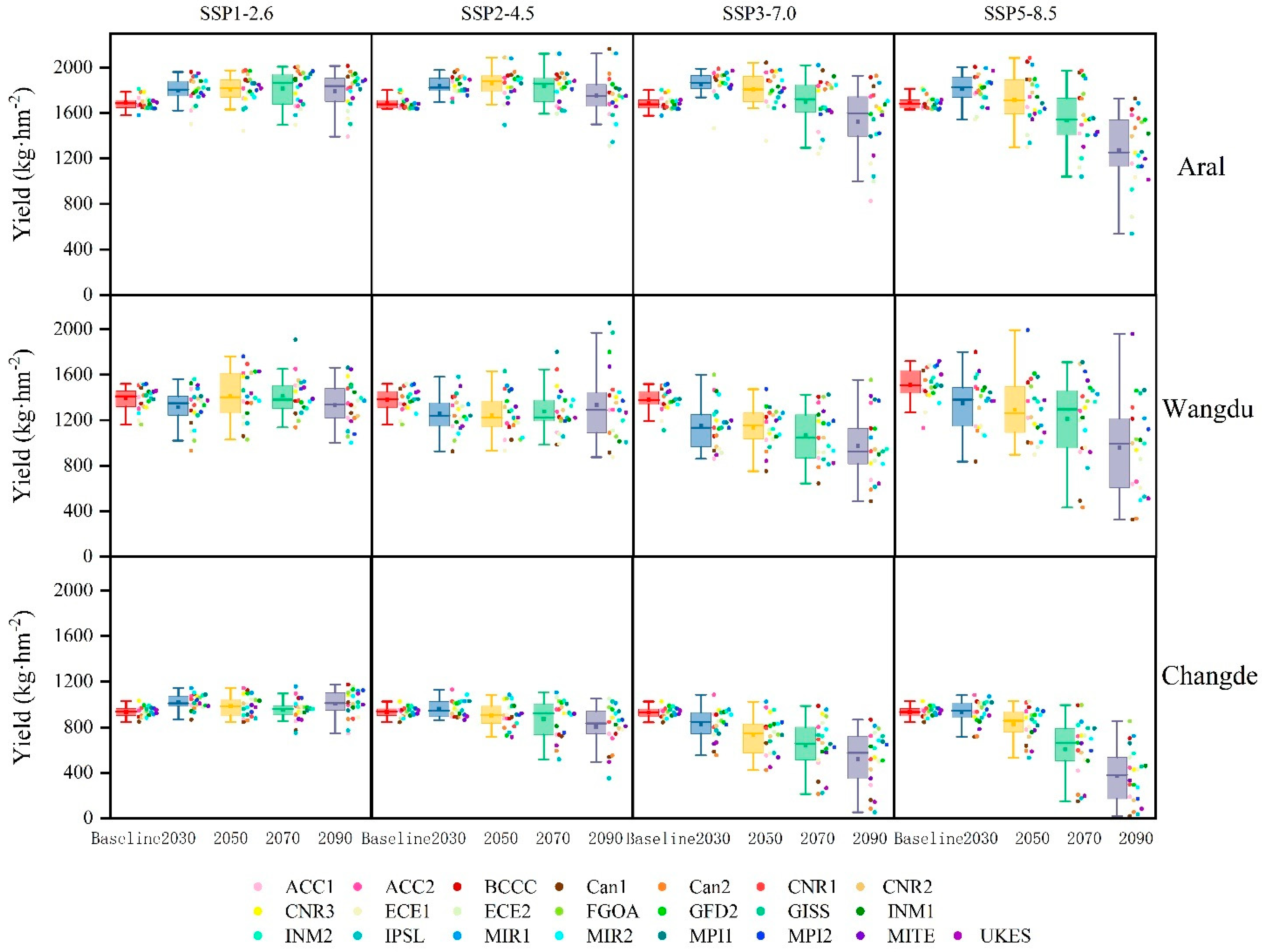
3.4. Change of the Yield and Uncertainty
3.5. Change of the Water Use and Uncertainty
3.6. Contribution of Climatic Factors to Cotton Yield
4. Discussion
4.1. Strength and Limitation of the Study
4.2. Differences in the Response to Climate Change in Different Regions
4.3. Dominant Climate Drivers and Regional Specificity
5. Conclusions
Supplementary Materials
Author Contributions
Funding
Data Availability Statement
Conflicts of Interest
References
- Semenov, M.A.; Stratonovitch, P. Use of multi-model ensembles from global climate models for assessment of climate change impacts. Clim. Res. 2010, 41, 1–14. [Google Scholar] [CrossRef]
- Di Virgilio, G.; Ji, F.; Tam, E.; Nishant, N.; Evans, J.P.; Thomas, C.; Riley, M.L.; Beyer, K.; Grose, M.R.; Narsey, S.; et al. Selecting CMIP6 GCMs for CORDEX dynamical downscaling: Model performance, independence, and climate change signals. Earths Future 2022, 10, e2021EF002625. [Google Scholar] [CrossRef]
- Wang, H.M.; Chen, J.; Xu, C.Y.; Zhang, J.; Chen, H. A framework to quantify the uncertainty contribution of GCMs over multiple sources in hydrological impacts of climate change. Earths Future 2020, 8, e2020EF001602. [Google Scholar] [CrossRef]
- Lun, Y.; Liu, L.; Cheng, L.; Li, X.; Li, H.; Xu, Z. Assessment of GCMs simulation performance for precipitation and temperature from CMIP5 to CMIP6 over the Tibetan Plateau. Int. J. Climatol. 2021, 41, 3994–4018. [Google Scholar] [CrossRef]
- Anwar, M.R.; Wang, B.; Liu, D.L.; Waters, C. Late planting has great potential to mitigate the effects of future climate change on Australian rain-fed cotton. Sci. Total Environ. 2020, 714, 136806. [Google Scholar] [CrossRef] [PubMed]
- Kumar, S.; Mukhopadhyay, P.; Balaji, C. A machine learning based deep convective trigger for climate models. Clim. Dyn. 2024, 62, 8183–8200. [Google Scholar] [CrossRef]
- Vosper, E.; Watson, P.; Harris, L.; McRae, A.; Santos-Rodriguez, R.; Aitchison, L.; Mitchell, D. Deep learning for downscaling tropical cyclone rainfall to hazard-relevant spatial scales. J. Geophys. Res. 2023, 128, e2022JD038163. [Google Scholar] [CrossRef]
- Gholami, H.; Lotfirad, M.; Ashrafi, S.M.; Biazar, S.M.; Singh, V.P. Multi-GCM ensemble model for reduction of uncertainty in runoff projections. Stoch. Environ. Res. Risk Assess. 2023, 37, 953–964. [Google Scholar] [CrossRef]
- Sun, L.; Lan, Y.; Jiang, R. Using CNN framework to improve multi-GCM ensemble predictions of monthly precipitation at local areas: An application over China and comparison with other methods. J. Hydrol. 2023, 623, 129866. [Google Scholar] [CrossRef]
- Kim, E.; Kim, T.; Mun, T.; Shin, S.-W.; Lee, M.; Cha, D.-H.; Chang, E.-C.; Ahn, J.-B.; Min, S.-K.; Kim, J.-U.; et al. Multimodel GCM-RCM ensemble-based projections of tropical cyclone activities over CORDEX East Asia domain. Clim. Dyn. 2025, 63, 143. [Google Scholar] [CrossRef]
- Ahmed, K.; Sachindra, D.A.; Shahid, S.; Iqbal, Z.; Nawaz, N.; Khan, N. Multi-model ensemble predictions of precipitation and temperature using machine learning algorithms. Atmos. Res. 2020, 236, 104806. [Google Scholar] [CrossRef]
- Li, Z.; Menefee, D.; Yang, X.; Cui, S.; Rajan, N. Simulating productivity of dryland cotton using APSIM, climate scenario analysis, and remote sensing. Agric. For. Meteorol. 2022, 325, 109148. [Google Scholar] [CrossRef]
- Luo, Q.; Bange, M.; Johnston, D.; Braunack, M. Cotton crop water use and water use efficiency in a changing climate. Agric. Ecosyst. Environ. 2015, 202, 126–134. [Google Scholar] [CrossRef]
- Chen, X.; Qi, Z.; Gui, D.; Gu, Z.; Ma, L.; Zeng, F.; Li, L. Simulating impacts of climate change on cotton yield and water requirement using RZWQM2. Agric. Water Manag. 2019, 222, 231–241. [Google Scholar] [CrossRef]
- Rahman, M.H.u.; Ahmad, A.; Wang, X.; Wajid, A.; Nasim, W.; Hussain, M.; Ahmad, B.; Ahmad, I.; Ali, Z.; Ishaque, W.; et al. Multi-model projections of future climate and climate change impacts uncertainty assessment for cotton production in Pakistan. Agric. For. Meteorol. 2018, 253–254, 94–113. [Google Scholar] [CrossRef]
- Jans, Y.; von Bloh, W.; Schaphoff, S.; Müller, C. Global cotton production under climate change—Implications for yield and water consumption. Hydrol. Earth. Syst. Sc. 2021, 25, 2027–2044. [Google Scholar] [CrossRef]
- Lobell, D.B.; Sibley, A.; Ivan Ortiz-Monasterio, J. Extreme heat effects on wheat senescence in India. Nat. Clim. Change 2012, 2, 186–189. [Google Scholar] [CrossRef]
- Han, W.; Liu, S.; Wang, J.; Lei, Y.; Zhang, Y.; Han, Y.; Wang, G.; Feng, L.; Li, X.; Li, Y.; et al. Climate variation explains more than half of cotton yield variability in China. Ind. Crop. Prod. 2022, 190, 115905. [Google Scholar] [CrossRef]
- Li, Y.; Li, N.; Javed, T.; Pulatov, A.S.; Yang, Q. Cotton yield responses to climate change and adaptability of sowing date simulated by AquaCrop model. Ind. Crop. Prod. 2024, 212, 118319. [Google Scholar] [CrossRef]
- Wang, Z.; Chen, J.; Xing, F.; Han, Y.; Chen, F.; Zhang, L.; Li, Y.; Li, C. Response of cotton phenology to climate change on the North China Plain from 1981 to 2012. Sci. Rep. 2017, 7, 6628. [Google Scholar] [CrossRef]
- Li, N.; Li, Y.; Biswas, A.; Wang, J.; Dong, H.; Chen, J.; Liu, C.; Fan, X. Impact of climate change and crop management on cotton phenology based on statistical analysis in the main-cotton-planting areas of China. J. Clean. Prod. 2021, 298, 126750. [Google Scholar] [CrossRef]
- Lesk, C.; Anderson, W. Decadal variability modulates trends in concurrent heat and drought over global croplands. Environ. Res. Lett. 2021, 16, 055024. [Google Scholar] [CrossRef]
- Virka, G.; Snidera, J.L.; Chee, P.; Jespersen, D.; Pilon, C.; Rains, G.; Roberts, P.; Kaur, N.; Ermanis, A.; Tishchenko, V. Extreme temperatures affect seedling growth and photosynthetic performance of advanced cotton genotypes. Ind. Crop. Prod. 2021, 172, 114025. [Google Scholar] [CrossRef]
- Liu, S.; Zhang, W.; Shi, T.; Li, T.; Li, H.; Zhou, G.; Wang, Z.; Ma, X. Increasing exposure of cotton growing areas to compound drought and heat events in a warming climate. Agric. Water Manag. 2025, 308, 109307. [Google Scholar] [CrossRef]
- Guo, C.; Bao, X.; Sun, H.; Zhu, L.; Zhang, Y.; Zhang, K.; Bai, Z.; Zhu, J.; Liu, X.; Li, A.; et al. Optimizing root system architecture to improve cotton drought tolerance and minimize yield loss during mild drought stress. Field Crop. Res. 2024, 308, 109305. [Google Scholar] [CrossRef]
- Zhang, T.; Xie, Z.; Zhou, J.; Feng, H.; Zhang, T. Temperature impacts on cotton yield superposed by effects on plant growth and verticillium wilt infection in China. Int. J. Biometeorol. 2024, 68, 199–209. [Google Scholar] [CrossRef] [PubMed]
- Kimball, B.A.; LaMorte, R.L.; Seay, R.S.; Pinter, P.J.; Rokey, R.R.; Hunsaker, D.J.; Dugas, W.A.; Heuer, M.L.; Mauney, J.R.; Hendrey, G.R.; et al. Effects of free-air CO2 enrichment on energy balance and evapotranspiration of cotton. Agric. For. Meteorol. 1994, 70, 259–278. [Google Scholar] [CrossRef]
- Fatima, Z.; Ahmed, M.; Hussain, M.; Abbas, G.; Ul-Allah, S.; Ahmad, S.; Ahmed, N.; Ali, M.A.; Sarwar, G.; Haque, E.u.; et al. The fingerprints of climate warming on cereal crops phenology and adaptation options. Sci. Rep. 2020, 10, 18013. [Google Scholar] [CrossRef]
- Chun, J.A.; Wang, Q.; Timlin, D.; Fleisher, D.; Reddy, V.R. Effect of elevated carbon dioxide and water stress on gas exchange and water use efficiency in corn. Agric. For. Meteorol. 2011, 151, 378–384. [Google Scholar] [CrossRef]
- Amthor, J.S. Effects of atmospheric CO2 concentration on wheat yield: Review of results from experiments using various approaches to control CO2 concentration. Field Crop. Res. 2001, 73, 1–34. [Google Scholar] [CrossRef]
- Long, S.P.; Ainsworth, E.A.; Leakey, A.D.B.; Nösberger, J.; Ort, D.R. Food for thought: Lower-than-expected crop yield stimulation with rising CO2 concentrations. Science 2006, 312, 1918–1921. [Google Scholar] [CrossRef]
- Demeke, B.W.; Rathore, L.S.; Mekonnen, M.M.; Liu, W. Spatiotemporal dynamics of the water footprint and virtual water trade in global cotton production and trade. Clean. Prod. Lett. 2024, 7, 100074. [Google Scholar] [CrossRef]
- Farooq, M.A.; Chattha, W.S.; Shafique, M.S.; Karamat, U.; Tabusam, J.; Zulfiqar, S.; Shakeel, A. Transgenerational impact of climatic changes on cotton production. Front. Plant Sci. 2023, 14, 987514. [Google Scholar] [CrossRef] [PubMed]
- Reddy, K.R.; Doma, P.R.; Mearns, L.O.; Boone, M.Y.L.; Hodges, H.F.; Richardson, A.G.; Kakani, V.G. Simulating the impacts of climate change on cotton production in the Mississippi Delta. Clim. Res. 2002, 22, 271–281. [Google Scholar] [CrossRef]
- Adhikari, P.; Ale, S.; Bordovsky, J.P.; Thorp, K.R.; Modala, N.R.; Rajan, N.; Barnes, E.M. Simulating future climate change impacts on seed cotton yield in the Texas High Plains using the CSM-CROPGRO-Cotton model. Agric. Water Manag. 2016, 164, 317–330. [Google Scholar] [CrossRef]
- Rezaei, E.E.; Webber, H.; Asseng, S.; Boote, K.; Durand, J.L.; Ewert, F.; Martre, P.; MacCarthy, D.S. Climate change impacts on crop yields. Nat. Rev. Earth Environ. 2023, 4, 831–846. [Google Scholar] [CrossRef]
- Keating, B.A.; Carberry, P.S.; Hammer, G.L.; Probert, M.E.; Robertson, M.J.; Holzworth, D.; Huth, N.I.; Hargreaves, J.N.G.; Meinke, H.; Hochman, Z.; et al. An overview of APSIM, a model designed for farming systems simulation. Eur. J. Agron. 2003, 18, 267–288. [Google Scholar] [CrossRef]
- Yang, Y.; Yang, Y.; Han, S.; Macadam, I.; Liu, D.L. Prediction of cotton yield and water demand under climate change and future adaptation measures. Agric. Water Manag. 2014, 144, 42–53. [Google Scholar] [CrossRef]
- Brock, T.D. Calculating solar radiation for ecological studies. Ecol. Model. 1981, 14, 1–19. [Google Scholar] [CrossRef]
- Liu, D.L.; Zuo, H. Statistical downscaling of daily climate variables for climate change impact assessment over New South Wales, Australia. Clim. Change 2012, 115, 629–666. [Google Scholar] [CrossRef]
- Richardson, C.W.; Wright, D.A. WGEN: A model for generating daily weather variables. U.S. department of agriculture. Agric. Res. Serv. 1984, ARS-8, 83. [Google Scholar]
- Saxton, K.E.; Rawls, W.J. Soil water characteristic estimates by texture and organic matter for hydrologic solutions. Soil Sci. Soc. Am. J. 2006, 70, 1569–1578. [Google Scholar] [CrossRef]
- Wang, K.; Yang, Y.M.; Yang, Y.H.; Liu, D.L.; Chen, L. Evaluation of the effect of future climatic change on Hebei cotton production and water consumption using multiple GCMs. Chin. J. Eco-Agric. 2023, 31, 845–857. [Google Scholar]
- Kuang, N.; Hao, C.; Liu, D.; Maimaitiming, M.; Xiaokaitijiang, K.; Zhou, Y.; Li, Y. Modeling of cotton yield responses to different irrigation strategies in Southern Xinjiang Region, China. Agr. Water Manag. 2024, 303, 109018. [Google Scholar] [CrossRef]
- Liang, X.-Z. Extreme rainfall slows the global economy. Nature 2022, 601, 193–194. [Google Scholar] [CrossRef]
- Fu, J.; Jian, Y.; Wang, X.; Li, L.; Ciais, P.; Zscheischler, J.; Wang, Y.; Tang, Y.; Müller, C.; Webber, H.; et al. Extreme rainfall reduces one-twelfth of China’s rice yield over the last two decades. Nat. Food 2023, 4, 416–426. [Google Scholar] [CrossRef] [PubMed]
- Yang, X.; Chen, F.; Lin, X.; Liu, Z.; Zhang, H.; Zhao, J.; Li, K.; Ye, Q.; Li, Y.; Lv, S.; et al. Potential benefits of climate change for crop productivity in China. Agric. For. Meteorol. 2015, 208, 76–84. [Google Scholar] [CrossRef]
- Guo, L.; Zhang, F.; Chan, N.W.; Shi, J.; Tan, M.L.; Kung, H.-T.; Zhang, M.; Qiao, Q. Interactions of climate, topography, and soil factors can enhance the effect of a single factor on spring phenology in the arid/semi-arid grasslands of China. J. Clean. Prod. 2024, 473, 143556. [Google Scholar] [CrossRef]
- Pasley, H.; Brown, H.; Holzworth, D.; Whish, J.; Bell, L.; Huth, N. How to build a crop model. A review. Agron. Sustain. Dev. 2022, 43, 2. [Google Scholar] [CrossRef]
- Lobell, D.B.; Hammer, G.L.; McLean, G.; Messina, C.; Roberts, M.J.; Schlenker, W. The critical role of extreme heat for maize production in the United States. Nat. Clim. Change 2013, 3, 497–501. [Google Scholar] [CrossRef]
- Chen, H.; Yue, Y.; Jiang, Q. Temporal and spatial patterns of extreme heat on wheat in China under climate change scenarios. Environ. Exp. Bot. 2024, 226, 105938. [Google Scholar] [CrossRef]
- Parker, L.E.; McElrone, A.J.; Ostoja, S.M.; Forrestel, E.J. Extreme heat effects on perennial crops and strategies for sustaining future production. Plant Sci. 2020, 295, 110397. [Google Scholar] [CrossRef]
- Piao, S.; Liu, Q.; Chen, A.; Janssens, I.A.; Fu, Y.; Dai, J.; Liu, L.; Lian, X.; Shen, M.; Zhu, X. Plant phenology and global climate change: Current progresses and challenges. Glob. Change Biol. 2019, 25, 1922–1940. [Google Scholar] [CrossRef] [PubMed]
- Schierhorn, F.; Hofmann, M.; Adrian, I.; Bobojonov, I.; Müller, D. Spatially varying impacts of climate change on wheat and barley yields in Kazakhstan. J. Arid Environ. 2020, 178, 104164. [Google Scholar] [CrossRef]
- Richardson, A.D.; Keenan, T.F.; Migliavacca, M.; Ryu, Y.; Sonnentag, O.; Toomey, M. Climate change, phenology, and phenological control of vegetation feedbacks to the climate system. Agric. For. Meteorol. 2013, 169, 156–173. [Google Scholar] [CrossRef]
- Jung, M.; Reichstein, M.; Ciais, P.; Seneviratne, S.I.; Sheffield, J.; Goulden, M.L.; Bonan, G.; Cescatti, A.; Chen, J.; de Jeu, R.; et al. Recent decline in the global land evapotranspiration trend due to limited moisture supply. Nature 2010, 467, 951–954. [Google Scholar] [CrossRef]
- Asseng, S.; Ewert, F.; Martre, P.; Rötter, R.P.; Lobell, D.B.; Cammarano, D.; Kimball, B.A.; Ottman, M.J.; Wall, G.W.; White, J.W.; et al. Rising temperatures reduce global wheat production. Nat. Clim. Change 2014, 5, 143–147. [Google Scholar] [CrossRef]
- Khan, A.; Ahmad, M.; Ahmed, M.; Iftikhar Hussain, M. Rising atmospheric temperature impact on wheat and thermotolerance strategies. Plants 2020, 10, 43. [Google Scholar] [CrossRef] [PubMed]
- Pan, N.; Feng, X.; Fu, B.; Wang, S.; Ji, F.; Pan, S. Increasing global vegetation browning hidden in overall vegetation greening: Insights from time-varying trends. Remote Sens. Environ. 2018, 214, 59–72. [Google Scholar] [CrossRef]
- Hu, T.; Zhang, X.; Khanal, S.; Wilson, R.; Leng, G.; Toman, E.M.; Wang, X.; Li, Y.; Zhao, K. Climate change impacts on crop yields: A review of empirical findings, statistical crop models, and machine learning methods. Environ. Modell. Softw. 2024, 179, 106119. [Google Scholar] [CrossRef]
- Li, N.; Yao, N.; Li, Y.; Chen, J.; Liu, D.; Biswas, A.; Li, L.; Wang, T.; Chen, X. A meta-analysis of the possible impact of climate change on global cotton yield based on crop simulation approaches. Agric. Syst. 2021, 193, 103221. [Google Scholar] [CrossRef]
- Yanagi, M. Climate change impacts on wheat production: Reviewing challenges and adaptation strategies. Adv. Resour. Res. 2024, 4, 89–107. [Google Scholar]
- Baethgen, W.E. Climate risk management for adaptation to climate variability and change. Crop Sci. 2010, 50, S-70–S-76. [Google Scholar] [CrossRef]
- Wang, X.; Li, X.; Gu, J.; Shi, W.; Zhao, H.; Sun, C.; You, S. Drought and waterlogging status and dominant meteorological factors affecting maize (Zea mays L.) in different growth and development stages in Northeast China. Agronomy 2023, 13, 374. [Google Scholar] [CrossRef]
- Tariq, M.; Yasmeen, A.; Ahmad, S.; Hussain, N.; Afzal, M.N.; Hasanuzzaman, M. Shedding of fruiting structures in cotton: Factors, compensation and prevention. Trop. Subtrop. Agroecosyst. 2017, 20, 251–262. [Google Scholar] [CrossRef]
- Welsh, J.M.; Taschetto, A.S.; Quinn, J.P. Climate and agricultural risk: Assessing the impacts of major climate drivers on Australian cotton production. Eur. J. Agron. 2022, 140, 126604. [Google Scholar] [CrossRef]



| Number | Code | Name | Institution | Country | Spatial Resolution (°) |
|---|---|---|---|---|---|
| 1 | ACC1 | ACCESS-CM2 | CSIRO-ARCCSS-BoM | Australia | 1.2 × 1.8 |
| 2 | ACC2 | ACCESS-ESM1-5 | CSIRO | Australia | 1.2 × 1.8 |
| 3 | BCC | BCC-CSM2-MR | BCC | China | 1.1 × 1.1 |
| 4 | Can1 | CanESM5 | CCCMA | Canada | 2.8 × 2.8 |
| 5 | Can2 | CanESM5-CanOE | CCCMA | Canada | 2.8 × 2.8 |
| 6 | CNR1 | CNRM-ESM2-1 | CNRM-CERFACS | France | 1.4 × 1.4 |
| 7 | CNR2 | CNRM-CM6-1 | CNRM-CERFACS | France | 1.4 × 1.4 |
| 8 | CNR3 | CNRM-CM6-1-HR | CNRM-CERFACS | France | 0.5 × 0.5 |
| 9 | ECE1 | EC-Earth3-Veg | EC-Earth-Consortium | EU | 0.7 × 0.7 |
| 10 | ECE2 | EC-Earth3 | EC-Earth-Consortium | EU | 0.7 × 0.7 |
| 11 | FGOA | FGOALS-g3 | CAS | China | 2.3 × 2.0 |
| 12 | GFD | GFDL-ESM4 | NOAA-GFDL | US | 1.0 × 1.3 |
| 13 | GISS | GISS-E2-1-G | NASA-GISS | US | 2.0 × 2.5 |
| 14 | INM1 | INM-CM4-8 | INM | Russia | 1.5 × 2.0 |
| 15 | INM2 | INM-CM5-0 | INM | Russia | 1.5 × 2.0 |
| 16 | LPSL | IPSL-CM6A-LR | LPSL | France | 1.3 × 2.5 |
| 17 | MIR1 | MIROC6 | MIROC | Japan | 1.4 × 1.4 |
| 18 | MIR2 | MIROC-ES2L | MIROC | Japan | 2.7 × 2.8 |
| 19 | MPI1 | MPI-ESM1-2-HR | MPI-M | Germany | 0.9 × 0.9 |
| 20 | MPI2 | MPI-ESM1-2-LR | MPI-M | Germany | 1.9 × 1.9 |
| 21 | MTIE | MRI-ESM2-0 | MIR | Japan | 1.1 × 1.1 |
| 22 | UKES | UKESM1-0-LL | MOHC | UK | 1.3 × 1.9 |
| Depth | Bulk Density | Air-Dry Water Content | Wilting Point | Field Capacity | Saturated Water Content | |
|---|---|---|---|---|---|---|
| cm | g·cm−3 | mm·mm−1 | mm·mm−1 | mm·mm−1 | mm·mm−1 | |
| Aral | 0–15 | 1.200 | 0.060 | 0.080 | 0.280 | 0.350 |
| 15–30 | 1.200 | 0.060 | 0.120 | 0.300 | 0.380 | |
| 30–60 | 1.400 | 0.060 | 0.150 | 0.320 | 0.410 | |
| 60–90 | 1.490 | 0.060 | 0.080 | 0.280 | 0.350 | |
| 90–120 | 1.560 | 0.060 | 0.080 | 0.280 | 0.350 | |
| 120–150 | 1.470 | 0.060 | 0.080 | 0.280 | 0.350 | |
| 150–180 | 1.470 | 0.060 | 0.080 | 0.280 | 0.350 | |
| Wangdu | 0–15 | 1.470 | 0.060 | 0.119 | 0.274 | 0.425 |
| 15–30 | 1.460 | 0.059 | 0.119 | 0.273 | 0.448 | |
| 30–60 | 1.390 | 0.050 | 0.109 | 0.264 | 0.444 | |
| 60–90 | 1.510 | 0.060 | 0.109 | 0.274 | 0.430 | |
| 90–120 | 1.510 | 0.058 | 0.097 | 0.272 | 0.430 | |
| 120–150 | 1.553 | 0.055 | 0.097 | 0.269 | 0.414 | |
| 150–180 | 1.510 | 0.065 | 0.097 | 0.313 | 0.430 | |
| Changde | 0–12 | 1.470 | 0.050 | 0.090 | 0.365 | 0.445 |
| 12–25 | 1.480 | 0.059 | 0.090 | 0.365 | 0.442 | |
| 25–65 | 1.490 | 0.060 | 0.115 | 0.300 | 0.410 | |
| 65–100 | 1.510 | 0.062 | 0.115 | 0.290 | 0.400 |
| Parameter | Unit | Description | Wangdu | Aral | Changde |
|---|---|---|---|---|---|
| Percent_l | Percent of lint | 43 | 41 | 36 | |
| Scboll | g/Boll | Seed cotton per boll | 3.8 | 5.5 | 5 |
| Respcon | Respiration constant | 0.01593 | 0.02500 | 0.02306 | |
| Sqcon | Rate of squaring in thermal time | 0.0181 | 0.021 | 0.0116 | |
| Fcutout | Constant relating timing of cutout to boll load | 0.5411 | 0.4789 | 0.4789 | |
| Flai | Ratio of leaf area per site | 0.52 | 0.87 | 0.87 | |
| DDISQ | °C·d | Thermal time between emergence and the first square | 402 | 380 | 450 |
| TIPOUT | Tipping out time | 52 | 75 | 52 | |
| FRUDD(8) | °C·d | Thermal time for each cotton fruiting stage | 50, 169, 329, 356, 499, 642, 857, 1099 | 50, 180, 380, 400, 570, 630, 900, 1115 | 50, 250, 330, 420, 512, 610, 820, 1050 |
| BLTME(8) | Fraction of boll development in one day | 0, 0, 0, 0.07, 0.21, 0.33, 0.55, 1 | 0, 0, 0, 0.07, 0.21, 0.33, 0.55, 1 | 0, 0, 0, 0.07, 0.21, 0.33, 0.55, 1 | |
| Dlds_max | Maximum LAI growth rate | 0.12 | 0.10 | 0.23 | |
| Rate_emergence | Rate of emergence | 1 | 1 | 1.2 | |
| Popcon | Plant population constant | 0.03633 | 0.3633 | 0.03633 | |
| Fburr | Ratio of seed cotton to seed cotton and burr per boll | 1.23 | 1.23 | 1.73 | |
| ACOTYL | mm2 | Area of cotyledons | 525 | 525 | 525 |
| RLAI | Growth rate of leaf area with water stress before squaring | 0.01 | 0.01 | 0.01 |
| Scenario | Radiation | Max T | Min T | Precipitation | [CO2] | R2 | |
|---|---|---|---|---|---|---|---|
| SSP1-2.6 | 0.12 *** | −0.2 *** | 0.04 | 0.2 *** | 0.19 *** | 0.76 | |
| SSP2-4.5 | 0.04 ** | −0.18 *** | 0.18 *** | 0.03 | 0.09 *** | 0.74 | |
| Aral | SSP3-7.0 | 0.07 *** | −0.42 *** | 0.37 *** | 0.005 | −0.02 | 0.67 |
| SSP5-8.5 | 0.1 *** | −6.47 | −4.73 | 10.73 | −0.15 *** | 0.56 | |
| All | 0.09 *** | −0.32 *** | 0.45 *** | 0.15 *** | −0.19 *** | 0.71 | |
| SSP1-2.6 | 0.23 *** | −0.21 *** | 0.22 *** | −0.94 *** | 0.02 | 0.61 | |
| SSP2-4.5 | 0.22 ** | −0.16 ** | 0.12 ** | −0.87 *** | 0.03 | 0.55 | |
| Wangdu | SSP3-7.0 | 0.15 *** | 0.02 | −0.08 | −0.8 *** | 0.003 | 0.46 |
| SSP5-8.5 | 0.13 *** | −0.02 | −0.11 * | −1.04 *** | 0.04 | 0.48 | |
| All | 0.21 *** | −0.10 *** | 0.11 *** | −1.11 *** | −0.03 | 0.57 | |
| SSP1-2.6 | 0.37 *** | −0.24 *** | 0.15 *** | −0.27 *** | 0.003 | 0.49 | |
| SSP2-4.5 | 0.41 *** | −0.54 *** | 0.05 | −0.31 *** | 0.04 * | 0.51 | |
| Changde | SSP3-7.0 | 0.42 *** | −0.73 *** | −0.11 | −0.42 *** | 0.08 ** | 0.48 |
| SSP5-8.5 | 0.49 *** | −0.84 *** | 0.01 | −0.26 *** | −0.15 *** | 0.45 | |
| All | 0.51 *** | −0.71 *** | 0.19 *** | −0.27 *** | −0.22 *** | 0.43 |
| Scenario | Radiation | Max T | Min T | Precipitation | [CO2] | |
|---|---|---|---|---|---|---|
| Aral | SSP1-2.6 | 16.57% | 26.14% | 5.26% | 26.52% | 25.51% |
| SSP2-4.5 | 7.88% | 34.97% | 34.71% | 5.86% | 16.57% | |
| SSP3-7.0 | 8.37% | 47.28% | 41.94% | 0.54% | 1.87% | |
| SSP5-8.5 | 0.46% | 29.17% | 21.31% | 48.39% | 0.67% | |
| Wangdu | SSP1-2.6 | 14.35% | 12.94% | 13.54% | 58.02% | 1.15% |
| SSP2-4.5 | 15.49% | 11.45% | 8.79% | 61.96% | 2.30% | |
| SSP3-7.0 | 14.43% | 1.60% | 7.24% | 76.38% | 0.35% | |
| SSP5-8.5 | 9.95% | 1.60% | 8.33% | 77.23% | 2.88% | |
| Changde | SSP1-2.6 | 35.56% | 22.82% | 15.03% | 26.30% | 0.29% |
| SSP2-4.5 | 30.13% | 41.46% | 3.91% | 22.97% | 2.97% | |
| SSP3-7.0 | 23.99% | 41.46% | 6.13% | 24.07% | 4.35% | |
| SSP5-8.5 | 27.95% | 47.97% | 0.76% | 15.00% | 8.31% |
Disclaimer/Publisher’s Note: The statements, opinions and data contained in all publications are solely those of the individual author(s) and contributor(s) and not of MDPI and/or the editor(s). MDPI and/or the editor(s) disclaim responsibility for any injury to people or property resulting from any ideas, methods, instructions or products referred to in the content. |
© 2025 by the authors. Licensee MDPI, Basel, Switzerland. This article is an open access article distributed under the terms and conditions of the Creative Commons Attribution (CC BY) license (https://creativecommons.org/licenses/by/4.0/).
Share and Cite
Yuan, R.; Wang, K.; Ren, D.; Chen, Z.; Guo, B.; Zhang, H.; Li, D.; Zhao, C.; Han, S.; Li, H.; et al. An Analysis of Uncertainties in Evaluating Future Climate Change Impacts on Cotton Production and Water Use in China. Agronomy 2025, 15, 1209. https://doi.org/10.3390/agronomy15051209
Yuan R, Wang K, Ren D, Chen Z, Guo B, Zhang H, Li D, Zhao C, Han S, Li H, et al. An Analysis of Uncertainties in Evaluating Future Climate Change Impacts on Cotton Production and Water Use in China. Agronomy. 2025; 15(5):1209. https://doi.org/10.3390/agronomy15051209
Chicago/Turabian StyleYuan, Ruixue, Keyu Wang, Dandan Ren, Zhaowang Chen, Baosheng Guo, Haina Zhang, Dan Li, Cunpeng Zhao, Shumin Han, Huilong Li, and et al. 2025. "An Analysis of Uncertainties in Evaluating Future Climate Change Impacts on Cotton Production and Water Use in China" Agronomy 15, no. 5: 1209. https://doi.org/10.3390/agronomy15051209
APA StyleYuan, R., Wang, K., Ren, D., Chen, Z., Guo, B., Zhang, H., Li, D., Zhao, C., Han, S., Li, H., Zhang, S., Liu, D. L., & Yang, Y. (2025). An Analysis of Uncertainties in Evaluating Future Climate Change Impacts on Cotton Production and Water Use in China. Agronomy, 15(5), 1209. https://doi.org/10.3390/agronomy15051209