


Abstract
This study aimed to investigate the effects of varying organic fertilizer substitution ratios on soil nutrients, organic matter, enzyme activities, and microbial communities, with the goal of optimizing fertilization strategies, enhancing soil fertility, and promoting sustainable agricultural development. Experimental Design: A three-year consecutive field experiment was conducted using an equal nitrogen application design with the following treatments: no fertilizer control (CK), conventional farmer fertilization (CF), and organic fertilizer substitutions at 10% (SF1), 20% (SF2), 30% (SF3), 40% (SF4), and 50% (SF5) of chemical fertilizer. Key soil parameters were analyzed, including available nutrients (alkali-hydrolyzable nitrogen, available phosphorus, and available potassium), organic matter content, enzyme activities (e.g., urease and phosphatase), and microbial community structure (bacterial and fungal diversity and abundance). Results: Partial substitution with organic fertilizer significantly enhanced soil available nutrient content and organic matter levels, with the 30–50% substitution treatments (SF3–SF5) demonstrating particularly pronounced effects. Moreover, organic fertilizer amendments markedly improved soil enzyme activities and altered microbial community composition, notably increasing the abundance of beneficial taxa such as Gemmatimonadota. These modifications further facilitated soil nutrient cycling and utilization efficiency. Conclusions: The findings demonstrate that appropriate organic fertilizer substitution not only improves soil fertility but also enhances microbial activity, thereby creating a healthier soil environment for crop growth. This study provides critical theoretical and practical insights for optimizing fertilization regimes, reducing chemical fertilizer reliance, and improving soil ecosystem functionality.
1. Introduction
Soil serves as the foundation of agricultural production, with its fertility directly influencing crop yield and quality. Amidst the growing global population and increasing demand for food, enhancing soil fertility through scientific fertilization practices has emerged as a critical research focus in agriculture to ensure food security. While the extensive use of chemical fertilizers in traditional agricultural practices has significantly boosted crop yields, it has also led to numerous environmental issues, including soil acidification, nutrient leaching, and microbial community imbalances [1,2]. These problems not only undermine the sustainable productivity of soil but also exert negative impacts on the ecological environment [3]. Consequently, exploring more sustainable fertilization methods, reducing chemical fertilizer usage, and improving soil health have become prominent areas of interest in contemporary agricultural research.
Organic fertilizer, as a traditional soil amendment, has garnered significant attention in recent years due to its rich organic matter and diverse nutrient content, which enhance soil structure and improve water and nutrient retention capacities [4,5]. Compared to chemical fertilizers, organic fertilizers release nutrients gradually and provide long-lasting effects, ensuring sustained nutrient supply for crop growth. Furthermore, organic fertilizers stimulate soil microbial activity and enhance soil enzyme activity, thereby improving the availability of soil nutrients [6]. However, relying solely on organic fertilizers often fails to meet the high-yield demands of crops. Consequently, the combined application of organic and chemical fertilizers has been recognized as a crucial approach to achieving sustainable agricultural development. In recent years, extensive research has been conducted by domestic and international scholars on the effects of combined organic and chemical fertilizer application on soil fertility, crop yield, and quality. Studies have demonstrated that this practice significantly increases soil organic matter content, improves soil structure, and enhances water and nutrient retention capacities [6,7,8]. Additionally, the combined application promotes the diversity and activity of soil microbial communities, thereby enhancing the cycling and utilization efficiency of soil nutrients [9]. For instance, the application of organic fertilizers increases the abundance of bacteria and fungi in the soil, particularly functional microorganisms involved in carbon, nitrogen, and phosphorus cycling, such as Gemmatimonadota and Pseudomonas, which facilitate the transformation and supply of soil nutrients [10,11,12].
However, systematic research on the optimal substitution ratio of organic fertilizers for chemical fertilizers and their impact mechanisms on soil microbial communities and enzyme activities remains limited. In particular, the applicability of these practices under different soil types and climatic conditions has not been thoroughly validated. Although the combined application of organic and chemical fertilizers demonstrates significant advantages in enhancing soil fertility and crop yield, its effectiveness is influenced by multiple factors, including the type of organic fertilizer, application ratio, soil type, and climatic conditions [13,14,15]. For instance, organic fertilizers derived from different sources, such as livestock manure, compost, and green manure, exhibit substantial variations in nutrient content and release characteristics, which may affect their synergistic effects with chemical fertilizers. Furthermore, the substitution ratio of organic fertilizers is a critical factor influencing fertilization outcomes. Excessive organic fertilizer proportions may lead to insufficient nutrient supply, adversely affecting crop growth, while insufficient proportions may fail to fully realize their soil-improving potential [16,17]. Therefore, further research is essential to determine the optimal substitution ratio of organic fertilizers to achieve the dual objectives of enhancing soil fertility and ensuring high crop yields. This study focuses on sugar beet as the research subject and systematically investigates the effects of organic fertilizer substitution on soil available nutrients, organic matter content, enzyme activity, and microbial community structure by establishing treatments with varying substitution ratios. Utilizing an equivalent nitrogen design, seven treatments were implemented. The effects of different fertilization practices were evaluated by measuring soil available nutrients (alkali-hydrolyzable nitrogen, available phosphorus, and available potassium), soil organic matter content, soil enzyme activities (such as urease and phosphatase), and soil microbial community structure (including the diversity and abundance of bacteria and fungi). The innovation of this study lies in its systematic exploration of the impact of different organic fertilizer substitution ratios on soil microbial communities and enzyme activities, as well as its elucidation of the relationship between these factors and soil nutrient cycling. The findings not only provide a scientific basis for optimizing fertilization ratios and reducing chemical fertilizer usage but also offer significant theoretical support for improving soil health and promoting sustainable agricultural development. Furthermore, this study lays the groundwork for further exploration of the mechanisms underlying the combined application of organic and chemical fertilizers and their applicability across diverse agricultural ecosystems.
In summary, this study systematically investigates the effects of substituting chemical fertilizers with organic fertilizers on soil fertility, microbial communities, and crop yield, aiming to provide theoretical foundations and practical guidance for scientific fertilization in agricultural production. The findings not only contribute to enhancing soil fertility and crop productivity but also mitigate the adverse environmental impacts associated with chemical fertilizer use, thereby promoting sustainable agricultural development. Future research should further explore the effects of different types of organic fertilizers, soil types, and climatic conditions on fertilization outcomes, offering more comprehensive scientific support for the global transition toward green agriculture.
2. Materials and Methods
2.1. Experiment Design
The experiment was conducted from 2021 to 2023 at the Manas Agricultural Experimental Station of the Xinjiang Academy of Agricultural Sciences, marking the third consecutive year of this continuous field trial. All data used in this study were obtained from the third year of the experiment. The experimental site featured gray desert soil with a sandy loam texture, and the preceding crop in 2021 was maize. The baseline physicochemical properties of the soil were as follows: organic matter content of 17.86 g·kg−1, available nitrogen of 76.9 mg·kg−1, available phosphorus of 34.89 mg·kg−1, and available potassium of 335.6 mg·kg−1.
This experiment comprised seven treatments: a no-fertilization control (CK), conventional farmer fertilization (CF), and organic fertilizer substitutions replacing 10% (SF1), 20% (SF2), 30% (SF3), 40% (SF4), and 50% (SF5) of chemical fertilizers. The experimental design followed an equivalent nitrogen substitution approach, with each treatment replicated three times in a randomized block arrangement. Each plot measured 10 m in length and 2 m in width, and drip irrigation was employed throughout the growing season, with a total irrigation volume of 5700 m3/hm2. Individual water meters were used for each treatment to ensure consistent irrigation volumes. Fertilizers were applied through fertigation, with a topdressing ratio of 5:3:2 during the rapid leaf growth stage, root and sugar accumulation stage, and sugar storage stage, respectively. All other cultivation management practices were consistent with local field farming practices. The chemical fertilizers used in the experiment Xinlianxin Brand urea (N ≥ 46.4%) supplied by Jiangxi Yuxin Environmental Protection Co., Ltd., located in Nanchang City, China, was selected as the nitrogen fertilizer for this experiment, Jingtai Brand Monoammonium Phosphate (MAP, N ≥ 12%, P2O5 ≥ 61%) produced in Shifang, Sichuan Province was used as the phosphorus source in the experiment and Luobupo Brand Potassium Sulfate (K2O ≥ 51.7%) produced in Luobupo, Xinjiang, was used as the potassium source in the experiment.From 2021 to 2022, the “Gen Shuai Te” humic acid water-soluble fertilizer developed by Xinjiang Kangzheng Agricultural Company of China was used in the experimental treatment. Its nutrient content is as follows: N ≥ 120 g/L, P2O5 ≥ 120 g/L, K2O ≥ 120 g/L. In 2023, due to unforeseen circumstances, the organic fertilizer was replaced with the “Heiyaoshi” microbial inoculant produced by Xinjiang Hei Yaoshi Acidic Fertilizer Co., Ltd., China (with nitrogen content ≥ 10%, phosphorus pentoxide content ≥ 30%, and potassium oxide content ≥ 10%).The crop samples were collected and evaluated in 2023. Moreover, soil samples (0–20 cm) from the experimental field were collected before beet harvest. The five-point method was used to collect soil samples near the drip irrigation belt in each district. The debris was removed, and the samples were air-dried, ground, and sifted for preservation before the soil nutrients were determined.
2.2. Soil Nutrient Contents
Soil-available nutrients refer to nutrients that can be directly absorbed and utilized by crops in the current season. The level of available nutrients is an indicator of the intensity of soil nutrient supply and a basic guarantee for crops to obtain a high yield [15,16]. For verification, soil alkaliolytic nitrogen (AN) was measured using the alkaliolytic diffusion method, and soil available phosphorus (AP) was extracted using the NaHCO3 and molybdenum-antimony resistance colorimetric method. Moreover, soil available potassium (AK) was determined using ammonium acetate extraction and flame spectrophotometry, and soil organic matter (OM) was determined using the potassium dichromate oxidation-external heating method [11].
2.3. Soil Enzyme Activity
Soil enzyme activity refers to the capacity of enzymes in the soil to catalyze biochemical reactions, reflecting the intensity of soil biological activity and nutrient cycling. These enzymes, primarily derived from microorganisms, plant roots, and soil fauna, play crucial roles in key processes such as the decomposition of organic matter and the transformation and release of nutrients. Common soil enzymes include urease (involved in nitrogen cycling) and phosphatase (involved in phosphorus cycling), among others. Soil urease activity was determined using the phenol sodium-hypochlorite colorimetric method, while catalase activity was measured via potassium permanganate titration. Sucrase activity was assessed using the 3,5-dinitrosalicylic acid (DNS) colorimetric method, and alkaline phosphatase activity was quantified through the disodium phenyl phosphate colorimetric method.
2.4. Soil Microbial Community
The soil microbial community refers to the collective assemblage of various microorganisms (such as bacteria, fungi, actinomycetes, and archaea) inhabiting the soil, which play a crucial role in soil ecosystems. These microorganisms are involved in key processes, including the decomposition of organic matter, nutrient cycling (e.g., carbon, nitrogen, and phosphorus), the formation of soil structure, and the promotion of plant growth.
High-throughput 16S ribosomal RNA gene sequencing: The genomic DNA of the soil sample was extracted using TGuide S96 Magnetic Soil/Stool DNA Kit (Tiangen Biotech (Beijing.China) Co., Ltd.) according to manufacturer’s instructions. The V1-V9 hypervariable regions of the 16S rRNA gene were amplified using primers (27F: AGRGTTTGATYNTGGCTCAG; 1492R: TASGGHTACCTTGTTASGACTT). The amplicons were quantified, after which the normalized equimolar concentrations of amplicons were pooled and sequenced on the PacBio Sequel II platform (Beijing Biomarker Technologies Co., Ltd., Beijing, China).
2.5. Data Analysis
The precision (X ± SD) of the test results is expressed by arithmetic mean and standard error. Use Microsoft Excel 2010 software (Microsoft, Redmond, WA, USA) and SPSS 19.0 data analysis software (IBM Inc., Amok, NC, USA). The measurement data were first tested for normality through the Shapiro–Wilk test and for homogeneity of variance through the Levene test. For data that met the requirements of normality and homogeneity of variance, one-way analysis of variance (one-way ANOVA) was used to test the differences among treatments, and Duncan’s multiple range test was adopted for post hoc multiple comparisons. A randomized block design was employed in the experiment. In the statistical analysis, “block” was included in the model as a random effect to eliminate the impact of inter-block heterogeneity on the results. The data were then used for statistical calculation, statistical inspection, square difference of test data analysis, and other work. Origin 2018 (OriginLab Inc., Northampton, MA, USA) was used to make a columnar accumulation chart.
3. Results
3.1. Soil Available Nutrient Content
Figure 1 illustrates the effects of substituting chemical fertilizers with organic fertilizers at different ratios on soil nutrient content over three consecutive years. As shown in Figure 1, the application of organic fertilizers significantly influenced soil nutrient levels, with available nitrogen, phosphorus, and potassium increasing as the proportion of organic fertilizer increased. Except for available phosphorus, which showed significant differences between the SF4 and SF5 treatments, no significant differences were observed in other soil nutrient indicators between these two treatments. The alkali-hydrolyzable nitrogen content in the SF5 treatment increased significantly by 20.01% and 21.55% compared to the CK and CF treatments, respectively, while the SF4 treatment showed significant increases of 20.01% and 13.04% compared to CK and CF, respectively. However, no significant differences were observed among the organic fertilizer substitution treatments.
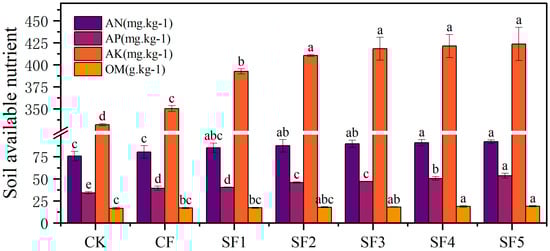
Figure 1.
Effects of different proportions of organic fertilizer instead of chemical fertilizer on soil nutrient content. Note: Different lowercase letters above the bars mean significant differences among treatments in the same growth stage at the 0.05 level.
Significant differences were noted in available phosphorus content across treatments. The SF5, SF4, SF3, and SF2 treatments exhibited significant increases of 16.37%, 19.51%, 28.11%, and 36.01%, respectively, compared to the CF treatment, while the 10% SF treatment showed no significant difference from CF. The available potassium content in the SF1 treatment was significantly lower than that in other organic fertilizer substitution treatments, although no significant differences were observed among the other substitution treatments. All organic fertilizer substitution treatments had significantly higher available potassium content compared to the no-fertilization (CK) and conventional fertilization (CF) treatments. Additionally, the application of organic fertilizers significantly increased soil organic matter content, with the SF4 and SF5 treatments showing significantly higher levels compared to the CK and CF treatments.
3.2. Soil Enzyme Activity
The application of organic fertilizers significantly enhanced soil enzyme activity, particularly soil urease activity. As can be seen from Figure 2, No significant differences were observed in alkaline phosphatase activity among the SF3, SF4, and SF5 treatments, which showed increases of 24.45%, 26.64%, and 26.64%, respectively, compared to the CF treatment. Soil sucrase activity in the SF1 treatment was significantly lower than that in other organic fertilizer substitution treatments, while no significant differences were observed among the other substitution treatments. The SF3, SF4, and SF5 treatments exhibited significant increases in soil sucrase activity by 36.45%, 38.05%, and 36.71%, respectively, compared to the CF treatment. The highest catalase activity was observed in the 50% SF treatment, which was significantly higher than that in the CK, CF, SF1, and SF2 treatments but showed no significant difference compared to other organic fertilizer substitution treatments. Urease activity was also notably higher in the SF3 treatment, with significant increases of 33.21% and 20.09% compared to the CK and CF treatments, respectively. No significant differences were observed between the SF3 and SF4 treatments, which showed increases of 7.56% and 13.08%, respectively, compared to the CF treatment.
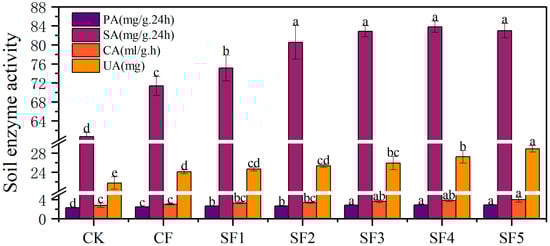
Figure 2.
Effects of different proportions of organic fertilizer replacing chemical fertilizer on soil enzyme activity. Note: Different lowercase letters above the bars mean significant differences among treatments in the same growth stage at the 0.05 level.
3.3. Soil Microbial Diversity
The Alpha diversity of soil bacteria and fungi under different treatments was characterized using the Shannon index at the OTU level. The application of organic fertilizers significantly increased the Alpha diversity of soil bacteria compared to the CK treatment, although no significant differences were observed among the various organic fertilizer treatments. The Shannon index for the SF2 treatment was 8.88 ± 0.08, slightly higher than other fertilization treatments but without significant differences. All organic fertilizer treatments showed slightly higher values than the CF treatment, with no significant differences among them, but all were significantly higher than the CK treatment. Specifically, the SF2 and SF4 treatments increased the Shannon index by 18.33% and 17.58%, respectively, compared to the CK treatment.
Fertilization treatments significantly enhanced the Alpha diversity of soil fungi compared to the no-fertilization treatment. The Shannon index for the SF3 treatment was 6.09 ± 0.1, representing significant increases of 18.25%, 437.23%, and 52.83% compared to the CF, CK, and SF4 treatments, respectively. The CF treatment had a Shannon index of 5.16 ± 0.55, slightly higher than other organic fertilizer treatments except for SF3, but without significant differences. However, the CF treatment showed a significant increase of 354.39% compared to the CK treatment. The PCoA analysis results are presented in Figure 3c,d. The SF5 treatment showed significant differences in bacterial beta diversity compared to the CF and SF3 treatments but was similar to other treatments. The SF3 treatment exhibited distinct fungal beta diversity compared to all other treatments, while the SF5 treatment was similar to the CK treatment but significantly different from other treatments in terms of beta diversity.
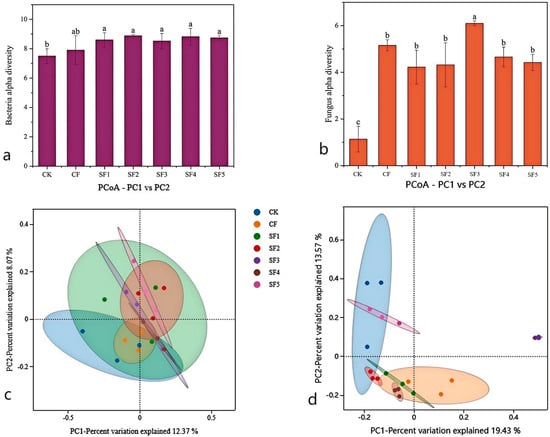
Figure 3.
Effects of fertilization treatment on bacterial alpha diversity (a), fungal alpha diversity (b), bacterial beta diversity (c), and fungal beta diversity (d). Note: Different lowercase letters above the bars mean significant differences among treatments in the same growth stage at the 0.05 level.
3.4. Soil Microbial Community Composition
The application of organic fertilizers significantly influenced the composition of soil bacterial communities. In Figure 4, at the phylum level, the relative abundances of Gemmatimonadota, Verrucomicrobiota, Planctomycota, and Acidobacteriota were significantly increased, while the relative abundances of Firmicutes and Proteobacteria showed slight decreases. In contrast, the relative abundances of Bacteroidota and Patescibacteria remained relatively unchanged. Similarly, organic fertilizer application affected the composition of soil fungal communities at the phylum level. In the SF3 treatment, the relative abundance of Ascomycota was significantly reduced, whereas in other treatments, Ascomycota accounted for more than 50% of the fungal community. The SF3 treatment significantly increased the relative abundance of Basidiomycota compared to other treatments, and the relative abundance of Mucoromycota was also higher in the SF3 treatment. The SF4 treatment significantly increased the richness of unclassified fungi, and a similar trend was observed in the CF treatment.
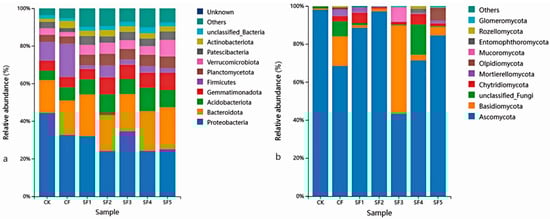
Figure 4.
Effects of fertilization treatment on bacterial (a) and fungal (b) taxonomic composition at phylum level.
3.5. Prediction of Soil Microbial Ecological Function
Using BugBase, high-level phenotypes of bacterial communities were classified, and phenotypic functional predictions were made for bacteria under different treatments. As shown in Figure 5a, the application of organic fertilizers significantly increased the abundance of Anaerobes in the soil bacterial community, with a substantial rise in Gram-Negative bacteria as well. Conversely, the abundance of Facultative Anaerobes decreased significantly, and the Form-Biofilm phenotype was notably reduced in organic fertilizer treatments compared to conventional fertilization and no-fertilization treatments. Fungal community classification and functional guild analysis were conducted using the FUNGuild tool, which links fungal species taxonomy to functional guilds through bioinformatics methods. The functional predictions for soil fungal communities are illustrated in Figure 5b. Fertilization treatments significantly reduced the abundance of fungi with the ecological function of Plant Pathogen compared to the no-fertilization treatment. The application of fertilizers increased the proportion of Undefined Saprotrophs and significantly enhanced the abundance of Endophytes. The SF5 treatment showed a notable increase in Arbuscular Mycorrhizal fungi compared to other treatments, while other organic fertilizer treatments also slightly increased the abundance of Arbuscular Mycorrhizal fungi, though not significantly (the functional inferences are based on BugBase/FUNGuild database predictions and require verification by direct functional measurement experiments).
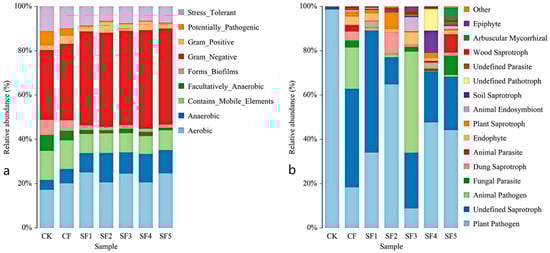
Figure 5.
Prediction of phenotypic function of bacteria (a) and fungi (b) using organic fertilizer.
3.6. Correlation Analysis
Analysis of Figure 6 reveals that Gemmatimonadota exhibits positive correlations with both soil nutrient content and soil enzyme activity. While no significant correlation was observed between Gemmatimonadota and soil available nitrogen, it showed highly significant positive correlations with soil sucrase activity, catalase activity, and available phosphorus, as well as significant correlations with other soil indicators. All soil nutrient and enzyme activity indicators were significantly positively correlated with Verrucomicrobiota. Bdellovibrionota and Nitrospirota displayed highly significant positive correlations with soil available potassium. In contrast, Firmicutes and Proteobacteria were negatively correlated with soil nutrient and enzyme activity indicators. Except for the non-significant negative correlation between organic fertilizer and Proteobacteria, all other soil indicators showed significant negative correlations with Proteobacteria.
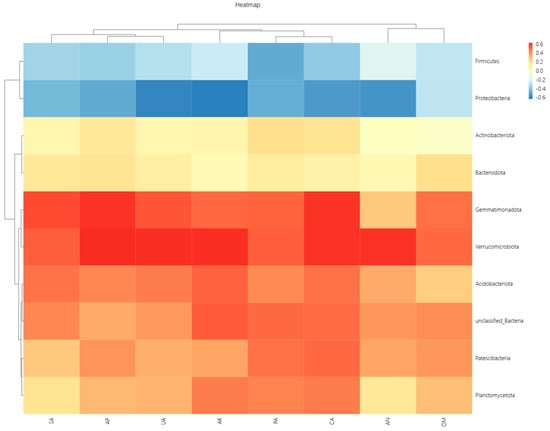
Figure 6.
Relationship between soil nutrients, soil enzyme activity and bacterial community composition in soil.
Analysis of Figure 7 indicates that Blastocladiomycota, Entomophthoromycota, and Glomeromycota exhibit positive correlations with various soil indicators. Specifically, soil available phosphorus showed significant positive correlations with Blastocladiomycota, Entomophthoromycota, and Glomeromycota. Soil available potassium was significantly positively correlated with Entomophthoromycota, while soil sucrase activity showed significant positive correlations with Blastocladiomycota and Entomophthoromycota. Additionally, Blastocladiomycota was significantly positively correlated with soil available phosphorus and catalase activity. Soil available nitrogen exhibited a significant positive correlation with Glomeromycota. However, no significant correlations were observed between other soil indicators and fungal enzyme activities. In contrast, Ascomycota showed negative correlations with soil available nutrients and other indicators, although these correlations were not statistically significant.
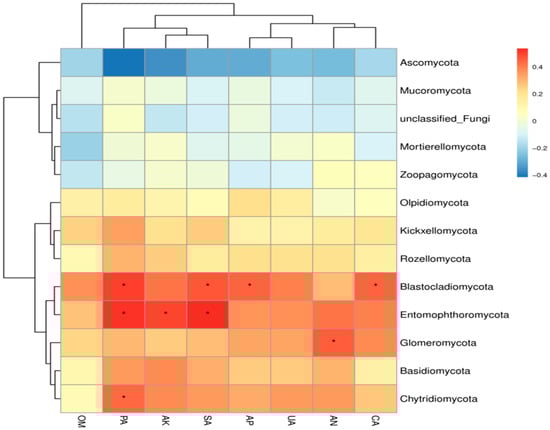
Figure 7.
Relationship between soil nutrients, soil enzyme activities and fungal community composition in soil. Note: “*” indicates a significant correlation between the two indicators.
4. Discussion
The energy of soil organisms primarily derives from soil organic matter (SOM). The level of SOM directly influences the survival of various microbial communities in the soil. Moreover, higher organic matter content enhances soil fertility and buffering capacity. Increasing organic matter is essential for maintaining soil fertility in sugar beet fields. In this study, a comparison between conventional fertilization and partial replacement of nitrogen fertilizer with low or high amounts of organic fertilizer revealed that partial substitution with organic fertilizer can increase SOM. This effect becomes more pronounced with higher application rates of organic fertilizer, which is largely attributed to the high organic matter content in the fertilizer itself [13]. Readily available nutrients in the soil, such as alkaline hydrolyzable nitrogen, available phosphorus, and available potassium, can be directly absorbed and utilized by crops during their growth and development. The levels of these available nutrients play a crucial role in the growth and development of sugar beet [14]. This study found that partially replacing nitrogen fertilizer with organic fertilizer can increase the contents of alkaline hydrolyzable nitrogen, available phosphorus, and available potassium in the soil. However, the nutrient content does not increase proportionally with the amount of organic fertilizer applied. Beyond the SF3 treatment, further increases in organic fertilizer application had little effect on the levels of available nutrients. This finding is consistent with the results of a four-year organic fertilization experiment conducted by Zhang Peng et al. [15], both demonstrating the positive effects of fertilization.
Numerous studies have shown that the application of organic fertilizer can enhance soil enzyme activity [15,16,17,18,19]. Catalase, widely distributed in the soil matrix and organisms, effectively alleviates the potential toxicity of metabolically derived hydrogen peroxide to organisms. Its activity level is closely related to the abundance of soil organic matter and fertility status, making it an indicator of soil oxidation intensity [16]. In this study, the application of organic fertilizer significantly increased soil catalase activity, and higher amounts of organic fertilizer further enhanced this effect. This suggests that organic fertilizer improves the soil micro-ecological environment and stimulates catalase activity to some extent, thereby reducing the toxic effect of hydrogen peroxide on sugar beets and enhancing their resistance to stress [16,17,18]. Urease activity is influenced by multiple factors, including the content of soil organic matter, nitrogen supply and transformation efficiency, and the size of microbial populations [19]. The application of organic fertilizer also increased soil urease activity, along with varying degrees of enhancement in phosphatase and sucrase activities. This may be attributed to the rich enzyme content in bio-organic fertilizer, which contributes to the increase in soil urease [20] and promotes the growth and reproduction of enzyme-producing microorganisms, thereby indirectly enhancing soil enzyme activity. These findings are consistent with the results of Song Zhenzhen et al. [21] and Luo Xinglu et al. [22].
Soil microbial diversity is a key indicator for assessing soil health and ecosystem functioning. In this study, alpha diversity of soil bacteria and fungi under different fertilization treatments was characterized using the Shannon index. The results demonstrated that the application of organic fertilizer significantly increased the diversity of both soil bacteria and fungi, which is consistent with previous studies [23,24]. Organic fertilizer provides abundant organic matter and nutrients to soil microorganisms, promoting the growth and reproduction of microbial communities, thereby enhancing soil microbial diversity. The composition and function of soil microbial communities have a significant impact on soil fertility and ecosystem functioning [25]. In this study, organic fertilizer application promoted the growth of dominant bacterial groups such as Gemmatimonadota, Verrucomicrobiota, Planctomycota, and Acidobacteriota. Gemmatimonadota are bacteria that play an important role in soil ecosystems, capable of decomposing complex organic matter and participating in soil nutrient cycling [26]. In this study, organic fertilizer application significantly increased the relative abundance of Gemmatimonadota, likely because the organic matter provided by the fertilizer created favorable conditions for their growth. Acidobacteriota is a common bacterial taxon in soil, involved in the formation of acidic environments and nutrient cycling. Organic fertilizer application significantly increased their relative abundance, possibly by altering soil pH balance and promoting the growth of this group. Yao Minna [27] suggested that organic fertilizer application increases soil organic matter, thereby promoting the growth of prokaryotic functional groups associated with the degradation and fermentation of large molecules. The mineralization of organic matter in organic fertilizer involves nitrogen transformation, which can influence the abundance of bacterial functional groups related to the nitrogen cycle. These findings are consistent with the results of this study.
The application of organic fertilizer also significantly influenced the composition of the soil fungal community. Ascomycota, the most species-rich phylum in the fungal kingdom, plays a key role in decomposing organic matter by releasing locked-up nutrients such as carbon, nitrogen, and phosphorus into forms accessible to plants. This process is central to global carbon and nutrient cycling. However, Ascomycota also includes major pathogens responsible for sugar beet powdery mildew. In this study, the SF3 treatment significantly reduced the relative abundance of Ascomycota. BugBase-based prediction of high-level phenotypic functions of the soil bacterial community revealed that organic fertilizer application reduced the relative abundance of plant pathogens while increasing the proportions of endophytes and arbuscular mycorrhizal fungi, which may help enhance plant disease resistance and nutrient uptake capacity. The SF3 treatment also significantly increased the relative abundance of Basidiomycota and Mucoromycota, both of which play important roles in soil ecosystems by participating in the decomposition of organic matter and nutrient cycling. This may be attributed to the appropriate application rate of organic fertilizer, modifying the soil environment in a way that promotes the growth of these beneficial microbial groups. These results indicate that organic fertilizer application has the potential to increase the abundance of beneficial soil microorganisms. Previous studies have also confirmed that partial substitution of chemical fertilizers with organic fertilizers significantly affects soil microbial diversity and community structure. These results indicate that organic fertilizer application has the potential to increase the abundance of beneficial soil microorganisms. This study reveals the regulatory effects of four consecutive years of organic fertilizer substitution on soil microbial communities; however, there are several limitations in the research. For instance, soil pH, a key indicator, was not simultaneously measured, and this should be supplemented as a critical index in subsequent studies. Secondly, since the type of organic fertilizer was changed during the third year of the experiment, follow-up research will continue to monitor the impacts of this change. Additionally, the measured indicators were limited to soil nutrients, enzyme activities, and microbial community structure, failing to fully capture the specific changes in sugar beet rhizosphere soil. Therefore, future research should establish a multi-scale observation system and integrate multi-omics technologies such as metagenomics and metabolomics to systematically elucidate the dynamics of microbial communities and the long-term response mechanisms of soil functions under different organic fertilizer substitution ratios.
5. Conclusions
Compared to the no-fertilization and conventional chemical fertilization treatments, the partial substitution of chemical fertilizers with organic fertilizer significantly increased soil nutrient content and enzyme activity. However, a higher organic substitution ratio did not lead to a significant further increase in these parameters. In terms of the alpha and beta diversity of soil prokaryotic and fungal communities, none of the organic fertilizer treatments showed significant differences compared to the conventional fertilization control. Nevertheless, organic fertilizer application notably enhanced the abundance of several important bacterial and fungal genera, as well as functional groups related to soil organic matter (SOM) degradation and nitrogen cycling. Regarding the substitution ratio, 30% organic fertilizer replacement was identified as the optimal proportion in this experimental region. At this ratio, soil nutrient levels and enzyme activities were higher than those under conventional fertilization, yet not significantly different from treatments with higher organic substitution rates. Therefore, a 30% organic fertilizer substitution rate can effectively enhance soil fertility and increase the abundance of beneficial microbial communities with relatively low input.
Author Contributions
Conceptualization, W.L. and Y.Z.; methodology, Y.Z.; software, X.M.; validation, J.G. (Jianglong Gao) and X.F.; formal analysis, J.G. (Jianfu Guo); investigation, W.G.; resources, W.L.; data curation, W.X.; writing—original draft preparation, W.L. and Y.Z.; writing—review and editing, M.L. and R.W.; visualization, M.L.; project administration, R.W.; funding acquisition, W.L. All authors have read and agreed to the published version of the manuscript.
Funding
This work was financially supported by the project of Cotton, oil, and sugar digital precision and efficient production technology system integration and demonstration promotion, Construction of Demonstration Park for Efficient Planting Technology of New Sugar Beet Varieties in Kazakhstan (2024BA002), and Seed Health & Pelletizing Innovation Team (2023CT06), supported by the National Modern Agricultural Industry Technology System of the Ministry of Finance and Ministry of Agriculture and Rural Affairs (CARS-17).
Data Availability Statement
Data are contained within the article.
Acknowledgments
This paper was completed under the careful guidance of Ming Lin. Ming Lin‘s profound professional knowledge, rigorous academic attitude, work style of excellence, tireless noble ethics in teaching others, noble style of disciplining oneself and forgiving others, and simple and approachable personality charm have exerted a profound influence on me. This has inspired me to establish lofty academic goals, master the basic research methods, and understand the truth about interpersonal relationships. From the topic selection to the completion of this paper, every step was completed under the guidance of Lin, who devoted a lot of effort. Here, I would like to express my high respect and heartfelt thanks to Teacher Lin! The successful completion of this paper is inseparable from the care and help of leaders, colleagues and friends. I would like to thank Jianfu Guo, Ronghua Wang and Xiaoqin Fan for their guidance and help. Thanks to Wang Xing, Xiaolong Ma, Weishi Gao and other colleagues for their guidance and help; I would like to thank Xinjiang Academy of Agricultural Sciences for their care, support and help.
Conflicts of Interest
The authors declare no conflicts of interest.
Abbreviations
The following abbreviations are used in this manuscript:
| AN | Alkali-hydrolyzable nitrogen |
| AP | Available phosphorus |
| AK | Available potassium |
| OM | Organic matter |
| PA | Phosphatase activity |
| SA | Sucrose enzyme activity |
| CA | Catalase enzyme activity |
| UA | Urease activity |
References
- Song, Z.; Li, X.; Li, J.; Lin, Z.; Zhao, B. Long-term effects of mineral versus organic fertilizers on soil labile nitrogen fractions and soil enzyme activities in agricultural soil. J. Plant Nutr. Fertil. 2014, 20, 525–533. [Google Scholar]
- Oladele, S.; Adeyemo, A.; Adegaiye, A.; Awodun, M. Effects of biochar amendment and nitrogen fertilization on soil microbial biomass pools in an Alfisol under rain-fed rice cultivation. Biochar 2019, 1, 163–176. [Google Scholar] [CrossRef]
- Iqbal, A.; Liang, H.; McBride, S.G.; Yuan, P.; Ali, I.; Zaman, M.; Zeeshan, M.; Khan, R.; Akhtar, K.; Wei, S.; et al. Manure applications combined with chemical fertilizer improves soil functionality, microbial biomass and rice production in a paddy field. Agron. J. 2022, 114, 1431–1446. [Google Scholar] [CrossRef]
- Wen, X.; Li, M.D.; Wu, H.Y.; Liu, Q. The effects of acid soil modifiers on soil pH, exchangeable calcium and exchangeable magnesium, and available pHospHorus in acid paddy soils. Res. Agric. Mod. 2014, 35, 618–623. [Google Scholar]
- Wang, J.; Yang, X.; Huang, S.; Wu, L.; Cai, Z.; Xu, M. Long-term combined application of organic and inorganic fertilizers increases crop yield sustainability by improving soil fertility in maize–wheat cropping systems. J. Integr. Agric. 2025, 24, 290–305. [Google Scholar] [CrossRef]
- Qaswar, M.; Jing, H.; Ahmed, W.; Li, D.; Liu, S.; Lu, Z.; Cai, A.; Liu, L.; Xu, Y.; Gao, J.; et al. Yield sustainability, soil organic carbon sequestration and nutrients balance under long-term combined application of manure and inorganic fertilizers in acidic paddy soil. Soil Tillage Res. 2020, 198, 104569. [Google Scholar] [CrossRef]
- Iqbal, A.; He, L.; Khan, A.; Wei, S.; Akhtar, K.; Ali, I.; Ullah, S.; Munsif, F.; Zhao, Q.; Jiang, L. Organic manure coupled with inorganic fertilizer: An approach for the sustainable production of rice by improving soil properties and nitrogen use efficiency. Agronomy 2019, 9, 651. [Google Scholar] [CrossRef]
- Holík, L.; Hlisnikovský, L.; Honzík, R.; Trögl, J.; Burdová, H.; Popelka, J. Soil microbial communities and enzyme activities after long-term application of inorganic and organic fertilizers at different depths of the soil profile. Sustainability 2019, 11, 3251. [Google Scholar] [CrossRef]
- Lazcano, C.; Gómez-Brandón, M.; Revilla, P.; Domínguez, J. Short-term effects of organic and inorganic fertilizers on soil microbial community structure and function: A field study with sweet corn. Biol. Fertil. Soils 2013, 49, 723–733. [Google Scholar] [CrossRef]
- Chang, E.H.; Chung, R.S.; Tsai, Y.H. Effect of different application rates of organic fertilizer on soil enzyme activity and microbial population. Soil Sci. Plant Nutr. 2007, 53, 132–140. [Google Scholar] [CrossRef]
- Bao, S.D. (Ed.) Soil Agricultural and Chemical Analysis, 3rd ed.; China Agricultural Press: Beijing, China, 2018. [Google Scholar]
- Ji, B.; Hu, H.; Zhao, Y.; Mu, X.; Liu, K.; Li, C. Effects of deep tillage and straw returning on soil microorganism and enzyme activities. Sci. World J. 2014, 2014, 451493. [Google Scholar] [CrossRef]
- Liu, Z.; Xie, W.; Yang, Z.; Huang, X.; Zhou, H. Effects of manure and chemical fertilizer on bacterial community structure and soil enzyme activities in North China. Agronomy 2021, 11, 1017. [Google Scholar] [CrossRef]
- Liu, C.A.; Li, F.R.; Zhou, L.M.; Zhang, R.H.; Jia, Y.; Lin, S.L.; Wang, L.J.; Siddique, K.H. Effect of organic manure and fertilizer on soil water and crop yields in newly-built terraces with loess soils in a semi-arid environment. Agric. Water Manag. 2013, 117, 123–132. [Google Scholar] [CrossRef]
- Zhang, P.; Jia, Z.K.; Lu, W.T.; Zhang, X.F.; Sun, H.X.; Yang, B.P. Effects of different organic fertilizer application rates on soil nutrients, enzyme activities, and crop productivity in the arid area of Southern Ningxia. J. Plant Nutr. Fertil. 2011, 17, 1122–1130. [Google Scholar]
- Wu, P.J.; Xia, Y.; Xue, Y.; Chen, X.B.; Yin, X. Effects of bio-organic fertilizer on yield, quality of cucumber and soil enzyme activities in oasis greenhouse. Soil Water Conserv. China 2019, 4, 53–56. [Google Scholar]
- Li, L.; Tong, L.; Lv, Y. Influence of bio-fertilizer type and amount jointly on microbial community composition, crop production and soil health. Agronomy 2023, 13, 1775. [Google Scholar] [CrossRef]
- Lin, T.; He, Y.Q.; Li, C.L.; Yang, F.; Xu, J. Response of soil enzymes to long-term fertilization in upland red soil. Acta Pedol. Sin. 2005, 42, 682–686. [Google Scholar]
- Zhao, M.X.; Liu, H.; Wang, J.; Chang, H.X.; Cheng, Z.R. Effects of reduced compound fertilizer combined with bio-organic fertilizer on soil fertility and enzyme activity in tomato field. J. Agric. 2020, 10, 56–61. [Google Scholar]
- Han, S.; Wu, J.; Zhang, X.M.; Hu, P.; Yang, Y.; Li, M.; Wang, H.; Tang, S. Effects of organic fertilizer application on subsoil fertility in paddy field. J. Agric. Resour. Environ. 2018, 35, 334–341. [Google Scholar]
- Song, Z.Z.; Li, X.H.; Li, J.; Lin, Z.A.; Zhao, B.Q. Effects of long-term application of organic manure and chemical fertilizer on soil labile organic nitrogen fractions and enzyme activities. J. Plant Nutr. Fertil. 2014, 20, 525–533. [Google Scholar]
- Luo, X.L.; Cen, Z.Y.; Xie, H.X.; Pan, Y.H.; Liao, C.; Shao, Z.F.; Chen, H.L. Effect of bio-organic fertilizer on soil physical, chemical and biological properties, and cassava growth. Acta Agric. Boreali-Occident. Sin. 2008, 17, 167–173. [Google Scholar]
- Zhang, G.; Liu, Q.; Zhang, Z.; Ci, D.; Zhang, J.; Xu, Y.; Guo, Q.; Xu, M.; He, K. Effect of reducing nitrogen fertilization and adding organic fertilizer on net photosynthetic rate, root nodules and yield in peanut. Plants 2023, 12, 2902. [Google Scholar] [CrossRef]
- Gao, R.; Duan, Y.; Zhang, J.; Ren, Y.; Li, H.; Liu, X.; Zhao, P.; Jing, Y. Effects of long-term application of organic manure and chemical fertilizer on soil properties and microbial communities in the agro-pastoral ecotone of north China. Front. Environ. Sci. 2022, 10, 993973. [Google Scholar] [CrossRef]
- Hirsch, A.M.; Valdés, M. Micromonospora: An important microbe for biomedicine and potentially for biocontrol and biofuels. Soil Biol. Biochem. 2010, 42, 536–542. [Google Scholar] [CrossRef]
- Böer, T.; Schüler, M.A.; Lüschen, A.; Eysell, L.; Dröge, J.; Heinemann, M.; Engelhardt, L.; Basen, M.; Daniel, R.; Poehlein, A. Isolation and characterization of novel acetogenic strains of the genera Terrisporobacter and Acetoanaerobium. Front. Microbiol. 2024, 15, 1426882. [Google Scholar] [CrossRef] [PubMed]
- Yao, M.N. Effects of short-term combined application of organic and chemical fertilizers on maize production, soil physicochemical properties and microbial communities. Soil Fertil. Sci. China 2025, 7, 11–20. [Google Scholar]
Disclaimer/Publisher’s Note: The statements, opinions and data contained in all publications are solely those of the individual author(s) and contributor(s) and not of MDPI and/or the editor(s). MDPI and/or the editor(s) disclaim responsibility for any injury to people or property resulting from any ideas, methods, instructions or products referred to in the content. |
© 2025 by the authors. Licensee MDPI, Basel, Switzerland. This article is an open access article distributed under the terms and conditions of the Creative Commons Attribution (CC BY) license (https://creativecommons.org/licenses/by/4.0/).