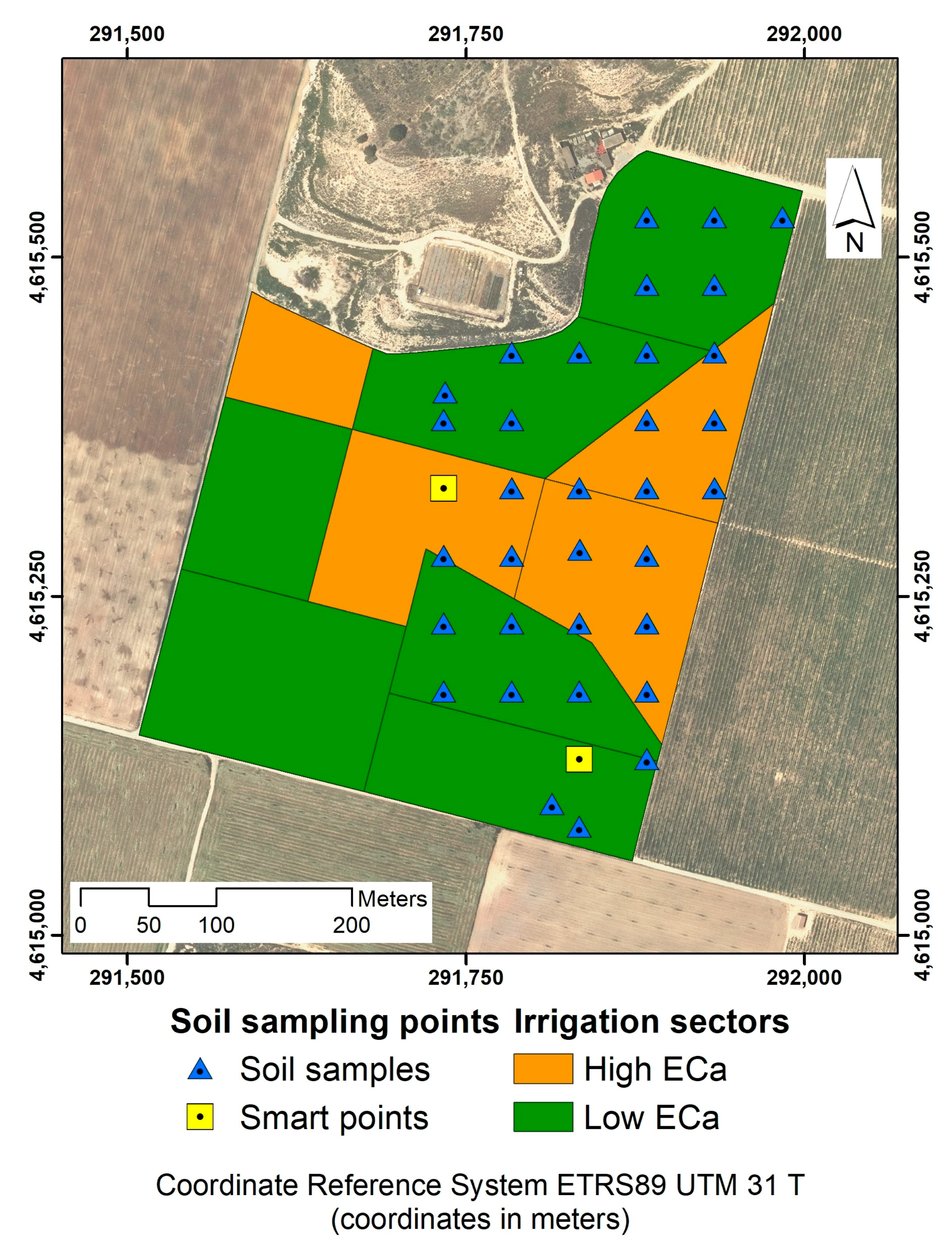
Drip Irrigation Soil-Adapted Sector Design and Optimal Location of Moisture Sensors: A Case Study in a Vineyard Plot

 ,
,  , ,
, ,  ,
,  ,
, 
Abstract
Share and Cite
Arnó, J.; Uribeetxebarria, A.; Llorens, J.; Escolà, A.; Rosell-Polo, J.R.; Gregorio, E.; Martínez-Casasnovas, J.A. Drip Irrigation Soil-Adapted Sector Design and Optimal Location of Moisture Sensors: A Case Study in a Vineyard Plot. Agronomy 2023, 13, 2369. https://doi.org/10.3390/agronomy13092369
Arnó J, Uribeetxebarria A, Llorens J, Escolà A, Rosell-Polo JR, Gregorio E, Martínez-Casasnovas JA. Drip Irrigation Soil-Adapted Sector Design and Optimal Location of Moisture Sensors: A Case Study in a Vineyard Plot. Agronomy. 2023; 13(9):2369. https://doi.org/10.3390/agronomy13092369
Chicago/Turabian StyleArnó, Jaume, Asier Uribeetxebarria, Jordi Llorens, Alexandre Escolà, Joan R. Rosell-Polo, Eduard Gregorio, and José A. Martínez-Casasnovas. 2023. "Drip Irrigation Soil-Adapted Sector Design and Optimal Location of Moisture Sensors: A Case Study in a Vineyard Plot" Agronomy 13, no. 9: 2369. https://doi.org/10.3390/agronomy13092369
APA StyleArnó, J., Uribeetxebarria, A., Llorens, J., Escolà, A., Rosell-Polo, J. R., Gregorio, E., & Martínez-Casasnovas, J. A. (2023). Drip Irrigation Soil-Adapted Sector Design and Optimal Location of Moisture Sensors: A Case Study in a Vineyard Plot. Agronomy, 13(9), 2369. https://doi.org/10.3390/agronomy13092369