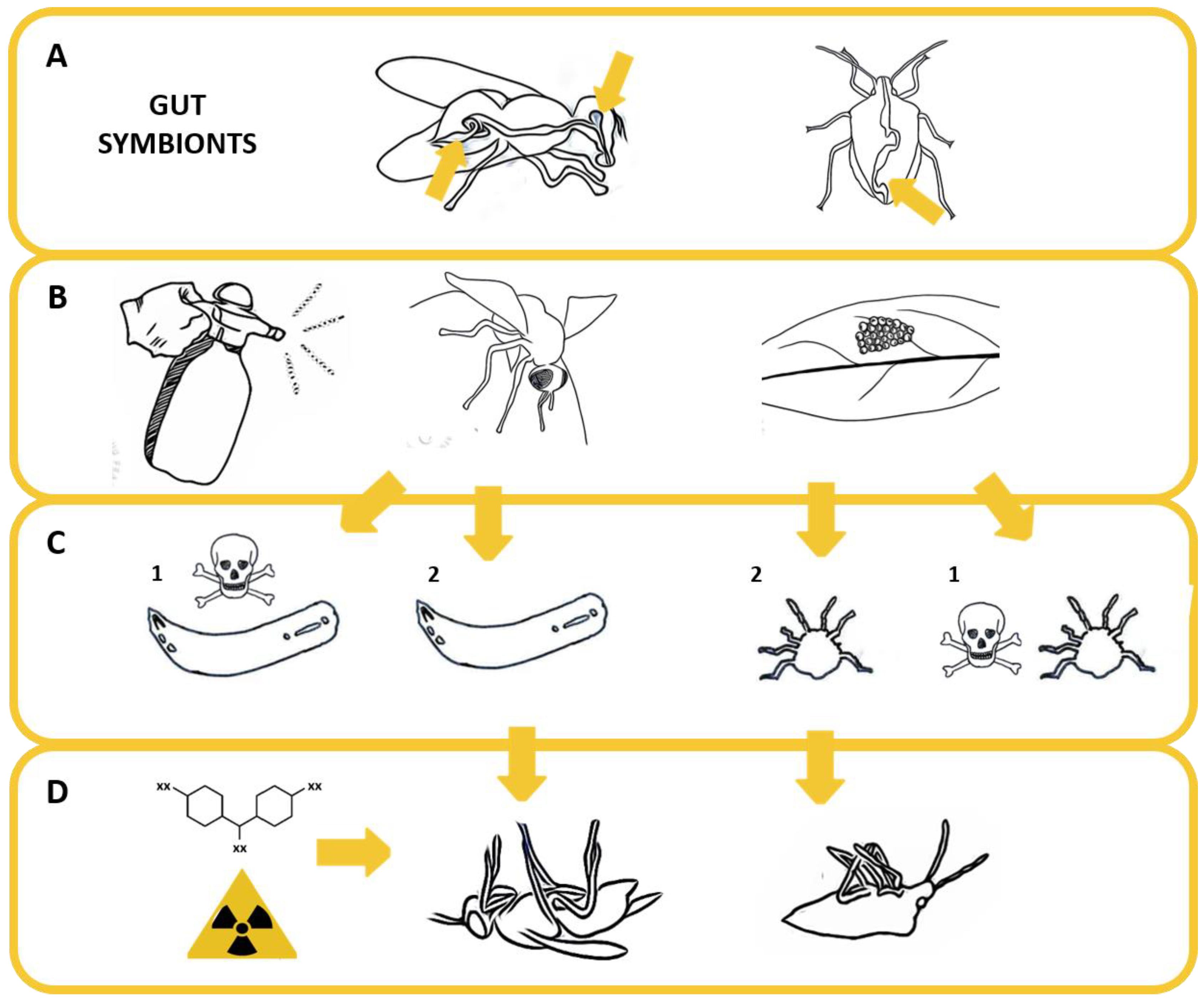
The Role of Symbiont-Targeted Strategies in the Management of Pentatomidae and Tephritidae Pests under an Integrated Vision



Abstract
1. Introduction
2. The Importance of Gut Symbionts in Pentatomidae and Tephritidae
3. Extracellular Routes for Symbiont Vertical Transmission
4. Symbiotic Control through Symbiosis Disruption
5. Symbiont-Targeted Strategies for Multiple Pest Control
6. Symbiont-Targeted Strategies and Biological Control
7. Symbiont-Targeted Strategies to Enhance SIT
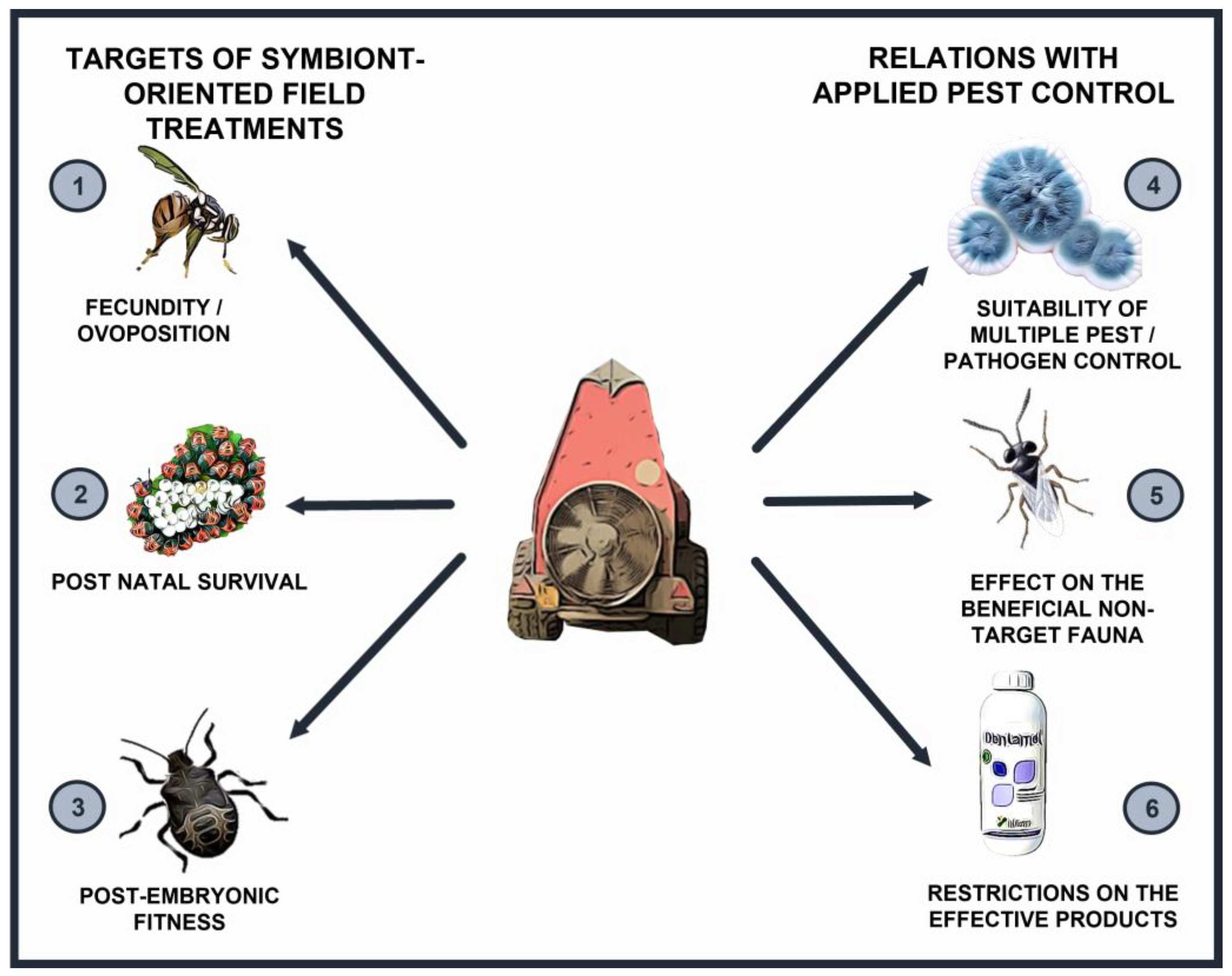
8. Potential Roles of Symbiont-Targeted Strategies in Pest Control Implementation
9. Operational Constraints in Symbiotic Control Programs
10. Conclusive Remarks
Author Contributions
Funding
Institutional Review Board Statement
Informed Consent Statement
Data Availability Statement
Conflicts of Interest
References
- Delgado, L.; Garino, C.; Moreno, F.J.; Zagon, J.; Broll, H. Sustainable food systems: EU regulatory framework and contribution of insects to the Farm-To-Fork strategy. Food Rev. Int. 2022, 105, 104760. [Google Scholar] [CrossRef] [Scilit]
- Purnhagen, K.P.; Clemens, S.; Eriksson, D.; Fresco, L.O.; Tosun, J.; Qaim, M.; Visser, R.G.F.; Weber, A.P.M.; Wesseler, J.H.H.; Zilberman, D. Europe’s Farm to Fork Strategy and its commitment to biotechnology and organic farming: Conflicting or complementary goals? Trends Plant Sci. 2021, 26, 600–606. [Google Scholar] [CrossRef] [Scilit] [PubMed]
- Hatt, S.; Osawa, N. Beyond “greening”: Which paradigms shape sustainable pest management strategies in the European Union? BioControl 2019, 64, 343–355. [Google Scholar] [CrossRef] [Scilit]
- Gonella, E.; Orrù, B.; Marasco, R.; Daffonchio, D.; Alma, A. Disruption of host-symbiont associations for the symbiotic control and management of pentatomid agricultural pest—A review. Front. Microbiol. 2020, 11, 547031. [Google Scholar] [CrossRef] [Scilit] [PubMed]
- Coolen, S.; Magda, R.D.; Welte, C.U. The secret life of insect-associated microbes and how they shape insect-plant interactions. FEMS Microbiol. Ecol. 2022, 98, fiac083. [Google Scholar] [CrossRef] [Scilit]
- Douglas, A.E. Multiorganismal insects: Diversity and function of resident microorganisms. Annu. Rev. Entomol. 2015, 60, 17–34. [Google Scholar] [CrossRef] [Scilit]
- Ben-Yosef, M.; Aharon, Y.; Jurkevitch, E.; Yuval, B. Give us the tools and we will do the job: Symbiotic bacteria affect olive fly fitness in a diet-dependent fashion. Proc. R. Soc. B Biol. Sci. 2010, 277, 1545–1552. [Google Scholar] [CrossRef] [Scilit]
- Akami, M.; Tamgue, O.; Ren, X.; Wang, Y.; Qi, X.; Luther, K.M.M.; Ngane, R.A.N.; Niu, C.-Y. Effects of symbiotic population impairment on microbiome composition and longevity of Bactrocera dorsalis. R. Soc. Open Sci. 2021, 8, 211104. [Google Scholar] [CrossRef] [Scilit]
- Arora, A.K.; Douglas, A.E. Hype or opportunity? Using microbial symbionts in novel strategies for insect pest control. J. Insect Physiol. 2017, 103, 10–17. [Google Scholar] [CrossRef] [Scilit]
- Noman, M.S.; Liu, L.; Bai, Z.; Li, Z. Tephritidae bacterial symbionts: Potentials for pest management. Bull. Entomol. Res. 2020, 110, 1–14. [Google Scholar] [CrossRef] [Scilit]
- Bigiotti, G.; Sacchetti, P.; Pastorelli, R.; Lauzon, C.R.; Belcari, A. Bacterial symbiosis in Bactrocera oleae, an Achilles’ heel for its pest control. Insect Sci. 2021, 28, 874–884. [Google Scholar] [CrossRef] [Scilit] [PubMed]
- Bigiotti, G.; Pastorelli, R.; Belcari, A.; Sacchetti, P. Symbiosis interruption in the olive fly: Effect of copper and propolis on Candidatus Erwinia dacicola. J. Appl. Entomol. 2019, 143, 357–364. [Google Scholar] [CrossRef] [Scilit]
- Gonella, E.; Orrù, B.; Alma, A. Egg masses treatment with micronutrient fertilizers has a suppressive effect on newly-emerged nymphs of the brown marmorated stink bug Halyomorpha halys. Entomol. Gen. 2019, 39, 231–238. [Google Scholar] [CrossRef] [Scilit]
- Gonella, E.; Orrù, B.; Alma, A. Symbiotic control of Halyomorpha halys using a microbial biopesticide. Entomol. Gen. 2022, 42, 901–909. [Google Scholar] [CrossRef] [Scilit]
- Sinno, M.; Bézier, A.; Vinale, F.; Giron, D.; Laudonia, S.; Garonna, A.P.; Pennacchio, F. Symbiosis disruption in the olive fruit fly, Bactrocera oleae (Rossi), as a potential tool for sustainable control. Pest Manag. Sci. 2020, 76, 3199–3207. [Google Scholar] [CrossRef] [Scilit]
- Nobre, T. Symbiosis in sustainable agriculture: Can olive fruit fly bacterial microbiome be useful in pest management? Microorganisms 2019, 7, 238. [Google Scholar] [CrossRef] [Scilit]
- Shan, H.; Wu, W.; Sun, Z.; Chen, J.; Li, H. The gut microbiota of the insect infraorder Pentatomomorpha (Hemiptera: Heteroptera) for the light of ecology and evolution. Microorganisms 2021, 9, 464. [Google Scholar] [CrossRef] [Scilit]
- Suckling, D.M.; Tobin, P.C.; McCullough, D.G.; Herms, D.A. Combining tactics to exploit Allee effects for eradication of alien insect populations. J. Econ. Entomol. 2012, 105, 1–13. [Google Scholar] [CrossRef] [Scilit]
- Maurya, R.P.; Koranga, R.; Samal, I.; Chaudhary, D.; Paschapur, A.U.; Sreedhar, M.; Manimala, R.N. Biological control: A global perspective. Int. J. Trop. Insect Sci. 2022, 42, 3203–3220. [Google Scholar] [CrossRef] [Scilit]
- Dias, N.P.; Montoya, P.; Nava, D.E. A 30-year systematic review reveals success in tephritid fruit fly biological control research. Entomol. Exp. Appl. 2022, 170, 370–384. [Google Scholar] [CrossRef] [Scilit]
- Conti, E.; Avila, G.; Barratt, B.; Cingolani, F.; Colazza, S.; Guarino, S.; Hoelmer, K.; Laumann, R.A.; Maistrello, L.; Martel, G.; et al. Biological control of invasive stink bugs: Review of global state and future prospects. Entomol. Exp. Appl. 2021, 169, 28–51. [Google Scholar] [CrossRef] [Scilit]
- Checchia, I.; Perin, C.; Mori, N.; Mazzon, L. Oviposition deterrent activity of fungicides and low-risk substances for the integrated management of the olive fruit fly Bactrocera oleae (Diptera, Tephritidae). Insects 2022, 13, 363. [Google Scholar] [CrossRef] [Scilit] [PubMed]
- Horrocks, K.J.; Welsh, T.; Carpenter, J.E.; Suckling, D.M. Egg sterilisation of irradiated Nezara viridula (Hemiptera: Pentatomidae). Insects 2020, 11, 564. [Google Scholar] [CrossRef] [Scilit] [PubMed]
- Dyck, V.A.; Hendrichs, J.; Robinson, A.S. Sterile Insect Technique: Principles and Practice in Area-Wide Integrated Pest Management, 2nd ed.; CRC Press: Boca Raton, FL, USA, 2021. [Google Scholar]
- Nguyen, H.N.; Stringer, L.D.; Hong, K.-J. Influence of irradiation on the biology of the brown marmorated stink bug (Hemiptera: Pentatomidae). J. Econ. Entomol. 2021, 114, 1211–1218. [Google Scholar] [CrossRef] [Scilit]
- Cristofaro, M.; Sforza, R.F.H.; Roselli, G.; Paolini, A.; Cemmi, A.; Musmeci, S.; Anfora, G.; Mazzoni, V.; Grodowitz, M. Effects of gamma irradiation on the fecundity, fertility, and longevity of the invasive stink bug pest Bagrada hilaris (Burmeister) (Hemiptera: Pentatomidae). Insects 2022, 13, 787. [Google Scholar] [CrossRef] [Scilit]
- Deutscher, A.T.; Chapman, T.A.; Shuttleworth, L.A.; Riegler, M.; Reynolds, O.L. Tephritid-microbial interactions to enhance fruit fly performance in sterile insect technique programs. BMC Micriobiol. 2019, 19, 287. [Google Scholar] [CrossRef] [Scilit]
- Ohbayashi, T.; Takeshita, K.; Kitagawa, W.; Nikoh, N.; Koga, R.; Meng, X.Y.; Tago, K.; Hori, T.; Hayatsu, M.; Asano, K.; et al. Insect’s intestinal organ for symbiont sorting. Proc. Natl. Acad. Sci. USA 2015, 112, E5179–E5188. [Google Scholar] [CrossRef] [Scilit] [PubMed]
- Bansal, R.; Michel, A.P.; Sabree, Z.L. The crypt-dwelling primary bacterial symbiont of the polyphagous pentatomid pest Halyomorpha halys (Hemiptera: Pentatomidae). Environ. Entomol. 2014, 43, 617–625. [Google Scholar] [CrossRef] [Scilit]
- Kenyon, L.J.; Meulia, T.; Sabree, Z.L. Habitat visualization and genomic analysis of ‘Candidatus Pantoea carbekii’, the primary symbiont of the brown marmorated stink bug. Genome Biol. Evol. 2015, 7, 620–635. [Google Scholar] [CrossRef] [Scilit]
- Kikuchi, Y.; Hayatsu, M.; Hosokawa, T.; Nagayama, A.; Tago, K.; Fukatsu, T. Symbiont-mediated insecticide resistance. Proc. Natl. Acad. Sci. USA 2012, 109, 8618–8622. [Google Scholar] [CrossRef] [Scilit]
- Raza, M.F.; Yao, Z.; Bai, S.; Cai, Z.; Zhang, H. Tephritidae fruit fly gut microbiome diversity, function and potential for applications. Bull. Entomol. Res. 2020, 110, 423–437. [Google Scholar] [CrossRef] [Scilit]
- Kounatidis, I.; Crotti, E.; Sapountzis, P.; Sacchi, L.; Rizzi, A.; Chouaia, B.; Bandi, C.; Alma, A.; Daffonchio, D.; Mavragani-Tsipidou, P.; et al. Acetobacter tropicalis is a major symbiont of the olive fruit fly (Bactrocera oleae). Appl. Environ. Microbiol. 2009, 75, 3281–3288. [Google Scholar] [CrossRef] [Scilit] [PubMed]
- Thaochan, N.; Drew, D.; Chinajariyawong, A.; Sunpapao, A.; Pornsuriya, C. Gut bacterial community structure of two Australian tropical fruit fly species (Diptera: Tephritidae). Songklanakarin J. Sci. Technol. 2015, 37, 617–624. [Google Scholar]
- Saha, P.; Ray, R.R. Production of polysaccharide degrading enzymes by the gut microbiota of Leucinodes Orbonalis and Bactrocera dorsalis. J. Entomol. Zool. Stud. 2015, 3, 122–125. [Google Scholar]
- Ben Ami, E.; Yuval, B.; Jurkevitch, E. Manipulation of the microbiota of mass-reared Mediterranean fruit flies Ceratitis capitata (Diptera: Tephritidae) improves sterile male sexual performance. ISME J. 2010, 4, 28–37. [Google Scholar]
- Cheng, D.; Guo, Z.; Riegler, M.; Xi, Z.; Liang, G.; Xu, Y. Gut symbiont enhances insecticide resistance in a significant pest, the oriental fruit fly Bactrocera dorsalis (Hendel). Microbiome 2017, 5, 13. [Google Scholar] [CrossRef] [Scilit] [PubMed]
- Ryu, J.H.; Kim, S.H.; Lee, H.Y.; Bai, J.Y.; Nam, Y.D.; Bae, J.W.; Lee, D.G.; Shin, S.C.; Ha, E.M.; Lee, W.J. Innate immune homeostasis by the homeobox gene caudal and commensal-gut mutualism in Drosophila. Science 2008, 319, 777–782. [Google Scholar] [CrossRef] [Scilit] [PubMed]
- Behar, A.; Yuval, B.; Jurkevitch, E. Community structure of the Mediterranean fruit fly microbiota: Seasonal and spatial sources of variation. Isr. J. Ecol. Evol. 2008, 54, 181–191. [Google Scholar] [CrossRef] [Scilit]
- Hafsi, A.; Delatte, H. Enterobactereaceae symbiont as facilitators of biological invasion: Review on Tephritidae fruit flies. Biol. Invasions 2022, 1–16. [Google Scholar] [CrossRef] [Scilit]
- Baumann, P. Biology of bacteriocyte-associated endosymbionts of plant sap-sucking insects. Annu. Rev. Microbiol. 2005, 59, 155–189. [Google Scholar] [CrossRef] [Scilit]
- Salem, H.; Florez, L.; Gerardo, N.; Kaltenpoth, M. An out-of-body experience: The extracellular dimension for the transmission of mutualistic bacteria in insects. Proc. R. Soc. B 2015, 282, 20142957. [Google Scholar] [CrossRef] [Scilit] [PubMed]
- Koga, R.; Meng, X.Y.; Tsuchida, T.; Fukatsu, T. Cellular mechanism for selective vertical transmission of an obligate insect symbiont at the bacteriocyte embryo interface. Proc. Natl. Acad. Sci. USA 2012, 109, E1230–E1237. [Google Scholar] [CrossRef] [Scilit] [PubMed]
- Sudakaran, S.; Kost, C.; Kaltenpoth, M. Symbiont acquisition and replacement as a source of ecological innovation. Trends Microbiol. 2017, 25, 375–390. [Google Scholar] [CrossRef] [Scilit] [PubMed]
- Bright, M.; Bulgheresi, S. A complex journey: Transmission of microbial symbionts. Nat. Rev. Microbiol. 2010, 8, 218–230. [Google Scholar] [CrossRef] [Scilit] [PubMed]
- Kikuchi, Y.; Hosokawa, T.; Fukatsu, T. An ancient but promiscuous host-symbiont association between Burkholderia gut symbionts and their heteropteran hosts. ISME J. 2011, 5, 446–460. [Google Scholar] [CrossRef] [Scilit]
- Ohbayashi, T.; Mergaert, P.; Kikuchi, Y. Host-symbiont specificity in insects: Underpinning mechanisms and evolution. Adv. Insect Physiol. 2020, 58, 27–62. [Google Scholar]
- Kaiwa, N.; Hosokawa, T.; Nikoh, N.; Tanahashi, M.; Moriyama, M.; Meng, X.Y.; Maeda, T.; Yamaguchi, K.; Shigenobu, S.; Ito, M.; et al. Symbiont-supplemented maternal investment underpinning host’s ecological adaptation. Curr. Biol. 2014, 24, 2465–2470. [Google Scholar] [CrossRef] [Scilit]
- Salem, H.; Bauer, E.; Kirsch, R.; Berasategui, A.; Cripps, M.; Weiss, B.; Koga, R.; Fukumori, K.; Vogel, H.; Fukatsu, T.; et al. Drastic genome reduction in an herbivore’s pectinolytic symbiont. Cell 2017, 171, 1520–1531. [Google Scholar] [CrossRef] [Scilit]
- Capuzzo, C.; Firrao, G.; Mazzon, L.; Squartini, A.; Girolami, V. “Candidatus Erwinia dacicola”, a coevolved symbiotic bacterium of the olive fly Bactrocera oleae (Gmelin). Int. J. Syst. Evol. Microbiol. 2005, 55, 1641–1647. [Google Scholar] [CrossRef] [Scilit]
- Taylor, C.M.; Coffey, P.L.; DeLay, B.D.; Dively, G.P. The importance of gut symbionts in the development of the brown marmorated stink bug, Halyomorpha halys (Stål). PLoS ONE 2014, 9, e90312. [Google Scholar] [CrossRef] [Scilit]
- Pons, I.; González Porras, M.Á.; Breitenbach, N.; Berger, J.; Hipp, K.; Salem, H. For the road: Calibrated maternal investment in light of extracellular symbiont transmission. Proc. R. Soc. B 2022, 289, 20220386. [Google Scholar] [CrossRef] [Scilit] [PubMed]
- Li, G.; Cai, M.; Zheng, X.; Xie, X.; Zhu, Y.; Long, Y. Impact of disinfectants on the intestinal bacterial symbionts and immunity of silkworm (Bombyx mori L.). Environ. Sci. Pollut. Res. 2022, 29, 79545–79554. [Google Scholar] [CrossRef] [Scilit] [PubMed]
- Sen, R.; Raychoudhury, R.; Cai, Y.; Sun, Y.; Lietze, V.-U.; Peterson, B.F.; Scharf, M.E.; Boucias, D.G. Molecular signatures of nicotinoid-pathogen synergy in the termite gut. PLoS ONE 2015, 10, e0123391. [Google Scholar] [CrossRef] [Scilit] [PubMed]
- Hou, J.; Yu, J.; Qin, Z.; Liu, X.; Zhao, X.; Hu, X.; Yu, R.; Wang, Q.; Yang, J.; Shi, Y.; et al. Guadipyr, a new insecticide, induces microbiota dysbiosis and immune disorders in the midgut of silkworms (Bombyx mori). Environ. Pollut. 2021, 286, 117531. [Google Scholar] [CrossRef] [Scilit] [PubMed]
- Viale, E.; Martinez-Sañudo, I.; Brown, J.M.; Simonato, M.; Girolami, V.; Squartini, A.; Bressan, A.; Faccoli, M.; Mazzon, L. Pattern of association between endemic Hawaiian fruit flies (Diptera, Tephritidae) and their symbiotic bacteria: Evidence of cospeciation events and proposal of “Candidatus Stammerula trupaneae”. Mol. Phylogenet. Evol. 2015, 90, 67–79. [Google Scholar] [CrossRef] [Scilit]
- Selivon, D.; Morgante, J.S.; Ribeiro, A.F.; Perondini, A.L.P. Extrusion of masses of yolk during embryonary development of the fruit fly Anastrepha fraterculus. Invertebr. Reprod. Dev. 1996, 29, 1–7. [Google Scholar] [CrossRef] [Scilit]
- Salgueiro, J.; Nussenbaum, A.L.; Milla, F.H.; Asimakis, E.; Goane, L.; Ruiz, M.J.; Bachmann, G.E.; Vera, M.T.; Stathopoulou, P.; Bourtzis, K.; et al. Analysis of the gut bacterial community of wild larvae of Anastrepha fraterculus sp. 1: Effect of host fruit, environment, and prominent stable associations of the genera Wolbachia, Tatumella, and Enterobacter. Front. Microbiol. 2022, 13, 822990. [Google Scholar] [CrossRef] [Scilit]
- Guo, Z.; Lu, Y.; Yang, F.; Zeng, L.; Liang, G.; Xu, Y. Transmission modes of a pesticide-degrading symbiont of the oriental fruit fly Bactrocera dorsalis (Hendel). Appl. Microbiol. Biotechnol. 2017, 101, 8543–8556. [Google Scholar] [CrossRef] [Scilit]
- Estes, A.M.; Hearn, D.J.; Bronstein, J.L.; Pierson, E.A. The olive fly endosymbiont, “Candidatus Erwinia dacicola,” switches from an intracellular existence to an extracellular existence during host insect development. Appl. Environ. Microbiol. 2009, 75, 7097–7106. [Google Scholar] [CrossRef] [Scilit]
- Kashkouli, M.; Fathipour, Y.; Mehrabadi, M. Heritable gammaproteobacterial symbiont improves the fitness of Brachynema germari Kolenati (Hemiptera: Pentatomidae). Environ. Entomol. 2019, 48, 1079–1087. [Google Scholar] [CrossRef] [Scilit]
- Mazzon, L.; Piscedda, A.; Simonato, M.; Martinez-Sañudo, I.; Squartini, A.; Girolami, V. Presence of specific symbiotic bacteria in flies of the subfamily Tephritinae (Diptera Tephritidae) and their phylogenetic relationships: Proposal of ‘Candidatus Stammerula tephritidis’. Int. J. Syst. Evol. Microbiol. 2008, 58, 1277–1287. [Google Scholar] [CrossRef] [Scilit]
- Lauzon, C.R.; Mccombs, S.D.; Potter, S.E.; Peabody, N.C. Establishment and vertical passage of Enterobacter (Pantoea) agglomerans and Klebsiella pneumoniae through all life stages of the Mediterranean fruit fly (Diptera: Tephritidae). Ann. Entomol. Soc. Am. 2009, 102, 85–95. [Google Scholar] [CrossRef] [Scilit]
- Otero-Bravo, A.; Goffredi, S.; Sabree, Z.L. Cladogenesis and genomic streamlining in extracellular endosymbionts of tropical stink bugs. Genome Biol. Evol. 2018, 10, 680–693. [Google Scholar] [CrossRef] [Scilit] [PubMed]
- Kikuchi, Y.; Fukatsu, T. Diversity of Wolbachia endosymbionts in heteropteran bugs. Appl. Environ. Microbiol. 2003, 69, 6082–6090. [Google Scholar] [CrossRef] [Scilit] [PubMed]
- Karamipour, N.; Fathipour, Y.; Mehrabadi, M. Removal of gut symbiotic bacteria negatively affects life history traits of the shield bug, Graphosoma lineatum. Ecol. Evol. 2021, 11, 2515–2523. [Google Scholar] [CrossRef] [Scilit]
- Prado, S.S.; Almeida, P.P. Role of symbiotic gut bacteria in the development of Acrosternum hilare and Murgantia histrionica. Entomol. Exp. Appl. 2009, 132, 21–29. [Google Scholar] [CrossRef] [Scilit]
- Geerinck, M.W.J.; Van Hee, S.; Gloder, G.; Crauwels, S.; Colazza, S.; Jacquemyn, H.; Cusumano, A.; Lievens, B. Diversity and composition of the microbiome associated with eggs of the Southern green stinkbug, Nezara viridula (Hemiptera: Pentatomidae). MicrobiologyOpen 2022, 11, e1337. [Google Scholar] [CrossRef] [Scilit] [PubMed]
- Hosokawa, T.; Ishii, Y.; Nikoh, N.; Fujie, M.; Satoh, N.; Fukatsu, T. Obligate bacterial mutualists evolving from environmental bacteria in natural insect populations. Nat. Microbiol. 2016, 1, 15011. [Google Scholar] [CrossRef] [Scilit] [PubMed]
- Bistolas, K.S.I.; Sakamoto, R.I.; Fernandes, J.A.M.; Goffredi, S.K. Symbiont polyphyly, co-evolution, and necessity in pentatomid stinkbugs from Costa Rica. Front. Microbiol. 2014, 5, 349. [Google Scholar] [CrossRef] [Scilit] [PubMed]
- Douglas, A.E. Symbiotic microorganisms: Untapped resources for insect pest control. Trends Biotechnol. 2007, 25, 338–342. [Google Scholar] [CrossRef] [Scilit]
- Taylor, C.M.; Johnson, V.; Dively, G. Assessing the use of antimicrobials to sterilize brown marmorated stink bug egg masses and prevent symbiont acquisition. J. Pest Sci. 2017, 90, 1287–1294. [Google Scholar] [CrossRef] [Scilit]
- Belcari, A.; Sacchetti, P.; Rosi, M.C.; Del Pianta, R. Control of the olive fly (Bactrocera oleae) through the use of copper products in Central Italy. IOBC-WPRS Bull. 2005, 28, 45–48. [Google Scholar]
- Caleca, V.; Lo Verde, G.; Lo Verde, V.; Palumbo Piccionello, M.; Rizzo, R. Control of Bactrocera oleae and Ceratitis capitata in organic orchards: Use of clays and copper products. Acta Hortic. 2010, 873, 227–233. [Google Scholar] [CrossRef] [Scilit]
- Chen, Y.; Zhou, H.; Lai, Y.; Chen, Q.; Yu, X.Q.; Wang, X. Gut microbiota dysbiosis influences metabolic homeostasis in Spodoptera frugiperda. Front. Microbiol. 2021, 12, 727434. [Google Scholar] [CrossRef] [Scilit] [PubMed]
- Chang, Q.; Wang, W.; Regev-Yochay, G.; Lipsitch, M.; Hanage, W.P. Antibiotics in agriculture and the risk to human health: How worried should we be? Evol. Appl. 2015, 8, 240–247. [Google Scholar] [CrossRef] [Scilit]
- Mojdehi, M.R.A.; Keyhanian, A.A.; Rafiei, B. Application of oviposition deterrent compounds for the control of olive fruit fly, Bactrocera oleae Rossi. (Dip. Tephritidae) control. Int. J. Trop. Insect Sci. 2022, 42, 63–70. [Google Scholar] [CrossRef] [Scilit]
- Gonçalves, F.; Torres, L. Effect of copper oxychloride on the olive infestation by Bactrocera oleae in Northeastern Portugal. Acta Hortic. 2012, 949, 333–340. [Google Scholar] [CrossRef] [Scilit]
- Tsolakis, H.; Ragusa, E.; Tarantino, P. Control of Bactrocera oleae by low environmental impact methods: NPC methodology to evaluate the efficacy of lure-and-kill method and copper hydroxide treatments. Bull. Insectol. 2011, 64, 1–8. [Google Scholar]
- Daher, E.; Cinosi, N.; Chierici, E.; Rondoni, G.; Famiani, F.; Conti, E. Field and laboratory efficacy of low-impact commercial products in preventing olive fruit fly, Bactrocera oleae, infestation. Insects 2022, 13, 213. [Google Scholar] [CrossRef] [Scilit]
- Bosco, L.; Moraglio, S.T.; Tavella, L. Halyomorpha halys, a serious threat for hazelnut in newly invaded areas. J. Pest Sci. 2018, 91, 661–670. [Google Scholar] [CrossRef] [Scilit]
- Zapponi, L.; Morten, M.; Chiesa, S.G.; Angeli, G.; Borri, G.; Mazzoni, V.; Sofia, M.; Anfora, G. Brown marmorated stink bug (Halyomorpha halys) feeding damage determines early drop in olive crops. J. Appl. Entomol. 2022, 146, 791–795. [Google Scholar] [CrossRef] [Scilit]
- Cacciola, S.O.; Faedda, R.; Sinatra, F.; Agosteo, G.E.; Schena, L.; Frisullo, S.; Magnano di San Lio, G. Olive Anthracnose. J. Plant Pathol. 2012, 94, 29–44. [Google Scholar]
- Bizos, G.; Papatheodorou, E.M.; Chatzistathis, T.; Ntalli, N.; Aschonitis, V.G.; Monokrousos, N. The role of microbial inoculants on plant protection, growth stimulation, and crop productivity of the olive tree (Olea europea L.). Plants 2020, 9, 743. [Google Scholar] [CrossRef] [Scilit]
- Kir, A.; Cetinel, B.; Sevim, D.; Gungor, F.O.; Rayns, F.; Touliatos, D.; Schmutz, U. Agroecological screening of copper alternatives for the conservation of soil health in organic olive production. Agronomy 2022, 12, 1712. [Google Scholar] [CrossRef] [Scilit]
- Poveda, J. Trichoderma as biocontrol agent against pests: New uses for a mycoparasite. Biol. Control 2021, 159, 104634. [Google Scholar] [CrossRef] [Scilit]
- Cappa, F.; Baracchi, D.; Cervo, R. Biopesticides and insect pollinators: Detrimental effects, outdated guidelines, and future directions. Sci. Total Environ. 2022, 837, 155714. [Google Scholar] [CrossRef] [Scilit]
- Serrão, J.E.; Plata-Rueda, A.; Martínez, L.C.; Zanucio, J.C. Side-effects of pesticides on non-target insects in agriculture: A mini-review. Sci. Nat. 2022, 109, 17. [Google Scholar] [CrossRef] [Scilit] [PubMed]
- Michaud, J.P.; Grant, A.K. Sub-lethal effects of a copper sulfate fungicide on development and reproduction in three coccinellid species. J. Insect Sci. 2003, 3, 1–6. [Google Scholar]
- Sabo, R.; Kopčáková, A.; Hamarová, Ľ.; Cingeľová Maruščáková, I.; Mudroňová, D.; Sabová, L.; Javorský, P.; Legáth, J. Sublethal effects of commercial plant protection product containing spores Bacillus amyloliquefaciens QST 713 (formerly subtilis) on winter adult honeybees. Apidologie 2020, 51, 226–239. [Google Scholar] [CrossRef] [Scilit]
- Pinheiro, L.A.; Dáder, B.; Wanumen, A.C.; Pereira, J.A.; Santos, S.A.P.; Medina, P. Side effects of pesticides on the olive fruit fly parasitoid Psyttalia concolor (Szépligeti): A review. Agronomy 2020, 10, 1755. [Google Scholar] [CrossRef] [Scilit]
- González-Núñez, M.; Pascual, S.; Cobo, A.; Seris, E.; Cobos, G.; Fernández, C.E.; Sánchez-Ramos, I. Copper and kaolin sprays as tools for controlling the olive fruit fly. Entomol. Gen. 2021, 41, 97–110. [Google Scholar] [CrossRef] [Scilit]
- Orrù, B.; Moraglio, S.T.; Tortorici, F.; Gonella, E.; Tavella, L.; Alma, A. No adverse effects of symbiotic control on the parasitism of Halyomorpha halys by egg parasitoids. J. Pest Sci. 2022, 1–12. [Google Scholar] [CrossRef] [Scilit]
- Cáceres, C.; Tsiamis, G.; Yuval, B.; Jurkevitch, E.; Bourtzis, K. Joint FAO/IAEA coordinated research project on “Use of symbiotic bacteria to reduce mass-rearing costs and increase mating success in selected fruit pests in support of SIT application”. BMC Microbiol. 2019, 19, 284. [Google Scholar] [CrossRef] [Scilit] [PubMed]
- Hadapad, A.B.; Shettigar, S.K.G.; Hire, R.S. Bacterial communities in the gut of wild and mass-reared Zeugodacus cucurbitae and Bactrocera dorsalis revealed by metagenomic sequencing. BMC Microbiol. 2019, 19 (Suppl. 1), 282. [Google Scholar] [CrossRef] [Scilit] [PubMed]
- Majumder, R.; Sutcliffe, B.; Adnan, S.M.; Mainali, B.; Dominiak, B.C.; Taylor, P.W.; Chapman, T.A. Artificial larval diet mediates the microbiome of Queensland fruit fly. Front. Microbiol. 2020, 11, 576156. [Google Scholar] [CrossRef] [Scilit] [PubMed]
- Bel Mokhtar, N.; Catalá-Oltra, M.; Stathopoulou, P.; Asimakis, E.; Remmal, I.; Remmas, N.; Maurady, A.; Britel, M.R.; García de Oteyza, J.; Tsiamis, G.; et al. Dynamics of the gut bacteriome during a laboratory adaptation process of the Mediterranean fruit fly, Ceratitis capitata. Front. Microbiol. 2022, 13, 919760. [Google Scholar] [CrossRef] [Scilit]
- Asimakis, E.D.; Khan, M.; Stathopoulou, P.; Cáceres, C.; Bourtzis, K.; Tsiamis, G. The effect of diet and radiation on the bacterial symbiome of the melon fly, Zeugodacus cucurbitae (Coquillett). BMC Biotechnol. 2019, 19 (Suppl. 2), 88. [Google Scholar] [CrossRef] [Scilit]
- Woruba, D.N.; Morrow, J.L.; Reynolds, O.L.; Chapman, T.A.; Collins, D.P.; Riegler, M. Diet and irradiation effects on the bacterial community composition and structure in the gut of domesticated teneral and mature Queensland fruit fly, Bactrocera tryoni (Diptera: Tephritidae). BMC Microbiol. 2019, 19 (Suppl. 1), 281. [Google Scholar] [CrossRef] [Scilit]
- Roque-Romero, L.; Guillén-Navarro, K.; Zarza, E.; Montoya, P.; Liedo, P. Bacterial diversity associated with Anastrepha obliqua males change under mass-rearing conditions and with irradiation. Curr. Microbiol. 2023, 80, 26. [Google Scholar] [CrossRef] [Scilit]
- Shuttleworth, L.A.; Khan, M.A.M.; Collins, D.; Osborne, T.; Reynolds, O.L. Wild bacterial probiotics fed to larvae of mass-reared Queensland fruit fly [Bactrocera tryoni (Froggatt)] do not impact long-term survival, mate selection, or locomotor activity. Insect Sci. 2020, 27, 745–755. [Google Scholar] [CrossRef] [Scilit]
- Koskinioti, P.; Ras, E.; Augustinos, A.A.; Beukeboom, L.W.; Mathiopoulos, K.D.; Cáceres, C.; Bourtzis, K. Manipulation of insect gut microbiota towards the improvement of Bactrocera oleae artificial rearing. Entomol. Exp. Appl. 2020, 168, 523–540. [Google Scholar] [CrossRef] [Scilit]
- Msaad Guerfali, M.; Charaabi, K.; Hamden, H.; Djobbi, W.; Fadhl, S.; Mosbah, A.; Cherif, A. Probiotic based-diet effect on the immune response and induced stress in irradiated mass reared Ceratitis capitata males (Diptera: Tephritidae) destined for the release in the sterile insect technique programs. PLoS ONE 2021, 16, e0257097. [Google Scholar] [CrossRef] [Scilit]
- Zhang, Q.; Cai, P.; Wang, B.; Liu, X.; Lin, J.; Hua, R.; Zhang, H.; Yi, C.; Song, X.; Ji, Q.; et al. Manipulation of gut symbionts for improving the sterile insect technique: Quality parameters of Bactrocera dorsalis (Diptera: Tephritidae) genetic sexing strain males after feeding on bacteria-enriched diets. J. Econ. Entomol. 2021, 114, 560–570. [Google Scholar] [CrossRef] [Scilit]
- Sacchetti, P.; Ghiardi, B.; Granchietti, A.; Stefanini, F.M.; Belcari, A. Development of probiotic diets for the olive fly: Evaluation of their effects on fly longevity and fecundity. Ann. Appl. Biol. 2014, 164, 138–150. [Google Scholar] [CrossRef] [Scilit]
- Hamden, H.; Guerfali, M.M.; Fadhl, S.; Saidi, M.; Chevrier, C. Fitness improvement of mass-reared sterile males Ceratitis capitata (Vienna 8 strain) (Diptera: Tephritidae) after gut enrichment with probiotics. J. Econ. Entomol. 2013, 106, 641–647. [Google Scholar] [CrossRef] [Scilit] [PubMed]
- Augustinos, A.A.; Kyritis, G.A.; Papadopoulos, N.T.; Abd-Alla, A.M.M.; Cáceres, C.; Bourtzis, K. Exploitation of the medfly gut microbiota for the enhancement of sterile insect technique: Use of Enterobacter sp. in larval diet-based probiotic applications. PLoS ONE 2015, 10, e0136459. [Google Scholar] [CrossRef] [Scilit]
- Cai, Z.; Yao, Z.; Li, Y.; Xi, Z.; Bourtzis, K.; Zhao, Z.; Bai, S.; Zhang, H. Intestinal probiotics restore the ecological fitness decline of Bactrocera dorsalis by irradiation. Evol. Appl. 2018, 11, 1946–1963. [Google Scholar] [CrossRef] [Scilit] [PubMed]
- Kashkouli, M.; Fathipour, Y.; Mehrabadi, M. Potential management tactics for pistachio stink bugs, Brachynema germari, Acrosternum heegeri and Acrosternum arabicum (Hemiptera: Pentatomidae): High temperature and chemical surface sterilants leading to symbiont suppression. J. Econom. Entomol. 2019, 112, 244–254. [Google Scholar] [CrossRef] [Scilit]
- Cariveau, D.; Powell, J.E.; Koch, H.; Winfree, R.; Moran, N.A. Variation in gut microbial communities and its association with pathogen infection in wild bumble bees (Bombus). ISME J. 2014, 8, 2369–2379. [Google Scholar] [CrossRef] [Scilit] [PubMed]
- Maes, P.W.; Rodrigues, P.A.P.; Oliver, R.; Mott, B.M.; Anderson, K.E. Diet-related gut bacterial dysbiosis correlates with impaired development, increased mortality and Nosema disease in the honeybee (Apis mellifera). Mol. Ecol. 2016, 25, 5439–5450. [Google Scholar] [CrossRef] [Scilit] [PubMed]
- Wu, H.; Zheng, L.; Tan, M.; Li, Y.; Xu, J.; Yan, S.; Jiang, D. Cd exposure-triggered susceptibility to Bacillus thuringiensis in Lymantria dispar involves in gut microbiota dysbiosis and hemolymph metabolic disorder. Ecotoxicol. Environ. Saf. 2022, 241, 113763. [Google Scholar] [CrossRef] [Scilit]
- Daisley, B.A.; Trinder, M.; McDowell, T.W.; Welle, H.; Dube, J.S.; Ali, S.N.; Leong, H.S.; Sumarah, M.W.; Reid, G. Neonicotinoid-induced pathogen susceptibility is mitigated by Lactobacillus plantarum immune stimulation in a Drosophila melanogaster model. Sci. Rep. 2017, 7, 2703. [Google Scholar] [CrossRef] [Scilit]
- Li, M.; Liu, T.; Yang, T.; Zhu, J.; Zhou, Y.; Wang, M.; Wang, Q. Gut microbiota dysbiosis involves in host non-alcoholic fatty liver disease upon pyrethroid pesticide exposure. Environ. Sci. Ecotechnol. 2022, 11, 100185. [Google Scholar] [CrossRef] [Scilit]
- Estes, A.M.; Nestel, D.; Belcari, A.; Jessup, A.; Rempoulakis, P.; Economopoulos, A.P. A basis for the renewal of sterile insect technique for the olive fly, Bactrocera oleae (Rossi). J. Appl. Entomol. 2012, 136, 1–16. [Google Scholar] [CrossRef] [Scilit]
- Suckling, D.M.; Cristofaro, M.; Roselli, G.; Levy, M.C.; Cemmi, A.; Mazzoni, V.; Stringer, L.D.; Zeni, V.; Ioriatti, C.; Anfora, G. The competitive mating of irradiated brown marmorated stink bugs, Halyomorpha halys, for the sterile insect technique. Insects 2019, 10, 411. [Google Scholar] [CrossRef] [Scilit]
- Barud, F.J.; Gómez, M.P.; Ruiz, M.J.; Bachmann, G.E.; Goane, L.; Segura, D.F.; Lara, N.; Murúa, F.; Asfennato, A.; Gómez, E.; et al. Sexual competitiveness of sterile Ceratitis capitata males exposed to essential oils from non-host plant species native to Argentina. Entomol. Exp. Appl. 2022, 171, 146–155. [Google Scholar] [CrossRef] [Scilit]
- Siddiqui, J.A.; Khan, M.M.; Bamisile, B.S.; Hafeez, M.; Qasim, M.; Rasheed, M.T.; Rasheed, M.A.; Ahmad, S.; Shahid, M.I.; Xu, Y. Role of insect gut microbiota in pesticide degradation: A review. Front. Microbiol. 2022, 13, 870462. [Google Scholar] [CrossRef] [Scilit]
- Blanton, A.G.; Peterson, B.F. Symbiont-mediated insecticide detoxification as an emerging problem in insect pests. Front. Microbiol. 2020, 11, 547108. [Google Scholar] [CrossRef] [Scilit] [PubMed]
- Tamm, L.; Thuerig, B.; Apostolov, S.; Blogg, H.; Borgo, E.; Corneo, P.E.; Fittje, S.; de Palma, M.; Donko, A.; Experton, C.; et al. Use of copper-based fungicides in organic agriculture in twelve European countries. Agronomy 2022, 12, 673. [Google Scholar] [CrossRef] [Scilit]
- Woo, S.L.; Hermosa, R.; Lorito, M.; Monte, E. Trichoderma: A multipurpose, plant-beneficial microorganism for eco-sustainable agriculture. Nat. Rev. Microbiol. 2022, 1–15. [Google Scholar] [CrossRef] [Scilit]
- Sundh, I.; Del Giudice, T.; Cembalo, L. Reaping the benefits of microorganisms in cropping systems: Is the regulatory policy adequate? Microorganisms 2021, 9, 1437. [Google Scholar] [CrossRef] [Scilit] [PubMed]


| Host Species | Host Family | Symbiont Species | Obligate/Facultative Association | Type of Egg Smearing Transmission * | Reference |
|---|---|---|---|---|---|
| Acanthiophilus helianthi. | Tephritidae | ‘Ca. Stammerula sp.’ | Obligate | Ovopositional smearing | [56] |
| Acrosternum spp. | Pentatomidae | Pantoea sp. | Obligate | Ovopositional smearing | [4] |
| Anastrepha fraterculus | Tephritidae | N.D. | N.D. | Ovopositional smearing | [57,58] |
| Bactrocera dorsalis | Tephritidae | Citrobacter sp. | Facultative | Ovopositional smearing | [59] |
| Bactrocera oleae | Tephritidae | ‘Ca. Erwinia dacicola’ | Obligate | Ovopositional smearing | [60] |
| Brachynema germari | Pentatomidae | Pantoea sp. | Obligate | Ovopositional smearing | [61] |
| Campiglossa spp. | Tephritidae | ‘Ca. Stammerula sp.’ | Obligate | Ovopositional smearing | [62] |
| Capitites ramulosa | Tephritidae | ‘Ca. Stammerula sp.’ | Obligate | Ovopositional smearing | [56] |
| Ceratitis capitata | Tephritidae | Enterobacter (Pantoea) agglomerans and Klebsiella pneumoniae | Facultative | Pre-ovopositional smearing | [63] |
| Dioxyna bidentis | Tephritidae | N.D. | Obligate | Ovopositional smearing | [56] |
| Edessa spp. | Pentatomidae | ‘Ca. Pantoea edessiphila’ | Obligate | Ovoposi-tional smearing | [64] |
| Eurydema spp. | Pentatomidae | N.D. | Obligate | Ovopositional smearing | [65] |
| Graphosoma lineatum | Pentatomidae | Pantoea sp. | Obligate | Ovopositional smearing | [66] |
| Halyomorpha halys | Pentatomi-dae | ‘Ca. Pantoea carbekii’ | Obligate | Ovopositional smearing | [51] |
| Murgantia histrionica | Pentatomidae | N.D. | Facultative | Ovopositional smearing | [67] |
| Nezara viridula | Pentatomidae | Pantoea sp. | Facultative | Ovopositional smearing | [68] |
| Nezara viridula | Pentatomidae | Sodalis sp. | Facultative | Ovopositional smearing | [68] |
| Noeeta spp. | Tephritidae | N.D. | Obligate | Ovopositional smearing | [56] |
| Oxyna flavipennis | Tephritidae | ‘Ca. Stammerula sp.’ | Obligate | Ovopositional smearing | [56] |
| Plautia stali | Pentatomidae | Pantoea spp. | Obligate | Ovopositional smearing | [69] |
| Sibaria englemani | Pentatomidae | Pantoea sp. | N.D. | Ovopositional smearing | [70] |
| Sphenella marginata | Tephritidae | ‘Ca. Stammerula sp.’ | Obligate | Ovopositional smearing | [56] |
| Tephritis spp. | Tephritidae | ‘Ca. Stammerula tephritidis’ | Obligate | Ovopositional smearing | [62] |
| Trupanea spp. | Tephritidae | ‘Ca. Stammerula trupaneae’ | Obligate | Ovopositional smearing | [56] |
| Active Substances or Microbial Biocontrol Agent | Trade Name and Manufacturer | Main Product Use | Target Species for Symbiotic Control (Insect, Symbiont) | Laboratory/ Field Validation | Symbiont Elimination Demonstrated (D)/Suggested (S) | References |
|---|---|---|---|---|---|---|
| Mixture (surfactant) | Naiad (Naiad Company, Inc.) | Wetting agent | H. halys, ‘Ca. Pantoea carbekii’ | Laboratory (field validation failed in containing insects) | D | [72] |
| Copper hydroxide | Keos® (Green Ravenna Srl) | Biostimulant | H. halys, ‘Ca. Pantoea carbekii’ | Laboratory | S | [13] |
| Manganese and copper biocomplex in water solution | Bio-D® (Diachem S.p.A.) | Biostimulant | H. halys, ‘Ca. Pantoea carbekii’ | Laboratory | D | [13] |
| Propolis | Propoli® (Serbios s.r.l.) | Biostimulant | B. oleae, ‘Ca. Erwinia dacicola’ | Field | D | [12,22] |
| Tannins | Distillato di Legno (BioDea) | Biostimulant | B. oleae, ‘Ca. Erwinia dacicola’ | Field | S | [22] |
| Zinc and copper biocomplex in water solution | Dentamet® (Diachem S.p.A.) | Biostimulant | H. halys, ‘Ca. Pantoea carbekii’; B. oleae, ‘Ca. Erwinia dacicola’ | Laboratory (H. halys), field (B. oleae) | D (H. halys); S (B. oleae) | [13,22] |
| Copper hydroxide + kaolin | Kaolin (SEPIDAN, WP®), Copper oxychloride (Oxifam®) | Fungicide (copper oxychloride), biostimulant (kaolin) | B. oleae, ‘Ca. Erwinia dacicola’ | Field | S | [77] |
| Copper hydroxide | Gafex® (Bayer CropScience); Copper idro 40 WDG® (SARIAF SA) | Fungicide | B. oleae, ‘Ca. Erwinia dacicola’ | Field | S | [78,79] |
| Copper hydroxide, calcium hydroxide | Manisol (Manica S.p.A,) | Fungicide | B. oleae, ‘Ca. Erwinia dacicola’ | Field | D | [12] |
| Copper oxychloride | Cupravit Blu 35 WG® (Bayer Cropscience S.r.l.); Neoram® (Isagro S.p.A.) | Fungicide | B. oleae, ‘Ca. Erwinia dacicola’ | Field | S | [22,80] |
| Copper oxychloride | N.A. | - | B. oleae, ‘Ca. Erwinia dacicola’ | Laboratory | D | [15] |
| Copper sulfate (Bordeaux mixture) | Poltiglia Caffaro 20 DF NEW (Isagro and Sumitomo Chemicals) | Fungicide | B. oleae, ‘Ca. Erwinia dacicola’ | Field | D | [12] |
| Dodine | Syllit® 544 SC (ARYSTA LifeScience Italia S.r.l.) | Fungicide | B. oleae, ‘Ca. Erwinia dacicola’ | Field | S | [22] |
| Bacillus velezensis (formerly amyloliquefaciens) D747 | Amylo-X (CBC (Europe) S.r.l.) | Fungicide, bactericide | H. halys, ‘Ca. Pantoea carbekii’ | Laboratory | D | [14] |
Disclaimer/Publisher’s Note: The statements, opinions and data contained in all publications are solely those of the individual author(s) and contributor(s) and not of MDPI and/or the editor(s). MDPI and/or the editor(s) disclaim responsibility for any injury to people or property resulting from any ideas, methods, instructions or products referred to in the content. |
© 2023 by the authors. Licensee MDPI, Basel, Switzerland. This article is an open access article distributed under the terms and conditions of the Creative Commons Attribution (CC BY) license (https://creativecommons.org/licenses/by/4.0/).
Share and Cite
Gonella, E.; Alma, A. The Role of Symbiont-Targeted Strategies in the Management of Pentatomidae and Tephritidae Pests under an Integrated Vision. Agronomy 2023, 13, 868. https://doi.org/10.3390/agronomy13030868
Gonella E, Alma A. The Role of Symbiont-Targeted Strategies in the Management of Pentatomidae and Tephritidae Pests under an Integrated Vision. Agronomy. 2023; 13(3):868. https://doi.org/10.3390/agronomy13030868
Chicago/Turabian StyleGonella, Elena, and Alberto Alma. 2023. "The Role of Symbiont-Targeted Strategies in the Management of Pentatomidae and Tephritidae Pests under an Integrated Vision" Agronomy 13, no. 3: 868. https://doi.org/10.3390/agronomy13030868
APA StyleGonella, E., & Alma, A. (2023). The Role of Symbiont-Targeted Strategies in the Management of Pentatomidae and Tephritidae Pests under an Integrated Vision. Agronomy, 13(3), 868. https://doi.org/10.3390/agronomy13030868