


Abstract
Improving seed yield and quality and optimizing plant architecture to adapt to mechanized harvesting are essential strategies for rapeseed industry development in the Yangtze River basin. The present study selected 24 elite rapeseed varieties from the middle region of the Yangtze River basin as materials to investigate the growth period, plant architecture characteristics, lodging resistance, yield, and seed quality across 2 growing seasons. The results showed that plant biomass, silique number per plant, and seed yield showed a significant positive correlation with each other. A high plant growth rate was the prerequisite for early maturity varieties to achieve high yield. The path analysis illustrated that plant architecture can directly affect the seed yield (direct path efficiency = 0.17) or indirectly affect the yield through lodging (indirect path efficiency: −0.37 × 0.30 = −0.11). Therefore, modifying the plant architecture needs to balance the tradeoff between seed yield and lodging. The comprehensive performance of selected genotypes was evaluated by combining D-CRITIC (Distance-based inter-criteria correlation) and membership function methods. From the comprehensive performance across two cropping seasons, the varieties V24, V23, V22, V21, V12, V17, V19, and V20 had substantial potential for mechanized harvesting with high yield and good seed quality. These results provide a theoretical basis for farmers’ decisions and breeding of rapeseed suitable for mechanized harvesting in the Yangtze River basin.
1. Introduction
Rapeseed is a key component of China’s agricultural sector and plays a significant role in the country’s economy [1,2]. It is used in various products, including cooking oil, animal feed, and biodiesel [3]. The country’s growing population drives the demand for rapeseed in China with limited arable land. Rapeseed is grown primarily in the Yangtze River basin of China, typically planted in the fall and harvested in the spring, around May or June, depending on the specific region and cultivar characteristics [4]. Recently, elite genotypes with early maturity have been introduced to the Yangtze River basin to alleviate the temporal contradiction of the double-cropping system [5]. Meanwhile, the traditional planting technology, with high labor costs and low efficiency, restricts the development of China’s rapeseed industry. Mechanized harvesting is the key to improving the level of rapeseed production in China.
Due to the biological characteristics and planting agro-technology of rapeseed, the efficiency of mechanical harvesting is still less than 50% in recent years. Rapeseed has a racemose with indeterminate inflorescences developed from the shoot apical and axillary meristems [6]. The axillary meristem may remain dormant or develop into a lateral axis, depending on the equilibrium between endogenous growth processes and exogenous constraints exerted by the environment [7]. For rapeseed, the upper axillary meristems have a greater chance of developing into effective branches, related to the top flow of nutrients [8]. Longer branch lengths, larger branch angel, and lower branch heights easily cause winding and pulling between branches during machine harvesting, resulting in certain grain loss during mechanical threshing [9]. Plant height is a crucial agronomic trait of plant architecture that affects machine harvesting [10]. Dwarf or semi-dwarf plants have strong lodging resistance and benefit the machine harvesting by reducing the biomass of stalks in the threshing drum [11]. Rapeseed with long plant height is prone to root or stem lodging at the post-flowering stage, deteriorating the photosynthetic product accumulation and machine harvesting at maturity [12].
Selecting and breeding varieties with suitable architecture is an effective strategy to improve the mechanical harvesting ratio of rapeseed. The angle between the branch and stem reflects the compactness of the plant [13,14]. The rapeseed plants have been divided into compact, intermediate, and loose plant architectures, corresponding to the branch angles less than 30°, 30~40°, and more than 40°, respectively [15,16]. Generally, the varieties suitable for machine harvest are characterized by compact architecture with a short plant height, high branching position, and high harvest index. Due to substantial progress in genetic improvement and breeding, the advantageous characteristics that confer lodging resistance and high yield have been deployed in rapeseed varieties [17,18]. However, evaluating the comprehensive performance of rapeseed genotypes suitable for mechanical harvesting is still rare.
It is an arduous task to enlarge the area for the mechanized harvesting of rapeseed in China. On the one hand, we should strengthen the research and improvement of rapeseed harvesting machinery [19]. On the other hand, we should breed and select varieties suitable for mechanized harvesting with high yield [20]. In this scenario, the present study selected 24 elite rapeseed varieties from the middle region of the Yangtze River as materials to investigate the growth period, plant architecture characteristics, lodging resistance, yield, and seed quality. The objective of this study is to comprehensively evaluate the potential of varieties suitable for mechanized harvesting with high yield, thus providing theoretical support for high-yield and high-efficiency rapeseed cultivation in the Yangtze River basin.
2. Materials and Methods
2.1. Experimental Site and Materials
The experiment was carried out at the Agricultural Research Center of Huazhong Agricultural University, Wuhan, China, (114°22′ E, 30°29′ N) during the 2020–2021 and 2021–2022 growing seasons. The previous crop sown in the field was rice for both growing seasons. The soil samples at 0–30 cm depth were taken for soil chemical property analysis. The total nitrogen in the soil was 0.91 g kg−1 and 1.29 g kg−1 for the two growing seasons, respectively. The available nitrogen, phosphorus, and potassium were 24.67 mg kg−1, 14.77 mg kg−1, and 126.83 mg kg−1, respectively, in the first year. The corresponding values were 29.68 mg kg−1, 25.11 mg kg−1, and 154.34 mg kg−1, respectively, in the second year. Twenty-four elite genotypes (Brassica napus L.) were provided by six breeding institutions, representing a wide range of genetic backgrounds in the middle region of the Yangtze River basin (Table 1). FY509, H20-09, and GDP-10 are elite experimental lines, and the rest are local economic varieties, which farmers widely use.
Table 1.
Information on 24 hybrid rapeseed varieties used in the study.
2.2. Experimental Design
The experiment was performed in a randomized complete block design (RCBD) with three replicates. The plot area was 12.0 m2 (2.0 m × 6.0 m), with a trench of 30 cm width. The sowing dates were 14 October 2020 and 9 October 2021. Plots were over-seeded in eight rows with 25 cm spacing. Seedlings in each plot were hand-thinned after emergence and determined to accommodate about 45 plants m−2 at the three-leaf stage. For each plot, 600.00 kg ha−1 compound fertilizer (N 15%, P2O5 15%, K2O 15%) and 11.25 kg ha−1 boron fertilizer (Na2B8O13·4H2O) were applied as the base, and 112.50 kg ha−1 urea (N 46%) was applied as topdressing at the overwintering stage. All the recommended agronomic techniques were practiced on plots at specific times throughout the two cropping seasons.
2.3. Measurement Index and Methods
2.3.1. Plant Biomass and Leaf Area Index
Five plants were sampled from each plot at the seedling, bolting, flowering, and podding stages, separately. The plants were oven-dried at 105 °C for 30 min to terminate the physiological process and re-oven dried at 75 °C for three days to obtain the dry biomass weight. The leaf area index (LAI) at these four stages was measured by the SunScan canopy analysis system (Delta-T Devices, Cambridge, UK) at 10:00–14:00 under clear and windless weather conditions, with five replicates in each plot.
2.3.2. Plant Lodging Investment
The degree of lodging measurement was carried out on ten randomly selected plants in each plot at maturity. Plant lodging was classified as root lodging (RLA) and stem lodging (SLA). The plant lodging angle was measured as the degree of the line connecting the highest point of the plant and the cotyledonary node diverging from the vertical direction. The root lodging was represented by the degree of the stem diverging from the vertical direction, measured by an inclinometer (IP65 Digital Inclinometer, Woosens Technology Co., Ltd., Shenzhen, China) at the stem, 20 cm above the cotyledonary node. The stem lodging, indicating the bending of the main stem, was calculated by the plant lodging degree, minus the root lodging degree [21,22].
2.3.3. Plant Architecture, Seed Yield, and Quality Measurement
At maturity, five plants were sampled from each plot to evaluate the plant architecture traits, including plant height (PH), and the length and angle of branches at the lowest, middle, and utmost positions in the topological structure of the plant. The branch angle (BA) and branch length (BL) were the averaged values from these three different positions. The relative branch height (RBH) was calculated as the ratio of the lowest branch height to the plant height. The yield component traits, such as pod number per plant, seed yield per plant, and 1000-seed weight, were investigated. The siliques were divided into seed and pericarp, and the seed-to-pericarp weight ratio was calculated by dividing the seed yield by the pericarp weight per plant. The harvest index (HI) was calculated by dividing the plant seed yield by the up-root dry biomass. The plants in the central six rows of each plot were manually harvested and naturally dried, then threshed to get the seed yield per plot. The seed oil content (ratio of oil to seed weight) and oleic acid content (ratio of oleic acid to seed oil content) were analyzed using a Near Infrared Reflectance Spectroscopy System (NIRSystem 3750, Höganäs, Sweden).
2.3.4. Evaluation of the Comprehensive Performance of Variety Suitable for Machine Harvest with High Yield
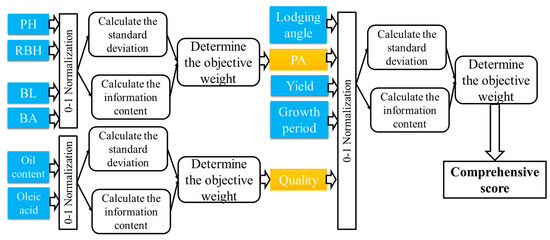
The raw data of seed yield, growth period, lodging angle, plant height, relative branch height, branch length, branch angle, oil content, and oleic acid content of each tested rapeseed variety were used to evaluate the comprehensive performance. Firstly, these indices were mapped to 0–1 intervals to eliminate the impact of dimension by 0–1 normalization. For the positive indices (seed yield, relative branch height, oil content, and oleic acid content), the 0–1 normalized calculation formula is ; for the remaining negative indices, the corresponding formula is , wherein i and k represent the i-th variety and k-th index, respectively. Secondly, the D-CRITIC (Distance-based inter-criteria correlation) method was used to calculate the objective weight of each index [23], which incorporated the distance correlation and standard deviation of each index to produce more valid criteria weights. The contained information of the k-th index () was calculated as follows: , wherein is the standard deviation of each criterion, and is the distance correlation coefficient between the k-th and j-th indices. Then, the objective weight was calculated as the formula: . In the final stage, the criteria weights and index values of each variety were aggregated into a comprehensive score by the membership function method, as follows: , wherein is the comprehensive score of i-th variety. Based on these comprehensive scores, the rapeseed varieties could be ranked from the most to the least preferred ones for decision making. The diagram graph for calculating the comprehensive score is provided in Figure 1.
Figure 1.
Diagram process for calculating the comprehensive score. BA, branch angle; BL, branch length; PA, plant architecture; PH, plant height; RBH, relative branch height. The rectangles with blue color indicate the raw data, and the rectangles with yellow color indicate the comprehensive traits calculated from the raw data.
2.4. Statistical Analysis
Analysis of variance (ANOVA) for growing seasons and genotypes was performed using the mixed linear model in SPSS version 20.0. Growing seasons and blocks were considered random effects, and genotypes were considered fixed effects. Significant differences in treatment means were compared by the LSD test at p < 0.05. Origin version 2023 was used to draw figures. The principle component analysis (PCA) and path analysis were conducted under the R environment by FactoMineR and lavaan packages, respectively [24]. We built a priori path analysis models based on current knowledge and hypotheses, representing cause-and-effect relationships between the variables. We expected that root lodging and shoot lodging both affect plant lodging conditions. Plant height, relative branch height, branch angle, and branch length have effects on plant architecture. Biomass and leaf area could indicate the plant growth rate.
3. Results
3.1. Climate Data
The trail field is located in the region of a subtropical monsoon climate, with significant non-periodic changes in temperature and seasonal changes in precipitation. The monthly average temperature, maximum temperature, and minimum temperature showed a similar trend between the growing season of 2020–2021 and 2021–2022 (Figure 2). The lowest monthly average temperature occurs in January (6.0 °C) and February (5.7 °C) for 2020–2021 and 2021–2022, respectively. The lowest monthly rainfall occurred in December, with 14.3 mm and 4.9 mm for 2020–2021 and 2021–2022, respectively. In comparison, the highest monthly rainfall occurred in May (220.4 mm) and March (212.2 mm) for 2020–2021 and 2021–2022, respectively. The total rainfall in the two growing seasons (October to May of the next cropping year) was 582.2 mm and 539.7 mm, respectively, and most of the precipitation came from Mar to May. The total solar radiation in the growing season of 2021–2022 was higher than that in 2020–2021. The lowest solar radiation in the two years occurred in December (168.6 MJ/m2) and January (159.7 MJ/m2), respectively. The highest solar radiation occurred in May, with 419.3 MJ/m2 and 501.7 MJ/m2 for the growing season 2020–2021 and 2021–2022, respectively.
Figure 2.
Climate data for the field during the two growing seasons. (A) Monthly rainfall and the monthly maximum, minimum, and mean temperature. (B) Monthly solar radiation.
3.2. Growth Period
The total growth period of the two growing seasons for each variety is shown in Figure 3. The whole growth period among the varieties ranged from 196 to 204 days and from 199 to 210 days for 2020–2021 and 2021–2022, respectively. The accumulated temperature during the whole growth period ranged from 2208~2391 °Cd and from 2284~2517 °Cd for the two growing seasons, respectively. The solar radiation during the whole growth period ranged from 1587~1735 MJ/m2 and from 1869~2071 MJ/m2, respectively. Considering the two growing seasons, the varieties V24, V04, V22, V20, V23, and V17 showed a shorter growth period, while the varieties V13, V03, V16, V01, V10, and V02 showed a longer growth period (Figure 3).
Figure 3.
Growth periods of the tested varieties during two cropping seasons. The varieties on the x-axis were ordered according to the average growth period across two growing seasons.
3.3. Yield Component and Seed Quality
The yield and yield components varied among years and genotypes. The ANOVA analysis indicated that all the yield-related traits showed significant differences among the genotypes, while only the siliques per plant and seed quality traits differed significantly between the two growing seasons (Table 2). There was a significant interaction between growing season and genotypes for the yield-related traits, except for the seed-to-pericarp ratio. Averaging across the two growing seasons, V06 has the highest seed yield of 3205 kg/hm2, which could mainly be attributed to a larger silique number per plant and high harvest index; V01 and V16 obtained the lowest seed yield of about 2530 kg/hm2. There was a 1.5-fold difference in the 1000-seed weight among the genotypes, and the highest (4.498 g) and lowest (2.975 g) were obtained by V04 and V13, respectively. The harvest index showed a 1.2-fold difference among the genotypes, and V17 obtained the highest value (0.33), and the lower value (0.28) was obtained by V13 and V14. The seed-to-pericarp ratio ranged from 0.73 to 1.16 among the genotypes, and V23 and V15, respectively, obtained the highest and lowest values. The oil and oleic acid contents ranged from 45.5% to 53.3% and from 67.6% to 76.2%, respectively. V12 had the highest oil content, and V16 had the highest oleic acid content (Supplementary Figure S1). The correlation analysis showed that the seed yield showed a significant positive correlation with the siliques per plant, plant dry biomass, and harvest index across the two years (Figure 4). Meanwhile, the harvest index showed a significant positive correlation with the seed-to-pericarp ratio.
Table 2.
Analyses of variance for the seed yield, yield components, and seed quality.
Figure 4.
Correlation analysis for the yield component traits and plant dry biomass of the growing seasons 2020–2021 (A) and 2021–2022 (B). Red lines indicate a positive correlation (0 < r ≤ 1) and green lines indicate a negative correlation (−1 ≤ r ≤ 0). Solid and dashed lines indicate p ≤ 0.05 and p > 0.05, respectively.
3.4. Plant Architecture
The principal component analysis was conducted for the plant architecture traits of plant height, branch angle, branch length, and the relative branch height, and the result is shown in Figure 5. PC1 and PC2 could explain about 50% and 30%, respectively, of the total variance for plant architecture traits across the two growing seasons. As the cosine value of the angle between the trait vectors represents the correlation between the two variables, the branch length had a higher negative correlation with relative branch height. The genotypes showed a very similar distribution on the PCA-Biplot for the growing season of 2020–2021 (Figure 5A) and 2021–2022 (Figure 5B). V19 had a large relative branch height and branch angle, as its projection values on these traits were high. V02, V04, V12, and V16 had large plant heights across the two growing seasons. The varieties V05 and V07 had large branch length.
Figure 5.
PCA-Biplot for the plant architecture traits of the growing seasons 2020–2021 (A) and 2021–2022 (B). BL, branch length; BA, branch angle; PH, plant height; RBH, relative branch height.
3.5. Lodging Resistance
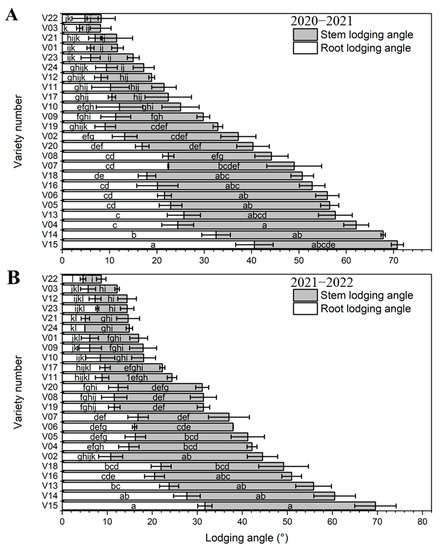
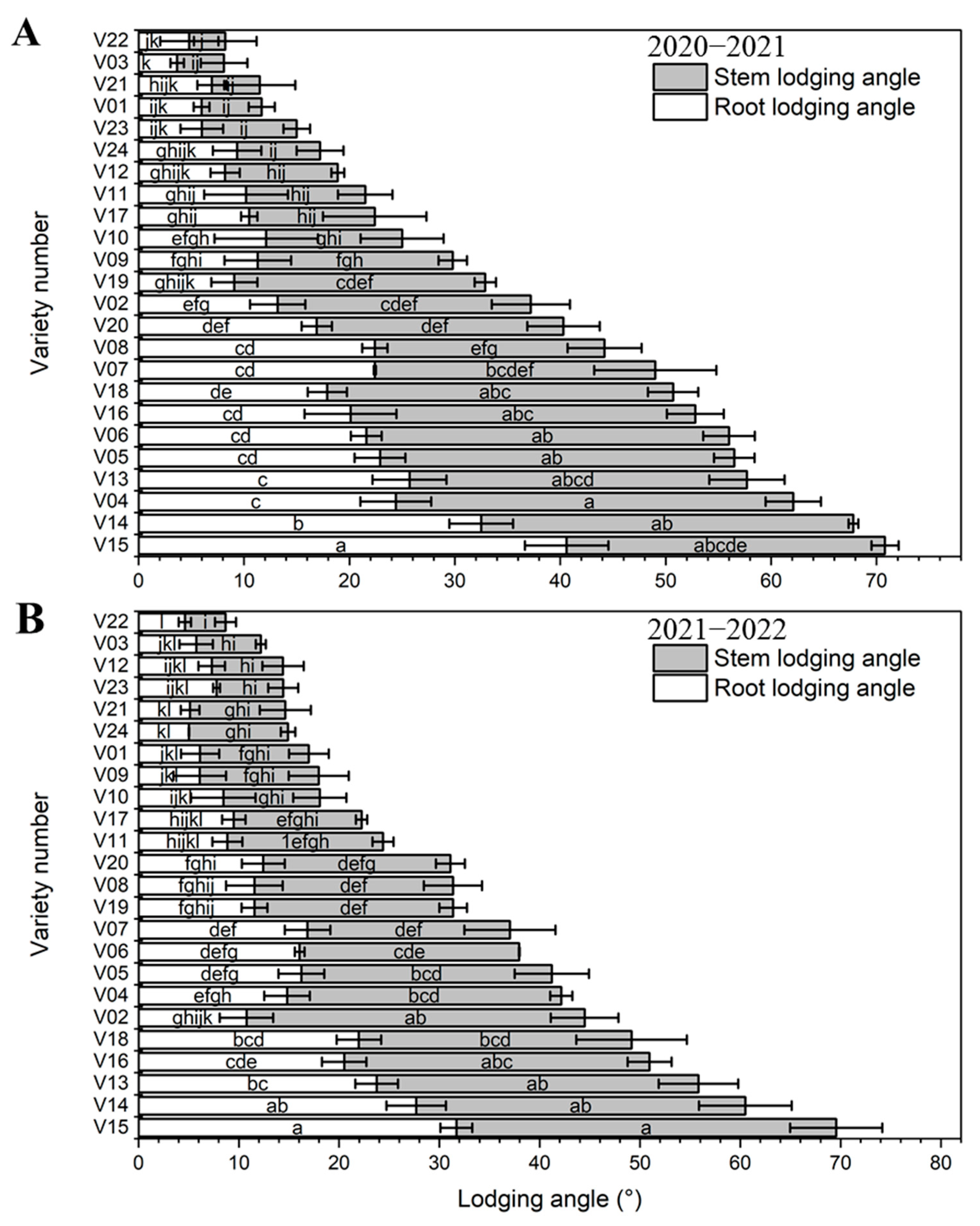
Figure 6 shows the varieties’ plant lodging, root lodging, and stem lodging angles in the growing seasons of 2020–2021 and 2021–2022. The plant lodging angle range ranged from 8.1~70.9° and 8.7~69.6° for the two growing seasons, respectively. The root lodging range ranged from 3.7~40.6° and 4.6~23.7° for the two growing seasons, respectively. The stem lodging ranged from 3.4~32.8° and 4.0~37.9° for the two growing seasons, respectively. Considering the sorting trend across the two years, the varieties with smaller plant lodging angles were V01, V03, V12, V21, V22, V23, and V24, while the varieties V13, V14, and V15 were not resistant to lodging.
Figure 6.
Root and stem lodging angles of the 24 rapeseed varieties for the growing seasons 2020–2021 (A) and 2021–2022 (B). Different lowercase letters in the bar indicate significant difference at the 5% level.
3.6. Path Analysis for the Seed Yield, Plant Architecture, Lodging, and Growth Rate
The path analysis showed the direct contribution of plant architecture, lodging, and growth rate to seed yield (Figure 7). The plant biomass and leaf area index at different developmental stages were used to reveal the plant growth rate. The result showed that the plant biomass at the podding stage (Bio_P) and the leaf area index at the bolting stage (LAI_B) and flowering stage (LAI_F) had a larger contribution to the plant growth rate. The plant growth rate had the largest positive contribution to seed yield with a direct path efficiency of 0.83. Lodging showed a negative contribution to seed yield with a direct path efficiency of −0.37. The plant height and branch length had positive contributions to architecture, while the relative branch height and angles had negative contributions to architecture. The plant architecture had a direct positive contribution to seed yield (direct path efficiency = 0.17). It also had an indirect negative contribution to seed yield by influencing the lodging (indirect path efficiency: −0.37 × 0.30 = −0.11).
Figure 7.
Path analysis to show the contribution of plant architecture, lodging, and growth rate to seed yield. Green arrows revealed positive relationships, while red arrows revealed negative relationships. Values at arrows were standardized path coefficients. PH, plant height; RBH, relative branch height; BA, branch angle; BL, branch length; Bio_V, Bio_B, Bio_F, and Bio_P represent the dry plant biomass at vegetative, bolting, flowering, and podding stages; LAI_V, LAI_B, LAI_F, and LAI_P represent the leaf area index at vegetative, bolting, flowering, and podding stages; RLA and SLA represent the root lodging angle and shoot lodging angle, respectively. The circle and rectangle indicate the measurable and latent variables, respectively.
3.7. A Comprehensive Evaluation for Mechanized Harvesting and High Yield
The objective weights of seed yield, growth period, lodging angle, plant architecture, and seed quality were obtained by the D-CRITIC calculation method, and the weights for these traits are listed in Table 3. The lodging angle had a higher objective weight in 2020–2021, while the growth period had a higher objective weight in 2021–2022; this could be attributed to the large standard deviation of the lodging angle in 2020–2021 and the growth period in 2021–2022. The comprehensive scores of each variety in 2020–2021 and 2021–2022 ranged from 0.24 to 0.93 and 0.26 to 0.86, respectively (Table 4). Considering the average comprehensive score ranking across the two years, the varieties with high yield, good quality, and suitable for mechanized harvesting were V24, V23, V22, V21, V12, V17, V19, and V20.
Table 3.
Weight of each indicator based on the D-CRITIC method for the growing seasons of 2020–2021 and 2021–2022.
Table 4.
Comprehensive scores for each indicator of the 24 tested varieties from the growing seasons of 2020–2021 and 2021–2022.
4. Discussion
Screening the varieties with high yield, high quality, and suitable for mechanized harvesting is an important avenue to improving the production efficiency and planting benefit of rapeseed in the Yangtze River basin of China [25]. The key finding from this study revealed the existence of substantial genetic variation and genotype × environment interactions of rapeseed in the growth period, yield components, seed quality, and suitability for mechanized harvesting and the linkage between these traits. The high genotype × environment interaction has been observed in rapeseed productivity in several cropping systems around the world [26,27,28]. Incorporating all the advantageous traits in an ideotype is potentially hazardous. Thus, a comprehensive evaluation of the elite varieties could be a valuable resource for farmers and breeders.
High seed yield has been a consequence of large plant biomass accumulation, coupled with a high harvest index [29]. Increasing the accumulation of dry matter can lead to an increase in the number of siliques in the plant population, thus improving the yield [30]. The correlation analysis for the two cropping seasons showed that plant biomass, silique number per plant, and seed yield showed a significant positive correlation with each other. The seeds per silique and 1000-seed weight showed no significant correlation with seed yield. Meanwhile, the correlation between the number of seeds per pod and the harvest index was significant in the first year, but not significant in the second year, indicating that environmental differences tend to lead to an unstable relationship between these two traits. Siliques act as the primary photosynthetic organs to support the development of the pericarp and seed at the post-flowering stage [31]. The pericarp plays dual roles in the source–sink relationship during seed development, and the translocation of dry matter from the pericarp to the seed largely determines the seed yield [32]. This conformed with our result that the seed-to-pericarp weight ratio showed a significant positive correlation with the harvest index.
Introducing early-maturing rapeseed genotypes to the Yangtze River basin could alleviate the temporal conflict between double-season rice and rapeseed [33,34]. Previous studies had identified a series of candidate genetic variations to control the earlier flowering, which could facilitate breeding for early maturity genotypes in rapeseed [35,36]. In general conditions, high yield and early maturity were negatively correlated. A transcriptional regulator, OsDREB1C, had been identified in rice to boost grain yield and shorten the growth duration [37], implying that the prerequisite for early maturity varieties to achieve high yield is to improve carbon fixation and nitrogen assimilation. In our experiment, the varieties V23 and V24 were both early maturing and high yielding, which was attributed to a larger amount of biomass accumulation in a shorter growth cycle. The order of the growth period of the varieties was not completely consistent between the two years. As the minimum temperature in Dec and Jan in 2021–2022 was higher than that in 2020–2021, the varieties with rigid vernalization requirements needed more days to initiate reproductive growth. The path analysis also showed that the plant growth rate had the largest positive contribution to seed yield. It agreed with a previous study that early-maturing genotypes of rapeseed could have a better tradeoff between early maturation and high seed yield by increasing the light energy and temperature production efficiencies [38].
Plant architecture can directly affect the seed yield or indirectly affect the yield through lodging. The path analysis illustrated that the plant height and branch length had positive contributions to architecture, while the relative branch height and branch angles had negative contributions to architecture. It implied that the positive effect of plant architecture on seed yield derived from the high plant height, long branch length, low relative branch height, and small branch angle. However, this type of plant architecture was prone to lodging. A significant positive correlation existed between the plant height and seed yield per plant of the winter rapeseed [39]. Height reduction was enhanced by applying plant growth regulators, and a significant reduction in lodging accompanied this change [40]. Lodging not only inhibited the yield formation of rapeseed, but also increased the loss rate of machine harvesting [41]. Increasing stem diameter and vascular bundle thickness can enhance the stem’s physical strength to improve rapeseed lodging resistance. Thus, these traits should be considered in further research [42,43].
Taken together, the breeding and selecting of rapeseed varieties should emphasize the agronomic functional characteristics of early maturity, suitable plant architecture, high lodging resistance, high seed yield, and good seed quality. Integrated assessment of varieties’ performance using these multiple traits is a crucial strategy for rapeseed mechanized harvesting development in the Yangtze River basin. The membership function method has been widely used to evaluate the comprehensive performance ability of crops [44,45]. The present study used the D-CRITIC method to calculate the objective weights of target traits to obtain the comprehensive score of each variety. The lodging angle and growth period had a higher objective weight in 2020–2021 and 2021–2022, respectively, suggesting that the objective weight was determined by the genotype and environment interaction. From the comprehensive performance of the two cropping seasons, the varieties V24, V23, V22, V21, V12, V17, V19, and V20 had substantial potential for mechanized harvesting with high yield and good seed quality.
5. Conclusions
Mechanized harvesting of rapeseed requires the systematic combination of varieties, machinery, and cultivation technology to improve planting efficiency. It is urgent to breed and select varieties with early maturation, compact plant architecture, short plant height, and high lodging resistance and high seed yield and seed quality. This experiment revealed the phenotypic diversity of different genotypes regarding the growth period, plant architecture characteristics, lodging resistance, yield, and seed quality. High yield and early maturity are not mutually exclusive, and early maturity varieties with high growth rates are crucial to obtain high seed yields. The comprehensive score of the varieties evaluated in the present research provides candidate criteria for selecting genotypes suitable for mechanized harvesting. Further study should be conducted to investigate the comprehensive scores of rapeseed germplasm resources in multiple year × environment trials to determine outstanding genotypes with broad adaption and high stability suitable for mechanized harvesting.
Supplementary Materials
The following supporting information can be downloaded at: https://www.mdpi.com/article/10.3390/agronomy13030795/s1, Figure S1: Each year’s ranking (from small to largest) of genotypes for each response variable.
Author Contributions
Conceptualization, Z.X.; Data curation, Q.L.; Formal analysis, T.L.; Funding acquisition, Z.X.; Investigation, T.L., S.Y. and H.S.; Methodology, Q.L.; Project administration, G.Z.; Software, T.L.; Supervision, G.Z.; Writing—original draft, Q.L. and T.L.; Writing—review & editing, T.C., J.L., B.W., J.K., J.W. and Z.X. All authors have read and agreed to the published version of the manuscript.
Funding
This research was funded by the National Key Research and Development Program of China, grant number 2020YFD1000901.
Data Availability Statement
Not applicable.
Conflicts of Interest
The authors declare no conflict of interest.
References
- Bonjean, A.P.; Dequidt, C.; Sang, T. Rapeseed in China. OCL 2016, 23, D605. [Google Scholar] [CrossRef] [Scilit]
- Wang, H. Strategy for rapeseed industry development based on the analysis of rapeseed production and demand in China. Chin. J. Oil Crop Sci. 2007, 29, 101–105. [Google Scholar]
- Lu, C.; Napier, J.A.; Clemente, T.E.; Cahoon, E.B. New frontiers in oilseed biotechnology: Meeting the global demand for vegetable oils for food, feed, biofuel, and industrial applications. Curr. Opin. Biotechnol. 2011, 22, 252–259. [Google Scholar] [CrossRef] [Scilit] [PubMed]
- Luo, T.; Zhang, J.; Khan, M.N.; Liu, J.; Xu, Z.; Hu, L. Temperature variation caused by sowing dates significantly affects floral initiation and floral bud differentiation processes in rapeseed (Brassica napus L.). Plant Sci. 2018, 271, 40–51. [Google Scholar] [CrossRef] [Scilit] [PubMed]
- Luo, T.; Lin, R.; Cheng, T.; Hu, L. Low temperature rather than nitrogen application mainly modulates the floral initiation of different ecotypes of rapeseed (Brassica napus L.). Agronomy 2022, 12, 1624. [Google Scholar] [CrossRef] [Scilit]
- Lopez, F.; Barclay, G. Plant anatomy and physiology. In Pharmacognosy; Elsevier: Amsterdam, The Netherlands, 2017; pp. 45–60. [Google Scholar]
- Barthélémy, D.; Caraglio, Y. Plant architecture: A dynamic, multilevel and comprehensive approach to plant form, structure and ontogeny. Ann. Bot. 2007, 99, 375–407. [Google Scholar] [CrossRef] [Scilit]
- Liu, H. Genetics and breeding of rapeseed. In Genetics and Breeding of Rapeseed; Liu, H., Ed.; Shanghai Scientific and Technical Publishers: Shanghai, China, 1985; pp. 338–339. [Google Scholar]
- Qing, Y.; Li, Y.; Xu, L.; Ma, Z. Screen oilseed rape (Brassica napus) suitable for low-loss mechanized harvesting. Agriculture 2021, 11, 504. [Google Scholar] [CrossRef] [Scilit]
- Ren, R.; Liu, W.; Yao, M.; Jia, Y.; Huang, L.; Li, W.; He, X.; Guan, M.; Liu, Z.; Guan, C. Regional association and transcriptome analysis revealed candidate genes controlling plant height in Brassica napus. Mol. Breed. 2022, 42, 69. [Google Scholar] [CrossRef] [Scilit]
- Qing, Y.; Li, Y.; Xu, L.; Ma, Z.; Tan, X.; Wang, Z. Oilseed rape (Brassica napus L.) pod shatter resistance and its relationship with whole plant and pod characteristics. Ind. Crops Prod. 2021, 166, 113459. [Google Scholar] [CrossRef] [Scilit]
- Khan, S.; Anwar, S.; Kuai, J.; Noman, A.; Shahid, M.; Din, M.; Ali, A.; Zhou, G. Alteration in yield and oil quality traits of winter rapeseed by lodging at different planting density and nitrogen rates. Sci. Rep. 2018, 8, 634. [Google Scholar] [CrossRef] [Scilit]
- Wang, Y.; Wang, K.; An, T.; Tian, Z.; Dun, X.; Shi, J.; Wang, X.; Deng, J.; Wang, H. Genetic dissection of branch architecture in oilseed rape (Brassica napus L.) germplasm. Front. Plant Sci. 2022, 4443, 1053459. [Google Scholar] [CrossRef] [Scilit]
- Sun, C.; Wang, B.; Wang, X.; Hu, K.; Li, K.; Li, Z.; Li, S.; Yan, L.; Guan, C.; Zhang, J. Genome-wide association study dissecting the genetic architecture underlying the branch angle trait in rapeseed (Brassica napus L.). Sci. Rep. 2016, 6, 33673. [Google Scholar] [CrossRef] [Scilit]
- Wang, W.; Qiong, H.; Mei, D.; Li, Y.; Hui, W.; Jun, W.; Li, F.; Jia, L. Evaluation of branch and pod angle measurement based on digital images from Brassica napus L. Chin. J. Oil Crop Sci. 2015, 37, 566. [Google Scholar]
- Wang, W.; Chu, W.; Mei, D.; Cheng, H.; Zhu, L.; Fu, L.; Hu, Q.; Liu, J. Quantitative trait loci mapping for branch angle and candidate gene screening in Brassica napus L. Acta Agron. Sin. 2019, 45, 37–45. [Google Scholar] [CrossRef] [Scilit]
- Li, H.; Cheng, X.; Zhang, L.; Hu, J.; Zhang, F.; Chen, B.; Xu, K.; Gao, G.; Li, H.; Li, L. An integration of genome-wide association study and gene co-expression network analysis identifies candidate genes of stem lodging-related traits in Brassica napus. Front. Plant Sci. 2018, 9, 796. [Google Scholar] [CrossRef] [Scilit]
- Liu, S.; Raman, H.; Xiang, Y.; Zhao, C.; Huang, J.; Zhang, Y. De novo design of future rapeseed crops: Challenges and opportunities. Crop J. 2022, 10, 587–596. [Google Scholar] [CrossRef] [Scilit]
- Alizadeh, M.R.; Bagheri, I.; Payman, M.H. Evaluation of a rice reaper used for rapeseed harvesting. Am.-Eurasian J. Agric. Environ. Sci. 2007, 2, 388–397. [Google Scholar]
- Zheng, M.; Terzaghi, W.; Wang, H.; Hua, W. Integrated strategies for increasing rapeseed yield. Trends Plant Sci. 2022, 27, 742–745. [Google Scholar] [CrossRef] [Scilit]
- Kuai, J.; Sun, Y.; Guo, C.; Zhao, L.; Zuo, Q.; Wu, J.; Zhou, G. Root-applied silicon in the early bud stage increases the rapeseed yield and optimizes the mechanical harvesting characteristics. Field Crops Res. 2017, 200, 88–97. [Google Scholar] [CrossRef] [Scilit]
- Zuo, Q.; Kuai, J.; Zhao, L.; Hu, Z.; Wu, J.; Zhou, G. The effect of sowing depth and soil compaction on the growth and yield of rapeseed in rice straw returning field. Field Crops Res. 2017, 203, 47–54. [Google Scholar] [CrossRef] [Scilit]
- Krishnan, A.R.; Kasim, M.M.; Hamid, R.; Ghazali, M.F. A modified CRITIC method to estimate the objective weights of decision criteria. Symmetry 2021, 13, 973. [Google Scholar] [CrossRef] [Scilit]
- R Core Team. R: A Language and Environment for Statistical Computing; R Foundation for Ftatistical Fomputing: Vienna, Austria, 2018. [Google Scholar]
- Hu, Q.; Hua, W.; Yin, Y.; Zhang, X.; Liu, L.; Shi, J.; Zhao, Y.; Qin, L.; Chen, C.; Wang, H. Rapeseed research and production in China. Crop J. 2017, 5, 127–135. [Google Scholar] [CrossRef] [Scilit]
- Pilarczyk, W. The relation between GxE interaction and the number of locations in series of oilseed rape trials. Biom. Lett. 2013, 50, 53–60. [Google Scholar] [CrossRef] [Scilit]
- Puhl, L.E.; Miralles, D.J.; López, C.G.; Iriarte, L.B.; Rondanini, D.P. Genotype × environment interaction on the yield of spring oilseed rape (Brassica napus) under rainfed conditions in Argentine Pampas. J. Agric. Sci. 2019, 157, 235–244. [Google Scholar] [CrossRef] [Scilit]
- Zhang, H.; Berger, J.D.; Herrmann, C. Yield stability and adaptability of canola (Brassica napus L.) in multiple environment trials. Euphytica 2017, 213, 155. [Google Scholar] [CrossRef] [Scilit]
- Zhang, H.; Turner, N.C.; Poole, M.L. Source–sink balance and manipulating sink–source relations of wheat indicate that the yield potential of wheat is sink-limited in high-rainfall zones. Crop Pasture Sci. 2010, 61, 852–861. [Google Scholar] [CrossRef] [Scilit]
- Li, S.; Zhu, Y.; Varshney, R.K.; Zhan, J.; Zheng, X.; Shi, J.; Wang, X.; Liu, G.; Wang, H. A systematic dissection of the mechanisms underlying the natural variation of silique number in rapeseed (Brassica napus L.) germplasm. Plant Biotechnol. J. 2020, 18, 568–580. [Google Scholar] [CrossRef] [Scilit]
- Wang, C.; Hai, J.; Yang, J.; Tian, J.; Chen, W.; Chen, T.; Luo, H.; Wang, H. Influence of leaf and silique photosynthesis on seeds yield and seeds oil quality of oilseed rape (Brassica napus L.). Eur. J. Agron. 2016, 74, 112–118. [Google Scholar] [CrossRef] [Scilit]
- Habibi, M.; Majidian, M.; Shoja, T.; Rabiee, M. Effects of S, B and Zn, on seed yield, nutrient concentration and seed quality of rapeseed (Brassica napus L.). J. Oil Plants Prod. 2016, 2, 1–12. [Google Scholar]
- Fang, C.; Wang, Z.; Wang, P.; Song, Y.; Ahmad, A.; Dong, F.; Hong, D.; Yang, G. Heterosis derived from nonadditive effects of the BnFLC homologs coordinates early flowering and high yield in rapeseed (Brassica napus l.). Front. Plant Sci. 2022, 12, 3351. [Google Scholar] [CrossRef] [Scilit]
- Lu, G.-Y.; Zhang, F.; Zheng, P.-Y.; Cheng, Y.; Feng-Ian, L.; Fu, G.-P.; Zhang, X.-K. Relationship among yield components and selection criteria for yield improvement in early rapeseed (Brassica napus L.). Agric. Sci. China 2011, 10, 997–1003. [Google Scholar] [CrossRef] [Scilit]
- Zhou, Q.; Han, D.; Mason, A.S.; Zhou, C.; Zheng, W.; Li, Y.; Wu, C.; Fu, D.; Huang, Y. Earliness traits in rapeseed (Brassica napus): SNP loci and candidate genes identified by genome-wide association analysis. DNA Res. 2018, 25, 229–244. [Google Scholar] [CrossRef] [Scilit]
- Huang, L.; Min, Y.; Schiessl, S.; Xiong, X.; Jan, H.U.; He, X.; Qian, W.; Guan, C.; Snowdon, R.J.; Hua, W. Integrative analysis of GWAS and transcriptome to reveal novel loci regulation flowering time in semi-winter rapeseed. Plant Sci. 2021, 310, 110980. [Google Scholar] [CrossRef] [Scilit]
- Wei, S.; Li, X.; Lu, Z.; Zhang, H.; Ye, X.; Zhou, Y.; Li, J.; Yan, Y.; Pei, H.; Duan, F. A transcriptional regulator that boosts grain yields and shortens the growth duration of rice. Science 2022, 377, eabi8455. [Google Scholar] [CrossRef] [Scilit]
- Zhang, C.; Luo, T.; Liu, J.; Xian, M.; Yuan, J.; Hu, L.; Xu, Z. Evaluation of the low-temperature tolerance of rapeseed genotypes at the germination and seedling emergence stages. Crop Sci. 2019, 59, 1709–1717. [Google Scholar] [CrossRef] [Scilit]
- Marjanović-Jeromela, A.; Marinković, R.; Mijić, A.; Zdunić, Z.; Ivanovska, S.; Jankulovska, M. Correlation and path analysis of quantitative traits in winter rapeseed (Brassica napus L.). Agric. Conspec. Sci. 2008, 73, 13–18. [Google Scholar]
- Armstrong, E.; Nicol, H. Reducing height and lodging in rapeseed with growth regulators. Aust. J. Exp. Agric. 1991, 31, 245–250. [Google Scholar] [CrossRef] [Scilit]
- Wu, W.; Ma, B.-L. Understanding the trade–off between lodging resistance and seed yield, and developing some non–destructive methods for predicting crop lodging risk in canola production. Field Crops Res. 2022, 288, 108691. [Google Scholar] [CrossRef] [Scilit]
- Zhang, L.; Miao, L.; He, J.; Li, H.; Li, M. The transcriptome and metabolome reveal the potential mechanism of lodging resistance in intergeneric hybrids between Brassica napus and Capsella bursa-pastoris. Int. J. Mol. Sci. 2022, 23, 4481. [Google Scholar] [CrossRef] [Scilit]
- Shah, L.; Yahya, M.; Shah, S.M.A.; Nadeem, M.; Ali, A.; Ali, A.; Wang, J.; Riaz, M.W.; Rehman, S.; Wu, W. Improving lodging resistance: Using wheat and rice as classical examples. Int. J. Mol. Sci. 2019, 20, 4211. [Google Scholar] [CrossRef] [Scilit]
- Kaur, H.; Kaur, R.; Manchanda, G.; Bindra, S.; Sharma, A. Screening of Cicer arietinum L. genotypes under combined presence of NaCl and anthracene using membership function value of stress tolerance. Plant Gene 2022, 31, 100371. [Google Scholar] [CrossRef] [Scilit]
- Yan, C.; Song, S.; Wang, W.; Wang, C.; Li, H.; Wang, F.; Li, S.; Sun, X. Screening diverse soybean genotypes for drought tolerance by membership function value based on multiple traits and drought-tolerant coefficient of yield. BMC Plant Biol. 2020, 20, 321. [Google Scholar] [CrossRef] [Scilit] [PubMed]





Disclaimer/Publisher’s Note: The statements, opinions and data contained in all publications are solely those of the individual author(s) and contributor(s) and not of MDPI and/or the editor(s). MDPI and/or the editor(s) disclaim responsibility for any injury to people or property resulting from any ideas, methods, instructions or products referred to in the content. |
© 2023 by the authors. Licensee MDPI, Basel, Switzerland. This article is an open access article distributed under the terms and conditions of the Creative Commons Attribution (CC BY) license (https://creativecommons.org/licenses/by/4.0/).