Four-Dimensional Printing of Shape Memory Polymers for Biomedical Applications: Advances in DLP and SLA Manufacturing



Abstract
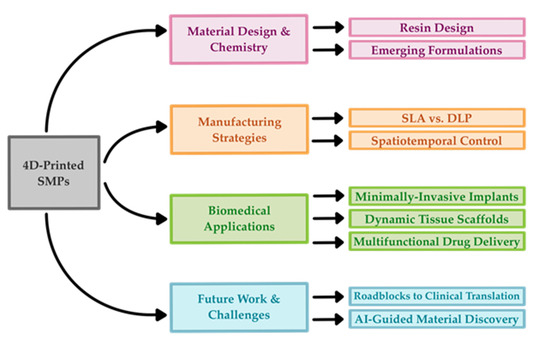
1. Introduction
2. Fundamentals of Shape Memory Polymers
2.1. Molecular Mechanisms
2.2. Classification of SMPs
2.3. Quantification of Shape Memory Effect
3. Advanced Manufacturing Techniques of Shape Memory Polymers
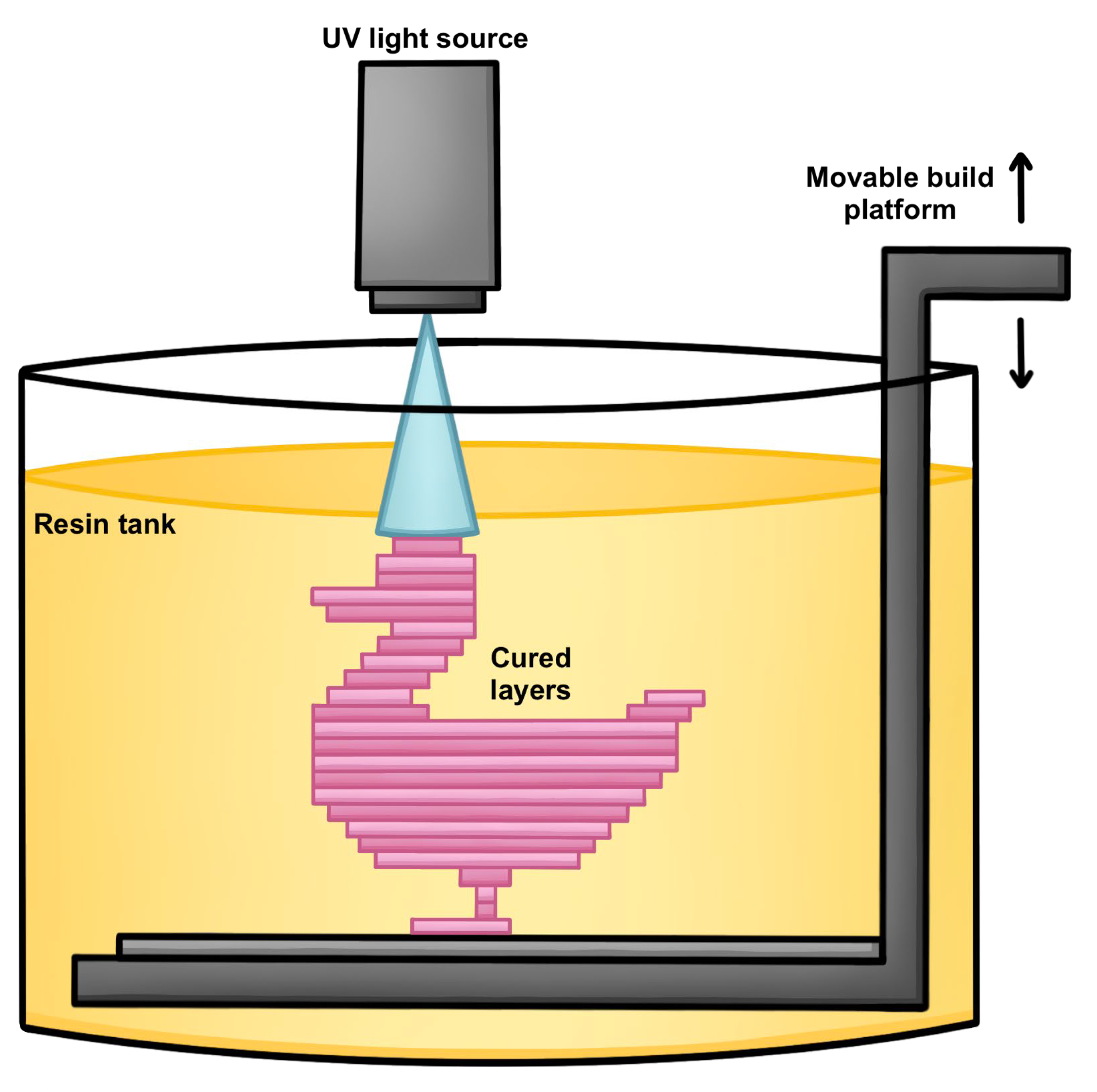
3.1. Stereolithography (SLA)
3.2. Digital Light Processing (DLP)
3.3. Comparative Analysis

| Attribute | SLA (Stereolithography) | DLP (Digital Light Processing) | Biomedical Implications | References |
|---|---|---|---|---|
| Resolution | High spatial resolution, typically around ~25 mm, suitable for fine feature detail | Slightly lower spatial resolution, around ~50 µm, sufficient for most biomedical applications | SLA better for microneedles, micro-stents; DLP sufficient for scaffolds, dental aligners | [57,58,59] |
| Printing Speed | Slower due to point-by-point laser scanning curing | Faster, cures entire layers via projected light | DLP preferred for large scaffolds or bulk constructs | [57,60] |
| Material Compatibility | Primarily acrylate-based resins including polyurethane acrylates with tunable mechanical/thermal properties | Broader resin compatibility including ceramics, metals, elastomers, and hydrogels | Essential SMP performance metrics | [57,58] |
| Post-Processing | Requires extensive UV or thermal post-curing and solvent washing to remove uncured resin | Often requires minimal or no curing; washing steps to remove residual resin | SLA-printed SMPs need further curing steps to maintain properties | [58] |
| Application Suitability | Well suited for high precision/small-scale applications, such as microneedles and implant models | Widely used for tissue engineering, dental aligners, flexible biomedical devices | SLA for rigid precision; DLP for flexible, scalable devices | [58] |
| Printing Volume/Scale | Typically smaller build volumes due to slower scanning | Larger volume printing enabling manufacturing of bigger constructs | DLP more scalable for biomedical scaffolds | [60] |
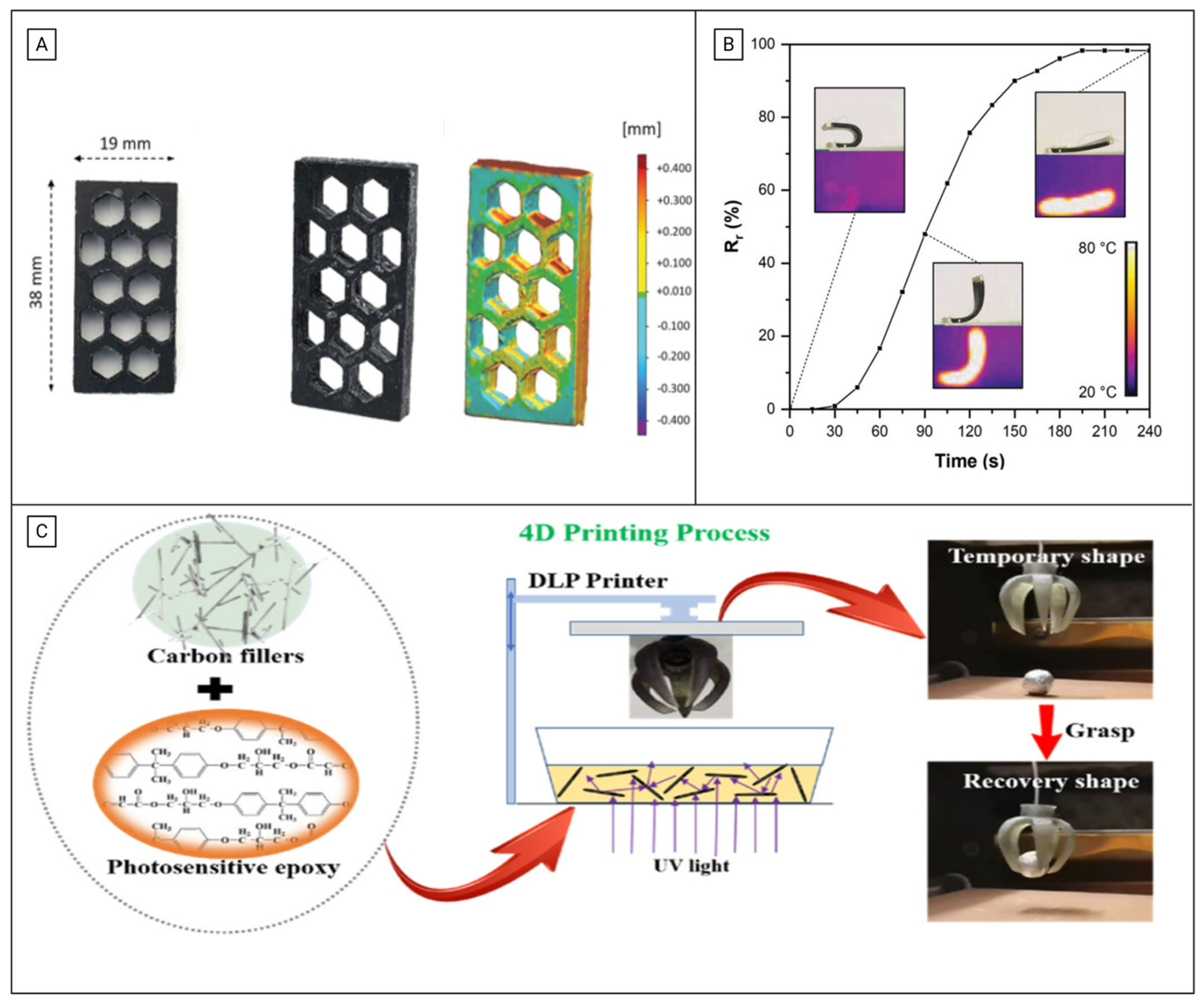
| Shape Fixity Ratio (Rf) | SLA-printed tBA-co-DEGDA polymer shows high shape fixity, though exact values are not disclosed | Electrical stimulus- activated DLP SMP composites demonstrate Rf ≈ 100% | SLA SMPs reliably hold temporary shapes which are critical for deployment; DLP composites enable nearly perfect fixation, ideal for precise biomedical actuation | [61] |
| Shape Recovery Ratio (Rr) | SLA polymers show high shape recovery performance over multiple cycles (implicitly >95%), but exact Rr values are not specified | DLP CNT/SMPCs demonstrate Rr > 95% | Both methods offer reliable recovery; DLP composites especially promising for highly accurate biomedical actuation | [61] |
| Surface finish | Usually smoother finish due to laser focus | Slightly rougher; limited by pixel size of projected light | SLA best for smooth surgical implants | [62] |
| Cost and Accessibility | Generally higher cost and complexity | More affordable and simplified optics | DLP is more accessible for biomedical labs | [60] |
4. Recent Advances in SMP Chemistry for DLP and SLA
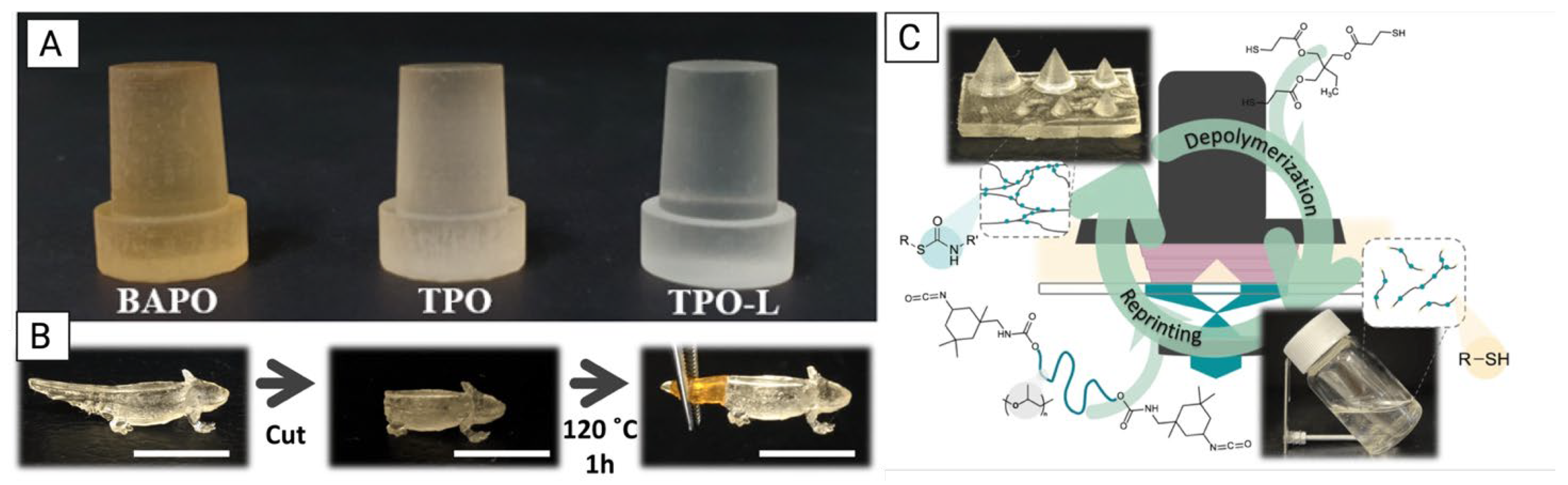
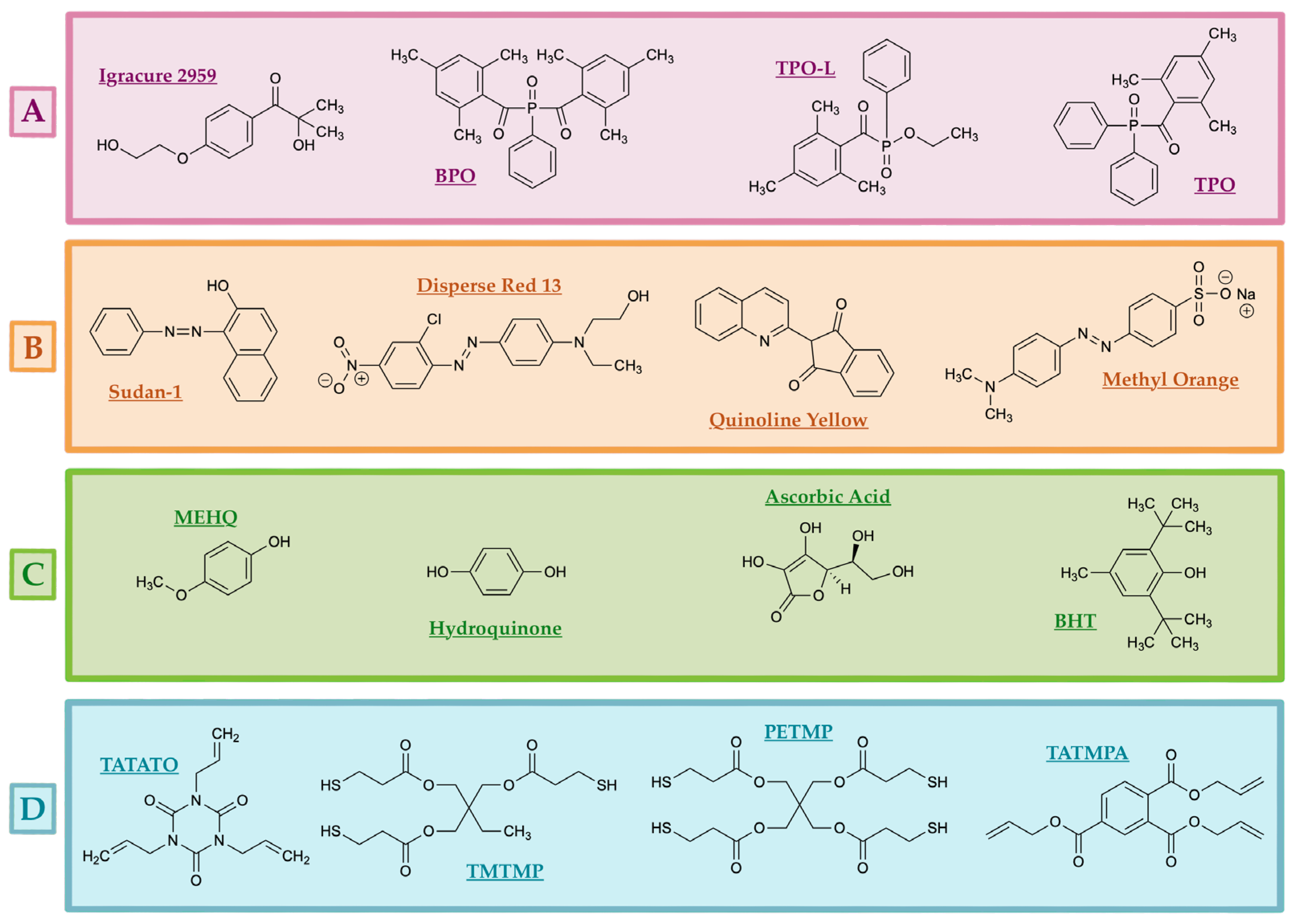
4.1. Novel Photoinitiators (BAPO, TPO-L) for Cytocompatibility
4.2. Low-Shrinkage, High-Recovery Thiol-Ene Resins
4.3. Multi-Responsive SMP Systems (Thermo + pH, Thermo + NIR Light)
4.4. Inclusion of Nanofillers (Graphene, Cellulose Nanocrystals)
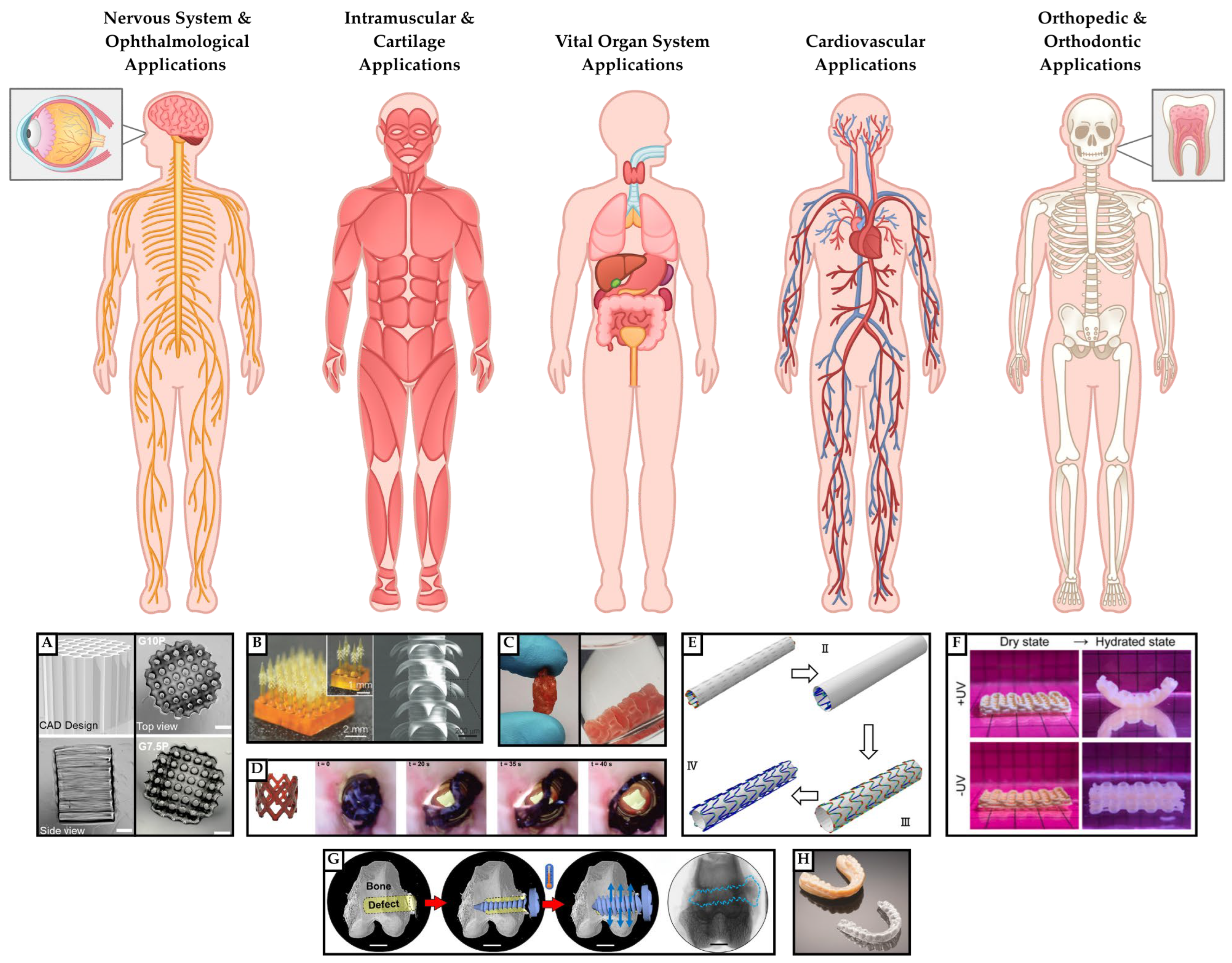
5. Biomedical Applications of 3D Printed SMPs
5.1. Dental Technology
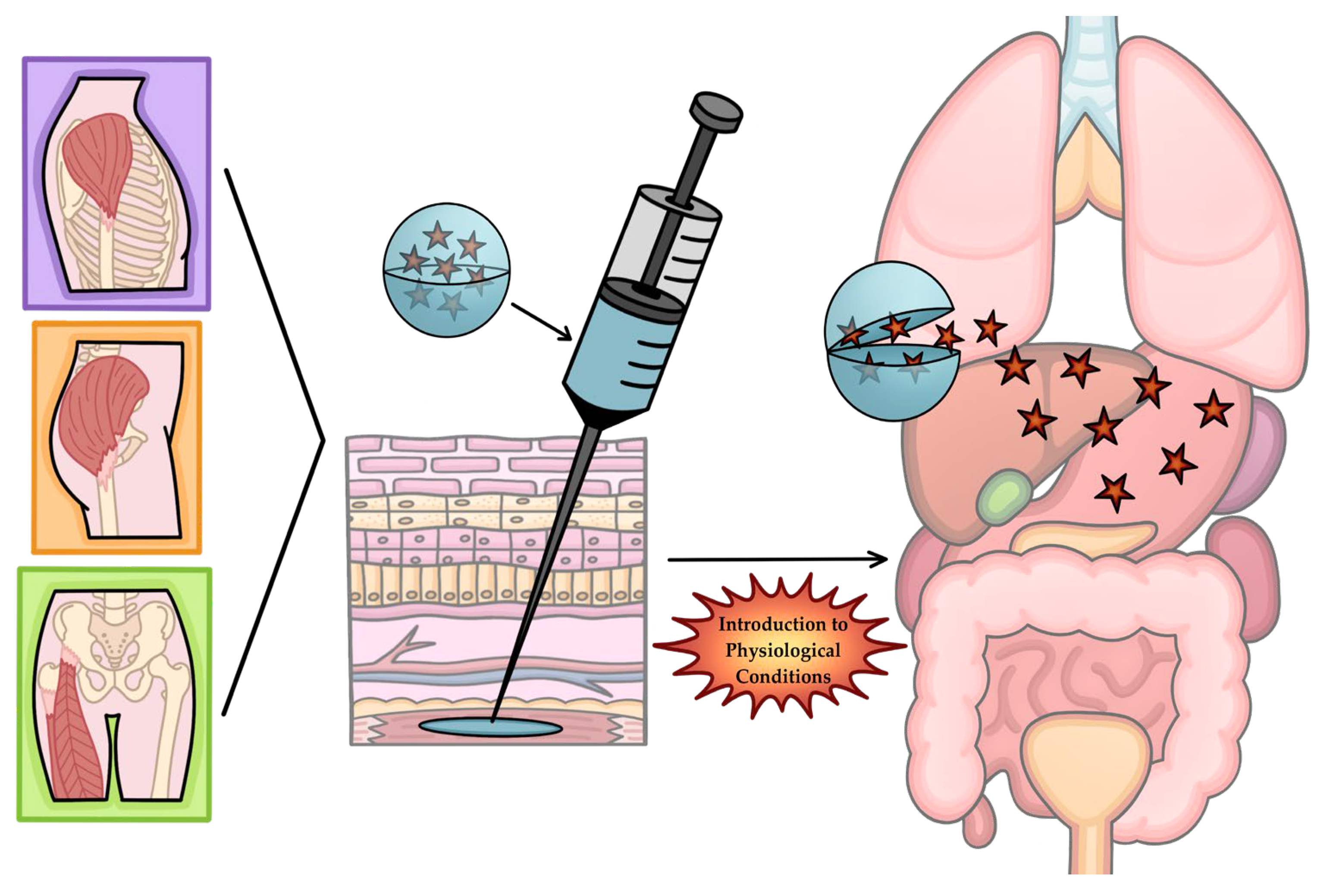
5.2. Drug Delivery Applications
5.3. Nervous System Applications
5.4. Orthopedic Applications
5.5. Cardiovascular Applications
5.6. Other Applications
6. AI in SMP Development
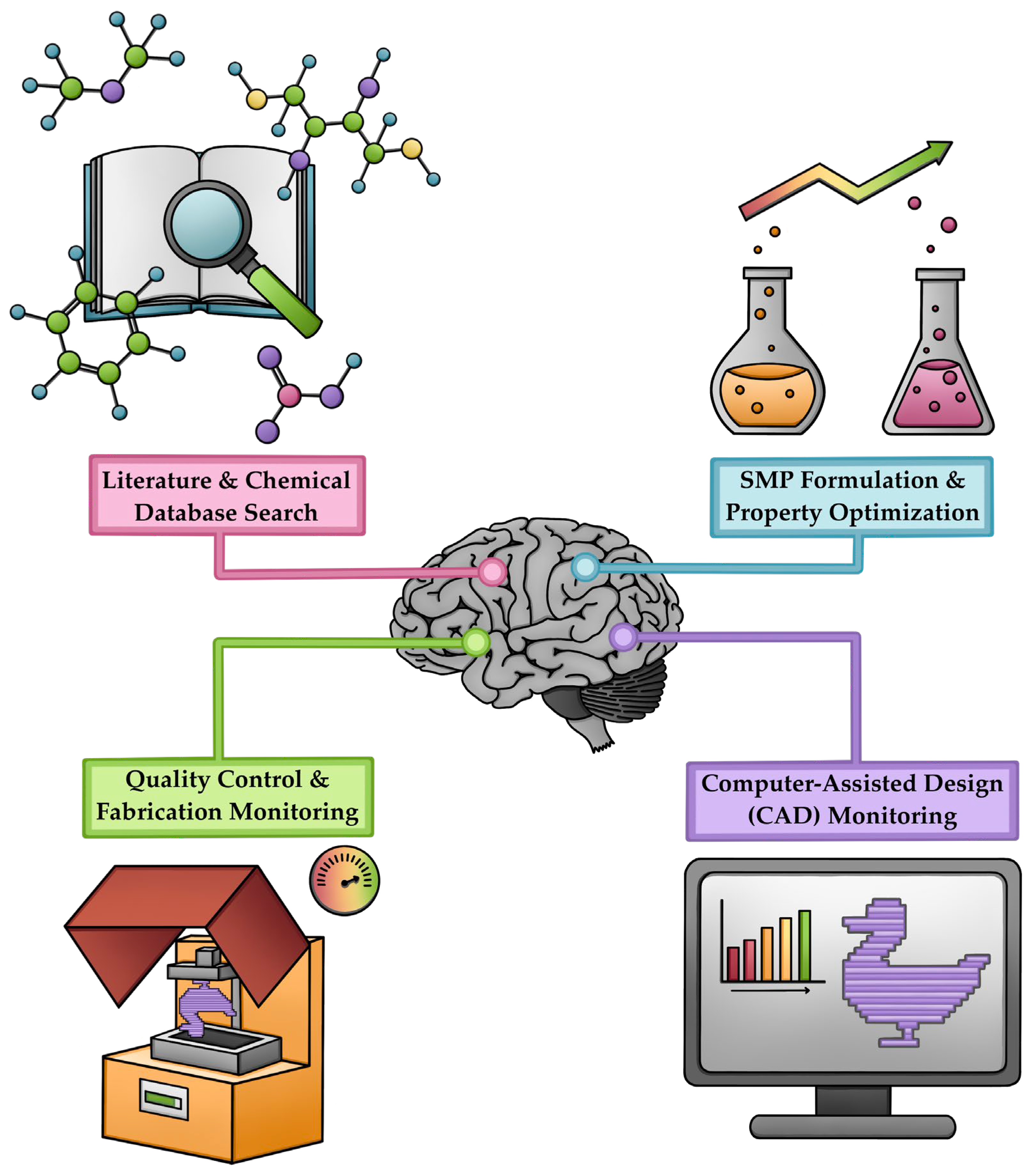
6.1. AI-Driven SMP Design and Printing via SLA/DLP for Biomedical Applications
6.2. AI-Driven Material Discovery and Design
6.3. Process Optimization and Parameter Control
6.4. Real-Time Monitoring and Quality Control
6.5. Multimodal AI Integration
6.6. Current Limitations and Research Needs
7. Emergence of 4D-Printed SMPs for Biomedical Applications
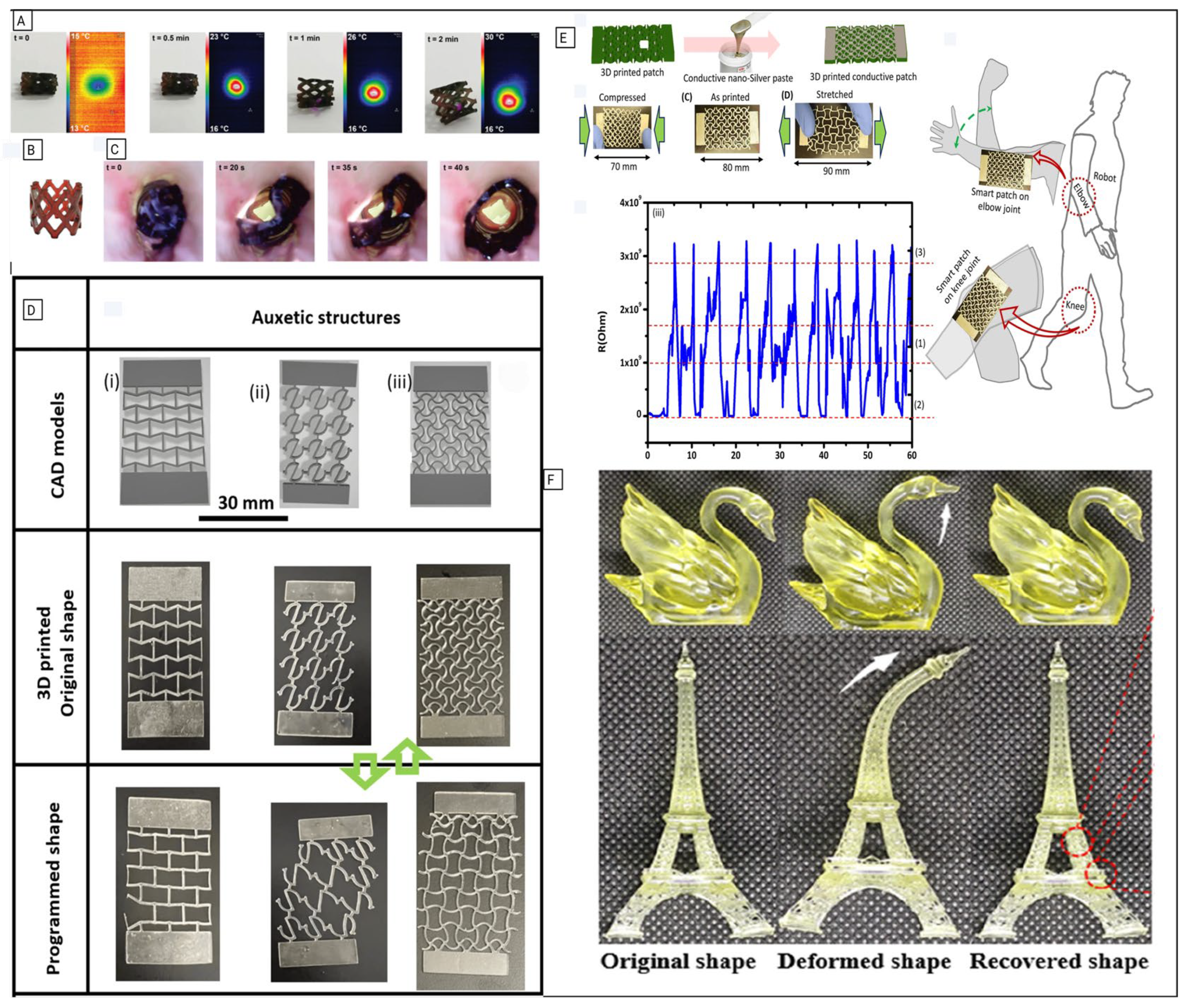
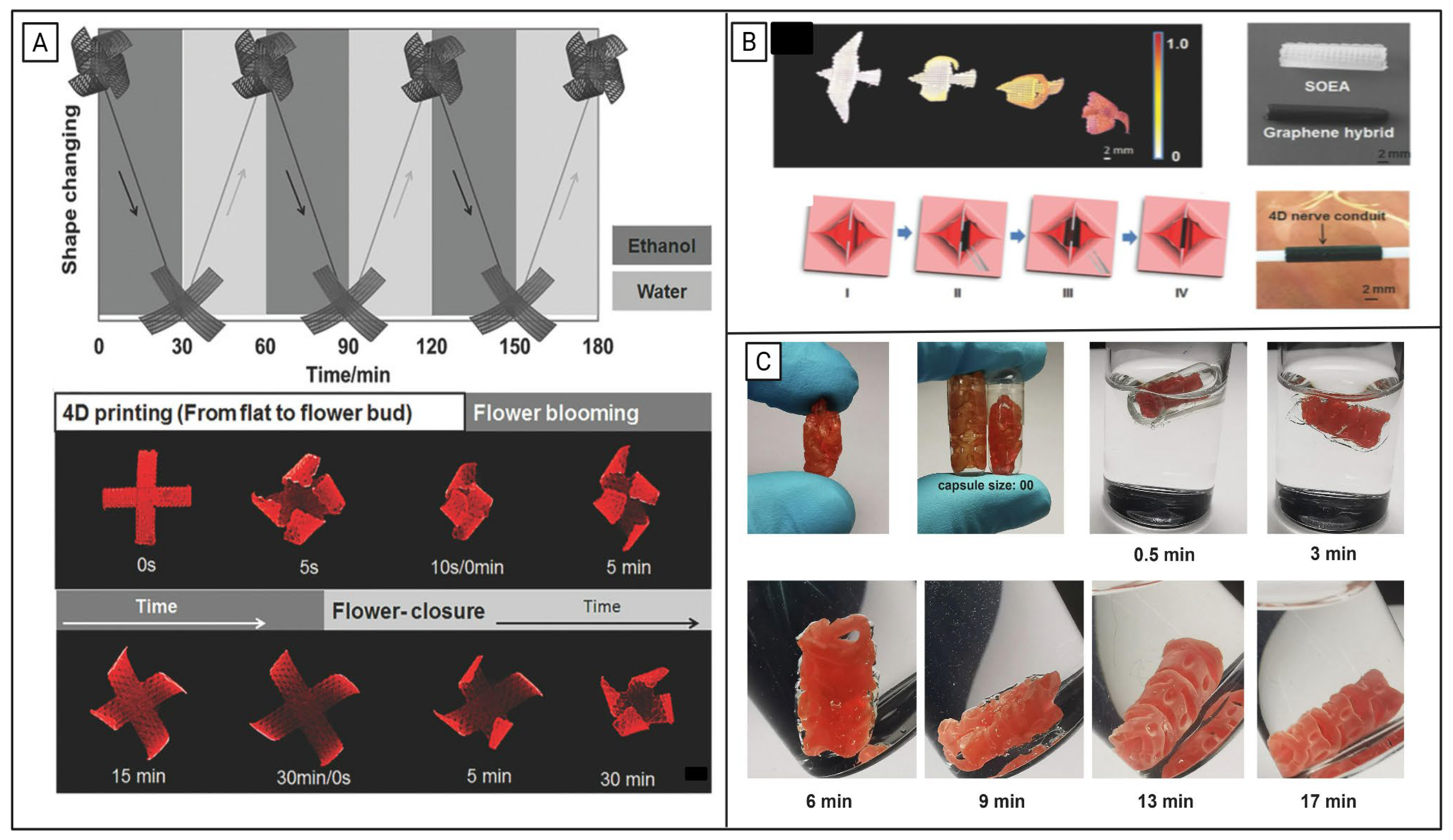
7.1. Self-Fitting Implants and Scaffolds
7.2. Minimally-Invasive, Deployable Devices
8. Technical Limitations of 4D Printed SMPs
8.1. Cytotoxicity from Unreacted Monomers and Photoinitiators
8.2. Sterilization Limitations for Printed SMP Devices
8.3. Challenges in Shelf-Life Stability and Packaging of DLP and SLA Printed SMPs
9. FDA Regulatory Considerations for 4D Printed Medical Devices
10. Conclusions and Future Directions
Author Contributions
Funding
Institutional Review Board Statement
Data Availability Statement
Acknowledgments
Conflicts of Interest
References
- Lendlein, A.; Kelch, S. Shape-memory polymers. Angew. Chem. Int. Ed. 2002, 41, 2034–2057. [Google Scholar] [CrossRef]
- Suzuki, Y.; Hu, Q.; Batchelor, B.; Voit, W.; Ecker, M. Thermo/hydration responsive shape memory polymers with enhanced hydrophilicity for biomedical applications. Smart Mater. Struct. 2022, 32, 015006. [Google Scholar] [CrossRef]
- Uyan, M.; Celiktas, M.S. Novel constitutive models, challenges and opportunities of shape memory polymer composites. Emerg. Mater. Res. 2024, 13, 192–211. [Google Scholar] [CrossRef]
- Correia, C.O.; Caridade, S.G.; Mano, J.F. Chitosan membranes exhibiting shape memory capability by the action of controlled hydration. Polymers 2014, 6, 1178–1186. [Google Scholar] [CrossRef]
- Panda, P.K.; Dash, P.; Biswal, A.K.; Chang, Y.-H.; Misra, P.K.; Yang, J.-M. Synthesis and Characterization of Modified Poly(vinyl alcohol) Membrane and Study of Its Enhanced Water-Induced Shape-Memory Behavior. J. Polym. Environ. 2022, 30, 3409–3419. [Google Scholar] [CrossRef]
- Mirasadi, K.; Yousefi, M.A.; Jin, L.; Rahmatabadi, D.; Baniassadi, M.; Liao, W.; Bodaghi, M.; Baghani, M. 4D Printing of Magnetically Responsive Shape Memory Polymers: Toward Sustainable Solutions in Soft Robotics, Wearables, and Biomedical Devices. Adv. Sci. 2025, e13091. [Google Scholar] [CrossRef]
- Mandal, A.; Chatterjee, K. 4D printing for biomedical applications. J. Mater. Chem. B 2024, 12, 2985–3005. [Google Scholar] [CrossRef]
- Ramezani, M.; Ripin, Z.M. 4D Printing in Biomedical Engineering: Advancements, Challenges, and Future Directions. J. Funct. Biomater. 2023, 14, 347. [Google Scholar] [CrossRef]
- Zhao, W.; Yue, C.; Liu, L.; Liu, Y.; Leng, J. Research Progress of Shape Memory Polymer and 4D Printing in Biomedical Application. Adv. Healthc. Mater. 2022, 12, e2201975. [Google Scholar] [CrossRef]
- Qu, G.; Huang, J.; Gu, G.; Li, Z.; Wu, X.; Ren, J. Smart implants: 4D-printed shape-morphing scaffolds for medical implantation. Int. J. Bioprinting 2023, 9, 314–339. [Google Scholar] [CrossRef]
- Slavkovic, V.; Palic, N.; Milenkovic, S.; Zivic, F.; Grujovic, N. Thermo-Mechanical Characterization of 4D-Printed Biodegradable Shape-Memory Scaffolds Using Four-Axis 3D-Printing System. Materials 2023, 16, 5186. [Google Scholar] [CrossRef]
- Kumar, K.B.; Rajitha, A.; Rao, A.K.; Alam, K.; Albawi, A.; Sethi, G. SMART Materials for Biomedical Applications: Advancements and Challenges. E3S Web Conf. 2023, 430, 01133. [Google Scholar] [CrossRef]
- Bond, G.; Mahjoubnia, A.; Zhao, W.; King, S.D.; Chen, S.-Y.; Lin, J. 4D printing of biocompatible, hierarchically porous shape memory polymeric structures. Mater. Sci. Eng. C 2023, 153, 213575. [Google Scholar] [CrossRef]
- Mahjoubnia, A.; Cai, D.; Wu, Y.; King, S.D.; Torkian, P.; Chen, A.C.; Talaie, R.; Chen, S.-Y.; Lin, J. Digital light 4D printing of bioresorbable shape memory elastomers for personalized biomedical implantation. Acta Biomater. 2024, 177, 165–177. [Google Scholar] [CrossRef]
- Hull, C.W. Apparatus for Production of Three-Dimensional Objects by Stereolithography. U.S. Patent 4,575,330, 11 March 1986. Available online: https://patents.google.com/patent/US4575330A/en (accessed on 19 May 2025).
- Hornbeck, L.J.; Nelson, W.E.; Carlo, J.T. Deformable Mirror Electrostatic Printer. February 1986, Dallas, TX, USA. Available online: https://image-ppubs.uspto.gov/dirsearch-public/print/downloadPdf/4571603 (accessed on 12 May 2025).
- Yakacki, C.M.; Gall, K. Shape-Memory Polymers for Biomedical Applications. In Shape-Memory Polymers. Advances in Polymer Science; Springer: Berlin/Heidelberg, Germany, 2009; pp. 147–175. [Google Scholar] [CrossRef]
- Zheng, Y.; Du, Y.; Chen, L.; Mao, W.; Pu, Y.; Wang, S.; Wang, D. Recent advances in shape memory polymeric nanocomposites for biomedical applications and beyond. Biomater. Sci. 2024, 12, 2033–2040. [Google Scholar] [CrossRef]
- Behl, M.; Lendlein, A. Shape-Memory Polymers. Mater. Today 2007, 10, 20–28. [Google Scholar] [CrossRef]
- Behl, M.; Zotzmann, J.; Lendlein, A. One-Way and Reversible Dual-Shape Effect of Polymer Networks Based on Polypentadecalactone Segments. Int. J. Artif. Organs 2011, 34, 231–237. [Google Scholar] [CrossRef] [PubMed]
- Ping, Z.; Xie, F.; Gong, X.; Liu, L.; Leng, J.; Liu, Y. Effects of Accelerated Aging on Thermal, Mechanical and Shape Memory Properties of Cyanate-Based Shape Memory Polymer: III Vacuum Thermal Cycling. Polymers 2023, 15, 1893. [Google Scholar] [CrossRef]
- Abberton, B.C.; Liu, W.K.; Keten, S. Coarse-grained simulation of molecular mechanisms of recovery in thermally activated shape-memory polymers. J. Mech. Phys. Solids 2013, 61, 2625–2637. [Google Scholar] [CrossRef]
- Delaey, J.; Dubruel, P.; Van Vlierberghe, S. Shape-Memory Polymers for Biomedical Applications. Adv. Funct. Mater. 2020, 30, 1909047. [Google Scholar] [CrossRef]
- Chitrakar, C.; Torres, M.A.; Rocha-Flores, P.E.; Hu, Q.; Ecker, M. Multifaceted Shape Memory Polymer Technology for Biomedical Application: Combining Self-Softening and Stretchability Properties. Polymers 2023, 15, 4226. [Google Scholar] [CrossRef] [PubMed]
- Liu, C.; Qin, H.; Mather, P.T. Review of progress in shape-memory polymers. J. Mater. Chem. 2007, 17, 1543–1558. [Google Scholar] [CrossRef]
- Ecker, M.; Joshi-Imre, A.; Modi, R.; Frewin, C.L.; Garcia-Sandoval, A.; Maeng, J.; Gutierrez-Heredia, G.; Pancrazio, J.J.; Voit, W.E. From softening polymers to multimaterial based bioelectronic devices. Multifunct. Mater. 2018, 2, 012001. [Google Scholar] [CrossRef]
- Ecker, M.; Pretsch, T. Durability of switchable QR code carriers under hydrolytic and photolytic conditions. Smart Mater. Struct. 2013, 22, 094005. [Google Scholar] [CrossRef]
- Panda, P.K.; Yang, J.-M.; Chang, Y.-H. Water-induced shape memory behavior of poly (vinyl alcohol) and p-coumaric acid-modified water-soluble chitosan blended membrane. Carbohydr. Polym. 2021, 257, 117633. [Google Scholar] [CrossRef] [PubMed]
- Fang, L.; Yan, W.; Chen, S.; Duan, Q.; Herath, M.; Epaarachchi, J.; Liu, Y.; Lu, C. Light and Shape-Memory Polymers: Characterization, Preparation, Stimulation, and Application. Macromol. Mater. Eng. 2023, 308, 2300158. [Google Scholar] [CrossRef]
- Beblo, R.V.; Weiland, L.M. Light activated shape memory polymer characterization. J. Appl. Mech. 2008, 76, 011008. [Google Scholar] [CrossRef]
- Herath, M.; Epaarachchi, J.; Islam, M.; Fang, L.; Leng, J. Light activated shape memory polymers and composites: A review. Eur. Polym. J. 2020, 136, 109912. [Google Scholar] [CrossRef]
- Mohr, R.; Kratz, K.; Weigel, T.; Lucka-Gabor, M.; Moneke, M.; Lendlein, A. Initiation of shape-memory effect by inductive heating of magnetic nanoparticles in thermoplastic polymers. Proc. Natl. Acad. Sci. USA 2006, 103, 3540–3545. [Google Scholar] [CrossRef]
- Santiago, D.; Ferrando, F.; De la Flor, S. Effect of Different Shape-Memory Processing Methods on the Thermomechanical Cyclic Properties of a Shape-Memory Polyurethane. J. Mater. Eng. Perform. 2014, 23, 2561–2566. [Google Scholar] [CrossRef]
- Wagermaier, W.; Kratz, K.; Heuchel, M.; Lendlein, A. Characterization Methods for Shape-Memory Polymers. In Shape-Memory Polymers; Lendlein, A., Ed.; Springer: Berlin/Heidelberg, Germany, 2010; pp. 97–145. [Google Scholar] [CrossRef]
- Gong, H.; Bickham, B.P.; Woolley, A.T.; Nordin, G.P. Custom 3D printer and resin for 18 μm × 20 μm microfluidic flow channels. Lab Chip 2017, 17, 2899–2909. [Google Scholar] [CrossRef]
- Kang, H.-W.; Lee, S.J.; Ko, I.K.; Kengla, C.; Yoo, J.J.; Atala, A. A 3D bioprinting system to produce human-scale tissue constructs with structural integrity. Nat. Biotechnol. 2016, 34, 312–319. [Google Scholar] [CrossRef]
- Yin, X.-Y.; Zhang, Y.; Cai, X.; Guo, Q.; Yang, J.; Wang, Z.L. 3D printing of ionic conductors for high-sensitivity wearable sensors. Mater. Horizons 2019, 6, 767–780. [Google Scholar] [CrossRef]
- Ligon, S.C.; Liska, R.; Stampfl, J.; Gurr, M.; Mülhaupt, R. Polymers for 3D Printing and Customized Additive Manufacturing. Chem. Rev. 2017, 117, 10212–10290. [Google Scholar] [CrossRef]
- Shan, W.; Chen, Y.; Hu, M.; Qin, S.; Liu, P. 4D printing of shape memory polymer via liquid crystal display (LCD) stereolithographic 3D printing. Mater. Res. Express 2020, 7, 105305. [Google Scholar] [CrossRef]
- Peng, B.; Yang, Y.; Gu, K.; Amis, E.J.; Cavicchi, K.A. Digital Light Processing 3D Printing of Triple Shape Memory Polymer for Sequential Shape Shifting. ACS Mater. Lett. 2019, 1, 410–417. [Google Scholar] [CrossRef]
- Xiao, X.; Kong, D.; Qiu, X.; Zhang, W.; Liu, Y.; Zhang, S.; Zhang, F.; Hu, Y.; Leng, J. Shape memory polymers with high and low temperature resistant properties. Sci. Rep. 2015, 5, 14137. [Google Scholar] [CrossRef] [PubMed]
- Huang, J.; Qin, Q.; Wang, J. A review of stereolithography: Processes and systems. Processes 2020, 8, 1138. [Google Scholar] [CrossRef]
- Zhao, T.; Yu, R.; Li, X.; Cheng, B.; Zhang, Y.; Yang, X.; Zhao, X.; Zhao, Y.; Huang, W. 4D printing of shape memory polyurethane via stereolithography. Eur. Polym. J. 2018, 101, 120–126. [Google Scholar] [CrossRef]
- Chu, B.; Cui, X.; Dong, X.; Li, Y.; Liu, X.; Guo, Z.; Xia, Y.; Huang, S.; Zhang, J.; Chen, Y. SLA printing of shape memory bio-based composites consisting of soybean oil and cellulose nanocrystals. Virtual Phys. Prototyp. 2024, 19, e2401933. [Google Scholar] [CrossRef]
- Zhao, J.; Han, M.; Li, L. Modeling and characterization of shape memory properties and decays for 4D printed parts using stereolithography. Mater. Des. 2021, 203, 109617. [Google Scholar] [CrossRef]
- Katheng, A.; Prawatvatchara, W.; Chaiamornsup, P.; Sornsuwan, T.; Lekatana, H.; Palasuk, J. Comparison of mechanical properties of different 3D printing technologies. Sci. Rep. 2025, 15, 18998. [Google Scholar] [CrossRef]
- Paunović, N.; Marbach, J.; Bao, Y.; Berger, V.; Klein, K.; Schleich, S.; Coulter, F.B.; Kleger, N.; Studart, A.R.; Franzen, D.; et al. Digital Light 3D Printed Bioresorbable and NIR-Responsive Devices with Photothermal and Shape-Memory Functions. Adv. Sci. 2022, 9, e2200907. [Google Scholar] [CrossRef]
- Alam, F.; Ubaid, J.; Butt, H.; El-Atab, N. Swift 4D printing of thermoresponsive shape-memory polymers using vat photopolymerization. NPG Asia Mater. 2023, 15, 65. [Google Scholar] [CrossRef]
- Qu, R.; Zhou, D.; Guo, T.; He, W.; Cui, C.; Zhou, Y.; Tang, Z.; Zhang, X.; Wang, Q.; Wang, T.; et al. 4D printing of shape memory inferior vena cava filters based on copolymer of poly(glycerol sebacate) acrylate-co-hydroxyethyl methacrylate (PGSA-HEMA). Mater. Des. 2022, 225, 111556. [Google Scholar] [CrossRef]
- Tang, Z.; Gong, J.; Cao, P.; Tao, L.; Pei, X.; Wang, T.; Zhang, Y.; Wang, Q.; Zhang, J. 3D printing of a versatile applicability shape memory polymer with high strength and high transition temperature. Chem. Eng. J. 2022, 431, 134211. [Google Scholar] [CrossRef]
- Mason, K.S.; Kim, J.-W.; Recker, E.A.; Nymick, J.M.; Shi, M.; Stolpen, F.A.; Ju, J.; Page, Z.A. Multicolor Digital Light Processing 3D Printing Enables Dissolvable Supports for Freestanding and Non-Assembly Structures. ACS Central Sci. 2025, 11, 975–982. [Google Scholar] [CrossRef]
- Xu, X.; Awad, A.; Robles-Martinez, P.; Gaisford, S.; Goyanes, A.; Basit, A.W. Vat photopolymerization 3D printing for advanced drug delivery and medical device applications. J. Control. Release 2021, 329, 743–757. [Google Scholar] [CrossRef] [PubMed]
- Taormina, G.; Sciancalepore, C.; Messori, M.; Bondioli, F. 3D printing processes for photocurable polymeric materials: Technologies, materials, and future trends. J. Appl. Biomater. Funct. Mater. 2018, 16, 151–160. [Google Scholar] [CrossRef] [PubMed]
- Wang, L.; Zhang, F.; Liu, Y.; Du, S.; Leng, J. Photosensitive Composite Inks for Digital Light Processing Four-Dimensional Printing of Shape Memory Capture Devices. ACS Appl. Mater. Interfaces 2021, 13, 18110–18119. [Google Scholar] [CrossRef]
- de Pariza, X.L.; Varela, O.; Catt, S.O.; Long, T.E.; Blasco, E.; Sardon, H. Recyclable photoresins for light-mediated additive manufacturing towards Loop 3D printing. Nat. Commun. 2023, 14, 5504. [Google Scholar] [CrossRef] [PubMed]
- He, L.; Fei, F.; Wang, W.; Song, X. Support-Free Ceramic Stereolithography of Complex Overhanging Structures Based on an Elasto-viscoplastic Suspension Feedstock. ACS Appl. Mater. Interfaces 2019, 11, 18849–18857. [Google Scholar] [CrossRef]
- Lakkala, P.; Munnangi, S.R.; Bandari, S.; Repka, M. Additive manufacturing technologies with emphasis on stereolithography 3D printing in pharmaceutical and medical applications: A review. Int. J. Pharm. X 2023, 5, 100159. [Google Scholar] [CrossRef]
- Small, W.; Singhal, P.; Wilson, T.S.; Maitland, D.J. Biomedical applications of thermally activated shape memory polymers. J. Mater. Chem. 2010, 20, 3356–3366. [Google Scholar] [CrossRef]
- Spiegel, C.A.; Hackner, M.; Bothe, V.P.; Spatz, J.P.; Blasco, E. 4D Printing of Shape Memory Polymers: From Macro to Micro. Adv. Funct. Mater. 2022, 32, 2110580. [Google Scholar] [CrossRef]
- Kalirajan, C.; Dukle, A.; Nathanael, A.J.; Oh, T.-H.; Manivasagam, G. A critical review on polymeric biomaterials for biomedical applications. Polymers 2021, 13, 3015. [Google Scholar] [CrossRef]
- Choong, Y.Y.C.; Maleksaeedi, S.; Eng, H.; Wei, J.; Su, P.-C. 4D printing of high performance shape memory polymer using stereolithography. Mater. Des. 2017, 126, 219–225. [Google Scholar] [CrossRef]
- Yan, S.; Zhang, F.; Luo, L.; Wang, L.; Liu, Y.; Leng, J. Shape Memory Polymer Composites: 4D Printing, Smart Structures, and Applications. Research 2023, 6, 0234. [Google Scholar] [CrossRef]
- Li, Z.; Wang, C.; Qiu, W.; Liu, R. Antimicrobial Thiol–ene–acrylate Photosensitive Resins for DLP 3D Printing. Photochem. Photobiol. 2019, 95, 1219–1229. [Google Scholar] [CrossRef]
- Shaukat, U.; Rossegger, E.; Schlögl, S. Thiol–acrylate based vitrimers: From their structure–property relationship to the additive manufacturing of self-healable soft active devices. Polymer 2021, 231, 124110. [Google Scholar] [CrossRef]
- Do, D.-H.; Ecker, M.; Voit, W.E. Characterization of a Thiol-Ene/Acrylate-Based Polymer for Neuroprosthetic Implants. ACS Omega 2017, 2, 4604–4611. [Google Scholar] [CrossRef]
- Paunović, N.; Leroux, J.-C.; Bao, Y. 3D printed elastomers with Sylgard-184-like mechanical properties and tuneable degradability. Polym. Chem. 2022, 13, 2271–2276. [Google Scholar] [CrossRef]
- Aldana, A.A.; Kuhnt, T.; Garcia, R.M.; Moroni, L.; Baker, M.B. Digital Light Processing Resins with Programmable Shape Memory for Biomedical Applications. Biomacromolecules 2024, 25, 4677–4685. [Google Scholar] [CrossRef] [PubMed]
- Chen, H.; Lee, S.-Y.; Lin, Y.-M. Synthesis and formulation of PCL-Based Urethane acrylates for DLP 3D printers. Polymers 2020, 12, 1500. [Google Scholar] [CrossRef]
- Sandmeier, M.; Paunović, N.; Conti, R.; Hofmann, L.; Wang, J.; Luo, Z.; Masania, K.; Wu, N.; Kleger, N.; Coulter, F.B.; et al. Solvent-Free Three-Dimensional Printing of Biodegradable Elastomers Using Liquid Macrophotoinitiators. Macromolecules 2021, 54, 7830–7839. [Google Scholar] [CrossRef]
- Sakarya, D.; Zorlu, T.; Yücel, S.; Sahin, Y.M.; Özarslan, A.C. Advanced Bioresin Formulation for 3D-Printed Bone Scaffolds: PCLDMA and p-PLA Integration. Polymers 2024, 16, 534. [Google Scholar] [CrossRef]
- Kashmari, K.; Kemppainen, J.; Patil, S.U.; Robles, J.B.; Hubert, P.; Odegard, G.M. Nanoscale Structure–Property Relationships of Cyanate Ester as a Function of Extent of Cure. ACS Polym. Au 2025, 5, 369–378. [Google Scholar] [CrossRef] [PubMed]
- Zhou, Z.-X.; Li, Y.; Zhong, J.; Luo, Z.; Gong, C.-R.; Zheng, Y.-Q.; Peng, S.; Yu, L.-M.; Wu, L.; Xu, Y. High-Performance Cyanate Ester Resins with Interpenetration Networks for 3D Printing. ACS Appl. Mater. Interfaces 2020, 12, 38682–38689. [Google Scholar] [CrossRef] [PubMed]
- Adeyera, J.A.; Silva, J.A.C.; Kardel, K.; Quirino, R.L. Effect of Carbon–Carbon Double Bond Content on the Final Properties of Stereolithography 3D-Printed Parts from Vegetable Oil-Based, Acrylated Resins. ACS Omega 2025, 10, 51322–51334. [Google Scholar] [CrossRef]
- Samper, M.D.; Ferri, J.M.; Carbonell-Verdu, A.; Balart, R.; Fenollar, O. Properties of biobased epoxy resins from epoxidized linseed oil (ELO) crosslinked with a mixture of cyclic anhydride and maleinized linseed oil. Express Polym. Lett. 2019, 13, 407–418. [Google Scholar] [CrossRef]
- Rekowska, N.; Teske, M.; Arbeiter, D.; Brietzke, A.; Konasch, J.; Riess, A.; Mau, R.; Eickner, T.; Seitz, H.; Grabow, N. Biocompatibility and thermodynamic properties of PEGDA and two of its copolymer. In Proceedings of the 2019 41st Annual International Conference of the IEEE Engineering in Medicine and Biology Society (EMBC), Berlin, Germany, 23–27 July 2019; pp. 1093–1096. [Google Scholar] [CrossRef]
- Rekowska, N.; Huling, J.; Brietzke, A.; Arbeiter, D.; Eickner, T.; Konasch, J.; Riess, A.; Mau, R.; Seitz, H.; Grabow, N.; et al. Thermal, Mechanical and Biocompatibility Analyses of Photochemically Polymerized PEGDA250 for Photopolymerization-Based Manufacturing Processes. Pharmaceutics 2022, 14, 628. [Google Scholar] [CrossRef]
- Rostami, N.; Faridghiasi, F.; Ghebleh, A.; Noei, H.; Samadzadeh, M.; Gomari, M.M.; Tajiki, A.; Abdouss, M.; Aminoroaya, A.; Kumari, M.; et al. Design, Synthesis, and Comparison of PLA-PEG-PLA and PEG-PLA-PEG Copolymers for Curcumin Delivery to Cancer Cells. Polymers 2023, 15, 3133. [Google Scholar] [CrossRef] [PubMed]
- Steudter, T.; Lam, T.; Pirmahboub, H.; Stoppel, C.; Kloke, L.; Pearson, S.; del Campo, A. Hyaluronic Acid-based Inks for Stereolithography (Bio)printing: Benefits of Thiol-ene vs. Acrylate Functionalized Inks. ChemRxiv 2024. [Google Scholar] [CrossRef]
- Locks, A.; Bowles, B.; Brown, S.; Hailes, H.; Hilton, S. 3D Printing with tuneable degradation: Thiol-ene and thiol-yne containing formulations for biomedical applications. Int. J. Pharm. 2025, 674, 125432. [Google Scholar] [CrossRef]
- Zhang, Z.; Yin, L.; Xu, Y.; Tong, R.; Lu, Y.; Ren, J.; Cheng, J. Facile Functionalization of Polyesters through Thiol-yne Chemistry for the Design of Degradable, Cell-Penetrating and Gene Delivery Dual-Functional Agents. Biomacromolecules 2012, 13, 3456–3462. [Google Scholar] [CrossRef]
- Hu, Y.; Luo, Z.; Bao, Y. Trends in Photopolymerization 3D Printing for Advanced Drug Delivery Applications. Biomacromolecules 2024, 26, 85–117. [Google Scholar] [CrossRef]
- Khan, S.B.; Irfan, S.; Zhang, Z.; Yuan, W. Redefining Medical Applications with Safe and Sustainable 3D Printing. ACS Appl. Bio Mater. 2025, 8, 6470–6525. [Google Scholar] [CrossRef]
- Kowalska, A.; Sokolowski, J.; Bociong, K. The Photoinitiators Used in Resin Based Dental Composite—A Review and Future Perspectives. Polymers 2021, 13, 470. [Google Scholar] [CrossRef] [PubMed]
- Qin, H.; Yang, D.; Zhao, J.; Leng, J.; Zhang, J.; Zhang, Y.; Hao, M.; Cui, J.; Yuan, H. Effect of substitution on light-curable properties in diphenyl(2,4,6-trimethylbenzoyl)phosphine oxide: DFT and TD-DFT calculations. Mater. Today Commun. 2023, 35, 106071. [Google Scholar] [CrossRef]
- Zhang, L.; Du, H.; Liu, L.; Liu, Y.; Leng, J. Analysis and design of smart mandrels using shape memory polymers. Compos. Part B Eng. 2014, 59, 230–237. [Google Scholar] [CrossRef]
- Kim, G.-T.; Go, H.-B.; Yu, J.-H.; Yang, S.-Y.; Kim, K.-M.; Choi, S.-H.; Kwon, J.-S. Cytotoxicity, Colour Stability and Dimensional Accuracy of 3D Printing Resin with Three Different Photoinitiators. Polymers 2022, 14, 979. [Google Scholar] [CrossRef]
- Xie, G.; Shuai, Z.; Huang, Y.; Yu, M.; Zeng, Z.; Yang, J. Use of floating acylphosphine oxide-based photoinitiators to reduce surface oxygen inhibition of UV-LED photopolymerization. Prog. Org. Coat. 2020, 147, 105716. [Google Scholar] [CrossRef]
- Zeng, B.; Cai, Z.; Lalevée, J.; Yang, Q.; Lai, H.; Xiao, P.; Liu, J.; Xing, F. Cytotoxic and cytocompatible comparison among seven photoinitiators-triggered polymers in different tissue cells. Toxicol. In Vitro 2021, 72, 105103. [Google Scholar] [CrossRef]
- Ikemura, K.; Endo, T. A review of the development of radical photopolymerization initiators used for designing light-curing dental adhesives and resin composites. Dent. Mater. J. 2010, 29, 481–501. [Google Scholar] [CrossRef]
- Shaukat, U.; Sölle, B.; Rossegger, E.; Rana, S.; Schlögl, S. Vat Photopolymerization 3D-Printing of Dynamic Thiol-Acrylate Photopolymers Using Bio-Derived Building Blocks. Polymers 2022, 14, 5377. [Google Scholar] [CrossRef]
- Wang, Y.; Huang, L.; Wang, X.; Lu, X.; Wang, B.; Qin, Y.; Huang, C. Photoresponsive triple shape memory polymers with a self-healing function based on poly (lactic acid)/polycaprolactone blends. Polym. Test. 2023, 120, 107966. [Google Scholar] [CrossRef]
- Peng, S.; Cao, X.; Sun, Y.; Chen, L.; Ma, C.; Yang, L.; Zhao, H.; Liu, Q.; Liu, Z.; Ma, C. Polyurethane Shape Memory Polymer/pH-Responsive Hydrogel Hybrid for Bi-Function Synergistic Actuations. Gels 2023, 9, 428. [Google Scholar] [CrossRef] [PubMed]
- Fan, G.; Wang, S.; Jiang, J.; Liu, Z.; Liu, Z.; Li, G. Rubber-like composites with tunable thermal- and photo-responsive shape memory properties. Chem. Eng. J. 2022, 447, 137534. [Google Scholar] [CrossRef]
- Badria, A.; Hutchinson, D.J.; del Olmo, N.S.; Malkoch, M. Acrylate-free tough 3D printable thiol-ene thermosets and composites for biomedical applications. J. Appl. Polym. Sci. 2022, 139, e53046. [Google Scholar] [CrossRef]
- Mu, Q.; Wang, L.; Dunn, C.K.; Kuang, X.; Duan, F.; Zhang, Z.; Qi, H.J.; Wang, T. Digital light processing 3D printing of conductive complex structures. Addit. Manuf. 2017, 18, 74–83. [Google Scholar] [CrossRef]
- Cortés, A.; Cosola, A.; Sangermano, M.; Campo, M.; Prolongo, S.G.; Pirri, C.F.; Jiménez-Suárez, A.; Chiappone, A. DLP 4D-Printing of Remotely, Modularly, and Selectively Controllable Shape Memory Polymer Nanocomposites Embedding Carbon Nanotubes. Adv. Funct. Mater. 2021, 31, 2106774. [Google Scholar] [CrossRef]
- Kumar, G.S.; Dharshini, C.P.; Soman, P.S.; Abraham, A. 3D printing—A paradigm shift in orthodontic appliances and patient care. J. Dent. Panacea 2024, 6, 171–180. [Google Scholar] [CrossRef]
- Atta, I.; Bourauel, C.; Alkabani, Y.; Mohamed, N.; Kim, H.; Alhotan, A.; Ghoneima, A.; Elshazly, T. Physiochemical and mechanical characterisation of orthodontic 3D printed aligner material made of shape memory polymers (4D aligner material). J. Mech. Behav. Biomed. Mater. 2023, 150, 106337. [Google Scholar] [CrossRef] [PubMed]
- Strunz, A.; Berger, L.; Seidel, A.; Ries, J.; Adler, W.; Wichmann, M.; Matta, R.E. The Impact of Three-Dimensional Printer Technology on the Accuracy of Dental Implant Models. Materials 2025, 18, 1902. [Google Scholar] [CrossRef] [PubMed]
- Schweiger, J.; Edelhoff, D.; Güth, J.-F. 3D Printing in Digital Prosthetic Dentistry: An Overview of Recent Developments in Additive Manufacturing. J. Clin. Med. 2021, 10, 2010. [Google Scholar] [CrossRef]
- Loh, J.M.; Lim, Y.J.L.; Tay, J.T.; Cheng, H.M.; Tey, H.L.; Liang, K. Design and fabrication of customizable microneedles enabled by 3D printing for biomedical applications. Bioact. Mater. 2024, 32, 222–241. [Google Scholar] [CrossRef]
- Kadry, H.; Wadnap, S.; Xu, C.; Ahsan, F. Digital light processing (DLP) 3D-printing technology and photoreactive polymers in fabrication of modified-release tablets. Eur. J. Pharm. Sci. 2019, 135, 60–67. [Google Scholar] [CrossRef] [PubMed]
- Yuts, Y.; McCabe, R.; Krell, M.; Bohley, M.; Leroux, J.-C. 4D printing of biodegradable intestinal drug delivery devices with shape-memory effect. Int. J. Pharm. 2024, 669, 125051. [Google Scholar] [CrossRef]
- Miao, S.; Cui, H.; Nowicki, M.; Xia, L.; Zhou, X.; Lee, S.; Zhu, W.; Sarkar, K.; Zhang, Z.; Zhang, L.G. Stereolithographic 4D Bioprinting of Multiresponsive Architectures for Neural Engineering. Adv. Biosyst. 2018, 2, 1800101. [Google Scholar] [CrossRef]
- Adamov, I.; Stanojević, G.; Medarević, D.; Ivković, B.; Kočović, D.; Mirković, D.; Ibrić, S. Formulation and characterization of immediate-release oral dosage forms with zolpidem tartrate fabricated by digital light processing (DLP) 3D printing technique. Int. J. Pharm. 2022, 624, 122046. [Google Scholar] [CrossRef]
- Yuan, T.-Y.; Zhang, J.; Yu, T.; Wu, J.-P.; Liu, Q.-Y. 3D Bioprinting for Spinal Cord Injury Repair. Front. Bioeng. Biotechnol. 2022, 10, 847344. [Google Scholar] [CrossRef] [PubMed]
- Kwokdinata, C.; Chai, K.; Lau, K.; Tan, J.; Chew, S.Y. Bioprinted Microchannel Scaffolds Modulate Neuronal Differentiation of Encapsulated Human Spinal Cord Progenitor Cells. ACS Appl. Bio Mater. 2025, 8, 4337–4350. [Google Scholar] [CrossRef] [PubMed]
- Miao, S.; Zhu, W.; Castro, N.J.; Nowicki, M.; Zhou, X.; Cui, H.; Fisher, J.P.; Zhang, L.G. 4D printing smart biomedical scaffolds with novel soybean oil epoxidized acrylate. Sci. Rep. 2016, 6, 27226. [Google Scholar] [CrossRef] [PubMed]
- Zhang, X.; Yang, Y.; Yang, Z.; Ma, R.; Aimaijiang, M.; Xu, J.; Zhang, Y.; Zhou, Y. Four-Dimensional Printing and Shape Memory Materials in Bone Tissue Engineering. Int. J. Mol. Sci. 2023, 24, 814. [Google Scholar] [CrossRef]
- Henriques, J.F.; Gonçalves, L.; Amaro, A.M.; Piedade, A.P. 3D printed polymers that mimic the mechanical properties of atherosclerotic blood vessels for training models: The advantageous degradation induced by UV radiation and hydrolysis. 3D Print. Med. 2025, 11, 34. [Google Scholar] [CrossRef]
- Hua, W.; Shi, W.; Mitchell, K.; Raymond, L.; Coulter, R.; Zhao, D.; Jin, Y. 3D Printing of Biodegradable Polymer Vascular Stents: A Review. Chin. J. Mech. Eng. Addit. Manuf. Front. 2022, 1, 100020. [Google Scholar] [CrossRef]
- Schweiger, J.; Beuer, F.; Stimmelmayr, M.; Edelhoff, D.; Magne, P.; Güth, J.F. Histo-anatomic 3D printing of dental structures. Br. Dent. J. 2016, 221, 555–560. [Google Scholar] [CrossRef]
- Satpute, H.; Suryavanshi, P.; Banerjee, S. Supramolecular chemistry empowers Vat photopolymerization mediated DLP-3D printing of PVA-MA-AA resin for pH-responsive drug delivery applications. Chem. Mater. 2025, 37, 2155–2165. [Google Scholar] [CrossRef]
- Pierce, B.F.; Bellin, K.; Behl, M.; Lendlein, A. Demonstrating the influence of water on shape-memory polymer networks based on poly[(rac-lactide)-co-glycolide] segments in vitro. Int. J. Artif. Organs 2011, 34, 172–179. [Google Scholar] [CrossRef]
- Han, Y.; Sun, M.; Lu, X.; Xu, K.; Yu, M.; Yang, H.; Yin, J. A 3D printable gelatin methacryloyl/chitosan hydrogel assembled with conductive PEDOT for neural tissue engineering. Compos. Part B Eng. 2024, 273, 111241. [Google Scholar] [CrossRef]
- Chugunov, S.; Tikhonov, A.; Kholodkova, A.; Bilyalov, A.; Piatnitskaia, S.; Shangina, O.; Akhatov, I.S.; Pavlov, V. DLP-based 3D printing of a perspective biomedical allograft material sourced from natural tissues. Ceram. Int. 2025, 51, 32608–32622. [Google Scholar] [CrossRef]
- Alparslan, C.; Bayraktar, Ş. Advances in Digital Light Processing (DLP) Bioprinting: A Review of Biomaterials and Its Applications, Innovations, Challenges, and Future Perspectives. Polymers 2025, 17, 1287. [Google Scholar] [CrossRef]
- Pugliese, R.; Regondi, S. Artificial Intelligence-Empowered 3D and 4D Printing Technologies toward Smarter Biomedical Materials and Approaches. Polymers 2022, 14, 2794. [Google Scholar] [CrossRef]
- Sun, X.; Zhou, K.; Demoly, F.; Zhao, R.R.; Qi, H.J. Perspective: Machine Learning in Design for 3D/4D Printing. J. Appl. Mech. 2023, 91, 030801. [Google Scholar] [CrossRef]
- Yan, C.; Feng, X.; Wick, C.; Peters, A.; Li, G. Machine learning assisted discovery of new thermoset shape memory polymers based on a small training dataset. Polymer 2021, 214, 123351. [Google Scholar] [CrossRef]
- Ge, W.; De Silva, R.; Fan, Y.; Sisson, S.A.; Stenzel, M.H. Machine Learning in Polymer Research. Adv. Mater. 2025, 37, e2413695. [Google Scholar] [CrossRef] [PubMed]
- ISO 10993-5:2009; Biological Evaluation of Medical Devices—Part 5: Tests for In Vitro Cytotoxicity. International Organization for Standardization: Geneva, Switzerland, 2009.
- Shahi, K.; Ramachandran, V. Theoretical and Experimental Investigation of Shape Memory Polymers Programmed below Glass Transition Temperature. Polymers 2022, 14, 2753. [Google Scholar] [CrossRef] [PubMed]
- Xiao, R.; Yakacki, C.M.; Guo, J.; Frick, C.P.; Nguyen, T.D. A predictive parameter for the shape memory behavior of thermoplastic polymers. J. Polym. Sci. Part B Polym. Phys. 2016, 54, 1405–1414. [Google Scholar] [CrossRef]
- Dutta, R.; Renshaw, D.; Yin, H.; Liang, D. Applying Vision Based Predictive Modelling for Rapid Characterization of Shape Memory Polymers. Available online: http://ceur-ws.org (accessed on 15 August 2025).
- Nikooharf, M.H.; Shirinbayan, M.; Arabkoohi, M.; Bahlouli, N.; Fitoussi, J.; Benfriha, K. Machine learning in polymer additive manufacturing: A review. Int. J. Mater. Form. 2024, 17, 52. [Google Scholar] [CrossRef]
- Ma, L.; Yu, S.; Xu, X.; Amadi, S.M.; Zhang, J.; Wang, Z. Application of artificial intelligence in 3D printing physical organ models. Mater. Today Bio 2023, 23, 100792. [Google Scholar] [CrossRef]
- Kalilayeva, A.; Zhumashev, D.; Wei, D.; Perveen, A.; Talamona, D. Investigation of Stereolithography Additively Manufactured Components for Deviations in Dimensional and Geometrical Features. Polymers 2024, 16, 3311. [Google Scholar] [CrossRef] [PubMed]
- Jain, B.; Singh, J.; Mamodiya, U. Improving Polymer Composite Properties Through Reinforcement Learning Guided Prototyping A Novel Approach for Material Engineering. Available online: https://journals.stmjournals.com/jopc/article=2024/view=156890 (accessed on 15 August 2025).
- Ji, Q.; Wang, X.V.; Wang, L.; Feng, L. Online reinforcement learning for the shape morphing adaptive control of 4D printed shape memory polymer. Control Eng. Pract. 2022, 126, 105257. [Google Scholar] [CrossRef]
- Armin, E.; Ebrahimian, S.; Sanjari, M.; Saidi, P.; Pourreza, H.-R. Defect detection in 3D printing: A review of image processing and machine vision techniques. Int. J. Adv. Manuf. Technol. 2025, 140, 2103–2128. [Google Scholar] [CrossRef]
- Paraskevoudis, K.; Karayannis, P.; Koumoulos, E.P. Real-time 3d printing remote defect detection (Stringing) with computer vision and artificial intelligence. Processes 2020, 8, 1464. [Google Scholar] [CrossRef]
- Sani, A.R.; Zolfagharian, A.; Kouzani, A.Z. Artificial Intelligence-Augmented Additive Manufacturing: Insights on Closed-Loop 3D Printing. Adv. Intell. Syst. 2024, 6, 2400102. [Google Scholar] [CrossRef]
- Mieszczanek, P.; Corke, P.; Mehanian, C.; Dalton, P.D.; Hutmacher, D.W. Towards industry-ready additive manufacturing: AI-enabled closed-loop control for 3D melt electrowriting. Commun. Eng. 2024, 3, 158. [Google Scholar] [CrossRef]
- Margadji, C.; Kuswoyo, A.; Pattinson, S.W. Regularized Interpolation in 4D Neural Fields Enables Optimization of 3D Printed Geometries. 2025. Available online: http://arxiv.org/abs/2502.01517 (accessed on 15 August 2025).
- Mensch, C.; Swaminathan, A.; Sha, Z. A Real-Time Monitoring Framework for Cooperative 3D Printing. In Proceedings of the 35th Annual International Solid Freeform Fabrication Symposium, Austin, TX, USA, 12–14 August 2024; pp. 88–99. [Google Scholar]
- Kim, H.; Kim, K.-H.; Jeong, J.; Jeon, H.; Jung, I.D. Advancing intelligent additive manufacturing: Machine learning approaches for process optimization and quality control. Int. J. AI Mater. Des. 2025, 2, 27–55. [Google Scholar] [CrossRef]
- Momeni, F.; Hassani, N.S.M.M.; Liu, X.; Ni, J. A review of 4D printing. Mater. Des. 2017, 122, 42–79. [Google Scholar] [CrossRef]
- Tibbits, S. 4D printing: Multi-material shape change. Arch. Des. 2014, 84, 116–121. [Google Scholar] [CrossRef]
- Senatov, F.S.; Zadorozhnyy, M.Y.; Niaza, K.V.; Medvedev, V.V.; Kaloshkin, S.D.; Anisimova, N.Y.; Kiselevskiy, M.V.; Yang, K.-C. Shape memory effect in 3D-printed scaffolds for self-fitting implants. Eur. Polym. J. 2017, 93, 222–231. [Google Scholar] [CrossRef]
- Zhang, C.; Cai, D.; Liao, P.; Su, J.-W.; Deng, H.; Vardhanabhuti, B.; Ulery, B.D.; Chen, S.-Y.; Lin, J. 4D Printing of shape-memory polymeric scaffolds for adaptive biomedical implantation. Acta Biomater. 2021, 122, 101–110. [Google Scholar] [CrossRef]
- Di Prima, M.; Coburn, J.; Hwang, D.; Kelly, J.; Khairuzzaman, A.; Ricles, L. Additively manufactured medical products—The FDA perspective. 3D Print. Med. 2016, 2, 1. [Google Scholar] [CrossRef] [PubMed]
- Behl, M.; Razzaq, M.Y.; Lendlein, A. Multifunctional Shape-Memory Polymers. Adv. Mater. 2010, 22, 3388–3410. [Google Scholar] [CrossRef]
- Cianchetti, M.; Ranzani, T.; Gerboni, G.; Nanayakkara, T.; Althoefer, K.; Dasgupta, P.; Menciassi, A. Soft Robotics Technologies to Address Shortcomings in Today’s Minimally Invasive Surgery: The STIFF-FLOP Approach. Soft Robot. 2014, 1, 122–131. [Google Scholar] [CrossRef]
- Hossain, M.J. Fatigue behavior of 4D printed materials: A review. Prog. Addit. Manuf. 2024, 10, 775–782. [Google Scholar] [CrossRef]
- Li, H.; Zhang, B.; Ye, H.; Jian, B.; He, X.; Cheng, J.; Sun, Z.; Wang, R.; Chen, Z.; Lin, J.; et al. Reconfigurable 4D printing via mechanically robust covalent adaptable network shape memory polymer. Sci. Adv. 2024, 10, eadl4387. [Google Scholar] [CrossRef]
- Agueda, J.R.H.S.; Chen, Q.; Maalihan, R.D.; Ren, J.; da Silva, Í.G.M.; Dugos, N.P.; Caldona, E.B.; Advincula, R.C. 3D printing of biomedically relevant polymer materials and biocompatibility. MRS Commun. 2021, 11, 197–212. [Google Scholar] [CrossRef] [PubMed]
- Yakacki, C.M.; Willis, S.; Luders, C.; Gall, K. Deformation limits in shape-memory polymers. Adv. Eng. Mater. 2008, 10, 112–119. [Google Scholar] [CrossRef]
- Arif, Z.U.; Khalid, M.Y.; Zolfagharian, A.; Bodaghi, M. 4D bioprinting of smart polymers for biomedical applications: Recent progress, challenges, and future perspectives. React. Funct. Polym. 2022, 179, 105374. [Google Scholar] [CrossRef]
- Guide for Evaluating Mechanical Properties of Metal Materials Made via Additive Manufacturing Processes; ASTM International: West Conshohocken, PA, USA, 2014. [CrossRef]
- Buckley, P.; McKinley, G.; Wilson, T.; Small, W.; Benett, W.; Bearinger, J.; McElfresh, M.; Maitland, D. Inductively Heated Shape Memory Polymer for the Magnetic Actuation of Medical Devices. IEEE Trans. Biomed. Eng. 2006, 53, 2075–2083. [Google Scholar] [CrossRef]
- Yakacki, C.M.; Shandas, R.; Lanning, C.; Rech, B.; Eckstein, A.; Gall, K. Unconstrained recovery characterization of shape-memory polymer networks for cardiovascular applications. Biomaterials 2007, 28, 2255–2263. [Google Scholar] [CrossRef]
- Ecker, M.; Danda, V.; Shoffstall, A.J.; Mahmood, S.F.; Joshi-Imre, A.; Frewin, C.L.; Ware, T.H.; Capadona, J.R.; Pancrazio, J.J.; Voit, W.E. Sterilization of Thiol-ene/Acrylate Based Shape Memory Polymers for Biomedical Applications. Macromol. Mater. Eng. 2016, 302, 1600331. [Google Scholar] [CrossRef]
- Yakacki, C.M.; Lyons, M.B.; Rech, B.; Gall, K.; Shandas, R. Cytotoxicity and thermomechanical behavior of biomedical shape-memory polymer networks post-sterilization. Biomed. Mater. 2008, 3, 015010. [Google Scholar] [CrossRef] [PubMed]
- Mubarak, M.T.; Ozsahin, I.; Ozsahin, D.U. Evaluation of Sterilization Methods for Medical Devices. In Proceedings of the 2019 Advances in Science and Engineering Technology International Conferences, ASET 2019, Dubai, United Arab Emirates, 26 March–10 April 2019. [Google Scholar] [CrossRef]
- Bernhardt, A.; Wehrl, M.; Paul, B.; Hochmuth, T.; Schumacher, M.; Schütz, K.; Gelinsky, M. Improved sterilization of sensitive biomaterials with supercritical carbon dioxide at low temperature. PLoS ONE 2015, 10, e0129205. [Google Scholar] [CrossRef]
- Ramaraju, H.; McAtee, A.M.; Akman, R.E.; Verga, A.S.; Bocks, M.L.; Hollister, S.J. Sterilization effects on poly(glycerol dodecanedioate): A biodegradable shape memory elastomer for biomedical applications. J. Biomed. Mater. Res. Part B Appl. Biomater. 2022, 111, 958–970. [Google Scholar] [CrossRef]
- Amza, C.G.; Zapciu, A.; Baciu, F.; Vasile, M.I.; Popescu, D. Aging of 3d printed polymers under sterilizing uv-c radiation. Polymers 2021, 13, 4467. [Google Scholar] [CrossRef]
- Haleem, A.; Javaid, M. 3D printed medical parts with different materials using additive manufacturing. Clin. Epidemiol. Glob. Health 2020, 8, 215–223. [Google Scholar] [CrossRef]
- Black, B.J.; Ecker, M.; Stiller, A.; Rihani, R.; Danda, V.R.; Reed, I.; Voit, W.E.; Pancrazio, J.J. In vitro compatibility testing of thiol-ene/acrylate-based shape memory polymers for use in implantable neural interfaces. J. Biomed. Mater. Res. Part A 2018, 106, 2891–2898. [Google Scholar] [CrossRef]
- Hosseini, S.M.; Rihani, R.; Batchelor, B.; Stiller, A.M.; Pancrazio, J.J.; Voit, W.E.; Ecker, M. Softening shape memory polymer substrates for bioelectronic devices with improved hydrolytic stability. Front. Mater. 2018, 5, 66. [Google Scholar] [CrossRef]
- ISO 11607-2:2019; Packaging for Terminally Sterilized Medical Devices—Part 2: Validation Requirements for Forming, Sealing and Assembly Processes. International Organization for Standardization: Geneva, Switzerland, 2019.
- Lee, J.; Kang, S.-K. Principles for controlling the shape recovery and degradation behavior of biodegradable shape-memory polymers in biomedical applications. Micromachines 2021, 12, 757. [Google Scholar] [CrossRef] [PubMed]
- Zhang, F.; Scull, G.; Gluck, J.M.; Brown, A.C.; King, M.W. Effects of Sterilization Methods on Gelatin Methacryloyl Hydrogel Properties and Macrophage Gene Expression in Vitro. Biomed. Mater. 2022, 18, 015015. [Google Scholar] [CrossRef]
- Hu, J.; Zhu, Y.; Huang, H.; Lu, J. Recent advances in shape–memory polymers: Structure, mechanism, functionality, modeling and applications. Prog. Polym. Sci. 2012, 37, 1720–1763. [Google Scholar] [CrossRef]
- Dzwonkowska-Zarzycka, M.; Sionkowska, A. Photoinitiators for Medical Applications—The Latest Advances. Molecules 2024, 29, 3898. [Google Scholar] [CrossRef] [PubMed]
- Zhou, W.; Qiao, Z.; Zare, E.N.; Huang, J.; Zheng, X.; Sun, X.; Shao, M.; Wang, H.; Wang, X.; Chen, D.; et al. 4D-Printed Dynamic Materials in Biomedical Applications: Chemistry, Challenges, and Their Future Perspectives in the Clinical Sector. J. Med. Chem. 2020, 63, 8003–8024. [Google Scholar] [CrossRef]
- ISO 10993-3:2014; Biological Evaluation of Medical Devices—Part 3: Tests for Genotoxicity, Carcinogenicity and Reproductive Toxicity. International Organization for Standardization: Geneva, Switzerland, 2014.
- Yarali, E.; Mirzaali, M.J.; Ghalayaniesfahani, A.; Accardo, A.; Diaz-Payno, P.J.; Zadpoor, A.A. 4D Printing for Biomedical Applications. Adv. Mater. 2024, 36, 2402301. [Google Scholar] [CrossRef]
- Shaukat, U.; Rossegger, E.; Schlögl, S. A Review of Multi-Material 3D Printing of Functional Materials via Vat Photopolymerization. Polymers 2022, 14, 2449. [Google Scholar] [CrossRef]
- Pisani, S.; Genta, I.; Modena, T.; Dorati, R.; Benazzo, M.; Conti, B. Shape-Memory Polymers Hallmarks and Their Biomedical Applications in the Form of Nanofibers. Int. J. Mol. Sci. 2022, 23, 1290. [Google Scholar] [CrossRef] [PubMed]
- You, D.; Lin, L.; Dong, M.; Wu, Y.; Hu, Y.; Hu, X.; Shao, Y.; Xie, Y.; Xu, M.; Chen, G.; et al. Recent advances in shape memory polymers for biomedical applications: Bridging macro- and micro-scale effects. Smart Mater. Med. 2025, 6, 240–269. [Google Scholar] [CrossRef]
- Arabiyat, A.S.; Pfau, M.R.; Grunlan, M.A.; Hahn, M.S. Intrinsic osteoinductivity of PCL-DA/PLLA semi-IPN shape memory polymer scaffolds. J. Biomed. Mater. Res. Part A 2021, 109, 2334–2345. [Google Scholar] [CrossRef]
- Zong, J.; He, Q.; Liu, Y.; Qiu, M.; Wu, J.; Hu, B. Advances in the development of biodegradable coronary stents: A translational perspective. Mater. Today Bio 2022, 16, 100368. [Google Scholar] [CrossRef]
- Song, Q.; Chen, Y.; Slesarenko, V.; Zhu, P.; Hamza, A.; Hou, P.; Helmer, D.; Kotz-Helmer, F.; Rapp, B.E. 4D Printed Shape-Memory Elastomer for Thermally Programmable Soft Actuators. ACS Appl. Mater. Interfaces 2023, 15, 40923–40932. [Google Scholar] [CrossRef]
- Yue, H.; Wang, Y.; Fernandes, S.; Vyas, C.; Bartolo, P. Bioprinting of GelMA/PEGDA Hybrid Bioinks for SH-SY5Y Cell Encapsulation: Role of Molecular Weight and Concentration. Macromol. Biosci. 2025, 25, e2400587. [Google Scholar] [CrossRef]
- Mather, P.T.; Luo, X.; Rousseau, I.A. Shape memory polymer research. Annu. Rev. Mater. Res. 2009, 39, 445–471. [Google Scholar] [CrossRef]
- Lerouge, S.; Simmons, A. Sterilisation of Biomaterials and Medical Devices; Woodhead Publishing: Sawston, UK, 2012. [Google Scholar] [CrossRef]
- McKeen, L.W. Plastics Used in Medical Devices. In Handbook of Polymer Applications in Medicine and Medical Devices; Elsevier Inc.: Amsterdam, The Netherlands, 2014; pp. 21–53. [Google Scholar] [CrossRef]
- Hakkarainen, M. Aliphatic Polyesters: Abiotic and Biotic Degradation and Degradation Products. In Degradable Aliphatic Polyesters; Springer: Berlin/Heidelberg, Germany, 2002; pp. 113–138. [Google Scholar] [CrossRef]
- ISO 11607-1:2019; Packaging for Terminally Sterilized Medical Devices—Part 1: Requirements for Materials, Sterile Barrier Systems and Packaging Systems. International Organization for Standardization: Geneva, Switzerland, 2019.
- Brody, A.L.; Bugusu, B.; Han, J.H.; Sand, C.K.; McHugh, T.H. Scientific status summary. Innovative food packaging solutions. J. Food Sci. 2008, 73, R107–R116. [Google Scholar] [CrossRef]
- Yam, K.L. Emerging Food Packaging Technologies: Principles and Practice; Woodhead Publishing: Cambridge, UK, 2012. [Google Scholar]
- CDRH. Technical Considerations for Additive Manufactured Medical Devices. Guidance for Industry and Food and Drug Administration Staff. Available online: https://www.fda.gov/regulatory-information/search-fda-guidance-documents/technical-considerations-additive-manufactured-medical-devices (accessed on 19 August 2025).
- Morrison, R.J.; Kashlan, K.N.; Flanangan, C.L.; Wright, J.K.; Green, G.E.; Hollister, S.J.; Weatherwax, K.J. Regulatory Considerations in the Design and Manufacturing of Implantable 3D-Printed Medical Devices. Clin. Transl. Sci. 2015, 8, 594–600. [Google Scholar] [CrossRef]
- Chia, H.N.; Wu, B.M. Recent advances in 3D printing of biomaterials. J. Biol. Eng. 2015, 9, 4. [Google Scholar] [CrossRef]
- Miao, S.; Castro, N.; Nowicki, M.; Xia, L.; Cui, H.; Zhou, X.; Zhu, W.; Lee, S.-J.; Sarkar, K.; Vozzi, G.; et al. 4D printing of polymeric materials for tissue and organ regeneration. Mater. Today 2017, 20, 577–591. [Google Scholar] [CrossRef]
- Melchels, F.P.W.; Feijen, J.; Grijpma, D.W. A review on stereolithography and its applications in biomedical engineering. Biomaterials 2010, 31, 6121–6130. [Google Scholar] [CrossRef]
- Giannopoulos, A.A.; Mitsouras, D.; Yoo, S.-J.; Liu, P.P.; Chatzizisis, Y.S.; Rybicki, F.J. Applications of 3D printing in cardiovascular diseases. Nat. Rev. Cardiol. 2016, 13, 701–718. [Google Scholar] [CrossRef] [PubMed]
- ISO 10993-6:2016; Biological Evaluation of Medical Devices—Part 6: Tests for Local Effects After Implantation. International Organization for Standardization: Geneva, Switzerland, 2016.
- ISO 10993-11:2017; Biological Evaluation of Medical Devices—Part 11: Tests for Systemic Toxicity. International Organization for Standardization: Geneva, Switzerland, 2017.
- Use of International Standard ISO 10993-1, Biological Evaluation of Medical Devices—Part 1: Evaluation and Testing Within a Risk Management Process. Guidance for Industry and Food and Drug Administration Staff. Available online: https://www.fda.gov/media/142959/download (accessed on 15 August 2025).
- ISO 13485:2016; Medical Devices—Quality Management Systems—Requirements for Regulatory Purposes. ISO: Geneva, Switzerland, 2016.
- CDRH. Postmarket Surveillance Under Section 522 of the Federal Food, Drug, and Cosmetic Act—Guidance for Industry and Food and Drug Administration Staff. Available online: https://www.fda.gov/regulatory-information/search-fda-guidance-documents/postmarket-surveillance-under-section-522-federal-food-drug-and-cosmetic-act (accessed on 19 August 2025).
- Medical Applications for 3D Printing: Current and Projected Uses. Available online: www.thingiverse.com (accessed on 10 August 2025).
- Sun, W.; Starly, B.; Daly, A.C.; A Burdick, J.; Groll, J.; Skeldon, G.; Shu, W.; Sakai, Y.; Shinohara, M.; Nishikawa, M.; et al. The bioprinting roadmap. Biofabrication 2020, 12, 022002. [Google Scholar] [CrossRef] [PubMed]
- Therapeutic Goods Administration. Classification of Active Medical Devices (Including Software-Based Medical Devices) Industry Guidance; Therapeutic Goods Administration: Woden Australia, 2021. Available online: https://www.tga.gov.au/sites/default/files/classification-of-active-medical-devices-including-software-based-medical-devices.pdf (accessed on 19 August 2025).
- Tadge, T.; Garje, S.; Saxena, V.; Raichur, A.M. Application of Shape Memory and Self-Healable Polymers/Composites in the Biomedical Field: A Review. ACS Omega 2023, 8, 32294–32310. [Google Scholar] [CrossRef] [PubMed]





| Resin Family/ Representative System | Printing Method(s) | Ttrans/Tg or Tm (°C) | Shape Fixity (Rf) and Shape Recovery (Rr) | Mechanical Properties | Biocompatibility/Cytotoxicity Findings | References |
|---|---|---|---|---|---|---|
| Thiol–ene/thiol–acrylate SMP networks (e.g., ABA block copolyester, urethane–thiol–ene, TATATO/TMTMP/TCMDA) | SLA, DLP | Tg: 10–50 (dry), <35 (soaked); Ttrans: tunable to 36.5 | Rf > 95%; Rr near 100% | Tensile: 0.58–1.3 MPa; elongation: 19–38%; stress relax 22–77 min | Antimicrobial; high viability for neural implants; low cytotoxicity | [63,64,65] |
| Acrylate/methacrylate SMP elastomers (e.g., PGDA-PAA, star-PCL-MA + poly-thiol) | DLP | Tg: −40 to −36 | Rf/Rr: tunable via composition | Young’s: 1–24 MPa; tensile: 1.7–7 MPa; elongation: 70–380% | >90% cell viability; suitable scaffolds | [14,66,67] |
| PCL-based semicrystalline acrylate resins (e.g., PCL-DMA, PCL-triacrylate, PCL-IA, PCL copolymers) | SLA, DLP | Tg: −38 to −40; Tm: crystalline domains | Rf > 90%; programmable speed | Modulus tunable; tensile > 80% conversion; elongation high | Excellent viability; degradable bone scaffolds | [67,68,69,70] |
| Cyanate-ester-based SMP IPNs and composites (e.g., triple-shape CE networks) | DLP | Tg > 160; processing- dependent | Triple-shape Rf high | High heat distortion; low dielectric; robust | Limited; suitable composites | [71,72] |
| AELO-based vitrimer SMP resins (e.g., acetoacetylated epoxidized linseed oil + amines) | DLP | Tg: −18; bio-derived | Triple-shape in 30 s at 30 °C | Tensile: 1 MPa; elongation: 31% post-anneal | Bio-sourced; healing for biomedical | [73,74] |
| PEG-based SMP hydrogels (e.g., PEGDA with thermo-responsive or crystalline segments) | SLA, DLP | Tg tunable; Tm crystalline | Rf/Rr high in hydrogels | Hydrophilic; adjustable modulus | >80% viability; low-immunogenic | [75,76,77] |
| Polyester-urethane SMP elastomers for DLP (e.g., PGDA-based SME, PU/PCL blends) | DLP | Tg: −38 to −40 | Rf tunable via blends | Tunable modulus; high elongation scaffolds | Low cytotoxicity; degradable tissue engineering | [14,68] |
| Miscellaneous thiol-yne/thiol-X polyester inks for elastic SMP scaffolds | SLA, DLP | Tg variable; degradable | Rf > 95%; tunable | Elastic; high elongation cell-penetrating | Non-immunogenic; low cytotoxicity gene deliver | [78,79,80] |
| CHI-MA/biobased acrylate hybrids (e.g., chitosan-methacrylate, PLA-PEG) | DLP | Tg/Tm tunable bioink | Rf/Rr tunable | Tunable for hydrogels/ scaffolds | Excellent biocompatibility; anticancer delivery | [77,81,82] |
| Application | Material/Type | Printing Technique | Stimulus | Key Advantage | Reference |
|---|---|---|---|---|---|
| Intestinal Drug Delivery Systems | poly(β-aminoester) (PBAE) and C18-acrylate | DLP | Temperature, pH, UV irradiation | Environmental stimuli can be utilized to expand and facilitate drug delivery across the GI tract | [103] |
| Orthodontic Clear Retainers | Dental LT Clear Resin | DLP | Oral environment | Efficient method to directly print patient aligners | [97,98] |
| Dental Implant Models | 1-alkoxylated bisphenol-A dimethacrylate, phosphine oxide, 2-UDMA, diacrylate, acrylic resin, phosphine oxide 3-bis methacrylate, methacrylate monomers, ethyl phenylphosphinate | DLP/SLA | / | High precision implant models with less waste and precise customization using patient scans | [99] |
| Multi-layered Dentures, Crowns, Bridges, etc. | Objet VeroGlaze MED620 and Objet MED610 Biocompatible Clear | DLP | / | Create more aesthetically pleasing dental restorations | [112] |
| Microneedles | Wide range of polymer formulations | DLP/SLA | Temperature, pH | High specificity and improved performance of microneedles | [101] |
| Drug Delivery Systems | PVA-MA-AA | DLP/SLA | pH | Supramolecular interactions can provide a more flexible alternative | [113] |
| Modified-Release Tablets | poly(ethylene glycol) diacrylate (PEGDA) and poly(ethylene glycol) dimethacrylate (PEGDMA) | DLP | UV | First fabrication of DLP printed solid oral dosage | [102,114] |
| Peripheral Nervous Tissue Regeneration | GelMA, chitosan, and PEDOT resin | DLP | UV | Very high printing resolution | [115] |
| Fabrication of Bone Implants | Photopolymerized feedstock derived from human cortical bone | DLP | / | DLP can utilize many different materials specific to desired application | [109,116] |
| Contact Lenses | methacrylate, diphenyl (2,4,6-trimethylbenzoyl) phosphine oxide | DLP | Temperature | Can utilize different materials and bases to achieve patient specific and efficient printing of contact lenses | [48] |
| Biodegradable Vascular Stents | PLC and PLA | DLP | / | Can be used to widen blocked blood vessels, while gradually degrading as the vessel heals and the blockage resolves | [111] |
| Sterilization Method | Temperature | Pros | Cons for 4D-Printed SMPs |
|---|---|---|---|
| Autoclave (Steam) | 121–135 °C | Fast, reliable sterilization | Deformation: Ttrans/Tg exceeded; Shape-memory effect (SME) loss |
| Ethylene Oxide (EtO) | <60 °C | Retains shape-memory; low temperature | Moisture triggers premature shape recovery in water-activated systems |
| Gamma/Electron-Beam (EB) | Ambient | Strong penetration; terminal sterilization | Polymer degradation (chain Scission, crosslinking); SME alteration |
| Plasma/Hydrogen Peroxide (H2O2) Vapor | <50 °C | Low-temp, surface sterilization | Limited penetration; potential surface oxidation |
| Nitrogen Dioxide (NO2/ Noxilizer) | 25–34 °C | Non-thermal; preserves SME | Experimental stage; lacks broad regulatory validation |
| Supercritical CO2 | Ambient | Non-thermal; good penetration | Early-phase; material compatibility and SME data limited |
| Low-Temperature H2O2 Vapor | ~50 °C | Clinically accepted; low heat | Limited published data on post-sterilization SME recovery |
| System/Monomers | Photoinitiator(s) | Short-Term Cytotoxicity (In Vitro, ISO 10993-5) [122] | Long-Term In Vivo Safety | Sterilization Compatibility | Translation Status & Closest to Clinic | Key Data Gaps | References |
|---|---|---|---|---|---|---|---|
| Thiol-ene (e.g., TATATO/TMTMP, pe ene:acrylate hybrids) | TPO, TPO-L | Low (<10% viability reduction); >70% cell viability in fibroblasts/cortical cultures; minimal unreacted thiols (<1 wt%) due to rapid kinetics | Non-neurotoxic; reduced glial reactivity on softening SMP; no adverse in rodent implants | EtO, low-T H2O2 vapor, NO2 (preserves SME); avoid gamma/EB (crosslinking) | Medium-High; neural conduits, coatings validated ex vivo/small animals | Degradation byproducts (thiols/sulfides) during cyclic actuation; nanofiller leaching | [86,160,161,162,163,164,165] |
| Acrylate (e.g., PEGDA/PEGDMA, UDMA) | BAPO, TPO | Moderate (10–30% viability loss from leachables > 10 ppm); BAPO more cytotoxic/discoloring than TPO | Limited; potential chronic inflammation from residuals; safe in short-term drug delivery | Plasma/H2O2, supercritical CO2; autoclave damages networks; radiation alters SME | Low-Medium; oral tablets, microneedles in vitro | Long-term monomer hydrolysis products; oxygen inhibition residuals | [8,64,81,86,166,167,168,169,170] |
| PCL/PLA-based SMP (e.g., PLC/PLA, PCL-DA/PLLA semi-IPN) | TPO, DMPA | Low (ISO 10993 -5) [122]; FDA-cleared analogs; osteoinductive in hMSCs | High biocompatibility; intrinsic osteoinductivity in cranial defects; vascular stents degrading safely | EtO, supercritical CO2 preferred; radiation risks crosslinking/acid byproducts | High (closest to clinic); bioresorbable stents/scaffolds in small animals (rats/pigs) | Acidic degradation during repeated actuation (pH drop); shelf-life under fatigue | [14,163,170,171,172,173,174] |
| PGDA-based (propyl gallate diacrylate, antioxidant SMP) | TPO | Very low (antioxidant quenches radicals; <5% cytotoxicity) | Promising; reduced oxidative stress in scaffolds | Low-temp (H2O2, NO2) preserves SME | High; neural/bone scaffolds in vitro/ex vivo | In vivo long-term (beyond 3 months); actuation-fatigue byproducts | [169,175] |
| PBAE (poly(β-aminoester), C18-acrylate) | TPO/BAPO | Moderate-short term (pH-sensitive; viable for GI delivery) | Limited; safe in GI tract models | EtO compatible; moisture risks premature response | Medium; intestinal drug systems in vitro | Chronic GI exposure; stimulus crosstalk | [8,81] |
| GelMA hybrids (GelMA/chitosan/PEDOT, PEGDA) | TPO/DMPA | Low-moderate (macrophage response varies by sterilization); >80% viability | Good neural compatibility; no major inflammation | EtO/EtOH better than autoclave (alters modulus) | Medium; neural tissue regeneration in vitro | Sterilization-induced gene expression changes; long-term resorption | [164,176] |
| Aspects | 3D-Printed Implantable SMP Devices | 4D-Printed Implantable SMP Devices | References |
|---|---|---|---|
| Definition | Additive manufacturing of SMP-based static implantable biomedical devices | Additively manufactured implantable devices made of SMPs that dynamically change shape over time inside the body post-implantation in response to an external stimulus | [195] |
| FDA Device Classification | Typically, Class 2 or 3 (510(K) for predicates or PMA for novel devices) | Typically, Class 3 (PMA or De Novo—high scrutiny as active implantable with dynamic in vivo actuation) | [184] |
| Key Regulatory Concerns | Biocompatibility (ISO 10993 [122,168,190,191] series) Mechanical reliability Sterilization validation 3D printing reproducibility Degradability/product safety | All 3D concerns in addition to: Predictability and repeatability of in vivo actuation Stimulus safety (thermal, pH, light etc.) Long-term actuation reliability and fatigue under cyclic physiological conditions Risk of unintended transformation Potential for dynamic shape recovery affecting surrounding tissue/organs | [189] |
| Preclinical Study Requirements | ISO 10993 [122,168,190,191] biocompatibility Mechanical and fatigue testing Sterilization and shelf-life studies Degradation kinetics and by-product analysis | All 3D requirements in addition to: Actuation performance testing under simulated physiological conditions Stimulus–response safety and reliability studies | [196] |
| Clinical Study Requirements | Biocompatibility and safety Mechanical and functional performance over implantation period | All 3D requirements in addition to: Clinical evaluation of in vivo actuation predictability Long-term functional follow-up and monitoring of shape recovery impact on adjacent tissues | [185] |
| Manufacturing Process Requirements | ISO 13485 [193] certified processes for additive manufacturing, ensuring dimensional accuracy, material consistency and sterility assurance | All 3D requirements in addition to: Process validation for dynamic functionality Actuation reliability checks post-manufacturing | [193] |
| Regulatory Submission Pathway | 510(k) or PMA depending on risk classification and predicate availability | PMA or De Novo application with extensive preclinical and clinical data demonstrating dynamic safety and efficacy | [184,185] |
| Post-market Surveillance Requirements | Post-market clinical follow-up (PMCF) under MDR Adverse event reporting (MDR/FDA) Device traceability and product recall protocols | Enhanced PMCF including: Monitoring of actuation-related adverse effects Surveillance for unintended shape changes and tissue interactions | [184,194] |
| Global Regulatory Pathways | FDA (510(k)/PMA) EU MDR (Class IIb/III) TGA (Australia) MDA (Japan) CFDA (China) | Similar pathways as 3D but with added scrutiny under “active implantable” or “high-risk device” categories across global authorities | [142,193,197] |
| Specific Regulatory Hurdles for 4D printed medical devices | Reproducibility of mechanical properties | All 3D hurdles in addition to: In vivo actuation predictability Dynamic reliability in long-term use Managing stimulus safety and unintended tissue effects | [185] |
| SMP-specific considerations (3D vs. 4D) | Reproducibility of mechanical properties and shape fixation Degradation by products from hydrolysis (e.g., carboxyl ends in polyesters like PLA/PCL) Biocompatibility of static stimulus exposure (e.g., thermal validation per ISO 10993 [122,168,190,191]) | All 3D considerations plus: Actuation reproducibility under physiological cycles (fatigue from repeated shape recovery) Degradation by-products during dynamic actuation (accelerated hydrolysis/oxidation) Stimulus safety (e.g., thermal/pH/light risks to tissues, unintended recovery) | [142,163,185,198] |
Disclaimer/Publisher’s Note: The statements, opinions and data contained in all publications are solely those of the individual author(s) and contributor(s) and not of MDPI and/or the editor(s). MDPI and/or the editor(s) disclaim responsibility for any injury to people or property resulting from any ideas, methods, instructions or products referred to in the content. |
© 2025 by the authors. Licensee MDPI, Basel, Switzerland. This article is an open access article distributed under the terms and conditions of the Creative Commons Attribution (CC BY) license.
Share and Cite
Pittala, R.K.; Torres, M.A.; Reddy, N.; Swank, S.; Ecker, M. Four-Dimensional Printing of Shape Memory Polymers for Biomedical Applications: Advances in DLP and SLA Manufacturing. Polymers 2026, 18, 24. https://doi.org/10.3390/polym18010024
Pittala RK, Torres MA, Reddy N, Swank S, Ecker M. Four-Dimensional Printing of Shape Memory Polymers for Biomedical Applications: Advances in DLP and SLA Manufacturing. Polymers. 2026; 18(1):24. https://doi.org/10.3390/polym18010024
Chicago/Turabian StylePittala, Raj Kumar, Marc Anthony Torres, Neha Reddy, Sara Swank, and Melanie Ecker. 2026. "Four-Dimensional Printing of Shape Memory Polymers for Biomedical Applications: Advances in DLP and SLA Manufacturing" Polymers 18, no. 1: 24. https://doi.org/10.3390/polym18010024
APA StylePittala, R. K., Torres, M. A., Reddy, N., Swank, S., & Ecker, M. (2026). Four-Dimensional Printing of Shape Memory Polymers for Biomedical Applications: Advances in DLP and SLA Manufacturing. Polymers, 18(1), 24. https://doi.org/10.3390/polym18010024