Article

Developing Active Modified Starch-Based Films Incorporated with Ultrasound-Assisted Muña (Minthostachys mollis) Essential Oil Nanoemulsions


by
José Antonio Flores-Bao
1,
Luis Jaime Pérez-Córdoba
2,
Patricia Martínez-Tapia
2,*,
Fiorela Peña-Carrasco
3,
Paulo José do Amaral Sobral
4,5,
Izabel Freitas Moraes
4 and
Carmen Velezmoro-Sánchez
2,*
1
Programa de Doctorado en Ciencia de Alimentos, Universidad Nacional Agraria La Molina, Av. La Molina s/n La Molina, Lima 15024, Peru
2
Departamento de Ingeniería de Alimentos, Facultad de Industrias Alimentarias, Universidad Nacional Agraria La Molina, Av. La Molina s/n La Molina, Lima 15024, Peru
3
Programa de Doctorado en Nutrición, Universidad Nacional Agraria La Molina, Av. La Molina s/n, La Molina, Lima 15024, Peru
4
Department of Food Engineering, School of Animal Sciences and Food Engineering, University of São Paulo, Pirassununga 13635-900, SP, Brazil
5
Food Research Center (FoRC), University of São Paulo, Rua do Lago, 250, Semi-Industrial Building, Block C, São Paulo 05508-080, SP, Brazil
*
Authors to whom correspondence should be addressed.
Polymers 2026, 18(1), 23; https://doi.org/10.3390/polym18010023
Submission received: 17 September 2025 / Revised: 7 November 2025 / Accepted: 11 November 2025 / Published: 22 December 2025
(This article belongs to the Special Issue Biopolymer-Based Materials for Edible Food Packaging)

Abstract

In this study, an I-optimal design was used to select an optimal muña essential oil nanoemulsion (MEO-NE) for application in active starch-based films. Four independent variables were used to optimize the process: emulsifier concentration (X1) (% w/w), sonication time (X2) (min), essential oil concentration (X3) (% w/w), and emulsifier type (X4) (Tween 80 or sapote gum). Results revealed that MEO-NE containing 5.24% of MEO, 6% Tween® 80, and 9 min of ultrasound treatment exhibited a small droplet size (Y1) (48.6 nm), moderate ζ-potential (Y2) (−15 mV), and DPPH inhibition (Y3) (95.6%). Starch-based films were incorporated with optimized MEO-NE at 5% (F1) and 10% (F2) and compared with control films (F0). F1 and F2 exhibited lower moisture content, water solubility, and water vapor permeability than F0; however, their contact angles were higher. The addition of MEO-NE into the polymeric matrix increased the stiffness of F1 and F2; however, the elongation at yield was slightly lower than that of F0, resulting in less stretchable composite films. All films were disintegrated by more than 90% after 5 days of burial under composting conditions. The incorporation of MEO-NE into composite films significantly enhanced their properties, suggesting their potential use as eco-friendly packaging.

1. Introduction

Nowadays, essential oil nanoemulsions (oil/water systems) are used to disperse aromatic substances with antioxidant and antimicrobial activities [1,2,3,4]. Among these substances, the essential oils of aromatic and medicinal plants stand out [5], such as those of Minthostachys mollis, a species native to the Andean region and commonly known as muña in Peru. Different researchers have identified up to 40 components, with menthone, carvacrol, thymol, and eucalyptol as the most abundant; however, these findings depend on where the plants grow and the extraction methods used, as reported by some authors [6,7]. On the other hand, the small droplets (up to 500 nm) obtained in a nanoemulsion do not require a lipophilic balance among their components; emulsifiers are still necessary to improve their stability over time [8]. Recently, the use of polymers, such as proteins, gums, or modified starches, among others, has gained importance for stabilizing emulsions without the need for synthetic stabilizers [1,8,9]. In this regard, among the polysaccharides used to stabilize emulsions, Arabic gum has proven to be a suitable natural emulsifier; however, concentrations greater than 5% are required to achieve optimal stability [9]. A less-studied polysaccharide is the gum from the Capparis scabrida H.B.K. tree, known in Peru as Sapote, which is obtained by exuding the bark. This gum has been used to create a coating for bananas, extending their shelf life [10], and could also serve as an emulsifier.
Nanoemulsions can be obtained by various methods, including high-pressure and ultrasound, which are considered high-energy methods for their formation [11]. Different authors have investigated the power and application time of ultrasound to produce stable emulsions, as demonstrated in the cases of curcumin/soybean essential oil and orange/soybean essential oil [12]. Likewise, the time and temperature parameters have been optimized to obtain nanoemulsions with cinnamon essential oil and Tween 80 at different percentages [13] or with different emulsifiers [14].
To determine the optimal parameters for a process, such as obtaining nanoemulsions, an I-optimal design can be used, including both categorical and numerical factors, and response surface modeling can be applied to minimize average prediction variance across the entire design space. In contrast, D-optimal designs focus on parameter estimation, whereas I-optimal designs are best for accurate predictions across a large portion of the experimental region [15].
Among the applications of nanoemulsions, their use in food has been investigated as a vehicle for lipid-based antimicrobial and antioxidant additives, which can be incorporated into aqueous media [11]. Likewise, the inclusion of essential oils in biodegradable films has led to the term ‘active packaging’ due to the functional properties they provide [16,17]. These biodegradable films are based on various biopolymers, including complex carbohydrates (such as starch, gum, pectin, and chitosan) and proteins (derived from whey, soy, quinoa, and other sources). These can be presented alone or in mixtures. By incorporating emulsified essential oils, they can transmit the functional properties of these oils to the foods they are protecting.
Potato starch has been widely studied but has received less attention due to its grain size, amylose content, and the high viscosity of the gels it forms. Some researchers, however, have developed edible or biodegradable active films based on potato starch [18,19,20,21]. Although the properties of the films obtained have been affected by the addition of essential oils, nanoemulsions, or starch modification, further research is needed to investigate the extent of these modifications and the interactions among film components, with a focus on specific applications tailored to targeted food. Due to the limited inclusion of chemical groups in starch molecules, which could cause long-term health harm, chemical modifications are losing popularity. Consequently, physical changes are receiving increased research attention. A modification using continuous natural freeze–thaw processes [22] demonstrated the potential to reduce the viscosity of potato starch gels, which contributed to the production of disintegrable films reinforced with tara gum and starch nanocrystals [23].
The incorporation of ultrasound-assisted muña (Mynthostachys mollis) essential oil nanoemulsions (MEO-NE) into active films based on naturally modified potato starch, prepared through freeze–thaw processing in a blend with chitosan, was investigated. MEO-NEs were prepared using Tween® 80 and sapote gum (SG); both types of NE were studied under an I-optimal design to obtain a stable nanoemulsion with high antioxidant activity. To our knowledge, there are no studies on the formation of nanoemulsions stabilized with SG, nor the development of active starch-based films incorporating muña essential oil nanoemulsions.

2. Materials and Methods

2.1. Materials

Muña (Minthostachys mollis) essential oil (MEO) (23.77% menthone, 22.67% pulegone) was purchased from Essential Oils Peru (Lima, Peru). Tunta starch (TS) was previously isolated and characterized by Martínez et al. [22]. Sapote gum (SG) was provided by a local farmer in Almirante Miguel Grau, a small town (Cura Mori, Piura, Peru), and it was purified before use according to Vélez-Erazo et al. [10]. Tween® 80, glycerol, and chitosan (medium molecular-weight, deacetylation degree: ≥75%, and viscosity: 200–800 cP) were purchased from Sigma-Aldrich® (Darmstadt, Germany). Additionally, 2,2-diphenyl-1-picrylhydrazyl (DPPH) was purchased from Sigma-Aldrich® (China), and anhydrous ethanol was obtained from Merck® (Darmstadt, Germany). Other chemical reagents used in this research were of analytical grade.

2.2. Ultrasound-Assisted MEO-NE Preparation

The ultrasound-assisted nanoemulsions were prepared using MEO as the disperse phase and deionized water as the continuous phase, following the method of Chu et al. [24] with minor modifications. Firstly, Tween® 80 or Sapote gum (6% and 10% w/w) was dissolved in deionized water using a magnetic stirrer at 800 rpm and room temperature for 30 min. Then, MEO (3% and 6% w/w) was added to the solutions, and the coarse emulsions were prepared by homogenization at 12,000 rpm for 4 min using a high-speed homogenizer (T25 Digital Ultra-Turrax®, IKA, Staufen, Germany). After that, the obtained coarse emulsions were subjected to ultrasonic emulsification for different sonication times (9 and 15 min) using a sonicator (VC 505, Sonics, Dallas, TX, USA) with a power output of 500 W and an amplitude of 60%. A 0.5-pulg sonicator probe was used, and the heat produced during treatment was dissipated using an ice-water bath.

2.3. Optimization of MEO-NE Using I-Optimal Design

The formulation (6 to 10% emulsifier concentration, 3 to 6% essential oil concentration, and type of emulsifier, Tween® 80 or sapote gum) and condition (sonication time of 9 to 15 min) that yielded the optimum MEO-NE were determined using the I-optimal design. This design was applied to investigate the effects of independent variables: emulsifier concentration (X1), sonication time (X2), essential oil concentration (X3), and type of emulsifier (X4) on the responses: droplet size (Y1), ζ-potential (Y2), and DPPH inhibition (Y3) for each run of MEO-NE. The levels of independent variables used in the I-optimal design are depicted in Table 1.
An I-optimal experimental design was generated, consisting of 24 experimental runs with three replicates (Table 2). Each factor level combination was randomized. A sequential model-fitting process was then performed using three tests (sequential model sum of squares, lack-of-fit tests, and model summary statistics) to evaluate the models’ competency. The results showed that the best-fitting model was a second-order polynomial model with main effects, two-factor interactions, and quadratic terms. Quadratic terms capture the curvature in the relationship between the response (Droplet size, ζ-potential, DPPH inhibition) and the experimental variables. A second-order polynomial equation was applied to indicate the responses that were a function of the independent variables (Equation (1)).
Y i = a 0 + a 1 X 1 + a 2 X 2 + + a n X n + a i j X i X j + a i i X i 2
where Y i is the response function (i = 1, 2, and 3), a0 is a constant, and the regression coefficients in Equation (1) are a1 to aii. The independent variables are represented as linear ( X i ), quadratic ( X i 2 ), and interaction terms ( X i X j ) (i, j = 1, 2, 3, and 4), respectively.

2.4. Characterization of MEO-NE

2.4.1. Droplet Size, Polydispersity Index (PDI), and ζ-Potential

The droplet size, PDI, and ζ-potential of nanoemulsions (NEs) were measured using a size analyzer (Litesizer 500, Anton Paar, Graz, Austria) and Milli-Q water, following the method of Chu et al. [24]. The ζ-potential was measured using 0.1 mM KCl to dilute the emulsions to a 1:100 ratio, as described by Shamsara et al. [25]. All analyses were conducted at 25 °C in triplicate.

2.4.2. DPPH Method

The antioxidant activity of the nanoemulsions was assessed using the DPPH free radical scavenging assay, as described by Pérez-Córdoba et al. [26]. Briefly, 100 μL of each MEO-NE was added to 3.9 mL of DPPH methanolic solution (60 μM). After 60 min of incubation in the dark, absorbance was measured at 515 nm using a spectrophotometer (Genesys 10S UV-Vis, Thermo Scientific, Madison, WI, USA). The antioxidant activity, expressed as percentage DPPH inhibition, was calculated using Equation (2):
DPPH %   inhibition = A DPPH A sample A DPPH × 100
where ADPPH represents the absorbance of the DPPH solution, and Asample denotes the absorbance of the sample.

2.4.3. ABTS●+ Method

The antioxidant activity of the nanoemulsions was assessed using the ABTS+ assay, as described by Pérez-Córdoba et al. [26]. Briefly, 300 μL of each MEO-NE was added to 2700 μL of ABTS+ solution, and the mixture was kept in the dark for 6 min. The absorbance was measured at 734 nm using a spectrophotometer (Genesys 10S UV-Vis, Thermo Scientific, Madison, WI, USA). The antioxidant activity, expressed as percentage ABTS+ inhibition, was calculated using Equation (3):
ABTS + %   inhibition = A ABTS A sample A ABTS × 100
where AABTS represents the absorbance of the ABTS+ solution, and Asample denotes the absorbance of the sample.

2.4.4. pH

pH values of the NE were equilibrated at approximately 25 °C and determined by direct immersion of the potentiometer electrode (Basic20, CRISON, Barcelona, Spain), which had been previously calibrated with buffer solutions (pH 4.0, 7.0, and 9.0) according to the AOAC method 981.12/90 [27].

2.4.5. Viscosity Measurements

The apparent viscosity of MEO-NE was measured using a hybrid rheometer (HR-3 Discovery, TA Instruments, New Castle, DE, USA) with a 40 mm parallel stainless-steel plate. The NEO was transferred to the platform, and the gap between the plate and the platform was adjusted to 1 mm. After equilibrating for 5 min at 25 °C, the viscosity was measured over a shear rate range of 1 s−1 to 100 s−1. The flow data were fitted to the Power Law and Herschel–Bulkley models using OriginPro 8 software (OriginLab Corporation, Northampton, MA, USA).

2.4.6. Creaming Stability Analysis

For creaming index (CI) determination, 10 mL of each MEO-NE was transferred into a cylindrical test tube (inner diameter, 1 cm; height, 10 cm), tightly sealed with a rubber cap, and then stored at ~25 °C. During storage, phase separation occurred, with MEO-NE forming an optically thin cream layer at the top and a transparent (or turbid) serum layer at the bottom. The total height of the NEO (HE) and the height of the serum layer (HS) were measured as described by Liao et al. [28]. CI was determined as follows (Equation (4)):
CI   % = H S H E × 100

2.4.7. Accelerated Stability Test

The physical stability of the MEO-NE was determined using an analytical centrifugal analyzer (LUMiSizer®, LUM GmbH, Berlin, Germany). This technique employs a centrifugation system to accelerate the onset of instability. Light (near-infrared and blue) passes through the sample, and the intensity of the transmitted light is detected as a function of time and position along the entire sample length. The experiment was performed by placing a 22 mm sample fill height in rectangular polycarbonate cells (r = 130 mm), which were exposed to centrifugal force at 4002 rpm for one hour at 25 °C, with an interval time of 10 s and a wavelength of 865 nm. The analyses were obtained in duplicate. Instability values were obtained directly from the SepView v.4.1 software (LUM GmbH, Berlin, Germany) and converted to stability as the percentage of light beam transmittance [29].

2.4.8. Atomic Force Microscopy (AFM)

The optimal MEO-NE was analyzed by atomic force microscopy (AFM) (Solver next, NT-MDT, Moscow, Russia) to characterize droplet shape and surface morphology. The sample was diluted in ultrapure water (1:10 v/v), and a ~15 μL droplet was placed on a cover glass, which was then incubated at 25 °C for 24 h to allow the sample to adsorb to the surface. The analysis was carried out in intermittent-contact mode using the NSG01 probe at a scan rate of 0.7 Hz. In each test, a three-dimensional image of the optimized MEO-NE surface area (5 µm × 5 µm) and a two-dimensional image (2 µm × 2 µm) were obtained. Statistical parameters were calculated and analyzed using Nova Px 3.2.5 software (NT-MDT, Moscow, Russia), and imagen’s treatment was done with Image Analysis 3.2.5 software (NT-MDT, Moscow, Russia) [30].

2.5. Film Preparation

Active composite starch-based films were developed using the solvent-casting procedure as follows. The film-forming dispersion (FFD) was based on tunta starch (TS) and its blend with chitosan (Ch). On the one hand, Ch (2% w/w) was dispersed in an aqueous acetic acid solution (2% v/w) under magnetic stirring at 40 °C and 400 rpm for 24 h [23]. On the other hand, the starch dispersion was prepared with TS (4% w/w), heated to 90 °C for 30 min under magnetic stirring (600 rpm) until gelatinization, and then cooled to 50 °C. MEO-NE and glycerol (15 g/100 g polymers) (plasticizer) were added separately to the TS dispersion and the Ch solution with magnetic stirring until their incorporation. Both the TS dispersion and the Ch solution were mixed for 5 min at 14,000 rpm using an Ultra-Turrax® T25 (IKA, Staufen, Germany). Then, the final blend FFD was degassed in a sonicator bath (DL 510 H Sonorex Digiplus, BANDELIN electronic GmbH & Co., Berlin, Germany) at 50 °C for 30 min. Finally, FFD was poured onto a polystyrene Petri plate (14 cm in diameter) and dried in a forced-air oven (MA035/5, Marconi, Piracicaba, SP, Brazil) at 35 °C for 24 h. Once dried, the films were removed from the plates and conditioned at room temperature in desiccators containing a saturated NaBr solution (58% relative humidity) for at least 5 days before characterization. Composite starch-based films were labeled as F0 (film without MEO-NE—Control), F1 (film loaded with MEO-NE to achieve 5 g MEO/100 g polymers), and F2 (film loaded with MEO-NE to achieve 10 g MEO/100 g polymers).

2.6. Film Characterization

2.6.1. Film’s Appearance and Thickness

The appearance and homogeneity of composite films were evaluated by qualitative visual inspection. The thickness was determined at 10 random points on each sample surface using a digital micrometer (543–391, Mitutoyo, Kawasaki, Japan) with an accuracy of 0.001 mm [23]. The average value of these measurements was reported.

2.6.2. Moisture Content (MC) and Solubility in Water (SW)

The composite films were cut into small discs (20 mm in diameter) to determine their moisture content (MC) and water solubility (SW). MC was evaluated by mass reduction of three film discs in a forced-air oven (Venticell 55, MMM, Munich, Germany) at 105 °C for 24 h. For SW measurement, three discs were weighed (m0) and immersed in distilled water (50 mL) under stirring in an orbital shaker (TOU-120, MRC, Holon, Israel) at 25 °C and 80 rpm for 24 h. Composite film samples were removed from the solution, dried in a forced-air oven (Venticell 55, MMM, Munich, Germany) at 105 °C for 24 h, and reweighted (mf) [23]. SW was calculated according to Equation (5):
SW % = m 0 m f m 0 × 100 %

2.6.3. Water Vapor Permeability (WVP)

WVP was determined using the method reported by Condés et al. [31]. Each composite film sample was sealed over a permeation cell containing silica gel (~0% RH), with a circular opening of 0.00317 m2, and stored in a desiccator at 25 °C. To maintain a 100% RH gradient across the film sample, distilled water was placed inside the desiccator. Water vapor transport was determined by measuring the weight gain of the permeation cell at steady state. Seven weight measurements were taken over 7 h, and the results were plotted as a function of time. The WVP was determined using Equation (6).
WVP = W t × x A   Δ P
where WVP is water vapor permeability, W/t is the angular coefficient of the linear regression (g/s), x is the film thickness (m), A is the permeation area (0.0032 m2), and ΔP is the partial vapor pressure difference between the dry atmosphere and water (2642 Pa at 25 °C). The results were expressed as g·m−1·s−1·Pa−1, and three replicates per film were measured.

2.6.4. Opacity

The opacity of the films was measured using a light transmission barrier assay, as described by Condés et al. [31]. Briefly, three film samples were cut into rectangular pieces and placed into the UV-Vis spectrophotometer cell (Genesys 10S UV-Vis, Thermo Scientific, Madison, WI, USA). The spectrum of each film was measured in transmittance mode (200–800 nm). The opacity was calculated using Equation (7), proposed by Qian et al. [32], and expressed in units of mm−1.
Opacity   mm 1 = Abs 500 nm / film   thickness   mm

2.6.5. Contact Angle

Water contact angles were measured using an optical tensiometer (Theta Attension Lite, KVS Instruments, Finland). A drop of approximately five μL of ultrapure water was carefully placed on the film surface (6 cm2) using a microsyringe (Hamilton Gastight Syringes, Reno, NV, USA). Both sides of the water droplet were measured at room temperature. The results were given as the average of three determinations [33].

2.6.6. Fourier Transform Infrared Spectroscopy (FTIR)

The FTIR spectra of composite films were obtained on a spectrometer (Spectrum-One, PerkinElmer, Waltham, MA, USA) using a DTGS detector and the ATR Smart iTX accessory. Each FTIR spectrum was recorded over 4000–550 cm−1, with a resolution of 4 cm−1 and 32 scans averaged. The Origin software was used to process the data.

2.6.7. Mechanical Properties

The tensile strength (TS) and elongation at break (EB) of the composite films were determined using the method reported by Pérez-Córdoba et al. [23]. The test was performed using a texture analyzer machine (Model 5984, Instron, Norwood, MA, USA) equipped with a tensile grip probe. The films were cut into strips (7 cm × 1.5 cm), tested with a grip separation of 50 mm and a speed rate of 1 mm/s till breaking. For TS and EB measurements, at least 10 strips per treatment (n = 3) were measured, and Bluehill 3 software (Bluehill®, Instron, Norwood, MA, USA) was used to collect the data.

2.6.8. Determination of Antioxidant Activity

Composite film samples (0.1 g) were immersed in 10 mL of a hydroalcoholic mixture (1:1, v/v) and kept under agitation at 80 rpm and 20 °C for 24 h to achieve the extraction of the bioactive compounds incorporated in MEO-NE. Antioxidant tests were performed in triplicate.
DPPH Test
According to Pérez-Córdoba et al. [26], the solubilized composite film was centrifuged (4000 rpm, 30 min), and an aliquot (1.5 mL) was added to 1.5 mL of DPPH radical solution (60 mM). Then, the mixture was kept in the dark for one hour. After this period, the absorbance was determined at 515 nm using a UV–Vis spectrophotometer. Antioxidant activity was calculated and expressed as a percentage of inhibition.
ABTS●+ Test
This assay was carried out according to the method of Pérez-Córdoba et al. [26]. First, a solution containing ABTS+ radical (7 mM) and potassium persulfate (2.45 mM) was mixed (1:0.5) and kept in the dark for 16 h. Then, an aliquot of this solution was diluted with ethanol to obtain the ABTS+ working solution (absorbance = 0.70 ± 0.02 at 734 nm, measured with a UV–Vis spectrophotometer). 100 μL of solubilized composite film was centrifuged (4000 rpm, 30 min) and added to the ABTS+ working solution (900 μL), and the obtained mixture was kept in darkness for 6 min. Antioxidant activity was calculated and expressed as a percentage of inhibition.

2.6.9. Disintegrability Test

An expanded polystyrene box (~5 L) was filled with compost from the Planta de Compostaje of the Universidad Nacional Agraria La Molina (Lima, Peru), which was used for the disintegrability test of the films according to Pérez-Córdoba et al. [23] and the Standard ISO 20200:2015 [34]. The films were cut into 2 cm discs (3 discs per film) and dried in a forced-air oven (Venticell 55, MMM, Munich, Germany) at 105 °C for 24 h until a constant weight was achieved. Once dried, the samples were entirely buried in the wet compost (10 cm deep) and left for 5 days under aerobic conditions. The box was maintained at 25 °C, with daily water additions to prevent evaporation and maintain a relative humidity of ~50%. The samples were carefully removed from the wet compost after 5 days and gently washed with distilled water to remove the compost adhering to the individual meshes and the film surface. The samples were then dried at 105 °C for 24 h and reweighed. The percentage of disintegration was calculated using Equation (8) proposed by Goswaim and Maiti [35].
D   % = W 0 W t / W 0 × 100
where D is the disintegrability, W0 is the initial weight of the dry film, and Wt is the weight of the degraded film at 5 days.

2.7. Statistical Analysis

Design-Expert software (version 12.0.3.0, Stat-Ease Inc., Minneapolis, MN, USA) was used to analyze experimental data. Multiple regression analysis was performed to fit the model to the experimental data, yielding an equation. The adequacy of the developed models was evaluated using the F-value, the coefficient of determination (R2), and the lack-of-fit test. Minimization and maximization of polynomials thus fitted were performed using the numerical optimization technique of this statistical package. To compare the treatments used to obtain active films (F0, F1, and F2), one-way analysis of variance (ANOVA) and the Least Significant Difference (LSD) test were used to determine significant differences among treatments (α = 0.05).

3. Results and Discussion

3.1. Optimization of Parameters for Obtaining MEO-NE Using I-Optimal Design

On the one hand, Table 2 presents the experimental matrix, including 24 runs carried out according to the I-optimal design, along with the responses (experimental). The multiple linear regression analysis of the experimental data produced second-order polynomial models to predict the droplet size (Y1, nm), ζ-potential (Y2, mV), and DPPH inhibition (Y3, %) values of optimized MEO-NE, which are described by Equations (9), (10), and (11), respectively, as functions of the coded factors (X1, X2, X3, and X4) and their interactions for the proposed fit.
On the other hand, Table 3 presents the ANOVA for the linear, quadratic, and interactive terms of the independent variables for each response (droplet size, ζ-potential, and DPPH inhibition) in the optimized MEO-NE (F-value). The quality of the proposed models was investigated by analyzing the coefficients of determination (R2) and the F-values. The R2 values (0.9685, 0.9685, and 0.8942 for droplet size, ζ-potential, and DPPH inhibition, respectively) represent the proportion of experimental variability that could be explained by the statistical model (regression equation) within the studied region.
Droplet size (nm):
Y 1 = 300.20 25.78 X 1 26.67 X 2 + 15.36 X 3 + 279.03 X 4 + 21.58 X 1 X 2 + 58.55 X 1 X 3 + 0.5389 X 1 X 4 31.29 X 2 X 3 25.03 X 2 X 4 + 44.26 X 3 X 4 + 19.33 X 1 2 18.48 X 2 2 + 42.99 X 3 2
ζ-potential (mV):
Y 2 = 24.44 + 0.8857 X 1 + 0.5714 X 2 + 0.5504 X 3 4.17 X 4 + 0.4313 X 1 X 2 0.2822 X 1 X 3 0.3428 X 1 X 4 + 1.52 X 2 X 3 0.2953 X 2 X 4 0.3511 X 3 X 4 0.7547 X 1 2 + 0.3175 X 2 2 + 1.83 X 3 2
DPPH inhibition (%):
Y 3 = 83.68 0.2780 X 1 + 1.18 X 2 + 3.26 X 3 6.68 X 4 1.38 X 1 X 2 + 0.2983 X 1 X 3 + 1.43 X 1 X 4 2.45 X 2 X 3 + 2.35 X 2 X 4 + 1.45 X 3 X 4
The goodness of fit was also confirmed by the lack-of-fit test, as indicated by the lack of significance (p > 0.05) for the three responses. Thus, there is no evidence of lack of fit for the models specified in Equations (8)–(10). All the values had a 95% confidence level. Residual analysis for the three proposed models (not included in this article) also confirms the goodness of fit to the experimental data. Given that the R2 values were ~1, there was no lack of fit, and the residuals met the statistical assumptions, it can be stated that the proposed models adequately describe the process and predict the behavior of the response variables with relative safety for preparing MEO-NE.

3.2. Characterization of Optimized MEO-NE

The highest desirability value (0.788) was obtained as a function of droplet size, ζ-potential, and DPPH inhibition using an I-optimal design. The optimal conditions were 6%, 9 min, 5.24%, and Tween® 80 for emulsifier concentration (X1), sonication time (X2), essential oil concentration (X3), and type of emulsifier (X4), respectively. Table 4 shows the predicted and experimental responses of MEO-NE stabilized with Tween 80, along with other characteristics (PDI, viscosity, and pH). Despite the emulsions stabilized with sapote gum achieving ζ-potential values very close to −30 mV, they exhibited the greatest droplet diameters (Table 3). Therefore, it was decided to prepare and characterize the films using the optimized MEO-NE formulation stabilized with Tween® 80.

3.2.1. Droplet Size, Polydispersity Index (PDI), ζ-Potential, DPPH Inhibition, and ABTS●+ Inhibition of MEO-NE Under Optimized Conditions

Tween® 80 can form small droplets in emulsions during homogenization due to its molecular weight and structure [36]. Optimized MEO-NE, stabilized with Tween® 80, showed reduced droplet size (Table 4), based on intensity-weighted distributions, indicating that this emulsifier adsorbed onto the droplet surface, which decreased the interfacial tension between the water and oil phases. In this regard, Chu et al. [24] reported that cinnamon essential oil nanoemulsions containing 6% Tween® 80 and subjected to 10 min of ultrasound treatment showed the smallest droplet size (~60 nm) and the highest stability.
Gul et al. [37] suggested that PDI is a dimensionless measure of the droplet size distribution, ranging from 0.05 for monodispersed distributions to 0.7 for broad distributions. As seen in Table 5, PDI was sufficiently low according to the reports of Gul et al. [37] and Tastan et al. [38] for hazelnut protein-based clove essential oil nanoemulsions (0.277–0.478) and carvacrol essential oil nanoemulsions (0.23–0.42), respectively.
ζ-potential is a crucial factor in evaluating the stability of emulsions. A high absolute ζ-potential indicates strong electrostatic repulsion between particles, helping the emulsion or colloidal system remain stable and prevent flocculation and coalescence. ζ-potential value of ±30 mV is considered to be sufficient for emulsion systems to maintain such stability [39]. As shown in Table 4, the ζ-potential value (−15.0 mV) was negative due to the negative surface charge of the MEO droplets and the non-ionic Tween® 80 used; regarding this, McClements [40] suggested that ζ-potential values between −10 mV and −20 mV could indicate short-term stability, but with a risk of instability under certain conditions. This result means that the obtained nanoemulsion was not stable, which was confirmed by an accelerated stability test using LUMiSizer® equipment. Furthermore, the lowest droplet size of MEO-NE stabilized with Tween® 80 did not show the highest stability; therefore, an alternative could be to mix this with a natural biopolymer, such as sapote gum and others.
The antioxidant assay of optimized MEO-NE, stabilized with Tween® 80, titrating against DPPH and ABTS+ radicals, is an essential indicator for evaluating the antioxidant capacity of substances in vitro (Wang et al. [41]). In this study, MEO-NE showed higher antioxidant activity. At the concentration of 5.24 g MEO/100 g, the antioxidant activity of MEO-NE reached 95.6% and 89.6% (Table 4) for DPPH and ABTS+ radicals, respectively. This may be due to the high volatility of pure MEO, resulting in a shorter reaction time for its active components, such as those in the essential oil nanoemulsion. According to Wang et al. [41], the smaller droplet size of nanoemulsions gives more comprehensive contact with free radicals. These results indicate that the MEO-NE could be used as an easily accessible natural antioxidant additive in the food industry and in active films.

3.2.2. Viscosity and pH of MEO-NE

Nanoemulsions exhibited Newtonian behavior with viscosities similar to those of pure water (Table 4), likely due to the low oil phase content. McClements [42] suggested that non-ionic emulsifiers tend to form more fluid, less viscous systems due to their simple molecular structure and lower tendency to form intermolecular crosslinks. This is because they can form swollen micelles with a small optimal radius, resulting in low interfacial tension and, therefore, lower system viscosity. This lower viscosity can be advantageous in applications that require higher fluidity and easy spreading.
The pH value (4.1) for the MEO-NE containing Tween® 80 (Table 4) is characteristic of emulsions prepared with non-ionic emulsifiers, which maintain a slightly acidic environment. This pH is favorable for the stability of certain emulsions and for maintaining the integrity of the volatile compounds of the essential oil. An opposite result was reported by Moradi and Barati [43] (pH = 7–8) for nanoemulsions prepared with thyme, Shirazi thyme, and rosemary essential oils, using Tween® 80 and/or sodium dodecyl sulfate as emulsifiers. Similar results were reported by Gorjian et al. [44] (pH = 7.20–7.64) for spearmint essential oil nanoemulsions, indicating their short and long-term physical and chemical stability. MEO contains active compounds, such as menthol and pulegone, that are highly pH-dependent [45]. At low pH values, the carboxyl groups of fatty acids are non-ionized and fat-soluble, allowing them to stabilize the emulsion. However, as pH increases, these carboxyl groups ionize and become water-soluble, thereby stabilizing oil-in-water emulsions [46].

3.2.3. Creaming Stability Analysis of MEO-NE

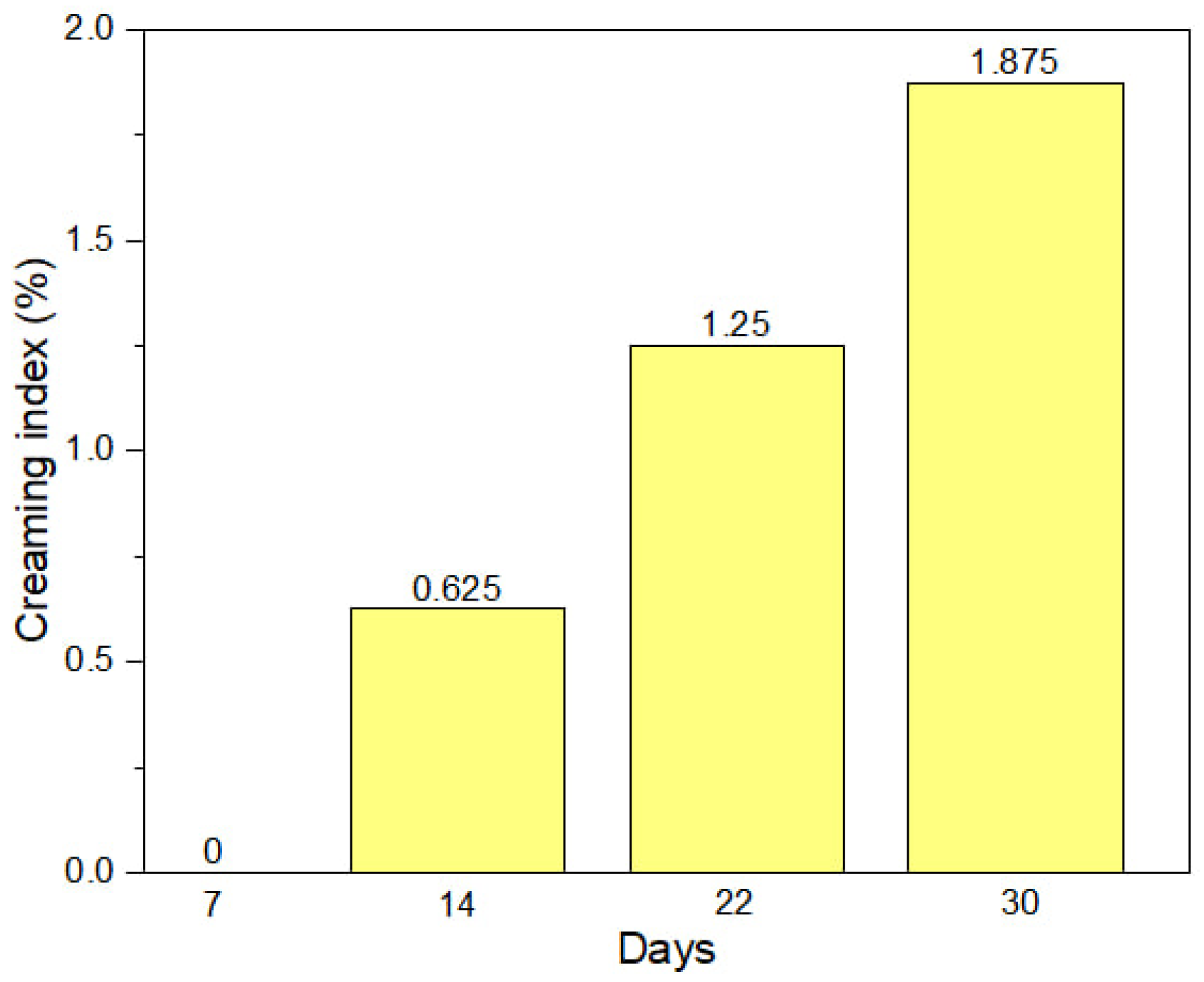
The creaming index of MEO-NE obtained was monitored at 7, 14, 22, and 30 days. The results show CI values of 0%, 0.625%, 1.250%, and 1.850%, respectively (Figure 1). Wu et al. [47] explained that Tween® 80 effectively reduces surface tension, thereby favoring nanoemulsion stability and reducing creaming. The stabilizing effect of Tween® 80 was independent of the measured physical properties, including zeta potential and apparent viscosity. This behavior is consistent with the observation of Tadros [48], who noted that emulsions stabilized with Tween® 80 tend to exhibit lower creaming rates due to greater droplet size homogeneity and reduced coalescence.

3.2.4. Accelerated Centrifugation Test of MEO-NE

Creaming stability is an essential indicator of an emulsion’s resistance to gravitational separation and can be evaluated via accelerated centrifugation tests. The physical stability of MEO-NE was analyzed using the LUMiSizer® at 25 °C, a temperature simulating the storage temperature to which the emulsion could be subjected. According to Dammak & Sobral [49], high transmission indicates low droplet concentration, while low transmission indicates high droplet concentration. All the first profiles were located at the bottom (red transmission profiles), and the last ones were located at the top (green transmission profiles). The transmission profiles depicting the variation in oil droplet concentration over time inside the MEO-NE are shown in Figure 2. The 108.5 mm position corresponds to the meniscus air sample. As shown, the tested Tween 80 concentration (6%) destabilizes oil droplets, resulting in a polydisperse distribution (no sharp front) and creaming, as indicated by increased transmission at the top of the cell. As creaming progressed, the increased concentration of droplets in the meniscus region increased transmission. The separation of the MEO-NE reveals its instability (index = 0.817), as it exhibited a remarkable increase in transmission over time during the test. A similar pattern was reported by Dammak & Sobral [50] for rutin emulsions stabilized by 0.5% lecithin. This result confirmed that the nanoemulsion obtained was unstable. Given that antioxidant activity (DPPH inhibition) is considered a response for MEO-NE optimization, the levels of the optimized independent variables yielded ζ-potential values indicative of instability. Furthermore, the lowest droplet size of MEO-NE stabilized with Tween® 80 did not correspond to the highest stability; therefore, an alternative could be to mix it with a natural biopolymer, such as sapote gum, and others.

3.2.5. Atomic Force Microscopy of MEO-NE

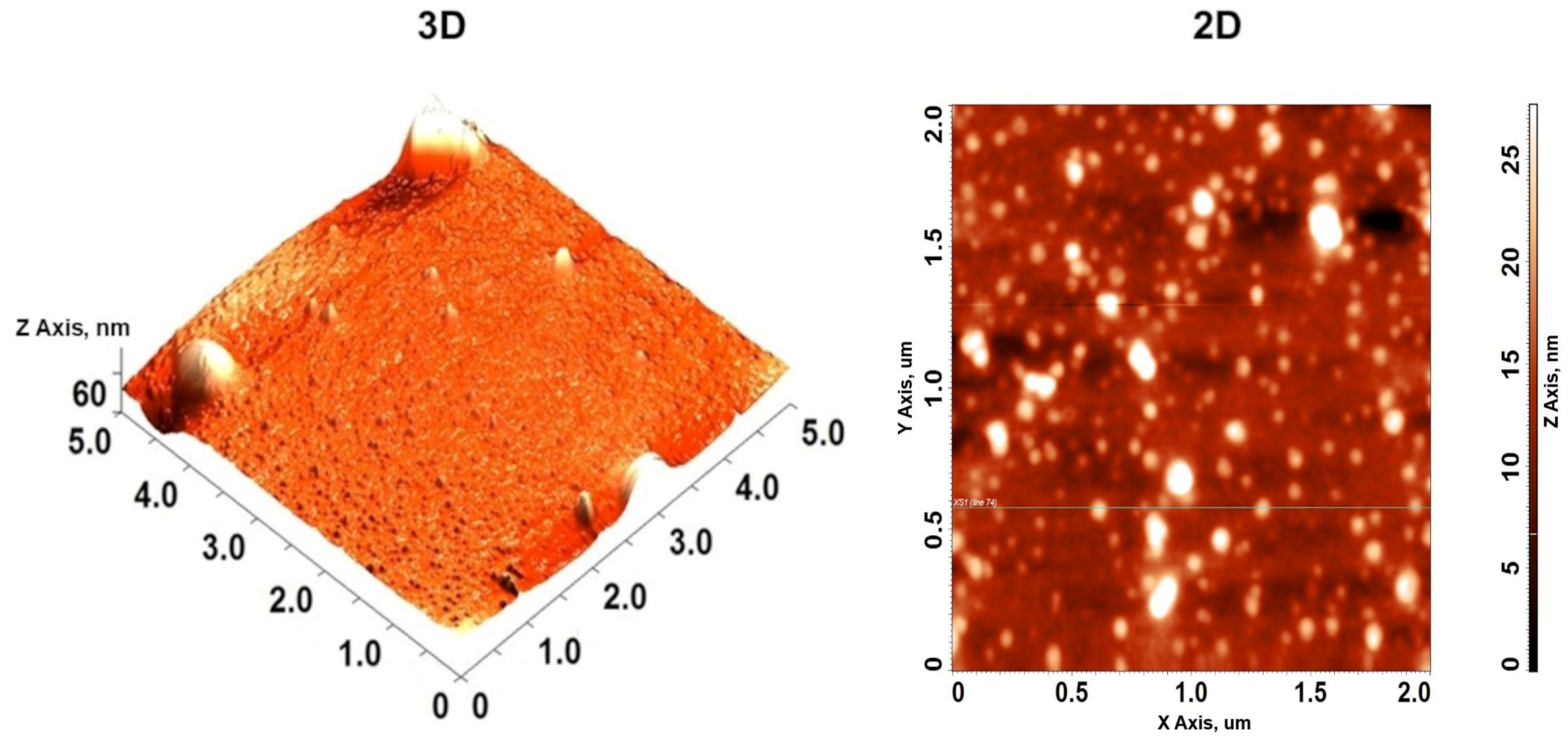
Typical 3-D and 2-D surface topographic AFM images of MEO-NE-stabilized with Tween® 80 are illustrated in Figure 3. Optimized MEO-NE exhibited the presence of nanosized globular and smooth-surfaced droplets, which is consistent with the assessments obtained from the size analyzer by dynamic light scattering (DLS). The droplet size was less than 100 nm. The uniformity of droplet shape and size in MEO-NE indicates a well-distributed formulation. According to Galvao et al. [30], sample preparation or weak adsorption of droplets on a substrate’s surface can cause droplets to deform. Hence, it is essential to take precautions when analyzing these results.

3.3. Composite Films Characterization

3.3.1. Film’s Appearance and Thickness

The addition of MEO-NE did not have a significant effect on composite films, which were slightly opaque. Nevertheless, the control and composite films had a similar good overall appearance, with no bubbles, scratches, or phase separation. The thickness of the composite films (Table 5) was maintained due to the same mass ratio of FFD to Petri dish area; thus, there were no significant differences (p < 0.05). A similar behavior was observed in irradiated nanocomposite tunta starch/tara gum films [23].

3.3.2. Moisture Content (MC), Solubility in Water (SW), Water Vapor Permeability (WVP), and Contact Angle (CA)

The physicochemical properties of the composite films could be affected by their MC, i.e., it plays an essential role due to the high plasticizing effect of water molecules. Table 5 shows that, at concentrations of 5% and 10% MEO-NE, the MC of composite films significantly decreased (p < 0.05). The MC of composite films was around 12%; it could be suggested that the oil phase of MEO-NE was insufficient to affect the films’ hygroscopicity, which was defined by the biopolymeric matrix rather than by the incorporated lipophilic components. Nevertheless, it is crucial to carry out shelf-life studies of composite films to ensure the preservation of their mechanical and stability properties.
SW is a crucial film characteristic that can impact film integrity. The films F1 and F2, loaded with 5% and 10%, respectively, showed lower (p < 0.05) SW values than F0; this may be due to MEO’s insolubility in water (Table 5). Similar behavior was reported by Dalasso et al. [51] for active films produced using ginger oleoresin nanoemulsion (17.7–21.4%), by Pérez-Córdoba et al. [26] for gelatin-chitosan-based films loaded with nanoemulsions (43.1–48.9%), and by Fan et al. [52] for corn starch-based films loaded with clove essential oil nanoemulsion (29.01–34.58%). The decrease in SW values of composite films could be attributed to the interaction of polysaccharide molecules in nanoemulsions, which enhances molecular cross-linking and stereoscopic network formation in the composite starch-based films [52]. The low MC and SW values of composite films can improve the mechanical properties and broaden the application scope of starch-based films [52].
WVP is a critical property in films developed from hydrophilic materials [53]. WVP analysis revealed a significant decrease (p < 0.05) in the films loaded with MEO-NE compared with the control (Table 5). In well-structured starch films, the addition of hydrophobic compounds is often related to a decrease in WVP due to an increase in the matrix’s polarity [54]. The reduction in WPV values in biocomposite films could be due to irregular surfaces and tortuous channels introduced by the addition of an oil phase to the film matrix [55]. Similar patterns were reported by Flórez et al. [54] and Mutlu et al. [55].
The surface hydrophobicity of composite films is mainly affected by the types and concentrations of the film matrix and fillers. CA is a crucial parameter for evaluating the wettability and hydrophobicity of composite films [52]. As depicted in Table 5, the CA of composite films F1 and F2 gradually increased with the incorporation of MEO-NE (p < 0.05), and their values exceeded 65, indicating that these films were slightly more water-repellent than the control but still somewhat wettable. The addition of the MEO-NE slightly increased the contact angles of the films (F1 and F2), despite the presence of free hydrophilic surfactant molecules (Tween® 80) in their formulations. According to Fan et al. [52], surfactants can decrease the contact angle of films, which is attributed to their capacity to adsorb at interfaces and lower surface or interfacial tension [55]. Therefore, the increased concentration of MEO-NE reduced the proportion of hydrophilic substances in the film matrix. These findings suggested that incorporating MEO-NE into starch films could enhance their WVP, which is valuable to food packaging.

3.3.3. Mechanical Properties

Their mechanical properties evaluate the suitability of films. The tensile strength (TS) measures the maximum tensile stress that the films can withstand, and elongation at yield (EY) indicates the maximum change in length of the films before yielding [55]. Table 6 shows the mechanical properties of composite films. F1 films exhibited the highest TS values (30.71 MPa), indicating that they required greater stress to break. Young’s modulus (YM) indicated that F0 and F2 films displayed lower stiffness than F1 ones. Additionally, films loaded with MEO-NE showed higher TS than those without MEO-NE, which may be due to interactions among MEO-NE, chitosan, and starch. The homogenous dispersion of MEO-NE in the matrix could improve the tensile properties of the films. Regarding EY values, there was no significant difference between F1 and F2 films (p > 0.05); however, they were significantly different from F0 films. The incorporation of essential oils in excess could induce a plasticizing effect on the films, leading to discontinuities by weakening intermolecular interactions among polymeric chains [55].

3.3.4. FTIR Analysis of Films

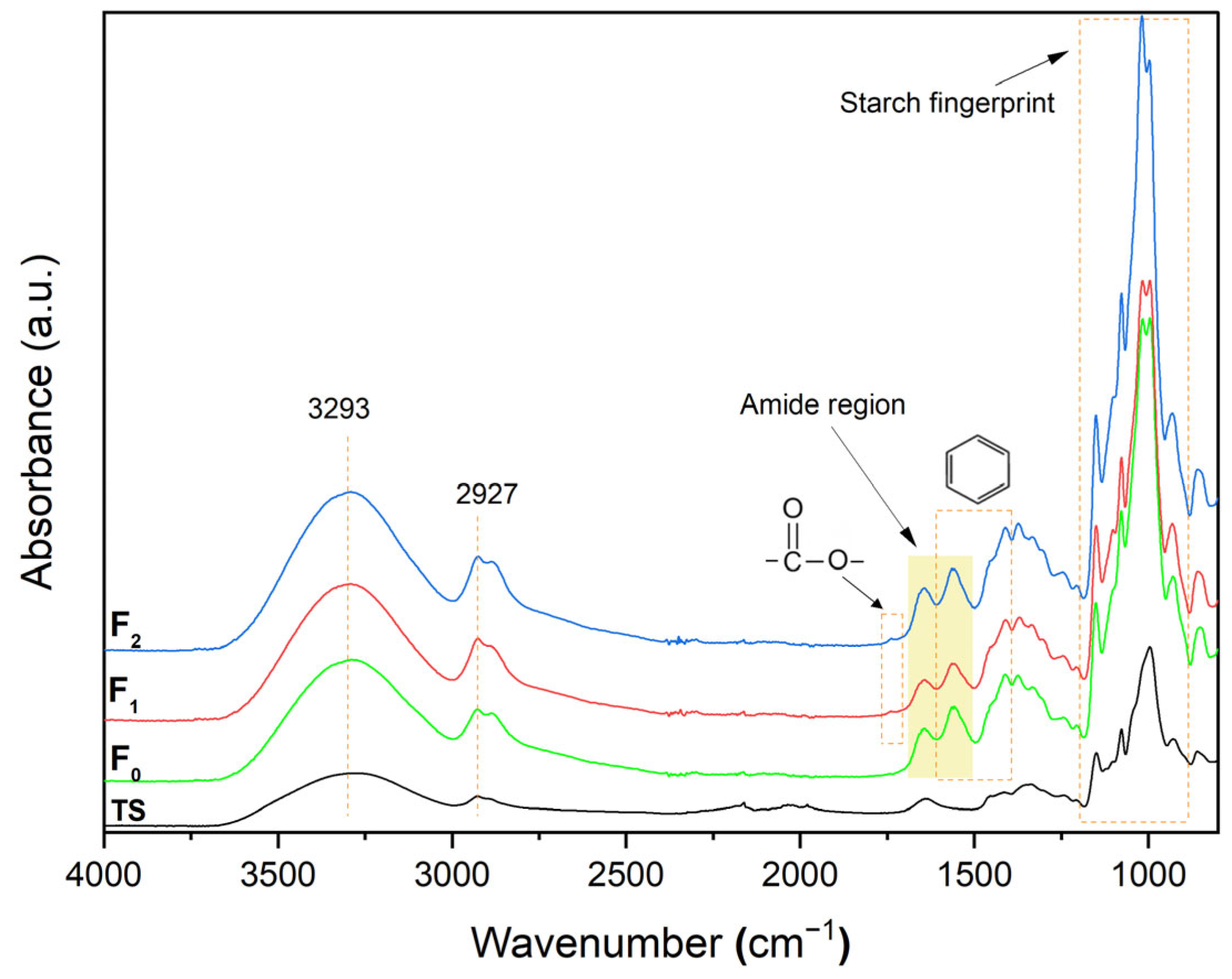
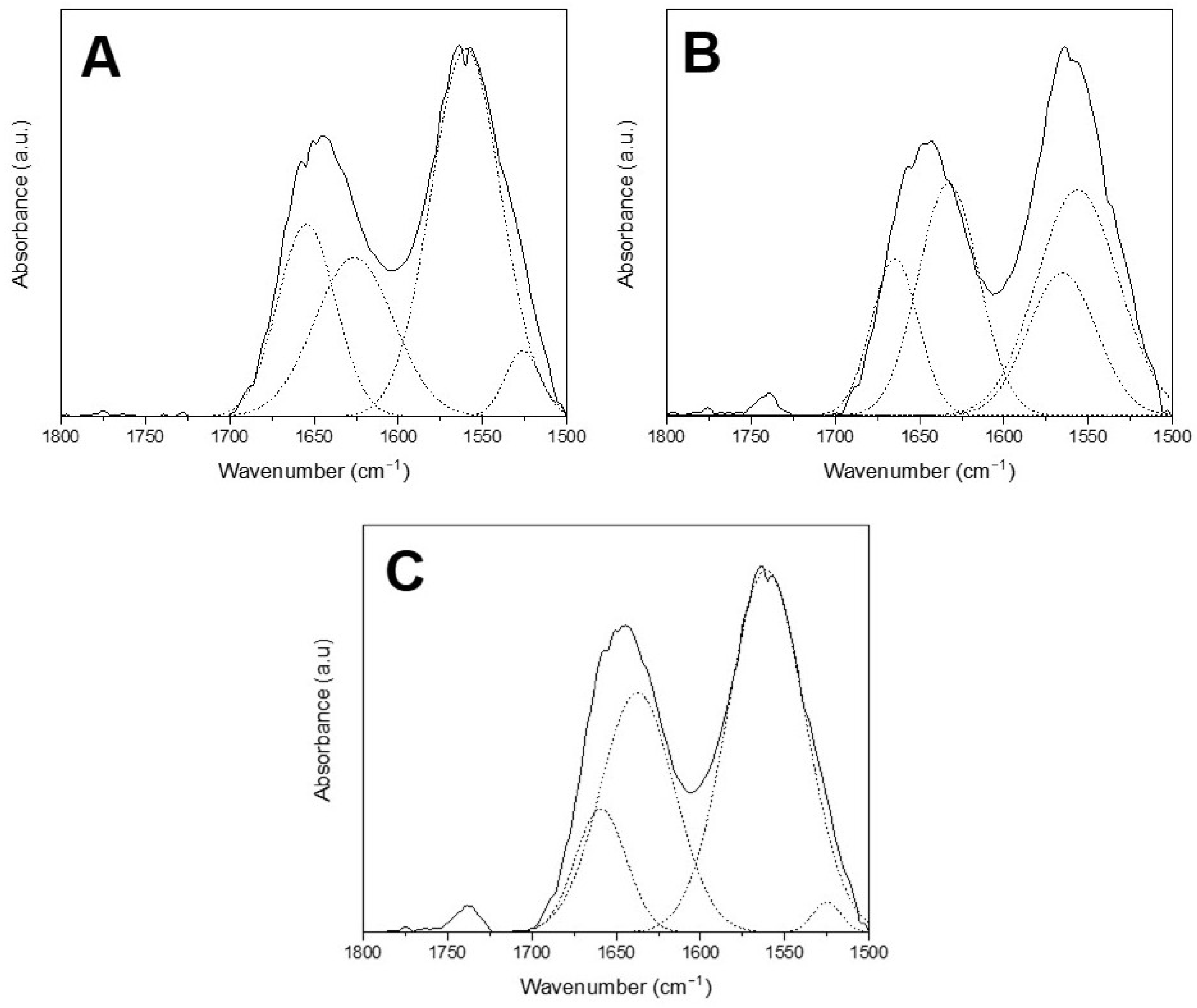
Figure 4 depicts the FTIR spectra and chemical structure of the developed composite films. The absorption band at 3293 cm−1 in the films corresponds to the stretching vibration of the hydroxyl group from polymers. This band is associated with the inter- and intramolecular OH groups of nearby starch molecules, indicating the formation of hydrogen bonds between the constituents in each film and its potential solubility in water [56]. At the same time, the absorption band at 2927 cm−1 corresponds to the stretching vibrations of C–H stretch [4] and C–H2 bonds of glycerol [56]. On the one hand, the amide I (C=O stretching) and amide II (N−H) regions, associated with chitosan presence, correspond to absorption bands at 1650 and 1560 cm−1, respectively [57]. On the other hand, tunta starch showed an absorption band at 1643 cm−1, assigned to bound water present in starch due to its hygroscopic nature [22]. The presence of Tween® 80 was related to C=O bonds at 1738 cm−1, which is clearly observed in Figure 5; similar results were reported by Mao et al. [58] in carvacrol nanoemulsions. The bands in the region ranged from 900 to 1200 cm−1 and are shown to be sensitive to changes in starch structure, also known as the starch fingerprint [59]. According to Taylan et al. [60], the aromatic ring C=C skeleton for essential oils could be identified around 1573 cm−1. The differences in peak intensity and amplitude could correspond to rearrangement and conformational changes in the starch matrix due to interactions among components within MEO-NE and films [52].
Also, Figure 5 depicts the FTIR spectra deconvolution of the amide region for each film sample, and Table 7 shows the peaks detected by deconvolution, which evidence the changes in the region 1500–1700 cm−1.

3.3.5. Antioxidant Activity

Active starch-based films containing MEO-NE at 5 and 10 g MEO/100 g polymers (F1 and F2, respectively) had a more antioxidant effect than films without MEO-NE (F0) (p < 0.05). The best inhibitory effects were seen at the 10 g MEO/100 g polymers, equal to 59.2% and 43.05% in DPPH and ABTS●+ scavenging assays, respectively (Table 8). This result is consistent with the reported high antioxidant capacity in films encapsulating phenolic compounds [26]. The control film showed the lowest radical-scavenging activity in the DPPH and ABTS●+ assays; therefore, the antioxidant activity of the developed films could be mainly due to the Chitosan content, which has a high antioxidant capacity. Among the analyzed films, the F2 films exhibited the highest antioxidant activity against both radicals. This could be due to a more open structure of the tunta starch-chitosan chains, affecting film integrity and resulting in higher solubility and concentration of the released active compounds, which in turn lead to higher antioxidant activity values [26]. Furthermore, the F1 and F2 films exhibited high free-radical-scavenging activity, probably because of the loading of the polyphenols and sesquiterpene-rich extract in the blend [23]. Additionally, this could be due to the contribution of the residual free amino groups of the Chitosan, which ionically react with free radicals, forming stable ammonium groups and macromolecular radicals.

3.3.6. Disintegrability Test

The disintegration of the films primarily depends on moisture and chemical structure, as evidenced by weight changes and surface microstructure. This disintegration occurs due to the action of enzymes and involves living soil microorganisms [61,62]. The compost soil used for the disintegrability test was reported by Pérez-Córdoba et al. [23]. In this work, F1 and F2 films exhibited higher weight losses (97% and 98%, respectively) after 5 days than the F0 (92%) ones. Indicating a positive disintegration process (Figure 6). According to the Standard ISO 20200:2015 [34], material is considered disintegrable when 90% of its mass is lost and the residues are below 2 mm within 90 days of the burial test. Similar results were reported by Bonilla and Sobral [63]. This is due to the relationship between the available moisture and the enzymes of soil compost microorganisms on the films [23]. The rapid disintegration of composite films could be attributed to soil moisture, which can easily penetrate the biopolymer intermolecular interactions, weakening their chains and facilitating hydrolysis by soil microorganisms [61,62]. Furthermore, due to intermolecular interactions and material performance, the F0 films (Control) were less disintegrable than the composite ones but still achieved 92% disintegration. Although starch provides a sustainable alternative to plastic, it is essential to evaluate the environmental impact of these films throughout their entire industrial life cycle —from production to use and disposal. It is also necessary to investigate whether these films release any components that could harm ecosystems.

4. Conclusions

In this study, optimized MEO-NE ultrasound-assisted stabilization with Tween® 80 was incorporated into tunta starch-based active composite films using the casting method. Tuna starch dispersion, Chitosan solution, and MEO-NE were blended to obtain composite starch-based films (F0, F1, and F2), which were characterized using several techniques. The effects of the MEO on the properties of composite films were investigated. The incorporation of MEO-NE into starch composite films decreased WVP, which is valuable to food packaging. The incorporation of MEO-NE influenced the mechanical properties of films; TS and YM values for F1 and F2 films were higher than those of F0 films. Also, the antioxidant activity of the composite films increased due to the addition of MEO-NE. Finally, F1 and F2 films (loaded with MEO-NE) exhibited higher disintegration, achieving 98% disintegration in 5 days. The characteristics of these active composite starch-based films could be further improved to meet requirements for commercial applications in the food industry by optimizing film-forming formulation variables, such as NE concentration and the types and concentrations of plasticizers.

Author Contributions

Conceptualization, L.J.P.-C., P.M.-T. and C.V.-S.; Methodology, J.A.F.-B., L.J.P.-C., P.M.-T. and C.V.-S.; Software, J.A.F.-B. and F.P.-C.; Validation, P.M.-T., L.J.P.-C. and C.V.-S.; Formal analysis, J.A.F.-B. and F.P.-C.; Investigation, J.A.F.-B., L.J.P.-C., P.M.-T. and C.V.-S.; Resources, P.M.-T. and C.V.-S.; Data curation, F.P.-C.; Writing—original draft preparation, J.A.F.-B. and P.M.-T.; Writing—review and editing, L.J.P.-C., P.M.-T., I.F.M., P.J.d.A.S. and C.V.-S.; Supervision, L.J.P.-C., I.F.M., P.J.d.A.S. and C.V.-S.; Project administration, C.V.-S.; Funding acquisition, P.M.-T., L.J.P.-C. and C.V.-S. All authors have read and agreed to the published version of the manuscript.

Funding

This research was funded by the Programa Nacional de Investigación Científica y Estudios Avanzados—PROCIENCIA en el marco del Contrato N° PE501079982-2022-PROCIENCIA and en el marco del proyecto ALIANZAS INTERINSTITUCIONALES PARA PROGRAMAS DE DOCTORADO-ETAPA II, “NUTRICIÓN”, CONTRATO N° PE501084302-2023-PROCIENCIA-BM.

Institutional Review Board Statement

Not applicable.

Data Availability Statement

The original contributions presented in this study are included in the article; further inquiries can be directed to the corresponding authors.

Conflicts of Interest

The authors declare no conflicts of interest.

References

  1. Zhao, S.; Li, Y.; Liu, Q.; Xia, X.; Chen, Q.; Liu, H.; Kong, B. Characterization, Release Profile, and Antibacterial Properties of Oregano Essential Oil Nanoemulsions Stabilized by Soy Protein Isolate/Tea Saponin Nanoparticles. Food Hydrocoll. 2024, 151, 109856. [Google Scholar] [CrossRef]
  2. Da Silva, B.D.; Do Rosário, D.K.A.; Weitz, D.A.; Conte-Junior, C.A. Essential Oil Nanoemulsions: Properties, Development, and Application in Meat and Meat Products. Trends Food Sci. Technol. 2022, 121, 1–13. [Google Scholar] [CrossRef]
  3. Liu, X.; Chen, L.; Kang, Y.; He, D.; Yang, B.; Wu, K. Cinnamon Essential Oil Nanoemulsions by High-Pressure Homogenization: Formulation, Stability, and Antimicrobial Activity. LWT 2021, 147, 111660. [Google Scholar] [CrossRef]
  4. Wan, J.; Zhong, S.; Schwarz, P.; Chen, B.; Rao, J. Physical Properties, Antifungal and Mycotoxin Inhibitory Activities of Five Essential Oil Nanoemulsions: Impact of Oil Compositions and Processing Parameters. Food Chem. 2019, 291, 199–206. [Google Scholar] [CrossRef]
  5. Mahran, H.A. Using Nanoemulsions of the Essential Oils of a Selection of Medicinal Plants from Jazan, Saudi Arabia, as a Green Larvicidal against Culex Pipiens. PLoS ONE 2022, 17, e0267150. [Google Scholar] [CrossRef]
  6. Quezada-Moreno, W.; Quezada-Torres, W.; Trevez, A.; Arias, G.; Cevallos, E.; Zambrano, Z.; Brito, H.; Salazar, K. Essential oil Minthostachys mollis: Extraction and chemical composition of fresh and stored samples. Arab. J. Med. Aromat. Plants 2019, 5, 59–71. [Google Scholar]
  7. Sánchez-Tito, J.M.A.; Cartagena-Cutipa, R.; Flores-Valencia, E.; Collantes-Díaz, I. Chemical Composition and Antimicrobial Activity of Essential Oil from Minthostachys Mollis against Oral Pathogens. Rev. Cuba Estomatol. 2021, 58, e3647. [Google Scholar]
  8. Dammak, I.; Sobral, P.J.D.A.; Aquino, A.; Neves, M.A.D.; Conte-Junior, C.A. Nanoemulsions: Using Emulsifiers from Natural Sources Replacing Synthetic Ones—A Review. Compr. Rev. Food Sci. Food Saf. 2020, 19, 2721–2746. [Google Scholar] [CrossRef]
  9. Geng, M.; Feng, X.; Wu, X.; Tan, X.; Shang, B.; Huang, Y.; Teng, F.; Li, Y. Characterization and Utilization of Soy Protein Isolate–(−)-Epigallocatechin Gallate–Maltose Ternary Conjugate as an Emulsifier for Nanoemulsions: Enhanced Physicochemical Stability of the β-Carotene Nanoemulsion. Food Chem. 2023, 417, 135842. [Google Scholar] [CrossRef]
  10. Vélez-Erazo, E.M.; Carbajal-Sandoval, M.S.; Sanchez-Pizarro, A.L.; Peña, F.; Martínez, P.; Velezmoro, C. Peruvian Biopolymers (Sapote Gum, Tunta, and Potato Starches) as Suitable Coating Material to Extend the Shelf Life of Bananas. Food Bioprocess Technol. 2022, 15, 2562–2572. [Google Scholar] [CrossRef]
  11. Cardoso-Ugarte, G.A.; López-Malo, A.; Jiménez-Munguía, M.T. Application of Nanoemulsion Technology for Encapsulation and Release of Lipophilic Bioactive Compounds in Food. In Emulsions; Elsevier: Amsterdam, The Netherlands, 2016; pp. 227–255. [Google Scholar] [CrossRef]
  12. Rashid, A.; Qayum, A.; Liang, Q.; Kang, L.; Raza, H.; Chi, Z.; Chi, R.; Ren, X.; Ma, H. Preparation and Characterization of Ultrasound-Assisted Essential Oil-Loaded Nanoemulsions Stimulated Pullulan-Based Bioactive Film for Strawberry Fruit Preservation. Food Chem. 2023, 422, 136254. [Google Scholar] [CrossRef]
  13. Pongsumpun, P.; Iwamoto, S.; Siripatrawan, U. Response Surface Methodology for Optimization of Cinnamon Essential Oil Nanoemulsion with Improved Stability and Antifungal Activity. Ultrason. Sonochem. 2020, 60, 104604. [Google Scholar] [CrossRef]
  14. Liang, D.; Wang, C.; Luo, X.; Wang, Z.; Kong, F.; Bi, Y. Preparation, Characterization and Properties of Cinnamon Essential Oil Nano-Emulsion Formed by Different Emulsifiers. J. Drug Deliv. Sci. Technol. 2023, 86, 104638. [Google Scholar] [CrossRef]
  15. Zhao, J.; Tian, G.; Qu, H. Application of I-Optimal Design for Modeling and Optimizing the Operational Parameters of Ibuprofen Granules in Continuous Twin-Screw Wet Granulation. Biomedicines 2023, 11, 2030. [Google Scholar] [CrossRef] [PubMed]
  16. Vilela, C.; Kurek, M.; Hayouka, Z.; Röcker, B.; Yildirim, S.; Antunes, M.D.C.; Nilsen-Nygaard, J.; Pettersen, M.K.; Freire, C.S.R. A Concise Guide to Active Agents for Active Food Packaging. Trends Food Sci. Technol. 2018, 80, 212–222. [Google Scholar] [CrossRef]
  17. Ribeiro-Santos, R.; Andrade, M.; Melo, N.R.D.; Sanches-Silva, A. Use of Essential Oils in Active Food Packaging: Recent Advances and Future Trends. Trends Food Sci. Technol. 2017, 61, 132–140. [Google Scholar] [CrossRef]
  18. Mao, X.; Lu, J.; Huang, H.; Gao, X.; Zheng, H.; Chen, Y.; Li, X.; Gao, W. Four Types of Winged Yam (Dioscorea Alata L.) Resistant Starches and Their Effects on Ethanol-Induced Gastric Injury in Vivo. Food Hydrocoll. 2018, 85, 21–29. [Google Scholar] [CrossRef]
  19. Zhelyazkov, S.; Zsivanovits, G.; Stamenova, E.; Marudova, M. Physical and Barrier Properties of Clove Essential Oil Loaded Potato Starch Edible Films. Biointerface Res. Appl. Chem. 2021, 12, 4603–4612. [Google Scholar] [CrossRef]
  20. Ma, Y.; Zhao, H.; Ma, Q.; Cheng, D.; Zhang, Y.; Wang, W.; Wang, J.; Sun, J. Development of Chitosan/Potato Peel Polyphenols Nanoparticles Driven Extended-Release Antioxidant Films Based on Potato Starch. Food Packag. Shelf Life 2022, 31, 100793. [Google Scholar] [CrossRef]
  21. Zavareze, E.D.R.; Pinto, V.Z.; Klein, B.; El Halal, S.L.M.; Elias, M.C.; Prentice-Hernández, C.; Dias, A.R.G. Development of Oxidised and Heat–Moisture Treated Potato Starch Film. Food Chem. 2012, 132, 344–350. [Google Scholar] [CrossRef]
  22. Martínez, P.; Betalleluz-Pallardel, I.; Cuba, A.; Peña, F.; Cervantes-Uc, J.M.; Uribe-Calderón, J.A.; Velezmoro, C. Effects of Natural Freeze-Thaw Treatment on Structural, Functional, and Rheological Characteristics of Starches Isolated from Three Bitter Potato Cultivars from the Andean Region. Food Hydrocoll. 2022, 132, 107860. [Google Scholar] [CrossRef]
  23. Pérez-Córdoba, L.J.; Sánchez-Pizarro, A.; Vélez-Erazo, E.M.; Peña-Carrasco, E.F.; Pasquel-Reátegui, J.L.; Martínez-Tapia, P.; Velezmoro-Sánchez, C. Bitter Potato Starch-based Film Enriched with Copaiba Leaf Extract Obtained Using Supercritical Carbon Dioxide: Physical–Mechanical, Antioxidant, and Disintegrability Properties. J. Appl. Polym. Sci. 2024, 141, e55243. [Google Scholar] [CrossRef]
  24. Chu, Y.; Cheng, W.; Feng, X.; Gao, C.; Wu, D.; Meng, L.; Zhang, Y.; Tang, X. Fabrication, Structure and Properties of Pullulan-Based Active Films Incorporated with Ultrasound-Assisted Cinnamon Essential Oil Nanoemulsions. Food Packag. Shelf Life 2020, 25, 100547. [Google Scholar] [CrossRef]
  25. Shamsara, O.; Jafari, S.M.; Muhidinov, Z.K. Fabrication, Characterization and Stability of Oil in Water Nano-Emulsions Produced by Apricot Gum-Pectin Complexes. Int. J. Biol. Macromol. 2017, 103, 1285–1293. [Google Scholar] [CrossRef]
  26. Pérez-Córdoba, L.J.; Norton, I.T.; Batchelor, H.K.; Gkatzionis, K.; Spyropoulos, F.; Sobral, P.J.A. Physico-Chemical, Antimicrobial and Antioxidant Properties of Gelatin-Chitosan Based Films Loaded with Nanoemulsions Encapsulating Active Compounds. Food Hydrocoll. 2018, 79, 544–559. [Google Scholar] [CrossRef]
  27. AOAC. Official Method of Analysis, 22nd ed.; Association of Official Analytical Chemists: Washington, DC, USA, 1990. [Google Scholar]
  28. Liao, W.; Elaissari, A.; Ghnimi, S.; Dumas, E.; Gharsallaoui, A. Effect of Pectin on the Properties of Nanoemulsions Stabilized by Sodium Caseinate at Neutral pH. Int. J. Biol. Macromol. 2022, 209, 1858–1866. [Google Scholar] [CrossRef] [PubMed]
  29. Felipe, L.D.O.; Bicas, J.L.; Changwatchai, T.; Abah, E.O.; Nakajima, M.; Neves, M.A. Physical Stability of α-Terpineol-Based Nanoemulsions Assessed by Direct and Accelerated Tests Using Photo Centrifuge Analysis. LWT 2024, 205, 116513. [Google Scholar] [CrossRef]
  30. Galvão, K.C.S.; Vicente, A.A.; Sobral, P.J.A. Development, Characterization, and Stability of O/W Pepper Nanoemulsions Produced by High-Pressure Homogenization. Food Bioprocess Technol. 2018, 11, 355–367. [Google Scholar] [CrossRef]
  31. Condés, M.C.; Añón, M.C.; Mauri, A.N.; Dufresne, A. Amaranth Protein Films Reinforced with Maize Starch Nanocrystals. Food Hydrocoll. 2015, 47, 146–157. [Google Scholar] [CrossRef]
  32. Qian, S.-Y.; Tang, M.-Q.; Gao, Q.; Wang, X.-W.; Zhang, J.-W.; Tanokura, M.; Xue, Y.-L. Effects of Different Modification Methods on the Physicochemical and Rheological Properties of Chinese Yam (Dioscorea opposita Thunb.) Starch. LWT 2019, 116, 108513. [Google Scholar] [CrossRef]
  33. Tessaro, L. Produção de Emulsão Dupla A/O/A Rica Em Extrato de Folha de Pitangueira (Eugenia uniflora L.) Para Aplicação Em Filmes Ativos de Gelatina e/ou Quitosana. Master’s Dissertation, Universidade de São Paulo, Pirassununga, Brazil, 2020. [Google Scholar]
  34. ISO 20200:2015; Plastics—Determination of the Degree of Disintegration of Plastic Materials Under Simulated Composting Conditions in a Laboratory-Scale Test. International Organization for Standardization (ISO): Geneva, Switzerland, 2015.
  35. Goswaim, T.H.; Maiti, M.M. Biodegradability of Gelatin—PF Resin Blends by Soil Burial Method. Polym. Degrad. Stab. 1998, 61, 355–359. [Google Scholar] [CrossRef]
  36. Gomes, A.; Costa, A.L.R.; Cunha, R.L. Impact of Oil Type and WPI/Tween 80 Ratio at the Oil-Water Interface: Adsorption, Interfacial Rheology and Emulsion Features. Colloids Surf. B Biointerfaces 2018, 164, 272–280. [Google Scholar] [CrossRef] [PubMed]
  37. Gul, O.; Saricaoglu, F.T.; Besir, A.; Atalar, I.; Yazici, F. Effect of Ultrasound Treatment on the Properties of Nano-Emulsion Films Obtained from Hazelnut Meal Protein and Clove Essential Oil. Ultrason. Sonochem. 2018, 41, 466–474. [Google Scholar] [CrossRef] [PubMed]
  38. Tastan, Ö.; Ferrari, G.; Baysal, T.; Donsì, F. Understanding the Effect of Formulation on Functionality of Modified Chitosan Films Containing Carvacrol Nanoemulsions. Food Hydrocoll. 2016, 61, 756–771. [Google Scholar] [CrossRef]
  39. Yin, L.-J.; Chu, B.-S.; Kobayashi, I.; Nakajima, M. Performance of Selected Emulsifiers and Their Combinations in the Preparation of β-Carotene Nanodispersions. Food Hydrocoll. 2009, 23, 1617–1622. [Google Scholar] [CrossRef]
  40. McClements, D.J. Food Emulsions: Principles, Practices, and Techniques, 2nd ed.; CRC Press: Boca Raton, FL, USA, 2004. [Google Scholar]
  41. Wang, Y.; Cen, C.; Chen, J.; Zhou, C.; Fu, L. Nano-Emulsification Improves Physical Properties and Bioactivities of Litsea Cubeba Essential Oil. LWT 2021, 137, 110361. [Google Scholar] [CrossRef]
  42. McClements, D.J. Nanoemulsions versus Microemulsions: Terminology, Differences, and Similarities. Soft Matter 2012, 8, 1719–1729. [Google Scholar] [CrossRef]
  43. Moradi, S.; Barati, A. Essential Oils Nanoemulsions: Preparation, Characterization and Study of Antibacterial Activity against Escherichia Coli. Int. J. Nanosci. Nanotechnol. 2019, 15, 199–210. [Google Scholar]
  44. Gorjian, H.; Mihankhah, P.; Khaligh, N.G. Influence of Tween Nature and Type on Physicochemical Properties and Stability of Spearmint Essential Oil (Mentha spicata L.) Stabilized with Basil Seed Mucilage Nanoemulsion. J. Mol. Liq. 2022, 359, 119379. [Google Scholar] [CrossRef]
  45. Juncos, N.S.; Cravero, C.F.; Grosso, N.R.; Olmedo, R.H. Pulegone/MENT Ratio as an Indicator of Antioxidant Activity for the Selection of Industrial Cultivars of Peperina with High Antioxidant Potential. Ind. Crops Prod. 2024, 216, 118770. [Google Scholar] [CrossRef]
  46. Barradas, T.N.; De Holanda E Silva, K.G. Nanoemulsions of Essential Oils to Improve Solubility, Stability and Permeability: A Review. Environ. Chem. Lett. 2021, 19, 1153–1171. [Google Scholar] [CrossRef]
  47. Wu, S.; Wang, G.; Lu, Z.; Li, Y.; Zhou, X.; Chen, L.; Cao, J.; Zhang, L. Effects of Glycerol Monostearate and Tween 80 on the Physical Properties and Stability of Recombined Low-Fat Dairy Cream. Dairy Sci. Technol. 2016, 96, 377–390. [Google Scholar] [CrossRef]
  48. Tadros, T. Emulsion Formation, Stability, and Rheology. In Emulsion Formation and Stability; John Wiley & Sons: Hoboken, NJ, USA, 2013; pp. 1–75. [Google Scholar]
  49. Dammak, I.; Sobral, P.J.D.A. Effect of Different Biopolymers on the Stability of Hesperidin-Encapsulating O/W Emulsions. J. Food Eng. 2018, 237, 33–43. [Google Scholar] [CrossRef]
  50. Dammak, I.; Do Amaral Sobral, P.J. Investigation into the Physicochemical Stability and Rheological Properties of Rutin Emulsions Stabilized by Chitosan and Lecithin. J. Food Eng. 2018, 229, 12–20. [Google Scholar] [CrossRef]
  51. Dalsasso, R.R.; Cesca, K.; Valencia, G.A.; Monteiro, A.R.; Zhang, Z.J.; Fryer, P.J. Active Films Produced Using Ginger Oleoresin Nanoemulsion: Characterization and Application on Mozzarella Cheese. Food Hydrocoll. 2025, 167, 111394. [Google Scholar] [CrossRef]
  52. Fan, S.; Yin, X.; Liu, X.; Wang, G.; Qiu, W. Enhancing Bread Preservation through Non-Contact Application of Starch-Based Composite Film Infused with Clove Essential Oil Nanoemulsion. Int. J. Biol. Macromol. 2024, 263, 130297. [Google Scholar] [CrossRef]
  53. Niu, X.; Ma, Q.; Li, S.; Wang, W.; Ma, Y.; Zhao, H.; Sun, J.; Wang, J. Preparation and Characterization of Biodegradable Composited Films Based on Potato Starch/Glycerol/Gelatin. J. Food Qual. 2021, 2021, 6633711. [Google Scholar] [CrossRef]
  54. Flórez, M.; Cazón, P.; Vázquez, M. Active Packaging Film of Chitosan and Santalum Album Essential Oil: Characterization and Application as Butter Sachet to Retard Lipid Oxidation. Food Packag. Shelf Life 2022, 34, 100938. [Google Scholar] [CrossRef]
  55. Mutlu, N. Effects of Grape Seed Oil Nanoemulsion on Physicochemical and Antibacterial Properties of Gelatin-sodium Alginate Film Blends. Int. J. Biol. Macromol. 2023, 237, 124207. [Google Scholar] [CrossRef]
  56. Shanbhag, C.; Shenoy, R.; Shetty, P.; Srinivasulu, M.; Nayak, R. Formulation and Characterization of Starch-Based Novel Biodegradable Edible Films for Food Packaging. J. Food Sci. Technol. 2023, 60, 2858–2867. [Google Scholar] [CrossRef]
  57. Basumatary, I.B.; Mukherjee, A.; Kumar, S. Chitosan-Based Composite Films Containing Eugenol Nanoemulsion, ZnO Nanoparticles and Aloe Vera Gel for Active Food Packaging. Int. J. Biol. Macromol. 2023, 242, 124826. [Google Scholar] [CrossRef]
  58. Mao, S.; Li, F.; Zhou, X.; Lu, C.; Zhang, T. Characterization and Sustained Release Study of Starch-Based Films Loaded with Carvacrol: A Promising UV-Shielding and Bioactive Nanocomposite Film. LWT 2023, 180, 114719. [Google Scholar] [CrossRef]
  59. Martínez, P.; Peña, F.; Bello-Pérez, L.A.; Núñez-Santiago, C.; Yee-Madeira, H.; Velezmoro, C. Physicochemical, Functional and Morphological Characterization of Starches Isolated from Three Native Potatoes of the Andean Region. Food Chem. X 2019, 2, 100030. [Google Scholar] [CrossRef] [PubMed]
  60. Taylan, O.; Cebi, N.; Sagdic, O. Rapid Screening of Mentha Spicata Essential Oil and L-Menthol in Mentha Piperita Essential Oil by ATR-FTIR Spectroscopy Coupled with Multivariate Analyses. Foods 2021, 10, 202. [Google Scholar] [CrossRef] [PubMed]
  61. Emadian, S.M.; Onay, T.T.; Demirel, B. Biodegradation of Bioplastics in Natural Environments. Waste Manag. 2017, 59, 526–536. [Google Scholar] [CrossRef] [PubMed]
  62. He, X.; Li, M.; Gong, X.; Niu, B.; Li, W. Biodegradable and Antimicrobial CSC Films Containing Cinnamon Essential Oil for Preservation Applications. Food Packag. Shelf Life 2021, 29, 100697. [Google Scholar] [CrossRef]
  63. Bonilla, J.; Sobral, P.J.A. Disintegrability under Composting Conditions of Films Based on Gelatin, Chitosan and/or Sodium Caseinate Containing Boldo-of-Chile Leafs Extract. Int. J. Biol. Macromol. 2020, 151, 178–185. [Google Scholar] [CrossRef]
Figure 1. Evolution of CI of MEO-NE stabilized with Tween® 80 under optimal conditions.
Polymers 18 00023 g001
Figure 2. Transmission profiles of MEO-NE-stabilized with the addition of Tween® 80 under optimal conditions obtained from LUMiSizer® equipment.
Polymers 18 00023 g002
Figure 3. Atomic Force Micrography (AFM) images of 3D topography and 2D surface of MEO-NE under optimized conditions.
Polymers 18 00023 g003
Figure 4. FT-IR spectra for composite films: TS: Tunta starch (Data from Martínez et al. [22]); F0: film without MEO-NE (Control); F1: film loaded with MEO-NE to achieve 5 g MEO/100 g polymers); F2 (film loaded with MEO-NE to reach 10 g MEO/100 g polymers).
Polymers 18 00023 g004
Figure 5. Deconvolution FT-IR spectra for composite films: (A) F0 films without MEO-NE (Control); (B) F1 films loaded with MEO-NE to achieve 5 g MEO/100 g polymers; (C) F2 films loaded with MEO-NE to achieve 10 g MEO/100 g polymers.
Polymers 18 00023 g005
Figure 6. Disintegrability test results of (A) F0 (Control), (B) F1, and (C) F2 composite films in soil.
Polymers 18 00023 g006
Table 1. Levels at coded factor levels of independent variables used in the I-optimal design.
Independent VariableTypeLevels
MinimumMaximum
Emulsifier concentration (%, w/w)Numeric610
Essential oil concentration (%, w/w)Numeric36
Sonication time (min)Numeric915
EmulsifierCategoricalTween® 80Sapote gum
Table 2. I-optimal design matrix and responses obtained for the different nanoemulsion formulations in the study.
RunFactorsResponses
X1X2X3X4Y1Y2Y3
19.6812.04.44Tween® 8013.96 ± 0.88−21.10 ± 0.5291.20 ± 0.54
210.009.03.00Tween® 8011.89 ± 0.63−18.06 ± 2.6788.98 ± 0.49
36.009.03.87Tween® 8089.44 ± 26.16−22.40 ± 3.0889.57 ± 0.37
410.009.04.93Tween® 8017.69 ± 3.28−24.23 ± 4.8691.81 ± 0.38
58.309.04.04Sapote gum687.96 ± 15.40−27.63 ± 0.2170.97 ± 1.08
67.7215.03.02Tween® 80129.02 ± 9.18−22.26 ± 4.1888.35 ± 0.36
76.0013.05.78Tween® 8024.13 ± 3.12−20.33 ± 0.4593.13 ± 0.36
89.9011.03.00Sapote gum414.46 ± 28.22−26.80 ± 0.4068.22 ± 0.33
96.1015.04.65Sapote gum429.26 ± 41.97−27.56 ± 1.0973.12 ± 0.37
109.9215.04.93Sapote gum579.23 ± 82.54−27.16 ± 0.3775.01 ± 0.60
116.0811.03.00Sapote gum708.56 ± 237.43−29.53 ± 0.1570.35 ± 1.11
126.009.06.00Sapote gum746.13 ± 46.39−28.60 ± 0.2676.81 ± 2.37
137.9211.03.00Tween® 8012.98 ± 0.77−16.46 ± 0.6689.07 ± 0.87
149.6812.04.44Tween® 8016.23 ± 2.12−17.03 ± 1.9081.39 ± 1.61
158.309.04.04Sapote gum506.73 ± 130.58−28.20 ± 0.1773.37 ± 0.26
1610.0015.06.00Tween® 8023.43 ± 3.47−13.70 ± 0.8086.53 ± 1.33
176.6015.03.00Sapote gum608.83 ± 89.65−28.53 ± 0.4584.02 ± 1.45
1810.0014.03.09Sapote gum501.60 ± 16.77−27.53 ± 0.2180.85 ± 0.68
198.3013.05.85Sapote gum650.80 ± 8.88−27.90 ± 0.4587.38 ± 0.29
209.6812.04.44Tween® 8013.69 ± 0.21−19.06 ± 2.5492.34 ± 0.48
218.289.06.00Tween® 8020.09 ± 1.08−18.40 ± 1.0894.34 ± 0.08
226.0013.05.78Tween® 8031.40 ± 1.06−18.30 ± 1.3594.12 ± 3.27
2310.009.06.00Sapote gum763.33 ± 78.37−27.40 ± 0.1782.72 ± 0.27
248.3013.05.85Sapote gum691.53 ± 60.13−27.76 ± 0.3586.31 ± 0.28
Values expressed as mean ± standard deviation (n = 3). X1, Emulsifier concentration (%); X2, Sonication time (min); X3, Essential oil concentration (%); X4, Type of emulsifier; Y1, Droplet size (nm), Y2, ζ-potential (mV); Y3, DPPH inhibition (%).
Table 3. ANOVA of linear, quadratic, and interactive terms of MEO-NE obtention variables on responses (F-value).
TermDroplet Size (nm)ζ-Potential (mV)DPPH Inhibition (%)
Model30.29 **7.66 *5.67 *
X1—Emulsifier concentration (%)1.772.230.0489
X2—Sonication time (min)1.590.78300.7524
X3—Essential oil concentration (%)0.57990.79696.27 *
X4—Type of emulsifier310.84 **74.27 **42.54 **
X1×20.75180.32130.7236
X1X35.04 *0.12520.0325
X1X40.00070.31821.23
X2X31.293.272.14
X2X41.410.20983.10
X3X44.710.31741.24
X120.24730.4038
X220.23230.0734
X321.372.65
Lack of fit2.083.731.79
R20.980.910.81
X1, Emulsifier concentration (%); X2, Sonication time (min); X3, Essential oil concentration (%); X4, Type of emulsifier. * p < 0.05. ** p < 0.01.
Table 4. Predicted and experimental responses (Droplet size, ζ-potential, and DPPH inhibition) of MEO-NE stabilized with Tween® 80 under optimized conditions (highest desirability).
CharacteristicsPredictedExperimental
Droplet size (nm)54.348.6 ± 2.5
ζ-potential (mV)−22.1−15.0 ± 1.17
DPPH inhibition (%)93.195.6 ± 0.08
ABTS+ inhibition (%)--89.6 ± 0.70
PDI--0.223 ± 0.00
Viscosity (mPa·s)--1 ± 0
pH--4.1 ± 0.01
Values expressed as mean ± standard deviation (n = 3).
Table 5. Physicochemical characterization of composite films.
SampleThickness (mm)Moisture Content (%)Solubility in Water (%)WVP × 10−10
(g·m−1 s−1 Pa−1)
Contact Angle (°)
F00.112 ± 0.005 a13.43 ± 0.48 c72.53 ± 2.25 c1.17 ± 0.06 b67.88 ± 0.56 a
F10.114 ± 0.007 a8.56 ± 0.36 a60.56 ± 0.57 b0.93 ± 0.05 a72.11 ± 0.80 b
F20.114 ± 0.003 a9.52 ± 0.49 b45.33 ± 0.18 a0.89 ± 0.05 a75.76 ± 0.26 c
Values expressed as mean ± standard deviation (n = 3). Means in the same row followed by different letters are significantly different (p < 0.05). F0: film without MEO-NE (Control); F1: film loaded with MEO-NE to achieve 5 g MEO/100 g polymers); F2 (film loaded with MEO-NE to reach 10 g MEO/100 g polymers).
Table 6. Tensile strength (TS), Elongation at break (EY), and Young’s modulus (YM) of composite films.
SampleTensile Strength (MPa)Elongation at Yield (%)Young’s Modulus (MPa)
F012.58 ± 0.05 a4.17 ± 0.06 b610.62 ± 13.07 a
F130.71 ± 0.63 c3.78 ± 0.05 a1425.82 ± 10.92 c
F215.75 ± 0.33 b3.59 ± 0.18 a786.45 ± 18.48 b
Values expressed as mean ± standard deviation (n = 3). Means in the same row followed by different letters are significantly different (p < 0.05). F0: film without MEO-NE (Control); F1: film loaded with MEO-NE to achieve 5 g MEO/100 g polymers); F2 (film loaded with MEO-NE to achieve 10 g MEO/100 g polymers).
Table 7. List of peak frequencies of the deconvoluted bands in the region 1500–1700 cm−1 for the composite films.
SampleF0F1F2
Peak 1165416651659
Peak 2162616331637
Peak 3156015651561
Peak 4152615561525
F0: films without MEO-NE (Control); F1: films loaded with MEO-NE to achieve 5 g MEO/100 g polymers; F2: films loaded with MEO-NE to reach 10 g MEO/100 g polymers.
Table 8. DPPH and ABTS+ scavenging assays of composite starch-based films loaded with MEO-NE.
SampleDPPH (% Inhibition)ABTS+ Radical (% Inhibition)
F09.8 ± 0.88 a13.92 ± 0.04 a
F153.9 ± 1.49 b28.46 ± 2.11 b
F259.2 ± 1.02 c43.05 ± 2.06 c
Values expressed as mean ± standard deviation (n = 3). Means in the same row followed by different letters are significantly different (p < 0.05). F0: film without MEO-NE (Control); F1: film loaded with MEO-NE to achieve 5 g MEO/100 g polymers; F2: films loaded with MEO-NE to reach 10 g MEO/100 g polymers.
Disclaimer/Publisher’s Note: The statements, opinions and data contained in all publications are solely those of the individual author(s) and contributor(s) and not of MDPI and/or the editor(s). MDPI and/or the editor(s) disclaim responsibility for any injury to people or property resulting from any ideas, methods, instructions or products referred to in the content.