Plant- and Animal-Derived Organic Waste as Fillers in Biodegradable Composites for Advanced Applications: A Comprehensive Overview

 ,
,  ,
,  , and
, and
Abstract
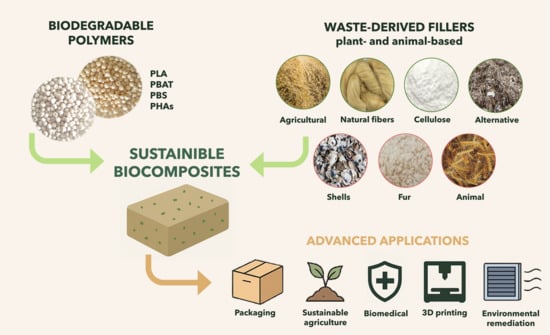
1. Introduction
- i.
- The types, characteristics, and pretreatments of natural fillers;
- ii.
- The processing strategies employed across different polymer matrices;
- iii.
- The resulting mechanical, thermal, morphological, functional, and degradation properties;
- iv.
- The main applications and end-of-life scenarios;
- v.
- Current challenges, limitations, and future research directions.
2. Biodegradable Polymeric Matrices for Biocomposites Production
3. Natural Waste Fillers in Biocomposites
3.1. Plant-Derived Organic Waste
3.1.1. Agricultural and Agrifood Waste
3.1.2. Natural Fibers

| Matrix | Filler | Sample Code | Area | Type (*) | Diameter [µm] | Length [mm] | Density [g/cm3] | Other Treatments | Additive | Ref. |
|---|---|---|---|---|---|---|---|---|---|---|
| PLA | Abutilon indicum | PLA/AI | Asia | D | - | 2.5 | - | - | - | [96] |
| PLA | Agave | PLA/AF | South America | - | - | - | - | - | - | [97] |
| PLA | Bamboo | PLA/BF | Asia | D | - | 2–6 | - | Chemical | - | [98] |
| PLA | Bamboo | PLA/BF | Asia | D | - | 2–6 | - | Chemical | - | [99] |
| PLA | Corn stalk | PLA/CS | Europe | D | - | 1–4 | - | - | - | [100] |
| PLA | Elephant grass | PLA/EG | Asia | D | 250 | 3 | - | Mercerization and bleaching | - | [101] |
| PLA | Flax | PLA/CFY | Asia | C | 400 | 20 | - | - | - | [102] |
| PLA | Flax | PLA/Flax | Europe | D | - | - | - | - | - | [103] |
| PLA | Flax | PLA/FS | Europe | C | - | - | 1.47 | - | - | [104] |
| PLA | Flax | PLA/FS | Europe | D | 300–600 | 2–5 | - | - | Plasticizer | [105] |
| PLA | Hemp shives | PLA/HS | Europe | D | - | <1 | 1.51 | - | - | [106] |
| PLA | Himalaya calamus falconeri | PLA/THF | Asia | D | - | 3–5 | - | Mechanical extraction | - | [107] |
| PLA | Jute | PLA/Jute | Europe | D | - | - | - | - | - | [103] |
| PLA | Kenaf | PLA/KF | Asia | D | 250 | - | - | - | - | [108] |
| PLA | Kenaf | PLA/KF | Asia | D | 70–250 | - | - | - | - | [109] |
| PLA | Kenaf | PLA/KFA | Asia | D | - | - | - | Acetylation | Acetic anhydride | [110] |
| PLA | Kenaf | PLA/LK | Asia | C | - | 175 | - | - | - | [111] |
| PLA | Kenaf (woven) | PLA/WK | Asia | D | - | - | - | - | - | [112] |
| PLA | Pennisetum setaceum | PLA/PS | Europe | D | 75 | 1–2 | - | - | - | [113] |
| PLA | Sisal | PLA/SF | Asia | D | - | 3–6 | 1.24 | Pretreatment | - | [114] |
| PLA | Sisal | PLA/SF | Asia | D | - | 3–8 | - | - | - | [115] |
| PLA | Sisal | PLA/SF | Africa | D | 239 | - | - | - | - | [116] |
| PLA | Sisal | PLA/MS | Africa | D | 239 | - | 1.42 | - | - | [117] |
| PCL | Date palm | PCL/DP | Asia | D | - | 10 | 0.9–1.2 | - | - | [118] |
| PCL | Hemp | PCL/HF | Europe | D | 22 | <1 | - | - | - | [119] |
| PCL | Phoenix dactylifera L. | PCL/DP | Asia | D | - | 10 | 0.92 | - | - | [120] |
| PBS | Curaua | PBS/C | South America | D | - | 10–40 | - | - | - | [121] |
| PBS | Hemp | PBS/HF | Europe | D | - | 30 | - | - | - | [122] |
| PHA | Pineapple leaf | PHA/PLF | Asia | D | 300–450 | - | - | - | - | [81] |
| PHB | Sisal | PHB/SF | Asia | D | - | - | - | - | - | [123] |
| PHBV | Alfa | PHBV/AF | Africa | D | - | - | - | Chemical | - | [124] |
| PBAT | Croton lanjouwensis | PBAT/CF | South America | D | - | - | 1.5 | - | - | [125] |
| PBAT | Malvastrum tomentosum | PBAT/MF | South America | D | - | - | 1.5 | - | - | [125] |
| PBAT | Trema micrantha | PBAT/TF | South America | D | - | - | 1.5 | - | - | [125] |
| PBAT | Cannabis sativa | PBAT/CS | Europe | D | <32 | - | - | - | - | [126] |
| PBAT | Hemp | PBAT/HF | Asia | D | - | - | - | Surface alkylation | Silane coupling agent | [127] |
| PBAT | Kenaf | PBAT/KF | Asia | D | - | 1–5 | - | - | - | [128] |
| PBAT | Linum | PBAT/F | Europe | D | 1 | - | - | - | [129] | |
| Mater-Bi® | Agave | MB/AF | South America | D | - | 4–6 | - | - | - | [130] |

3.1.3. Cellulose and Derivatives
| Matrix | Cellulose Type | Sample Code | Area | Mechanical Treatment | Drying Temp. [°C] | Drying Time [h] | Other Treatments | Additive | Ref. |
|---|---|---|---|---|---|---|---|---|---|
| PLA | Nanocrystal (eucalyptus) | PLA/CNC | Africa | Freeze-dried | - | - | - | - | [133] |
| PLA | Eucomis autumnalis | PLA/EA | Africa | Ground and sieved | - | - | Sodium chloride | - | [134] |
| PLA | Lignin (corn cob) | PLA/Lignin | Asia | - | 80 | 12 | - | Plasticizer | [135] |
| PLA | Micro-fibrillated | PLA/MFC | Europe | - | - | - | - | - | [144] |
| PLA | Nanocellulose (agro-industrial) | PLA/NCs | South America | - | - | - | Bleaching | - | [136] |
| PLA | Waste paper | PLA/WP | Europe | UC mill and sieved | 60 | 24 | Fatty acid ester | - | [137] |
| PCL | Microcrystalline (durian rind) | PCL/MCC | Asia | Ground and sieved | 100 | 24 | Alkaline and bleaching | - | [138] |
| PCL | Cellulose (agricultural) | PCL/CNC | Asia | Ground and sieved | - | - | - | - | [139] |
| PCL | Nanocrystal (luffa cylindrica) | PCL/MLW | South America | - | - | - | Acid and bleaching | Compatibilizer | [140] |
| PBAT | Lignin (black liquor) | PBAT/lignin | Europe | - | 80 | 12 | - | - | [141] |
| PBAT | Microcrystalline (almond shells) | PBAT/as-MCC | Europe | Ground and sieved | 80 | 4 | - | - | [142] |
| PVA | Cellulose acetate (potato peel) | PVA-CA/Starch | Asia | Ground and sieved | - | - | - | - | [145] |
| PVA | Nanofibrils (coconut) | CCNF/PVA | Asia | - | - | - | Alkaline and bleaching | - | [143] |
3.1.4. Alternative Plant-Derived Waste
3.2. Animal-Derived Waste
4. Processing, Properties Application, and End of Life of the Natural-Waste-Based Biocomposites
4.1. Plant-Derived Organic Waste
4.1.1. Agricultural and Agrifood Waste
4.1.2. Natural Fibers
4.1.3. Cellulose and Derivatives
4.1.4. Alternative Organic Waste
4.2. Animal-Derived Organic Waste
4.3. Compatibilization Strategies in Plant- and Animal-Derived Biocomposites
5. Conclusions
- i.
- Optimize filler selection, compatibilization routes, and processing conditions;
- ii.
- Developing scalable and low-energy pretreatment technologies;
- iii.
- Conducting systematic life-cycle and techno-economic assessments to evaluate the true sustainability and industrial feasibility of these systems.
Author Contributions
Funding
Institutional Review Board Statement
Data Availability Statement
Conflicts of Interest
Abbreviations
| PLA | Polylactic Acid |
| PCL | Polycaprolactone |
| PBS | Poly(butylene succinate) |
| PHAs | Polyhydroxyalkanoates |
| PHB | Polyhydroxybutyrate |
| PHBV | Poly(3-hydroxybutyrate-co-3-hydroxyvalerate) |
| PBAT | Poly(butylene adipate-co-terephthalate) |
| TPS | Thermoplastic Starch |
| PVA | Polyvinyl Alcohol |
| CA | Cellulose Acetate |
| AP | Artichoke Plant |
| BF | Bamboo Fiber |
| CBS | Cocoa Bean Shell |
| CBSW | Cocoa Bean Shell Waste |
| CH | Cocoa Husk |
| GP | Grape Pomace |
| HSF | Hazelnut Shell Flour |
| HS | Hazelnut Shells |
| HC | Hedysarum Coronarium |
| MS | Mango Seed |
| OW | Olive Wood |
| OFI | Opuntia ficus indica |
| OPP | Orange Peel Powder |
| RH | Rice Husk |
| MNRH | Micro–Nano Rice Husk |
| RS | Rice Straw |
| RSP | Rice Straw Powder |
| SSHP | Sesame Husk Powder |
| TPF | Tangerine Peel Flour |
| THP | Tomato Peel |
| WM/WW | Wheat Middling/Wheat Waste |
| PL | Pineapple Leaf/Pineapple Leaf Fiber |
| PO/POL/POS | Posidonia oceanica Leaves/Powder |
| AV | Aloe Vera |
| AB | Algal Biomass |
| BS | Babassu Shell or Residue |
| MO | Moringa oleifera |
| WE/ESP/WES | Waste Eggshell |
| FG | Fish Gelatin |
| PUS | P. undulata Shell |
| CSP | Crab Shell Powder |
| EE | Engraulis Encrasicolus (Anchovy Bones) |
| OSP | Oyster Shell Powder |
| WWF/WWP | Waste Wool Fiber/Waste Wool Powder |
| CNC | Cellulose Nanocrystals |
| MFC | Micro-Fibrillated Cellulose |
| NCs | Nanocellulose (agro-industrial) |
| WP | Waste Paper |
| MCC | Microcrystalline Cellulose |
| MB | Mater-Bi® |
| Inz | Inzea® |
| MC | Melt Compounding |
| IM/Inject. mold. | Injection Molding |
| CM/Compress. mold. | Compression Molding |
| HP | Hot Process |
| SBS | Solution Blow Spinning |
| FDM | Fused Deposition Modeling |
| SC | Solution Casting/Solvent Casting |
| UC mill | Ultra-Centrifugal Milling |
| HS mill | High-Speed Milling |
| NaOH | Sodium Hydroxide Treatment |
| HCl | Hydrochloric Acid Treatment |
| DCP | Dicumyl Peroxide |
| UV | Ultraviolet Radiation |
| NPK | Nitrogen, Phosphorus, Potassium (fertilizer) |
References
- Williams, A.T.; Rangel-Buitrago, N. The Past, Present, and Future of Plastic Pollution. Mar. Pollut. Bull. 2022, 176, 113429. [Google Scholar] [CrossRef]
- Horton, A.A. Plastic Pollution: When Do We Know Enough? J. Hazard. Mater. 2022, 422, 126885. [Google Scholar] [CrossRef]
- Shams, M.; Alam, I.; Mahbub, M.S. Plastic Pollution during COVID-19: Plastic Waste Directives and Its Long-Term Impact on the Environment. Environ. Adv. 2021, 5, 100119. [Google Scholar] [CrossRef] [PubMed]
- Plastics the Fast Facts 2025 • Plastics Europe. 2025. Available online: https://plasticseurope.org/knowledge-hub/plastics-the-fast-facts-2025/ (accessed on 5 November 2025).
- Wu, F.; Misra, M.; Mohanty, A.K. Challenges and New Opportunities on Barrier Performance of Biodegradable Polymers for Sustainable Packaging. Prog. Polym. Sci. 2021, 117, 101395. [Google Scholar] [CrossRef]
- Dallaev, R.; Papež, N.; Allaham, M.M.; Holcman, V. Biodegradable Polymers: Properties, Applications, and Environmental Impact. Polymers 2025, 17, 1981. [Google Scholar] [CrossRef] [PubMed]
- Olonisakin, K.K.; Mohanty, A.; Thimmanagari, M.; Misra, M. Recent Advances in Biodegradable Polymer Blends and Their Biocomposites: A Comprehensive Review. Green Chem. 2025, 27, 11656–11704. [Google Scholar] [CrossRef]
- Latos-Brozio, M.; Rułka, K.; Masek, A. Review of Bio-Fillers Dedicated to Polymer Compositions. Chem. Biodivers. 2025, 22, e202500406. [Google Scholar] [CrossRef]
- Scaffaro, R.; Maio, A.; Gulino, E.F.; Megna, B. Structure-Property Relationship of PLA-Opuntia Ficus Indica Biocomposites. Compos. Part B Eng. 2019, 167, 199–206. [Google Scholar] [CrossRef]
- Scaffaro, R.; Maio, A.; Gulino, E.F.; Pitarresi, G. Lignocellulosic Fillers and Graphene Nanoplatelets as Hybrid Reinforcement for Polylactic Acid: Effect on Mechanical Properties and Degradability. Compos. Sci. Technol. 2020, 190, 108008. [Google Scholar] [CrossRef]
- Scaffaro, R.; Citarrella, M.C.; Morreale, M. Green Composites Based on Mater-Bi® and Solanum Lycopersicum Plant Waste for 3D Printing Applications. Polymers 2023, 15, 325. [Google Scholar] [CrossRef]
- Citarrella, M.C.; Scaffaro, R. Sustainable and Reusable 3D Fibrous Structures Based on PLA and Biomass Wastes for FOG (Fat, Oil, Greases) Wastewater Treatment. J. Environ. Chem. Eng. 2025, 13, 116349. [Google Scholar] [CrossRef]
- Maio, A.; Gulino, E.F.; Gammino, M.; Citarrella, M.C.; Scaffaro, R. Photochemical Degradation of PLA-Based Green Composites Containing Waste Biomass from Posidonia oceanica, Chamaerops humilis and Ailanthus altissima: A Comparative Study. Polym. Degrad. Stab. 2025, 234, 111204. [Google Scholar] [CrossRef]
- Scaffaro, R.; Maio, A.; Gulino, E.F. Hydrolytic Degradation of PLA/Posidonia Oceanica Green Composites: A Simple Model Based on Starting Morpho-Chemical Properties. Compos. Sci. Technol. 2021, 213, 108930. [Google Scholar] [CrossRef]
- Antor, R.I.; Bithi, A.M.; Nahin, A.M. Variation in Mechanical Properties of Polymer Composites with Reinforcements from Different Animal Origins—A Comprehensive Review. Int. J. Polym. Sci. 2025, 2025, 4184239. [Google Scholar] [CrossRef]
- Sholokhova, A.; Varžinskas, V.; Rutkaitė, R. Valorization of Agro-Waste in Bio-Based and Biodegradable Polymer Composites: A Comprehensive Review with Emphasis on Europe Perspective. Waste Biomass Valorization 2025, 16, 1537–1571. [Google Scholar] [CrossRef]
- Tabassum, Z.; Girdhar, M.; Anand, A.; Kumari, N.; Sood, B.; Malik, T.; Kumar, A.; Mohan, A. Trash to Treasure: Advancing Resource Efficiency Using Waste-Derived Fillers as Sustainable Reinforcing Agents in Bioplastics. Mater. Adv. 2025, 6, 527–546. [Google Scholar] [CrossRef]
- Gupta, N.; Mahur, B.K.; Izrayeel, A.M.D.; Ahuja, A.; Rastogi, V.K. Biomass Conversion of Agricultural Waste Residues for Different Applications: A Comprehensive Review. Environ. Sci. Pollut. Res. 2022, 29, 73622–73647. [Google Scholar] [CrossRef]
- Akter, M.; Uddin, M.H.; Tania, I.S. Biocomposites Based on Natural Fibers and Polymers: A Review on Properties and Potential Applications. J. Reinf. Plast. Compos. 2022, 41, 705–742. [Google Scholar] [CrossRef]
- Farah, S.; Anderson, D.G.; Langer, R. Physical and Mechanical Properties of PLA, and Their Functions in Widespread Applications—A Comprehensive Review. Adv. Drug Deliv. Rev. 2016, 107, 367–392. [Google Scholar] [CrossRef]
- Tsuji, H. Polylactic Acid: Synthesis, Properties and Applications. In Monomers, Polymers and Composites from Renewable Resources; Elsevier: Amsterdam, The Netherlands, 2008; pp. 433–450. [Google Scholar]
- Södergård, A.; Stolt, M. Properties of Lactic Acid Based Polymers and Their Correlation with Composition. Prog. Polym. Sci. 2002, 27, 1123–1163. [Google Scholar] [CrossRef]
- Nofar, M.; Sacligil, D.; Carreau, P.J.; Kamal, M.R.; Heuzey, M.-C. Poly (Lactic Acid) Blends: Processing, Properties and Applications. Int. J. Biol. Macromol. 2019, 125, 307–360. [Google Scholar] [CrossRef]
- Lasprilla, A.J.R.; Martinez, G.A.R.; Lunelli, B.H.; Jardini, A.L.; Filho, R.M. Poly-Lactic Acid Synthesis for Application in Biomedical Devices—A Review. Biotechnol. Adv. 2012, 30, 321–328. [Google Scholar] [CrossRef]
- Singhvi, M.S.; Zinjarde, S.S.; Gokhale, D.V. Polylactic Acid: Synthesis and Biomedical Applications. J. Appl. Microbiol. 2019, 127, 1612–1626. [Google Scholar] [CrossRef] [PubMed]
- Sonchaeng, U.; Iñiguez-Franco, F.; Auras, R.; Selke, S.; Rubino, M.; Lim, L.-T. Poly(Lactic Acid) Mass Transfer Properties. Prog. Polym. Sci. 2018, 86, 85–121. [Google Scholar] [CrossRef]
- Coudane, J.; Nottelet, B.; Mouton, J.; Garric, X.; Van Den Berghe, H. Poly(ε-Caprolactone)-Based Graft Copolymers: Synthesis Methods and Applications in the Biomedical Field: A Review. Molecules 2022, 27, 7339. [Google Scholar] [CrossRef] [PubMed]
- Sachan, R.; Warkar, S.G.; Purwar, R. An Overview on Synthesis, Properties and Applications of Polycaprolactone Copolymers, Blends & Composites. Polym.-Plast. Technol. Mater. 2023, 62, 327–358. [Google Scholar] [CrossRef]
- Backes, E.H.; Harb, S.V.; Beatrice, C.A.G.; Shimomura, K.M.B.; Passador, F.R.; Costa, L.C.; Pessan, L.A. Polycaprolactone Usage in Additive Manufacturing Strategies for Tissue Engineering Applications: A Review. J. Biomed. Mater. Res. B Appl. Biomater. 2022, 110, 1479–1503. [Google Scholar] [CrossRef]
- Xu, J.; Guo, B.-H. Poly(Butylene Succinate) and Its Copolymers: Research, Development and Industrialization. Biotechnol. J. 2010, 5, 1149–1163. [Google Scholar] [CrossRef]
- Rafiqah, S.A.; Khalina, A.; Harmaen, A.S.; Tawakkal, I.A.; Zaman, K.; Asim, M.; Nurrazi, M.N.; Lee, C.H. A Review on Properties and Application of Bio-Based Poly(Butylene Succinate). Polymers 2021, 13, 1436. [Google Scholar] [CrossRef] [PubMed]
- Bi, S.; Tan, B.; Soule, J.L.; Sobkowicz, M.J. Enzymatic Degradation of Poly (Butylene Succinate-Co-Hexamethylene Succinate). Polym. Degrad. Stab. 2018, 155, 9–14. [Google Scholar] [CrossRef]
- Barletta, M.; Aversa, C.; Ayyoob, M.; Gisario, A.; Hamad, K.; Mehrpouya, M.; Vahabi, H. Poly(Butylene Succinate) (PBS): Materials, Processing, and Industrial Applications. Prog. Polym. Sci. 2022, 132, 101579. [Google Scholar] [CrossRef]
- Naser, A.Z.; Deiab, I.; Defersha, F.; Yang, S. Expanding Poly(Lactic Acid) (PLA) and Polyhydroxyalkanoates (PHAs) Applications: A Review on Modifications and Effects. Polymers 2021, 13, 4271. [Google Scholar] [CrossRef]
- Grigore, M.E.; Grigorescu, R.M.; Iancu, L.; Ion, R.-M.; Zaharia, C.; Andrei, E.R. Methods of Synthesis, Properties and Biomedical Applications of Polyhydroxyalkanoates: A Review. J. Biomater. Sci. Polym. Ed. 2019, 30, 695–712. [Google Scholar] [CrossRef]
- Lee, J.; Park, C.; Fai Tsang, Y.; Andrew Lin, K.-Y. Towards Sustainable Production of Polybutylene Adipate Terephthalate: Non-Biological Catalytic Syntheses of Biomass-Derived Constituents. ChemSusChem 2024, 17, e202401070. [Google Scholar] [CrossRef]
- Mahata, D.; Karthikeyan, S.; Godse, R.; Gupta, V.K. Poly(Butylene Adipate-Co-Terephthalate) Polyester Synthesis Process and Product Development. Polym. Sci. Ser. C 2021, 63, 102–111. [Google Scholar] [CrossRef]
- Ferreira, F.V.; Cividanes, L.S.; Gouveia, R.F.; Lona, L.M.F. An Overview on Properties and Applications of Poly(Butylene Adipate-Co-Terephthalate)–PBAT Based Composites. Polym. Eng. Sci. 2019, 59, E7–E15. [Google Scholar] [CrossRef]
- Jian, J.; Xiangbin, Z.; Xianbo, H. An Overview on Synthesis, Properties and Applications of Poly(Butylene-Adipate-Co-Terephthalate)–PBAT. Adv. Ind. Eng. Polym. Res. 2020, 3, 19–26. [Google Scholar] [CrossRef]
- Pokhrel, S. A Review on Introduction and Applications of Starch and Its Biodegradable Polymers. Int. J. Environ. 2015, 4, 114–125. [Google Scholar] [CrossRef]
- Diyana, Z.N.; Jumaidin, R.; Selamat, M.Z.; Ghazali, I.; Julmohammad, N.; Huda, N.; Ilyas, R.A. Physical Properties of Thermoplastic Starch Derived from Natural Resources and Its Blends: A Review. Polymers 2021, 13, 1396. [Google Scholar] [CrossRef] [PubMed]
- Policastro, G.; Panico, A.; Fabbricino, M. Improving Biological Production of Poly(3-Hydroxybutyrate-Co-3-Hydroxyvalerate) (PHBV) Co-Polymer: A Critical Review. Rev. Environ. Sci. Biotechnol. 2021, 20, 479–513. [Google Scholar] [CrossRef]
- Su, S.; Kopitzky, R.; Tolga, S.; Kabasci, S. Polylactide (PLA) and Its Blends with Poly(Butylene Succinate) (PBS): A Brief Review. Polymers 2019, 11, 1193. [Google Scholar] [CrossRef]
- Ahmed, R.; Manik, K.H.; Nath, A.; Shohag, J.R.; Mim, J.J.; Hossain, N. Recent Advances in Sustainable Natural Fiber Composites: Environmental Benefits, Applications, and Future Prospects. Mater. Today Sustain. 2025, 32, 101220. [Google Scholar] [CrossRef]
- Puttegowda, M. Eco-Friendly Composites: Exploring the Potential of Natural Fiber Reinforcement. Discov. Appl. Sci. 2025, 7, 401. [Google Scholar] [CrossRef]
- Avella, A.; Idström, A.; Mincheva, R.; Nakayama, K.; Evenäs, L.; Raquez, J.-M.; Lo Re, G. Reactive Melt Crosslinking of Cellulose Nanocrystals/Poly(ε-Caprolactone) for Heat-Shrinkable Network. Compos. Part Appl. Sci. Manuf. 2022, 163, 107166. [Google Scholar] [CrossRef]
- Avella, A.; Ruda, M.; Gioia, C.; Sessini, V.; Roulin, T.; Carrick, C.; Verendel, J.; Lo Re, G. Lignin Valorization in Thermoplastic Biomaterials: From Reactive Melt Processing to Recyclable and Biodegradable Packaging. Chem. Eng. J. 2023, 463, 142245. [Google Scholar] [CrossRef]
- Restaino, O.F.; Giosafatto, C.V.L.; Mirpoor, S.F.; Cammarota, M.; Hejazi, S.; Mariniello, L.; Schiraldi, C.; Porta, R. Sustainable Exploitation of Posidonia Oceanica Sea Balls (Egagropili): A Review. Int. J. Mol. Sci. 2023, 24, 7301. [Google Scholar] [CrossRef]
- Fragassa, C.; Pesic, A.; Mattiello, S.; Pavlovic, A.; Santulli, C. Exploring the Potential of Posidonia Oceanica Fibers in Eco-Friendly Composite Materials: A Review. J. Mar. Sci. Eng. 2025, 13, 177. [Google Scholar] [CrossRef]
- Chandrappa, D.R.K.; Kamath, M.S.S. The Egg Shell as a Filler in Composite Materials—A Review. J. Mech. Energy Eng. 2020, 4, 335–340. [Google Scholar] [CrossRef]
- Şen, İ.; Sever, K. Production and Characterization of Agricultural Waste Natural Fiber-Filled Polylactic Acid Composites. Polym. Bull. 2025, 82, 4051–4074. [Google Scholar] [CrossRef]
- Komal, U.K.; Lila, M.K.; Singh, I. PLA/Banana Fiber Based Sustainable Biocomposites: A Manufacturing Perspective. Compos. Part B Eng. 2020, 180, 107535. [Google Scholar] [CrossRef]
- Fico, D.; Rizzo, D.; De Carolis, V.; Esposito Corcione, C. Bio-Composite Filaments Based on Poly(Lactic Acid) and Cocoa Bean Shell Waste for Fused Filament Fabrication (FFF): Production, Characterization and 3D Printing. Materials 2024, 17, 1260. [Google Scholar] [CrossRef] [PubMed]
- Almeida, V.H.M.d.; Jesus, R.M.d.; Santana, G.M.; Khan, S.; Silva, E.F.M.S.; Cruz, I.S.d.; Santos, I.d.S.; dos Anjos, P.N.M. The Development of Biocomposite Filaments for 3D Printing by Utilizing a Polylactic Acid (PLA) Polymer Matrix Reinforced with Cocoa Husk Cellulose Fibers. Polymers 2024, 16, 1757. [Google Scholar] [CrossRef]
- Bruna, J.E.; Castillo, M.; López de Dicastillo, C.; Muñoz-Shugulí, C.; Lira, M.; Guarda, A.; Rodríguez-Mercado, F.J.; Galotto, M.J. Development of Active Biocomposite Films Based on Poly(Lactic Acid) and Wine by-Product: Effect of Grape Pomace Content and Extrusion Temperature. J. Appl. Polym. Sci. 2023, 140, e54425. [Google Scholar] [CrossRef]
- Aliotta, L.; Vannozzi, A.; Bonacchi, D.; Coltelli, M.-B.; Lazzeri, A. Analysis, Development, and Scaling-Up of Poly(Lactic Acid) (PLA) Biocomposites with Hazelnuts Shell Powder (HSP). Polymers 2021, 13, 4080. [Google Scholar] [CrossRef]
- Balart, J.F.; García-Sanoguera, D.; Balart, R.; Boronat, T.; Sánchez-Nacher, L. Manufacturing and Properties of Biobased Thermoplastic Composites from Poly(Lactid Acid) and Hazelnut Shell Wastes. Polym. Compos. 2018, 39, 848–857. [Google Scholar] [CrossRef]
- Scaffaro, R.; Gulino, E.F.; Citarrella, M.C.; Maio, A. Green Composites Based on Hedysarum Coronarium with Outstanding FDM Printability and Mechanical Performance. Polymers 2022, 14, 1198. [Google Scholar] [CrossRef]
- Lima, E.M.; Middea, A.; Neumann, R.; Thiré, R.M.; Pereira, J.F.; de Freitas, S.C.; Penteado, M.S.; Lima, A.M.; Minguita, A.P.; Mattos, M.D.; et al. Biocomposites of PLA and Mango Seed Waste: Potential Material for Food Packaging and a Technological Alternative to Reduce Environmental Impact. Starch Stärke 2021, 73, 2000118. [Google Scholar] [CrossRef]
- Fico, D.; Rizzo, D.; De Carolis, V.; Montagna, F.; Palumbo, E.; Corcione, C.E. Development and Characterization of Sustainable PLA/Olive Wood Waste Composites for Rehabilitation Applications Using Fused Filament Fabrication (FFF). J. Build. Eng. 2022, 56, 104673. [Google Scholar] [CrossRef]
- Scaffaro, R.; Maio, A.; Gulino, E.F.; Alaimo, G.; Morreale, M. Green Composites Based on PLA and Agricultural or Marine Waste Prepared by FDM. Polymers 2021, 13, 1361. [Google Scholar] [CrossRef]
- Botta, L.; Mistretta, M.C.; Lamattina, G.; Gargano, F.; Liguori, G. Opuntia Ficus-Indica Fruit by-Products as Fillers for PLA-Based Biocomposites: A Comparison between Glochids and Peel. Polym. Compos. 2025, 46, 12243–12256. [Google Scholar] [CrossRef]
- Sambudi, N.S.; Lin, W.Y.; Harun, N.Y.; Mutiari, D. Modification of Poly(Lactic Acid) with Orange Peel Powder as Biodegradable Composite. Polymers 2022, 14, 4126. [Google Scholar] [CrossRef]
- Wu, C.-S.; Tsou, C.-H. Fabrication, Characterization, and Application of Biocomposites from Poly(Lactic Acid) with Renewable Rice Husk as Reinforcement. J. Polym. Res. 2019, 26, 44. [Google Scholar] [CrossRef]
- Sun, Y.; Wang, Y.; Mu, W.; Zheng, Z.; Yang, B.; Wang, J.; Zhang, R.; Zhou, K.; Chen, L.; Ying, J.; et al. Mechanical Properties of 3D Printed Micro-Nano Rice Husk/Polylactic Acid Filaments. J. Appl. Polym. Sci. 2022, 139, e52619. [Google Scholar] [CrossRef]
- Asheghi-Oskooee, R.; Morsali, P.; Mohammadi-Roshandeh, J.; Hemmati, F. Tailoring Interfacial Adhesion and Mechanical Performance of Biocomposites Based on Poly(Lactic Acid)/Rice Straw by Using Maleic Anhydride through Reactive Extrusion Process. J. Appl. Polym. Sci. 2024, 141, e55153. [Google Scholar] [CrossRef]
- Kampeerapappun, P.; O-Charoen, N.; Dhamvithee, P.; Jansri, E. Biocomposite Based on Polylactic Acid and Rice Straw for Food Packaging Products. Polymers 2024, 16, 1038. [Google Scholar] [CrossRef] [PubMed]
- Yu, W.; Dong, L.; Lei, W.; Shi, J. Rice Straw Powder/Polylactic Acid Biocomposites for Three-Dimensional Printing. Adv. Compos. Lett. 2020, 29, 2633366X20967360. [Google Scholar] [CrossRef]
- Ramesh, T.; Saravanakumar, S.S.; Balavairavan, B.; Senthamaraikannan, P. Development and Characterization of a Polylactic Acid/Sesame Husk Powder–Based Biocomposite Film for Packaging Application. Waste Biomass Valorization 2024, 15, 2845–2856. [Google Scholar] [CrossRef]
- Gomez-Caturla, J.; Montanes, N.; Quiles-Carrillo, L.; Balart, R.; Garcia-Garcia, D.; Dominici, F.; Puglia, D.; Torre, L. Development of Biodegradable PLA Composites and Tangerine Peel Flour with Improved Toughness Containing a Natural-Based Terpenoid. Express Polym. Lett. 2023, 17, 789–805. [Google Scholar] [CrossRef]
- Kocak, E.; Cetin, M.S.; Kizilirmak Esmer, O.; Karahan Toprakci, H.A. Effects of Tomato Peel Extract on Morphological, Chemical, Thermal, and Mechanical Properties of Poly(Lactic Acid). Iran. Polym. J. 2023, 32, 1135–1148. [Google Scholar] [CrossRef]
- Giani, N.; Maccaferri, E.; Benelli, T.; Bovo, M.; Torreggiani, D.; Campari, E.G.; Tassinari, P.; Giorgini, L.; Mazzocchetti, L. Valorization of Agro-Wastes as Fillers in PLA-Based Biocomposites for Increasing Sustainability in Fused Deposition Modeling Additive Manufacturing. Materials 2024, 17, 1421. [Google Scholar] [CrossRef]
- Giani, N.; Mazzocchetti, L.; Benelli, T.; Bovo, M.; Gazzotti, S.; Torreggiani, D.; Tassinari, P.; Giorgini, L. A New Biocomposite Material Based on Wheat Waste and Suitable for 3D Printing Applications. Macromol. Symp. 2022, 405, 2100235. [Google Scholar] [CrossRef]
- Hejna, A.; Sulyman, M.; Przybysz, M.; Saeb, M.R.; Klein, M.; Formela, K. On the Correlation of Lignocellulosic Filler Composition with the Performance Properties of Poly(ε-Caprolactone) Based Biocomposites. Waste Biomass Valorization 2020, 11, 1467–1479. [Google Scholar] [CrossRef]
- De Monte, C.; Arrighetti, L.; Ricci, L.; Civello, A.; Bronco, S. Agro-Waste Bean Fibers as Reinforce Materials for Polycaprolactone Composites. Compounds 2023, 3, 504–520. [Google Scholar] [CrossRef]
- Picard, M.C.; Rodriguez-Uribe, A.; Thimmanagari, M.; Misra, M.; Mohanty, A.K. Sustainable Biocomposites from Poly(Butylene Succinate) and Apple Pomace: A Study on Compatibilization Performance. Waste Biomass Valorization 2020, 11, 3775–3787. [Google Scholar] [CrossRef]
- Araújo, R.P.; Beatrice, C.A.G.; Backes, E.H.; Costa, L.C. Enhancing Sustainability and Biodegradability of Poly(Butylene Succinate) (PBS) Composite Filaments Reinforced with Cocoa Bean Shell Residues. Polym. Compos. 2024, 45, 13650–13662. [Google Scholar] [CrossRef]
- Liminana, P.; Garcia-Sanoguera, D.; Quiles-Carrillo, L.; Balart, R.; Montanes, N. Development and Characterization of Environmentally Friendly Composites from Poly(Butylene Succinate) (PBS) and Almond Shell Flour with Different Compatibilizers. Compos. Part B Eng. 2018, 144, 153–162. [Google Scholar] [CrossRef]
- Sasimowski, E.; Grochowicz, M.; Szajnecki, Ł. Preparation and Spectroscopic, Thermal, and Mechanical Characterization of Biocomposites of Poly(Butylene Succinate) and Onion Peels or Durum Wheat Bran. Materials 2023, 16, 6799. [Google Scholar] [CrossRef]
- Root, K.P.; Pal, A.K.; Pesaranhajiabbas, E.; Mohanty, A.K.; Misra, M. Injection Moulded Composites from High Biomass Filled Biodegradable Plastic: Properties and Performance Evaluation for Single-Use Applications. Compos. Part C Open Access 2023, 11, 100358. [Google Scholar] [CrossRef]
- Wu, C.-S.; Wu, D.-Y.; Wang, S.-S. Preparation, Characterization, and Functionality of Bio-Based Polyhydroxyalkanoate and Renewable Natural Fiber with Waste Oyster Shell Composites. Polym. Bull. 2021, 78, 4817–4834. [Google Scholar] [CrossRef]
- Wu, C.-S. Preparation and Characterization of Polyhydroxyalkanoate Bioplastic-Based Green Renewable Composites from Rice Husk. J. Polym. Environ. 2014, 22, 384–392. [Google Scholar] [CrossRef]
- Sánchez-Safont, E.L.; Aldureid, A.; Lagarón, J.M.; Gámez-Pérez, J.; Cabedo, L. Biocomposites of Different Lignocellulosic Wastes for Sustainable Food Packaging Applications. Compos. Part B Eng. 2018, 145, 215–225. [Google Scholar] [CrossRef]
- Batista, K.C.; Silva, D.A.K.; Coelho, L.A.F.; Pezzin, S.H.; Pezzin, A.P.T. Soil Biodegradation of PHBV/Peach Palm Particles Biocomposites. J. Polym. Environ. 2010, 18, 346–354. [Google Scholar] [CrossRef]
- Xu, Z.; Qiao, X.; Sun, K. Environmental-Friendly Corn Stover/Poly(Butylene Adipate-Co-Terephthalate) Biocomposites. Mater. Today Commun. 2020, 25, 101541. [Google Scholar] [CrossRef]
- Techawinyutham, L.; Techawinyutham, W.; Rangappa, S.M.; Siengchin, S. Lignocellulose Based Biofiller Reinforced Biopolymer Composites from Fruit Peel Wastes as Natural Pigment. Int. J. Biol. Macromol. 2024, 257, 128767. [Google Scholar] [CrossRef]
- Li, R.; Zhu, X.; Peng, F.; Lu, F. Biodegradable, Colorless, and Odorless PLA/PBAT Bioplastics Incorporated with Corn Stover. ACS Sustain. Chem. Eng. 2023, 11, 8870–8883. [Google Scholar] [CrossRef]
- Ibáñez García, A.; Martínez García, A.; Ferrándiz Bou, S. Study of the Influence of the Almond Shell Variety on the Mechanical Properties of Starch-Based Polymer Biocomposites. Polymers 2020, 12, 2049. [Google Scholar] [CrossRef]
- Ibáñez-García, A.; Martínez-García, A.; Ferrándiz-Bou, S. Influence of Almond Shell Content and Particle Size on Mechanical Properties of Starch-Based Biocomposites. Waste Biomass Valorization 2021, 12, 5823–5836. [Google Scholar] [CrossRef]
- Titone, V.; Rapisarda, M.; Pulvirenti, L.; Napoli, E.; Impallomeni, G.; Botta, L.; Mistretta, M.C.; Rizzarelli, P. Sustainable Biocomposites Based on Mater-Bi and Grape Pomace for a Circular Economy: Performance Evaluation and Degradation in Soil. Polym. Degrad. Stab. 2025, 231, 111091. [Google Scholar] [CrossRef]
- Ceraulo, M.; La Mantia, F.P.; Mistretta, M.C.; Titone, V. The Use of Waste Hazelnut Shells as a Reinforcement in the Development of Green Biocomposites. Polymers 2022, 14, 2151. [Google Scholar] [CrossRef] [PubMed]
- Scaffaro, R.; Citarrella, M.C.; Gulino, E.F.; Morreale, M. Hedysarum Coronarium-Based Green Composites Prepared by Compression Molding and Fused Deposition Modeling. Materials 2022, 15, 465. [Google Scholar] [CrossRef]
- Scaffaro, R.; Citarrella, M.C.; Gulino, E.F. Opuntia Ficus Indica Based Green Composites for NPK Fertilizer Controlled Release Produced by Compression Molding and Fused Deposition Modeling. Compos. Part A Appl. Sci. Manuf. 2022, 159, 107030. [Google Scholar] [CrossRef]
- Scaffaro, R.; Gulino, E.F.; Citarrella, M.C. Multifunctional 3D-Printed Composites Based on Biopolymeric Matrices and Tomato Plant (Solanum Lycopersicum) Waste for Contextual Fertilizer Release and Cu(II) Ions Removal. Adv. Compos. Hybrid Mater. 2024, 7, 95. [Google Scholar] [CrossRef]
- Ramos, M.; Dominici, F.; Luzi, F.; Jiménez, A.; Garrigós, M.C.; Torre, L.; Puglia, D. Effect of Almond Shell Waste on Physicochemical Properties of Polyester-Based Biocomposites. Polymers 2020, 12, 835. [Google Scholar] [CrossRef]
- Wang, H.; Hassan, E.A.M.; Memon, H.; Elagib, T.H.H.; Abad AllaIdris, F. Characterization of Natural Composites Fabricated from Abutilon-Fiber-Reinforced Poly (Lactic Acid). Processes 2019, 7, 583. [Google Scholar] [CrossRef]
- Figueroa-Velarde, V.; Diaz-Vidal, T.; Cisneros-López, E.O.; Robledo-Ortiz, J.R.; López-Naranjo, E.J.; Ortega-Gudiño, P.; Rosales-Rivera, L.C. Mechanical and Physicochemical Properties of 3D-Printed Agave Fibers/Poly(Lactic) Acid Biocomposites. Materials 2021, 14, 3111. [Google Scholar] [CrossRef] [PubMed]
- Rao, G.S.; Debnath, K.; Mahapatra, R.N. Mechanical, Thermal, Morphological, and Fibre Characteristics During Injection Moulding of Green Composites. Fibers Polym. 2024, 25, 331–346. [Google Scholar] [CrossRef]
- Rao, G.S.; Debnath, K.; Mahapatra, R.N. Recycling and Degradation Behaviour of the Bamboo Fibre Reinforced Green Composite Fabricated by Injection Moulding. Sustain. Mater. Technol. 2024, 39, e00865. [Google Scholar] [CrossRef]
- Łączny, D.; Macko, M.; Moraczewski, K.; Szczepański, Z.; Trafarski, A. Influence of the Size of the Fiber Filler of Corn Stalks in the Polylactide Matrix Composite on the Mechanical and Thermomechanical Properties. Materials 2021, 14, 7281. [Google Scholar] [CrossRef]
- Gunti, R.; Ratna Prasad, A.V.; Gupta, A.V. Mechanical and Degradation Properties of Natural Fiber-Reinforced PLA Composites: Jute, Sisal, and Elephant Grass. Polym. Compos. 2018, 39, 1125–1136. [Google Scholar] [CrossRef]
- Le Duigou, A.; Barbé, A.; Guillou, E.; Castro, M. 3D Printing of Continuous Flax Fibre Reinforced Biocomposites for Structural Applications. Mater. Des. 2019, 180, 107884. [Google Scholar] [CrossRef]
- Morreale, M.; Mistretta, M.C.; Fiore, V. Creep Behavior of Poly(Lactic Acid) Based Biocomposites. Materials 2017, 10, 395. [Google Scholar] [CrossRef]
- Lang, M.; Neitzel, B.; MohammadKarimi, S.; Puch, F. Investigation on the Influence of Process Parameters on the Mechanical Properties of Extruded Bio-Based and Biodegradable Continuous Fiber-Reinforced Thermoplastic Sheets. Polymers 2023, 15, 3830. [Google Scholar] [CrossRef]
- Depuydt, D.; Balthazar, M.; Hendrickx, K.; Six, W.; Ferraris, E.; Desplentere, F.; Ivens, J.; Van Vuure, A.W. Production and Characterization of Bamboo and Flax Fiber Reinforced Polylactic Acid Filaments for Fused Deposition Modeling (FDM). Polym. Compos. 2019, 40, 1951–1963. [Google Scholar] [CrossRef]
- Vitiello, L.; Carroccio, S.C.; Ambrogi, V.; Podda, E.; Filippone, G.; Salzano de Luna, M. Degradation Kinetics of PLA/Hemp Biocomposites: Tradeoff between Nucleating Action and pro-Hydrolytic Effect of Natural Fibers. Compos. Sci. Technol. 2024, 257, 110806. [Google Scholar] [CrossRef]
- Pokhriyal, M.; Rakesh, P.K. Processing and Characterization of Novel Himalayacalamus Falconeri Fiber Reinforced Biodegradable Composites. Biomass Convers. Biorefin. 2024, 14, 21245–21260. [Google Scholar] [CrossRef]
- Shahar, F.S.; Hameed Sultan, M.T.; Safri, S.N.A.; Jawaid, M.; Abu Talib, A.R.; Basri, A.A.; Md Shah, A.U. Fatigue and Impact Properties of 3D Printed PLA Reinforced with Kenaf Particles. J. Mater. Res. Technol. 2022, 16, 461–470. [Google Scholar] [CrossRef]
- Yussuf, A.A.; Massoumi, I.; Hassan, A. Comparison of Polylactic Acid/Kenaf and Polylactic Acid/Rise Husk Composites: The Influence of the Natural Fibers on the Mechanical, Thermal and Biodegradability Properties. J. Polym. Environ. 2010, 18, 422–429. [Google Scholar] [CrossRef]
- Chung, T.-J.; Park, J.-W.; Lee, H.-J.; Kwon, H.-J.; Kim, H.-J.; Lee, Y.-K.; Tai Yin Tze, W. The Improvement of Mechanical Properties, Thermal Stability, and Water Absorption Resistance of an Eco-Friendly PLA/Kenaf Biocomposite Using Acetylation. Appl. Sci. 2018, 8, 376. [Google Scholar] [CrossRef]
- Tharazi, I.; Sulong, A.B.; Omar, R.C.; Muhamad, N. Mechanical Durability and Degradation Characteristics of Long Kenaf-Reinforced PLA Composites Fabricated Using an Eco-Friendly Method. Eng. Sci. Technol. Int. J. 2024, 57, 101820. [Google Scholar] [CrossRef]
- Nor, M.A.M.; Sapuan, S.M.; Yusoff, M.Z.M.; Zainudin, E.S. Mechanical, Thermal and Morphological Properties of Woven Kenaf Fiber Reinforced Polylactic Acid (PLA) Composites. Fibers Polym. 2022, 23, 2875–2884. [Google Scholar] [CrossRef]
- Cabrera-García, P.; Marrero, M.D.; Benítez, A.N. Disintegration and Marine Biodegradability of Biocomposite Using Pennisetum setaceum Fiber and PLA as Matrix. Polym. Degrad. Stab. 2024, 230, 111026. [Google Scholar] [CrossRef]
- Kumar, K.S.; Gairola, S.; Singh, I. Sustainable Polymers and Sisal Fibers Based Green Composites: A Detailed Characterization and Analysis. Express Polym. Lett. 2023, 17, 992–1006. [Google Scholar] [CrossRef]
- Chaitanya, S.; Singh, I. Processing of PLA/Sisal Fiber Biocomposites Using Direct- and Extrusion-Injection Molding. Mater. Manuf. Process. 2017, 32, 468–474. [Google Scholar] [CrossRef]
- Samouh, Z.; Molnar, K.; Boussu, F.; Cherkaoui, O.; El Moznine, R. Mechanical and Thermal Characterization of Sisal Fiber Reinforced Polylactic Acid Composites. Polym. Adv. Technol. 2019, 30, 529–537. [Google Scholar] [CrossRef]
- Samouh, Z.; Molnár, K.; Hajba, S.; Boussu, F.; Cherkaoui, O.; El Moznine, R. Elaboration and Characterization of Biocomposite Based on Polylactic Acid and Moroccan Sisal Fiber as Reinforcement. Polym. Compos. 2021, 42, 3812–3826. [Google Scholar] [CrossRef]
- Saifullah, A.; Chacko, N.G.; Dhakal, H.N.; Khan, S.H.; Sarker, F.; Zhang, Z. Valorisation of Agricultural Residue Bio-Mass Date Palm Fibre in Dry-Blended Polycaprolactone (PCL) Bio-Composites for Sustainable Packaging Applications. Waste Biomass Valorization 2024, 15, 5805–5817. [Google Scholar] [CrossRef]
- Dhakal, H.N.; Ismail, S.O.; Zhang, Z.; Barber, A.; Welsh, E.; Maigret, J.-E.; Beaugrand, J. Development of Sustainable Biodegradable Lignocellulosic Hemp Fiber/Polycaprolactone Biocomposites for Light Weight Applications. Compos. Part A Appl. Sci. Manuf. 2018, 113, 350–358. [Google Scholar] [CrossRef]
- Dhakal, H.; Bourmaud, A.; Berzin, F.; Almansour, F.; Zhang, Z.; Shah, D.U.; Beaugrand, J. Mechanical Properties of Leaf Sheath Date Palm Fibre Waste Biomass Reinforced Polycaprolactone (PCL) Biocomposites. Ind. Crops Prod. 2018, 126, 394–402. [Google Scholar] [CrossRef]
- Frollini, E.; Bartolucci, N.; Sisti, L.; Celli, A. Biocomposites Based on Poly(Butylene Succinate) and Curaua: Mechanical and Morphological Properties. Polym. Test. 2015, 45, 168–173. [Google Scholar] [CrossRef]
- Terzopoulou, Z.N.; Papageorgiou, G.Z.; Papadopoulou, E.; Athanassiadou, E.; Reinders, M.; Bikiaris, D.N. Development and Study of Fully Biodegradable Composite Materials Based on Poly(Butylene Succinate) and Hemp Fibers or Hemp Shives. Polym. Compos. 2016, 37, 407–421. [Google Scholar] [CrossRef]
- Lagazzo, A.; Moliner, C.; Bosio, B.; Botter, R.; Arato, E. Evaluation of the Mechanical and Thermal Properties Decay of PHBV/Sisal and PLA/Sisal Biocomposites at Different Recycle Steps. Polymers 2019, 11, 1477. [Google Scholar] [CrossRef] [PubMed]
- Hammiche, D.; Boukerrou, A.; Grohens, Y.; Guermazi, N.; Arrakhiz, F.E. Mechanical Properties and Biodegradation of Biocomposites Based on Poly (Hydroxybutyrate-Co-Valerate) and Alfa Fibers. J. Polym. Res. 2020, 27, 308. [Google Scholar] [CrossRef]
- Ferreira, F.V.; Pinheiro, I.F.; Mariano, M.; Cividanes, L.S.; Costa, J.C.M.; Nascimento, N.R.; Kimura, S.P.R.; Neto, J.C.M.; Lona, L.M.F. Environmentally Friendly Polymer Composites Based on PBAT Reinforced with Natural Fibers from the Amazon Forest. Polym. Compos. 2019, 40, 3351–3360. [Google Scholar] [CrossRef]
- Lamsaf, H.; Singh, S.; Pereira, J.; Poças, F. Multifunctional Properties of PBAT with Hemp (Cannabis Sativa) Micronised Fibres for Food Packaging: Cast Films and Coated Paper. Coatings 2023, 13, 1195. [Google Scholar] [CrossRef]
- Zeng, D.; Zhang, L.; Jin, S.; Zhang, Y.; Xu, C.; Zhou, K.; Lu, W. Mechanical Properties and Tensile Model of Hemp-Fiber-Reinforced Poly(Butylene Adipate-Co-Terephthalate) Composite. Materials 2022, 15, 2445. [Google Scholar] [CrossRef]
- Jeon, S.M.; Choo, J.E.; Park, T.H.; Hwang, S.W. The Effect of Isocyanate on the Properties of Poly(Butylene Adipate-Co-Terephthalate)/Kenaf Fiber Composites. Polym. Compos. 2024, 45, 10799–10811. [Google Scholar] [CrossRef]
- Badouard, C.; Traon, F.; Denoual, C.; Mayer-Laigle, C.; Paës, G.; Bourmaud, A. Exploring Mechanical Properties of Fully Compostable Flax Reinforced Composite Filaments for 3D Printing Applications. Ind. Crops Prod. 2019, 135, 246–250. [Google Scholar] [CrossRef]
- Pérez-Fonseca, A.A.; Reynoso-Llamas, C.; Robledo-Ortíz, J.R.; Rodrigue, D.; Martín del Campo, A.S. Recycling of Biodegradable Biobased Polymer/Agave Fiber Biocomposites. Polym. Compos. 2025, 46, 4059–4074. [Google Scholar] [CrossRef]
- Ghafari, R.; Scaffaro, R.; Maio, A.; Gulino, E.F.; Lo Re, G.; Jonoobi, M. Processing-Structure-Property Relationships of Electrospun PLA-PEO Membranes Reinforced with Enzymatic Cellulose Nanofibers. Polym. Test. 2020, 81, 106182. [Google Scholar] [CrossRef]
- Sessini, V.; Latty, H.; Milazzo, M.; Mirkhalaf, M.; Lo Re, G. Experiments and Computational Modelling Combined to Shed Light on the Reinforcement Mechanism in Reactive Extruded Pulp Fibres/Starch Biocomposites. Adv. Compos. Hybrid Mater. 2025, 8, 365. [Google Scholar] [CrossRef]
- Agbakoba, V.C.; Hlangothi, P.; Andrew, J.; John, M.J. Mechanical and Shape Memory Properties of 3D-Printed Cellulose Nanocrystal (CNC)-Reinforced Polylactic Acid Bionanocomposites for Potential 4D Applications. Sustainability 2022, 14, 12759. [Google Scholar] [CrossRef]
- Sikhosana, S.T.; Gumede, T.P.; Malebo, N.J.; Ogundeji, A.O.; Motloung, B. The Influence of Cellulose Content on the Morphology, Thermal, and Mechanical Properties of Poly(Lactic Acid)/Eucomis Autumnalis Cellulose Biocomposites. Polym. Eng. Sci. 2023, 63, 1411–1422. [Google Scholar] [CrossRef]
- Ren, Z.; Zhou, X.; Ding, K.; Ji, T.; Sun, H.; Chi, X.; Wei, Y.; Xu, M.; Cai, L.; Xia, C. Design of Sustainable 3D Printable Polylactic Acid Composites with High Lignin Content. Int. J. Biol. Macromol. 2023, 253, 127264. [Google Scholar] [CrossRef] [PubMed]
- de Souza, A.G.; Barbosa, R.F.S.; Rosa, D.S. Nanocellulose from Industrial and Agricultural Waste for Further Use in PLA Composites. J. Polym. Environ. 2020, 28, 1851–1868. [Google Scholar] [CrossRef]
- Delgado-Orti, C.; Navas-Martos, F.J.; Rodríguez-Liébana, J.A.; La Rubia, M.D.; Jurado-Contreras, S. Development of PLA–Waste Paper Biocomposites with High Cellulose Content. Polymers 2024, 16, 2000. [Google Scholar] [CrossRef]
- Yong, W.S.; Yeu, Y.L.; Chung, P.P.; Soon, K.H. Extraction and Characterization of Microcrystalline Cellulose (MCC) from Durian Rind for Biocomposite Application. J. Polym. Environ. 2024, 32, 6544–6575. [Google Scholar] [CrossRef]
- Chen, J.; Huang, Y.; Deng, L.; Jiang, H.; Yang, Z.; Yang, R.; Wu, D. Preparation and Research of PCL/Cellulose Composites: Cellulose Derived from Agricultural Wastes. Int. J. Biol. Macromol. 2023, 235, 123785. [Google Scholar] [CrossRef]
- Siqueira, G.; Bras, J.; Follain, N.; Belbekhouche, S.; Marais, S.; Dufresne, A. Thermal and Mechanical Properties of Bio-Nanocomposites Reinforced by Luffa cylindrica Cellulose Nanocrystals. Carbohydr. Polym. 2013, 91, 711–717. [Google Scholar] [CrossRef]
- Botta, L.; Titone, V.; Teresi, R.; Scarlata, M.C.; Lo Re, G.; La Mantia, F.P.; Lopresti, F. Biocomposite PBAT/Lignin Blown Films with Enhanced Photo-Stability. Int. J. Biol. Macromol. 2022, 217, 161–170. [Google Scholar] [CrossRef]
- Botta, L.; Titone, V.; Mistretta, M.C.; La Mantia, F.P.; Modica, A.; Bruno, M.; Sottile, F.; Lopresti, F. PBAT Based Composites Reinforced with Microcrystalline Cellulose Obtained from Softwood Almond Shells. Polymers 2021, 13, 2643. [Google Scholar] [CrossRef]
- Camarena-Bononad, P.; Freitas, P.A.V.; Chiralt, A.; Vargas, M. Use of Cellulose Fibres from Posidonia Oceanica to Obtain Chitosan Biocomposites and Poly(Lactic Acid) Laminates. Polysaccharides 2025, 6, 27. [Google Scholar] [CrossRef]
- Aliotta, L.; Gigante, V.; Garofalo, G.; Baiamonte, M.; Molinari, G.; Lazzeri, A.; La Mantia, F.P.; Botta, L. Poly(Lactic Acid) (PLA)/Micro-Fibrillated Cellulose (MFC) Biocomposites for Film Blowing Applications. Cellulose 2025, 32, 965–981. [Google Scholar] [CrossRef]
- Taha, R.H.; Taha, T.H.; Elnouby, M.; Desouky, E.A.E.; Alhudhaibi, A.M.; Moustafa, M.; Elsherif, M.A.; Yahia, M.; Abu-Saied, M.A. Environmentally Green Film Blends: Polyvinyl Alcohol (PVA)/Cellulose Acetate (CA)/Potato Peel Starch as an Alternative to Petroleum Plastics. Cellulose 2024, 31, 6155–6172. [Google Scholar] [CrossRef]
- Scaffaro, R.; Lopresti, F.; Botta, L. PLA Based Biocomposites Reinforced with Posidonia oceanica Leaves. Compos. Part B Eng. 2018, 139, 1–11. [Google Scholar] [CrossRef]
- Barandiaran, A.; Lascano, D.; Montanes, N.; Balart, R.; Selles, M.A.; Moreno, V. Improvement of the Ductility of Environmentally Friendly Poly(Lactide) Composites with Posidonia Oceanica Wastes Plasticized with an Ester of Cinnamic Acid. Polymers 2023, 15, 4534. [Google Scholar] [CrossRef]
- Scaffaro, R.; Citarrella, M.C. Stable and Reusable Electrospun Bio-Composite Fibrous Membranes Based on PLA and Natural Fillers for Air Filtration Applications. Sustain. Mater. Technol. 2024, 42, e01146. [Google Scholar] [CrossRef]
- Nicácio, P.; Albuquerque, A.; Dantas, L.; Siqueira, D.; Ries, A.; Wellen, R. Biocomposites Based on Poly(Lactic Acid)/Aloe Vera/Priplast. Effects of UVA Radiation on the Crystallization. Polym. Adv. Technol. 2023, 34, 3097–3110. [Google Scholar] [CrossRef]
- Scaffaro, R.; Maio, A.; Lopresti, F. Physical Properties of Green Composites Based on Poly-Lactic Acid or Mater-Bi® Filled with Posidonia oceanica Leaves. Compos. Part A Appl. Sci. Manuf. 2018, 112, 315–327. [Google Scholar] [CrossRef]
- Kalita, N.K.; Damare, N.A.; Hazarika, D.; Bhagabati, P.; Kalamdhad, A.; Katiyar, V. Biodegradation and Characterization Study of Compostable PLA Bioplastic Containing Algae Biomass as Potential Degradation Accelerator. Environ. Chall. 2021, 3, 100067. [Google Scholar] [CrossRef]
- Verdi, A.G.; de Souza, A.G.; Rocha, D.B.; de Oliveira, S.A.; Alves, R.M.V.; dos Santos Rosa, D. Biodegradable Films Functionalized with Moringa Oleifera Applied in Food Packaging. Iran. Polym. J. 2021, 30, 235–246. [Google Scholar] [CrossRef]
- Hoffmann, R.; Morais, D.D.S.; Braz, C.J.F.; Haag, K.; Wellen, R.M.R.; Canedo, E.L.; de Carvalho, L.H.; Koschek, K. Impact of the Natural Filler Babassu on the Processing and Properties of PBAT/PHB Films. Compos. Part A Appl. Sci. Manuf. 2019, 124, 105472. [Google Scholar] [CrossRef]
- Cree, D.; Soleimani, M. Bio-Based White Eggshell as a Value-Added Filler in Poly(Lactic Acid) Composites. J. Compos. Sci. 2023, 7, 278. [Google Scholar] [CrossRef]
- Ashok, B.; Naresh, S.; Reddy, K.O.; Madhukar, K.; Cai, J.; Zhang, L.; Rajulu, A.V. Tensile and Thermal Properties of Poly(Lactic Acid)/Eggshell Powder Composite Films. Int. J. Polym. Anal. Charact. 2014, 19, 245–255. [Google Scholar] [CrossRef]
- Betancourt, N.G.; Cree, D.E. Mechanical Properties of Poly (Lactic Acid) Composites Reinforced with CaCO3 Eggshell Based Fillers. MRS Adv. 2017, 2, 2545–2550. [Google Scholar] [CrossRef]
- Yang, F.; Ye, X.; Zhong, J.; Lin, Z.; Wu, S.; Hu, Y.; Zheng, W.; Zhou, W.; Wei, Y.; Dong, X. Recycling of Waste Crab Shells into Reinforced Poly(Lactic Acid) Biocomposites for 3D Printing. Int. J. Biol. Macromol. 2023, 234, 122974. [Google Scholar] [CrossRef]
- Wu, C.-S.; Wu, D.-Y.; Wang, S.-S. Preparation, Characterization, and Performance of Bio-Based Polyester Composites Derived from Renewable Distillers Grains and Shellfish. J. Polym. Res. 2021, 28, 114. [Google Scholar] [CrossRef]
- Joseph Chandran, A.; Sanjay, M.R.; Siengchin, S. Sustainable Hybrid PLA Based Composites with Animal Waste Fillers for Lightweight Applications. J. Thermoplast. Compos. Mater. 2025, 4, 08927057251364534. [Google Scholar] [CrossRef]
- Rodrigues, P.V.; Cunha, A.B.; Andrade, M.A.; Vilarinho, F.; Machado, A.V.; Castro, M.C.R. Blown Film of PLA for Packaging with Green Tea and Fish Industrial Residues: An Insight on Their Properties. Food Packag. Shelf Life 2024, 43, 101283. [Google Scholar] [CrossRef]
- Scaffaro, R.; Citarrella, M.C.; Catania, A.; Settanni, L. Green Composites Based on Biodegradable Polymers and Anchovy (Engraulis encrasicolus) Waste Suitable for 3D Printing Applications. Compos. Sci. Technol. 2022, 230, 109768. [Google Scholar] [CrossRef]
- Scaffaro, R.; Gulino, E.F.; Citarrella, M.C. Sandwich-Structured Bimodal Polymeric Fiber/Waste Wool Fiber Bio-Composite Membrane for High-Performance and Eco-Friendly Air Filtration. Sep. Purif. Technol. 2026, 380, 135543. [Google Scholar] [CrossRef]
- Akderya, T.; Özmen, U.; Baba, B.O. Revealing the Long-Term Ageing Effect on the Mechanical Properties of Chicken Feather Fibre/Poly(Lactic Acid) Biocomposites. Fibers Polym. 2021, 22, 2602–2611. [Google Scholar] [CrossRef]
- Subbiah, R.; Krishna Kumar, B.; Sathish, T.; Ravichandran, M.; Mohanavel, V.; Raja, T. Wear Properties of Waste Silk Fibre Reinforced PLA Bio Composites Using Taguchi Technique. J. Phys. Conf. Ser. 2021, 2027, 012012. [Google Scholar] [CrossRef]
- Mohanavel, V.; Sathish, T.; Ravichandran, M.; Arul, K.; Subbiah, R. Mechanical Properties of Waste Silk Fibre Reinforced PLA Bio Composites Manufactured through Hand Layup Method. J. Phys. Conf. Ser. 2021, 2027, 012016. [Google Scholar] [CrossRef]
- Mansourieh, M.; Farshbaf Taghinezhad, S.; Abbasi, A.; Chen, Y.; Devine, D. A Study on the Degradability and Mechanical–Rheological Correlations of PLA/Silk Composites. J. Compos. Sci. 2024, 8, 428. [Google Scholar] [CrossRef]
- Nakayama, D.; Wu, F.; Mohanty, A.K.; Hirai, S.; Misra, M. Biodegradable Composites Developed from PBAT/PLA Binary Blends and Silk Powder: Compatibilization and Performance Evaluation. ACS Omega 2018, 3, 12412–12421. [Google Scholar] [CrossRef]
- Dadras Chomachayi, M.; Jalali-arani, A.; Martínez Urreaga, J. A Comparison of the Effect of Silk Fibroin Nanoparticles and Microfibers on the Reprocessing and Biodegradability of PLA/PCL Blends. J. Polym. Environ. 2021, 29, 2585–2597. [Google Scholar] [CrossRef]
- Lee, S.M.; Cho, D.; Park, W.H.; Lee, S.G.; Han, S.O.; Drzal, L.T. Novel Silk/Poly(Butylene Succinate) Biocomposites: The Effect of Short Fibre Content on Their Mechanical and Thermal Properties. Compos. Sci. Technol. 2005, 65, 647–657. [Google Scholar] [CrossRef]
- Ok Han, S.; Muk Lee, S.; Ho Park, W.; Cho, D. Mechanical and Thermal Properties of Waste Silk Fiber-Reinforced Poly(Butylene Succinate) Biocomposites. J. Appl. Polym. Sci. 2006, 100, 4972–4980. [Google Scholar] [CrossRef]
- Tserki, V.; Matzinos, P.; Panayiotou, C. Effect of Compatibilization on the Performance of Biodegradable Composites Using Cotton Fiber Waste as Filler. J. Appl. Polym. Sci. 2003, 88, 1825–1835. [Google Scholar] [CrossRef]
- Yatigala, N.S.; Bajwa, D.S.; Bajwa, S.G. Compatibilization Improves Physico-Mechanical Properties of Biodegradable Biobased Polymer Composites. Compos. Part A Appl. Sci. Manuf. 2018, 107, 315–325. [Google Scholar] [CrossRef]


| Matrix | Filler | Sample Code | Area | Mechanical Treatment | Drying Temp. [°C] | Drying Time [h] | Other Treatments | Coupling Agent | Ref. |
|---|---|---|---|---|---|---|---|---|---|
| PLA | Artichoke Plants | PLA/AP | Europe | Ground and sieved | 60 | 12 | - | - | [51] |
| PLA | Banana | PLA/BF | Asia | - | 90 | 6 | - | - | [52] |
| PLA | Cocoa Bean Shell | PLA/CBSW | Europe | Milled and sieved | 60 | 24 | - | - | [53] |
| PLA | Cocoa Husk | PLA/CH | South America | Knife mill and sieved | 60 | 12 | - | - | [54] |
| PLA | Grape Pomace | PLA/GP | Europe | Milled and sieved | 48 | 72 | - | - | [55] |
| PLA | Hazelnut Shell | PLA/HSF | - | UC mill and sieved | 60 | 24 | - | - | [56] |
| PLA | Hazelnuts Shell | PLA/HSF | Europe | Milled and sieved | 60 | 16 | - | - | [57] |
| PLA | Hedysarum Coronarium | PLA/HC | Europe | Ground and sieved | 90 | ~16 on | - | - | [58] |
| PLA | Mango Seed | PLA/MS | South America | Milled and sieved | 52 | 24 | - | - | [59] |
| PLA | Olive Wood | PLA/OW | Europe | UC mill and sieved | 60 | - | - | - | [60] |
| PLA | Opuntia Ficus Indica | PLA/OFI | Europe | Ground and sieved | 90 | ~16 on | - | - | [61] |
| PLA | Opuntia Ficus Indica | PLA/OFI | Europe | HS mill and sieved | 70 | ~16 on | - | - | [62] |
| PLA | Orange Peel | PLA/OPP | Europe | Ground and sieved | 60 | 18 | - | - | [63] |
| PLA | Rice husk | PLA/RH | Asia | Ground and sieved | 90 | 12 | - | yes | [64] |
| PLA | Rice husk | PLA/MNRH | Asia | - | - | - | Alkaline treatment | - | [65] |
| PLA | Rice Straw | PLA/RS | Asia | Milled and sieved | 105 | 12 | - | yes | [66] |
| PLA | Rice Straw | PLA/RS | Asia | Knife mill and sieved | 80 | 6 | - | yes | [67] |
| PLA | Rice straw | PLA/RSP | Asia | Ground and sieved | 60 | 12 | - | - | [68] |
| PLA | Sesame Husk | PLA/SSHP | Asia | Milled and sieved | 50 | 36 | - | - | [69] |
| PLA | Tangerines | PLA/TPF | Europe | UC mill and sieved | 40 | 48 | - | yes | [70] |
| PLA | Tomato Peel | PLA/THP | Europe | Milled and sieved | 60 | 8 | Alkaline extraction | - | [71] |
| PLA | Wheat Middling | PLA/WM | Europe | Milled and sieved | 75 | 1 | - | - | [72] |
| PLA | Wheat Wastes | PLA/WW | Europe | - | - | - | - | - | [73] |
| PCL | Date Seed | PCL/DS | Europe | Ground and sieved | - | - | - | - | [74] |
| PCL | Olive Stones | PCL/OS | Europe | Ground and sieved | - | - | - | [74] | |
| PCL | Waste Bean | PCL/WaB | Europe | - | 50 | ~16 on | - | - | [75] |
| PCL | Wheat Bran | PCL/WhB | Europe | Ground and sieved | - | - | - | - | [74] |
| PBS | Apple Pomace | PBS/AP | Asia | Milled and sieved | 80 | 12 | - | yes | [76] |
| PBS | Cocoa Bean Shells | PBS/CBS | South America | Ground and sieved | 80 | 16 | - | -- | [77] |
| PBS | Almond Shell Flour | PBS/ESF | Europe | Milled and sieved | 50 | 24 | - | yes | [78] |
| PBS | Onion Peels | PBS/OP | Europe | Knife mill and sieved | 60 | 24 | - | - | [79] |
| PBSA | Almond Shell | PBSA/AS | North America | Ground and sieved | 68 | 48 | - | yes | [80] |
| PHA | Pineapple Leaf | PHA/PL | Asia | Ground and sieved | - | - | Alkaline treatment | - | [81] |
| PHA | Rice Husk | PHA/RH | Asia | Ground and sieved | 105 | 24 | - | - | [82] |
| PHB | Almond Shell | PHB/AS | Europe | Ground and sieved | 60 | 24 | - | - | [83] |
| PHB | Rice Husk | PHB/RH | Europe | UC mill | 60 | 24 | - | - | [83] |
| PHB | Seagrass | PHB/SG | Europe | UC mill | 60 | 24 | - | - | [83] |
| PHBV | Peach Palm | PHBV/PP | South America | Ground and sieved | 60 | 48 | - | - | [84] |
| PBAT | Corn stover | PBAT/CS | Asia | Ground and sieved | 80 | 12 | - | - | [85] |
| PBAT | Mangosteen | PBAT/M | Asia | Ground and sieved | 80 | 2 | - | - | [86] |
| PLA/PBAT | Corn Stover | PLA/PBAT/CS | Asia | - | 50 | - | - | [87] | |
| Mater-Bi® | Almond Shell | MB/AS | Europe | Milled and sieved | 105 | 24 | - | - | [88] |
| Mater-Bi® | Almond Shell | MB/AS | Europe | Milled and sieved | 102 | 24 | - | - | [89] |
| Mater-Bi® | Grape Pomace | MB/GP | Europe | Milled and sieved | 80 | ~16 on | - | - | [90] |
| Mater-Bi® | Hazelnut Shells | MB/HS | Europe | - | 60 | 4 | - | - | [91] |
| Mater-Bi® | Hedysarum Coronarium | MB/HC | Europe | Ground and sieved | 60 | ~16 on | - | - | [92] |
| Mater-Bi® | Opuntia Ficus Indica | MB/OFI | Europe | Ground and sieved | 90 | ~16 on | - | - | [93] |
| Mater-Bi® | Tomato Plant | MB/TP | Europe | Ground and sieved | 40 | ~16 on | - | - | [94] |
| Inzea® | Almond Shell | Inz/AS | - | HS mill and sieved | - | - | - | - | [95] |
| Matrix | Filler | Sample Code | Area | Mechanical Treatment | Drying Temp. [°C] | Drying Time [h] | Additive | Ref. |
|---|---|---|---|---|---|---|---|---|
| PLA | Posidonia Oceanica leaves | PLA/PO | Europe | Ground and sieved | 80 | 12 | - | [146] |
| PLA | Egagropili | PLA/POS | Europe | Crushed | 65 | 12 | DCP, Plasticizer | [147] |
| PLA | Posidonia Oceanica leaves | PLA/POL | Europe | Ground and sieved | 60 | 12 | - | [148] |
| PLA | Aloe vera | PLA/AV | S. America | - | 60 | 16 | - | [149] |
| PLA | Posidonia Oceanica leaves | PLA10A | Europe | Ground and sieved | 90 | 12 | - | [150] |
| PLA | Duneleila Tertiolecta algae | PLA/AB | Asia | - | - | - | - | [151] |
| PBAT | Moringa oleifera | PBAT/MO | S. America | Ground and sieved | 60 | 24 | - | [152] |
| PBAT/PHB | Babassu | PBAT/PHB/BS | Europe | Ground and sieved | 60 | 20 | - | [153] |
| Matrix | Filler | Sample Code | Area | Mechanical Treatment | Drying Temp. [°C] | Drying Time [h] | Other Treatments or Additive | Ref. |
|---|---|---|---|---|---|---|---|---|
| PLA | Eggshell | PLA/WE | N. America | Ground | 80 | 4 | - | [154] |
| PLA | Eggshell | PLA/ESP | Asia | Ground | - | - | - | [155] |
| PLA | Eggshell | PLA/WES | N. America | Ground | - | - | - | [156] |
| PLA | Fish gelatin | PLA/FG | Europe | - | 80 | 12 | [160] | |
| PLA | P. undulata shell | PLA/PUS | Asia | Ground | 100/60 | 24/48 | Calcination | [158] |
| PLA | Crab shells | PLA/CSP | Asia | Ground | 60 | 12 | HCl, NaOH | [157] |
| PLA | Anchovy fish bone | PLA/EE | Europe | Ground | 60 | 12 | - | [161] |
| PLA | Fish scales | PFS:PLA | Asia | Milled | 60 | 24 | - | [159] |
| PLA | Seashells | PSS:PLA | Asia | Milled | 60 | 24 | - | [159] |
| PLA | Wool | PLA/WP | Europe | Ground | 60 | 12 | - | [162] |
| PLA | Chicken feathers | PCF:PLA | Asia | Milled | 60 | 24 | - | [159] |
| PLA | Chicken feather | CCF/PLA | Asia | Cut | 60 | 6 | - | [163] |
| PLA | Silk fibers | PLA/SF | Asia | Chopped | - | - | - | [164] |
| PLA | Silk fibers | WSF/PLA | Asia | Chopped | - | - | - | [165] |
| PLA | Silk fibers | PLA/Silk | Europe | - | - | - | maleic anhydride, ethylene glycidyl methacrylate | [166] |
| PLA/PBAT | Silk powder | PLA/PBAT/S | Asia | - | 80 | 24 | epoxy oligomeric acrylic resins | [167] |
| PLA/PCL | Silk nanoparticles | PLA/PCL/NP | Asia | - | 40 | 2 | - | [168] |
| PLA/PCL | Silk nanofibers | PLA/PCL/SF | Asia | - | 85 | 2 | - | [168] |
| PBS | Silk fibers | silk/PBS | Asia | Chopped | 100 | 2 | - | [169] |
| PBS | Silk fibers | wsilk/PBS | Asia | Chopped | 100 | 2 | - | [170] |
| PHA | Oyster shell | PHA/OSP | Asia | Ground | - | - | - | [81] |
| Mater-Bi® | Anchovy fish bone | MB/EE | Europe | Ground | 60 | 12 | - | [161] |
| Sample Code | Processing | Key Results | Application | End of Life | Ref. |
|---|---|---|---|---|---|
| PLA/AP | MC + Hot process | ↑ Elastic modulus | Variety of Fields | - | [51] |
| PLA/BF | MC + Inject. mold. | ↑ Flexure and tensile strength | - | - | [52] |
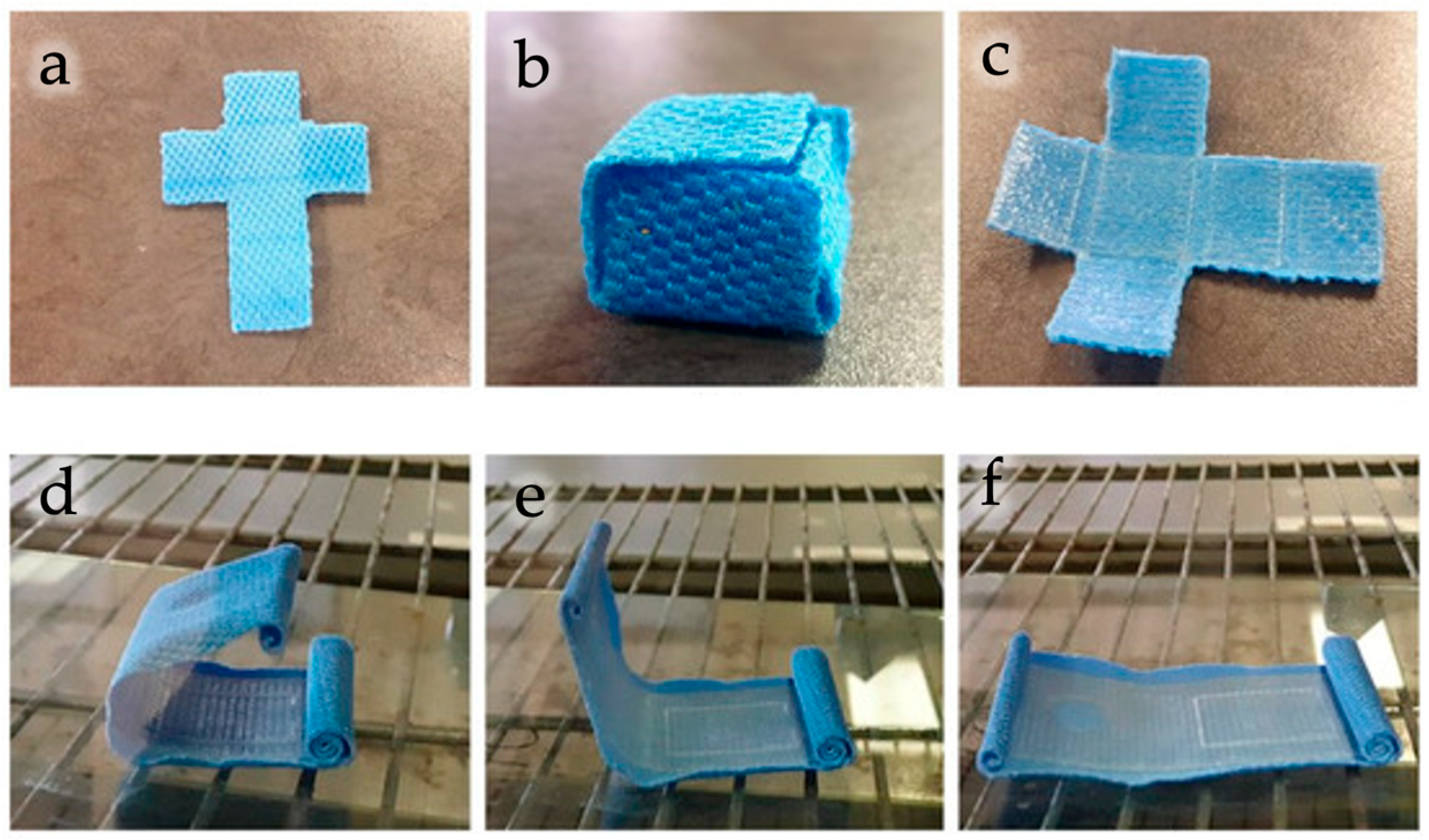
| PLA/CBSW | MC + 3D printing | ↑ Rigidity and load resistance | 3D printing filament | - | [53] |
| PLA/CH | MC + 3D printing | ↑ Tensile strength | 3D printing filament | - | [54] |
| PLA/GP | MC + Film blowing | ↑ Antioxidant and antimicrobial activity | Packaging | - | [55] |
| PLA/HSF | MC + Inject. mold. | ↑ Flexural modulus and sustainability | Building industry | - | [56] |
| PLA/HSF | MC + Inject. mold. | Easily scalable | - | - | [57] |
| PLA/HC | MC + Compress. mold. MC + 3D printing | ↑ Elastic modulus Excellent printability | - Automotive | - - | [58] |
| PLA/MS | MC + Inject. mold. | ↑ Barrier properties | Packaging | - | [59] |
| PLA/OW | MC + 3D printing | ↑ Porosity | Non-structural | - | [60] |
| PLA/OFI | MC + 3D printing | Good processability | 3D printing filament | - | [61] |
| PLA/OFI | MC + Compress. mold. | ↑ Stiffness | Packaging | [62] | |
| PLA/OPP | Solvent casting | ↑ Biodegradation | - | Soil burial | [63] |
| PLA/RH | MC + 3D printing | ↑ Tensile strength and improved adhesion | 3D printing filament | - | [64] |
| PLA/MNRH | MC + 3D printing | ↑ Mechanical and thermal properties | Automotive | - | [65] |
| PLA/RS | MC + Compress. mold. | Improve interfacial adhesion | - | - | [66] |
| PLA/RS | MC + Inject. mold. | - | - | [67] | |
| PLA/RSP | MC + 3D printing | ↑ Flexure and tensile strength | 3D printing filament | Soil burial | [68] |
| PLA/SSHP | Solvent casting | ↑ Tensile and thermal properties | Packaging | Soil degradation | [69] |
| PLA/TPF | MC + Inject. mold. | ↑ Biodegradation | - | Compost soil | [70] |
| PLA/THP | Solvent casting + compress. mold. | ↑ Tensile strength | Packaging | - | [71] |
| PLA/WM | MC + 3D printing | Good filler dispersion | 3D printing filament | - | [72] |
| PLA/WW | MC + 3D printing | ↑ Sustainability | 3D printing filament | - | [73] |
| PCL/DS | MC + Hot process | ↑ Modulus and thermal stability | Packaging | - | [74] |
| PCL/OS | MC + Hot process | ↑ Modulus and thermal stability | - | - | [74] |
| PCL/WaB | MC + Compress. mold. | ↑ Modulus and thermal stability | Industrial | - | [75] |
| PCL/WhB | MC + Hot process | Plasticization effect | Industrial | - | [74] |
| PBS/AP | MC + Inject. mold. | ↑ Impact and tensile strength | - | - | [76] |
| PBS/CBS | MC + 3D printing | ↑ Modulus | Packaging | - | [77] |
| PBS/ESF | MC + Inject. mold. | ↑ Disintegration rate | 3D printing filament | Disintegration in soil | [78] |
| PBS/OP | MC + Inject. mold. | ↑ Ductile properties (with compatibilizers) | Automotive | - | [79] |
| PBSA/AS | MC + Inject. mold | ↑ Mechanical properties (with compatibilizers) | Packaging | - | [80] |
| PHA/PL | MC + Hot process | ↑ Biodegradation | Packaging | - | [81] |
| PHA/RH | MC + Hot process | ↑ Biodegradation | - | - | [82] |
| PHB/AS | MC + Hot process | ↑ Permeability | Packaging | Disintegration | [83] |
| PHB/RH | MC + Hot process | ↑ Mechanical properties | Packaging | Disintegration | [83] |
| PHB/SG | MC + Hot process | ↑ Mechanical properties | Packaging | Disintegration | [83] |
| PHBV/PP | MC + Inject. mold. | ↑ Biodegradation | Packaging | Soil burial | [84] |
| PBAT/CS | MC + Compress. mold. | ↑ Stiffness | Packaging | - | [85] |
| PBAT/M | MC + Compress. mold. | ↑ Thermal stability | Packaging | - | [86] |
| PLA/PBAT/CS | MC + Inject. mold. | ↑ Mechanical properties | Packaging | Soil burial | [87] |
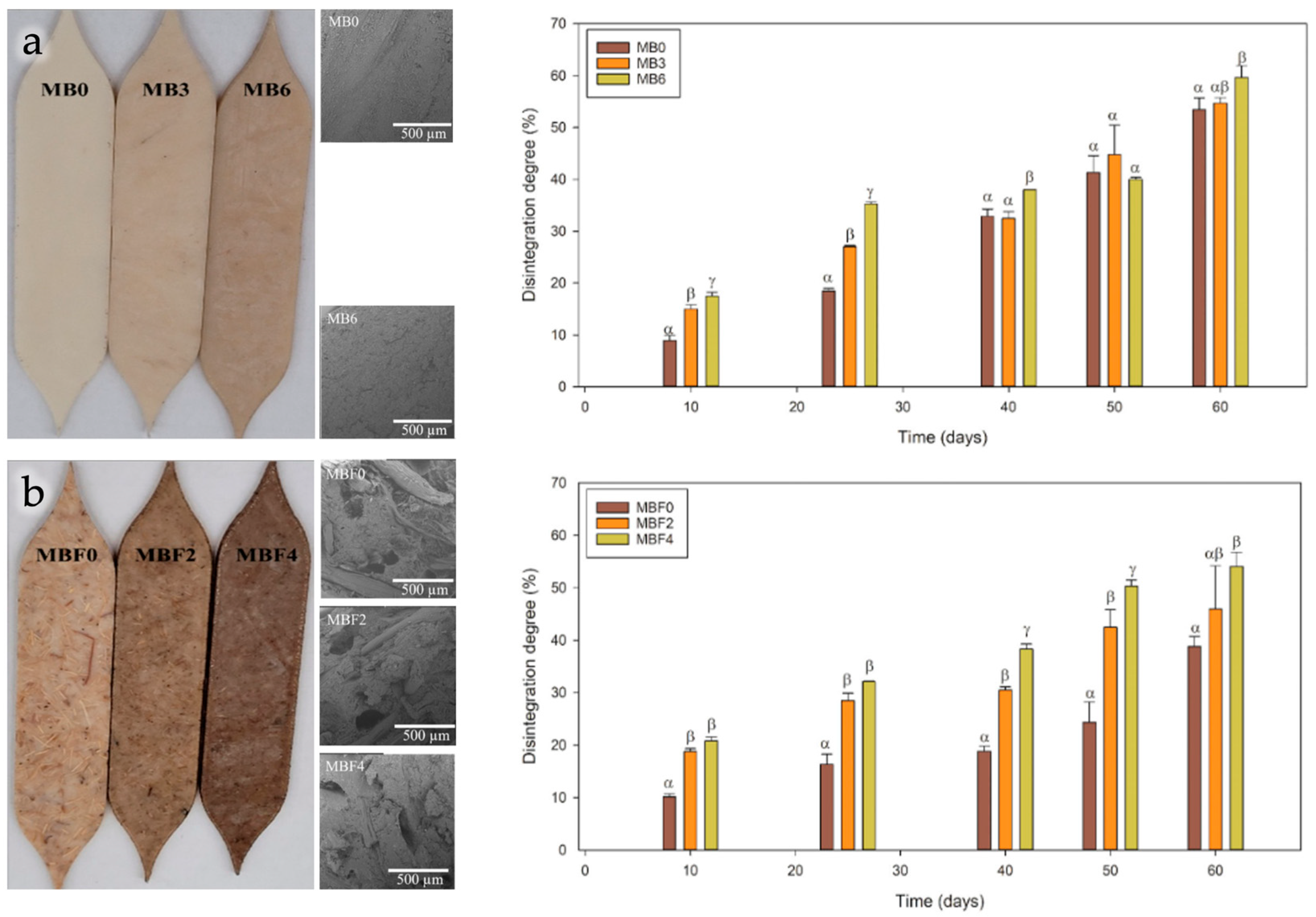
| MB/AS | MC + Inject. mold. | ↑ Biodegradation | Packaging | Soil burial | [88] |
| MB/AS | MC + Inject. mold. | ↑ Mechanical properties | Packaging | - | [89] |
| MB/GP | MC + Compress. mold. | Good fertilizer release | 3D printing filament | - | [90] |
| MB/HS | MC + Inject. mold. | ↑ Ductility | - | - | [91] |
| MB/HC | MC + 3D printing | ↑ Rigidity | - | - | [92] |
| MB/OFI | MC + 3D printing | ↑ Fertilizer release | - | - | [93] |
| MB/TP | MC + 3D printing | ↑ Mechanical properties | 3D printing filament | - | [94] |
| Inz/AS | MC + Inject. mold. | ↑ Mechanical properties | - | Compost soil | [95] |
| Sample Code | Processing | Key Results | Application | End of Life | Ref. |
|---|---|---|---|---|---|
| PLA/AI | MC + Inject. mold. | ↑ Mechanical Properties | Industrial | - | [96] |
| PLA/AF | MC + 3D printing | ↑ Impact Tensile | 3D printing filament | Compost in soil | [97] |
| PLA/BF | MC + Inject. mold. | ↑ Mechanical and Thermal Properties | Variety of fields | - | [98] |
| PLA/BF | MC + Inject. mold. | ↑ Recycling | Variety of fields | - | [99] |
| PLA/CS | MC + Inject. mold. | Low Interfacial Adhesion | - | - | [100] |
| PLA/EG | MC + Inject. mold. | ↑ Mechanical Properties and Bio | - | Soil degradation | [101] |
| PLA/CFY | Extr. coating + 3D printing | ↑ Mechanical Properties | 3D printing filament | - | [102] |
| PLA/Flax | MC + Compress. mold. | ↑ Tensile Strength | - | - | [103] |
| PLA/FS | Direct Extr. process | ↑ Impact and Tensile Modulus | Automotive | - | [104] |
| PLA/FS | Direct Extr. process | ↑ l/d Ratio at Low Rotational Speed | 3D printing filament | - | [105] |
| PLA/HS | MC + Compress. mold. | ↑ Biodegradation | - | Soil degradation | [106] |
| PLA/THF | Direct Inject. mold. | ↑ Mechanical and Thermal Properties | Non-structural | - | [107] |
| PLA/Jute | MC + Compress. mold. | ↑ Resistence creep | - | - | [103] |
| PLA/KF | MC + 3D printing | ↑ Toughness | 3D printing filament | - | [108] |
| PLA/KF | MC + Compress. mold. | ↑ Mechanical Properties | - | Soil burial | [109] |
| PLA/KFA | MC + Inject. mold. | ↑ Mechanical and Water Resistance | - | - | [110] |
| PLA/LK | MC + Hot process | ↑ Mechanical Properties | - | - | [111] |
| PLA/WK | MC + Hot process | ↑ Mechanical Properties | Automotive | - | [112] |
| PLA/PS | MC + Inject. mold. | ↑ Biodegradation | - | Compost in soil | [113] |
| PLA/SF | MC + Inject. mold. | ↑ Mechanical and Thermal Properties | Non-structural | - | [114] |
| PLA/SF | MC + Inject. mold. | ↑ Impact and Tensile Modulus | - | - | [115] |
| PLA/SF | MC + Inject. mold. | ↑ Mechanical Properties | - | - | [116] |
| PLA/MS | MC + Inject. mold. | ↑ Mechanical Properties | - | - | [117] |
| PCL/DP | MC + Compress. mold. | ↑ Mechanical Properties | - | - | [118] |
| PCL/HF | MC + Compress. mold. | ↑ Mechanical Properties | Packaging | - | [119] |
| PCL/DP | MC + Compress. mold. | ↑ Flexure and Tensile Strength | - | - | [120] |
| PBS/C | MC + Compress. mold. | ↑ Mechanical Properties | Packaging | - | [121] |
| PBS/HF | MC + Compress. mold. | ↑ Sustainability | - | Enzymatic hydrolysis and soil burial | [122] |
| PHA/PLF | MC + Hot pression | ↑ Biodegradation | 3D printing filament | Soil burial | [81] |
| PHB/SF | MC + Compress. mold. | ↑ Recycling | - | - | [123] |
| PHBV/AF | MC + Inject. mold. | ↑ Mechanical Properties (with alkali treatment) | - | Aqueous environment | [124] |
| PBAT/CF | MC + Compress. mold. | ↑ Mechanical Properties | - | - | [125] |
| PBAT/MF | MC + Compress. mold. | ↑ Mechanical Properties | - | - | [125] |
| PBAT/TF | MC + Compress. mold. | ↑ Mechanical Properties | - | - | [125] |
| PBAT/CS | Solvent casting | ↑ Antioxidant and Antimicrobial Activity | Packaging | - | [126] |
| PBAT/HF | Open blending + Hot press | ↑ Biodegradation | - | Soil burial | [127] |
| PBAT/KF | MC + Hot process | ↑ Mechanical Properties (with compatibilizers) | - | - | [128] |
| PBAT/F | MC + 3D printing | ↑ Stiffness and Strength | 3D printing filament | - | [129] |
| MB/AF | MC + Compress. mold. | ↑ Recycling | - | Compost in soil | [130] |
| Sample Code | Processing | Key Results | Application | End of Life | Ref. |
|---|---|---|---|---|---|
| PLA/CNC | MC + 3D printing | ↑ Mechanical, shape memory | 4D applications | - | [133] |
| PLA/EA | MC + Compress mold | No significant changes | 3D printing filament | - | [134] |
| PLA/Lignin | MC + 3D printing | ↑ Elongation and toughness | Biomedical | - | [135] |
| PLA/MFC | MC + Film Blowing | ↑ Mechanical | Packaging | - | [144] |
| PLA/NCs | MC + Compress mold | ↑ Mechanical | Packaging | - | [136] |
| PLA/WP | Melt compounding | ↑ Mechanical, sustainability | Packaging | - | [137] |
| PCL/MCC | Melt compounding | ↑ Mechanical, biodegradability | - | Soil degradation | [138] |
| PCL/CNC | Solution casting | ↑ Tensile Strength | - | - | [139] |
| PCL/MLW | Solution casting | ↑ Modulus | - | - | [140] |
| PBAT/lignin | MC + Film Blowing | ↑ Modulus, photo degradation | Packaging | - | [141] |
| PBAT/as-MCC | MC + Compress. mold. | ↑ Modulus | - | - | [142] |
| PVA-CA/Starch | Solution casting | ↑ Mechanical, biodegradability | - | Enzymatic degradation | [145] |
| CCNF/PVA | Solution casting | ↑ Mechanical | Packaging | - | [143] |
| Sample Code | Processing | Key Results | Application | End of Life | Ref. |
|---|---|---|---|---|---|
| PLA/PO | Compression molding | ↑ Sustainability | - | - | [146] |
| PLA/POS | Injection molding | ↑ Ductility, Sustainability | - | - | [147] |
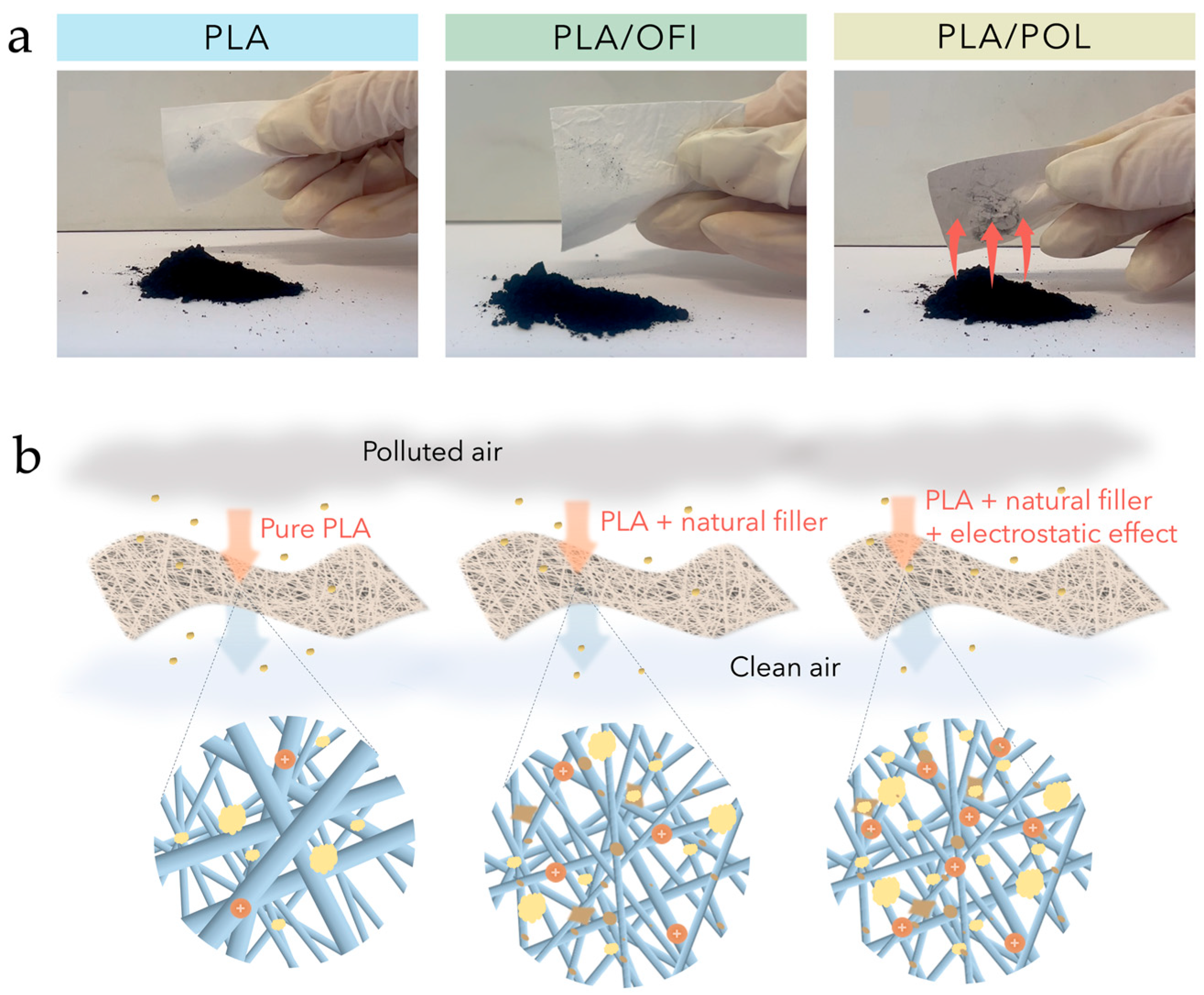
| PLA/POL | Electrospinning | ↑ Mechanical, Sustainability | Air filtration | - | [148] |
| PLA/AV | Injection molding | ↑ UV Resistance | - | - | [149] |
| PLA10A | Compression molding | ↑ Sustainability | - | - | [150] |
| PLA/AB | Extrusion | ↑ Degradation, Sustainability | - | Compostability, soil degradation | [151] |
| PBAT/MO | Wire extension (film) | ↑ Fruit Shelf Life | Packaging | - | [152] |
| PBAT/PHB/BS | Wire extension (film) | ↑ Mechanical, Sustainability | Packaging and mulch films | - | [153] |
| Sample Code | Processing | Key Results | Application | End of Life | Ref. |
|---|---|---|---|---|---|
| PLA/WE | Injection Molding | ↑ Tensile modulus | - | - | [154] |
| PLA/ESP | Film Casting | ↑ Mechanical, sustainability | Packaging | - | [155] |
| PLA/WES | Injection Molding | No significant changes | - | - | [156] |
| PLA/FG | Film Blowing | ↑ Oxy barrier, antioxidant | Packaging | Compostability | [160] |
| PLA/PUS | Compression Molding | ↑ Mechanical, sustainability | Packaging, utensils | Soil degradation | [158] |
| PLA/CSP | 3D Printing | ↑ Mechanical | Biomedical | - | [157] |
| PLA/EE | 3D Printing | ↑ Mechanical, ↑ processability, sustainability | Packaging | - | [161] |
| PFS:PLA | Compression Molding | ↑ Biodegradation | Fishing gears | Soil degradation | [159] |
| PSS:PLA | Compression Molding | ↑ Mechanical, thermal | Thermal insulation | Soil degradation | [159] |
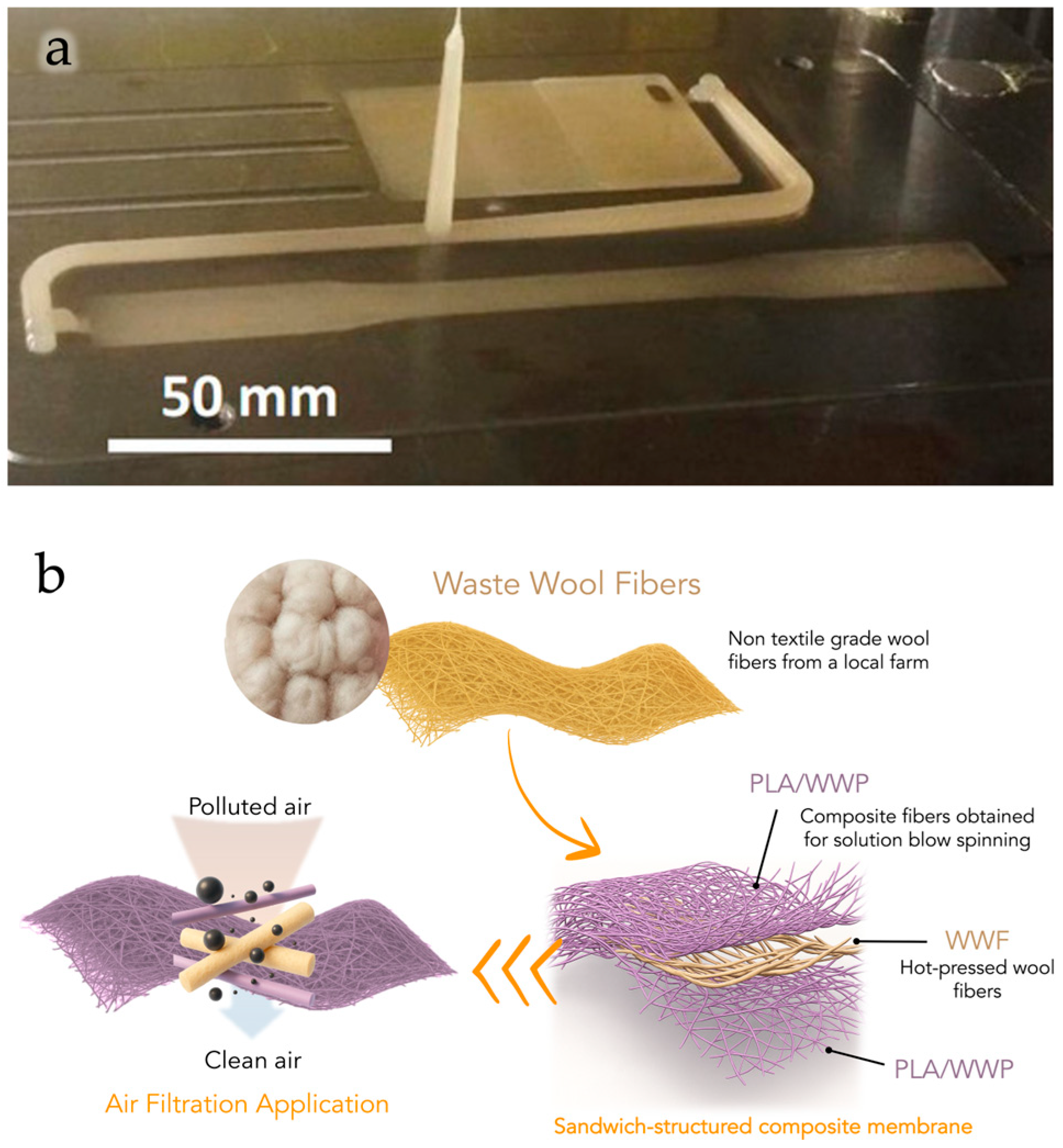
| PLA/WP | Solution Blow Spinning | ↑ Mechanical, sustainability | Air filtration | - | [162] |
| PCF:PLA | Compression Molding | ↑ Mechanical, biodegradation | Sustainable Agriculture | Soil degradation | [159] |
| CCF/PLA | Injection Molding | ↑ Sustainability | - | - | [163] |
| PLA/SF | Hand Layup | ↑ Mechanical, wear prop. | Textile | - | [164] |
| WSF/PLA | Hand Layup | ↑ Mechanical | - | - | [165] |
| PLA/Silk | Injection Molding | ↑ Mechanical | - | Physiological environment | [166] |
| PLA/PBAT/silk | Injection Molding | ↑ Mechanical | - | - | [167] |
| PLA/PCL/NP | Compression Molding | ↑↑ Mechanical, thermal | - | Hydrolytic degradation | [168] |
| PLA/PCL/SF | Compression Molding | ↑ Mechanical, thermal | - | Hydrolytic degradation | [168] |
| silk/PBS | Compression Molding | ↑ Mechanical, thermal | - | - | [169] |
| wsilk/PBS | Compression Molding | ↑ Mechanical, thermal | - | - | [170] |
| PHA/OSP | Compression Molding | ↑ Mechanical, sustainability | Packaging, utensils | Soil degradation | [81] |
| MB/EE | 3D Printing | ↑ Mechanical, sustainability | Packaging | - | [161] |
Disclaimer/Publisher’s Note: The statements, opinions and data contained in all publications are solely those of the individual author(s) and contributor(s) and not of MDPI and/or the editor(s). MDPI and/or the editor(s) disclaim responsibility for any injury to people or property resulting from any ideas, methods, instructions or products referred to in the content. |
© 2025 by the authors. Licensee MDPI, Basel, Switzerland. This article is an open access article distributed under the terms and conditions of the Creative Commons Attribution (CC BY) license.
Share and Cite
Scaffaro, R.; La Mantia, F.P.; Lo Re, G.; Titone, V.; Citarrella, M.C. Plant- and Animal-Derived Organic Waste as Fillers in Biodegradable Composites for Advanced Applications: A Comprehensive Overview. Polymers 2026, 18, 22. https://doi.org/10.3390/polym18010022
Scaffaro R, La Mantia FP, Lo Re G, Titone V, Citarrella MC. Plant- and Animal-Derived Organic Waste as Fillers in Biodegradable Composites for Advanced Applications: A Comprehensive Overview. Polymers. 2026; 18(1):22. https://doi.org/10.3390/polym18010022
Chicago/Turabian StyleScaffaro, Roberto, Francesco Paolo La Mantia, Giada Lo Re, Vincenzo Titone, and Maria Clara Citarrella. 2026. "Plant- and Animal-Derived Organic Waste as Fillers in Biodegradable Composites for Advanced Applications: A Comprehensive Overview" Polymers 18, no. 1: 22. https://doi.org/10.3390/polym18010022
APA StyleScaffaro, R., La Mantia, F. P., Lo Re, G., Titone, V., & Citarrella, M. C. (2026). Plant- and Animal-Derived Organic Waste as Fillers in Biodegradable Composites for Advanced Applications: A Comprehensive Overview. Polymers, 18(1), 22. https://doi.org/10.3390/polym18010022