

You are currently viewing a new version of our website. To view the old version click .

Catalysts, Volume 15, Issue 2

February 2025 - 96 articles

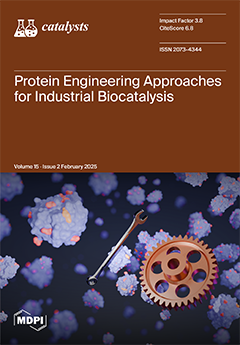
Cover Story: Protein engineering is revolutionizing industrial biocatalysis by enhancing enzyme stability, specificity, and efficiency. Advances in rational design, directed evolution, semi-rational design, and machine learning are driving the development of robust biocatalysts for diverse applications. Engineered PETases exemplify this progress, with protein engineering assuming a pivotal role in transitioning PETases from an academic curiosity focus to industrially relevant biocatalysts, enabling efficient PET depolymerization for a circular bioeconomy. As interdisciplinary efforts integrate computational and experimental approaches, particularly machine learning, the future of enzyme engineering promises transformative innovations, not only in sustainable plastics recycling, but also pharmaceuticals, agriculture, and other key industries. View this paper
  • Issues are regarded as officially published after their release is announced to the table of contents alert mailing list .
  • You may sign up for email alerts to receive table of contents of newly released issues.
  • PDF is the official format for papers published in both, html and pdf forms. To view the papers in pdf format, click on the "PDF Full-text" link, and use the free Adobe Reader to open them.

Articles (96)

  • Article
  • Open Access
1,263 Views
12 Pages

Modifying Pathways in CO Preferential Oxidation over CuxO/CeO2 Catalysts by Boosting Cu-Ce Interfacial Interaction

  • Changjin Xu,
  • Desheng Wang,
  • Herima Qi,
  • Laibing Wang,
  • Tingting Chen,
  • Na Ta,
  • Riqing Cheng,
  • Huiqing Guo and
  • Shikui Wu

19 February 2025

Improving the dispersion of CuxO species is critical for enhancing the catalytic performance of CuxO/CeO2 catalysts in the preferential oxidation of CO. Herein, the 10CuxO/CeO2 catalyst was synthesized using a combined approach of one-step thermal de...

  • Feature Paper
  • Article
  • Open Access
1,659 Views
15 Pages

Theoretical Insight into the Mechanism and Descriptor for Hydrogen Spillover on the Pt/CeO2(111) Surface with Different Pt Coverages

  • Congcong Liang,
  • De Zhang,
  • Xin Li,
  • Yan Liu,
  • Congbiao Chen,
  • Qiang Wang,
  • Bo Hou,
  • Zhongyi Ma and
  • Kangjun Wang

19 February 2025

Hydrogen spillover, as a common phenomenon, pervasively occurs in heterogeneous catalysis. Nevertheless, the understanding of the dynamic mechanism of hydrogen spillover in the typical Pt/CeO2 system remains limited. Herein, the pathways for hydrogen...

  • Feature Paper
  • Article
  • Open Access
3 Citations
1,150 Views
18 Pages

19 February 2025

Developing a catalyst with excellent electrical conductivity and catalytic performance for on-site testing of residual imidacloprid is significant and challenging. In situ growth of Mo2C nanodots on Co-induced N-doped carbon nanotubes (Co/Mo2C/N-CNT)...

  • Feature Paper
  • Article
  • Open Access
2 Citations
2,235 Views
18 Pages

Palladium-Catalyzed Decarbonylative Nucleophilic Halogenation of Acid Anhydrides

  • Tian Tian,
  • Shuhei Uei,
  • Weidan Yan and
  • Yasushi Nishihara

19 February 2025

In this study, we developed a palladium-catalyzed decarbonylative nucleophilic halogenation reaction using inexpensive and readily available acid anhydrides as substrates. This approach effectively circumvents the instability of acyl chlorides and th...

  • Feature Paper
  • Article
  • Open Access
4 Citations
1,680 Views
20 Pages

Environmental Impacts on the Photocatalytic Activities of Anatase and Rutile

  • Karolina Solymos,
  • Áron Ágoston,
  • Tamás Gyulavári,
  • Lilla Szalma,
  • Milica Todea,
  • Ákos Kukovecz,
  • Zoltán Kónya and
  • Zsolt Pap

18 February 2025

Titanium dioxide (TiO2) nanoparticles (NPs) are widely used in various industries and are increasingly found in environmental systems, especially in soil. However, the environmental behavior of TiO2 NPs is still poorly understood. Hence, this study a...

  • Feature Paper
  • Article
  • Open Access
1 Citations
1,323 Views
17 Pages

Enhancing H2O2 Generation Using Activated Carbon Electrocatalyst Cathode: Experimental and Computational Insights on Current, Cathode Design, and Reactor Configuration

  • Maria del Mar Cerrillo-Gonzalez,
  • Amir Taqieddin,
  • Stephanie Sarrouf,
  • Nima Sakhaee,
  • Juan Manuel Paz-García,
  • Akram N. Alshawabkeh and
  • Muhammad Fahad Ehsan

18 February 2025

Granular activated carbon (GAC) serves as a cost-efficient electrocatalyst cathode in electrochemical water treatment. This study investigates the impact of current intensity and cathode mesh size on the electrocatalytic generation of reactive oxygen...

  • Feature Paper
  • Article
  • Open Access
2,944 Views
15 Pages

18 February 2025

Water pollution by dyes is a major environmental problem, particularly in the textile, food, and pharmaceutical industries. These dyes are often complex chemical compounds that are difficult to remediate due to their chemical stability, their solubil...

  • Review
  • Open Access
7 Citations
2,566 Views
15 Pages

18 February 2025

This review explores the role of surfactants in enhancing or inhibiting the biodegradation of hydrophobic organic compounds (HOCs) by microorganisms. Bioavailability, the extent to which pollutants can be accessed and metabolized by microbes, is a ke...

  • Article
  • Open Access
1,178 Views
11 Pages

17 February 2025

A rapid synthesis of structurally novel s-indacene-1,5-dione and cyclopentanone-fused isoxazole derivatives in generally moderate yields was achieved through the NaNO2-catalyzed/involved transformation of cyclopentenone-MBH acetates. Under similar re...

  • Article
  • Open Access
1,248 Views
19 Pages

Self-Assembly of Benzyloxycarbonyl Histidine with Zinc Ions for the Construction of Esterase Mimics

  • Jiacheng Sun,
  • Jingjing Guo,
  • Ling Liu,
  • Yu Liu,
  • Linling Yu and
  • Yan Sun

17 February 2025

Esterases have been applied in many industrial fields. However, many esterases have inherent defects as natural enzyme, such as low long-term storability, poor operational stability, and difficulty in recovery for reuse. Herein, two histidine derivat...

of 10

Get Alerted

Add your email address to receive forthcoming issues of this journal.

XFacebookLinkedIn
Catalysts - ISSN 2073-4344