


Simple Summary
Cancer treatment is increasingly guided by tumor DNA alterations. Changes in fibroblast growth factor receptors, a family of four related proteins, occur across many solid tumors and drive growth, spread, and treatment response by activating multiple signaling pathways. This review examines how these receptor changes—amplifications, mutations, and fusions—differ in their mechanisms and distribution across cancer types, and how they reshape the tumor environment, blood supply, and immune landscape. We summarize the clinical benefits and limitations of approved targeted drugs, explain why resistance develops through secondary mutations or alternative signaling routes, and describe how blood-based tests may detect resistance early. We also discuss next-generation strategies including combination with immunotherapy or anti-vessel therapy, antibody–drug conjugates, and nanotechnology-based delivery systems. By integrating molecular, translational, and clinical evidence, this review aims to guide patient selection, treatment monitoring, and the design of durable precision therapies targeting these receptor abnormalities.
Abstract
Aberrations in fibroblast growth factor receptors (FGFRs) constitute a key oncogenic mechanism across multiple solid tumors, influencing tumor initiation, therapeutic response, and clinical outcomes. This review synthesizes current knowledge on the molecular biology, signaling networks, and tumor-specific distribution of FGFR alterations, including amplifications, point mutations, and gene fusions. The mechanistic basis of FGFR-driven tumor progression is discussed, including activation of downstream signaling pathways, crosstalk with other receptor tyrosine kinases, and regulation of the tumor microenvironment, angiogenesis, and immune escape. Recent development of selective FGFR inhibitors—such as pemigatinib, erdafitinib, and futibatinib—has translated mechanistic insights into measurable clinical benefits in genomically defined patient populations. However, acquired resistance remains a major challenge, driven by secondary mutations, activation of bypass pathways, and intratumoral heterogeneity. Integration of multi-omics profiling, liquid biopsy monitoring, and biomarker-guided patient selection is essential to optimize therapeutic efficacy and overcome resistance. This review also highlights emerging therapeutic modalities, such as antibody–drug conjugates and nanotechnology-based delivery systems, which may improve target specificity and prolong therapeutic durability. By integrating molecular, translational, and clinical evidence, this review aims to establish a comprehensive framework for precision oncology strategies targeting FGFR-driven malignancies.
1. Introduction
Malignant tumors represent the second leading cause of death worldwide. GLOBOCAN 2022 reported 20.1 million new cancer cases and 9.7 million cancer-related deaths globally in 2022. Projections indicate that new cancer cases will reach 28.4 million by 2040 [1]. Pan-cancer multi-omics studies have systematically identified widespread aberrations in key oncogenic drivers, including TP53, KRAS, and PIK3CA [2]. These discoveries have accelerated the development of precision oncology.
Cancer treatment has shifted from traditional surgery, radiotherapy, and chemotherapy toward comprehensive strategies guided by molecular biomarkers. The fibroblast growth factor receptor (FGFR) family comprises four receptor tyrosine kinases (FGFR1–4) that regulate cell proliferation, differentiation, and angiogenesis. Upon ligand binding, these receptors activate the RAS/MAPK, PI3K/AKT, and PLCγ signaling pathways. This activation drives tumor growth and remodels the tumor microenvironment [3]. Regulatory agencies have approved pemigatinib for cholangiocarcinoma and erdafitinib for urothelial carcinoma. Additionally, futibatinib has demonstrated promising selectivity and tolerability in clinical trials [4,5,6].
FGFR aberrations exhibit distinct distributions across cancer types. These aberrations include amplifications, mutations, fusions, and aberrant splicing. FGFR2 fusions occur in approximately 10–16% of intrahepatic cholangiocarcinomas [7,8]. In contrast, FGFR3 mutations are present in 17–20% of bladder cancers [9,10]. These genetic alterations drive oncogenic phenotypes. They also promote angiogenesis and facilitate immune evasion. Recent single-cell and spatial omics studies have revealed the critical role of FGFR signaling in tumor heterogeneity and clonal evolution [11].
Despite therapeutic advances, FGFR-targeted therapies face significant clinical challenges. Tumors develop acquired resistance through secondary mutations or bypass signaling activation. Patients experience dose-limiting toxicities, including hyperphosphatemia and cutaneous or ocular adverse events. Furthermore, clinicians face uncertainties in detecting FGFR aberrations across diverse cancer types and determining the druggability of rare variants [12,13,14,15,16]. Next-generation inhibitors, such as tinengotinib and rogaratinib, demonstrate improved selectivity and tolerability in preclinical and early clinical studies [17,18]. These agents may enhance clinical outcomes through optimized drug design and biomarker-driven patient selection.
This review systematically examines FGFR aberrations and oncogenic mechanisms in solid tumors, clinical development, and combination strategies, emphasizing resistance biology and biomarker advances. We propose multi-omics-based predictive frameworks to guide precision application and drug development of FGFR-targeted therapies.
2. Molecular Biology and Tumor Distribution of the FGFR Family
2.1. Structural and Functional Features of the FGFR Family
The FGFR family belongs to the receptor tyrosine kinase (RTK) superfamily and plays central roles in cell proliferation, differentiation, and metabolism. It comprises four highly conserved isoforms (FGFR1–4) that initiate complex signaling networks upon binding to specific fibroblast growth factors (FGFs), thereby mediating diverse physiological and pathological processes.
2.1.1. Domain Architecture and Molecular Characteristics of FGFR1–4
FGFR1–4 share a highly conserved three-domain architecture: an extracellular domain, a transmembrane region, and an intracellular kinase domain [19]. The extracellular region contains three immunoglobulin-like domains (D1, D2, and D3). D1 and the acid box form an autoinhibitory module, while D2 and D3 constitute the primary ligand-binding region [20]. This structure maintains receptor quiescence in the resting state, with activation occurring only upon ligand binding and dimerization.
In addition to the classical kinase receptors FGFR1–4, the FGFR family includes an atypical member, fibroblast growth factor receptor-like 1 (FGFRL1, also known as FGFR5) [21]. The extracellular domain of FGFRL1 contains three immunoglobulin-like domains and a conserved FGF-binding site, while its intracellular region is limited to a short cytoplasmic tail, lacking the catalytic tyrosine kinase domain [22]. This structural feature classifies FGFRL1 as a “decoy receptor” or “pseudo-receptor.” FGFRL1 binds multiple FGF ligands but does not initiate the classical kinase cascade, thereby modulating local FGF availability, influencing the signaling strength of other FGFRs, and playing a role in tissue morphogenesis and homeostasis [21].
Crystallographic studies reveal that FGFs bind primarily to the D2–D3 region, with heparan sulfate proteoglycans (HSPGs) enhancing binding affinity and promoting dimerization, thereby establishing the molecular basis for FGFR activation [23,24]. The intracellular kinase domain contains an ATP-binding site and multiple tyrosine residues; upon activation, autophosphorylation recruits downstream signaling proteins. Subtle differences in the kinase domain confer distinct substrate specificity and signaling intensity among isoforms [3].
2.1.2. Ligand-Binding Specificity and Signal Transduction Mechanisms
The FGF family comprises 22 members, classified into paracrine and endocrine subfamilies [25]. Paracrine FGFs, such as FGF1 and FGF2, require HSPGs as co-receptors, whereas endocrine FGFs, like FGF19, FGF21, and FGF23, interact specifically with Klotho proteins to modulate FGFR selectivity and activity [26,27]. Klotho proteins act as essential co-receptors that alter FGFR ligand specificity, particularly in tissues such as the liver and kidney. For instance, the FGF19-FGFR4-βKlotho complex enhances binding specificity by stabilizing receptor conformations that preferentially activate FGFR4 signaling in hepatocytes [24,28,29].
Structural studies have revealed that the presence of Klotho proteins influences the affinity of FGFs for FGFR isoforms. For example, FGF19 binding to FGFR4 is greatly enhanced by βKlotho, leading to a higher binding affinity compared to when βKlotho is absent. This alteration in ligand–receptor binding is essential for the regulation of key metabolic pathways such as bile acid synthesis and hepatic glucose metabolism [24,30,31]. On the other hand, Klotho proteins are absent in the binding of FGF1 and FGF2 to FGFRs, which exhibit a broader specificity across multiple FGFR isoforms [32].
Upon activation, FGFR signals predominantly through RAS/MAPK, PI3K/AKT, and PLCγ pathways [33]. FGFR substrate 2 (FRS2) serves as a key adaptor protein, recruiting GRB2 and SOS to initiate the RAS/MAPK pathway for proliferation and differentiation; the PI3K/AKT pathway promotes cell survival and metabolic reprogramming; PLCγ activation modulates intracellular calcium levels and protein kinase C activity [34].
Furthermore, ligand binding to the extracellular Ig-like domains of FGFR leads to receptor dimerization, which is further stabilized in the presence of Klotho proteins. This process is crucial for activating downstream signaling pathways, including RAS/MAPK and PI3K/AKT, which are involved in cell proliferation and survival. The altered specificity induced by Klotho proteins provides a mechanism for the tissue-specific regulation of FGFR signaling, which is pivotal for understanding both normal physiology and oncogenic transformations driven by FGFR aberrations [35,36].
2.1.3. Physiological Functions of the FGFR Family
FGFR signaling is indispensable in both embryonic development and adult homeostasis. During embryogenesis, FGFR1–3 participate in neural, skeletal, and organ formation: FGFR1 is critical for central nervous system and skeletal development, FGFR2 mediates epithelial–mesenchymal interactions, and FGFR3 regulates cartilage and bone growth [37,38].
Beyond the classical FGFRs, genetic and experimental evidence highlights a key role for FGFRL1 in organogenesis, particularly in embryonic kidney and diaphragm development. Fgfrl1 knockout mice exhibit severe metanephric hypoplasia, often progressing to near-complete renal agenesis, accompanied by a thin, hypoplastic diaphragm that allows for liver herniation, resulting in respiratory failure and perinatal lethality [39,40]. In humans, germline loss-of-function or deleterious FGFRL1 variants—arising from 4p16.3 terminal deletions or biallelic missense mutations—have been linked to congenital diaphragmatic hernia, though consistent extra-diaphragmatic features, such as cardiac or skeletal anomalies, remain sparsely documented [41]. Mechanistically, FGFRL1 interacts with FGF8 to modulate FGF–FGFR signaling during nephrogenesis, explaining the renal agenesis in null mice, while similar pathways in diaphragmatic myogenesis await elucidation. High FGFRL1 expression in musculoskeletal and renal tissues from embryonic to postnatal stages suggests potential contributions to adult tissue homeostasis and repair, a notion meriting further exploration via single-cell and spatial transcriptomics [39,40,41].
In adult tissues, FGFR pathways maintain homeostasis and participate in repair processes. For example, FGF2–FGFR1 promotes endothelial cell proliferation and migration to regulate angiogenesis; FGF7 stimulates epithelial cell proliferation and differentiation via FGFR2-IIIb, contributing to skin and lung repair [21,33]. Additionally, endocrine FGFs achieve tissue-specific functions in cooperation with Klotho family co-receptors: the FGF19–β-Klotho–FGFR4 axis regulates bile acid and hepatic glucose metabolism; FGF21 modulates lipid metabolism and insulin sensitivity; the FGF23–α-Klotho–FGFR1 axis maintains phosphate and vitamin D homeostasis. These findings suggest FGFR as a potential therapeutic target for metabolic disorders [26,27].
2.1.4. FGF-FGFR Interaction Networks and Regulatory Mechanisms
The complexity of the FGF–FGFR network arises not only from ligand–receptor binding diversity but also from multilayered regulation. HSPGs, serving as co-receptors for paracrine FGFs, enhance binding affinity and promote dimerization, thereby establishing local concentration gradients and shaping spatial signal distribution [23]. Endocrine FGFs depend on Klotho proteins to alter FGFR ligand selectivity, enabling precise regulation in specific tissues [42].
Beyond canonical ligand–receptor interactions, FGFRL1 acts as a molecular rheostat of FGF signaling. As a decoy receptor, FGFRL1 sequesters soluble FGF ligands and constrains the signaling range of select FGFs, thereby restricting signal amplitude and spatial spread. Under oncogenic conditions, dysregulated FGFRL1 expression or altered subcellular localization can reprogram FGF–FGFR signaling networks through context-dependent modulation of effector pathways such as PI3K–Akt and ERK1/2, potentially contributing to therapeutic resistance [43]. Thus, integrating FGFRL1 into comprehensive models of the FGF–FGFR network is imperative for understanding the dynamic regulation and plasticity of this signaling system.
Negative regulation is critical for maintaining spatiotemporal specificity: Sprouty (SPRY) proteins inhibit the GRB2/SOS–RAS axis to limit MAPK activation; SEF binds to receptor complexes to suppress kinase activity or promote endocytosis; dual-specificity phosphatases (DUSPs) terminate signaling by dephosphorylating MAPKs [44,45]. Furthermore, structural studies reveal that in the resting state, D1-acid box interactions maintain receptor autoinhibition; ligand binding induces receptor dimerization and conformational changes that relieve inhibition, thereby initiating downstream signaling [23,34].
2.2. Distribution Patterns of FGFR Aberrations in Solid Tumors
As a key receptor tyrosine kinase, FGFR exhibits structural and functional aberrations across multiple solid tumors. Large-scale genomic studies (e.g., TCGA, ICGC) have provided systematic evidence characterizing the frequency, types, and associations of FGFR aberrations with molecular subtypes, clinical features, and population differences.
2.2.1. Statistical Analysis of FGFR Aberrations in Solid Tumors Based on Large Databases
In a sequencing study of 4853 solid tumors, the overall prevalence of FGFR aberrations was 7.1%, comprising 66% amplifications, 26% mutations, and 8% fusions [46]. This provides a reference for understanding the overall landscape of FGFR aberrations.
Notably, reported pan-cancer prevalence estimates are strongly influenced by assay design and analytical sensitivity. DNA-based hybrid-capture panels and whole-exome sequencing often under-detect FGFR rearrangements compared with RNA-based NGS or anchored multiplex PCR, which provide higher sensitivity for in-frame and rare-partner fusions [47]. In contrast, assays with higher copy-number resolution—such as high-depth targeted NGS or array-CGH—tend to detect more low-level FGFR amplifications [48,49]. Conversely, cfDNA-based NGS may miss subclonal or low-allele-fraction FGFR events because detection relies on tumor DNA fraction and shedding dynamics [50,51].
Pan-cancer analyses further reveal significant heterogeneity in FGFR isoform distribution across cancer types [52]. A combined TCGA and ICGC whole-genome study demonstrated that each cancer harbors an average of 4–5 driver mutations, with FGFR aberrations representing an important component that appears across multiple cancer types, though their oncogenic contribution varies by tumor type [53,54]. Additionally, a large-scale study of Chinese patient cohorts found an overall FGFR aberration rate of 7.0%, consistent with international data, while showing certain ethnic differences in cancer type distribution [55].
2.2.2. Frequency and Type Distribution of FGFR Aberrations Across Cancer Types
FGFR aberrations exhibit marked tissue specificity and molecular preferences across tumor types. In urothelial carcinoma, FGFR3 mutations are most prevalent, with an overall frequency of approximately 15–20%; detection rates reach 40–50% in non-muscle-invasive bladder cancer but decline to 10–15% in muscle-invasive or metastatic disease [56,57,58]. In intrahepatic cholangiocarcinoma (iCCA), FGFR2 fusions are most common, occurring in approximately 10–16% of cases and correlating with distinct clinicopathological features [52,59]. Breast cancer harbors FGFR aberrations in 14–18% of cases, predominantly FGFR1 amplifications [46,55]. Endometrial cancer frequently exhibits FGFR2 mutations (e.g., S252W, N549K) in approximately 10–12% of cases, with established oncogenic activity [54,60]. While FGFR aberrations are generally rare in lung cancer, FGFR1 amplification occurs in 15–20% of lung squamous cell carcinomas [46,61]. In glioblastoma, the overall prevalence of FGFR aberrations is approximately 2–8%, with FGFR3 fusions being relatively common [62,63]. Additionally, certain rare tumors such as adenoid cystic carcinoma and ovarian malignant Brenner tumor display elevated proportions of FGFR fusions, typically associated with sensitivity to FGFR inhibitors [64].
In contrast to FGFR1–4, the role of FGFRL1 in cancer research remains underexplored. However, large-scale cancer genomics analyses together with functional studies in several tumor types have suggested its potential importance in solid tumors. On the one hand, transcriptomic and clinicopathological data indicate that FGFRL1 expression in prostate cancer, esophageal cancer, and small-cell lung cancer is associated with tumor progression and, in some cohorts, with patient outcome, suggesting biological roles that are at least partly distinct from those of classical FGFR1–4 [65,66,67]. On the other hand, in esophageal cancer, increased FGFRL1 expression correlates with disease progression and is directly repressed by miR-107, whereas in small-cell lung cancer FGFRL1 promotes chemoresistance via an ENO1–PI3K/Akt axis, and in pancreatic cancer models exosomal miR-210 from cancer stem cells targets FGFRL1 to drive macrophage M2 polarization and gemcitabine resistance [68,69]. These findings suggest significant variation in FGFR signaling dependency across tumors of different tissue origins.
2.2.3. Association of FGFR Aberrations with Tumor Molecular Subtypes
FGFR aberrations display pronounced molecular subtype specificity across tumor types. In bladder cancer, FGFR3 mutations predominantly occur in low-grade, non-muscle-invasive subtypes with papillary growth patterns and well-differentiated histology, suggesting they may define a distinct molecular subtype. Typical hotspot mutations (S249C, R248C, Y373C) involve extracellular cysteine substitutions that alter receptor conformation and confer ligand-independent activation [70,71,72]. In cholangiocarcinoma, FGFR2 fusions and truncation variants (e.g., FGFR2ΔE18) represent mechanistically distinct driver events. FGFR2 fusions typically act as solitary drivers activating RAS/MAPK and PI3K/AKT pathways to induce tumorigenesis, while FGFR2ΔE18 causes receptor conformational stabilization and ligand-independent activation through structural deletion, indicating significant differences in signaling dependency and drug sensitivity [73,74]. In breast cancer, FGFR1 amplification is enriched in hormone receptor-positive (ER+) subtypes, particularly Luminal B-like (high-proliferation HR+) tumors, and closely associates with endocrine therapy resistance and poor prognosis [75,76]. A large-scale functional study identified 71 newly confirmed oncogenic variants among 160 FGFR mutations; FGFR2 mutations in endometrial cancer significantly correlate with molecular subtypes, showing markedly elevated frequency in microsatellite instability-high (MSI-H) tumors [77]. Table 1 summarizes the distribution patterns, frequency ranges, and molecular characteristics of FGFR aberrations in major solid tumors.

Table 1.
FGFR Alterations Across Major Solid Tumor Types: Frequency, Predominant Alteration Type, and Molecular Characteristics.
2.2.4. Impact of Racial, Geographic, and Age Differences on FGFR Aberration Distribution
FGFR alterations also vary across populations. In a Chinese cohort study (n = 58), the frequency of FGFR alterations in colorectal cancer was 31%, significantly higher than in Western populations; in gastric cancer, the frequency was 16.8%, likewise indicating geographic variation. Regarding subtype distribution, FGFR1 alterations were most common among Chinese patients (56.8%), followed by FGFR3 (17.7%) and FGFR2 (14.4%), differing from Western populations [55]. In Indian bladder cancer patients, the FGFR3 mutation rate is 19%, comparable to the 15–30% range in European and American populations, but with differences in clinicopathological correlations [78]. Age also influences FGFR aberration distribution. In childhood and adolescent cancers, mutations, fusions, and amplifications of FGFR1–4 are all relatively common, particularly in low-grade neuroepithelial tumors where they are significantly more prevalent than in adults, suggesting developmental stage-related differences in oncogenic mechanisms [79].
Taken together, available sequencing datasets indicate that the overall prevalence of FGFR alterations is broadly similar between Chinese and predominantly European/North American cohorts. By contrast, the relative contribution of individual tumor types differs by ethnicity and geography, with Chinese pan-cancer series enriched for FGFR-altered gastric and colorectal cancers, whereas Western datasets are more heavily weighted toward urothelial, breast, and endometrial tumors. Robust prevalence data from patients of African, South Asian, or Latin American ancestry remain scarce, underscoring the need for more ethnically diverse, globally representative genomic studies.
2.2.5. Aberrant Alternative Splicing of FGFR1–3 in Solid Tumors
Alternative splicing represents an important yet underappreciated source of functional diversity within the FGFR family. For FGFR1–3, the best-characterized splicing events occur in the third immunoglobulin-like domain (IgIII), giving rise to the epithelial-associated IIIb and mesenchymal-associated IIIc isoforms, which differ in ligand specificity and downstream signaling output. This splicing program is tightly regulated during development but is frequently dysregulated in cancer, contributing to altered tumor–stromal interactions and oncogenic signaling plasticity [80].
In FGFR1, expression of truncated splice variants such as FGFR1β, which lacks the first Ig-like domain, enhances ligand binding affinity and mitogenic signaling and has been associated with aggressive behavior in breast cancer and other solid tumors [81]. In FGFR2, a shift from the IIIb to the IIIc isoform is recurrently observed during carcinoma progression and has been mechanistically linked to epithelial–mesenchymal transition and increased invasiveness, partly through aberrant regulation by splicing factors such as PTBP1 [82,83]. FGFR3 also exhibits cancer-associated splice variants beyond the canonical IIIb/IIIc forms, including variants that alter C-terminal regulation of kinase signaling, leading to enhanced oncogenic activity and altered therapeutic sensitivity in prostate cancer models [84].
Collectively, aberrant alternative splicing of FGFR1–3 adds an additional layer of complexity to FGFR dysregulation in solid tumors, with implications for tumor biology, biomarker interpretation, and therapeutic targeting.
3. Molecular Mechanisms and Pathophysiological Roles of FGFR Signaling Pathways
3.1. FGFR Downstream Signaling Network
As key members of the receptor tyrosine kinase family, FGFRs activate multiple signaling cascades through intracellular kinase domain autophosphorylation upon ligand binding, thereby regulating core biological processes including cell proliferation, differentiation, survival, and migration.
3.1.1. Activation Mechanisms of Classical Downstream Pathways: MAPK/ERK, PI3K/AKT, and PLCγ
FGFRs primarily function through three classical pathways: RAS-MAPK/ERK, PI3K-AKT, and PLCγ-PKC. The coordinated activation of these pathways constitutes the core signaling network [3]. These three signaling axes are spatially and temporally interconnected, collectively determining cell fate transitions and response patterns (Figure 1).
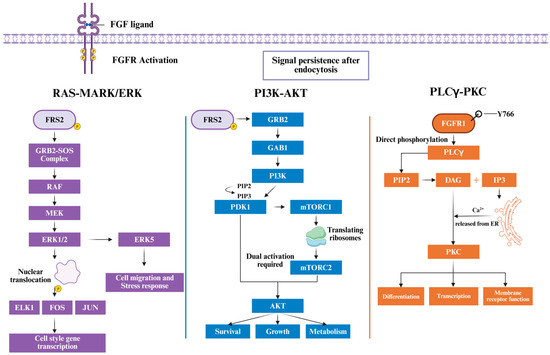
Figure 1.
Major Signaling Cascades Downstream of FGFR Activation. A schematic representation of three major signaling cascades activated by FGFR: the RAS-MAPK/ERK pathway (purple) regulating transcription and mediating cell migration and stress responses, the PI3K-AKT pathway (blue) controlling cell survival, growth, and metabolism, and the PLCγ-PKC pathway (orange) mediating differentiation, transcription, and membrane receptor function. Detailed pathway descriptions and abbreviations are provided in the main text.
RAS-MAPK/ERK Pathway Activation Mechanism
Upon FGFR activation, the receptor substrate FRS2 is rapidly phosphorylated and recruits the GRB2-SOS complex, triggering the RAS-RAF-MEK-ERK cascade. Activated ERK1/2 translocates to the nucleus and phosphorylates transcription factors including ELK1, FOS, and JUN, driving transcription of cell cycle-related genes [85]. Additionally, the ERK5 (MAPK7) branch can also be activated by FGFR signaling, mediating cell migration and stress responses [86]. Recent studies reveal that the FGFR-FRS2-GRB2 complex maintains signaling persistence after receptor endocytosis, indicating spatiotemporal-specific regulation [87].
PI3K-AKT Pathway Activation Mechanism
PI3K-AKT pathway activation also depends on FRS2. Phosphorylated FRS2 recruits GAB1 (GRB2-associated binder 1), providing binding sites for PI3K. Activated PI3K generates PIP3, which further recruits and activates AKT and PDK1 [88]. Full AKT activation requires both PDK1 and mTORC2. Activated AKT regulates cell survival (BAD, FoxO3a, p53), growth (TSC2-mTOR pathway), metabolism (GSK3β), and cell cycle through phosphorylation of multiple substrates, playing critical roles in tumor cell survival, proliferation, and metabolic reprogramming [89].
PLCγ-PKC Pathway Activation Mechanism
PLCγ pathway activation is relatively unique. PLCγ1 can directly bind to and be phosphorylated by specific sites on the FGFR activation loop, subsequently hydrolyzing PIP2 to generate IP3 and DAG. In FGFR1, this direct interaction is primarily mediated by autophosphorylation of the juxtamembrane tyrosine residue Y766, which serves as a canonical docking site for the SH2 domains of PLCγ1 and is essential for its recruitment and activation. IP3 promotes calcium release from the endoplasmic reticulum, elevating intracellular Ca2+; DAG and Ca2+ jointly activate PKC [19]. PKC further regulates cell differentiation, transcription, and membrane receptor function. In tumors, aberrant PKC activation is closely associated with invasion, angiogenesis, and drug resistance [90].
Overall, these three classical pathways are both independent and tightly interconnected. FGFR signaling maintains cellular homeostasis through spatial restriction, negative feedback, and pathway crosstalk. Its aberrant sustained activation not only promotes tumor cell proliferation and anti-apoptosis but also provides a molecular basis for drug resistance development.
3.1.2. Crosstalk Between FGFR Signaling and Other Growth Factor Receptor Pathways
FGFR pathways exhibit extensive crosstalk with multiple RTKs, playing important roles in tumorigenesis and drug resistance. FGFR-EGFR interactions primarily depend on shared downstream adaptors (GRB2, GAB1) and common signaling nodes (RAS-MAPK, PI3K-AKT), generating synergistic oncogenic effects and mutual compensation in certain tumors, thereby affecting sensitivity to single-agent targeted therapy [91]. In non-small-cell lung cancer, co-occurrence of FGFR1 amplification with EGFR alterations (amplification or mutations) has been observed in individual cases and small cohorts. The associated signaling is mediated through GRB2/GAB1 and may lead to downstream hyperactivation, though this remains a rare phenomenon overall, requiring larger studies to validate its clinical significance [92,93].
Mechanistic studies suggest that FGFRs can form complexes with EGFR and other RTKs at the membrane or in endosomes, or undergo transactivation, thereby altering signal output and promoting drug resistance. For example, studies report that FGFR4 can enhance EGFR oncogenic signaling and affect responses to EGFR inhibitors, suggesting potential targetable interaction mechanisms. However, the frequency and prevalence of such direct interactions remain unclear [94].
FGFR-MET interactions are also observed in triple-negative breast cancer, gastric cancer, and glioblastoma. Their co-expression or complementary activation is often associated with enhanced invasiveness and poor prognosis, with mechanisms frequently involving synergistic activation of the PI3K-AKT-mTOR axis, suggesting potential benefit from dual-target inhibition in selected patients [91,95].
In hormone receptor-positive breast cancer, FGFRs (especially FGFR2) exhibit functional interactions with estrogen receptor (ER): FGFR signaling promotes Erα phosphorylation and transcriptional activation via PI3K-AKT, and synergizes with EGFR/IGF-1R, thereby accelerating acquired endocrine resistance. This evidence indicates that comprehensive characterization of FGFR interactions with RTK/nuclear receptor networks holds significant value for optimizing combination or sequential therapy strategies and overcoming resistance [96].
3.1.3. Spatiotemporal Dynamics and Feedback Mechanisms of Signal Transduction
Precise transmission of FGFR signals depends on complex negative feedback mechanisms and spatiotemporal regulatory systems to ensure effective control of signal specificity, intensity, and duration.
Multilevel Regulation by Negative Feedback Molecules
At the negative feedback level, the SPRY protein family serves as important inducible inhibitors of FGFR-mediated MAPK signaling. SPRY1–4 can be induced and translocate to the plasma membrane upon receptor stimulation, competitively blocking GRB2-SOS complex recruitment by binding GRB2, thereby inhibiting RAS activation. Additionally, SPRY can interfere at multiple levels of the MAPK axis, forming dual upstream/midstream inhibition to limit signal amplification. DUSP6 (MKP-3), an ERK-specific dual-specificity phosphatase, rapidly terminates MAPK signaling by dephosphorylating activated ERK1/2. Its expression is positively regulated by ERK, forming a classical negative feedback loop that enables timely signal termination following rapid initiation [97,98,99]. Similar expression to FGF (SEF) inhibits FGFR activity through interaction with the receptor or receptor complexes and can competitively bind FRS2α to block downstream signal transmission. SEF can also alter signal output characteristics in different subcellular compartments by affecting receptor localization [44,100].
Precise Regulation of Receptor Endocytosis and Degradation
Receptor endocytosis and degradation represent another critical mechanism controlling signal intensity and duration. Ligand-activated FGFRs undergo clathrin-mediated endocytosis into endosomes, where they can either recycle to the plasma membrane for continued signaling or traffic to lysosomes for degradation. Receptor ubiquitination is mediated by specific E3 ubiquitin ligases (such as NEDD4/CBL), determining lysosomal sorting and affecting signal duration. Experimental evidence indicates that FGFR1 ubiquitination is not required for endocytosis but is essential for lysosomal trafficking and degradation; defective ubiquitination can increase receptor recycling and prolong signal transduction [101,102].
Spatiotemporal-Specific Signal Regulation Mechanisms
Regarding spatiotemporal dynamics, FGFR signaling exhibits significant spatial and temporal specificity: spatially, plasma membrane-localized receptor complexes are typically associated with rapid MAPK pathway activation, while endosomal receptor complexes more readily trigger metabolic pathways such as PI3K-AKT in certain cell types; temporally, FGFR-mediated signaling typically shows early MAPK dominance, followed by dynamic succession involving negative feedback inhibition and participation of other pathways [87,103]. This multilevel spatiotemporal regulation ensures orderly coordination of different biological processes according to temporal and spatial sequences.
3.1.4. Molecular Mechanisms of Aberrant Pathway Activation in Tumorigenesis and Progression
Aberrant activation of FGFR signaling pathways is a critical driver in various malignancies, commonly achieved through gene amplification, activating point mutations, and chromosomal translocations/fusions, leading to sustained downstream signaling that promotes tumor proliferation, survival, invasion, and therapeutic resistance [52].
Pathway Hyperactivation by Gene Amplification
Gene amplification causes receptor overexpression and amplifies signal intensity. FGFR1 amplification is relatively enriched in lung squamous cell carcinoma, with multiple reports indicating an incidence of approximately 15–20%. Amplified FGFR1 synergistically drives tumorigenesis and progression through sustained activation of RAS-MAPK (upregulating cell cycle regulators such as CCND1/CCNE1), PI3K-AKT-mTOR (promoting metabolic reprogramming and survival), and PLCγ-PKC (affecting cytoskeleton and migration) pathways [93,104,105]. FGFR2 amplification occurs at low overall frequencies in gastric cancer but is relatively prominent in certain diffuse-type or specific cohorts. It promotes epithelial–mesenchymal transition, invasion, and tumor growth by activating PI3K-AKT and MAPK pathways to upregulate epithelial–mesenchymal transition (EMT) transcription factors (such as Snail/Slug) and induce angiogenic factors (such as VEGF) [106].
Oncogenic Mechanisms of Activating Mutations
FGFR3 mutations play important oncogenic roles in bladder cancer. Common mutations such as S249C, R248C, and Y373C, located in the receptor dimerization domain, cause constitutive receptor activation in the absence of ligand [107]. These mutations promote tumorigenesis through multiple mechanisms: sustained MAPK-ERK pathway activation phosphorylates and activates transcription factors ELK1 and AP-1, upregulating proliferation-related genes; meanwhile, aberrant PI3K-AKT pathway activation inhibits apoptosis by phosphorylating BAD and FoxO3a, enhancing tumor cell survival [108,109]. Activating FGFR2 mutations commonly found in endometrial cancer (such as S252W, N549K) similarly enhance receptor kinase activity, thereby activating the PI3K-AKT-mTOR pathway to promote cell proliferation and metabolic reprogramming, while regulating cell cycle-related gene expression through the MAPK pathway [110].
Aberrant Activation Mechanisms of Fusion Genes
FGFR2 fusions occur in approximately 10–16% of cholangiocarcinomas, with common fusion partners including BICC1, AHCYL1, and PPHLN1 [111,112]. These fusion proteins typically retain the FGFR2 kinase domain but lose the ligand-binding domain and autoinhibitory region, resulting in constitutive kinase activity. Oncogenic mechanisms include sustained MAPK pathway activation upregulating oncogenes such as MYC and CCND1 to promote cell proliferation; PI3K-AKT-mTOR pathway promotion of protein synthesis and lipid metabolism; and STAT3 pathway activation to regulate the tumor microenvironment and immune evasion [113,114].
Pathway Reactivation Associated with Therapeutic Resistance
During FGFR inhibitor therapy, tumor cells can reactivate downstream signaling through multiple mechanisms to acquire resistance. Major mechanisms include the following: ① Secondary kinase domain mutations: In FGFR2 fusion-positive patients, polyclonal mutations frequently emerge at progression, with hotspot sites including the “molecular brake” (N549/N550) and gatekeeper residue (V564), these alterations significantly reduce inhibitor binding and drive resistance; ② Bypass pathway activation: Compensatory activation of RTKs such as EGFR, MET, and IGF1R can maintain MAPK and PI3K-AKT signaling, thereby circumventing FGFR dependency; ③ Downstream molecular aberrations: Mutations or amplifications in RAS, PI3K, or AKT can directly activate key signaling axes, enabling tumor cells to escape inhibition [12,115].
Pathway Activation Through Tumor Microenvironment Modulation
Aberrant FGFR signaling activation also promotes tumor progression by remodeling the tumor microenvironment. On one hand, FGFR signaling upregulates angiogenic factors such as VEGF and PDGF, promoting neovascularization; on the other hand, FGFR signaling enhances expression of cytokines including TGF-β and IL-6, regulating cancer-associated fibroblast and immune cell functions to establish a pro-tumorigenic microenvironment. Additionally, FGFR pathways can promote extracellular matrix remodeling by upregulating matrix metalloproteinases (MMPs), thereby enhancing tumor invasion and metastatic potential [116,117,118,119].
Available phosphoproteomic and immunoblot analyses demonstrate that FGFR amplifications, activating mutations, and oncogenic fusions consistently engage MAPK/ERK and PI3K/AKT signaling relative to FGFR-wild-type controls [87,120,121]. However, quantitative studies across different isoforms, fusion partners, and cellular contexts show substantial variability in the magnitude of downstream activation, indicating that no uniform fold-change estimate can be applied across aberration classes or tumor types [122,123].
3.2. Interactions Between FGFR and the Tumor Microenvironment
3.2.1. Regulatory Mechanisms of FGFR Signaling in Tumor Angiogenesis
Angiogenesis is a key feature of the tumor microenvironment, providing nutrients and oxygen for tumor growth and metastasis. FGFR signaling plays a central role in vessel formation and maintenance, with FGF2 being the prototypical pro-angiogenic factor. Upon binding to endothelial cell-surface FGFR1 and its co-receptor HSPG, FGF2 activates the PI3K-AKT and MAPK pathways, driving endothelial cell proliferation, migration, and lumen formation, and promotes basement membrane degradation and cellular infiltration by inducing MMPs [124]. This regulatory mechanism is detailed in (Figure 2). In the tumor microenvironment, FGF/FGFR signaling not only acts directly on endothelial cells but also indirectly promotes angiogenesis by modulating immune and stromal cells. For example, tumor-derived FGF2 enhances the survival and migration of tumor-associated macrophages (TAMs) and skews them toward an immunosuppressive phenotype, thereby establishing a microenvironment conducive to angiogenesis and tumor progression [125].
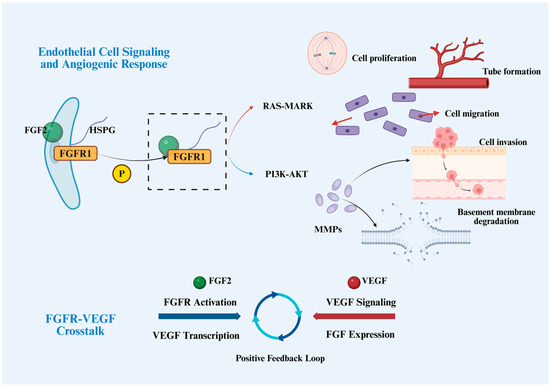
Figure 2.
FGFR Signaling Regulates Tumor Angiogenesis Through Endothelial Cell Activation and VEGF Crosstalk. Upper panel: Tumor-derived FGF2 (green sphere) binds to FGFR1 (orange) and HSPG co-receptor (blue glycan chains) on endothelial cells, inducing receptor dimerization and autophosphorylation (marked as P). Activated FGFR1 triggers RAS-MAPK-ERK (red) and PI3K-AKT (blue) pathways, coordinately driving pro-angiogenic effects. Lower panel: FGFR-VEGF positive feedback loop amplifies angiogenic signaling. FGF2 (left, green sphere) activates FGFR to upregulate VEGF transcription and secretion. Secreted VEGF (right, red sphere) activates VEGFR, reciprocally enhancing FGF expression.
FGFR and VEGF signaling pathways exhibit significant complementarity and positive feedback regulation in tumor angiogenesis. FGFR activation can upregulate VEGF transcription and secretion, while VEGF signaling in turn enhances FGF expression, forming a bidirectional regulatory loop that cooperatively drives neovascularization under specific microenvironmental conditions (Figure 2). This crosstalk not only strengthens the angiogenic capacity of tumors but is also considered a key mechanism underlying compensatory resistance to anti-VEGF therapy. To disrupt such signaling interplay, multi-target tyrosine kinase inhibitors (TKIs), such as nintedanib, which simultaneously target VEGFR, FGFR, and PDGFR, have been developed to attenuate pathway cross-activation. Translational studies have shown that nintedanib effectively suppresses FGFR/VEGFR-mediated angiogenic signaling, improves tumor vascular structure and function, and enhances responsiveness to chemotherapy and immunotherapy. For instance, in non-small-cell lung cancer (NSCLC) xenograft models, nintedanib concurrently inhibits VEGFR and FGFR activities, significantly reduces tumor angiogenesis, and, when combined with immunotherapy, promotes CD8+ T cell infiltration, thereby augmenting antitumor immune responses [126,127,128].
It is noteworthy that aberrant FGFR activation not only Increases the number of blood vessels but also induces structural disorganization and elevated vascular permeability, which together promote tumor cell dissemination and affect drug delivery. Based on the concept of “vascular normalization,” moderate inhibition of FGFR signaling can help restore vascular architecture and enhance the efficacy of chemotherapy and immunotherapy [129,130]. In addition to FGF2, ligands such as FGF9 also play roles in microcirculatory regulation, influencing metastatic potential and tumor dynamics, further underscoring the multifaceted role of FGFR signaling in angiogenesis [131].
3.2.2. Relationship Between FGFR and Immune Cell Infiltration and Immune Evasion
FGFR signaling not only regulates angiogenesis but also reshapes the immune microenvironment to influence immune infiltration and immune evasion. The underlying mechanisms involve cancer-associated fibroblasts (CAFs), myeloid cells, and cytokine networks, which collectively alter immune cell recruitment and function, ultimately affecting the efficacy of immune checkpoint inhibitors (ICIs) [132].
Different FGFR subtypes exert distinct immunomodulatory effects. In gastric cancer, FGFR1 expression correlates positively with CD8+, CD4+, and dendritic cell infiltration, whereas FGFR4 expression shows a negative correlation with lymphocyte infiltration. Functional studies reveal that FGFR1 overexpression enhances the response to PD-1 blockade, while FGFR4 overexpression weakens it, suggesting that different FGFR subtypes shape immune lineages through distinct mechanisms [133].
Mechanistic studies indicate that FGFR inhibition can remodel the tumor microenvironment to enhance effector T cell infiltration. In triple-negative breast cancer models, FGFR inhibition alters CAF secretory profiles and matrix remodeling, markedly increasing CD8+ T cell infiltration and suppressing tumor growth, supporting the rationale for FGFR-TKI and ICI combination therapy [134]. Additionally, FGFR inhibition reduces infiltration of myeloid-derived suppressor cells (MDSCs), decreases the incidence of distant metastases, and further potentiates antitumor immune responses [135].
A key mechanism involves the IFN-γ → JAK/STAT1/IRF1 axis. FGFR activation broadly attenuates IFN-γ-induced transcriptional programs, whereas FGFR inhibition restores them and enhances ICI responsiveness [136]. Tumor-type-specific datasets support this conserved inhibitory effect: in renal cell carcinoma and multiple solid-tumor models, constitutive FGFR signaling diminishes IFN-γ-induced STAT1 phosphorylation and downstream genes such as IRF1, CXCL10, B2M, and PD-L1, while FGFR blockade reinstates this pathway [136]. Similar suppression of interferon-stimulated genes by FGF/FGFR activation has been documented across cellular systems, suggesting a shared biological mechanism rather than a model-restricted phenomenon [137]. In bladder cancer, FGFR3 activation further intersects with IFN-γ signaling by modulating PD-L1 stability through NEDD4-dependent ubiquitination or by altering IFN-γ-induced PD-L1 turnover in FGFR3-TACC3 fusion models [138,139]. By contrast, evidence from FGFR2-fusion intrahepatic cholangiocarcinoma is limited and sometimes inconsistent, underscoring the need for tumor-specific interpretation of FGFR–interferon crosstalk [140,141].
On the other hand, in hepatocellular carcinoma, FGFR4 inhibition promotes PD-L1 ubiquitin–proteasome degradation via GSK3β activation and suppresses IL-2–induced STAT5 phosphorylation to limit Treg differentiation, thereby reducing PD-L1 levels and immunosuppression and enhancing anti-PD-1 efficacy [142]. These mechanisms are not contradictory but rather context-specific, depending on tumor type, FGFR subtype, and molecular background. This highlights the importance of considering tumor-specific contexts when interpreting FGFR–ICI interactions.
3.2.3. Role of FGFR in Cancer-Associated Fibroblasts and Its Crosstalk with Tumor Cells
CAFs are the most abundant stromal cells in the tumor microenvironment and profoundly influence tumor progression by secreting growth factors, cytokines, and extracellular matrix (ECM) components. FGF/FGFR signaling plays a central role in CAF activation and functional maintenance, forming an interactive network among CAFs, immune cells, and tumor cells [143,144].
In gastric cancer, CAF-derived IGFBP7 enhances the FGF2/FGFR1–PI3K/AKT pathway, promoting TAM recruitment and polarization, thereby establishing a pro-tumorigenic CAF–TAM–tumor cell axis [145]. In addition, FGF2 sustains CAF activation via autocrine and paracrine mechanisms. Activated CAFs upregulate MMPs and their regulators (such as TIMPs) through FGFR-related pathways, driving ECM remodeling that both creates invasion channels for tumor dissemination and releases matrix-sequestered pro-tumorigenic factors to amplify signaling [146,147].
The heterogeneity of CAFs has garnered considerable attention. Single-cell sequencing and functional analyses reveal transcriptional and functional differences among CAF subtypes. Differential expression patterns of FGFR isoforms have been observed in some contexts, though such “CAF subtype–FGFR” correspondence is not universal and requires validation across tumor types [148,149].
Recent spatial and single-cell transcriptomic studies further contextualize this heterogeneity. In pancreatic ductal adenocarcinoma (PDAC), inflammatory CAF (iCAF), myofibroblastic CAF (myCAF), and antigen-presenting CAF (apCAF) programs occupy discrete spatial niches and show characteristic proximity to tumor or immune compartments, as demonstrated by integrated spatial and single-cell profiling [150,151]. Similar integrated approaches in breast, colorectal, lung, and skin cancers have delineated conserved CAF subclasses (e.g., iCAF- and myCAF-like populations) while revealing tumor-specific spatial organization and neighborhood interactions. For instance, in breast cancer, spatial transcriptomics combined with scRNA-seq identifies CAF subpopulations with distinct proximity to immune infiltrates and tumor cells, implicating them in immune evasion, tumor progression, and potentially modulating responses to immunotherapy [152]. In colorectal cancer, spatially resolved profiling uncovers multicellular immune hubs involving CAFs that organize immunosuppressive niches [153]. In non-small-cell lung cancer, similar analyses underscore the plasticity of stromal and myeloid compartments, while in cutaneous squamous cell carcinoma and melanoma, CAF-associated stromal remodeling at the tumor interface supports the existence of conserved yet context-dependent stromal states [154,155,156]. Collectively, these integrated datasets refine CAF subset annotation and strengthen evidence for their specialized roles within distinct tumor microenvironments.
FGFR inhibition can partially reverse the pro-tumorigenic effects of CAFs. In triple-negative breast cancer, FGFR blockade remodels CAF phenotypes, enhances CD8+ T cell infiltration, and boosts immune responses [134]. In lung adenocarcinoma, inhibition of the FGF/FGFR pathway suppresses CAF activation and reduces secretion of proinflammatory and prometastatic factors, thereby restraining tumor growth [157]. Furthermore, in prostate cancer, downregulation of miR-15/16 in CAFs relieves repression of the FGF2/FGFR1 axis, further promoting tumor growth and metastasis, highlighting the molecular complexity of CAF–tumor cell interactions [158].
3.2.4. Molecular Mechanisms of FGFR Signaling in Tumor Invasion and Metastasis
FGFR signaling plays a pivotal role in multiple stages of tumor invasion and metastasis by regulating cell adhesion, motility, angiogenesis, and the immune microenvironment [159]. Among these, EMT is a key mechanism that endows tumor cells with migratory and invasive capabilities. Numerous reviews and experimental studies have demonstrated that FGF/FGFR signaling can initiate or potentiate EMT-related molecular programs, typically accompanied by altered expression of EMT-associated transcription factors (such as Snail, Slug, and Twist) and epithelial markers (such as E-cadherin), thereby promoting mesenchymal phenotypes and stem-like properties in tumor cells [130,160]. This transition not only enhances cellular motility and invasiveness but also confers stemness and therapeutic resistance.
In addition, FGFR signaling promotes ECM degradation by regulating the expression and activity of MMPs. Activated FGFR upregulates MMP-2, MMP-9, and MMP-14 via the MAPK and PI3K-AKT pathways. These proteases degrade key ECM components such as collagen, fibronectin, and laminin, thus creating invasion corridors for tumor dissemination. Meanwhile, MMPs can also activate latent growth factors and cytokines, further amplifying pro-metastatic signaling cascades [161].
During hematogenous metastasis, tumor cells must traverse the vascular endothelial barrier. FGFR signaling facilitates this process by regulating endothelial permeability and the expression of adhesion molecules, thereby promoting tumor cell intravasation and extravasation [162]. Studies have shown that FGF2 increases the permeability of endothelial tight junctions and upregulates ICAM-1 and VCAM-1 expression, providing favorable conditions for circulating tumor cell adhesion and transendothelial migration [163,164].
Furthermore, FGFR signaling plays a crucial role in the formation and maintenance of distant metastatic niches. In colorectal cancer liver metastasis, tumor-derived FGF19 acts on FGFR4 expressed in hepatic stellate cells, activating the JAK2–STAT3 pathway and inducing their differentiation into iCAFs. These iCAFs secrete proinflammatory mediators such as IL-1, complement C5a, and various chemokines, which recruit neutrophils and promote the formation of neutrophil extracellular traps (NETs). NETs capture circulating tumor cells and release growth-promoting factors, enhancing tumor cell adhesion, survival, and proliferation in the liver. This “soil conditioning” mechanism enables metastatic cells to adapt and thrive within the new tissue microenvironment (Figure 3) [165,166].
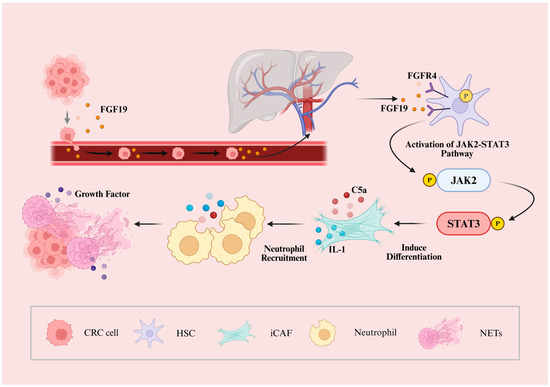
Figure 3.
FGF19-FGFR4 axis promotes colorectal cancer liver metastasis through neutrophil extracellular trap formation. Tumor-derived FGF19 (orange sphere) activates FGFR4 on hepatic stellate cells (HSCs), triggering JAK2-STAT3 signaling and inducing HSC differentiation into inflammatory cancer-associated fibroblasts (iCAFs). iCAFs secrete IL-1 (blue sphere), complement C5a (red sphere), and chemokines to recruit neutrophils and promote NET formation. NETs facilitate colorectal cancer liver metastasis by capturing circulating tumor cells (CTCs) and releasing growth-promoting factors (purple sphere), thereby enhancing tumor cell adhesion, survival, and proliferation in the liver. CRC, colorectal cancer; HSC, hepatic stellate cell; iCAF, inflammatory cancer-associated fibroblast; NETs, neutrophil extracellular traps; CTCs, circulating tumor cells.
Consistent with these mechanistic insights, preclinical CRC liver metastasis models provide causal evidence supporting this FGF19–FGFR4–iCAF–NET axis. Genetic silencing of FGF19 or pharmacologic inhibition of FGFR4 or JAK2 markedly reduces iCAF polarization and hepatic NET deposition [165,167]. Similarly, neutrophil depletion or NET disruption—such as DNase I administration or the use of peptidylarginine deiminase 4 (Padi4)-deficient mice—significantly suppresses metastatic outgrowth. Functionally, NETs not only trap circulating tumor cells but also deliver proliferative and metabolic cues that facilitate micrometastatic expansion, in line with broader evidence implicating NETs in distant seeding and reactivation of dormant cancer cells [167,168,169].
In addition, FGFR signaling regulates the chemokine system; for instance, it upregulates CXCR4 expression, thereby enhancing tumor cell chemotaxis toward CXCL12. In metastatic breast cancer, blockade of CXCR4 signaling not only directly suppresses metastasis but also increases T cell infiltration and improves responses to immunotherapy [170,171]. These findings suggest that the FGFR–CXCR4 signaling axis may represent a promising therapeutic target for anti-metastatic interventions.
While other signaling axes such as HGF/MET and CXCL12/CXCR4 are also critical for metastatic niche formation, FGFR signaling exhibits distinct yet cooperative functional characteristics. The HGF/MET pathway is classically recognized as a primary initiator of “invasive growth” and EMT driven by stromal paracrine signaling, whereas the CXCL12/CXCR4 axis predominantly functions as a “chemotactic compass” guiding tumor cell homing to specific organs like the bone and lung [172,173]. In contrast to single-pathway chemotactic axes such as CXCR4, FGFR signaling operates as both an invasion driver and a microenvironmental “soil remodeler.” FGFs can recruit neutrophils and reshape innate immune composition [174], while FGF2 potently modulates endothelial function and angiogenic programs, including VEGF induction, thereby facilitating intravasation and metastatic seeding [175,176]. FGFR activity also intersects with chemokine-driven trafficking, as FGF2 mobilizes stromal precursors that are subsequently recruited through the CXCL12–CXCR4 axis [177]. In parallel, extensive RTK crosstalk—particularly with MET—reinforces survival signaling and contributes to adaptive resistance to targeted therapies [178,179]. Collectively, these immune, vascular, and cooperative RTK effects define FGFR-driven niches as integrative hubs that strengthen metastatic establishment.
3.3. Phenotypic Diversity Driven by Aberrant FGFR Activation
Aberrant activation of the FGFR signaling pathway is a major driver of tumorigenesis and progression across various solid tumors. Distinct types of FGFR alterations exhibit significant differences at the molecular, cellular, and metabolic levels, leading to diverse tumor phenotypes. This has been well supported by large-scale sequencing analyses and comprehensive reviews [53,180].
3.3.1. Distinct Oncogenic Mechanisms of Different Types of FGFR Alterations
Point mutations often cause constitutive receptor activation by altering receptor conformation or promoting aberrant dimerization. In urothelial carcinoma of the bladder, recurrent FGFR3 hotspot mutations such as R248C, S249C and G370C cluster within the extracellular Ig-like domains or in the linker between the IgII and IgIII domains [181]. Biochemical analyses of the corresponding germline mutations that cause thanatophoric dysplasia type I have shown that substitution of these residues by cysteine introduces unpaired cysteines in the IgII–IgIII linker or juxtamembrane region, thereby promoting the formation of abnormal intermolecular disulfide bonds and covalent receptor dimers with ligand-independent kinase activation [182]. Together with crystallographic and biophysical studies that define how the D1–acid box module and HSPG–mediated FGF–FGFR assembly normally enforce an autoinhibited, ligand-dependent state [20,34], these data support a model in which Cys-substituting FGFR3 mutations found in both bladder cancer and skeletal dysplasias drive constitutive signaling by stabilizing a covalent homodimer that at least partially bypasses D1–acid box-mediated autoinhibition and the strict requirement for HSPG-bridged dimerization, resulting in sustained trans-phosphorylation of the intracellular kinase domains.
The protein levels of FGFR3 are also associated with mutation status and histological differentiation [181,183]. In contrast, in endometrial carcinoma, FGFR2 kinase-domain mutations (such as N550K and K660E) directly enhance kinase activity and alter receptor conformation. Structural studies indicate that these mutations often occur within the ATP-binding pocket or activation loop, disrupting the “molecular brake” mechanism and maintaining constitutive activation [184,185].
Gene amplification primarily enhances physiological signaling via receptor overexpression. Among such alterations, FGFR1 amplification is most prominent in breast cancer. It increases cellular sensitivity to FGF, alters signaling strength and spatiotemporal dynamics, and frequently co-occurs with amplification of the 8p11–12 region harboring multiple oncogenic drivers, thereby influencing prognosis. FGFR1 amplification is also strongly correlated with endocrine therapy resistance. Notably, copy number gain does not always correspond to protein overexpression across tumor subtypes, suggesting a critical role for post-transcriptional regulation in modulating receptor activity [75,96,186]. This genomic instability further contributes to the complexity of amplification-driven oncogenesis.
Gene fusions remodel receptor function through domain rearrangement. In cholangiocarcinoma, the recurrent FGFR2–BICC1 fusion retains the kinase domain but lacks the autoinhibitory region, leading to constitutive activation and altered subcellular localization. This fusion represents a key molecular rationale for FGFR2-targeted therapy.
Emerging evidence indicates that the oncogenicity of FGFR2 fusion proteins is shaped not only by the preserved kinase domain but also by fusion-partner-encoded modules that govern oligomerization and intracellular trafficking [187]. Many recurrent partners, including TACC3 and BICC1, provide coiled-coil, Sterile Alpha Motif, or related multimerization motifs that drive ligand-independent dimerization or higher-order clustering, thereby stabilizing constitutive FGFR activation [188]. For example, in FGFR3–TACC3, the TACC3 coiled-coil domain promotes aberrant oligomerization and redirects the fusion protein to mitotic spindle and centrosomal structures, producing ectopic signaling outputs and mitotic defects [189]. Similarly, BICC1 contains domains that facilitate spontaneous multimerization and influence membrane–endosomal or centrosomal localization, ultimately altering receptor trafficking dynamics [190]. These trafficking alterations—shifting the balance between recycling and lysosomal degradation, or redistributing receptors across plasma membrane, endosomal, or pericentrosomal compartments—can prolong kinase activity and reshape downstream signaling amplitude and duration. Consistent observations across engineered cell systems and functional genomic studies support these mechanisms and highlight disruption of fusion-driven oligomerization or trafficking as a potential therapeutic strategy complementary to kinase inhibition.
Another prototypical example is the FGFR3–TACC3 fusion, which was first identified and remains most prevalent in glioblastoma, with an incidence of approximately 2–5%. Beyond driving constitutive activation, its fusion partner TACC3 regulates cytoskeletal organization, spindle assembly, and cell division, thereby promoting malignant phenotypes. Moreover, this fusion induces distinct transcriptional and metabolic programs depending on the histological and cellular context [191,192,193].
Taken together, different types of FGFR alterations define distinct oncogenic mechanisms and downstream signaling networks: point mutations activate receptors through conformational changes or aberrant dimerization, amplifications enhance signal amplitude via a dosage effect, and fusions induce structural and localization remodeling. This molecular diversity underlies the heterogeneity of clinical phenotypes and therapeutic responses, highlighting the necessity of tailoring FGFR-targeted strategies according to specific alteration types and accompanying genomic contexts.
3.3.2. The Role of FGFR Alterations in Cancer Stem Cell Maintenance and Differentiation
FGFR signaling plays a central role in the self-renewal and pluripotency maintenance of cancer stem cells (CSCs). In glioblastoma, for instance, FGFR1 sustains CSC stemness and EMT-related phenotypes through an ADAMDEC1–FGF2 autocrine loop that activates ERK1/2 signaling and upregulates transcription factors such as ZEB1 [194]. Moreover, in other solid tumors, such as non-small-cell lung cancer with FGFR1 amplification, the same alteration has been shown to induce “stem cell-like” characteristics, suggesting that this pathway exerts a conserved role in maintaining stemness across different tissue contexts [195].
This regulation extends beyond transcriptional control and involves chromatin remodeling mechanisms. Nuclear-localized FGFR1 can bind chromatin and colocalize with active histone marks, as supported by ChIP-seq and transcriptomic analyses, thereby reorganizing the transcriptional program of stemness-associated genes and influencing therapeutic sensitivity [196].
In hematologic malignancies—particularly myeloid or mixed-phenotype leukemias harboring FGFR1 fusions—the constitutive kinase activity of fusion proteins interferes with myeloid differentiation, leading to differentiation blockade, accumulation of immature progenitors, and clonal expansion that confers enhanced chemoresistance [197,198,199]. Patient-derived models and single-cell sequencing analyses have further demonstrated the heterogeneity in differentiation states driven by FGFR alterations. FGFR1 amplification or overexpression often results in disrupted differentiation hierarchies: some cells retain CSC-like features, while others display aberrant differentiation-related transcriptional profiles. The coexistence of these subpopulations is closely associated with treatment response variability [200,201].
The CSC niche, composed of CAFs, vascular endothelial cells, and other stromal components, sustains CSC activity through the secretion of exogenous FGFs [119,202]. In colorectal and other solid tumor models, stromal cell-derived or membrane-bound FGFs (such as FGF2) activate downstream FGFR signaling to promote tumor cell migration, invasion, and stem-like phenotypes. Recent studies have further demonstrated that FGFR signaling cooperates with multiple downstream pathways, including MAPK, PI3K, STATs, and SRC family kinases, to orchestrate these processes [203,204]. Furthermore, CSCs often localize within specialized microenvironmental niches, such as perivascular regions or tumor-invasive fronts, where local FGFR overexpression correlates positively with CSC enrichment. This suggests a spatially coordinated interaction between FGFR signaling and microenvironmental cues in shaping CSC heterogeneity and site-specific behavior [205,206].
Overall, FGFR abnormalities maintain CSC phenotypes and shape differentiation trajectories through multilayered mechanisms—including transcriptional regulation, chromatin remodeling, disruption of differentiation programs, and microenvironmental interactions—collectively driving tumor resistance, recurrence, and invasion. However, the precise molecular consequences vary significantly among tumor types and distinct FGFR alteration forms.
3.3.3. Effects of FGFR Signaling on Tumor Metabolic Reprogramming
FGFR signaling plays a pivotal role in tumor metabolic reprogramming, particularly in glycolytic and lipid metabolic pathways. In lung squamous cell carcinoma models, FGFR1 signaling activates the PI3K–AKT–mTOR axis, leading to HIF-1α accumulation and upregulation of GLUT1, thereby enhancing glucose uptake and glycolysis—the hallmark Warburg effect. In addition, FGFR1 regulates glucose metabolism through its interaction with PKM2, modulating its phosphorylation status and subcellular localization. Metabolomic analyses have further revealed that FGFR aberrations promote glycolytic bias by altering lactate dehydrogenase (LDH) isoenzyme composition—upregulating LDHA while downregulating LDHB—which collectively supports tumor growth and metabolic flexibility [207,208,209,210].
In terms of lipid metabolism, FGFR signaling has been shown to activate lipogenic pathways across multiple tumor models, particularly in FGFR3-altered bladder cancer. It upregulates SREBP1 downstream targets, such as SCD1 and FASN, thereby promoting monounsaturated fatty acid synthesis and membrane biogenesis. These findings indicate that FGFR aberrations can drive lipid metabolic reprogramming. Lipidomic studies have also demonstrated a close association between the RTK/PI3K signaling axis and lipid metabolism, whereby FGFR–PI3K signaling supports downstream transduction by modulating levels of phospholipid precursors, such as PIP2, ultimately influencing membrane composition and signal propagation [211,212,213].
3.3.4. Single-Cell Heterogeneity of FGFR Expression and Its Biological Significance
Single-cell sequencing has revealed a high degree of heterogeneity in FGFR expression within tumor tissues. Multiple single-cell and spatial transcriptomic studies have shown that FGFR expression varies markedly across cellular subpopulations, and FGFR-high cells are frequently colocalized with invasive, stem-like phenotypes or microenvironmental niches enriched in angiogenic and immunosuppressive features. This phenomenon has been observed, to varying extents, across several solid tumors, including pancreatic cancer, head and neck squamous cell carcinoma, and lung cancer [214,215,216].
Pseudotime trajectory and clonal dynamics analyses further demonstrate that FGFR expression correlates with cell differentiation states and clonal selection. For example, in head and neck squamous cell carcinoma and breast cancer, FGFR-high subpopulations typically exhibit transcriptional signatures resembling stem/progenitor cells, whereas FGFR-low or -negative subgroups show a trend toward differentiation lineages. Under therapeutic pressure, rare resistant or “refuge” subclones may expand and drive tumor recurrence—a dynamic process directly observed in longitudinal studies of FGFR-driven cholangiocarcinoma [13,217].
In addition, single-cell ligand–receptor interaction analyses and spatial transcriptomic tools have been applied to dissect the roles of FGFR-mediated signaling circuits among tumor cells, CAFs, and immune cells. These integrative analyses provide fresh insights into therapeutic response and resistance mechanisms and suggest that FGFR-targeted therapies should account for cooperative and compensatory interactions within the tumor microenvironment [218].
4. FGFR-Targeted Therapy: Drug Development and Clinical Applications
4.1. Classification and Mechanisms of FGFR Inhibitors
The development of FGFR inhibitors has evolved from non-selective multi-target inhibition toward highly selective and precise targeting. With deeper insights into FGFR structural biology and advances in rational drug design, a variety of strategies have emerged, including small-molecule TKIs, monoclonal antibodies, ADCs and novel delivery platforms. Understanding the design principles and clinical profiles of different inhibitor classes is essential for precision oncology and the development of next-generation therapeutics.
4.1.1. Design Concepts and Clinical Performance of Selective vs. Non-Selective Inhibitors
Early FGFR inhibitors were predominantly non-selective multi-target TKIs, such as nintedanib and dovitinib. Nintedanib inhibits VEGFR, FGFR, and PDGFR simultaneously and demonstrated moderate efficacy in NSCLC but was frequently associated with diarrhea, hepatotoxicity, and vascular-related adverse events [128,219]. Dovitinib exhibits inhibitory activity against FGFR1–3, VEGFR, FLT3, and c-KIT, yet clinical trials in breast and renal cancers reported limited efficacy and substantial toxicity, restricting its clinical utility [220,221]. These early attempts highlighted a key trade-off: while non-selective inhibitors benefit from broad target coverage and potential multi-target synergism, their lack of specificity often leads to off-target toxicity and suboptimal therapeutic precision.
With advances in structural biology, the development of selective FGFR inhibitors has become increasingly sophisticated. These agents are designed to exploit the unique structural features of FGFR kinase domains, thereby improving target specificity and minimizing off-target effects [222]. Erdafitinib, the first selective FGFR inhibitor approved by the U.S. FDA, demonstrates high affinity toward FGFR1–4 (IC50: 1.8–10.8 nM). In patients with FGFR3-altered urothelial carcinoma, erdafitinib achieved an objective response rate (ORR) of 40%, markedly outperforming chemotherapy, which yielded an ORR of 13% [5,223].
Pemigatinib, a reversible ATP-competitive inhibitor, binds to the ATP-binding pocket of FGFR1–3, effectively suppressing their kinase activities. In the FIGHT-207 basket trial, pemigatinib demonstrated an ORR of 26.5% and a median progression-free survival (PFS) of 4.5 months among patients harboring FGFR fusions or rearrangements [224].
Futibatinib, a next-generation covalent FGFR inhibitor, exhibits potent antitumor activity, particularly in tumors harboring FGFR2 and FGFR3 mutations. Through optimized scaffold design, futibatinib overcomes several resistance-associated mutations and shows strong promise in both preclinical and early-phase clinical studies. Its molecular configuration enhances binding affinity for FGFR kinases while reducing nonspecific inhibition of other kinases. This highly selective targeting of FGFR2 and FGFR3 translates into superior efficacy and improved tolerability in genetically defined tumor subtypes [225].
4.1.2. Development Strategies for Monoclonal Antibodies and Antibody–Drug Conjugates
Monoclonal antibodies (mAbs) inhibit FGFR signaling by blocking ligand–receptor interactions or preventing receptor dimerization, representing a mechanism distinct from that of small-molecule TKIs. Bemarituzumab is a humanized monoclonal antibody targeting FGFR2b, which inhibits ligand binding of FGF7 and FGF10. In a phase II clinical trial involving patients with gastric and gastroesophageal junction cancer, bemarituzumab in combination with chemotherapy significantly improved progression-free survival (PFS) (9.5 vs. 7.4 months) and demonstrated a favorable efficacy profile [226].
Vofatamab (B-701) is a monoclonal antibody targeting FGFR3, which acts through allosteric binding to the extracellular domain to block receptor activation. In early clinical studies, vofatamab combined with pembrolizumab in patients with metastatic urothelial carcinoma refractory to platinum-based therapy showed acceptable safety and preliminary signals of efficacy, suggesting that this combination approach warrants further clinical investigation [227].
ADCs combine the target specificity of monoclonal antibodies with the cytotoxic potency of chemotherapeutic payloads, earning them the nickname “biological missiles”. However, the development of FGFR-targeted ADCs faces multiple challenges, including the optimization of antibody selection, linker–payload design, and management of FGFR-specific toxicities [228].
Aprutumab ixadotin (BAY 1187982) was among the first FGFR2-targeting ADCs. Although it demonstrated selective cytotoxic activity against FGFR2-overexpressing tumors in preclinical models, its phase I clinical trial was terminated due to severe proteinuria and hematologic toxicities. Subsequent reviews have cited this case as an example to illustrate linker-associated toxicity and the unique risk profile of FGFR-targeted ADCs [229,230,231]. A novel tetravalent anti-FGFR1 ADC has recently been developed to enhance binding avidity and internalization efficiency. In vitro studies showed 5–10-fold greater cytotoxic potency compared to traditional bivalent ADCs, and superior antitumor efficacy was further validated in xenograft models [232,233].
The design of the ADC linker is a critical determinant of both therapeutic efficacy and safety. Cleavable linkers, such as the valine–citrulline linker, release their cytotoxic payload upon lysosomal enzymatic cleavage, while non-cleavable linkers require complete degradation of the antibody to liberate the drug [234]. Most FGFR-targeted ADCs employ cleavable linkers to ensure efficient intracellular drug release within target cells [235]. Emerging pH-sensitive or glutathione-responsive linkers exploit the unique biochemical characteristics of the tumor microenvironment to achieve precise site-specific drug release, potentially improving the therapeutic index and mitigating the impact of FGFR expression heterogeneity on treatment outcomes [236,237].
4.1.3. Advances in Novel Targeted Delivery Systems and Nanomedicine Carriers
The efficient internalization properties of FGFR confer a unique advantage for developing targeted delivery systems [187]. Upon ligand binding, FGFR undergoes clathrin-mediated endocytosis, a process that has been leveraged to engineer diverse FGFR-targeted carriers. For instance, constructs that use FGF1 as the recognition module and are conjugated to fluorescent oligomers can integrate targeting, tracking, and toxin loading. A representative molecule, 3xGFPp_FGF1–MMAE, exhibits nanomolar affinity and marked cytotoxicity toward FGFR1-high cells in vitro, while showing minimal effects on FGFR1-negative cells, indicating potential for imaging-guided and precision delivery applications [238].
Nanotechnology provides a platform for improving the stability, targetability, and therapeutic index of FGFR inhibitors, including liposomes, polymeric nanoparticles, and inorganic nanocarriers, but still faces challenges in clinical translation such as Enhanced Permeability and Retention effect (EPR) heterogeneity, in vivo clearance, and scaled-up manufacturing [239,240]. Notably, the robust EPR effect observed in rapidly growing murine xenografts is substantially weaker and more heterogeneous in human solid tumors [241]. Clinical and preclinical studies using quantitative imaging of radiolabeled or MRI/PET-tracked nanomedicines indicate that, in patients, only a limited and highly variable fraction of the injected dose accumulates in tumor tissue, with variability influenced by tumor type, anatomical site, stromal architecture, vascular normalization status, and prior therapies [242,243]. This mismatch between preclinical and clinical EPR behavior is thought to be one important factor contributing to the observation that many EPR-dependent nanomedicines with impressive efficacy in mouse models have achieved only modest, if any, overall survival benefit in late-phase clinical trials [244,245].
To mitigate this translational gap, current strategies increasingly explore functional “EPR imaging” (e.g., dynamic contrast-enhanced MRI or nanocarrier-based MRI/PET) for patient and lesion stratification, transient modulation of tumor vasculature in rational combinations to improve perfusion, and the development of actively targeted or stimuli-responsive carriers designed to be less reliant on passive EPR for intratumoral delivery [246,247,248,249].
Targeted liposomes typically achieve active targeting through surface modification with anti-FGFR antibodies or ligands, enabling prolonged circulation time and accumulation in tumor tissues. Preclinical studies have demonstrated that encapsulating FGFR-active compounds in targeted liposomes or other nanocarriers can achieve superior antitumor efficacy compared to free drug and a more controllable systemic toxicity profile in animal models [250,251].
Polymer–drug conjugates (PDCs) offer an additional option for delivering FGFR inhibitors. By tethering drugs to polymers via biodegradable linkages, PDCs enable controlled release and targeted delivery. PDC formulations of FGFR inhibitors have shown improved pharmacokinetic profiles and enhanced antitumor activity in preclinical and early-phase studies; however, further evidence is required to establish their clinical utility [252,253,254].
In addition, smart stimuli-responsive delivery systems leverage features of the tumor microenvironment to achieve precise release. For example, pH-responsive nanocarriers accelerate drug release under acidic conditions, whereas enzyme-responsive carriers rely on tumor-overexpressed proteases such as MMPs to cleave linkers and liberate the payload. These “microenvironment-responsive” strategies have demonstrated promising controlled-release behavior and targeting potential in vitro and in selected in vivo models, yet a meaningful gap to clinical translation remains [255,256,257].
4.2. Clinical Efficacy Evaluation of Approved FGFR Inhibitors
The evidence-based evaluation of approved FGFR inhibitors provides a scientific foundation for precision oncology strategies. Table 2 summarizes the key trial designs and efficacy outcomes of major FGFR inhibitors across different cancer types. With the regulatory approvals of pemigatinib, erdafitinib, and futibatinib in multiple countries, the body of clinical data regarding their efficacy and safety has expanded, while real-world studies continue to supplement findings from pivotal registration trials.
Table 2.
Clinical Efficacy and Trial Design of FGFR Inhibitors Across Different Tumor Types and Molecular Alterations.
4.2.1. Clinical Trial Outcomes of Pemigatinib in Cholangiocarcinoma
The FIGHT-202 trial (Phase II, multicenter, open-label) demonstrated the antitumor efficacy of pemigatinib in previously treated patients with FGFR2 fusion or rearrangement–positive cholangiocarcinoma. The initial analysis reported an ORR of approximately 35.5%, a disease control rate (DCR) of about 82%, a median PFS of 6.9 months, and a median overall survival (OS) of 21.1 months [4]. An independent review committee (IRC)-based long-term follow-up analysis further validated these results, showing an ORR of 37.0%, median duration of response (DOR) of 9.1 months, median PFS of 7.0 months, and median OS of 17.5 months [258].
In the broader FIGHT-207 trial (Phase II, basket study encompassing multiple tumor types and FGFR alterations), the ORR was 26.5% among patients with FGFR fusions or rearrangements, while those harboring activating non-kinase domain mutations exhibited an ORR of only 9.4%, underscoring a marked difference in pemigatinib sensitivity across distinct FGFR alteration types, and providing direct evidence to support molecular stratification in clinical practice [224].
The ongoing FIGHT-302 study (Phase III, randomized controlled trial; pemigatinib vs. gemcitabine + cisplatin, 2:1 randomization; primary endpoint: PFS) is designed to evaluate the efficacy and safety of pemigatinib as first-line therapy for advanced FGFR2-rearranged cholangiocarcinoma. The trial has not yet reported final endpoint data [259].
In terms of safety, both clinical trials and subsequent pooled analyses have identified hyperphosphatemia as the most common treatment-related adverse event, with a relatively high incidence rate. Effective management—including dose adjustment, low-phosphate diets, and use of phosphate binders—is recommended to maintain treatment adherence and optimize long-term benefit. Real-world data generally confirm efficacy and safety outcomes consistent with clinical trial findings but highlight the critical role of toxicity management in improving clinical outcomes [4,258].
4.2.2. Efficacy and Safety of Erdafitinib in Bladder Cancer
The BLC2001 trial, a pivotal phase II registration study, evaluated erdafitinib in 99 patients with advanced urothelial carcinoma harboring FGFR alterations. The trial reported an ORR of 40%, a median DOR of 5.6 months, and a median PFS of 5.5 months. Subgroup analysis revealed a higher ORR among patients with FGFR3 mutations (49%) compared with those with FGFR fusions (33%), indicating that the type of FGFR alteration may influence therapeutic response [5,260].
The phase III THOR trial, which enrolled 266 patients with FGFR-altered advanced urothelial carcinoma, compared erdafitinib with standard chemotherapy. Erdafitinib significantly improved OS, achieving a median OS of 12.1 months versus 7.8 months with chemotherapy (p = 0.005), thereby establishing its role as the standard of care for patients with FGFR-altered urothelial carcinoma [261].
The RAGNAR trial, an international, single-arm phase II study, was designed to systematically evaluate the efficacy and safety of erdafitinib in patients with advanced or metastatic solid tumors harboring FGFR1–4 alterations. In the overall study population, erdafitinib achieved an ORR of 29% and a median DOR of 6.9 months, supporting the tumor-agnostic druggability of FGFR-driven malignancies. Notably, in the cholangiocarcinoma cohort, erdafitinib demonstrated robust antitumor activity, with an ORR of approximately 60% and a median PFS of around 8.5 months [262].
With respect to safety, pooled analyses identified the most common treatment-related adverse events as dry skin (74%), fatigue (36%), diarrhea (32%), and hyperphosphatemia (>50%) [265]. Hyperphosphatemia represents a mechanism-related, on-target toxicity, while ocular adverse events—including central serous retinopathy—occurred in about 25% of patients, were largely reversible, and required regular ophthalmologic evaluation and serum phosphate monitoring to optimize the balance between efficacy and tolerability [266].
4.2.3. Clinical Advances of Futibatinib and Next-Generation FGFR Inhibitors
The FOENIX CCA2 trial, a pivotal phase II registration study, enrolled 103 patients with advanced iCCA harboring FGFR2 fusions or rearrangements. The study reported an ORR of 42%, a median PFS of 9.0 months, and a median OS of 21.7 months, demonstrating durable and clinically meaningful benefit in this molecularly defined population [191].
Exploratory genomic analyses indicated no significant efficacy difference between BICC1 and non BICC1 fusion partners (ORR = 41.7% vs. 44.6%). Moreover, a rapid decline in circulating tumor DNA (ctDNA) after treatment correlated with improved clinical outcomes, underscoring the potential utility of liquid biopsy for response monitoring and early detection of resistance. Mechanistic studies revealed that secondary FGFR2 kinase domain mutations represent the predominant mechanism of acquired resistance, with specific sites such as L617 reducing inhibitor sensitivity. The irreversible binding mode of futibatinib confers activity against certain resistant mutants; however, polyclonal secondary mutations remain a major therapeutic challenge [267].
Among emerging agents, RLY 4008 (lirafugratinib), a highly selective FGFR2 inhibitor, has demonstrated exceptional target specificity and broad activity against resistance mutations in early clinical evaluation. Preliminary results from the phase I ReFocus study showed encouraging antitumor activity at the recommended dose in FGFR2 driven malignancies. These findings suggest that sequential use of more selective FGFR inhibitors may offer a novel strategy to extend the durability of FGFR targeted therapy [263,264].
4.2.4. Real World Evidence on the Efficacy and Safety of FGFR Inhibitors
A large-scale pharmacovigilance analysis based on the FDA Adverse Event Reporting System (FAERS) evaluated real world safety profiles of erdafitinib, pemigatinib, and futibatinib. Overall, the safety spectrum in real world settings was consistent with findings from registration trials, although certain rare but serious adverse events appeared at slightly higher frequencies, likely reflecting patient heterogeneity and reporting bias [268]. For instance, pemigatinib associated calciphylaxis has been reported in real world cases but was not observed in clinical trials [269].
In terms of clinical effectiveness, real world outcomes generally aligned with pivotal trial data but demonstrated modest variations due to differences in patient selection and response assessment. In a real-world cohort of 120 pemigatinib treated patients, the real-world ORR was 59.2%, and the median real world PFS was 7.4 months, exceeding those reported in the FIGHT 202 trial [270]. This improvement may reflect selection bias toward patients with more favorable baseline characteristics and non-uniform response assessment methods.
Real world populations also exhibited greater clinical complexity, including a higher prevalence of hepatic dysfunction and heavily pretreated disease, which likely contributed to outcome variability and underscored the limitations of real-world evidence studies [258,271]. Furthermore, inconsistent quality of FGFR genomic testing markedly influenced efficacy evaluations. Patients assessed using standardized next-generation sequencing (NGS) platforms showed significantly better outcomes than those tested by non-standardized methods [73]. Thus, establishing uniform FGFR testing standards is essential for enhancing clinical reproducibility and improving the reliability of real-world evidence.
5. Mechanisms of Resistance and Therapeutic Strategies
5.1. Molecular Basis of Resistance to FGFR Targeted Therapy
Resistance to FGFR targeted therapy represents a major barrier to sustaining durable clinical benefit, arising from highly diverse and complex molecular mechanisms. With the expanding clinical use of FGFR inhibitors, therapeutic resistance has become increasingly apparent. Detailed elucidation of the underlying mechanisms provides crucial insights into treatment failure and informs the design of next-generation inhibitors and predictive biomarkers [52]. Current evidence suggests that FGFR targeted resistance primarily results from acquired FGFR structural mutations, activation of compensatory bypass pathways, and clonal evolution driven by tumor heterogeneity, reflecting the multifaceted nature of therapeutic escape.
5.1.1. Molecular Characteristics and Structural Basis of Acquired Resistance Mutations
Acquired mutations constitute the most prevalent mechanism of resistance to FGFR inhibitors, with gatekeeper mutations being the archetypal example. These mutations occur within the ATP binding pocket of the kinase domain, where substitution of small residues (e.g., valine) with bulkier amino acids (e.g., methionine or phenylalanine) introduces steric hindrance that impedes inhibitor access or proper orientation, thereby diminishing drug affinity. Canonical examples include FGFR1 V561M, FGFR2 V564F, and FGFR3 V555M [272,273,274]. Structural studies reveal that such mutations disrupt key hydrophobic interactions, promote stabilization of the active kinase conformation, and may enhance catalytic turnover, while also altering the kinetic stability of the inhibitor–protein complex rather than merely increasing ATP affinity [275].
Beyond gatekeeper substitutions, additional secondary mutations within the FGFR kinase domain have been implicated in clinical resistance. In patients with FGFR2 fusion–positive cholangiocarcinoma, approximately 60% develop one or more secondary FGFR2 kinase domain alterations upon progression, most frequently at N550 and V565 [12]. These mutations exhibit heterogeneous modes of action: N550 variants disrupt hydrogen bond networks within the hinge/molecular brake region, destabilizing the autoinhibited conformation, whereas gatekeeper like mutations primarily confer resistance via steric interference with inhibitor binding [276,277].
Molecular dynamics simulations further demonstrate that V564F/V565F mutations markedly reduce the structural stability of complexes formed between reversible ATP competitive inhibitors (e.g., pemigatinib and infigratinib) and FGFR2, providing a mechanistic explanation for the distinct resistance profiles observed across clinical and preclinical settings [275,278].
5.1.2. Bypass Signaling Activation as a Mechanism of Resistance
Upon pharmacologic blockade of FGFR signaling, tumor cells frequently exploit alternative RTKs and their downstream cascades to sustain proliferation and survival. Multiple RTKs—including EGFR, MET, ErbB3, and EphB3—have been validated across diverse preclinical models as key mediators of acquired resistance to FGFR inhibitors [279,280,281]. Their activation is driven by multifactorial mechanisms, encompassing transcriptional upregulation, enhanced protein stability, and increased availability of extracellular ligands, collectively enabling tumor cells to circumvent FGFR dependency and restore oncogenic signaling.
PI3K–AKT signaling represents a pivotal downstream effector of FGFR and constitutes a major bypass mechanism underlying therapeutic resistance. Loss or functional impairment of PTEN results in sustained accumulation of PIP3, thereby maintaining AKT activation even under FGFR inhibition and consequently diminishing inhibitor sensitivity [282,283,284]. In addition, reduced expression or inactivation of pleckstrin homology-like domain family A member 1 (PHLDA1)—a critical negative regulator of PI3K–AKT signaling—can unleash AKT activity and promote a resistant phenotype, a mechanism functionally validated in multiple RTK-driven tumor models [285,286].
Reactivation of the RAS–MAPK cascade represents another prevalent route to escape FGFR-targeted therapy. Acquired NRAS/KRAS amplifications or gain-of-function mutations have been detected in resistant tumor specimens, while downregulation of DUSP6—a phosphatase specifically targeting ERK—can sustain ERK phosphorylation and propagate proliferative output. Such convergent rewiring of the MAPK pathway highlights the inherent vulnerability of monotherapy against a single RTK, which is frequently bypassed by resilient downstream oncogenic signaling [287,288].
Beyond canonical oncogenic cascades, metabolic rewiring and autophagy have emerged as increasingly critical drivers of therapeutic resistance. In gastric cancer models, FGFR inhibition has been shown to activate the TAK1/AMPK axis and enhance autophagic flux, thereby enabling resistant cells to withstand metabolic and pharmacologic stress; concurrently, transcription factor EB (TFEB), a lysosome–autophagy master regulator, undergoes nuclear translocation to upregulate lysosomal and autophagy-associated gene programs, further strengthening cellular stress tolerance [289,290]. These findings collectively illustrate that, when classical RTK pathways are blocked, tumor cells can acquire alternative survival routes through metabolic adaptability and autophagy activation, ultimately inducing or sustaining resistance. However, substantial heterogeneity has been observed across distinct tumor types and molecular subgroups, suggesting that rational combinations or sequential strategies co-targeting downstream MAPK/PI3K signaling or metabolic vulnerabilities may outperform FGFR monotherapy in delaying or overcoming resistance.
5.1.3. The Role of Tumor Heterogeneity and Clonal Evolution in Resistance
Tumor heterogeneity represents a fundamental driver of resistance to FGFR-targeted therapies, manifesting across both temporal and spatial dimensions. Multi-omics profiling and rapid autopsy analyses have demonstrated that FGFR inhibitors can profoundly reshape the clonal architecture of cholangiocarcinoma: dominant FGFR-altered clones prior to treatment diminish following FGFR blockade, whereas minor subclones harboring secondary resistance mutations expand under therapeutic pressure and ultimately gain dominance [115,217]. Single-cell and high-resolution omics studies further reveal that these resistant subpopulations may pre-exist at low frequency before therapy, with drug exposure promoting their accelerated expansion. Such competitive or replacement clonal dynamics ultimately select for fitter clones, which govern the emergence of resistant phenotypes [291].
ctDNA has emerged as a powerful tool for real-time tracking of clonal evolution. Longitudinal analyses demonstrate that resistance-associated mutations can arise prior to radiographic progression, indicating opportunities for earlier therapeutic intervention. Moreover, ctDNA profiling reveals the prevalent nature of polyclonal resistance: diverse resistant mutations may coexist within the same patient, underscoring the tumor’s ability to deploy multiple escape strategies simultaneously. This complexity explains why next-generation inhibitors alone often fail to fully eradicate resistance and highlights the necessity of rational combination therapies [12,292].
Clinical and multi-omics investigations suggest that resistant and sensitive clones may engage in competitive, coexistent, or even cooperative interactions. However, current evidence largely stems from observational molecular profiling, with limited real-time tumor ecology or functional validation. Future studies integrating high-resolution longitudinal omics, dynamic ctDNA monitoring, and ecological modeling will be essential to elucidate the evolutionary trajectories of resistance and optimize personalized therapeutic strategies [115].
5.1.4. Epigenetic Alterations Shaping Sensitivity to FGFR-Targeted Therapy
Epigenetic dysregulation plays a multilayered role in modulating resistance to FGFR-targeted therapies. Aberrations in chromatin-remodeling complexes—particularly loss of function of the SWI/SNF complex—represent an important molecular dimension influencing therapeutic response and have been directly implicated in adaptive resistance to FGFR inhibition in selected models [293]. In lung cancer and other solid tumors, deficiency of key SWI/SNF subunits (such as SMARCA4/BRG1) profoundly reorganizes chromatin architecture and transcriptional circuitry, thereby reshaping cellular sensitivity to multiple anticancer agents.
Mechanistically, SMARCA4 loss promotes heterochromatin accumulation and elevates replication stress, rendering tumor cells increasingly dependent on ATR signaling and consequently more vulnerable to ATR inhibitors in vitro and in vivo [294,295]. Moreover, SMARCA4/2 deficiency drives enhancer reprogramming and global transcriptional rewiring, activating MYC-linked or lineage plasticity programs and perturbing the DNA damage response (DDR), which in certain contexts confers potential susceptibility to PARP inhibition or ATR/PARP combinatorial strategies [296,297]. In addition, SMARCA4 defects attenuate expression of apoptosis-related programs—including mechanisms associated with impaired ER-to-mitochondria Ca2+ transfer—resulting in diminished responses to chemotherapy and other targeted agents (Figure 4) [298]. Although these molecular axes provide strong biological rationale for exploiting drug vulnerabilities in SMARCA4-deficient contexts, whether SMARCA4 directly drives clinical resistance to FGFR inhibitors remains to be validated through larger multi-omics datasets and longitudinal cohorts.
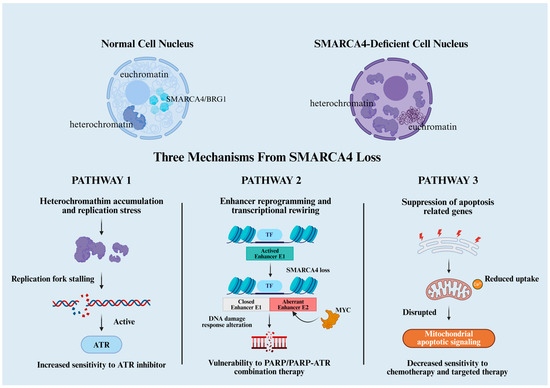
Figure 4.
Molecular Mechanisms Underlying SMARCA4/BRG1 Loss-Mediated Therapeutic Response in Cancer. Upper panel: Chromatin organization in normal versus SMARCA4-deficient cell nuclei. The SMARCA4/BRG1 complex maintains euchromatin-heterochromatin balance in normal cells (left). SMARCA4 loss (right) causes global heterochromatin accumulation and reduced chromatin accessibility. Pathway 1 (left): Heterochromatin accumulation and replication stress. SMARCA4 deficiency promotes excessive heterochromatin formation (purple clusters), causing replication fork stalling and DNA damage. Persistent replication stress activates ATR signaling, creating oncogenic addiction to ATR-mediated DNA damage response and conferring sensitivity to ATR inhibitors. Pathway 2 (center): Enhancer reprogramming and transcriptional rewiring. SMARCA4 loss induces enhancer reprogramming, converting active enhancers to closed or aberrantly activated states. This activates MYC signaling and alters DNA damage response (DDR) gene expression, conferring vulnerability to PARP inhibitors. Pathway 3 (right): Suppression of apoptosis-related genes. SMARCA4 deficiency downregulates pro-apoptotic genes, disrupting ER-to-mitochondria Ca2+ transfer. Impaired mitochondrial Ca2+ uptake compromises apoptotic signaling, reducing sensitivity to chemotherapy and FGFR-targeted therapy.
Abnormalities in histone deacetylases (HDACs) may also contribute to resistance against FGFR-targeted therapies. Emerging evidence suggests that members such as HDAC2 promote tumor cell survival and drug-refractory phenotypes by modulating cell-cycle regulators, apoptosis pathways, EMT and cancer stemness features [299,300]. Although these findings have been supported in vitro and in animal models, causal evidence within the specific context of FGFR inhibition remains limited, underscoring the need for further functional and translational studies to define their actionable relevance.
DNA methylation represents another critical epigenetic determinant. FGFR-altered tumors frequently demonstrate unique methylation landscapes associated with transcriptional states and therapeutic responsiveness; however, systematic evidence remains insufficient, particularly regarding whether FGFR inhibitor treatment induces widespread remodeling of methylation programs involving DNA repair and cell death genes [301]. In glioblastoma, MGMT promoter methylation is strongly associated with enhanced sensitivity to alkylating chemotherapy, suggesting that impaired DNA repair capacity may modulate treatment response. Yet, whether similar principles apply to FGFR inhibition remains hypothetical, lacking direct clinical validation [302,303].
Non-coding RNAs, particularly microRNAs (miRNAs), play pivotal roles in therapeutic resistance regulation. Accumulating evidence demonstrates that the miR-100 family orchestrates FGFR3 expression through direct targeting of its 3′ untranslated region (3′UTR). In urothelial carcinoma, reduced miR-100 expression correlates with aberrant FGFR3 activation and enhanced downstream signaling, implicating the miR-100-associated non-coding RNA regulatory networks in modulating drug sensitivity and acquired resistance in FGFR-driven malignancies [304,305].
Emerging insights further reveal that lysosomal biology constitutes an underappreciated mechanism of resistance to small-molecule targeted therapies. Under therapeutic stress, the TFEB undergoes nuclear translocation and induces the expression of lysosomal and autophagy-related genes, thereby augmenting lysosomal biogenesis and functional capacity [290]. Certain small-molecule inhibitors—particularly lipophilic weak bases—undergo lysosomal sequestration, which substantially diminishes their effective intracellular concentrations at target sites. Moreover, alterations in vacuolar-type H+-ATPase (V-ATPase) function or expression modulate lysosomal acidification status, potentiating this resistance phenotype [306,307,308]. While these mechanisms have been validated across diverse experimental models and provide a compelling framework for understanding intracellular drug distribution and resistance, direct clinical evidence specific to FGFR inhibitors remains limited, warranting rigorous investigation.
5.2. Prediction, Monitoring, and Early Intervention Strategies for Therapeutic Resistance
As FGFR-targeted therapies gain widespread clinical adoption, acquired resistance has emerged as the principal barrier limiting durable patient benefit. Establishing a systematic framework for resistance management necessitates not only mechanistic elucidation of resistance pathways but also the development of robust predictive tools, implementation of dynamic surveillance systems, and formulation of evidence-based early intervention protocols. The convergence of multi-omics-integrated prediction models, real-time ctDNA monitoring platforms, and artificial intelligence-driven personalized treatment algorithms has ushered in unprecedented opportunities for comprehensive resistance management in FGFR-driven malignancies. This multidimensional approach to resistance mitigation holds promise not only for enhancing therapeutic efficacy but also for postponing resistance emergence, ultimately improving patient clinical outcomes and long-term survival.
5.2.1. Resistance Prediction Models Integrating FGFR Genomic Alterations and Proteomic Profiling
Integrative prediction models incorporating FGFR genomic alterations and proteomic profiling have emerged as a pivotal approach for precision resistance prognostication. Multi-omics frameworks integrating genomic and proteomic signatures have demonstrated superior predictive performance relative to single-biomarker approaches across multiple cohort studies. However, prospective clinical validation remains nascent, with existing evidence predominantly derived from retrospective cohort analyses and exploratory early-phase trial investigations [309,310].
Proteomics and phosphoproteomics investigations have illuminated complex nonlinear relationships between genetic alterations and functional phenotypes, providing a rational foundation for patient-specific therapeutic target prioritization [311]. In cholangiocarcinoma, patients harboring identical FGFR2 fusions frequently exhibit marked heterogeneity in molecular profiles and downstream signaling cascades. Converging evidence indicates that aberrant activation of compensatory pathways closely associates with intrinsic or acquired resistance, manifesting distinct patient-specific patterns [191,287]. Consequently, elucidating resistance mechanisms typically necessitates serial biopsies or longitudinal ctDNA profiling to guide subsequent targeted strategies or sequential treatment selection. Recent investigations and comprehensive reviews consistently support the clinical utility of ctDNA in detecting resistance clones and informing therapeutic decision-making in FGFR2 fusion-positive iCCA [312,313,314].
Beyond driver mutations and signaling pathway activation, genomic instability may also influence therapeutic efficacy. In certain solid tumors, homologous recombination deficiency correlates with treatment response; however, evidence supporting its role as a predictive biomarker for FGFR therapeutic efficacy remains insufficient. High tumor mutational burden (TMB) is typically accompanied by multi-pathway abnormalities and complex signaling networks, which may increase resistance risk. The relationship between TMB and FGFR inhibitor efficacy requires further validation through prospective studies [13,52].
Identification and functional validation of proteomic biomarkers are essential for establishing reliable prediction models. Large-scale screening of various FGFR-aberrant tumors has identified multiple candidate proteins associated with resistance [311,315]. For instance, low PHLDA1 expression is closely associated with resistance in RTK-driven tumors, including models related to the FGFR pathway. PHLDA1 negatively regulates AKT signaling; its loss leads to excessive PI3K-AKT activation, thereby promoting resistance [286,316]. These findings highlight the important value of proteomics in elucidating resistance mechanisms and constructing prediction models, laying the foundation for developing individualized resistance prediction tools based on functional parameters such as protein expression and phosphorylation status.
5.2.2. The Value of ctDNA Dynamic Monitoring of FGFR Secondary Mutations in Early Resistance Detection
ctDNA, as a core tool of liquid biopsy, has demonstrated unique advantages in monitoring FGFR secondary mutations. Compared with traditional tissue biopsy, ctDNA detection is characterized by its non-invasive, real-time, and repeatable nature, making it particularly suitable for dynamic assessment during treatment. In cholangiocarcinoma, ultra-high-sensitivity digital PCR technology has achieved detection of FGFR2 secondary mutations at frequencies as low as 0.1% [115]. However, its application still faces several challenges, including the risk of false negatives when tumor burden is low or ctDNA shedding is limited, as well as difficulties in distinguishing tumor-derived mutations from clonal hematopoiesis-associated mutations. Additionally, the relatively short half-life of ctDNA (approximately 1.5–2 h) imposes stringent requirements on the timeliness of sample collection and processing [317,318,319].
Clinical studies have validated the practical value of ctDNA dynamic monitoring. Prospective investigations of FGFR2 fusion-positive cholangiocarcinoma have established standardized protocols: baseline detection followed by initial assessment at 4 weeks of treatment, with subsequent monitoring every 8 weeks. Results demonstrate that the detection of emergent FGFR2 secondary mutations in ctDNA precedes radiographic progression by an average of 10–14 weeks, providing a critical window for early intervention [292]. Furthermore, ctDNA analysis has revealed the polyclonal nature of resistance: individual patients may harbor multiple mutations, including V564F, N549H, and E565A, at different timepoints, indicating that tumors evade therapy through multiple pathways. This complexity suggests that single next-generation inhibitors are unlikely to fully overcome resistance, and combination therapies may offer superior efficacy [115].
ctDNA and imaging assessment demonstrate clear complementarity. In targeted therapy for urothelial carcinoma, ctDNA can reflect molecular-level resistance or response earlier, while CT/MRI retains irreplaceable advantages in tumor burden quantification and local control assessment [13]. Therefore, their integration can form a stratified management strategy: when ctDNA indicates resistance but imaging shows no progression, follow-up intervals should be shortened and biopsy considered; when both indicate progression, treatment strategies should be adjusted promptly. However, large-scale systematic studies to validate this combined monitoring approach are lacking, and future research should focus on this area.
5.2.3. Application Prospects of Artificial Intelligence in FGFR Resistance Prediction and Individualized Decision-Making
Artificial intelligence (AI) has demonstrated significant potential in predicting targeted drug resistance. By integrating genomic, transcriptomic, proteomic, and clinical data, researchers have constructed various machine learning models to assess resistance risk. In multiple pan-cancer studies, algorithms such as random forest and Bayesian multi-kernel learning have significantly improved prediction accuracy by integrating genetic features including point mutations, copy number variations, and gene fusions, along with clinical variables such as age, sex, stage, and prior treatment history, providing a methodological foundation for FGFR-related resistance risk assessment [320,321,322]. Deep learning has further advanced model performance, convolutional neural networks (CNNs) can identify complex genomic variation patterns. In cholangiocarcinoma research, CNN-based models have revealed multiple copy number and structural variation features associated with FGFR2 resistance [191,323].
Multimodal data fusion is considered a key development direction for AI in FGFR resistance prediction. By integrating ctDNA, imaging, pathology, and clinical information, complex interactions between molecular features and clinical phenotypes can be captured. Multiple studies have shown that multimodal models outperform single-modality models in precision medicine tasks [324,325]. For example, Vanguri et al. integrated radiomics, pathomics, and genomic features to predict immunotherapy response in 247 patients with advanced NSCLC, achieving an AUC of 0.80, significantly superior to single-modality models [326].
However, multimodal AI research targeting FGFR aberrations remains in early stages, predominantly consisting of small-sample or single-center explorations that lack external validation and multi-center consistency assessment [327,328]. Additionally, cross-modal data differences in dimensionality, distribution, and noise characteristics, along with data missingness and quality heterogeneity, as well as issues of model interpretability and reproducibility, all limit clinical translation. Future research requires interdisciplinary collaboration to establish standardized data collection and annotation systems, promote large-scale multi-center studies, and incorporate dynamic ctDNA monitoring information to enhance the verifiability and clinical applicability of FGFR resistance prediction models.
5.3. Therapeutic Strategies for Overcoming Resistance
The emergence of FGFR-targeted therapy resistance represents a significant challenge in clinical practice, necessitating innovative therapeutic strategies to overcome this obstacle. Strategies for reversing resistance must be based not only on in-depth understanding of resistance mechanisms, but also require the development of next-generation therapeutic tools and combination treatment regimens through multidisciplinary collaboration. From next-generation FGFR inhibitors designed at the molecular structural level, to exploration of synergistic mechanisms in immunotherapy combination strategies, and to formulation of precision treatment regimens based on individual resistance profiles, these innovative solutions offer new hope and avenues for overcoming FGFR-targeted therapy resistance. With deepening understanding of resistance mechanisms and continued advances in therapeutic technologies, individualized resistance reversal strategies will become an important development direction for FGFR-targeted therapy.
5.3.1. Design Principles and Preclinical Research of Next-Generation FGFR Inhibitors
The core objective of next-generation FGFR inhibitors is to overcome acquired resistance mutations, particularly the steric barriers imposed by gatekeeper mutations. Irreversible inhibitors exemplified by futibatinib can achieve sustained inhibition by forming covalent bonds with cysteine residues in the FGFR kinase domain, thereby overcoming gatekeeper and other acquired mutations to a certain extent [225]. Structural studies indicate that utilizing electrophilic warheads such as acrylamide to form covalent linkages with cysteine can enhance inhibitory activity against gatekeeper mutations and prolong duration of action; however, the specific binding mode, selectivity, and pharmacokinetic effects remain dependent on molecular design [329].
The development of multi-targeted inhibitors aims to block bypass resistance. AZD4547 is a multi-targeted TKI primarily inhibiting FGFR1/2/3, with additional activity against VEGFR2/VEGFR3 and CSF1R. It can directly block FGFR-driven proliferative signaling in tumor cells while possessing anti-angiogenic potential through inhibition of FGFR1/2 and VEGFR2/3 signaling in endothelial cells. Consequently, it demonstrates potential advantages in tumors with active angiogenesis and/or synergistic FGF/VEGF signaling [130]. Another direction involves combined inhibition of FGFR and cell cycle pathways. Since FGFR signaling regulates the cell cycle through cyclin D1, preclinical studies have shown that in NSCLC models with FGF3/4/19/CCND1 amplification, LY2874455 and the CDK4/6 inhibitor abemaciclib exhibit synergistic effects and can reverse resistance; in estrogen receptor-positive breast cancer, both theoretical rationale and early clinical studies support the validity of triple combination therapy targeting ER, CDK4/6, and FGFR [330,331].
Novel drug delivery strategies also provide expanded avenues for FGFR-targeted therapy. Anti-FGFR3 antibody–drug conjugates (such as LY3076226) have demonstrated tolerable dose ranges and preliminary antitumor activity in phase I clinical studies, but require larger-scale validation [332]. Additionally, nanoparticle or lipid carriers (such as LNPs, PLGA nanoparticles, and liposomes) can significantly enhance tumor tissue accumulation of FGFR inhibitors and improve the therapeutic index in preclinical studies, suggesting their potential in drug delivery optimization; however, their clinical translation remains dependent on further evaluation of pharmacokinetics and toxicity profiles [333,334].
5.3.2. Synergistic Potential and Mechanistic Basis of FGFR Inhibition and Immunotherapy
FGFR signaling plays a central regulatory role in shaping the tumor immune microenvironment. Beyond promoting tumor cell proliferation and survival, aberrant FGFR activation can induce expression of immunosuppressive factors through multiple pathways, enhance the activity of regulatory T cells (Tregs) and myeloid suppressor cells, thereby attenuating antitumor immune responses [132,335]. Multiple murine model studies have demonstrated that FGFR inhibitors can partially reverse the immunosuppressive state, manifested by increased CD8+ T cell infiltration and decreased proportions of immunosuppressive cells, thereby creating a more favorable immune environment for the action of ICIs [134,336].
Based on this rationale, the combination of FGFR inhibitors with PD-1/PD-L1 checkpoint inhibitors is considered to have potential synergistic effects. However, this effect exhibits significant tumor type and molecular dependency. For example, erdafitinib can reduce PD-L1 expression on tumor cells and enhance T cell activation in certain models, thereby improving the efficacy of anti-PD-1 antibodies; conversely, in FGFR3-activated bladder cancer models, FGFR3 inhibition can upregulate PD-L1 levels through modulation of the E3 ubiquitin ligase NEDD4, paradoxically attenuating immune responses [138,139,337]. These discrepancies suggest that complex bidirectional regulatory mechanisms exist between the FGFR pathway and immune checkpoint signaling, and combination strategies should be optimized in conjunction with specific molecular contexts and tumor ecosystem features.
In recent studies, FGFR has also been explored as a novel target for cell-based therapy. CAR-T cells targeting FGFR4 have demonstrated significant antitumor activity in multiple solid tumor models, providing feasibility evidence for FGFR-targeted cellular immunotherapy [338,339]. In bladder cancer, FGFR3 can regulate PD-L1 ubiquitination and stability through phosphorylation of NEDD4, thereby affecting CD8+ T cell function [72,138]. Furthermore, preclinical evidence indicates that combination of FGFR inhibitors with CAR-T or ICIs can enhance therapeutic efficacy through dual mechanisms: on one hand, suppressing immunosuppressive signaling, and on the other hand, improving T cell infiltration and effector function. However, direct preclinical or clinical evidence remains limited at present, and further validation in standardized models and multi-center studies is needed in the future [340].
5.3.3. Formulation of Individualized Treatment Strategies Based on Resistance Mechanisms
The core of personalized therapy lies in the precise identification of patients’ molecular characteristics. Different types of FGFR aberrations exhibit differential drug sensitivity: some studies suggest that patients with FGFR gene amplification or overexpression are more sensitive to ATP-competitive inhibitors, whereas those with fusions or specific activating mutations demonstrate more heterogeneous responses [52]. Monitoring of resistance mutation spectra is particularly critical. For patients harboring gatekeeper mutations, irreversible FGFR inhibitors may be effective [191], whereas if resistance mechanisms involve bypass pathway activation, a combination of FGFR inhibitors with pathway-specific inhibitors may hold greater promise [341]. Through ctDNA monitoring technology, the emergence of resistance mutations can be tracked in real time, providing evidence for timely adjustment of treatment regimens.
Beyond molecular characteristics, phenotype-based individualized strategies are equally important. In highly vascularized FGFR-aberrant tumors, FGFR inhibitors combined with anti-angiogenic agents have demonstrated synergistic effects in preclinical models and warrant further exploration in certain solid tumors [132,342]; in tumors with high FGFR4/KLB expression, selective FGFR4 inhibitors have shown feasibility in early studies, and preliminary results of their combination with PD-1 inhibitors suggest potential benefits [343]. Immune phenotype also serves as a key reference: in immunologically “hot” tumors, combination of FGFR inhibitors with checkpoint inhibitors may produce more significant therapeutic efficacy; whereas in immunologically “cold” tumors, it may be necessary to first remodel the microenvironment through FGFR inhibitors or other strategies before introducing immunotherapy [222].
Furthermore, dynamic and adaptive treatment strategies further expand the scope of individualized management. In early treatment phases, the most effective FGFR inhibitors can be prioritized to achieve rapid disease control; when resistance signals emerge, combination or sequential therapy should be promptly implemented. Through intermittent dosing or dose adjustment, selection pressure on resistant clones can be reduced, thereby delaying resistance development. In prostate cancer androgen deprivation therapy, intermittent treatment has been proven to delay resistance and improve quality of life, and similar strategies warrant exploration in FGFR-targeted therapy [344,345,346].
6. Combination Treatment Strategies and Multidisciplinary Integration
6.1. Combination Modalities of FGFR Inhibitors with Conventional Therapies
As an emerging targeted therapy, FGFR inhibitors have demonstrated application potential in various solid tumors. However, their single-agent efficacy is often limited by resistance and tumor heterogeneity. Therefore, combining them with conventional treatments (chemotherapy, radiotherapy, and surgery) has become a critical direction for optimizing existing therapeutic paradigms. This section focuses on exploring combination modalities of FGFR inhibitors with conventional therapies, encompassing temporal sequencing, dose optimization, mechanisms of action, clinical validation, and toxicity management. By integrating the latest clinical and preclinical data, we evaluate their contribution to the therapeutic paradigm of solid tumors.
6.1.1. Studies on Temporal Sequencing and Dose Optimization in Combination with Chemotherapy
In cholangiocarcinoma, the combination of FGFR inhibitors (represented by pemigatinib) with chemotherapy (such as gemcitabine, GEM) has emerged as an important exploratory direction. Preclinical studies have demonstrated that GEM can induce downstream pathway activation (including phosphorylation of FRS2 and ERK) in certain FGF-activated tumor models, accompanied by alterations in cell cycle and mitotic markers; in cell lines and xenograft models harboring FGFR2 fusions, the combination of GEM with pemigatinib produced synergistic antitumor effects both in vitro and in vivo, significantly enhancing apoptosis through inhibition of FGFR-mediated survival signaling, suggesting potential clinical value for concurrent combination in chemotherapy-naive patients with FGF-activated backgrounds [347]. Given that other receptor tyrosine kinases have shown schedule-dependent effects, systematic comparison of three strategies—“targeted therapy followed by chemotherapy,” “chemotherapy followed by targeted therapy,” and “concurrent administration”—is still needed in the future to confirm the optimal timing of FGFR inhibitors with chemotherapy [348].
Regarding dose optimization, FIGHT-101 established and recommended pemigatinib at 13.5 mg QD (intermittent dosing, 2 weeks on/1 week off) as the dose for subsequent studies. FIGHT-202 was conducted under this regimen and validated clinical activity in cholangiocarcinoma with FGFR2 fusions/rearrangements. In FIGHT-202, the ORR in patients with FGFR2 fusions/rearrangements was approximately 37.0%, supporting the clinical significance of dose and patient selection [4,349]. However, clinical evidence regarding combination of pemigatinib with standard chemotherapy (such as gemcitabine/cisplatin) remains limited, currently consisting primarily of preclinical studies, early-phase/small-sample clinical reports, and reviews, with a lack of large-scale randomized controlled trials to definitively establish optimal combination doses and administration schedules [350]. Additionally, chemotherapy dose intensity (clinically used GEM doses typically around 1000 mg/m2, with variations of 800–1250 mg/m2 in different regimens) is closely associated with toxicity risk, requiring careful balance between efficacy and safety in clinical practice [351,352,353].
6.1.2. Molecular Mechanisms of Radiosensitization and Clinical Translation Prospects
The radiosensitization effect of FGFR inhibitors in bladder cancer may depend on their intervention in DNA damage response and cell cycle regulation. FGFR/FGF signaling can affect multiple cell cycle checkpoints, commonly at the G1/S phase, and in specific contexts can also act on G2/M, thereby exhibiting context-dependent radiosensitivity [354,355]. Preclinical studies have shown that FGFR inhibitors can impair homologous recombination repair capacity, for instance, by prolonging the duration of γH2AX signaling and reducing RAD51 expression, thereby exacerbating radiation-induced DNA double-strand break damage and enhancing apoptosis [356,357].
Regarding clinical evidence, large-scale randomized trials confirming FGFR inhibitors as universal radiosensitizers are currently lacking. The phase III THOR study (cohort 2) compared the efficacy of erdafitinib versus pembrolizumab, with results showing no significant difference in OS (10.9 vs. 11.1 months, p = 0.18); PFS was numerically superior (4.4 vs. 2.7 months) but did not reach statistical significance; however, ORR was significantly improved (40.0% vs. 21.6%) [358]. Nevertheless, this study did not include radiotherapy-related controls or subgroup analyses, and thus is insufficient to validate the radiosensitization effect of FGFR inhibitors. Recent systematic reviews have also emphasized that current evidence is inadequate to support widespread combination of FGFR inhibitors with radiotherapy, and future studies will need to rely on prospective randomized trials and systematic meta-analyses to clarify their clinical value [58].
6.1.3. Translational Prospects of FGFR2 Fusions in Postoperative Risk Stratification and Individualized Treatment of Cholangiocarcinoma
FGFR2 fusions have gradually demonstrated potential value in postoperative prognostic assessment and surgical decision-making. A retrospective single-center study revealed that FGFR2 fusion-positive patients exhibited significantly superior long-term survival compared to fusion-negative patients following curative resection, and FGFR2 fusion was identified as an independent protective factor in multivariate analysis, suggesting its utility as a molecular biomarker for preoperative or intraoperative risk stratification [359]. Furthermore, related cohort studies have found that patients with FGFR2 fusions or rearrangements often exhibit reprogramming of immune-related pathways and differential immune cell infiltration patterns, which are closely associated with improved clinical outcomes, further reinforcing their potential application value in individualized treatment strategies [140].
At the mechanistic level, FGFR2 fusions can constitutively activate the RAS/MAPK and PI3K/AKT signaling pathways, promoting tumor cell proliferation and invasion. Targeted intervention of these signaling axes may alter tumor biological behavior, providing a theoretical rationale for perioperative treatment [360]. Clinical studies have demonstrated that FGFR inhibitors can partially reverse the associated phenotypes. Notably, the irreversible inhibitor futibatinib has exhibited significant efficacy in patients with FGFR2 fusion-positive iCCA who are resistant to ATP-competitive inhibitors, suggesting that perioperative treatment regimens should be individualized and optimized based on resistance mutation profiles [191,361].
However, existing evidence predominantly originates from retrospective or small-sample studies, and large-scale prospective validation remains lacking. Molecular detection methodology also represents a critical limiting factor for clinical translation. Different detection platforms exhibit variations in coverage, sensitivity, and fusion partner identification capability: studies have shown that DNA-only NGS has a higher false-negative rate compared to RNA sequencing or FISH, and concordance across different study series is limited. Therefore, clinical practice should adopt multimodal detection or repeat validation strategies to enhance accuracy [192,362]. Overall, FGFR2 fusions demonstrate significant value in surgical prognostic assessment and individualized treatment, but their clinical application still requires further confirmation through multicenter large-scale studies.
6.1.4. Mechanisms of Action and Translational Evidence for FGFR Inhibitors Combined with Chemotherapy
Studies have demonstrated that FGFR1 amplification or overexpression is closely associated with the EMT program and invasive/metastatic phenotypes. In multiple lung cancer models, inhibition of FGFR signaling can suppress or reverse EMT features and partially restore sensitivity to certain antitumor agents [363,364]. In the KRAS-mutant context, FGFR1 can serve as a compensatory pathway following inhibition of downstream KRAS signaling; therefore, the combination of FGFR inhibitors with chemotherapy or downstream pathway inhibitors has demonstrated synergistic effects in preclinical models under this context [365,366].
Another potential synergistic mechanism involves c-Myc regulation: multiple models have shown that FGFR inhibitors can downregulate c-Myc and promote tumor cell apoptosis. Taxanes can also reduce c-Myc expression in certain systems, suggesting that the two have biological synergistic potential in regulating c-Myc and related proliferation/apoptosis networks. A recent review on the association between taxanes and c-Myc has summarized supporting evidence from different models, indicating that this synergistic hypothesis warrants further validation in in vivo and clinical trials [367,368].
6.1.5. Toxicity and Management Strategies for FGFR Inhibitor Combination Therapy
Multimodal combinations (FGFR inhibitor + chemotherapy ± radiotherapy) are frequently associated with on-target toxicities, including hyperphosphatemia, ocular toxicity, and fatigue. Hyperphosphatemia is the most common, with management measures including low-phosphate diet, phosphate binders, and dose adjustment or treatment discontinuation when necessary. Ocular toxicity (such as corneal epithelial changes and retinopathy) requires regular monitoring before and during treatment to enable early detection and intervention [14,369].
Clinical experience and guidelines indicate that combination therapy has a higher incidence of toxicity compared to monotherapy, but most adverse events can be controlled through supportive care and dose adjustment. Current toxicity management is largely experience-based and lacks large-scale prospective validation. Multiple reviews have emphasized that establishing standardized management frameworks (early monitoring, multidisciplinary collaboration, and timely intervention) can significantly reduce treatment discontinuation rates and improve adherence, though specific outcomes vary across studies [370,371]. Therefore, toxicity management of combination therapy requires multidisciplinary collaboration to ensure a balance between efficacy and safety and to improve patient outcomes.
6.2. Synergistic Mechanisms of FGFR-Targeted Therapy and Immunotherapy
The combination of FGFR-targeted therapy and immunotherapy is considered a cutting-edge strategy that can overcome the limitations of monotherapy by dually modulating the tumor microenvironment and enhancing antitumor immune responses. Current research focuses include: the mechanistic role of FGFR signaling in immune regulation, evidence from preclinical combination studies, exploration of adoptive cell therapy and cancer vaccines, and synergistic effects of gene regulation in specific cancer types. Based on multi-omics data and preclinical models, these strategies hold promise for improving therapeutic efficacy and reversing resistance.
6.2.1. Regulatory Mechanisms of FGFR Signaling on the Immune Microenvironment
FGFR signaling plays a pivotal regulatory role in shaping the immune microenvironment in bladder cancer. FGFR3 activation or mutation is particularly common in bladder cancer, with an incidence of 50–70% in non-muscle-invasive cases and approximately 10–15% in muscle-invasive tumors, with an overall reported rate of 15–20% [78,372]. Mechanistic studies have revealed that FGFR3 can remodel the immune microenvironment through regulation of PD-L1 stability and the IFN-γ signaling pathway. Jing et al. found that FGFR3 activation promotes NEDD4-mediated ubiquitination and degradation of PD-L1, leading to PD-L1 downregulation and reduced CD8+ T cell infiltration; whereas FGFR3 inhibition can block this process, upregulate PD-L1, and enhance anti-PD-1 therapeutic efficacy in mouse models, providing a molecular rationale for combining FGFR inhibitors with immune checkpoint inhibitors [138]. Additionally, FGFR signaling activation can suppress the IFN-γ–JAK/STAT response, limiting cytokine and chemokine expression, thereby attenuating the recruitment and function of dendritic cells and natural killer cells; whereas FGFR inhibition can restore IFN-γ pathway activity and enhance immune activation [132,136]. These findings reveal the bidirectional role of FGFR signaling in immune regulation, although most remain based on in vitro and animal studies and await clinical validation.
Retrospective analyses have indicated that FGFR3 alterations are typically associated with a “non-T cell-inflamed” tumor phenotype, characterized by insufficient CD8+ T cell infiltration and poor response to ICI monotherapy. However, this association exhibits significant heterogeneity: in low-grade or well-differentiated lesions, FGFR3 mutations are sometimes associated with better prognosis, whereas in high-grade tumors or those harboring co-mutations such as TP53 and PIK3CA, they are frequently associated with immune evasion and poor ICI response [108,372,373]. These findings underscore that the immune regulatory effects of FGFR3 are jointly influenced by pathological grade, molecular context, and immune ecology.
In summary, FGFR3 influences tumor immune phenotype through regulation of PD-L1 stability and the IFN-γ signaling pathway, serving as an important molecular hub determining the immune microenvironment in bladder cancer. Its biological characteristics provide a theoretical foundation for FGFR status-based combination immunotherapy, but further validation in prospective clinical studies with clearly defined molecular stratification is still needed to clarify its translational potential and optimal combination strategies.
6.2.2. FGFR Inhibition-Mediated Immune Remodeling and Its Translational Potential in Combination Immunotherapy
Extensive preclinical studies have demonstrated that FGF/FGFR pathway inhibition can remodel the tumor immune microenvironment, thereby enhancing the antitumor efficacy of ICIs. Mechanistically, FGFR blockade can restore or enhance IFN-γ signaling pathway activity, upregulate antitumor immunity-related genes, and promote antigen presentation; additionally, it can induce vascular normalization, reduce immunosuppressive macrophage infiltration, and reactivate the IFN-γ pathway, thereby generating synergistic effects with anti-PD-1 or anti-PD-L1 therapy [136,336]. It should be noted that some agents used in combination immunotherapy (such as lenvatinib) are multi-target inhibitors, and their immunomodulatory effects are not solely mediated by FGFR inhibition. Recent clinical and real-world studies both suggest that careful distinction of the contributions of different targets is required when interpreting the efficacy of lenvatinib-ICI combinations [337,374].
Multiple animal model studies have further validated this synergistic effect: FGFR inhibitors combined with PD-1/PD-L1 inhibitors can significantly increase CD8+ T cell infiltration, reduce immunosuppressive cell populations, and promote TCR clonal expansion, thereby achieving superior antitumor activity and survival benefit compared to monotherapy. For example, in FGFR2-driven lung cancer and FGFR3-driven urothelial carcinoma models, erdafitinib or other FGFR inhibitors combined with anti-PD-1 all demonstrated significant synergistic effects [132,336]. However, efficacy varied significantly across different models, and some mouse studies also observed increased combination therapy-related toxicity, suggesting that clinical translation requires thorough evaluation of safety and tolerability.
Clinically, the FIGHT-207 study demonstrated that pemigatinib achieved a monotherapy ORR of 26.5% in select solid tumors with FGFR alterations, suggesting that FGFR inhibition has definitive antitumor activity. However, clinical data on combinations with ICIs remain limited at present. Future studies should systematically evaluate the synergistic potential of FGFR inhibition and immunotherapy through stratified early- to mid-phase clinical trials, and validate their long-term impact on PFS, OS, and safety in randomized phase III trials [224,336].
6.2.3. Exploratory Combination of Cellular Therapies Such as CAR-T and TCR-T with FGFR-Targeted Therapy
In cholangiocarcinoma, FGFR2 fusions not only provide a target for small molecule inhibitors but also lay the foundation for neoantigen-directed cell therapies such as TCR-T. Research by White et al. demonstrated that TILs isolated from patients with metastatic cholangiocarcinoma can specifically recognize FGFR2 fusion peptides, directly demonstrating that these sites possess natural immune accessibility and providing critical evidence for TCR-T design [375]. Currently, FGFR-targeted cell therapy research remains largely in preclinical or early clinical phases. Previous studies have indicated that FGFR-targeted CAR-T can be developed and have demonstrated potential in some solid tumor models; however, due to differences in tissue distribution and expression profiles among different subtypes of the FGFR family, FGFR2 fusion-directed CAR-T development faces greater challenges [338,376,377].
Regarding combination strategies, theoretical and preliminary studies suggest that FGFR-TKIs can enhance CAR-T/TCR-T through the following pathways: first, by weakening tumor-dependent pathways and exposing more antigens; second, by remodeling the tumor microenvironment (reducing MDSCs/TAMs and improving vascular permeability), thereby promoting exogenous T cell infiltration and persistence; and third, by achieving precise elimination through fusion site-specific TCRs. Although these mechanisms are supported in vitro and in limited animal models, systematic preclinical data on pemigatinib or other selective FGFR-TKIs combined with CAR-T/TCR-T remain insufficient, and existing efficacy evidence should be cautiously interpreted [375,378].
Although this strategy possesses potential advantages through targeting of specific fusion proteins and improvement in the immune microenvironment, its limitations are also significant: first, fusion partner diversity leads to antigenic heterogeneity; second, cell therapy in solid tumors still faces challenges of insufficient infiltration, T cell exhaustion, and immunosuppressive barriers; third, safety concerns may compound the metabolic and electrolyte toxicities of FGFR-TKIs. Future efforts require establishment of a systematic preclinical validation framework and comprehensive evaluation of safety and durable efficacy through phased clinical trials progressing from small to expanded sample sizes [338,379].
6.2.4. Application Prospects of Tumor Vaccines in FGFR-Positive Tumors
Tumor vaccines can provide novel strategies for the treatment of FGFR-positive tumors by inducing specific immune responses. Animal model studies have demonstrated that vaccines based on xenogeneic FGFR1 (pxFR1) can significantly inhibit tumor growth and exert antitumor effects through activation of CD8+ T cells and antibody responses [380]. Furthermore, FGFR1 as an immune target can be combined with FGFR inhibitors to enhance T cell responses and memory effects [381]. These findings suggest that FGFR-related antigens possess certain immunogenicity, providing a theoretical basis for the development of FGFR-targeted tumor vaccines.
However, compared to vaccine research for molecular targets such as HER2, EGFR, and NY-ESO-1, FGFR vaccine development is notably lagging. HER2 vaccines have entered multiple phase I/II clinical trials in breast cancer and demonstrated certain immunological activity; EGFR vaccines have also been explored in non-small-cell lung cancer, and although efficacy remains limited, translational experience has been accumulated; while cancer testis antigen vaccines such as NY-ESO-1 and MUC1 have demonstrated durable T cell responses in various solid tumors [382,383,384]. In contrast, FGFR vaccines still lack systematic preclinical and clinical validation, with existing evidence remaining primarily at the level of animal experiments.
Overall, vaccine development for FGFR-positive tumors remains in its nascent stages, with significant research gaps. Its potential value is more likely to be reflected in adjuvant therapy or recurrence prevention rather than monotherapy, and requires interdisciplinary collaboration and multicenter clinical trials to further advance the field.
7. Conclusions
Although extensive research has revealed the biological diversity of FGFR aberrations in various solid tumors and their feasibility as potential drug targets, there remains a lack of systematic, pan-cancer evidence integration that comprehensively compares different FGFR aberration types, resistance profiles, and optimal clinical management pathways. To address this gap, this review systematically reviews and synthesizes key evidence from recent years regarding the molecular mechanisms, clinical development progress, and translational challenges of FGFR aberration-driven solid tumors. Multi-omics analyses and functional studies consistently demonstrate that in several cancer types, FGFR aberrations can serve as definitive oncogenic driver events and significantly influence the heterogeneity in pharmacological sensitivity and clinical benefit to FGFR-targeted strategies. With the successive approval of targeted drugs such as pemigatinib, erdafitinib, and futibatinib and their demonstration of considerable efficacy in clinical trials, FGFR-targeted therapy has transitioned from concept to partial clinical benefit. However, the heterogeneity in real-world efficacy, complex resistance mechanisms, and lack of biomarkers indicate that substantial work remains in the clinical translation of this field.
First, different types of FGFR aberrations exhibit significant differences in signal dependency and drug sensitivity. Fusions and rearrangements typically lead to ligand-independent activation, whereas amplifications or point mutations display varying degrees of dependency. Therefore, precise stratification based on aberration type, fusion partners, and co-mutation profiles is critical for achieving personalized therapy. Although qualitative insights into pathway hyperactivation are presented here, a quantitative meta-analysis of signaling intensity remains unfeasible due to the lack of standardized data. Existing evidence relies largely on disparate assays (e.g., Western blot) with varying baseline conditions, preventing a unified comparison of MAPK/ERK or PI3K/AKT activation across different FGFR genotypes. Future efforts must therefore prioritize standardized phosphoproteomic quantification to bridge the gap between mechanistic characterization and clinical stratification.
Second, acquired resistance is widespread. Secondary kinase domain mutations, compensatory activation of downstream pathways or other RTKs represent the major mechanisms. Irreversible inhibitors and multi-target combination strategies developed specifically for these mechanisms have shown partial potential to overcome resistance, but polyclonal resistance and heterogeneity remain to be addressed. Liquid biopsy-assisted dynamic monitoring and sequential therapy will become future directions.
Additionally, FGFR inhibition exerts dual regulatory effects on the tumor immune microenvironment. It can enhance antitumor immune responses but may also upregulate PD-L1 expression in certain contexts. Precision combination designs based on molecular and immune features are expected to improve response rates to immune checkpoint inhibitors, while FGF-VEGF signaling crosstalk also suggests potential value in combining with antiangiogenic therapy.
Future research should focus on three aspects: ① establishing a standardized biomarker system that integrates tissue, ctDNA, and multi-omics data; ② optimizing combination and sequential strategies to delay resistance development; ③ promoting the development of new inhibitors with high selectivity or covalent binding properties. The introduction of artificial intelligence and multimodal data analysis is expected to further enhance the predictive and monitoring precision of FGFR-targeted therapy.
Overall, research on FGFR aberration-driven tumors is transitioning from mechanistic exploration toward clinical translation. Through molecular stratification, dynamic monitoring, and combination innovation, FGFR-targeted therapy is expected to achieve reproducible clinical benefit in a broader range of cancer types.
Author Contributions
Z.H.: Conceptualization, Writing—original draft preparation, Visualization, Methodology. G.L., J.W. and Y.W.: Data curation. P.T., Y.H. and X.P.: Visualization, Supervision. L.Z.: Visualization, Funding acquisition. Y.C., H.L. and W.C.: Conceptualization, Supervision, Project administration, Writing—review & editing, Funding acquisition. All authors have read and agreed to the published version of the manuscript.
Funding
The study was funded by the National Natural Science Foundation of China (82102981), the Natural Science Foundation of Fujian Province (2022J05073), Joint Funds for the Innovation of Science and Technology, Fujian Province (2023Y9352).
Institutional Review Board Statement
Not applicable.
Informed Consent Statement
Not applicable.
Data Availability Statement
No new data were generated or analyzed in this study. All data discussed in this review are derived from previously published studies and publicly available databases cited within the manuscript.
Acknowledgments
During the preparation of this work the authors used ChatGPT (version 5.1, OpenAI) in order to improve the language and readability of the manuscript. After using this tool, the authors reviewed and edited the content as needed and take full responsibility for the content of the publication.
Conflicts of Interest
The authors declare no conflicts of interest and the funders had no role in the design of the study; in the collection, analyses, or interpretation of data; in the writing of the manuscript; or in the decision to publish the results.
Abbreviations
The following abbreviations are used in this manuscript:
| FGFRs | fibroblast growth factor receptors |
| FGFR | fibroblast growth factor receptor |
| RTK | receptor tyrosine kinase |
| FGFs | fibroblast growth factors |
| HSPGs | heparan sulfate proteoglycans |
| SPRY | Sprouty |
| DUSPs | dual-specificity phosphatases |
| iCCA | intrahepatic cholangiocarcinoma |
| GAB1 | GRB2-associated binder 1 |
| ER | estrogen receptor |
| SEF | similar expression to FGF |
| MMPs | matrix metalloproteinases |
| TAMs | tumor-associated macrophages |
| TKIs | tyrosine kinase inhibitors |
| NSCLC | non-small-cell lung cancer |
| CAFs | cancer-associated fibroblasts |
| ICIs | immune checkpoint inhibitors |
| MDSCs | myeloid-derived suppressor cells |
| ECM | extracellular matrix |
| EMT | epithelial–mesenchymal transition |
| iCAFs | inflammatory cancer-associated fibroblasts |
| NETs | neutrophil extracellular traps |
| CSCs | cancer stem cells |
| LDH | lactate dehydrogenase |
| ADCs | antibody–drug conjugates |
| mAbs | monoclonal antibodies |
| PFS | progression-free survival |
| PDCs | polymer–drug conjugates |
| DCR | disease control rate |
| OS | overall survival |
| IRC | independent review committee |
| DOR | duration of response |
| ORR | objective response rate |
| ctDNA | circulating tumor DNA |
| FAERS | the FDA Adverse Event Reporting System |
| NGS | next-generation sequencing |
| PHLDA1 | pleckstrin homology-like domain family A member 1 |
| TFEB | transcription factor EB |
| DDR | DNA damage response |
| HDACs | histone deacetylases |
| miRNAs | microRNAs |
| 3′UTR | 3′ untranslated region |
| V-ATPase | vacuolar-type H+-ATPase |
| TMB | tumor mutational burden |
| AI | Artificial intelligence |
| CNNs | convolutional neural networks |
| Tregs | regulatory T cells |
| GEM | gemcitabine |
| NA | not applicable |
| mPFS | median progression-free survival |
| mOS | median overall survival |
| mDOR | median duration of response |
| GEJ | gastroesophageal junction |
| EPR | Enhanced Permeability and Retention effect |
References
- Bray, F.; Laversanne, M.; Sung, H.; Ferlay, J.; Siegel, R.L.; Soerjomataram, I.; Jemal, A. Global cancer statistics 2022: GLOBOCAN estimates of incidence and mortality worldwide for 36 cancers in 185 countries. CA Cancer J. Clin. 2024, 74, 229–263. [Google Scholar] [CrossRef]
- Hutter, C.; Zenklusen, J.C. The Cancer Genome Atlas: Creating Lasting Value beyond Its Data. Cell 2018, 173, 283–285. [Google Scholar] [CrossRef]
- Zhang, P.; Yue, L.; Leng, Q.; Chang, C.; Gan, C.; Ye, T.; Cao, D. Targeting FGFR for cancer therapy. J. Hematol. Oncol. 2024, 17, 39. [Google Scholar] [CrossRef]
- Abou-Alfa, G.K.; Sahai, V.; Hollebecque, A.; Vaccaro, G.; Melisi, D.; Al-Rajabi, R.; Paulson, A.S.; Borad, M.J.; Gallinson, D.; Murphy, A.G.; et al. Pemigatinib for previously treated, locally advanced or metastatic cholangiocarcinoma: A multicentre, open-label, phase 2 study. Lancet Oncol. 2020, 21, 671–684. [Google Scholar] [CrossRef]
- Loriot, Y.; Necchi, A.; Park, S.H.; Garcia-Donas, J.; Huddart, R.; Burgess, E.; Fleming, M.; Rezazadeh, A.; Mellado, B.; Varlamov, S.; et al. Erdafitinib in Locally Advanced or Metastatic Urothelial Carcinoma. N. Engl. J. Med. 2019, 381, 338–348. [Google Scholar] [CrossRef]
- Bahleda, R.; Meric-Bernstam, F.; Goyal, L.; Tran, B.; He, Y.; Yamamiya, I.; Benhadji, K.A.; Matos, I.; Arkenau, H.T. Phase I, first-in-human study of futibatinib, a highly selective, irreversible FGFR1-4 inhibitor in patients with advanced solid tumors. Ann. Oncol. 2020, 31, 1405–1412. [Google Scholar] [CrossRef]
- Choudhury, N.J.; Harada, G.; Whiting, K.; Shen, R.; Yang, S.-R.; Solit, D.B.; Berger, M.F.; Dinapoli, S.; Abou-Alfa, G.K.; Iyer, G.; et al. Genomic characterization of FGFR-altered solid tumors using a clinically annotated pan-cancer repository. J. Clin. Oncol. 2023, 41, 3074. [Google Scholar] [CrossRef]
- Zuo, W.; He, Y.; Li, W.; Wu, H.; Zhao, Z.; Zhang, Y.; Chen, S.; Yin, Y. Landscape of FGF/FGFR Alterations in 12,372 Chinese Cancer Patients. J. Cancer 2020, 11, 6695–6699. [Google Scholar] [CrossRef]
- Bou Zerdan, M.; Bratslavsky, G.; Jacob, J.; Ross, J.; Huang, R.; Basnet, A. Urothelial Bladder Cancer: Genomic Alterations in Fibroblast Growth Factor Receptor. Mol. Diagn. Ther. 2023, 27, 475–485. [Google Scholar] [CrossRef]
- Li, J.; Hu, K.; Huang, J.; Zhou, L.; Yan, Y.; Xu, Z. Insights of fibroblast growth factor receptor 3 aberrations in pan-cancer and their roles in potential clinical treatment. Aging 2021, 13, 16541–16566. [Google Scholar] [CrossRef]
- Wu, F.; Fan, J.; He, Y.; Xiong, A.; Yu, J.; Li, Y.; Zhang, Y.; Zhao, W.; Zhou, F.; Li, W.; et al. Single-cell profiling of tumor heterogeneity and the microenvironment in advanced non-small cell lung cancer. Nat. Commun. 2021, 12, 2540. [Google Scholar] [CrossRef]
- Wu, Q.; Ellis, H.; Siravegna, G.; Michel, A.G.; Norden, B.L.; Fece de la Cruz, F.; Balasooriya, E.R.; Zhen, Y.; Silveira, V.S.; Che, J.; et al. Landscape of Clinical Resistance Mechanisms to FGFR Inhibitors in FGFR2-Altered Cholangiocarcinoma. Clin. Cancer Res. 2024, 30, 198–208. [Google Scholar] [CrossRef] [PubMed]
- Facchinetti, F.; Hollebecque, A.; Braye, F.; Vasseur, D.; Pradat, Y.; Bahleda, R.; Pobel, C.; Bigot, L.; Deas, O.; Florez Arango, J.D.; et al. Resistance to Selective FGFR Inhibitors in FGFR-Driven Urothelial Cancer. Cancer Discov. 2023, 13, 1998–2011. [Google Scholar] [CrossRef] [PubMed]
- Subbiah, V.; Verstovsek, S. Clinical development and management of adverse events associated with FGFR inhibitors. Cell Rep. Med. 2023, 4, 101204. [Google Scholar] [CrossRef] [PubMed]
- Hsu, J.; Francis, J.H.; Ahmad, S. Ocular toxicities of fibroblast growth factor receptor inhibitors: A review. Surv. Ophthalmol. 2024, 69, 34–41. [Google Scholar] [CrossRef]
- Gu, W.; Yang, J.; Wang, Y.; Xu, J.; Wang, X.; Du, F.; Hu, X.; Guo, H.; Song, C.; Tao, R.; et al. Comprehensive identification of FGFR1-4 alterations in 5557 Chinese patients with solid tumors by next-generation sequencing. Am. J. Cancer Res. 2021, 11, 3893–3906. [Google Scholar]
- Piha-Paul, S.A.; Xu, B.; Dumbrava, E.E.; Fu, S.; Karp, D.D.; Meric-Bernstam, F.; Hong, D.S.; Rodon, J.A.; Tsimberidou, A.M.; Raghav, K.; et al. First-In-Human Phase I Study of Tinengotinib (TT-00420), a Multiple Kinase Inhibitor, as a Single Agent in Patients with Advanced Solid Tumors. Oncologist 2024, 29, e514–e525. [Google Scholar] [CrossRef]
- Schuler, M.; Cho, B.C.; Sayehli, C.M.; Navarro, A.; Soo, R.A.; Richly, H.; Cassier, P.A.; Tai, D.; Penel, N.; Nogova, L.; et al. Rogaratinib in patients with advanced cancers selected by FGFR mRNA expression: A phase 1 dose-escalation and dose-expansion study. Lancet Oncol. 2019, 20, 1454–1466. [Google Scholar] [CrossRef]
- Xie, Y.; Su, N.; Yang, J.; Tan, Q.; Huang, S.; Jin, M.; Ni, Z.; Zhang, B.; Zhang, D.; Luo, F.; et al. FGF/FGFR signaling in health and disease. Signal Transduct. Target. Ther. 2020, 5, 181. [Google Scholar] [CrossRef]
- Olsen, S.K.; Ibrahimi, O.A.; Raucci, A.; Zhang, F.; Eliseenkova, A.V.; Yayon, A.; Basilico, C.; Linhardt, R.J.; Schlessinger, J.; Mohammadi, M. Insights into the molecular basis for fibroblast growth factor receptor autoinhibition and ligand-binding promiscuity. Proc. Natl. Acad. Sci. USA 2004, 101, 935–940. [Google Scholar] [CrossRef]
- Liu, Q.; Huang, J.; Yan, W.; Liu, Z.; Liu, S.; Fang, W. FGFR families: Biological functions and therapeutic interventions in tumors. MedComm 2023, 4, e367. [Google Scholar] [CrossRef]
- Aprajita; Sharma, R. Comprehending fibroblast growth factor receptor like 1: Oncogene or tumor suppressor? Cancer Treat. Res. Commun. 2021, 29, 100472. [Google Scholar] [CrossRef]
- Schlessinger, J.; Plotnikov, A.N.; Ibrahimi, O.A.; Eliseenkova, A.V.; Yeh, B.K.; Yayon, A.; Linhardt, R.J.; Mohammadi, M. Crystal structure of a ternary FGF-FGFR-heparin complex reveals a dual role for heparin in FGFR binding and dimerization. Mol. Cell 2000, 6, 743–750. [Google Scholar] [CrossRef]
- Chen, L.; Fu, L.; Sun, J.; Huang, Z.; Fang, M.; Zinkle, A.; Liu, X.; Lu, J.; Pan, Z.; Wang, Y.; et al. Structural basis for FGF hormone signalling. Nature 2023, 618, 862–870. [Google Scholar] [CrossRef]
- Goetz, R.; Mohammadi, M. Exploring mechanisms of FGF signalling through the lens of structural biology. Nat. Rev. Mol. Cell Biol. 2013, 14, 166–180. [Google Scholar] [CrossRef]
- Aaldijk, A.S.; Verzijl, C.R.C.; Jonker, J.W.; Struik, D. Biological and pharmacological functions of the FGF19- and FGF21-coreceptor beta klotho. Front. Endocrinol. 2023, 14, 1150222. [Google Scholar] [CrossRef]
- Phan, P.; Ternier, G.; Edirisinghe, O.; Kumar, T.K.S. Exploring endocrine FGFs—Structures, functions and biomedical applications. Int. J. Biochem. Mol. Biol. 2024, 15, 68–99. [Google Scholar] [CrossRef]
- Dolegowska, K.; Marchelek-Mysliwiec, M.; Nowosiad-Magda, M.; Slawinski, M.; Dolegowska, B. FGF19 subfamily members: FGF19 and FGF21. J. Physiol. Biochem. 2019, 75, 229–240. [Google Scholar] [CrossRef]
- Liu, Y.; Cao, M.; Cai, Y.; Li, X.; Zhao, C.; Cui, R. Dissecting the Role of the FGF19-FGFR4 Signaling Pathway in Cancer Development and Progression. Front. Cell Dev. Biol. 2020, 8, 95. [Google Scholar] [CrossRef]
- Beenken, A.; Mohammadi, M. The structural biology of the FGF19 subfamily. Adv. Exp. Med. Biol. 2012, 728, 1–24. [Google Scholar] [CrossRef]
- Lin, B.C.; Wang, M.; Blackmore, C.; Desnoyers, L.R. Liver-specific activities of FGF19 require Klotho beta. J. Biol. Chem. 2007, 282, 27277–27284. [Google Scholar] [CrossRef]
- Goetz, R.; Beenken, A.; Ibrahimi, O.A.; Kalinina, J.; Olsen, S.K.; Eliseenkova, A.V.; Xu, C.; Neubert, T.A.; Zhang, F.; Linhardt, R.J.; et al. Molecular insights into the klotho-dependent, endocrine mode of action of fibroblast growth factor 19 subfamily members. Mol. Cell. Biol. 2007, 27, 3417–3428. [Google Scholar] [CrossRef] [PubMed]
- Edirisinghe, O.; Ternier, G.; Alraawi, Z.; Suresh Kumar, T.K. Decoding FGF/FGFR Signaling: Insights into Biological Functions and Disease Relevance. Biomolecules 2024, 14, 1622. [Google Scholar] [CrossRef]
- Mohammadi, M.; Olsen, S.K.; Ibrahimi, O.A. Structural basis for fibroblast growth factor receptor activation. Cytokine Growth Factor Rev. 2005, 16, 107–137. [Google Scholar] [CrossRef]
- Farrell, B.; Breeze, A.L. Structure, activation and dysregulation of fibroblast growth factor receptor kinases: Perspectives for clinical targeting. Biochem. Soc. Trans. 2018, 46, 1753–1770. [Google Scholar] [CrossRef]
- Park, J.S.; Choi, J.; Cao, L.; Mohanty, J.; Suzuki, Y.; Park, A.; Baker, D.; Schlessinger, J.; Lee, S. Isoform-specific inhibition of FGFR signaling achieved by a de-novo-designed mini-protein. Cell Rep. 2022, 41, 111545. [Google Scholar] [CrossRef]
- Ornitz, D.M.; Itoh, N. New developments in the biology of fibroblast growth factors. WIREs Mech. Dis. 2022, 14, e1549. [Google Scholar] [CrossRef]
- Kumar, V.; Goutam, R.S.; Park, S.; Lee, U.; Kim, J. Functional Roles of FGF Signaling in Early Development of Vertebrate Embryos. Cells 2021, 10, 2148. [Google Scholar] [CrossRef]
- Gerber, S.D.; Beauchamp, P.; Zhuang, L.; Villiger, P.M.; Trueb, B. Functional domains of the FgfrL1 receptor. Dev. Biol. 2020, 461, 43–54. [Google Scholar] [CrossRef]
- Zhuang, L.; Vogel, M.; Villiger, P.M.; Trueb, B. Dissecting the Interaction of FGF8 with Receptor FGFRL1. Biomolecules 2020, 10, 1399. [Google Scholar] [CrossRef]
- Gofin, Y.; Mackay, L.P.; Machol, K.; Keswani, S.; Potocki, L.; Di Gregorio, E.; Naretto, V.G.; Brusco, A.; Hernandez-Garcia, A.; Scott, D.A. Evidence that FGFRL1 contributes to congenital diaphragmatic hernia development in humans. Am. J. Med. Genet. A 2021, 185, 836–840. [Google Scholar] [CrossRef] [PubMed]
- Eswarakumar, V.P.; Lax, I.; Schlessinger, J. Cellular signaling by fibroblast growth factor receptors. Cytokine Growth Factor. Rev. 2005, 16, 139–149. [Google Scholar] [CrossRef] [PubMed]
- Guan, L.; Feng, L.; Wang, C.; Xie, Y. FGFRL1: Structure, Molecular Function, and Involvement in Human Disease. Curr. Issues Mol. Biol. 2025, 47, 286. [Google Scholar] [CrossRef]
- Szybowska, P.; Kostas, M.; Wesche, J.; Haugsten, E.M.; Wiedlocha, A. Negative Regulation of FGFR (Fibroblast Growth Factor Receptor) Signaling. Cells 2021, 10, 1342. [Google Scholar] [CrossRef]
- Relav, L.; Price, C.A. Regulation of dual specificity phosphatases by fibroblast growth factor signaling pathways in bovine granulosa cells. Reproduction 2021, 162, 367–374. [Google Scholar] [CrossRef]
- Helsten, T.; Elkin, S.; Arthur, E.; Tomson, B.N.; Carter, J.; Kurzrock, R. The FGFR Landscape in Cancer: Analysis of 4,853 Tumors by Next-Generation Sequencing. Clin. Cancer Res. 2016, 22, 259–267. [Google Scholar] [CrossRef] [PubMed]
- Benayed, R.; Offin, M.; Mullaney, K.; Sukhadia, P.; Rios, K.; Desmeules, P.; Ptashkin, R.; Won, H.; Chang, J.; Halpenny, D.; et al. High Yield of RNA Sequencing for Targetable Kinase Fusions in Lung Adenocarcinomas with No Mitogenic Driver Alteration Detected by DNA Sequencing and Low Tumor Mutation Burden. Clin. Cancer Res. 2019, 25, 4712–4722. [Google Scholar] [CrossRef]
- Hieronymus, H.; Murali, R.; Tin, A.; Yadav, K.; Abida, W.; Moller, H.; Berney, D.; Scher, H.; Carver, B.; Scardino, P.; et al. Tumor copy number alteration burden is a pan-cancer prognostic factor associated with recurrence and death. Elife 2018, 7, e37294. [Google Scholar] [CrossRef]
- Boone, P.M.; Bacino, C.A.; Shaw, C.A.; Eng, P.A.; Hixson, P.M.; Pursley, A.N.; Kang, S.H.; Yang, Y.; Wiszniewska, J.; Nowakowska, B.A.; et al. Detection of clinically relevant exonic copy-number changes by array CGH. Hum. Mutat. 2010, 31, 1326–1342. [Google Scholar] [CrossRef]
- Merker, J.D.; Oxnard, G.R.; Compton, C.; Diehn, M.; Hurley, P.; Lazar, A.J.; Lindeman, N.; Lockwood, C.M.; Rai, A.J.; Schilsky, R.L.; et al. Circulating Tumor DNA Analysis in Patients With Cancer: American Society of Clinical Oncology and College of American Pathologists Joint Review. J. Clin. Oncol. 2018, 36, 1631–1641. [Google Scholar] [CrossRef]
- Aggarwal, C.; Thompson, J.C.; Black, T.A.; Katz, S.I.; Fan, R.; Yee, S.S.; Chien, A.L.; Evans, T.L.; Bauml, J.M.; Alley, E.W.; et al. Clinical Implications of Plasma-Based Genotyping With the Delivery of Personalized Therapy in Metastatic Non-Small Cell Lung Cancer. JAMA Oncol. 2019, 5, 173–180. [Google Scholar] [CrossRef]
- Krook, M.A.; Reeser, J.W.; Ernst, G.; Barker, H.; Wilberding, M.; Li, G.; Chen, H.Z.; Roychowdhury, S. Fibroblast growth factor receptors in cancer: Genetic alterations, diagnostics, therapeutic targets and mechanisms of resistance. Br. J. Cancer 2021, 124, 880–892. [Google Scholar] [CrossRef]
- The ICGC/TCGA Pan-Cancer Analysis of Whole Genomes Consortium; Campbell, P.J.; Getz, G. Pan-cancer analysis of whole genomes. Nature 2020, 578, 82–93. [Google Scholar] [CrossRef] [PubMed]
- Li, J.; Hu, K.; Huang, J.; Zhou, L.; Yan, Y.; Xu, Z. A Pancancer Analysis of the Expression Landscape and Clinical Relevance of Fibroblast Growth Factor Receptor 2 in Human Cancers. Front. Oncol. 2021, 11, 644854. [Google Scholar] [CrossRef] [PubMed]
- Sun, Y.; Li, G.; Zhu, W.; He, Q.; Liu, Y.; Chen, X.; Liu, J.; Lin, J.; Han-Zhang, H.; Yang, Z.; et al. A comprehensive pan-cancer study of fibroblast growth factor receptor aberrations in Chinese cancer patients. Ann. Transl. Med. 2020, 8, 1290. [Google Scholar] [CrossRef]
- Noeraparast, M.; Krajina, K.; Pichler, R.; Niedersuss-Beke, D.; Shariat, S.F.; Grunwald, V.; Ahyai, S.; Pichler, M. FGFR3 alterations in bladder cancer: Sensitivity and resistance to targeted therapies. Cancer Commun. 2024, 44, 1189–1208. [Google Scholar] [CrossRef]
- Teo, M.Y.; Mota, J.M.; Whiting, K.A.; Li, H.A.; Funt, S.A.; Lee, C.H.; Solit, D.B.; Al-Ahmadie, H.; Milowsky, M.I.; Balar, A.V.; et al. Fibroblast Growth Factor Receptor 3 Alteration Status is Associated with Differential Sensitivity to Platinum-based Chemotherapy in Locally Advanced and Metastatic Urothelial Carcinoma. Eur. Urol. 2020, 78, 907–915. [Google Scholar] [CrossRef]
- Li, R.; Linscott, J.; Catto, J.W.F.; Daneshmand, S.; Faltas, B.M.; Kamat, A.M.; Meeks, J.J.; Necchi, A.; Pradere, B.; Ross, J.S.; et al. FGFR Inhibition in Urothelial Carcinoma. Eur. Urol. 2025, 87, 110–122. [Google Scholar] [CrossRef]
- Jain, A.; Borad, M.J.; Kelley, R.K.; Wang, Y.; Abdel-Wahab, R.; Meric-Bernstam, F.; Baggerly, K.A.; Kaseb, A.O.; Al-Shamsi, H.O.; Ahn, D.H.; et al. Cholangiocarcinoma With FGFR Genetic Aberrations: A Unique Clinical Phenotype. JCO Precis. Oncol. 2018, 2, 1–12. [Google Scholar] [CrossRef]
- Du, S.; Zhang, Y.; Xu, J. Current progress in cancer treatment by targeting FGFR signaling. Cancer Biol. Med. 2023, 20, 490–499. [Google Scholar] [CrossRef]
- Makinen, N.; Meyerson, M. Genomic insights into the mechanisms of FGFR1 dependency in squamous cell lung cancer. J. Clin. Investig. 2023, 133, e174171. [Google Scholar] [CrossRef]
- Lassman, A.B.; Sepulveda-Sanchez, J.M.; Cloughesy, T.F.; Gil-Gil, M.J.; Puduvalli, V.K.; Raizer, J.J.; De Vos, F.Y.F.; Wen, P.Y.; Butowski, N.A.; Clement, P.M.J.; et al. Infigratinib in Patients with Recurrent Gliomas and FGFR Alterations: A Multicenter Phase II Study. Clin. Cancer Res. 2022, 28, 2270–2277. [Google Scholar] [CrossRef]
- Marastoni, E.; Mulone, D.; Barresi, V. Diffuse Gliomas with FGFR3::TACC3 Fusion: Morphological and Molecular Features and Classification Challenges. Cancers 2024, 16, 1644. [Google Scholar] [CrossRef]
- Masago, K.; Kuroda, H.; Sasaki, E.; Fujita, Y.; Fujita, S.; Horio, Y.; Endo, M.; Ishihara, H.; Hanai, N.; Matsushita, H. Novel gene fusions in human oropharyngeal carcinoma. Cancer Genet. 2024, 286–287, 29–34. [Google Scholar] [CrossRef] [PubMed]
- Sharma, P.; Kaushik, V.; Saraya, A.; Sharma, R. Aberrant Expression of FGFRL1 in Esophageal Cancer and Its Regulation by miR-107. Asian Pac. J. Cancer Prev. 2023, 24, 1331–1341. [Google Scholar] [CrossRef] [PubMed]
- Chen, R.; Li, D.; Zheng, M.; Chen, B.; Wei, T.; Wang, Y.; Li, M.; Huang, W.; Tong, Q.; Wang, Q.; et al. FGFRL1 affects chemoresistance of small-cell lung cancer by modulating the PI3K/Akt pathway via ENO1. J. Cell. Mol. Med. 2020, 24, 2123–2134. [Google Scholar] [CrossRef]
- Yu, L.; Toriseva, M.; Afshan, S.; Cangiano, M.; Fey, V.; Erickson, A.; Seikkula, H.; Alanen, K.; Taimen, P.; Ettala, O.; et al. Increased Expression and Altered Cellular Localization of Fibroblast Growth Factor Receptor-Like 1 (FGFRL1) Are Associated with Prostate Cancer Progression. Cancers 2022, 14, 278. [Google Scholar] [CrossRef]
- Wang, L.; He, J.; Hu, H.; Tu, L.; Sun, Z.; Liu, Y.; Luo, F. Lung CSC-derived exosomal miR-210-3p contributes to a pro-metastatic phenotype in lung cancer by targeting FGFRL1. J. Cell. Mol. Med. 2020, 24, 6324–6339. [Google Scholar] [CrossRef]
- Guo, Y.; Cui, J.; Liang, X.; Chen, T.; Lu, C.; Peng, T. Pancreatic cancer stem cell-derived exosomal miR-210 mediates macrophage M2 polarization and promotes gemcitabine resistance by targeting FGFRL1. Int. Immunopharmacol. 2024, 127, 111407. [Google Scholar] [CrossRef]
- Bannier, P.A.; Saillard, C.; Mann, P.; Touzot, M.; Maussion, C.; Matek, C.; Klumper, N.; Breyer, J.; Wirtz, R.; Sikic, D.; et al. AI allows pre-screening of FGFR3 mutational status using routine histology slides of muscle-invasive bladder cancer. Nat. Commun. 2024, 15, 10914. [Google Scholar] [CrossRef] [PubMed]
- Guercio, B.J.; Sarfaty, M.; Teo, M.Y.; Ratna, N.; Duzgol, C.; Funt, S.A.; Lee, C.H.; Aggen, D.H.; Regazzi, A.M.; Chen, Z.; et al. Clinical and Genomic Landscape of FGFR3-Altered Urothelial Carcinoma and Treatment Outcomes with Erdafitinib: A Real-World Experience. Clin. Cancer Res. 2023, 29, 4586–4595. [Google Scholar] [CrossRef]
- Wang, Z.; Muthusamy, V.; Petrylak, D.P.; Anderson, K.S. Tackling FGFR3-driven bladder cancer with a promising synergistic FGFR/HDAC targeted therapy. NPJ Precis. Oncol. 2023, 7, 70. [Google Scholar] [CrossRef] [PubMed]
- Silverman, I.M.; Hollebecque, A.; Friboulet, L.; Owens, S.; Newton, R.C.; Zhen, H.; Feliz, L.; Zecchetto, C.; Melisi, D.; Burn, T.C. Clinicogenomic Analysis of FGFR2-Rearranged Cholangiocarcinoma Identifies Correlates of Response and Mechanisms of Resistance to Pemigatinib. Cancer Discov. 2021, 11, 326–339. [Google Scholar] [CrossRef]
- Zingg, D.; Bhin, J.; Yemelyanenko, J.; Kas, S.M.; Rolfs, F.; Lutz, C.; Lee, J.K.; Klarenbeek, S.; Silverman, I.M.; Annunziato, S.; et al. Truncated FGFR2 is a clinically actionable oncogene in multiple cancers. Nature 2022, 608, 609–617. [Google Scholar] [CrossRef]
- Marin, A.; Morales, F.; Walbaum, B. Fibroblast growth factor receptor signaling in estrogen receptor-positive breast cancer: Mechanisms and role in endocrine resistance. Front. Oncol. 2024, 14, 1406951. [Google Scholar] [CrossRef]
- Elbauomy Elsheikh, S.; Green, A.R.; Lambros, M.B.; Turner, N.C.; Grainge, M.J.; Powe, D.; Ellis, I.O.; Reis-Filho, J.S. FGFR1 amplification in breast carcinomas: A chromogenic in situ hybridisation analysis. Breast Cancer Res. 2007, 9, R23. [Google Scholar] [CrossRef] [PubMed]
- Nakamura, I.T.; Kohsaka, S.; Ikegami, M.; Ikeuchi, H.; Ueno, T.; Li, K.; Beyett, T.S.; Koyama, T.; Shimizu, T.; Yamamoto, N.; et al. Comprehensive functional evaluation of variants of fibroblast growth factor receptor genes in cancer. npj Precis. Oncol. 2021, 5, 66. [Google Scholar] [CrossRef]
- Ahmad, F.; Mahal, V.; Verma, G.; Bhatia, S.; Das, B.R. Molecular investigation of FGFR3 gene mutation and its correlation with clinicopathological findings in Indian bladder cancer patients. Cancer Rep. 2018, 1, e1130. [Google Scholar] [CrossRef] [PubMed]
- Brown, L.M.; Ekert, P.G.; Fleuren, E.D.G. Biological and clinical implications of FGFR aberrations in paediatric and young adult cancers. Oncogene 2023, 42, 1875–1888. [Google Scholar] [CrossRef]
- Kelleher, F.C.; O’Sullivan, H.; Smyth, E.; McDermott, R.; Viterbo, A. Fibroblast growth factor receptors, developmental corruption and malignant disease. Carcinogenesis 2013, 34, 2198–2205. [Google Scholar] [CrossRef]
- Wendt, M.K.; Taylor, M.A.; Schiemann, B.J.; Sossey-Alaoui, K.; Schiemann, W.P. Fibroblast growth factor receptor splice variants are stable markers of oncogenic transforming growth factor beta1 signaling in metastatic breast cancers. Breast Cancer Res. 2014, 16, R24. [Google Scholar] [CrossRef]
- Ishiwata, T. Role of fibroblast growth factor receptor-2 splicing in normal and cancer cells. Front. Biosci. 2018, 23, 626–639. [Google Scholar] [CrossRef]
- Chen, Y.Y.; Zhang, Q.; Gui, M.H.; Feng, L.; Cao, P.B.; Zhou, G.Q. PTBP1 promotes the progression of hepatocellular carcinoma by enhancing the oncogenic splicing switch of FGFR2. Yi Chuan 2024, 46, 46–62. [Google Scholar] [CrossRef] [PubMed]
- Olender, J.; Wang, B.D.; Ching, T.; Garmire, L.X.; Garofano, K.; Ji, Y.; Knox, T.; Latham, P.; Nguyen, K.; Rhim, J.; et al. A Novel FGFR3 Splice Variant Preferentially Expressed in African American Prostate Cancer Drives Aggressive Phenotypes and Docetaxel Resistance. Mol. Cancer Res. 2019, 17, 2115–2125. [Google Scholar] [CrossRef] [PubMed]
- Turner, N.; Grose, R. Fibroblast growth factor signalling: From development to cancer. Nat. Rev. Cancer 2010, 10, 116–129. [Google Scholar] [CrossRef] [PubMed]
- Song, C.; Zhang, Z.; Leng, D.; He, Z.; Wang, X.; Liu, W.; Zhang, W.; Wu, Q.; Zhao, Q.; Chen, G. ERK5 promotes autocrine expression to sustain mitogenic balance for cell fate specification in human pluripotent stem cells. Stem Cell Rep. 2024, 19, 1320–1335. [Google Scholar] [CrossRef]
- Watson, J.; Ferguson, H.R.; Brady, R.M.; Ferguson, J.; Fullwood, P.; Mo, H.; Bexley, K.H.; Knight, D.; Howell, G.; Schwartz, J.M.; et al. Spatially resolved phosphoproteomics reveals fibroblast growth factor receptor recycling-driven regulation of autophagy and survival. Nat. Commun. 2022, 13, 6589. [Google Scholar] [CrossRef]
- He, Y.; Sun, M.M.; Zhang, G.G.; Yang, J.; Chen, K.S.; Xu, W.W.; Li, B. Targeting PI3K/Akt signal transduction for cancer therapy. Signal Transduct. Target. Ther. 2021, 6, 425. [Google Scholar] [CrossRef]
- Glaviano, A.; Foo, A.S.C.; Lam, H.Y.; Yap, K.C.H.; Jacot, W.; Jones, R.H.; Eng, H.; Nair, M.G.; Makvandi, P.; Geoerger, B.; et al. PI3K/AKT/mTOR signaling transduction pathway and targeted therapies in cancer. Mol. Cancer 2023, 22, 138. [Google Scholar] [CrossRef]
- Zheng, J.; Zhang, W.; Li, L.; He, Y.; Wei, Y.; Dang, Y.; Nie, S.; Guo, Z. Signaling Pathway and Small-Molecule Drug Discovery of FGFR: A Comprehensive Review. Front. Chem. 2022, 10, 860985. [Google Scholar] [CrossRef]
- Ferguson, H.R.; Smith, M.P.; Francavilla, C. Fibroblast Growth Factor Receptors (FGFRs) and Noncanonical Partners in Cancer Signaling. Cells 2021, 10, 1201. [Google Scholar] [CrossRef]
- Peng, M.; Deng, J.; Li, X. Clinical advances and challenges in targeting FGF/FGFR signaling in lung cancer. Mol. Cancer 2024, 23, 256. [Google Scholar] [CrossRef]
- Homayounfar, S.; Ayatollahi, H.; Ferns, G.; Hemmatan Attarbashi, R.; Gharib, M.; Sheikhi, M.; Khoshnegah, Z.; Siyadat, P.; Jafarian, A. Fibroblast growth factor receptor 1 gene (FGFR1) amplification in non-small cell lung cancer (NSCLC) by real-time PCR. Caspian J. Intern. Med. 2025, 16, 66–72. [Google Scholar] [CrossRef]
- Hong, C.S.; Sun, E.G.; Choi, J.N.; Kim, D.H.; Kim, J.H.; Ryu, K.H.; Shim, H.J.; Hwang, J.E.; Bae, W.K.; Kim, H.R.; et al. Fibroblast growth factor receptor 4 increases epidermal growth factor receptor (EGFR) signaling by inducing amphiregulin expression and attenuates response to EGFR inhibitors in colon cancer. Cancer Sci. 2020, 111, 3268–3278. [Google Scholar] [CrossRef]
- Sung, V.Y.C.; Knight, J.F.; Johnson, R.M.; Stern, Y.E.; Saleh, S.M.; Savage, P.; Monast, A.; Zuo, D.; Duhamel, S.; Park, M. Co-dependency for MET and FGFR1 in basal triple-negative breast cancers. npj Breast Cancer 2021, 7, 36. [Google Scholar] [CrossRef]
- Servetto, A.; Formisano, L.; Arteaga, C.L. FGFR signaling and endocrine resistance in breast cancer: Challenges for the clinical development of FGFR inhibitors. Biochim. Biophys. Acta Rev. Cancer 2021, 1876, 188595. [Google Scholar] [CrossRef]
- Hanafusa, H.; Torii, S.; Yasunaga, T.; Nishida, E. Sprouty1 and Sprouty2 provide a control mechanism for the Ras/MAPK signalling pathway. Nat. Cell Biol. 2002, 4, 850–858. [Google Scholar] [CrossRef]
- Mason, J.M.; Morrison, D.J.; Basson, M.A.; Licht, J.D. Sprouty proteins: Multifaceted negative-feedback regulators of receptor tyrosine kinase signaling. Trends Cell Biol. 2006, 16, 45–54. [Google Scholar] [CrossRef]
- Yoo, D.H.; Im, Y.S.; Oh, J.Y.; Gil, D.; Kim, Y.O. DUSP6 is a memory retention feedback regulator of ERK signaling for cellular resilience of human pluripotent stem cells in response to dissociation. Sci. Rep. 2023, 13, 5683. [Google Scholar] [CrossRef]
- Cabrita, M.A.; Christofori, G. Sprouty proteins, masterminds of receptor tyrosine kinase signaling. Angiogenesis 2008, 11, 53–62. [Google Scholar] [CrossRef]
- Haugsten, E.M.; Malecki, J.; Bjorklund, S.M.; Olsnes, S.; Wesche, J. Ubiquitination of fibroblast growth factor receptor 1 is required for its intracellular sorting but not for its endocytosis. Mol. Biol. Cell 2008, 19, 3390–3403. [Google Scholar] [CrossRef]
- Tang, R.; Langdon, W.Y.; Zhang, J. Negative regulation of receptor tyrosine kinases by ubiquitination: Key roles of the Cbl family of E3 ubiquitin ligases. Front. Endocrinol. 2022, 13, 971162. [Google Scholar] [CrossRef] [PubMed]
- Clark, J.F.; Soriano, P. Diverse Fgfr1 signaling pathways and endocytic trafficking regulate mesoderm development. Genes Dev. 2024, 38, 393–414. [Google Scholar] [CrossRef]
- Moes-Sosnowska, J.; Chorostowska-Wynimko, J. Fibroblast Growth Factor Receptor 1-4 Genetic Aberrations as Clinically Relevant Biomarkers in Squamous Cell Lung Cancer. Front. Oncol. 2022, 12, 780650. [Google Scholar] [CrossRef]
- Weiss, J.; Sos, M.L.; Seidel, D.; Peifer, M.; Zander, T.; Heuckmann, J.M.; Ullrich, R.T.; Menon, R.; Maier, S.; Soltermann, A.; et al. Frequent and focal FGFR1 amplification associates with therapeutically tractable FGFR1 dependency in squamous cell lung cancer. Sci. Transl. Med. 2010, 2, 62ra93. [Google Scholar] [CrossRef]
- Schrumpf, T.; Behrens, H.M.; Haag, J.; Kruger, S.; Rocken, C. FGFR2 overexpression and compromised survival in diffuse-type gastric cancer in a large central European cohort. PLoS ONE 2022, 17, e0264011. [Google Scholar] [CrossRef]
- di Martino, E.; L’Hote, C.G.; Kennedy, W.; Tomlinson, D.C.; Knowles, M.A. Mutant fibroblast growth factor receptor 3 induces intracellular signaling and cellular transformation in a cell type- and mutation-specific manner. Oncogene 2009, 28, 4306–4316. [Google Scholar] [CrossRef] [PubMed]
- Komura, K.; Hirosuna, K.; Tokushige, S.; Tsujino, T.; Nishimura, K.; Ishida, M.; Hayashi, T.; Ura, A.; Ohno, T.; Yamazaki, S.; et al. The Impact of FGFR3 Alterations on the Tumor Microenvironment and the Efficacy of Immune Checkpoint Inhibitors in Bladder Cancer. Mol. Cancer 2023, 22, 185. [Google Scholar] [CrossRef]
- Yu, S.H.; Kim, S.S.; Kim, S.; Lee, H.; Kang, T.W. FGFR3 Mutations in Urothelial Carcinoma: A Single-Center Study Using Next-Generation Sequencing. J. Clin. Med. 2024, 13, 1305. [Google Scholar] [CrossRef]
- Porta, R.; Borea, R.; Coelho, A.; Khan, S.; Araujo, A.; Reclusa, P.; Franchina, T.; Van Der Steen, N.; Van Dam, P.; Ferri, J.; et al. FGFR a promising druggable target in cancer: Molecular biology and new drugs. Crit. Rev. Oncol. Hematol. 2017, 113, 256–267. [Google Scholar] [CrossRef] [PubMed]
- Graham, R.P.; Barr Fritcher, E.G.; Pestova, E.; Schulz, J.; Sitailo, L.A.; Vasmatzis, G.; Murphy, S.J.; McWilliams, R.R.; Hart, S.N.; Halling, K.C.; et al. Fibroblast growth factor receptor 2 translocations in intrahepatic cholangiocarcinoma. Hum. Pathol. 2014, 45, 1630–1638. [Google Scholar] [CrossRef] [PubMed]
- Yin, L.; Han, Z.; Feng, M.; Wang, J.; Xie, Z.; Yu, W.; Fu, X.; Shen, N.; Wang, X.; Duan, A.; et al. Chimeric transcripts observed in non-canonical FGFR2 fusions with partner genes’ breakpoint located in intergenic region in intrahepatic cholangiocarcinoma. Cancer Genet. 2022, 266–267, 39–43. [Google Scholar] [CrossRef] [PubMed]
- Arai, Y.; Totoki, Y.; Hosoda, F.; Shirota, T.; Hama, N.; Nakamura, H.; Ojima, H.; Furuta, K.; Shimada, K.; Okusaka, T.; et al. Fibroblast growth factor receptor 2 tyrosine kinase fusions define a unique molecular subtype of cholangiocarcinoma. Hepatology 2014, 59, 1427–1434. [Google Scholar] [CrossRef]
- Sia, D.; Losic, B.; Moeini, A.; Cabellos, L.; Hao, K.; Revill, K.; Bonal, D.; Miltiadous, O.; Zhang, Z.; Hoshida, Y.; et al. Massive parallel sequencing uncovers actionable FGFR2-PPHLN1 fusion and ARAF mutations in intrahepatic cholangiocarcinoma. Nat. Commun. 2015, 6, 6087. [Google Scholar] [CrossRef]
- Goyal, L.; Saha, S.K.; Liu, L.Y.; Siravegna, G.; Leshchiner, I.; Ahronian, L.G.; Lennerz, J.K.; Vu, P.; Deshpande, V.; Kambadakone, A.; et al. Polyclonal Secondary FGFR2 Mutations Drive Acquired Resistance to FGFR Inhibition in Patients with FGFR2 Fusion-Positive Cholangiocarcinoma. Cancer Discov. 2017, 7, 252–263. [Google Scholar] [CrossRef]
- Boichuk, S.; Dunaev, P.; Galembikova, A.; Valeeva, E. Fibroblast Growth Factor 2 (FGF2) Activates Vascular Endothelial Growth Factor (VEGF) Signaling in Gastrointestinal Stromal Tumors (GIST): An Autocrine Mechanism Contributing to Imatinib Mesylate (IM) Resistance. Cancers 2024, 16, 3103. [Google Scholar] [CrossRef]
- Liu, G.; Chen, T.; Ding, Z.; Wang, Y.; Wei, Y.; Wei, X. Inhibition of FGF-FGFR and VEGF-VEGFR signalling in cancer treatment. Cell Prolif. 2021, 54, e13009. [Google Scholar] [CrossRef]
- Thuault, S.; Ghossoub, R.; David, G.; Zimmermann, P. A Journey on Extracellular Vesicles for Matrix Metalloproteinases: A Mechanistic Perspective. Front. Cell Dev. Biol. 2022, 10, 886381. [Google Scholar] [CrossRef]
- Nguyen, A.L.; Facey, C.O.B.; Boman, B.M. The Complexity and Significance of Fibroblast Growth Factor (FGF) Signaling for FGF-Targeted Cancer Therapies. Cancers 2024, 17, 82. [Google Scholar] [CrossRef] [PubMed]
- Chapman, J.R.; Katsara, O.; Ruoff, R.; Morgenstern, D.; Nayak, S.; Basilico, C.; Ueberheide, B.; Kolupaeva, V. Phosphoproteomics of Fibroblast Growth Factor 1 (FGF1) Signaling in Chondrocytes: Identifying the Signature of Inhibitory Response. Mol. Cell. Proteom. 2017, 16, 1126–1137. [Google Scholar] [CrossRef]
- De Luca, A.; Esposito Abate, R.; Rachiglio, A.M.; Maiello, M.R.; Esposito, C.; Schettino, C.; Izzo, F.; Nasti, G.; Normanno, N. FGFR Fusions in Cancer: From Diagnostic Approaches to Therapeutic Intervention. Int. J. Mol. Sci. 2020, 21, 6856. [Google Scholar] [CrossRef]
- Cunningham, D.L.; Sarhan, A.R.; Creese, A.J.; Larkins, K.P.B.; Zhao, H.; Ferguson, H.R.; Brookes, K.; Marusiak, A.A.; Cooper, H.J.; Heath, J.K. Differential responses to kinase inhibition in FGFR2-addicted triple negative breast cancer cells: A quantitative phosphoproteomics study. Sci. Rep. 2020, 10, 7950. [Google Scholar] [CrossRef] [PubMed]
- Terp, M.G.; Jacobsen, K.; Molina, M.A.; Karachaliou, N.; Beck, H.C.; Bertran-Alamillo, J.; Gimenez-Capitan, A.; Cardona, A.F.; Rosell, R.; Ditzel, H.J. Combined FGFR and Akt pathway inhibition abrogates growth of FGFR1 overexpressing EGFR-TKI-resistant NSCLC cells. npj Precis. Oncol. 2021, 5, 65. [Google Scholar] [CrossRef] [PubMed]
- Liu, Z.L.; Chen, H.H.; Zheng, L.L.; Sun, L.P.; Shi, L. Angiogenic signaling pathways and anti-angiogenic therapy for cancer. Signal Transduct. Target. Ther. 2023, 8, 198. [Google Scholar] [CrossRef]
- Shen, L.; Li, Y.; Zhao, H. Fibroblast growth factor signaling in macrophage polarization: Impact on health and diseases. Front. Immunol. 2024, 15, 1390453. [Google Scholar] [CrossRef] [PubMed]
- Tu, J.; Xu, H.; Ma, L.; Li, C.; Qin, W.; Chen, X.; Yi, M.; Sun, L.; Liu, B.; Yuan, X. Nintedanib enhances the efficacy of PD-L1 blockade by upregulating MHC-I and PD-L1 expression in tumor cells. Theranostics 2022, 12, 747–766. [Google Scholar] [CrossRef]
- Liu, J.; Gao, J.; Wang, A.; Jiang, Z.; Qi, S.; Qi, Z.; Liu, F.; Yu, K.; Cao, J.; Chen, C.; et al. Nintedanib overcomes drug resistance from upregulation of FGFR signalling and imatinib-induced KIT mutations in gastrointestinal stromal tumours. Mol. Oncol. 2022, 16, 1761–1774. [Google Scholar] [CrossRef]
- Yan, S.; Xue, S.; Wang, T.; Gao, R.; Zeng, H.; Wang, Q.; Jia, X. Efficacy and safety of nintedanib in patients with non-small cell lung cancer, and novel insights in radiation-induced lung toxicity. Front. Oncol. 2023, 13, 1086214. [Google Scholar] [CrossRef]
- Jain, R.K. Normalization of tumor vasculature: An emerging concept in antiangiogenic therapy. Science 2005, 307, 58–62. [Google Scholar] [CrossRef]
- Katoh, M. FGFR inhibitors: Effects on cancer cells, tumor microenvironment and whole-body homeostasis (Review). Int. J. Mol. Med. 2016, 38, 3–15. [Google Scholar] [CrossRef]
- Yin, H.; Frontini, M.J.; Arpino, J.M.; Nong, Z.; O’Neil, C.; Xu, Y.; Balint, B.; Ward, A.D.; Chakrabarti, S.; Ellis, C.G.; et al. Fibroblast Growth Factor 9 Imparts Hierarchy and Vasoreactivity to the Microcirculation of Renal Tumors and Suppresses Metastases. J. Biol. Chem. 2015, 290, 22127–22142. [Google Scholar] [CrossRef]
- Ruan, R.; Li, L.; Li, X.; Huang, C.; Zhang, Z.; Zhong, H.; Zeng, S.; Shi, Q.; Xia, Y.; Zeng, Q.; et al. Unleashing the potential of combining FGFR inhibitor and immune checkpoint blockade for FGF/FGFR signaling in tumor microenvironment. Mol. Cancer 2023, 22, 60. [Google Scholar] [CrossRef]
- Yang, C.; Song, D.; Zhao, F.; Wu, J.; Zhang, B.; Ren, H.; Sun, Q.; Qin, S. Comprehensive analysis of the prognostic value and immune infiltration of FGFR family members in gastric cancer. Front. Oncol. 2022, 12, 936952. [Google Scholar] [CrossRef]
- Wu, Y.; Yi, Z.; Li, J.; Wei, Y.; Feng, R.; Liu, J.; Huang, J.; Chen, Y.; Wang, X.; Sun, J.; et al. FGFR blockade boosts T cell infiltration into triple-negative breast cancer by regulating cancer-associated fibroblasts. Theranostics 2022, 12, 4564–4580. [Google Scholar] [CrossRef]
- Liu, L.; Ye, T.H.; Han, Y.P.; Song, H.; Zhang, Y.K.; Xia, Y.; Wang, N.Y.; Xiong, Y.; Song, X.J.; Zhu, Y.X.; et al. Reductions in myeloid-derived suppressor cells and lung metastases using AZD4547 treatment of a metastatic murine breast tumor model. Cell. Physiol. Biochem. 2014, 33, 633–645. [Google Scholar] [CrossRef]
- Adachi, Y.; Kamiyama, H.; Ichikawa, K.; Fukushima, S.; Ozawa, Y.; Yamaguchi, S.; Goda, S.; Kimura, T.; Kodama, K.; Matsuki, M.; et al. Inhibition of FGFR Reactivates IFNgamma Signaling in Tumor Cells to Enhance the Combined Antitumor Activity of Lenvatinib with Anti-PD-1 Antibodies. Cancer Res. 2022, 82, 292–306. [Google Scholar] [CrossRef]
- Maddaluno, L.; Urwyler, C.; Rauschendorfer, T.; Meyer, M.; Stefanova, D.; Sporri, R.; Wietecha, M.; Ferrarese, L.; Stoycheva, D.; Bender, D.; et al. Antagonism of interferon signaling by fibroblast growth factors promotes viral replication. EMBO Mol. Med. 2020, 12, e11793. [Google Scholar] [CrossRef]
- Jing, W.; Wang, G.; Cui, Z.; Xiong, G.; Jiang, X.; Li, Y.; Li, W.; Han, B.; Chen, S.; Shi, B. FGFR3 Destabilizes PD-L1 via NEDD4 to Control T-cell-Mediated Bladder Cancer Immune Surveillance. Cancer Res. 2022, 82, 114–129. [Google Scholar] [CrossRef]
- Lin, Y.C.; Chu, C.Y.; Hsieh, T.H.; Lin, B.J.; Liou, J.P.; Yen, Y.; Chen, C.H. FGFR inhibitors promote the autophagic degradation of IFN-gamma-induced PD-L1 and alleviate the PD-L1-mediated transcriptional suppression of FGFR3-TACC3 in non-muscle-invasive bladder cancer. Cell Death Dis. 2025, 16, 485. [Google Scholar] [CrossRef]
- Liu, S.; Weng, J.; Cao, M.; Zhou, Q.; Xu, M.; Xu, W.; Hu, Z.; Xu, M.; Dong, Q.; Sheng, X.; et al. FGFR2 fusion/rearrangement is associated with favorable prognosis and immunoactivation in patients with intrahepatic cholangiocarcinoma. Oncologist 2024, 29, e1734–e1747. [Google Scholar] [CrossRef]
- Dong, L.; Lu, D.; Chen, R.; Lin, Y.; Zhu, H.; Zhang, Z.; Cai, S.; Cui, P.; Song, G.; Rao, D.; et al. Proteogenomic characterization identifies clinically relevant subgroups of intrahepatic cholangiocarcinoma. Cancer Cell 2022, 40, 70–87.e15. [Google Scholar] [CrossRef] [PubMed]
- Yi, C.; Chen, L.; Lin, Z.; Liu, L.; Shao, W.; Zhang, R.; Lin, J.; Zhang, J.; Zhu, W.; Jia, H.; et al. Lenvatinib Targets FGF Receptor 4 to Enhance Antitumor Immune Response of Anti-Programmed Cell Death-1 in HCC. Hepatology 2021, 74, 2544–2560. [Google Scholar] [CrossRef] [PubMed]
- Maia, A.; Schollhorn, A.; Schuhmacher, J.; Gouttefangeas, C. CAF-immune cell crosstalk and its impact in immunotherapy. Semin. Immunopathol. 2023, 45, 203–214. [Google Scholar] [CrossRef] [PubMed]
- Wright, K.; Ly, T.; Kriet, M.; Czirok, A.; Thomas, S.M. Cancer-Associated Fibroblasts: Master Tumor Microenvironment Modifiers. Cancers 2023, 15, 1899. [Google Scholar] [CrossRef]
- Li, D.; Xia, L.; Huang, P.; Wang, Z.; Guo, Q.; Huang, C.; Leng, W.; Qin, S. Cancer-associated fibroblast-secreted IGFBP7 promotes gastric cancer by enhancing tumor associated macrophage infiltration via FGF2/FGFR1/PI3K/AKT axis. Cell Death Discov. 2023, 9, 17. [Google Scholar] [CrossRef]
- Ardizzone, A.; Bova, V.; Casili, G.; Repici, A.; Lanza, M.; Giuffrida, R.; Colarossi, C.; Mare, M.; Cuzzocrea, S.; Esposito, E.; et al. Role of Basic Fibroblast Growth Factor in Cancer: Biological Activity, Targeted Therapies, and Prognostic Value. Cells 2023, 12, 1002. [Google Scholar] [CrossRef]
- Yuan, Z.; Li, Y.; Zhang, S.; Wang, X.; Dou, H.; Yu, X.; Zhang, Z.; Yang, S.; Xiao, M. Extracellular matrix remodeling in tumor progression and immune escape: From mechanisms to treatments. Mol. Cancer 2023, 22, 48. [Google Scholar] [CrossRef]
- Lujano Olazaba, O.; Farrow, J.; Monkkonen, T. Fibroblast heterogeneity and functions: Insights from single-cell sequencing in wound healing, breast cancer, ovarian cancer and melanoma. Front. Genet. 2024, 15, 1304853. [Google Scholar] [CrossRef]
- Solek, J.; Braun, M.; Sadej, R.; Romanska, H.M. FGFR-related phenotypic and functional profile of CAFs in prognostication of breast cancer (Review). Int. J. Oncol. 2024, 65, 94. [Google Scholar] [CrossRef]
- Elyada, E.; Bolisetty, M.; Laise, P.; Flynn, W.F.; Courtois, E.T.; Burkhart, R.A.; Teinor, J.A.; Belleau, P.; Biffi, G.; Lucito, M.S.; et al. Cross-Species Single-Cell Analysis of Pancreatic Ductal Adenocarcinoma Reveals Antigen-Presenting Cancer-Associated Fibroblasts. Cancer Discov. 2019, 9, 1102–1123. [Google Scholar] [CrossRef]
- Croft, W.; Pearce, H.; Margielewska-Davies, S.; Lim, L.; Nicol, S.M.; Zayou, F.; Blakeway, D.; Marcon, F.; Powell-Brett, S.; Mahon, B.; et al. Spatial determination and prognostic impact of the fibroblast transcriptome in pancreatic ductal adenocarcinoma. Elife 2023, 12, e86125. [Google Scholar] [CrossRef]
- Wu, S.Z.; Al-Eryani, G.; Roden, D.L.; Junankar, S.; Harvey, K.; Andersson, A.; Thennavan, A.; Wang, C.; Torpy, J.R.; Bartonicek, N.; et al. A single-cell and spatially resolved atlas of human breast cancers. Nat. Genet. 2021, 53, 1334–1347. [Google Scholar] [CrossRef] [PubMed]
- Pelka, K.; Hofree, M.; Chen, J.H.; Sarkizova, S.; Pirl, J.D.; Jorgji, V.; Bejnood, A.; Dionne, D.; Ge, W.H.; Xu, K.H.; et al. Spatially organized multicellular immune hubs in human colorectal cancer. Cell 2021, 184, 4734–4752.e4720. [Google Scholar] [CrossRef]
- Salcher, S.; Sturm, G.; Horvath, L.; Untergasser, G.; Kuempers, C.; Fotakis, G.; Panizzolo, E.; Martowicz, A.; Trebo, M.; Pall, G.; et al. High-resolution single-cell atlas reveals diversity and plasticity of tissue-resident neutrophils in non-small cell lung cancer. Cancer Cell 2022, 40, 1503–1520 e1508. [Google Scholar] [CrossRef]
- Ji, A.L.; Rubin, A.J.; Thrane, K.; Jiang, S.; Reynolds, D.L.; Meyers, R.M.; Guo, M.G.; George, B.M.; Mollbrink, A.; Bergenstrahle, J.; et al. Multimodal Analysis of Composition and Spatial Architecture in Human Squamous Cell Carcinoma. Cell 2020, 182, 497–514.e422. [Google Scholar] [CrossRef] [PubMed]
- Thrane, K.; Eriksson, H.; Maaskola, J.; Hansson, J.; Lundeberg, J. Spatially Resolved Transcriptomics Enables Dissection of Genetic Heterogeneity in Stage III Cutaneous Malignant Melanoma. Cancer Res. 2018, 78, 5970–5979. [Google Scholar] [CrossRef] [PubMed]
- Hegab, A.E.; Ozaki, M.; Kameyama, N.; Gao, J.; Kagawa, S.; Yasuda, H.; Soejima, K.; Yin, Y.; Guzy, R.D.; Nakamura, Y.; et al. Effect of FGF/FGFR pathway blocking on lung adenocarcinoma and its cancer-associated fibroblasts. J. Pathol. 2019, 249, 193–205. [Google Scholar] [CrossRef]
- Musumeci, M.; Coppola, V.; Addario, A.; Patrizii, M.; Maugeri-Sacca, M.; Memeo, L.; Colarossi, C.; Francescangeli, F.; Biffoni, M.; Collura, D.; et al. Control of tumor and microenvironment cross-talk by miR-15a and miR-16 in prostate cancer. Oncogene 2011, 30, 4231–4242. [Google Scholar] [CrossRef]
- Facchinetti, F.; Hollebecque, A.; Bahleda, R.; Loriot, Y.; Olaussen, K.A.; Massard, C.; Friboulet, L. Facts and New Hopes on Selective FGFR Inhibitors in Solid Tumors. Clin. Cancer Res. 2020, 26, 764–774. [Google Scholar] [CrossRef]
- Szymczyk, J.; Sluzalska, K.D.; Materla, I.; Opalinski, L.; Otlewski, J.; Zakrzewska, M. FGF/FGFR-Dependent Molecular Mechanisms Underlying Anti-Cancer Drug Resistance. Cancers 2021, 13, 5796. [Google Scholar] [CrossRef]
- Nomura, S.; Yoshitomi, H.; Takano, S.; Shida, T.; Kobayashi, S.; Ohtsuka, M.; Kimura, F.; Shimizu, H.; Yoshidome, H.; Kato, A.; et al. FGF10/FGFR2 signal induces cell migration and invasion in pancreatic cancer. Br. J. Cancer 2008, 99, 305–313. [Google Scholar] [CrossRef]
- Psaila, B.; Kaplan, R.N.; Port, E.R.; Lyden, D. Priming the ‘soil’ for breast cancer metastasis: The pre-metastatic niche. Breast Dis. 2006, 26, 65–74. [Google Scholar] [CrossRef]
- Murakami, M.; Nguyen, L.T.; Zhuang, Z.W.; Moodie, K.L.; Carmeliet, P.; Stan, R.V.; Simons, M. The FGF system has a key role in regulating vascular integrity. J. Clin. Investig. 2008, 118, 3355–3366. [Google Scholar] [CrossRef]
- Ribatti, D. The role of endothelial junctions in the regulation of the extravasation of tumor cells. A historical reappraisal. Front. Oncol. 2024, 14, 1415601. [Google Scholar] [CrossRef]
- Li, C.; Chen, T.; Liu, J.; Wang, Y.; Zhang, C.; Guo, L.; Shi, D.; Zhang, T.; Wang, X.; Li, J. FGF19-Induced Inflammatory CAF Promoted Neutrophil Extracellular Trap Formation in the Liver Metastasis of Colorectal Cancer. Adv. Sci. 2023, 10, e2302613. [Google Scholar] [CrossRef] [PubMed]
- Xie, M.; Lin, Z.; Ji, X.; Luo, X.; Zhang, Z.; Sun, M.; Chen, X.; Zhang, B.; Liang, H.; Liu, D.; et al. FGF19/FGFR4-mediated elevation of ETV4 facilitates hepatocellular carcinoma metastasis by upregulating PD-L1 and CCL2. J. Hepatol. 2023, 79, 109–125. [Google Scholar] [CrossRef] [PubMed]
- Li, N.; Yang, S.; Hu, C.; Zheng, J.; Yang, H.; Jiang, T.; Li, X.; Han, Q.; Zhang, X.; Yang, Y.; et al. Neutrophil extracellular traps regulate LDHA expression to promote colorectal cancer liver metastasis. J. Transl. Med. 2025, 23, 1208. [Google Scholar] [CrossRef]
- Okamoto, M.; Mizuno, R.; Kawada, K.; Itatani, Y.; Kiyasu, Y.; Hanada, K.; Hirata, W.; Nishikawa, Y.; Masui, H.; Sugimoto, N.; et al. Neutrophil Extracellular Traps Promote Metastases of Colorectal Cancers through Activation of ERK Signaling by Releasing Neutrophil Elastase. Int. J. Mol. Sci. 2023, 24, 1118. [Google Scholar] [CrossRef] [PubMed]
- Ronchetti, L.; Boubaker, N.S.; Barba, M.; Vici, P.; Gurtner, A.; Piaggio, G. Neutrophil extracellular traps in cancer: Not only catching microbes. J. Exp. Clin. Cancer Res. 2021, 40, 231. [Google Scholar] [CrossRef]
- Chen, I.X.; Chauhan, V.P.; Posada, J.; Ng, M.R.; Wu, M.W.; Adstamongkonkul, P.; Huang, P.; Lindeman, N.; Langer, R.; Jain, R.K. Blocking CXCR4 alleviates desmoplasia, increases T-lymphocyte infiltration, and improves immunotherapy in metastatic breast cancer. Proc. Natl. Acad. Sci. USA 2019, 116, 4558–4566. [Google Scholar] [CrossRef]
- Shi, Y.; Riese, D.J., 2nd; Shen, J. The Role of the CXCL12/CXCR4/CXCR7 Chemokine Axis in Cancer. Front. Pharmacol. 2020, 11, 574667. [Google Scholar] [CrossRef]
- Gherardi, E.; Birchmeier, W.; Birchmeier, C.; Vande Woude, G. Targeting MET in cancer: Rationale and progress. Nat. Rev. Cancer 2012, 12, 89–103. [Google Scholar] [CrossRef] [PubMed]
- Muller, A.; Homey, B.; Soto, H.; Ge, N.; Catron, D.; Buchanan, M.E.; McClanahan, T.; Murphy, E.; Yuan, W.; Wagner, S.N.; et al. Involvement of chemokine receptors in breast cancer metastasis. Nature 2001, 410, 50–56. [Google Scholar] [CrossRef]
- Haddad, L.E.; Khzam, L.B.; Hajjar, F.; Merhi, Y.; Sirois, M.G. Characterization of FGF receptor expression in human neutrophils and their contribution to chemotaxis. Am. J. Physiol. Cell Physiol. 2011, 301, C1036–C1045. [Google Scholar] [CrossRef] [PubMed]
- Seghezzi, G.; Patel, S.; Ren, C.J.; Gualandris, A.; Pintucci, G.; Robbins, E.S.; Shapiro, R.L.; Galloway, A.C.; Rifkin, D.B.; Mignatti, P. Fibroblast growth factor-2 (FGF-2) induces vascular endothelial growth factor (VEGF) expression in the endothelial cells of forming capillaries: An autocrine mechanism contributing to angiogenesis. J. Cell Biol. 1998, 141, 1659–1673. [Google Scholar] [CrossRef]
- Murakami, M.; Simons, M. Fibroblast growth factor regulation of neovascularization. Curr. Opin. Hematol. 2008, 15, 215–220. [Google Scholar] [CrossRef] [PubMed]
- Qiu, H.; Zhang, X.; Qi, J.; Zhang, J.; Tong, Y.; Li, L.; Fu, L.; Qin, Y.R.; Guan, X.; Zhang, L. Identification and characterization of FGFR2(+) hematopoietic stem cell-derived fibrocytes as precursors of cancer-associated fibroblasts induced by esophageal squamous cell carcinoma. J. Exp. Clin. Cancer Res. 2022, 41, 240. [Google Scholar] [CrossRef]
- Kim, S.M.; Kim, H.; Yun, M.R.; Kang, H.N.; Pyo, K.H.; Park, H.J.; Lee, J.M.; Choi, H.M.; Ellinghaus, P.; Ocker, M.; et al. Activation of the Met kinase confers acquired drug resistance in FGFR-targeted lung cancer therapy. Oncogenesis 2016, 5, e241. [Google Scholar] [CrossRef]
- Kim, B.; Wang, S.; Lee, J.M.; Jeong, Y.; Ahn, T.; Son, D.S.; Park, H.W.; Yoo, H.S.; Song, Y.J.; Lee, E.; et al. Synthetic lethal screening reveals FGFR as one of the combinatorial targets to overcome resistance to Met-targeted therapy. Oncogene 2015, 34, 1083–1093. [Google Scholar] [CrossRef]
- Touat, M.; Ileana, E.; Postel-Vinay, S.; Andre, F.; Soria, J.C. Targeting FGFR Signaling in Cancer. Clin. Cancer Res. 2015, 21, 2684–2694. [Google Scholar] [CrossRef]
- Cappellen, D.; De Oliveira, C.; Ricol, D.; de Medina, S.; Bourdin, J.; Sastre-Garau, X.; Chopin, D.; Thiery, J.P.; Radvanyi, F. Frequent activating mutations of FGFR3 in human bladder and cervix carcinomas. Nat. Genet. 1999, 23, 18–20. [Google Scholar] [CrossRef] [PubMed]
- d’Avis, P.Y.; Robertson, S.C.; Meyer, A.N.; Bardwell, W.M.; Webster, M.K.; Donoghue, D.J. Constitutive activation of fibroblast growth factor receptor 3 by mutations responsible for the lethal skeletal dysplasia thanatophoric dysplasia type I. Cell Growth Differ. 1998, 9, 71–78. [Google Scholar]
- Tomlinson, D.C.; Baldo, O.; Harnden, P.; Knowles, M.A. FGFR3 protein expression and its relationship to mutation status and prognostic variables in bladder cancer. J. Pathol. 2007, 213, 91–98. [Google Scholar] [CrossRef]
- Byron, S.A.; Gartside, M.; Powell, M.A.; Wellens, C.L.; Gao, F.; Mutch, D.G.; Goodfellow, P.J.; Pollock, P.M. FGFR2 point mutations in 466 endometrioid endometrial tumors: Relationship with MSI, KRAS, PIK3CA, CTNNB1 mutations and clinicopathological features. PLoS ONE 2012, 7, e30801. [Google Scholar] [CrossRef]
- Chen, H.; Ma, J.; Li, W.; Eliseenkova, A.V.; Xu, C.; Neubert, T.A.; Miller, W.T.; Mohammadi, M. A molecular brake in the kinase hinge region regulates the activity of receptor tyrosine kinases. Mol. Cell 2007, 27, 717–730. [Google Scholar] [CrossRef]
- Goncalves, E.; Poulos, R.C.; Cai, Z.; Barthorpe, S.; Manda, S.S.; Lucas, N.; Beck, A.; Bucio-Noble, D.; Dausmann, M.; Hall, C.; et al. Pan-cancer proteomic map of 949 human cell lines. Cancer Cell 2022, 40, 835–849.e8. [Google Scholar] [CrossRef]
- Porebska, N.; Latko, M.; Kucinska, M.; Zakrzewska, M.; Otlewski, J.; Opalinski, L. Targeting Cellular Trafficking of Fibroblast Growth Factor Receptors as a Strategy for Selective Cancer Treatment. J. Clin. Med. 2018, 8, 7. [Google Scholar] [CrossRef]
- Li, F.; Peiris, M.N.; Donoghue, D.J. Functions of FGFR2 corrupted by translocations in intrahepatic cholangiocarcinoma. Cytokine Growth Factor Rev. 2020, 52, 56–67. [Google Scholar] [CrossRef] [PubMed]
- Nita, A.; Abraham, S.P.; Krejci, P.; Bosakova, M. Oncogenic FGFR Fusions Produce Centrosome and Cilia Defects by Ectopic Signaling. Cells 2021, 10, 1445. [Google Scholar] [CrossRef] [PubMed]
- Reicher, A.; Harris, A.L.; Prinz, F.; Kiesslich, T.; Wei, M.; Ollinger, R.; Rad, R.; Pichler, M.; Kwong, L.N. Generation of An Endogenous FGFR2-BICC1 Gene Fusion/58 Megabase Inversion Using Single-Plasmid CRISPR/Cas9 Editing in Biliary Cells. Int. J. Mol. Sci. 2020, 21, 2460. [Google Scholar] [CrossRef]
- Goyal, L.; Meric-Bernstam, F.; Hollebecque, A.; Valle, J.W.; Morizane, C.; Karasic, T.B.; Abrams, T.A.; Furuse, J.; Kelley, R.K.; Cassier, P.A.; et al. Futibatinib for FGFR2-Rearranged Intrahepatic Cholangiocarcinoma. N. Engl. J. Med. 2023, 388, 228–239. [Google Scholar] [CrossRef]
- Zou, Y.; Zhu, K.; Pang, Y.; Han, J.; Zhang, X.; Jiang, Z.; Huang, Y.; Gu, W.; Ji, Y. Molecular Detection of FGFR2 Rearrangements in Resected Intrahepatic Cholangiocarcinomas: FISH Could Be An Ideal Method in Patients with Histological Small Duct Subtype. J. Clin. Transl. Hepatol. 2023, 11, 1355–1367. [Google Scholar] [CrossRef]
- Gott, H.; Uhl, E. FGFR3-TACCs3 Fusions and Their Clinical Relevance in Human Glioblastoma. Int. J. Mol. Sci. 2022, 23, 8675. [Google Scholar] [CrossRef]
- Jimenez-Pascual, A.; Hale, J.S.; Kordowski, A.; Pugh, J.; Silver, D.J.; Bayik, D.; Roversi, G.; Alban, T.J.; Rao, S.; Chen, R.; et al. ADAMDEC1 Maintains a Growth Factor Signaling Loop in Cancer Stem Cells. Cancer Discov. 2019, 9, 1574–1589. [Google Scholar] [CrossRef]
- Ji, W.; Yu, Y.; Li, Z.; Wang, G.; Li, F.; Xia, W.; Lu, S. FGFR1 promotes the stem cell-like phenotype of FGFR1-amplified non-small cell lung cancer cells through the Hedgehog pathway. Oncotarget 2016, 7, 15118–15134. [Google Scholar] [CrossRef]
- Servetto, A.; Kollipara, R.; Formisano, L.; Lin, C.C.; Lee, K.M.; Sudhan, D.R.; Gonzalez-Ericsson, P.I.; Chatterjee, S.; Guerrero-Zotano, A.; Mendiratta, S.; et al. Nuclear FGFR1 Regulates Gene Transcription and Promotes Antiestrogen Resistance in ER+ Breast Cancer. Clin. Cancer Res. 2021, 27, 4379–4396. [Google Scholar] [CrossRef] [PubMed]
- Karajannis, M.A.; Vincent, L.; Direnzo, R.; Shmelkov, S.V.; Zhang, F.; Feldman, E.J.; Bohlen, P.; Zhu, Z.; Sun, H.; Kussie, P.; et al. Activation of FGFR1beta signaling pathway promotes survival, migration and resistance to chemotherapy in acute myeloid leukemia cells. Leukemia 2006, 20, 979–986. [Google Scholar] [CrossRef] [PubMed]
- Lee, H.; Kim, M.; Lim, J.; Kim, Y.; Han, K.; Cho, B.S.; Kim, H.J. Acute myeloid leukemia associated with FGFR1 abnormalities. Int. J. Hematol. 2013, 97, 808–812. [Google Scholar] [CrossRef] [PubMed]
- Marinelli, L.M.; Romain, J.T.; Ehman, W., Jr.; Ortega, V.; Velagaleti, G.; Gibbons, T.F.; Nazario-Toole, A.; Holmes, A.R. Myeloid/Lymphoid Neoplasm with FGFR1 Rearrangement Presenting with Polycythemia Vera and T-cell Acute Lymphoblastic Leukemia. Cancer Genet. 2023, 276-277, 43–47. [Google Scholar] [CrossRef]
- Chew, N.J.; Lim Kam Sian, T.C.C.; Nguyen, E.V.; Shin, S.-Y.; Yang, J.; Hui, M.N.; Deng, N.; McLean, C.A.; Welm, A.L.; Lim, E.; et al. Evaluation of FGFR targeting in breast cancer through interrogation of patient-derived models. Breast Cancer Res. 2021, 23, 82. [Google Scholar] [CrossRef]
- Ding, S.; Chen, X.; Shen, K. Single-cell RNA sequencing in breast cancer: Understanding tumor heterogeneity and paving roads to individualized therapy. Cancer Commun. 2020, 40, 329–344. [Google Scholar] [CrossRef] [PubMed]
- Guo, Q.; Zhou, Y.; Xie, T.; Yuan, Y.; Li, H.; Shi, W.; Zheng, L.; Li, X.; Zhang, W. Tumor microenvironment of cancer stem cells: Perspectives on cancer stem cell targeting. Genes Dis. 2024, 11, 101043. [Google Scholar] [CrossRef] [PubMed]
- Knuchel, S.; Anderle, P.; Werfelli, P.; Diamantis, E.; Ruegg, C. Fibroblast surface-associated FGF-2 promotes contact-dependent colorectal cancer cell migration and invasion through FGFR-SRC signaling and integrin alphavbeta5-mediated adhesion. Oncotarget 2015, 6, 14300–14317. [Google Scholar] [CrossRef]
- Stefanova, D.; Olszewski, D.; Glitscher, M.; Bauer, M.; Ferrarese, L.; Wust, D.; Hildt, E.; Greber, U.F.; Werner, S. FGF receptor kinase inhibitors exhibit broad antiviral activity by targeting Src family kinases. Cell. Mol. Life Sci. 2024, 81, 471. [Google Scholar] [CrossRef] [PubMed]
- Meyiah, A.; Khan, F.I.; Alfaki, D.A.; Murshed, K.; Raza, A.; Elkord, E. The colorectal cancer microenvironment: Preclinical progress in identifying targets for cancer therapy. Transl. Oncol. 2025, 53, 102307. [Google Scholar] [CrossRef]
- Calabrese, C.; Poppleton, H.; Kocak, M.; Hogg, T.L.; Fuller, C.; Hamner, B.; Oh, E.Y.; Gaber, M.W.; Finklestein, D.; Allen, M.; et al. A perivascular niche for brain tumor stem cells. Cancer Cell 2007, 11, 69–82. [Google Scholar] [CrossRef]
- Fumarola, C.; Cretella, D.; La Monica, S.; Bonelli, M.A.; Alfieri, R.; Caffarra, C.; Quaini, F.; Madeddu, D.; Falco, A.; Cavazzoni, A.; et al. Enhancement of the anti-tumor activity of FGFR1 inhibition in squamous cell lung cancer by targeting downstream signaling involved in glucose metabolism. Oncotarget 2017, 8, 91841–91859. [Google Scholar] [CrossRef]
- Zhou, C.; Chen, T.; Xie, Z.; Qin, Y.; Ou, Y.; Zhang, J.; Li, S.; Chen, R.; Zhong, N. RACK1 forms a complex with FGFR1 and PKM2, and stimulates the growth and migration of squamous lung cancer cells. Mol. Carcinog. 2017, 56, 2391–2399. [Google Scholar] [CrossRef]
- Liu, J.; Chen, G.; Liu, Z.; Liu, S.; Cai, Z.; You, P.; Ke, Y.; Lai, L.; Huang, Y.; Gao, H.; et al. Aberrant FGFR Tyrosine Kinase Signaling Enhances the Warburg Effect by Reprogramming LDH Isoform Expression and Activity in Prostate Cancer. Cancer Res. 2018, 78, 4459–4470. [Google Scholar] [CrossRef]
- Ye, Y.; Yang, F.; Gu, Z.; Li, W.; Yuan, Y.; Liu, S.; Zhou, L.; Han, B.; Zheng, R.; Cao, Z. Fibroblast growth factor pathway promotes glycolysis by activating LDHA and suppressing LDHB in a STAT1-dependent manner in prostate cancer. J. Transl. Med. 2024, 22, 474. [Google Scholar] [CrossRef]
- Du, X.; Wang, Q.R.; Chan, E.; Merchant, M.; Liu, J.; French, D.; Ashkenazi, A.; Qing, J. FGFR3 stimulates stearoyl CoA desaturase 1 activity to promote bladder tumor growth. Cancer Res. 2012, 72, 5843–5855. [Google Scholar] [CrossRef]
- Zhao, Q.; Lin, X.; Wang, G. Targeting SREBP-1-Mediated Lipogenesis as Potential Strategies for Cancer. Front. Oncol. 2022, 12, 952371. [Google Scholar] [CrossRef]
- Jung, J.H.; Yang, D.Q.; Song, H.; Wang, X.; Wu, X.; Kim, K.P.; Pandey, A.; Byeon, S.K. Characterization of Lipid Alterations by Oncogenic PIK3CA Mutations Using Untargeted Lipidomics in Breast Cancer. OMICS 2023, 27, 327–335. [Google Scholar] [CrossRef]
- Oh, K.; Yoo, Y.J.; Torre-Healy, L.A.; Rao, M.; Fassler, D.; Wang, P.; Caponegro, M.; Gao, M.; Kim, J.; Sasson, A.; et al. Coordinated single-cell tumor microenvironment dynamics reinforce pancreatic cancer subtype. Nat. Commun. 2023, 14, 5226. [Google Scholar] [CrossRef]
- Hwang, W.L.; Jagadeesh, K.A.; Guo, J.A.; Hoffman, H.I.; Yadollahpour, P.; Reeves, J.W.; Mohan, R.; Drokhlyansky, E.; Van Wittenberghe, N.; Ashenberg, O.; et al. Single-nucleus and spatial transcriptome profiling of pancreatic cancer identifies multicellular dynamics associated with neoadjuvant treatment. Nat. Genet. 2022, 54, 1178–1191. [Google Scholar] [CrossRef]
- Zhang, J.; Liu, Y.; Xia, L.; Zhen, J.; Gao, J.; Atsushi, T. Constructing heterogeneous single-cell landscape and identifying microenvironment molecular characteristics of primary and lymphatic metastatic head and neck squamous cell carcinoma. Comput. Biol. Med. 2023, 165, 107459. [Google Scholar] [CrossRef] [PubMed]
- Krook, M.A.; Bonneville, R.; Chen, H.Z.; Reeser, J.W.; Wing, M.R.; Martin, D.M.; Smith, A.M.; Dao, T.; Samorodnitsky, E.; Paruchuri, A.; et al. Tumor heterogeneity and acquired drug resistance in FGFR2-fusion-positive cholangiocarcinoma through rapid research autopsy. Cold Spring Harb. Mol. Case Stud. 2019, 5, a004002. [Google Scholar] [CrossRef]
- Jin, S.; Guerrero-Juarez, C.F.; Zhang, L.; Chang, I.; Ramos, R.; Kuan, C.H.; Myung, P.; Plikus, M.V.; Nie, Q. Inference and analysis of cell-cell communication using CellChat. Nat. Commun. 2021, 12, 1088. [Google Scholar] [CrossRef] [PubMed]
- Reck, M.; Kaiser, R.; Mellemgaard, A.; Douillard, J.Y.; Orlov, S.; Krzakowski, M.; von Pawel, J.; Gottfried, M.; Bondarenko, I.; Liao, M.; et al. Docetaxel plus nintedanib versus docetaxel plus placebo in patients with previously treated non-small-cell lung cancer (LUME-Lung 1): A phase 3, double-blind, randomised controlled trial. Lancet Oncol. 2014, 15, 143–155. [Google Scholar] [CrossRef]
- Angevin, E.; Lopez-Martin, J.A.; Lin, C.C.; Gschwend, J.E.; Harzstark, A.; Castellano, D.; Soria, J.C.; Sen, P.; Chang, J.; Shi, M.; et al. Phase I study of dovitinib (TKI258), an oral FGFR, VEGFR, and PDGFR inhibitor, in advanced or metastatic renal cell carcinoma. Clin. Cancer Res. 2013, 19, 1257–1268. [Google Scholar] [CrossRef] [PubMed]
- Andre, F.; Bachelot, T.; Campone, M.; Dalenc, F.; Perez-Garcia, J.M.; Hurvitz, S.A.; Turner, N.; Rugo, H.; Smith, J.W.; Deudon, S.; et al. Targeting FGFR with dovitinib (TKI258): Preclinical and clinical data in breast cancer. Clin. Cancer Res. 2013, 19, 3693–3702. [Google Scholar] [CrossRef]
- Babina, I.S.; Turner, N.C. Advances and challenges in targeting FGFR signalling in cancer. Nat. Rev. Cancer 2017, 17, 318–332. [Google Scholar] [CrossRef]
- Perera, T.P.S.; Jovcheva, E.; Mevellec, L.; Vialard, J.; De Lange, D.; Verhulst, T.; Paulussen, C.; Van De Ven, K.; King, P.; Freyne, E.; et al. Discovery and Pharmacological Characterization of JNJ-42756493 (Erdafitinib), a Functionally Selective Small-Molecule FGFR Family Inhibitor. Mol. Cancer Ther. 2017, 16, 1010–1020. [Google Scholar] [CrossRef] [PubMed]
- Rodon, J.; Damian, S.; Furqan, M.; Garcia-Donas, J.; Imai, H.; Italiano, A.; Spanggaard, I.; Ueno, M.; Yokota, T.; Veronese, M.L.; et al. Pemigatinib in previously treated solid tumors with activating FGFR1-FGFR3 alterations: Phase 2 FIGHT-207 basket trial. Nat. Med. 2024, 30, 1645–1654. [Google Scholar] [CrossRef] [PubMed]
- Sootome, H.; Fujita, H.; Ito, K.; Ochiiwa, H.; Fujioka, Y.; Ito, K.; Miura, A.; Sagara, T.; Ito, S.; Ohsawa, H.; et al. Futibatinib Is a Novel Irreversible FGFR 1-4 Inhibitor That Shows Selective Antitumor Activity against FGFR-Deregulated Tumors. Cancer Res. 2020, 80, 4986–4997. [Google Scholar] [CrossRef]
- Wainberg, Z.A.; Enzinger, P.C.; Kang, Y.K.; Qin, S.; Yamaguchi, K.; Kim, I.H.; Saeed, A.; Oh, S.C.; Li, J.; Turk, H.M.; et al. Bemarituzumab in patients with FGFR2b-selected gastric or gastro-oesophageal junction adenocarcinoma (FIGHT): A randomised, double-blind, placebo-controlled, phase 2 study. Lancet Oncol. 2022, 23, 1430–1440. [Google Scholar] [CrossRef]
- Siefker-Radtke, A.O.; Currie, G.; Abella, E.; Vaena, D.A.; Kalebasty, A.R.; Curigliano, G.; Tupikowski, K.; Andric, Z.G.; Lugowska, I.; Kelly, W.K. FIERCE-22: Clinical activity of vofatamab (V) a FGFR3 selective inhibitor in combination with pembrolizumab (P) in WT metastatic urothelial carcinoma, preliminary analysis. J. Clin. Oncol. 2019, 37, 4511. [Google Scholar] [CrossRef]
- Beck, A.; Goetsch, L.; Dumontet, C.; Corvaia, N. Strategies and challenges for the next generation of antibody-drug conjugates. Nat. Rev. Drug Discov. 2017, 16, 315–337. [Google Scholar] [CrossRef] [PubMed]
- Kim, S.B.; Meric-Bernstam, F.; Kalyan, A.; Babich, A.; Liu, R.; Tanigawa, T.; Sommer, A.; Osada, M.; Reetz, F.; Laurent, D.; et al. First-in-Human Phase I Study of Aprutumab Ixadotin, a Fibroblast Growth Factor Receptor 2 Antibody-Drug Conjugate (BAY 1187982) in Patients with Advanced Cancer. Target. Oncol. 2019, 14, 591–601. [Google Scholar] [CrossRef]
- Lau, D.K.; Collin, J.P.; Mariadason, J.M. Clinical Developments and Challenges in Treating FGFR2-Driven Gastric Cancer. Biomedicines 2024, 12, 1117. [Google Scholar] [CrossRef]
- Maecker, H.; Jonnalagadda, V.; Bhakta, S.; Jammalamadaka, V.; Junutula, J.R. Exploration of the antibody-drug conjugate clinical landscape. MAbs 2023, 15, 2229101. [Google Scholar] [CrossRef]
- Pozniak, M.; Porebska, N.; Krzyscik, M.A.; Sokolowska-Wedzina, A.; Jastrzebski, K.; Sochacka, M.; Szymczyk, J.; Zakrzewska, M.; Otlewski, J.; Opalinski, L. The cytotoxic conjugate of highly internalizing tetravalent antibody for targeting FGFR1-overproducing cancer cells. Mol. Med. 2021, 27, 46. [Google Scholar] [CrossRef]
- Wei, Q.; Li, P.; Yang, T.; Zhu, J.; Sun, L.; Zhang, Z.; Wang, L.; Tian, X.; Chen, J.; Hu, C.; et al. The promise and challenges of combination therapies with antibody-drug conjugates in solid tumors. J. Hematol. Oncol. 2024, 17, 1. [Google Scholar] [CrossRef]
- Lu, J.; Jiang, F.; Lu, A.; Zhang, G. Linkers Having a Crucial Role in Antibody-Drug Conjugates. Int. J. Mol. Sci. 2016, 17, 561. [Google Scholar] [CrossRef]
- Sommer, A.; Kopitz, C.; Schatz, C.A.; Nising, C.F.; Mahlert, C.; Lerchen, H.G.; Stelte-Ludwig, B.; Hammer, S.; Greven, S.; Schuhmacher, J.; et al. Preclinical Efficacy of the Auristatin-Based Antibody-Drug Conjugate BAY 1187982 for the Treatment of FGFR2-Positive Solid Tumors. Cancer Res. 2016, 76, 6331–6339. [Google Scholar] [CrossRef]
- Su, Z.; Xiao, D.; Xie, F.; Liu, L.; Wang, Y.; Fan, S.; Zhou, X.; Li, S. Antibody-drug conjugates: Recent advances in linker chemistry. Acta Pharm. Sin. B 2021, 11, 3889–3907. [Google Scholar] [CrossRef]
- Zhou, L.; Lu, Y.; Liu, W.; Wang, S.; Wang, L.; Zheng, P.; Zi, G.; Liu, H.; Liu, W.; Wei, S. Drug conjugates for the treatment of lung cancer: From drug discovery to clinical practice. Exp. Hematol. Oncol. 2024, 13, 26. [Google Scholar] [CrossRef]
- Porebska, N.; Knapik, A.; Pozniak, M.; Krzyscik, M.A.; Zakrzewska, M.; Otlewski, J.; Opalinski, L. Intrinsically Fluorescent Oligomeric Cytotoxic Conjugates Toxic for FGFR1-Overproducing Cancers. Biomacromolecules 2021, 22, 5349–5362. [Google Scholar] [CrossRef] [PubMed]
- Dasgupta, A.; Sofias, A.M.; Kiessling, F.; Lammers, T. Nanoparticle Delivery to Tumours: From EPR and ATR Mechanisms to Clinical Impact. Nat. Rev. Bioeng. 2024, 2, 714–716. [Google Scholar] [CrossRef] [PubMed]
- Li, J.; Lu, J.; Guo, H.; Zhou, J.; Wang, S.; Jiang, K.; Chai, Z.; Yao, S.; Wang, X.; Lu, L.; et al. A pentapeptide enabled AL3810 liposome-based glioma-targeted therapy with immune opsonic effect attenuated. Acta Pharm. Sin. B 2021, 11, 283–299. [Google Scholar] [CrossRef] [PubMed]
- Sindhwani, S.; Syed, A.M.; Ngai, J.; Kingston, B.R.; Maiorino, L.; Rothschild, J.; MacMillan, P.; Zhang, Y.; Rajesh, N.U.; Hoang, T.; et al. The entry of nanoparticles into solid tumours. Nat. Mater. 2020, 19, 566–575. [Google Scholar] [CrossRef]
- Wilhelm, S.; Tavares, A.J.; Dai, Q.; Ohta, S.; Audet, J.; Dvorak, H.F.; Chan, W.C.W. Analysis of nanoparticle delivery to tumours. Nat. Rev. Mater. 2016, 1, 16014. [Google Scholar] [CrossRef]
- Ramanathan, R.K.; Korn, R.L.; Raghunand, N.; Sachdev, J.C.; Newbold, R.G.; Jameson, G.; Fetterly, G.J.; Prey, J.; Klinz, S.G.; Kim, J.; et al. Correlation between Ferumoxytol Uptake in Tumor Lesions by MRI and Response to Nanoliposomal Irinotecan in Patients with Advanced Solid Tumors: A Pilot Study. Clin. Cancer Res. 2017, 23, 3638–3648. [Google Scholar] [CrossRef]
- Danhier, F. To exploit the tumor microenvironment: Since the EPR effect fails in the clinic, what is the future of nanomedicine? J. Control Release 2016, 244, 108–121. [Google Scholar] [CrossRef]
- Hare, J.I.; Lammers, T.; Ashford, M.B.; Puri, S.; Storm, G.; Barry, S.T. Challenges and strategies in anti-cancer nanomedicine development: An industry perspective. Adv. Drug Deliv. Rev. 2017, 108, 25–38. [Google Scholar] [CrossRef]
- Perez-Herrero, E.; Fernandez-Medarde, A. Advanced targeted therapies in cancer: Drug nanocarriers, the future of chemotherapy. Eur. J. Pharm. Biopharm. 2015, 93, 52–79. [Google Scholar] [CrossRef]
- Stylianopoulos, T.; Jain, R.K. Combining two strategies to improve perfusion and drug delivery in solid tumors. Proc. Natl. Acad. Sci. USA 2013, 110, 18632–18637. [Google Scholar] [CrossRef] [PubMed]
- Chauhan, V.P.; Stylianopoulos, T.; Martin, J.D.; Popovic, Z.; Chen, O.; Kamoun, W.S.; Bawendi, M.G.; Fukumura, D.; Jain, R.K. Normalization of tumour blood vessels improves the delivery of nanomedicines in a size-dependent manner. Nat. Nanotechnol. 2012, 7, 383–388. [Google Scholar] [CrossRef]
- Mi, Y.; Hagan, C.T.t.; Vincent, B.G.; Wang, A.Z. Emerging Nano-/Microapproaches for Cancer Immunotherapy. Adv. Sci. 2019, 6, 1801847. [Google Scholar] [CrossRef] [PubMed]
- Alijaj, N.; Moutel, S.; Gouveia, Z.L.; Gray, M.; Roveri, M.; Dzhumashev, D.; Weber, F.; Meier, G.; Luciani, P.; Rossler, J.K.; et al. Novel FGFR4-Targeting Single-Domain Antibodies for Multiple Targeted Therapies against Rhabdomyosarcoma. Cancers 2020, 12, 3313. [Google Scholar] [CrossRef] [PubMed]
- Dong, Z.; Yin, Y.; Luo, J.; Li, B.; Lou, F.; Wang, Q.; Zhou, Q.; Ye, B.; Wang, Y. An FGFR1-Binding Peptide Modified Liposome for siRNA Delivery in Lung Cancer. Int. J. Mol. Sci. 2022, 23, 8380. [Google Scholar] [CrossRef] [PubMed]
- Wang, Y.; Liu, D.; Zhang, T.; Xia, L. FGF/FGFR Signaling in Hepatocellular Carcinoma: From Carcinogenesis to Recent Therapeutic Intervention. Cancers 2021, 13, 1360. [Google Scholar] [CrossRef] [PubMed]
- Junyaprasert, V.B.; Thummarati, P. Innovative Design of Targeted Nanoparticles: Polymer-Drug Conjugates for Enhanced Cancer Therapy. Pharmaceutics 2023, 15, 2216. [Google Scholar] [CrossRef] [PubMed]
- Parashar, A.K.; Saraogi, G.K.; Jain, P.K.; Kurmi, B.; Shrivastava, V.; Arora, V. Polymer-drug conjugates: Revolutionizing nanotheranostic agents for diagnosis and therapy. Discov. Oncol. 2024, 15, 641. [Google Scholar] [CrossRef]
- Jin, Z.; Al Amili, M.; Guo, S. Tumor Microenvironment-Responsive Drug Delivery Based on Polymeric Micelles for Precision Cancer Therapy: Strategies and Prospects. Biomedicines 2024, 12, 417. [Google Scholar] [CrossRef]
- Cong, X.; Chen, J.; Xu, R. Recent Progress in Bio-Responsive Drug Delivery Systems for Tumor Therapy. Front. Bioeng. Biotechnol. 2022, 10, 916952. [Google Scholar] [CrossRef]
- Liu, J.; Huang, Y.; Kumar, A.; Tan, A.; Jin, S.; Mozhi, A.; Liang, X.J. pH-sensitive nano-systems for drug delivery in cancer therapy. Biotechnol. Adv. 2014, 32, 693–710. [Google Scholar] [CrossRef]
- Vogel, A.; Sahai, V.; Hollebecque, A.; Vaccaro, G.M.; Melisi, D.; Al Rajabi, R.M.; Paulson, A.S.; Borad, M.J.; Gallinson, D.; Murphy, A.G.; et al. An open-label study of pemigatinib in cholangiocarcinoma: Final results from FIGHT-202. ESMO Open 2024, 9, 103488. [Google Scholar] [CrossRef]
- Bekaii-Saab, T.S.; Valle, J.W.; Van Cutsem, E.; Rimassa, L.; Furuse, J.; Ioka, T.; Melisi, D.; Macarulla, T.; Bridgewater, J.; Wasan, H.; et al. FIGHT-302: First-line pemigatinib vs gemcitabine plus cisplatin for advanced cholangiocarcinoma with FGFR2 rearrangements. Future Oncol. 2020, 16, 2385–2399. [Google Scholar] [CrossRef]
- Siefker-Radtke, A.O.; Necchi, A.; Park, S.H.; Garcia-Donas, J.; Huddart, R.A.; Burgess, E.F.; Fleming, M.T.; Rezazadeh Kalebasty, A.; Mellado, B.; Varlamov, S.; et al. Efficacy and safety of erdafitinib in patients with locally advanced or metastatic urothelial carcinoma: Long-term follow-up of a phase 2 study. Lancet Oncol. 2022, 23, 248–258. [Google Scholar] [CrossRef]
- Loriot, Y.; Matsubara, N.; Park, S.H.; Huddart, R.A.; Burgess, E.F.; Houede, N.; Banek, S.; Guadalupi, V.; Ku, J.H.; Valderrama, B.P.; et al. Erdafitinib or Chemotherapy in Advanced or Metastatic Urothelial Carcinoma. N. Engl. J. Med. 2023, 389, 1961–1971. [Google Scholar] [CrossRef]
- Pant, S.; Schuler, M.; Iyer, G.; Witt, O.; Doi, T.; Qin, S.; Tabernero, J.; Reardon, D.A.; Massard, C.; Minchom, A.; et al. Erdafitinib in patients with advanced solid tumours with FGFR alterations (RAGNAR): An international, single-arm, phase 2 study. Lancet Oncol. 2023, 24, 925–935. [Google Scholar] [CrossRef] [PubMed]
- Borad, M.J.; Schram, A.M.; Kim, R.D.; Kamath, S.D.; Sahai, V.; Dotan, E.; Kelley, R.K.; Ponz-Sarvise, M.; Oh, D.-Y.; Yachnin, J.; et al. Updated dose escalation results for ReFocus, a first-in-human study of highly selective FGFR2 inhibitor RLY-4008 in cholangiocarcinoma and other solid tumors. J. Clin. Oncol. 2023, 41, 4009. [Google Scholar] [CrossRef]
- Subbiah, V.; Sahai, V.; Maglic, D.; Bruderek, K.; Toure, B.B.; Zhao, S.; Valverde, R.; O’Hearn, P.J.; Moustakas, D.T.; Schonherr, H.; et al. RLY-4008, the First Highly Selective FGFR2 Inhibitor with Activity across FGFR2 Alterations and Resistance Mutations. Cancer Discov. 2023, 13, 2012–2031. [Google Scholar] [CrossRef]
- Zheng, X.; Wang, H.; Deng, J.; Yao, M.; Zou, X.; Zhang, F.; Ma, X. Safety and efficacy of the pan-FGFR inhibitor erdafitinib in advanced urothelial carcinoma and other solid tumors: A systematic review and meta-analysis. Front. Oncol. 2022, 12, 907377. [Google Scholar] [CrossRef] [PubMed]
- Schauwvlieghe, P.P.; Peeters, F.; Strijbos, M.; Vulsteke, C. The unjustified fear of erdafitinib-induced central serous retinopathy. Ann. Oncol. 2025, 36, 1001–1002. [Google Scholar] [CrossRef]
- Meric-Bernstam, F.; Bahleda, R.; Hierro, C.; Sanson, M.; Bridgewater, J.; Arkenau, H.T.; Tran, B.; Kelley, R.K.; Park, J.O.; Javle, M.; et al. Futibatinib, an Irreversible FGFR1-4 Inhibitor, in Patients with Advanced Solid Tumors Harboring FGF/FGFR Aberrations: A Phase I Dose-Expansion Study. Cancer Discov. 2022, 12, 402–415. [Google Scholar] [CrossRef] [PubMed]
- Li, P.; Wu, L.; Song, Z. Data mining and safety analysis of FGFR tyrosine kinase inhibitors based on the FAERS database. Sci. Rep. 2025, 15, 26150. [Google Scholar] [CrossRef]
- Chandana, S.R.; Frisch, A.; Mendoza, S.; Sinniah, R.S.; Crysler, O.; Banga, R.; Perkins, D.E. Management and mechanism of calciphylaxis in a patient treated with the FGFR inhibitor pemigatinib-a case report. J. Gastrointest. Oncol. 2024, 15, 478–484. [Google Scholar] [CrossRef]
- Saverno, K.; Zimmerman Savill, K.M.; Brown-Bickerstaff, C.; Kotomale, A.; Rodriguez, M.; Feinberg, B.; Ren, H.; Blecker, M.; Kim, R. Real-world use of pemigatinib for the treatment of cholangiocarcinoma in the US. Oncologist 2025, 30, oyae204. [Google Scholar] [CrossRef]
- Gile, J.J.; Ou, F.S.; Mahipal, A.; Larson, J.J.; Mody, K.; Jin, Z.; Hubbard, J.; Halfdanarson, T.; Alberts, S.R.; Jatoi, A.; et al. FGFR Inhibitor Toxicity and Efficacy in Cholangiocarcinoma: Multicenter Single-Institution Cohort Experience. JCO Precis. Oncol. 2021, 5, 1228–1240. [Google Scholar] [CrossRef]
- Benjamin, D.J.; Mita, A.C. FGFR-Altered Urothelial Carcinoma: Resistance Mechanisms and Therapeutic Strategies. Target. Oncol. 2025, 20, 1–11. [Google Scholar] [CrossRef]
- Liu, J.; Jin, Q.; Xia, J.; Liu, L.; Liu, Y.; Jiang, L. Computational Insights into the Resistance of the Gatekeeper Mutation V564F of FGFR2 Against Pemigatinib. J. Comput. Biophys. Chem. 2024, 23, 891–900. [Google Scholar] [CrossRef]
- Chell, V.; Balmanno, K.; Little, A.S.; Wilson, M.; Andrews, S.; Blockley, L.; Hampson, M.; Gavine, P.R.; Cook, S.J. Tumour cell responses to new fibroblast growth factor receptor tyrosine kinase inhibitors and identification of a gatekeeper mutation in FGFR3 as a mechanism of acquired resistance. Oncogene 2013, 32, 3059–3070. [Google Scholar] [CrossRef] [PubMed]
- Mahapatra, S.; Kar, P. Computational biophysical characterization of the effect of gatekeeper mutations on the binding of ponatinib to the FGFR kinase. Arch. Biochem. Biophys. 2024, 758, 110070. [Google Scholar] [CrossRef] [PubMed]
- Krook, M.A.; Lenyo, A.; Wilberding, M.; Barker, H.; Dantuono, M.; Bailey, K.M.; Chen, H.Z.; Reeser, J.W.; Wing, M.R.; Miya, J.; et al. Efficacy of FGFR Inhibitors and Combination Therapies for Acquired Resistance in FGFR2-Fusion Cholangiocarcinoma. Mol. Cancer Ther. 2020, 19, 847–857. [Google Scholar] [CrossRef]
- Zhou, Y.; Xiang, S.; Yang, F.; Lu, X. Targeting Gatekeeper Mutations for Kinase Drug Discovery. J. Med. Chem. 2022, 65, 15540–15558. [Google Scholar] [CrossRef]
- Lin, Q.; Chen, X.; Qu, L.; Guo, M.; Wei, H.; Dai, S.; Jiang, L.; Chen, Y. Characterization of the cholangiocarcinoma drug pemigatinib against FGFR gatekeeper mutants. Commun. Chem. 2022, 5, 100. [Google Scholar] [CrossRef]
- Yue, S.; Li, Y.; Chen, X.; Wang, J.; Li, M.; Chen, Y.; Wu, D. FGFR-TKI resistance in cancer: Current status and perspectives. J. Hematol. Oncol. 2021, 14, 23. [Google Scholar] [CrossRef]
- Ko, B.; He, T.; Gadgeel, S.; Halmos, B. MET/HGF pathway activation as a paradigm of resistance to targeted therapies. Ann. Transl. Med. 2017, 5, 4. [Google Scholar] [CrossRef]
- Herrera-Abreu, M.T.; Pearson, A.; Campbell, J.; Shnyder, S.D.; Knowles, M.A.; Ashworth, A.; Turner, N.C. Parallel RNA interference screens identify EGFR activation as an escape mechanism in FGFR3-mutant cancer. Cancer Discov. 2013, 3, 1058–1071. [Google Scholar] [CrossRef] [PubMed]
- Georgescu, M.M. PTEN Tumor Suppressor Network in PI3K-Akt Pathway Control. Genes Cancer 2010, 1, 1170–1177. [Google Scholar] [CrossRef]
- Lau, D.K.; Jenkins, L.; Weickhardt, A. Mechanisms of acquired resistance to fibroblast growth factor receptor targeted therapy. Cancer Drug Resist. 2019, 2, 568–579. [Google Scholar] [CrossRef]
- Pearson, A.; Smyth, E.; Babina, I.S.; Herrera-Abreu, M.T.; Tarazona, N.; Peckitt, C.; Kilgour, E.; Smith, N.R.; Geh, C.; Rooney, C.; et al. High-Level Clonal FGFR Amplification and Response to FGFR Inhibition in a Translational Clinical Trial. Cancer Discov. 2016, 6, 838–851. [Google Scholar] [CrossRef]
- Sakthianandeswaren, A.; Christie, M.; D’Andreti, C.; Tsui, C.; Jorissen, R.N.; Li, S.; Fleming, N.I.; Gibbs, P.; Lipton, L.; Malaterre, J.; et al. PHLDA1 expression marks the putative epithelial stem cells and contributes to intestinal tumorigenesis. Cancer Res. 2011, 71, 3709–3719. [Google Scholar] [CrossRef]
- Fearon, A.E.; Carter, E.P.; Clayton, N.S.; Wilkes, E.H.; Baker, A.M.; Kapitonova, E.; Bakhouche, B.A.; Tanner, Y.; Wang, J.; Gadaleta, E.; et al. PHLDA1 Mediates Drug Resistance in Receptor Tyrosine Kinase-Driven Cancer. Cell Rep. 2018, 22, 2469–2481. [Google Scholar] [CrossRef] [PubMed]
- DiPeri, T.P.; Zhao, M.; Evans, K.W.; Varadarajan, K.; Moss, T.; Scott, S.; Kahle, M.P.; Byrnes, C.C.; Chen, H.; Lee, S.S.; et al. Convergent MAPK pathway alterations mediate acquired resistance to FGFR inhibitors in FGFR2 fusion-positive cholangiocarcinoma. J. Hepatol. 2024, 80, 322–334. [Google Scholar] [CrossRef] [PubMed]
- Bockorny, B.; Rusan, M.; Chen, W.; Liao, R.G.; Li, Y.; Piccioni, F.; Wang, J.; Tan, L.; Thorner, A.R.; Li, T.; et al. RAS-MAPK Reactivation Facilitates Acquired Resistance in FGFR1-Amplified Lung Cancer and Underlies a Rationale for Upfront FGFR-MEK Blockade. Mol. Cancer Ther. 2018, 17, 1526–1539. [Google Scholar] [CrossRef]
- Peng, R.; Chen, Y.; Wei, L.; Li, G.; Feng, D.; Liu, S.; Jiang, R.; Zheng, S.; Chen, Y. Resistance to FGFR1-targeted therapy leads to autophagy via TAK1/AMPK activation in gastric cancer. Gastric Cancer 2020, 23, 988–1002. [Google Scholar] [CrossRef]
- Settembre, C.; Fraldi, A.; Medina, D.L.; Ballabio, A. Signals from the lysosome: A control centre for cellular clearance and energy metabolism. Nat. Rev. Mol. Cell Biol. 2013, 14, 283–296. [Google Scholar] [CrossRef]
- Ortega-Batista, A.; Jaen-Alvarado, Y.; Moreno-Labrador, D.; Gomez, N.; Garcia, G.; Guerrero, E.N. Single-Cell Sequencing: Genomic and Transcriptomic Approaches in Cancer Cell Biology. Int. J. Mol. Sci. 2025, 26, 2074. [Google Scholar] [CrossRef]
- Varghese, A.M.; Patel, J.; Janjigian, Y.Y.; Meng, F.; Selcuklu, S.D.; Iyer, G.; Houck-Loomis, B.; Harding, J.J.; O’Reilly, E.M.; Abou-Alfa, G.K.; et al. Noninvasive Detection of Polyclonal Acquired Resistance to FGFR Inhibition in Patients With Cholangiocarcinoma Harboring FGFR2 Alterations. JCO Precis. Oncol. 2021, 5, 44–50. [Google Scholar] [CrossRef]
- Li, Y.; Qiu, X.; Wang, X.; Liu, H.; Geck, R.C.; Tewari, A.K.; Xiao, T.; Font-Tello, A.; Lim, K.; Jones, K.L.; et al. FGFR-inhibitor-mediated dismissal of SWI/SNF complexes from YAP-dependent enhancers induces adaptive therapeutic resistance. Nat. Cell Biol. 2021, 23, 1187–1198. [Google Scholar] [CrossRef] [PubMed]
- Gupta, M.; Concepcion, C.P.; Fahey, C.G.; Keshishian, H.; Bhutkar, A.; Brainson, C.F.; Sanchez-Rivera, F.J.; Pessina, P.; Kim, J.Y.; Simoneau, A.; et al. BRG1 Loss Predisposes Lung Cancers to Replicative Stress and ATR Dependency. Cancer Res. 2020, 80, 3841–3854. [Google Scholar] [CrossRef]
- Kurashima, K.; Kashiwagi, H.; Shimomura, I.; Suzuki, A.; Takeshita, F.; Mazevet, M.; Harata, M.; Yamashita, T.; Yamamoto, Y.; Kohno, T.; et al. SMARCA4 deficiency-associated heterochromatin induces intrinsic DNA replication stress and susceptibility to ATR inhibition in lung adenocarcinoma. NAR Cancer 2020, 2, zcaa005. [Google Scholar] [CrossRef]
- Xue, Y.; Morris, J.L.; Yang, K.; Fu, Z.; Zhu, X.; Johnson, F.; Meehan, B.; Witkowski, L.; Yasmeen, A.; Golenar, T.; et al. SMARCA4/2 loss inhibits chemotherapy-induced apoptosis by restricting IP3R3-mediated Ca2+ flux to mitochondria. Nat. Commun. 2021, 12, 5404. [Google Scholar] [CrossRef]
- Yu, L.; Wu, D. SMARCA2 and SMARCA4 Participate in DNA Damage Repair. Front. Biosci. 2024, 29, 262. [Google Scholar] [CrossRef]
- Kotagiri, S.; Blazanin, N.; Xi, Y.; Han, Y.; Qudratullah, M.; Liang, X.; Wang, Y.; Pandey, P.; Mazhar, H.; Lam, T.N.; et al. Enhancer reprogramming underlies therapeutic utility of a SMARCA2 degrader in SMARCA4 mutant cancer. Cell Chem. Biol. 2024, 31, 2069–2084.e2069. [Google Scholar] [CrossRef]
- Jo, H.; Shim, K.; Kim, H.U.; Jung, H.S.; Jeoung, D. HDAC2 as a target for developing anti-cancer drugs. Comput. Struct. Biotechnol. J. 2023, 21, 2048–2057. [Google Scholar] [CrossRef] [PubMed]
- Minisini, M.; Mascaro, M.; Brancolini, C. HDAC-driven mechanisms in anticancer resistance: Epigenetics and beyond. Cancer Drug Resist. 2024, 7, 46. [Google Scholar] [CrossRef] [PubMed]
- Bogatyrova, O.; Mattsson, J.S.M.; Ross, E.M.; Sanderson, M.P.; Backman, M.; Botling, J.; Brunnstrom, H.; Kurppa, P.; La Fleur, L.; Strell, C.; et al. FGFR1 overexpression in non-small cell lung cancer is mediated by genetic and epigenetic mechanisms and is a determinant of FGFR1 inhibitor response. Eur. J. Cancer 2021, 151, 136–149. [Google Scholar] [CrossRef]
- Etcheverry, A.; Aubry, M.; de Tayrac, M.; Vauleon, E.; Boniface, R.; Guenot, F.; Saikali, S.; Hamlat, A.; Riffaud, L.; Menei, P.; et al. DNA methylation in glioblastoma: Impact on gene expression and clinical outcome. BMC Genom. 2010, 11, 701. [Google Scholar] [CrossRef]
- Butler, M.; Pongor, L.; Su, Y.T.; Xi, L.; Raffeld, M.; Quezado, M.; Trepel, J.; Aldape, K.; Pommier, Y.; Wu, J. MGMT Status as a Clinical Biomarker in Glioblastoma. Trends Cancer 2020, 6, 380–391. [Google Scholar] [CrossRef]
- Das, S.; Hayden, J.; Sullivan, T.; Rieger-Christ, K. The Roles of miRNAs in Predicting Bladder Cancer Recurrence and Resistance to Treatment. Int. J. Mol. Sci. 2023, 24, 964. [Google Scholar] [CrossRef]
- Bogale, D.E. The roles of FGFR3 and c-MYC in urothelial bladder cancer. Discov. Oncol. 2024, 15, 295. [Google Scholar] [CrossRef] [PubMed]
- Hrabeta, J.; Belhajova, M.; Subrtova, H.; Merlos Rodrigo, M.A.; Heger, Z.; Eckschlager, T. Drug Sequestration in Lysosomes as One of the Mechanisms of Chemoresistance of Cancer Cells and the Possibilities of Its Inhibition. Int. J. Mol. Sci. 2020, 21, 4392. [Google Scholar] [CrossRef] [PubMed]
- Trybus, W.; Trybus, E.; Krol, T. Lysosomes as a Target of Anticancer Therapy. Int. J. Mol. Sci. 2023, 24, 2176. [Google Scholar] [CrossRef] [PubMed]
- Chen, T.; Lin, X.; Lu, S.; Li, B. V-ATPase in cancer: Mechanistic insights and therapeutic potentials. Cell Commun. Signal 2024, 22, 613. [Google Scholar] [CrossRef]
- Pal, S.K.; Rosenberg, J.E.; Hoffman-Censits, J.H.; Berger, R.; Quinn, D.I.; Galsky, M.D.; Wolf, J.; Dittrich, C.; Keam, B.; Delord, J.P.; et al. Efficacy of BGJ398, a Fibroblast Growth Factor Receptor 1-3 Inhibitor, in Patients with Previously Treated Advanced Urothelial Carcinoma with FGFR3 Alterations. Cancer Discov. 2018, 8, 812–821. [Google Scholar] [CrossRef]
- Xu, N.; Yao, Z.; Shang, G.; Ye, D.; Wang, H.; Zhang, H.; Qu, Y.; Xu, F.; Wang, Y.; Qin, Z.; et al. Integrated proteogenomic characterization of urothelial carcinoma of the bladder. J. Hematol. Oncol. 2022, 15, 76. [Google Scholar] [CrossRef]
- Khorsandi, S.E.; Dokal, A.D.; Rajeeve, V.; Britton, D.J.; Illingworth, M.S.; Heaton, N.; Cutillas, P.R. Computational Analysis of Cholangiocarcinoma Phosphoproteomes Identifies Patient-Specific Drug Targets. Cancer Res. 2021, 81, 5765–5776. [Google Scholar] [CrossRef] [PubMed]
- Gonzalez-Medina, A.; Vila-Casadesus, M.; Gomez-Rey, M.; Fabregat-Franco, C.; Sierra, A.; Tian, T.V.; Castet, F.; Castillo, G.; Matito, J.; Martinez, P.; et al. Clinical Value of Liquid Biopsy in Patients with FGFR2 Fusion-Positive Cholangiocarcinoma During Targeted Therapy. Clin. Cancer Res. 2024, 30, 4491–4504. [Google Scholar] [CrossRef]
- Nakamura, H.; Arai, Y.; Totoki, Y.; Shirota, T.; Elzawahry, A.; Kato, M.; Hama, N.; Hosoda, F.; Urushidate, T.; Ohashi, S.; et al. Genomic spectra of biliary tract cancer. Nat. Genet. 2015, 47, 1003–1010. [Google Scholar] [CrossRef]
- Hwang, S.; Woo, S.; Kang, B.; Kang, H.; Kim, J.S.; Lee, S.H.; Kwon, C.I.; Kyung, D.S.; Kim, H.P.; Kim, G.; et al. Concordance of ctDNA and tissue genomic profiling in advanced biliary tract cancer. J. Hepatol. 2025, 82, 649–657. [Google Scholar] [CrossRef] [PubMed]
- Lu, Y.; Li, X.; Zhao, K.; Shi, Y.; Deng, Z.; Yao, W.; Wang, J. Proteomic and Phosphoproteomic Profiling Reveals the Oncogenic Role of Protein Kinase D Family Kinases in Cholangiocarcinoma. Cells 2022, 11, 3088. [Google Scholar] [CrossRef] [PubMed]
- Iqbal, S.; Karim, M.R.; Mohammad, S.; Mathiyalagan, R.; Morshed, M.N.; Yang, D.C.; Bae, H.; Rupa, E.J.; Yang, D.U. Multiomics Analysis of the PHLDA Gene Family in Different Cancers and Their Clinical Prognostic Value. Curr. Issues Mol. Biol. 2024, 46, 5488–5510. [Google Scholar] [CrossRef]
- Diehl, F.; Schmidt, K.; Choti, M.A.; Romans, K.; Goodman, S.; Li, M.; Thornton, K.; Agrawal, N.; Sokoll, L.; Szabo, S.A.; et al. Circulating mutant DNA to assess tumor dynamics. Nat. Med. 2008, 14, 985–990. [Google Scholar] [CrossRef]
- Razavi, P.; Li, B.T.; Brown, D.N.; Jung, B.; Hubbell, E.; Shen, R.; Abida, W.; Juluru, K.; De Bruijn, I.; Hou, C.; et al. High-intensity sequencing reveals the sources of plasma circulating cell-free DNA variants. Nat. Med. 2019, 25, 1928–1937. [Google Scholar] [CrossRef]
- Bettegowda, C.; Sausen, M.; Leary, R.J.; Kinde, I.; Wang, Y.; Agrawal, N.; Bartlett, B.R.; Wang, H.; Luber, B.; Alani, R.M.; et al. Detection of circulating tumor DNA in early- and late-stage human malignancies. Sci. Transl. Med. 2014, 6, 224ra224. [Google Scholar] [CrossRef]
- Wang, C.; Zhang, M.; Zhao, J.; Li, B.; Xiao, X.; Zhang, Y. The prediction of drug sensitivity by multi-omics fusion reveals the heterogeneity of drug response in pan-cancer. Comput. Biol. Med. 2023, 163, 107220. [Google Scholar] [CrossRef]
- Eckhart, L.; Lenhof, K.; Rolli, L.M.; Lenhof, H.P. A comprehensive benchmarking of machine learning algorithms and dimensionality reduction methods for drug sensitivity prediction. Brief. Bioinform. 2024, 25, bbae242. [Google Scholar] [CrossRef]
- Cai, Z.; Poulos, R.C.; Liu, J.; Zhong, Q. Machine learning for multi-omics data integration in cancer. iScience 2022, 25, 103798. [Google Scholar] [CrossRef]
- Unger, M.; Kather, J.N. Deep learning in cancer genomics and histopathology. Genome Med. 2024, 16, 44. [Google Scholar] [CrossRef] [PubMed]
- Elemento, O.; Leslie, C.; Lundin, J.; Tourassi, G. Artificial intelligence in cancer research, diagnosis and therapy. Nat. Rev. Cancer 2021, 21, 747–752. [Google Scholar] [CrossRef]
- Kline, A.; Wang, H.; Li, Y.; Dennis, S.; Hutch, M.; Xu, Z.; Wang, F.; Cheng, F.; Luo, Y. Multimodal machine learning in precision health: A scoping review. npj Digit. Med. 2022, 5, 171. [Google Scholar] [CrossRef]
- Vanguri, R.S.; Luo, J.; Aukerman, A.T.; Egger, J.V.; Fong, C.J.; Horvat, N.; Pagano, A.; Araujo-Filho, J.A.B.; Geneslaw, L.; Rizvi, H.; et al. Multimodal integration of radiology, pathology and genomics for prediction of response to PD-(L)1 blockade in patients with non-small cell lung cancer. Nat. Cancer 2022, 3, 1151–1164. [Google Scholar] [CrossRef]
- Huang, S.C.; Pareek, A.; Seyyedi, S.; Banerjee, I.; Lungren, M.P. Fusion of medical imaging and electronic health records using deep learning: A systematic review and implementation guidelines. npj Digit. Med. 2020, 3, 136. [Google Scholar] [CrossRef]
- Waqas, A.; Tripathi, A.; Ramachandran, R.P.; Stewart, P.A.; Rasool, G. Multimodal data integration for oncology in the era of deep neural networks: A review. Front. Artif. Intell. 2024, 7, 1408843. [Google Scholar] [CrossRef] [PubMed]
- Qu, L.; Chen, X.; Wei, H.; Guo, M.; Dai, S.; Jiang, L.; Li, J.; Yue, S.; Chen, Z.; Chen, Y. Structural insights into the potency and selectivity of covalent pan-FGFR inhibitors. Commun. Chem. 2022, 5, 5. [Google Scholar] [CrossRef]
- Liu, D.; Liu, H.; Gan, J.; Zeng, S.; Zhong, F.; Zhang, B.; Zhang, Z.; Zhang, S.; Jiang, L.; Wang, G.; et al. LY2874455 and Abemaciclib Reverse FGF3/4/19/CCND1 Amplification Mediated Gefitinib Resistance in NSCLC. Front. Pharmacol. 2022, 13, 918317. [Google Scholar] [CrossRef] [PubMed]
- Mouron, S.; Manso, L.; Caleiras, E.; Rodriguez-Peralto, J.L.; Rueda, O.M.; Caldas, C.; Colomer, R.; Quintela-Fandino, M.; Bueno, M.J. FGFR1 amplification or overexpression and hormonal resistance in luminal breast cancer: Rationale for a triple blockade of ER, CDK4/6, and FGFR1. Breast Cancer Res. 2021, 23, 21. [Google Scholar] [CrossRef]
- Kollmannsberger, C.; Britten, C.D.; Olszanski, A.J.; Walker, J.A.; Zang, W.; Willard, M.D.; Radtke, D.B.; Farrington, D.L.; Bell-McGuinn, K.M.; Patnaik, A. A phase 1 study of LY3076226, a fibroblast growth factor receptor 3 (FGFR3) antibody-drug conjugate, in patients with advanced or metastatic cancer. Investig. New Drugs 2021, 39, 1613–1623. [Google Scholar] [CrossRef] [PubMed]
- Kallus, S.; Englinger, B.; Senkiv, J.; Laemmerer, A.; Heffeter, P.; Berger, W.; Kowol, C.R.; Keppler, B.K. Nanoformulations of anticancer FGFR inhibitors with improved therapeutic index. Nanomedicine 2018, 14, 2632–2643. [Google Scholar] [CrossRef]
- Waheed, I.; Ali, A.; Tabassum, H.; Khatoon, N.; Lai, W.F.; Zhou, X. Lipid-based nanoparticles as drug delivery carriers for cancer therapy. Front. Oncol. 2024, 14, 1296091. [Google Scholar] [CrossRef]
- Im, J.H.; Buzzelli, J.N.; Jones, K.; Franchini, F.; Gordon-Weeks, A.; Markelc, B.; Chen, J.; Kim, J.; Cao, Y.; Muschel, R.J. FGF2 alters macrophage polarization, tumour immunity and growth and can be targeted during radiotherapy. Nat. Commun. 2020, 11, 4064. [Google Scholar] [CrossRef] [PubMed]
- Akhand, S.S.; Liu, Z.; Purdy, S.C.; Abdullah, A.; Lin, H.; Cresswell, G.M.; Ratliff, T.L.; Wendt, M. Pharmacologic Inhibition of FGFR Modulates the Metastatic Immune Microenvironment and Promotes Response to Immune Checkpoint Blockade. Cancer Immunol. Res. 2020, 8, 1542–1553. [Google Scholar] [CrossRef]
- Palakurthi, S.; Kuraguchi, M.; Zacharek, S.J.; Zudaire, E.; Huang, W.; Bonal, D.M.; Liu, J.; Dhaneshwar, A.; DePeaux, K.; Gowaski, M.R.; et al. The Combined Effect of FGFR Inhibition and PD-1 Blockade Promotes Tumor-Intrinsic Induction of Antitumor Immunity. Cancer Immunol. Res. 2019, 7, 1457–1471. [Google Scholar] [CrossRef] [PubMed]
- Tian, M.; Wei, J.S.; Shivaprasad, N.; Highfill, S.L.; Gryder, B.E.; Milewski, D.; Brown, G.T.; Moses, L.; Song, H.; Wu, J.T.; et al. Preclinical development of a chimeric antigen receptor T cell therapy targeting FGFR4 in rhabdomyosarcoma. Cell Rep. Med. 2023, 4, 101212. [Google Scholar] [CrossRef]
- Sullivan, P.M.; Kumar, R.; Li, W.; Hoglund, V.; Wang, L.; Zhang, Y.; Shi, M.; Beak, D.; Cheuk, A.; Jensen, M.C.; et al. FGFR4-Targeted Chimeric Antigen Receptors Combined with Anti-Myeloid Polypharmacy Effectively Treat Orthotopic Rhabdomyosarcoma. Mol. Cancer Ther. 2022, 21, 1608–1621. [Google Scholar] [CrossRef]
- Nguyen, A.; Johanning, G.; Shi, Y. Emerging Novel Combined CAR-T Cell Therapies. Cancers 2022, 14, 1403. [Google Scholar] [CrossRef]
- Chakrabarti, S.; Finnes, H.D.; Mahipal, A. Fibroblast growth factor receptor (FGFR) inhibitors in cholangiocarcinoma: Current status, insight on resistance mechanisms and toxicity management. Expert. Opin. Drug Metab. Toxicol. 2022, 18, 85–98. [Google Scholar] [CrossRef] [PubMed]
- Peng, M.; Li, H.; Cao, H.; Huang, Y.; Yu, W.; Shen, C.; Gu, J. Dual FGFR and VEGFR inhibition synergistically restrain hexokinase 2-dependent lymphangiogenesis and immune escape in intrahepatic cholangiocarcinoma. J. Gastroenterol. 2023, 58, 908–924. [Google Scholar] [CrossRef]
- Chan, S.L.; Schuler, M.; Kang, Y.-K.; Yen, C.-J.; Edeline, J.; Choo, S.P.; Lin, C.-C.; Okusaka, T.; Weiss, K.-H.; Macarulla, T.; et al. A first-in-human phase 1/2 study of FGF401 and combination of FGF401 with spartalizumab in patients with hepatocellular carcinoma or biomarker-selected solid tumors. J. Exp. Clin. Cancer Res. 2022, 41, 189. [Google Scholar] [CrossRef]
- Kassab, J.G.; Meeks, R.H.; de Riese, W.T.W. Current Clinical Aspects of Androgen Deprivation Therapy for Locally Advanced and Metastatic Prostate Cancer: A Scoping Review for Urologists and Medical Providers. Res. Rep. Urol. 2024, 16, 187–193. [Google Scholar] [CrossRef]
- West, J.; Adler, F.; Gallaher, J.; Strobl, M.; Brady-Nicholls, R.; Brown, J.; Roberson-Tessi, M.; Kim, E.; Noble, R.; Viossat, Y.; et al. A survey of open questions in adaptive therapy: Bridging mathematics and clinical translation. Elife 2023, 12, e84263. [Google Scholar] [CrossRef] [PubMed]
- Grisay, G.; Turco, F.; Litiere, S.; Fournier, B.; Patrikidou, A.; Gallardo, E.; McDermott, R.; Alanya, A.; Gillessen, S.; Tombal, B. EORTC 2238 “De-Escalate”: A pragmatic trial to revisit intermittent androgen deprivation therapy in the era of new androgen receptor pathway inhibitors. Front. Oncol. 2024, 14, 1391825. [Google Scholar] [CrossRef]
- Ito, Y.; Yamada, D.; Kobayashi, S.; Sasaki, K.; Iwagami, Y.; Tomimaru, Y.; Asaoka, T.; Noda, T.; Takahashi, H.; Shimizu, J.; et al. The combination of gemcitabine plus an anti-FGFR inhibitor can have a synergistic antitumor effect on FGF-activating cholangiocarcinoma. Cancer Lett. 2024, 595, 216997. [Google Scholar] [CrossRef]
- Morelli, M.P.; Cascone, T.; Troiani, T.; De Vita, F.; Orditura, M.; Laus, G.; Eckhardt, S.G.; Pepe, S.; Tortora, G.; Ciardiello, F. Sequence-dependent antiproliferative effects of cytotoxic drugs and epidermal growth factor receptor inhibitors. Ann. Oncol. 2005, 16, iv61–iv68. [Google Scholar] [CrossRef]
- Subbiah, V.; Iannotti, N.O.; Gutierrez, M.; Smith, D.C.; Feliz, L.; Lihou, C.F.; Tian, C.; Silverman, I.M.; Ji, T.; Saleh, M. FIGHT-101, a first-in-human study of potent and selective FGFR 1-3 inhibitor pemigatinib in pan-cancer patients with FGF/FGFR alterations and advanced malignancies. Ann. Oncol. 2022, 33, 522–533. [Google Scholar] [CrossRef]
- Chmiel, P.; Geca, K.; Rawicz-Pruszynski, K.; Polkowski, W.P.; Skorzewska, M. FGFR Inhibitors in Cholangiocarcinoma-A Novel Yet Primary Approach: Where Do We Stand Now and Where to Head Next in Targeting This Axis? Cells 2022, 11, 3929. [Google Scholar] [CrossRef] [PubMed]
- Valle, J.; Wasan, H.; Palmer, D.H.; Cunningham, D.; Anthoney, A.; Maraveyas, A.; Madhusudan, S.; Iveson, T.; Hughes, S.; Pereira, S.P.; et al. Cisplatin plus gemcitabine versus gemcitabine for biliary tract cancer. N. Engl. J. Med. 2010, 362, 1273–1281. [Google Scholar] [CrossRef] [PubMed]
- Vogel, A.; Ducreux, M.; ESMO Guidelines Committee. ESMO Clinical Practice Guideline interim update on the management of biliary tract cancer. ESMO Open 2025, 10, 104003. [Google Scholar] [CrossRef] [PubMed]
- Ramjeesingh, R.; Chaudhury, P.; Tam, V.C.; Roberge, D.; Lim, H.J.; Knox, J.J.; Asselah, J.; Doucette, S.; Chhiber, N.; Goodwin, R. A Practical Guide for the Systemic Treatment of Biliary Tract Cancer in Canada. Curr. Oncol. 2023, 30, 7132–7150. [Google Scholar] [CrossRef] [PubMed]
- Xiao, J.F.; Caliri, A.W.; Duex, J.E.; Theodorescu, D. Targetable Pathways in Advanced Bladder Cancer: FGFR Signaling. Cancers 2021, 13, 4891. [Google Scholar] [CrossRef]
- Ascione, C.M.; Napolitano, F.; Esposito, D.; Servetto, A.; Belli, S.; Santaniello, A.; Scagliarini, S.; Crocetto, F.; Bianco, R.; Formisano, L. Role of FGFR3 in bladder cancer: Treatment landscape and future challenges. Cancer Treat. Rev. 2023, 115, 102530. [Google Scholar] [CrossRef]
- Sergei, B.; Pavel, D.; Aigul, G.; Firyuza, B.; Ilmira, N.; Ilshat, M.; Aida, A.; Refat, K.; Natalia, A.; Elena, S.; et al. Inhibition of FGFR2-Signaling Attenuates a Homology-Mediated DNA Repair in GIST and Sensitizes Them to DNA-Topoisomerase II Inhibitors. Int. J. Mol. Sci. 2020, 21, 352. [Google Scholar] [CrossRef]
- SenthilKumar, G.; Fisher, M.M.; Skiba, J.H.; Miller, M.C.; Brennan, S.R.; Kaushik, S.; Bradley, S.T.; Longhurst, C.A.; Buehler, D.; Nickel, K.P.; et al. FGFR Inhibition Enhances Sensitivity to Radiation in Non-Small Cell Lung Cancer. Mol. Cancer Ther. 2020, 19, 1255–1265. [Google Scholar] [CrossRef]
- Siefker-Radtke, A.O.; Matsubara, N.; Park, S.H.; Huddart, R.A.; Burgess, E.F.; Ozguroglu, M.; Valderrama, B.P.; Laguerre, B.; Basso, U.; Triantos, S.; et al. Erdafitinib versus pembrolizumab in pretreated patients with advanced or metastatic urothelial cancer with select FGFR alterations: Cohort 2 of the randomized phase III THOR trial. Ann. Oncol. 2024, 35, 107–117. [Google Scholar] [CrossRef]
- Buckarma, E.; De La Cruz, G.; Truty, M.; Nagorney, D.; Cleary, S.; Kendrick, M.; Borad, M.; Graham, R.P.; Gores, G.; Smoot, R. Impact of FGFR2 gene fusions on survival of patients with intrahepatic cholangiocarcinoma following curative intent resection. HPB 2022, 24, 1748–1756. [Google Scholar] [CrossRef]
- Tsujie, M.; Iwai, T.; Kubo, S.; Ura, T.; Hatano, E.; Sakai, D.; Takeda, Y.; Kaibori, M.; Kobayashi, T.; Katanuma, A.; et al. Fibroblast growth factor receptor 2 (FGFR2) fusions in Japanese patients with intrahepatic cholangiocarcinoma. Jpn. J. Clin. Oncol. 2021, 51, 911–917. [Google Scholar] [CrossRef]
- Goyal, L.; Shi, L.; Liu, L.Y.; Fece de la Cruz, F.; Lennerz, J.K.; Raghavan, S.; Leschiner, I.; Elagina, L.; Siravegna, G.; Ng, R.W.S.; et al. TAS-120 Overcomes Resistance to ATP-Competitive FGFR Inhibitors in Patients with FGFR2 Fusion-Positive Intrahepatic Cholangiocarcinoma. Cancer Discov. 2019, 9, 1064–1079. [Google Scholar] [CrossRef]
- Neumann, O.; Burn, T.C.; Allgauer, M.; Ball, M.; Kirchner, M.; Albrecht, T.; Volckmar, A.L.; Beck, S.; Endris, V.; Goldschmid, H.; et al. Genomic architecture of FGFR2 fusions in cholangiocarcinoma and its implication for molecular testing. Br. J. Cancer 2022, 127, 1540–1549. [Google Scholar] [CrossRef]
- Pacini, L.; Jenks, A.D.; Lima, N.C.; Huang, P.H. Targeting the Fibroblast Growth Factor Receptor (FGFR) Family in Lung Cancer. Cells 2021, 10, 1154. [Google Scholar] [CrossRef] [PubMed]
- Chang, M.M.; Wu, S.Z.; Yang, S.H.; Wu, C.C.; Wang, C.Y.; Huang, B.M. FGF9/FGFR1 promotes cell proliferation, epithelial-mesenchymal transition, M2 macrophage infiltration and liver metastasis of lung cancer. Transl. Oncol. 2021, 14, 101208. [Google Scholar] [CrossRef]
- Yang, Z.; Liang, S.Q.; Saliakoura, M.; Yang, H.; Vassella, E.; Konstantinidou, G.; Tschan, M.; Hegedus, B.; Zhao, L.; Gao, Y.; et al. Synergistic effects of FGFR1 and PLK1 inhibitors target a metabolic liability in KRAS-mutant cancer. EMBO Mol. Med. 2021, 13, e13193. [Google Scholar] [CrossRef] [PubMed]
- Manchado, E.; Weissmueller, S.; Morris, J.P.t.; Chen, C.C.; Wullenkord, R.; Lujambio, A.; de Stanchina, E.; Poirier, J.T.; Gainor, J.F.; Corcoran, R.B.; et al. A combinatorial strategy for treating KRAS-mutant lung cancer. Nature 2016, 534, 647–651. [Google Scholar] [CrossRef] [PubMed]
- Giacomini, A.; Taranto, S.; Rezzola, S.; Matarazzo, S.; Grillo, E.; Bugatti, M.; Scotuzzi, A.; Guerra, J.; Di Trani, M.; Presta, M.; et al. Inhibition of the FGF/FGFR System Induces Apoptosis in Lung Cancer Cells via c-Myc Downregulation and Oxidative Stress. Int. J. Mol. Sci. 2020, 21, 9376. [Google Scholar] [CrossRef]
- Cevatemre, B.; Bulut, I.; Dedeoglu, B.; Isiklar, A.; Syed, H.; Bayram, O.Y.; Bagci-Onder, T.; Acilan, C. Exploiting epigenetic targets to overcome taxane resistance in prostate cancer. Cell Death Dis. 2024, 15, 132. [Google Scholar] [CrossRef]
- Kommalapati, A.; Tella, S.H.; Borad, M.; Javle, M.; Mahipal, A. FGFR Inhibitors in Oncology: Insight on the Management of Toxicities in Clinical Practice. Cancers 2021, 13, 2968. [Google Scholar] [CrossRef]
- Schwartz, G.; Darling, J.O. Practical Management of Adverse Events Associated With FGFR Inhibitors for Cholangiocarcinoma for the Advanced Practice Provider. J. Adv. Pract. Oncol. 2024, 1–27. [Google Scholar] [CrossRef]
- Meric-Bernstam, F.; Hollebecque, A.; Furuse, J.; Oh, D.-Y.; Bridgewater, J.A.; Shimura, M.; Anderson, B.; Hangai, N.; Wacheck, V.; Goyal, L. Management (mgmt) of futibatinib-associated adverse events (AEs) in patients (pts) with advanced cancers: Results of a pooled analysis. J. Clin. Oncol. 2023, 41, 586. [Google Scholar] [CrossRef]
- Robertson, A.G.; Kim, J.; Al-Ahmadie, H.; Bellmunt, J.; Guo, G.; Cherniack, A.D.; Hinoue, T.; Laird, P.W.; Hoadley, K.A.; Akbani, R.; et al. Comprehensive Molecular Characterization of Muscle-Invasive Bladder Cancer. Cell 2017, 171, 540–556.e525. [Google Scholar] [CrossRef] [PubMed]
- Ouyang, Y.; Ou, Z.; Zhong, W.; Yang, J.; Fu, S.; Ouyang, N.; Chen, J.; Xu, L.; Wu, D.; Qian, J.; et al. FGFR3 Alterations in Bladder Cancer Stimulate Serine Synthesis to Induce Immune-Inert Macrophages That Suppress T-cell Recruitment and Activation. Cancer Res. 2023, 83, 4030–4046. [Google Scholar] [CrossRef]
- Okato, A.; Utsumi, T.; Ranieri, M.; Zheng, X.; Zhou, M.; Pereira, L.D.; Chen, T.; Kita, Y.; Wu, D.; Hyun, H.; et al. FGFR inhibition augments anti-PD-1 efficacy in murine FGFR3-mutant bladder cancer by abrogating immunosuppression. J. Clin. Investig. 2024, 134, e169241. [Google Scholar] [CrossRef] [PubMed]
- White, B.S.; Sindiri, S.; Hill, V.; Gasmi, B.; Nah, S.; Gartner, J.J.; Prickett, T.D.; Li, Y.; Gurusamy, D.; Robbins, P.; et al. Specific recognition of an FGFR2 fusion by tumor infiltrating lymphocytes from a patient with metastatic cholangiocarcinoma. J. Immunother. Cancer 2023, 11, e006303. [Google Scholar] [CrossRef] [PubMed]
- Dadgar, N.; Arunachalam, A.K.; Hong, H.; Phoon, Y.P.; Arpi-Palacios, J.E.; Uysal, M.; Wehrle, C.J.; Aucejo, F.; Ma, W.W.; Melenhorst, J.J. Advancing Cholangiocarcinoma Care: Insights and Innovations in T Cell Therapy. Cancers 2024, 16, 3232. [Google Scholar] [CrossRef]
- Tian, M.; Wei, J.S.; Cheuk, A.T.; Milewski, D.; Zhang, Z.; Kim, Y.Y.; Chou, H.C.; Liu, C.; Badr, S.; Pope, E.G.; et al. CAR T-cells targeting FGFR4 and CD276 simultaneously show potent antitumor effect against childhood rhabdomyosarcoma. Nat. Commun. 2024, 15, 6222. [Google Scholar] [CrossRef]
- Zanuso, V.; Tesini, G.; Valenzi, E.; Rimassa, L. New systemic treatment options for advanced cholangiocarcinoma. J. Liver Cancer 2024, 24, 155–170. [Google Scholar] [CrossRef]
- Pang, Z.; Lu, M.M.; Zhang, Y.; Gao, Y.; Bai, J.J.; Gu, J.Y.; Xie, L.; Wu, W.Z. Neoantigen-targeted TCR-engineered T cell immunotherapy: Current advances and challenges. Biomark. Res. 2023, 11, 104. [Google Scholar] [CrossRef]
- He, Q.M.; Wei, Y.Q.; Tian, L.; Zhao, X.; Su, J.M.; Yang, L.; Lu, Y.; Kan, B.; Lou, Y.Y.; Huang, M.J.; et al. Inhibition of tumor growth with a vaccine based on xenogeneic homologous fibroblast growth factor receptor-1 in mice. J. Biol. Chem. 2003, 278, 21831–21836. [Google Scholar] [CrossRef]
- Kono, M.; Komatsuda, H.; Yamaki, H.; Kumai, T.; Hayashi, R.; Wakisaka, R.; Nagato, T.; Ohkuri, T.; Kosaka, A.; Ohara, K.; et al. Immunomodulation via FGFR inhibition augments FGFR1 targeting T-cell based antitumor immunotherapy for head and neck squamous cell carcinoma. Oncoimmunology 2022, 11, 2021619. [Google Scholar] [CrossRef]
- Mittendorf, E.A.; Lu, B.; Melisko, M.; Price Hiller, J.; Bondarenko, I.; Brunt, A.M.; Sergii, G.; Petrakova, K.; Peoples, G.E. Efficacy and Safety Analysis of Nelipepimut-S Vaccine to Prevent Breast Cancer Recurrence: A Randomized, Multicenter, Phase III Clinical Trial. Clin. Cancer Res. 2019, 25, 4248–4254. [Google Scholar] [CrossRef] [PubMed]
- Cebon, J.S.; Gore, M.; Thompson, J.F.; Davis, I.D.; McArthur, G.A.; Walpole, E.; Smithers, M.; Cerundolo, V.; Dunbar, P.R.; MacGregor, D.; et al. Results of a randomized, double-blind phase II clinical trial of NY-ESO-1 vaccine with ISCOMATRIX adjuvant versus ISCOMATRIX alone in participants with high-risk resected melanoma. J. Immunother. Cancer 2020, 8, e000410. [Google Scholar] [CrossRef] [PubMed]
- Li, F.; Deng, L.; Jackson, K.R.; Talukder, A.H.; Katailiha, A.S.; Bradley, S.D.; Zou, Q.; Chen, C.; Huo, C.; Chiu, Y.; et al. Neoantigen vaccination induces clinical and immunologic responses in non-small cell lung cancer patients harboring EGFR mutations. J. Immunother. Cancer 2021, 9, e002531. [Google Scholar] [CrossRef] [PubMed]
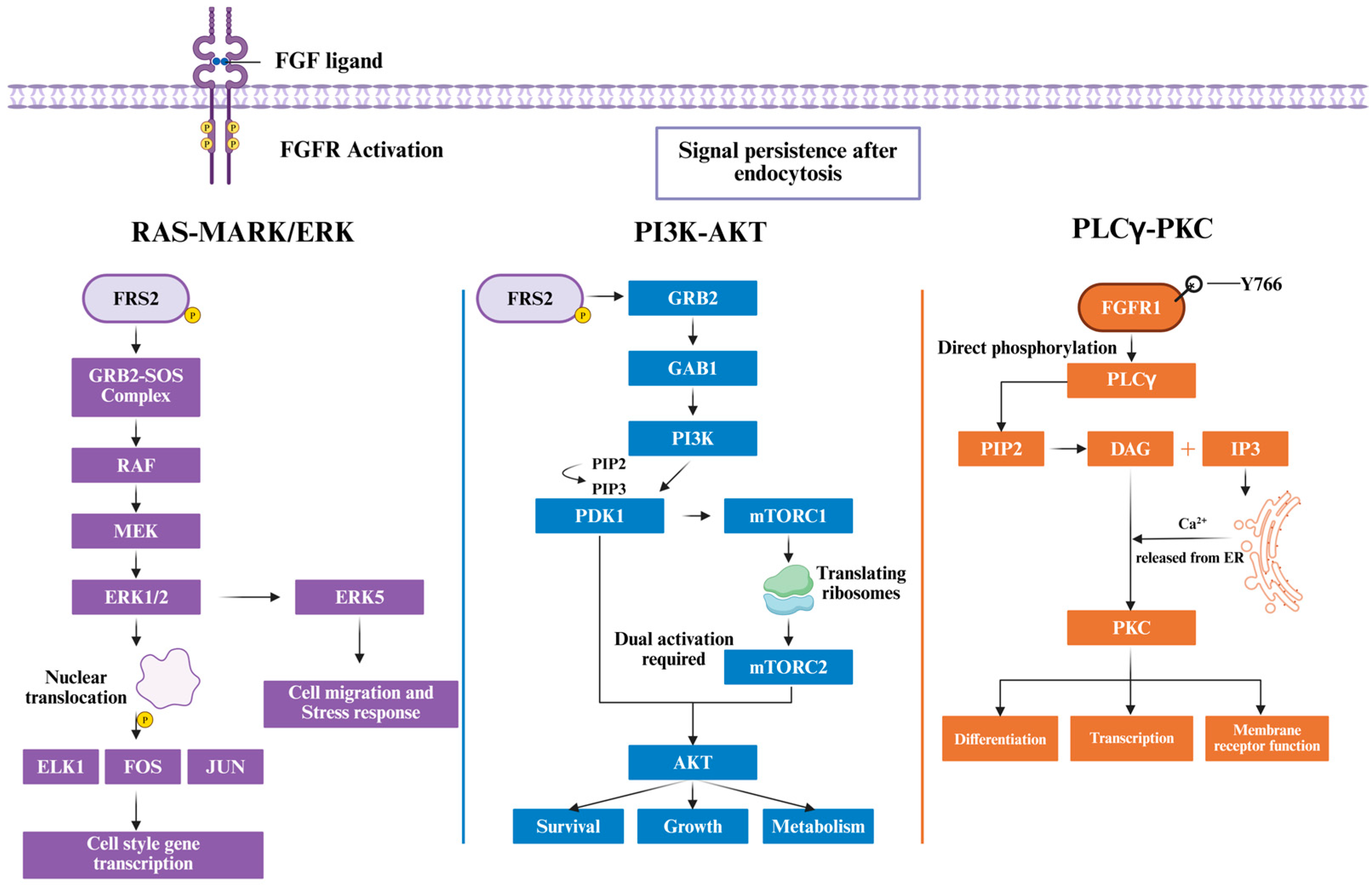
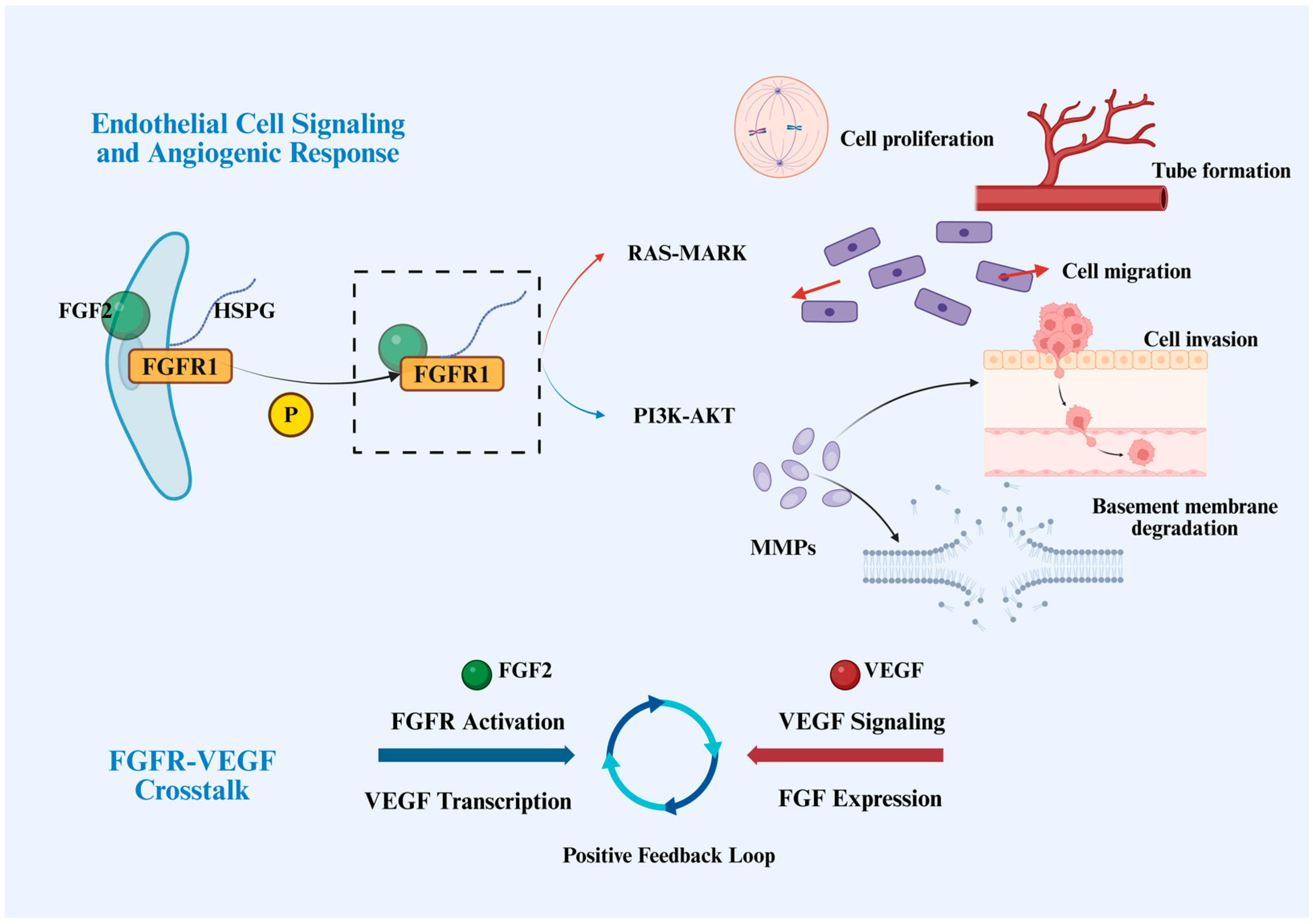
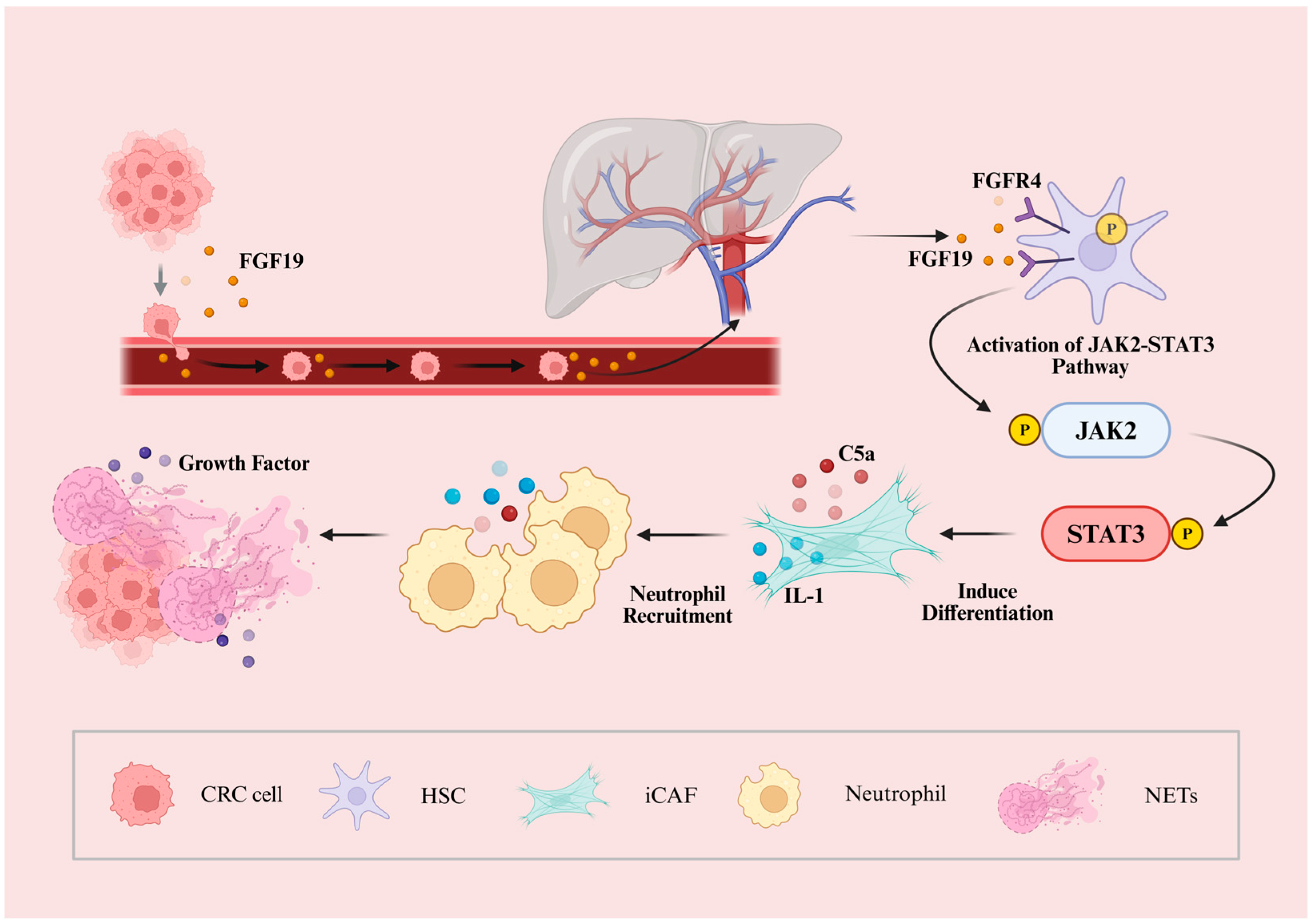
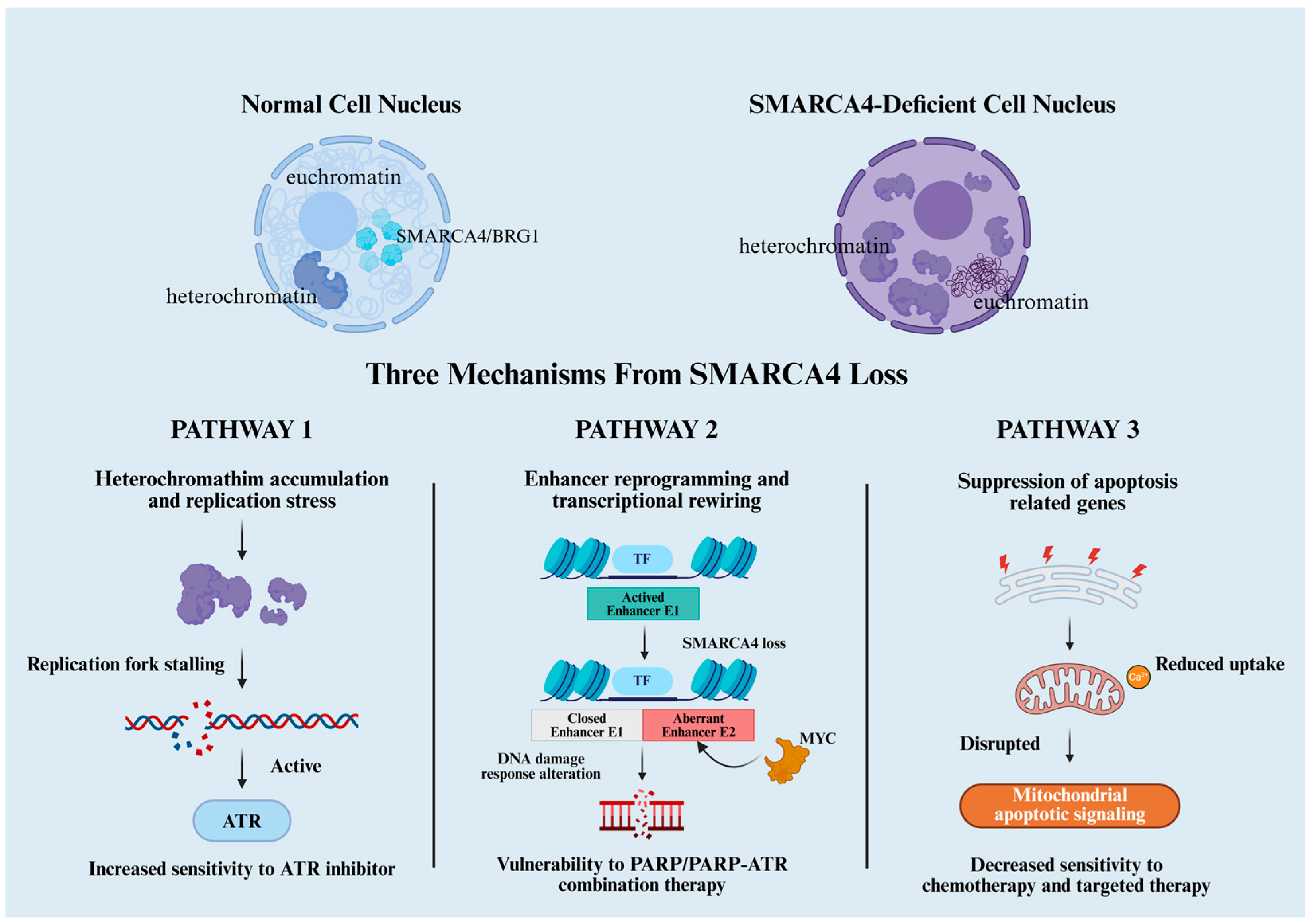
Disclaimer/Publisher’s Note: The statements, opinions and data contained in all publications are solely those of the individual author(s) and contributor(s) and not of MDPI and/or the editor(s). MDPI and/or the editor(s) disclaim responsibility for any injury to people or property resulting from any ideas, methods, instructions or products referred to in the content. |
© 2025 by the authors. Licensee MDPI, Basel, Switzerland. This article is an open access article distributed under the terms and conditions of the Creative Commons Attribution (CC BY) license.