Potential Impact of Updated Bayesian Deduction in Medicine: Application to Colonoscopy Prioritization


Simple Summary
Abstract
1. Introduction
- Very simple to perform: A stool sample can be collected at home in a jar and sent to a lab without any prior preparation or diet;
- Very cheap: The reported average cost is USD 3.04, with a range from USD 0.83 to USD 6.41 per test [6]), meaning that a FIT costs around 100x less than a colonoscopy;
- Non-invasive: They do not have associated risks and do not require sedation or recovery time;
- Immediately available: There is no waiting list for this very cheap test.
- However, they are less precise in their diagnosis:
- They have a higher false-positive rate (lower specificity) because they test for occult blood in stool, which is not specific to CRC (haemorrhoids can also cause rectal bleeding):
- They have a higher false-negative rate (lower sensitivity) due to the intermittent bleeding nature of cancerous polyps (cf. Section 2.1 below).
- CRC screening in Chile’s Metropolitan Region, where the CRC prevalence is 19.6/100,000, and the accepted FIT sensitivity and specificity from [9];
- A published symptomatic cohort for prioritisation purposes, representative of a hospital’s needs, where the CRC prevalence is much higher.
2. Presentation of the Method
2.1. Bibliographic Analysis
- Ref. [16] showed a nonuniform distribution of occult blood in faeces;
- Ref. [17] studies bleeding patterns in colorectal cancer;
- Ref. [18] concludes (from a very small sample study) that the immunochemical faecal occult blood test “is unsuitable for the diagnosis of rectal cancer, due to a low sensitivity of the diagnostic test combined with a slight haemorrhage or intraintestinal degeneration of haemoglobin, inappropriate site and amount of stool sampling, poor preservation of the specimen”.
- More recently, ref. [19] shows, on a larger cohort, “a low concordance between daily consecutive [FIT] tests results”.
2.2. Bayesian Analysis of the Results of a FIT in the Metropolitan Region of Chile
- P(p|s) is the Probability of being Positive if Sick (this is the sensitivity);
- P(s) is the prior Probability of being Sick (the prevalence of the sickness in the cohort to which the person belongs);
- P(p) is the observed Probability of being Positive.
Application to CRC Screening
- The 19.6/100,000 prevalence of CRC observed in the Metropolitan Region;
- The 73% observed sensitivity;
- The 94% specificity of a single FIT, observed on 92,447 asymptomatic people from 44 studies [9].
- In probability, 19.6 are sick, but due to the 27% false negatives (FN), statistically, in probability, 5.29 of them will falsely test negative (and 14.31 will truly test positive = TP);
- In probability, 100,000 − 19.6 = 99,980.4 are healthy, but due to the 6% false positives (FP), in probability, 5998.82 of them will falsely test positive (and 93,981.58 will truly test negative = TN).
2.3. Proposed Updated Bayesian Deduction (UBD) Method with Application to CRC
- A FIT+ virtual subcohort of 6013.132 positive people with a prevalence of 237.9/100,000;
- A FIT− virtual subcohort of 93,986.87 people with a prevalence of 5.631/100,000.
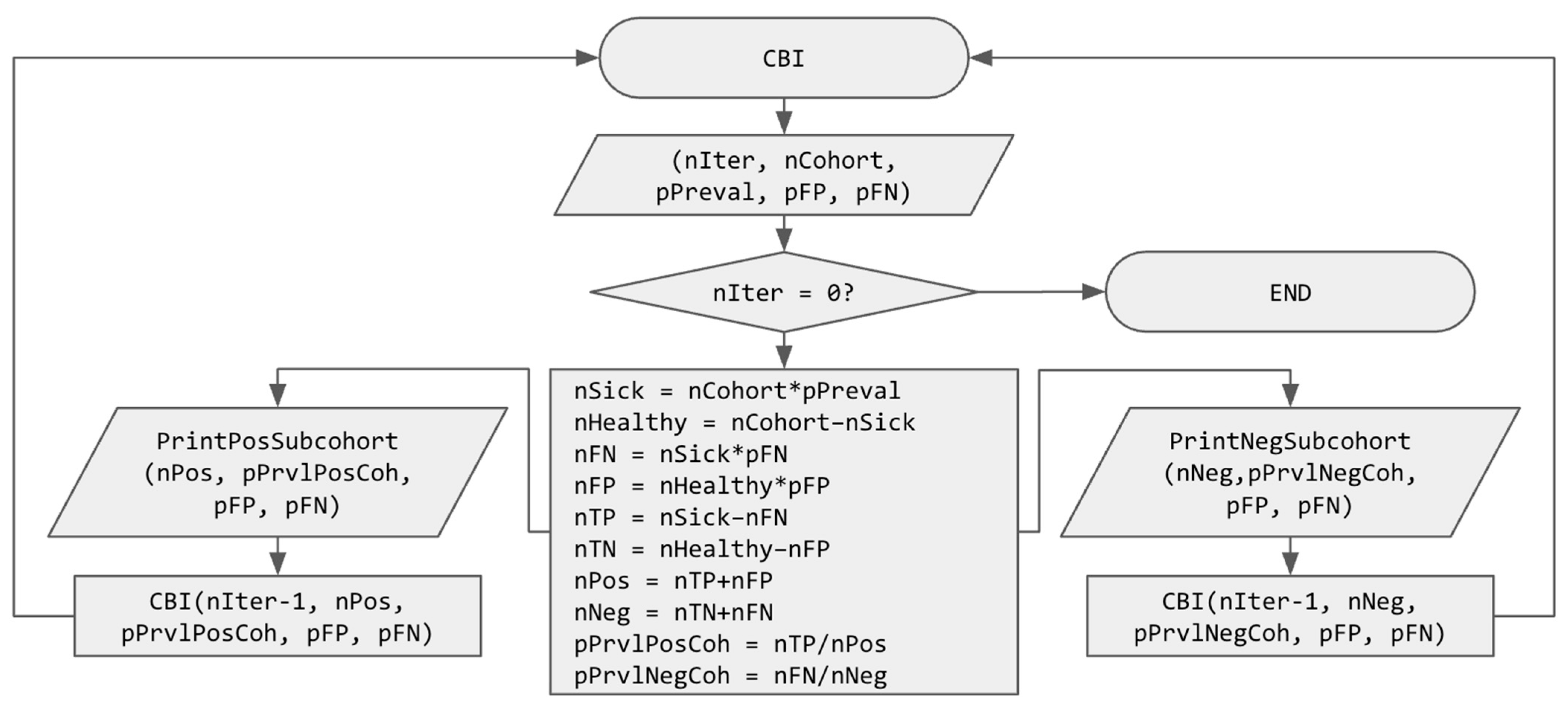
- Perform a test with known sensitivity and specificity on a cohort with known prevalence.
- Divide into subcohorts depending on the result of the test.
- Associate a Bayesian-computed prevalence with each subcohort.
- Repeat from step 1.
- nIter, the number of recursive calls to be computed (or, in computer science terms, the depth of the resulting tree);
- nCohort is the size of the cohort;
- pPreval is the prior known disease prevalence (in probability);
- pFP is the prior probability of a false positive result when using the test;
- pFN is the prior probability of a false negative result when using the test.
3. Results
3.1. Application of 4-FIT Updated Bayesian Deduction to CRC Screening in Chile’s Metropolitan Region
| nSick = nCohort × pPreval | (100,000 × 0.000196 = 19.6) |
| nHealthy = nCohort − nSick | (100,000 − 19.6 = 99980.4) |
| nFN = nSick × pFN | (19.6 × 0.27 = 5.292) |
| nFP = nHealthy × pFP | (99,980.4 × 0.06 = 5998.824) |
| nTP = nSick − nFN | (19.6 − 5.292 = 14.308) |
| nTN = nHealthy − nFP | (99,980.4 − 5998.824 = 93,981.576) |
| nPos = nTP + nFP | (14.308 + 5998.824 = 6013.132) |
| nNeg = nTN + nFN | (93,981.576 + 5.292 = 93,986.868) |
| pPrvlPosCoh = nTP/nPos | (14.308/6013.132 = 0.00237946) |
| pPrvlNegCoh = nFN/nNeg | (5.292/93,986.868 = 0.00005631) |
- On the 6013.13 FIT+ subcohort (composed of the 5998.82 FP + 14.31 TP) with 237.9/100,000 prevalence (i.e., 11.9 higher than the original global cohort);
- On the 93,986.87 FIT− subcohort (composed of the 93,981.58 TN + 5.29 FN) with 5.631/100,000 prevalence (i.e., 3.55 lower than before).
- Singles out only 96 high-risk people out of 100,000 to whom a colonoscopy could be prescribed;
- Shows that 78,058 colonoscopies could be avoided and possibly 19,931 more, resulting in the possibility of replacing 98.99% (or even 99.9%) of colonoscopies with 4xFITs.
3.2. Result of the Application of Four Consecutive FIT Updated Bayesian Deduction (4-FIT UBD) on a Symptomatic Cohort
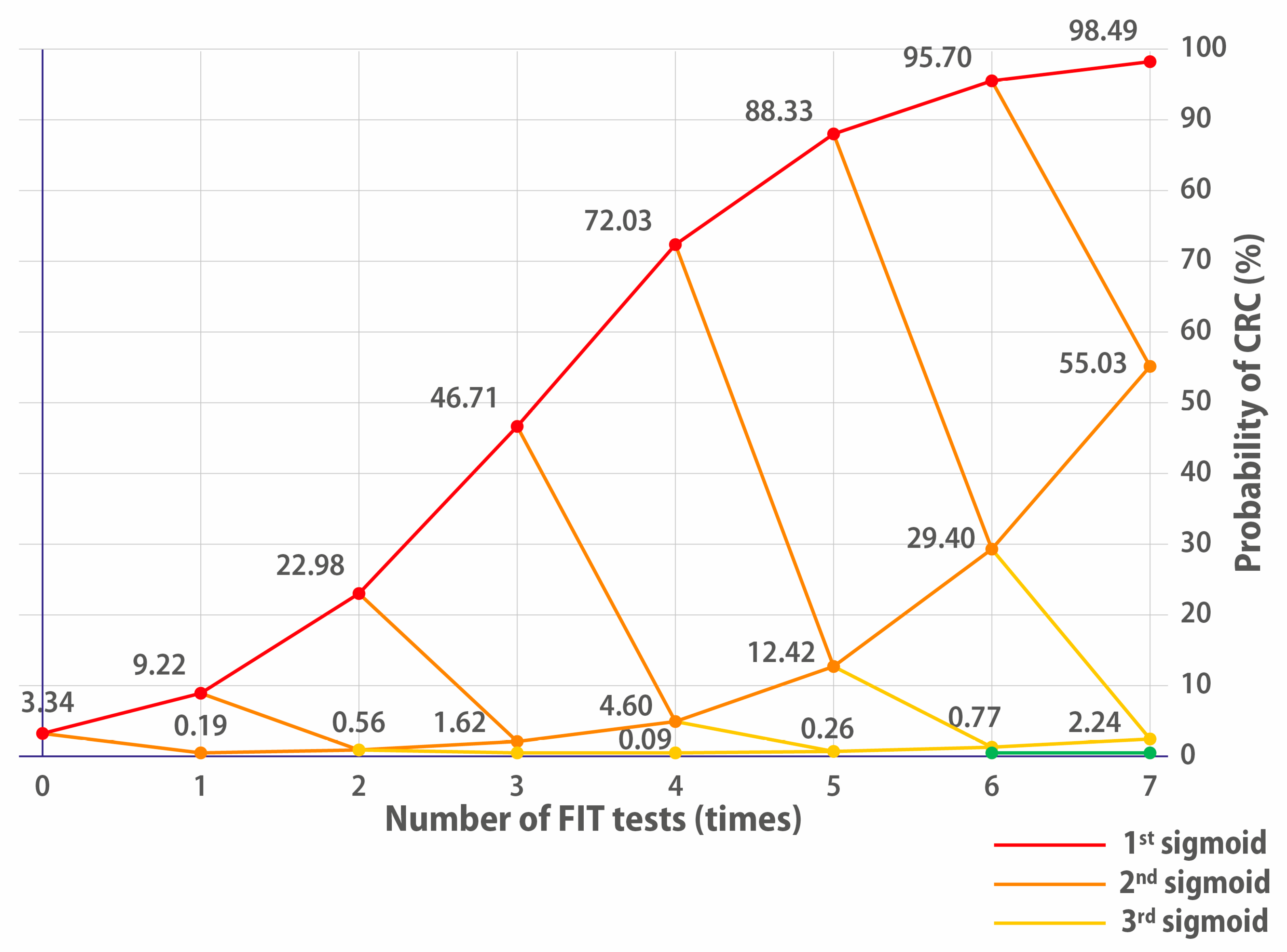
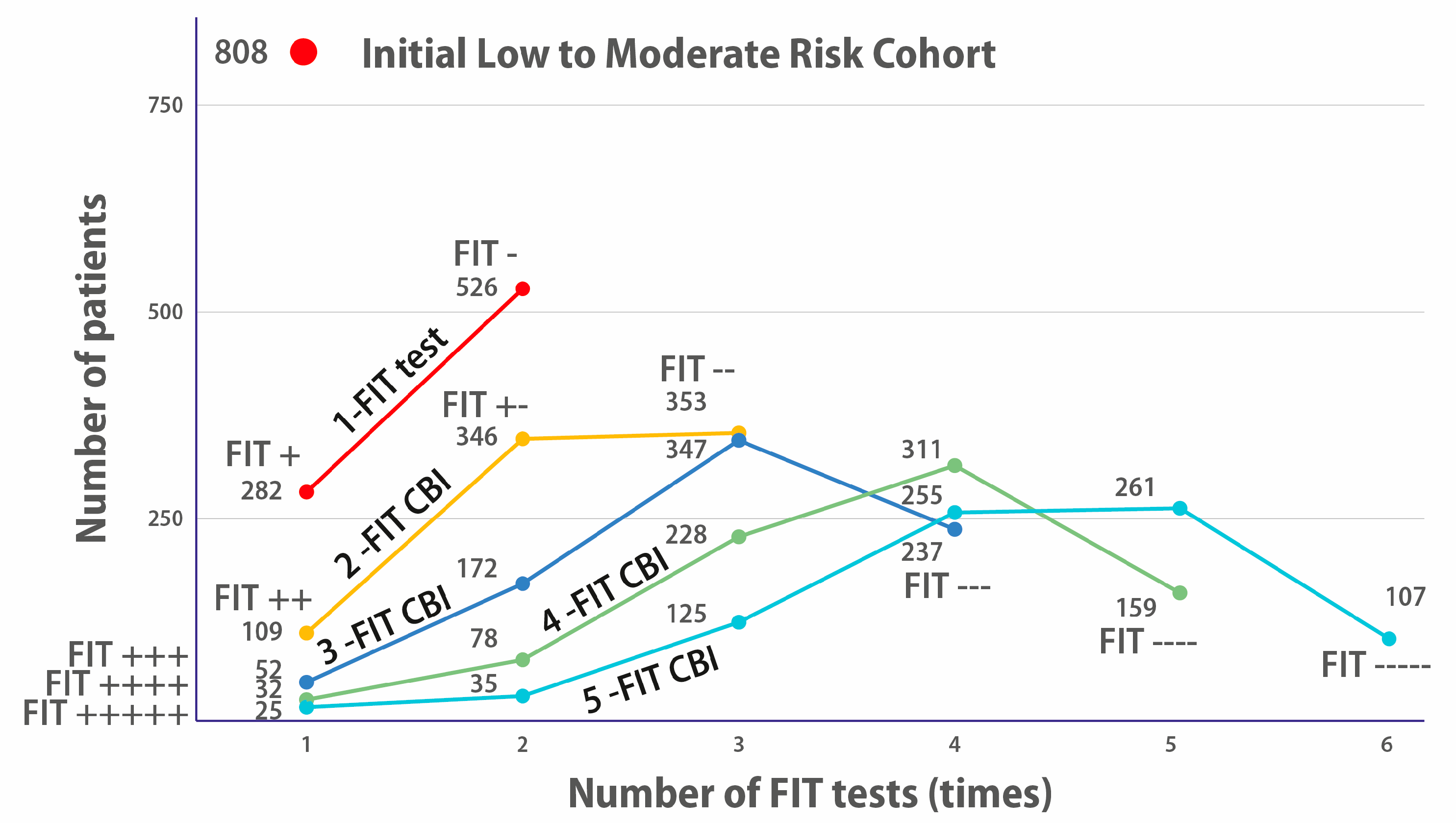
- A total of 27 were diagnosed (with colonoscopy) with CRC, yielding a prevalence of 3.3415841584% (27 out of 808), i.e., 170 times higher than for the asymptomatic cohort. Please note that we get exact numbers because we exploit exact observed values by deductive inference, and not inductive inference. We keep a large number of decimals because the probabilities will compound, so rounding to two decimals will be a source of future errors. This also guarantees the reproducibility of the presented results.
- Out of 781 non-CRC patients, 256 were FP = 67.2215108835% specificity.
- Out of the 27 CRC patients, 1 was FN = 96.2962962963% sensitivity.
3.2.1. Results of 4 FITs on the Low/Moderate Risk Cohort of [34]
3.2.2. Potential Results of Four FIT UBD on the High-Risk Patients Cohort [34]
3.3. Mathematical Analysis of the Performance of Multiple FIT Updated Bayesian Deduction Tests on the L/MR Cohort of [34]
- With a 3-FIT, there were 52 FIT+++ patients. A total of 52 colonoscopies would be performed to find the 27 who had CRC.
- A 4-FIT reduces the colonoscopies to 32 FIT++++patients.
- But with five FITs, there are only 25 FIT+++++, when we know for a fact that there are 27 CRC patients, so we are missing 2.
4. Discussion
Combining Other Indicators (Such as Age) with Multiple FITs
5. Conclusions and Future Perspectives
- Be multimodal by integrating other indicators such as sex or age (as shown in the discussion) or blood test markers [38] to better match the patient;
- Also be used for screening (or prioritising resources for) other types of cancer or diseases. The number of mammograms could possibly be reduced if cheaper, less invasive, and less resource-intensive independent tests, such as blood markers for breast cancer, are available [39];
- Not only save lives but also money, as the reason for resource scarcity is typically their overall cost in equipment and human resources.
Supplementary Materials
Author Contributions
Funding
Institutional Review Board Statement
Informed Consent Statement
Data Availability Statement
Conflicts of Interest
References
- Sung, H.; Ferlay, J.; Siegel, R.L.; Laversanne, M.; Soerjomataram, I.; Jemal, A.; Bray, F. Global Cancer Statistics 2020: GLOBOCAN Estimates of Incidence and Mortality Worldwide for 36 Cancers in 185 Countries. CA A Cancer J. Clin. 2021, 71, 209–249. [Google Scholar] [CrossRef] [Scilit] [PubMed]
- WHO. Facts Sheet on Colorectal Cancer. Available online: https://www.who.int/news-room/fact-sheets/detail/colorectal-cancer (accessed on 13 October 2025).
- Zauber, A.G. Cost-effectiveness of Colonoscopy. Gastrointest. Endosc. Clin. N. Am. 2010, 20, 751–770. [Google Scholar] [CrossRef] [Scilit] [PubMed]
- Haslam, R.; El-Khassawneh, S.; Sucher, U. The Cost of Colonoscopy—A Worldwide View. Gut 2013, 62, A16. [Google Scholar] [CrossRef] [Scilit]
- Gómez-Molina, R.; Suárez, M.; Martínez, R.; Chilet, M.; Bauça, J.M.; Mateo, J. Utility of Stool-Based Tests for Colorectal Cancer Detection: A Comprehensive Review. Healthcare 2024, 12, 1645. [Google Scholar] [CrossRef] [Scilit]
- Coury, J.; Ramsey, K.; Gunn, R.; Judkins, J.; Davis, M. Source matters: A survey of cost variation for fecal immunochemical tests in primary care. BMC Health Serv. Res. 2022, 22, 204. [Google Scholar] [CrossRef] [Scilit]
- Daly, J.M.; Xu, Y.; Levy, B.T. Which Fecal Immunochemical Test Should I Choose? J. Prim. Care Community Health 2017, 8, 264–277. [Google Scholar] [CrossRef] [Scilit]
- Niedermaier, T.; Tikk, K.; Gies, A.; Bieck, S.; Brenner, H. Sensitivity of Fecal Immunochemical Test for Colorectal Cancer Detection Differs According to Stage and Location. Clin. Gastroenterol. Hepatol. 2020, 18, 2920–2928.e6. [Google Scholar] [CrossRef] [Scilit]
- Niedermaier, T.; Balavarca, Y.; Brenner, H. Stage-Specific Sensitivity of Fecal Immunochemical Tests for Detecting Colorectal Cancer: Systematic Review and Meta-Analysis. Am. J. Gastroenterol. 2019, 115, 56–69. [Google Scholar] [CrossRef] [Scilit]
- Imperiale, T.F.; Gruber, R.N.; Stump, T.E.; Emmett, T.W.; Monahan, P.O. Performance Characteristics of Fecal Immunochemical Tests for Colorectal Cancer and Advanced Adenomatous Polyps. Ann. Intern. Med. 2019, 170, 319–329. [Google Scholar] [CrossRef] [Scilit]
- D’sOuza, N.; Brzezicki, A.; Abulafi, M. Faecal immunochemical testing in general practice. Br. J. Gen. Pract. 2019, 69, 60–61. [Google Scholar] [CrossRef] [Scilit]
- Lee, J.K.; Liles, E.G.; Bent, S.; Levin, T.R.; Corley, D.A. Accuracy of Fecal Immunochemical Tests for Colorectal Cancer. Ann. Intern. Med. 2014, 160, 171–181. [Google Scholar] [CrossRef] [Scilit] [PubMed]
- Pellat, A.; Deyra, J.; Husson, M.; Benamouzig, R.; Coriat, R.; Chaussade, S. Colorectal cancer screening programme: Is the French faecal immunological test (FIT) threshold optimal? Ther. Adv. Gastroenterol. 2021, 14. [Google Scholar] [CrossRef] [Scilit] [PubMed]
- Heisser, T.; Hoffmeister, M.; Tillmanns, H.; Brenner, H. Impact of demographic changes and screening colonoscopy on long-term projection of incident colorectal cancer cases in Germany: A modelling study. Lancet Reg. Health—Eur. 2022, 20, 100451. [Google Scholar] [CrossRef] [Scilit] [PubMed]
- Ruiz-Garcia, E.; Michaus, V.S. Colorectal Cancer in Latin America: Quick Comment. OncoDaily Med. J. 2025. [Google Scholar] [CrossRef] [Scilit]
- Rosenfield, R.E.; Kochwa, S.; Kaczera, Z.; Maimon, J. Nonuniform Distribution of Occult Blood in Feces. Am. J. Clin. Pathol. 1979, 71, 204–209. [Google Scholar] [CrossRef] [Scilit]
- Doran, J.; Hardcastle, J.D. Bleeding patterns in colorectal cancer: The effect of aspirin and the implications for faecal occult blood testing. Br. J. Surg. 1982, 69, 711–713. [Google Scholar] [CrossRef] [Scilit]
- Nakama, H.; Kamijo, N.; Fujimori, K.; Horiuchi, A.; Fattah, A.S.M.A.; Zhang, B. Characteristics of Colorectal Cancer with False Negative Result on Immunochemical Faecal Occult Blood Test. J. Med. Screen. 1996, 3, 115–118. [Google Scholar] [CrossRef] [Scilit]
- Santiago, L.; Toro, D.H. Effectiveness of Multiple Consecutive Fecal Immunohistochemical Testing for Colorectal Cancer Screening. P. R. Health Sci. J. 2022, 41, 117–122. [Google Scholar]
- Gelman, A.; Shalizi, C.R. Philosophy and the practice of Bayesian statistics. Br. J. Math. Stat. Psychol. 2012, 66, 8–38. [Google Scholar] [CrossRef] [Scilit]
- Bayes, T.; Price, R. An essay towards solving a problem in the doctrine of chances. Phil. Trans. R. Soc. Lond. 1763, 53, 370–418. [Google Scholar] [CrossRef] [Scilit]
- Laplace, P.-S. Mémoire sur la probabilité des causes par les événements. Mémoire De L’académie Des Sci. De Paris 1774, 6, 621. Available online: https://gallica.bnf.fr/ark:/12148/bpt6k77596b/f32.item (accessed on 13 October 2025).
- Albert, J.; Hu, J. Probability and Bayesian Modeling; Chapman & Hall: Boca Raton, FL, USA, 2019; 552p, ISBN 9781138492561. [Google Scholar]
- Broemeling, L.D. Bayesian Methods for Repeated Measures; Taylor & Francis: London, UK, 2015. [Google Scholar]
- Lesaffre, E.; Speybroeck, N.; Berkvens, D. Bayes and diagnostic testing. Veter- Parasitol. 2007, 148, 58–61. [Google Scholar] [CrossRef] [Scilit] [PubMed]
- Balayla, J. Bayesian updating and sequential testing: Overcoming inferential limitations of screening tests. BMC Med. Inform. Decis. Mak. 2022, 22, 6. [Google Scholar] [CrossRef] [Scilit] [PubMed]
- Dendukuri, N.; Joseph, L. Bayesian approaches to modeling the conditional dependence between multiple diagnostic tests. Biometrics 2001, 57, 158–167. [Google Scholar] [CrossRef] [Scilit] [PubMed]
- Pereira da Silva, H.D.; Ascaso, C.; Gonçalves, A.Q.; Orlandi, P.P.; Abellana, R. A Bayesian approach to model the conditional correlation between several diagnostic tests and various replicated subjects measurements. Stat. Med. 2017, 36, 3154–3170. [Google Scholar] [CrossRef] [Scilit]
- Lachenbruch, P.A. Multiple reading procedures: The performance of diagnostic tests. Stat. Med. 1988, 7, 549–557. [Google Scholar] [CrossRef] [Scilit]
- Farkas, N.G.; Palyvos, L.; O’BRien, J.W.; Yu, K.S.; Pigott, C.; Whyte, M.; Jourdan, I.; Rockall, T.; Fraser, C.G.; Benton, S.C. The repeat FIT (RFIT) study: Does repeating faecal immunochemical tests provide reassurance and improve colorectal cancer detection? Color. Dis. 2024, 26, 1711–1719. [Google Scholar] [CrossRef] [Scilit]
- Wu, D.; Luo, H.-Q.; Zhou, W.-X.; Qian, J.-M.; Li, J.-N. The Performance of Three-Sample Qualitative Immunochemical Fecal Test to Detect Colorectal Adenoma and Cancer in Gastrointestinal Outpatients: An Observational Study. PLoS ONE 2014, 9, e106648. [Google Scholar] [CrossRef] [Scilit]
- Dale, A.I. A History of Inverse Probability: From Thomas Bayes to Karl Pearson; Springer International Publishing: New York, NY, USA, 1999. [Google Scholar]
- Mondschein, S.; Subiabre, F.; Yankovic, N.; Estay, C.; Von Mühlenbrock, C.; Berger, Z. Colorectal cancer trends in Chile: A Latin-American country with marked socioeconomic inequities. PLoS ONE 2022, 17, e0271929. [Google Scholar] [CrossRef] [Scilit]
- Quezada-Diaz, F.F.; Acevedo, J.; González, M.; Tello, A.; Castillo, R.; Morales, C.; Manríquez, E.; Duran, V.; Mena, F.; Le-Bert, C.; et al. Assessing the impact of a single qualitative fecal immunochemical test on colonoscopy prioritization and mortality in risk-stratified patients with suspected colorectal cancer: A retrospective cohort study. Lancet Reg. Health—Am. 2025, 50, 101201. [Google Scholar] [CrossRef] [Scilit]
- Heisser, T.; Weigl, K.; Hoffmeister, M.; Brenner, H. Age-specific sequence of colorectal cancer screening options in Germany: A model-based critical evaluation. PLoS Med. 2020, 17, e1003194. [Google Scholar] [CrossRef] [Scilit]
- Lwin, M.W.; Cheng, C.-Y.; Calderazzo, S.; Schramm, C.; Schlander, M. Would initiating colorectal cancer screening from age of 45 be cost-effective in Germany? An individual-level simulation analysis. Front. Public Health 2024, 12, 1307427. [Google Scholar] [CrossRef] [Scilit]
- Bie, A.K.L.; Brodersen, J. Why do some participants in colorectal cancer screening choose not to undergo colonoscopy following a positive test result? A qualitative study. Scand. J. Prim. Health Care 2018, 36, 262–271. [Google Scholar] [CrossRef] [Scilit]
- Chung, D.C.; Gray, D.M.; Singh, H.; Issaka, R.B.; Raymond, V.M.; Eagle, C.; Hu, S.; Chudova, D.I.; Talasaz, A.; Greenson, J.K.; et al. A Cell-free DNA Blood-Based Test for Colorectal Cancer Screening. N. Engl. J. Med. 2024, 390, 973–983. [Google Scholar] [CrossRef] [Scilit]
- Luo, J.; Xiao, J.; Yang, Y.; Chen, G.; Hu, D.; Zeng, J. Strategies for five tumour markers in the screening and diagnosis of female breast cancer. Front. Oncol. 2023, 12, 1055855. [Google Scholar] [CrossRef] [Scilit]



| Second FIT test | ||||
| ON FIT+ people | Cohort size | Specificity % | Sensitivity % | Prevalence |
| 6013.13 | 6.00 | 27.00 | 0.237946% | |
| Concerned | True | False | Sickness prob. | |
| FIT ++ | 370.37 | 10.44 | 359.93 | 2.820077% |
| FIT +– | 5642.76 | 5638.89 | 3.86 | 0.068462% |
| ON FIT–people | Cohort size | Specificity % | Sensitivity % | Prevalence |
| 93,986.87 | 6.00 | 27.00 | 0.005631% | |
| Concerned | True | False | Sickness prob. | |
| FIT -+ | 5642.76 | 3.86 | 5638.89 | 0.068462% |
| FIT -- | 88,344.11 | 88,342.68 | 1.43 | 0.001617% |
| 4-FIT Test | ||||
| FR % | FN % | Cohort Size | Sick | |
| On 3-FIT subcohorts | 6.00 | 27.00 | 100,000.00 | 19.60 |
| Concerned | True | False | Sickness prob. | |
| FIT++++ | 6.86 | 5.57 | 1.30 | 81.116533% |
| FIT+++− | 89.43 | 8.23 | 81.20 | 9.207504% |
| FIT++−− | 1912.77 | 4.57 | 1908.20 | 0.238846% |
| FIT+−−− | 19,931.24 | 1.13 | 19,930.11 | 0.005652% |
| FIT−−−− | 78,059.70 | 0.10 | 78,059.59 | 0.000133439% |
| Variable | Total (n = 808) |
|---|---|
| FIT outcomes; n (%) | |
| True positives | 26 |
| True negatives | 525 |
| False positives | 256 |
| False negatives | 1 |
| CRC diagnosis confirmed | 27 |
| Qualitative FIT; % (confidence interval 95%) | |
| Sensitivity | 96.3 (81.71–99.34) |
| Specificity | 67.22 (63.85–70.42) |
| Predictive value % (confidence interval 95%) | |
| Positive (PPV) | 9.22 (6.37–13.17) |
| Negative (NPV) | 99.81 (98.93–99.97) |
| Likelihood ratio | |
| Positive (LR+) | 2.93 |
| Negative (LR−) | 0.06 |
| Parameters | Cohort size | Prevalence % | Specificity % | Sensitivity % |
| 808 | 3.34 | 67.22 | 96.30 | |
| First FIT test | ||||
| Specificity % | Sensitivity % | Cohort size | Sick | |
| Original cohort | 32.78 | 3.70 | 808 | 27.00 |
| Concerned | True | False | Sickness prob. | |
| FIT + | 282.00 | 26.00 | 256.00 | 9.219858% |
| FIT - | 526.00 | 525.00 | 1.00 | 0.190114% |
| 4-FIT Test | ||||
|---|---|---|---|---|
| FR% | FN% | Cohort Size | Sick | |
| On 3-FIT subcohorts | 32.78 | 3.70 | 808.00 | 27.00 |
| Concerned | True | False | Sickness prob. | |
| FIT++++ | 32.23 | 23.22 | 9.02 | 72.028812% |
| FIT+++− | 77.53 | 3.57 | 73.96 | 4.607010% |
| FIT++−− | 227.71 | 0.21 | 227.51 | 0.090493% |
| FIT+−−− | 311.05 | 0.01 | 311.05 | 0.001699% |
| FIT−−−− | 159.47 | 0.00 | 159.47 | 0.000031858% |
| 4-FIT Test | ||||
|---|---|---|---|---|
| FR% | FN% | Cohort Size | Sick | |
| On 3-FIT subcohorts | 32.78 | 3.70 | 345.00 | 16.00 |
| Concerned | True | False | Sickness prob. | |
| FIT++++ | 17.56 | 13.76 | 3.80 | 78.366618% |
| FIT+++− | 33.27 | 2.12 | 31.16 | 6.361622% |
| FIT++−− | 95.96 | 0.12 | 95.84 | 0.127253% |
| FIT+−−− | 131.03 | 0.00 | 131.03 | 0.002390% |
| FIT−−−− | 67.18 | 0.00 | 67.18 | 0.000044816% |
Disclaimer/Publisher’s Note: The statements, opinions and data contained in all publications are solely those of the individual author(s) and contributor(s) and not of MDPI and/or the editor(s). MDPI and/or the editor(s) disclaim responsibility for any injury to people or property resulting from any ideas, methods, instructions or products referred to in the content. |
© 2025 by the authors. Licensee MDPI, Basel, Switzerland. This article is an open access article distributed under the terms and conditions of the Creative Commons Attribution (CC BY) license (https://creativecommons.org/licenses/by/4.0/).
Share and Cite
Collet, P.; Quezada-Diaz, F.; Taramasco, C. Potential Impact of Updated Bayesian Deduction in Medicine: Application to Colonoscopy Prioritization. Cancers 2025, 17, 3845. https://doi.org/10.3390/cancers17233845
Collet P, Quezada-Diaz F, Taramasco C. Potential Impact of Updated Bayesian Deduction in Medicine: Application to Colonoscopy Prioritization. Cancers. 2025; 17(23):3845. https://doi.org/10.3390/cancers17233845
Chicago/Turabian StyleCollet, Pierre, Felipe Quezada-Diaz, and Carla Taramasco. 2025. "Potential Impact of Updated Bayesian Deduction in Medicine: Application to Colonoscopy Prioritization" Cancers 17, no. 23: 3845. https://doi.org/10.3390/cancers17233845
APA StyleCollet, P., Quezada-Diaz, F., & Taramasco, C. (2025). Potential Impact of Updated Bayesian Deduction in Medicine: Application to Colonoscopy Prioritization. Cancers, 17(23), 3845. https://doi.org/10.3390/cancers17233845