You are currently viewing a new version of our website. To view the old version click .
Micromachines
  • Review
  • Open Access

8 August 2025

Microrheology: From Video Microscopy to Optical Tweezers

,
,
and
1
Division of Biomedical Engineering, James Watt School of Engineering, Advanced Research Centre, University of Glasgow, Glasgow G11 6EW, UK
2
School of Physics and Astronomy, Advanced Research Centre, University of Glasgow, Glasgow G11 6EW, UK
3
Department of Chemical and Molecular Engineering, Faculty of Process and Environmental Engineering, Lodz University of Technology, Wolczanska 213, 93-005 Lodz, Poland
*
Author to whom correspondence should be addressed.
This article belongs to the Special Issue Microrheology with Optical Tweezers

Abstract

Microrheology, a branch of rheology, focuses on studying the flow and deformation of matter at micron length scales, enabling the characterization of materials using minute sample volumes. This review article explores the principles and advancements of microrheology, covering a range of techniques that infer the viscoelastic properties of soft materials from the motion of embedded tracer particles. Special emphasis is placed on methods employing optical tweezers, which have emerged as a powerful tool in both passive and active microrheology thanks to their exceptional force sensitivity and spatiotemporal resolution. The review also highlights complementary techniques such as video particle tracking, magnetic tweezers, dynamic light scattering, and atomic force microscopy. Applications across biology, materials science, and soft matter research are discussed, emphasizing the growing relevance of particle tracking microrheology and optical tweezers in probing microscale mechanics.

1. Introduction

Rheology, derived from the Greek words rheo (meaning “flow”) and logia (“study of”), is the science that investigates the deformation and flow of matter. It focuses on how materials respond to applied forces, particularly their deformation over time. Central to rheology is the concept of shear flow, which involves the relative motion of parallel planes within a material. This type of flow is crucial for understanding how materials behave under various conditions, including in industrial processes and structural engineering applications, as most materials exhibit a weaker response to shear deformation compared to other forms of deformation.
Microrheology, a branch of rheology, extends these principles to the microscale, enabling the study of material properties on length scales of micrometres or smaller. The roots of microrheology can be traced back to Robert Brown’s 1827 discovery of Brownian motion, where he observed the random, thermally driven motion of pollen particles in water. This observation laid the groundwork for later theoretical advancements by scientists like Albert Einstein [1] and Jean Perrin [2], who helped to establish the foundational principles of microrheology by linking the motion of microscopic particles to the properties of the surrounding medium.
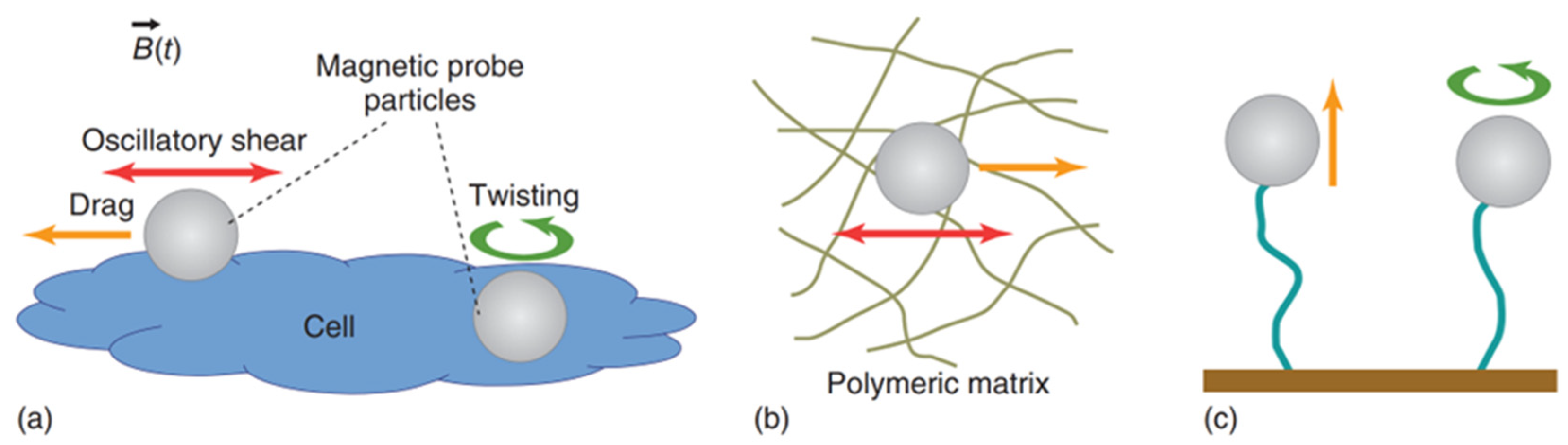
The field of microrheology was formally established by the seminal work of Mason and Weitz [3], who pioneered methods to measure the viscoelastic properties of complex fluids using light-scattering techniques. Their approach involved tracking the Brownian motion of microscopic tracer particles suspended in a fluid and applying the generalized Stokes-Einstein relation to extract the material’s frequency-dependent shear modulus. This innovation provided a powerful means to probe the mechanical properties of soft materials at the microscale. Since then, the field has evolved into two primary branches: “active microrheology”, which involves applying external forces to the tracer particles (e.g., via optical traps or magnetic fields) to probe the material’s response, and “passive microrheology”, which relies on analyzing the spontaneous thermal motion of particles to infer rheological properties.
Microrheology techniques are highly sensitive, capable of detecting forces as small as a few piconewtons and displacements on the nanometre scale, with temporal resolutions commonly reaching microseconds and, in some cases, even stretching down to picoseconds [4]. This sensitivity makes microrheology particularly valuable in studying biological systems where traditional rheological methods are impractical due to the small sample volumes and the complex, often heterogeneous, nature of the materials. However, challenges arise when applying microrheology to non-homogeneous samples, as the assumption of uniform material properties may not hold. In such cases, the local variations experienced by different probe particles can lead to unreliable bulk measurements.
Particle Tracking Microrheology (PTM) is one such technique that has gained prominence due to its ability to monitor the dynamics of biological and soft matter systems at the micron scale. By tracking the movement of individual probe particles, PTM provides a detailed understanding of the viscoelastic properties of complex fluids and biological samples, offering insights that are inaccessible through conventional bulk rheology. Despite its limitations in non-homogeneous materials, PTM remains a powerful tool for studying the mechanical behaviour of small volumes of homogeneous fluids, particularly in biological applications.
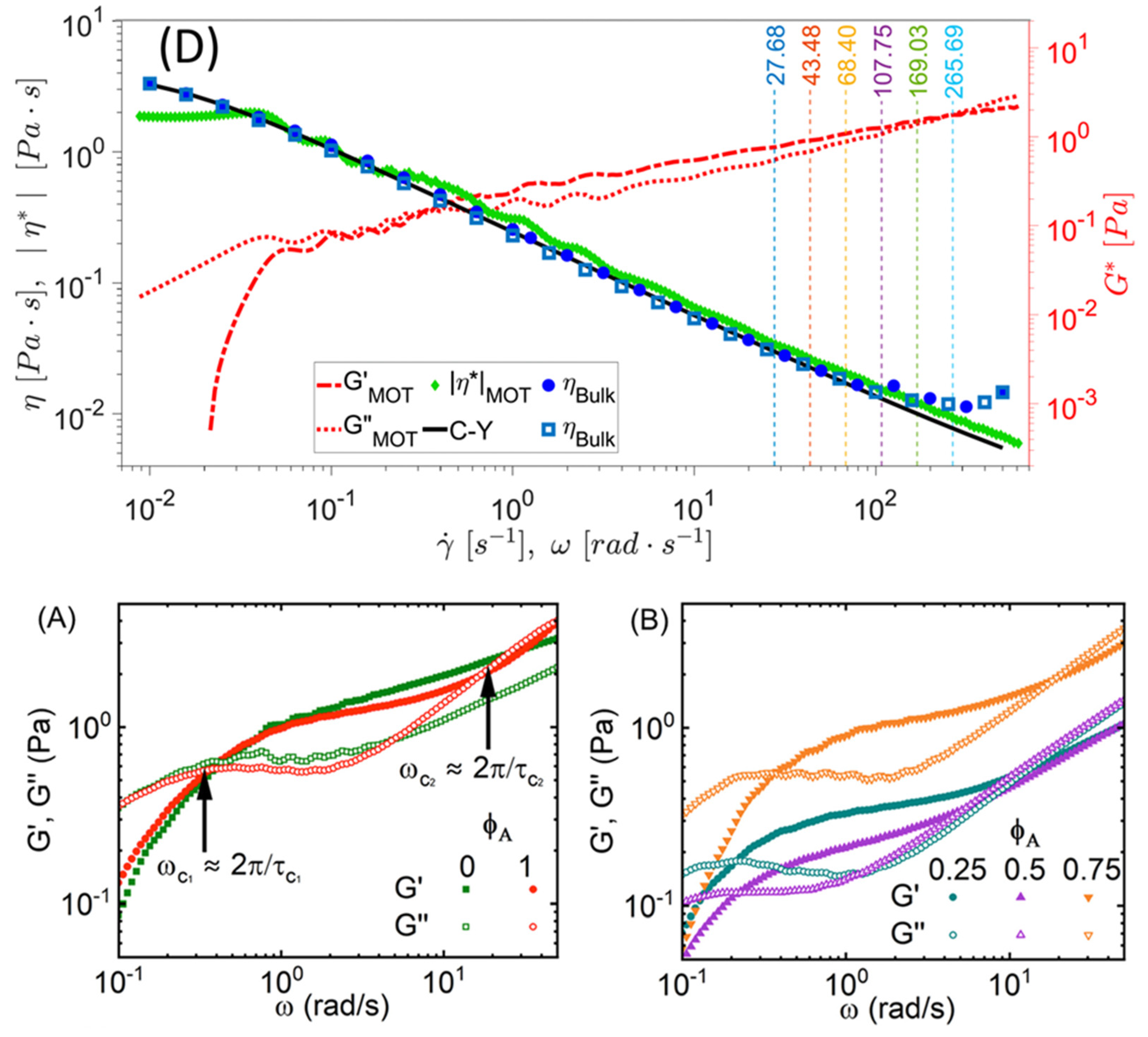
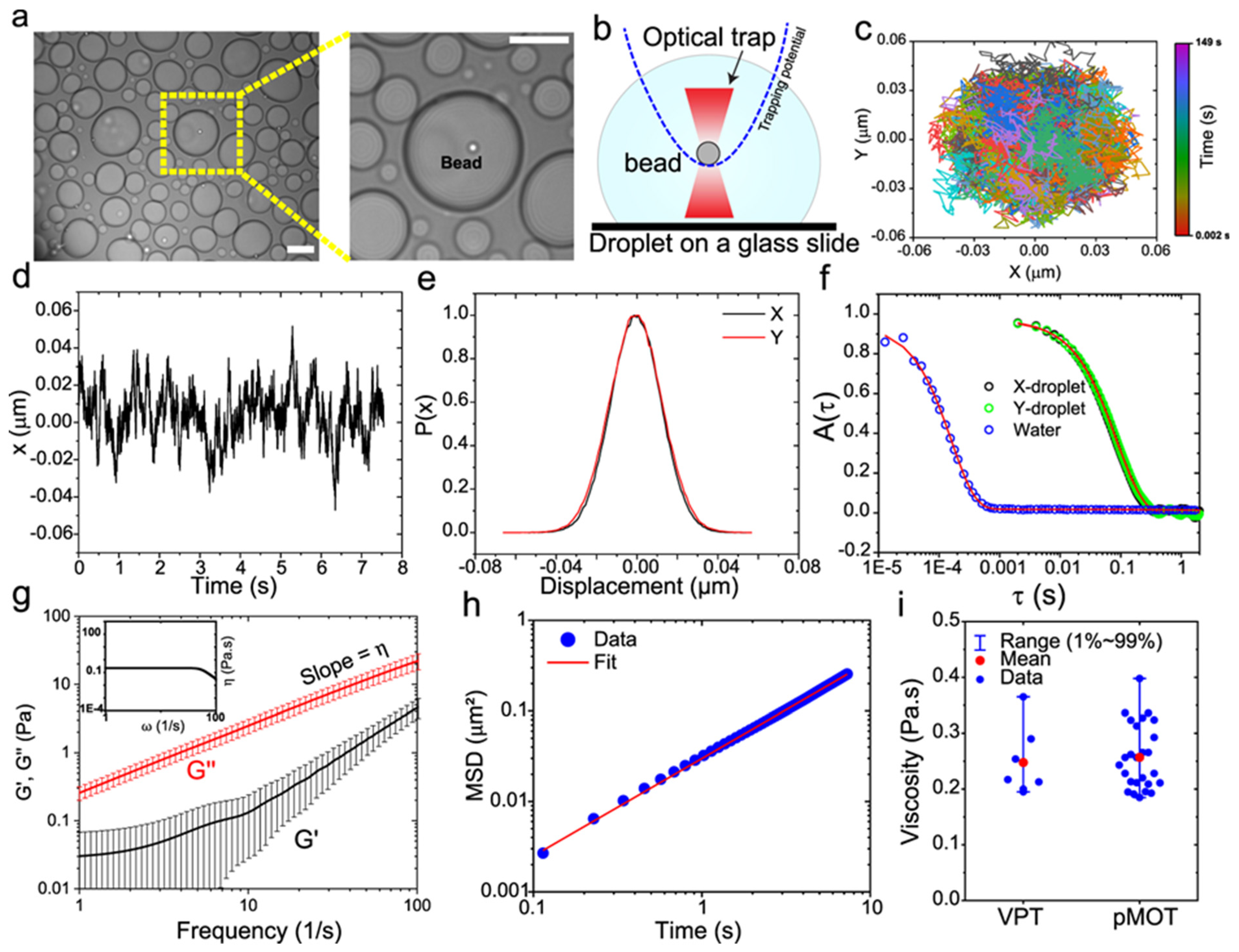
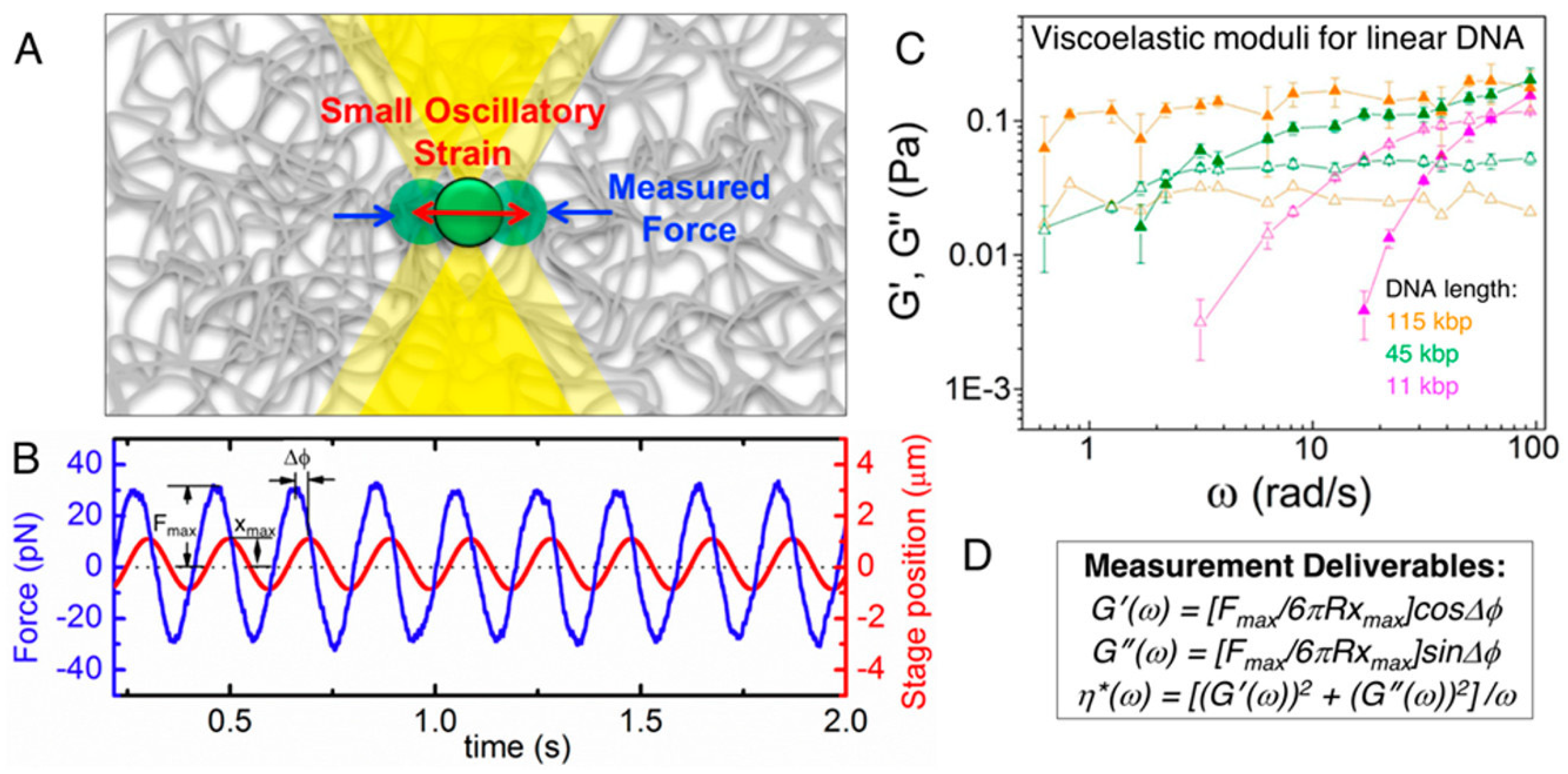
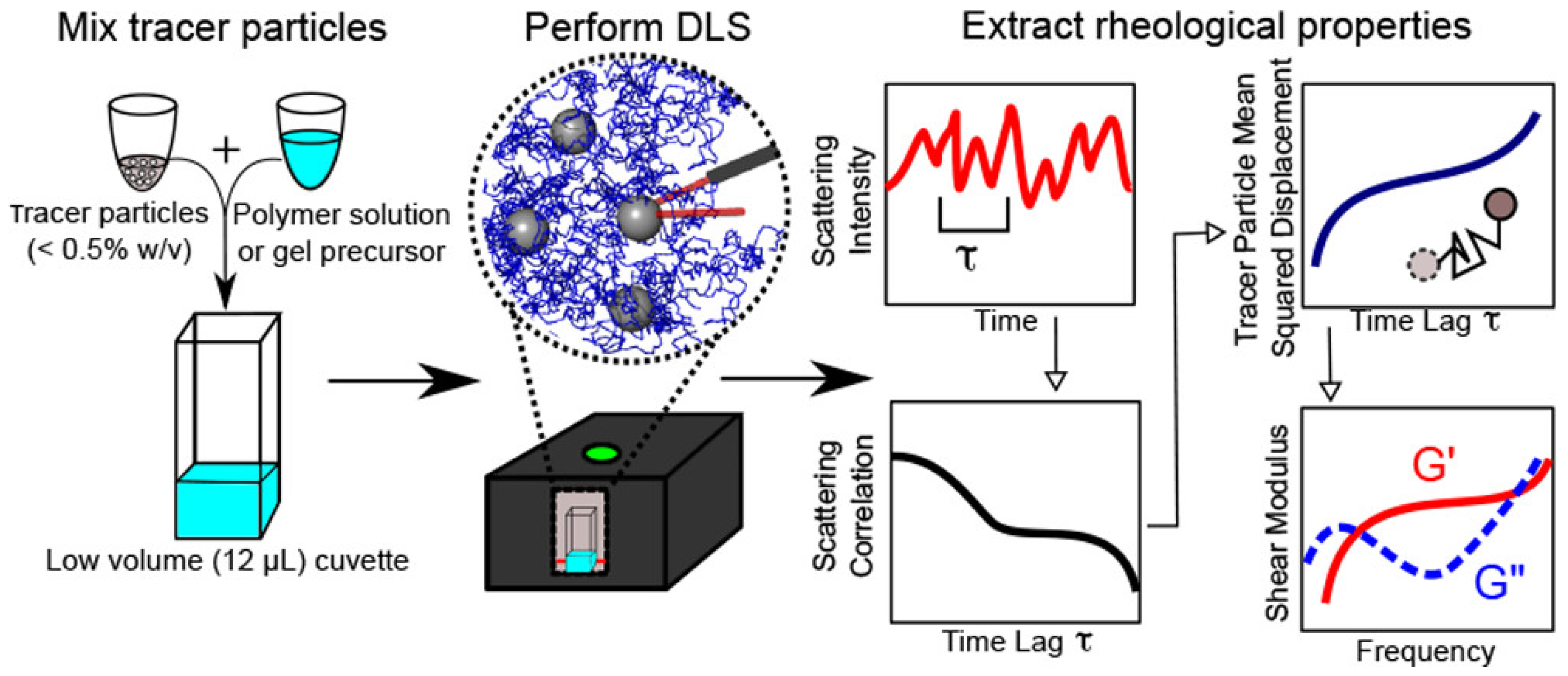
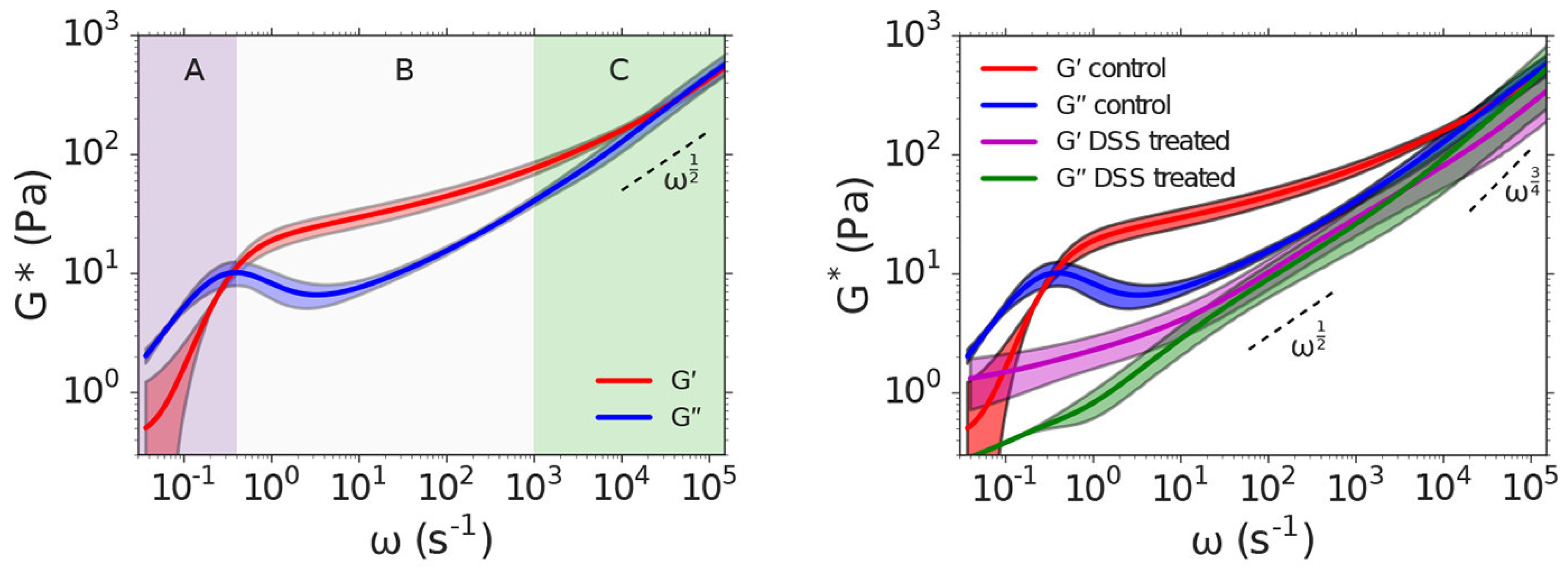
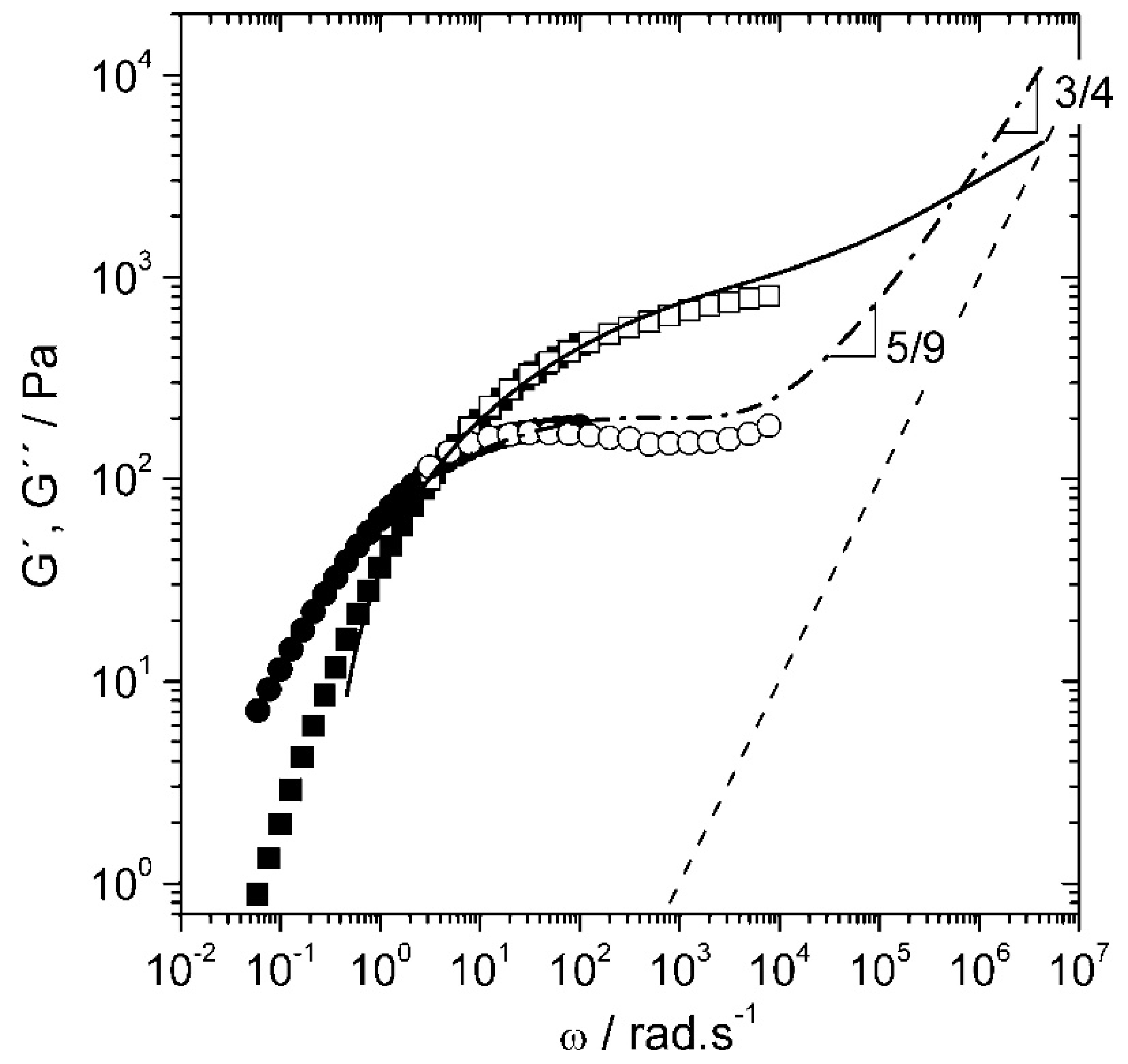
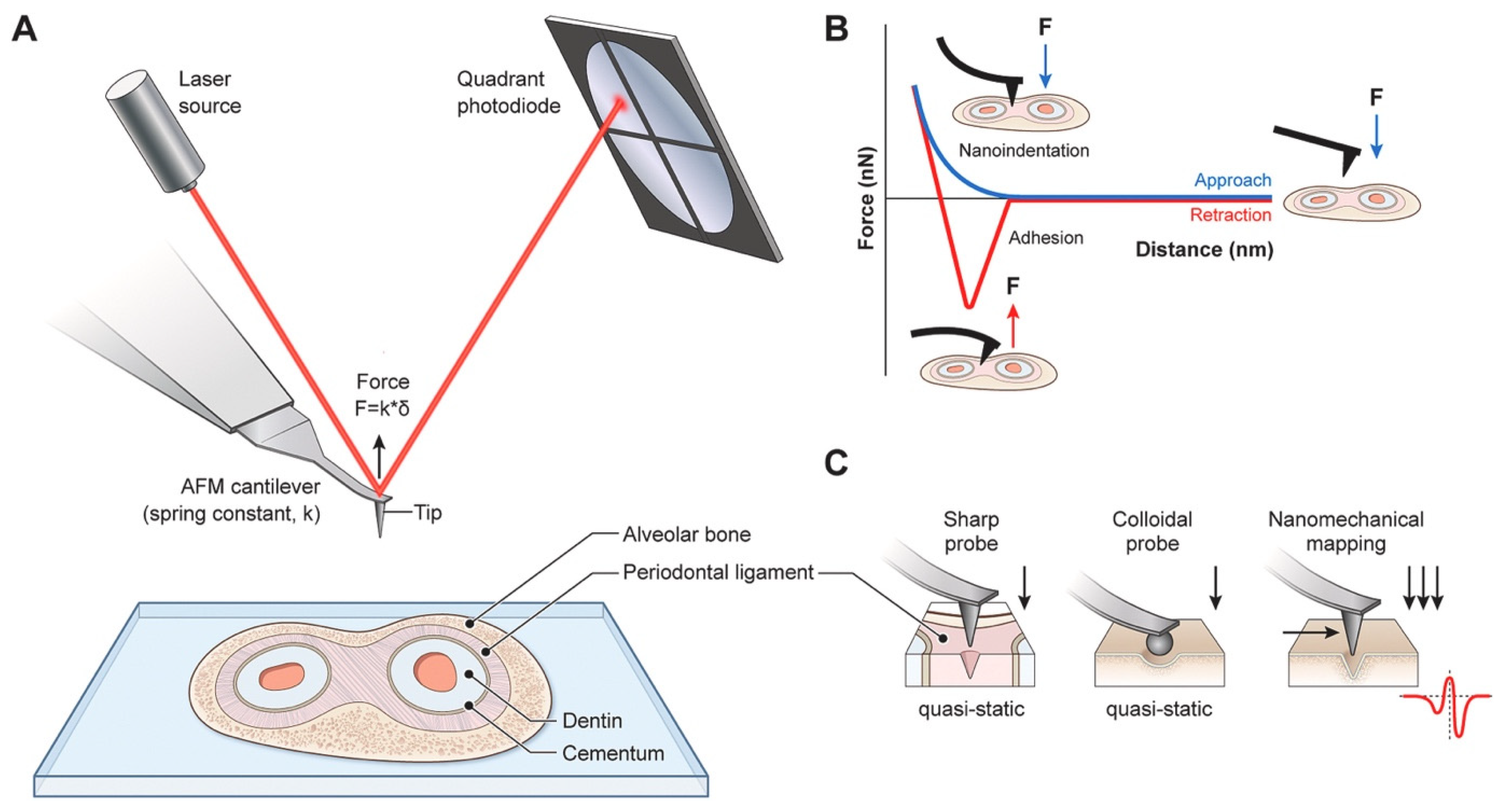
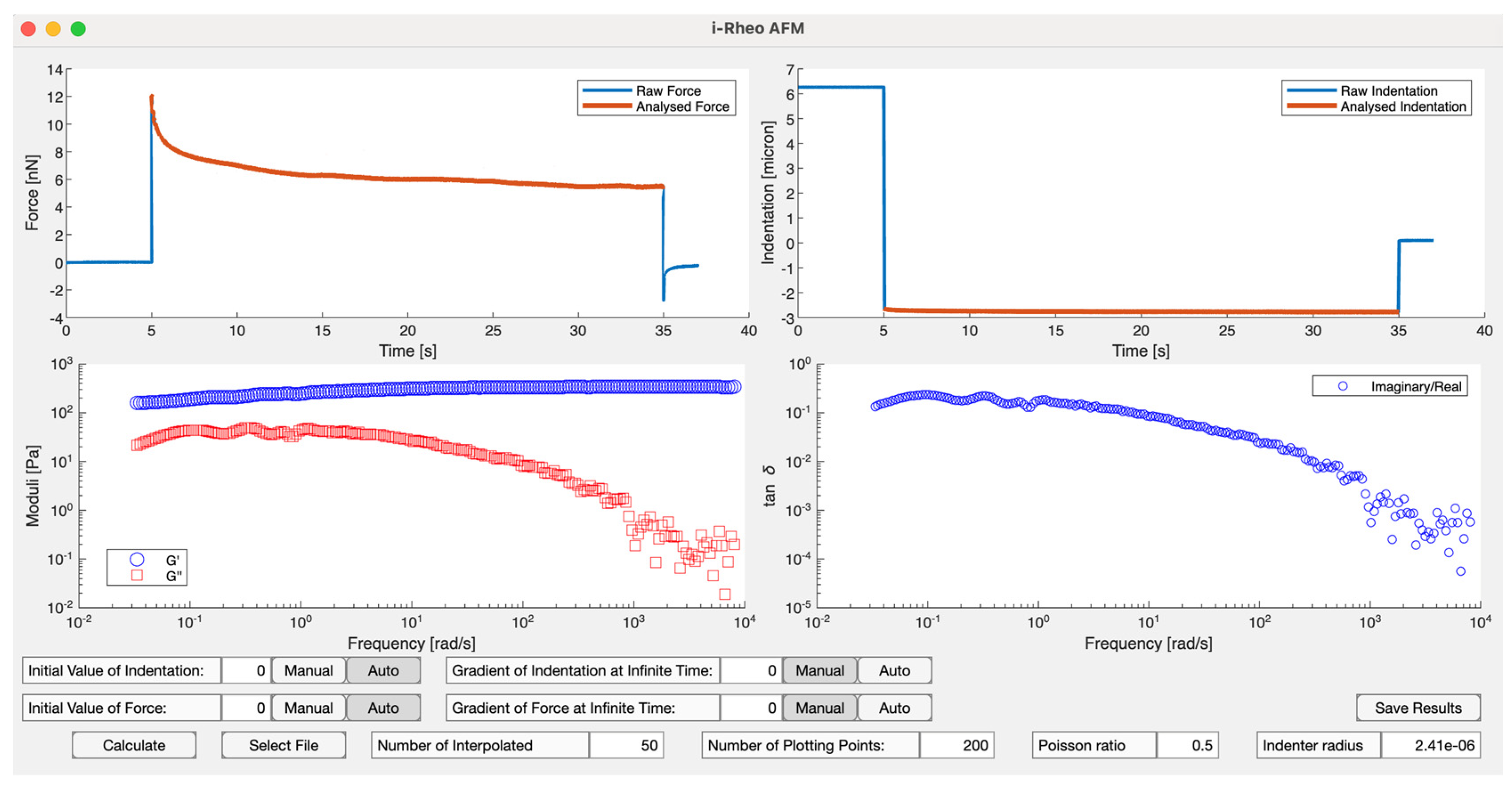
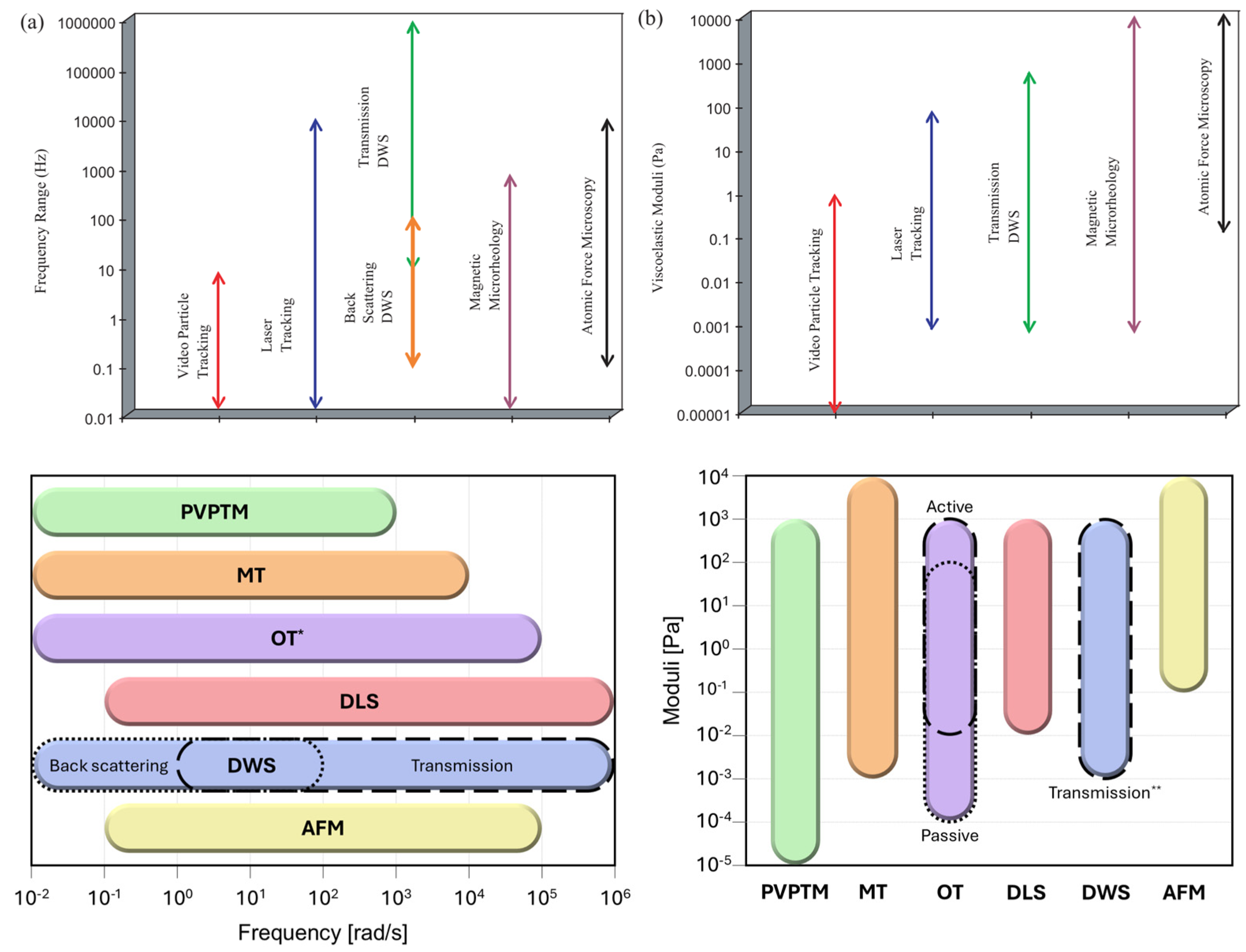
This paper presents an in-depth exploration of Particle Tracking Microrheology, discussing its principles, methodologies, and applications in modern scientific research. However, this review article cannot be exhaustive; therefore, we refer the reader to some of the most established review articles on the subject [5,6,7,8,9,10,11], as well as to more recent contributions [12,13,14,15]. Notably, when comparing earlier work with more recent studies (see Figure 1), one observes a substantial expansion in the sensitivity of most microrheology techniques—both in terms of accessible frequency ranges and the magnitudes of measurable viscoelastic moduli of complex materials. This improvement is primarily due to technological advancements in instrumentation since the initial development of these techniques. Figure 1 presents an up-to-date estimation of these ranges, as reported in recent publications.
Figure 1. Past (top (a,b), adapted with permission from IOP Publishing, Ltd., reference [5] published in 2005) and current (bottom) accessible ranges of frequencies and magnitudes of viscoelastic moduli obtained from different microrheology methods including passive video particle tracking microrheology (PVPTM) [16,17,18,19,20], magnetic tweezers (MT) [21,22], optical tweezers (OT) [23,24,25,26,27,28], dynamic light scattering (DLS) [29,30,31,32], diffusing wave spectroscopy (DWS) [33,34,35,36,37,38,39], and atomic force microscopy (AFM) [40,41,42,43,44]. * Active and passive microrheology with OT share the same frequency range. ** Experimental results from transmission DWS are more commonly reported compared to back scattering DWS. (Colour-coded in both the diagrams.)
A summary of the main advantages and limitations of each technique is provided in Table 1 for quick reference and comparison.
Table 1. Comparison of microrheology techniques (as in Figure 1): advantages and limitations.

2. Theoretical Background

2.1. Rheology in Simple Shear Flow

In linear rheology, shear deformation is the most relevant type of deformation as it effectively describes the laminar flow behaviour of fluids. Moreover, many materials exhibit weaker mechanical resistance under shear compared to other types of deformation, such as compressional or torsional stresses. This sensitivity to shear makes it particularly valuable in considerations of material performance, safety, and the design and operation of rheological instrumentation.
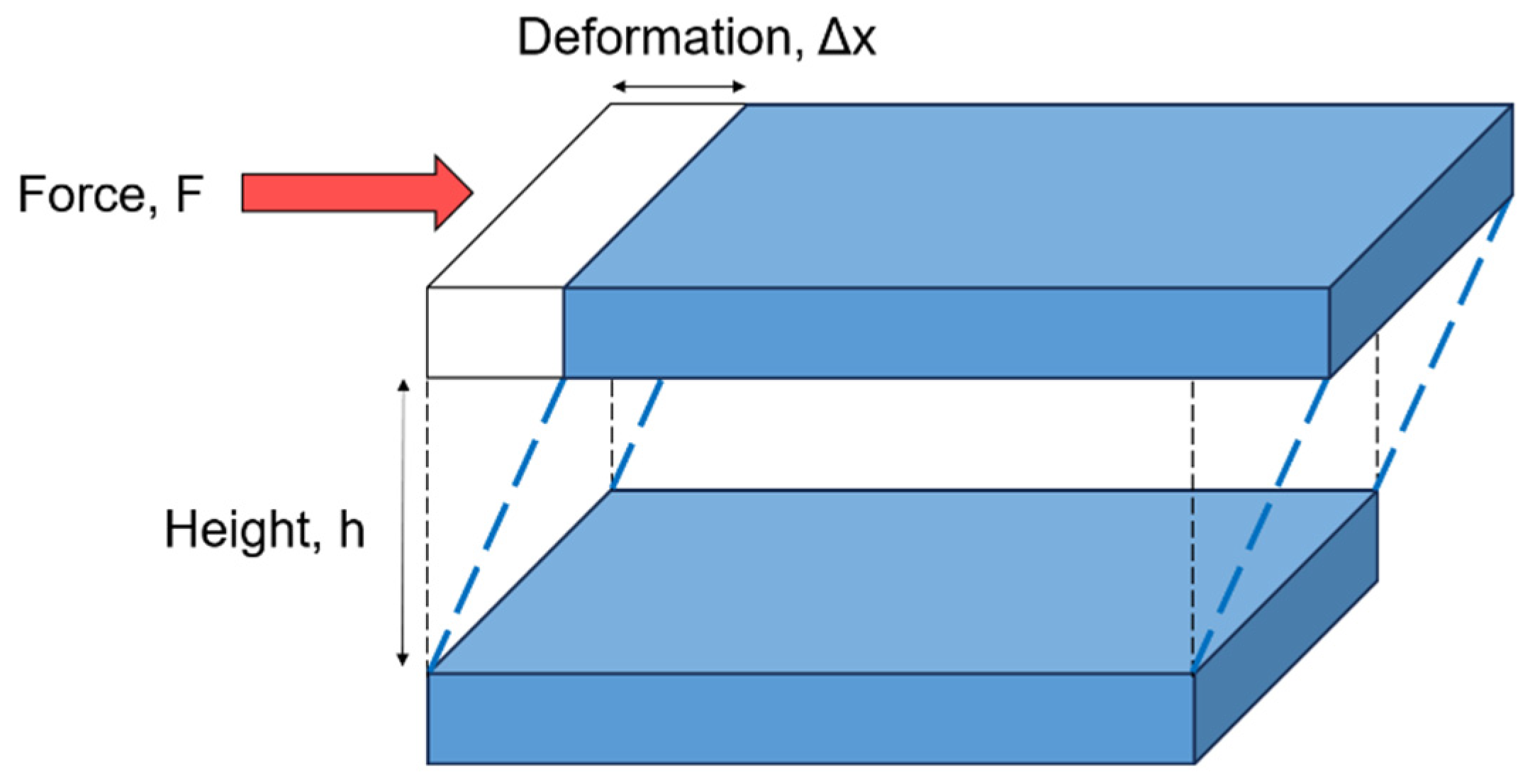
Shear deformation can be illustrated using the two-plate model, depicted in Figure 2. In this model, a material is placed between two parallel plates separated by a fixed distance. The flow of the material is induced by a shear stress σ , which is defined as the ratio of the applied tangential force F to the contact area A of the upper plate in contact with the material, assuming the lower plate remains stationary. Shear stress is expressed in Pascals (Pa) according to the International System of Units (SI). The resulting deformation is described by the shear strain γ , which is defined as the ratio of the relative displacement x to the separation height h of the two plates. This yields a dimensionless quantity. Similarly, shear flow can be characterized by the rate of deformation, referred to as the shear rate or strain rate, which is the time derivative of the shear strain γ ˙ = d γ / d t . The shear rate is expressed in the International System of Units (SI) as reciprocal seconds (s−1).
Figure 2. A schematic of the two-plate model for shear deformation.
All real materials exhibit mechanical properties that lie between two quasi-ideal extremes: (1) a perfectly elastic solid and (2) a purely viscous fluid. According to Hooke’s law, a perfectly elastic solid subjected to small deformations experiences a stress that is directly proportional to the strain, regardless of the strain rate. This behaviour reflects the material’s ability to store deformation energy and recover its original shape upon the removal of stress. In the context of shear deformation, the relationship for a perfectly elastic solid is expressed as:
σ t = G γ t
where G is the time-independent shear elastic modulus, analogous to the Young’s modulus E for shear deformation, with the unit of Pascal (Pa).
Conversely, for a purely viscous fluid, stress is directly proportional to the strain rate and independent of strain, as described by Newton’s law of viscosity:
σ t = η d γ t d t
where η   is the Newtonian viscosity of the fluid, a time-independent parameter with units of Pascal-seconds (Pa⋅s). In reality, both G and η can be considered time-independent constants only within a finite stress and strain range, which defines the material’s Linear Viscoelastic (LVE) regime. To fully capture the viscoelastic behaviour of real materials, more complex constitutive equations are necessary.
In simple shear, the constitutive equation for linear viscoelasticity is based on the principle that the effects of sequential changes in strain are additive, and it can be expressed as [45]:
σ t = t G t t γ ˙ t d t
where G t   is the time-dependent shear relaxation modulus of the material.
From Equation (3), it is an easy step to express the LVE properties of a generic material in terms of its shear complex modulus G * ω , whose real and imaginary parts describe the elastic and viscous nature of the material, respectively:
G * ω = G ω + i G ω
where ω is the angular frequency, i is the imaginary unit ( i 2 = 1   ), and G ω and G ω are the frequency-dependent storage (elastic) and loss (viscous) moduli of the material, respectively. The complex shear modulus can be defined as the ratio of the Fourier transform of the stress to that of strain, or equivalently as the Fourier transform of the time derivative of the shear relaxation modulus G t [45]:
G * ω = σ ^ ω γ ^ ω = F T d G t d t = i ω G ^ ω
An alternative way to describe the viscoelastic nature of a material is by means of its dynamic compliance J * ω , which, in the frequency domain, can be defined as the inverse of G * ω :
J * ω = γ ^ ω σ ^ ω = i ω J ^ ω
where J ^ ω is the Fourier transform of the time-dependent creep compliance J t , which has a unit of Pa−1 and is defined as:
J t = γ t σ 0
where σ 0 is the amplitude of a constant stress applied at time equal zero.
Conventionally, to measure G * ω of a generic material over a finite range of frequencies, an oscillatory stress σ ω , t = σ 0 sin ω t is applied, where σ 0 is its amplitude. The resulting oscillatory strain γ ω , t = γ 0 sin ω t φ ω is then measured; where γ 0 is the amplitude of the strain and φ ω is the phase shift between the stress and strain. In follows that the complex shear modulus can thus be further explicated as:
G * ω = σ 0 γ 0 ω cos φ ω + i σ 0 γ 0 ω sin φ ω
from which the expressions of G ω and G ω in Equation (4) are revealed. Interestingly, all materials experience a phase shift 0 φ ω π 2 when subjected to oscillating stress. Depending on the frequency range explored, these materials can exhibit asymptotic behaviours characteristic of either perfectly elastic solids or purely viscous fluids. Specifically, for frequencies where the phase shift φ ω approaches 0, the material behaves like an elastic solid; whereas, for frequencies where φ ω approaches π 2 , the material behaves like a Newtonian fluid [46].

2.2. Passive and Active Microrheology

Most microrheology techniques involve the suspension of micron- or nano-sized spherical particles, also known as probe or tracer particles, into the fluid under investigation. As previously mentioned, existing microrheology techniques are defined as either ‘passive’ or ‘active’, depending on whether the motion of these particles is caused by the thermal energy via random collisions with fluid molecules (i.e., Brownian motion) or induced by an external force. In either case, the viscoelastic properties of the suspending fluid are determined by solving the relationship between the driving force and the trajectory of the tracer particles, which are monitored over time. This approach was pioneered by Mason and Weitz [3], who established the field of microrheology by correlating the mean squared displacement (MSD) of diffusing particles to the complex shear modulus G * ω of the suspending fluid, as elucidated hereafter.

2.2.1. Passive Microrheology

The mean squared displacement (MSD), Δ r 2 τ r t 0 + τ r t 0 2 , of a particle is a function of its position and depends only on the lag time τ = t t 0 , where t 0 is a generic initial observation time. For a Newtonian fluid, where the viscosity η remains constant, the MSD is directly proportional to the lag time:
Δ r 2 τ = 2 d D τ
where d is the number of observed dimensions ( d = 3 for three-dimensional trajectories) and D is the diffusion coefficient, defined by the Stokes-Einstein relation:
D = k B T 6 π a η
where k B is the Boltzmann constant, T is the absolute temperature, and a is the radius of the particle. By combining Equations (9) and (10), the viscosity of the suspending fluid can easily be determined once the particles size is known:
Δ r 2 τ = d k B T 3 π a η τ
In the case of non-Newtonian fluids, the viscoelastic properties of a complex fluid have been linked to the MSD of a suspended particle by means of a generalized Langevin equation (GLE), which describes the thermally driven motion of the particle:
m a t = f R t t ζ t t v t d t
where m , v t , and a t are the mass, velocity, and acceleration of the particle, respectively. The term f R t describes random forces acting on the particle, due to both direct forces between particles and stochastic thermal forces. Furthermore, ζ t is a time-dependent memory function that represents the viscous damping force. By following the assumption made by Mason and Weitz [3] on ζ ~ s being proportional to the Laplace-transformed viscosity of the fluid η ~ s :
ζ ~ s = 6 π a η ~ s
Equation (12) can be solved for the materials’ shear complex modulus in terms of the MSD, giving the Generalized Stokes Einstein Relation (GSER):
G * ω = s   η ~ s | s = i ω = 1 6 π a 6 k B T i ω Δ r ^ 2 ω + m ω 2
where Δ r ^ 2 ω is the Fourier transform of the MSD. The second term in the brackets, representing an inertial effect, is commonly neglected, as it becomes significant only at very high frequencies, typically on the order of MHz for micron-sized particles. Levine and Lubensky [47] provided further theoretical insights into the validity of the generalized Stokes-Einstein relation, introducing a dimensionless, frequency-dependent term to assess the significance of fluid inertia:
β F ω = 4 a 2 ω 2 ρ F G ω π 2
where ρ F is the density of the fluid. Likewise, they also provided a term for the contribution of particle inertia:
β b ω = 2 a 2 ω 2 ρ b 9 G ω
where ρ b is the density of the tracer particle. The GSER is said to be valid for the frequency range where the inertial effects of both the fluid and the particle are negligible. This occurs when ω < ω * , where β F ω *   ~   β b ω *   ~   1 , translating to an upper frequency limit on the order of MHz. Furthermore, the contribution of the longitudinal compressional mode of the fluid must also be negligible to ensure that microrheology measurements have good agreement with bulk rheology [47].

2.2.2. Active Microrheology

Active microrheology methods apply stresses significantly larger than the thermal fluctuations within the fluid, enabling the characterization of stiffer materials and the observation of their nonlinear and nonequilibrium responses [48]. When a driving force F t is applied to the probe particles, the generalized Langevin equation provided in Equation (12) becomes:
m a t = f R t + F t 0 t ζ t t v t d t
As discussed in later sections, the force term F t varies depending on the method of application, and therefore, the analytical solution of Equation (17) will be tailored to the specific experimental procedure employed.

2.3. Image Analysis

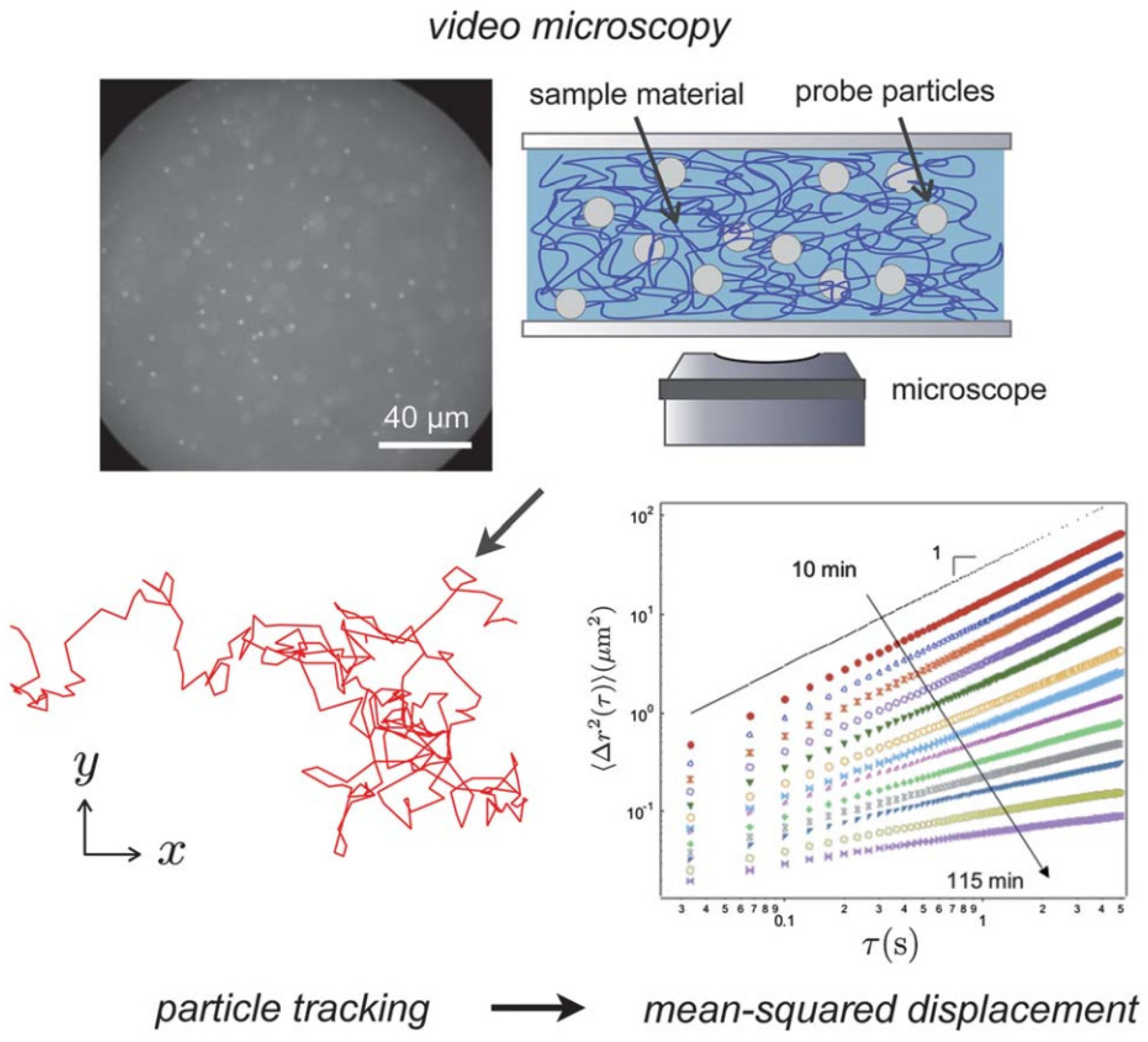
To track the motion of particles, two approaches are generally used. The first involves the direct monitoring of particles through video microscopy, while the other relies on the detection of light scattered from tracer particles, offering a more indirect approach.

2.3.1. Video Microscopy

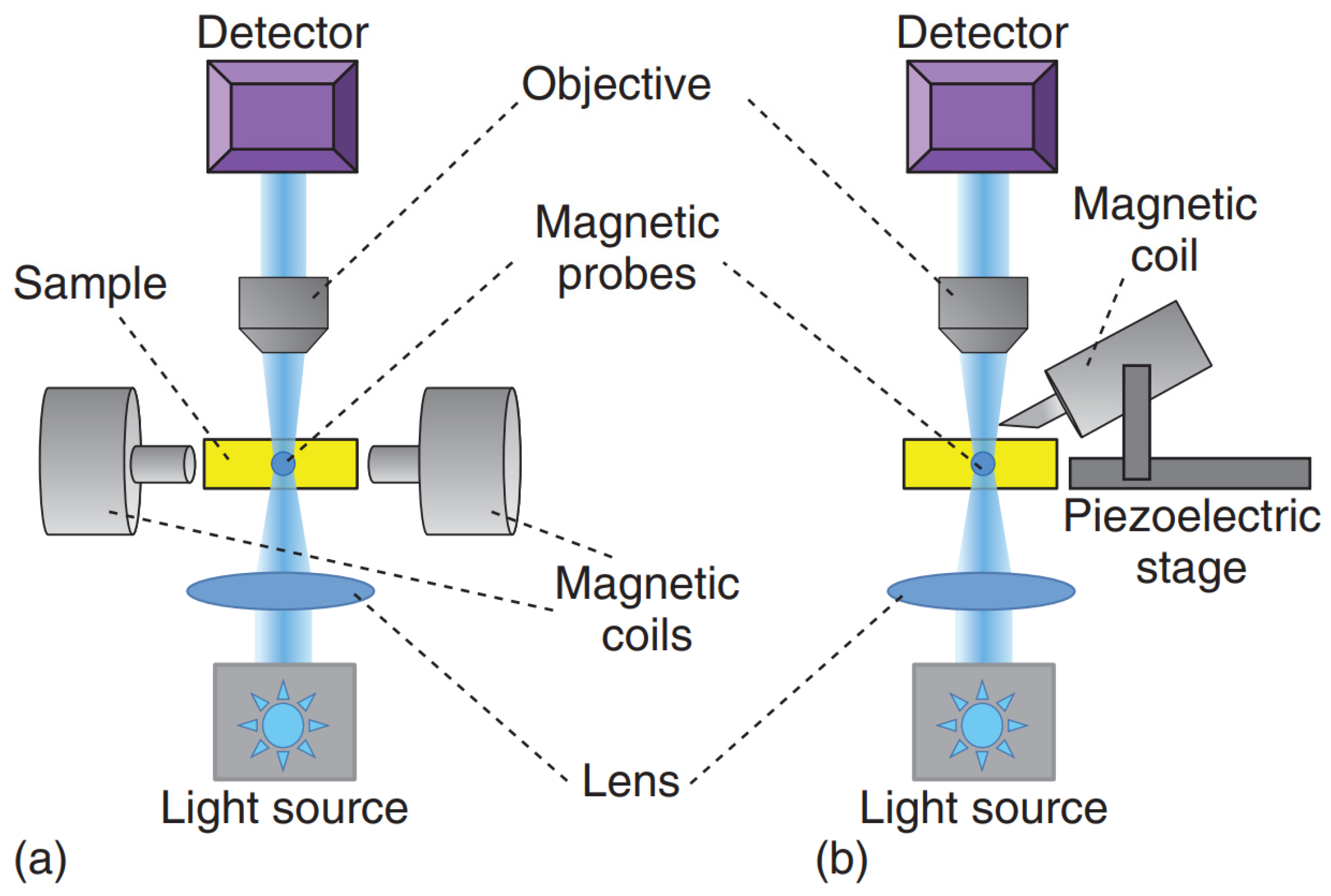
Some microrheology techniques such as passive video particle tracking, magnetic and optical tweezers rely on video microscopy to directly observe and record the motion of probe particles. Bright-field, fluorescence, and confocal microscopy can be used for capturing videos depending on the nature of the sample, size of tracer particles, and the required spatial resolution. The position of the particle versus time is then determined through image analysis. This can be performed using a number of open-access software that have been written in different programming languages [49].
Particle tracking was first demonstrated by Crocker and Grier [50], who developed an image processing algorithm using the programming language IDL (Interactive Data Language). This method is versatile, applicable to a wide range of colloidal systems, and supports both single-particle and multi-particle tracking. Their approach involves five key stages: (i) background and noise removal, (ii) particle localization, (iii) refinement of particle position estimates, (iv) noise discrimination, and (v) linking particle positions to form trajectories.
Background subtraction aids in correcting contrast variations that may arise due to uneven illumination of the sample, which in turn can affect the easy recognition of spheres. The background image can be modelled by a boxcar average over a region of 2 w + 1 , where w is an integer in pixels larger than a sphere’s apparent radius, but smaller than the interparticle separation distance:
A w x , y = 1 2 w + 1 2 i , j = w w A x + i , y + j
Meanwhile, noise that arises from digitization can be suppressed using a Gaussian revolution of pixel half width λ n = 1 :
A λ n x , y = i , j = w w A x + i , y + j exp i 2 + j 2 4 λ n 2 B
where B is a normalization factor equal to:
B = i = w w exp i 2 4 λ n 2 2
The ideal image is best estimated by obtaining the difference between A w x , y and A λ n x , y . Because both Equations (18) and (19) are taken as convolutions of the image A x , y over the same region 2 w + 1 , they can be computed in a single step through the equation:
K i , j = 1 K 0 1 B exp i 2 + j 2 4 λ n 2 1 2 w + 1 2
where K 0 is a normalization constant equal to [50]:
K 0 = 1 B i = w w exp i 2 2 λ n 2 2 B 2 w + 1 2
Particle locations are then taken as the local brightness maxima within the image. Initially, candidate locations for particle centroids are identified if a given pixel A x , y is brighter than any other pixel within a distance of w pixels. Furthermore, to reduce error, candidate pixels can be given an additional criterion of being within the top 30% of brightest pixels within the entire image. The identification process is facilitated through grayscale dilation, where a pixel is set to the maximum value within the area w . The pixel in the original image with the same value in the dilated image is then regarded as a candidate [50].
After identifying candidate locations at x , y , the actual centroids or the geometric centres x 0 , y 0 of the sphere can be calculated by determining the offset ϵ x , ϵ y between the two coordinates:
ϵ x ϵ y = 1 m 0 i 2 + j 2 w 2 i j A x + i , y + j
where m 0 is the total summation of the brightness within the sphere, given by:
m 0 = i 2 + j 2 w 2 A x + i , y + j
The exact centroid of the sphere is hence located at x 0 , y 0 = x 0 + ϵ x ,   y 0 + ϵ y [50]. Following this, the eccentricity e of the tracked objects can be calculated as an additional identifier to disregard non-spherical objects. These objects may be in the form of aggregated particles, impurities such as dust, and imperfections in the optical system. Perfectly circular particles have an eccentricity of e = 0 , whereas perfect lines would have an eccentricity of e = 1 [51].
Noise can further be discriminated by calculating the moment of brightness distribution given by Equation (24) replacing x , y with the coordinates of the centroid of the particle x 0 , y 0 . A second moment m 2 can also be obtained:
m 2 = 1 m 0 i 2 + j 2 w 2 i 2 + j 2 A x 0 + i , y 0 + j
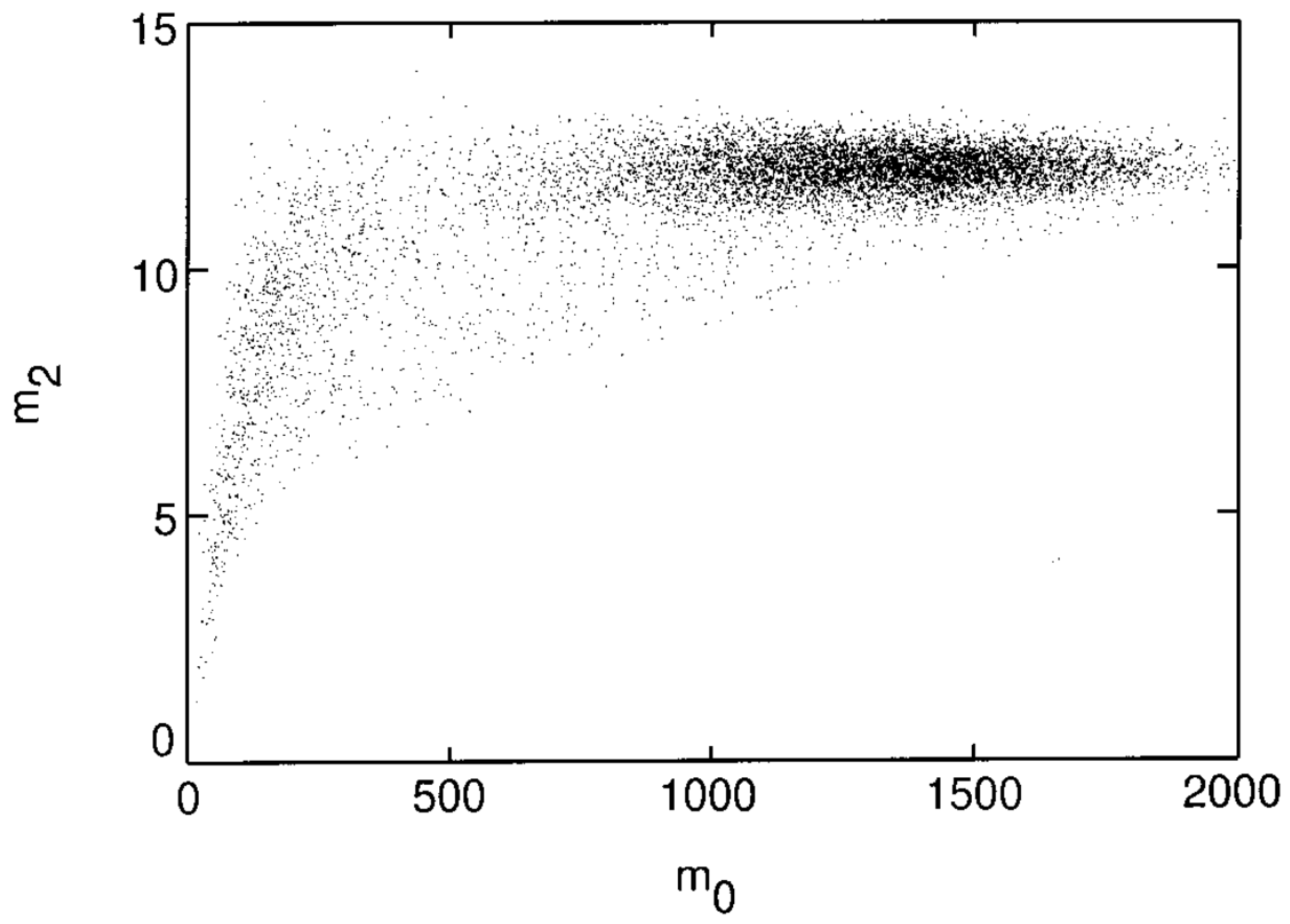
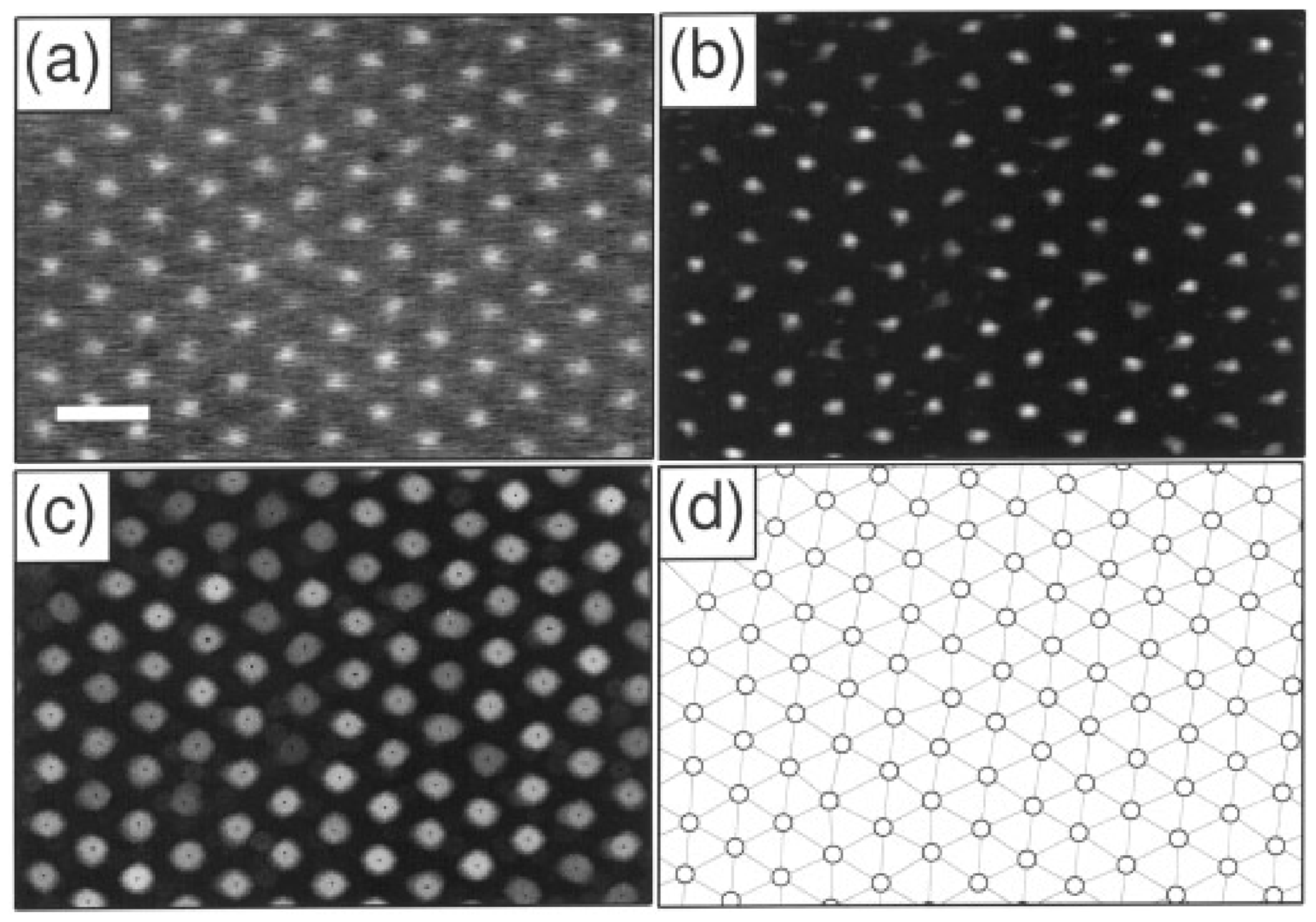
These moments help ascertain the size of the identified particles and can thus be used to determine their relative location from the focal plane. As seen in Figure 3, the colloidal spheres tend to distribute into broad clusters within the ( m 0 , m 2 ) plane, which also arises from the variation in distances in the direction normal to the imaging plane. Notably, a decrease in m 2 at low m 0 reflects the fact that dimmer objects are often out of focus, smaller, or represent noise, and therefore exhibit lower spatial variance in intensity. Statistical cluster analysis is used to filter out the noise and to distinguish different particle types from one another, which is useful in the case of bi- and poly-disperse suspensions. The first four stages of the tracking implementation can be seen in Figure 4 [50].
Figure 3. Clustering of colloidal images in the ( m 0 , m 2 ) plane. 15,000 images of σ = 0.325 µm radius spheres. Reprinted with permission from Ref. [50]. Copyright 1996 Elsevier.
Figure 4. Stages of image processing. (a) Detail of a video micrograph of the (111) plane of a face-centred cubic colloidal crystal. The radius of each polystyrene sulfonate sphere is σ = 0.163 µm. The scale bar indicates 2 µm. (b) The same image filtered with the convolution kernel in Equation (21). (c) Grey-scale dilation of the image in (b). Dark spots represent the initial estimates for particle locations based on the neighbourhood maximum algorithm. (d) Final particle location estimates. The lines connecting sites constitute the network of nearest-neighbour bonds computed as a Delaunay triangulation (Preparata, F. P., and Shamos, M. I., “Computational Geometry.” Springer-Verlag, New York, 1985.) Such a network is useful as the basis of many measurements of local ordering. Reprinted with permission from Ref. [50]. Copyright 1996 Elsevier.
Finally, particle trajectories are formed by linking the locations of particles in successive image frames. For monodisperse colloidal suspensions where particles are indistinguishable, the likelihood that one particle corresponds to another in a previous frame is estimated through their proximity in the two images. Hence, to find the most likely set of particle locations that evolved from those in a previous image, a probability distribution function describing Brownian motion is considered. For a single particle with a diffusion coefficient D , the probability that it will diffuse at a distance δ in time τ is:
P δ τ = 1 4 π D τ exp δ 2 4 D τ
When the system contains N identical, non-interacting particles such as in the case of multiple particle tracking, the probability distribution becomes the product of N single particle distributions:
P δ i τ = 1 4 π D τ N exp i = 1 N δ i 2 4 D τ
Using Equation (27) to link particle trajectories means finding bonds between two successive frames that maximizes the probability P δ i τ , or minimizes the squared distances travelled by all particles i = 1 N δ i 2 . To limit the number of possible combinations that are considered and lessen the computational demand for the process, a length L can be assigned such that bonds longer than this length will be disregarded. This is similar to truncating the probability distribution P δ τ at δ = L [50]. This simplification can be performed as long as the interparticle separation distance d is much larger than the distance travelled by particles, else particles that are close to one another may swap positions once trajectories are linked. To circumvent this, the particle concentration in a sample can be lowered [51]. Ideally, L should also be chosen such that δ < L < d 2 [50].
Particles may appear or disappear from the field of view of the microscope in between frames, causing some bonds to be missing when linking particle trajectories. To ensure that Equation (27) can be evaluated despite this, the missing bonds are assigned the length δ i = L . The affected particles are also labelled as missing at certain time steps, and their last known locations are stored in case a particle would appear close to it to resume the trajectory linking [50]. A memory number n mem can be assigned, indicating the maximum number of consecutive frames a particle can be missing before it is treated as a new particle upon reappearing. Similarly, objects that only appear for a single frame and may contribute to erroneous data can be eliminated by specifying n min , or the minimum number of frames a particle must be present in the video [51].
To address challenges in particle tracking in three dimensions (3D), optical techniques have advanced significantly, particularly through stereoscopic imaging and structured illumination. Structured illumination using a digital projector, as demonstrated by Dam et al. [52], offers dynamic 3D visualization, allowing for real-time adjustments to illumination patterns for enhanced tracking and manipulation. This approach employs colour-coded illumination and stereo cameras to map particles’ 3D coordinates accurately while maintaining flexibility in illumination configurations. Alternatively, stereoscopic microscopy, as described by Bowman et al. [53] and Lee et al. [54], utilizes dual-view imaging systems to resolve axial and lateral positions of particles with high precision. Their technique employs Fourier-domain optical filters to generate stereoscopic pairs, achieving axial resolutions down to 3 nm at 340 Hz frame rates. Both methods represent crucial innovations in overcoming defocusing and ghosting issues in conventional tracking, providing precise, scalable solutions for studying microscale dynamics in complex systems.

2.3.2. Light Scattering or Non-Direct Tracking

Particle locations can also be tracked without the use of video microscopy. Microrheology techniques such as Dynamic Light Scattering (DLS) and Diffusing Wave Spectroscopy (DWS) rely instead on the scattering and detection of light that hits the sample under investigation.
Light interacts with matter through four major ways, namely absorption, emission, transmission, and reflection. During the transmission of light through a medium, light scattering may also occur [55]. During this process, the scattering centre receives incident light, which has a given frequency and propagation vector. The scattering centre then emits light with a changed propagation vector, either with or without the accompaniment of a changed frequency. The first case where the scattered light only has a change in the propagation vector is referred to as elastic scattering. Meanwhile, the second case with a change in both propagation vector and frequency is called inelastic scattering [56].
Elastic scattering may take place through two possible mechanisms. First, the incident light may only simply have a change in direction, similar to the reflection of light from a smooth or rough surface. Second, and more relevant to present context, the incident photons may be absorbed by a molecular process then reemitted without noticeable changes in frequency. This process is referred to as Rayleigh or Mie scattering depending on the scattering centre involved [56].
Named after Lord Rayleigh, who first theorized the process to explain the colour of the sky, Rayleigh scattering occurs when the particles scattering the incident light are much smaller than the wavelength of the incident light. Typically, the diameter of the scattering centre should be less than λ 10 , where λ is the wavelength of the incident light [57]. The oscillating electric field of the incident light wave excites bound electrons within the atom or molecule, causing them to oscillate at the same frequency as the incident wave and release electromagnetic radiation [58]. For unpolarized incident light with intensity I 0 , the Rayleigh scattered intensity I s is given by:
I s = I o 8 π 4 N a 6 λ 4 r 2 m 2 1 m 2 + 1 1 + cos 2 θ
where N is the number of particles, a is the radius of the particles, θ is the scattering angle, r is the distance of the observation point from the scattering centre, and m is the ratio of the refractive indices of the scattering centre to the medium (i.e., m = n 1 n 0 ). The λ 4 dependence explains why shorter wavelengths of light scatter more compared to longer wavelengths [56].
Meanwhile, Mie scattering is named after Mie, who developed a general theory for the scattering of electromagnetic waves by spherical particles of any size. Mie scattering is particularly observed when the scattering centres are larger than those involved in Rayleigh scattering (i.e., diameters greater than λ 10 ). Mie scattering has two features that become more pronounced when the scattering centres become much larger than λ . First, with increasing particle size, more light scatters in the forward direction compared to the back direction. Second, the scattering of lower wavelengths becomes less dominant until all wavelengths are scattered equally [58].
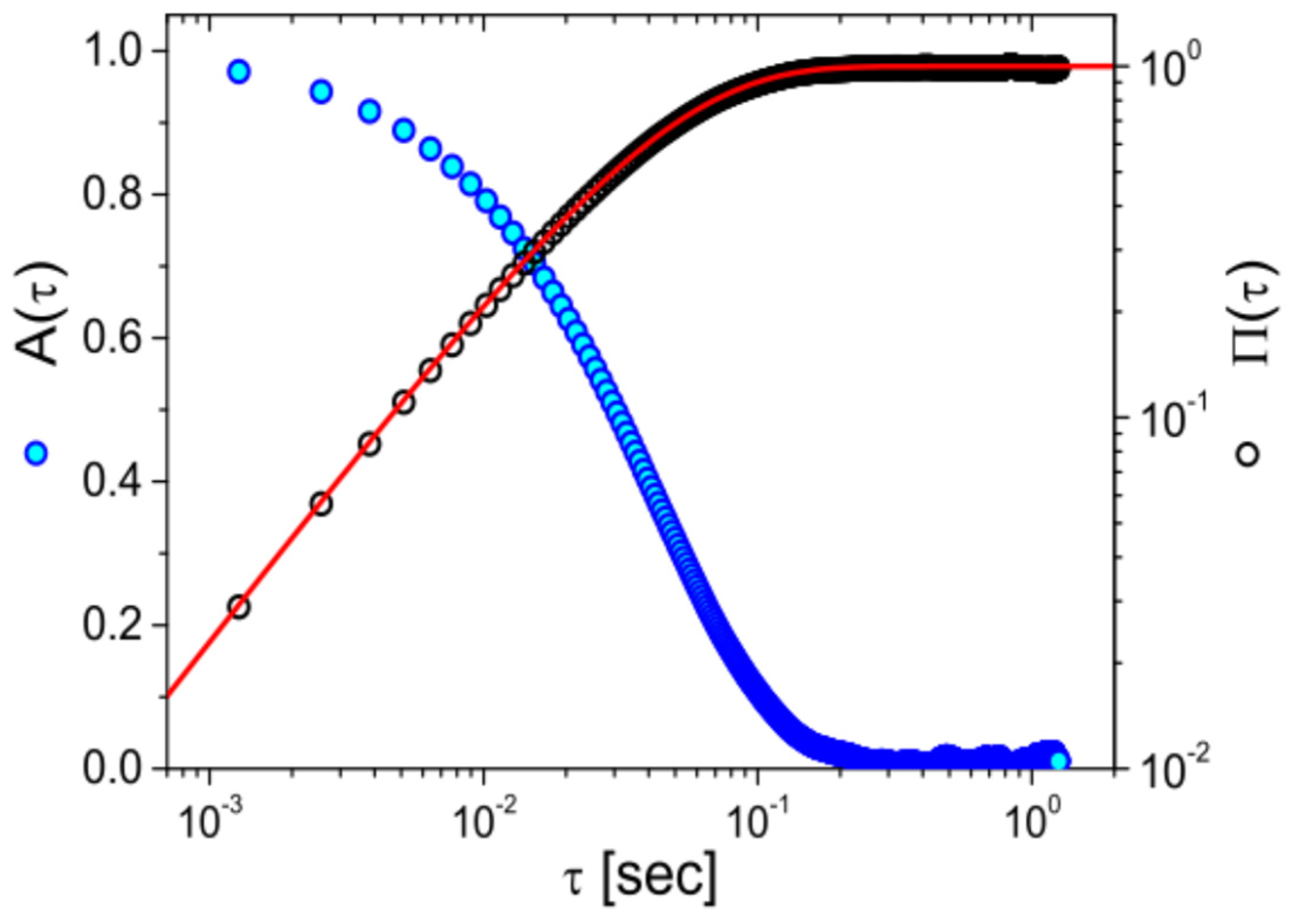
Once light is scattered by atoms or molecules in a sample, the emitted light waves will undergo either destructive or constructive interference. A detectable signal is only formed in the latter case, since out-of-phase waves in the former cancel each other out. The signal intensity is recorded by a detector [59] and often processed in real time to construct a correlation function between the intensity fluctuations of the scattered light and the dynamics of the scattering centres, as explained below.

4. Conclusions

Microrheology has transformed our understanding of the mechanical properties of complex systems at the microscale. By integrating active and passive techniques, it has enabled researchers to study the viscoelastic behaviour of biological systems and soft materials with unprecedented precision, offering insights that were previously unattainable.
In biology, microrheology has revealed how cells interact with and adapt to their mechanical environment. Techniques such as particle tracking and optical tweezers have uncovered the influence of mechanical properties on key processes like migration, division, and mechanotransduction. These findings are particularly significant in understanding diseases like cancer, where the mechanical properties of cells and their microenvironment are closely tied to progression and metastasis.
In materials science, microrheology has been instrumental in studying the dynamics of polymers, gels, and protein solutions. By capturing spatial heterogeneities and mapping phase transitions, it has contributed to the design of materials with tailored mechanical properties, fostering advancements in both scientific research and industrial applications.
Future work in PTM may focus on investigating a wider range of biological structures, potentially in vivo, as well as characterizing novel materials to optimize their functionality. Though challenges remain, particularly in interpreting data from heterogeneous systems, the continued development of microrheological techniques promises to address these complexities. By bridging biology and materials science, microrheology has established itself as a critical tool for modern research, offering a deeper understanding of the mechanical behaviour of complex systems and driving innovation across disciplines.

Author Contributions

M.T. is responsible for the ideation of this review article. The initial draft of the work was written by A.J.F. and then revised by A.J.F., G.M.G., A.R. and M.T. All authors have read and agreed to the published version of the manuscript.

Funding

A.R. thanks the National Science Centre Poland (project number: 2025/09/X/ST8/00104).

Data Availability Statement

No new data were created or analyzed in this study. Data sharing is not applicable to this article.

Acknowledgments

A.J.F. thanks the James Watt School of Engineering, University of Glasgow for their financial support.

Conflicts of Interest

The authors declare no conflicts of interest.

References

  1. Einstein, A. Investigations on the Theory of the Brownian Movement; Fürth, R., Ed.; Dover Publications, Inc.: New York, NY, USA, 1956; ISBN 978-0-486-60304-9. [Google Scholar]
  2. Perrin, J. Atoms; Constable: London, UK, 1916. [Google Scholar]
  3. Mason, T.G.; Weitz, D.A. Optical Measurements of Frequency-Dependent Linear Viscoelastic Moduli of Complex Fluids. Phys. Rev. Lett. 1995, 74, 1250–1253. [Google Scholar] [CrossRef] [PubMed]
  4. Tassieri, M. Microrheology with Optical Tweezers: Peaks & Troughs. Curr. Opin. Colloid Interface Sci. 2019, 43, 39–51. [Google Scholar] [CrossRef]
  5. Waigh, T.A. Microrheology of Complex Fluids. Rep. Prog. Phys. 2005, 68, 685–742. [Google Scholar] [CrossRef]
  6. MacKintosh, F.C.; Schmidt, C.F. Microrheology. Curr. Opin. Colloid Interface Sci. 1999, 4, 300–307. [Google Scholar] [CrossRef]
  7. Squires, T.M.; Mason, T.G. Fluid Mechanics of Microrheology. Annu. Rev. Fluid Mech. 2010, 42, 413–438. [Google Scholar] [CrossRef]
  8. Cicuta, P.; Donald, A.M. Microrheology: A Review of the Method and Applications. Soft Matter 2007, 3, 1449–1455. [Google Scholar] [CrossRef]
  9. Weihs, D.; Mason, T.G.; Teitell, M.A. Bio-Microrheology: A Frontier in Microrheology. Biophys. J. 2006, 91, 4296–4305. [Google Scholar] [CrossRef] [PubMed]
  10. Schultz, K.M.; Furst, E.M. Microrheology of Biomaterial Hydrogelators. Soft Matter 2012, 8, 6198–6205. [Google Scholar] [CrossRef]
  11. Wirtz, D. Particle-Tracking Microrheology of Living Cells: Principles and Applications. Annu. Rev. Biophys. 2009, 38, 301–326. [Google Scholar] [CrossRef] [PubMed]
  12. Mao, Y.; Nielsen, P.; Ali, J. Passive and Active Microrheology for Biomedical Systems. Front. Bioeng. Biotechnol. 2022, 10, 916354. [Google Scholar] [CrossRef] [PubMed]
  13. Meleties, M.; Martineau, R.L.; Gupta, M.K.; Montclare, J.K. Particle-Based Microrheology as a Tool for Characterizing Protein-Based Materials. ACS Biomater. Sci. Eng. 2022, 8, 2747–2763. [Google Scholar] [CrossRef]
  14. Leartprapun, N.; Adie, S.G. Recent Advances in Optical Elastography and Emerging Opportunities in the Basic Sciences and Translational Medicine [Invited]. Biomed. Opt. Express 2023, 14, 208–248. [Google Scholar] [CrossRef]
  15. John, J.; Panahi, A.; Pu, D.; Natale, G. Progress in Rheology of Active Colloidal Systems. Curr. Opin. Colloid Interface Sci. 2025, 75, 101886. [Google Scholar] [CrossRef]
  16. Jones, D.P.; Hanna, W.; Cramer, G.M.; Celli, J.P. In Situ Measurement of ECM Rheology and Microheterogeneity in Embedded and Overlaid 3D Pancreatic Tumor Stroma Co-Cultures via Passive Particle Tracking. J. Innov. Opt. Health Sci. 2017, 10, 1742003. [Google Scholar] [CrossRef]
  17. Mellnik, J.W.R.; Lysy, M.; Vasquez, P.A.; Pillai, N.S.; Hill, D.B.; Cribb, J.; McKinley, S.A.; Forest, M.G. Maximum Likelihood Estimation for Single Particle, Passive Microrheology Data with Drift. J. Rheol. 2016, 60, 379–392. [Google Scholar] [CrossRef]
  18. Hafner, J.; Grijalva, D.; Ludwig-Husemann, A.; Bertels, S.; Bensinger, L.; Raic, A.; Gebauer, J.; Oelschlaeger, C.; Bastmeyer, M.; Bieback, K.; et al. Monitoring Matrix Remodeling in the Cellular Microenvironment Using Microrheology for Complex Cellular Systems. Acta Biomater. 2020, 111, 254–266. [Google Scholar] [CrossRef] [PubMed]
  19. Bayles, A.V.; Squires, T.M.; Helgeson, M.E. Probe Microrheology without Particle Tracking by Differential Dynamic Microscopy. Rheol. Acta 2017, 56, 863–869. [Google Scholar] [CrossRef]
  20. Lewis, C.M.; Heise, C.T.; Harasimiuk, N.; Tovey, J.; Lu, J.R.; Waigh, T.A. The Viscoelasticity of High Concentration Monoclonal Antibodies Using Particle Tracking Microrheology. APL Bioeng. 2024, 8, 026105. [Google Scholar] [CrossRef]
  21. Evans, R.M.L.; Tassieri, M.; Auhl, D.; Waigh, T.A. Direct Conversion of Rheological Compliance Measurements into Storage and Loss Moduli. Phys. Rev. E 2009, 80, 012501. [Google Scholar] [CrossRef]
  22. Fabry, B.; Maksym, G.N.; Butler, J.P.; Glogauer, M.; Navajas, D.; Fredberg, J.J. Scaling the Microrheology of Living Cells. Phys. Rev. Lett. 2001, 87, 148102. [Google Scholar] [CrossRef] [PubMed]
  23. Neckernuss, T.; Mertens, L.K.; Martin, I.; Paust, T.; Beil, M.; Marti, O. Active Microrheology with Optical Tweezers: A Versatile Tool to Investigate Anisotropies in Intermediate Filament Networks. J. Phys. Appl. Phys. 2015, 49, 045401. [Google Scholar] [CrossRef]
  24. Geonzon, L.C.; Kobayashi, M.; Tassieri, M.; Bacabac, R.G.; Adachi, Y.; Matsukawa, S. Microrheological Properties and Local Structure of ι-Carrageenan Gels Probed by Using Optical Tweezers. Food Hydrocoll. 2023, 137, 108325. [Google Scholar] [CrossRef]
  25. Preece, D.; Warren, R.; Evans, R.M.L.; Gibson, G.M.; Padgett, M.J.; Cooper, J.M.; Tassieri, M. Optical Tweezers: Wideband Microrheology. J. Opt. 2011, 13, 044022. [Google Scholar] [CrossRef]
  26. Wei, M.-T.; Latinovic, O.; Hough, L.A.; Chen, Y.-Q.; Ou-Yang, H.D.; Chiou, A. Optical-Tweezers-Based Microrheology of Soft Materials and Living Cells. In Handbook of Photonics for Biomedical Engineering; Springer: Dordrecht, The Netherlands, 2017; pp. 731–753. ISBN 978-94-007-5052-4. [Google Scholar]
  27. Yanagishima, T.; Frenkel, D.; Kotar, J.; Eiser, E. Real-Time Monitoring of Complex Moduli from Micro-Rheology. J. Phys. Condens. Matter 2011, 23, 194118. [Google Scholar] [CrossRef]
  28. Mendonca, T.; Urban, R.; Lucken, K.; Coney, G.; Kad, N.M.; Tassieri, M.; Wright, A.J.; Booth, D.G. The Mitotic Chromosome Periphery Modulates Chromosome Mechanics. Nat. Commun. 2025, 16, 6399. [Google Scholar] [CrossRef]
  29. Krajina, B.A.; Tropini, C.; Zhu, A.; DiGiacomo, P.; Sonnenburg, J.L.; Heilshorn, S.C.; Spakowitz, A.J. Dynamic Light Scattering Microrheology Reveals Multiscale Viscoelasticity of Polymer Gels and Precious Biological Materials. ACS Cent. Sci. 2017, 3, 1294–1303. [Google Scholar] [CrossRef]
  30. Amin, S.; Rega, C.A.; Jankevics, H. Detection of Viscoelasticity in Aggregating Dilute Protein Solutions through Dynamic Light Scattering-Based Optical Microrheology. Rheol. Acta 2012, 51, 329–342. [Google Scholar] [CrossRef]
  31. Ghosh, R.; Bentil, S.A.; Juárez, J.J. Dynamic Light Scattering Microrheology of Phase-Separated Poly(Vinyl) Alcohol–Phytagel Blends. Polymers 2024, 16, 2875. [Google Scholar] [CrossRef] [PubMed]
  32. Ozaki, H.; Indei, T.; Koga, T.; Narita, T. Physical Gelation of Supramolecular Hydrogels Cross-Linked by Metal-Ligand Interactions: Dynamic Light Scattering and Microrheological Studies. Polymer 2017, 128, 363–372. [Google Scholar] [CrossRef]
  33. Huh, J.Y.; Furst, E.M. Colloid Dynamics in Semiflexible Polymer Solutions. Phys. Rev. E 2006, 74, 031802. [Google Scholar] [CrossRef]
  34. Palmer, A.; Mason, T.G.; Xu, J.; Kuo, S.C.; Wirtz, D. Diffusing Wave Spectroscopy Microrheology of Actin Filament Networks. Biophys. J. 1999, 76, 1063–1071. [Google Scholar] [CrossRef]
  35. Oelschlaeger, C.; Schopferer, M.; Scheffold, F.; Willenbacher, N. Linear-to-Branched Micelles Transition: A Rheometry and Diffusing Wave Spectroscopy (DWS) Study. Langmuir 2009, 25, 716–723. [Google Scholar] [CrossRef] [PubMed]
  36. Chen, Y.-Q.; Chou, P.; Cheng, C.-Y.; Chiang, C.-C.; Wei, M.-T.; Chuang, C.-T.; Chen, Y.-L.S.; Chiou, A. Microrheology of Human Synovial Fluid of Arthritis Patients Studied by Diffusing Wave Spectroscopy. J. Biophotonics 2012, 5, 777–784. [Google Scholar] [CrossRef]
  37. Dasgupta, B.R.; Tee, S.-Y.; Crocker, J.C.; Frisken, B.J.; Weitz, D.A. Microrheology of Polyethylene Oxide Using Diffusing Wave Spectroscopy and Single Scattering. Phys. Rev. E 2002, 65, 051505. [Google Scholar] [CrossRef]
  38. Li, Q.; Dennis, K.A.; Lee, Y.-F.; Furst, E.M. Two-Point Microrheology and Diffusing Wave Spectroscopy. J. Rheol. 2023, 67, 1107–1118. [Google Scholar] [CrossRef]
  39. Narita, T.; Mayumi, K.; Ducouret, G.; Hébraud, P. Viscoelastic Properties of Poly(Vinyl Alcohol) Hydrogels Having Permanent and Transient Cross-Links Studied by Microrheology, Classical Rheometry, and Dynamic Light Scattering. Macromolecules 2013, 46, 4174–4183. [Google Scholar] [CrossRef]
  40. Chim, Y.H.; Mason, L.M.; Rath, N.; Olson, M.F.; Tassieri, M.; Yin, H. A One-Step Procedure to Probe the Viscoelastic Properties of Cells by Atomic Force Microscopy. Sci. Rep. 2018, 8, 14462. [Google Scholar] [CrossRef] [PubMed]
  41. Rother, J.; Nöding, H.; Mey, I.; Janshoff, A. Atomic Force Microscopy-Based Microrheology Reveals Significant Differences in the Viscoelastic Response between Malign and Benign Cell Lines. Open Biol. 2014, 4, 140046. [Google Scholar] [CrossRef]
  42. Alcaraz, J.; Buscemi, L.; Grabulosa, M.; Trepat, X.; Fabry, B.; Farré, R.; Navajas, D. Microrheology of Human Lung Epithelial Cells Measured by Atomic Force Microscopy. Biophys. J. 2003, 84, 2071–2079. [Google Scholar] [CrossRef]
  43. Igarashi, T.; Fujinami, S.; Nishi, T.; Asao, N.; Nakajima, K. Nanorheological Mapping of Rubbers by Atomic Force Microscopy. Macromolecules 2013, 46, 1916–1922. [Google Scholar] [CrossRef]
  44. Roca-Cusachs, P.; Almendros, I.; Sunyer, R.; Gavara, N.; Farré, R.; Navajas, D. Rheology of Passive and Adhesion-Activated Neutrophils Probed by Atomic Force Microscopy. Biophys. J. 2006, 91, 3508–3518. [Google Scholar] [CrossRef] [PubMed]
  45. Ferry, J.D. Viscoelastic Properties of Polymers, 3rd ed.; John Wiley & Sons: New York, NY, USA, 1980; ISBN 978-0-471-04894-7. [Google Scholar]
  46. Tassieri, M. Introduction to Linear Rheology. In Microrheology with Optical Tweezers: Principles and Applications; Tassieri, M., Ed.; Pan Stanford Publishing: Singapore, 2016; pp. 137–145. ISBN 978-981-4669-18-4. [Google Scholar]
  47. Levine, A.J.; Lubensky, T.C. One- and Two-Particle Microrheology. Phys. Rev. Lett. 2000, 85, 1774–1777. [Google Scholar] [CrossRef] [PubMed]
  48. Rizzi, L.G.; Tassieri, M. Microrheology of Biological Specimens. In Encyclopedia of Analytical Chemistry; John Wiley & Sons, Ltd.: New York, NY, USA, 2018; pp. 1–24. ISBN 978-0-470-02731-8. [Google Scholar]
  49. Crocker, J.C.; Weeks, E.R. Particle Tracking Using IDL. Available online: https://physics.emory.edu/faculty/weeks/idl/index.html (accessed on 3 September 2024).
  50. Crocker, J.C.; Grier, D.G. Methods of Digital Video Microscopy for Colloidal Studies. J. Colloid Interface Sci. 1996, 179, 298–310. [Google Scholar] [CrossRef]
  51. McGlynn, J.A.; Wu, N.; Schultz, K.M. Multiple Particle Tracking Microrheological Characterization: Fundamentals, Emerging Techniques and Applications. J. Appl. Phys. 2020, 127, 201101. [Google Scholar] [CrossRef]
  52. Dam, J.S.; Perch-Nielsen, I.R.; Palima, D.; Glückstad, J. Three-Dimensional Imaging in Three-Dimensional Optical Multi-Beam Micromanipulation. Opt. Express 2008, 16, 7244–7250. [Google Scholar] [CrossRef] [PubMed]
  53. Bowman, R.; Gibson, G.; Padgett, M. Particle Tracking Stereomicroscopy in Optical Tweezers: Control of Trap Shape. Opt. Express 2010, 18, 11785–11790. [Google Scholar] [CrossRef] [PubMed][Green Version]
  54. Lee, M.P.; Gibson, G.M.; Phillips, D.; Padgett, M.J.; Tassieri, M. Dynamic Stereo Microscopy for Studying Particle Sedimentation. Opt. Express 2014, 22, 4671–4677. [Google Scholar] [CrossRef]
  55. Saleem, A.; Afzal, I.; Javed, Y.; Jamil, Y. Fundamentals of Light–Matter Interaction. In Modern Luminescence from Fundamental Concepts to Materials and Applications; Sharma, S.K., da Silva, C.J., Garcia, D.J., Shrivastava, N., Eds.; Woodhead Publishing Series in Electronic and Optical Materials; Woodhead Publishing: Cambridge, UK, 2023; pp. 185–218. ISBN 978-0-323-89954-3. [Google Scholar]
  56. Potter, K.S.; Simmons, J.H. Optical Properties of Insulators—Fundamentals. In Optical Materials, 2nd ed.; Potter, K.S., Simmons, J.H., Eds.; Elsevier: Amsterdam, The Netherlands, 2021; pp. 101–171. ISBN 978-0-12-818642-8. [Google Scholar]
  57. Moore, J.; Cerasoli, E. Particle Light Scattering Methods and Applications. In Encyclopedia of Spectroscopy and Spectrometry, 2nd ed.; Lindon, J.C., Ed.; Academic Press: London, UK, 2010; pp. 2077–2088. ISBN 978-0-12-374413-5. [Google Scholar]
  58. Lahiri, A. Diffraction and Scattering. In Basic Optics; Lahiri, A., Ed.; Elsevier: Amsterdam, The Netherlands, 2016; pp. 385–537. ISBN 978-0-12-805357-7. [Google Scholar]
  59. Stetefeld, J.; McKenna, S.A.; Patel, T.R. Dynamic Light Scattering: A Practical Guide and Applications in Biomedical Sciences. Biophys. Rev. 2016, 8, 409–427. [Google Scholar] [CrossRef]
  60. Crocker, J.C.; Hoffman, B.D. Multiple-Particle Tracking and Two-Point Microrheology in Cells. Methods Cell Biol. 2007, 83, 141–178. [Google Scholar] [CrossRef]
  61. Nishizawa, K.; Bremerich, M.; Ayade, H.; Schmidt, C.F.; Ariga, T.; Mizuno, D. Feedback-Tracking Microrheology in Living Cells. Sci. Adv. 2017, 3, e1700318. [Google Scholar] [CrossRef]
  62. Weihs, D.; Mason, T.G.; Teitell, M.A. Effects of Cytoskeletal Disruption on Transport, Structure, and Rheology within Mammalian Cells. Phys. Fluids 2007, 19, 103102. [Google Scholar] [CrossRef] [PubMed]
  63. Hardiman, W.; Clark, M.; Friel, C.; Huett, A.; Pérez-Cota, F.; Setchfield, K.; Wright, A.J.; Tassieri, M. Living Cells as a Biological Analog of Optical Tweezers—A Non-Invasive Microrheology Approach. Acta Biomater. 2023, 166, 317–325. [Google Scholar] [CrossRef] [PubMed]
  64. Moschakis, T. Microrheology and Particle Tracking in Food Gels and Emulsions. Curr. Opin. Colloid Interface Sci. 2013, 18, 311–323. [Google Scholar] [CrossRef]
  65. Josephson, L.L.; Furst, E.M.; Galush, W.J. Particle Tracking Microrheology of Protein Solutions. J. Rheol. 2016, 60, 531–540. [Google Scholar] [CrossRef]
  66. Xia, Q.; Xiao, H.; Pan, Y.; Wang, L. Microrheology, Advances in Methods and Insights. Adv. Colloid Interface Sci. 2018, 257, 71–85. [Google Scholar] [CrossRef] [PubMed]
  67. Zia, R.N. Active and Passive Microrheology: Theory and Simulation. Annu. Rev. Fluid Mech. 2018, 50, 371–405. [Google Scholar] [CrossRef]
  68. Gal, N.; Lechtman-Goldstein, D.; Weihs, D. Particle Tracking in Living Cells: A Review of the Mean Square Displacement Method and Beyond. Rheol. Acta 2013, 52, 425–443. [Google Scholar] [CrossRef]
  69. Tseng, Y.; Kole, T.P.; Wirtz, D. Micromechanical Mapping of Live Cells by Multiple-Particle-Tracking Microrheology. Biophys. J. 2002, 83, 3162–3176. [Google Scholar] [CrossRef] [PubMed]
  70. Heilbronn, A. Eine Neue Methode Zur Bestimmung Der Viskosität Lebender Protoplasten; Jahrbücher Für Wissenschaftliche Botanik: Leipzig, Germany, 1922. [Google Scholar]
  71. Crick, F.H.C.; Hughes, A.F.W. The Physical Properties of Cytoplasm: A Study by Means of the Magnetic Particle Method Part I. Experimental. Exp. Cell Res. 1950, 1, 37–80. [Google Scholar] [CrossRef]
  72. Waigh, T.A. Advances in the Microrheology of Complex Fluids. Rep. Prog. Phys. 2016, 79, 074601. [Google Scholar] [CrossRef]
  73. Kollmannsberger, P.; Fabry, B. Linear and Nonlinear Rheology of Living Cells. Annu. Rev. Mater. Res. 2011, 41, 75–97. [Google Scholar] [CrossRef]
  74. Waigh, T.A. The Physics of Living Processes: A Mesoscopic Approach; John Wiley & Sons, Ltd.: Chichester, UK, 2014. [Google Scholar]
  75. Ziemann, F.; Rädler, J.; Sackmann, E. Local Measurements of Viscoelastic Moduli of Entangled Actin Networks Using an Oscillating Magnetic Bead Micro-Rheometer. Biophys. J. 1994, 66, 2210–2216. [Google Scholar] [CrossRef] [PubMed]
  76. Taormina, M.J.; Hay, E.A.; Parthasarathy, R. Passive and Active Microrheology of the Intestinal Fluid of the Larval Zebrafish. Biophys. J. 2017, 113, 957–965. [Google Scholar] [CrossRef] [PubMed]
  77. Yang, Y.; Bai, M.; Klug, W.S.; Levine, A.J.; Valentine, M.T. Microrheology of Highly Crosslinked Microtubule Networks Is Dominated by Force-Induced Crosslinker Unbinding. Soft Matter 2012, 9, 383–393. [Google Scholar] [CrossRef]
  78. Zakharov, M.N.; Aprelev, A.; Turner, M.S.; Ferrone, F.A. The Microrheology of Sickle Hemoglobin Gels. Biophys. J. 2010, 99, 1149–1156. [Google Scholar] [CrossRef] [PubMed][Green Version]
  79. Whyte, C.S.; Chernysh, I.N.; Domingues, M.M.; Connell, S.; Weisel, J.W.; Ariens, R.A.S.; Mutch, N.J. Polyphosphate Delays Fibrin Polymerisation and Alters the Mechanical Properties of the Fibrin Network. Thromb. Haemost. 2016, 116, 897–903. [Google Scholar] [CrossRef]
  80. Hoffman, B.D.; Massiera, G.; Van Citters, K.M.; Crocker, J.C. The Consensus Mechanics of Cultured Mammalian Cells. Proc. Natl. Acad. Sci. 2006, 103, 10259–10264. [Google Scholar] [CrossRef]
  81. Ashkin, A. Acceleration and Trapping of Particles by Radiation Pressure. Phys. Rev. Lett. 1970, 24, 156–159. [Google Scholar] [CrossRef]
  82. Neuman, K.C.; Block, S.M. Optical Trapping. Rev. Sci. Instrum. 2004, 75, 2787–2809. [Google Scholar] [CrossRef]
  83. Tassieri, M.; Giudice, F.D.; Robertson, E.J.; Jain, N.; Fries, B.; Wilson, R.; Glidle, A.; Greco, F.; Netti, P.A.; Maffettone, P.L.; et al. Microrheology with Optical Tweezers: Measuring the Relative Viscosity of Solutions ‘at a Glance’. Sci. Rep. 2015, 5, 8831. [Google Scholar] [CrossRef]
  84. Tassieri, M.; Evans, R.M.L.; Warren, R.L.; Bailey, N.J.; Cooper, J.M. Microrheology with Optical Tweezers: Data Analysis. New J. Phys. 2012, 14, 115032. [Google Scholar] [CrossRef]
  85. Gittes, F.; Schmidt, C.F. Thermal Noise Limitations on Micromechanical Experiments. Eur. Biophys. J. 1998, 27, 75–81. [Google Scholar] [CrossRef]
  86. Berg-Sørensen, K.; Flyvbjerg, H. Power Spectrum Analysis for Optical Tweezers. Rev. Sci. Instrum. 2004, 75, 594–612. [Google Scholar] [CrossRef]
  87. Tassieri, M.; Gibson, G.M.; Evans, R.M.L.; Yao, A.M.; Warren, R.; Padgett, M.J.; Cooper, J.M. Measuring Storage and Loss Moduli Using Optical Tweezers: Broadband Microrheology. Phys. Rev. E 2010, 81, 026308. [Google Scholar] [CrossRef]
  88. Smith, M.G.; Gibson, G.M.; Link, A.; Raghavan, A.; Clarke, A.; Franke, T.; Tassieri, M. The Role of Elastic Instability on the Self-Assembly of Particle Chains in Simple Shear Flow. Physics of Fluids 2023, 35, 122017. [Google Scholar] [CrossRef]
  89. Pinchiaroli, J.; Saldanha, R.; Patteson, A.E.; Robertson-Anderson, R.M.; Gurmessa, B.J. Scale-Dependent Interactions Enable Emergent Microrheological Stress Response of Actin–Vimentin Composites. Soft Matter 2024, 20, 9007–9021. [Google Scholar] [CrossRef] [PubMed]
  90. Alshareedah, I.; Moosa, M.M.; Pham, M.; Potoyan, D.A.; Banerjee, P.R. Programmable Viscoelasticity in Protein-RNA Condensates with Disordered Sticker-Spacer Polypeptides. Nat. Commun. 2021, 12, 6620. [Google Scholar] [CrossRef]
  91. Alshareedah, I.; Borcherds, W.M.; Cohen, S.R.; Singh, A.; Posey, A.E.; Farag, M.; Bremer, A.; Strout, G.W.; Tomares, D.T.; Pappu, R.V.; et al. Sequence-Specific Interactions Determine Viscoelasticity and Ageing Dynamics of Protein Condensates. Nat. Phys. 2024, 20, 1482–1491. [Google Scholar] [CrossRef]
  92. Robertson-Anderson, R.M. Optical Tweezers Microrheology: From the Basics to Advanced Techniques and Applications. ACS Macro Lett. 2018, 7, 968–975. [Google Scholar] [CrossRef] [PubMed]
  93. Chapman, C.D.; Lee, K.; Henze, D.; Smith, D.E.; Robertson-Anderson, R.M. Onset of Non-Continuum Effects in Microrheology of Entangled Polymer Solutions. Macromolecules 2014, 47, 1181–1186. [Google Scholar] [CrossRef]
  94. Berne, B.J.; Pecora, R. Dynamic Light Scattering: With Applications to Chemistry, Biology, and Physics; Dover Publications Inc.: Mineola, NY, USA, 2000. [Google Scholar]
  95. Del Giudice, F.; Tassieri, M.; Oelschlaeger, C.; Shen, A.Q. When Microrheology, Bulk Rheology, and Microfluidics Meet: Broadband Rheology of Hydroxyethyl Cellulose Water Solutions. Macromolecules 2017, 50, 2951–2963. [Google Scholar] [CrossRef]
  96. Teixeira, A.V.; Geissler, E.; Licinio, P. Dynamic Scaling of Polymer Gels Comprising Nanoparticles. J. Phys. Chem. B 2007, 111, 340–344. [Google Scholar] [CrossRef] [PubMed][Green Version]
  97. Pine, D.J.; Weitz, D.A.; Chaikin, P.M.; Herbolzheimer, E. Diffusing Wave Spectroscopy. Phys. Rev. Lett. 1988, 60, 1134–1137. [Google Scholar] [CrossRef]
  98. Weitz, D.; Pine, D. Diffusing-Wave Spectroscopy. In Dynamic Light Scattering: The Method and Some Applications; Brown, W., Ed.; Monographs on the Physics and Chemistry of Material; Oxford University Press: Oxford, UK, 1993; Volume 49, pp. 652–720. [Google Scholar]
  99. Viasnoff, V.; Lequeux, F.; Pine, D.J. Multispeckle Diffusing-Wave Spectroscopy: A Tool to Study Slow Relaxation and Time-Dependent Dynamics. Rev. Sci. Instrum. 2002, 73, 2336–2344. [Google Scholar] [CrossRef]
  100. Oelschlaeger, C.; Cota Pinto Coelho, M.; Willenbacher, N. Chain Flexibility and Dynamics of Polysaccharide Hyaluronan in Entangled Solutions: A High Frequency Rheology and Diffusing Wave Spectroscopy Study. Biomacromolecules 2013, 14, 3689–3696. [Google Scholar] [CrossRef] [PubMed]
  101. Cho, D.H.; Aguayo, S.; Cartagena-Rivera, A.X. Atomic Force Microscopy-Mediated Mechanobiological Profiling of Complex Human Tissues. Biomaterials 2023, 303, 122389. [Google Scholar] [CrossRef] [PubMed]
  102. Mendonca, T.; Lis-Slimak, K.; Matheson, A.B.; Smith, M.G.; Anane-Adjei, A.B.; Ashworth, J.C.; Cavanagh, R.; Paterson, L.; Dalgarno, P.A.; Alexander, C.; et al. OptoRheo: Simultaneous in Situ Micro-Mechanical Sensing and Imaging of Live 3D Biological Systems. Commun. Biol. 2023, 6, 463. [Google Scholar] [CrossRef]
  103. Walker, M.; Pringle, E.W.; Ciccone, G.; Oliver-Cervelló, L.; Tassieri, M.; Gourdon, D.; Cantini, M. Mind the Viscous Modulus: The Mechanotransductive Response to the Viscous Nature of Isoelastic Matrices Regulates Stem Cell Chondrogenesis. Adv. Healthc. Mater. 2024, 13, 2302571. [Google Scholar] [CrossRef] [PubMed]
  104. Tassieri, M.; Ramírez, J.; Karayiannis, N.C.; Sukumaran, S.K.; Masubuchi, Y. I-Rheo GT: Transforming from Time to Frequency Domain without Artifacts. Macromolecules 2018, 51, 5055–5068. [Google Scholar] [CrossRef]
  105. Tassieri, M.; Laurati, M.; Curtis, D.J.; Auhl, D.W.; Coppola, S.; Scalfati, A.; Hawkins, K.; Williams, P.R.; Cooper, J.M. I-Rheo: Measuring the Materials’ Linear Viscoelastic Properties “in a Step”! J. Rheol. 2016, 60, 649–660. [Google Scholar] [CrossRef]
  106. Tripathy, S.; Berger, E.J. Measuring Viscoelasticity of Soft Samples Using Atomic Force Microscopy. J. Biomech. Eng. 2009, 131, 094507. [Google Scholar] [CrossRef] [PubMed]
  107. Haidar, Y.; Tassieri, M. I-Rheo-AFM; University of Glasgow: Glasgow, UK, 2024. [Google Scholar] [CrossRef]
  108. Guadayol, Ò.; Mendonca, T.; Segura-Noguera, M.; Wright, A.J.; Tassieri, M.; Humphries, S. Microrheology Reveals Microscale Viscosity Gradients in Planktonic Systems. Proc. Natl. Acad. Sci. USA 2021, 118, e2011389118. [Google Scholar] [CrossRef] [PubMed]
  109. Matheson, A.B.; Paterson, L.; Wright, A.J.; Mendonca, T.; Tassieri, M.; Dalgarno, P.A. Optical Tweezers with Integrated Multiplane Microscopy (OpTIMuM): A New Tool for 3D Microrheology. Sci. Rep. 2021, 11, 5614. [Google Scholar] [CrossRef] [PubMed]
  110. Ramírez, J.; Gibson, G.M.; Tassieri, M. Optical Halo: A Proof of Concept for a New Broadband Microrheology Tool. Micromachines 2024, 15, 889. [Google Scholar] [CrossRef] [PubMed]
Disclaimer/Publisher’s Note: The statements, opinions and data contained in all publications are solely those of the individual author(s) and contributor(s) and not of MDPI and/or the editor(s). MDPI and/or the editor(s) disclaim responsibility for any injury to people or property resulting from any ideas, methods, instructions or products referred to in the content.

Article Metrics

Citations

Article Access Statistics

Multiple requests from the same IP address are counted as one view.